PART 2: They Found a Tiny Spaniel With Seven Broken Bones—But the Worst Truth Was Still Waiting to Be Discovered
PART 2
For several seconds, nobody moved.
I kept staring through the glass.
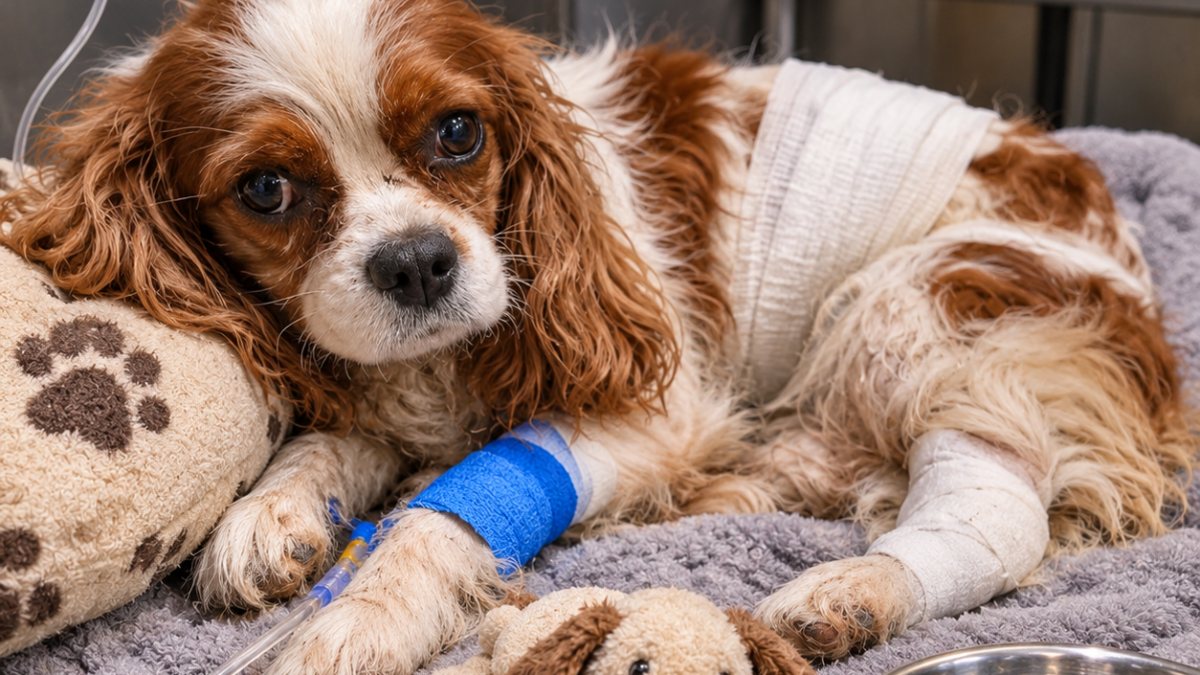
The little spaniel looked impossibly small beneath the warming blanket.
Seven broken bones.
I had been around injured animals for years.
I had seen dogs hit by cars.
Animals caught in fences.
Dogs injured in fights.
Falls.
Accidents.
Terrible things happened.
But accidents had patterns.
This did not.
“How certain are you?” I asked.
Dr. Carter folded his arms.
“Certain enough that I’m documenting everything.”
“For authorities?”
“For whoever needs it.”
Adam stood near the door.
He had been unusually quiet.
“What are his chances?”
Dr. Carter looked toward the dog.
“That depends on tonight.”
My stomach tightened.
“Meaning?”
“He’s dangerously dehydrated. His body condition is terrible. We need to stabilize him before we even think about repairing fractures.”
“Can he die?”
Dr. Carter looked at me.
“Yes.”
I hated him for answering honestly.
I also needed him to.
We inserted an IV.
Pain medication.
Fluids.
Warmth.
Careful monitoring.
The spaniel slept most of the night.
I didn’t.
Every hour, I found a reason to walk past his room.
At midnight, his breathing was stable.
At one, still stable.
At two fifteen, a machine alarm sounded.
I ran.
The nurse was already there.
“What happened?”
“His heart rate changed.”
Dr. Carter appeared seconds later.
For the next several minutes, everyone worked.
I stood outside because there was nothing useful I could do.
That helplessness was unbearable.
The little dog had survived God knew how long before we found him.
I couldn’t accept the possibility that he might die now.
Not after reaching safety.
Twenty minutes later, Dr. Carter came out.
“He’s stable.”
I released a breath I hadn’t realized I was holding.
“Can I see him?”
“Give us a minute.”
When I finally entered, the spaniel opened his eyes.
Barely.
I sat beside his kennel.
“You scared us.”
His eyelids drooped.
“I don’t know what happened to you.”
I rested my hand outside the bars.
“I don’t know who did it.”
His eyes shifted toward my fingers.
“But you made it here.”
He fell asleep again.
“And if you keep fighting, I promise we’ll do the rest.”
I had no right to make that promise.
I made it anyway.
By morning, the entire clinic knew about him.
Nobody had given him a name.
The paperwork simply said:
**Male spaniel. Found abandoned.**
That felt wrong.
One of the nurses, Mia, carried in medication.
“We need to call him something.”
Adam said, “Lucky.”
I shook my head.
“No.”
“Why?”
“Too obvious.”
Mia looked at the dog.
“What about Teddy?”
I glanced at his tangled ears.
Under the dirt and wounds, he did look almost like an old stuffed animal.
“Teddy.”
One ear moved.
Adam smiled.
“Well, apparently he voted.”
That was how he became Teddy.
For the first three days, Teddy barely interacted with us.
He ate only when nobody stood close.
When we changed his bedding, he watched every hand.
When someone entered too quickly, he flattened himself against the rear of the kennel.
He never tried to bite.
That somehow made it harder.
Dogs with enough confidence to growl are still telling you what they need.
Teddy seemed to believe resistance was pointless.
He expected whatever happened next to happen.
On the fourth morning, I entered carrying a small bowl of food.
Teddy was awake.
“Breakfast.”
His nose moved.
I placed the bowl near him.
He looked at the food.
Then at me.
I stepped away.
He waited.
I turned my back.
Only then did I hear him eat.
Fast.
Too fast.
I turned slightly.
Teddy froze.
I faced away again.
He resumed.
The same thing happened at lunch.
And dinner.
“He thinks someone will take it,” Mia said.
I knew.
The realization sat heavily inside me.
How many meals do you have to lose before you become afraid to eat in front of people?
How many hands have to hurt you before every hand becomes a threat?
On day five, Teddy allowed me to touch his ear.
Only the tip.
I was changing a bandage.
He tensed.
I stopped.
“Okay.”
His eyes remained on mine.
I waited.
Then tried again.
My fingers brushed the long fur near his ear.
Teddy flinched.
But he stayed.
“Good boy.”
The phrase came out automatically.
Teddy blinked.
I froze.
Something in his face changed.
Not much.
But enough.
I repeated it.
“Good boy.”
His eyes softened.
That was the first time I wondered whether someone had once loved him.
Before everything went wrong.
Maybe he knew those words.
Maybe somewhere in his memory they belonged to another life.
A week after rescue, we faced the first major decision.
Teddy needed surgery.
Several fractures could heal with careful management.
Others could not.
His rear leg worried Dr. Carter most.
“If we don’t stabilize it,” he explained, “he may never use it properly.”
“What about the pelvis?”
“We manage that conservatively for now.”
“Can he walk again?”
Dr. Carter looked at the images.
“I think so.”
Think.
I hated words like that.
Maybe.
Possibly.
Chance.
They are the vocabulary of hope when nobody wants to lie.
“When?”
“Months.”
I looked through the window.
Teddy was asleep.
“Then we start.”
The surgery lasted almost four hours.
I spent every minute pacing.
Adam finally pushed a coffee into my hands.
“You’re wearing a path into the floor.”
“I’m fine.”
“You’ve said that thirteen times.”
“Stop counting.”
“You told the dog we’d do the rest.”
I stared at him.
“So?”
“So now you think personally keeping him alive is part of your job description.”
“It is.”
“No. It’s Dr. Carter’s job.”
I glared at him.
“You know what I mean.”
He did.
When Dr. Carter finally came through the doors, I stood before he spoke.
“He made it.”
My knees nearly gave out.
“Everything went well?”
“As well as we could hope.”
I looked past him.
“Can I see him?”
“He’ll be sleeping for a while.”
“That wasn’t my question.”
Dr. Carter almost smiled.
“Five minutes.”
Teddy looked even smaller after surgery.
Bandages.
IV line.
Monitoring equipment.
I sat beside him.
“You look terrible.”
His eyes remained closed.
“But apparently you’re difficult to kill.”
One paw twitched.
“I’m choosing to interpret that as agreement.”
The next two weeks were ugly.
Recovery is not inspirational while it is happening.
It is exhausting.
Medication schedules.
Cleaning.
Pain.
Fear.
Small setbacks that feel enormous.
On one morning, Teddy refused food entirely.
My stomach dropped.
We checked him.
No new complication.
He simply felt awful.
I sat beside the kennel with cooked chicken.
“Come on.”
Nothing.
“You love this.”
No movement.
I placed one tiny piece near his nose.
He turned away.
I waited fifteen minutes.
Then twenty.
Finally Teddy sniffed.
He took it.
I nearly cried over one piece of chicken.
A week later, he took three supported steps.
His legs shook.
Mia held the sling beneath his body.
I crouched in front of him.
“Come on.”
Teddy looked at me.
“One more.”
His paw moved.
Then another.
The third step failed.
He sank into the support.
I caught his chest.
“That counts.”
Mia laughed.
“That absolutely counts.”
Dr. Carter watched from the doorway.
“Don’t push him.”
“We’re not.”
“You are emotionally pushing him.”
“That’s not medically measurable.”
“It is when you do it.”
Teddy slowly lifted his head.
Then something happened.
His tail moved.
Once.
Mia gasped.
“Did you see that?”
“I saw it.”
His tail moved again.
Not a real wag yet.
But enough.
The entire room fell apart.
A technician cried.
Mia cried.
Adam pretended he had something in his eye.
Dr. Carter left before anyone could look at him too closely.
Teddy seemed confused by the reaction.
I rubbed his chest.
“You have no idea what you just did.”
His tail moved a third time.
That night, I wrote the date on a piece of paper and taped it to my locker.
**FIRST TAIL WAG.**
I still have it.
While Teddy healed, another part of his story began unfolding.
We had reported the suspected abuse immediately.
Photographs were taken.
Every injury documented.
The place where he had been found was inspected.
No identification tag.
No microchip.
No obvious clue.
For almost two weeks, we had nothing.
Then a woman called.
Her name was Sarah.
“I think I recognize the dog you posted.”
My body went rigid.
“How?”
“I used to live near the industrial road behind that garage.”
“Did you see him before?”
A pause.
“Yes.”
“What was his name?”
Another pause.
“Charlie.”
I looked across the clinic.
Teddy was asleep.
Charlie.
I repeated it.
His ear moved.
My stomach dropped.
“You’re sure?”
“I’m almost sure.”
“Who owned him?”
Sarah hesitated.
“Can I come in?”
That afternoon, she arrived carrying her phone.
She looked nervous.
“I don’t want my name posted anywhere.”
“It won’t be.”
“I mean it.”
“I understand.”
She opened her photographs.
The first showed a backyard barbecue.
People.
A table.
A dog sitting near a chair.
My heart stopped.
Long ears.
Golden coat.
Healthy body.
Same white patch beneath the throat.
Teddy.
Or Charlie.
He looked different.
Not only healthier.
Happy.
His mouth was open.
Tail blurred in motion.
“What year is this?”
“Almost three years ago.”
“Who is the man beside him?”
Sarah swallowed.
“Eric Dalton.”
The name meant nothing to me.
“He owned the dog?”
“Yes.”
“What happened?”
She stared at the photograph.
“Eric lived with my former neighbor, Rachel.”
“Rachel owned Teddy?”
“I’m not sure. They got him together.”
“What were they like with him?”
Sarah’s answer took too long.
“Sarah.”
“At first? Fine.”
“And later?”
She looked at me.
“Eric changed.”
“How?”
“He had a temper.”
I waited.
“He yelled constantly. At Rachel. At the dog. At everybody.”
“Did you ever see him hurt Teddy?”
Her eyes dropped.
“Once.”
My hands clenched.
“What happened?”
“The dog grabbed food off an outdoor table.”
Sarah’s voice became quieter.
“Eric kicked him.”
I stared at her.
“Hard?”
“Yes.”
“Did you report it?”
“No.”
The word came quickly.
Then her face crumpled.
“I know what you’re thinking.”
“I’m not here to judge you.”
“I should have.”
“Yes.”
She blinked.
I hadn’t meant to say it.
But it was true.
Sarah nodded.
“I should have.”
“What happened after that?”
“Rachel moved out maybe eight months ago.”
“And Teddy?”
“He stayed with Eric.”
“Why?”
“I don’t know.”
“Did you continue seeing him?”
“Sometimes.”
“What condition was he in?”
“Thinner.”
My chest tightened.
“Anything else?”
“He stopped coming to the fence.”
“Meaning?”
“He used to run over when I walked past.”
“And later?”
“He hid.”
I glanced toward Teddy.
The little dog who flinched whenever hands approached.
“When did Eric move?”
“About two weeks before you found the dog.”
The room went silent.
“He moved?”
“Yes.”
“Where?”
“I don’t know.”
“And the dog?”
“I thought someone had taken him.”
I thought of the abandoned garage.
The wet cardboard.
Seven fractures.
“Do you have anything else?”
Sarah scrolled.
“There’s this.”
A short video.
Teddy was in the yard.
Healthy.
Chasing a ball.
A man’s voice called from behind the camera.
“Charlie!”
The dog spun and ran toward him.
I watched twice.
Then I walked into Teddy’s room.
He was awake.
I crouched.
“Charlie?”
His entire body changed.
His head lifted sharply.
Ears forward.
I felt sick.
“Charlie?”
He looked toward the door.
Not at me.
The door.
As though someone might appear.
I stopped saying the name.
Teddy slowly lowered his head.
Sarah stood behind me.
“Oh God.”
I turned.
She was crying.
“That’s him.”
“Yes.”
“I should have done something.”
I looked at Teddy.
“Then do something now.”
Sarah gave a full statement.
She provided photographs.
Dates.
The old address.
Names.
Other neighbors were contacted.
One remembered hearing repeated shouting.
Another remembered Teddy limping months earlier.
One man had seen Eric putting belongings into a truck.
Another had security cameras facing the street.
That camera became important.
Very important.
The footage was grainy.
No audio.
But the date was clear.
11:43 p.m.
A pickup truck entered the industrial road.
It stopped near the abandoned garage.
A man got out.
He opened the passenger-side rear door.
He lifted something.
A dog.
Small.
The dog did not stand.
The man carried him behind the building.
Eight minutes later, he returned alone.
The truck drove away.
Adam watched beside me.
“Can you identify him?”
“Not from that.”
The license plate was partly visible.
Authorities could do more than we could.
And they did.
Three days later, I received a call.
The truck was registered to Eric Dalton.
I sat in silence.
Teddy was asleep beside my desk.
For the first time since finding him, I knew exactly who had abandoned him.
But abandonment was only part of the question.
Who broke his bones?
We still had to prove that.
When investigators located Eric, his explanation was immediate.
Teddy had been injured in an accident.
“What accident?” I asked when the officer later summarized the interview.
Eric claimed the dog had fallen from a staircase.
I laughed once.
Not because it was funny.
“What?”
The officer continued.
“Then he said the dog had been hit by a bicycle several months earlier.”
“Both?”
“That’s what he says.”
“What about the old fractures?”
“He says the dog was clumsy.”
I stared at the officer.
“Clumsy.”
“Yes.”
Dr. Carter’s medical report mattered enormously.
Seven fractures.
Different healing stages.
Patterns inconsistent with one event.
Soft-tissue injuries.
Chronic malnutrition.
Untreated pain.
Eric insisted he loved the dog.
That sentence made me angrier than any denial.
Love.
People use that word as though saying it erases behavior.
“I loved him.”
“I lost my temper.”
“I didn’t mean it.”
“It wasn’t that bad.”
“He was difficult.”
“He destroyed things.”
“He had accidents in the house.”
Every excuse circles the same idea.
The victim caused the harm.
Teddy could not answer.
So the evidence had to.
Meanwhile, Teddy kept healing.
Physical therapy began.
At first, he hated it.
Especially water therapy.
We placed him in a shallow rehabilitation pool with support.
Teddy froze.
His eyes widened.
“Nope,” Mia said. “He hates us.”
“He hates you.”
“You’re holding him.”
“Technicality.”
Gradually, his paws began moving.
One.
Then another.
His rear leg remained weak.
But it moved.
After several sessions, he started paddling.
After ten, he no longer panicked.
After fifteen, he walked several supported yards on land.
We celebrated every ridiculous milestone.
The first time he stood long enough to eat an entire meal.
The first time he scratched his ear.
The first time he rolled onto his back while sleeping.
That one affected me more than I expected.
A dog does not expose his stomach when he believes danger is coming.
I entered one morning and found Teddy asleep with all four paws loose in the air.
I stood there smiling like an idiot.
Mia walked past.
“What?”
“Nothing.”
She looked inside.
“Oh.”
We both understood.
Trust.
It was returning before Teddy even knew it.
Then came the first toy.
A volunteer left a blue stuffed rabbit in his room.
For two days, Teddy ignored it.
On the third, the rabbit had moved.
“Did you move this?” I asked Mia.
“No.”
The following morning, it was beside Teddy’s blanket.
The next day, he was sleeping with one paw over it.
We named the rabbit Frank.
I don’t know why.
Frank became Teddy’s property.
Nobody was permitted to touch Frank without supervision from management.
Management was Teddy.
If I picked it up, he watched.
If I moved it, he followed.
One afternoon, I tossed Frank gently across the room.
Teddy stared at me.
Then at Frank.
Then back at me with an expression that clearly questioned my intelligence.
“You’re supposed to get it.”
Nothing.
“Spaniels retrieve things.”
Teddy lay down.
“Your ancestors are disappointed.”
Mia laughed from the hallway.
Weeks turned into months.
Teddy gained weight.
His fur grew back.
The fear remained.
But it changed shape.
Instead of overwhelming him, it became something he could recover from.
A dropped metal bowl made him jump.
Then he looked at me.
I stayed calm.
His body relaxed.
A stranger entered.
He retreated.
Then came forward when ready.
No forcing.
No grabbing.
No “he has to get used to it.”
Trust was Teddy’s decision.
Our job was to give him safe opportunities to make it.
About three months after the rescue, investigators asked Dr. Carter and me for final statements.
The case was moving forward.
Eric faced charges related to animal cruelty and abandonment.
I had imagined I would feel satisfied.
Instead, I felt nervous.
“What if it goes nowhere?” I asked Dr. Carter.
He looked up from paperwork.
“We documented the truth.”
“That isn’t what I asked.”
“I know.”
“What if he says the fractures were accidents?”
“He already has.”
“What if someone believes him?”
Dr. Carter leaned back.
“Then I explain the medicine.”
He tapped the file.
“Bones heal on a timeline.”
I looked at him.
“They remember.”
“In a way.”
That sentence stayed with me.
Bones remember.
Teddy couldn’t testify.
But his body had kept the record.
The hearing came months later.
I did not bring Teddy.
I refused.
He was not a prop.
He did not need to sit in a strange building while humans argued over what had happened to him.
I went.
Dr. Carter went.
Sarah went.
Several neighbors gave statements.
Eric sat across the room.
It was the first time I had seen him in person.
Ordinary.
That was the disturbing part.
People expect cruelty to have a face.
It doesn’t.
Sometimes it looks completely ordinary.
Eric’s attorney argued that Teddy had experienced several unrelated accidents.
He emphasized there were no recordings showing Eric directly breaking bones.
He said abandonment was a misunderstanding.
Eric claimed he intended to return.
The prosecutor asked:
“Return when?”
Eric did not have a clear answer.
“Who was feeding the dog?”
He named nobody.
“Why was the dog left unable to stand behind an abandoned garage?”
He said he panicked.
“Why not take him to a veterinarian?”
Money.
“Why not surrender him?”
He didn’t know.
“Why leave him at night?”
Silence.
Then Dr. Carter testified.
Calmly.
No anger.
No dramatic language.
He described each injury.
The approximate age of several fractures.
The muscle wasting.
The dehydration.
The untreated pain.
Then came the question.
“In your professional opinion, are these injuries consistent with one accidental fall?”
“No.”
“Two accidents?”
“Not in any pattern I would consider plausible given the evidence.”
Eric looked down.
Dr. Carter continued.
“Some fractures were healing while others were comparatively recent.”
“What does that indicate?”
“That the animal sustained significant trauma on multiple occasions.”
The room was completely silent.
Bones remember.
I looked at Eric.
For the first time, he looked afraid.
Not the fear Teddy had shown.
A different kind.
The fear of consequences.
Sarah testified next.
She described the kick she had witnessed.
Her voice shook.
The defense asked why she had not reported it.
Sarah swallowed.
“Because I told myself it was none of my business.”
“Then your memory may be influenced by guilt?”
Sarah looked directly at Eric.
“Yes.”
The attorney seemed surprised.
Sarah continued.
“I feel guilty.”
She took a breath.
“But guilt didn’t invent what I saw.”
That was one of the strongest moments of the hearing.
The security video came last.
Truck.
Garage.
Dog.
Man.
Departure.
Eight minutes.
No return.
Eric eventually admitted leaving Teddy there.
He denied intentional torture.
Nobody needed him to admit everything for the evidence to matter.
The final ruling came later.
There were penalties.
Financial restitution toward veterinary care.
Probationary conditions.
And, most importantly to me, a court-ordered prohibition preventing Eric from owning or caring for animals for a significant period.
People at the clinic celebrated.
Mia brought cupcakes.
Adam opened sparkling cider.
Someone taped a sign above Teddy’s kennel.
**JUSTICE FOR TEDDY.**
I removed it.
Mia looked offended.
“Why?”
“Because he can’t read.”
“That is not the point.”
I looked at Teddy.
He was chewing Frank’s ear.
“The case is over.”
“So?”
“So his life should stop being about Eric.”
Mia became quiet.
That was the real victory.
Eric had already taken enough space in Teddy’s story.
He did not deserve the ending too.
Now that the legal case was resolved, Teddy could officially be placed for adoption.
That should have made me happy.
It terrified me.
Applications arrived immediately.
A teacher.
A retired couple.
A family with older children.
A woman who had owned spaniels for twenty years.
Several were excellent.
I found problems with all of them.
The retired couple had stairs.
The teacher worked six hours outside the home.
The experienced spaniel owner had another dog who was “very energetic.”
The family lived too far away.
Mia watched me reject one application.
“You’re doing it again.”
“Doing what?”
“Finding reasons.”
“They need to be right for him.”
“The woman bought nonslip rugs before meeting him.”
“She could return them.”
Mia stared.
“What?”
“Nothing.”
“Do not ‘nothing’ me.”
She smiled.
“You love him.”
“I work with him.”
“You sleep here after surgeries.”
“That was months ago.”
“You bought him orthopedic bedding.”
“Clinic expense.”
“You paid for it.”
“Accounting error.”
“You have sixteen hundred photos of him.”
I stared.
“How do you know?”
“You left your phone open.”
“That is a crime.”
“Adopt your dog.”
“He is not my dog.”
Teddy walked into the room.
He approached me.
Sat on my foot.
Mia pointed.
I looked down.
Teddy looked up.
“Coincidence.”
Mia walked away laughing.
I kept insisting adoption by someone else was the responsible thing.
My job was rescue.
Not collecting animals I became emotionally attached to.
Then we arranged a meeting with a genuinely wonderful couple.
David and Laura.
Quiet home.
Fenced yard.
No children.
No other animals.
One worked remotely.
They understood trauma.
They did not rush Teddy.
Everything was perfect.
I hated them.
Not really.
That would have been easier.
They were kind.
Patient.
Exactly the type of people I should have been hoping for.
Teddy sniffed David’s hand.
Then Laura’s.
They sat on the floor.
After twenty minutes, Teddy came closer.
Laura smiled.
“He’s beautiful.”
I nodded.
“He is.”
David asked, “Does he still have pain?”
“Sometimes stiffness.”
“We can continue therapy.”
“Yes.”
“We’ve already spoken to a rehabilitation clinic.”
Of course they had.
Perfect people.
Teddy allowed Laura to stroke his shoulder.
My chest tightened.
Mia stood near the doorway.
She caught my eye.
I looked away.
After the meeting, David said, “We’d like to move forward.”
I should have said wonderful.
Instead:
“I need to think.”
He looked surprised.
“Of course.”
That night, Teddy stayed at the clinic because I had the late shift.
At midnight, I walked into his room.
He was asleep.
Frank beside him.
I sat on the floor.
“You met nice people today.”
One ear moved.
“They have a yard.”
Nothing.
“Better house than mine.”
He opened his eyes.
“I’m serious.”
Teddy stood.
Walked toward me.
Then lay down with his body against my leg.
I looked at the ceiling.
“This is emotional manipulation.”
His eyes closed.
“I’m supposed to make objective decisions.”
Tail tap.
“One.”
Another tap.
“Stop.”
He put his head on my knee.
That was the end of objectivity.
The following morning, I called David and Laura.
I expected embarrassment.
Maybe anger.
Instead, after I explained, Laura started laughing.
“I told David.”
“Told him what?”
“That Teddy already had a home.”
I stared at the phone.
“You knew?”
“The way he looked for you every time you walked out of the room?”
I said nothing.
David took the phone.
“Adopt your dog.”
I rubbed my face.
“Apparently everyone has become an expert.”
He laughed.
They adopted another rescue two months later.
Teddy came home with me the following Friday.
For the first time, not temporarily.
Not for medical monitoring.
Not for fostering.
Home.
I had prepared everything.
Bed.
Bowls.
Medication.
Rugs so he wouldn’t slip.
A ramp beside the two steps leading into the yard.
Mia inspected the house.
“This is ridiculous.”
“What?”
“You criticized that retired couple for stairs.”
“They had seven.”
“You have two and built a ramp.”
“He gets tired.”
She smiled.
“Nothing.”
“Leave.”
Teddy entered cautiously.
He had visited before.
But this time, something felt different to me.
Maybe because I knew nobody would be picking him up.
I placed Frank on his bed.
Teddy walked through the kitchen.
Living room.
Hallway.
Then returned.
He stood in front of me.
“Welcome home.”
His tail wagged.
A real one.
Big enough to hit the cabinet.
That night, I woke around three.
I heard movement.
I went downstairs.
Teddy stood near the front door.
My chest tightened.
Was he anxious?
Did he need outside?
Then I noticed headlights passing the front window.
Teddy watched.
For one second, I thought about the abandoned garage.
Maybe he remembered being dumped.
Maybe every car still meant someone leaving.
I crouched.
“Teddy.”
He turned.
I held out my hand.
He looked at the road.
Then back at me.
And walked away from the door.
He came to me.
I sat on the floor.
Teddy curled beside my legs.
Within minutes, he was asleep.
That was the night I knew healing had truly started.
Not because Teddy forgot.
I don’t think animals always forget.
But remembering was no longer stronger than the present.
Months passed.
Teddy discovered ordinary life.
He loved scrambled eggs.
Hated vacuum cleaners.
Despised rain.
Was deeply suspicious of cardboard boxes.
Which made sense.
He adored soft blankets.
He slept upside down.
He carried Frank everywhere until Frank became mostly thread and stuffing.
Mia bought him another rabbit.
Teddy ignored it.
Frank was Frank.
One afternoon, I returned from work and found stuffing covering the living room.
Teddy sat in the center.
Frank had finally exploded.
I stared.
Teddy stared.
“What happened?”
Tail wag.
“You were attacked?”
Wag.
“Frank fought bravely?”
Wag.
I repaired the rabbit that night.
Badly.
Teddy didn’t care.
The first anniversary of his rescue arrived quietly.
I did not want a party.
The clinic ignored me.
When I arrived for work, a banner hung across reception.
**ONE YEAR STRONGER.**
Teddy wore a ridiculous blue bandana.
Mia had baked dog-safe treats.
Dr. Carter pretended he knew nothing about any of it.
I knew he was lying because he brought Teddy a new orthopedic pillow.
Sarah came.
The moment she saw Teddy, she stopped.
He had gained weight.
His coat was glossy.
He walked with only a slight unevenness in the rear leg.
Sarah began crying.
“I’m sorry.”
Teddy approached.
She knelt.
“I’m so sorry I didn’t help you sooner.”
He sniffed her face.
Then licked her cheek.
Sarah laughed through the tears.
I stood beside her.
“You helped.”
“Too late.”
“You gave us the name.”
“I should have called before.”
“Yes.”
She looked at me.
Again, I refused to lie.
“But guilt is only useful if it changes what you do next.”
She nodded.
A few months later, Sarah began volunteering with an animal welfare hotline.
She became the person who told callers:
“If something feels wrong, report it.”
Teddy changed more lives than he knew.
Two years after his rescue, something happened I never expected.
We received a small terrier named Ruby.
She had been removed from a neglect case.
Ruby feared men.
She feared leashes.
She feared sudden movement.
She would hide beneath furniture whenever someone entered.
I brought Teddy into the large quiet room.
He noticed her beneath a chair.
He did not approach.
Instead, he lay down approximately six feet away.
Head on paws.
Ruby watched.
Twenty minutes.
Thirty.
Teddy fell asleep.
Ruby crawled forward.
One inch.
Then another.
She sniffed his paw.
Teddy opened one eye.
He did not move.
Ruby sat.
After an hour, she lay beside him.
I watched through the glass.
Mia whispered, “He knows.”
“Yes.”
“He’s doing exactly what we did.”
“No.”
I smiled.
“He’s better at it.”
Teddy became our unofficial calm dog.
Not a therapy dog in any formal sense.
Something simpler.
When frightened dogs needed to learn that another living creature could exist nearby without demanding anything, Teddy sometimes helped.
He never forced.
Never crowded.
He simply stayed.
That became the pattern of his life.
Stay.
The thing nobody had done for him.
Years passed.
His scars became difficult to see.
The slight limp remained.
Cold weather bothered his rear leg.
We managed it.
Medication when necessary.
Warm bedding.
Shorter winter walks.
Teddy turned gray around his muzzle.
I often wondered about the puppy in Sarah’s old photograph.
Charlie.
That dog had once run toward Eric’s voice.
Part of me felt sad for him.
Because abuse is rarely the first chapter.
Often there is affection before fear.
Good days before bad ones.
That can make betrayal even harder to understand.
I never called Teddy Charlie.
Not after the day we tested the name.
He was Teddy now.
Not because we wanted to erase his past.
Because he deserved a name that belonged to the life after it.
One spring morning, nearly four years after I found him, I drove past the abandoned garage.
I had avoided the place.
That day I stopped.
Teddy sat in the passenger seat.
The building looked even worse.
Part of the roof had collapsed.
Someone had painted over the old door.
Weeds covered the concrete.
I did not know whether taking him there was wise.
I almost drove away.
Instead, I parked across the road.
Teddy looked out the window.
No visible reaction.
I opened the door.
“Want to walk?”
He climbed down carefully.
We approached the garage.
Teddy sniffed.
Grass.
Concrete.
A broken fence.
Then he stopped near the wall.
The same wall.
I knew because I had never forgotten it.
For a moment, his body became still.
I held the leash loosely.
No pulling.
“No pressure.”
Teddy stared toward the patch where the cardboard had been.
Then he turned.
He walked toward me.
I crouched.
He passed me.
Straight toward the car.
I laughed.
“That’s your opinion?”
He looked back.
Tail wag.
We left.
That was enough.
Healing does not always require confronting the past.
Sometimes it means deciding the past is boring now.
The garage had no power over him.
He had better places to be.
The strongest moment came almost five years after his rescue.
Our clinic was hosting a small educational event about reporting animal cruelty.
Teddy was there with me.
Older now.
Calm.
Several children sat near him.
He loved children who understood gentle hands.
During a break, I noticed a man standing across the parking lot.
My body recognized him before my mind did.
Eric.
Older.
Thinner.
He had no legal reason to be near Teddy.
But he was standing on public property outside our grounds.
I immediately moved between them.
Mia saw my face.
“What?”
“Take Teddy inside.”
Eric raised one hand.
“Wait.”
My anger returned so fast it surprised me.
“You need to leave.”
“I’m not here for trouble.”
“You should not be here at all.”
“I know.”
Teddy had noticed him.
He stared.
The world seemed to become silent.
Eric looked at him.
“Charlie.”
Teddy’s ears lifted.
My stomach tightened.
Five years.
That name still existed somewhere inside him.
Eric took one step.
I blocked him.
“Don’t.”
“I just want to see him.”
“You’re seeing him.”
Eric’s eyes filled.
I did not expect that.
“I heard he was still alive.”
“He’s doing very well.”
“He looks…”
Eric stopped.
Healthy.
Loved.
Old enough to have survived him.
“I’m sorry,” Eric said.
I looked at him.
“You told the court that too?”
“No.”
“Why now?”
He stared at Teddy.
“I don’t know.”
I almost walked away.
Then Teddy moved.
One step toward us.
Then another.
I held the leash loose.
His choice.
Eric crouched.
“Charlie.”
Teddy stopped several feet away.
His body was calm.
No trembling.
That alone felt enormous.
Eric held out one hand.
Teddy looked at it.
For a long moment, he did nothing.
Then he turned.
He walked back to me.
He pressed his side against my leg.
And sat.
Eric closed his eyes.
No barking.
No dramatic rejection.
Teddy did not need drama.
He simply chose.
Eric whispered, “He remembers me.”
I looked down at Teddy.
“Yes.”
“That’s worse.”
I said nothing.
Eric stared at him.
“I used to love him.”
My jaw tightened.
“Maybe you did.”
He looked surprised.
“Love isn’t always enough.”
His face changed.
“No.”
“It especially isn’t enough when someone depends on you.”
He nodded.
I did not forgive him.
That was not my role.
Teddy didn’t need my forgiveness on his behalf.
Eric stood.
“Take care of him.”
“I already do.”
He almost smiled.
Then walked away.
Teddy did not watch him.
Instead, he looked toward the clinic door where Mia was holding Frank—the original rabbit, now more stitching than fabric.
His tail wagged.
He pulled gently toward her.
I laughed.
“Priorities.”
That moment gave me the ending I had once thought punishment would provide.
It wasn’t revenge in the way people imagine revenge.
Eric had already faced consequences.
The court.
The financial penalties.
The restriction on keeping animals.
The public record.
But none of that felt as powerful as watching Teddy make his own choice.
The man who once controlled his entire world was now simply somebody in a parking lot.
Teddy walked away.
Years earlier, Eric had abandoned a broken dog behind a garage believing, perhaps, that the story ended there.
It didn’t.
Teddy lived.
That was the revenge.
He walked again.
That was the revenge.
He slept without fear.
He trusted hands again.
He became the steady presence another terrified dog could lie beside.
He grew old enough for gray fur to appear around his muzzle.
He learned the sound of my car and ran toward the door instead of away from it.
He discovered that bowls could remain full.
That doors could open without abandonment.
That footsteps in a hallway could belong to people who came back.
That was the revenge.
A life.
A long one.
A good one.
And Eric became smaller inside it every year.
By Teddy’s tenth year with me, stairs became difficult.
I built a ramp.
Mia visited and laughed.
“You once made fun of people who did this.”
“I was young and stupid.”
“You were not young.”
“Leave.”
Teddy stood on the ramp looking unimpressed with both of us.
His face had turned almost completely white.
The old fractures bothered him more.
Arthritis settled into the joints that had worked so hard to compensate for his injuries.
But he remained happy.
That word matters.
Not perfect.
Not painless.
Happy.
He still carried Frank.
Very slowly.
He still hated the vacuum.
He still preferred chicken over every scientifically balanced meal ever invented.
And every morning, when I sat down with coffee, Teddy rested his head on my foot.
Sometimes I looked at him and remembered the first night.
The cardboard.
The wall.
My jacket around his body.
A dog unable to stand.
There was almost no connection between that animal and the old spaniel sleeping in my kitchen.
Except his eyes.
The same eyes.
But no longer waiting for pain.
One evening, Dr. Carter came to dinner.
He was nearing retirement.
Teddy slept near us.
“You remember what you said?” I asked.
“When?”
“First night.”
“That was a decade ago.”
“You looked at the X-rays and said his injuries told several stories.”
Dr. Carter nodded.
“I remember.”
I looked at Teddy.
“You were wrong.”
He raised an eyebrow.
“How?”
“They were only the beginning of one.”
Dr. Carter smiled.
“I’ll accept the correction.”
Teddy lived long enough to see Dr. Carter retire.
Long enough to see Mia get married.
Long enough for Ruby, the terrified terrier he once helped, to find a family and send Christmas photographs every year.
Long enough for Sarah to become one of the loudest voices in our community encouraging people to report animal cruelty.
Long enough that when people met Teddy, many no longer knew the story of the abandoned garage.
I liked that.
I did not want suffering to be the most interesting thing about him forever.
He was more than what someone had done to him.
He was stubborn.
Funny.
Terrible at fetch.
Excellent at stealing blankets.
Suspicious of bananas for reasons nobody understood.
He once barked at a statue for eleven straight minutes.
He loved children.
He hated thunderstorms but learned to sleep through them if my foot touched his bed.
Those things were Teddy too.
Maybe more Teddy than the seven fractures ever were.
When his final winter came, I knew before the veterinarian told me.
Teddy stopped wanting breakfast.
Then walks.
Then even chicken required negotiation.
Tests showed that his kidneys were failing.
He was very old.
We could treat.
We could buy time.
But not much good time.
I asked the question I had asked for other animals hundreds of times.
“What would you do if he were yours?”
The veterinarian looked at me.
“He is yours.”
I laughed once.
Then cried.
“That isn’t helpful.”
She sat beside me.
“I would give him the good days he has left.”
So I did.
We went nowhere important.
That was the point.
Teddy slept in sunlight.
Ate whatever he wanted.
Visitors came.
Mia brought Frank after repairing him one final time.
Sarah sat on the floor and cried into Teddy’s fur.
Dr. Carter visited.
He crouched with difficulty.
“Well, old man.”
Teddy licked his wrist.
“You proved me wrong several times.”
I smiled.
“Doctors hate that.”
“Doctors invoice for that.”
Even near the end, Teddy made us laugh.
Then came a morning when he tried to stand and could not.
His legs folded.
I helped him.
He looked at me.
No panic.
Just exhaustion.
I knew.
We arranged for the veterinarian to come to my house.
Teddy lay on his favorite blanket.
Frank beside him.
I sat on the floor.
Mia came.
Adam came.
Dr. Carter, retired and grumbling about his knees, came anyway.
I had not asked for a crowd.
They came because Teddy had spent years gathering people around him.
The veterinarian explained what would happen.
I nodded.
I knew every step.
Knowledge did not help.
My hand rested on Teddy’s head.
His breathing was slow.
I looked at the scar on his leg.
The surgery scar.
Then at the faint marks beneath his fur that time had almost hidden.
Seven fractures.
Ten years earlier, I had wondered whether he would survive one night.
Now I was angry that ten more years had somehow not been enough.
Teddy opened his eyes.
“Hey.”
His tail moved against the blanket.
Once.
Exactly like the first time.
That broke me.
I bent close.
“You remember our deal?”
His eyes stayed on mine.
“I told you that if you kept fighting, we’d do the rest.”
My voice shook.
“You did your part.”
I stroked his ear.
“You don’t have to fight anymore.”
Mia turned away.
Adam covered his face.
I continued.
“No garages.”
Teddy breathed.
“No cardboard.”
Another breath.
“No broken bones.”
I pressed my forehead gently against his.
“No one hurting you.”
My tears fell into his fur.
“You’re home.”
The medication made him sleepy.
His body relaxed.
For the first time in his life with me, I wished he would stay awake.
Teddy’s head became heavy in my lap.
The veterinarian waited.
I nodded.
The final medication entered slowly.
Teddy exhaled.
And did not inhale again.
Nobody spoke.
I kept holding him.
Ten years earlier, the first human touch I offered had terrified him.
Now his last moment happened beneath my hand.
That felt important.
Afterward, we buried Teddy beneath a maple tree behind my house.
Mia placed Frank beside him.
Then changed her mind.
She picked the rabbit back up.
I looked at her.
“What?”
She wiped her face.
“He’d be furious.”
I laughed through tears.
She was right.
Frank now sits on a shelf in my living room.
Stitched.
Faded.
Missing half an ear.
A ridiculous stuffed rabbit that somehow survived almost as much as Teddy did.
Months later, a new spaniel arrived at the clinic.
Young.
Healthy.
Terrified.
She had been surrendered after her owner died.
No abuse.
Just grief.
The dog hid beneath a chair.
One of our newest employees tried to coax her out.
I stopped him.
“Don’t.”
He looked confused.
“We need to examine her.”
“We will.”
“When?”
“When she can hear us without being terrified.”
He frowned.
“So what do we do?”
I pulled a chair across the room.
Sat down.
“Nothing.”
“Nothing?”
“Stay.”
He looked at me as though I were insane.
I smiled.
“I learned it from a dog.”
We waited.
Twenty minutes later, the spaniel came forward.
One paw.
Then another.
I did not reach.
She sniffed my shoe.
And for a fraction of a second, I felt Teddy beside me again.
Not as a ghost.
Not as some sentimental miracle.
As knowledge.
Something he left behind.
That was the final gift.
People still tell Teddy’s story as one of cruelty.
They remember seven broken bones.
The abandoned garage.
The X-rays.
The court case.
The man who hurt him.
I understand why.
Those details shock people.
But I no longer think that was Teddy’s real story.
His real story was what came afterward.
The first bite of chicken he ate without fear.
The first tail wag.
The first three shaking steps.
The first night he slept on his back.
The first time another frightened dog crawled beside him because he felt safe.
The day he saw the man from his past and calmly chose to walk away.
Those were the important moments.
Cruelty explains why Teddy needed rescuing.
It does not explain who he became.
Eric broke bones.
He did not break Teddy.
That distinction became more important to me with every passing year.
And perhaps that was the most satisfying justice of all.
The man who hurt Teddy became a footnote.
Teddy became the story.
He lived long enough for the scars to fade beneath gray fur.
Long enough to teach people.
Long enough to help other animals.
Long enough to become old.
There is something profoundly beautiful about an abused animal getting the chance to become old.
Wrinkles.
Gray hair.
Stiff joints.
Too many naps.
All the things we complain about in ordinary life became evidence that Teddy had won.
He had not merely survived the night behind the abandoned garage.
He had survived long enough for survival to stop being the most interesting thing about him.
And whenever someone asks me what I remember most clearly, I never say the seven fractures.
I remember one cold evening.
A tiny spaniel lying on wet cardboard.
My hand moving toward him.
His body trying desperately to crawl away.
And then I remember the final morning years later.
The same dog.
Gray-faced.
Warm.
Safe.
His head resting in my lap beneath the hand he no longer feared.
Between those two moments was everything.
Pain.
Justice.
Recovery.
Trust.
Home.
A whole life.
And that is why I will never say Teddy’s story ended when we found the person responsible for hurting him.
That was never the ending.
The ending was much simpler.
The little dog who once believed every human hand might bring pain eventually learned to fall asleep beneath one.
And when his last breath came, he did not hide.
He did not tremble.
He did not try to crawl away.
He stayed in my arms.
Because after everything the world had taught him to fear, Teddy had finally learned one truth stronger than all the others:
This time, the person holding him was never going to hurt him.
This time, he was home.








