PART 2: THEY FORCED HER TO HAVE LITTER AFTER LITTER—THEN LEFT HER IN A CARRIER WHEN SHE COULD NO LONGER MAKE THEM MONEY
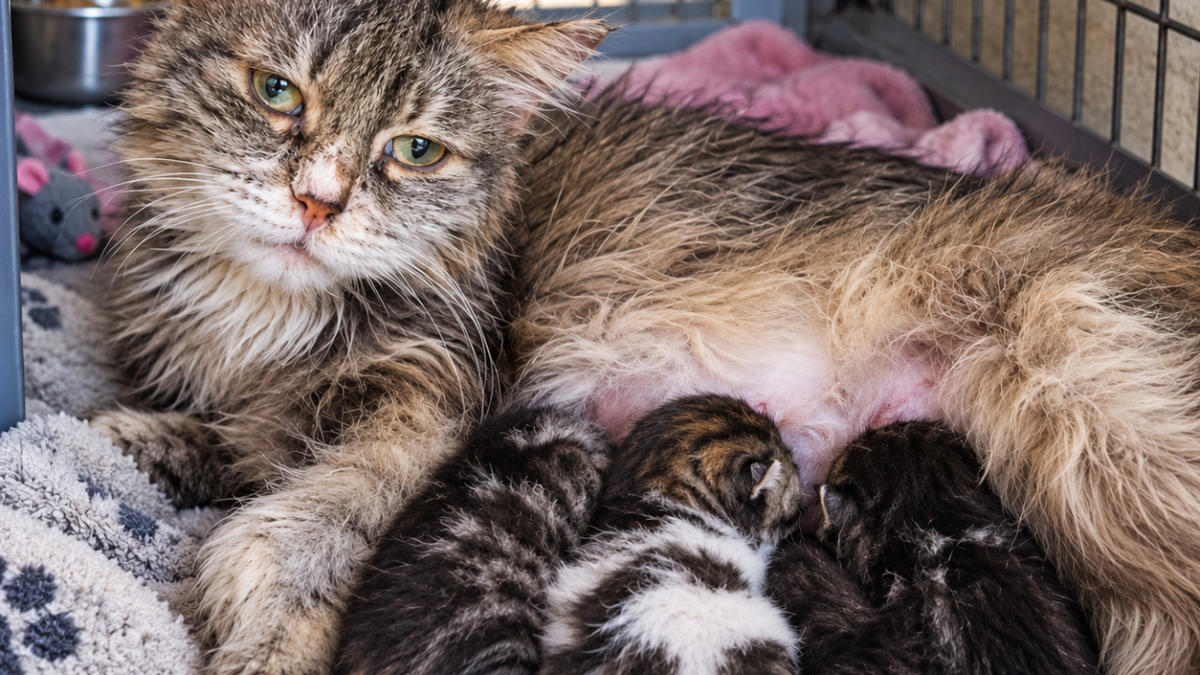
She had spent almost her entire life producing expensive kittens for people who cared more about their color than whether their mother could still stand.
When she finally became too weak to make them money, they took away her last five babies and left her overnight in a carrier so small she could barely turn around.
But when I lifted her onto our examination table the next morning, we found something that made me realize abandoning her might have exposed far more than they intended.
My name is Emily Carter, and I was working the opening shift at a small rescue outside Dayton, Ohio, when I found her.
It was 6:18 on a Tuesday morning.
There was an old plastic carrier beside our front doors.
No note.
No blanket.
No food.
The carrier was dirty enough that I almost assumed someone had dumped trash.
Then I saw two enormous eyes staring through the metal grate.
“Hey, sweetheart.”
The cat didn’t move.
That frightened me immediately.
Terrified cats usually retreat, hiss, flatten their ears, or push themselves into the farthest corner.
This one simply sat against the back wall.
Waiting.
I carried the crate inside and opened it in our intake room.
She was beautiful beneath the neglect.
Long cream-colored fur, though much of it had become tangled into painful mats. Her face was delicate. Her eyes were wide and amber. Her body underneath all that hair was shockingly thin.
“Come on.”
I expected resistance.
There was none.
When I reached inside, she didn’t swat.
Didn’t hiss.
Didn’t even brace her paws.
She allowed me to lift her as though she’d learned long ago that resisting human hands changed nothing.
That was worse than fear.
Fear still contains the belief that you can protect yourself.
This cat seemed to have lost that belief.
Our veterinarian, Dr. Leah Morrison, arrived twenty minutes later.
She ran her hands over the cat’s spine.
Her expression changed.
“How old?”
“No paperwork.”
“Five? Six?”
“That was my guess.”
Leah gently examined her abdomen.
The cat flinched.
“She’s recently given birth.”
“How recently?”
“Very.”
My stomach tightened.
“Where are her kittens?”
Leah looked at me.
“That would be my first question.”
We checked her mammary glands.
She was still producing milk.
There were signs that kittens had been nursing only days earlier.
One gland was swollen and hot.
Possible mastitis.
Her gums were pale.
She was dehydrated.
Her coat hid sores where mats had pulled constantly against her skin.
Her nails were overgrown.
And there was something else.
Her body showed the unmistakable physical strain of repeated pregnancies.
Not one accidental litter.
Not two.
Again and again.
“She was being bred,” Leah said.
I looked at the silent cat.
“For how long?”
“I can’t tell you exactly.”
Leah’s jaw tightened.
“But longer than she should have been.”
We started fluids.
The cat lay on the towel without struggling.
I opened a can of recovery food.
She sniffed it.
Then turned her face toward the door.
A sound came from her throat.
So soft I almost thought I’d imagined it.
“Mrrrow.”
Not loud.
Not demanding.
Leah stopped working.
The cat called again.
Then she stood despite how weak she was, stepped toward the edge of the table and looked toward the hallway.
I understood.
“She wants her kittens.”
Leah closed her eyes.
“Probably.”
I put my hand beside her.
The cat pressed her nose against my fingers.
Then called again.
That sound followed me for the rest of the day.
A mother asking for babies who were no longer there.
We named her Maisie.
And while Leah prepared medication for her infection, I went back outside to examine the abandoned carrier.
That’s when I found the first clue.
A faded veterinary label was stuck underneath the handle.
Most of the ink had been scratched away.
But one line was still readable.
And it contained a name.
PART 2
The label was filthy.
I had to tilt the carrier beneath the morning light just to read it.
The clinic name was mostly gone.
The phone number had been rubbed into a gray blur.
But one line survived:
OWNER: R. DALTON
I stared at it.
Then called Leah.
“Come outside.”
She stepped through the door, removing one glove.
“What?”
I pointed.
She bent over the carrier.
“Dalton.”
“Mean anything to you?”
“No.”
I photographed the label before touching anything else.
Then I photographed the carrier from every angle.
The cracked ventilation slot.
The rust on the metal door.
The dried feces in one corner.
A strip of silver duct tape along the bottom.
Something about the whole thing bothered me.
People surrendered animals all the time.
Some were ashamed.
Some were desperate.
Some genuinely had no other options.
But abandoning a recently nursing mother outside a shelter in the dark without her babies wasn’t desperation.
It was disposal.
I carried the crate into our storage room.
When I returned, Maisie was standing unsteadily on the examination table.
She was looking toward the door again.
Calling.
Leah gently guided her back down.
“She’s going to exhaust herself.”
“Can we calm her?”
“We can make her physically comfortable. But if she’s searching for kittens, medication isn’t going to explain where they went.”
Maisie called again.
My chest tightened.
“Could the kittens survive without her?”
“Depends on their age.”
“Can you tell how old?”
“Based on her milk production and abdominal recovery, I’d guess they’re still very young.”
“How young?”
“Possibly under six weeks.”
I swore under my breath.
Leah looked at me.
“I know.”
“If whoever had her removed five kittens days ago—”
“They could be bottle-feeding.”
“Or selling them.”
“Emily.”
“What?”
“We don’t know that yet.”
I hated when Leah was reasonable.
But she was right.
We had a name.
Nothing more.
I searched the county’s public business records during lunch.
There were seventeen Daltons.
Four had first names beginning with R.
Then one entry made me stop.
Rosewood Crown Cats LLC.
Registered agent: Rebecca Dalton.
Address: Brookhaven Road.
The business description identified it as a small companion-animal breeding operation.
I pulled up the website.
It was beautiful.
Soft cream backgrounds.
Gold lettering.
Photographs of long-haired kittens posed in wicker baskets.
Perfect faces.
Blue blankets.
Tiny ribbons.
The homepage promised:
HOME-RAISED PREMIUM KITTENS FROM HEALTH-TESTED PARENTS.
I scrolled.
AVAILABLE NOW.
Five kittens.
My fingers stopped.
They had been posted that morning.
Three cream.
One silver.
One pale orange.
The listing said:
READY FOR RESERVATION.
Mother: Dahlia.
Father: Kingsley.
I clicked the mother.
The photograph loaded.
My stomach dropped.
Maisie.
Not called Maisie.
Dahlia.
She looked younger in the photo.
Full coat.
Bright eyes.
Sitting against a white studio backdrop.
The caption read:
OUR BEAUTIFUL DAHLIA HAS PRODUCED SOME OF OUR MOST EXCEPTIONAL LITTERS.
Produced.
Not raised.
Not loved.
Produced.
I took screenshots.
Every page.
Every kitten.
Every photograph.
Every statement.
Then I called our county animal-control investigator, Marcus Bell.
He answered after three rings.
“Bell.”
“Marcus, it’s Emily at Second Chance.”
“What happened?”
“I think somebody dumped a breeding cat outside our shelter.”
There was a pause.
“How sure?”
“I have their carrier label and their breeding website.”
Another pause.
“Don’t contact them.”
“I wasn’t going to.”
“You absolutely were.”
I said nothing.
Marcus sighed.
“Emily.”
“Fine.”
“Send me everything.”
Within twenty minutes, he was at the shelter.
Marcus was a former sheriff’s deputy who had moved into animal cruelty investigations after twelve years on patrol.
He had an irritating habit of staying calm when everyone around him was furious.
I showed him the carrier.
Then the website.
Then Maisie.
He stood quietly beside her enclosure.
She was lying on a heated pad.
Leah had shaved several mats from her belly and chest.
Without the heavy coat, the truth was worse.
You could see every rib.
Her hips.
The loose skin along her abdomen.
Marcus crouched.
“She friendly?”
“She doesn’t resist anything.”
“That isn’t what I asked.”
“No. I don’t know if she’s friendly.”
He understood.
Maisie opened her eyes.
Marcus didn’t touch her.
“Microchip?”
“None.”
“Spay scar?”
I looked at him.
“She gave birth recently.”
“I mean old scar.”
“No.”
Marcus stood.
“Any breeder tattoo?”
“Not that we found.”
He photographed the cat.
Then the medical notes.
“What’s the prognosis?”
Leah answered.
“Good if the infection responds and there aren’t complications.”
“Life-threatening?”
“Not currently.”
“Could it have become life-threatening?”
“Yes.”
Marcus wrote that down.
“What about the kittens?”
Leah’s expression hardened.
“They should probably still be nursing.”
Marcus glanced toward me.
I pointed to the website.
“Five kittens.”
He looked.
“How do you know they’re hers?”
“I don’t.”
“Good answer.”
I hated him too.
He smiled faintly.
“Facts first.”
“They posted five kittens the morning after dumping a lactating female who had five kittens.”
“Strong lead. Not proof.”
“So what do you do?”
“Visit.”
“I’ll come.”
“No.”
“Marcus.”
“No.”
“She’s here because somebody threw her away.”
“And if you show up angry, they’ll know exactly what evidence we have.”
I crossed my arms.
“They’ll know somebody found her anyway.”
“Maybe.”
He picked up the carrier.
“But they don’t know we found this label.”
That stopped me.
He was right.
“Keep her stable,” he said. “Don’t post her publicly yet.”
“Why?”
“If they realize she survived, they may start cleaning.”
That sentence changed everything.
Cleaning.
Not caring for animals.
Cleaning evidence.
Marcus left.
For the next three hours, I stayed beside Maisie whenever I could.
She barely slept.
Every twenty or thirty minutes, she stood.
Called.
Waited.
Then lay down again.
I finally placed a stuffed kitten-sized toy beside her.
It was a terrible idea emotionally.
Maybe medically too.
I don’t know.
Maisie sniffed it.
Then began licking its head.
I had to walk out of the room.
Leah found me in the hallway.
“You okay?”
“No.”
“She is.”
“No, she isn’t.”
“You know what I mean.”
I leaned against the wall.
“I’ve seen neglect.”
“So have I.”
“But this feels different.”
“Because babies are involved.”
“Because she doesn’t even know she can say no.”
Leah was quiet.
I continued.
“You saw her when we picked her up. Nothing.”
“I know.”
“She just lets us move her.”
“That’s learned helplessness.”
“I know.”
“Then don’t mistake quiet for absence.”
I looked at her.
“What?”
Leah glanced toward the treatment room.
“There is still a cat in there.”
That sentence mattered later.
At 4:11 that afternoon, Marcus called.
“I’m outside Rosewood Crown Cats.”
My pulse jumped.
“And?”
“Property looks occupied.”
“What does that mean?”
“It means there’s a house, detached garage, two outbuildings, three vehicles.”
“Cats?”
“Can’t tell yet.”
“Did you knock?”
“Not yet.”
“Why not?”
“Because I’m waiting for another officer.”
I paced.
“Marcus.”
“Emily.”
“I hate you.”
“I know.”
He ended the call.
Forty minutes later, he called again.
This time his voice had changed.
“She’s theirs.”
My hand tightened around the phone.
“You saw her records?”
“Rebecca Dalton identified the carrier.”
“She admitted dumping Maisie?”
“Dahlia.”
“I don’t care what she called her.”
“I know.”
“What did she say?”
Marcus exhaled.
“She says she surrendered the cat.”
“At four in the morning without telling anyone?”
“She says she left her at your entrance because she believed someone would find her.”
“That’s abandonment.”
“Likely.”
“What about the kittens?”
Silence.
“Marcus.”
“They’re there.”
My knees nearly gave out.
“All five?”
“Yes.”
“Alive?”
“Yes.”
I sat down.
“Are they nursing?”
“No.”
“What are they eating?”
“Commercial milk replacer and softened food.”
“How old?”
“Five weeks, according to Dalton.”
Leah overheard.
She came closer.
I put the call on speaker.
“Five weeks?” Leah asked.
“Yes.”
“They should still have access to their mother if possible.”
“Dalton says the litter was intentionally weaned early because Dahlia was ‘declining.’”
Leah’s face hardened.
“So instead of treating the mother, they removed the kittens.”
“That’s what we’re establishing.”
I asked, “Are you taking them?”
“Not yet.”
“What?”
“We can’t seize animals because you and I dislike the situation.”
“She’s emaciated.”
“I’m obtaining veterinary and breeding records.”
“What else did you see?”
Another pause.
“More cats.”
“How many?”
“I counted sixteen.”
Leah looked at me.
“Adults?”
“Eleven adults, five kittens.”
“Conditions?”
“Mixed.”
That was Marcus language.
Meaning bad, but not yet something he could describe legally.
“Several adult females are thin,” he continued. “One has significant coat matting. There are cages in the rear building.”
My anger sharpened.
“Breeding cages.”
“Possibly.”
“How many?”
“Emily—”
“How many?”
“I saw eight enclosures from the doorway.”
“Why aren’t you taking them?”
“Because I don’t have a warrant.”
“Then get one.”
“That’s the plan.”
Rebecca Dalton had allowed Marcus and the accompanying officer into the front room and kitchen.
She refused access to the outbuilding.
That refusal was legal.
For the moment.
But Marcus had seen enough through the open door to request further inspection.
He also had Maisie’s medical condition.
The carrier.
The admission that Rebecca left her at our shelter.
The active breeding listings.
The five kittens.
And something Rebecca said without realizing its importance.
“She was done.”
Marcus repeated the sentence to me.
“What exactly?”
“When he asked why she didn’t take Dahlia to a vet, Rebecca said, ‘She was done anyway.’”
I felt cold.
Not sick.
Cold.
Done.
As though Maisie were a printer that had stopped producing acceptable pages.
“What happens now?”
“We document.”
“I know that part.”
“Then we seek the warrant.”
“And if she moves the cats?”
“We’ve notified her the animals are part of an active welfare inquiry.”
“That won’t stop her.”
“No.”
I hated that too.
That night, I stayed late.
Maisie’s temperature had improved.
She ate half a can of food.
Then more.
Progress.
At 8:30, the shelter was nearly silent.
I opened her enclosure and sat on the floor.
Maisie watched me.
I placed my hand nearby.
She didn’t come closer.
Didn’t move away.
“You have five babies.”
Her ears shifted.
“They’re alive.”
Her head came up.
I knew she couldn’t understand the sentence.
But the sound of my voice changed something.
She called.
The same soft sound.
“Yeah.”
I swallowed.
“They’re there.”
Another call.
“We’re trying.”
Maisie stood.
She walked to the enclosure door.
Then looked at me.
I started crying.
“I know.”
She called again.
That was the first time I wanted revenge.
Real revenge.
Not justice.
Not paperwork.
I wanted Rebecca Dalton to feel what Maisie was feeling.
I wanted someone to take something she loved from her and let her wonder where it went.
I hated myself for thinking it.
Then I hated Rebecca more.
The warrant came the following afternoon.
Marcus didn’t tell me until they were already executing it.
He knew me too well.
At 3:06, my phone rang.
“We’re inside.”
I stood so fast my chair rolled backward.
“And?”
“It’s worse.”
Two words.
That’s all.
“What did you find?”
“Twenty-eight cats.”
I closed my eyes.
“Twenty-eight?”
“Some weren’t visible yesterday.”
“Where?”
“Back room. Basement. Outbuilding.”
“Conditions?”
Marcus was quiet.
Then:
“Come to the clinic.”
“What clinic?”
“County emergency vet.”
“Why?”
“We’re bringing them out.”
I was already grabbing my keys.
Leah came with me.
We reached the veterinary hospital while transport vans were still arriving.
Carrier after carrier came through the doors.
Long-haired cats.
Short-haired cats.
Adults.
Young cats.
Males.
Females.
Several looked healthy at first glance.
Others did not.
One female had fur missing around her neck.
Another was so thin I could fit both hands around her waist.
A silver cat had dried discharge around both eyes.
A male had infected skin around his ears.
Then Marcus carried in a carrier covered with a towel.
“Emily.”
I stepped toward him.
“What?”
He removed the towel.
Five kittens.
Cream.
Silver.
Pale orange.
The website kittens.
Maisie’s babies.
I covered my mouth.
“They’re okay?”
“Veterinarian hasn’t cleared them yet.”
One kitten pressed its face against the carrier door.
I crouched.
“Hey.”
Tiny blue-gray eyes stared back.
Leah came beside me.
“We need to see if they’ll still nurse.”
“Can we bring Maisie?”
Marcus shook his head.
“Evidence transfer first.”
“How long?”
“An hour.”
It was the longest hour of my life.
By 5:30, Maisie arrived at the emergency clinic.
We placed her in a quiet examination room.
She smelled the carrier before we opened it.
Her entire body changed.
That cat who had barely reacted to anything rose so quickly she almost pulled out her IV catheter.
“Easy!”
Leah steadied her.
The first kitten came out.
Cream-colored.
Maisie froze.
Her pupils widened.
The kitten cried.
Maisie answered.
Loudly.
Not the weak little sound we’d been hearing.
A real call.
The kitten scrambled toward her.
Maisie lowered herself despite the discomfort in her swollen mammary glands.
The kitten buried its face against her chest.
Then another kitten.
Then another.
All five.
Maisie began licking them frantically.
Heads.
Backs.
Ears.
Faces.
She counted them in scent and touch.
One.
Two.
Three.
Four.
Five.
Then she curled around them.
I was standing against the wall crying openly.
Leah was crying.
Even Marcus looked away.
After several minutes, Maisie lifted her head.
For the first time since I found her, she looked directly at me and blinked slowly.
Maybe it meant nothing.
Maybe it meant everything.
I chose everything.
The seizure inventory from Rosewood Crown Cats took two days.
The warrant uncovered veterinary records, breeding calendars, sales contracts and financial ledgers.
Rebecca had been organized.
Very organized.
Every breeding female had a page.
Name.
Color.
Bloodline.
Mating date.
Expected delivery.
Number of kittens.
Number sold.
Revenue.
Beside some names were notes.
GOOD PRODUCER.
SMALL LITTERS.
COLOR WEAK.
DIFFICULT MOTHER.
RETIRED.
Maisie’s page was longer than most.
DAHLIA.
Seven documented litters.
Seven.
Her first was recorded when she was barely more than a year old.
Five kittens.
Then four.
Six.
Three.
Five.
Four.
Five.
Thirty-two kittens documented over her breeding life.
Thirty-two babies.
Marcus showed me only because I was involved in her intake.
I couldn’t stop staring.
“How much?”
“What?”
“How much money?”
He understood.
Based on listed sale prices, Maisie’s kittens alone could have generated tens of thousands of dollars.
Possibly much more.
And when her body finally couldn’t keep up, Rebecca had left her outside our shelter in a carrier.
No veterinary appointment.
No retirement home.
No spay.
No recovery.
Just disposal.
The ledgers contained something else.
Under Maisie’s final litter:
WEAN 5 WKS. FEMALE NOT RECOVERING. REMOVE.
Remove.
I wanted Rebecca to have to read that word in court.
Marcus warned me not to build my expectations around punishment.
“Why?”
“Because breeding itself isn’t automatically illegal.”
“This wasn’t breeding. This was exploitation.”
“I agree emotionally.”
“Emotionally?”
“Legally, we prove neglect.”
“She bred her seven times.”
“That alone may not establish cruelty.”
“She didn’t treat the infection.”
“Important.”
“She was underweight.”
“Important.”
“She abandoned her.”
“Very important.”
“What about the others?”
“We document each one.”
I hated legal language.
But I learned it.
Body condition scores.
Untreated medical conditions.
Failure to provide veterinary care.
Unsanitary confinement.
Inadequate space.
Overbreeding where supported by medical evidence.
Abandonment.
Falsified health documentation.
That last one surprised me.
Several kitten buyers had been given health certificates implying recent veterinary examinations.
The listed veterinarian denied signing some of them.
Now the case wasn’t only animal welfare.
It was fraud.
Then consumer complaints surfaced.
One family bought a kitten that developed a congenital heart problem within six months.
Another received a kitten with severe parasites.
Another had been told their kitten was twelve weeks old.
Veterinary examination suggested it was closer to eight.
One buyer had been instructed never to contact the breeder again after asking for medical records.
The beautiful website began falling apart one screenshot at a time.
Premium.
Home-raised.
Health-tested.
Behind the photographs were cages.
Behind the ribbons were breeding calendars.
Behind “retired” females were animals whose usefulness had expired.
Rebecca hired an attorney.
Her defense was immediate.
She called herself a responsible hobby breeder targeted by animal activists.
She said the cats were loved.
She said Maisie’s condition had deteriorated rapidly.
She said she left her at our shelter because she wanted her cared for.
I heard that and nearly threw my phone.
She wanted her cared for.
After seven litters.
After removing her babies.
After untreated infection.
After leaving her at dawn without even telling us she was outside.
Marcus called before I could do something stupid.
“Don’t post.”
“I wasn’t going to.”
“You opened the shelter Facebook page fourteen minutes ago.”
I stared at my computer.
“How do you know that?”
“Because Hannah told me.”
“Traitor.”
“Don’t post.”
“She released a statement.”
“I know.”
“She says she rescued Maisie by leaving her with us.”
“I know.”
“She is rewriting what happened.”
“Let her.”
“What?”
Marcus’s voice remained maddeningly calm.
“Every public statement becomes another statement we can compare to evidence.”
I stopped.
“So don’t argue with her?”
“Exactly.”
I looked through the window into Maisie’s foster room.
She was nursing her kittens.
Her eyes were half closed.
For the first time, she looked peaceful.
“Fine.”
That might have been the first time in my life I learned that silence could be strategic.
The cats remained in protective custody while the case proceeded.
Maisie’s kittens stayed with her until they were fully weaned.
Watching her change during those weeks was one of the greatest privileges of my life.
At first, she existed only for the kittens.
If they moved, she moved.
If one cried, she answered.
She ate because food allowed her to nurse.
She slept curled around them.
Humans barely mattered.
Then the kittens began exploring.
The cream female discovered toys.
The orange male climbed everything.
The silver kitten learned that shoelaces were prey.
Maisie watched them.
And slowly, something happened.
She began watching us too.
One afternoon, I entered carrying food.
Maisie stood.
I expected her to move toward the bowl.
Instead, she walked toward me.
Stopped.
Then rubbed one cheek against my ankle.
I froze.
“Leah.”
No answer.
“LEAH.”
Leah came running.
“What happened?”
I pointed down.
Maisie had moved away.
“What?”
“She touched me.”
Leah stared.
“You screamed because a cat touched you?”
“She chose to.”
Leah’s expression softened.
“Oh.”
Exactly.
Choice.
Until then, most of Maisie’s life had been things happening to her.
Doors opened.
Hands reached in.
Cats were placed near her.
Kittens came.
Kittens disappeared.
She was moved.
Examined.
Confined.
Abandoned.
Now she had walked across a room and chosen contact.
The next day, she did it again.
Then she discovered brushing.
That took longer.
The first time I showed her a brush, Maisie flattened herself.
I stopped immediately.
“Okay.”
I placed the brush on the floor.
She sniffed it.
Walked away.
The next day, same thing.
A week later, I touched the brush once to her shoulder.
She left.
I didn’t follow.
Another week passed.
One afternoon, Maisie walked up while I was brushing one of her nearly weaned kittens.
She watched.
Then sat beside me.
I held out the brush.
She sniffed it.
I made one stroke down her back.
Maisie remained.
Another.
Still there.
By the fifth stroke, her eyes closed.
I swallowed.
Nobody had cared for her coat because it didn’t affect how many kittens she produced.
Now grooming could be pleasure instead of maintenance.
Something given without requiring anything back.
We brushed for eleven minutes.
The next day, Maisie climbed into my lap.
I cried again.
I cried a lot that year.
When her kittens reached appropriate age, we began adoption screening.
I was unbearable.
Hannah told me so.
“No breeder.”
“Obviously.”
“Indoor homes.”
“Yes.”
“Veterinary references.”
“Standard.”
“Lifetime return requirement.”
“Already in contract.”
“No declawing.”
“Already there.”
“No—”
“Emily.”
“What?”
“You are not personally interviewing their childhood teachers.”
“I hadn’t thought of that.”
“That wasn’t a suggestion.”
All five kittens found homes.
Good homes.
The first one to leave was the orange male.
We named him Sunny.
His adopter was a middle-school librarian named Diane.
Maisie watched as Diane placed Sunny into a carrier.
My stomach twisted.
Would this destroy her?
Would she believe her kittens were being stolen again?
We had planned carefully.
One kitten at a time.
No sudden removals.
Allow Maisie to see and smell the carrier.
Keep routine stable.
Sunny cried once.
Maisie approached.
They touched noses through the grate.
Then Diane left.
Maisie watched the door.
I knelt nearby.
She called once.
Then walked back to the remaining kittens.
That night, she ate.
She slept.
She was okay.
The next adoption was harder.
Then easier.
By the final kitten, Maisie had begun spending more time away from them voluntarily.
That mattered.
Motherhood was becoming something she could finish naturally.
The last kitten was the little cream female.
We called her Pearl.
Pearl had inherited Maisie’s amber eyes.
When her adopter arrived, Maisie groomed Pearl’s head for almost two minutes.
Then walked away and sat beside me.
Pearl left.
Maisie watched the door.
My heart broke anyway.
But she didn’t call.
Instead, she looked at me.
Then climbed onto the chair beside mine.
The chapter had closed.
This time nobody ripped the pages away.
Maisie was spayed after she had fully recovered.
That surgery affected me more than I expected.
Leah came out afterward and said:
“She’s done.”
I flinched.
Leah immediately understood.
“No.”
She shook her head.
“Wrong word.”
I looked at her.
“She is free.”
That was better.
Free.
No more litters.
No more heat cycles scheduled against breeding calendars.
No more humans deciding which male would be placed with her.
No more losing babies because a sales date had arrived.
Her body belonged to her.
The case against Rebecca Dalton reached court seven months later.
By then, Maisie had gained nearly four pounds.
Her coat had returned.
Not fully.
Some areas remained thinner.
But she was beautiful.
Actually beautiful.
Not breeder-website beautiful.
Not posed.
Not brushed for photographs.
Alive beautiful.
She played.
That shocked all of us.
At first she didn’t understand toys.
A feather wand frightened her.
A ball bored her.
Then one evening I rolled a little cloth mouse across the floor.
Maisie watched.
The toy stopped.
She crouched.
Her rear end moved slightly.
Then she pounced.
I laughed so loudly she ran away.
“Sorry!”
She returned two minutes later.
I rolled it again.
Pounce.
Again.
Pounce.
Maisie had spent years being a breeding female.
At six or seven years old, she was learning how to be a cat.
The courtroom did not care about cloth mice.
It cared about evidence.
Marcus testified first.
The abandoned carrier.
Rebecca’s admission.
The inspection.
The warrant.
The cats.
The records.
Leah testified about Maisie’s physical condition.
The prosecutor asked:
“In your medical opinion, was Dahlia—now called Maisie—receiving adequate care at the time she was abandoned?”
“No.”
“What conditions did you observe?”
“Severe underweight condition, dehydration, significant matting, skin lesions, mammary inflammation consistent with mastitis, overgrown nails, and evidence of repeated reproductive strain.”
“Could those problems have been treated?”
“Yes.”
“Was she brought to a veterinarian?”
“Not according to the records provided.”
Rebecca’s attorney stood.
“Dr. Morrison, repeated pregnancies do not automatically constitute abuse, correct?”
“Correct.”
“Breeders routinely produce multiple litters from healthy queens?”
“Yes.”
“So the number of litters alone does not establish neglect.”
“No.”
He smiled slightly.
Then Leah added:
“But continuing to breed an animal whose physical condition is deteriorating without appropriate medical management can contribute to serious welfare concerns.”
His smile disappeared.
The prosecutor introduced Maisie’s breeding sheet.
Seven litters.
Thirty-two kittens.
Revenue entries.
Then the last notation appeared on the courtroom monitor.
WEAN 5 WKS. FEMALE NOT RECOVERING. REMOVE.
I looked at Rebecca.
Her eyes moved downward.
The prosecutor asked:
“What did ‘remove’ mean?”
Rebecca’s former assistant answered that question.
Her name was Kayla Jensen.
Twenty-three years old.
She had worked for Rosewood Crown Cats for fourteen months.
At first, she had been afraid to talk.
Then she saw the photographs after the seizure.
Kayla testified under subpoena.
“When Rebecca wrote ‘remove,’ what did that mean?”
Kayla swallowed.
“It meant the cat wouldn’t be bred anymore.”
“What happened to cats marked that way?”
“Sometimes she sold them.”
“Sometimes?”
“Sometimes she gave them away.”
“And Dahlia?”
Silence.
“Ms. Jensen?”
Kayla looked toward Rebecca.
Then back at the prosecutor.
“She said nobody would pay for her looking like that.”
The courtroom went still.
“What happened next?”
“She told me to take the kittens.”
“Why?”
“They already had deposits.”
“Were they five weeks old?”
“Yes.”
“Did you tell Ms. Dalton that Dahlia looked sick?”
“Yes.”
“What did she say?”
Kayla’s voice dropped.
“She said a vet bill would cost more than the cat was worth.”
I stopped breathing.
There are sentences so ugly they remove all ambiguity.
That was one.
The prosecutor waited.
Then:
“What happened to Dahlia?”
“Rebecca put her in the old carrier.”
“When?”
“Late that night.”
“Did she say where she was taking her?”
Kayla nodded.
“The shelter.”
“Did she call the shelter?”
“No.”
“Arrange a surrender?”
“No.”
“Leave medical records?”
“No.”
“Food?”
“No.”
“Water?”
“No.”
“Why use the old carrier?”
Kayla’s eyes filled.
“Because she didn’t want the good carriers smelling like her infection.”
I had to look away.
It wasn’t dramatic cruelty.
No shouting.
No cinematic villain.
Just calculation.
A good carrier had value.
Maisie did not.
Or so Rebecca had believed.
Then the financial records came in.
Kitten deposits.
Cash transfers.
Sales.
Veterinary bills that repeatedly decreased over two years while breeding revenue increased.
Purchases of grooming supplies.
Photography equipment.
Advertising.
Premium food for kittens scheduled for sale.
And cheap bulk food for adult breeding cats.
Presentation where customers could see it.
Minimum survival where they couldn’t.
The fraud evidence came next.
Certificates.
Signatures.
Emails.
Several buyers testified.
One woman named Jessica brought photographs of her kitten, Milo.
Beautiful silver coat.
He had died before his second birthday from a congenital heart condition.
She had been told both parents were fully screened.
Records did not support that claim.
Jessica cried during testimony.
Rebecca’s attorney objected to emotional prejudice.
The judge narrowed what could be considered.
That was fair.
Justice needed discipline.
I had learned that from Marcus.
Rebecca eventually accepted a plea agreement rather than take every count to trial.
She pleaded to multiple animal-welfare offenses and fraud-related charges tied to falsified representations.
The court prohibited her from breeding or owning more than a tightly restricted number of animals for an extended period, subject to compliance terms.
She paid restitution.
Lost her business license.
Rosewood Crown Cats dissolved.
The remaining seized cats were permanently surrendered.
Some required months of medical treatment.
All eventually left rescue custody.
For years, I imagined revenge as suffering transferred back to the person who caused it.
But when Rebecca’s website finally disappeared, I felt almost nothing.
I expected triumph.
Instead, I went into our foster room.
Maisie was sleeping in a patch of sunlight.
On her back.
One front paw folded against her chest.
Completely exposed.
Completely relaxed.
That sight mattered more than Rebecca’s sentence.
A cat who once sat motionless because she believed resistance was useless now slept with her belly exposed because she believed nobody in the room would hurt her.
That was victory.
The question of where Maisie would live permanently remained.
Technically, she was available for adoption after the case ended.
We posted her profile.
I wrote it myself.
MAISIE
Adult female.
Quiet home preferred.
Affectionate on her own terms.
Learning to play.
Professional sunbeam collector.
No breeding. Obviously.
Hannah deleted the last line.
I put it back.
She deleted it again.
“People know she’s spayed.”
“I want moral emphasis.”
“You are exhausting.”
Maisie received thirty-seven applications.
I rejected thirty-two.
Hannah accused me of sabotage.
One family had three noisy dogs.
No.
One applicant wanted a “beautiful long-haired cat for social media.”
Absolutely not.
One asked whether Maisie could attend cat shows.
I nearly threw my laptop.
Then an application came from a woman named Ruth Palmer.
Sixty-eight.
Retired elementary-school teacher.
Widowed.
No other pets.
Quiet house.
Screened porch.
Veterinary references spanning twenty-six years.
Her previous cat had lived to nineteen.
Ruth wrote:
I don’t need a cat who performs affection. I would like company, and I have time to let her decide what kind of company she wants to be.
I read it twice.
Then three times.
Hannah looked at me.
“Well?”
“I hate her.”
“Why?”
“She’s perfect.”
We scheduled a meeting.
Ruth entered the room and did exactly what I hoped.
Nothing.
She didn’t approach Maisie.
Didn’t reach.
Didn’t make kissing noises.
Didn’t call her name repeatedly.
Ruth sat in a chair and opened a book.
For fifteen minutes, Maisie remained beneath a table.
Ruth read.
Twenty minutes.
Maisie came out.
Ruth kept reading.
Maisie walked closer.
Sniffed Ruth’s shoe.
No reaction.
Then Maisie sat beside the chair.
Ruth turned one page.
I whispered to Hannah:
“This woman is manipulating me.”
“Shut up.”
Thirty-five minutes after Ruth arrived, Maisie jumped onto the chair beside her.
Ruth closed the book.
Still didn’t touch her.
Maisie sniffed her hand.
Then rubbed one cheek against it.
Ruth’s eyes filled with tears.
She did not move.
She let Maisie finish.
Finally she asked me:
“May I pet her?”
That was it.
I knew.
Maisie went home with Ruth two weeks later.
I hated every second.
I helped carry the carrier to Ruth’s car.
Maisie sat inside on a yellow blanket.
No panic.
No resignation.
She watched me.
I crouched.
“You know this is supposed to be the good part.”
Maisie blinked.
“I’ve done all the paperwork.”
Another blink.
“Ruth is better than me.”
Ruth stood nearby.
“I doubt that.”
“She has a screened porch.”
“I do.”
“She reads.”
“I noticed.”
“She probably doesn’t yell when cats touch her unexpectedly.”
“I’ll try not to.”
I put my fingers through the carrier bars.
Maisie sniffed them.
Then pressed her forehead against one.
The same gesture she’d offered me months earlier.
My eyes burned.
“You get to be done now.”
I hated the word again.
I corrected it.
“You get to live.”
Ruth drove away.
I stood in the parking lot until the car disappeared.
Then went inside and cried in the supply closet like an adult professional.
Ruth sent me a photograph that evening.
Maisie was hiding beneath the bed.
The next morning:
Maisie sitting in the doorway.
Day three:
Maisie on the couch.
Day seven:
Maisie on Ruth’s lap.
Day eleven:
Maisie asleep beside a book.
Three weeks:
Maisie on the screened porch watching birds.
Two months:
Maisie playing with a feather toy.
The most important photograph came six months later.
Ruth sent no caption.
Maisie was sitting on a windowsill.
Healthy.
Thick coat.
Sunlight surrounding her.
Nothing remarkable happening.
I printed it.
Placed it beside the photograph from intake.
The contrast was almost painful.
In the first photo, Maisie’s body seemed to ask permission to exist.
In the second, she occupied the entire windowsill as if the house had been built specifically for her.
Maybe that is what healing looks like.
Not dramatic transformation.
Space claimed.
Years passed.
Ruth became family to our shelter whether she wanted to or not.
She attended adoption events.
Donated food.
Sent updates.
Maisie developed opinions.
Strong ones.
She hated salmon-flavored food.
Loved turkey.
Refused expensive cat beds.
Slept on folded laundry.
Discovered that pencils could be pushed off tables.
Repeated the experiment daily.
She liked Ruth’s classical music but left the room when television sports came on.
She learned to open one kitchen cabinet.
Ruth installed a child lock.
Maisie learned to defeat it.
That cat had spent years appearing helpless.
Turns out she was an engineer.
Once, I visited and watched Maisie jump onto the table.
Ruth pointed.
“Down.”
Maisie stared at her.
“Down.”
Maisie sat.
“That is not down.”
I laughed.
Ruth glared at me.
“You told me she was quiet.”
“She is being quiet.”
“She’s also sitting in my soup.”
Maisie had one paw inside Ruth’s empty soup bowl.
I laughed harder.
That was the gift.
Seeing her misbehave.
Seeing her want things.
Choose things.
Refuse things.
A cat who once permitted every human decision now had preferences about soup bowls.
Good.
Let her.
Her kittens grew too.
Their families remained in contact.
Sunny became enormous.
Pearl slept inside bathroom sinks.
The silver kitten, Ash, learned to play fetch.
Milo—named before we realized another buyer’s deceased kitten had shared the name—became inseparable from an elderly Labrador.
Cleo ruled a house containing two adults and three teenagers.
Once a year, Ruth allowed us to compile updated photographs.
Not a reunion.
Cats generally do not need our sentimental reunions.
Just photographs.
Thirty-two documented kittens had once passed through Maisie’s life.
We couldn’t find most of them.
But her final five were safe.
That had to be enough.
Then something unexpected happened.
Kayla, the former assistant who testified against Rebecca, came to the shelter.
She stood near reception holding an envelope.
“I don’t expect you to forgive me.”
I looked at her.
“For what?”
“I worked there.”
“You also testified.”
“Too late.”
“How long did you know?”
Her eyes lowered.
“Longer than I should have.”
I didn’t rescue her from that truth.
“Why did you stay?”
“I needed the job.”
“That explains it.”
“Doesn’t excuse it.”
“No.”
She nodded.
Fair.
Then she handed me the envelope.
Inside were old photographs.
Maisie as a young cat.
Maybe ten months old.
Perfect coat.
Bright eyes.
Playing with a ribbon.
Another photograph showed her sleeping on someone’s couch.
“What is this?”
“Before Rebecca expanded.”
Kayla swallowed.
“She used to keep them in the house.”
I turned another photo.
Young Maisie looking directly at the camera.
Curious.
Alive in a way I hadn’t seen in the breeder photos.
“She wasn’t always like that,” Kayla said.
“Like what?”
“Shut down.”
I looked at her.
“When did it change?”
Kayla thought.
“After the third litter, maybe.”
My chest tightened.
“She started hiding when Rebecca carried the breeding carrier.”
“The breeding carrier?”
Kayla looked ashamed.
“She knew.”
Of course she knew.
Animals understand patterns long before humans admit patterns exist.
A specific room.
A specific cage.
A specific male.
A pregnancy.
Babies.
Removal.
Recovery just long enough to begin again.
“I should’ve done something.”
“Yes.”
Kayla cried.
I let her.
Sometimes kindness is not telling someone their guilt is undeserved.
Sometimes guilt is evidence that conscience survived.
“What are you going to do with it?” I asked.
“With what?”
“The fact that you should’ve acted sooner.”
She wiped her eyes.
“I don’t know.”
“Figure it out.”
Months later, Kayla enrolled in veterinary technician training.
She eventually worked for a low-cost spay-and-neuter clinic.
I saw her years later.
She had become excellent.
Gentle.
Particularly with frightened cats.
Maybe guilt can rot a person.
Or it can become responsibility.
Maisie lived with Ruth for nine years.
Nine.
Longer than her breeding life.
I loved that arithmetic.
For years she had been measured by litters.
Now I measured her in ordinary things.
Nine Christmases.
Nine summers on the porch.
Nine winters sleeping against Ruth’s legs.
Thousands of naps.
Hundreds of pencils pushed off tables.
Zero pregnancies.
That last number might have been my favorite.
As Maisie aged, her coat turned softer around the face.
Her movements slowed.
She developed kidney disease.
Then arthritis.
Ruth modified the house.
Low-sided litter boxes.
Steps beside the couch.
Food bowls elevated slightly.
Heated bed.
Maisie ignored the heated bed and slept on Ruth’s cardigan.
Naturally.
At sixteen—or our best estimate—Maisie stopped jumping onto the windowsill.
Ruth built a ramp.
Maisie used it immediately.
“She respects my carpentry more than the bed I bought.”
“Take the victory.”
At seventeen, her kidney disease progressed.
Leah had retired by then but still remembered Maisie.
Our new veterinarian managed her care.
Ruth did everything.
Fluids.
Medication.
Special diet.
Bloodwork.
Maisie tolerated it with the impatience of an elderly queen.
Then one November morning, Ruth called me.
Her voice told me before the words did.
“She won’t eat.”
I closed my eyes.
“When?”
“Yesterday afternoon.”
“Water?”
“A little.”
“Movement?”
“Not much.”
I drove over.
Maisie was lying on the screened porch despite the cold, wrapped in Ruth’s cardigan.
Sunlight touched her face.
She opened her eyes when I sat down.
“Hey.”
One ear moved.
“You remember me?”
I placed my hand nearby.
Not touching.
Old habit.
Maisie sniffed.
Then moved her head forward.
Her forehead met my fingers.
Seventeen years old, approximately.
And she still chose.
I stroked between her ears.
Ruth sat beside us.
“I thought we’d have another Christmas.”
“I know.”
“She likes the tree.”
“I know.”
Maisie’s breathing was slow.
Ruth began crying.
“I don’t want her last memory to be a clinic.”
“It doesn’t have to be.”
We arranged an in-home visit.
While we waited, Ruth brought out a box.
Inside were photographs.
The windowsill.
The porch.
The soup bowl.
The cabinet.
Christmas tree.
Maisie asleep on Ruth’s chest.
Nine years.
Ruth held the first photo I’d ever sent her.
Maisie at the shelter.
Shaved mats.
Thin body.
Eyes too big for her face.
“I can’t believe that’s her.”
I looked at Maisie now.
Old.
Beautiful.
Safe.
“It is.”
“She looks so defeated.”
“She was.”
Ruth wiped her face.
“When did that change?”
I thought about it.
Not one day.
Not one rescue.
Not one adoption.
It changed in thousands of choices.
When we opened the carrier and didn’t force her out.
When we stopped brushing because she moved away.
When her kittens returned.
When she was spayed.
When Ruth let her hide under the bed for three days.
When nobody punished her for knocking down pencils.
When every “no” she expressed was allowed to remain a no.
“Slowly,” I said.
Ruth nodded.
“That’s how trust usually works.”
Maisie spent her last afternoon exactly where she wanted.
On the porch.
Wrapped in the cardigan.
Ruth beside her.
Me on the floor.
The veterinarian arrived near sunset.
She explained everything.
Ruth asked for one minute.
Then another.
Nobody rushed.
That mattered.
So much of Maisie’s younger life had run on schedules she didn’t control.
Breeding date.
Birth date.
Weaning date.
Sale date.
Next litter.
Now time belonged to her.
We waited until she was comfortable.
Ruth placed one hand beside Maisie’s face.
I rested mine nearby.
Maisie sniffed Ruth’s fingers.
Then mine.
The veterinarian gave the first medication.
Maisie’s body softened.
Not collapsed.
Softened.
Her head lowered onto Ruth’s cardigan.
Ruth whispered:
“You never have to have another baby.”
I broke.
Ruth kissed Maisie’s head.
“You never have to earn your food.”
Another breath.
“You never have to make anybody money.”
Maisie’s eyes began closing.
“You don’t have to be beautiful.”
Ruth was sobbing now.
“You don’t have to be useful.”
I touched Maisie’s paw.
“You just had to be here.”
Her breathing slowed.
Ruth whispered the final words.
“You got to be a cat.”
Maisie died with sunlight on her face.
For a long time, we stayed.
Afterward, Ruth asked if I wanted the old photographs.
I shook my head.
“Keep them.”
“You sure?”
“Yes.”
I looked at Maisie.
“But send me one.”
“Which?”
“The windowsill.”
Not intake.
Not breeder photo.
Not kittens.
The windowsill.
A cat in sunlight.
Nothing expected from her.
That photograph went onto our shelter wall.
Not under cruelty cases.
Not under success stories.
Just near the staff room.
A small frame.
MAISIE.
Underneath, I wrote:
SHE SPENT THE FIRST HALF OF HER LIFE BEING VALUED FOR WHAT SHE COULD PRODUCE.
SHE SPENT THE REST LEARNING SHE WAS VALUABLE FOR EXISTING.
Years later, new employees still asked me about her.
“Was she the breeding case?”
I always corrected them.
“She was Maisie.”
Not Dahlia.
Not breeding female number whatever.
Not seven litters.
Not thirty-two kittens.
Maisie.
The case changed our shelter.
We began asking more questions when intact female animals arrived with evidence of repeated breeding.
We built relationships with veterinary clinics.
We created confidential reporting channels for workers inside questionable breeding operations.
We educated buyers about health records and responsible breeding practices.
Not because all breeders were cruel.
They aren’t.
But because secrecy makes cruelty easier.
And beautiful photographs can hide ugly rooms.
Kayla helped develop one of those trainings.
The first time she spoke publicly, her hands shook.
She said:
“I used to think cruelty looked like somebody hitting an animal.”
The room became silent.
“Sometimes it looks like seeing something wrong every day until it starts looking normal.”
That was the most important thing she ever said.
Rebecca Dalton eventually disappeared from animal business listings.
I don’t know where she lives now.
I don’t know what she tells people about the case.
I stopped caring.
That surprised me.
At the beginning, I wanted revenge.
I wanted her humiliated.
I wanted her to lose everything she had earned through Maisie’s body.
Some consequences came.
But over time, Rebecca became smaller in the story.
Maisie became larger.
Rebecca had controlled perhaps seven years of her life.
Then Maisie got nine years nobody could monetize.
That was enough for me.
More than enough.
Because revenge, I learned, doesn’t have to look like destruction.
Sometimes revenge looks like a formerly exhausted breeding cat refusing a $90 heated bed because she prefers a cardigan.
Sometimes it looks like an elderly woman saying:
“That is my chair.”
And a cat refusing to move.
Sometimes it looks like a veterinarian writing:
SPAYED.
Sometimes it is a litter of kittens growing into adult cats who will never enter a breeding cage.
Sometimes it is an animal learning that hands can touch without taking.
That food can arrive without conditions.
That affection doesn’t create debt.
That pregnancy is not her purpose.
That beauty isn’t rent she owes the world.
Maisie’s entire early life had been built around one question:
What can she give us?
Her second life answered with another:
What can we give her without asking for anything back?
A warm window.
Food.
Medical care.
Choice.
Time.
A lap if she wanted it.
Distance if she didn’t.
That was all.
And somehow, that ordinary list felt more powerful than any punishment.
Ruth scattered Maisie’s ashes beneath the maple tree behind her house.
Not all of them.
She kept a small urn inside.
“But she liked the tree,” Ruth explained.
So we stood beneath it one spring morning.
Pearl’s family came.
Sunny’s family sent flowers.
Leah came despite retirement.
Marcus came too.
Older.
Still annoyingly calm.
Hannah stood beside me.
Kayla stood at the back.
Nobody made speeches.
Ruth scattered a little ash around the roots.
Then said:
“No cages.”
That was it.
Two words.
No cages.
We understood.
Later, Marcus stood beside me.
“Still wish Rebecca had gotten more time?”
I looked at him.
“You remember that?”
“You weren’t subtle.”
“I was angry.”
“You were homicidally organized.”
I laughed.
Then looked toward the tree.
“No.”
“No?”
“I wish Maisie had gotten more time.”
Marcus nodded.
“That I understand.”
Years have passed since then.
Sometimes a carrier appears outside our shelter before opening.
Every time, my stomach tightens.
Most contain ordinary surrender stories.
An eviction.
A death.
A crisis.
People make desperate choices.
I try not to judge before knowing.
But I always look beneath the handle.
I always photograph labels.
I always ask:
Where did this animal come from?
What happened before the door?
Maisie taught me that the animal in front of you may be only the visible edge of a much larger story.
She also taught me something else.
An animal can survive long after hope seems absent.
When I found her, I thought the worst thing about Maisie was that she wasn’t afraid.
I understand that differently now.
She had learned stillness because movement hadn’t changed anything.
So we gave movement meaning again.
Walk away from the brush?
We stopped brushing.
Hide under the chair?
Nobody dragged her out.
Approach a hand?
The hand waited.
Climb onto a lap?
The lap remained.
Choice by choice, Maisie discovered agency.
That is the part of rescue photographs cannot capture.
Weight gain is visible.
Coat growth is visible.
Healing wounds are visible.
Choice is harder to photograph.
But choice was Maisie’s recovery.
The first time she walked away from me, I celebrated.
The first time she refused food she disliked, I laughed.
The first time Ruth said Maisie had slapped her hand away because petting time was over, I nearly cheered.
A cat with opinions.
Imagine that.
People sometimes ask which moment made me happiest.
The reunion with her five kittens?
Close.
The conviction?
No.
Her adoption?
Maybe.
But if I’m truthful, it was something smaller.
About a year after Maisie went home with Ruth, I visited.
Ruth made coffee.
We sat in the living room.
Maisie entered.
She looked at me.
I held out my hand.
She walked straight past.
No greeting.
Nothing.
She jumped onto the windowsill and turned her back to me.
I stared.
“Seriously?”
Ruth laughed.
“She does that.”
“I saved her.”
“She doesn’t know that.”
“I sat beside her for months.”
Maisie began washing one paw.
I pointed.
“Ungrateful.”
Ruth smiled.
“Isn’t it wonderful?”
I stopped.
Then understood.
Yes.
It was.
Maisie didn’t need to perform gratitude.
She didn’t need to comfort me.
Didn’t need to prove rescue had worked.
She didn’t owe us a beautiful ending.
She could ignore me.
She could leave.
She could choose the window.
And nothing bad happened.
I sat back.
“Yeah.”
Ruth looked at her.
“It is.”
That is how I remember Maisie now.
Not in the carrier.
Not beside missing kittens.
Not thin.
Not sick.
Not trapped in a breeding room.
I remember her sitting on a windowsill with her back to me, watching birds.
Completely uninterested in whether I approved.
Completely unconcerned that a human might want something.
For the first time in her life, nobody did.
They had forced her to produce kittens until her body couldn’t keep up.
They had counted them.
Priced them.
Photographed them.
Sold them.
They had measured Maisie’s value by the babies she could make.
Then, when she could no longer produce enough profit, they left her in an old carrier outside our shelter.
They thought that was the end of her usefulness.
They were right about one thing.
It was the end.
The end of breeding.
The end of cages.
The end of pregnancies scheduled around sales.
The end of babies disappearing through doors.
The end of being valued by what her body could produce.
But it was not the end of Maisie.
It was the beginning.
The beginning of sunlight.
Of toys.
Of turkey dinners.
Of pencils pushed from tables.
Of a screened porch.
Of Ruth’s books.
Of nine quiet years.
Of saying no.
Of walking away.
Of choosing affection.
Of choosing solitude.
Of getting old.
Of becoming difficult about food.
Of occupying chairs that weren’t technically hers.
Of being nothing more—and nothing less—than a cat.
And after everything humans had demanded from her, that simple freedom was the greatest thing we could ever have given back.
Maisie’s first night in Ruth’s house was almost completely silent.
Ruth had prepared everything carefully.
A litter box in the spare bathroom.
Two bowls in the kitchen.
A soft bed beside the couch.
Another bed near the bedroom window.
Three toys.
A scratching post.
A covered hiding space beneath a small table.
She had even moved several houseplants after Leah warned her that some common varieties could be dangerous to cats.
But when Ruth opened the carrier, Maisie did not step out.
She sat inside.
Watching.
Ruth didn’t reach for her.
She didn’t tip the carrier.
She didn’t call her repeatedly or try to lure her with food.
She simply opened the door and sat six feet away with a book.
For almost forty minutes, nothing happened.
Then one paw appeared.
Maisie placed it cautiously on the carpet.
Another followed.
Her head emerged.
She looked toward Ruth.
Ruth kept reading.
Maisie stepped completely out.
Then she disappeared under the bed.
And that was where she stayed for most of the first day.
Ruth sent me a photograph of an apparently empty bedroom.
Underneath she wrote:
I assume she is under there. I am pretending not to know.
I smiled.
Perfect.
The next morning, another photograph arrived.
Maisie’s face was visible beneath the bed frame.
Day three, she sat in the bedroom doorway.
Day four, she entered the kitchen while Ruth prepared breakfast.
Day six, she slept on the couch while Ruth sat at the opposite end.
Then, on the seventh evening, Ruth sent a picture that made me cry.
Maisie was lying across her lap.
Not restrained.
Not placed there.
Not coaxed.
She had chosen it.
That word became everything to me.
Chosen.
For most of Maisie’s early life, humans had decided nearly everything.
When she bred.
Where she slept.
Which male was placed with her.
When her kittens were removed.
When she ate.
When she was moved.
When she was finally discarded.
Now the choices belonged to her.
If she wanted Ruth’s lap, it was there.
If she wanted the windowsill instead, nobody complained.
If she walked away halfway through being brushed, Ruth put the brush down.
At first Ruth called me almost every day.
“Is it normal that she doesn’t play?”
“Yes.”
“Is it normal that she watches me when I eat?”
“Yes.”
“She hates the salmon food.”
“Then stop buying salmon.”
“It was expensive.”
“Maisie doesn’t understand economics.”
Ruth sighed.
“I’m beginning to understand why you liked her.”
Three weeks later, she called again.
“She did something strange.”
My stomach tightened.
“What happened?”
“She ran.”
“Ran where?”
“Across the living room.”
I waited.
“And?”
“That’s it.”
I laughed.
“You called because your cat ran?”
“She has never done that before.”
Then I understood.
“Was she scared?”
“No.”
“Tail up?”
“Yes.”
“Did she turn around and run back?”
“Yes.”
“Ruth.”
“What?”
“She was playing.”
Silence.
Then Ruth started laughing.
The next time I visited, I saw it myself.
Maisie was sitting beneath the coffee table when Ruth rolled a cloth mouse across the floor.
Her pupils widened.
Her shoulders lowered.
Her rear end gave the smallest wiggle.
Then she launched herself after it.
Not gracefully.
Maisie had apparently missed the kitten stage where coordination becomes refined.
She slid halfway across the rug, collided gently with a chair leg, recovered with dignity, and attacked the mouse.
I laughed.
Maisie stopped.
She stared at me as if deeply offended.
“Sorry.”
She picked up the mouse.
Carried it under the table.
Ruth whispered:
“She does that every night.”
I watched Maisie disappear with her prize.
For years, her body had been used for reproduction.
Now the same body could chase something useless.
Something fun.
Something with no purpose beyond the pleasure of movement.
That felt enormous.
Six months after her adoption, Ruth invited me for lunch.
When I arrived, Maisie was asleep on the windowsill.
Her fur had grown back thick.
Not exactly the coat from the breeder photographs.
Some areas remained shorter.
Her abdomen still showed the physical history of repeated pregnancies.
But she looked healthy.
Her body finally had reserves.
Her face had softened.
Most importantly, she slept deeply.
I stepped closer.
Maisie opened one eye.
Closed it again.
“That’s the welcome I get?”
Ruth laughed.
“You’re no longer important.”
“Apparently.”
“Isn’t that what you wanted?”
It was.
More than anything.
Maisie no longer needed rescuers.
That meant the rescue had worked.
Ruth poured coffee.
We sat near the window.
Maisie stayed asleep.
“She has a routine now,” Ruth told me.
“Of course she does.”
“At six, she demands breakfast.”
“Reasonable.”
“At six fifteen, she inspects the porch.”
“For what?”
“Unknown threats.”
“Important work.”
“At seven, she knocks one pencil off my desk.”
“One?”
“Exactly one.”
“Why?”
“I have stopped asking.”
“At noon she sleeps here.”
Ruth pointed toward the windowsill.
“At three she wants brushing.”
“Wants it?”
“Yes.”
That word hit me.
Wants.
Ruth continued.
“If I forget, she sits beside the drawer where the brush is kept.”
I looked toward Maisie.
“You’re kidding.”
“No.”
The cat who once flattened herself when she saw a grooming brush now requested one.
Not because her coat needed to look beautiful for photographs.
Because it felt good.
I swallowed.
Ruth noticed.
“Still difficult?”
“Sometimes.”
She smiled.
“She is very good at becoming ordinary.”
That was exactly it.
People assume rescue stories end with dramatic transformation.
A sick animal becomes healthy.
A frightened animal becomes affectionate.
A criminal is punished.
Music rises.
Credits roll.
But real happy endings become boring.
Food bowls.
Naps.
Vet appointments.
Hair on furniture.
Complaints about litter tracked across floors.
A cat refusing a flavor that cost three dollars more than the one she likes.
Boredom is a privilege after survival.
Maisie earned it.
Once a year, Ruth brought her to Leah for a full examination.
The first visits remained difficult.
The carrier still made Maisie tense.
That made sense.
For much of her life, carriers had predicted things she could not control.
So Ruth changed the association slowly.
The carrier stayed open in the living room year-round.
Blanket inside.
Occasional treats.
No sudden capture.
Eventually Maisie began sleeping in it.
The first photograph Ruth sent of that nearly stopped me.
Maisie.
Inside a carrier.
Door open.
Sleeping.
I stared at it for several minutes.
Same object.
Different meaning.
That may be the simplest description of healing I know.
The world doesn’t always remove the thing that once frightened you.
Sometimes you learn that it can mean something else.
Years passed.
Maisie turned ten.
Then eleven.
Then twelve.
We estimated her age because her early records were incomplete.
Ruth celebrated every adoption anniversary as Maisie’s “freedom day.”
She hated birthday hats.
We discovered that during year one.
Ruth placed a tiny paper hat near her.
Maisie slapped it onto the floor.
“No hats,” Ruth announced.
“Excellent boundary setting,” I said.
After that, freedom day involved turkey.
No decorations.
No unnecessary dignity violations.
Her final five kittens grew into healthy adults.
Their families occasionally sent photographs.
Sunny became a large cream-colored male who slept on his owner’s textbooks.
Pearl developed an obsession with bathroom sinks.
Ash learned to fetch bottle caps.
Cleo ruled a home with three teenagers.
Milo spent his afternoons pressed against the side of an elderly Labrador.
Maisie never saw them again after adoption.
I sometimes wondered if that was sad.
Then I realized that was a human question.
Her motherhood had ended.
Naturally.
Safely.
Her kittens lived.
She lived.
That was enough.
Rebecca Dalton’s name disappeared from our conversations.
At first, everything came back to her.
The breeding records.
The abandonment.
The court case.
The closed business.
Then months passed without anyone mentioning her.
One afternoon I realized I had not thought about Rebecca in almost a year.
That surprised me.
I had once imagined anger lasting forever.
But anger requires attention.
Maisie had become too interesting for Rebecca to remain central.
Her favorite sleeping position changed.
She developed a hatred of the vacuum cleaner.
She began sitting on Ruth’s newspaper precisely when Ruth tried to read it.
She discovered birds on the porch.
She learned that a kitchen cabinet could be opened if she hooked one paw around the bottom edge.
These things took up space.
Life pushed cruelty outward.
Eventually the person who had damaged her became smaller than the life she built afterward.
That felt like a better punishment than hatred.
Maisie reached fifteen.
Then sixteen.
Her pace slowed.
She no longer leaped to the windowsill.
Ruth placed a padded stool beneath it.
Later, a small ramp.
Maisie accepted both without gratitude.
“She acts like I owed her these years ago,” Ruth complained.
“She may be right.”
“She is always right according to you.”
“Correct.”
Kidney disease appeared gradually.
First increased thirst.
Then changes in bloodwork.
Then prescription food that Maisie considered a personal insult.
Ruth tried three brands.
Maisie rejected two.
The third was tolerated only if warmed slightly.
“She’s impossible,” Ruth told me.
“She’s seventeen.”
“Approximately.”
“She’s allowed.”
Ruth sighed.
“She knows that.”
By then, I visited more often.
Not because Maisie needed me.
Because I knew time was changing.
One autumn afternoon, I found her on the porch wrapped in Ruth’s cardigan.
Sunlight warmed her back.
She opened her eyes when I sat down.
I held out my hand.
Maisie sniffed.
Then rested her forehead against my fingers.
The same gesture from the shelter.
I felt the entire story collapse into that single touch.
The frightened cat in the old carrier.
The mother calling for missing kittens.
The reunion.
The spay surgery.
The first toy.
Ruth’s lap.
The windowsill.
Seventeen years of life condensed into one quiet moment.
“You did all right,” I whispered.
Maisie closed her eyes.
A month later, Ruth called.
“She stopped eating.”
I knew.
We arranged for the veterinarian to come to the house.
No clinic.
No stressful transport.
No final carrier ride.
Maisie would leave from the place she had chosen.
She spent that last day on the porch.
Ruth’s cardigan beneath her.
The afternoon sun on her face.
I sat nearby.
Ruth stroked her only when Maisie leaned toward her hand.
Even at the end, choice mattered.
When the veterinarian arrived, nobody rushed.
Ruth cried quietly.
“I keep thinking about all those babies.”
“So do I.”
“Thirty-two.”
“At least.”
Ruth looked at Maisie.
“She gave them everything.”
“Yes.”
“And nobody gave her anything.”
“Not then.”
Ruth nodded.
“But later.”
Later.
That was the word that saved me.
We could not change the beginning.
We had later.
Later gave her food without conditions.
Later gave her medical care.
Later gave her sunlight.
Later gave her Ruth.
Later gave her nine years with no kittens to produce and nobody counting what she was worth.
When the veterinarian prepared the medication, Ruth lowered her face close to Maisie.
“You never have to work again.”
Her voice broke.
“You never have to have another litter.”
Maisie breathed slowly.
“You don’t have to earn anything.”
Ruth kissed her head.
“You don’t have to be useful.”
I touched Maisie’s paw.
“You only had to be here.”
The first medication relaxed her.
Her body softened against the cardigan.
Ruth whispered:
“You finally got to be just a cat.”
Maisie died in sunlight.
No cage.
No breeding room.
No crying kittens being carried away.
No stranger abandoning her outside a shelter.
Just a quiet porch.
A woman who loved her.
And enough time to become old.
Afterward, Ruth scattered part of Maisie’s ashes beneath the maple tree.
We kept the gathering small.
No speeches.
No dramatic memorial.
Ruth stood beneath the branches, opened the container, and said only:
“No cages.”
Then she scattered the ashes.
That sentence broke me more than anything else could have.
No cages.
Not anymore.
Months later, I visited Ruth.
The house felt different without Maisie.
But the windowsill remained.
The little ramp remained too.
Ruth had not removed it.
On the shelf sat a framed photograph.
Maisie on the windowsill.
Back turned toward the camera.
Watching birds.
I smiled.
“That one?”
Ruth nodded.
“It’s my favorite.”
“Mine too.”
“She wasn’t even looking at us.”
“Exactly.”
Ruth understood.
A cat who spent the first half of her life being watched, evaluated, measured and used had finally become free enough not to care whether humans were looking.
That photograph eventually went onto the shelter wall.
Under it, we placed no description of the cruelty case.
No list of litters.
No photograph of her emaciated body.
Just her name.
MAISIE.
And one sentence:
SHE SPENT YEARS BEING VALUED FOR WHAT SHE COULD PRODUCE. SHE SPENT THE REST OF HER LIFE LEARNING SHE WAS VALUABLE FOR EXISTING.
New volunteers still ask about her.
Sometimes someone calls her “the breeding cat.”
I always correct them.
“She was Maisie.”
Because that was the final victory.
Rebecca had reduced her to a function.
A mother.
A producer.
A pedigree.
A source of expensive kittens.
Rescue gave her back a name.
Ruth gave her a life.
And Maisie filled that life with wonderfully useless things.
Sunbeams.
Turkey.
Pencils pushed from tables.
Cloth mice.
Books she sat on.
Cabinets she opened.
A porch.
A lap.
A windowsill.
Nine quiet years in which nobody once asked her body to create anything for them.
That was revenge.
Not Rebecca losing her business.
Not the court order.
Not the fines.
Those mattered.
But the deepest answer came afterward.
Maisie became happy without ever needing Rebecca to witness it.
She healed without permission.
She grew old.
She became stubborn.
Selective.
Lazy.
Affectionate when she wanted to be.
Independent when she didn’t.
She learned that hands could touch without taking.
That food could arrive without debt.
That a carrier could remain open.
That kittens could leave without her being discarded next.
That saying no did not bring punishment.
That walking away was allowed.
And that she did not have to produce one single thing to deserve tomorrow.
They had forced her to spend half her life being a mother.
In the end, the greatest gift we gave her was something far simpler.
We finally let her be a cat.
[END OF FULL STORY]








