PART 2: THEY DUMPED HIM WHEN HE COULD NO LONGER WALK—27 DAYS LATER, THE DOG THEY LEFT TO DIE TOOK HIS FIRST STEPS
PART 2
We named him Sombra before midnight.
It wasn’t planned.
Names usually came later, after intake paperwork, after photographs, after somebody had time to argue over ten terrible suggestions in the staff group chat.
But that night, the little dog needed something other than “the road dog” written on his medical chart.
Elena was adjusting his fluids when one of the technicians, Luis, looked at him beneath the dim treatment-room lights and said quietly, “He looks like a little shadow.”
“Sombra,” I repeated.
Luis nodded.
Shadow.
Something that had been there all along even when nobody stopped to see it.
The name stayed.
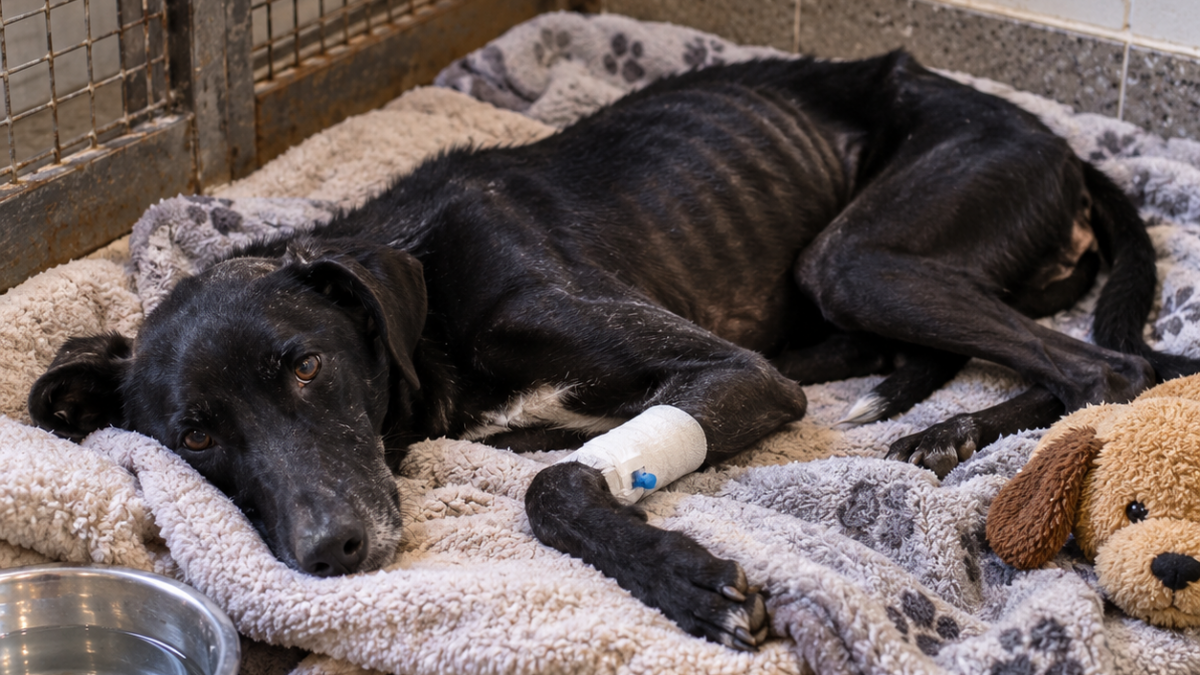
Sombra spent his first night fighting battles we could barely see.
His anemia was severe enough that Elena discussed transfusion if his values continued dropping.
His body temperature remained unstable.
He was dehydrated, but because of his fragile condition the fluids had to be managed carefully.
The X-rays showed injuries around his pelvis and lower spine that explained why standing had become almost impossible.
There were signs that healing had already started badly.
That was what haunted me.
Healing.
His body had been trying to repair itself for weeks while he apparently received little or no proper medical treatment.
Every morning he had awakened in pain.
Every day he had needed food his body didn’t get enough of.
Every night he had somehow survived.
Then, when he became too weak to move normally, somebody left him in a park.
I sat in the waiting room after the clinic officially closed.
The lights in reception had been dimmed.
Only the treatment area remained bright.
At 10:45, Elena walked out.
“He needs calories.”
“Can he eat?”
“Not enough on his own.”
“So what do we do?”
“We place a feeding tube temporarily.”
My stomach tightened.
“Is that dangerous?”
“Everything carries risk right now. But starvation carries a bigger one.”
I signed the consent form.
Sombra didn’t belong to me.
Legally he belonged to nobody we could identify.
Still, that signature felt personal.
As if someone had handed me responsibility for whether this dog saw morning.
I texted our rescue director, Nina.
**We’re admitting him overnight. Severe anemia. Old trauma. Unable to walk.**
Her reply came immediately.
**Do whatever Elena recommends. We’ll figure out the money.**
That was how rescue often worked.
Save first.
Panic about the bill later.
At 12:18 in the morning, I finally walked into the treatment area.
Sombra was awake.
A thin feeding tube had been placed carefully, and blankets covered most of his body.
His eyes followed me.
“Hey.”
His ears moved.
I sat beside the kennel.
“You have a name now.”
No reaction.
“Sombra.”
His eyes remained on me.
“You could at least pretend you like it.”
Nothing.
I put my fingers near the kennel door.
He slowly moved his nose toward them.
Then stopped.
Too tired.
I moved the rest of the distance.
His nose touched my knuckles.
That was our first agreement.
I would keep coming closer when he didn’t have enough strength to do it himself.
The next morning, Sombra was still alive.
That became our first victory.
Not walking.
Not eating.
Alive.
When I arrived at seven, Elena handed me coffee before she gave me the medical update.
That told me the update would not be easy.
“His blood values haven’t improved.”
“But they haven’t dropped?”
“Not dramatically.”
“That sounds good.”
“It means we’re holding.”
I had already learned enough from other rescue cases to understand that holding could be beautiful.
“What about the injuries?”
“We need a specialist to review the images.”
“Surgery?”
“Maybe. Maybe not. He’s too weak for major surgery right now regardless.”
I looked toward him.
“So first we get him strong.”
“We try.”
There was that word.
Try.
I hated uncertain words in those first days.
Try.
Maybe.
Possibly.
We’ll see.
I wanted promises.
Medicine rarely gives them.
Sombra’s meals were prepared like chemistry experiments.
Small amounts.
Carefully measured calories.
Protein.
Electrolytes.
Nutrition designed for a body that had been denied what it needed for too long.
Too much food too quickly could create additional danger.
So even feeding a starving dog required patience.
Every few hours, nourishment went through the tube.
At first Sombra seemed barely aware of it.
Then on the second day, he began sniffing when food was prepared nearby.
Luis noticed.
“He smells it.”
I leaned closer.
“You hungry?”
Sombra’s nose moved again.
That tiny movement made three grown adults smile like idiots.
We offered him a little food by mouth.
He turned away.
Not ready.
“That’s okay,” I said.
His eyes followed the dish after I removed it.
That mattered.
Somewhere inside him, appetite had not disappeared completely.
On the third day, his anemia worsened.
The phone rang at 5:36 in the morning.
I knew before answering that no one calls from a veterinary hospital before sunrise with casual news.
“Mara?”
Elena.
“What happened?”
“His red cell count dropped.”
I sat up.
“Transfusion?”
“We’re preparing.”
“I’ll be there.”
“You don’t have to—”
“I’ll be there.”
Sombra received blood from a donor dog named Bruno, a massive, cheerful Labrador who belonged to one of the technicians.
Bruno entered the clinic wagging as if blood donation were a social event.
I kissed his enormous head.
“You have no idea what you’re doing, do you?”
Bruno licked my face.
“That’s okay.”
The transfusion took time.
Sombra remained quiet throughout.
I sat near him reading messages people had started sending after our rescue posted his photograph.
His story had spread faster than any of us expected.
People asked whether he would walk.
Whether he would survive.
Whether donations were needed.
Others simply wrote:
**Tell him somebody loves him.**
**Please don’t let him think everyone is cruel.**
**I lost my old dog last year. I’m praying this little guy gets another chance.**
**Fight, Sombra.**
Nina printed some of them.
At first I thought it was silly.
A dog couldn’t read.
But that evening, sitting beside him with nothing else I could do, I began reading aloud.
“Karen from Michigan says you’re handsome.”
Sombra slept.
“She’s obviously correct.”
His ear moved.
“Daniel in Ohio says he hopes you’re running someday.”
Nothing.
“Maria from Texas says her rescue dog couldn’t walk either, and now he steals food from the table.”
Sombra opened one eye.
“That one interests you?”
I continued.
Maybe the words meant nothing.
But tone means something.
Presence means something.
And maybe those messages were less for Sombra than for us.
They reminded everyone caring for him that his life had become visible.
That mattered after somebody had tried to make him disappear.
The transfusion helped.
Not dramatically.
But enough.
His gums became slightly pinker.
His breathing steadied.
His eyes seemed more alert.
On Day Five, he licked food from a spoon.
I nearly yelled.
Luis was holding the plate.
“Again.”
Sombra licked once more.
“Did you see that?”
“I am literally holding the spoon.”
“Again.”
Sombra ate less than a tablespoon.
We treated it like Thanksgiving dinner.
Then he slept for three hours.
Recovery was like that.
Five seconds of victory.
Hours of exhaustion.
By Day Seven, Sombra ate a small meal on his own.
We removed the tube only after Elena was convinced he could maintain enough nutrition without it.
I watched him lower his head toward the bowl.
Slow bite.
Pause.
Another bite.
Pause.
No panic.
No greed.
He ate as if chewing itself required concentration.
When he finished half the portion, he rested his chin beside the bowl.
I started crying.
Elena walked in.
“What happened?”
“He ate.”
“I know.”
“He ate by himself.”
“Mara, you watched him.”
“I know.”
She smiled.
“You need sleep.”
That became a recurring professional diagnosis.
The orthopedic specialist reviewed Sombra’s imaging that afternoon.
Dr. Samuel Kim was careful with his words.
“The good news is that I don’t see complete spinal cord disruption.”
I leaned forward.
“And the bad news?”
“The pelvic trauma is significant. There’s muscle wasting. His hind limbs have been unused for a long time. Pain has changed the way he holds himself. And because he was left untreated, healing has happened in less-than-ideal alignment.”
“Can you operate?”
“We could consider surgery for certain parts of the injury, but first we have to ask whether surgery is the best option after this much time.”
“What does that mean?”
“It means I want to see what he can recover with stabilization, pain control, nutrition, and rehabilitation before putting his body through a major procedure.”
“Will he walk?”
He didn’t answer immediately.
I hated him for that silence too.
“I can’t promise it.”
“Could he?”
“Yes.”
“How likely?”
“I don’t assign percentages when I don’t have enough information.”
I looked through the window.
Sombra was asleep.
“What would you do?”
“Give him time.”
So we did.
Time became treatment.
We massaged his hind legs.
Moved joints gently.
Supported him with a sling.
Encouraged him to bear tiny amounts of weight.
At first, his back paws folded underneath him.
He didn’t seem to understand where they were.
That frightened me.
“Does he feel them?”
“Yes,” Samuel said. “Some sensation is there.”
“So why won’t he use them?”
“Pain. Weakness. Neurologic impairment. Learned compensation. Maybe all four.”
We had to teach his body that standing was possible again.
The first rehabilitation session lasted less than five minutes.
Sombra hated it.
For a dog who had surrendered to almost everything, he suddenly discovered protest.
I placed a towel sling beneath his abdomen.
“Ready?”
He looked suspicious.
“We’re standing.”
His eyes narrowed.
“You don’t get a vote.”
I lifted gently.
His front paws found the mat.
His rear legs trembled.
Then he growled.
I froze.
Luis grinned.
“He has opinions.”
Sombra growled again.
I laughed so hard I almost dropped the sling.
“You’re mad.”
He stared at me.
“That is fantastic.”
The dog who had lain on the road without enough strength to resist being lifted now possessed enough energy to tell me exactly what he thought of physical therapy.
I would take anger over surrender every day.
“Ten seconds,” I said.
He growled.
“Five.”
Another growl.
“Fine. Three.”
We completed three.
Then I lowered him.
Sombra immediately turned his head away from me.
“You’re dramatic.”
He refused eye contact.
Luis whispered, “I think he’s punishing you.”
“He’s alive enough to hold a grudge.”
That night, I read him another message.
**Sombra, keep fighting. Someday you’re going to surprise everyone.**
His tail tapped once against the blanket.
I decided that counted as agreement.
The public attention brought something else.
Information.
On Day Nine, a woman named Teresa called the rescue.
“I think I know that dog.”
Nina transferred the call to me.
“How?”
“I’ve seen him in my neighborhood.”
“Where?”
“About three miles from the park.”
My pulse increased.
“With someone?”
“Yes.”
“Do you know who?”
“Not personally.”
She described a small house with a chain-link fence.
A man sometimes kept several dogs outside.
Sombra, she believed, had been one of them.
“Are you sure?”
“No.”
That mattered.
We couldn’t accuse someone because a stranger thought she recognized a dog from an online photograph.
But Teresa gave us something specific.
Sombra had a small white mark beneath his left ear shaped like a crescent.
She remembered it because she had once given him water through the fence during a heat wave.
I walked into his kennel.
Moved his ear.
There it was.
A white crescent.
My stomach turned.
Animal control became involved.
Officer Daniel Ruiz took the lead.
He warned me immediately.
“Do not contact the property owner.”
“I wasn’t planning to.”
“You were absolutely planning to.”
“I was considering it.”
“Don’t.”
He visited Teresa.
Collected a statement.
Then drove past the address.
There were two dogs still on the property.
Both appeared thin.
That gave him enough reason to begin asking questions.
The man living there was named Vernon Hale.
He initially denied owning Sombra.
Then Daniel showed him a photograph.
Vernon changed his story.
“He used to hang around.”
“Not yours?”
“No.”
“Did you feed him?”
“Sometimes.”
“Did he live in your yard?”
“Dogs come and go.”
Daniel asked neighbors.
The answers were less convenient.
Several had seen Sombra behind Vernon’s fence for years.
One had photographs from the previous summer.
Another remembered Sombra being struck by a vehicle approximately one month before his rescue.
That witness, a mechanic named Joel, had seen a brown dog run through an open gate and into the street.
A car clipped him.
Joel stopped.
The dog was alive but couldn’t stand normally.
He approached Vernon.
“You need to take him to a vet.”
Vernon apparently replied:
“He’ll be fine.”
Joel offered to help load the dog into a truck.
Vernon refused.
“Not paying hundreds for some mutt.”
When Daniel told me those words, I felt something hot move through my chest.
Some mutt.
For weeks, Sombra had lived with injuries because somebody decided his pain cost too much.
“What happened after the accident?” I asked.
“Neighbors say they saw him mostly lying in the yard.”
“No veterinarian?”
“None we’ve found.”
“And then the park?”
“We’re working on that.”
Two days later, investigators obtained security video from a convenience store facing one entrance to Westbrook Park.
The image quality was poor.
But a pickup entered around 11:20 the night before Sombra was reported in the road.
It stopped near the far end of the parking lot.
A man got out.
Opened the passenger side.
Then lifted something from the vehicle.
He placed the shape near the grass.
Returned to the truck.
Drove away.
The truck matched Vernon’s.
License plate partially visible.
Enough characters aligned.
Daniel called me.
“We have more work to do, but it’s useful.”
I stared at Sombra.
He was sleeping after rehabilitation.
“Did Vernon know he couldn’t walk?”
The question came out sharper than I intended.
“Mara.”
“He carried him from the truck.”
Silence.
“He carried Sombra out, put him down, and drove away.”
Daniel said carefully, “That’s what the footage appears to show.”
I had imagined abandonment before.
The reality was worse.
Sombra had not been capable of following.
There had been no chance he would chase the vehicle.
No chance he would find his way home.
Someone selected a place, carried him out, and made sure the dog’s weakness would prevent him from returning.
For the first time, I understood why people sometimes use the word revenge when they hear rescue stories.
I wanted Vernon to feel one day of what Sombra had experienced.
One hour.
The hunger.
The pain.
The confusion.
Watching someone leave while your body cannot follow.
But anger isn’t justice.
And revenge doesn’t rehabilitate a dog’s legs.
So I did what Daniel told me.
I stayed away.
Then I went into Sombra’s rehabilitation room.
He was standing in the sling.
Growling at Luis.
“Good,” I said.
Luis looked at me.
“He hates us.”
“No. He trusts us enough to complain.”
Sombra turned toward my voice.
His tail moved.
My anger softened.
“That’s our revenge,” I whispered.
Luis frowned.
“What?”
“Nothing.”
But I knew.
If someone had wanted Sombra to disappear, then survival would be the answer.
The investigation could handle the rest.
On Day Twelve, Sombra supported his own rear weight for less than two seconds.
We had the sling loose beneath him.
Samuel said, “Don’t lift.”
“I’m not.”
Sombra’s legs trembled.
One second.
Two.
Then he collapsed into the sling.
I gasped.
Samuel smiled.
“There.”
“That counted?”
“That absolutely counted.”
I hugged Sombra.
He looked annoyed.
“Two seconds.”
His tail wagged.
“Two beautiful seconds.”
Day Fourteen brought a setback.
Sombra developed a fever.
His appetite dropped.
Bloodwork showed inflammation.
Everyone immediately feared infection.
For twenty-four hours, he became frighteningly quiet again.
The growling stopped.
That was how I knew he felt terrible.
I sat beside him through most of the night.
“You’re not allowed to go backward.”
His eyes remained closed.
“You hear me?”
Nothing.
I touched his front paw.
“You’re supposed to annoy me tomorrow.”
His paw stayed still.
I hated how quickly fear returned.
One bad day and suddenly I was back on that road, holding a dog whose body seemed ready to quit.
The veterinarians adjusted antibiotics and ran additional tests.
Fortunately, the problem appeared treatable.
By the second morning, his fever was lower.
By evening, he ate several bites.
Then I tried repositioning his blanket.
Sombra growled.
I laughed.
“There you are.”
The technician beside me smiled.
“We’ve established growling as a vital sign.”
“Yes.”
Sombra looked deeply unimpressed by our medical standards.
Day Seventeen.
Sombra stood for four seconds.
Day Nineteen.
Seven seconds.
Day Twenty-One.
He shifted one rear paw forward.
Not a full step.
More like his body remembered a movement it had abandoned weeks earlier.
Samuel saw it.
“Again.”
We reset him.
Nothing.
“Come on,” I whispered.
Sombra stared.
I held chicken several inches ahead.
Luis laughed.
“Bribery.”
“Rehabilitation science.”
Sombra leaned forward.
His back leg moved.
A fraction.
“That.”
Samuel pointed.
“He’s initiating.”
My heart hammered.
“What does that mean?”
“It means the signal is getting through.”
I crouched in front of Sombra.
“You hear that?”
He reached for the chicken.
“Yes, you can have it.”
We didn’t push further.
Tiny victories can be damaged by impatience.
That became one of the biggest lessons Sombra taught me.
Everyone wants transformation.
Before-and-after photographs.
The first walk.
The dramatic ending.
But healing mostly happens in the middle.
In repetitions nobody photographs.
Three seconds standing.
One extra bite.
A paw moving half an inch.
Five minutes of exercise.
Rest.
Medication.
Again.
Again.
Again.
Meanwhile, Vernon’s case advanced.
Animal control removed the two remaining dogs from his property after veterinary examinations documented inadequate condition and care concerns.
They were not as critical as Sombra.
Thankfully.
But both needed treatment.
One had a severe ear infection.
The other was underweight with untreated skin disease.
Vernon’s attorney argued that financial hardship had made veterinary care difficult.
I understood financial hardship.
Rescue work introduced me to good people who could not afford expensive treatment.
But there was a difference between being unable to pay and refusing help.
Neighbors had offered.
Joel had offered transportation after the accident.
Teresa had given water through the fence.
Several local organizations provided low-cost services.
Vernon had not asked.
He had waited until Sombra became a burden.
Then removed the burden.
That distinction mattered.
Daniel told me not to obsess over the legal process.
Again, irritatingly, he was right.
“You won’t control the outcome.”
“I know.”
“So control what you can.”
I looked at Sombra.
Day Twenty-Four.
Standing nearly fifteen seconds with minimal support.
“I am.”
On Day Twenty-Six, Samuel changed the plan.
“No sling tomorrow.”
I stared at him.
“What?”
“We’ll keep it around him but loose.”
“What if he falls?”
“We catch him.”
“That is an irresponsible amount of confidence.”
“He’s ready to try.”
I looked at Sombra.
He was chewing on the edge of his therapy mat.
“You sure?”
Samuel smiled.
“No.”
I hated medical professionals.
The next morning—Day Twenty-Seven—everyone pretended it was a normal rehabilitation session.
Nobody believed that.
Nina appeared even though she rarely attended therapy.
Elena happened to “need something” from the rehabilitation room.
Luis brought his phone.
Samuel told him to put it away.
Then changed his mind.
“Actually, record.”
Sombra stood on the mat.
I crouched in front of him holding chicken.
A loose sling hung beneath his belly without carrying weight.
“Okay, buddy.”
He looked at me.
“Come here.”
Nothing.
His legs trembled.
“Come on.”
Sombra lowered his head.
For a second, I thought he was going to sit.
Then his right rear paw moved.
Forward.
He shifted weight.
Left rear paw.
Forward.
I stopped breathing.
One step.
Then another.
The room went silent.
Sombra took a third.
His body wobbled.
Samuel moved closer but didn’t touch him.
“Let him.”
Fourth step.
Fifth.
Sombra reached me.
I caught him against my chest.
The entire room erupted.
Luis yelled.
Nina cried.
Elena covered her mouth.
Samuel laughed.
I buried my face against Sombra’s neck.
“You walked.”
His tail beat against my arm.
“You walked.”
He licked my chin.
For twenty-seven days, we had asked whether Sombra’s body could remember how to carry him.
It had.
Not perfectly.
Not strongly.
But enough.
That evening, the video spread through the same pages that had shared his first photograph.
Thousands of people who had seen him lying helpless in the road now watched five awkward steps.
The messages came faster than we could read them.
**GO SOMBRA!**
**That’s the strongest five steps I’ve ever seen.**
**Whoever left him doesn’t deserve him.**
**Look at that tail!**
**Keep going, little shadow.**
One message said:
**They left him because he couldn’t walk. Imagine their faces seeing this.**
I read that one twice.
Then I deleted it from my screen.
Not because I disagreed with the emotion.
Because I didn’t want Vernon’s face anywhere inside that moment.
Sombra’s first steps belonged to Sombra.
Not to the person who failed him.
That distinction became important as the legal case drew public attention.
A local reporter contacted the rescue.
“Would you comment on the charges?”
Nina handled it.
She kept the statement simple.
The rescue’s concern was animal welfare.
Sombra and the other dogs were receiving care.
The legal process should be allowed to proceed.
Privately, I wanted more.
I wanted everyone to know exactly what abandonment looked like.
I wanted them to see the park footage.
The X-rays.
The road.
The feeding tube.
Then I looked at Sombra sleeping in his new room at the shelter.
That was not what he needed.
Sombra didn’t need to become evidence forever.
He needed to become a dog.
So we shifted attention back to recovery.
Day Thirty-One.
Sombra walked twelve feet.
Day Thirty-Five.
He managed a controlled bathroom trip outside without the sling carrying his weight.
Day Forty.
He tried to trot.
It was terrible.
Three uneven steps and a sideways wobble that nearly sent him into a flower pot.
I caught him.
“No.”
Tail wag.
“You are not ready.”
Another wag.
“You walked five steps two weeks ago and now you think you’re an athlete?”
He licked my hand.
We introduced hydrotherapy when Samuel approved.
The water supported Sombra’s body while allowing him to move his legs more naturally.
He hated the first session.
Not fear.
Insult.
The expression on his face clearly suggested we had violated some important agreement.
“You’re fine.”
Sombra stared.
“It’s warm.”
Stare.
“Other dogs pay good money for pools.”
Stare.
Then he began moving.
One paw.
Another.
His legs worked beneath the water.
Within a few sessions, his gait improved.
His muscles returned slowly.
His spine and pelvis would never be exactly as they had been before the accident.
Samuel warned us that arthritis could come earlier.
He might always walk with a slight irregularity.
None of us cared.
Perfect walking had never been the goal.
Comfortable independence was.
By the time Sombra left the hospital and entered full-time shelter recovery, his personality transformed.
The motionless dog from the road disappeared.
In his place emerged a shameless manipulator.
He learned which volunteers carried treats.
He learned that sad eyes worked particularly well on new people.
He learned the kitchen schedule.
He learned that if he stood by the refrigerator long enough, somebody eventually opened it.
One morning, I found him sitting beside Luis while Luis ate breakfast.
“Don’t.”
Luis looked innocent.
“Don’t what?”
“Feed him.”
“I haven’t.”
Sombra was chewing.
I pointed.
“What is in his mouth?”
Luis looked down.
“Evidence?”
Sombra swallowed.
“Unbelievable.”
His tail wagged.
His coat became healthier.
His weight increased.
His ribs disappeared beneath muscle.
His eyes changed most.
At intake, Sombra had looked through people more than at them.
That distant expression faded.
Now he expected interaction.
If I entered without greeting him, he followed me.
If I sat down, he leaned against my leg.
If somebody stopped petting him too quickly, he pushed his nose beneath their hand.
The dog who once seemed ready to disappear had become extremely committed to being noticed.
Good.
He deserved that.
About two months after rescue, Vernon appeared in court.
The evidence included veterinary reports, witness statements, photographs, video from the park area, and information about the other dogs.
The final outcome was less dramatic than angry strangers online wanted.
Real cases usually are.
There was no cinematic speech.
No crowd cheering.
No judge announcing some enormous punishment.
Vernon eventually accepted responsibility through a plea arrangement related to neglect and abandonment.
He was required to pay fines and restitution toward veterinary expenses, lost ownership rights to the dogs removed from his property, and faced court-imposed restrictions involving future animal ownership for a period determined by the case.
Some people complained that it wasn’t enough.
I understood them.
Sombra had suffered nearly a month after the injury.
Money couldn’t restore that.
A court order couldn’t erase the park.
But something happened during the restitution discussion that gave me more satisfaction than any dramatic punishment could have.
The rescue’s veterinary expenses for Sombra had become substantial.
Hospitalization.
Emergency stabilization.
Transfusion.
Feeding support.
Imaging.
Specialist consultations.
Medication.
Rehabilitation.
Hydrotherapy.
Follow-up testing.
A portion of the restitution Vernon was ordered to pay went directly toward those costs.
Nina showed me the paperwork.
“Thought you’d appreciate this.”
I read the amount.
Then looked at Sombra.
He was sleeping on an orthopedic bed donated by one of his supporters.
I laughed once.
“What?”
“Nothing.”
“Come on.”
“The man who said a veterinarian wasn’t worth paying for is now helping pay the veterinary bill anyway.”
Nina smiled.
“There it is.”
“That’s enough revenge for me.”
And it was.
I didn’t need Vernon humiliated.
I didn’t need to watch his life collapse.
I needed the system to say what happened to Sombra mattered.
The veterinary care he refused had value.
The dog he discarded had value.
The suffering was not invisible.
And he could not simply walk away from it twice.
The two other dogs removed from his property were eventually cleared for adoption.
Both found homes.
That mattered too.
Sombra’s case had not only changed his future.
It had interrupted what might have happened to them.
For me, that was consequence with purpose.
By the third month, Sombra was ready for foster care.
I should have been excited.
Instead, I became absurdly protective.
Nina noticed immediately.
“You’re going to be a nightmare.”
“What?”
“For whoever fosters him.”
“I just want the correct home.”
“Yes. That’s what nightmares say.”
Sombra still needed exercises.
Medication for discomfort as required.
Follow-up orthopedic evaluations.
Controlled activity.
He could walk, but reckless jumping wasn’t ideal.
Stairs needed care.
His diet mattered.
We wanted someone patient.
Someone who understood that recovery wasn’t over simply because the dramatic part had ended.
A woman named Caroline Reed applied.
She was fifty-nine and worked from home as a copy editor.
She had recently lost a senior terrier named Max.
Her house was one story.
Small fenced yard.
No other pets.
Quiet neighborhood.
Her application looked excellent.
I distrusted it immediately.
Nina stared at me.
“What is wrong with her?”
“Nothing.”
“Exactly.”
“That is suspicious.”
“Mara.”
“What?”
“You cannot investigate a nice woman because you’re emotionally attached.”
“Watch me.”
Caroline came to meet Sombra.
I gave her the full medical history.
Not the polished rescue version.
Everything.
“He may develop arthritis.”
“Okay.”
“He still occasionally loses balance.”
“Okay.”
“He needs continued exercises.”
“Okay.”
“He cannot gain excessive weight.”
“Understood.”
“He’s food motivated enough to commit crimes.”
She smiled.
“So was Max.”
Sombra entered the room.
Caroline didn’t rush him.
She sat on the floor.
Waited.
Sombra approached.
Sniffed her.
Then sat beside her.
After a few minutes, he leaned against her shoulder.
I hated her.
Not really.
But a little.
“He likes you.”
Caroline scratched beneath his chin.
“The feeling seems mutual.”
The foster trial began three days later.
I packed Sombra’s things as though he were leaving for college.
Food.
Medication.
Exercise instructions.
Orthopedic mat.
Favorite blanket.
Two toys.
Medical folder.
Emergency contacts.
Nina removed three unnecessary items while I wasn’t looking.
When Caroline arrived, I gave her instructions for almost forty minutes.
“Mara,” she finally said gently.
“Yes?”
“I promise I’m bringing him back for the follow-up visit.”
“I know.”
“And this is foster care.”
“I know.”
“And you have my phone number.”
“I know.”
Sombra was sitting beside her.
Traitor.
I crouched.
“You behave.”
He licked my nose.
“You don’t jump.”
Tail wag.
“No stairs.”
Wag.
“Don’t manipulate her for chicken.”
Caroline laughed.
“I feel that rule won’t survive tonight.”
They left.
I stood in the parking lot.
Nina came beside me.
“You’ve fostered out hundreds of dogs.”
“Not him.”
“I know.”
That evening, Caroline sent a photograph.
Sombra was asleep on her couch.
Not his bed.
The couch.
I replied:
**He isn’t supposed to jump.**
She answered:
**He didn’t. I lifted him.**
Then another message:
**He looked at the couch until I understood my responsibility.**
I smiled.
Good.
He had trained her already.
The one-week foster period became two.
Then four.
Sombra’s gait continued improving.
Caroline walked him carefully every morning.
She kept his rehabilitation appointments.
She learned the exercises.
She bought rugs for every slippery floor even though I had only suggested two.
She built a shallow ramp to the back porch.
She sent me videos.
Sombra sniffing flowers.
Sombra sleeping beneath her desk while she worked.
Sombra barking at a squirrel.
Sombra stealing a dish towel.
The dish towel video might have been my favorite.
Caroline filmed herself saying:
“Sombra.”
He froze.
A blue towel hung from his mouth.
“Drop it.”
He slowly turned away.
“Sombra.”
He walked faster.
She followed.
“You cannot run well enough to escape me.”
Sombra attempted exactly that.
His crooked little trot carried him around the dining table.
Caroline laughed.
So did I.
A dog once incapable of standing had become a thief who believed he could outrun justice.
That was recovery.
Not a perfect gait.
Mischief.
At Sombra’s next examination, Samuel watched him cross the room.
“Look at that.”
I smiled.
“What?”
“He’s compensating very well.”
“Translation?”
“He’s doing great.”
“Can you say it again?”
Samuel sighed.
“He’s doing great.”
“More enthusiasm.”
“No.”
Sombra’s pelvis had healed as much as we could reasonably expect.
His muscles supported him well.
There was some permanent structural change.
But no immediate surgery was necessary.
We would monitor him.
Keep his weight healthy.
Continue moderate activity.
Manage arthritis if it developed.
Sombra would never move exactly like a dog who had never been injured.
But he could walk.
He could play.
He could live without constant pain.
That was more than anyone had promised.
Caroline came to the appointment.
After Samuel left, she stayed quiet.
I knew what was coming.
“Say it.”
She looked at me.
“I want to adopt him.”
I pretended to examine Sombra’s paperwork.
“Do you?”
“Yes.”
“You understand everything.”
“Yes.”
“Follow-up costs?”
“Yes.”
“Possible arthritis?”
“Yes.”
“His history?”
“Yes.”
“His towel theft?”
“That is our greatest challenge.”
I finally looked at her.
Sombra sat between us.
Then he moved toward Caroline.
Rested his head against her knee.
She put one hand on his neck.
“I know he was abandoned because somebody decided his needs had become too much.”
Her voice softened.
“I need you to understand something, Mara.”
“What?”
“If his needs become more difficult, he stays.”
I felt tears immediately.
Caroline continued.
“If he needs medication, he stays. If he needs another surgery someday, we figure it out. If he gets arthritis, we manage it. If he eventually needs help walking again, we help him.”
She looked down at Sombra.
“He doesn’t lose his home because his body changes.”
That was the sentence.
The one I hadn’t realized I needed.
I looked at Sombra.
The first person had apparently kept him while he was useful enough to require little.
When injury made care harder, they abandoned him.
Caroline was promising the opposite.
His needs would not determine whether he belonged.
“Okay,” I whispered.
“Okay?”
“Fill out the papers.”
Caroline started crying.
Then I did.
Sombra looked between us as though both women had become unstable.
The adoption became final that afternoon.
Caroline changed nothing about his name.
“Shadow suits him,” she said.
At first I wasn’t sure.
The name had come from darkness.
From the animal we found almost disappearing into the pavement.
But over time, it gained another meaning.
Sombra followed Caroline everywhere.
Kitchen.
Office.
Yard.
Laundry room.
He became her literal shadow.
A name that began as a memory of darkness became a description of belonging.
I liked that better.
The first anniversary of Sombra’s rescue arrived on a Thursday.
Caroline invited several of us to her house.
Nothing elaborate.
Elena.
Luis.
Nina.
Daniel.
Samuel.
A few volunteers.
Sombra walked around greeting everyone.
No sling.
No feeding tube.
No blanket beneath a hospital monitor.
He had filled out into a healthy little dog.
His gait still had a slight hitch.
I loved it.
That irregular step was proof.
Every time his rear leg moved forward, I remembered the road.
Caroline brought out a dog-safe cake.
Luis objected.
“I donated blood through Bruno and nobody made us a cake.”
“You personally donated nothing,” Elena said.
“Emotional support.”
Bruno had died peacefully of old age several months earlier.
We toasted him too.
Without Bruno’s blood, Sombra’s story might have ended very differently.
Caroline cut a tiny piece.
Sombra swallowed it without chewing.
“Classy,” I said.
Tail wag.
Daniel stood beside me.
“Worth all those phone calls?”
I looked at him.
“You complained constantly.”
“I did not.”
“You told me to stop asking you for case updates.”
“Because you asked every six hours.”
“That seems reasonable.”
He smiled.
Then his expression became serious.
“You know the legal restriction on Vernon is still active.”
“I know.”
“No new animals reported.”
“Good.”
“That’s the best outcome.”
I looked toward Sombra.
Caroline was helping him onto his orthopedic bed.
“Yes.”
I meant it.
At first, I had wanted Vernon to suffer.
Now, I wanted something simpler.
No more dogs suffering because of him.
That was enough.
Years passed.
Sombra grew older.
His old injury eventually brought the arthritis Samuel predicted.
The first sign was hesitation on cold mornings.
Caroline called me.
“He seems stiff.”
I drove over even though she had already scheduled a veterinary appointment.
Sombra stood when I arrived.
Walked toward me.
Slowly.
“Hey, road warrior.”
His tail wagged.
I crouched.
“You getting old?”
He leaned into my hands.
Caroline frowned.
“I hate that.”
“What?”
“The word old.”
“Why?”
“Because everybody used his physical condition against him once already.”
I understood.
But age wasn’t punishment.
It was something Sombra had almost never received.
“He gets to be old,” I said.
Caroline looked at me.
“He earned it.”
That changed her expression.
Yes.
Old age was not tragedy for Sombra.
It was victory.
The dog who nearly died on the road reached ten.
Then eleven.
Every year became another answer to the person who abandoned him.
Not revenge in the dramatic sense.
Something stronger.
Continuation.
Sombra developed arthritis medication.
Then joint supplements.
Caroline replaced the shallow ramp with an even gentler one.
She bought another orthopedic bed because apparently three were insufficient.
When his walks shortened, she adjusted.
When cold weather made his joints ache, she warmed a blanket before bed.
Never once did she describe him as a burden.
I noticed that.
One winter morning, Sombra slipped.
Nothing severe.
But the fall frightened Caroline.
She called me crying.
“What if he stops walking again?”
I drove over.
Sombra was fine, merely offended.
The veterinarian found no new injury.
Just aging joints.
That evening Caroline sat beside him.
“I promised he wouldn’t lose his home if this happened.”
“He won’t.”
“I know.”
She looked at me.
“But I’m scared.”
“Being scared doesn’t break the promise.”
She touched his back.
“What if someday he needs a cart?”
“Then we get a cart.”
“What if he can’t control his bladder?”
“Then you buy pads.”
“What if—”
“Caroline.”
She stopped.
“You don’t have to solve his entire old age tonight.”
Sombra sighed.
I smiled.
“He agrees.”
Caroline laughed.
We took it one day at a time.
Exactly like the first twenty-seven.
That was another symmetry I didn’t notice until later.
Recovery had taught us patience when Sombra was young enough to regain movement.
Aging required the same patience in reverse.
Slow changes.
Small accommodations.
No panic.
No shame.
A body can become less capable without becoming less worthy.
Sombra already knew that better than any of us.
At twelve, he could no longer manage long walks.
Caroline bought a wagon.
The first time she placed him inside, Sombra looked insulted.
“He hates it,” she said.
“He hated hydrotherapy too.”
“He looks ridiculous.”
“He looks important.”
We took him to the park.
He rode for most of the distance, then walked slowly through the grass.
Children stopped to pet him.
Caroline always told them:
“He used to not be able to walk at all.”
One boy looked at Sombra.
“Was he born like that?”
“No.”
“He got better?”
“He did.”
The boy scratched Sombra’s neck.
“Cool.”
Children have an efficient way of handling miracles.
Cool.
Then they move on.
I liked that.
Sombra didn’t need pity.
He needed someone to scratch behind his ear.
His final year came gently.
That matters.
No dramatic accident.
No return to the road.
No abandonment.
Age simply began asking more from his body.
Arthritis.
Kidney changes.
Reduced appetite.
Longer sleep.
Caroline adjusted everything.
By then Sombra’s face had become almost white.
The small dog rescued as an emaciated adult was now unmistakably old.
The first time I saw his completely gray muzzle, I had to turn away.
Caroline noticed.
“Why are you crying?”
“I’m not.”
“You are.”
“Dust.”
“In my living room?”
“Very dusty house.”
She smiled.
I looked at Sombra.
“He wasn’t supposed to get this.”
“What?”
“Gray.”
Caroline’s eyes filled too.
“No.”
He had been left because someone apparently believed his damaged body no longer justified effort.
And somehow he had survived long enough to become an old dog with a wardrobe of blankets.
That felt like defiance.
On his final rescue anniversary, we did not hold a party.
Sombra tired easily.
Instead, I visited Caroline.
We sat in the backyard.
Sombra slept between us.
The afternoon was warm.
Birds moved through the hedge.
At one point, Sombra woke and looked toward me.
“Hey.”
His tail moved slowly.
“I remember when that was the most exciting thing you could do.”
He closed his eyes.
Caroline said, “Tell me again.”
“What?”
“The first day.”
She knew the story.
She had heard it dozens of times.
Still, I told her.
The road.
The cars.
His head lifting.
The man from the store.
The way Sombra surrendered when I lifted him.
The late clinic.
Elena’s face.
The anemia.
The X-rays.
The first night.
Caroline stroked Sombra.
“Do you think he remembers?”
“Some of it.”
“Does that bother you?”
I thought.
“No.”
“Why?”
“Because he knows what came after.”
That was the part that mattered.
Dogs may remember fear.
Pain.
Smells.
Places.
But memory doesn’t have to own the present.
Sombra had spent years gathering evidence against his worst memories.
Hands could hurt.
But Caroline’s hands helped.
Cars could mean abandonment.
But cars also meant parks.
Being lifted could mean being discarded.
But later it meant being carried to bed when his joints hurt.
A road once nearly ended his life.
Thousands of roads afterward took him home.
That was healing.
Not forgetting.
Relearning.
A few months later, Caroline called before dawn.
That voice.
I knew it immediately.
“Mara.”
“What happened?”
“He won’t get up.”
I drove straight over.
Sombra lay on his bed beside the living room window.
His breathing was calm but weak.
He lifted his head when I entered.
Barely.
“Hey, shadow.”
Tail movement.
Tiny.
Still there.
Caroline sat beside him.
“The vet is coming.”
I nodded.
Sombra had stopped eating the previous evening.
Now he refused water.
His body wasn’t in obvious distress.
It simply seemed finished.
The house-call veterinarian examined him.
Advanced kidney failure.
Pain from arthritis despite medication.
Weakness.
At his age, hospitalization might temporarily change numbers.
It probably would not restore the life he enjoyed.
Caroline asked the same question every loving person eventually asks.
“If we take him in, can they fix this?”
The veterinarian answered gently.
“They may be able to stabilize parts of it for a little while.”
“Will he feel like himself again?”
A pause.
“I’m not confident.”
Caroline closed her eyes.
Then she looked at Sombra.
Years earlier, somebody had faced a dog who could no longer walk and chosen abandonment.
Now Caroline faced an old dog whose body was failing.
She chose presence.
That contrast hit me so hard I nearly couldn’t speak.
She didn’t carry him to a park.
Didn’t leave him beside a road.
Didn’t decide that difficult care erased responsibility.
She sat down.
Put Sombra’s head in her lap.
And stayed.
“I promised you.”
Her voice shook.
Sombra’s eyes remained on her.
“You remember?”
Tail tap.
“You stay.”
She cried.
“And I stay.”
I looked away.
The veterinarian prepared the medication.
Before anything happened, Caroline offered Sombra a tiny piece of chicken.
He sniffed.
Then ate it.
We laughed through tears.
“Of course.”
Another piece.
He refused.
One was enough.
The veterinarian gave the first medication.
Sombra relaxed.
His body, tight from discomfort, softened against Caroline.
I sat on the floor beside them.
I touched the white fur beneath his left ear.
The crescent mark was still there.
The detail that had once helped identify where he came from.
I had almost forgotten it.
“Look at you,” I whispered.
Sombra breathed slowly.
“You made everybody work for this ending.”
His eyes closed.
“You couldn’t even stand when we met.”
Another breath.
“Then five steps.”
Another.
“Then you stole towels.”
Caroline laughed softly.
“Many towels.”
“Then you got old.”
My voice broke.
“That was the best part.”
The final medication entered.
Sombra remained in Caroline’s arms.
No road.
No traffic.
No strangers passing.
No wondering whether somebody would stop.
He knew exactly who was holding him.
Caroline leaned close.
“You were never too much.”
His breathing slowed.
“Never.”
I put my hand against his shoulder.
“You mattered from the beginning.”
One last breath.
Then quiet.
Sombra died at home.
The dog somebody abandoned because he couldn’t walk died after years of walking through the same front door every day.
He died with his name known.
Medical records thick from years of care.
Photographs covering Caroline’s phone.
Beds in three rooms.
A favorite park.
A ridiculous wagon.
Friends.
Routine.
History.
Family.
The person who abandoned him had left him as though injury had erased his worth.
Sombra spent the rest of his life disproving that decision.
Not by becoming perfectly healthy.
He never did.
His gait remained slightly crooked.
Arthritis came.
Age came.
His body needed help again eventually.
The victory was that none of those things cost him his home.
After he died, Caroline donated the wagon to the rescue.
She kept his first blanket.
The one I had packed for his foster stay years earlier.
We placed Sombra’s photograph in the rehabilitation room at the shelter.
Not the road photograph.
I refused.
That wasn’t how I wanted new volunteers to meet him.
We used a photograph from three years after adoption.
Sombra was standing in Caroline’s yard.
His posture slightly crooked.
Tail raised.
Eyes bright.
Beneath it we placed a small plaque:
**SOMBRA — DAY 27 WAS ONLY THE BEGINNING.**
People asked what it meant.
Then we told them.
About five steps.
About the month-old injury.
About severe anemia.
About tube feeding.
About messages from strangers.
About rehabilitation.
About a woman who promised his body would never cost him his home again.
Sometimes new volunteers cried.
Sometimes they became angry.
I always told them the same thing.
“Don’t spend too much time on the person who left him.”
Why?
Because Sombra’s story became larger than Vernon.
Much larger.
His first owner contributed neglect.
Hundreds of other people contributed everything that came after.
Bruno gave blood.
Elena stayed late.
Samuel designed rehabilitation.
Luis took the growling personally.
Nina found money.
Daniel built the case.
Strangers donated.
Caroline gave him years.
If cruelty belonged to one chapter, compassion wrote the rest.
That was the revenge.
Not destroying Vernon.
Making his decision irrelevant.
He abandoned Sombra as a dog who could no longer walk.
Sombra became known as the dog who walked again.
He abandoned him because medical care seemed too expensive.
His court-ordered restitution helped pay for the care anyway.
He treated Sombra as disposable.
Sombra became unforgettable.
Years later, Boa Nova created a rehabilitation assistance fund using donations made in Sombra’s memory.
It helped dogs recovering from fractures, neurologic injuries, orthopedic surgery, and severe neglect.
The first recipient was a shepherd mix named Benny who had been found after a construction-site accident.
Benny needed months of therapy.
His foster family couldn’t afford all of it.
The Sombra Fund covered the difference.
Benny walked again.
Then a little terrier named Mocha.
Then an older hound named Esther.
Then dozens more.
Every time a dog took difficult first steps in the therapy room, someone pointed toward Sombra’s photograph.
“That’s your competition.”
Somebody eventually placed a tiny handwritten note beneath the frame.
**Five steps count.**
I left it.
Because they do.
We spend our lives waiting for dramatic transformations.
Sometimes the most important change is five steps.
Or one bite.
One tail wag.
One night survived.
One person stopping.
One promise kept.
Those moments become lives.
Years after Sombra was gone, I drove past Westbrook Park.
I hadn’t intended to stop.
But I did.
The road had been resurfaced.
New trees lined part of the sidewalk.
People jogged.
Children played near the field.
Nothing about it looked like the place where a starving dog had once collapsed.
I parked.
Walked to the approximate spot.
Traffic passed.
For several minutes, I simply stood there.
I tried to see what I had seen that evening.
Bones beneath dull fur.
Hind legs that wouldn’t cooperate.
Eyes too tired for fear.
Then I remembered something else.
The moment I lifted him.
How his head dropped against my shoulder.
How completely he surrendered.
At the time, I thought he had given up.
I was wrong.
Maybe surrender can mean something else.
Maybe sometimes it means:
I can’t carry myself anymore.
You carry me.
Sombra did that.
For a little while, we carried him.
Then we taught him to carry himself again.
Later, Caroline carried him when age took strength away.
And at the end, she carried the grief after he was gone.
That’s what love does.
The weight moves between us.
Nobody remains strong forever.
The question is whether somebody stays when it becomes their turn to carry.
Sombra’s first person didn’t.
Everyone afterward did.
I stood beside the road and smiled.
“You got the last word, buddy.”
Of course, he didn’t answer.
But I knew exactly what his answer would have looked like.
One crooked step.
Then another.
Then another.
Toward home.
Years after Sombra was gone, Caroline told me there was one part of his story she still couldn’t talk about without crying.
It wasn’t the road.
It wasn’t the video from the park.
It wasn’t even the final morning when she held him as his breathing slowed.
It was the first winter after his adoption.
I remembered that winter.
The cold arrived early, and Sombra’s old injuries reacted almost immediately. On damp mornings, his rear legs stiffened. He would stand beside his bed, hesitate, and look toward Caroline as though asking his body for permission to move.
She called me after the first bad morning.
“He won’t walk.”
My stomach dropped.
“What do you mean?”
“He stood up, took two steps, and sat back down.”
“Is he crying?”
“No.”
“Dragging anything?”
“No.”
“Did he slip?”
“I don’t think so.”
“Call Samuel.”
“I already did.”
Of course she had.
By the time I reached the clinic, Sombra was sitting beside Caroline with a blanket around his shoulders.
He looked mildly annoyed.
Samuel examined him carefully, manipulated his hips, checked his reflexes, and reviewed new X-rays.
Finally he looked at us.
“This is arthritis.”
Caroline stared at him.
“That fast?”
“His pelvis healed after significant trauma. The joints aren’t moving like normal joints. Cold weather can make everything worse.”
“Can we fix it?”
Samuel’s answer was gentle.
“We can manage it.”
There was that word again.
Manage.
Not cure.
Not erase.
Manage.
Medication.
Warmth.
Controlled activity.
Weight management.
Physical therapy.
Maybe injections later if he needed them.
Caroline looked at Sombra.
“He’s going to hurt forever?”
“Not necessarily all the time.”
“But this doesn’t go away.”
“No.”
For a moment I saw something move across her face.
Fear.
Not of the cost.
Not of the inconvenience.
Fear of becoming the next person who failed him.
Later, in the parking lot, she said:
“This is what happened before.”
“What?”
“He couldn’t walk.”
“This isn’t the same.”
“It feels the same.”
“No.”
She looked at me.
I opened Sombra’s car door.
“He’s older now. He’s cared for. His pain is being treated. He has follow-up. He has you.”
Sombra looked between us.
“The injury doesn’t repeat just because his legs hurt.”
Caroline swallowed.
“I know.”
“Do you?”
She nodded slowly.
Then she whispered:
“I just don’t ever want him to think he’s being left because his body got difficult again.”
That sentence stayed with me.
Because trauma doesn’t belong only to the animal.
Sometimes the people who love survivors become afraid of repeating what someone else did.
Caroline had inherited Sombra’s history along with him.
Every stiff morning reminded her of the road.
Every stumble made her wonder whether she was missing something.
Every expensive medical decision carried the shadow of the person who had decided Sombra wasn’t worth one.
So she responded in the opposite direction.
Too much, sometimes.
If Sombra coughed once, she called the clinic.
If he skipped breakfast, she texted me.
If he slept longer than usual, she counted his breaths.
One afternoon I found her kneeling beside him while he slept.
“What are you doing?”
“Watching.”
“For what?”
“I don’t know.”
I sat beside her.
“Sombra is allowed to be an old dog.”
She looked at me.
“He’s not that old.”
“He’s older than when we found him.”
“That doesn’t mean—”
“Mara.”
I smiled.
“You’re arguing with yourself.”
She looked back at Sombra.
His mouth was slightly open.
Completely relaxed.
“You know what I think he wants right now?”
“What?”
“To sleep without you checking whether he’s dying.”
That made her laugh.
It also made her cry.
We learned balance together.
Care without panic.
Attention without fear.
Love without turning every quiet moment into a warning.
Sombra taught us that recovery did not mean his body would never hurt again.
It meant pain would no longer happen alone.
That difference mattered.
The following spring, he surprised everyone again.
Caroline took him to the park on one of the first warm mornings of the year.
His joints were moving better.
He walked slowly along a flat path.
Then he saw a squirrel.
I was there.
I watched his entire body change.
Ears up.
Head forward.
Tail high.
“No,” Caroline said immediately.
Sombra looked at her.
The squirrel ran.
Sombra launched.
Not fast.
Not gracefully.
But with enormous confidence.
His strange little gait became a lopsided trot.
Caroline shouted:
“Sombra!”
I started laughing.
He made it perhaps fifteen feet before deciding the squirrel had clearly trained professionally for this encounter.
He stopped.
Turned.
Then trotted back.
Caroline put both hands on her hips.
“You are not built for that.”
Sombra’s tail wagged.
“You have arthritis.”
Wag.
“You have old pelvic injuries.”
Wag.
“You almost gave me a heart attack.”
More wagging.
I crouched.
“Worth it?”
Sombra licked my hand.
That day Caroline finally stopped looking at every limitation as a tragedy.
Sombra could not run like other dogs.
So what?
He had chased a squirrel.
Badly.
Happily.
That was enough.
His world did not need to become normal.
It only needed to become his.
That became something we said often at the rescue.
Not every recovery ends with normal.
Sometimes recovery means comfortable.
Sometimes independent.
Sometimes adapted.
Sometimes simply joyful in a different shape than before.
Sombra never cared how his walk looked.
Humans did.
We saw the uneven rear leg.
The slight pelvic tilt.
The slower turn.
Sombra saw grass.
Food.
Caroline.
Sunlight.
A squirrel.
Maybe animals are wiser because they don’t compare themselves to the body they were supposed to have.
They just use the one that still carries them toward something they want.
That lesson followed me into other cases.
A year after Sombra’s adoption, we received a dog named Hazel after spinal surgery.
She would probably never use her back legs normally.
Her adopter was terrified of the wheelchair.
“She’ll hate it.”
“Maybe.”
“She’ll look disabled.”
“She is disabled.”
The woman looked at me.
I pointed toward a photograph of Sombra standing crookedly in the yard.
“He didn’t care what normal looked like.”
Hazel learned the wheelchair in six days.
By the second week, she was crashing into furniture because she refused to slow down.
Her adopter sent me a message:
You were right. She doesn’t think she’s missing anything.
Sombra’s life kept doing that.
Teaching lessons he never knew he was teaching.
When Caroline and I eventually talked about his old owner, the conversation changed too.
In the beginning, her anger had been enormous.
“If Vernon ever came near him—”
“He won’t.”
“How do you know?”
“Because there are restrictions.”
“And after those?”
“We deal with reality if reality happens.”
She hated that answer.
She wanted certainty.
No more risk.
No more possibility.
The legal consequences helped.
The ownership restrictions mattered.
The restitution mattered.
The fact that the other dogs had been removed mattered.
But none of it could create a universe where cruelty was impossible.
We could only create one home where Sombra would never experience it again.
Over time, Caroline stopped saying Vernon’s name.
That felt like another victory.
There is a point where continuing to hate someone can keep them inside the story longer than they deserve.
Vernon mattered because his choices hurt Sombra.
After accountability came, he did not need to remain the center.
Sombra became bigger than what was done to him.
That was important.
Rescue stories sometimes freeze animals at their worst moment.
The broken dog.
The starving dog.
The dog in the road.
But Sombra spent years not being that dog.
Years being Caroline’s shadow.
Years stealing towels.
Years taking medications hidden in cheese.
Years sleeping too close to the heater.
Years barking at delivery drivers and then hiding behind Caroline when they actually approached.
Years becoming ordinary.
Ordinary was the miracle.
One Christmas, Caroline sent me a photograph of Sombra wearing a red scarf.
He looked furious.
I called.
“What have you done to him?”
“He looks festive.”
“He looks betrayed.”
“He got chicken afterward.”
“That explains why he’s still living with you.”
Sombra was sitting beneath the Christmas tree.
Behind him were wrapped gifts.
One package had his name written across the tag.
I stared at the photo longer than I expected.
The first image I had of Sombra was the road.
The last thing whoever abandoned him had given him was distance.
Caroline gave him presents.
Not because dogs understand Christmas.
Because she enjoyed including him.
That is what family often is.
Inclusion in rituals that may mean nothing to the animal and everything to us.
His birthday was unknown, so Caroline chose Day 27.
Not the day he was rescued.
The day he walked.
Every year, she called it Walking Day.
I teased her.
“That is unbearably sentimental.”
“You started crying the first year.”
“I had allergies.”
“In February?”
“Seasonal.”
On Walking Day, Sombra received chicken and one new toy.
Nothing more.
No party.
No crowd.
Caroline would take him outside and let him walk whatever distance felt good.
Then she would send me a message:
Still walking.
Every year.
Still walking.
At eleven:
Still walking. Slowly, but still counts.
At twelve:
Wagon for most of it. Three minutes on his own. Still walking.
Those messages became some of the most meaningful things on my phone.
Because Day 27 had once felt like the ending.
It wasn’t.
It was the beginning of all the days nobody had guaranteed.
By the time Sombra reached his final year, his world had become small.
Not sad.
Small.
Living room.
Backyard.
Caroline’s bedroom.
The wagon.
The veterinary clinic.
My visits.
The small circle was enough.
He no longer needed adventure.
He needed familiarity.
One afternoon I found him sleeping with his head on Caroline’s slipper.
She was sitting beside him reading.
I whispered:
“Remember when he couldn’t tolerate five minutes of therapy?”
She looked over her book.
“He still wouldn’t if he had a choice.”
“He growled at me.”
“He had excellent judgment.”
Sombra opened one eye.
Then closed it again.
Caroline smiled.
“I used to think rescuing him meant restoring everything he lost.”
“What do you think now?”
“That some things can’t be restored.”
I waited.
She touched his shoulder.
“But they can be replaced with something good enough that the loss stops being the biggest thing.”
I wrote that sentence down later.
Sombra never got back the month he spent injured.
We could not remove those days from his body.
The pelvis still showed them.
The arthritis showed them.
Some mornings his stiffness showed them.
Healing did not erase history.
It surrounded it.
That’s different.
That idea helped when his kidney disease appeared.
By then, we knew we were nearing the final stretch.
The veterinarian explained dietary changes.
Medication.
Monitoring.
Fluids if necessary.
Caroline listened carefully.
Then asked:
“Can he still have chicken?”
The veterinarian smiled.
“In moderation.”
Sombra looked toward Caroline.
“You heard the doctor.”
Tail wag.
Even then, life remained filled with tiny negotiations.
That final winter was colder than usual.
Caroline moved his bed closer to the radiator but not directly beside it.
She warmed blankets in the dryer.
Sombra discovered this and became impossible.
If a blanket arrived at room temperature, he stared at Caroline.
“No.”
He stared.
“You’re spoiled.”
Stare.
She put the blanket in the dryer.
“I blame Mara.”
I accepted responsibility.
There was satisfaction in spoiling a dog who had once been denied necessities.
Not recklessly.
Comfortably.
A warm blanket did not undo the road.
It didn’t need to.
It simply told Sombra:
That was then.
This is now.
On his final Walking Day, Sombra could not walk the entire path around Caroline’s yard.
She lifted him into the wagon.
They went to the park.
I met them there.
He rode beneath a soft blanket.
His head remained above the side so he could smell everything.
We stopped near a flat patch of grass.
Caroline lifted him down.
“Want to try?”
Sombra stood.
For several seconds, nothing happened.
Then one front paw moved.
One rear paw followed.
Slow.
Uneven.
He took six steps.
Then stopped.
Caroline started crying.
I whispered:
“Still counts.”
She nodded.
“Always.”
We did not know those would be the last outdoor steps he took without help.
I’m glad we didn’t know.
Knowledge would have made the moment heavy.
Instead, it was simply an old dog walking six steps in sunshine.
Maybe the best moments are often important only afterward.
The final morning arrived without drama.
No storm.
No emergency.
Just fatigue.
Sombra looked tired in a way sleep could not fix.
The veterinarian confirmed what Caroline already understood.
His kidneys were failing.
His pain was harder to control.
His appetite had nearly disappeared.
His world had become effort.
That was when the promise changed.
For years, the promise was:
We will help you continue.
That morning it became:
We will not make you continue for us.
Those are both forms of love.
People sometimes confuse them.
Holding on can be devotion.
Holding on too long can become fear disguised as devotion.
Caroline knew the difference because she had spent years learning Sombra’s face.
She knew the look that meant tired.
Knew the look that meant pain.
Knew the look that meant I want outside.
Knew the look that meant chicken.
That final morning, his eyes said enough.
She listened.
After he died, I watched Caroline wrap his blanket around him.
Not because he was cold anymore.
Because she had spent years doing it.
Habits of love continue for a while after the body no longer needs them.
She kissed the crescent-shaped mark beneath his ear.
The mark that had once helped us identify his past.
Then she whispered:
“You don’t belong to that story anymore.”
I asked what she meant.
She looked at me.
“The road.”
She touched his face.
“That isn’t where he belongs.”
She was right.
The road was part of his history.
It was not his final identity.
Sombra belonged to the couch.
The yard.
The ramp.
The park.
The wagon.
The kitchen where he waited for chicken.
Caroline’s bed on stormy nights.
Our therapy room where he took five steps.
All the places that came after.
That is why we never used his intake photograph in the memorial.
Pain attracts attention too easily.
I didn’t want strangers seeing only a broken dog.
I wanted them seeing the result.
The crooked stance.
Healthy coat.
Bright eyes.
That photograph asked a better question.
Not:
What happened to him?
But:
Look what happened after.
Years later, a volunteer asked me whether I believed Sombra understood that he had been rescued.
I thought about it.
“I don’t know.”
“Dogs understand safety.”
“Sure.”
“But rescue?”
“Probably not as a concept.”
She looked toward his photograph.
“Then what’s the point?”
I smiled.
“He didn’t need to understand rescue.”
“What did he need?”
“To experience it.”
Food arriving every day.
Pain treated.
Hands staying.
Doors opening toward home instead of abandonment.
A body being helped instead of discarded.
That’s rescue from the animal’s side.
Not a dramatic moment.
A pattern.
One good thing becoming predictable.
Sombra eventually expected good things.
That may have been his deepest recovery.
On the road, he had not expected anyone to stop.
Later, if Caroline left the room, he expected her back.
If breakfast was late, he complained because he expected breakfast.
If his blanket was cold, he stared because he expected warmth.
Expectation is trust.
He had earned the right to become demanding.
Sometimes I tell new volunteers that Sombra’s story had three lives.
The first we barely know.
The injured dog behind Vernon’s fence.
The month of untreated pain.
The second life began on the road.
Hospital.
Tube feeding.
Transfusion.
Five steps.
The third life was the longest.
Home.
And that is the life people forget to tell because it contains fewer dramatic scenes.
But it was the most important.
A rescue is successful not when an animal becomes inspiring.
It is successful when the animal becomes boring.
Predictable.
Safe.
Ordinary.
Sombra became boring in the best possible way.
Morning walk.
Breakfast.
Nap.
Caroline working.
Lunch.
Yard.
Dinner.
Couch.
Bed.
Repeat.
Years of repeat.
For a dog once abandoned because his body required too much, routine became proof that someone had built a life around his needs instead of discarding him because of them.
That was the ending.
Not the courthouse.
Not restitution.
Not Day 27.
Not even adoption day.
The ending was thousands of ordinary mornings.
And when those mornings finally ran out, nobody walked away.
That fact mattered most.
Sombra’s life began disappearing from the public eye years before he died.
People moved on.
Another rescue story appeared.
Then another.
That’s normal.
The internet forgets quickly.
Caroline didn’t.
Neither did we.
Sombra didn’t need thousands of people remembering him forever.
He only needed one person remembering his medication.
One person remembering his appointment.
One person remembering the ramp when his joints got worse.
One person noticing he was tired.
One person staying.
Sometimes one is enough.
When I think about the man who abandoned Sombra, I no longer feel the same rage.
Not because what happened was acceptable.
It wasn’t.
Accountability mattered.
But anger eventually became too small for the story.
Vernon gave Sombra one terrible month.
Caroline gave him years.
Why let the smaller part dominate?
That would be another kind of theft.
So I remember the larger thing.
Sombra walking.
Sombra stealing.
Sombra aging.
Sombra becoming difficult about warm blankets.
Sombra sitting proudly in the wagon.
Sombra taking six last steps in the park.
That is how he won.
Not because someone else lost.
Because he gained a life larger than the suffering meant to define him.
And if I had to reduce everything he taught me to one sentence, it would be this:
A body becoming difficult is not permission to stop loving the life inside it.
Sombra couldn’t walk.
Someone left him.
Then strangers found him.
Carried him.
Fed him.
Treated him.
Taught him.
Waited.
He walked again.
Years later, when age made walking difficult once more, Caroline did exactly what love required.
She slowed down with him.
And when he could go no farther, she stayed beside him until the very last breath.
The first time Sombra couldn’t walk, he was abandoned.
The last time Sombra couldn’t walk, he was carried home.
That difference was his whole second life.








