PART 2: They Dug Me Out After 87 Hours Beneath a Collapsed Mill—Then the Rescuers Realized Why My Cat Hadn’t Moved
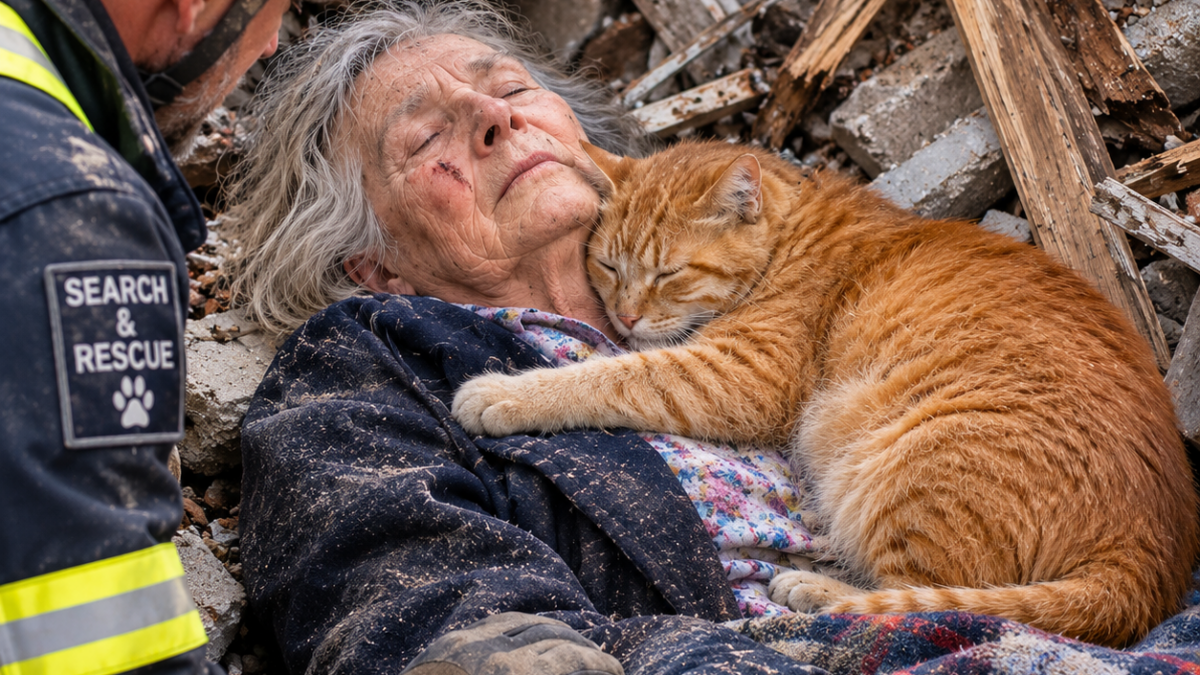
At 2:15 in the morning, the abandoned textile mill I had been sleeping inside came down around me, and within seconds I was trapped beneath thousands of pounds of soaked timber, concrete, and rusted steel with only my orange cat Brick somewhere in the darkness beside me.
For the next eighty-seven hours, I drifted in and out of consciousness inside a space barely eighteen inches high, unable to move without feeling broken ribs grind against each other, while Brick ignored every instinct that should have told an animal to escape and stayed pressed against me.
When daylight finally broke through the rubble and the first rescuer saw what that scarred old street cat had been doing the entire time, he stopped digging and shouted a warning that made every person above us freeze.
I was seventy-four years old in March of 2023, and by then I had learned that homelessness rarely arrives in one dramatic moment.
Mine came piece by piece.
A husband buried too young. Medical bills I couldn’t keep up with. A rent increase that finally pushed my Social Security check beyond its limit. A bad winter, a borrowed couch, then another place that didn’t work out.
Eventually, I ended up inside an abandoned textile mill in the eastern Kentucky foothills.
It had been condemned for more than a decade.
Everybody knew I was there.
A deputy had warned me twice that the place wasn’t safe. A church volunteer named Daniel brought canned food every few days. Another woman left bottled water near a broken side entrance.
Nobody called it a home.
Neither did I.
But it had four walls, most of a roof, and one dry corner on the ground floor where I could spread my blankets.
And I had Brick.
He was a large dark-orange tabby with a torn right ear, a white patch under his chin, and an old scar running across his nose. Nobody knew where he came from.
Neither did I.
One evening two winters earlier, I had awakened to find him sitting six feet from my blankets, staring at the can of tuna in my hand.
“Don’t get comfortable,” I told him.
He stayed anyway.
By the following winter, we belonged to each other.
The night the mill collapsed, rain had been falling for hours.
Brick was restless.
He kept walking toward the dark center of the building, stopping, then returning to me.
“Quit pacing,” I whispered. “You’re making me nervous.”
At 2:15, I heard a sound from above.
Not thunder.
Metal.
A deep, twisting groan ran through the building.
Brick’s head snapped upward.
Then the second floor came down.
I remember concrete exploding against the floor.
A beam struck my shoulder.
Something crushed the air out of my lungs.
Then darkness.
When I woke, I couldn’t sit up.
I couldn’t even roll over.
A fallen support beam had created a narrow pocket between the floor and an industrial shelving unit. My left shoulder felt like fire. Every breath stabbed deep inside my chest.
“Brick?”
Nothing.
I called again.
Then something touched my face.
Whiskers.
I started crying.
“Oh, thank God.”
Brick crawled toward me through the darkness.
I could feel debris moving beneath him.
“Get out,” I whispered.
There had to be an opening somewhere.
Cats could fit through places humans couldn’t.
“Go.”
Instead, Brick climbed onto my chest.
Pain shot through my ribs.
“No, baby. Not there.”
I tried to push him away.
My arm barely moved.
Brick lowered himself across me.
His front legs stretched over my shoulders.
His body covered my chest.
His chin settled beside my neck.
I could feel his heartbeat.
At first, I thought he was frightened.
Then hour after hour passed.
The temperature dropped.
My clothes became damp.
Cold air moved through the cavity.
And Brick remained exactly where he was.
Sometime later—I had no idea whether it was morning or night—I heard distant voices somewhere above us.
I tried to scream.
Nothing came out but a broken whisper.
Brick lifted his head.
Then lowered it again.
Much later, a scraping sound came from overhead.
Dust fell into my eyes.
A narrow blade of light appeared through the wreckage.
Someone shouted, “I’ve got a void!”
Another voice answered.
Then the light widened.
A man leaned toward the opening.
His face changed when he saw us.
He didn’t reach for me first.
He stared directly at Brick.
Then he yelled over his shoulder:
“Stop moving debris—there’s a cat lying on her chest, and he’s bracing against the floor!”
PART 2
I remember that sentence only because one of the rescuers repeated it to me weeks later.
At the time, I heard almost none of it clearly.
By then, I was barely conscious.
The world had narrowed to flashes.
Light.
Hands.
Voices.
Brick’s weight.
Pain whenever I breathed.
Then darkness again.
What happened next was reconstructed for me later by the people who pulled us out.
The search had begun the morning after the collapse.
Daniel Mercer—the man who brought groceries to me every few days—arrived at the mill shortly after nine.
He found part of the eastern wall gone.
The roofline had changed.
A pile of soaked timber and steel filled the area where he knew I normally slept.
He called my name from outside.
No answer.
Daniel later told me that at first he hoped I had left before the collapse.
Then he saw my shopping cart.
It was still beside the eastern doorway.
My blanket bag was partly visible beneath fallen boards.
Brick’s dented metal food bowl was sitting where I usually left it.
Daniel called the county.
The first responders who arrived faced a terrible problem.
The building had already been condemned.
Now it was actively unstable.
Three days of rain had soaked ancient timber framing. Sections of the second floor hung at angles. Steel supports had twisted away from the walls. Every time the wind moved through the exposed upper level, pieces of plaster and rotten wood fell.
Nobody even knew whether I was alive.
But they knew I had probably been inside.
By noon, volunteers joined the search.
Firefighters.
County emergency personnel.
Two men from a nearby excavation company.
A structural engineer who drove forty miles after hearing what happened.
They could not simply climb into the wreckage.
Moving the wrong beam could collapse whatever space remained underneath.
So they worked slowly.
Painfully slowly.
They called my name.
They used listening equipment.
They searched gaps with cameras.
Nothing.
That first day passed.
Then the second.
People in town started assuming the worst.
Daniel did not.
“He had this stubbornness about him,” I told him later.
He laughed.
“You’re one to talk.”
He kept returning to the site.
He stood behind the safety barrier in the rain.
Every few hours, he asked whether they had found anything.
The answer remained no.
Inside that pocket, I had no concept of days.
At first, I tried counting.
One hundred breaths.
Then another hundred.
But breathing hurt too badly.
My collarbone was broken.
Four ribs had fractured.
One of those ribs had punctured my left lung.
I did not know any of that.
I only knew each breath felt smaller than the one before it.
Brick stayed over me.
Sometimes he shifted.
Only slightly.
He would raise his body, reposition his paws, then settle again.
Whenever debris beneath him moved, I felt his back legs push downward.
At the time, I thought he was simply trying not to fall.
Later, the veterinarian explained what those movements had done to his paws.
But trapped under the mill, all I understood was warmth.
Brick was warm.
That may sound ridiculous considering what surrounded us.
The cavity was cold.
Rainwater had seeped through the collapse.
The concrete beneath me pulled heat from my body.
But Brick’s stomach rested across my chest.
His body covered part of my neck and shoulders.
When I began shivering, I pushed my face into the fur beneath his chin.
“Good boy,” I whispered.
He answered with a weak rumbling sound.
Not quite a purr.
Brick had never been much of a purrer.
He was too dignified for obvious affection.
He preferred following me while pretending it was coincidence.
If I moved my blankets, he moved.
If I walked to the creek, he walked twenty feet behind me.
If somebody came close at night, he sat between them and my sleeping area.
He had chosen me without ever admitting it.
That was Brick.
During those first hours, I kept telling him to leave.
“Find a hole.”
He stayed.
“Go get Daniel.”
He stayed.
“You’re a cat. You’re supposed to be smarter than me.”
Still there.
Eventually I stopped asking.
At some point, thirst became worse than pain.
Water dripped somewhere near my right hand.
I could hear it hit metal.
I tried stretching my fingers toward the sound.
My shoulder exploded with pain.
I stopped.
Brick lifted his head.
“You want to help?”
He stared through the darkness.
“Bring me a cup.”
No cup arrived.
I laughed once.
It hurt so badly I nearly passed out.
After that, I saved my breath.
I thought about stupid things.
Not profound things.
I did not review my entire life.
I didn’t see angels.
I thought about coffee.
Hot coffee with too much sugar.
A clean pair of socks.
The old blue sweater I had lost at the bus station.
My husband Frank complaining that I always overcooked eggs.
I thought about being thirty years old and dancing in our kitchen while a radio played.
I thought about the daughter I had not spoken to in almost six years.
That one hurt differently.
Her name was Rachel.
We had loved each other badly.
That is the simplest way to explain it.
After Frank died, I became harder.
Rachel became tired of watching me refuse help.
I became tired of hearing advice.
There were arguments.
Then accusations.
Then silence.
When I lost my apartment, I did not call her.
Pride becomes a strange thing when you have very little else.
Lying beneath four thousand pounds of wreckage, I wondered whether somebody would tell Rachel where I died.
Then Brick shifted.
His paw pressed gently against my shoulder.
“Not yet,” I whispered.
Maybe I meant him.
Maybe myself.
On the second day—though I did not know it was the second—I heard something.
A faint metallic pounding.
Then voices.
I tried answering.
My lung wouldn’t give me enough air.
I scraped one fingernail against the concrete instead.
Three times.
Pause.
Three times.
Nothing.
Again.
My fingers were bleeding before I stopped.
Brick raised his head whenever the sounds came near.
Once, he made a noise.
A loud, rough yowl.
I had never heard him make that sound before.
The voices stopped.
I waited.
Then someone shouted from somewhere beyond the debris.
“HELLO?”
I tried answering.
No sound.
Brick yowled again.
The sound echoed through the void.
My heart started pounding.
“They hear you.”
He looked down at me.
“Do it again.”
He didn’t.
Of course.
He was still a cat.
I wanted to strangle him.
Instead, I cried.
The search team did hear something that afternoon.
They knew that later.
One rescuer recorded a faint animal sound through a listening device.
But the signal came from beneath overlapping steel and timber in the center of an unstable section.
They could not reach it safely.
For fourteen more hours, they worked toward us.
During that time, my body temperature continued dropping.
The punctured lung made breathing increasingly difficult.
I lost consciousness for long periods.
Brick never left.
The rescuers later estimated there were two narrow gaps large enough for him to squeeze through.
One ran toward an exposed section near the shelving.
Another opened behind a broken wall panel.
If he had wanted to escape, he probably could have.
That fact upset me more than anything after I learned it.
He had options.
I didn’t.
He stayed anyway.
At approximately eighty-three hours after the collapse, a volunteer firefighter named Cole Ramsey managed to snake a camera through a newly opened gap.
The screen showed darkness.
Concrete.
A torn blanket.
Then orange fur.
Cole called everyone over.
“There’s an animal.”
“Alive?”
“I can’t tell.”
The camera moved.
Brick’s eye opened.
Cole nearly dropped the monitor.
“He’s alive.”
Then they saw my hand beneath him.
That changed everything.
The rescue stopped being a recovery operation.
They knew I might still be alive.
Four hours later, enough debris had been stabilized for Cole and another firefighter to enter the void.
That was when daylight reached us.
Brick saw it first.
He lifted his head.
Cole looked through the opening.
At me.
Then at Brick.
He later said his first instinct was to grab the cat.
But something looked wrong.
Brick’s hind legs were spread wide.
His paws pressed hard into uneven fragments of concrete and warped flooring.
His chest lay across mine.
The shelving above us had shifted several times during the search.
Brick appeared to be bracing himself against the unstable surface every time something moved.
Cole shouted for everyone to stop.
They needed to stabilize the area before touching him.
That was the sentence I remembered only as distant noise.
“Stop moving debris—there’s a cat lying on her chest, and he’s bracing against the floor!”
For another nineteen minutes, nobody moved us.
Imagine surviving eighty-seven hours and then being told to wait nineteen more minutes.
I do not remember being angry.
I barely remember anything.
The rescue team inserted additional supports.
They secured the beam above us.
A medic crawled close enough to reach my neck.
He found a pulse.
Weak.
But there.
Then Cole reached toward Brick.
“Come on, buddy.”
Brick looked at him.
He did not hiss.
He did not run.
Cole touched his side.
Brick lowered his head back onto my shoulder.
That image became the photograph everybody later talked about.
Not because anyone planned it.
A county volunteer had been documenting the rescue area for structural records.
In one frame, Brick is lying across my chest while Cole’s gloved hand reaches toward him.
Brick looks exhausted.
His eyes are half open.
His torn ear is flattened.
He looks as though he is simply too tired to care anymore.
They had to lift him away from me.
Cole said Brick resisted only once.
Not violently.
He twisted his body toward me.
“Easy,” Cole whispered.
“We’ve got her.”
Brick stared.
Then let them carry him out.
The instant his body left my chest, one medic later said he could feel how cold I actually was.
They placed thermal blankets over me immediately.
That detail became important later.
The temperature inside the void had remained just above freezing.
My clothing was wet.
My body had already fallen into dangerous hypothermia.
But the part of my chest and upper abdomen that Brick had covered remained measurably warmer.
One paramedic told me weeks later:
“If he hadn’t been there, I don’t know that we would have gotten a pulse.”
I asked whether he was sure.
He said, “I can’t prove exactly how much difference he made.”
That mattered to me.
I did not want people turning Brick into some magical creature.
He was a cat.
A very stubborn cat.
But the medic continued.
“What I can tell you is that you were exposed for eighty-seven hours. Your core temperature was critically low. He covered the area around your heart and chest with his body heat for most of that time.”
He paused.
“I’d rather find you with him than without him.”
That was enough.
The rescue crew brought me out on a backboard.
I was unconscious.
Brick was already in another vehicle.
A volunteer held him wrapped in two blankets.
He tried to stand once.
His rear left leg collapsed.
Then he lay down.
The first medical examination revealed more than anyone expected.
Brick had lost roughly forty percent of his body weight compared with the condition local residents remembered before the collapse.
Some of that loss had clearly begun before the mill fell.
Neither of us had been eating well.
But dehydration and three and a half days without food had made it much worse.
His rear left leg had a hairline fracture.
Probably from falling debris.
Both hind paws were badly damaged.
At first, the veterinarian assumed he had been trying to dig.
Then she looked closer.
The wear pattern was wrong.
The pads had been rubbed raw along the places that would have pressed against the unstable floor.
Repeated pressure.
Repeated bracing.
Hours of it.
She later explained it to Daniel.
“He wasn’t walking.”
“What was he doing?”
“Holding position.”
Daniel called me a month later just to repeat those words.
Holding position.
I could not stop thinking about them.
Brick had not dragged me out.
He had not summoned rescuers.
He had not performed some impossible heroic act.
He had simply stayed.
Warm body over cold body.
Paws against unstable ground.
One breath above another.
For eighty-seven hours.
Sometimes the smallest action becomes enormous when you repeat it long enough.
Stay.
Stay.
Stay.
That was Brick’s whole rescue.
I spent the first eleven days in the hospital unable to speak.
A chest tube drained the punctured lung.
My broken ribs were stabilized as much as possible.
My collarbone did not require surgery, but moving felt impossible.
I had hypothermia.
Dehydration.
A kidney injury.
Muscle breakdown from being trapped.
Doctors were cautiously optimistic, which is medical language for “we don’t know yet.”
During those first days, my mind came back in fragments.
A ceiling.
White light.
A nurse asking me to squeeze her hand.
A machine beeping.
Pain.
Sleep.
Whenever I woke, I felt something missing.
At first, I could not name it.
Then I remembered orange fur.
I tried asking.
No voice came.
The breathing tube had irritated my throat, and my lung injury made speech difficult.
I wrote with a marker once.
My hand shook so badly the letters were unreadable.
The nurse thought I wanted water.
I shook my head.
She tried again.
“Pain?”
No.
“Family?”
I stared.
Brick.
I tried writing B.
The marker slipped.
The nurse looked confused.
I gave up.
That was torture.
Not knowing.
I had seen Brick taken from me.
Or maybe I had dreamed that.
I could not tell.
Had he survived?
Had the collapse killed him after they moved him?
Had he run away?
Was he back at the mill?
Every time I woke, the question returned.
Where is Brick?
On the eleventh day, my voice finally worked.
Barely.
A nurse named Allison was adjusting my oxygen line.
I whispered one word.
“Where?”
She leaned closer.
“What do you need?”
“My boy.”
She smiled.
“Your son?”
I shook my head.
“Brick.”
Her expression changed immediately.
“Oh.”
My heart started racing.
That “oh” terrified me.
“Where?”
She put one hand on my arm.
“He’s alive.”
I started crying.
No dignity.
No restraint.
Just tears.
“Alive?”
“He’s alive.”
“Where?”
“A foster volunteer has him. About three miles from here.”
“Bring him.”
Allison laughed softly.
“I don’t think animals are usually allowed—”
“Bring him.”
“You just started talking.”
“Brick.”
She looked toward the hallway.
“I’ll ask.”
“Today.”
That was the first argument I won after the collapse.
It took almost two days.
The hospital had policies.
The foster volunteer needed permission.
Brick needed veterinary clearance because of his fracture.
My doctor worried that a fifteen-pound cat walking across four broken ribs was a terrible idea.
He was right.
I didn’t care.
On the thirteenth day, Allison entered my room smiling.
“Your visitor is here.”
A woman named Carla walked behind her carrying a large pet carrier.
My heart began pounding so hard the monitor complained.
“Easy,” Allison said.
“Open it.”
“First, we need—”
“Open it.”
Carla set the carrier beside the bed.
The door clicked.
Nothing happened.
For three seconds, I saw only darkness.
Then Brick’s torn ear appeared.
He stepped out.
Slowly.
His rear left leg had been wrapped.
His paws were healing.
He was thinner than I remembered.
So much thinner.
“Brick.”
His head snapped toward me.
That broke something in me.
He knew my voice.
He walked across the blanket.
Allison reached to stop him from stepping on my ribs.
I raised one hand.
“Let him.”
Brick came directly to my chest.
The exact place where the rescue photographs showed him lying under the mill.
He turned once.
Lowered himself.
Stretched his front legs across me.
Put his chin against my shoulder.
And closed his eyes.
Nobody spoke.
Carla turned away.
Allison covered her mouth.
I buried my fingers in Brick’s fur.
“You stupid boy.”
He did not move.
“You could’ve left.”
Nothing.
“You should’ve left.”
His chest vibrated.
A purr.
The first one I had ever heard from him.
I cried harder.
For almost twenty minutes, that hospital room stayed nearly silent.
No reporter.
No photograph.
No speech.
Just an old homeless woman lying in a hospital bed with a scarred orange cat on her chest.
Eventually my doctor entered.
He looked at Brick.
Looked at me.
Then at the monitor.
“This is exactly what I said not to do.”
Brick opened one eye.
The doctor sighed.
“Fine.”
That was the beginning of my second recovery.
The first was physical.
The second was realizing I had somewhere to go.
Not where I expected.
Before the collapse, I had avoided nearly every housing program offered to me.
Some were temporary.
Some had waiting lists.
Some required paperwork I did not have.
Some would not accept pets.
That last one ended every conversation.
“You can place the cat with a rescue.”
No.
“We can find him a foster home.”
No.
“It doesn’t have to be permanent.”
No.
People thought I was being unreasonable.
Maybe I was.
But when you lose enough pieces of your life, eventually you become fiercely protective of whatever remains.
Brick was not luggage.
He was not an obstacle.
He was the only living thing that had shared every freezing night with me and never once treated me as something inconvenient.
I was not leaving him.
After the mill collapse, suddenly everyone wanted to help.
That should have made things easier.
Instead, it created a new fight.
A county caseworker named Patricia came to my hospital room during my fifth week.
She was kind.
Organized.
Well intentioned.
I disliked her immediately because she carried a folder.
Folders usually meant rules.
“We have a placement possibility.”
I looked at Brick’s photograph on my bedside table.
“Does he come?”
Patricia hesitated.
There it was.
“No.”
“Then no.”
“Please let me explain.”
“You already did.”
“It’s an assisted housing unit. Private room. Meals available. Medical transportation. Rent based on income.”
“Cat?”
“The building has a no-pet policy.”
“Then I don’t have a placement.”
Patricia closed the folder slightly.
“You cannot return to the mill.”
“I know.”
“The county is demolishing the remaining structure.”
“I know.”
“You also cannot live outside while recovering from a punctured lung and four broken ribs.”
“I know.”
“Then we need an option.”
“I gave you the condition.”
She leaned closer.
“This isn’t me trying to separate you from him.”
“That’s exactly what it is.”
“No.”
“Yes.”
“I’m trying to get you somewhere safe.”
“So did Brick.”
That silenced her.
I regret saying it the way I did.
Patricia did not cause my homelessness.
She did not write the building policy.
But after spending weeks being lifted, scanned, measured, injected, questioned, and discussed, I had very little patience left.
She tried again.
“Could Brick remain in foster care temporarily while we—”
“No.”
“Just until another unit opens.”
“No.”
“You might lose this placement.”
“Then I lose it.”
Patricia stared at me.
“After everything you survived, you’d choose homelessness again over a cat?”
I looked at her.
“No.”
My voice became quieter.
“I’d choose not to abandon the one thing that didn’t abandon me.”
Her face changed.
She closed the folder.
“I’ll see what I can do.”
I thought that was the end.
It wasn’t.
Two days later, a program administrator visited.
Then another.
Everybody had some variation of the same argument.
Policies.
Liability.
Allergies.
Insurance.
Consistency.
“If we make one exception—”
I stopped the man speaking.
“One exception?”
“Yes.”
“You think Brick is asking for a special privilege?”
“That’s not what I mean.”
“He lay on me for three and a half days.”
“I understand.”
“No, you heard it.”
I pointed toward my chest.
“You didn’t understand it.”
The man shifted uncomfortably.
I continued.
“He had two ways out.”
I had learned that from the rescuers by then.
“He could’ve squeezed through.”
The administrator said nothing.
“He stayed until his paws bled.”
“I’m sorry.”
“I’m not asking you to be sorry.”
I sat straighter despite the pain.
“I’m telling you that wherever I go, he goes.”
The administrator left.
I assumed I had ruined everything.
That afternoon Allison entered my room carrying coffee.
“You’re famous again.”
“What now?”
“Somebody told the newspaper about the housing issue.”
I closed my eyes.
“Who?”
She looked innocent.
“Allison.”
“What?”
“You did.”
“I’m a nurse. We have confidentiality rules.”
“You told somebody.”
“I said nothing.”
“Your face says you said plenty.”
She handed me coffee.
“The story was already public. People know Brick exists.”
I did not want public sympathy.
I wanted a room.
But the story spread.
The same residents who had followed the rescue now learned the cat might be separated from me because of housing rules.
Daniel called.
“You need a lawyer?”
“No.”
“I know somebody.”
“No lawyers.”
“A reporter?”
“No reporters.”
“A petition?”
“Absolutely not.”
By evening, there was apparently a petition.
I was furious.
Then Patricia returned.
She looked exhausted.
“What happened?”
She sat down.
“We found a path.”
I waited.
“The housing provider allows documented exceptions after administrative review.”
“For Brick?”
“For Brick.”
I stared.
“What does that mean?”
“It means there will be conditions.”
“Of course there will.”
“Veterinary records. Vaccinations. Indoor-only. You’ll need to maintain his litter area.”
“I have been caring for him while living in a condemned mill.”
Patricia almost smiled.
“I think you can manage a litter box.”
“What else?”
“That’s mostly it.”
I didn’t believe her.
“So he comes?”
“If you accept the placement.”
I looked at Brick’s photograph.
“Where do I sign?”
That should have been the end of the fight.
Then came the veterinarian.
Brick’s rear leg was healing.
His hind paws had developed scar tissue.
But he was still weak.
The foster volunteer worried about moving him again.
The veterinarian worried that my assisted housing room might overwhelm him.
Everyone was careful.
Reasonable.
I hated all of them.
“I want my cat.”
The veterinarian, Dr. Lewis, sat across from me.
“He is your cat.”
“He’s living with Carla.”
“Temporarily.”
“It’s been nine weeks.”
“It has also been nine weeks since he was trapped under a collapsed building.”
I looked away.
Dr. Lewis softened.
“He needs you.”
“Then why is he not with me?”
“Because both of you needed medical care.”
I knew she was right.
That made me more irritated.
“When can he move?”
“When you move.”
“Same day?”
“I would recommend you settle first.”
“No.”
“Twenty-four hours.”
“No.”
She smiled.
“You negotiate like a hostage taker.”
“I’ve been homeless. We get practical.”
Finally, she agreed.
Brick would arrive the same afternoon I did.
The housing unit was small.
One room.
Bathroom.
Tiny kitchenette.
Window overlooking a parking lot and a strip of trees.
To most people, it would have looked plain.
To me, it looked impossible.
A bed.
My bed.
A door with a lock.
My key.
Heat coming from a vent that belonged to my room.
A refrigerator.
A shower.
No rain falling through a ceiling.
No rats moving behind old machinery.
I stood inside holding the key for almost a full minute.
Patricia watched from the doorway.
“Well?”
“It’s too clean.”
She laughed.
“We can make it dirtier if that helps.”
“I don’t know where to put anything.”
“You don’t have much.”
She was right.
Everything I owned fit into two donated bags.
That hurt more than it should have.
Then a knock came.
Carla entered carrying Brick.
He was not in a crate.
He hated crates after the collapse.
She carried him in a padded open-top pet basket with a harness clipped for safety.
Brick saw me.
He struggled immediately.
“Easy.”
Carla put him down.
Brick limped across the room.
Straight toward me.
He rubbed once against my leg.
Then stopped.
He looked around.
New smells.
New walls.
New floor.
I bent down.
“This is it.”
Brick looked at me.
“No roof falling down.”
His torn ear moved.
“No rats.”
He sniffed my shoe.
“And they said we can stay.”
Brick walked past me.
He inspected the bathroom.
The bed.
The small closet.
Then jumped onto the windowsill.
His injured leg made the landing awkward.
I gasped.
“Don’t do that.”
Brick ignored me.
He sat facing the glass.
For the first time in years, I watched him look outside from the safe side of a window.
I cried.
Quietly.
Patricia pretended not to notice.
That night, Brick did not sleep on my chest.
He slept beneath the bed.
I found that funny.
After eighty-seven hours refusing to leave me, the moment we finally had a secure room, he wanted privacy.
“Fine,” I told him.
“You’ve earned it.”
At two in the morning, I woke.
Brick was beside the bed.
Watching me.
I lifted the blanket.
“You coming?”
He walked away.
“Rude.”
Ten minutes later, he jumped onto the mattress.
He did not lie on my chest.
He settled against my ribs.
Carefully.
Exactly where the fractures had healed.
I touched the scar across his nose.
“We’re inside.”
Brick closed his eyes.
That became our life.
Not immediately easy.
Just ours.
My recovery continued.
For months, bending hurt.
Deep breaths hurt.
Cold weather made the healed ribs ache.
I went to physical therapy.
Brick developed a permanent limp in his rear left leg.
His veterinarian believed the hairline fracture healed well, but muscle weakness and paw damage changed his gait.
He walked slowly.
Carefully.
He rarely ran again.
Some days, watching him made me feel guilty.
If he had escaped the mill, his leg might have healed differently.
His paws would not have been worn raw.
He would not have lost so much weight.
One afternoon, I said this aloud during a visit with Daniel.
“He should’ve left me.”
Daniel looked at Brick asleep near the window.
“You really believe that?”
“He could’ve gotten out.”
“Maybe.”
“He chose to stay.”
“Yes.”
“He got hurt because of it.”
Daniel leaned back.
“You going to be mad at him for loving you?”
“I’m not mad.”
“You sound mad.”
“I’m mad at myself.”
“There it is.”
I looked away.
Daniel had known me too long.
“If I hadn’t been living there—”
“The building fell.”
“I chose to stay.”
“You had nowhere else you were willing to go.”
“Because of Brick.”
“No.”
I looked at him.
Daniel continued.
“You were homeless before Brick.”
I said nothing.
“You two found each other while both of you were already surviving.”
That hurt because it was true.
Daniel pointed toward the cat.
“He didn’t create your situation.”
“I know.”
“And you didn’t force him to stay on your chest.”
“I know.”
“Then quit turning his choice into your punishment.”
I stared out the window.
People liked to tell me Brick saved me because it made a beautiful story.
They were right.
But beautiful stories often leave out the guilt.
Survival has guilt inside it.
I survived while Brick suffered.
I got a room because the building collapsed.
I got medical care because I nearly died.
People cared because something dramatic happened.
Before the collapse, I was simply an old homeless woman people drove past.
Afterward, I was “the woman with the hero cat.”
I struggled with that.
One morning, a reporter asked whether the collapse had been a blessing in disguise.
I nearly threw him out.
“No.”
He looked startled.
“I only meant—”
“I know what you meant.”
I leaned forward.
“A building falling on you is not a blessing.”
He closed his notebook.
“I apologize.”
“Good.”
I calmed down.
Then added, “What happened afterward had blessings in it.”
That was different.
Brick.
Rescuers.
The hospital.
Carla.
Patricia refusing to give up on the housing review even after I insulted her.
Daniel bringing groceries for months before anybody cared who I was.
Those people mattered.
The collapsing mill did not deserve credit for any of them.
Neither did the county deserve congratulations for waiting until I almost died before finding me a room.
That anger stayed with me.
A county official later invited me to a meeting about homelessness services.
I almost refused.
Patricia convinced me.
“Why me?”
“Because you’ll say what everyone else is afraid to.”
“That’s not always a good thing.”
“In this case, it might be.”
The meeting took place in a government building with bright lights, bottled water, and too many chairs.
Officials discussed emergency beds.
Cold-weather plans.
Condemned properties.
Outreach teams.
Then somebody said:
“We had been aware an unhoused individual was intermittently occupying the mill.”
I raised my hand.
The man nodded.
“Yes, ma’am?”
“My name is Evelyn.”
I had finally gotten tired of being called “an unhoused individual.”
He looked embarrassed.
“I apologize.”
“You knew I was there.”
“We were aware of reports.”
“You sent deputies.”
“Yes.”
“They told me the building was dangerous.”
“Yes.”
“What did they offer me?”
The room became quiet.
The official looked at papers.
“I don’t have the specific case record.”
“I do.”
I tapped my head.
“One shelter forty miles away that didn’t take Brick.”
Patricia looked down.
“One temporary placement with a two-night limit.”
Nobody interrupted.
“And a bus ticket I was supposed to use to go somewhere I had nobody.”
The official began, “Mrs.—”
“I’m not blaming one person.”
I looked around the table.
“That’s the problem.”
Nobody moved.
“There wasn’t one bad person.”
There had been no villain twirling a mustache.
No one had thrown me into the mill.
No one had chained the door.
Everyone had done a little bit.
A warning.
A form.
A referral.
A suggestion.
Then they moved on.
I continued.
“You all knew the building could fall.”
“Yes.”
“You knew I was sleeping there.”
The man nodded slowly.
“Yes.”
“And because technically I could leave, everybody decided the job was done.”
The room stayed silent.
I felt my heart pounding.
I had spent years making myself small around people with offices.
Not anymore.
I pointed toward the folder in front of him.
“Brick had two holes he could crawl through after that building fell.”
The official looked confused.
“My cat.”
“Oh.”
“He could’ve left.”
Nobody spoke.
“He didn’t.”
I leaned back.
“If a cat can understand that knowing someone is in danger means you don’t just walk away, maybe we can build a system that understands it too.”
That sentence ended up in the newspaper.
I hated that.
Then I saw what happened afterward.
The county established a new winter outreach review for people known to be staying in condemned structures.
Local shelters began discussing pet-friendly emergency options with a rescue group.
It did not solve homelessness.
Nothing that simple would.
But the next winter, there were heated temporary kennels attached to one cold-weather shelter so people did not automatically have to choose between entering and abandoning their animals.
Daniel brought me a newspaper showing the announcement.
“Look.”
I read it.
Then read it again.
“Brick did that.”
“You did.”
“No.”
I looked at him.
“I yelled at some people.”
“Sometimes that helps.”
Brick was asleep on the windowsill.
I smiled.
“He did the hard part.”
That was the closest thing I ever wanted to revenge.
Not somebody losing a job.
Not public humiliation.
Not punishment.
I wanted the system that had ignored us to become slightly harder to ignore the next person.
And it did.
Brick became famous locally.
He hated it.
People occasionally asked to meet him.
He generally disappeared beneath the bed.
One woman drove thirty miles with treats.
Brick refused to come out.
“I’m sorry,” I told her.
“No, that’s okay.”
“He doesn’t care that he’s famous.”
“That makes him more charming.”
“You haven’t met him.”
She laughed.
“He sounds like a cat.”
Exactly.
He remained Brick.
He stole chicken.
He pushed water bowls until they spilled.
He woke me at four in the morning by sitting near my face.
He scratched the same corner of a donated chair despite having a scratching post two feet away.
He tolerated exactly three people.
Me.
Daniel.
Carla.
He was suspicious of Patricia until she discovered canned salmon.
Then he became morally flexible.
One afternoon, Rachel called.
My daughter.
Six years of silence.
I almost didn’t answer.
I recognized the area code but not the number.
“Hello?”
For several seconds, nobody spoke.
Then:
“Mom?”
I sat down.
Brick looked up from the floor.
“Rachel.”
She started crying.
I didn’t.
Not immediately.
“I saw the story.”
Of course.
The story.
Brick.
The mill.
Everybody could find me now.
“I didn’t know where you were.”
“I know.”
“I tried before.”
“I changed phones.”
“Why didn’t you call?”
That old anger rose.
“Why didn’t you?”
Silence.
There it was.
Six years in three words.
Why didn’t you?
Why didn’t you?
We could have spent another six years arguing about who failed first.
Brick jumped onto the bed.
His limp was worse that day.
He walked toward me.
I put one hand on his back.
Rachel whispered, “Is the cat there?”
I laughed despite myself.
“Yes.”
“The one from the pictures?”
“He’s only got one face.”
She laughed too.
That tiny laugh cracked something.
We talked for nineteen minutes.
Not enough to repair six years.
Enough to begin.
Rachel visited three months later.
Brick hated her immediately.
“Good,” I said.
“What?”
“He has standards.”
“Mom.”
“I’m joking.”
“You don’t sound like you’re joking.”
Brick hid beneath the chair.
Rachel sat across from me.
We stared at each other.
She looked older.
Of course she did.
So did I.
“I’m sorry,” she said.
I looked down.
“So am I.”
It wasn’t dramatic.
No music.
No perfect reconciliation.
Just two stubborn women realizing the years had become heavier than the original argument.
Rachel visited again.
And again.
On her fourth visit, Brick stayed in the room.
On her sixth, he smelled her shoe.
“Progress,” I said.
“That’s progress?”
“For him?”
“Yes.”
By the end of the year, Rachel could sit beside the window while Brick slept three feet away.
Family takes different forms.
Sometimes it returns slowly.
Like an injured cat learning a room is safe.
My relationship with Brick changed too.
Before the collapse, we had been partners in survival.
We slept in the same ruined building because both of us needed warmth.
We shared food.
Watched doors.
Listened for strangers.
Afterward, we had no emergency to manage.
At first, that felt strange.
We had to learn ordinary life.
Brick learned rugs.
Sunlight through glass.
The hum of a refrigerator.
Elevators, which he hated.
He learned that food appeared every morning without searching.
He gained weight.
Not all of it.
He remained leaner than before the collapse.
Dr. Lewis said that was partly age.
Partly stress.
Partly damage.
His rear leg never became completely normal.
When weather turned damp, he limped more.
I knew how he felt.
My ribs ached whenever rain moved in.
We became weather instruments together.
“You hurting?”
Brick limped toward the bed.
“Me too.”
He jumped up.
Barely.
I lifted him the rest of the way.
At first he hated being helped.
Then he learned to wait.
That was one of the few changes age forced him to accept.
Sometimes he still settled on my chest.
Not for eighty-seven hours.
Ten minutes.
Twenty.
Then he moved.
Every time he did, my body remembered.
Cold concrete.
Darkness.
Broken ribs.
His weight.
I would close my eyes and place a hand on his side.
Warm.
Still warm.
The first anniversary of the collapse was difficult.
People wanted interviews.
I declined.
A local church wanted to hold a small gathering.
I declined that too.
Daniel finally asked, “What do you want to do?”
“Nothing.”
“That doesn’t sound healthy.”
“I survived. I don’t need cake.”
He laughed.
“What would Brick want?”
“Chicken.”
So that was what we did.
Daniel brought roasted chicken.
Carla came.
Patricia brought a ridiculous toy shaped like a brick.
Yes.
A brick.
For Brick.
He stared at it.
Then walked away.
Patricia looked offended.
“I paid nine dollars.”
“He’s ungrateful.”
Daniel tore chicken into small pieces.
Brick suddenly remembered all of us existed.
We sat in my room.
Four people who would never have known one another if a mill had not collapsed.
No speeches.
No candles.
Just food.
Brick ate too much chicken.
Later, when everyone left, he climbed onto the bed.
I looked at the clock.
2:15 a.m.
Exactly one year.
Rain tapped lightly against the window.
My chest tightened.
Brick settled against my side.
I whispered, “We’re not there.”
His ear moved.
“We’re here.”
That helped.
The remains of the textile mill were demolished completely that spring.
I went to watch.
Patricia thought it might be a bad idea.
She was probably right.
I went anyway.
Excavators tore down the surviving walls.
Dust rose.
Metal twisted.
The place looked smaller than I remembered.
That surprised me.
For months, the mill had occupied an enormous space inside my head.
Seeing it from the road, it was just a ruined building.
Daniel stood beside me.
“That where your corner was?”
I pointed.
“Over there.”
Nothing remained.
No blankets.
No food bowls.
No place where Brick first appeared.
No pocket where we survived.
An excavator lifted a section of steel and dropped it into a truck.
I felt no grief for the building.
People assumed I would.
It had sheltered me.
Yes.
It had also almost killed me.
Both things could be true.
Daniel asked, “Want anything from it?”
“What?”
“A brick?”
I looked at him.
He immediately realized what he’d said.
“Oh.”
I started laughing.
Hard.
First real laugh I’d had in days.
“No.”
“You sure?”
“I already have one Brick.”
That story spread too.
Small towns are merciless.
Weeks later somebody left a cleaned red brick outside my room with a note:
BACKUP BRICK.
I still have it.
Brick the cat refused to acknowledge it.
The older I got, the more I understood that survival is rarely one moment.
People focused on the eighty-seven hours.
But surviving afterward took longer.
Learning to sleep without expecting a ceiling to move.
Learning not to panic when rain started.
Learning that a locked door was protection, not confinement.
Learning to accept help without feeling reduced by it.
Learning to let my daughter back into my life.
Learning that Brick could leave the room and come back without me wondering whether something had happened to him.
For months, if I woke and did not see him, I searched immediately.
“Brick?”
Nothing.
“Brick!”
Sometimes he was under the bed.
Sometimes in the bathroom.
Once behind a curtain.
He would look at me with complete annoyance.
“Don’t judge me.”
He did.
I started therapy through the medical center.
I resisted at first.
“I’m seventy-four.”
The therapist smiled.
“Trauma has no retirement age.”
I hated that line.
She was right.
We talked about the collapse.
Homelessness.
Frank.
Rachel.
Guilt.
Brick.
Mostly Brick.
One afternoon she asked, “What do you think would have happened if Brick had left?”
“I’d probably be dead.”
“What does that make you feel?”
“Grateful.”
“Only grateful?”
I stared at her.
“No.”
“What else?”
“Guilty.”
“Why?”
“Because he got hurt.”
“He chose to stay.”
“He’s a cat.”
“So?”
“So he didn’t understand the consequences.”
“Do we always understand the consequences when we stay with someone we love?”
That irritated me.
Good therapists are annoying.
“I don’t like where this is going.”
She smiled.
“Neither do you.”
I looked out the window.
She continued.
“Maybe Brick didn’t calculate eighty-seven hours. Maybe he didn’t understand hypothermia.”
“He definitely doesn’t understand numbers.”
“But perhaps he understood one thing.”
“What?”
“You were there.”
I cried.
Quietly.
That became enough.
You were there.
He stayed.
Not because he understood heroism.
Because I was there.
That is much more believable.
And somehow more beautiful.
By the second year after the collapse, Brick was slowing down.
He was older than anyone knew exactly.
The veterinarian estimated somewhere between ten and thirteen.
Years outdoors had aged him.
His limp became more noticeable.
He slept more.
His scarred nose turned gray around the edges.
The torn ear remained torn.
I loved every ugly part of him.
One evening, Rachel visited and found Brick sleeping on my chest.
She stopped in the doorway.
“You okay?”
“Yes.”
“Can you breathe?”
“Mostly.”
“He’s huge.”
“He used to be bigger.”
She looked at him.
“So that’s the position?”
I knew what she meant.
“Yes.”
“The pictures.”
“Yes.”
Brick’s chin rested against my shoulder.
Rachel sat carefully.
“Does he do that a lot?”
“Enough.”
She watched him.
“Mom?”
“Yeah?”
“I’m glad he stayed.”
I swallowed.
“So am I.”
Then she said, “I’m glad you did too.”
I looked at her.
Neither of us spoke for a while.
Some apologies arrive disguised as other sentences.
I understood hers.
She understood mine.
Brick slept between us.
There are people who believe animals do not love the way humans do.
Maybe.
I’m not an animal behaviorist.
I don’t need to win that argument.
I know what Brick did.
I know what happened before the collapse too.
When I was sick, he slept closer.
When somebody approached my corner of the mill at night, he woke.
When Daniel brought food, Brick waited until I ate.
When winter came, he pushed beneath my blankets even though he pretended not to like it.
Maybe all of that was instinct.
Fine.
Love may be instinct with a name.
I don’t care.
At the assisted housing unit, Brick still rarely leaves my room.
The hallway makes him nervous.
Too many doors.
Too many footsteps.
He likes the window.
The bed.
A worn chair Rachel bought secondhand.
His food dish beside the kitchenette.
Sometimes Patricia visits and brings salmon.
Brick has forgiven bureaucracy entirely as long as bureaucracy arrives carrying fish.
Daniel still comes by.
Carla visits less often now, but when she does, Brick remembers her.
Cole Ramsey—the firefighter who first reached us—came once.
Brick stared at him for a long time.
Cole knelt.
“Remember me?”
Brick walked closer.
Sniffed his glove.
Then touched his nose to Cole’s hand.
Cole sat on the floor and cried.
He didn’t hide it.
Neither did I.
“You’re the one who pulled him off me.”
Cole nodded.
“I hated doing it.”
“You had to.”
“I know.”
“He tried to come back?”
Cole looked surprised.
“Nobody told you?”
“No.”
“When we moved him away, he kept turning toward you.”
My throat tightened.
“He was injured.”
“Yeah.”
“He could barely walk.”
“Yeah.”
“And he still tried?”
Cole smiled sadly.
“Brick wasn’t exactly cooperative.”
I laughed through tears.
“That sounds right.”
Cole looked toward him.
“He kept looking at the opening until we brought you out.”
That detail stayed with me.
Even after leaving my chest, Brick had not considered his job finished.
He waited.
Maybe that is why he rarely leaves my room now.
Maybe not.
Again, I refuse to invent thoughts for him.
But every morning I wake and see him somewhere nearby.
Window.
Chair.
Foot of the bed.
Floor beside the door.
Never far.
He had already shown everyone what he would do if given the chance not to leave.
One winter evening, the power flickered.
Only for a second.
My entire body reacted.
Heart pounding.
Hands cold.
I sat upright.
Brick lifted his head.
The lights returned.
I knew that.
Still, I could not breathe normally.
Brick stood.
His bad leg made his first step uneven.
He crossed the room.
Jumped onto the bed with difficulty.
I reached to help.
He ignored me.
He climbed onto my chest.
Same position.
Legs spread.
Chin near my shoulder.
I laughed and cried at once.
“We’re not under the mill.”
His purr started.
“We have electricity.”
Purr.
“The building is safe.”
Purr.
“You don’t have to do this.”
Brick closed his eyes.
I stopped talking.
Maybe he wasn’t comforting me.
Maybe he simply wanted the warmest spot.
Fine.
Sometimes the explanation does not matter as much as the result.
My heart slowed.
That night, Brick stayed until I fell asleep.
The next morning, sunlight came through the window.
He was on the chair.
I was alive.
Ordinary morning.
Coffee.
Toast.
Medication.
Cat food.
That is what eighty-seven hours bought us.
Ordinary mornings.
I used to believe a satisfying ending had to correct everything that came before it.
It doesn’t.
I was still homeless for years.
The collapse still happened.
Brick’s leg still hurts.
My ribs still ache in wet weather.
Six years with Rachel are gone.
No policy change can return them.
No housing unit turns the mill into something acceptable.
But endings can give suffering somewhere to go.
Mine went here.
A small room.
A daughter who calls.
A cat sleeping near the window.
A county program that now asks people during winter outreach whether an animal is keeping them from accepting shelter.
A heated kennel area that exists because enough people finally admitted pets are family to people who may have almost nothing else.
That matters.
Last March, on another anniversary, I returned to the empty lot where the mill once stood.
Grass had started growing through the mud.
You would never know a building had been there unless someone told you.
Brick did not come.
Too difficult for his leg.
Rachel drove me.
We stood near the old eastern corner.
“You slept here?”
“Somewhere around here.”
She looked around.
“I hate that.”
“So do I.”
“I wish you’d called me.”
I nodded.
“I know.”
She looked at me.
“I mean it.”
“I know.”
I took her hand.
That was easier than apologizing again.
We stood there.
The wind moved through young grass.
No walls.
No roof.
No rubble.
Just open ground.
Rachel asked, “Do you miss it?”
“No.”
“Not even a little?”
I thought about nights with Brick curled beside my blankets.
Daniel arriving with groceries.
Rain hitting broken windows.
Small moments.
“I miss who was there with me.”
“Brick?”
“Yes.”
“He’s still here.”
I smiled.
“Exactly.”
We went home.
Brick was waiting inside my room.
He stood when I entered.
Limped toward me.
Then stopped.
He had always preferred making people come the final few feet.
I bent down.
“Lazy.”
He pushed his head against my hand.
That night, he slept beside me.
Not on my chest.
Just close enough that one paw rested against my arm.
I woke around two.
For a moment, the room was dark enough that memory returned.
Collapsed beam.
Dust.
Cold.
Then Brick moved.
One paw.
Small pressure against my skin.
I knew where I was.
Home.
That word still surprises me.
Home.
Not shelter.
Not placement.
Not unit.
Home.
A place where Brick’s food bowl stays in the same corner.
Where my name is on the mailbox.
Where Rachel knows the address.
Where Daniel knocks before entering.
Where rain stays outside.
Where the ceiling does not move.
Where, if I wake at two in the morning, I can reach one hand into the darkness and usually find orange fur.
I never asked Brick why he stayed.
I never needed to.
People keep searching for some grand explanation.
Loyalty.
Instinct.
Love.
Warmth.
Protection.
Maybe all of them.
Maybe none.
A cat does not need to understand sacrifice the way a human does in order to make one.
Brick had openings he could have used.
He was injured, hungry, thirsty, frightened.
He stayed on my chest until rescuers reached us.
His body kept part of mine warm.
His paws wore raw from bracing against the shifting floor.
When light finally reached him, he did not run toward it.
He looked at the rescuers.
Then lowered his head back onto me.
That is the part I return to.
Light.
An exit.
People calling.
And Brick staying.
Eighty-seven hours is three days and fifteen hours.
Written that way, it looks smaller.
A number.
But I remember it as an entire world.
Cold.
Dark.
Pain.
One heartbeat above mine.
That heartbeat kept telling me something I could not put into words then.
Not yet.
Stay.
Not yet.
Stay.
Not yet.
By the time rescuers found us, I had almost nothing left.
Brick did not have much either.
But he gave me what he had.
His weight.
His warmth.
His presence.
Nothing supernatural.
Nothing impossible.
Just everything available to him.
Sometimes that is what love looks like when there is nothing else left to give.
Today, Brick still walks with a limp.
He takes his time crossing the room.
He no longer jumps onto the windowsill without using the little stool Rachel bought him.
His orange coat has gray mixed through it now.
The scar across his nose remains.
His right ear is still torn.
He rarely leaves my room.
Some people feel sorry for him because of that.
I don’t.
Brick spent years outside because outside was all either of us had.
Now he has a choice.
A warm room.
A bed.
Food.
Sunlight.
A door he never has to walk through unless he wants to.
Most days, he chooses to stay.
And after everything he has already shown me about staying, I will never ask him for anything more.
[END OF STORY]








