PART 2: They Drove Across My Lawn Every Morning—Then I Changed One Thing They Couldn’t Ignore
PART 2
I didn’t do anything dramatic.
Not immediately.
That matters.
Because anger gives you terrible ideas first.
The first version of every revenge fantasy is usually the dumbest one.
I could have parked my truck across the corner.
Could have stood outside every morning yelling at people.
Could have dumped something huge in the path and waited for somebody to hit it.
All of those solutions created a new problem.
Either I would spend every morning guarding my own lawn, or somebody could get hurt, or I would end up explaining to police why my attempt to protect grass had become a vehicle-damage dispute.
I didn’t want that.
I wanted my yard back.
So I started with normal solutions.
Saturday morning, I drove to a garden center outside Brook Hollow and bought decorative landscape stones.
Heavy enough to define the curve.
Large enough to be obvious.
Nothing threatening.
I spent two hours arranging them.
When I finished, the corner actually looked better.
Intentional.
A landscaped edge instead of empty grass.
I stood there with my hands on my hips thinking:
There.
Problem solved.
Monday morning I woke early.
Coffee.
Window.
8:07.
Nothing.
8:09.
Gray sedan.
The original one.
Or at least the same model.
It approached the shortcut.
Slowed.
For one beautiful second, I thought human civilization had survived.
Then the driver eased forward.
One wheel touched a stone.
The stone shifted.
The driver continued.
Another stone rolled.
Then another.
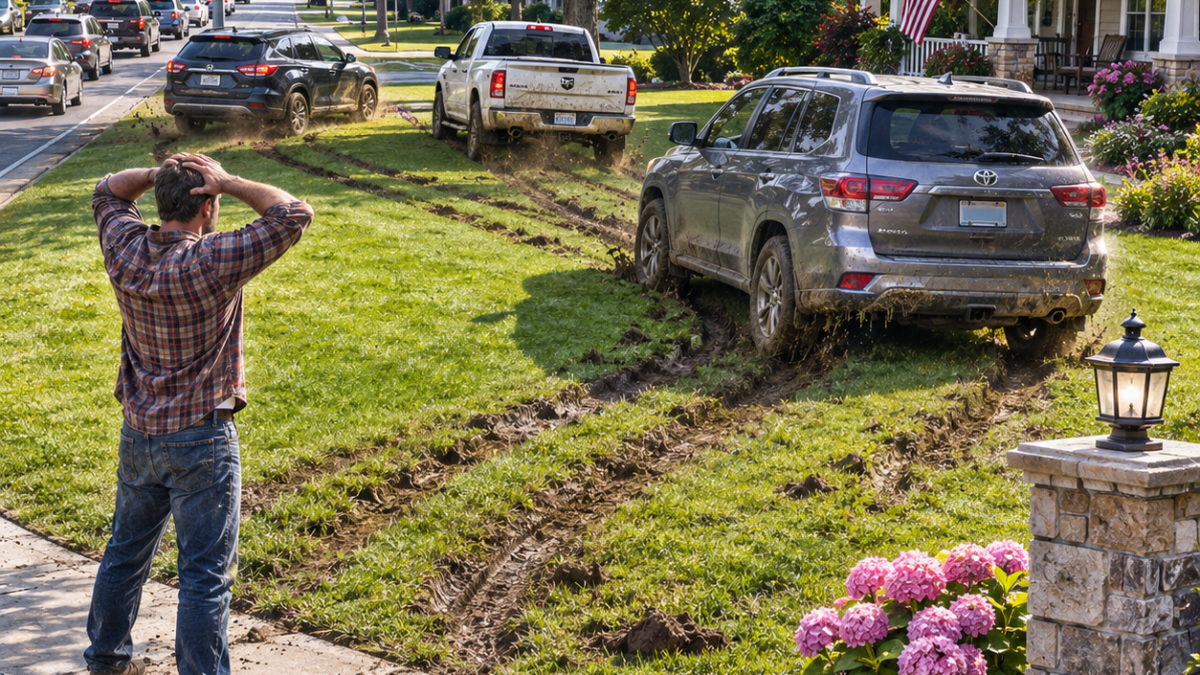
Thirty seconds later the sedan was across my yard.
The stones were scattered.
I laughed.
I actually laughed.
Not because it was funny.
Because the confidence was incredible.
The driver had encountered an obvious boundary on private property and apparently thought:
Those must be movable for my convenience.
By Wednesday, half the stones were pushed into the dirt.
Two had been moved toward the sidewalk.
One disappeared completely.
I found it a week later near the drainage ditch.
Fine.
Stones didn’t work.
Next I tried wooden boundary stakes.
Visible.
Simple.
Not dangerous.
I placed them along the worn curve.
Tuesday morning, a pickup approached.
Slowed.
I watched the driver assess them.
He could have stayed on the street.
The traffic light was maybe forty seconds away.
Instead he angled wider.
Front bumper clipped one stake.
Crack.
The stake snapped.
The truck continued.
I stood in the kitchen gripping my mug.
“Are you kidding me?”
The truck never stopped.
By Friday, three stakes were broken.
Two were gone entirely.
One leaned at forty-five degrees like it had survived a small war.
I replaced them.
Drove them in deeper.
That part was stupid in hindsight.
I wasn’t solving anything.
I was just repeating the same idea with more force because I was annoyed that people hadn’t respected it the first time.
That’s one of the things anger does.
It convinces you the problem is that you haven’t pushed hard enough.
Sometimes the problem is that you’re pushing the wrong thing.
The replacement stakes lasted three days.
Then I put up a sign.
Nothing aggressive.
No threats.
No “VIOLATORS WILL BE PROSECUTED.”
Just:
PRIVATE PROPERTY
PLEASE STAY OFF GRASS
I placed it where any driver entering the shortcut had to see it.
The next morning somebody drove over the edge of the sign.
Not enough to destroy it.
Just enough to tilt it backward.
That was when I finally understood the actual problem.
They weren’t confused.
They knew it was private property.
They knew the lawn belonged to a house.
They knew the shortcut wasn’t a road.
They simply calculated that nothing meaningful would happen if they ignored all of that.
Awareness wasn’t missing.
Consequence was.
That afternoon, Carl saw me straightening the sign.
“You look like you’re losing a war.”
“Feels like it.”
He nodded toward the brown arc.
“How many today?”
“Eleven.”
He whistled.
“I’ve tried rocks.”
“Seen them.”
“Stakes.”
“Seen those too.”
“Sign.”
Carl looked at the leaning sign.
“Apparently they saw that.”
I sighed.
“I’m about ready to build a fence.”
“Could.”
“I don’t want a fence wrapping around the whole corner.”
“Then don’t.”
“What would you do?”
Carl set down his trimmer.
“Make the boundary part of the property.”
“What does that mean?”
“Stop treating it like something temporary.”
I frowned.
He pointed toward the yard.
“Every solution you’ve used so far looks movable.”
“The stones were landscaping.”
“Loose landscaping.”
“The stakes were obvious.”
“Also breakable.”
“So what?”
Carl shrugged.
“Make the line permanent.”
I stared at him.
“Fence?”
“Not necessarily.”
Then he started the hedge trimmer again.
Conversation over.
That night, I walked the corner after dark.
Not plotting.
Studying.
The worn route started near the wide curb opening on Alder.
Drivers cut diagonally across the corner.
Then exited onto Ninth.
They weren’t doing it because there was literally no alternative.
They were saving maybe one traffic-light cycle.
Forty seconds.
A minute on a bad morning.
My destroyed lawn was worth less to them than a minute.
That irritated me more than if they had needed emergency access.
I stood in the middle of the worn path and looked toward the intersection.
Alder was empty at night.
The signal changed from red to green for nobody.
The neighborhood sounded different after ten.
Air-conditioning units.
Crickets.
Somebody’s television through an open window.
I could suddenly imagine what the corner looked like from inside a car.
Wide.
Open.
Flat.
Inviting.
Nothing about the landscape told a driver where public pavement ended and private lawn truly began.
There was a curb, yes.
There was grass.
There was my sign.
But once the tracks were worn in, the path itself started sending the opposite message.
People follow evidence of other people.
A worn path says somebody went here before.
A path wide enough for a car starts looking almost official if you don’t think too hard about it.
That realization bothered me.
The damage was becoming permission.
I photographed the entire area.
Then I went inside and found the property survey from when I bought the house.
I spread it across my dining table.
I wanted one thing confirmed before I changed anything permanent.
The line.
The wide corner belonged to me.
Completely.
There was a utility strip farther back.
A sidewalk easement near Ninth.
Nothing running through the shortcut.
No public drive.
No emergency lane.
No vehicular access.
Still, I didn’t trust myself to improvise.
So instead of building something hidden, I called the town planning office the next morning.
That was not satisfying.
I spent thirteen minutes listening to hold music that sounded like it had been recorded underwater.
Then a woman answered.
“Brook Hollow Planning and Development.”
“Hi. I have a corner lot and I need to install something to stop vehicles crossing my lawn.”
Pause.
“Something?”
“Landscaping. Barrier. I’m not sure yet.”
“Are vehicles currently driving across it?”
“Every weekday.”
Another pause.
“You mean parking?”
“No. Driving.”
“Across your lawn?”
“Yes.”
“To avoid the intersection?”
“Yes.”
She sounded almost impressed.
“Okay.”
She transferred me to zoning.
Zoning transferred me to public works.
Public works transferred me back to planning.
By the time I reached somebody named Nora, I had heard the town’s hold music enough times to know when the saxophone solo was coming.
Nora listened.
“What’s your address?”
I gave it.
Keyboard tapping.
“You’re the southwest corner of Alder and Ninth?”
“Yes.”
“Sight triangle applies.”
“What does that mean?”
“You can’t install tall landscaping or structures that block driver visibility near the intersection.”
“Fine.”
“You’ll also want to stay clear of utility access.”
“Fine.”
“If you’re thinking of bollards or permanent barriers, you need to make sure they’re fully on private property and visible.”
“Visible is good.”
“Do not install anything concealed.”
“I wasn’t planning to.”
“People do.”
That sentence made me pause.
“What kind of people?”
“Angry ones.”
Fair.
Nora emailed me the relevant setback diagram and suggested I talk to a licensed landscape contractor.
That was the first moment the whole thing stopped feeling like a personal feud.
There were actual rules.
Actual ways to solve it.
Not dramatic.
But real.
I called three contractors.
The first didn’t return my message.
The second said the job was too small.
The third was Miguel Alvarez.
He owned a landscaping company that had done retaining walls, drainage work, commercial planters, and curbside planting all over Brook Hollow.
He came Thursday afternoon.
Dusty work boots.
Tape measure clipped to his belt.
Baseball cap faded almost gray.
He didn’t say much at first.
Just walked the corner.
Looked at the tire tracks.
Looked at the street.
Looked at the bent sign.
Then:
“You have cars doing that?”
“Every morning.”
“How many?”
“Usually eight to twelve.”
He looked toward the intersection.
“All to skip the light?”
“Apparently.”
Miguel shook his head.
“People are incredible.”
“I need something permanent.”
“Fence?”
“Prefer not.”
“Boulders?”
“I tried stones.”
“Not stones.”
He pointed toward a commercial property across town.
“Real landscape boulders. The kind you move with equipment.”
“Wouldn’t that dominate the corner?”
“Yes.”
“I don’t want my front yard looking like a military checkpoint.”
He laughed.
“Then not boulders.”
We walked the route again.
Miguel crouched near the worst rut.
“You could build a reinforced landscape edge here.”
“What does that mean?”
“Something designed as part of the landscaping. Visible. Low. Strong enough that nobody casually drives through it.”
“Dangerous?”
“No.”
“I don’t want somebody hitting something hidden.”
“Good.”
He looked at me.
“Because I won’t install hidden vehicle traps.”
“I wasn’t asking.”
“People ask.”
“I’m learning that.”
He smiled.
“Usually after somebody tells them to call a lawyer.”
We discussed options.
Low stone edging.
Reinforced planting beds.
Permanent decorative posts set back enough to remain visible.
Reflective markers facing traffic.
Nothing sharp.
Nothing concealed.
Nothing positioned to damage a car that accidentally mounted the edge at low speed.
The purpose was simple.
Make the lawn unmistakably non-drivable.
Miguel measured.
Checked the sight-line diagram Nora had emailed.
Marked utilities.
Then said:
“I’d also repair the grade.”
“What’s wrong with it?”
“Cars compacted this section. Water’s going to pool.”
I hadn’t noticed.
He pointed to the dirt.
“You’re focused on the tracks. But look at the edge.”
The soil had sunk.
Rainwater had been collecting in shallow depressions.
“So even if they stop, the grass won’t recover well.”
“Exactly.”
That irritated me in a new way.
The damage wasn’t cosmetic anymore.
The shortcut had changed the ground.
Miguel wrote up an estimate.
It was more than I wanted to spend.
Not outrageous.
Still enough to make me stare at the number.
I called Carl over that evening.
He read the estimate.
“Pay it.”
“That’s your analysis?”
“Yes.”
“You didn’t even ask how much I have in savings.”
“You own the house.”
“Technically the bank owns most of it.”
“You planning to stay?”
“Yes.”
“Then pay it.”
“That’s easy for you to say.”
“Dan.”
“What?”
“You have bought stones twice, stakes twice, sod once, and that sign.”
I frowned.
“So?”
“How much?”
I did the math.
More than I expected.
Carl gave me the look.
“You’re spending money losing.”
I hated that sentence.
Mostly because he was right.
“Pay once to win.”
“This isn’t a war.”
“You said it was.”
“You said I looked like I was losing one.”
“Same thing.”
I called Miguel.
“Do it.”
Saturday morning his crew arrived.
Not at dawn.
I had learned enough to respect neighbors.
Seven-thirty.
Small equipment.
Trailer.
Topsoil.
Sod.
Permanent landscape materials.
The whole process took most of the day.
I stayed nearby but forced myself not to hover.
Miguel kept laughing every time I wandered too close.
“You hired us.”
“I know.”
“So go drink coffee.”
“I am drinking coffee.”
“Inside.”
“Why?”
“Because you are staring at my guys.”
“I’m supervising.”
“No.”
He pointed toward my porch.
“Go.”
I went.
Mostly.
From the window, I watched them remove compacted soil, correct the grade, install the border, repair the damaged area, lay new sod, and place low reflective markers where drivers approaching from Alder would clearly see the edge.
By four-thirty, they were cleaning up.
I walked outside.
The difference was strange.
The lawn looked more finished.
But not fortified.
No fence.
No giant wall.
No row of ugly concrete barriers.
Just a clean landscape edge that visually separated road space from yard space.
Miguel handed me the final paperwork.
“You’re good.”
“Think they’ll stop?”
“They’ll see it.”
“That wasn’t my question.”
He looked toward the intersection.
“If somebody deliberately tries to drive through landscaping after seeing it, that’s a different problem.”
“Comforting.”
“You wanted certainty?”
“Yes.”
“Buy a castle.”
“HOA probably wouldn’t approve it.”
He laughed.
Brook Hollow didn’t even have an HOA on my street.
Thank God.
Sunday, I watered the sod.
Carl wandered over.
He inspected the new edge.
“Professional.”
“Yes.”
“Expensive?”
“More expensive than your advice.”
“My advice was free.”
“It caused this.”
“No. The cars caused this.”
He crouched.
“Cars aren’t moving that easily.”
“No.”
“They can see it.”
“Yes.”
“That matters.”
I nodded.
“Apparently.”
Carl stood.
“That’s the difference between a boundary and a trap.”
I looked at him.
“You been talking to Nora at planning?”
“Who’s Nora?”
“Never mind.”
Sunday night I slept badly.
Which was ridiculous.
The problem was supposedly solved.
But some part of me had spent so many mornings waiting for cars that my body had learned the schedule.
At 7:42 Monday, I woke without an alarm.
I made coffee.
Didn’t stand at the window.
Sat at the kitchen table.
7:56.
I lasted four minutes.
Then I went to the window.
Traffic began building.
A school bus passed.
Two delivery vans.
A city pickup.
8:06.
Line of cars on Alder.
8:08.
My heart rate increased.
I felt stupid.
It was grass.
Landscaping.
Commuters.
Why did it feel like a courtroom verdict?
8:09.
Gray sedan.
The car drifted toward the corner.
I leaned closer to the glass.
The driver slowed.
Saw the new boundary.
Paused.
For a second, I could see the exact old habit in the angle of the wheels.
Right turn.
Drop off pavement.
Shortcut.
But the route no longer looked like a route.
The driver rolled another foot.
Stopped.
Brake lights.
Then the wheel turned left.
The sedan returned to the street.
Joined the line.
I exhaled.
“Okay.”
One car meant nothing.
Thirty seconds later, a white crossover approached.
Same drift.
Same hesitation.
Then back into traffic.
Second.
A pickup came.
The one that had broken my stake?
Maybe.
It slowed earlier.
Never left the road.
Third.
By 8:25, no one had crossed.
I poured the rest of my coffee out.
It was cold.
Tuesday, I was ready.
That felt slightly embarrassing.
I had coffee at 8:00.
Window.
Line.
Gray sedan.
White crossover.
Then the black SUV.
I recognized it immediately.
The same shape.
Same dark wheels.
Same driver?
He approached.
Slowed.
Then the window lowered.
I couldn’t hear him from inside.
He looked at the yard.
Looked at the line of traffic.
He rolled closer.
Stopped.
For a moment, I thought he might test it.
My shoulders tightened.
He didn’t.
He backed away from the corner.
Merged into line.
Waited.
I smiled.
Not dramatically.
Not revenge-movie satisfaction.
Just a small smile into my coffee.
The man who had driven past me saying “it’s just grass” had looked at the lawn and decided it wasn’t worth it anymore.
Wednesday:
Zero.
Thursday:
Zero.
Friday morning, I counted.
Not the cars crossing.
The cars that started to drift toward the old route and corrected.
Five.
The habit was still there.
The opportunity wasn’t.
By the following Monday, even the hesitation was disappearing.
Cars lined up normally.
People waited at the light.
The shortcut was dead.
It had taken weeks to become normal.
Three days to disappear.
That fascinated me.
Human beings adapt faster to consequences than to requests.
At least commuters do.
The lawn took longer.
The new sod had to settle.
Miguel told me not to overwater.
I overwatered.
He came by for something else a week later and saw me standing with the hose.
“How long have you been watering?”
“Not long.”
“How long?”
“Maybe twenty minutes.”
He turned the hose off.
“You’re drowning it.”
“I’m helping.”
“You are the reason plants need professionals.”
I gave him the hose.
“You want the job?”
“No. I want you to follow instructions.”
Fair.
The grass slowly came back.
At first, the repaired section was brighter than the rest.
A green stripe where the scar used to be.
Then it blended.
Rain softened the soil.
Roots caught.
The brown tire arc faded.
Every Saturday I mowed over the area, and each time I had to concentrate a little harder to remember the exact path.
That felt good.
Carl noticed too.
One evening he came over while I was watering—correctly this time.
“Well.”
“What?”
“Looks like traffic found the street.”
“Eventually.”
“No broken signs?”
“No.”
“No decorative rock migration?”
“No.”
“No stakes sacrificed in battle?”
“Please stop calling it a battle.”
“You did.”
“Once.”
Carl looked toward the restored corner.
“So what worked?”
“You know what worked.”
“I want to hear you say it.”
“You’re unbearable.”
“Correct.”
I shut off the hose.
“The boundary became permanent.”
Carl nodded.
“And?”
“And visible.”
“And?”
I sighed.
“And I stopped trying to win arguments with strangers from my front yard.”
“There you go.”
He started walking away.
“That’s it?”
“What else you want?”
“I don’t know.”
“Applause?”
“Maybe.”
Carl clapped twice without turning around.
I threw the hose nozzle at him.
Missed.
The next unexpected part happened about a week later.
I was grabbing the mail when the black SUV pulled to the curb.
Window down.
Same driver.
Definitely.
He looked less confident than before.
“Hey.”
“Hey.”
“What’d you do to the yard?”
“Landscaping.”
He nodded toward the corner.
“Car doesn’t go through there anymore.”
“That was the idea.”
He looked annoyed.
Not angry.
Confused.
“Thought maybe something was wrong with the ground.”
“Ground’s fine.”
Long pause.
Then:
“Guess I’ll just wait at the light.”
I nodded.
“Probably easiest.”
He looked at me for another second.
Maybe remembering our first conversation.
Maybe not.
Then drove off.
I expected to feel victorious.
Instead, I felt relieved.
That surprised me.
For weeks I had imagined satisfaction coming from forcing those drivers to experience some dramatic consequence.
A confrontation.
A fine.
Police.
Something.
But once it stopped, I realized I didn’t care about punishing anyone.
I wanted to stop thinking about them.
I wanted my morning coffee to be coffee again.
Not surveillance duty.
I wanted to look at the corner without checking tire marks.
I wanted to mow grass instead of repair damage.
That was victory.
Quiet becoming normal again.
Still, I couldn’t stop thinking about the intersection itself.
Why had the shortcut started at that exact time?
Why almost always between eight and eight-thirty?
Why not evenings?
Why not weekends?
The answer seemed obvious.
Traffic.
But I wanted to understand it.
One morning, instead of standing inside, I sat on the porch with a notebook.
Not because I planned another battle.
Because curiosity had replaced anger.
7:45.
Light traffic.
7:55.
School traffic begins.
8:03.
Alder queue reaches four cars.
8:07.
Eight cars.
8:10.
Thirteen.
The signal stayed red longer than I expected.
Then green.
Only a handful cleared before it changed.
Within two cycles, the line rebuilt.
By 8:25, traffic began easing.
That was the entire window.
The lawn shortcut had been a symptom.
A bad behavior.
Still a symptom.
I remembered the woman from planning.
Nora.
I called town hall.
This time I reached her quickly.
“Brook Hollow Planning.”
“Hi, Nora. Daniel Mercer.”
Pause.
“Corner lawn?”
“That’s me.”
“Please tell me you didn’t install a moat.”
“No.”
“Good.”
“The landscaping worked.”
“Excellent.”
“But I think the intersection timing is part of the problem.”
“What makes you say that?”
I explained the pattern.
Queue length.
Time window.
Signal cycles.
Nora listened.
“You’ve counted this?”
“A little.”
“How little?”
“Enough to know you’re going to call me weird.”
She laughed.
“I work in planning. Weird data is welcome.”
She connected me with public works traffic operations.
A man named Jeff answered.
I gave him the same explanation.
He sounded skeptical at first.
“Residents often perceive signals as unusually long when they’re waiting.”
“I understand.”
“Do you have video?”
“Yes.”
That changed his tone.
“You do?”
“Doorbell camera covers the road.”
“Can you send representative clips?”
“Yes.”
I sent three mornings.
Not hours of footage.
Just clips showing queue buildup.
The shortcut attempts.
The timing.
Two weeks later a town vehicle parked near the intersection.
A technician set up equipment.
I watched from the window.
Carl texted me.
YOU CALLED THE GOVERNMENT?
I replied:
I HAVE EVOLVED.
He sent:
DANGEROUS.
The technician stayed for part of the morning.
Another returned the next day.
Then nothing.
For a week.
Two.
I assumed the issue had disappeared into municipal bureaucracy.
Then Jeff called.
“Mr. Mercer?”
“Yes?”
“We reviewed Alder and Ninth.”
“And?”
“The morning queue is longer than we’d like.”
“So the drivers weren’t imagining it.”
“No.”
“They still shouldn’t cross my lawn.”
“Absolutely not.”
“Just establishing context.”
“We’re adjusting the signal timing during the morning peak.”
“How much?”
“A small change.”
“Enough to help?”
“We think so.”
They also planned clearer lane markings and reviewed whether a turn restriction sign would help.
I thanked him.
Then called Carl.
“You’re not going to believe this.”
“Town annexed your lawn?”
“Traffic signal is getting adjusted.”
Silence.
Then:
“So after all that, the light actually was bad.”
“Yes.”
Carl laughed so hard he coughed.
“That doesn’t excuse them.”
“I know.”
“But it’s funny.”
“It is.”
A week later, the signal timing changed.
Not dramatically.
The queue still existed.
But fewer cars stacked up.
More cleared each cycle.
The pressure that had created the shortcut weakened.
That mattered.
I watched for another week.
Even if my landscaping disappeared overnight, I wasn’t sure the old pattern would return as quickly.
Convenience had been reduced.
The environment changed.
I began thinking about something I hadn’t wanted to admit.
Those drivers weren’t all villains.
The black SUV guy had been rude.
Yes.
The people who deliberately pushed stones aside or broke stakes knew exactly what they were doing.
No excuse.
But most drivers had probably seen an already-worn path and followed it.
That doesn’t make it right.
It makes it ordinary.
Ordinary bad behavior is more interesting than villainy because it explains more of the world.
One person does something.
Nothing happens.
Someone else sees.
Copies.
Soon the behavior feels permitted because it is common.
The grass itself had helped create the illusion.
Once the path was brown enough, it looked less like lawn.
More like an unofficial drive.
The physical result of repeated disrespect became evidence that disrespect was allowed.
That realization stayed with me.
A month later, I saw a delivery van begin turning toward the corner.
The driver stopped.
Backed up.
Rolled down his window.
“Sorry.”
I walked over.
“You’re good.”
“Thought that was a driveway.”
“Used to look like one.”
He looked at the landscape edge.
“Glad I saw that.”
“Me too.”
No anger.
Accident.
Awareness.
Apology.
Completely different.
I started noticing the difference between people making mistakes and people being entitled.
A mistake changes when new information appears.
Entitlement argues with the information.
The SUV driver had known.
The stake-breaking pickup had known.
The stone-moving sedan had known.
They weren’t mistaken.
They were choosing convenience.
That difference mattered.
By late summer, the lawn looked better than before the shortcut started.
Miguel’s grading fixed the drainage.
The new edge gave the corner structure.
I added native ornamental grasses set well inside the sight line.
Nothing tall enough to block traffic visibility.
Nothing aggressive.
Just enough to visually say:
Yard.
Not road.
A woman walking a golden retriever stopped one evening.
“Your corner looks nice.”
“Thanks.”
“Didn’t there used to be dirt there?”
“Long story.”
She smiled.
“Cars?”
I looked at her.
“How’d you know?”
“I saw them.”
“You did?”
“Everybody did.”
That surprised me.
“Why didn’t anybody say anything?”
She shrugged.
“I thought you knew.”
“I knew.”
“I mean, I assumed you had some reason.”
“What possible reason would I have for letting commuters drive across my yard?”
She laughed.
“When you say it like that…”
That conversation bothered me.
Not because of her.
Because it showed how normal the shortcut had looked from outside.
People saw it and assumed somebody must have approved it.
That’s another human habit.
If something happens publicly enough, we assume authority exists somewhere behind it.
Sometimes nobody authorized anything.
Sometimes people just keep doing a thing until everyone else stops questioning why.
I brought that up to Carl.
He was sitting on my porch for once, holding a beer.
“Maybe people thought it was a driveway.”
“No.”
“You don’t know.”
“The first guy knew.”
“One guy.”
“The others saw the sign.”
“Some did.”
“Stakes.”
“Some did.”
“Stones.”
“Dan.”
“What?”
“You want all of them to be villains because then you get to be completely right.”
I stared at him.
“I am completely right.”
“About the property.”
“Yes.”
“Not necessarily about every person.”
I didn’t like that.
Carl took a drink.
“Most people aren’t thinking about you at all.”
“That’s not better.”
“It’s different.”
“How?”
“They weren’t saying, ‘Daniel Mercer’s property doesn’t matter.’”
“They drove across it.”
“They were saying, ‘I can save forty seconds.’”
“That still means my property mattered less than forty seconds.”
“Yes.”
I pointed at him.
“That’s exactly my point.”
Carl nodded.
“Then your point is people are selfish when convenience is easy.”
“Thank you.”
“You’re welcome.”
Pause.
“You’ve done it too.”
“What?”
“Cut through a gas station parking lot to avoid a red light?”
I opened my mouth.
Closed it.
Carl smiled.
“That’s different.”
“How?”
“It’s paved.”
“Private property.”
“It’s a business.”
“Private property.”
“I didn’t drive across landscaping.”
“No.”
He raised his bottle.
“But you took a shortcut somebody probably didn’t design for you.”
I hated Carl.
Not really.
But in that moment, a little.
I thought about it later.
He was right.
I had never driven across somebody’s lawn.
But I had done little convenience things assuming they didn’t matter because everybody did them.
People are good at seeing boundaries clearly when they own the boundary.
Less good when the boundary slows them down.
That didn’t excuse the cars.
It gave me perspective.
Fall arrived.
Leaves collected along the landscape edge.
For the first time, I worried they might hide it.
I called Miguel.
He answered:
“Daniel.”
“Leaves.”
“What?”
“Could leaves hide the edge?”
Pause.
“You called me about leaves?”
“I don’t want somebody saying they couldn’t see it.”
“You have reflectors.”
“Yes.”
“Clear your leaves.”
“That’s your professional advice?”
“Yes.”
“How much do I owe you?”
“Nothing. Please don’t call me again tonight.”
I raked.
The boundary stayed visible.
No incidents.
Then winter came.
Brook Hollow got its first real snow in years.
Three inches.
Enough to cover everything.
I woke early.
Looked outside.
White lawn.
White sidewalk edges.
The landscape border partly visible.
Reflectors sticking above the snow.
Alder traffic moved slowly.
I stood at the window with coffee.
8:10.
Cars waited.
No tire tracks crossed the snow.
That hit me harder than seeing green grass.
Fresh snow records everything.
One car would have written across it.
There were none.
The road was the road.
The yard was the yard.
Simple again.
I took a photograph.
Not evidence.
Memory.
I sent it to Carl.
LOOK.
He replied:
GRASS IS WHITE.
I wrote:
NO TRACKS.
He replied:
YOU NEED A HOBBY.
He wasn’t wrong.
The next spring, the black SUV guy appeared in my life again.
Not at the corner.
Hardware store.
I was standing in the plumbing aisle holding two nearly identical fittings and pretending I knew why one cost six dollars more.
A voice behind me:
“Lawn guy?”
I turned.
Black SUV guy.
Except he wasn’t inside a black SUV.
He was just a man.
Late thirties.
Baseball cap.
Work clothes.
Basket containing furnace filters and screws.
For a second neither of us knew whether to be hostile.
Then I laughed.
“You’re ‘it’s just grass’ guy.”
He winced.
“Yeah.”
“Still driving across lawns?”
“No.”
“Good.”
He smiled.
“My wife was in the car that morning.”
“The first time?”
“Yeah.”
“She hear you?”
“Every word.”
“That go well?”
“No.”
I laughed again.
He held out a hand.
“Brian.”
“Daniel.”
We shook.
Brian looked toward the shelf.
“I was kind of a jerk.”
“A little.”
“I honestly thought everyone used that corner.”
“They did.”
“Still.”
He shifted the basket.
“When you came out, I should’ve stopped.”
“Yes.”
“I was late.”
“You were going to save maybe forty seconds.”
“I know.”
“Worth it?”
“No.”
He shook his head.
“My wife asked me that exact question.”
“Smart woman.”
“Very.”
We stood there awkwardly.
Then Brian said:
“Signal’s better now.”
“It is.”
“You call the town?”
“Eventually.”
He laughed.
“So the light actually sucked.”
“Yes.”
“I knew it.”
“That still doesn’t make my lawn a road.”
“I know.”
He raised both hands.
“I know.”
Then:
“Your landscaping looks good.”
“Thanks.”
“Expensive?”
“More than waiting at a light.”
He winced again.
“Fair.”
We shook hands once more and went separate directions.
That should have been unremarkable.
It wasn’t.
Brian had existed in my mind for months as a symbol.
The smug guy.
The one who looked me in the eye and ignored me.
Meeting him in a hardware store turned him back into a person.
Still wrong.
Still rude.
Also a guy buying furnace filters.
The world gets easier when people stop being symbols.
It’s harder to stay angry at a symbol once it starts comparing air filter sizes three aisles away.
That summer, Brook Hollow repainted the intersection markings.
Added a clearer right-turn lane.
Adjusted signal timing again.
Traffic improved.
The old shortcut became almost impossible to imagine.
New residents moved onto Alder.
Some had no idea it had happened.
A teenage kid delivering flyers once asked me:
“Was there a driveway here?”
“No.”
“Looks like landscaping used to be different.”
“Cars drove through the yard.”
He looked at me like I had said horses used to pull wagons through the kitchen.
“Why?”
“To skip the light.”
“That’s stupid.”
“Yes.”
He shrugged.
“Why didn’t you just put up a fence?”
I laughed.
“Long story.”
Teenagers are brutal editors.
Years went by.
Not many.
Enough.
The story became something I told occasionally at cookouts.
People always wanted the dramatic version.
“What did you install?”
“Landscaping.”
“No, really.”
“Really.”
“There wasn’t some hidden thing?”
“No.”
“But they just stopped?”
“Yes.”
“That’s less exciting.”
“Correct.”
One friend said:
“You should say you installed steel spikes.”
“No.”
“More viral.”
“Also sounds criminal.”
“Details.”
That bothered me because the exaggerated version was more satisfying to listeners.
Invisible barrier.
Cars stopped cold.
Secret trap.
Revenge.
But reality was better precisely because nobody got hurt.
No flat tires.
No damaged suspension.
No lawsuit.
No ambulance.
No police report.
The drivers saw a permanent boundary and chose not to cross.
That was the win.
A boundary shouldn’t need blood to be effective.
The phrase “invisible barrier” became a joke between Carl and me.
He would point toward the lawn.
“How’s the invisible fortress?”
“Still holding.”
“Any casualties?”
“Three dandelions.”
“Thoughts and prayers.”
One afternoon, Carl knocked on my door.
Not normal.
He usually yelled from the yard.
I opened.
He looked older than I remembered.
That happens suddenly with neighbors.
You see them every week, so aging is invisible until one day it isn’t.
“Everything okay?”
“Selling.”
“What?”
“My house.”
I stared.
“Why?”
“My daughter wants me closer.”
“She lives forty minutes away.”
“Thirty-seven.”
“That’s not far.”
“She says it is.”
“You want to go?”
Carl shrugged.
“Condo. No yard.”
“You’ll die.”
“Possibly from happiness.”
“You love your hedge.”
“I hate my hedge.”
“You trim it twice a week.”
“That’s why I hate it.”
I laughed.
Then realized he was serious.
“When?”
“Month.”
That month moved too fast.
Carl’s house filled with boxes.
A moving pod appeared.
His hedge became slightly less perfect.
That disturbed me more than it should have.
The week before he left, he came over carrying his old hedge shears.
Wooden handles polished smooth.
“You want these?”
“Why?”
“My daughter says I’m not allowed to trim condo landscaping.”
“She’s wise.”
“Take them.”
I accepted.
They were heavier than expected.
“Thanks.”
He looked toward the corner.
“Remember when you were ready to declare war over grass?”
“I was not.”
“You absolutely were.”
“I was calmly defending property.”
“You bought rocks.”
“Decorative landscaping.”
“Then stakes.”
“Boundary markers.”
“Then a sign.”
“Communication.”
Carl stared.
“Daniel.”
“Fine.”
I laughed.
“I was losing my mind.”
“Little bit.”
He nodded toward the permanent edge.
“You handled it okay eventually.”
“Thanks.”
“Could’ve done it faster.”
“Thanks less.”
He smiled.
Then grew quieter.
“You know why I told you people do what they can get away with?”
“Because you’re cynical?”
“No.”
“Because you were seventy?”
“I was sixty-eight.”
“Same thing.”
Carl ignored me.
“My father used to say it.”
That surprised me.
“He had a store.”
“What kind?”
“Hardware.”
“Of course.”
“He used to leave boxes outside. People would take them.”
“Free boxes?”
“No.”
“Oh.”
“He’d get furious. Put up signs. Didn’t work.”
“So what’d he do?”
“Put the boxes inside.”
I looked at him.
“That’s your profound wisdom?”
“Yep.”
“Remove the opportunity.”
“Exactly.”
“You could have told me that.”
“You wouldn’t have listened.”
He was probably right.
We stood there.
Then Carl pointed at the grass.
“Boundaries work best when they don’t require somebody else to agree with them.”
That one stayed.
We shook hands.
Carl moved three days later.
His replacement neighbors were a young couple named Emma and Joel.
They let their hedges grow slightly wild.
I hated it.
Which proved Carl had infected me.
I called him.
“The new people ruined your hedge.”
“Good.”
“It’s uneven.”
“Excellent.”
“You’re a monster.”
He laughed.
“Get a hobby.”
I used his hedge shears on my own bushes.
Badly.
They never looked like his.
A year later, I accepted a job opportunity in another state.
The offer surprised me.
Better pay.
More responsibility.
Closer to my sister.
Farther from Brook Hollow.
I sat at the dining table with the contract.
Looked toward the corner lawn.
Funny how property becomes part of identity.
When I bought the house, it represented independence.
Then the lawn became conflict.
Then peace.
Now selling felt like handing over a story.
I called Carl.
“Thinking about moving.”
“Do it.”
“You didn’t even ask where.”
“Doesn’t matter.”
“What if it’s terrible?”
“Then move again.”
“You make everything sound easy.”
“Most decisions become easier after seventy.”
“You were sixty-nine when you moved.”
“I’m rounding.”
I accepted.
The house went on the market.
Showings started.
People loved the corner lot.
That made me nervous.
Every time a potential buyer walked across the lawn, I wanted to explain the entire traffic history.
My realtor, Susan, told me to stop.
“You don’t need to narrate the property.”
“But they should know.”
“Know what?”
“Cars used to cut across.”
“Do they now?”
“No.”
“Problem resolved?”
“Yes.”
“Then disclose anything legally required and stop scaring buyers with neighborhood archaeology.”
She was right.
Eventually a family named the Parkers made an offer.
Aaron and Maya.
Two kids.
They loved the yard.
Aaron stood near the landscaped edge during inspection.
“Was this added later?”
“Yes.”
“Drainage?”
“Partly.”
“Looks good.”
I decided to tell him.
“Cars used to shortcut across here.”
He looked toward Alder.
“Across the lawn?”
“Yes.”
“Why?”
“Light backed up.”
“Still happen?”
“No.”
“What stopped it?”
I pointed at the edge.
“That. Plus town changed signal timing.”
Aaron studied it.
“Any issues since?”
“None for years.”
“Good.”
Then he smiled.
“I’d probably put giant rocks there.”
I laughed.
“I considered that.”
Closing day arrived.
The house was empty.
Rooms echo differently when furniture is gone.
I walked from room to room.
Kitchen.
Living room.
Bedroom.
Garage.
Then outside.
The lawn looked exactly the way it had when I first fell in love with the house.
Wide.
Green.
Morning light across the corner.
The old tire path was impossible to see.
I knew where it had been.
I traced it in my head.
Entry near Alder.
Curve past the tree.
Exit toward Ninth.
Gray sedan.
Black SUV.
Broken stake.
Tilted sign.
Dirt.
Gone.
Aaron arrived early.
His kids jumped out.
Ran across the grass.
One of them shouted:
“This is huge!”
I smiled.
Using the lawn as a lawn.
Perfect.
I handed Aaron the keys.
“One thing.”
“What?”
“If somebody ever tells you ‘it’s just grass’…”
He laughed.
“I remember.”
“Good.”
I loaded the last box into my truck.
Carl’s hedge shears were behind the passenger seat.
Before leaving, I sat in the cab for a minute.
Didn’t start the engine.
The Alder light turned red.
Cars lined up.
One.
Two.
Five.
Eight.
Nobody moved toward the lawn.
The light turned green.
Cars went.
I started my truck.
Pulled onto Alder.
At the intersection, the light changed red again.
I stopped.
Of course.
I looked toward my old lawn.
There was a moment—just a stupid little moment—where I imagined cutting through some convenient piece of private property to save time.
I laughed aloud.
Stayed in line.
Forty-two seconds later, green.
I drove.
That should have been the end.
For a while, it was.
New state.
New house.
Smaller yard.
Not a corner.
Very intentional.
My sister asked why.
“Trauma.”
“From grass?”
“You wouldn’t understand.”
I settled in.
Work got busy.
Brook Hollow became a place I thought about occasionally.
Carl called.
Aaron sent me a photo once after the first snowfall.
No tire tracks.
Caption:
BOUNDARY STILL HOLDING.
I replied:
GOOD.
Two years later, I passed through Brook Hollow for work.
I had an hour before a meeting.
I drove toward Alder without planning to.
The neighborhood looked smaller.
That’s what happens when you return somewhere you once treated as your whole world.
Carl’s old hedge was wildly uneven.
I took a photo.
Sent it.
He replied immediately:
BEAUTIFUL.
I parked across from my old house.
Didn’t want to be creepy.
Aaron was outside.
He recognized me.
“Daniel?”
“Hey.”
He waved me over.
The kids were older.
The lawn looked great.
The permanent edge had weathered naturally into the landscaping.
No shortcut.
“You were right,” Aaron said.
“About?”
“People still look sometimes.”
“What?”
“New drivers.”
He pointed toward the corner.
“They drift toward it. Then they see the edge and stop.”
I smiled.
“Still?”
“Once in a while.”
“Anybody try?”
“Not really.”
“Good.”
Aaron leaned against the mailbox.
“You know what’s funny?”
“What?”
“Most people probably have no idea why that landscaping is there.”
“That’s okay.”
“Kids in the neighborhood think it’s always been like that.”
“Even better.”
That was when I understood the ending more clearly.
The best boundary eventually becomes boring.
It stops being a story.
Nobody debates it.
Nobody challenges it.
Nobody remembers the conflict that created it.
It simply becomes part of the landscape.
That’s peace.
We like dramatic justice because it feels satisfying.
But dramatic justice keeps the conflict alive.
Somebody loses publicly.
Somebody wins publicly.
Everyone remembers.
The lawn gave me something better.
A problem that became uninteresting.
I think that’s why I kept returning to the story.
Not because I outsmarted commuters.
I didn’t.
Not because I got revenge.
I didn’t.
Because I learned the difference between warning people and building a boundary that doesn’t depend on their cooperation.
Before that, every solution required them to care.
Please don’t move the stones.
Please don’t break the stakes.
Please read the sign.
Please respect the lawn.
Please understand it matters to me.
That is a fragile system.
It works only when the other person is willing to participate.
The permanent landscaping changed the question.
They didn’t have to understand me.
They didn’t have to agree with me.
They didn’t have to think lawns were important.
They only had to recognize:
This route is closed.
That principle followed me into other parts of life.
Work.
I had a manager who used to text after ten at night.
At first I answered.
Every time.
Then I resented him.
Then I realized I had taught him I was available.
So I stopped answering non-emergencies after seven.
No confrontation.
No angry email.
Just a boundary.
Within two weeks, the late messages stopped.
My sister had a habit of volunteering me for family favors before asking.
“Daniel can drive you.”
“Daniel can help move that.”
“Daniel can fix it.”
I used to complain after agreeing.
Then I started saying:
“Ask me first.”
She forgot twice.
I said no twice.
She remembered after that.
Not punishment.
Reality.
Carl was right.
People repeat what keeps working.
That doesn’t make everyone malicious.
It makes behavior adaptive.
The question becomes:
What are you accidentally teaching people works?
For months, I taught commuters that driving across my yard worked.
Not intentionally.
But the result was the same.
Stones?
Worked.
They pushed them.
Stakes?
Worked.
They broke them.
Sign?
Worked.
They ignored it.
The actual line didn’t exist in a way that mattered to the behavior.
Once it did, everything changed.
I don’t think that makes me clever.
I think it makes me slow.
Carl probably figured it out the first week.
He was kind enough to let me learn.
Years later, when Carl died, his daughter called me.
That sentence still feels strange.
He was seventy-seven.
Heart attack.
Quick.
She told me there would be a small service.
I flew back.
His daughter, Rebecca, recognized me immediately.
“You’re Daniel.”
“Yeah.”
“Lawn Daniel.”
I laughed through the grief.
“He told you?”
“For years.”
“That man.”
“He loved that story.”
“I thought he loved making fun of me.”
“Same thing.”
After the service, Rebecca handed me a small box.
Inside was a sharpening stone.
Old.
Oil-stained.
“For the hedge shears.”
I stared at it.
“He kept this?”
“Dad kept everything.”
Of course.
She smiled.
“He said you’d destroy the blades without it.”
Also of course.
I drove to my old street afterward.
Aaron wasn’t home.
The lawn looked good.
I stood on the sidewalk.
Touched the handle of Carl’s hedge shears in my trunk.
Looked at the corner.
Thought about the first sentence he gave me.
People do what they can get away with.
At twenty-something, that sounded cynical.
By then, I understood it differently.
People respond to the world we build around them.
Rules.
Habits.
Incentives.
Boundaries.
Examples.
Most people are not constantly calculating how much wrongdoing they can commit.
They are noticing what seems normal.
What works.
What others do.
What carries consequences.
The shortcut had become normal because nobody interrupted the pattern early enough.
My anger had been directed at individual drivers.
The better solution changed the pattern itself.
That is less satisfying emotionally.
More effective practically.
I took one last picture of the lawn.
Sent it to Rebecca.
STILL HOLDING.
She replied:
DAD WOULD LOVE THAT.
I sat in the truck for a while.
Then left.
I never moved back to Brook Hollow.
Didn’t need to.
Some places do their work in your life and then become memory.
My new house has a narrow front yard.
No intersection.
No shortcuts.
I still take care of the grass.
Not obsessively.
At least that’s what I tell myself.
Saturday mornings:
Coffee.
Mower.
Trimmer.
Sometimes Carl’s hedge shears.
I sharpen them with his stone.
They still don’t make my bushes look as good as his.
One spring morning, a neighbor named Kelly walked by while I was trimming.
She stopped.
“You know that side is lower than the other.”
I looked.
It was.
“Thanks, Carl.”
“What?”
“Nothing.”
I corrected it.
Then stood back.
Good enough.
The story occasionally comes up when people see the old photo of my Brook Hollow lawn.
I keep two pictures.
One from the worst week.
Brown arc.
Broken stake.
Tilted sign.
One from the first snow afterward.
Perfect white.
No tracks.
Side by side, they look almost like a before-and-after advertisement.
But what changed wasn’t really the lawn.
It was my thinking.
The first photo says:
Why won’t these people listen?
The second says:
They no longer need to.
That is a much more useful question.
For a long time, I thought enforcement meant punishment.
It doesn’t always.
Sometimes enforcement means designing the situation so the unwanted behavior is no longer easy.
That’s not revenge.
It’s structure.
Traffic engineers do it.
Architects do it.
Parents do it.
Software designers do it.
Cities do it.
Good fences do it.
So do well-designed landscapes.
You don’t necessarily have to make somebody regret what they did.
You only have to make sure repeating it no longer makes sense.
That distinction kept me from becoming the angriest version of myself.
And I came close.
I really did.
After the SUV driver passed me that first morning, I imagined all kinds of stupid responses.
I wanted him to be embarrassed.
Wanted the next shortcut driver to regret choosing my lawn.
Wanted the lesson to hurt enough that nobody forgot.
That is a dangerous place to make decisions from.
Because when you are angry, “consequence” and “punishment” start sounding like the same word.
They aren’t.
A consequence protects the boundary.
Punishment satisfies the anger.
Sometimes they overlap.
Sometimes they absolutely should not.
If I had hidden something under the lawn designed to damage cars, the entire moral balance would have changed.
Suddenly I wouldn’t be the homeowner protecting his yard.
I would be the person who intentionally created a hazard.
What if somebody came across at night?
What if a driver lost control?
What if a passenger was injured?
What if an emergency vehicle somehow needed the corner?
What if a child was in the car?
All over grass.
No.
I’m glad I stayed on the boring side of the line.
Permits.
Planning.
Professional installation.
Visibility.
Repair.
It gave me something the revenge version could never give me.
Peace without guilt.
That is underrated.
People talk about satisfying revenge.
Nobody talks enough about satisfying resolution.
Resolution is quieter.
Nothing explodes.
Nobody gets publicly destroyed.
You wake up one morning and realize the problem didn’t happen.
Then again.
Then again.
Eventually you stop checking.
That was how I knew the lawn was truly mine again.
Not when the first car backed away.
Not when the black SUV waited at the light.
Not even when the grass grew back.
It was the first morning I woke at 8:30 and realized I had forgotten to look.
I stood in the kitchen.
Coffee.
Sunlight.
Clock.
8:31.
I walked to the window out of habit.
Traffic.
Road.
Lawn.
Nothing.
No drama.
No tracks.
No one crossing.
I had missed the whole morning rush.
And I smiled.
Because the problem had finally become boring.
That was the real victory.
Years later, Aaron sent me another picture.
His oldest kid had graduated high school.
The family posed on the front lawn.
Right on the corner.
Four people.
Caps.
Flowers.
The landscape edge behind them.
Green grass.
He wrote:
Thought you’d appreciate this. Still no shortcuts.
I did.
I stared at the photograph longer than expected.
The lawn wasn’t mine anymore.
Hadn’t been for years.
Yet the boundary remained.
Not because Daniel Mercer was standing there.
Not because commuters feared me.
Not because of a sign.
Because the property itself had been designed to communicate clearly.
That may sound like too much philosophy for a yard.
Maybe it is.
But ordinary things teach ordinary lessons.
And ordinary lessons are usually the ones we use most.
I don’t remember the license plate of the gray sedan.
I don’t remember what the pickup looked like beyond the color.
I barely remember Brian’s face now.
I remember Carl.
I remember the broken stakes.
I remember standing in compacted dirt and feeling more disrespected than a patch of dead grass should have made me feel.
I remember Miguel saying he wouldn’t build a trap.
I remember Nora laughing when I promised not to dig a moat.
I remember the first sedan stopping.
I remember snow without tracks.
I remember Brian saying:
“Guess I’ll just wait at the light.”
Forty seconds.
That was all.
Forty seconds had caused weeks of damage.
Forty seconds had made strangers ignore signs.
Forty seconds had almost made me stupid.
Now when I get impatient at a red light, I sometimes think about Alder and Ninth.
I look at the clock.
I look at the road.
Then I wait.
Not because I became some saint of traffic etiquette.
Because somewhere behind every shortcut is somebody else’s boundary.
Sometimes visible.
Sometimes not.
And I’ve learned what it feels like to be standing on the other side of one while somebody looks at you and decides their convenience matters more.
So I wait.
The light turns green.
Eventually it always does.
And every time it does, I think of that old corner in Brook Hollow.
The lawn.
The scar.
The rebuilt edge.
Carl’s hedge across the street.
The first morning nobody crossed.
What started as a fight over grass turned into one of the clearest lessons I ever got about ownership, patience, anger, and the difference between asking for respect and creating a boundary that can stand even when respect doesn’t show up.
The grass grew back.
The traffic returned to the road.
The town fixed part of the real problem.
Brian apologized.
Carl moved.
I moved.
Life kept going.
And somewhere on the corner of Alder and Ninth, kids who never knew any of that run across a lawn that looks like it was always just a lawn.
That is exactly how I want it remembered.
Or not remembered at all.
Because the best boundary I ever built eventually became so ordinary that nobody needed to know why it was there.
They only knew where the road ended.
And where the yard began.