PART 2: They Chased This 2-Year-Old Dog Away Because of His Tumors—Then the X-Ray Revealed What He’d Been Walking On
PART 2
I kept staring at the X-ray.
For several seconds, I forgot that the veterinarian was still talking.
Two injuries in the same leg.
One near the hip.
One farther down near the tibia.
Either one would have been enough to make an ordinary dog cry out or refuse to walk.
Polito had been walking on both.
He had crossed streets on that leg.
He had searched for food on that leg.
He had run from people on that leg.
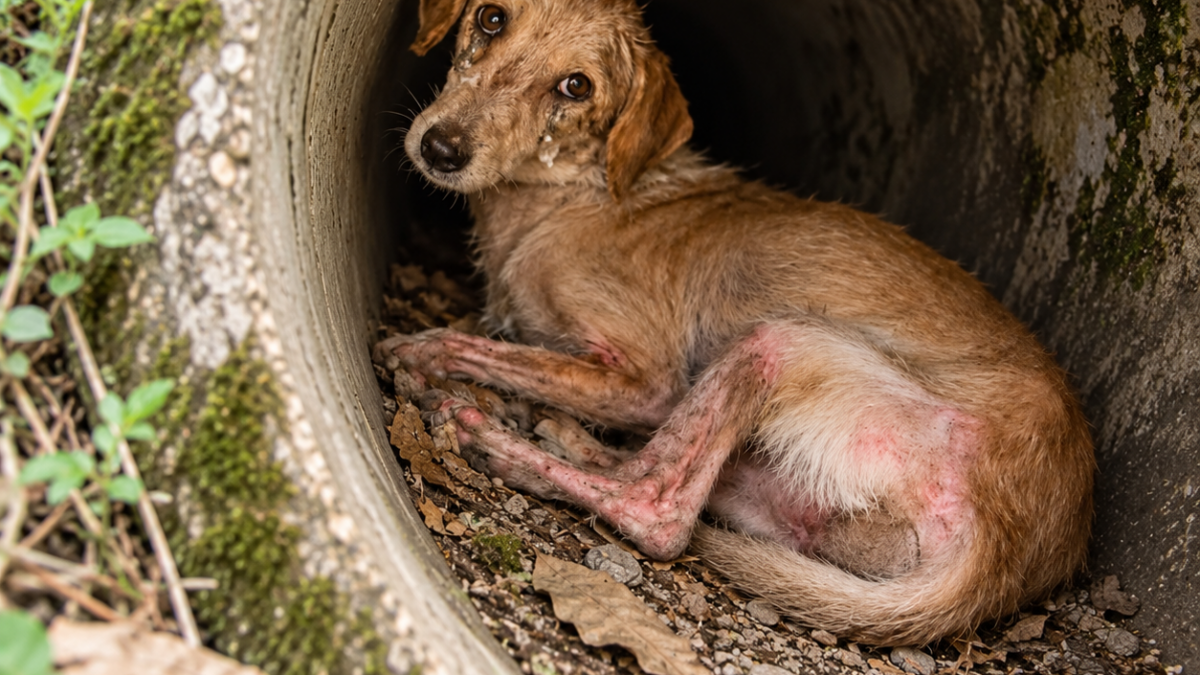
And when we approached him that morning, he had somehow found enough strength to drag himself beneath a concrete drain because fear was stronger than pain.
“How old do you think these injuries are?” I asked.
The veterinarian studied the images again.
“It’s difficult to say exactly.”
“Days?”
A pause.
“Some of this doesn’t look recent.”
I looked at Polito.
He was standing awkwardly against the wall of the examination room, trying not to put weight on the injured leg.
He watched us silently.
No barking.
No whining.
No demand for attention.
His eyes followed every movement.
When the veterinarian reached for him again, Polito lowered his head.
That small movement hurt me more than the X-rays.
He wasn’t preparing to fight.
He was preparing to endure.
I stepped closer and crouched beside the table.
“Hey.”
His eyes shifted toward me.
“You don’t have to do that anymore.”
Of course he didn’t understand the words.
But I needed to say them.
Maybe I needed to hear them too.
The veterinarian explained that treating Polito would not be simple.
The cancer needed attention.
The leg needed attention.
His general condition needed attention.
But we could not treat everything aggressively at the same time without considering how much his weakened body could tolerate.
First, they needed blood work.
Then more tests.
Then a treatment plan.
For the first time since receiving that desperate video, there was no immediate action for me to take.
I couldn’t pull him out of another drain.
I couldn’t simply carry him away from danger.
Now we had to wait for numbers, images and decisions.
And Polito hated waiting in that clinic.
Every sound made him flinch.
A metal tray touched a counter.
His head snapped around.
A door closed in the hallway.
His muscles tightened.
Someone laughed in another room.
Polito lowered himself closer to the floor.
One of the veterinary assistants noticed.
“He’s terrified of everything.”
I nodded.
“Not everything.”
She looked at me.
I pointed toward the hallway.
“When nobody is paying attention to him, he relaxes a little.”
We began learning him that day.
Not the medical chart.
Polito.
There is a difference.
A chart can tell you weight, temperature, blood values and fracture location.
It cannot tell you that a frightened dog prefers people to sit sideways instead of facing him directly.
It cannot tell you that he is more willing to accept food if you place it on the floor and move your hand away.
It cannot tell you that a quiet voice makes his ears lift slightly.
Those things mattered almost as much as medicine.
So we stopped trying to convince him quickly.
We stopped reaching toward him unless necessary.
We gave him space.
I sat on the floor several feet away.
For nearly twenty minutes, nothing happened.
Then Polito looked at me.
I placed a small piece of food on the floor between us.
He stared at it.
Then at me.
Then back at the food.
“You can have it.”
He didn’t move.
I turned my face away.
A minute passed.
Then I heard the smallest sound.
His nails against the tile.
I didn’t look.
Another step.
Then another.
When I finally glanced sideways, the food was gone.
Polito had retreated to the wall.
But something had changed.
He had taken food with a human in the room.
It seemed like nothing.
For him, it was enormous.
That night, after leaving the hospital, I kept seeing him beneath the drain.
The darkness behind him.
The way his body shook when we touched him.
I had rescued frightened street dogs before.
Some fought.
Some barked.
Some tried to escape.
Polito’s fear was different.
He expected surrender to hurt less than resistance.
That told me more about his past than anyone in San Martin ever could.
The next morning, I returned early.
One of the veterinary staff met me near the entrance.
“He ate.”
I stopped.
“On his own?”
She smiled.
“Not much. But yes.”
I went to see him.
Polito was lying on a blanket.
For the first time, I noticed how young his face actually was.
Fear had aged him.
When he relaxed, even slightly, he looked like the two-year-old dog he was supposed to be.
I sat beside his enclosure.
“Morning, buddy.”
His eyes opened.
He watched me.
I waited for the usual retreat.
It didn’t happen.
His head remained on the blanket.
That became our routine.
Sit.
Wait.
Speak quietly.
Never force.
The cancer treatment began once the medical team believed his body could manage it.
Chemotherapy is a frightening word.
People hear it and imagine suffering.
But TVT can respond to treatment, and Polito deserved the chance to fight something that had been growing unchecked while he lived on the streets.
Still, watching that first treatment was difficult.
Not because Polito understood what chemotherapy meant.
He didn’t.
What frightened him was restraint.
Hands.
Needles.
Being unable to leave.
The veterinary staff worked slowly.
One assistant held him gently.
Another prepared the medication.
I stayed near his head.
Polito began trembling.
I placed my hand on the blanket, not on him.
“Look at me.”
His eyes found mine.
“You survived the streets.”
His breathing remained fast.
“You survived that drain.”
The veterinarian began the treatment.
“You can survive this too.”
For the next several minutes, I kept talking.
I told him nonsense.
I told him what the weather was like outside.
I told him there were better meals waiting for him.
I told him one day he might sleep through an entire night without needing to listen for footsteps.
I told him one day he might learn what a bed was.
At one point, his nose touched my fingers.
Maybe accidentally.
Maybe not.
I didn’t move.
When the treatment ended, Polito immediately pulled away.
But before turning toward the wall, he looked back once.
That glance was enough to make everyone in the room smile.
Progress with a dog like Polito did not arrive dramatically.
It arrived in inches.
The first time he ate while someone watched.
The first time he drank without waiting for the room to empty.
The first time a veterinarian touched his shoulder and he did not flatten himself against the wall.
The first time he accepted a piece of chicken directly from my fingers.
Each moment was tiny.
Together, they were a revolution.
His physical treatment remained complicated.
The tumors needed repeated chemotherapy.
His blood had to be monitored.
The damaged leg had to be evaluated carefully because the injuries affected two areas.
Some days were better than others.
On one difficult morning, I arrived and found Polito refusing breakfast.
I felt panic immediately.
“What happened?”
The veterinary assistant shook her head.
“He’s tired today.”
“From the treatment?”
“Possibly.”
I entered slowly.
Polito did not lift his head.
I sat beside him.
“You scared me.”
One ear moved.
That was all.
I placed food nearby.
No reaction.
I stayed.
Twenty minutes.
Thirty.
I told myself not to make my fear his problem.
Eventually Polito lifted his head.
He sniffed.
Then he ate one bite.
I nearly cried over that single bite.
People sometimes imagine rescue as the moment an animal is pulled from danger.
That is the photograph everyone remembers.
The dog carried out of the drain.
The rescuer smiling.
The blanket wrapped around the body.
But rescue is rarely one moment.
Rescue is returning the next morning.
And the morning after that.
Rescue is medication schedules.
Cleaning.
Blood tests.
Cancelled plans.
Unexpected bills.
Watching a dog refuse food and sitting beside him until he tries again.
Rescue is wondering whether his body can tolerate another treatment.
Rescue is celebrating when he finally urinates normally.
Rescue is learning that love is often repetitive and inconvenient.
Polito taught me that better than almost any dog I had met.
His distrust made every small victory visible.
Weeks earlier, a hand moving toward him meant danger.
Now he sometimes leaned forward to sniff one.
Not every hand.
Not every time.
But sometimes.
One afternoon, a police officer from the area where Polito had wandered came to visit.
I recognized him from the original search.
He stood several feet from Polito.
“So this is our street boy.”
Polito looked up.
His ears changed immediately.
Not fully raised.
But interested.
The officer crouched.
“Remember me?”
Polito sniffed the air.
The officer smiled.
“He used to walk behind us sometimes.”
“Why?”
“I don’t know.”
“Did you feed him?”
“Whenever we had something safe.”
That explained part of it.
But the officer continued.
“He wouldn’t let us get close. He’d just stay nearby. Sometimes we’d finish a patrol and realize he’d followed us half the block.”
I looked at Polito.
The officer’s smile disappeared.
“People weren’t always kind to him.”
“What do you mean?”
He hesitated.
“Some didn’t want a dog like that near their businesses.”
Because of the tumors.
Because he looked sick.
Because customers might complain.
Because it was easier to chase away suffering than look at it.
“Did anyone hurt him?”
“I never personally saw someone injure him.”
It was an important distinction.
We had no evidence identifying who or what caused the fractures.
No responsible rescuer should invent an abuser just because a dog has been abused by circumstance.
Maybe he had been struck by a vehicle.
Maybe he had fallen.
Maybe someone had kicked him.
We did not know.
And the truth mattered.
But there was one thing we did know.
After whatever caused those injuries, Polito had been left to survive outside.
That failure belonged to more than one person.
The officer reached slowly into his pocket and removed a small piece of food.
“Can I?”
I nodded.
He placed it on the floor.
Polito stared at him.
Then, to my surprise, he walked forward.
Three careful steps.
He ate the food.
The officer’s eyes became wet.
“I tried to catch him once.”
Polito looked up again.
“I couldn’t.”
“You helped keep him alive.”
The officer shook his head.
“Not enough.”
I understood the feeling.
In rescue work, “not enough” can become a permanent voice in your head.
Not enough money.
Not enough space.
Not enough foster homes.
Not enough time.
Not enough hands.
But sometimes keeping an animal alive until the next person arrives is enough to change the ending.
I told him that.
He looked at Polito for a long moment.
Then he whispered, “I hope so.”
Polito’s cancer treatments continued.
Slowly, the visible tumors began changing.
The veterinary team noticed first.
Then I did.
Areas that had once looked angry and prominent began reducing.
His body was responding.
The morning the veterinarian told me that, I asked her to repeat it.
“You’re seeing improvement?”
“Yes.”
“Real improvement?”
She laughed softly.
“Yes. Real improvement.”
I went straight to Polito.
He was standing on three legs beside his blanket.
“You hear that?”
He tilted his head.
“You’re winning.”
That word felt good.
Winning.
For weeks, Polito’s life had been described in terms of damage.
Cancer.
Fracture.
Dislocation.
Malnutrition.
Fear.
Now we had a word that moved in the opposite direction.
Winning.
I knew we were not finished.
His leg remained a serious issue.
Trust remained a serious issue.
Cancer treatment requires patience.
But hope had finally become medically reasonable.
That mattered.
Then came the day Polito wagged his tail at me.
I almost missed it.
I entered with food.
He recognized the bowl and took a step toward me.
His tail moved once.
Barely.
I stopped walking.
“What was that?”
His tail froze.
I smiled.
“Did you just wag at me?”
Nothing.
I set down the bowl.
“You did.”
Polito began eating.
I sat nearby pretending the moment had not shattered something inside me.
I had watched dogs perform extraordinary recoveries.
But that tiny tail movement felt like revenge.
Not revenge against one person.
We still did not know who had caused his injuries.
It was revenge against every moment that had taught him human beings could not be trusted.
Every meal he ate safely was revenge.
Every uninterrupted night of sleep was revenge.
Every gentle touch he accepted was revenge.
Every tumor that shrank under treatment was revenge.
The world had told this dog, again and again, that he was disposable.
His recovery was his answer.
Weeks passed.
Polito became stronger.
His personality began emerging from beneath the fear.
He was observant.
Stubborn.
Quiet.
And surprisingly funny.
One morning, a veterinary assistant placed his medication inside a piece of food.
Polito took it.
Chewed carefully.
Swallowed the food.
Then dropped the pill perfectly onto the floor.
The assistant stared.
I laughed.
“No.”
She tried again.
Different food.
Same result.
Polito ate around the medication and left the pill.
“You survived on the streets for a reason,” I told him.
His eyes seemed brighter now.
We eventually learned to disguise the medication better.
Polito learned to inspect everything we gave him.
It became a battle neither side officially admitted was happening.
Those ordinary moments were precious because illness had stopped being the only thing in the room.
Polito was becoming a dog instead of a patient.
There is a moment in many rescues when survival slowly turns into living.
It is difficult to identify exactly when it happens.
Maybe it was the tail wag.
Maybe it was the pill trick.
Maybe it was the first time Polito chose to lie near a person instead of as far away as possible.
But eventually I realized I no longer entered his room wondering whether he would survive the day.
I entered wondering what he would do next.
That was when another problem became impossible to ignore.
His leg.
The cancer treatment had been urgent, but the orthopedic damage remained.
The femoral head injury caused persistent pain and abnormal movement.
The lower fracture complicated the picture.
We discussed options repeatedly.
Surgery.
Management.
Timing.
Risks.
Recovery.
There was no perfect answer.
There rarely is in medicine.
The veterinarian spread the new images across the screen.
“This is what we’re dealing with.”
I listened carefully.
“What gives him the best chance at a comfortable life?”
That became the only question that mattered.
Not whether we could make the X-ray beautiful.
Not whether we could make him mechanically perfect.
Could he live without constant pain?
Could he walk?
Could he play?
Could he eventually run?
Could he forget that leg enough to enjoy being a dog?
The team developed a plan.
And once again, Polito had to trust humans to hurt him temporarily in order to stop a deeper pain.
That irony haunted me.
He could not understand surgery.
He could not understand chemotherapy.
He could not understand why strangers restrained him or inserted needles.
All he knew was that we were asking for trust.
Trust he had no reason to give.
So on the morning of his procedure, I sat with him for a long time.
He sensed something was different.
Animals always seem to.
“You’re going to wake up,” I told him.
Polito watched me.
“And when you do, I’m going to be here.”
He lowered his head onto the blanket.
I placed my hand beside his paw.
Not touching.
Just there.
After a minute, Polito moved his paw.
It landed against my fingers.
I stopped breathing.
He left it there.
That was his answer.
The procedure took longer than I wanted.
Every surgery does when you are waiting.
I walked.
Sat.
Stood.
Checked my phone even though nobody had called.
Walked again.
Finally the veterinarian came out.
“He’s awake.”
Those two words released every muscle in my body.
“How did it go?”
She explained.
I heard maybe half of it at first.
The part that mattered most was simple.
They had done what they needed to do.
Polito was stable.
Now recovery began.
When I saw him afterward, he looked exhausted.
His eyes were heavy from anesthesia.
He tried to lift his head.
“No.”
I sat down beside him.
“You don’t have to do anything.”
His head lowered again.
“I told you I’d be here.”
That night I stayed longer than necessary.
Maybe far longer.
There was something about leaving him alone after surgery that felt wrong, even though the veterinary team was nearby.
Polito had already spent too many painful nights without anyone sitting beside him.
So I stayed.
At some point, his breathing became slow and even.
He slept.
Really slept.
No twitching toward every hallway sound.
No lifting his head every few minutes.
Just sleep.
I remember looking at him and thinking about the streets where we found him.
Food stalls closing.
Metal shutters coming down.
People going home.
Polito searching for somewhere dry.
That broken leg underneath him.
Tumors across his body.
Hunger tightening his stomach.
And no door that belonged to him.
Now he was asleep on a clean blanket in a warm room, surrounded by medication, monitors and people who knew his name.
It wasn’t a home yet.
But it was proof his life had changed direction.
Recovery from orthopedic treatment tested Polito in ways cancer treatment hadn’t.
He wanted to move before he was ready.
For a dog who had spent his life free to wander—even in misery—restricted activity frustrated him.
The first time he tried to get up too quickly, I caught him.
“No, sir.”
He looked offended.
“Doctor’s orders.”
Polito stared at me.
“Yes, I know you disagree.”
He tried again.
I blocked him.
That was when I saw something wonderful.
Annoyance.
Not fear.
Polito was annoyed with me.
I laughed.
“You can be mad.”
His ears shifted.
“Mad is good.”
Because anger requires a belief that you are allowed to have preferences.
Fearful dogs often suppress everything.
They disappear inside themselves.
Polito was beginning to object.
He disliked certain foods.
He disliked waiting.
He disliked being told not to walk.
He disliked one particular cleaning spray.
He disliked a squeaky toy someone gave him.
He loved chicken.
He loved soft blankets.
He liked sitting in sunlight.
And he had developed a strange fascination with the sound of keys.
Whenever someone entered with keys clipped to a belt, Polito watched them.
I wondered whether that came from the police officers he had once followed.
Maybe keys meant those safer humans were nearby.
We never knew.
But I found an old key ring and began carrying it.
The first time Polito heard it, his head lifted.
“You know this sound?”
His tail moved.
I laughed.
“All right. I’m keeping them.”
Physical therapy began carefully.
Every movement had purpose.
Weight shifting.
Controlled standing.
Short assisted steps.
At first, Polito hated it.
Then he understood something important.
Moving no longer produced the same pain.
I watched realization happen in his body before it reached his face.
He placed the leg down.
Lifted it.
Placed it again.
Waited.
No sharp reaction.
Another step.
The therapist looked at me.
“That’s good.”
Polito took another.
My throat tightened.
For most dogs, four steps across a room mean nothing.
For Polito, they were a journey.
“Come on,” I whispered.
Five steps.
Six.
Then he stopped.
That was enough.
I crouched and opened my hands.
Polito looked at me.
And for the first time since we had met, he walked toward me without food being involved.
Slowly.
Awkwardly.
But by choice.
When he reached me, I did not grab him.
I let him decide.
He sniffed my sleeve.
Then pressed his head lightly against my knee.
I looked away because I did not want the therapist to see me crying.
She saw anyway.
“He trusts you.”
“Don’t say that.”
“Why?”
“Because I’m going to lose it.”
She laughed.
I lost it anyway.
Trust did not erase his past.
That is another thing people misunderstand.
A rescued animal does not wake one morning with trauma gone because somebody loves him now.
Polito still flinched sometimes.
He still disliked sudden movements.
Certain strangers frightened him.
If someone approached too quickly, his body remembered before his mind could evaluate whether he was safe.
But recovery was changing what happened next.
Before, fear sent him running until he disappeared.
Now he might retreat three steps and look back.
Then one day, only two.
Eventually, sometimes, he stayed.
The chemotherapy continued working.
The tumors shrank significantly.
Each appointment brought more evidence that his body was responding.
I began taking pictures for his medical record.
Looking back at the earliest photographs was difficult.
The difference seemed impossible.
His coat looked healthier.
His eyes were clearer.
He carried more weight.
His posture was changing.
But photographs could not capture the biggest transformation.
Polito had started expecting tomorrow.
Street dogs live in immediate mathematics.
Where is food?
Where is danger?
Where can I sleep?
What direction should I run?
Tomorrow is a luxury.
Polito finally had routines.
Breakfast.
Medication.
Therapy.
Rest.
A short walk.
Dinner.
Blanket.
Sleep.
Then morning again.
The future had become predictable.
Safety became boring.
That was exactly what I wanted for him.
One afternoon, I took him outside into a fenced area behind the clinic.
It was one of his first longer periods outdoors after his leg had strengthened.
The gate closed behind us.
Polito froze.
His nose lifted.
Wind moved through the grass.
For a moment I worried he might panic.
Outside had always meant survival.
Then he smelled something.
He took three steps.
Sniffed.
Another three.
He reached a patch of sunlight and stood there.
I waited.
Polito slowly lowered himself onto the grass.
Not hiding.
Not watching an escape route.
Just lying in the sun.
I sat several feet away.
Five minutes passed.
Then Polito rolled slightly onto one side.
His eyes closed.
I took a picture.
That photograph became my favorite.
Not because it was dramatic.
Nobody would look at it and understand everything.
It was simply a young dog resting on grass.
But that was the miracle.
He was resting.
Outside.
With a human nearby.
Nothing bad happened.
A few days later, we returned to San Martin.
Not with Polito.
Not yet.
I wanted to speak with people who had seen him before the rescue and understand whether anyone knew more about his history.
We asked questions.
Had anyone owned him?
Had anyone seen an accident?
Had anyone noticed when the tumors appeared?
Had anyone seen someone harm him?
Stories overlapped but never formed a complete answer.
“He was always around.”
“He showed up months ago.”
“No, longer than that.”
“I thought he belonged to somebody.”
“He slept near the market sometimes.”
“He came from another neighborhood.”
Nobody knew.
That is how invisible street dogs become.
Everyone recognizes them.
Nobody knows them.
They belong to the landscape until suddenly they are gone.
One vendor remembered Polito clearly.
“He used to stand over there.”
She pointed beside a wall.
“Did you feed him?”
“Sometimes.”
Another man interrupted.
“He made customers uncomfortable.”
I looked at him.
“Because he was sick?”
“He looked terrible.”
“He was sick.”
“I know.”
“Then why chase him away?”
The man crossed his arms.
“What was I supposed to do?”
There it was.
The sentence that follows suffering everywhere.
What was I supposed to do?
Not everyone could pay Polito’s veterinary bills.
Not everyone could rescue him personally.
I understood that.
But compassion does not always require solving everything.
Sometimes it means a bowl of water.
One meal.
A phone call.
Not kicking a frightened animal away.
I did not argue.
There was nothing to gain from turning Polito’s story into a public trial of strangers.
But one older woman standing nearby spoke quietly.
“I gave him leftovers.”
The man looked away.
She continued.
“He came after closing. I put food near the wall.”
“Did he let you touch him?”
“No.”
“Did you notice the leg?”
She nodded.
“For a long time.”
“How long?”
“I don’t know. Weeks. Maybe more.”
My chest tightened.
“Did anyone call for help?”
She looked ashamed.
“I thought someone else would.”
That sentence was worse.
I thought someone else would.
It is how suffering survives in crowded places.
Everyone sees.
Everyone assumes rescue belongs to another pair of hands.
The woman wiped her eyes.
“Is he alive?”
“Yes.”
Her face changed.
“Really?”
“Yes. He’s being treated.”
She pressed both hands against her chest.
“Thank God.”
I showed her a recent photograph.
She stared at it for several seconds.
“That’s him?”
“That’s Polito.”
“I didn’t know his name.”
“He has one now.”
She touched the screen carefully.
“He looks different.”
“He feels different too.”
Before we left, she asked something I was not expecting.
“When he is better… could I see him?”
I thought about it.
“Maybe.”
Months earlier, Polito had stood near this woman’s food stall waiting for leftovers.
Now she wanted to see him healthy.
That felt like another circle beginning to close.
Back at the clinic, Polito was learning stairs.
One step.
Pause.
Another.
His therapist stayed close.
I stood at the top with a piece of chicken.
“You’re bribing him,” she said.
“Motivating.”
“Bribing.”
Polito stared at the chicken.
I moved it slightly.
“Come on.”
He climbed.
Slowly.
At the top, he took the food and looked at me expectantly.
“That’s all.”
He stared.
“No.”
He stared harder.
The therapist laughed.
“He knows you have more.”
I reached into my pocket.
“One more.”
He took it.
This time his tail wagged several times.
Full movements.
No hesitation.
I remembered the first tiny twitch.
Now his whole rear end moved.
There are victories nobody applauds because nobody else knows a battle happened.
That tail was one of them.
The medical team eventually gave us news I had been waiting to hear.
The cancer was responding extremely well.
The visible tumors had regressed dramatically.
Treatment still had to follow the veterinary plan, but Polito was moving toward remission.
I sat down when they told me.
Not because I was shocked.
We had seen improvement.
But hearing the words made it real.
Polito had survived long enough for medicine to catch up with him.
That afternoon, I bought him chicken.
Too much chicken.
The veterinarian raised an eyebrow.
“Celebration.”
“He has dietary limits.”
“I know.”
“Do you?”
“Yes.”
She removed half the chicken.
Polito watched her do it.
I pointed at the veterinarian.
“Not my fault.”
Polito stared at her.
She laughed.
“Do not turn him against me.”
For the first time, the clinic around Polito sounded normal.
People joking.
Staff smiling.
A dog begging.
Nobody whispering about whether he would make it.
The next stage was finding where Polito would live once medical supervision became less intense.
That question terrified me more than I expected.
Rescue creates attachment.
You tell yourself you are temporary.
You tell yourself the goal is not to keep every animal.
Then a dog rests his broken trust against your knee and suddenly “temporary” feels like betrayal.
Several foster options existed.
We evaluated them carefully.
Quiet home.
Secure yard.
No chaotic environment.
Someone patient.
Someone willing to continue rehabilitation.
Someone who understood fear could return unexpectedly.
Polito did not need a person who wanted instant gratitude.
He needed someone willing to earn ordinary trust slowly.
A couple came to meet him.
They had experience with nervous dogs.
I watched from a distance.
The woman sat on the floor without approaching.
Good.
The man avoided staring directly at Polito.
Better.
They talked quietly with each other.
Polito remained near the back of the room.
Five minutes.
Ten.
The woman placed a treat beside her.
Then she continued talking as if nothing had happened.
Polito stared.
My heart pounded.
He stepped forward.
Stopped.
Another step.
Stopped again.
He reached the treat.
Ate it.
Retreated.
The woman did not reach for him.
I smiled.
After they left, she asked me, “Was that okay?”
“It was perfect.”
“I wanted to pet him.”
“I know.”
“He wasn’t ready.”
Exactly.
Many people say they love animals.
Patience shows whether they mean the animal in front of them or only the feeling they hope the animal will give them.
The couple returned several times.
Every visit, Polito went a little closer.
On the fourth visit, he sniffed the man’s hand.
The man remained completely still.
On the fifth, Polito sat three feet from them.
On the sixth, something happened none of us expected.
The woman stood to leave.
Polito followed her.
She stopped.
He stopped.
She took another step.
He followed again.
She looked at me.
I nodded.
“Keep walking.”
She crossed the room.
Polito followed.
At the door, she turned carefully.
Polito stood behind her.
His tail moved once.
The woman covered her mouth.
I knew then.
He had chosen.
We arranged a trial foster period once his medical team approved the transition.
The morning he left the clinic, I felt physically sick.
I packed his blankets.
Medication.
Food.
Records.
Favorite treats.
The ridiculous key ring he liked.
The foster couple had bought him a bed.
A good one.
Thick sides.
Washable cover.
Placed in a quiet corner of their living room.
I knew all of this.
It did not help.
Polito watched me pack.
“You’re not being abandoned.”
His ears shifted.
“You need to understand that.”
He obviously didn’t.
“You’re moving up.”
I clipped on his leash.
He walked with me toward the entrance.
Months earlier, we had carried him because walking hurt too much.
Now he crossed the clinic under his own strength.
Outside, the couple waited near their vehicle.
The woman crouched.
“Hi, Polito.”
His tail moved.
That nearly destroyed me.
We loaded his things.
Then came his turn.
Polito hesitated at the vehicle.
I lifted him carefully.
He no longer trembled when I held him.
That fact alone was worth everything.
I placed him inside.
He turned around.
For one horrible second, his expression looked exactly like the dog under the drain.
Confused.
Unsure.
I climbed halfway into the vehicle.
“Listen to me.”
Polito stared.
“You are not going back.”
I touched his shoulder.
He allowed it.
“You will never be that dog again.”
The woman beside me wiped her eyes.
I continued.
“You have people now.”
Polito licked my wrist.
He had never done that before.
I laughed and cried at the same time.
“That was cheap.”
He licked me again.
The drive to the foster home was quiet.
When we arrived, we let Polito enter at his own pace.
Front door.
Hallway.
Living room.
Everything new.
He sniffed every corner.
The bed frightened him slightly.
Probably because it was unfamiliar.
We left treats near it.
He ignored them.
Instead, Polito walked to the front door and lay down.
I understood immediately.
Street dogs often position themselves where they can see exits.
The couple understood too.
They moved the bed.
Not forcing Polito to adapt to their idea of where he should feel safe.
They placed it near the door.
He sniffed it.
Stepped inside.
Turned twice.
Lay down.
“That’s his spot,” the man said.
Yes.
For now.
The first night was difficult.
Polito paced.
He woke frequently.
Every unfamiliar sound mattered.
The refrigerator turning on.
Pipes.
A passing motorcycle.
Neighbors closing a gate.
At 2:13 in the morning, the foster woman sent me a photograph.
Polito was asleep beside the bed instead of inside it.
The message read:
“He’s okay. I’m sleeping on the couch nearby.”
I looked at the picture for a long time.
That was exactly the person he needed.
Not someone demanding he become normal.
Someone willing to meet him where he was.
Over the next week, Polito explored more of the house.
Living room first.
Then kitchen.
Then hallway.
Bedrooms remained suspicious territory.
The backyard became his favorite place.
At first, he circled the perimeter repeatedly.
Checking fences.
Checking gates.
Mapping escape routes.
Then one afternoon, the foster man sent a video.
Polito was lying in the middle of the yard.
Not against the fence.
Not near the gate.
Middle.
Exposed.
Safe.
His eyes were closed.
The caption under the video said:
“Look who stopped guarding the exits.”
I watched it five times.
That was recovery.
Not dramatic.
Not cinematic.
Just a dog deciding he did not need to plan an escape.
His follow-up veterinary appointments remained necessary.
Each time he returned to the clinic, I worried the environment would trigger old fear.
Sometimes it did.
But something else happened too.
Polito recognized us.
The first time he came back after moving to the foster home, I was waiting in the hallway.
He turned the corner.
Stopped.
Then his tail began moving.
I crouched.
“Hey, street boy.”
Polito walked directly toward me.
No hesitation.
He pressed his body against my legs.
Everyone nearby became quiet.
I rubbed his neck.
“You remember.”
Of course he remembered.
Dogs remember places differently than humans.
Maybe not as stories.
Maybe as smells.
Sounds.
Body sensations.
Hands.
Safety.
But Polito knew us.
And now the clinic was not only the place where needles happened.
It was also the place where he had survived.
His tests continued showing progress.
The cancer treatment approached its final stages.
His leg became stronger.
Muscle slowly returned.
He would probably never move exactly like a dog who had never suffered those injuries.
That no longer mattered.
Comfort mattered.
Function mattered.
Joy mattered.
And joy had become visible.
The foster couple bought him a stuffed toy.
A small brown animal that squeaked when bitten.
Polito initially hated squeaky toys.
This one was different.
Maybe the sound was softer.
Maybe his confidence had changed.
He sniffed it.
Pawed it.
Picked it up.
Dropped it.
The toy squeaked.
Polito jumped backward.
The couple laughed.
He stared at the toy.
Then attacked it with the enthusiasm of a dog discovering puppyhood two years late.
The video lasted forty-seven seconds.
Polito shook the toy.
Dropped it.
Pounced.
Tail whipping.
Front legs lowered.
Rear end high.
Play bow.
I cried.
Again.
I had seen Polito walk through traffic looking for food.
I had held him while he shook beneath the drain.
I had watched doctors point to fractures on a screen.
Now I was watching him play.
People ask which moment makes rescue worthwhile.
That one.
A dog discovering he is allowed to be ridiculous.
Polito had been serious because survival demanded seriousness.
Now he could waste energy.
That is what play is.
Energy spent without necessity.
Street animals often cannot afford it.
Polito finally could.
The couple’s home gradually stopped being a foster placement.
Everyone knew what was happening except perhaps Polito.
He followed the woman into the kitchen.
Waited near the man’s chair.
Slept beside their bedroom door.
Then inside the bedroom.
Then one night, according to them, he climbed onto the bed.
They had not invited him.
Polito apparently decided paperwork was unnecessary.
He stepped onto the mattress, circled twice, and lay between them.
The man sent me a message the next morning.
“I think we’ve lost control of the foster situation.”
I replied:
“You never had control.”
They laughed.
Then came the question I had expected.
“We want to adopt him.”
I stared at the message.
My chest felt both heavy and light.
There are endings you want so badly they still hurt when they arrive.
I called them.
“Are you sure?”
“Yes.”
“You understand his medical history.”
“Yes.”
“You understand he may need continued follow-up.”
“Yes.”
“You understand he might always carry some fear.”
“We know.”
“What if he never becomes completely confident?”
The woman answered.
“He doesn’t have to.”
That was the correct answer.
Not “we’ll fix him.”
Not “he’ll get over it.”
He doesn’t have to.
I approved the adoption.
Before finalizing everything, we scheduled one more medical evaluation.
The veterinarian reviewed Polito’s cancer treatment.
Examined the former tumor sites.
Checked his blood work.
Evaluated his leg.
Then she smiled.
“He’s doing very well.”
I looked at her.
“How well?”
She knew exactly what I was asking.
“The treatment has done what we hoped.”
I let out a breath.
“And the leg?”
“He has limitations, but look at him.”
Polito was standing near the door, watching us.
His tail wagged.
“He’s using it.”
“Yes.”
“Pain?”
“Manageable. We’ll continue monitoring him, but he has a good quality of life.”
Good quality of life.
Months earlier, Polito had barely had life.
Now we were discussing its quality.
I knelt beside him.
“You did it.”
Polito sniffed my pocket.
“You only care about treats.”
He nudged the pocket.
The veterinarian laughed.
“He looks pretty recovered emotionally too.”
“Selective affection.”
Polito sat.
I gave him a treat.
On adoption day, we did something I had been thinking about for weeks.
We drove Polito back toward the neighborhood where he had once wandered.
Not to abandon him.
Not even to walk him through the busy market.
I wanted one person to see him.
The older woman who had left food near the wall.
We arranged to meet somewhere quiet.
She was already waiting when we arrived.
Polito stepped from the vehicle wearing a clean harness.
His body looked dramatically different.
Healthy weight.
Clearer skin.
Stronger posture.
His coat caught the sunlight.
The woman began crying before we reached her.
“That’s him?”
I smiled.
“That’s him.”
She covered her face.
Polito looked at her cautiously.
She crouched but did not reach.
“I’m sorry,” she whispered.
I heard it.
So did his new family.
Polito obviously did not understand the words.
But he knew tone.
The woman placed food on the ground.
He stepped forward.
Ate it.
Then looked at her.
“I should have called sooner,” she said.
There was nothing useful in punishing her.
She already knew.
“You fed him when others chased him away.”
“Not enough.”
“It mattered.”
She cried harder.
Polito took another step.
Then, unexpectedly, he sniffed her hand.
She froze.
“Can I touch him?”
“Let him decide.”
She held still.
Polito sniffed again.
Then moved away.
The woman smiled through tears.
“That’s okay.”
Good.
She had learned too.
The man who had complained about Polito frightening customers stood farther down the street.
I recognized him.
He recognized me.
Then he saw Polito.
His expression changed.
He walked over slowly.
“That’s the dog?”
“Yes.”
He looked at the healed areas where tumors had once been.
“He looks completely different.”
“He got treatment.”
The man nodded awkwardly.
“I didn’t know it could be treated.”
I said nothing.
He continued.
“I thought he was dying.”
“He almost was.”
The words landed.
The man stared at Polito.
Then he looked at me.
“Who paid for all this?”
“People who decided he was worth saving.”
He looked away.
That was the closest thing to revenge I wanted.
Not humiliation.
Recognition.
I wanted the people who once saw a disgusting sick dog to see the animal underneath the disease.
I wanted them to understand the body they had waved away contained a life capable of healing.
Polito did not need vengeance.
His existence was enough.
Healthy.
Loved.
Standing there beside a family who had driven across town just to show him a piece of the world he had survived.
The police officer who once fed him joined us a few minutes later.
When Polito heard the familiar jingle of keys, his ears lifted.
The officer laughed.
“No way.”
Polito walked toward him.
The officer crouched.
“Hey, buddy.”
This time Polito did not stop several feet away.
He walked all the way to him.
The officer gently touched his chest.
Polito allowed it.
Then his tail began moving.
The officer looked at me.
“You’ve got to be kidding.”
“I told you he remembered.”
The officer rubbed his face.
“I’m not crying.”
“You are absolutely crying.”
He laughed.
“Don’t tell anybody.”
Polito leaned closer.
The officer looked down.
“You used to follow my patrol car.”
He scratched lightly beneath Polito’s chin.
“Now look at you.”
I stepped back and watched them.
The woman from the food stand.
The officer.
The new family.
Polito.
For a few minutes, the street that had represented rejection became something else.
A witness.
Proof.
Then Polito turned toward his new family’s vehicle.
He was ready to leave.
That mattered too.
He did not belong to San Martin’s streets anymore.
We opened the door.
He climbed in with a little assistance.
Before I closed it, Polito looked back.
I remembered carrying him away from this place the first time.
His entire body had shaken.
Now he stood with his front paws on the seat and his tail moving.
“Ready to go home?” the woman asked.
Home.
The word hit me.
Not clinic.
Not shelter.
Not foster.
Home.
Polito climbed onto the back seat.
The door closed.
And we drove away.
His adoption became official that afternoon.
The paperwork took minutes.
The journey had taken months.
His new family kept the name Polito.
They said changing it felt wrong.
For so long, so many people had seen him without knowing who he was.
Now his name belonged to a different story.
Polito the patient.
Polito the survivor.
Polito the dog who cheated medication.
Polito the blanket thief.
Polito the former street dog who believed couches had been invented specifically for him.
Yes.
The couch became a problem.
Within two weeks of adoption, Polito learned that human furniture was softer than dog furniture.
He began sleeping at one end.
Then the middle.
Then sideways.
His family sent me a picture.
The man was squeezed into one corner while Polito occupied most of the couch.
I wrote back:
“You rescued him from the streets so he could take your property.”
The reply came immediately.
“Worth it.”
Months passed.
Polito returned for routine checks.
Every visit looked less like treating a rescue case and more like caring for someone’s dog.
That distinction mattered deeply.
He arrived in a harness.
His family carried records.
They asked questions.
They noticed small changes.
They knew which food upset his stomach.
They knew how far he could comfortably walk.
They knew which strangers made him nervous.
They knew he slept better when a light remained on in the hallway.
They knew he stole socks but never destroyed them.
They knew thunder frightened him.
They knew chicken could defeat almost any fear.
They knew him.
That is what Polito had been missing.
Not merely medical care.
Witnesses to his individual life.
One evening, his family sent me another photograph.
Polito was asleep on his back.
All four legs loose.
Belly exposed.
Mouth slightly open.
No defensive posture.
No wall behind him.
No drain overhead.
I stared at that photograph longer than I should have.
A dog sleeping on his back is not always extraordinary.
For Polito, it was a declaration.
Animals do not expose vulnerable parts of themselves when they believe danger is coming.
His body finally understood what we had spent months trying to teach his mind.
Safe.
He was safe.
I saved the picture beside the first video.
Sometimes I look at them together.
In the first, Polito is thin, sick and uncertain, moving from one food stand to another.
His tumors are visible.
His injured leg struggles to carry him.
People move around him.
He seems almost transparent to them.
In the second photograph, he is asleep in a home.
If you did not know the story, you might not recognize him.
But I do.
I recognize the ears.
The shape of his eyes.
The small marks on his coat.
Most of all, I recognize the dog who kept walking when every reason to stop had already been given to him.
We eventually received the medical confirmation we had hoped for.
His cancer treatment had been successful.
There would always be monitoring.
There would always be history.
But Polito was no longer the dog whose future was being counted in emergency decisions.
He was living.
His leg would never erase the evidence of what had happened.
Some injuries leave architecture behind.
He moved differently.
Sometimes after too much activity, he needed rest.
His family learned his limits.
They never treated those limits like failures.
On cooler mornings, they walked slowly through a nearby park.
Polito liked stopping at every tree.
Progress could be measured by distance.
At first, a few minutes.
Then longer.
One morning, his family sent me a video.
Polito was trotting.
Not running wildly.
Not moving perfectly.
Trotting.
His tail high.
Head forward.
He stopped near a patch of grass, sniffed, then continued.
I watched the video again.
And again.
I thought of the veterinarian pointing at the X-ray.
Broken.
Dislocated.
Another fracture.
Nobody knew how long.
Now those same bones carried him through a park because he wanted to smell a tree.
That felt like justice.
People often want rescue stories to have villains and heroes.
Sometimes they do.
But Polito’s story was more complicated.
We never learned exactly who injured him.
We never discovered a single person responsible for every terrible thing he endured.
Life does not always provide that kind of clean answer.
There was no courtroom.
No confession.
No dramatic punishment.
And I refuse to invent one simply because anger wants a target.
But I did learn something about revenge.
The strongest revenge against cruelty is not cruelty returned.
It is making cruelty unsuccessful.
Whatever happened to Polito was supposed to reduce his world.
Pain made walking difficult.
Cancer consumed his body.
Hunger kept him moving.
Rejection taught him to hide.
Fear pushed him underground.
And still, none of it got the final word.
His leg healed enough to carry him.
Medicine defeated the cancer.
Food filled his body.
Patience challenged the fear.
A family replaced the street.
The drain became a memory.
Cruelty failed.
Neglect failed.
Abandonment failed.
Polito lived.
That was enough.
Nearly a year after his rescue, I visited him at home.
I had seen him at veterinary appointments, but this was different.
I wanted to see who he had become in the place where nobody was examining him.
His family opened the door.
Polito barked.
I laughed.
He had almost never barked at the clinic.
Then he saw me.
His body froze.
For one second, I wondered whether too much time had passed.
Then his tail started.
He crossed the room.
Fast.
Far faster than the dog I had carried from beneath that drain.
He reached me and pushed his head against my legs.
“Hey.”
I crouched.
Polito licked my face.
“Okay. Okay.”
His family laughed.
“He remembers.”
I wrapped my arms loosely around him.
A year earlier, that would have terrified him.
Now he leaned into me.
“You look good.”
He pulled away and ran toward the kitchen.
“What was that?”
“He thinks everybody who enters the house owes him food.”
“Excellent system.”
The woman handed me a treat.
Polito came back.
I held it out.
He took it gently.
No hesitation.
No watching my hand for danger.
Afterward, we sat in the living room.
Polito climbed onto the couch.
His couch, apparently.
He placed his head on my leg.
We talked about his habits.
His walks.
His favorite sleeping positions.
His irrational hatred of one particular delivery truck.
His obsession with roasted chicken.
His dislike of rain.
His friendship with an older neighborhood dog.
Ordinary things.
Beautifully ordinary things.
At one point, I looked down.
Polito was asleep.
His head still on my leg.
I stopped listening to the conversation.
My hand rested on his shoulder.
Warm.
Solid.
Healthy.
A memory returned so clearly it felt physical.
Concrete beneath my knees.
Dark drainage tunnel.
Two frightened eyes disappearing farther inside.
“It’s okay,” I had told him then.
I’ve got you.
I had not known whether that promise was true.
We had no diagnosis yet.
No treatment plan.
No guarantee.
We barely had the dog.
Now, sitting on his family’s couch, I finally understood what those words had become.
“I’ve got you” had never meant I could personally solve everything.
It meant someone would stay.
A veterinarian.
A nurse.
A police officer with food.
A woman at a market who left leftovers.
A rescuer sitting on the floor.
A foster mother sleeping on a couch.
A family signing an adoption form.
One person becoming another person becoming another.
A chain of hands that no longer frightened him.
Polito woke and looked at me.
His eyes were different.
Not physically.
Emotionally.
The constant question was gone.
Will you hurt me?
Now his expression asked something much simpler.
Do you have more chicken?
I smiled.
“You’ve changed.”
His tail thumped against the couch.
I gave him another treat.
Before leaving, I walked into the yard with him.
The afternoon sun was warm.
Polito wandered through the grass.
He stopped near the fence.
Sniffed.
Then trotted back toward me.
His gait still held a slight irregularity.
It probably always would.
I loved it.
Not the injury.
Never that.
I loved that his body no longer hid what he had survived.
Every imperfect step said he was still here.
Polito stopped in front of me.
I crouched.
He leaned against my chest.
For several seconds, we stayed like that.
Then he heard his family opening the back door.
He immediately left me and ran toward them.
I laughed.
That was exactly how it should be.
Rescue is successful when you become unnecessary.
The person who pulls the dog from danger should eventually become a visitor.
Home should belong somewhere else.
Polito reached the door and looked back once.
“Go,” I said.
His tail moved.
Then he disappeared inside.
Not beneath concrete.
Not into darkness.
Into his house.
Years from now, someone may meet Polito and see only a friendly dog with an unusual walk.
They may never know he once wandered between food stands with cancer growing across his body.
They may never know that his femur had been dislocated and broken.
They may never know about the second fracture lower in the same leg.
They may never know that people saw his tumors and drove him away.
They may never know he trusted police officers more than ordinary strangers because those patrols had become some of the only safe moments on his streets.
They may never know about the desperate video.
The hours beneath the drain.
The trembling.
The first piece of food.
The chemotherapy.
The surgery.
The rehabilitation.
The tiny tail wag.
The first sunny afternoon on grass.
The foster home.
The couch.
The final adoption.
Maybe that is the best ending.
Maybe surviving does not require carrying your tragedy as an introduction forever.
Polito does not wake up each morning thinking of himself as a cancer survivor.
He does not identify as the dog with two injuries in one leg.
He does not care that strangers once chased him away.
He wakes up because breakfast should already have been served.
He walks to the kitchen.
He checks the yard.
He takes his medication when necessary—usually after suspiciously examining whatever food it is hidden inside.
He sleeps in ridiculous positions.
He waits for his family.
He follows familiar footsteps.
He plays.
He rests.
He lives.
That is his revenge.
Once, Polito approached people because hunger forced him to.
Now he approaches people because he expects kindness.
Once, he searched the street for scraps.
Now he leaves food in his bowl when he is full.
Once, he hid beneath concrete because a human hand terrified him.
Now he falls asleep with a human hand resting against his chest.
Once, nobody seemed to know where he belonged.
Now if someone asks, there is an address.
A bed.
A family.
A home.
And every time I think about the dog we pulled from that drain, I remember the moment he trembled in my arms and stared up at me as if he were waiting to discover what kind of human I would become.
I wish I could go back to that moment for just a few seconds.
I would hold him exactly the same way.
I would look into those frightened eyes.
And this time, I would know the ending.
I would tell him:
“You’re right to be scared, Polito. You’ve had to survive things no two-year-old dog should ever understand.
“There will still be difficult days.
“There will be needles.
“There will be treatment.
“There will be pain while your body learns how to heal.
“You are going to meet people you don’t trust yet.
“And you are going to have to do something terrifying.
“You are going to have to believe us.
“But someday soon, you will lie in the middle of a yard without watching the gate.
“You will play with a toy just because you can.
“You will learn that blankets are for sleeping instead of hiding.
“You will hear keys and think of friends.
“You will steal space on a couch.
“You will make a family rearrange their entire house around where you feel safest.
“You will sleep on your back.
“You will walk into a clinic and wag your tail at the people who once had to carry you.
“You will go back to the street where people once looked away from your suffering, and they will hardly recognize you.
“And then you will leave that street again.
“But this time, you won’t be searching for somewhere to survive the night.
“You’ll be going home.”
That is the ending Polito earned.
Not because the world had been fair to him.
It had not.
Not because somebody could erase what happened.
Nobody could.
He earned it because when his body was sick, broken and starving, some stubborn part of him kept moving.
From one street to another.
From one food stand to another.
Toward police officers who felt safer.
Into the drain when fear overwhelmed him.
Out of that drain when we finally reached him.
Into the hospital.
Through chemotherapy.
Through treatment.
Through rehabilitation.
Into a foster home.
Across a living room.
Onto a couch.
Into somebody’s heart.
And finally into a life where he no longer had to fight every day just to remain alive.
Polito was barely two years old when we found him.
For most of those two years, pain and rejection may have been the only language he understood.
But they were not the language he would spend the rest of his life speaking.
Love took longer to teach.
Trust took longer.
Safety took longer.
But Polito learned.
And in the end, the frightened dog who once disappeared beneath a drain did something far harder than surviving cancer or walking on broken bones.
He came back out.
He trusted us.
And he finally understood that he was home.








