PART 2: THEY CHAINED MARIN OUTSIDE UNTIL HIS FUR BECAME A PRISON—BUT THE DOG THEY GAVE AWAY NEVER STOPPED WAITING FOR FAMILY
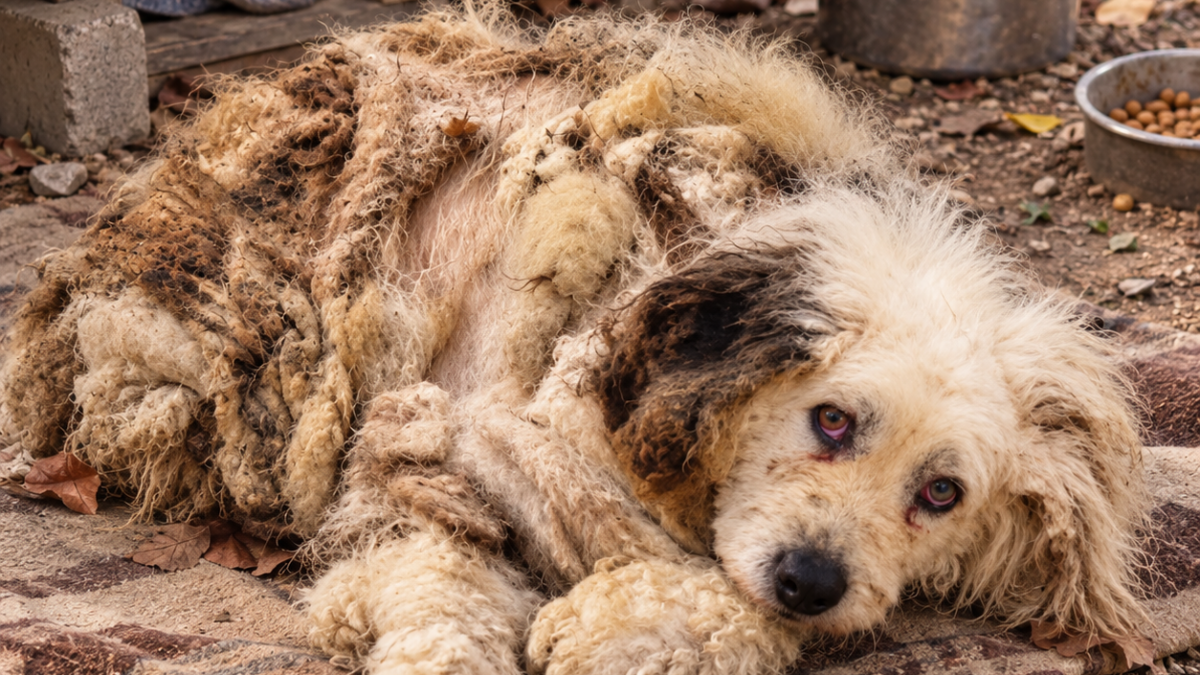
The first time I saw Marin, he was lying beside a tiny shelter with a metal chain defining the entire size of his world, and the emptiness in his blue eyes frightened me more than anything else around him.
His coat had hardened into layers of dirt, waste, and painful mats so thick that I could barely tell where the fur ended and his injured skin began, yet he made no sound when I walked toward him.
I thought the most heartbreaking moment would be cutting that chain away, but what Marin did after he became free told me something about loyalty I was not prepared to understand.
I stopped several feet from him.
“Hey, buddy.”
Marin looked at me.
He didn’t bark.
He didn’t rise.
He simply watched.
The smell reached us before we touched him, but standing close made the reality worse. Years of neglect seemed trapped inside his coat. The mats hung from him like heavy ropes, pulling against skin that had not been properly cleaned or examined in far too long.
His food bowl sat nearby.
Dirty.
Scratched.
Ordinary.
Yet Marin treated it like treasure.
We learned that he sometimes carried it into his little shelter, protecting it as though it were the only possession in his life he understood belonged to him.
That image stayed with me.
A dog with almost nothing, protecting a bowl.
Marin had once belonged to a family.
He had been held.
Fed.
Called theirs.
Then he grew.
As he became larger and more difficult for them to manage, apparently something changed.
He became inconvenient.
Eventually he was given to an elderly couple who were not prepared to care for him properly.
From there, Marin’s world grew smaller until it became the length of the chain around his neck.
Rain came.
Snow came.
Summer heat returned.
Then winter again.
Marin stayed.
No walks.
No bathing.
No proper grooming.
Nobody getting close enough to understand what years of neglect were doing underneath all that fur.
The mats thickened.
His skin suffered beneath them.
And when Marin became desperate enough, he reportedly chewed at the chain.
He wore down his own teeth trying to defeat something stronger than he was.
But the chain always won.
Until the day we arrived.
One of us knelt near him while another worked carefully to release the restraint.
Marin watched.
The metal shifted.
Then suddenly there was nothing holding him.
No pull against his neck.
No fixed radius.
No invisible wall.
Marin stood.
For one second he seemed confused.
Then he moved.
He started running in circles.
Not far.
Not gracefully.
He simply ran because, for the first time in years, his body could choose the distance.
I felt tears burn behind my eyes.
“Go, buddy,” someone whispered.
Marin ran again.
Then he stopped.
And that was when the moment became almost unbearable.
Instead of running away from the place where he had suffered, Marin walked toward the elderly man’s car.
He stood beside it.
Waiting.
I stared at him.
After the chain.
After the loneliness.
After every freezing night and every painful mat pulling against his skin, Marin still seemed to believe family meant staying close.
He did not understand abandonment.
He did not understand that loyalty could be one-sided.
Someone beside me whispered, “He still wants to go with him.”
I couldn’t answer.
I walked over and touched Marin carefully.
“No,” I finally said. “You’re coming with us.”
At the veterinary clinic, the team began removing the hardened coat.
Piece by piece, Marin emerged from underneath it.
And so did the damage.
Sores.
Diseased skin.
Areas that had been hidden for years.
I thought that was the worst discovery waiting for us.
Then the veterinarian called me aside.
Her expression had changed.
“We found something else.”
My stomach dropped.
“What?”
She showed me the imaging.
Four masses.
Inside Marin’s chest.
Four tumors growing in a dog people had described as healthy.
I looked through the glass toward him.
Marin was lying on a clean blanket while someone gently stroked his newly uncovered head.
For years, nobody had seen what was happening beneath his fur.
Now we were finally seeing all of it.
And the question was no longer simply whether Marin could learn how to live without a chain.
It was whether we had found him soon enough for him to live at all.
PART 2
For several seconds, I could not take my eyes off the images.
Four tumors.
The veterinarian pointed carefully while explaining where they were located and what would need to happen next, but my mind kept returning to the same thought.
Four.
I looked through the small window in the examination-room door.
Marin lay on a clean blanket.
Without the enormous mass of filthy fur covering him, he looked smaller than I expected.
Vulnerable.
His blue eyes followed the veterinary technician whenever she moved around the room.
He did not know that only a few feet away, adults were discussing whether something inside his chest might threaten the freedom he had experienced for less than a day.
“How long could these have been there?” I asked.
The veterinarian paused.
“We can’t know exactly without more information.”
“Would someone have noticed?”
“Not necessarily from looking at him from a distance.”
That answer hurt.
From a distance.
That seemed to describe Marin’s life.
Fed from a distance.
Watched from a distance.
Allowed to exist from a distance.
Nobody had gotten close enough.
Close enough to brush him.
Close enough to examine his skin.
Close enough to notice his teeth wearing down.
Close enough to discover the things growing inside him.
Close enough to understand that surviving and being healthy were not the same thing.
“What do we do?”
“More tests first.”
“And after that?”
“If surgery is appropriate, we’ll discuss it.”
I nodded.
There was no dramatic answer.
No promise.
Just another step.
That became the rhythm of Marin’s rescue.
One step.
Then another.
The veterinary team continued shaving away the mats.
Some sections could not simply be brushed or combed because the fur had become too tightly bound. It had trapped dirt and moisture against his skin, and in places it pulled painfully whenever Marin moved.
The process took time.
The technicians worked gently.
Whenever Marin became restless, they stopped.
Whenever he looked overwhelmed, a hand stayed near him.
For years, human hands had apparently brought food, attached a chain, or passed him by.
Now hands were trying to relieve pain.
That distinction was new to him.
At first Marin kept his body tense.
His eyes followed everything.
A clipper turned on.
His ears moved.
A hand approached.
He watched.
Then the hand touched him gently.
Nothing bad happened.
Another section of matted fur fell.
Then another.
Eventually the floor around him looked covered in pieces of an old life.
Someone whispered, “There you are.”
I understood exactly what she meant.
We were finally seeing the dog underneath.
Marin’s coat had not simply been dirty.
It had become a structure around him.
A second confinement.
The chain had restricted where he could move.
The mats had restricted how comfortably he could move.
Freedom required removing both.
When enough fur was gone, we could finally see the condition of his body clearly.
His skin was irritated.
There were sores.
Areas of inflammation.
Places where constant pulling and trapped waste had caused damage that should never have been allowed to continue.
The technician shook her head.
“How did nobody see this?”
I knew the answer.
They had not looked.
Or not closely enough.
Anger rose inside me again.
I thought of Marin carrying his food bowl into his shelter.
Protecting that one object because apparently nothing else in his world felt reliably his.
I thought of him chewing the chain hard enough to damage his teeth.
A dog does not understand ownership agreements or human excuses.
He knows whether the chain releases.
Marin’s never had.
Until us.
But anger was useless in that room.
Marin needed treatment, not rage.
So we focused on what he needed.
The first night at the clinic, Marin did not sleep deeply.
One of the staff members told me he raised his head whenever footsteps approached.
Every sound mattered.
Every door opening made him look.
He did not know whether this new environment was temporary.
He did not know whether someone might return him to the chain.
He did not know that several people had already promised each other that would never happen.
I visited the next morning.
“Hey, blue eyes.”
Marin lifted his head.
The name had begun as a simple observation.
His eyes were striking.
Deep and clear beneath everything else that had hidden him.
Marin seemed right.
A name connected not to neglect, but to something beautiful about him.
I crouched near the kennel.
“You slept?”
He stared.
“Probably not.”
His nose moved toward my hand.
I held it still.
Marin sniffed.
Then he pressed his nose against my fingers.
That tiny gesture felt enormous.
I opened the kennel only when the staff allowed it.
Marin stepped out slowly.
No chain.
Every time I saw him move freely, I noticed it.
I wondered how long it would take before I stopped thinking about the chain every time he crossed a room.
Maybe never.
We walked him carefully down the hallway.
His movements were awkward.
Years of confinement leave habits behind.
The body learns the dimensions of a small world.
Even when the boundary disappears, the mind sometimes keeps it.
Marin stopped near an open doorway.
I encouraged him gently.
“You can go.”
He looked inside.
Then at me.
“Go ahead.”
One paw crossed the threshold.
Then another.
Nothing pulled him backward.
He continued.
I smiled.
A normal doorway should not feel like a triumph.
With Marin, it did.
Testing continued over the next several days.
The masses in his chest remained our greatest concern.
We needed to understand their nature as much as possible before making decisions.
The possibility of surgery became increasingly real.
So did the risk.
Marin had already suffered through years nobody could give back.
I hated the thought that his first days of freedom might become nothing but veterinary procedures.
But ignoring the tumors would not be kindness.
Freedom meant giving him medical care too.
Freedom meant taking his pain seriously.
That included pain he could not show us.
One afternoon, the veterinarian sat with us.
“We should proceed.”
“With surgery?”
“Yes.”
My stomach tightened.
“How dangerous?”
“Any surgery has risk. This is not a trivial procedure.”
I looked through the window toward Marin.
He was sleeping.
Actually sleeping.
Head down.
Body relaxed.
The first time I had seen that.
“Can it help him?”
“We believe it gives him the best chance.”
That was the answer.
Not certainty.
Chance.
Rescue is full of chances.
You take a chance approaching a frightened dog.
The dog takes a chance trusting you.
A foster family takes a chance opening their home.
A surgeon takes a chance that intervention will give an animal more life rather than more suffering.
Nothing comes guaranteed.
Marin deserved the chance anyway.
We scheduled the procedure.
The night before surgery, I stayed with him longer than usual.
He had started enjoying touch.
Not demanding it.
Not yet.
But when I scratched the side of his neck, he leaned slightly toward my hand.
“You know something?” I whispered.
His eyes remained half closed.
“You are allowed to make this difficult.”
One ear moved.
“You don’t have to be brave because humans like brave-dog stories.”
He looked at me.
“You can be scared.”
His head lowered again.
“We’ll be scared too.”
I sat beside him.
For years, Marin had faced every uncomfortable thing alone.
Cold.
Heat.
Pain.
Confinement.
Whatever pressure those tumors created.
Nobody should have asked him to face one more frightening experience alone.
So we didn’t.
On the morning of surgery, the veterinary technician came for him.
Marin stood.
For a moment he hesitated at the doorway.
I remembered another doorway.
Another boundary.
“Go ahead,” I said softly.
He stepped forward.
Then stopped and looked back.
My throat tightened.
“I’ll be here.”
Obviously Marin did not understand those words literally.
But I meant them.
The doors closed.
Then came waiting.
Waiting is one of the cruelest parts of loving an animal in surgery because there is nothing useful left for you to do.
You cannot operate.
You cannot speed up time.
You cannot negotiate with biology.
You sit.
You stare at a phone.
You stand.
You walk.
You sit again.
You drink coffee you do not taste.
You replay every decision that brought you to that chair.
I wondered whether surgery was fair.
I wondered whether doing nothing would have been worse.
I remembered the veterinarian’s explanation.
Best chance.
That had to be enough.
Hours passed.
Finally, the call came.
I answered before the first ring had finished.
“How is he?”
The veterinarian’s voice was calm.
“He’s out of surgery.”
I sat down immediately.
“And?”
“We were able to address the masses we planned to remove. He’s recovering now.”
“Is he awake?”
“Not yet fully.”
“But he made it?”
“He made it through.”
I closed my eyes.
It felt as if someone had released a chain from around my own chest.
“Thank you.”
“There’s still recovery ahead.”
“I know.”
“And we need pathology results.”
“I know.”
But Marin was alive.
That was enough for that hour.
When I saw him afterward, he looked exhausted.
The shaved areas and surgical sites made everything feel frighteningly real.
He had spent years hidden beneath too much fur.
Now there was nowhere for the damage to hide.
I sat nearby.
“Blue eyes.”
His eyelids moved.
“Don’t get up.”
He tried anyway.
Of course he did.
The technician gently encouraged him to stay down.
I laughed weakly.
“Apparently you have opinions.”
Marin settled.
His eyes opened enough to find me.
There was no tail wag.
No dramatic recognition.
Just looking.
I placed my hand near his paw.
“You’re still free.”
That was the sentence I wanted him to understand.
This hospital was not another prison.
The kennel door would open.
The leash would come off.
The people around him would not attach him to the ground and walk away.
Recovery required restrictions, but temporary medical restriction is different from neglect.
The purpose matters.
The ending matters.
Marin was being limited so his body could heal enough to become free again.
For several days, freedom looked like rest.
Short walks.
Medication.
Careful feeding.
Monitoring.
He disliked some of it.
He tolerated most of it.
And slowly, his personality surfaced.
It began with his bowl.
One morning, a technician placed food inside his kennel.
Marin ate.
Then, after finishing, he took the bowl in his mouth.
He carried it toward the back of the kennel.
The technician called me later.
“He moved his bowl.”
I immediately understood.
“Into the corner?”
“Yes.”
I closed my eyes.
That old habit.
Protect what belongs to you.
Carry it somewhere safe.
That dirty bowl beside his shelter had been one of the only possessions Marin controlled.
Now he had a clean stainless-steel bowl.
Still, he protected it.
I visited that afternoon.
The bowl sat behind him.
I sat outside the kennel.
“You know nobody is taking that, right?”
Marin stared at me.
“It’s yours.”
He lowered his head over it.
“Okay.”
I smiled sadly.
“We’ll work on that.”
And we did.
Nobody snatched food away.
Nobody used the bowl as leverage.
It appeared.
Food came.
It was washed.
It returned.
Day after day.
Eventually Marin stopped hiding it.
That was how his healing happened.
Not through one lesson.
Through repetition.
Food returns.
Water returns.
People return.
Nothing around your neck.
No chain.
No winter outside.
No need to chew metal until your teeth wear down.
Safety became a pattern.
His skin began healing.
Without the mats constantly pulling and trapping moisture, treatments could finally reach the damaged areas.
Baths were introduced carefully.
The first one was difficult.
Marin stiffened when water touched him.
I kept one hand near his shoulder.
“It’s okay.”
Water running from his body carried away dirt that had been embedded for who knew how long.
The smell changed.
The skin became visible.
Marin looked smaller wet.
I hated imagining how many rains had soaked him outside while nobody dried him.
This water was different.
Warm.
Controlled.
Hands supporting him.
Towels waiting.
When the bath ended, Marin was wrapped immediately.
He stood inside the towel while someone rubbed him gently.
His eyes softened.
A technician smiled.
“You like that?”
Marin leaned forward slightly.
We laughed.
“Apparently.”
That became another discovery.
Marin loved towels.
Warm towels especially.
After later baths, he would stand patiently because he seemed to know what came next.
The wrap.
The rubbing.
The warmth.
An experience connected to discomfort became connected to comfort.
That transformation mirrored everything happening to him.
Human hand.
Once uncertain.
Now affection.
Leash.
Once restriction.
Now walks.
Bowl.
Once something to protect desperately.
Now something reliably refilled.
Shelter.
Once a tiny place beside a chain.
Soon, hopefully, a home.
When pathology results finally came back, I was afraid to answer the phone.
The veterinarian explained them carefully.
The news was serious, but there was reason to continue treatment and reason to hope.
We discussed the next stages.
Follow-up care.
Monitoring.
The possibility of additional intervention depending on how Marin responded.
There was no magical declaration that he was cured forever.
Real medicine rarely works like that.
Instead we received something more honest.
A future worth fighting for.
I went to see him.
Marin was standing when I entered.
“Good news and complicated news,” I told him.
His tail moved slightly.
“The complicated part is that you still have doctors.”
He looked toward the hallway.
“The good part is that you have tomorrow.”
His tail moved again.
Tomorrow.
For a dog whose entire life had once been measured by a chain, tomorrow had become enormous.
As Marin became stronger, we moved him into foster care.
The transition worried me.
The clinic had become familiar.
Familiarity mattered to him.
But a veterinary kennel could not teach Marin what ordinary home life felt like.
He needed rooms.
A yard.
A couch he might or might not use.
Doors.
People moving through daily routines.
He needed to learn that a home could mean something other than being chained beside one.
His foster family prepared carefully.
A quiet space.
Soft bedding.
Food schedule.
Medication.
A secure yard.
No pressure.
The first time Marin entered, he stopped just inside the doorway.
His blue eyes moved around the room.
He sniffed.
The foster caregiver sat on the floor.
She did not call repeatedly.
She did not pull him closer.
She waited.
Marin took three steps.
Stopped.
Then another two.
The woman smiled but stayed still.
Marin approached.
He sniffed her hand.
Then walked past.
She laughed quietly.
“I guess I’m not interesting.”
“Give him time.”
We showed him the bed.
He investigated.
Then the water bowl.
Then the room.
But what interested him most was the open doorway leading toward the yard.
We attached a leash for safety and walked outside.
Marin stepped onto the grass.
He froze.
The yard was larger than the space he had been chained inside.
Much larger.
I unclipped the leash once we were secure.
Marin looked down.
Then around.
Nothing connected him to anything.
He walked several feet.
Stopped.
Looked back.
The foster caregiver said softly, “You can go.”
Marin walked farther.
Then something happened.
He began circling.
The same behavior from the day the chain had been removed.
A few steps.
Turn.
Faster.
Then another circle.
At first I smiled.
Then I realized why it hurt.
The freedom was still so unfamiliar that Marin almost did not know how to use open space.
He had learned movement around a fixed point.
His body remembered a chain that was no longer there.
He circled again.
The foster caregiver whispered, “Should we stop him?”
“Not unless he’s hurting himself.”
Marin slowed.
Then, for the first time, instead of turning back toward the imaginary center of a chain, he walked straight across the yard.
Ten feet.
Fifteen.
Twenty.
He stopped near the fence.
Sniffed the grass.
I exhaled.
There.
A straight line.
Nothing pulling him back.
Marin explored for almost twenty minutes.
Then he returned toward the house.
Not because a chain forced him.
Because he chose to.
That mattered more than I can explain.
Inside, Marin discovered another terrifying object.
The stairs.
He stood at the bottom.
Looked up.
One step.
Then the next.
His foster caregiver waited at the top.
“You don’t have to.”
Marin put one paw on the first stair.
Then backed away.
“That’s okay.”
Later he tried again.
First stair.
Second.
Stopped.
By the end of the week, he climbed the entire staircase.
By the end of the month, he raced up it when he heard the sound of a food bag.
Freedom became practical very quickly.
Marin also discovered toys.
At first he ignored them.
A ball rolled past him.
Nothing.
A rope toy landed nearby.
Nothing.
A squeaker sounded.
His ears moved.
That was progress.
We wondered whether anybody had ever played with him.
The thought was painful, but there was no point dwelling on what we could not prove.
So his foster caregiver kept leaving toys nearby without demanding interaction.
One evening, she sent me a short message.
“He picked up the duck.”
I called immediately.
“What?”
“The yellow squeaky duck.”
“And?”
“He carried it to his bed.”
“Did he play?”
“Not really. He’s sleeping with it.”
I smiled.
“Let him.”
Another possession.
But this one did not need to be guarded from hunger.
This one existed purely for comfort.
For several days, Marin carried the duck around.
Sometimes he placed it near his bowl.
Sometimes beside his bed.
Sometimes at the door.
His foster caregiver laughed.
“He has upgraded from protecting bowls to protecting ducks.”
That was healing too.
Soon, another dog entered his world.
A calm foster dog named Sadie belonged to the household.
Their first interactions were controlled.
Marin was curious but uncertain.
Sadie sniffed him.
Walked away.
Returned later.
No conflict.
No pressure.
Within days, Marin started following her.
She showed him routines humans could not explain.
When the back door opened, Sadie went outside.
Marin followed.
When the family settled in the living room, Sadie lay down.
Marin eventually did the same.
When someone came home, Sadie went to greet them.
At first Marin stayed behind.
Then one evening he followed.
The foster caregiver opened the door after work.
Sadie ran forward.
Marin stood in the hallway.
She crouched.
“Hi, Marin.”
He hesitated.
Then walked toward her.
Tail moving.
That was the first time he greeted someone coming home.
She cried.
Later she called me.
“He was waiting for me.”
I smiled.
“How did it feel?”
“Like somebody punched me in the chest.”
“That sounds right.”
“He knew I was coming back.”
Maybe.
Or maybe he was beginning to hope.
Either way, it mattered.
The old man’s car haunted me sometimes.
That moment when Marin had been released and still walked toward the vehicle.
After everything, he had wanted to stay with what he knew.
People sometimes misunderstand abused or neglected animals because of reactions like that.
They ask:
Why would he still follow them?
Why would he remain loyal?
Why wouldn’t he run?
But animals do not analyze relationships like humans.
Familiarity is powerful.
Dependence is powerful.
Marin had no alternate concept of family yet.
The people around him, however imperfectly they had cared for him, had been the center of the world he knew.
Freedom did not instantly rewrite that.
We had to give him something new to learn.
Family could mean coming back.
Family could mean noticing pain.
Family could mean cutting the chain instead of shortening it.
Family could mean a vet bill paid because his health mattered.
Family could mean grooming before the coat became torture.
Family could mean a warm room in winter.
Family could mean not measuring love by how convenient the dog remained.
Those lessons required months.
Marin learned them.
So did we.
His follow-up medical appointments were tense.
Every scan reminded us that freedom did not erase illness.
Every time the veterinarian examined his chest, I watched her face.
Every lab result seemed capable of changing our plans.
But Marin continued recovering.
His skin improved.
His coat began growing back.
Not the monstrous heavy coat of neglect.
Healthy fur.
Soft.
Clean.
When I ran my hand across it, I could reach skin easily.
No armor.
No prison.
Just fur.
His teeth could not be restored to what they had been before years of chewing the chain, but the veterinary team addressed what could be treated and monitored what needed continued care.
Marin adapted.
He ate well.
Sometimes too enthusiastically.
The old habit of guarding the bowl gradually disappeared.
One day his foster caregiver sent a video.
Sadie walked past while Marin was eating.
Marin glanced up.
Then continued eating.
No rushing.
No carrying the bowl away.
No panic.
I replayed it.
Months before, that bowl had been his one protected possession.
Now he trusted that food would still exist even with another dog nearby.
Security had replaced possession.
Then Marin discovered sleeping indoors during thunderstorms.
The first major storm after he entered foster care arrived late one night.
Rain hit the windows.
Thunder rolled.
His foster caregiver expected him to become frightened.
Instead Marin walked to the window.
Stared outside.
Then looked back at her.
She called me the next morning.
“You know what he did?”
“What?”
“He watched the rain.”
“Was he scared?”
“Not really.”
She paused.
“Then he climbed onto the bed.”
I smiled.
The image hit me hard.
How many storms had Marin endured beside that tiny shelter?
Rain blown sideways.
Mud.
Wind.
The chain.
Now thunder could shake the windows and Marin could simply choose a softer place to sleep.
Weather no longer controlled whether he suffered.
Walls stood between him and the storm.
A roof.
Heat.
People.
Normal things.
Again, normal felt miraculous.
But not everything improved easily.
There were nights Marin paced.
There were moments when being restrained for veterinary procedures brought tension back into his body.
Certain metallic sounds made him freeze.
The clink of hardware against a gate once caused him to stop completely.
His foster caregiver noticed.
She did not force him forward.
She crouched.
“Come here.”
Marin looked at the metal gate.
Then at her.
Sadie walked through first.
Marin followed.
Fear did not disappear because the chain disappeared.
The nervous system remembers.
Healing meant giving Marin new outcomes.
Metal sound.
Then nothing bad.
Leash attached.
Then a walk.
Gate closes.
Still safe.
Human approaches.
Gentle touch.
Repeat.
Repeat.
Repeat.
Eventually old associations weakened.
Marin began wagging when his leash appeared.
I laughed the first time I saw it.
“You realize you’re excited about something attached to your collar?”
His tail moved harder.
The irony was not lost on me.
Once, something around his neck meant the world became smaller.
Now the leash meant the front door was opening.
Context changes everything.
We walked through the neighborhood.
Marin stopped every few feet because there were so many smells.
Trees.
Grass.
Mailboxes.
Other dogs.
Cars.
A child’s bicycle lying in a driveway.
A sprinkler.
He investigated everything as though taking inventory of a planet he had been denied access to.
Half a block took twenty minutes.
I did not hurry him.
He had spent years in one small area.
He could have twenty minutes for a mailbox.
The world was finally his to smell.
One afternoon we reached a small park.
Marin stood at the edge.
Open grass stretched ahead.
I remembered the circles.
The chain radius.
The imaginary boundary.
We used a secure long lead because his safety still mattered.
Marin walked forward.
Then farther.
He turned back once.
Saw us.
Continued.
Eventually he broke into a trot.
Not circles.
A line.
Straight across the grass.
My chest tightened.
Sadie ran beside him.
Marin accelerated.
For several seconds he looked almost young again.
Not because time had reversed.
Because freedom had finally reached his body.
His ears moved with every stride.
His coat lifted in the wind.
His blue eyes were alive.
I whispered, “Look at him.”
His foster caregiver was crying.
“I am.”
Marin ran until we slowed him.
He returned panting.
Then pressed his body against her legs.
Not because he had to remain within a chain’s radius.
Because he wanted to remain near her.
Choice made affection mean something different.
The question of accountability for Marin’s neglect eventually surfaced.
Reports had been documented.
Veterinary records described his condition.
Photographs existed.
The worn teeth.
The skin disease.
The severe matting.
The chain.
What followed was less cinematic than anger wanted it to be.
There was no dramatic courtroom where a judge slammed a gavel while Marin sat heroically beside us.
Real accountability moves through documentation.
Reports.
Statements.
Records.
Animal-welfare procedures.
Conversations people would rather avoid.
What mattered most to us was ensuring Marin could never be returned to the conditions that had harmed him.
That protection became the line we refused to compromise.
When questions were raised about whether the elderly couple had intentionally wanted Marin to suffer, I had mixed emotions.
Intent mattered legally.
But Marin had lived with the outcome.
A dog does not experience intent.
Cold feels cold whether someone intended cruelty or simply failed to act.
Matted fur hurts whether neglect comes from malice or incapacity.
A chain restricts movement regardless of whether the person holding responsibility understands the psychological damage.
Compassion for human limitations could not mean returning Marin to them.
That was where we stood firm.
One conversation became especially difficult.
The elderly man reportedly wanted to know whether Marin might come back after treatment.
I stared at the person who told me.
“Back?”
“He says Marin knows him.”
“I’m sure he does.”
“He says Marin waited by his car.”
My stomach tightened.
Of course Marin had.
That memory still hurt.
I took a slow breath.
“Knowing someone is not the same as being safe with them.”
There was silence.
“He says he misses the dog.”
I looked across the room at Marin.
He was lying on a clean bed with the yellow duck between his paws.
“I believe he may miss him.”
I meant it.
Human relationships with animals can be complicated.
Someone can feel attachment and still fail catastrophically at care.
Love is not proved by missing an animal after he leaves.
It is proved by what happens while he depends on you.
Marin had depended on humans for years.
His body told us what that care had looked like.
“He can’t go back.”
The words came quietly.
But there was nothing uncertain about them.
Marin would not return to the chain.
Not after learning grass.
Not after warm towels.
Not after surgery.
Not after sleeping beside Sadie.
Not after running straight across an open park.
Not after finally learning that bowls refill and people return.
That door was closed.
If anyone wanted to call that revenge, they could.
I called it responsibility.
Marin had already paid for human mistakes.
He would not be asked to pay again so somebody else could feel less guilty.
That was the first boundary in Marin’s life built for his protection instead of his confinement.
And we held it.
His medical recovery continued.
The months after surgery brought follow-up scans.
Some appointments gave us encouraging information.
Others reminded us that vigilance would always matter.
We did not treat every normal day like a guarantee.
We treated it like a gift.
Marin did the opposite.
He simply lived.
That may have been healthier.
He became obsessed with morning walks.
Around the same time every day, he appeared near the door.
If nobody responded quickly enough, he stared.
His foster caregiver joked that he had developed a union schedule.
At 7:03 one morning, she sent me a photograph.
Marin sat beside the leash.
Caption:
“Management has been notified.”
I laughed.
The dog whose world had once been controlled entirely by a chain now demanded a different line be attached so he could explore the neighborhood.
I loved the contradiction.
He learned car rides too.
At first they confused him.
The old man’s car had symbolized familiarity, and after his rescue Marin had stood beside it rather than leave.
His first foster car rides ended at veterinary clinics.
Not exactly ideal advertising.
So his foster caregiver began taking him on short rides that ended somewhere pleasant.
A quiet park.
A walking path.
Occasionally a drive-through where he received a dog-safe treat.
Soon the sound of car keys caused his ears to lift.
Eventually he waited near the door.
The first time Marin voluntarily jumped into the back seat, his foster caregiver called me.
“You’re not going to believe this.”
I already knew from her voice.
“What did he do?”
“He got in the car by himself.”
“Vet appointment?”
“No. Park.”
I smiled.
“Good.”
The car was no longer something belonging to someone Marin needed to follow because he feared being left.
It was transportation into a bigger world.
That mattered.
One day we drove past an area that looked similar to where Marin had once been chained.
A small outbuilding.
Fence.
Patch of dirt.
For a second I wondered whether the sight would mean anything to him.
Marin looked through the window.
Then turned away.
He put his head down.
I felt relief.
Humans sometimes need symbolic confrontations more than animals do.
Marin did not need to revisit the place where he had suffered.
He did not need to stand beside an empty chain to prove anything.
His healing was happening elsewhere.
So we kept driving.
By late summer, Marin’s coat had grown beautifully.
People who met him for the first time could not imagine what we had cut away.
One woman at the park knelt near him.
“What gorgeous fur.”
I almost laughed.
If only she knew.
She looked into his face.
“And those eyes.”
“That’s how he got his name.”
“They’re beautiful.”
Marin accepted the compliment by sniffing her shoe.
I smiled.
For once, somebody noticed him because he was beautiful rather than because his condition was shocking.
That felt important.
Eventually, the question we had avoided became unavoidable.
Was Marin ready for adoption?
His foster caregiver went silent when I asked.
“I knew this was coming.”
“Yeah.”
She looked toward him.
Marin was asleep beside Sadie.
“What if nobody understands him?”
“Then they don’t adopt him.”
“What if someone sees the blue eyes and wants him because he’s beautiful?”
“Then we ask harder questions.”
“What if his tumors come back?”
“We tell them the truth.”
She nodded.
Marin’s medical history would never be hidden.
Whoever adopted him needed to understand follow-up care might be part of loving him.
No fantasy.
No guarantee.
Just commitment.
His foster caregiver looked at me.
“What if I’m the one who understands him?”
I smiled.
“I’ve been waiting for you to say that.”
She stared.
“What?”
“You really thought I didn’t know?”
Her eyes filled.
“I wasn’t sure I was allowed.”
“Allowed?”
“I’m supposed to foster.”
“You did.”
“And then let go.”
“Sometimes.”
Marin woke at the sound of our voices.
He looked at her.
She crouched.
He walked over and placed his head against her.
That answered more than either of us could.
She wrapped her arms around him.
“I don’t want him to leave.”
“Then don’t make him.”
She looked up.
“Are you serious?”
“If the home is appropriate, the medical commitment is understood, and everyone agrees, why would I force a dog out of the place where he already feels safe?”
Her tears came immediately.
Marin licked her face.
She laughed and cried at once.
“That’s disgusting.”
He did it again.
She hugged him tighter.
“Okay. Fine. You win.”
Marin’s tail started.
Sadie wandered over, apparently concerned she was missing attention.
The three of them ended up tangled together on the floor.
I stood watching.
This was not how I had pictured Marin’s story ending.
I had imagined some unknown family appearing.
A careful meeting.
A tearful handoff.
Instead, somewhere during the process of teaching Marin what a home was, his foster home had quietly become his home.
Sometimes the dog finds the answer before the humans admit it.
The adoption paperwork was completed.
There was no car leaving.
No packed bag.
No emotional transition.
Marin simply woke up one morning in the same house and, from the human point of view, stopped being a foster dog.
From Marin’s point of view, perhaps nothing changed.
That made it perfect.
No more transfers.
No more uncertainty.
No need to learn another routine.
He already knew where breakfast happened.
Where Sadie slept.
Which door led to the yard.
Which staircase made humans laugh when he ran up too fast.
Which bed was technically his but which couch he preferred.
He knew the sound of his person arriving home.
He knew the hand that scratched his neck.
He knew his family.
This time, family stayed.
On the evening the adoption became official, his new permanent guardian placed a new collar around his neck.
She paused before fastening it.
The moment carried weight.
Marin stood still.
The collar was soft.
Identification tag attached.
Nothing heavy.
Nothing connected to a fixed chain.
She fastened it.
Marin shook his head.
The tag jingled.
I smiled.
“There.”
She touched the collar.
“You know what this says?”
Marin looked toward the kitchen.
“It says you live here.”
He walked away.
Apparently paperwork was less interesting than dinner.
We laughed.
Later that evening, Marin lay beside Sadie.
His blue eyes slowly closed.
I took a photograph.
Not for evidence.
Not for a medical file.
Not to document neglect.
Just because he looked peaceful.
That difference meant more than I expected.
The earliest photographs of Marin existed because something was wrong.
The chain.
The mats.
The wounds.
The condition of his body.
Now we photographed him because he was sleeping in a funny position.
Because his coat looked beautiful in sunlight.
Because he and Sadie were sharing a bed despite having two.
Because he had stolen a sock.
Because he carried the yellow duck outside and forgot it in the rain.
Because ordinary life creates photographs too.
Those became the images I preferred.
Months passed.
Marin’s medical follow-ups remained part of our routine.
We did not pretend the tumors had never existed.
Every scan brought anxiety.
But he continued doing well.
At one appointment, the veterinarian reviewed his results and smiled.
“I’m pleased.”
His guardian exhaled.
“That’s the best sentence you can say to us.”
Marin was standing beside the treat cabinet.
The veterinarian laughed.
“He seems pleased too.”
“He assumes this building exists to provide snacks.”
“That’s healthier than fearing it.”
Absolutely.
The dog who once endured pain unnoticed now walked confidently into a clinic where people knew his name.
When something hurt, someone noticed.
When something changed, someone called.
That was another definition of family.
Attention.
Not obsessive attention.
Responsible attention.
Marin’s body no longer had to scream before anyone looked.
Nearly a year after his rescue, we visited the place where he had first experienced true open-space freedom—a large fenced field used by one of the rescue volunteers.
Marin stepped through the gate.
No leash.
No chain.
Sadie followed.
His guardian stood beside me.
“Remember the circles?”
“Yes.”
Marin sniffed near us.
Then Sadie ran.
Marin looked up.
For a moment his blue eyes sharpened.
Then he chased her.
Straight across the field.
No circle.
No imaginary center.
Straight.
Thirty yards.
Forty.
Farther.
His legs stretched beneath him.
His healthy coat moved in the wind.
His guardian covered her mouth.
“He’s not circling.”
I shook my head.
“No.”
Marin reached the far end.
He turned.
For an instant he stood there, farther from us than the chain would ever have allowed.
Then he ran back.
Not because something pulled him.
Because we were his people.
That was the moment everything came together for me.
Marin’s old world had been defined by forced proximity.
He could not leave.
Now he had voluntary return.
He could go anywhere inside that field.
He came back anyway.
That is what loyalty should be.
Not a dog trapped near you.
A dog free enough to leave who chooses to return.
His guardian dropped to her knees.
Marin reached her at full speed.
He almost knocked her over.
She laughed while wrapping her arms around him.
“You came back.”
I looked away for a second because my eyes were burning.
Of course he came back.
This time he knew what family meant.
Family was not the old man’s car.
Not the chain.
Not whoever happened to own the bowl.
Family was the person who had washed his damaged skin.
Driven him to follow-up appointments.
Waited while he learned stairs.
Cleaned muddy paws.
Shared the couch.
Refilled the bowl.
Stayed through the medical uncertainty.
Held him after thunderstorms.
And decided that foster was no longer enough.
Marin finally had loyalty going both directions.
That was the ending he deserved.
But life did not become perfect.
A satisfying ending is not the absence of future problems.
Marin remained a dog with a serious medical history.
There were appointments.
There were days when something small frightened us.
A cough.
A change in appetite.
A tired afternoon.
Because once you have almost lost an animal, ordinary variations can feel like warnings.
His guardian sometimes called.
“He didn’t finish breakfast.”
“How much did he leave?”
“Maybe twenty percent.”
“What’s he doing?”
“Sleeping.”
“Anything else?”
“No.”
“Call the vet if you’re worried.”
She always did.
Most times it was nothing serious.
Sometimes medication needed adjustment.
Sometimes Marin had simply discovered that humans panicked easily.
But we never regretted checking.
Neglect had been the failure to notice.
Marin’s new life would never repeat that.
One winter morning, his guardian sent me a photograph.
Snow covered the yard.
Marin stood at the open door.
He had one front paw outside and the rest of his body firmly indoors.
Message:
“He has declined winter.”
I laughed.
The irony was almost too perfect.
For years he had been chained outside through snow.
Now he could look at snow and decide:
No.
Not today.
His guardian finally put a warm coat on him.
He walked outside long enough to relieve himself and immediately returned to the house.
The photograph afterward showed him wrapped in a blanket beside a heating vent.
I stared at it for a long time.
That was revenge.
Not punishment.
Choice.
The weather that once happened to him could now be refused.
Marin had become a dog with preferences.
He disliked cold rain.
Loved warm towels.
Preferred one particular corner of the couch.
Wanted walks in the morning but was less enthusiastic after dark.
Carried the yellow duck when excited.
Liked Sadie’s bed better than his own despite Sadie’s disagreement.
Stared at the refrigerator whenever cheese appeared.
These details mattered because neglect had once reduced him to a condition.
“Matted dog.”
“Chained dog.”
“Dog with tumors.”
But Marin was never a condition.
He was a personality waiting for enough safety to become visible.
The more normal his life became, the more complicated and funny he became.
One evening he stole Sadie’s bed.
Sadie stood beside him staring.
Marin refused to move.
His guardian pointed.
“That is not your bed.”
Marin closed his eyes.
“Marin.”
Nothing.
Sadie looked at the human as if requesting legal intervention.
I laughed.
“Maybe he needs a lawyer.”
His guardian tried coaxing him with his own bed.
Marin remained motionless.
Eventually Sadie squeezed beside him.
Both dogs slept together.
The next morning Marin had migrated to the couch.
Power had been redistributed.
His guardian told me, “I think the prisoner has become the landlord.”
I smiled.
Good.
Let him take up space.
Let him occupy the couch.
Let him stretch.
Let him choose.
A dog who spent years living inside the radius of a chain deserved to become inconveniently comfortable.
As the anniversary of his rescue approached, I found myself looking again at the earliest photographs.
I almost regretted it.
Marin beside the little shelter.
The heavy mats.
The chain.
The bowl.
Those empty-looking eyes.
Then I opened the newest picture.
Marin lying upside down on the couch.
Blue eyes bright.
Healthy coat spread around him.
Yellow duck underneath one paw.
Sadie occupying the floor because apparently Marin had claimed the furniture.
I put the pictures side by side.
Same dog.
Different world.
His guardian sat beside me.
“I can’t believe that was him.”
“It was.”
“He looks dead inside.”
“Almost.”
She stared.
“What made him keep going?”
I shook my head.
“I don’t know.”
Maybe there was no poetic answer.
Animals survive because their bodies keep trying.
Hunger comes and they eat if food exists.
Cold comes and they curl tighter.
A chain holds and they adjust to its length.
Marin had not known rescue was coming.
There was no reason for him to save hope for us.
He had simply continued.
That was enough.
Someone eventually arrived before continuing became impossible.
His guardian touched the old photograph.
“I wish I’d found him sooner.”
“Everybody who loves a rescued animal wishes that.”
“I keep thinking about the years.”
“So do I.”
“Does it ever stop making you angry?”
“No.”
She looked toward Marin.
He was asleep.
“But the anger changes.”
“How?”
I thought for a moment.
“At first you want revenge.”
She nodded.
“You want the people responsible to see what they did. You want them to hurt because he hurt.”
“Exactly.”
“Then eventually you realize Marin has no use for their pain.”
She looked at me.
“He has use for this.”
I gestured toward the room.
The couch.
Warm lights.
Sadie.
Clean bowls.
The leash near the door.
Medication organized on a shelf.
His toy on the floor.
His person beside him.
“This is what matters to him.”
She nodded.
Marin stretched without waking.
I smiled.
“Besides, look what happened.”
“What?”
“The chain lost.”
She stared at me.
I continued.
“It held his world to a few feet for years. Now he has this house, this yard, parks, car rides, walks.”
She smiled.
“The mats lost.”
“Healthy coat.”
“The tumors?”
I paused.
“We’re still fighting that battle responsibly.”
She nodded.
“And abandonment?”
I looked at her.
“You adopted him.”
Her eyes filled.
“That one lost too.”
That was Marin’s revenge.
Everything that reduced his life became smaller than the life that followed.
Not erased.
Outgrown.
One spring afternoon, we returned to the field again.
Marin was older now.
Still energetic, but he paced himself more.
Sadie ran first.
Marin followed.
They crossed the field.
His guardian and I walked behind them.
At the far end, Marin stopped near a tree.
He looked back.
Then continued exploring.
I remembered the first time freedom confused him.
Running in circles.
The body still orbiting an imaginary chain.
Now he wandered wherever scent led him.
No pattern.
No radius.
No center.
Just choice.
His guardian said, “Sometimes I wonder if he remembers.”
“The chain?”
“Yes.”
“Probably some of it, in whatever way dogs remember experiences.”
“Do you think he knows this is different?”
I watched Marin.
He trotted toward Sadie.
Then both dogs headed back toward us.
“Yes.”
“How?”
“Because he doesn’t circle anymore.”
Marin reached us.
His guardian bent down.
He passed her.
Walked toward me.
Then changed his mind and returned to her.
We laughed.
Entirely free.
Even free to choose the wrong human and correct himself.
That evening Marin slept through a storm.
Thunder rattled the windows.
Rain beat against the roof.
He never got up.
His guardian sent me a picture from the couch.
Marin lay on his side, one paw touching Sadie.
Caption:
“He didn’t even wake up.”
I stared at it.
There it was.
The final transformation.
Not running.
Not surgery.
Not the beautiful coat.
Sleep.
Deep sleep while a storm raged outside.
Years ago, rain meant exposure.
Now rain was noise beyond a wall.
Years ago, a metallic sound might mean the chain.
Now his collar tag could jingle while he slept.
Years ago, darkness meant another night beside a shelter.
Now darkness meant bedtime.
Safety does not always look dramatic.
Sometimes safety looks like not waking up.
Marin’s later veterinary checks continued to give us cautious reasons for gratitude.
Nobody promised forever.
We stopped asking for forever.
Forever is too large.
We wanted today.
Then tomorrow.
Then another season.
Marin received them.
Birthdays became meaningful even though nobody knew his exact emotional relationship with dates.
His family celebrated anyway.
A special meal.
A new toy.
A photograph.
On one birthday, he received another stuffed duck.
He ignored it.
The original yellow duck remained superior.
His guardian held up the new one.
“This is objectively cleaner.”
Marin walked away carrying the filthy original.
I laughed.
“He has brand loyalty.”
“Apparently.”
Objects matter strangely in rescue stories.
The dirty bowl.
The yellow duck.
Both represented ownership.
But in completely different worlds.
The bowl had been protected because scarcity ruled Marin’s life.
The duck was loved because abundance finally existed.
He could lose it and still have food.
He could destroy it and another toy would appear.
He did not need the duck.
He wanted it.
Wanting is a luxury.
Marin had earned luxuries.
One morning, years after rescue, I received a photograph that stopped me.
Marin stood beside his guardian’s car.
For a second I was transported back to that first day.
The chain removed.
Marin running.
Then stopping beside the elderly man’s car because some part of him still believed he should remain with the person he knew.
But this photograph was different.
The rear door was open.
Sadie was already inside.
Marin looked toward his guardian.
She was laughing in the background.
The caption said:
“He refuses to leave without me.”
I smiled.
The symmetry felt almost impossible.
Once Marin stood beside a car because he did not understand that he had been failed.
Now he stood beside a car because he knew exactly who his family was.
And this family was getting in with him.
Nobody leaving him behind.
I called her.
“That picture.”
“I knew you’d notice.”
“The car.”
“I thought about it too.”
We were quiet.
Then she said, “He doesn’t wait beside it when I’m not going.”
“What does he do?”
“Goes back inside.”
I laughed softly.
Of course.
Marin no longer attached family to objects.
Car.
Shelter.
Bowl.
Chain.
Family was people.
And the right people returned.
Near the anniversary of his third year free, we held a small gathering at the foster-turned-permanent home.
Nothing formal.
Several rescuers.
Veterinary staff who had cared for him.
People who remembered the beginning.
When Marin walked into the room, everyone reacted.
Not because his condition shocked them.
Because he looked good.
A veterinary technician crouched.
“Do you remember me?”
Marin sniffed her.
Then leaned against her leg.
She laughed.
“I’ll take that.”
Another person ran a hand over his coat.
“This fur.”
We all understood.
She did not need to finish.
Healthy.
Soft.
Touchable.
Nobody had to cut it away.
Marin moved through the room accepting attention.
Years before, rescuers had approached him while he stared blankly from beside a shelter.
Now Marin walked from person to person because he expected gentle hands.
At one point, everyone was talking loudly.
I looked for him.
He was lying in the center of the room.
Not hiding.
Not near a door.
Not pressed against a wall.
Center.
I whispered to his guardian.
“Look.”
She followed my gaze.
Her eyes filled immediately.
“He’s in the middle.”
“Yeah.”
The dog who once existed at the edge of human attention now slept in the middle of a room full of people who had gathered partly because his life mattered to them.
There are no statistics for that kind of healing.
No laboratory number.
No scan.
But I believed it anyway.
Later, when people had left, Marin walked toward the back door.
His guardian opened it.
He went into the yard.
I followed.
The evening was cool.
Marin stood in the grass.
No leash.
No chain.
He looked toward the far fence.
Then toward the house.
I knelt.
“Come here, blue eyes.”
Marin looked at me.
For a moment he did nothing.
Then he trotted over.
I scratched his chest.
“You know you’re famous around here?”
He leaned against me.
“You’re also expensive.”
His guardian laughed from the doorway.
“Very expensive.”
Marin looked toward her.
His tail started.
There it was.
The loyalty that had once broken my heart had never disappeared.
It had simply found the right destination.
That was important.
We did not teach Marin to stop loving people.
We taught him that love could be returned.
We did not teach him independence by making him detached.
We gave him enough freedom that closeness became voluntary.
Marin remained deeply loyal.
But now somebody deserved it.
When I eventually stood to leave, he followed me to the front door.
I touched his head.
“Good night.”
Marin looked outside.
Then back toward his guardian.
I opened the door.
He did not follow.
He turned and walked deeper into the house.
I smiled.
That was perfect.
The first day, freedom had arrived and Marin had stood beside someone else’s car because he did not know where he belonged.
Now an open door could exist in front of him and Marin chose to remain inside.
Home was no longer wherever a human happened to keep him.
Home was here.
Years of neglect had taught him the wrong definition.
Years of love had corrected it.
If I could return to the day we found him, I would want to tell that chained dog everything.
I would want to tell him the metal was coming off.
That the heavy mats would be removed.
That warm water would touch his skin without cold wind afterward.
That doctors would find the tumors.
That surgery would be frightening.
That he would wake up.
That someone would sit beside him.
That a yellow duck would become absurdly important.
That another dog named Sadie would teach him how to move through a house.
That stairs would stop being mysterious.
That snow would become something he could refuse.
That rain would become a sound against windows.
That cars would become trips to parks.
That a leash would become an invitation rather than imprisonment.
That his bowl would eventually become so ordinary he would stop protecting it.
That his coat would grow back soft.
That people would compliment his eyes without first noticing the smell of neglect.
That somebody would foster him and then realize she could not imagine the house without him.
That one day paperwork would make official what Marin had already decided.
Family.
But the Marin beside that shelter could not have understood any of it.
So if I could go back, perhaps I would say nothing.
I would simply kneel.
Let him see my hands.
Reach for the chain.
Remove it.
Then let him run.
Because sometimes hope is too complicated to explain before freedom exists.
First, you remove what is hurting them.
Then you let the future prove itself.
Marin’s future did.
One day.
Then another.
Then another.
His life became larger.
The chain became an old photograph.
The shelter became a place he no longer needed.
The matted armor disappeared.
His skin healed.
His coat returned.
The wounds became history.
The medical scars became evidence that somebody had finally cared enough to treat what was wrong.
Even the tumors stopped being the only thing people talked about when they saw him.
They saw Marin.
Blue eyes.
Soft coat.
Yellow duck.
Morning-walk obsession.
Warm-towel enthusiast.
Sadie’s bed thief.
Winter critic.
Family dog.
That was the ultimate revenge against neglect.
Neglect had tried to erase his identity.
Love gave it back.
I sometimes wonder whether the people who first called him family ever saw what he became.
Whether they knew the dog who had grown too large and inconvenient became somebody else’s irreplaceable companion.
Whether the elderly couple understood that the animal beside their shelter had been in pain they failed to recognize.
I do not know.
Maybe they did.
Maybe they didn’t.
Eventually I stopped needing them to know.
Marin knew.
Not the details.
Not blame.
Not justice.
He knew what mattered.
His bowl filled.
His person returned.
The door opened.
The leash meant walking.
The car meant adventure.
The bed stayed warm.
When something hurt, someone noticed.
When storms came, walls surrounded him.
When illness frightened everybody, nobody sent him away.
When he grew older, nobody decided he had become inconvenient.
That was enough.
The most powerful punishment for abandonment was permanence.
The answer to neglect was attention.
The answer to confinement was choice.
The answer to a chain was an open field.
And the answer to years of one-sided loyalty was finally giving Marin a family loyal enough to deserve him.
The final image I keep of him is simple.
Marin stands in the middle of that open field.
His healthy coat catches the light.
Sadie is several yards away.
His guardian is behind me.
There is nothing attached to Marin’s collar.
No chain.
No leash.
Nothing.
He can run toward the far fence.
He can investigate the trees.
He can stay where he is.
He can come back.
For a few seconds, Marin looks at the open space.
Then he runs.
Straight ahead.
Farther than his old chain would ever have allowed.
Farther than the mats would once have made comfortable.
Farther than the frightened people who failed him ever imagined his life could reach.
He stops.
Turns.
His blue eyes find us.
Then Marin runs back.
Not because metal pulls against his neck.
Not because he is afraid somebody will leave.
Not because the length of a chain tells him where his world ends.
He comes back because home is waiting behind us.
That is how Marin’s story ends for me.
Not beside the shelter.
Not inside an operating room.
Not with anger.
With a choice.
Marin had once been forced to stay near people who did not know how to care for him.
Now he was completely free.
And for the first time in his life, the people he chose to return to were exactly the people who would never leave him chained outside again.








