PART 2: They Chained Her Until Her Legs Began to Fail—When I Finally Freed Her, I Made Sure They Couldn’t Walk Away From What They’d Done
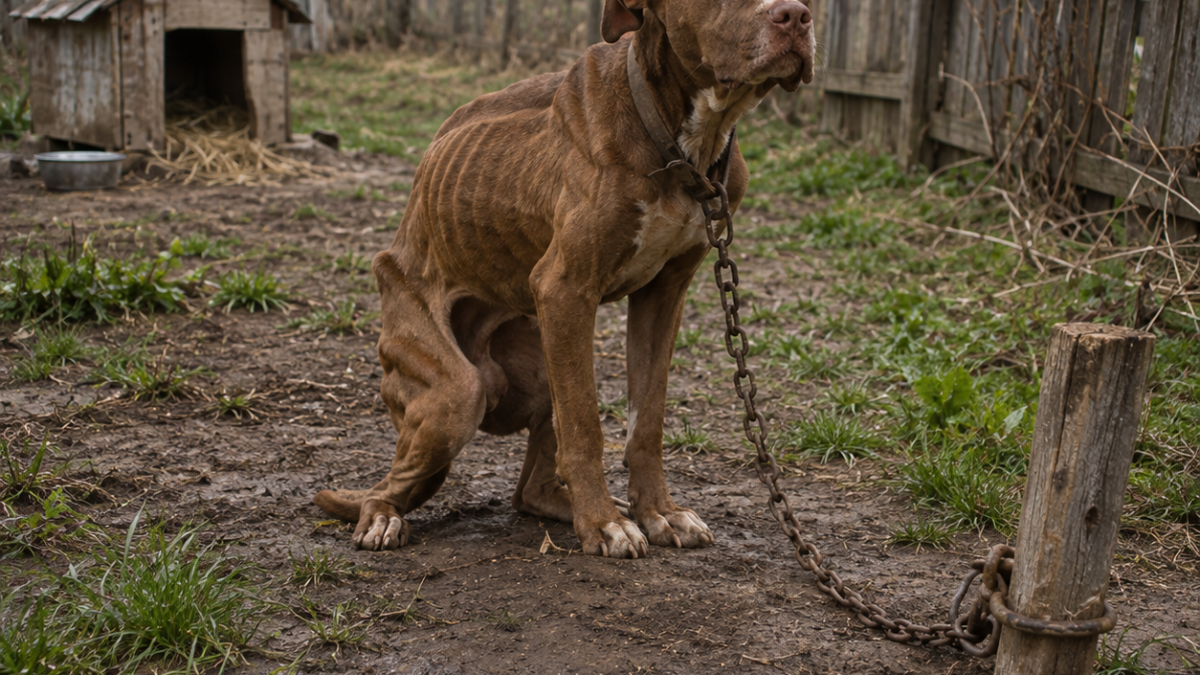
PART 2
The dog slept almost the entire drive back to the shelter.
We wrapped her in the old gray blanket I kept in the rear seat for emergencies. Normally newly rescued dogs stayed alert during transport. Their heads moved at every turn. Their ears reacted to engines, horns, voices, unfamiliar smells.
Not her.
Within minutes, her eyes closed.
At first I worried she might be losing consciousness.
I pulled over twice just to check her breathing.
Both times she opened one eye when I touched her shoulder.
“You’re okay,” I whispered.
Her eye closed again.
At the shelter, we carried her directly into our quiet room.
It was nothing fancy. Soft lighting. Washable walls. A large padded bed. Fresh water. Blankets. No barking dogs pressing against kennel doors.
For frightened animals, quiet could be medicine.
She sniffed the bed.
Then she looked at me.
I don’t know what I expected.
Maybe hesitation.
Instead, she slowly lowered herself onto the padding.
Her back legs stretched behind her awkwardly.
Then came another of those long sighs.
The kind that seemed too heavy for such a thin body.
That evening, I sat beside her until almost midnight.
I had paperwork to finish.
Calls to return.
A kennel intake sheet waiting on my desk.
I ignored all of it.
“You need a name,” I told her.
She watched me.
The light caught her eyes at an angle, and for a second they seemed to hold a strange reddish-brown glow.
“Ruby,” I murmured.
Then I smiled.
“No. Rubie.”
Her ear twitched.
“Rubie it is.”
The next morning, Dr. Fletcher arrived early.
He had been working with our rescue for years, and I trusted him because he never softened bad news just to make people feel better.
He examined Rubie carefully.
Teeth.
Heart.
Skin.
Body condition.
Neck.
Spine.
Then he reached her hips.
His expression changed.
He placed one hand on her pelvis and moved her leg with the other.
Rubie flinched.
He stopped immediately.
“How long was she chained?” he asked.
“Years, according to the neighbor.”
He exhaled.
“I want X-rays.”
“Is it bad?”
“I don’t want to guess.”
That was Dr. Fletcher’s way of saying yes.
The first images came back twenty minutes later.
Then he requested another angle.
Then another.
I stood behind him as he stared at the screen.
Even without veterinary training, I could see something was wrong.
The joints didn’t look clean or smooth.
Her hips looked distorted.
Her knees showed damage.
Finally he pulled a chair toward me.
“Sit down.”
“I’d rather stand.”
“Evelyn.”
I sat.
He turned the monitor.
“Rubie has severe bilateral hip dysplasia.”
I stared at the image.
“Both hips?”
“Yes.”
He pointed.
“There’s substantial degeneration here. Her knees also show chronic damage, and she has arthritis.”
I looked through the glass window toward the treatment room.
Rubie was lying on a towel while a technician scratched beneath her chin.
“Can you fix it?”
That was the question.
It was always the question.
Can you fix it?
Can surgery fix it?
Can medicine fix it?
Can love fix it?
Dr. Fletcher didn’t answer immediately.
“We can improve her quality of life,” he said.
“That isn’t what I asked.”
“I know.”
I waited.
“A major orthopedic procedure might reduce some pain, but given the extent of the damage, it will not restore a normal gait. She will almost certainly limp for the rest of her life.”
My throat tightened.
“Will she run?”
“Not normally.”
“Will she hurt?”
“We can manage the pain. Medication. Weight control. Physical therapy. Possibly hydrotherapy. Joint support. Careful exercise.”
He paused.
“But some degree of chronic discomfort may always be part of her life.”
I looked back at the X-rays.
“How long does damage like this take?”
“Years.”
“How many?”
“Four or five would not surprise me.”
I felt heat rise behind my face.
“So someone watched her deteriorate.”
Dr. Fletcher said nothing.
“If she’d been treated earlier?”
“The outcome could have been very different.”
“And the chain?”
“Likely made things worse. Restricted movement, poor muscle development, repetitive strain, limited activity, poor nutrition. None of that helped.”
I stood and walked to the window.
Rubie lifted her head when she saw me.
I had spent years telling volunteers not to let anger control them.
Anger made people careless.
Anger made rescuers turn every bad owner into a monster before evidence was collected.
Anger could destroy a cruelty case.
But standing there, looking at a dog who had lived with years of preventable pain, I had never felt more furious.
Dr. Fletcher came beside me.
“Don’t waste that anger.”
I looked at him.
“What?”
“Use it correctly.”
He knew me too well.
“We document everything,” he continued. “Every injury. Every image. Every estimate of duration. Every indication of chronic neglect.”
I looked back at Rubie.
“And then?”
“Then you let the evidence speak.”
That became the second promise I made to her.
The first was that she would never go back to that chain.
The second was that the chain would not become the only evidence of what had happened.
We photographed the hair loss around her neck.
The calluses.
Her body condition.
Her paws.
The muscle wasting in her hindquarters.
Dr. Fletcher wrote a detailed medical report.
Mrs. Bennett gave a statement.
Then another neighbor came forward.
Then another.
One had photographs from the previous winter showing Rubie lying beside a frozen water bowl.
Another had a short video taken months earlier. In it, Rubie tried to stand when someone approached the fence, but her rear legs buckled.
The video was only fourteen seconds long.
I watched it once.
I couldn’t watch it again.
Three days after Rubie arrived, the man who owned the property called the shelter.
His name was Randall Mercer.
“I want my dog back.”
His voice carried the confidence of someone who believed possession automatically made him right.
I stood in the hallway outside Rubie’s room.
“That isn’t something I can authorize.”
“She belongs to me.”
“The case has been referred to the proper authorities.”
“There is no case.”
“There is now.”
Silence.
Then he laughed.
Not loudly.
That somehow made it worse.
“You rescue people always exaggerate everything.”
I looked through the glass.
Rubie was asleep.
“You had a dog chained outside with advanced orthopedic disease.”
“She walked.”
“Barely.”
“She was old.”
“She isn’t old.”
“You don’t know that.”
“Our veterinarian examined her.”
There was another pause.
Then he said, “That dog has always had bad legs.”
The words hit me like a door slamming.
I lowered my voice.
“You knew?”
“What?”
“You just said she always had bad legs.”
“I didn’t say I knew anything.”
“You said she had always had them.”
“I’m done talking to you.”
“Good.”
He hung up.
I stood there holding the phone.
My hands were shaking.
Not because he had shouted.
Because he hadn’t.
He spoke about years of suffering as though we were discussing a broken lawn mower.
I walked into Rubie’s room and sat beside her.
She opened her eyes.
“Not your problem anymore,” I told her.
She rested her chin on my leg.
“Let him call whoever he wants.”
Her treatment began immediately.
The first goal was simple: control the pain.
Then rebuild whatever strength we could.
Dr. Fletcher prescribed anti-inflammatory medication and pain management.
We changed her diet.
We ordered an orthopedic bed.
Our physical therapist, Dana, created a program so gentle that at first it hardly looked like exercise.
Weight shifting.
Assisted standing.
Slow controlled steps.
Massage.
Short walks on flat ground.
Rubie hated the first week.
Not because she resisted us.
Because she had learned an awful lesson over the years.
Movement meant pain.
When Dana encouraged her forward, Rubie would look at us as though asking why we wanted her to do something that hurt.
I sat several feet away with tiny pieces of chicken.
“Come on, girl.”
She stared.
“One step.”
Her tail remained still.
“You came farther than this to meet me in that yard.”
Dana smiled.
“She doesn’t understand motivational speeches.”
“She understands me.”
Rubie took one step.
I held up the chicken.
“That’s my girl.”
Then another.
On the fourth step, she stopped.
I didn’t push.
I walked to her and sat on the floor.
“That’s enough.”
She leaned against me.
Dana checked her notes.
“You know what her biggest problem is?”
“Her hips?”
“No.”
I looked up.
“She thinks pain is normal.”
That sentence stayed with me.
Sometimes recovery isn’t teaching the body how to heal.
Sometimes it is teaching the mind that suffering is no longer required.
For the next several weeks, we built a routine.
Medication in the morning.
A short walk.
Breakfast.
Rest.
Physical therapy.
Another short walk in the afternoon.
Gentle stretching.
More rest.
And every day, I watched for signs.
Not miracles.
Signs.
The first came nine days after her rescue.
She lifted her rear paw completely off the ground instead of dragging it.
Just once.
The second came three days later.
She walked from her bed to the water bowl without stopping.
Then, almost two weeks after she arrived, I opened the quiet-room door one morning and froze.
Rubie stood up.
She looked at me.
And her tail moved.
Once.
Then again.
I covered my mouth.
“Oh, no.”
One of our volunteers glanced over.
“What?”
“She’s wagging.”
“What?”
“Her tail.”
Rubie began walking toward me.
Slowly.
Unevenly.
Her hips swayed.
But the tail kept moving.
I dropped to my knees.
She pressed her head against my chest.
I buried my face in her neck.
“You’re going to make me cry at seven in the morning?”
Her tail thumped against the floor.
That day, everybody in the shelter knew.
Rubie wagged her tail.
It sounds insignificant until you understand what it means when an animal who has spent years surviving begins expressing joy.
The legal case developed more slowly.
That frustrated me.
Cruelty cases depended on evidence, ordinances, veterinary documentation and procedure.
Emotion wasn’t enough.
Nor should it have been.
But patience is difficult when the evidence sleeps ten feet away from your desk.
Randall hired an attorney.
Then he claimed Rubie had received adequate veterinary care.
We requested records.
There were none.
He claimed she had only been chained temporarily.
Mrs. Bennett produced photographs dated across multiple years.
He claimed she had access to food and clean water.
Another neighbor provided images of empty bowls and a frozen container.
He claimed her hip condition was genetic and therefore not his responsibility.
Dr. Fletcher’s report addressed that directly.
Genetics could explain predisposition.
They did not explain years without treatment.
They did not explain severe muscle loss.
They did not explain untreated pain.
And they certainly did not justify chaining a mobility-impaired dog in a dirt yard.
One afternoon, Randall appeared outside our shelter.
I recognized his truck before I saw him.
My pulse jumped.
He got out and walked toward the entrance.
I stepped outside and closed the door behind me.
“You can’t be here.”
“I came for my property.”
“She is not property available for pickup.”
“She’s my dog.”
“This is an active case.”
He looked past me toward the windows.
“You people are turning this into something it isn’t.”
I folded my arms.
“What is it, then?”
“A dog with bad hips.”
“A dog with severe chronic pain.”
“She had food.”
“That is not the only legal or moral obligation involved in caring for an animal.”
His jaw tightened.
“You think you’re some kind of hero?”
“No.”
I took a step closer.
“I think she deserved a doctor.”
That landed.
His face changed.
Just slightly.
“I didn’t have money for expensive surgery.”
“Then you ask for help.”
“You don’t know my situation.”
“You’re right.”
I kept my voice controlled.
“But I know hers.”
He stared at me.
For a moment, I thought he might shout.
Instead, he said, “This will disappear.”
Then he turned around and walked back to his truck.
I watched him leave.
Dana had been standing inside the doorway.
When I went back in, she said, “You okay?”
“Yes.”
“You look like you want to bite through steel.”
“I’m fine.”
She handed me Rubie’s leash.
“Good. Walk the dog, not into a jail cell.”
Despite myself, I laughed.
Rubie and I went outside.
She made it nearly halfway around the small grass yard before needing to rest.
I sat beside her beneath a maple tree.
“You have no idea how much trouble you’re causing,” I told her.
She sniffed a leaf.
“Absolutely no remorse.”
She ate the leaf.
“Criminal.”
As the weeks passed, Rubie began joining some of the calmer shelter dogs outside.
That was when she met Gus.
Gus was a huge yellow Labrador with the emotional urgency of a couch cushion.
He had been surrendered after his owner entered assisted living.
He loved three things: food, naps and human attention.
Running ranked somewhere around ninety-third.
Which made him perfect for Rubie.
The first time they met, Gus waddled toward her.
I prepared to intervene.
Rubie stiffened.
Gus stopped three feet away.
He sniffed.
She sniffed.
Then Gus turned around, dropped onto the grass and went to sleep.
Rubie stared at him.
I laughed.
“That’s Gus.”
The next day, she lay beside him.
Within a week, they were inseparable.
They didn’t chase each other.
They didn’t wrestle.
They simply existed together.
Gus seemed to understand her pace.
If Rubie walked slowly, Gus walked slowly.
If she stopped, he stopped.
When she rested, he collapsed beside her like a sack of potatoes.
One morning I saw something I will never forget.
Gus was lying in the sun.
Rubie stood several feet away.
She lowered her front legs.
Play bow.
I froze.
Gus raised his head.
Rubie made a tiny hopping motion.
Both back paws left the ground.
Barely an inch.
Then she landed awkwardly and looked startled.
Gus exploded into one delighted bark.
Rubie looked at me.
I pointed at her.
“I saw that.”
Her tail wagged.
“You jumped.”
Dana stepped out behind me.
“Did she?”
“She jumped.”
Rubie did it again.
Smaller this time.
I started crying.
Dana laughed.
“This shelter is exhausting.”
“You’re crying too.”
“I have allergies.”
“It’s February.”
“Very aggressive winter allergies.”
Rubie pressed herself against Gus.
He licked the side of her face.
There are moments in rescue when you understand that recovery cannot be measured only on an X-ray.
Rubie’s hips were still damaged.
Her knees were still damaged.
Her arthritis had not disappeared.
Yet something inside her had begun moving again.
Joy.
Trust.
Curiosity.
Expectation.
She had started waiting for mornings instead of merely surviving them.
The cruelty case reached its turning point nearly three months after Rubie’s rescue.
I was at the shelter when Mrs. Bennett called.
“Evelyn?”
Her voice was urgent.
“What happened?”
“I found something.”
She explained that while cleaning old photographs from her phone, she had discovered a video taken almost two years earlier.
She had filmed through her kitchen window during a storm because she was worried about Rubie.
The video showed the yard flooded with rain.
Rubie was chained to the same metal post.
Her shelter had partially collapsed.
She tried repeatedly to move toward the porch.
The chain stopped her.
Then something else happened.
A man walked through the yard.
Randall.
He looked at Rubie.
He looked at the collapsed shelter.
And then he went inside.
The video continued for almost six minutes.
He never returned.
Mrs. Bennett was crying.
“I should have done more.”
“You called.”
“Years later.”
“You kept trying.”
“It wasn’t enough.”
I closed my eyes.
“Mrs. Bennett, listen to me. You cannot change what happened before. But this video matters now.”
“Will it help?”
“Yes.”
It did.
Combined with veterinary documentation, witness statements and additional evidence, the video helped establish something crucial.
This wasn’t a single bad day.
It was a pattern.
Randall’s attorney changed tactics shortly afterward.
Instead of demanding Rubie back, they began discussing surrender.
The agreement would permanently transfer Rubie and restrict Randall from reclaiming her while the cruelty proceedings continued separately under local law.
When the paperwork arrived, I read Rubie’s name three times before signing.
Then I walked into the yard.
She was asleep beside Gus.
I crouched beside her.
“You know what happened today?”
She opened one eye.
“You’re ours.”
Gus snored.
“Technically, you were already ours emotionally, but now there’s paperwork.”
Rubie lifted her head.
“No one can take you back to that yard.”
Her tail moved.
I sat in the grass and cried harder than I had on the day we rescued her.
Because rescue has different stages.
Getting an animal physically away from danger is one.
Making certain the danger cannot legally reclaim them is another.
That evening, I removed Rubie’s old chain from our evidence storage only long enough to photograph it one final time.
The links were thick.
Heavy.
Rust had spread around the clasp.
I held it in both hands.
It weighed almost as much as the first bag of food Rubie had gained enough strength to finish by herself.
I imagined that weight dragging behind her every day.
Then I put it back.
I wanted to destroy it.
Instead, I wanted it preserved until the case ended.
Because sometimes the best revenge isn’t breaking the chain.
It’s making sure everyone sees it.
The hearing was scheduled for late spring.
I almost didn’t attend.
Dr. Fletcher told me I didn’t need to.
The reports spoke for themselves.
But I wanted to be there.
Not because I expected some dramatic courtroom confession.
Real life rarely works that way.
I wanted to hear someone say, officially, that what happened to Rubie mattered.
Randall arrived wearing a collared shirt and an expression I had seen many times before in people who resented consequences more than they regretted decisions.
His attorney did most of the talking.
The defense emphasized that hip dysplasia could be hereditary.
Dr. Fletcher agreed.
Then he explained why that did not absolve a caretaker.
“A genetic condition requires management,” he said. “It does not justify neglect.”
They asked whether Rubie could have experienced pain even with excellent care.
“Yes.”
“So pain alone proves nothing.”
“Pain alone does not.”
Dr. Fletcher remained calm.
“But severe muscle wasting, progressive untreated orthopedic disease, prolonged restraint, inadequate mobility, skin damage from tethering and absence of documented veterinary intervention together are clinically significant.”
I glanced at Randall.
For the first time, he wasn’t looking bored.
The video from Mrs. Bennett was shown.
I watched the first thirty seconds.
Then I looked away.
I didn’t need to see Rubie standing in that rain again.
I remembered it without video.
At one point, Randall turned his head toward me.
Our eyes met.
There was no triumphant feeling.
No movie-style satisfaction.
Just a strange sadness.
Because there was no punishment that could give Rubie back four healthy years.
No fine could restore cartilage.
No court order could erase the mornings she had woken up in pain.
That was the truth I had to accept.
Justice could recognize damage.
It could punish neglect.
It could prevent repetition.
But it could not reverse time.
Eventually, the case ended with consequences that were real and enforceable: financial penalties, restrictions on future animal ownership under the applicable orders, responsibility for portions of documented costs and a permanent record of the cruelty findings.
It wasn’t revenge in the way people imagine revenge.
Randall didn’t lose everything.
There was no cheering courtroom crowd.
I didn’t stand on the courthouse steps and deliver a speech.
But something far more important happened.
He could no longer say nothing was wrong.
He could no longer describe Rubie as “just a dog with bad hips.”
The record said otherwise.
The veterinary evidence said otherwise.
The photographs said otherwise.
His neighbors said otherwise.
The chain said otherwise.
And Rubie herself, walking slowly across the shelter yard every morning, said otherwise.
When I returned from the final hearing, Rubie was waiting near the gate.
Dana had brought her outside.
“Well?” she asked.
I looked at Rubie.
“It’s done.”
Dana studied my face.
“You don’t look happy.”
“I thought I would.”
She nodded.
“Justice rarely feels like people expect.”
Rubie started toward me.
Her gait was uneven.
One step.
Another.
Another.
When she reached me, I knelt and wrapped my arms around her.
“I’m sorry we couldn’t make them give you those years back.”
She licked my chin.
“But nobody gets the rest of them.”
That was enough.
There was still one problem.
Rubie needed a home.
A real one.
The shelter loved her.
I loved her.
Gus adored her.
But shelters are meant to be bridges, not destinations.
Rubie needed someone who understood that adopting her meant medication schedules, veterinary appointments, ramps, carefully managed exercise and the possibility that her mobility might worsen as she aged.
We posted her story.
Applications came in quickly.
Too quickly.
Some people loved the idea of rescuing the “poor chained dog,” but their applications revealed they wanted a hiking companion.
Others had homes full of stairs.
Some underestimated the cost of chronic medical care.
One applicant asked whether Rubie would eventually become “normal.”
I stared at that word.
Normal.
What did normal mean?
Running five miles?
Jumping into a truck?
Climbing stairs?
Rubie was normal.
She was a dog.
She liked chicken.
She disliked rain.
She loved Gus.
She stole blankets.
She snored.
She leaned into anyone she trusted.
Her body worked differently.
That was all.
Then Margaret and Thomas came.
Margaret was fifty-five and taught elementary school.
Thomas worked at a library.
They had never owned a dog together.
Usually that might have worried me for a special-needs adoption.
But Margaret had read every sentence of Rubie’s medical profile.
Every sentence.
Her first question wasn’t, “Will she ever run?”
It was, “What does a bad pain day look like, and how do we know when she’s having one?”
I looked at Dana.
Dana looked at me.
That was the right question.
Thomas asked about flooring.
“Would rugs help her grip?”
“Yes.”
“Should we build a ramp before she comes home?”
“Yes.”
“What angle?”
I almost laughed.
“You’re serious.”
He looked confused.
“Of course.”
Margaret knelt beside Rubie.
Rubie watched her cautiously.
“Hello,” Margaret whispered.
No dramatic moment happened.
Rubie didn’t leap into her arms.
She didn’t immediately choose her.
She sniffed Margaret’s hand.
Then walked away.
Margaret smiled.
“I guess I have to earn it.”
Another right answer.
They returned the next day.
And the day after that.
For nearly two weeks, they visited.
Thomas sat quietly with Rubie in the yard.
Margaret learned how to give her medication.
They observed physical therapy.
They asked Dr. Fletcher questions.
They met Gus.
On the seventh visit, Margaret sat beneath the maple tree.
Rubie walked over.
She stood beside her for several seconds.
Then slowly lowered her head onto Margaret’s lap.
Margaret froze.
Her eyes filled with tears.
She looked at me.
I whispered, “Don’t move.”
“I wasn’t planning to.”
Rubie closed her eyes.
Margaret stroked her ear.
Thomas turned his face away.
I noticed his shoulders move.
“Thomas?”
“I’m fine.”
“You’re crying.”
“Library dust.”
“We’re outside.”
“It travels.”
I laughed.
Rubie opened one eye.
And in that moment, I knew.
Not because Margaret and Thomas were perfect.
Perfect people don’t exist.
Because they had never asked Rubie to become a different dog before they could love her.
They were ready to build their life around the dog she already was.
Adoption day came on a warm Saturday morning.
I arrived early.
Rubie’s medications were labeled.
Her veterinary records were copied.
Her orthopedic bed had been cleaned.
We packed her favorite blanket.
Two toys.
Her food.
A folder containing her therapy plan.
And one ridiculous stuffed duck she carried around even though it was almost as large as her head.
Gus knew something was happening.
He followed Rubie everywhere.
When we put her blanket near the front desk, he lay on it.
“Gus.”
He ignored me.
“That’s not yours.”
He put his head down.
Dana sighed.
“He knows.”
Rubie walked toward him.
She sniffed his face.
Then she lay beside him.
For nearly ten minutes, neither moved.
I had to turn away.
Rescue is full of goodbyes.
Some are tragic.
Some are beautiful.
Beautiful goodbyes can hurt just as much.
Margaret and Thomas arrived at eleven.
They had already transformed their house.
Rugs covered the slippery floors.
A low orthopedic bed sat in the living room.
A ramp had been installed at the back steps.
They had placed water bowls in two rooms so Rubie wouldn’t need to walk farther than necessary.
Thomas showed me photographs.
“We might add another rug here.”
I examined the picture.
“That would help.”
Margaret held Rubie’s leash.
Her hands trembled.
“Nervous?” I asked.
“Terrified.”
“Good.”
She stared at me.
I smiled.
“It means you understand this matters.”
We walked outside.
Rubie stopped near the parking lot.
Behind her was the shelter.
Ahead was Margaret and Thomas’s car.
For a second, she looked back at me.
My chest tightened.
Months earlier, I had carried her from a dirt yard because she could barely walk.
Now she stood between two homes.
One temporary.
One permanent.
Margaret crouched near the car.
“Come on, sweetheart.”
Rubie looked at her.
Then she started walking.
Slowly.
Left foot.
Right foot.
Pause.
Another step.
There was no running.
No dramatic leap.
No burst of speed.
She simply walked.
And somehow, those slow uneven steps felt stronger than any sprint I had ever seen.
Halfway to the car, she stopped.
She turned.
Looked directly at me.
I went to her.
I knelt and held her face between my hands.
“You don’t owe me anything.”
Her eyes remained on mine.
“You hear me?”
Her tail moved.
“You go home.”
She pressed her forehead to mine.
For several seconds, I couldn’t speak.
Then she licked my nose.
I laughed through tears.
“Okay. That was rude.”
Margaret laughed too.
Rubie turned and continued toward the car.
Thomas helped her up the ramp they had bought specifically for her.
She settled onto the blanket in the back seat.
Margaret sat beside her.
Before Thomas closed the door, Rubie lifted her head and looked at me through the opening.
“Goodbye, Rubie.”
The door closed.
Their car pulled away.
I stood in the parking lot until it disappeared.
Dana came beside me.
“You could have adopted her yourself.”
“I know.”
“Do you regret not doing it?”
I thought about the question.
“No.”
Then I wiped my face.
“But I reserve the right to cry about it for the next seventy-two hours.”
“Reasonable.”
Gus was depressed for four days.
He refused to sleep in their usual spot beneath the maple tree.
So Margaret brought Rubie back for a visit.
When Gus saw her, he moved faster than I had ever seen him move.
Which was still not especially fast.
Rubie’s tail went wild.
They touched noses.
Then Gus collapsed beside her.
Rubie lay down too.
Apparently their reunion had exhausted them.
The updates from Margaret arrived almost daily at first.
Rubie asleep with her stuffed duck.
Rubie lying beside Thomas while he read.
Rubie standing in the kitchen staring at Margaret while chicken cooked.
Rubie sleeping in a patch of sunlight.
Rubie refusing to go outside because it was raining.
The caption under that one said:
**Apparently she has decided she has experienced enough outdoor rain for one lifetime.**
I agreed.
Her personality continued emerging.
She was stubborn.
That surprised everyone.
At the shelter, she had been so gentle and compliant that we mistook exhaustion for temperament.
At home, once she realized she was safe enough to have opinions, Rubie developed many.
Breakfast at 7:00 meant 7:00.
Not 7:05.
Her blue blanket belonged on the left side of the living-room bed.
If Thomas moved it, she stared at him until he corrected his mistake.
She disliked carrots.
She adored cheese.
She believed every delivery driver had come specifically to visit her.
She learned the sound of Margaret’s car.
And she began waiting near the front window each afternoon.
Three months after the adoption, Margaret called me.
She was laughing so hard I could barely understand her.
“What happened?”
“You’re not going to believe this.”
“What?”
“Rubie almost ran.”
I stood up from my desk.
“What do you mean, almost?”
“Thomas was in the backyard. He’d been gone all morning. Rubie saw him through the door and started going toward him.”
“How fast?”
“Fast for her.”
“That doesn’t answer my question.”
“She was doing this strange little half-walk, half-hop.”
I smiled.
“That counts.”
“I think so too.”
“Did you record it?”
“No!”
“Margaret!”
“I was crying!”
“You have one job.”
“I thought my job was keeping her alive.”
“Second job.”
That evening she sent a photograph.
Thomas sat on the grass.
Rubie was pressed against his chest.
Her mouth was slightly open.
Her eyes were bright.
The caption said:
**She didn’t make it very far, but she knew exactly where she wanted to go.**
I stared at the photograph for a long time.
That was Rubie’s entire story in one sentence.
She didn’t move quickly.
But she knew where she wanted to go.
Toward kindness.
Toward safety.
Toward the people who loved her.
Winter came.
Cold weather made her joints worse.
Margaret noticed immediately.
They adjusted her medication with Dr. Fletcher.
Thomas bought heated pads designed for pets.
They shortened her walks.
On difficult mornings, Rubie needed help standing.
I worried.
Every special-needs rescuer knows the fear.
You celebrate progress while quietly wondering how long it will last.
One evening, Margaret called.
Her voice sounded different.
“Rubie had a bad day.”
My stomach dropped.
“What happened?”
“She wouldn’t get up this morning.”
“Did you call Fletcher?”
“We’re at the clinic now.”
“I’m coming.”
“You don’t have to.”
“I know.”
I drove there anyway.
Rubie was lying on a padded mat when I arrived.
Thomas sat beside her.
Margaret stood near the examination table.
Dr. Fletcher was reviewing new X-rays.
Rubie lifted her head when she heard my voice.
“Hey, hero.”
Her tail moved once.
I sat beside her.
“Don’t scare me like that.”
Dr. Fletcher finally turned around.
“No catastrophic change.”
Margaret released a breath.
“What does that mean?”
“Arthritis flare. Cold weather likely contributed. Her condition is chronic. There will be difficult days.”
“Can we do more?”
“We can always evaluate options.”
Thomas looked down at Rubie.
“I don’t want her suffering because we’re afraid to lose her.”
The room became quiet.
That sentence told me again that Rubie had ended up exactly where she belonged.
Dr. Fletcher nodded.
“And that is the correct way to think about this.”
He adjusted her treatment plan.
Within several days, Rubie improved.
Not back to some imaginary perfect version.
Back to herself.
Slow.
Stiff.
Happy.
Loved.
A year after her rescue, I drove past the street where we had found her.
I hadn’t planned to.
A detour took me nearby.
For several seconds, I considered turning away.
Instead, I drove past.
The old metal post was gone.
The dirt yard remained.
Randall no longer lived there.
The property had been sold months earlier.
A family had moved in.
There was grass now.
Children’s bicycles lay near the porch.
No chain.
I slowed.
For a moment, I saw the old scene anyway.
Rubie at the end of those heavy links.
Back legs shaking.
Eyes tired.
Trying to come toward me.
Then the image changed.
I saw her walking toward Margaret’s car.
I saw her under the maple tree with Gus.
I saw her sleeping beside Thomas.
I saw her almost running across a backyard.
That was when I understood something I had been struggling with since the legal case.
For months, I had wanted Randall to understand what he had done.
I wanted him to feel shame.
I wanted some consequence severe enough to equal Rubie’s suffering.
But suffering doesn’t balance like numbers on a scale.
Hurting the person who caused pain cannot restore the years lost to the victim.
The most satisfying revenge was never going to be Randall’s misery.
It was Rubie’s happiness.
He had treated her life as though it were small.
We made it large.
He had left her at the end of a chain.
She ended up with an entire community behind her.
He had allowed pain to become her normal.
Margaret and Thomas made comfort normal.
He had given her a dirt circle measured by the length of a chain.
Now she had a house.
A yard.
A soft bed.
A family.
Friends.
Doctors.
Medicine.
Sunlight through a living-room window.
Her revenge was not that he suffered.
Her revenge was that he failed to destroy her.
But there was one final chapter I didn’t expect.
Two years after Rubie’s rescue, Mrs. Bennett called me.
At first I thought something was wrong.
Instead, she sounded excited.
“Do you remember the video?”
“Of course.”
“And all the neighbors who came forward?”
“Yes.”
“Well, we’ve been talking.”
“About what?”
“About animals like Rubie.”
I waited.
Mrs. Bennett explained that several residents had begun working with a local welfare group to create a neighborhood assistance program.
The idea was simple.
Some neglect came from cruelty.
But some came from poverty, ignorance, age or people becoming overwhelmed.
The program would help connect pet owners with low-cost veterinary care, food assistance, temporary foster care and education before problems became disasters.
Mrs. Bennett had volunteered to coordinate calls.
I smiled.
“You’re serious?”
“Very.”
“What made you decide to do this?”
Her answer came quietly.
“I watched Rubie too long before I found the courage to make enough noise.”
I sat down.
“So now I’m going to make noise earlier.”
I closed my eyes.
“That might be the best thing that came out of this.”
“It doesn’t erase what happened.”
“No.”
“Nothing does.”
“No.”
“But maybe the next dog doesn’t wait four years.”
That was enough.
The program eventually helped dozens of animals.
A senior man who couldn’t afford medication for his beagle.
A young mother who needed temporary help feeding two cats after losing her job.
A family whose dog needed urgent dental treatment.
A woman fleeing domestic violence who needed someone to foster her pets while she found housing.
And, yes, there were cases where intervention revealed deliberate neglect.
Those were reported.
But others were solved before they reached the point Rubie had reached.
Sometimes rescue is pulling a dog out of a terrible yard.
Sometimes rescue is preventing the yard from becoming terrible in the first place.
On the third anniversary of Rubie’s adoption, Margaret invited us to their house.
Dana came.
Dr. Fletcher came.
Mrs. Bennett came.
Even Gus came with his foster-turned-adoptive family.
He was older now.
Grayer.
Slower.
Which meant, finally, Rubie and Gus moved at approximately the same speed.
The moment Rubie saw him, her tail started moving.
Gus lumbered across the lawn.
Rubie walked toward him.
They met in the middle.
Noses touched.
Then, predictably, Gus lay down.
Everyone laughed.
Rubie lowered herself beside him.
I sat on the grass a few feet away.
Thomas brought lemonade.
Margaret sat beside me.
“She’s slowing down,” she said quietly.
I looked at Rubie.
“I know.”
“Fletcher says we probably have some difficult decisions ahead someday.”
“Someday.”
Margaret nodded.
“I used to be afraid of thinking about that.”
“And now?”
She watched Rubie.
“Now I think loving her means accepting all of it.”
I understood.
The rescue.
The recovery.
The medication.
The good mornings.
The bad mornings.
And one day, the goodbye.
That is the bargain we make when we love animals.
Their lives are often shorter than ours.
We know the ending.
We love them anyway.
Rubie suddenly struggled to stand.
Margaret immediately moved.
I touched her arm.
“Watch.”
Rubie planted her front paws.
Shifted her weight.
Tried again.
Her hind legs trembled.
Then she stood.
Margaret smiled.
Rubie walked across the grass toward Thomas.
He opened his arms.
“Come here, sweetheart.”
She went.
Slowly.
Always slowly.
But she went.
That evening, as the sun began dropping behind the trees, Mrs. Bennett sat beside me.
“I almost didn’t call you that day,” she said.
I looked at her.
“Why?”
“I thought maybe I was interfering.”
I shook my head.
“You changed her life.”
“No.”
She looked toward Margaret and Thomas.
“We all did.”
She was right.
Rubie’s story had no single hero.
I was the person who unclipped the chain.
But Mrs. Bennett made the call.
Dr. Fletcher diagnosed the damage.
Dana taught Rubie to move without fearing every step.
Volunteers gave her medication and sat beside her.
Gus reminded her how to be a dog.
Witnesses spoke when silence would have been easier.
Authorities took the evidence seriously.
Margaret and Thomas turned recovery into a life.
And Rubie?
Rubie did the hardest part.
She trusted us.
After everything people had done to her, she trusted people again.
A few months later, I visited the house alone.
Margaret opened the door.
“She’s in the living room.”
I stepped inside.
Rubie lay on her orthopedic bed.
She was older.
There was gray around her muzzle now.
Her hips had become stiffer.
When she noticed me, her eyes widened.
Her tail began thumping.
“Don’t get up,” I said.
She ignored me.
Of course she did.
She planted her front paws.
Struggled.
Stood.
Then started coming toward me.
I dropped to my knees.
“No, no. I’m coming to you.”
But she kept walking.
One slow step.
Another.
Her body swayed.
Another.
I felt my eyes burn.
“Stubborn girl.”
She reached me.
I wrapped my arms around her.
Her head pressed against my chest exactly as it had the first morning she wagged her tail at the shelter.
For a second, I was back in that dirt yard.
The chain.
The metal post.
The trembling legs.
Except this time there was no chain behind her.
There was a soft rug.
A warm house.
Photographs of her framed on the walls.
A stuffed duck missing one wing.
A bowl with her name on it.
Thomas’s books stacked near the couch.
Margaret’s shoes beside the door.
A home.
“You did it,” I whispered.
Rubie licked my hand.
“You really did it.”
Later, we sat in the backyard.
Rubie lay at my feet.
The afternoon was warm.
Thomas was reading.
Margaret brought coffee.
Nobody said much.
We didn’t need to.
I thought about the first time Dr. Fletcher had shown me the X-rays.
I had felt devastated because I wanted healing to mean restoration.
I wanted Rubie’s hips repaired.
Her gait corrected.
Her pain erased.
I wanted some great medical victory where a dog who could barely walk suddenly ran through a field.
But life taught me something different.
Healing does not always mean becoming what you were before you were hurt.
Sometimes healing means building a beautiful life around what cannot be undone.
Rubie never got perfect hips.
She got pain management.
She never became a strong runner.
She got people who walked at her speed.
She never forgot every bad day.
But she learned there would be good ones.
She never stopped needing medication.
But she learned that hands approaching her could carry medicine, food or affection instead of another chain.
She never became the dog she might have been if someone had cared for her properly when she was young.
She became Rubie.
And Rubie was enough.
More than enough.
The sun moved lower.
I eventually stood.
“I should go.”
Rubie raised her head.
Margaret smiled.
“She’ll escort you.”
“She doesn’t have to.”
Rubie began standing.
“I said she doesn’t have to.”
Thomas laughed.
“You know she doesn’t listen.”
Rubie walked with me toward the front door.
I shortened my stride deliberately.
Years earlier, I had watched her try to keep up with a world that never slowed down for her.
Now I matched my pace to hers.
At the door, I knelt.
She sat.
“Remember when we first met?”
Her ears lifted.
“You were terrible at walking.”
Her tail moved.
“You’re still terrible at walking.”
Margaret laughed behind me.
“But you’re very good at getting where you need to go.”
Rubie pressed her face against mine.
I kissed the top of her head.
“I’ll see you soon.”
I stepped outside.
Before the door closed, I turned back.
Rubie was still sitting there.
Thomas stood behind her.
Margaret rested one hand on her shoulder.
The image was so ordinary that years earlier I might not have understood how precious it was.
A dog.
A doorway.
A family.
Nothing dramatic.
Nothing extraordinary.
And yet everything Rubie had once been denied was contained in that small scene.
Safety.
Warmth.
Belonging.
Someone waiting beside her.
Someone who would notice if she hurt.
Someone who would refill the water bowl.
Someone who would call the veterinarian.
Someone who would never attach a chain and forget she was alive.
The door closed.
I sat in my car for a while before starting the engine.
I thought again about strength.
People often imagine strength as speed.
Power.
Perfect bodies.
The ability to fight.
Rubie taught me otherwise.
Strength was the first step she took toward me when every step hurt.
Strength was trusting my hand after human hands had failed her.
Strength was allowing Dana to guide her through exercises she didn’t understand.
Strength was wagging her tail for the first time.
Strength was trying to play with Gus.
Strength was walking toward Margaret and Thomas’s car.
Strength was waking up every morning inside a body that still carried damage from the past and choosing to participate in life anyway.
She never ran away from what had happened to her.
She couldn’t.
Her body carried the evidence.
But she walked beyond it.
Slowly.
Painfully at times.
One stubborn step after another.
And the people responsible for her suffering?
They did not get the final word.
That was the part I eventually understood.
Randall’s punishment mattered.
The legal record mattered.
The ownership restrictions mattered.
The financial consequences mattered.
Accountability matters because silence protects cruelty.
But none of those things became the ending.
Rubie did.
The dog who had once been dismissed as a broken animal became the center of a family.
The neighbor who once felt powerless became someone who helped protect other animals.
The medical records that documented suffering became evidence.
The chain that restricted Rubie’s world became proof that someone’s actions had consequences.
And a shelter room that was supposed to be temporary became the place where Rubie learned that pain did not have to control every day of her life.
Years later, I still think about the moment I unclipped that chain.
If this were a movie, that would probably be the scene everyone remembered.
Metal hitting dirt.
Freedom.
But freedom didn’t happen in that single instant.
Freedom happened the next morning when Rubie woke up on a soft bed.
It happened when Dr. Fletcher treated her pain.
It happened when she learned she could stop walking when she was tired and nobody would punish her.
It happened when she discovered grass beneath her paws.
It happened when Gus lay beside her without demanding anything.
It happened when Margaret learned her medication schedule.
It happened when Thomas built the ramp.
It happened when a court made certain she could never be returned to the yard where she suffered.
It happened every morning she opened her eyes inside a home where somebody was happy she existed.
That is what freedom looked like for Rubie.
Not running.
Living.
And maybe that is why the memory that stays with me most isn’t the chain falling to the ground.
It is Rubie walking toward her new family on adoption day.
Her hips swaying.
Her back legs uncertain.
Margaret waiting beside the car.
Thomas holding the ramp.
Me trying not to cry behind her.
Rubie stopped once.
She looked back.
Then she turned toward them again.
One step.
Another.
Another.
She couldn’t run toward freedom.
But she walked toward it.
And in those slow, uneven steps, there was more courage than in a thousand desperate sprints.
Because Rubie knew something I was still learning.
Freedom is not measured by how fast you can move.
Healing is not measured by whether the scars disappear.
Justice is not measured by whether the person who hurt you suffers as much as you did.
Sometimes victory is much quieter.
Sometimes victory is an old dog sleeping on an orthopedic bed while someone she loves reads beside her.
Sometimes justice is a full water bowl.
A warm room.
Medicine on time.
A gentle hand.
A ramp instead of stairs.
A family that rearranges its home because your comfort matters.
Sometimes revenge is surviving long enough to discover that the world contains more than the people who failed you.
And sometimes the most powerful ending is not watching the cruel person lose.
It is watching the one they tried to break finally understand that she was worth saving all along.
Rubie never became perfect.
She became loved.
And in the end, that was the victory none of them could take away from her.








