PART 2: They Chained an Old German Shepherd Under a Flooded Bridge—But He Kept Begging Me to Save the Basket First
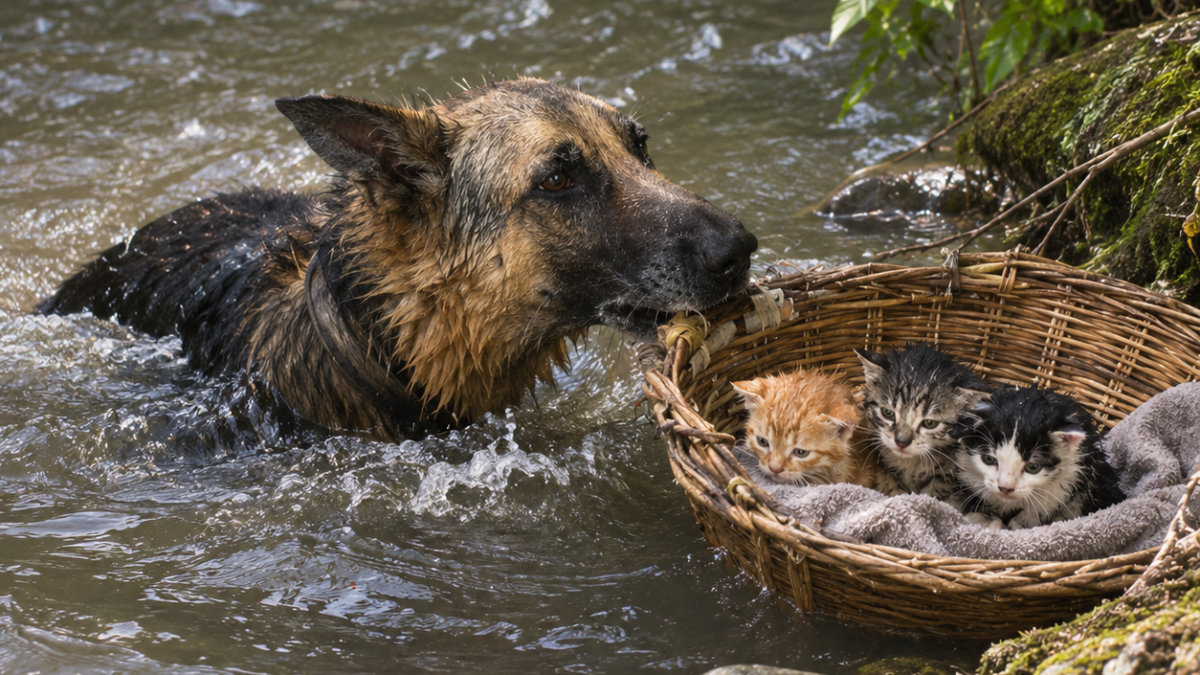
PART 2
Knox arrived before the fire engine.
His truck skidded slightly on the wet shoulder before stopping behind my motorcycle.
He jumped out wearing muddy work boots and an old green rain jacket.
“What have you got?”
I pointed.
Then he saw the dog.
His face changed.
“Oh, man.”
“Basket too.”
“What basket?”
I pointed again.
The current shifted it just enough for the broken handle to appear.
Knox squinted.
“What’s in it?”
“Kittens.”
He looked at me.
“You’re kidding.”
“I wish.”
The Shepherd whined.
Knox moved down beside me.
The mud immediately swallowed half his boots.
“How many?”
“Two I can see. Maybe more.”
“Water rising?”
“Fast.”
He watched the current for several seconds.
“You went in?”
“No.”
“Good.”
“I thought about it.”
“Of course you did.”
He looked at the chain.
“Can we cut it?”
“Maybe.”
“Then why are we still talking?”
“Because every time he gets slack, he pulls toward the basket.”
Knox looked at the Shepherd again.
The dog wasn’t watching us.
He was watching the kittens.
Another siren grew louder.
A red engine appeared above the bridge.
Three firefighters came down the embankment.
One carried a throw bag.
Another brought bolt cutters.
Their captain, Reyes, surveyed the scene quickly.
“How long’s he been there?”
“No idea.”
“Current increasing?”
“Yes.”
She pointed to the pillar.
“Chain anchored?”
“Steel ring. Padlock.”
Then she saw the basket.
“What’s that?”
“Kittens.”
She closed her eyes for half a second.
“Of course there are.”
Nobody laughed.
She turned to her crew.
“Anchor line up top. Second safety on the pillar. Miller, suit up.”
One firefighter clipped into a rescue line.
The Shepherd heard the movement.
His body tightened.
I crouched near him.
“Easy.”
Reyes looked at me.
“He trusts you?”
“I don’t know.”
“He’s tracking you.”
Maybe she was right.
Every few seconds, Ranger—though I didn’t know his name yet—looked from the basket to me.
As if checking whether I remembered my promise.
“I’m still here,” I told him.
His ears twitched.
“Still see them.”
The basket struck the concrete again.
Miller entered the water.
Immediately, the current pushed against him.
He braced.
Moved sideways.
The Shepherd lunged.
The chain snapped tight.
“Easy!”
I reached toward his shoulder.
His muscles were shaking under the wet fur.
Not aggression.
Fear.
Miller moved another step.
The water reached his waist.
Then higher.
Reyes called:
“Keep tension on the line.”
The basket shifted.
Miller reached.
Missed.
The Shepherd barked.
One deep, violent sound beneath the bridge.
Miller tried again.
The basket rotated.
I caught a glimpse of the orange kitten.
Its head barely above the soaked blanket.
“Come on.”
Miller reached farther.
His fingertips touched the broken handle.
Then the concrete shelf under the basket crumbled.
Everything happened at once.
The basket dropped.
The current took it.
The Shepherd exploded against the chain.
“No!”
Miller lunged.
The safety rope snapped tight.
For one horrible second, both he and the basket vanished behind a wall of brown water.
Reyes shouted.
Then Miller’s arm came up.
He had the basket.
“I GOT IT!”
Everyone exhaled.
The Shepherd stopped barking.
He stood frozen.
Watching.
Miller fought his way back.
Two firefighters pulled the safety rope.
When he reached the bank, Reyes grabbed the basket.
I looked inside.
Three kittens.
Not two.
Three.
Gray.
Orange.
Black.
All tiny.
All soaked.
One moving.
One crying.
One almost completely still.
“Blankets!”
Someone wrapped them immediately.
The Shepherd strained forward.
“Bring them where he can see.”
Reyes looked at me.
“You sure?”
“Yes.”
The animal-control officer held the basket at chest height.
The Shepherd sniffed.
Saw movement.
Something in his body changed.
His shoulders dropped.
His breathing slowed.
He looked at me.
Then toward the bank.
As if saying:
Now.
CUTTING THE CHAIN
Miller moved to the dog.
The lock was positioned too close to the concrete to cut safely.
“Chain link,” Reyes said.
The Shepherd watched the bolt cutters.
The jaws closed around one steel link.
Miller pressed.
Nothing.
He repositioned.
Again.
Metal groaned.
The Shepherd flinched.
I put my hand near his neck.
“Easy, buddy.”
Third try.
The link snapped.
The sudden absence of tension made the Shepherd stumble forward.
He had been bracing against the chain for so long that his body didn’t seem to understand freedom.
I caught him under the chest.
He was heavy.
But weak.
His back legs shook.
“Come on.”
He took one step.
Then another.
The current pushed him sideways.
Two firefighters supported him.
Halfway toward the bank, he stopped.
Turned.
Looked toward the basket.
Of course.
“Bring them closer.”
The animal-control officer lifted the kittens.
The Shepherd moved again.
When his paws finally reached solid mud, his legs collapsed.
He fell hard onto one side.
I dropped beside him.
His chest heaved.
Mud covered his stomach.
His paws were raw and bleeding.
The collar had rubbed the skin around his neck bright red.
But he tried to stand again.
“Where are you going?”
His eyes moved toward the kittens.
I almost laughed.
Even now.
The basket was placed beside him.
He pushed his nose toward the gray kitten.
Sniff.
Then orange.
Then the black one.
The black kitten barely moved.
The Shepherd licked its head once.
Then again.
The tiny body twitched.
The dog let out a breath.
A long one.
Then rested his head beside the basket.
For the first time since I had seen him, he stopped fighting.
“WHO DID THIS?”
Knox said the words behind me.
Quietly.
“Who does this?”
Nobody answered.
We all looked toward the pillar.
The chain.
The padlock.
The steel ring.
Then the basket.
The storm had created the danger.
But the storm had not chained a dog to concrete.
The storm had not placed kittens in a wicker basket.
Somebody had done that.
Reyes took photographs before anything else was moved.
The sheriff’s deputy who had been helping with traffic came down the slope.
His name was Cole Ramirez.
He looked at the chain.
“Padlock?”
“Yeah.”
“Deliberate.”
“Very.”
He crouched near the Shepherd.
“Tags?”
We checked.
No identification tag.
Only an old leather collar.
Cole said:
“We’ll scan for a chip at the clinic.”
The kittens were loaded first.
When they carried the basket away, the dog tried to get up.
He failed.
I put one hand against his chest.
“They’re coming with you.”
He stared.
“I promise.”
That was the second promise I had made to him.
I barely knew this animal.
Still, I felt responsible now.
THE CLINIC
The emergency veterinary clinic was already crowded from the storm.
Wet dogs.
Injured wildlife.
A cat found inside a flooded crawlspace.
Two puppies rescued from a drainage ditch.
When the Shepherd arrived on a stretcher, staff took him immediately.
The kittens were carried into another treatment area.
A technician cut away the wet collar.
Underneath, the skin was badly abraded.
Dr. Patel examined him.
Older dog.
Severe dehydration.
Hypothermia.
Exhaustion.
Paw-pad injuries.
Possible aspiration.
Possible kidney stress.
They started warming him.
IV fluids.
Bloodwork.
Chest imaging.
I stayed in the corner.
I should have left.
He wasn’t my dog.
But something about walking away felt wrong.
Knox brought me coffee.
“You planning to live here now?”
“Maybe.”
“You know he’s not yours.”
“I know.”
“You also know you’ve been staring at him for forty minutes.”
“I know.”
Dr. Patel brought out the microchip scanner.
It beeped near the Shepherd’s shoulders.
Everyone looked up.
“Got one.”
A receptionist entered the number.
Then smiled.
“Name is Ranger.”
I looked toward the dog.
“Ranger.”
His ear moved.
I walked closer.
“Ranger?”
His eyes opened.
Tail moved once.
That tiny response felt enormous.
“Okay.”
I smiled.
“Ranger it is.”
Owner:
Harold Mercer.
Phone number.
Address outside town.
First call.
Disconnected.
Second call.
No answer.
Emergency contact.
A woman named Diane Mercer.
She answered.
The receptionist spoke quietly.
Then her expression changed.
“What?”
She covered the receiver.
“Harold died six months ago.”
Knox and I looked at each other.
“So who has Ranger?”
The receptionist asked.
Then wrote a name.
Evan Mercer.
Harold’s son.
THE KITTENS’ CONDITION
Dr. Patel came from the kitten room.
“Gray and orange are hypothermic but responding.”
“And black?”
His face changed.
“More serious.”
“How serious?”
“Very weak. Possible aspiration. We’re giving oxygen and warming slowly.”
Ranger heard the kitten cry from the next room.
He lifted his head.
His IV line pulled.
“Easy.”
I put my hand on his shoulder.
“You did what you could.”
He stared toward the sound.
Dr. Patel watched him.
“He’s bonded to them?”
“We don’t know.”
“He certainly acts like it.”
I asked:
“Can they stay where he can see them?”
Dr. Patel hesitated.
Then:
“As long as it doesn’t interfere with treatment.”
They moved the warmed carrier near Ranger’s treatment area.
He relaxed immediately.
That was the first time I saw how deep this went.
DIANE ARRIVED
About an hour later, a woman in her late fifties rushed through the clinic doors.
Wet hair.
No coat.
She must have left home without thinking.
“Ranger?”
The Shepherd heard her.
His tail moved.
Then harder.
Diane knelt beside him.
“Oh, sweetheart.”
Ranger tried to stand.
“Don’t.”
She pressed her face against his neck.
“You’re alive.”
I watched the two of them.
After a minute, she looked at me.
“You found him?”
“Yes.”
“Where?”
“Under Shelby Avenue bridge.”
Her expression went blank.
“Why?”
“He was chained.”
She stared.
“What?”
“Padlocked to a support pillar.”
Her face changed from confusion to horror.
“And there were kittens.”
“Kittens?”
“Three.”
Diane looked toward the carrier.
Then covered her mouth.
“No.”
“You recognize them?”
“I don’t know yet.”
“What do you mean?”
“My brother had cats.”
“Harold?”
“Yes.”
She sat down hard.
“After Harold died, Evan inherited the house.”
“Ranger stayed there?”
“He was supposed to.”
“You couldn’t take him?”
“My apartment didn’t allow large dogs.”
Her voice cracked.
“I tried finding him somewhere else. Evan said he’d keep him.”
She looked toward Ranger.
“I believed him.”
I asked about the kittens.
Diane wiped her eyes.
“Harold fed stray cats for years. He had one female inside the barn, plus kittens sometimes.”
“Did Evan like them?”
“No.”
That answer came too quickly.
“How much did he dislike them?”
Diane looked at me.
“Enough to complain constantly.”
“Did he ever threaten them?”
“He said after Harold died he was ‘cleaning out the zoo.’”
My stomach turned.
“What does that mean?”
“I didn’t ask enough.”
THE BLUE FABRIC
I told Diane about the strip of blue cloth caught in the basket.
Her face changed again.
“What kind of blue?”
“Dark blue. Maybe picnic blanket.”
Diane went pale.
“My brother had one.”
“Where?”
“Barn.”
“Could be coincidence.”
“Yes.”
But neither of us believed it.
I called Cole.
He listened.
Then said:
“We need to look at the house.”
HAROLD MERCER
While deputies arranged access, Diane told me more.
Harold had been seventy-two when he died.
Retired mail carrier.
Widower.
Quiet.
Stubborn.
He had adopted Ranger eleven years earlier from a rescue.
The dog was already scarred.
Torn ear.
Nose injury.
Fearful of men.
Harold worked with him.
Slowly.
Never forced.
Never yelled.
Over the years, stray cats showed up around the property.
Harold fed them.
Got them vaccinated when he could.
Had most fixed.
Ranger became their protector.
“He’d sleep on the porch while kittens climbed over him,” Diane said.
“Seriously?”
“Yes.”
“Big Shepherd?”
“Yes.”
She smiled through tears.
“Harold used to call him the babysitter.”
I looked at Ranger.
The behavior under the bridge suddenly wasn’t mysterious at all.
“He knew those kittens.”
“Probably.”
Diane looked toward the carrier.
“If they came from the farm, he definitely knew them.”
I asked:
“Would he stay with them instead of saving himself?”
Diane stared at me.
“You saw what he did.”
Fair.
THE MERCER PROPERTY
Cole called later.
They had reached the house.
Diane still had authority as co-executor of Harold’s estate.
The property looked neglected.
Beer cans on the porch.
Trash piled near the barn.
No dog bed.
No fresh dog food.
No water bucket.
Inside the barn:
Cat carriers.
Old blankets.
Chain.
Padlocks.
And a blue picnic blanket with one corner missing.
Cole sent a photograph.
The torn edge looked exactly like the strip from the basket.
Not proof yet.
But strong.
Then another photograph.
A receipt.
Hardware store.
Same week.
Heavy chain.
Three padlocks.
Two remained in the package.
One missing.
Same brand as the lock from the bridge.
I felt anger rise.
But Cole said:
“Don’t jump ahead.”
“I know.”
“We still need him tied to the bridge.”
“I know.”
“Knowing and proving are different.”
“I know.”
I hated that he was right.
THE NEIGHBOR’S CAMERA
The best evidence came from next door.
A neighbor had a security camera pointed partly toward the Mercer driveway.
Footage from the night before the flood showed Evan’s pickup leaving around 11:40 p.m.
In the truck bed:
A large object under tarp.
Something moving.
And a wicker basket.
The image wasn’t perfect.
But good enough to justify more investigation.
Cole sent me a still frame.
I stared.
Ranger might already have been in the truck.
Already chained or confined.
Already watching that basket.
The storm warning had been issued hours earlier.
Everyone in town knew heavy rain was coming.
That detail mattered.
RANGER WOULDN’T EAT
Back at the clinic, Ranger refused food.
Chicken.
Beef.
Wet dog food.
Nothing.
Dr. Patel frowned.
“He needs calories.”
The gray kitten cried.
Ranger lifted his head.
I offered chicken again.
He looked toward the kitten.
Then took one piece.
I stared.
Another.
He ate.
Then another.
Knox laughed.
“You’re feeding the dog through emotional blackmail.”
“Apparently.”
The gray kitten cried again.
Ranger ate six pieces total.
Then stopped.
Good enough.
Dr. Patel smiled.
“I’ll take it.”
The dog wasn’t recovering for himself alone.
That thought stayed with me.
THE BLACK KITTEN
The smallest kitten was the one we feared losing.
Black fur.
Tiny white patch under the chin.
Very cold.
Weak lungs.
The clinic staff named him Coal just so they could stop calling him “the black one.”
The orange kitten became Rusty.
The gray one Pebble.
Temporary names.
Or so everyone said.
Coal remained on oxygen overnight.
Ranger slept near the carrier.
Every time Coal made a sound, Ranger’s eyes opened.
At 2:00 a.m., I finally left.
I drove home exhausted.
I slept three hours.
Then returned.
Coal was still alive.
Ranger was awake.
That felt like winning something.
EVAN’S FIRST STORY
Deputies found Evan the following morning at his girlfriend’s apartment.
He said Ranger had run away.
When shown the chain:
He changed his story.
Said he had taken Ranger near the bridge but the dog got tangled.
Padlock?
He had no answer.
Then he said maybe someone else chained the dog after he left.
Basket?
He said he knew nothing about kittens.
Security footage?
He asked for an attorney.
That was where the interview ended.
But phones speak even when people don’t.
A warrant came next.
THE MESSAGES
Evan’s phone contained everything anger needs to become evidence.
Text to a friend:
finally getting rid of old man’s zoo tonight
Another:
dog won’t leave those stupid kittens
Another:
he keeps guarding them like they’re his
Then the one that changed the case.
storm will solve it
I read that line twice.
Then again.
Cole looked at me.
“Don’t punch a wall.”
“I wasn’t going to.”
“You look like you were.”
I probably was.
Another message:
if the dumb dog had any sense he’d quit watching them
Now we understood.
Evan knew Ranger’s attachment to the cats.
He knew the dog would not willingly leave them.
That may have been exactly why he chained him.
Loyalty became the trap.
That fact made me sicker than almost anything else.
THE CHARGES
The prosecutor moved quickly.
Intentional animal cruelty.
Abandonment.
Endangerment during severe-weather conditions.
Additional counts related to the kittens.
The legal language became complicated.
For me, the facts stayed simple.
A man put a senior dog and three kittens beneath a bridge during a flood warning.
He locked the dog in place.
He left.
Everything afterward came from that.
RANGER STOOD
Two days after rescue, Ranger stood without help.
His legs shook.
But he stood.
Dr. Patel immediately said:
“That’s enough.”
Ranger disagreed.
He took three steps toward the kitten carrier.
One.
Two.
Three.
Then lay down beside it.
Pebble reached a tiny paw through the bars.
Touched Ranger’s nose.
He closed his eyes.
That image later became famous locally.
At the time, it was simply proof that both of them were alive.
COAL TURNED THE CORNER
The next night, Coal ate.
Not much.
A few licks of formula.
But enough.
Dr. Patel messaged me:
Coal ate on his own.
I showed Knox.
He raised both hands.
“Yes!”
Then we laughed.
Two grown men celebrating half a teaspoon of kitten formula.
That’s what rescue does.
It changes your scale of victory.
DIANE’S GUILT
Diane came daily.
She brought one of Harold’s old jackets.
Ranger smelled it.
Immediately laid his head on it.
Diane cried.
“I should have taken him.”
“You tried.”
“Not enough.”
“You couldn’t keep him where you lived.”
“I could’ve moved sooner.”
“You didn’t know Evan would do this.”
“I should have known.”
There’s no easy argument against guilt because guilt doesn’t care about reason.
I said:
“Evan chained him.”
She looked at me.
“You didn’t.”
She said nothing.
“You believed he would care for his father’s dog.”
“I was stupid.”
“No.”
“You don’t know our family.”
“Maybe not.”
I paused.
“But the person who deserves your anger is not you.”
Ranger lifted one paw and placed it on her shoe.
Diane looked down.
“He always does that when someone cries.”
I smiled.
“Professional therapist?”
“Terrible rates.”
That got a small laugh.
Good.
RANGER’S SCARS
I asked Diane about the scar across his nose.
She knew.
Years earlier, one of Harold’s barn cats had been attacked by a coyote.
Ranger went after it.
Came back with the scar.
The cat survived.
His folded ear?
Before adoption.
Probably abuse.
Nobody knew.
Every mark had a story.
Not all of them were ours to understand.
But one thing was clear:
Ranger had been protecting smaller animals for most of his life.
The bridge wasn’t a single heroic moment.
It was who he was.
THE STORY SPREAD
Someone had filmed part of the bridge rescue.
No one knew who first posted it.
But within days, the video spread.
Old Shepherd in floodwater.
Basket.
Firefighter.
Kittens.
Then Ranger lying beside them.
People wanted to adopt him.
Hundreds of messages.
Some from across the country.
Diane laughed when she saw the number.
“He hates long car rides.”
I looked at her.
“You sound like you’re keeping him.”
She became defensive.
“I didn’t say that.”
“Sure.”
“My landlord doesn’t allow him.”
“Right.”
Two days later she called.
“I’m moving.”
I laughed.
“What?”
“New apartment. Ground floor. Small yard.”
“For Ranger?”
“For family.”
There it was.
Family.
THE KITTEN PROBLEM
Dr. Patel warned against separating Ranger from the kittens too quickly.
“He’s associating their safety with his own ability to relax.”
Diane stared at the three carriers.
“You’re not serious.”
“Temporary foster could help.”
“I can take Ranger.”
“And the kittens?”
“No.”
Rusty meowed.
“No.”
Pebble climbed the carrier.
“No.”
Coal squeaked.
Diane closed her eyes.
I laughed.
She pointed at me.
“Not one word.”
Two weeks later, she signed foster paperwork for all four animals.
Temporary.
Nobody believed her.
THEIR FIRST NIGHT TOGETHER
Diane sent photographs.
Ranger on an orthopedic bed.
Pebble asleep against his front leg.
Rusty sitting inside the water bowl.
Coal under the couch.
Caption:
Temporary.
Knox replied:
Of course.
I wrote:
Extremely temporary.
Diane ignored both of us.
EVAN’S DEFENSE
Evan’s attorney argued several things.
He was overwhelmed after Harold’s death.
He had financial problems.
He didn’t want the animals.
He panicked.
He thought someone would find them.
He did not expect the flood to rise that high.
Then prosecutors introduced:
storm will solve it
Hard sentence to explain.
The defense tried anyway.
Dark humor.
Frustration.
No actual intent.
But the chain.
Padlock.
Location.
Weather warning.
Basket.
Phone location.
Hardware receipt.
Security footage.
All of it told one story.
I TESTIFIED
I hated court.
Still do.
The prosecutor asked:
“What did you see when you first reached the bridge?”
“Ranger in water up to his neck.”
“Was he trying to reach the bank?”
“No.”
“What was he doing?”
“Watching the basket.”
“Did you know why?”
“Not initially.”
“When did you understand?”
“When I heard a kitten cry.”
“What did Ranger do when the basket moved?”
“Pulled toward it.”
“What happened after the kittens were removed?”
“He stopped fighting us.”
“Why?”
The defense objected before I answered.
Speculation.
Sustained.
Fair.
I said instead:
“After the kittens were removed, his behavior changed. He allowed us to guide him toward the bank.”
That was fact.
The prosecutor nodded.
“Did he attempt to approach the kittens after being freed?”
“Yes.”
“Despite his physical condition?”
“Yes.”
“How weak was he?”
“He collapsed on the bank.”
Silence.
Then:
“No further questions.”
CROSS-EXAMINATION
Evan’s attorney stood.
“You’re not an animal behaviorist.”
“No.”
“You can’t know what Ranger was thinking.”
“No.”
“So you cannot say he was trying to save those kittens.”
“Not scientifically.”
“Yet you’ve described him publicly as protecting them.”
“I describe what I saw.”
“And what you saw could have another explanation.”
“Sure.”
“Movement attracts dogs.”
“Yes.”
“Noise attracts dogs.”
“Yes.”
“Fear changes behavior.”
“Yes.”
He seemed satisfied.
Then I added:
“But he repeatedly pulled toward the basket, not the bank.”
The attorney frowned.
“And after the basket came out, he stopped.”
“Again, interpretation.”
“Yes.”
I looked toward the chain evidence.
“Fortunately, the padlock isn’t an interpretation.”
The judge looked at me.
I shut up.
Smart.
THE VERDICT
Guilty.
Major cruelty counts.
Abandonment.
Additional penalties.
Prison time.
Probation afterward.
Years-long ban on animal ownership.
Restitution for veterinary care.
People online argued the sentence wasn’t enough.
Some wanted decades.
Some wanted violence.
I understood the anger.
But I kept thinking about Ranger sleeping in Diane’s apartment.
Pebble on his leg.
Coal getting stronger.
Rusty stealing food.
That mattered more.
The legal system could handle Evan.
My concern was the animals.
THE ADOPTION THAT WAS “TEMPORARY”
Three months after rescue, Diane called.
“I have a problem.”
“What?”
“I’m adopting all four.”
I laughed.
“You don’t sound surprised.”
“I’m shocked.”
“You liar.”
She had already bought three cat trees.
Two dog beds.
Four different kinds of food.
A ramp.
A new vacuum.
“Temporary,” I reminded her.
“Shut up.”
ADOPTION DAY
Ranger wore Harold’s old red bandana.
The kittens had breakaway collars.
Rusty tried to remove his before the paperwork was finished.
Pebble climbed Ranger.
Coal hid under a chair.
Diane signed Ranger’s form first.
Then the kittens.
She stared at the papers.
“This is insane.”
Knox said:
“You moved apartments for one dog.”
“Don’t.”
Ranger leaned against her leg.
She looked down.
“You caused all of this.”
Tail wag.
“You win.”
That was the family.
Official.
RANGER’S NEW ROUTINE
Morning:
Slow walk.
Breakfast.
Check cats.
Nap.
Midday:
Patrol yard.
Check cats again.
Nap.
Evening:
Dinner.
Follow Diane around kitchen.
Check cats.
Sleep.
He never stopped monitoring them.
Rusty grew into a huge orange troublemaker.
Pebble stayed small.
Coal became the shyest but most attached to Ranger.
When Ranger lay down, Coal often curled near his chest.
The kitten who almost died became the cat who slept closest to the dog who refused to leave him.
That felt right.
THE BRIDGE AGAIN
Months later, I drove past Shelby Avenue.
The water was shallow.
Sun shining.
Nothing dramatic.
I stopped.
Walked down.
The steel ring was still bolted into the concrete.
That bothered me more than I expected.
I called Knox.
“What are you doing Saturday?”
“Why?”
“Need tools.”
“For?”
“Bridge.”
He sighed.
“I knew this friendship was a mistake.”
Saturday morning we removed the ring.
Probably not legally.
I’m not recommending it.
But we did.
Knox held it.
“Keep it?”
“No.”
“Evidence?”
“Case is done.”
“Souvenir?”
“No.”
We tossed it into scrap metal.
Some things do not deserve preservation.
RANGER’S FEAR OF WATER
Diane discovered Ranger avoided fast-moving water.
Puddles?
Fine.
Rain?
Fine.
Bath?
Offensive but tolerable.
Creeks?
No.
Bridges with water underneath?
Absolutely not.
She never forced him.
That mattered.
People sometimes believe healing means confronting everything that frightened you.
Not always.
Sometimes healing means learning you can turn around.
Ranger had spent enough of his life without choice.
Now he had it.
HAROLD’S PHOTOGRAPHS
Before selling Harold’s house, Diane invited me over.
She had found boxes of photographs.
Ranger with Harold.
Ranger on the porch.
Ranger beside cats.
Ranger lying in grass while kittens slept against his stomach.
One photograph stopped me.
Harold sitting in an old lawn chair.
Ranger beside him.
Three tiny kittens climbing across Ranger’s back.
On the back, Harold had written:
He thinks they’re his.
I laughed.
Diane said:
“Now you believe me?”
“I believed you.”
“Not enough.”
Another picture showed Ranger standing between a fox and the barn.
Another with a kitten asleep between his paws.
He had always been that dog.
The bridge only revealed it to strangers.
HAROLD’S JOURNAL
Diane found a notebook.
Mostly ordinary entries.
Fuel prices.
Weather.
Veterinary bills.
Grocery lists.
One line:
Ranger brought another kitten from barn. He thinks every small thing is his responsibility. Told him he’s old enough to retire. He ignored me.
Diane read it aloud.
We laughed.
Then the next line:
Maybe that’s what good dogs do. They keep caring even when nobody asked them to.
That one stayed with me.
THE DONATIONS
The rescue video brought donations.
Enough to cover Ranger and the kittens.
More than enough.
Diane insisted the remaining money go toward flood rescue.
Animal control bought thermal blankets.
Life jackets.
Rescue slings.
Bolt cutters.
Portable chip scanners.
The fire department added animal-specific equipment.
Reyes said:
“Ranger upgraded the county.”
I liked that.
The dog who nearly died because rescue was difficult made future rescues easier.
That is how survival becomes legacy.
KNOX AND BEANS
Knox insisted he was done with rescue animals.
“I have limits.”
Six months later, he adopted a three-legged Beagle.
Name:
Beans.
Beans destroyed two pairs of shoes in the first week.
I reminded Knox of his limits.
He told me to leave.
Justice.
YEAR ONE
A year after the bridge, Ranger was slower.
But healthy for his age.
His coat shone.
Neck healed.
Paws healed.
Kidney numbers stable.
Coal had fully recovered.
Rusty was overweight.
Pebble ruled the apartment.
Diane had no authority over any of them.
I visited on the anniversary.
Ranger saw me.
Stood slowly.
Walked over.
Pressed his head into my leg.
I crouched.
“Remember me?”
Tail wag.
Knox said:
“He remembers the guy who promised not to forget the basket.”
Maybe.
I liked believing that.
THE NIGHTMARES
Diane told me Ranger sometimes woke suddenly.
Panting.
Trying to stand.
Looking around.
She would sit beside him.
Pebble often came too.
Eventually Ranger settled.
Trauma did not disappear after rescue.
That is important.
People love before-and-after stories.
Before:
Terrified.
After:
Perfect.
Reality is messier.
After can include nightmares.
Startle responses.
Medical problems.
Fear of certain places.
The success is not that the past disappears.
It is that the past stops owning every day.
Ranger reached that.
YEAR TWO
Ranger’s muzzle became almost white.
His arthritis worsened.
He needed medication.
Diane bought an orthopedic mattress.
Then another because Rusty stole the first.
Ranger still patrolled the yard.
Still checked where the cats were.
If one cried, he got up.
Even when getting up hurt.
“Retire,” Diane would tell him.
Ranger ignored her.
Harold had warned us.
COAL
Coal became Ranger’s closest companion.
The kitten most likely to die beneath the bridge grew into a sleek black cat with one white patch beneath his chin.
He slept against Ranger almost every night.
If Ranger left the room, Coal followed.
If Ranger went outside, Coal sat at the window.
It was hard not to read meaning into that.
Maybe animals remember more than we understand.
Maybe they simply form new bonds.
Either way, they chose each other.
YEAR THREE
Ranger’s kidneys began failing.
Not catastrophically.
Gradually.
Old age.
Dr. Patel adjusted food.
Medication.
More water.
More monitoring.
Diane called me.
“He’s getting old.”
“He was old when we found him.”
“I know.”
“But now?”
“Older.”
I visited.
Ranger lay in the yard.
Rusty nearby.
Pebble grooming.
Coal against Ranger’s side.
A complete family.
I sat beside him.
“You still supervising?”
His eyes moved toward the cats.
Of course.
THE LAST SPRING
Ranger made it through another winter.
Spring came warm.
He spent hours outside.
He no longer ran.
Barely trotted.
But he liked the sun.
One afternoon Coal disappeared behind a shrub.
Ranger stood too quickly.
His back legs failed.
Diane caught him.
“You cannot keep doing this.”
Ranger stared toward the shrub.
Coal emerged.
Ranger lay back down.
Mission accomplished.
THE DAY HE STOPPED EATING
That was how Diane knew.
Ranger loved chicken.
Always.
When he refused it, she called Dr. Patel.
Bloodwork.
Advanced kidney failure.
Heart changes.
Severe arthritis.
His body was tired.
Dr. Patel explained options.
Fluids.
Hospitalization.
Temporary support.
Diane asked the question that mattered.
“For him or for me?”
Dr. Patel didn’t answer immediately.
That was enough.
Diane called me.
“I think it’s time.”
I went.
Knox came.
Ranger lay on his bed.
Harold’s red bandana around his neck.
Pebble against his front leg.
Rusty nearby.
Coal closest to his face.
I knelt.
“Hey, buddy.”
Eyes opened.
Tail moved once.
I laughed.
“Still got it.”
Diane sat beside him.
“I don’t know how to do this.”
Nobody does.
That is the truth.
You simply decide whether your love is strong enough to carry pain so they don’t have to.
Dr. Patel came to the house.
Ranger ate one piece of chicken.
Then another.
Diane laughed through tears.
“You liar.”
Tail movement.
Then he refused the third.
THE CATS STAYED
After the sedative, Ranger relaxed.
Pebble climbed onto the bed.
Sniffed his face.
Coal lay against his chest.
Rusty sat at his feet.
Maybe they understood.
Maybe not.
I don’t know.
But they stayed.
Dr. Patel gave the final medication.
Ranger’s breathing slowed.
One breath.
Another.
Then stillness.
Diane held his head.
I held one paw.
Knox stood behind us.
No flood.
No chain.
No cold.
No basket beyond reach.
Just home.
And the animals he had refused to abandon.
For once, Ranger did not need to protect anyone.
AFTER RANGER
Diane kept the cats.
Obviously.
Rusty became fatter.
Pebble became bossier.
Coal became the quiet one.
Ranger’s ashes were divided.
Some went to Harold’s old property before it was sold.
Some stayed with Diane.
Some went beneath the tree where Ranger slept in summer.
None went to the bridge.
That was deliberate.
The bridge was where someone tried to end him.
It did not deserve his remains.
Home did.
EVAN’S LETTER
Years later, Diane received an apology from Evan.
Through his attorney.
He wrote about addiction.
Debt.
Anger after Harold died.
Feeling trapped by responsibility.
He said he never thought the water would rise that fast.
He said he was sorry.
Diane read it once.
Then put it in a drawer.
I asked:
“Answering?”
“No.”
“Forgive him?”
She thought.
“I don’t know.”
Then:
“But I’m done letting him live in my head.”
That sounded better than forgiveness.
Peace does not always require reconciliation.
WHAT PEOPLE GOT WRONG
People often said:
“Ranger refused to be rescued until the kittens were safe.”
Maybe.
We cannot know exactly what he thought.
But we know what he did.
He pulled toward the basket.
He vocalized when it moved.
He stopped struggling after the kittens were removed.
He tried to follow them.
He stayed bonded to them afterward.
That is enough.
You don’t need to turn an animal into a human to respect what its behavior means.
WAS IT REVENGE?
Evan went to prison.
Lost the right to own animals for years.
Paid restitution.
Had his name attached publicly to what he did.
Was that justice?
Yes.
Did it satisfy people?
Some.
Was it Ranger’s revenge?
No.
Ranger didn’t know what court meant.
He didn’t care about sentencing.
His revenge was survival.
The kittens survived.
The family Evan tried to erase became permanent.
Ranger got a home.
A yard.
Medicine.
Chicken.
A woman who moved apartments for him.
Three cats who slept against his body.
Years of ordinary mornings.
That mattered more.
THE PHOTOGRAPH
My favorite picture of Ranger is not from the rescue.
Not the flood.
Not the chain.
Not the basket.
It was taken almost a year later.
Ranger lies in Diane’s yard.
Sunlight on his gray muzzle.
Rusty asleep against his stomach.
Pebble on one front leg.
Coal near his head.
Ranger’s eyes are closed.
Completely relaxed.
No emergency.
No heroism.
No drama.
Just rest.
That photograph taught me something.
People celebrate the rescue moment because it is dramatic.
But the real goal is not rescue.
The real goal is all the boring days afterward.
Breakfast.
Medication.
Naps.
Walks.
Annoying habits.
Veterinary appointments.
Arguments about furniture.
Ordinary life.
That is what you rescue them for.
EPILOGUE — LOOK WHERE I’M LOOKING
The first time I saw Ranger, I thought he needed me to save him.
That made sense.
He was old.
Chained.
Standing in rising floodwater.
His neck held by steel.
His paws slipping on submerged concrete.
He could not escape.
Everything about the scene said:
Save the dog.
But Ranger kept looking away from me.
Toward a broken wicker basket.
At first, I misunderstood.
I thought maybe it was a toy.
Something familiar.
Something he wanted.
Then I heard a squeak.
Saw a tiny gray paw.
And suddenly the whole rescue changed.
Three kittens were inside.
The water was rising.
Ranger had been chained close enough to see them.
Far enough that he could not reach them.
I still think about the cruelty of that distance.
A few feet.
That’s all.
Close enough to hear them cry.
Close enough to see the basket move.
Close enough to try.
Too far to succeed.
Every attempt tightened the collar around his throat.
Maybe Evan designed it that way.
His messages suggested he knew Ranger would stay with the kittens.
He knew the dog would not simply run.
So he used loyalty against him.
That is the part that still makes me angry.
But loyalty became the reason Evan failed too.
Because Ranger refused to stop looking at the basket.
And because Ranger kept looking, I finally looked too.
The basket led to the kittens.
The kittens led to questions.
Questions led to the farm.
The farm led to the chain, padlocks, blanket, receipt, security footage and phone.
The truth came out because one old dog would not stop caring about something smaller than himself.
People called that poetic justice.
Maybe.
I just call it Ranger.
Harold Mercer wrote:
He thinks every small thing is his responsibility.
That old man understood him.
Ranger spent his life acting as though size had nothing to do with value.
A kitten mattered.
A frightened animal mattered.
Something vulnerable mattered.
Maybe humans could learn from that.
Under the bridge, Ranger was terrified.
That matters too.
Sometimes stories turn animals into fearless heroes.
He wasn’t fearless.
His body shook.
He panicked when the basket moved.
He fought the chain until his neck was raw.
He was old.
Cold.
Exhausted.
Afraid.
That is exactly why what he did mattered.
Courage is not lack of fear.
Sometimes courage is caring about something while you are terrified.
Ranger cared.
When Miller went into the water, Ranger watched.
When the basket slipped, Ranger barked.
When it disappeared beneath the water for one second, he nearly strangled himself trying to reach it.
When the kittens came out, he stopped.
Then he let us save him.
I have replayed those minutes many times.
Sometimes I wonder what would have happened if I had cut Ranger loose first.
Would he have gone straight toward the basket?
I think so.
Would the current have taken him?
Maybe.
Would I have been able to stop him?
I don’t know.
That uncertainty reminds me how thin the line was.
One more foot of water.
One slower phone call.
One firefighter arriving later.
One basket shifting another few inches.
The entire story could have ended differently.
Instead, four lives came out of that flood.
Ranger.
Rusty.
Pebble.
Coal.
Four.
Years later, when Ranger died, the three kittens were no longer kittens.
They were adult cats.
And they were beside him.
That is the ending I choose.
Not court.
Not Evan.
Not the flood.
Ranger lying on a bed.
Pebble near his front leg.
Rusty at his feet.
Coal beside his chest.
No chain.
No rushing water.
No basket.
No need to save anyone.
The family he refused to abandon had grown up around him.
There was something complete about that.
The bridge had once placed all four of them within feet of death.
Years later, they were together in a room where nothing could reach them.
When Ranger’s breathing stopped, nobody pulled him away.
Nobody locked him down.
Nobody left him.
He was held.
Watched.
Loved.
That matters.
Whenever I cross Shelby Avenue now, I still glance toward the bridge.
The steel ring is gone.
Knox and I removed it.
The water is usually shallow.
Children sometimes ride bikes nearby.
Traffic passes overhead.
Most people have no idea what happened beneath that concrete.
That’s fine.
Places move on.
So do people.
So do animals.
But I remember.
I remember the old German Shepherd standing in brown water.
I remember calling to him.
I remember him barely looking at me.
I remember being confused.
Then hearing the tiny cry.
I remember saying:
“I see them.”
And I remember what changed in Ranger’s face after that.
Not relief exactly.
Trust.
As though he had been trying desperately to tell the world one thing:
Look where I’m looking.
Not me.
Them.
Once I understood, he stopped fighting me.
That lesson stayed.
Sometimes helping means not assuming you already understand what somebody needs.
You stop.
You watch.
You listen.
You look where they’re looking.
Ranger wasn’t saying:
Save me first.
He was saying:
Don’t forget them.
So we didn’t.
We saw the kittens.
We saw Ranger.
We saw the chain.
We saw what someone had done.
And once it had been seen, it became much harder to erase.
That is why I don’t remember Ranger primarily as the chained dog.
I remember him as the dog who made me pay attention.
The dog who, even with floodwater at his neck, still noticed three smaller lives beside him.
The dog who nearly died because somebody used his loyalty against him.
The dog who survived long enough to turn that loyalty into a family.
And when I think of him now, I do not picture the chain around his neck.
I picture Diane’s yard.
Warm sunlight.
Gray muzzle.
One folded ear.
That scar across his nose.
Rusty asleep against him.
Pebble stretched across his leg.
Coal beside his face.
Ranger’s eyes closed.
Nothing left to watch.
Nothing left to guard.
Nothing left to save.
Finally, just rest.
For the first several weeks after Ranger moved in with Diane, I kept waiting for the phone call telling me it hadn’t worked.
Not because Diane wasn’t committed.
She was.
But commitment and reality are different things.
Ranger was old.
He needed medication twice a day.
His joints hurt.
He woke from nightmares.
He occasionally refused food unless one of the cats was nearby.
He paced when rain hit the windows too hard.
And despite everything he had survived, he still behaved as though the three cats were his personal responsibility.
Diane called me one night around eleven.
I answered expecting an emergency.
“What happened?”
“There’s a problem.”
My stomach tightened.
“With Ranger?”
“Yes.”
“What?”
“He won’t go to bed.”
I paused.
“What do you mean?”
“He keeps standing in the hallway.”
“Is he sick?”
“No.”
“Pain?”
“I don’t think so.”
“What’s he looking at?”
Silence.
Then:
“Coal.”
I nearly laughed.
“Where’s Coal?”
“On top of the bookshelf.”
“And?”
“Ranger apparently believes he is in mortal danger.”
I could hear annoyance in her voice.
Then, in the background, a tiny meow.
Ranger barked once.
Diane sighed.
“This has been going on for twenty minutes.”
“Get Coal down.”
“I tried.”
“Then what?”
“He went higher.”
I covered my mouth to keep from laughing.
“You are enjoying this.”
“A little.”
“This is your fault.”
“How?”
“You told me keeping them together was good for him.”
“I did not tell you to adopt all three.”
“You absolutely encouraged it.”
“I witnessed your surrender. Different thing.”
Another meow.
Another bark.
Then I heard Diane say:
“Ranger, he can climb down!”
Pause.
“No, you may not climb the bookshelf.”
That was when I laughed.
For the first time since the bridge, Ranger’s biggest emergency involved a cat refusing to come off furniture.
That was progress.
Eventually Diane moved a chair beside the bookshelf.
Coal descended with all the dignity of an animal who believed everyone else had overreacted.
Ranger sniffed him from nose to tail.
Only then did he go to bed.
The next morning Diane sent me a photograph.
Ranger was asleep.
Coal was curled directly against his stomach.
Caption:
Ungrateful child.
I saved that picture.
I saved too many pictures of them.
Maybe because I knew Ranger was old.
Maybe because part of me was still trying to prove that the bridge hadn’t gotten the final word.
Every photograph felt like evidence.
Ranger asleep in sunlight.
Ranger eating chicken.
Ranger walking in the yard.
Ranger with Pebble standing on his back.
Ranger waiting outside the bathroom because Diane had taken too long.
Ranger watching all three cats eat before touching his own food.
Ordinary things.
Beautiful things.
That’s what people don’t always understand about rescue.
The dramatic moment gets attention.
The chain being cut.
The animal being lifted from water.
The emergency clinic.
But rescue isn’t really finished there.
That’s only the door.
The real work is what happens after.
The medications.
The mess.
The fear.
The unexpected behavior.
The nights when an animal wakes trembling for reasons nobody can explain.
The vet bills.
The patience.
The repetition.
The decision to keep coming back even when there is no camera recording it.
Ranger had spent one terrible night beneath a bridge.
His recovery required hundreds of quiet ones afterward.
Diane gave him those.
At first, thunderstorms were difficult.
The first major storm after the rescue arrived about six weeks later.
I knew about it because Diane called me before the rain even started.
“I’m worried.”
“About flooding?”
“No. Ranger.”
“What’s he doing?”
“Nothing yet.”
“Then why are you calling?”
She was quiet for a second.
“I don’t know what he’ll remember.”
That was fair.
None of us knew.
By nine that evening, rain was pounding the windows.
Diane later told me Ranger had been sleeping near the couch.
The first crack of thunder woke him.
His head lifted.
Then the rain grew louder.
Ranger stood.
His ears went back.
He walked toward the front door.
Then toward the windows.
Then back to the cats.
Rusty was asleep.
Pebble watched him.
Coal disappeared under the couch.
Ranger began panting.
Diane sat on the floor.
“Come here.”
He ignored her.
Another thunderclap.
Ranger moved toward the door again.
That was when Diane realized what might be happening.
Maybe he remembered the bridge.
Maybe only the sound.
Maybe the pressure change.
Maybe the smell of rain.
We can never know exactly what an animal connects.
But his body knew something his mind could not explain.
She did the only thing she could.
She opened the bedroom door.
Moved all three cats inside.
Then brought Ranger.
She shut the curtains.
Turned on the television.
Sat on the floor.
Rusty climbed onto the bed.
Pebble curled beside Ranger.
Coal eventually came out from underneath a chair.
Diane stayed there for nearly two hours.
Ranger’s panting slowed.
His head lowered.
Eventually, he slept.
The next morning, the storm had passed.
Diane opened the back door.
Ranger stepped into the yard.
Sniffed the wet grass.
Looked at the sky.
Then walked to his usual spot.
That was healing.
Not forgetting.
Not pretending the fear never existed.
Experiencing the same kind of weather and discovering that this time, the chain wasn’t there.
Months later, Ranger began sleeping through lighter storms.
Heavy rain still made him restless.
But he no longer stood at the front door.
He no longer checked every room repeatedly.
His body was learning something new.
Rain could happen.
And nothing terrible followed.
Meanwhile, Evan’s legal case continued moving.
Slowly.
Much slower than people online wanted.
Every few weeks, someone asked me:
“Has he been sentenced yet?”
No.
“Why not?”
Because courts are not television.
Evidence gets reviewed.
Attorneys file motions.
Hearings move.
Dates change.
Witnesses are interviewed.
The law is slow because consequences are supposed to be built on proof, not outrage.
I understood that intellectually.
Emotionally, I hated it.
Every time I drove past the bridge, I saw Ranger again.
Water against his chest.
Chain pulled tight.
Eyes fixed on the basket.
Then I would hear that message in my head:
storm will solve it
Four words.
That was all.
Evan’s attorney tried to have the messages excluded.
Failed.
Tried to argue the flood level was unforeseeable.
Weather alerts proved otherwise.
Tried to argue Ranger might have broken loose if the water rose.
The padlock made that difficult.
Tried to claim Evan had intended someone to find the animals quickly.
Then prosecutors showed the time.
Nearly midnight.
Under a bridge.
During heavy rain.
There was no realistic rescue plan.
Only abandonment.
The final hearing was crowded.
More crowded than I expected.
Animal-rescue volunteers came.
Several firefighters.
Dr. Patel.
Diane.
Knox.
Even Captain Reyes sat near the back.
I almost didn’t go.
I had already testified.
But Diane asked.
“Please.”
So I went.
Evan entered in a plain shirt and looked smaller than I remembered.
Not physically.
Something else.
When a person is doing something cruel in private, the act can feel enormous.
Once that act is reduced to photographs, timestamps, chain measurements, phone records, veterinary reports, it loses its mystery.
It becomes evidence.
Evan did not look like a monster.
That bothered some people.
They expected him to.
But cruelty doesn’t require horns.
Sometimes it is a tired man with debts, anger, resentment and the decision to treat living things as disposable.
That is more frightening because it is more ordinary.
The prosecutor did not shout.
She didn’t need to.
She placed the photograph of Ranger beneath the bridge on a monitor.
Water to his neck.
Then the basket.
Then the chain.
Then a screenshot:
storm will solve it
The room became silent.
Evan looked down.
Diane didn’t.
She stared directly at him.
I watched her.
Later, I asked how that felt.
She said:
“I wanted him to look at me.”
“Why?”
“So he knew Ranger had somebody.”
That answer stayed with me.
Evan had treated Ranger like an unwanted object inherited from his father.
Diane wanted him to understand that assumption had failed.
Ranger had somebody now.
The kittens did too.
The judge spoke for a long time before sentencing.
Most of it was legal language.
But one sentence stood out.
“You were not overwhelmed by an unexpected animal problem. You made a series of deliberate choices designed to place vulnerable animals beyond your responsibility and beyond easy rescue.”
That was exactly right.
A series of choices.
Take the animals.
Load them into the truck.
Drive.
Choose the bridge.
Wrap the chain.
Close the padlock.
Leave the basket.
Drive away.
Cruelty often happens in steps.
Which means there are multiple moments where someone could stop.
Evan did not.
The sentence included incarceration, supervised release, restitution, and a ban on owning animals.
Some people thought it was too short.
Others thought it was severe.
I looked at Diane.
She was crying quietly.
Not with satisfaction.
Grief.
Her nephew was going to prison.
Her brother was dead.
Her brother’s dog had nearly died because of family.
Justice doesn’t erase complexity.
Outside the courthouse, reporters asked questions.
Diane refused.
I refused.
Knox said one sentence before we pulled him away.
“Go donate to your local shelter.”
That became the quote everyone used.
He hated that.
For the next week people called him “the shelter guy.”
I enjoyed it enormously.
When we got back to Diane’s apartment, Ranger was asleep near the couch.
A neighbor had stayed with him.
Diane walked inside.
Ranger lifted his head.
His tail started moving.
She dropped to her knees.
He approached slowly.
She wrapped her arms around him.
“It’s over.”
Ranger licked her cheek.
He didn’t know what was over.
Court?
Case?
Fear?
Maybe none of it.
But he knew Diane had come home.
Sometimes that is enough.
The cats emerged.
Rusty first, because Rusty believed every human arrival might involve food.
Pebble second.
Coal last.
Within five minutes, Diane was sitting on the floor surrounded by all four.
That was the real verdict.
The family survived.
After the case ended, life became wonderfully boring.
Ranger had physical therapy twice a week for several months.
At first he hated the underwater treadmill.
The irony was not lost on anyone.
Dr. Patel warned Diane that the controlled water was completely different from floodwater.
Ranger disagreed.
The first session, he put all four legs rigidly against the edge and refused to move.
The technician offered chicken.
Nothing.
Diane stepped closer.
“Come on.”
Ranger looked betrayed.
“Five minutes.”
No.
“Three?”
No.
Pebble was not allowed in the rehabilitation room, so Ranger had no emotional incentive.
Finally the technician smeared a tiny amount of peanut butter on a lick mat.
Ranger stared.
Then stepped.
One paw.
Another.
By the fourth session, he tolerated it.
By the eighth, he walked willingly.
His back legs grew stronger.
He could rise more easily.
He started making longer loops around Diane’s yard.
Nothing dramatic.
Ten extra feet.
Then twenty.
But those distances mattered.
At the bridge, every foot had been a fight.
Now he chose where to put them.
Diane eventually bought him a bright red orthopedic bed.
Rusty claimed it within six minutes.
Ranger stood beside the bed looking at her.
Diane took a photograph.
His expression was pure betrayal.
“You’re bigger,” she told him.
Rusty stretched.
Ranger sighed.
Then lay on the floor.
Two days later Diane bought a second bed.
Pebble took that one.
Three days later, she bought a third.
Coal slept in the cardboard box it came in.
That was the moment Diane accepted she no longer controlled her household.
Ranger seemed satisfied.
His favorite place remained beside the patio door.
From there, he could see the yard.
And the cats.
Always the cats.
When Rusty chased insects, Ranger watched.
When Pebble climbed the fence enclosure, Ranger stood.
When Coal hid behind a planter, Ranger checked.
His vigilance softened over time.
He stopped following every movement.
But the instinct never disappeared.
One afternoon I visited and found Ranger asleep while all three cats played outside.
I pointed.
“He’s off duty.”
Diane smiled.
“He finally trusts the fence.”
That mattered.
Trust is the ability to stop watching.
Ranger had spent too much time believing disaster happened whenever he looked away.
Now he could sleep.
We celebrated his rescue anniversary every year.
Not with a party.
Diane hated that idea.
Usually chicken.
A long nap.
Sometimes I came.
Sometimes Knox.
Captain Reyes visited once.
Ranger recognized her.
Or maybe he recognized the smell of firefighter gear.
He wagged anyway.
She crouched beside him.
“You were a pain.”
Ranger licked her chin.
“Still manipulative.”
She brought him a toy.
A red rubber ball.
Ranger looked at it.
Then at her.
He had no interest.
Rusty stole it.
Reyes looked offended.
“Wrong species.”
That ball remained a cat toy for years.
On the second anniversary, Diane brought out Harold’s journal.
She read the line again.
He thinks every small thing is his responsibility.
Then she added underneath it in a different pen:
He was right.
I saw it.
“Why’d you write that?”
She shrugged.
“Because Harold never got to see the bridge.”
“You think he would’ve been surprised?”
“No.”
Neither did I.
Harold knew Ranger.
Probably better than any of us.
Sometimes I wondered what he would have thought of Diane taking in all three cats.
Probably laughed.
Probably told her she was foolish.
Then bought another bag of food.
The third year was harder.
Ranger began losing weight.
Slowly.
His appetite became inconsistent.
Some mornings he ate everything.
Other mornings he sniffed the bowl and walked away.
The first time that happened, Diane panicked.
She called Dr. Patel.
Bloodwork showed kidney decline.
Not yet catastrophic.
Manageable.
Diet change.
Medication.
Fluids later if needed.
Diane reorganized her life again.
Morning medicine.
Evening medicine.
Special food.
More frequent checkups.
Ranger tolerated everything because Diane followed each pill with chicken.
Corrupt system.
Very effective.
One evening I found her sitting on the porch beside him.
She looked tired.
“You okay?”
“No.”
“What happened?”
“Nothing.”
That answer told me everything.
She was anticipating loss.
Ranger was still there.
Still breathing.
Still eating some.
Still watching cats.
But Diane had begun grieving the future.
That is one of the cruelest parts of loving an old animal.
You start missing them while they’re still beside you.
I sat down.
Ranger’s head rested near her boot.
She said:
“I thought saving him would feel like winning.”
“It did.”
“For a while.”
“It still does.”
She looked at me.
“He’s going to die.”
“Yes.”
I didn’t lie.
“Then what did we save him from?”
That question surprised me.
“The bridge.”
“For what? Three more years?”
“Maybe.”
She looked away.
I understood what she meant.
When the ending comes, every rescue can suddenly feel temporary.
But all lives are temporary.
That does not make them pointless.
I pointed toward the yard.
Rusty was stalking a leaf.
Pebble sat on a chair.
Coal slept in sunlight.
Ranger watched all three.
“For that.”
Diane looked.
“For what?”
“Years where he wasn’t chained.”
She started crying.
“For mornings he had breakfast. For your couch. For the cats growing up. For being annoying. For getting arthritis medication. For stealing your chicken.”
She laughed through tears.
“He did steal my chicken.”
“Twice.”
“Four times.”
“See?”
I touched Ranger’s shoulder.
“We didn’t save him from dying.”
That was never possible.
“We saved him from dying under that bridge.”
Diane wiped her face.
That difference mattered.
It still does.
Ranger made it through another winter.
Barely.
Cold weather hurt his joints.
Diane used heated blankets.
The cats discovered them too.
Ranger lost every competition for space.
He never protested much.
Maybe because he had spent his life letting smaller animals take what they needed.
By spring, he moved more slowly.
Coal matched his pace.
That was something I noticed.
When Ranger was young enough to walk quickly, Coal ran everywhere.
Now when Ranger crossed the yard, Coal often walked beside him.
No rushing.
No darting ahead.
Just matching.
I don’t know whether that was intentional.
I only know what I saw.
One evening Ranger stopped halfway back from the yard.
His legs shook.
Coal stopped too.
Ranger rested.
Coal sat.
When Ranger moved again, Coal followed.
Diane filmed it.
I couldn’t watch without crying.
The animal Ranger had once risked his life trying to save now moved at the speed of his old body.
That is the kind of detail no court sentence can compete with.
On Ranger’s final week, he stopped patrolling.
That was how Diane really knew.
He still watched.
But he no longer stood whenever a cat left the room.
He trusted them now.
Or he was too tired.
Maybe both.
Pebble spent more time beside him.
Rusty slept near his back.
Coal remained at his chest.
Diane moved Ranger’s bed into the living room so he was never alone.
The night before his final veterinary visit, a thunderstorm passed over.
Rain hit the windows.
Diane woke immediately.
Three years earlier, Ranger would have paced.
Panted.
Checked the doors.
That night, he only opened his eyes.
Coal was beside him.
Pebble nearby.
Rusty on the couch.
Diane sat on the floor.
Ranger looked around once.
Then put his head back down.
The rain continued.
He slept.
When Diane told me that later, I understood something.
The storm had finally become just weather again.
Not a warning.
Not memory taking control.
Just rain outside a safe house.
The next day, Dr. Patel came.
Ranger was too weak for the clinic.
Diane didn’t want his final car ride to end beneath fluorescent lights.
So we stayed home.
Knox brought chicken.
Captain Reyes sent a message.
I sat on the floor.
Ranger looked at all of us as though wondering why people were being strange.
Diane tied Harold’s old bandana around his neck.
Her hands shook.
“You look handsome.”
Ranger blinked.
Rusty sniffed the bandana.
Pebble sat near his front paw.
Coal curled beside his chest.
Dr. Patel explained everything.
Diane nodded.
Then changed her mind.
Then nodded again.
No one rushed.
Eventually she whispered:
“Okay.”
The sedative entered first.
Ranger relaxed slowly.
His head grew heavy in Diane’s lap.
She stroked the scar across his nose.
“I’m sorry about the bridge.”
Her voice broke.
“I’m sorry I didn’t take you sooner.”
I wanted to interrupt.
Tell her not to apologize.
But maybe people need to speak certain words even when they aren’t guilty.
“I’m glad you stayed.”
Ranger’s eyes closed.
Diane continued:
“Thank you for the cats.”
I laughed softly.
“That sounds insane.”
She cried and laughed at once.
“It does.”
Dr. Patel waited.
Then gave the final medication.
Coal lifted his head.
Ranger’s breathing slowed.
Diane held him.
I watched his chest.
One breath.
Another.
Then stillness.
No panic.
No current.
No chain.
For the first time since I met him, Ranger didn’t need to watch anything.
The cats were safe.
Diane was there.
The room was warm.
His job was finished.
Afterward, none of us moved for several minutes.
Pebble sniffed Ranger’s face.
Rusty approached cautiously.
Coal stayed pressed against him.
I don’t claim they understood death.
But they understood change.
The body that had always been warm and responsive was now still.
Coal remained longest.
Eventually he stood.
Walked to Diane.
Climbed into her lap.
That was when she completely broke.
I left later that night.
Driving home, I crossed Shelby Avenue.
I almost stopped.
Then didn’t.
The bridge was not where I wanted to think of him.
I wanted the yard.
The bed.
The cats.
Sunlight.
A chicken stolen from Diane’s kitchen.
The years mattered more than the worst night.
That became the lesson Ranger left me.
We often remember rescue animals by the moment they were almost lost.
Starving dog.
Burned cat.
Flood victim.
Abandoned puppy.
Those labels help people understand urgency.
But they can also trap the animal forever inside the worst thing that happened.
Ranger deserved more than that.
He was not only the German Shepherd chained beneath a bridge.
He was the dog who hated physical therapy.
The dog who manipulated everyone for chicken.
The dog who let cats steal his expensive bed.
The dog who became nervous during thunderstorms and eventually learned to sleep through them.
The dog who spent years checking three cats before eating.
The dog who grew old in a house where somebody knew his medication schedule.
The dog who died surrounded by family.
That is the full story.
And if there is revenge in it, it is not what happened to Evan.
It is what happened to Ranger afterward.
Someone tried to reduce his life to one final night under a bridge.
Instead, Ranger got years.
Someone treated him as disposable.
He became irreplaceable.
Someone used his loyalty to trap him.
That same loyalty built the family that stayed beside him until the end.
Someone expected the storm to solve a problem.
Instead, the storm revealed exactly what had been done.
Evan lost the ability to decide Ranger’s fate.
That was justice.
Ranger gaining years nobody intended him to have?
That was victory.
I still have the first photograph Knox took after the rescue.
Ranger lying beside the basket.
Soaked.
Exhausted.
Eyes almost closed.
The three kittens wrapped beside him.
For years, I thought that photograph represented the miracle.
Now I think the miracle came later.
It’s another photograph.
Ranger asleep in Diane’s yard.
Old.
Safe.
Coal against his face.
Pebble stretched across one paw.
Rusty occupying far too much space against his stomach.
No one is looking at the camera.
Nothing dramatic is happening.
That is why I love it.
Because the greatest thing we gave Ranger wasn’t rescue.
It was the chance to become ordinary.
To wake up expecting breakfast.
To know which door led to the yard.
To recognize the sound of Diane’s car.
To sleep without guarding his own throat.
To stop treating every storm like the end of the world.
To grow old.
People often say an animal was “given a second chance.”
That phrase is beautiful.
But it can sound too clean.
Ranger’s second chance included arthritis.
Vet bills.
Fear.
Kidney disease.
Messy floors.
Stolen beds.
Bad days.
Good days.
Everything.
A real life.
Not a perfect one.
A real one.
And that was enough.
Whenever someone asks me now what I remember most about Ranger, they expect me to say the bridge.
Sometimes I do.
But often, I tell them about the bookshelf.
About the night Coal refused to come down and Ranger stood beneath him barking like the building was on fire.
Because that ridiculous moment tells the truth better.
Under the bridge, Ranger showed us what he would die for.
In Diane’s home, he finally discovered what he could live for.
There is a difference.
And he deserved both parts of the story.
Especially the second.








