PART 2: They Chained Aisha to the Same Tree for Years—Then Decided to Leave Her There to Di3
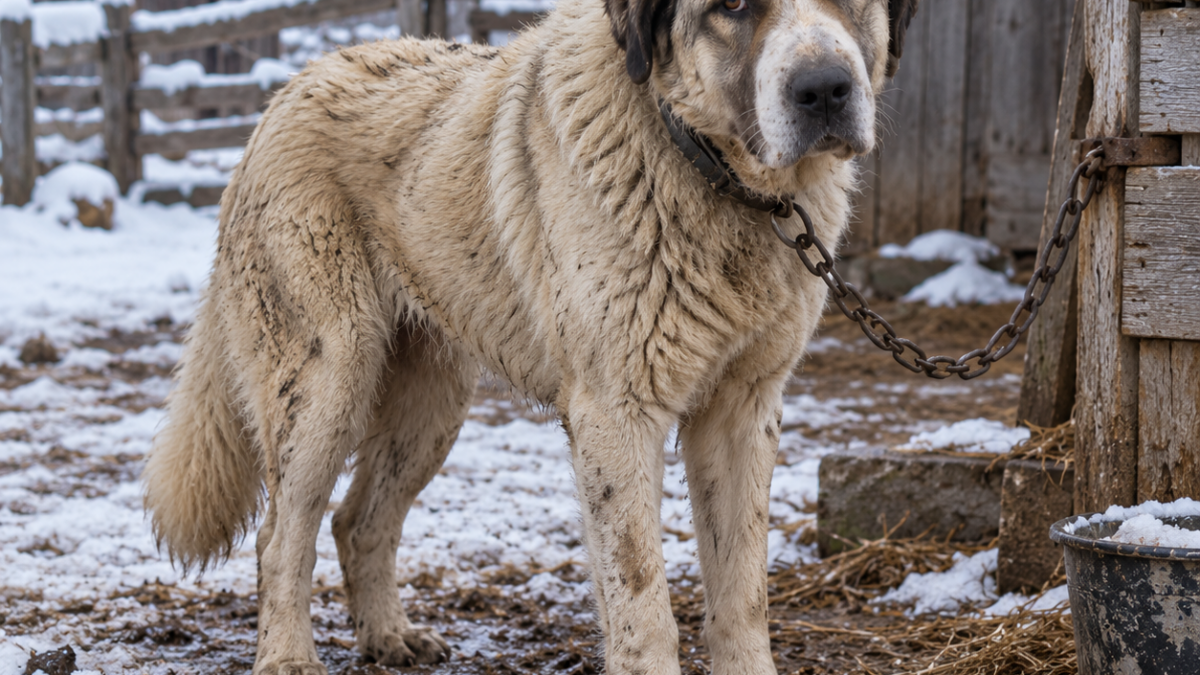
PART 2
“Don’t cut that.”
For a second, I thought I had misheard him.
My teammate froze with the bolt cutters around one of the rusted links.
I looked at the man.
“You just told me to take her.”
“You can take the dog.”
He pointed at the chain.
“That chain stays.”
I stared at him.
Behind us, Aisha lay with her chin against the dirt, breathing hard from the effort of simply trying to understand what all these strangers were doing around her.
“The chain is attached to her collar.”
“Then open the collar.”
I looked at it again.
The leather was so old and hardened that it had practically become part of the dirt packed into Aisha’s coat.
The buckle was rusted.
The skin underneath was already irritated.
Trying to fight with it while she was conscious and frightened would only cause more pain.
My teammate lowered the cutters.
“We can replace your chain.”
The man shook his head.
“I don’t want another one.”
I could not believe we were having this conversation.
“You were planning to leave her tied to this until she died, but the chain is the thing you’re worried about losing?”
His expression hardened.
“Don’t tell me what to do on my property.”
I felt my anger rise, but I forced it down.
Aisha mattered more than winning an argument.
“We are taking the dog.”
“Fine.”
“And if the collar will not open safely, the chain gets cut.”
The man started toward us.
One of my teammates stepped between him and Aisha.
“Sir, please stay back.”
He stopped.
I could see something had changed in him.
Not concern for Aisha.
Ownership.
The moment strangers arrived and began treating the dog like a life worth saving, suddenly he cared about what belonged to him.
The dog had not mattered.
The chain did.
I turned back to Aisha.
“Do it.”
The bolt cutters closed.
The first attempt barely dented the metal.
The chain was thick.
Old.
Heavy enough for livestock.
I looked at Aisha’s neck and tried to imagine a puppy wearing anything connected to this weight.
The second cut snapped one link.
The sound was sharp.
Metal striking dirt.
Aisha flinched.
Then everything became quiet.
The chain lay in two pieces.
For the first time in years, there was nothing connecting Aisha to the tree.
She did not understand.
That was obvious.
She did not get up and run.
She did not wag wildly.
She did not suddenly realize she was free.
She simply remained where she had always been, staring toward the trunk as if some invisible chain still held her there.
I touched her shoulder.
“Aisha.”
Her eyes moved toward me.
“You can leave.”
She tried to rise.
Her front legs pushed.
Her back legs trembled.
Then collapsed.
We unfolded the stretcher.
The man stood behind us with his arms crossed.
No sadness.
No goodbye.
No hand on her head.
Nothing.
That angered me more than shouting would have.
When we moved the stretcher beneath Aisha, she panicked.
Her huge head lifted.
She tried to pull back toward the tree.
“Aisha, easy.”
She had spent years being unable to move more than the length of a chain.
Now even being carried beyond that circle felt dangerous.
I crouched beside her face.
“Look at me.”
She did.
“Nothing bad is happening.”
Her breathing remained fast.
I put one hand gently against her cheek.
“I promise.”
We lifted.
Aisha cried.
It was not a loud cry.
A low, broken sound from deep in her chest.
She turned her head toward the tree.
Then toward the house.
The man still stood there.
Her tail moved.
One weak sweep.
She was saying goodbye to someone who had already abandoned her.
He did not move.
That image stayed with me for years.
We carried Aisha through the gate.
She kept looking backward until the fence blocked the view.
Then she lowered her head onto the blanket and closed her eyes.
In the rescue vehicle, I sat beside her.
One hand rested near her face.
She did not know me.
I could tell that every bump in the road frightened her.
Every change in engine noise made her eyes open.
When I touched her forehead, she relaxed slightly.
“You don’t know where we’re going.”
Her nose moved.
“I understand.”
We had called the veterinary hospital before leaving.
They were ready.
I had described malnutrition, severe weakness, skin damage and possible infection.
But no description prepared them for how bad Aisha looked under proper lighting.
The moment we rolled her into the examination room, the veterinarian’s expression changed.
“How long has she been like this?”
“Years on the chain. We don’t know how long she’s been this sick.”
He ran his hands carefully along her body.
Every rib.
Every vertebra.
The great dog’s frame was there, but almost everything that should have covered it had disappeared.
“How old?”
“The owner wasn’t sure. At least several years. Possibly eight or more.”
He lifted part of the matted coat.
The skin underneath was inflamed.
Some places were raw.
Others showed chronic irritation and hair loss.
He examined her mouth.
Her gums were pale.
“Anemic?”
“Likely.”
He listened to her heart.
Then lungs.
Took blood.
Checked hydration.
Temperature.
Parasites.
Joint mobility.
The list grew.
Aisha endured most of it silently.
At one point, the veterinarian tried to straighten one back leg slightly.
She cried out.
He stopped immediately.
“Pain.”
“From injury?”
“Could be arthritis, nutritional weakness, old trauma, hip disease. We’ll image once she is stable enough.”
Stable enough.
I knew that phrase.
It means there are bigger problems first.
Bloodwork confirmed severe anemia, malnutrition, dehydration and evidence of infection.
Her protein levels were poor.
Her muscles had wasted dramatically.
Parasites had likely contributed.
There were signs her organs had been under prolonged stress.
The veterinarian looked at me.
“She is very sick.”
“Can she recover?”
“Possibly.”
Possibly.
I grabbed onto it.
“What do you need?”
“Time.”
He paused.
“And luck.”
Aisha received fluids carefully.
Her body was too compromised for anything aggressive.
Nutrition had to be introduced in controlled amounts.
People think starving animals should receive as much food as they can eat immediately.
That can be dangerous.
A body deprived for too long does not always tolerate sudden abundance.
So we started slowly.
Small meals.
Carefully balanced.
Frequent monitoring.
Medications for infection.
Parasite treatment staged according to her condition.
Pain relief.
Wound care.
Warmth.
Clean bedding.
For the first time in years, Aisha slept on something soft.
That first night, she did not understand the bed.
She kept trying to move off it toward the corner.
The nurse repositioned it.
Aisha moved again.
Eventually, they left part of the blanket on the floor beside the bed.
She chose the floor.
That broke my heart.
Comfort itself was unfamiliar.
The next morning, I arrived early.
Aisha was awake.
She looked toward the door every time footsteps passed.
I entered.
“Aisha.”
Her ears moved.
The tail did not.
Not yet.
I sat.
A bowl of food rested nearby.
Half eaten.
“That’s good.”
She watched me.
“Half is good.”
I had learned not to expect miracles.
The nurse entered.
“She ate more overnight.”
“How much?”
She told me.
I smiled.
Aisha looked toward the bowl.
The nurse laughed softly.
“She’s beginning to understand it comes back.”
That sentence stayed with me.
Food comes back.
Water comes back.
People come back.
Warmth comes back.
For years, none of those things had been guaranteed.
At the tree, Aisha ate when someone remembered.
Drank whatever water remained.
Slept in dirt.
Now the hospital ran on schedules.
Predictability.
Every few hours, something happened because she needed it.
Not because she guarded anything.
Not because she performed.
Simply because she existed.
Still, emotionally, Aisha was elsewhere.
She watched doors.
Listened to vehicle sounds.
Once, someone started an old truck outside and Aisha tried to stand.
Her head lifted.
Tail moved.
Then she collapsed.
The owner’s car had probably sounded similar.
She was still waiting.
I sat beside her afterward.
“He’s not coming.”
I hated saying it.
Aisha looked at me.
“I know you want him to.”
Her eyes remained on the door.
“He doesn’t deserve that.”
Dogs do not understand deserve.
They understand attachment.
Routine.
Smell.
History.
Ten bad years can still create loyalty.
That is one of the hardest things about neglected animals.
They do not always hate the people who fail them.
Sometimes they love them anyway.
Aisha had spent most of her life trying to be a good dog.
She had not yet learned that being good never should have required suffering.
On day three, she stood with assistance.
We used a wide support sling under her abdomen.
Two people.
Slow.
Her paws touched the nonslip mat.
“Aisha.”
She looked at me.
“Up.”
Her front legs straightened.
Back legs shook.
I felt the weight of her body settle into the sling.
“Good.”
Three seconds.
Five.
Her legs buckled.
We lowered her.
The entire exercise lasted less than ten seconds.
I felt triumphant.
The veterinarian did not.
“Do not rush.”
“I know.”
“You look like you want to run a marathon with her tomorrow.”
“I want her to stand.”
“She will stand when her body can support it.”
I nodded.
Patience again.
Rescue is a constant argument between urgency and biology.
You want the animal well now.
Cells do not care.
Muscle takes time.
Skin takes time.
Blood takes time.
Trust takes longest.
The first major setback came on day five.
Aisha stopped eating.
Completely.
Breakfast untouched.
Lunch untouched.
My stomach dropped.
“Why?”
The veterinarian examined her.
Temperature mildly elevated.
New bloodwork.
Ultrasound.
We found gastrointestinal irritation likely related to parasites, stress and the body adjusting.
Medication changed.
Fluids adjusted.
Nutrition supported differently.
Nothing catastrophic yet.
But enough to scare us.
That afternoon, I sat beside her.
“You cannot do this.”
Aisha closed her eyes.
“I know you are tired.”
No response.
“But you finally got off that chain.”
My voice broke.
“You don’t get to leave now.”
It was unfair.
She owed me nothing.
Still, I said it.
That evening, the veterinarian offered a small amount of food by hand.
Aisha turned away.
He tried again later.
Nothing.
At eleven at night, the nurse sent me a message.
She ate two bites.
Two bites.
I cried.
The next morning, four.
By evening, part of a meal.
The fever eased.
Day seven, she ate from the bowl again.
There are victories nobody outside rescue understands.
A starving dog eating sounds obvious.
Until you spend hours afraid she has lost the will.
By the second week, Aisha could stand for fifteen seconds with support.
Then twenty.
Her muscles began responding.
We introduced gentle physiotherapy.
Passive range-of-motion exercises.
Weight shifting.
Massage.
Very short supported steps.
The first time she moved one back paw deliberately, the therapist smiled.
“That’s important.”
I almost asked how important.
Then stopped myself.
Important was enough.
Her coat became another project.
We could not simply shave everything immediately because of her skin condition and temperature regulation.
So mats were removed gradually.
Sections cleaned.
Medicated treatments.
Underneath the filthy outer coat, patches of soft white fur remained.
I touched one.
“There you are.”
Aisha looked at me.
For a moment, I imagined the puppy described by one of the neighbors.
Because eventually, people started talking.
Once Aisha disappeared from the yard, questions spread.
A woman from two houses away contacted us.
“I remember when they bought her.”
I listened.
“She was beautiful.”
“How old?”
“Maybe eight weeks? Ten?”
The woman described a huge white puppy with dark eyes and oversized paws.
Ears that had not decided what direction to face.
“She followed the children around.”
“Children?”
“The owners’ kids. They were younger then.”
“What happened?”
The woman sighed.
“At first she was in the yard loose. Then she got bigger.”
Central Asian Shepherds grow fast.
Large.
Powerful.
Protective.
Exactly what the owner wanted.
“He started saying she needed discipline.”
“What kind?”
“I don’t know.”
Then came the collar.
Then the chain.
At first long.
Later shorter.
Aisha slept near the tree.
Year after year.
“Did anyone report it?”
The woman was quiet.
“I didn’t.”
I heard shame in her voice.
“Why?”
“I thought she was fed.”
“Were there complaints?”
“People talked.”
Talking.
So much suffering survives inside conversations that never become action.
Someone says poor dog.
Someone else says not my property.
Another says the owner knows best.
Then years pass.
The woman continued.
“In winter I sometimes threw food over the fence.”
That complicated my anger.
She had cared.
A little.
But care without intervention can become a way of living with what we know is wrong.
“Why didn’t you call someone?”
“I wish I had.”
I believed her.
Regret is easy after rescue.
Courage is harder before.
I asked whether she had photographs of Aisha younger.
She did.
The first photo arrived that evening.
I stared at it.
Aisha as a puppy.
White.
Round.
Healthy.
Standing in green grass.
No chain.
Her ears did look ridiculous.
One folded forward.
One sideways.
Dark eyes.
Mouth open.
A normal puppy.
The second photo, maybe a year later.
Larger.
Collar.
Chain visible.
Third, older.
Same tree.
The radius of bare ground already forming.
Fourth, winter.
Snow.
Aisha curled near the trunk.
I stopped.
The chain lay partly buried in ice.
The original story had described winters when the chain froze into snow.
Now I could see it.
Real evidence.
I sent the photographs to the animal welfare officer already reviewing the case.
Because we had reported the neglect.
I had not confronted the owner again after rescue.
Not yet.
The authorities had asked us to preserve records.
Veterinary findings.
Photographs.
Statements.
The owner had surrendered Aisha verbally in front of witnesses, but depending on local law, documentation still mattered.
The images changed the case.
This was not a bad week.
Not one period of illness unnoticed.
The neglect had history.
Years.
That word again.
Years.
At the hospital, Aisha knew none of this.
She cared about the person carrying food.
She had begun recognizing one technician, Mia.
Mia had a quiet voice.
Never reached from above.
Always approached from the side.
One morning, Mia entered with breakfast.
Aisha’s tail moved.
Three times.
Mia froze.
“Did you see that?”
“Yes.”
Aisha looked embarrassed by our reaction.
Mia knelt.
“Hi, beautiful.”
Another wag.
I put my hand over my mouth.
The first deliberate greeting.
Not for the owner.
For someone new.
That mattered more than any legal filing.
Aisha was building another attachment.
A new sound meant good things.
Mia’s footsteps.
Food.
Gentle touch.
Clean bedding.
The world was expanding.
Week three brought the first independent stand.
Nobody expected it.
Aisha was lying on a mat during rehabilitation.
I was across the room talking to the therapist.
A small bowl of food sat six feet away.
Aisha lifted her head.
The therapist noticed first.
“Watch.”
Aisha placed one front paw forward.
Then the other.
She shifted.
Her hindquarters rose halfway.
Dropped.
I took a step.
The therapist held up one hand.
“Wait.”
Aisha tried again.
Front legs straight.
Back legs trembling.
Up.
She stood.
No sling.
No hands.
Nothing.
Three seconds.
Maybe four.
Then sat heavily.
I forgot the instruction not to rush and dropped beside her.
“You did it.”
Aisha panted.
I laughed and cried.
The therapist smiled.
“She did.”
Aisha looked toward the bowl.
That was when I realized the heroic moment had been motivated by lunch.
Perfect.
Food had become worth standing for.
We moved the bowl closer.
She ate.
The next day, she stood twice.
Then took one step.
Two days later, three.
Progress accelerated slightly as nutrition and muscle returned.
Still, she tired quickly.
Her hips showed degenerative changes.
Years of inactivity had damaged her body.
The veterinarian was honest.
“She may never move like a young healthy dog.”
“She doesn’t need to.”
“Good.”
“I just want comfortable.”
“That is the right goal.”
Comfort.
Not perfection.
Aisha had lost years.
We could not restore puppyhood.
Could not rebuild every muscle exactly.
Could not erase joint damage.
Rescue is not time travel.
Success would mean giving the remaining years quality.
That had to be enough.
At the end of the first month, Aisha was discharged from the hospital into our rehabilitation foster facility.
The move terrified me.
Hospitals feel safe because monitors exist.
Doctors nearby.
Leaving means accepting improvement.
Aisha entered the transport van on a ramp with support.
She had refused to step into the first rescue vehicle.
Now she tried.
One paw.
Pause.
Another.
I walked beside her.
“Good girl.”
She reached the top.
Looked back.
For a second, I thought of the tree.
The day we carried her.
The chain breaking.
Then the door closed.
This time she did not cry.
At the foster property, we had prepared a quiet room opening onto a fenced yard.
Soft orthopedic bed.
Nonslip mats.
Water.
Food station.
No chain.
The first thing Aisha did when she entered the room was walk to the wall and sit.
Not the bed.
Not the middle.
Wall.
She positioned herself where she could see the door.
Old habits.
We let her.
That night, the foster caregiver called.
“She won’t sleep on the bed.”
“That’s okay.”
“She’s on the floor next to it.”
“Put a blanket there.”
The next morning, Aisha had one front paw on the bed.
The night after, half her body.
Day three, fully on it.
Choice.
That was how we handled everything.
Offer.
Do not force.
The yard created another strange moment.
The first time the door opened, Aisha stood at the threshold.
Grass outside.
Sunlight.
Open space.
She did not move.
We waited.
Five minutes.
Ten.
The caregiver sat outside and ignored her.
Aisha watched.
Eventually one paw crossed.
Then another.
She stepped onto grass.
No chain stopped her.
Aisha moved three feet.
Stopped.
Turned toward the tree nearest the fence.
My stomach tightened.
Would she seek something to tether herself near?
She sniffed.
Then kept walking.
Five feet.
Seven.
At around twelve feet, she stopped abruptly.
Looked back toward the doorway.
That distance was probably longer than the chain had ever allowed.
The caregiver whispered, “You can go farther.”
Aisha stood.
Then took another step.
Another.
I watched from behind the glass because we did not want too many people crowding her.
She reached the center of the yard.
Nothing happened.
No collar jerked.
No metal pulled her backward.
Aisha turned in a slow circle.
Then sat.
Sunlight touched her white coat.
The coat was still patchy.
Thin.
But cleaner.
I took a photograph.
Not dramatic.
Just a dog sitting in grass.
To me, it was historic.
The first circle larger than the chain.
That became one of our milestones.
Twenty feet.
Thirty.
Fence line.
Back to door.
Every day, Aisha explored farther.
She never ran.
Not yet.
But walking without a radius changed her body language.
Her head lifted more.
Tail no longer stayed tucked.
She sniffed.
Investigated.
Once, she spent two full minutes smelling a bush.
I laughed.
“Take your time.”
That was luxury.
Time to smell something useless.
No duty.
No guarding.
No survival.
Just dog.
The revenge part of Aisha’s story began outside the rescue.
The owner received notice that the animal welfare case was moving forward.
He called us.
Angry.
“You said you were taking a dying dog.”
“We took a neglected dog.”
“She was dying.”
“Because she had gone without medical care.”
“She’s old.”
“She is recovering.”
Silence.
Then, “What do you mean?”
“Exactly what I said.”
“She can walk?”
“Yes.”
Another silence.
“How?”
The question almost made me laugh.
Veterinary care.
Food.
Water.
Medicine.
Things that had been available all along.
Instead, I said, “Treatment.”
He became defensive.
“I fed her.”
“Not adequately.”
“You weren’t there.”
“We have veterinary findings.”
“She wouldn’t eat.”
“For how long?”
No answer.
He shifted.
“She was useless. What was I supposed to spend thousands on?”
There it was.
Useless.
Again.
I wrote the word down after the call.
Not because I needed emotional ammunition.
Because the statement mattered.
The investigator later took a formal account.
The owner argued Aisha was property he had purchased as a guard dog.
He insisted aging made treatment pointless.
But local animal welfare law did not define neglect according to whether an animal remained economically useful.
Basic care obligations remained.
Food.
Water.
Shelter.
Necessary treatment.
The case became stronger.
Neighbors provided statements.
Photographs established duration.
Veterinary records established suffering.
The old water bowl.
Chain condition.
Skin lesions.
Body score.
All documented.
I wanted a dramatic arrest.
I will admit it.
I wanted someone to put cuffs on him while Aisha walked past in sunlight.
Real life rarely gives you such clean scenes.
The process moved slowly.
Paperwork.
Interviews.
Inspections.
Hearings.
At one point, the owner claimed we had exaggerated her condition to raise donations.
The accusation infuriated me.
Then the veterinarian testified.
Professional records.
Objective measurements.
Blood values.
Body condition score.
Skin infection.
Parasites.
Dehydration.
Muscle wasting.
Chronic pressure damage from the collar.
Degenerative joint disease exacerbated by inactivity.
Facts are less dramatic than shouting.
They are also harder to dismiss.
The owner’s attorney tried arguing age and breed predisposition.
The veterinarian answered calmly.
“Age does not explain prolonged inadequate nutrition.”
Then:
“Breed does not explain an untreated infected collar wound.”
Then:
“Arthritis does not explain absence of clean water.”
I sat behind the prosecutor and almost cried from relief.
Aisha’s suffering had language now.
Medical language.
Not poor dog.
Not looks bad.
Evidence.
The case eventually resulted in penalties, restrictions on animal ownership, and financial consequences tied to neglect and treatment costs.
Was it enough?
Emotionally, nothing could reimburse years.
No fine equals winters frozen beside a tree.
No restriction returns summers.
No hearing gives puppyhood back.
But something mattered.
The owner could no longer say nothing happened.
Aisha’s life entered the record.
His choices had consequences.
And the most satisfying part came later.
Not in court.
In the yard.
By month two, Aisha’s coat was growing.
Soft white undercoat returned across places that had been bare.
The skin healed.
The collar wound closed.
Her weight increased gradually.
The giant frame began looking like a giant dog again.
One morning, the foster caregiver sent me a video.
Aisha standing near the gate.
A delivery vehicle pulled up.
Her ears lifted.
For a second, she became alert.
Old guard instinct.
Then the driver stepped out.
Aisha watched.
Did not bark.
Did not rush the fence.
The caregiver called, “Aisha.”
She turned.
Walked away from the gate.
Toward her.
I replayed the video.
Years of guarding.
One name spoken kindly.
She chose the person.
That was recovery.
Aisha eventually met another dog.
We chose carefully.
A calm male named Bruno.
Large enough that his presence would not overwhelm her physically, but gentle.
First meeting through fence.
Aisha stiffened.
Bruno sniffed.
Looked away.
Good manners.
Aisha relaxed.
Second meeting on parallel leashes.
They walked.
Aisha watched him.
Bruno ignored her.
Perfect.
Third meeting inside the yard.
Bruno found a patch of grass and rolled on his back.
Aisha stared as if witnessing insanity.
I laughed.
“He’s showing off.”
Bruno rolled again.
Aisha approached.
Sniffed him.
He sneezed.
She stepped back.
Then her tail moved.
Not huge.
Enough.
Two weeks later, Aisha followed Bruno around the yard.
He became her unofficial guide to useless activities.
Sniffing.
Rolling.
Watching birds.
Standing near the kitchen because maybe food.
These were things nobody had taught Aisha because nobody had given her a life spacious enough for them.
Bruno had.
One afternoon, Bruno picked up a rope toy.
Aisha watched.
He shook it.
Dropped it.
Aisha sniffed.
No interest.
The next day, same.
Week later, she mouthed the edge.
I almost celebrated.
Then stopped.
Let it be normal.
She picked it up.
Dropped.
Walked away.
Fine.
Not every rescued dog needs to become playful in the way humans expect.
Aisha’s joy looked different.
Sun.
Soft ground.
Food.
Company.
Distance.
Choice.
Her favorite activity became lying beneath a different tree.
That detail felt cruelly symbolic at first.
Why would she choose a tree?
Then I understood.
The tree was never the enemy.
The chain was.
At the foster property, Aisha chose shade under an old maple.
No tether.
If sunlight moved, she moved.
If she wanted water, she walked inside.
If Bruno barked, she got up.
If she was tired, she slept.
Same object.
Different meaning.
That taught me something.
Freedom does not always require avoiding every reminder of captivity.
Sometimes it means being able to leave the reminder whenever you want.
By month three, adoption became possible.
I resisted.
“She is older.”
“Yes.”
“She needs joint medication.”
“Yes.”
“Skin monitoring.”
“Yes.”
“Large breed experience.”
“Yes.”
“Secure property.”
“Yes.”
The coordinator smiled.
“You are listing requirements, not reasons not to adopt.”
I knew.
Aisha had become special to me.
Not because she was dramatic.
Because trust had come so quietly.
She did not jump.
Did not lick wildly.
Did not throw herself into affection.
Aisha’s love appeared in decisions.
Sitting closer.
Following.
Resting where she could see you.
Choosing to enter when called.
One morning, she placed her enormous head on my knee.
That was it.
No tail wag.
No theatrical display.
Head.
Knee.
Weight.
I stayed motionless.
“Okay.”
She closed her eyes.
I cried.
Of course.
The rescue team joked that Aisha had converted my emotional standards.
A dog did not need to do anything impressive anymore.
“Look, she sighed.”
Tears.
“Look, she slept.”
Tears.
“Look, she ate normally.”
Tears.
They were right.
Then an application arrived from a woman named Sarah.
Fifty-nine.
Owned a small rural property.
Recently retired from teaching.
No young children.
One elderly livestock guardian mix who had died the previous year.
Large fenced acreage.
Heated mudroom connected to the house.
Experience with giant breeds.
Veterinary references excellent.
She wrote:
I am not looking for a guard dog. I would like an older companion who can choose whether she wants to be inside or outside. I understand she may never behave like a dog raised as a pet.
That sentence stopped me.
Choose.
Again.
I read the application twice.
Then a third time.
Our coordinator laughed.
“You like her.”
“I am reviewing.”
“You’ve already checked her fencing through satellite images.”
“That is responsible.”
“It is obsessive.”
“Same thing.”
Sarah came to meet Aisha.
She wore old jeans and boots.
No treats in hand.
No baby voice.
She sat on a bench in the yard.
Aisha remained beneath the maple.
Sarah did not call her.
Ten minutes.
Fifteen.
Aisha got up.
Walked toward Bruno.
Then near Sarah.
Sniffed her boot.
Sarah kept her hands on her lap.
Aisha moved away.
“That went well,” Sarah said.
I laughed.
“You barely interacted.”
“She came over.”
That impressed me.
Second visit.
Aisha allowed Sarah to touch her shoulder.
Third.
Head on Sarah’s knee.
My stomach dropped.
Traitor.
I knew the pattern by now.
The dog was choosing.
Sarah asked careful questions.
Not how protective is she?
Not will she bark at strangers?
Not can she guard livestock?
Instead:
“Where does she like sleeping?”
“How long can she comfortably walk?”
“Does she become anxious if a collar is put on?”
That question mattered.
Yes.
Aisha tolerated harnesses better.
Neck restraint could trigger tension.
Sarah nodded.
“I can use a harness.”
“What about the yard?”
“Double gate.”
“Trees?”
“Plenty.”
“Chains?”
She looked at me.
“None.”
I liked her immediately after that.
The home inspection was almost unfairly perfect.
Soft indoor bed.
Outdoor shelter even though Aisha would have full house access.
Secure fence.
Shaded areas.
Water stations.
Ramp for the porch.
No expectation of guarding.
Sarah had even removed an old decorative tether hook from the barn wall.
“You didn’t have to.”
“I know.”
“Why?”
“I don’t want you thinking about it.”
I almost cried.
“Thank you.”
Transition visits began.
Aisha entered the property cautiously.
Huge open space.
She walked twenty feet.
Stopped.
Looked back.
Sarah waited.
Aisha went farther.
Fifty feet.
No chain.
At the edge of the field, she found a large oak.
Of course.
She stood beneath it.
Sarah did not approach.
Aisha lay down.
The first visit lasted one hour.
Second, three.
Third, half a day.
At pickup, Aisha hesitated.
I hated and loved that hesitation.
She looked toward Sarah.
Then me.
The coordinator whispered, “She likes it here.”
“I know.”
“You look angry.”
“I’m emotional.”
“That is not the same face.”
“It is today.”
By the fourth visit, Aisha walked into Sarah’s mudroom voluntarily.
The floor was warm.
She sniffed the bed.
Then slept.
Deeply.
When I came to collect her, she did not get up immediately.
That was when I knew.
Home.
The adoption was approved.
I spent the night before packing things that did not need packing.
Medication.
Grooming supplies.
Food.
Harness.
Her blanket.
Medical records.
Favorite brush.
One soft toy she barely used.
The coordinator watched.
“She does not need six towels.”
“She likes these.”
“They are identical.”
“She has preferences.”
“Sure.”
I folded them anyway.
On adoption morning, Aisha sensed something.
Maybe my behavior.
Maybe the bags.
She followed me more closely.
I sat beside her.
“You’re leaving.”
She placed her head on my thigh.
“Terrible timing.”
I stroked her forehead.
“You know, the first day I met you, you couldn’t walk away from a tree.”
Aisha breathed slowly.
“Now I’m sending you somewhere with too many trees.”
I laughed.
“You never have to stand beside one unless you want to.”
She lifted her head.
Dark eyes.
Same eyes from behind the fence.
Different dog around them.
Sarah arrived.
Aisha saw her.
Tail wag.
One.
Two.
Then she walked over.
No hesitation.
Sarah crouched.
“Ready?”
Aisha sniffed her face.
I looked away.
We signed papers.
Reviewed medication.
Joint support.
Diet.
Skin.
Follow-ups.
Emergency contact.
Sarah listened.
Then said, “I know you’re worried.”
“I am.”
“You can visit.”
“That helps.”
“And I’ll send updates.”
“That helps more.”
Aisha stood between us.
Finally, it was time.
No crate.
No stretcher.
No bolt cutters.
Sarah opened the vehicle door and placed the ramp.
Aisha climbed.
Slowly.
Independently.
At the top, she turned around.
Looked at me.
I walked close.
“You are not being abandoned.”
I touched her forehead.
“You’re being chosen.”
Aisha licked my wrist.
One time.
I nearly collapsed.
She had never done that before.
Sarah cried.
“You saved that for today?”
Aisha looked toward the window.
Of course.
The car left.
I stood in the parking lot.
No tree.
No chain.
No dog.
I felt empty.
That evening, Sarah sent a photograph.
Aisha asleep inside the house.
Not near the door.
Not against a wall.
Middle of the living room.
On an orthopedic bed.
Message:
SHE ATE DINNER, WALKED THE FIELD, AND DECIDED THE HOUSE BELONGS TO HER.
I laughed.
Then another photo.
Aisha beneath the oak.
No collar.
No leash.
Just shade.
I stared for a long time.
The same basic image as the old photographs.
White dog.
Tree.
But everything was different.
That was the revenge.
Choice.
Months later, the old owner contacted the rescue again.
I had not expected it.
He had heard Aisha was adopted.
“Where is she?”
“We don’t disclose adopter information.”
“She was my dog.”
“You surrendered her.”
“I want to see her.”
“Why?”
Silence.
Then, “People in town think I’m some monster.”
I felt anger rise.
This was about him.
Not Aisha.
“Do you miss her?”
“I had her ten years.”
“That wasn’t my question.”
Another silence.
“I just want to see she’s okay.”
I thought about it.
The decision was not mine alone.
We discussed it with Sarah.
The welfare officer.
Our behavior team.
Would seeing him help Aisha?
Probably not.
Could it destabilize her?
Possibly.
The answer was no.
Aisha did not owe him closure.
That is important.
People sometimes expect rescued animals to participate in human redemption.
They do not have to.
If the person who failed them feels guilt, the animal is not responsible for easing it.
We declined.
The man became angry.
Then pleaded.
Then accused us of stealing.
The legal surrender documents ended that claim.
Eventually, the calls stopped.
But the community consequences continued.
Neighbors who had once ignored Aisha now spoke openly.
The owner’s reputation changed.
Some people stopped asking him for help with animals.
Others confronted him about what they had seen.
He hated that.
I heard through one neighbor that he complained everyone was “acting like the dog mattered more than a person.”
That sentence revealed everything.
Aisha’s value had always depended on what she provided him.
Our entire point was that her value did not.
Months after adoption, Sarah invited me to visit.
I drove out on a cool morning.
Aisha was in the field.
She saw my car.
Her head lifted.
I got out.
“Aisha!”
She stood.
For one second, nothing.
Then she walked toward me.
Faster.
Not running.
Her joints still would not allow that.
But purposeful.
Tail wagging.
I crouched.
She reached me.
Placed her enormous head against my chest.
I wrapped my arms around her.
“You remember.”
Sarah laughed.
“She absolutely remembers.”
I cried.
Aisha tolerated that.
Inside, I saw her life.
Water bowl always full.
Bed.
Another bed.
Apparently one bed was insufficient.
Hair on the sofa.
Sarah shrugged.
“I lost that battle.”
“You let her on the couch?”
“She decided.”
Good.
Aisha slept indoors most nights.
Some nights, she preferred the mudroom with the door cracked toward the fenced yard.
Sarah let her choose.
She had learned stairs slowly but liked the ramp better.
She had become interested in a soft ball.
Not fetching.
Just carrying.
She stole kitchen towels.
This surprised me.
“Kitchen towels?”
“Only the blue ones.”
“Why?”
“No idea.”
Aisha walked past carrying a blue towel.
I laughed.
The dog who had owned nothing had preferences.
That delighted me.
We walked outside.
Aisha moved toward the oak.
Sarah said, “This is her spot.”
I touched the trunk.
“No chain.”
“Never.”
Aisha lay beneath it.
I sat beside her.
The grass had not been worn into a circle.
That detail mattered.
No bare radius.
No path traced by restriction.
The ground around her remained alive.
One year after rescue, Aisha’s transformation photographs spread through the local animal welfare community.
Before.
After.
I had mixed feelings.
The first photo hurt.
The second inspired.
But transformations can accidentally imply that an animal becomes worthy only after they look beautiful.
Aisha had mattered when she was filthy too.
I made that point whenever asked to speak about her.
Still, people responded.
Donations for chained dogs increased.
Several owners contacted rescues asking for help improving conditions rather than abandoning animals.
One family allowed a volunteer group to build a fenced run and remove a chain.
Another surrendered an elderly dog for medical care.
Aisha became a reason people noticed tethering differently.
Not every chained dog is neglected.
Laws vary.
Working arrangements differ.
But long-term tethering without adequate movement, social contact, shelter, water and care can create profound physical and behavioral harm.
Aisha showed that in a body nobody could ignore.
The county later strengthened enforcement around chronic tethering and minimum care requirements.
Was that solely because of Aisha?
No.
Policy rarely changes because of one case.
But her photographs were cited in public discussion.
Her case became one example among several.
That mattered.
The tree had become evidence.
Two years after adoption, Aisha slowed somewhat.
Age.
Arthritis.
Her early neglect probably accelerated joint problems.
Sarah adjusted.
Shorter walks.
More medication under veterinary guidance.
A heated bed in winter.
Cool shaded areas in summer.
Water everywhere.
I visited one July afternoon.
Aisha lay indoors near a vent.
I laughed.
“What happened to mighty guardian dog?”
Sarah smiled.
“She guards the air-conditioning.”
Aisha did not move.
Correct choice.
The first summer, hot earth had burned her paws.
Now she avoided heat because she could.
Freedom can look like refusing discomfort.
Winter affected me more.
Sarah sent a photograph after the first snow.
Aisha stood in a fenced field.
White coat against white ground.
No chain.
I zoomed in.
Nothing around her neck except a soft identification collar worn loosely for supervised outdoor time.
No metal disappearing beneath ice.
I cried.
Then Sarah sent a second photo ten minutes later.
Aisha inside by the fireplace.
Message:
SHE DECIDED SNOW IS OVERRATED.
I laughed.
Exactly.
She had spent winters with no choice.
Now she could hate winter.
At three years after rescue, Sarah called.
“I have a question.”
“What?”
“I’m thinking of fostering.”
I smiled.
“What kind?”
“Older livestock guardian.”
“Of course.”
A rescue had a male Anatolian mix named Max who had lived outdoors most of his life.
Not abused like Aisha.
But socially isolated.
We arranged a careful introduction.
Aisha met Max in a neutral fenced area.
Both large.
Both older.
They sniffed.
Ignored.
Perfect start.
Max eventually moved in as foster.
Aisha taught him the house.
Not deliberately.
She simply walked inside.
Max watched.
Followed.
The first night, he slept near the door.
Aisha walked to her bed.
Max stayed.
Second night, closer.
Third, on a spare mat.
Sarah called me.
“She’s showing him.”
I smiled.
“Maybe.”
The dog once unsure how to cross an open yard now became the confident one.
Max was adopted by another family months later.
Then Sarah fostered another.
Aisha tolerated this new career with dignity.
She did not love puppies.
Important fact.
One young foster attempted to climb on her.
Aisha stood up and walked away.
Boundaries.
Good.
No saint narrative.
Aisha was allowed to dislike things.
That too was freedom.
The original owner eventually moved away.
I heard about it through neighbors.
He sold the property.
The tree remained.
Years later, I drove past once.
I did not stop.
The fence had been replaced.
Different people.
Children’s bicycles in the yard.
No dog.
The tree looked ordinary.
I realized something.
I had given the tree too much emotional power.
It was wood.
Shade.
Roots.
Aisha’s suffering came from people’s decisions.
Not the tree.
At Sarah’s house, another tree meant rest.
That distinction helped me let the old property go.
Aisha did too, long before I did.
She never went back.
Never needed to.
Her life became too full elsewhere.
Around her fourth year with Sarah, Aisha’s mobility declined more noticeably.
We estimated she was perhaps twelve or older.
No one knew exact age.
Her hips stiff.
Back legs weaker.
Some days she needed the ramp.
Other days she ignored it.
Sarah tracked everything.
Medication time.
Appetite.
Walk distance.
Bad days.
Good days.
The first time Aisha could not rise by herself in the morning, Sarah called crying.
“I helped her with the sling.”
“Did she walk afterward?”
“Yes.”
“Eat?”
“Yes.”
“Comfortable?”
“Yes.”
“Vet today.”
“Already booked.”
Perfect.
This was care.
Immediate.
The exact opposite of what had happened before rescue.
The veterinarian adjusted arthritis treatment.
Physical therapy resumed.
Hydrotherapy was considered.
Aisha hated water.
Deeply.
The first pool session lasted three minutes.
She looked personally betrayed.
I laughed.
“She survived a chain for years but draws the line at swimming.”
The therapist smiled.
“Everybody has boundaries.”
We switched emphasis to land-based therapy.
Aisha approved.
Age continued.
Slowly.
One afternoon, Sarah sent me a video.
Aisha walking across the field.
Very slow.
Then she stopped under the oak.
Looked around.
Lay down.
No drama.
I watched twice.
The video felt peaceful.
Old age after rescue is one of the greatest gifts and hardest contradictions.
You fight desperately to extend life.
Then time succeeds.
The dog becomes old.
Exactly what you wanted.
Exactly what later breaks your heart.
Aisha began developing gray around a face already mostly white, visible mostly near the muzzle and eyes.
Her dark eyes remained.
I could always recognize the puppy from the first photograph in them.
Not literally.
Memory makes those connections.
The funny ears had long settled into adult shape.
But sometimes when she tilted her head, one sat slightly different.
I loved that.
Sarah celebrated adoption anniversaries quietly.
Extra meal.
Long brush.
Photograph under the oak.
On the fifth anniversary, she sent me two images.
First: Aisha at rescue.
Second: Aisha that morning.
Caption:
FIVE YEARS WITHOUT A CHAIN.
I stared at the phrase.
Five years.
How many years had she spent tied?
Maybe eight.
Ten.
We might never know.
But freedom was catching up.
Not equal yet.
Still.
Every free year mattered.
I replied:
MAKE IT SIX.
We did.
Year six came.
Aisha slower.
Still eating.
Still enjoying people.
Still choosing outdoors on mild mornings.
Then year seven.
Her world shrank somewhat.
Field became yard.
Yard became porch.
Long walks became slow circuits.
But shrinking with age is different from confinement.
This time the body created limits, not a chain.
And whenever she wanted inside, the door opened.
Whenever she wanted outside, someone helped.
There was dignity in that.
One cold morning, Sarah called before sunrise.
“Aisha fell.”
I was awake instantly.
“Is she hurt?”
“She tried to get up. Back legs slipped.”
“Vet?”
“We’re going.”
Imaging showed no fracture.
Arthritis progression.
Muscle weakness.
Age.
The veterinarian discussed quality of life.
Not end yet.
Management.
Support harness.
More traction rugs.
Medication changes.
Aisha returned home.
Sarah covered almost every slick surface.
Her living room looked like a patchwork of rugs.
I visited.
“You redecorated.”
“Aisha chose the style.”
The dog lay on an enormous bed.
I sat beside her.
“You ruined this woman’s house.”
Tail wag.
Good.
The owner who once thought medical care was pointless because Aisha was “useless” would not have understood spending money on rugs for an old dog.
Sarah did not need him to understand.
That was another freedom.
We no longer measured Aisha’s life against the neglectful man.
He became irrelevant.
That is when I realized true recovery had happened.
When the offender stops being the main character.
Aisha’s story became about Aisha.
At the end of year seven, Sarah adopted another senior dog permanently.
A smaller mixed breed named Daisy.
Daisy loved Aisha immediately.
Aisha tolerated this affection.
Daisy slept near her.
Sometimes touching.
Aisha pretended not to notice.
One evening, Sarah sent a photo.
Daisy curled against Aisha’s huge side.
Aisha asleep.
Message:
SHE PRETENDS SHE DOESN’T LIKE HER.
I replied:
CLASSIC.
Companionship softened the final years.
Aisha no longer wanted play.
But Daisy gave presence.
When Aisha moved rooms, Daisy often followed.
When Aisha slept outside, Daisy slept nearby.
Not every rescue needs a dramatic best friend story.
Sometimes friendship is simply choosing the same patch of floor.
In her final year, Aisha’s appetite fluctuated.
That scared us more than mobility.
Aisha loved food.
Always.
Perhaps hunger history made meals deeply important.
When she left breakfast, Sarah called.
The veterinarian found kidney changes.
Early at first.
Then progression.
Special diet.
Medication.
Fluids later.
Aisha adapted.
Sarah learned home care.
I came over for the first fluid session.
Aisha looked at us with deep suspicion.
“You have survived worse.”
She turned away.
“Not persuasive?”
Sarah laughed.
We managed.
Weeks became months.
Good days.
Bad.
The quality-of-life chart returned.
Eating.
Drinking.
Mobility.
Comfort.
Interest.
Connection.
Hygiene.
More good than bad.
Then closer.
We did not rush the decision.
We also promised not to delay because goodbye hurt.
That promise is easier to make before you love an animal.
Harder when the day approaches.
One evening, Sarah called.
“I think she’s tired.”
My heart sank.
“Tell me.”
Aisha had eaten only a few bites.
Could not rise without significant help.
Did not want to go outside.
Still responded to Sarah.
Still accepted touch.
But the body was failing.
The veterinarian came the next morning.
Exam.
Bloodwork.
Progressed kidney disease.
Arthritis severe.
More hospitalization could potentially extend time.
Maybe days.
Maybe weeks.
At cost of stress.
Sarah looked at me.
I stayed quiet.
This was her decision with the veterinarian.
She asked, “If we hospitalize, will she get back to enjoying the field?”
The veterinarian hesitated.
“Probably not.”
“Eating normally?”
“Uncertain.”
“Walking comfortably?”
“Unlikely.”
Sarah cried.
Aisha rested her head near her foot.
Then Sarah said something I will never forget.
“She spent too much of her life being forced to stay somewhere she was suffering.”
Silence.
“I won’t do that again.”
That was the decision.
Not because Aisha was worthless.
Because she was precious.
The exact opposite of the first owner’s logic.
He had said, Nothing can be done, and left her to die because helping cost too much.
Sarah said, We could do more, but more may only prolong discomfort, and chose a gentle goodbye because Aisha’s comfort mattered more than keeping her.
From a distance, both decisions end with death.
Morally, they could not be more different.
One is abandonment.
The other is care.
We scheduled an in-home goodbye for the next afternoon.
Aisha had one final morning.
Weather mild.
Sarah opened the back door.
Aisha looked outside.
We helped her with the support sling.
Slowly.
She walked onto the porch.
Daisy followed.
Aisha stood.
Then moved toward the oak.
I almost stopped her.
Too far.
Sarah said, “Let her choose.”
We walked with her.
Step.
Pause.
Step.
Pause.
At the oak, Aisha lowered herself.
Sun filtered through leaves.
The huge white coat, now thinner with age, caught the light.
I sat.
Sarah beside me.
Daisy curled near Aisha’s front legs.
For an hour, we did nothing.
No speeches.
No dramatic last meal yet.
Just morning.
Aisha sniffed the air.
A bird landed nearby.
She watched.
At one point, a car came up the road.
Her ears moved.
Then relaxed.
No need to guard.
Never again.
Later, Sarah offered pieces of cooked chicken approved as a final treat.
Aisha ate three.
Then refused the fourth.
We laughed.
“Standards.”
Back inside, we laid her on the large bed in the living room.
Not beside a door.
Center.
The veterinarian arrived quietly.
Aisha recognized her from home visits.
No fear.
Sarah sat on one side.
I sat on the other.
Daisy stayed nearby.
I touched Aisha’s forehead.
The same place I had touched through dirt and mats years earlier.
Soft fur now.
Gray.
Clean.
Warm.
I thought about the chain.
The bolt cutters.
The man arguing about metal.
The stretcher.
Aisha turning back toward the tree.
I had wanted that past erased.
Now I understood it did not need erasing.
It had been defeated by what came after.
The veterinarian gave the sedative.
Aisha relaxed.
Her breathing deepened.
Sarah whispered, “You don’t have to stand guard.”
My eyes filled.
“You never did.”
Aisha’s tail moved once.
Maybe reflex.
Maybe response.
Did not matter.
Sarah continued.
“You don’t have to wait by a tree.”
Another breath.
“You don’t have to earn dinner.”
I covered my face briefly.
“You don’t have to be useful.”
That sentence shattered me.
Because it answered the first owner.
Useless.
That had been his word.
Sarah kissed Aisha’s forehead.
“You only had to be ours.”
The final medication was given.
Aisha’s breathing slowed.
Her great body softened.
For the first time since I knew her, there was no tension anywhere.
No need to rise.
No pain in the hips.
No anticipation.
No waiting.
One breath.
Then another.
Then stillness.
Daisy sniffed her.
Lay down.
Sarah sobbed against Aisha’s neck.
I placed my hand on the old collar-free fur.
Seven years free.
Maybe more than we ever expected.
Not enough to balance the early years mathematically.
Love does not work like accounting.
You cannot subtract suffering.
You add something else.
Another experience.
Another day.
Another meaning.
Aisha’s first owner had decided her life was over because she could no longer serve him.
He was wrong.
Her real life, in many ways, began after usefulness ended.
She became somebody’s companion.
Somebody’s family.
A foster mentor.
A dog who hated hydrotherapy.
A thief of blue kitchen towels.
A lover of shade.
A reluctant friend to Daisy.
An old woman who slept near the fire.
None of those roles made money.
None protected property.
They mattered more.
After Aisha died, Sarah removed nothing immediately.
Bed stayed.
Water bowl.
Harness.
Blue towel on the floor.
For weeks, grief occupied the house physically.
Eventually, she called.
“I’m ready to bring some things to the rescue.”
We sorted.
Medication returned for proper disposal.
Unused supplies donated.
Beds washed.
One harness remained.
The collar?
Aisha had not worn the old one after rescue.
We had preserved it as evidence.
The chain too.
Years earlier, after the legal case ended, authorities released those items.
I had stored them in a box at the rescue because I could not decide what to do.
Sarah asked to see them.
I hesitated.
Then brought the box.
Heavy chain.
Rust.
Old collar.
She stared.
“That’s what she wore?”
“Yes.”
Sarah lifted one end of the chain.
Her face changed.
“It’s so heavy.”
“I know.”
She set it down.
For a moment, anger returned.
Then she said, “Can we get rid of it?”
I looked at her.
“Yes.”
We did not make a shrine.
Did not auction it.
Did not hang it dramatically.
We took it to metal recycling.
The old chain was cut into unusable sections before disposal.
Watching the machine shear through the links gave me more satisfaction than I expected.
Not because metal feels pain.
Because nothing would ever be tethered with those links again.
That was the only revenge the chain needed.
The collar we kept briefly for education.
Then retired it too.
Aisha’s photograph remained.
Not the starvation photo.
A later one.
Under the oak.
White coat.
Head up.
No visible restraint.
We put it in the rescue hallway.
Name beneath:
AISHA.
No long inscription.
People asked.
We told them.
Years later, a new volunteer stopped at the photo.
“She looks majestic.”
I smiled.
“She was.”
“What happened to her?”
“Long story.”
The volunteer had time.
So I told it.
Not every detail.
But enough.
Puppy.
Guard dog.
Chain.
Neglect.
Rescue.
Recovery.
Sarah.
Seven years.
The volunteer looked at the photograph.
“She forgave people?”
I thought carefully.
“I don’t know if dogs think in forgiveness the way we do.”
“What do you think happened?”
“She learned some people were safe.”
That was more accurate.
Forgiveness is a human narrative.
Trust can be observed.
Aisha trusted Sarah.
Me.
Mia.
Her veterinarians.
Some visitors.
Not all.
She remained cautious with men she did not know.
Large movements made her uneasy.
She disliked anything clipped tightly around the neck.
Those were not failures to heal.
They were history inside behavior.
Healing did not require erasing every trace.
Only enough safety for history not to control the whole day.
The volunteer nodded.
“She got a good ending.”
“Yes.”
Then I corrected myself.
“She got a good middle too.”
That mattered.
Endings receive too much attention.
The final goodbye.
The adoption.
The legal result.
But Aisha’s life was built in the middle.
Morning medication.
Walking to the oak.
Blue towels.
Warm rooms.
Bruno.
Daisy.
Sarah making coffee while Aisha slept.
Thousands of unremarkable moments.
Those are what rescue is for.
Not one dramatic transformation.
Ordinary days.
The owner who neglected her eventually faded from everyone’s attention.
I heard he moved again.
I stopped caring.
That was freedom for me too.
For years, anger had made him important.
Then Aisha’s life became larger than my anger.
He turned into a footnote.
A bad beginning.
Not the center.
Sometimes people asked what happened to him and seemed disappointed when I did not give a cinematic punishment story.
The truth was enough.
He faced legal consequences.
Restrictions.
Financial penalties.
Community judgment.
He lost ownership of Aisha permanently.
And then Aisha lived seven years where he had no role at all.
If you want revenge, consider that.
He called her useless.
Another family treated her as priceless.
He left her hungry.
She learned meals arrived on schedule.
He denied veterinary care.
She had specialists.
He kept her in one circle.
She crossed fields.
He made a tree her prison.
She chose another tree as her favorite resting place.
He waited for her to die alone.
She died surrounded by people who could barely imagine the house without her.
He said there was nothing left to do for her.
There were seven years left.
Seven.
That is the answer I wish I could have given him that day.
When he stood by the back door and said, “She’s finished.”
I wish I could have shown him Sarah’s yard.
The oak.
The warm bed.
The first snow photo.
The blue towels.
Daisy sleeping against her.
I wish I could have said:
No.
You are finished with her.
She is not finished.
There is a difference.
But at the time, I did not know.
I only knew a giant dog was lying in dirt and still wagging for the man who had stopped caring.
That was enough.
You do not need certainty about the ending to intervene.
You need evidence that the present is wrong.
Aisha had that everywhere.
Empty bowl.
Dirty water.
Chain.
Wounds.
Weakness.
A person saying he planned to do nothing.
We acted.
Then the future revealed itself.
That is why I still think about the woman who first showed me old photographs.
The neighbor.
She regretted not calling sooner.
For years, she carried guilt.
Eventually, she began volunteering.
Not with us initially.
A local food program for outdoor dogs.
Then she joined outreach visits.
She became the person who knocked on doors and asked:
“Does your dog have water?”
“Do you need help with a fence?”
“Can we get you low-cost veterinary care?”
She once told me, “I’m doing it for Aisha.”
I said, “Do it for the dog in front of you.”
She understood.
Regret became action.
That was another consequence of Aisha’s life.
The neighbors who had normalized the chain stopped seeing chains the same way.
One installed a fence for his own dog.
Another called about an elderly animal two streets away.
No abuse.
Owner simply struggling financially.
Instead of shaming her, volunteers brought food and arranged veterinary assistance.
The dog stayed safely with the owner.
That mattered to me.
Animal welfare should not be only punishment after failure.
Sometimes prevention means helping people before neglect begins.
Aisha’s first owner had resources and chose not to use them.
Other people may genuinely need help.
We learned to distinguish.
The tree did not only produce anger.
It produced better questions.
Why is the dog tethered?
Does the owner understand alternatives?
Is there safe shelter?
Clean water?
Exercise?
Veterinary care?
Can we improve conditions without removing the animal?
Is the situation willful neglect or solvable hardship?
Nuance does not weaken compassion.
It makes action smarter.
Aisha’s case was clear.
Others are not.
Years after her death, our rescue used her story in volunteer training.
Not the viral version.
The practical version.
How to approach a large frightened dog.
How to document chronic neglect.
How to avoid escalating with owners before securing the animal.
How to transport a severely weak giant breed.
How to introduce nutrition safely after prolonged deprivation.
How to manage orthopedic rehabilitation.
How to distinguish attachment to a harmful environment from evidence the environment is healthy.
That last point came directly from Aisha.
She wanted the tree.
At first.
She looked back at the house.
She wagged for the owner.
If we had interpreted those behaviors as proof she should stay, she would have died there.
Animals cannot always make informed welfare decisions.
But once safe, choice becomes essential.
That balance became part of our philosophy.
Remove immediate danger when necessary.
Then return as much control as possible.
Aisha chose her bed.
Her yard.
Her tree.
Her distance.
Her people.
Her pace.
That was not contradiction.
It was rehabilitation.
One young volunteer once asked, “Did she ever run?”
I smiled.
“Not really.”
He looked disappointed.
“Like, never?”
“A little trot sometimes.”
The volunteer had expected the usual transformation video.
Near-death dog becomes energetic puppy.
Aisha was older.
Arthritic.
Her victory was not speed.
I showed him a clip.
Aisha walking across Sarah’s field.
Slow.
Steady.
No leash.
She stopped halfway.
Looked around.
Continued.
“This is the big moment?”
“Yes.”
He watched again.
Then understood.
The chain would have stopped her after a few feet.
Every step beyond that radius was extraordinary.
Not all freedom looks like running.
Sometimes it looks like choosing twenty more feet.
That became one of my favorite ways to describe Aisha.
She did not need to run away from the past.
She simply kept walking beyond where it used to stop her.
After Sarah adopted Daisy, she continued senior-dog advocacy.
Aisha changed what kind of animals she noticed.
Before, she admitted, she usually looked at young dogs first.
After Aisha, gray faces caught her eye.
She sponsored medical care for several.
Fostered others.
She never tried to recreate Aisha.
That would have been impossible.
Each dog different.
But Aisha had opened a category of love Sarah had not known she possessed.
Older.
Slower.
Complicated.
Worth it.
Several years later, Sarah adopted another giant-breed senior.
I went to meet him.
He was black.
Long-haired.
Completely different personality.
He barked at me for ten minutes.
Sarah laughed.
“Aisha would’ve hated this noise.”
“Absolutely.”
We sat on the porch.
Aisha’s photo remained by the door.
Not shrine.
Family photograph.
Sarah looked at it.
“Sometimes I still expect her under the oak.”
“I do too.”
“She hated hydrotherapy.”
I laughed.
“Passionately.”
“She never learned fetch.”
“No.”
“She stole my towels.”
“Only blue.”
Sarah smiled.
Those details were what survived.
Not the chain first.
The towels.
That is how I knew neglect had lost.
When memories of personality outrank memories of suffering, the life has reclaimed itself.
I do not mean we should forget abuse.
We need memory for prevention.
Evidence.
Policy.
Education.
But Aisha deserved to be remembered as more than what was done to her.
She had preferences.
Humor.
Stubbornness.
Dignity.
A slow developing affection.
She liked shade.
Chicken.
Brushing behind the ears.
Not under the chin at first.
She disliked rain.
Swimming.
Men in heavy boots until she knew them.
Door slams.
Collars.
She tolerated Daisy stealing bed space.
Pretended not to notice foster dogs.
Those facts matter because they restore individuality.
Cruelty makes victims look interchangeable.
Rescue should return names.
Aisha.
One life.
Specific.
I still have the first photograph I took at the property.
I rarely show it now.
Aisha in dirt.
Head lifted.
Chain visible.
Eyes on me.
I used to look at it and feel rage.
Now I notice something else.
Her head.
She lifted it.
That tiny act began everything.
If she had been too weak?
We still would have seen her.
Still rescued.
But psychologically, I have always connected to that movement.
She heard a different voice and spent precious energy looking up.
Maybe simple curiosity.
Maybe hope.
I do not pretend to know.
But I answered.
That is the relationship I remember.
She looked.
I moved closer.
Many rescues begin that way.
One being notices another.
Then responsibility enters.
The world is full of suffering too large for one person.
That can become an excuse to do nothing.
Aisha taught me something smaller.
You do not have to solve everything.
You solve what is in front of you.
That day, it was a chain.
A starving dog.
A man saying nothing would be done.
We could solve that.
Then doctors solved infection.
Therapists solved parts of mobility.
Sarah solved belonging.
No one solved the entire story alone.
A chain of care replaced the metal chain.
I know that phrase sounds poetic.
It is also practical truth.
Rescue is networks.
The woman who noticed.
Team with cutters.
Driver.
Veterinarian.
Nurse.
Foster.
Investigator.
Neighbor witness.
Adopter.
Each held a piece.
Aisha’s first life was narrowed by one chain.
Her second expanded because many people connected.
That is the structure of most successful rescues.
Years after Aisha died, someone sent me a social media post using her old before-and-after images.
The caption said, “She never stopped smiling.”
I sighed.
It was not true.
Aisha was not always smiling.
She had pain.
Fear.
Bad days.
She snapped once during a painful bath.
She withdrew.
She resisted.
She grieved familiar patterns.
Turning her into a permanently grateful inspirational animal erased complexity.
I contacted the page politely and asked them to adjust.
They did.
Why did it matter?
Because rescued animals do not owe us happy expressions to validate rescue.
Aisha’s right to care did not depend on being sweet every moment.
She could be scared.
Difficult.
Old.
Expensive.
Still worthy.
That lesson remains one of the strongest.
The original owner had valued function.
We had to refuse a different trap: valuing inspiration.
Both make worth conditional.
Aisha was worthy because she was alive.
Everything else was personality.
I think that is why her final day felt satisfying despite grief.
She died after years during which nobody required usefulness from her.
She had aged naturally into greater dependence.
Sarah responded with greater care.
Not less.
That reversal was complete.
At the tree, weakness had led to abandonment.
At home, weakness led to rugs, slings, medicine, home veterinary visits, chicken and hands supporting her hips.
Same weakness.
Different human response.
The difference between neglect and love is often not what the body does.
It is what people do when the body changes.
I wish everyone who buys a puppy understood that.
You are not buying the puppy only.
You are accepting the old dog hidden inside that puppy.
The arthritis.
The gray face.
The medication.
The slower walk.
The accidents.
The expensive tests.
If you only want the powerful guardian, the playful retriever, the cute kitten, you do not want the entire animal.
Aisha’s owner wanted the guardian.
Sarah wanted Aisha.
That is the whole story in one distinction.
Sometimes people ask whether the title is too harsh.
“They Chained Her for Years.”
It is factual.
But the part I care about most comes after the dash.
She was not only chained.
She was freed.
She was not only starved.
She was fed.
Not only ignored.
Seen.
Not only sick.
Treated.
Not only abandoned.
Chosen.
Not only a guard dog.
Aisha.
If I could tell the story in one final scene, it would not be court.
Not the chain being cut.
Not even adoption.
It would be a summer evening at Sarah’s house.
Aisha was older.
Maybe five years after rescue.
I sat on the porch.
Sarah carried two glasses of iced tea.
Daisy was not there yet.
Aisha lay under the oak.
The gate stood open briefly while Sarah moved a wheelbarrow, with another interior fence keeping the property secure.
Aisha watched.
Years earlier, an open gate might have meant escape.
Or fear.
Now she did nothing.
Sarah finished.
Closed it.
Aisha remained.
I said, “You know she could’ve gotten up.”
Sarah smiled.
“She knows.”
That was it.
Aisha stayed because she wanted to.
Not because metal prevented leaving.
Choice transformed staying.
Same location.
Different meaning.
That may be the deepest thing freedom gave her.
She could leave.
Therefore staying became love.
On the day she died, she stayed under that oak until her body was tired.
Then came inside.
Not dragged.
Not chained.
Helped.
Chosen.
She had spent the first part of life physically unable to go farther than a short circle.
She spent the second part proving home is not where you are forced to remain.
Home is where the door opens and you still decide to come back.
Aisha came back to Sarah every day.
For seven years.
That was her answer to the people who once said she was useless.
She did not need to protect a gate.
She did not need to scare strangers.
She did not need to earn food.
She became valuable by doing absolutely nothing productive.
Sleeping under a tree.
Stealing towels.
Taking slow walks.
Growing old.
Being loved.
There is no better revenge against a life that treated you as a tool than discovering you were always more than your function.
And there is no better ending for a dog chained to one tree for years than dying many years later beneath another tree she had chosen herself, knowing the house behind her was hers whenever she wanted to go inside.
That is how I remember Aisha.
Not at the end of a chain.
At the end of a long free life.
Head lifted.
Dark eyes calm.
No metal between her and the world.
Nothing holding her there except the fact that, at last, she wanted to stay.








