PART 2: They Called Her Dangerous for Guarding a Torn Box—Then I Saw What Was Moving Under Her Chest
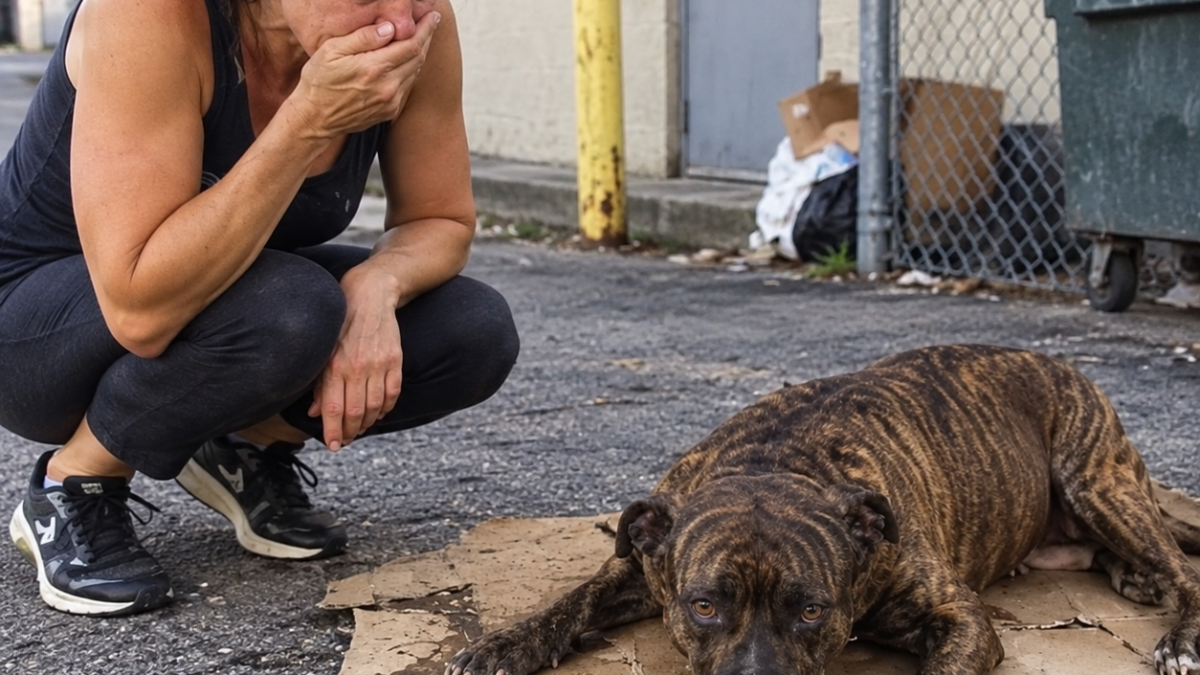
For two days, everyone at the little grocery store called the brindle dog dangerous because she refused to let anyone near the soaked cardboard beneath her body. She growled at workers, delivery drivers, and even the municipal team that came to remove her, yet she never chased anyone beyond the invisible line she had drawn around that box. I almost walked away too—until one corner of the cardboard moved beneath her chest.
“Don’t get any closer,” the store manager shouted behind me.
I stopped in the middle of the parking lot, maybe forty feet from the dog. She had lifted her head, but the rest of her body stayed exactly where it had been, stretched across a torn cardboard box wedged between a dumpster and the chain-link fence behind the store. She was a stocky female with a brindle coat, brown and black, maybe fifty-five pounds, and her eyes never left mine. A low growl rolled from her throat, not loud enough to sound theatrical, but steady enough to make the boundary perfectly clear.
My name is Claire. I was thirty-six then, working as a home-care aide in Marseille, spending most of my days moving between elderly clients’ apartments, pharmacies, grocery stores, reheated lunches, forgotten appointments, and small emergencies that somehow became large ones by the time I arrived. I wasn’t a veterinarian. I wasn’t a dog trainer. I wasn’t especially brave. That afternoon, I had only stopped at the store for dish soap and paper towels before picking up my daughter from my mother’s house.
The manager, Karim, stayed near the service door. “She’s been there since yesterday morning,” he told me. “She barely moves. We put water out, but she won’t come near it if anyone’s watching. Somebody from the city came earlier, but they said they needed different equipment because she was aggressive.”
Aggressive.
I looked at the dog again.
Something about that word bothered me.
If she wanted the entire parking lot, why didn’t she charge when people crossed it? If she wanted the dumpster, why didn’t she patrol around it? Why had she remained in one exact position for nearly two days, lying not beside the box, not in front of it, but directly on top of it?
Her chest and stomach covered almost the entire opening. Her front legs stretched across the flaps as if she were physically holding them closed.
So instead of walking away, I sat down on the pavement.
Karim stared at me.
“Madame, what are you doing?”
“Nothing.”
“That’s not nothing.”
“I’m not getting closer.”
The dog kept growling.
I spoke to her the same way I spoke to frightened clients who woke from naps confused about where they were.
“Okay. I’m staying here.”
Her ears twitched.
“I’m not taking anything.”
The growling continued, but I stayed where I was. Ten minutes became twenty. The asphalt warmed through my pants. A delivery driver arrived, saw the dog, and waited beside his truck. Two teenagers slowed their bicycles behind the fence long enough to shout that I was going to get bitten before riding away.
I talked anyway.
Not baby talk. Not commands. Just nonsense.
I told her about my daughter leaving socks everywhere. About spilling coffee across my kitchen counter that morning. About the fact that I had originally come there for dish soap and somehow ended up sitting behind a supermarket having a conversation with a dog who clearly wished I would disappear.
After about twenty minutes, the growling stopped.
She still watched me.
But her jaw loosened.
I moved forward perhaps three inches.
Her entire body tightened.
I froze.
“Okay. Too much.”
I waited again.
When her shoulders softened, I moved another few inches.
It took almost forty minutes to cross most of the space between us. By then I was about six feet away, close enough to see small scars around her muzzle and the dried mud on her paws. I could also see that she looked exhausted, not angry. Her eyes were red around the edges. Her breathing was shallow. Every few seconds, she shifted her weight as though staying in that position hurt.
Then the cardboard moved.
Not from the wind.
From underneath her.
One flap lifted.
Dropped.
Lifted again.
I stopped breathing.
The dog saw my face change.
Her growl returned instantly, deeper this time, and she lowered her chest over the box as though she could hide whatever was inside with her own body.
Karim whispered from behind me.
“What was that?”
I didn’t answer.
Because now I could hear it.
A sound so small I almost mistook it for cardboard rubbing against cardboard.
A tiny squeak.
Then another.
Something was alive inside that box.
And suddenly I understood that this dog had not spent two days threatening people away from herself.
She had spent two days making sure nobody reached what she was willing to die protecting.
PART 2
I stayed perfectly still.
The dog’s eyes were locked on mine again, but now I understood the warning differently. She wasn’t saying, Come closer and I’ll hurt you. She was saying, I have already lost too much. You are not taking this too.
Behind me, Karim whispered, “Claire?”
“Don’t move.”
“I’m not moving.”
“Tell the driver not to move either.”
Karim turned and raised one hand toward the delivery man. Nobody needed a second explanation. The entire back lot seemed to freeze around us.
The cardboard moved again.
A tiny sound came from underneath the dog.
Then another.
The dog lowered her chin until it almost touched the box.
That was the first moment I became certain.
“Puppies,” I whispered.
Karim said something under his breath.
I looked at the dog’s body more carefully now. Her teats were enlarged. There was dried milk and dirt around her belly. She wasn’t simply guarding puppies she had found.
They were hers.
“Call the city again,” I said.
Karim immediately reached for his phone.
“No. Wait.”
He stopped.
“If they come with catch poles and rush her, she could panic.”
“So what do we do?”
“I don’t know.”
That was the truth.
My entire qualification consisted of being able to sit on hot asphalt longer than everyone else.
I looked back at the dog.
“Hey, mama.”
Her ears moved.
The word felt right.
“You’ve been here two days?”
She stared.
“Then you’re probably thirsty.”
I asked Karim for a bowl and bottled water.
He disappeared into the store and returned with both. I told him to put them on the ground behind me and back away. I filled the bowl slowly, making sure the sound didn’t startle her, then pushed it forward several inches.
The dog watched the bowl.
Then me.
Then the box.
She would not move off it.
That told me something else.
Whatever was under her mattered more than her own thirst.
I pushed the water a little closer.
Her lip lifted.
I stopped.
“Okay.”
For another fifteen minutes, nothing changed.
Then I had an idea.
“Karim, do you have canned meat? Tuna? Anything strong-smelling?”
“I have dog food in the store.”
“You sell dog food?”
“It’s a grocery store.”
“Right.”
Five minutes later he returned with a can of wet food and a plastic spoon.
I opened it.
The dog’s nose moved immediately.
Hunger.
Real hunger.
But still she didn’t stand.
I placed a small amount on the pavement near me.
She watched.
I moved backward.
Nothing.
Farther.
Still nothing.
Finally, when I was perhaps fifteen feet away, she lifted herself just enough to stretch her neck toward the food.
The cardboard shifted underneath her.
For half a second I saw a tiny black nose.
Then she dropped down again.
My chest tightened.
“Definitely puppies.”
Karim had stopped looking afraid.
Now he looked horrified.
“How many?”
“I can’t tell.”
“What if they’re hurt?”
“I don’t know.”
“What if she hasn’t eaten for two days?”
“She probably has barely moved.”
He swore softly.
I called a local animal rescue group I had heard about through one of my elderly clients. The woman who answered introduced herself as Sophie. I explained everything as quickly as possible.
Her voice became serious.
“Do not try to remove the puppies.”
“I wasn’t planning to.”
“Do not separate the mother from the box.”
“I understand.”
“Is she injured?”
“I can’t tell.”
“Bleeding?”
“No obvious blood.”
“Can she stand?”
“I haven’t seen her fully stand.”
“Okay. We’re coming.”
“How long?”
“Twenty minutes if traffic behaves.”
Traffic in Marseille rarely behaves, but I appreciated the optimism.
I sat down again.
The dog watched me.
“I called people who know what they’re doing.”
She blinked once.
“That makes one of us.”
Karim brought a folded beach umbrella and held it awkwardly to create shade over part of the area without approaching the dog. The afternoon sun had moved high enough that the narrow strip beside the dumpster was becoming hot.
The dog was panting now.
I pushed the water closer.
This time she stretched her neck and drank.
Not much.
Three quick laps.
Then back over the box.
That tiny concession felt enormous.
I began calling her Mama because I didn’t know her name.
“Good girl, Mama.”
No growl.
“Drink again.”
She didn’t.
“You’re stubborn.”
One ear twitched.
“Fine. We have that in common.”
When Sophie arrived, she wasn’t alone. A younger man named Thomas came with her. They carried blankets, crates, slip leads, gloves, food, and a low plastic transport tub.
Sophie stopped twenty feet away.
“She let you get that close?”
“Eventually.”
“How long?”
“About an hour.”
She looked at me.
“You’ve been sitting there an hour?”
“My mother has called three times.”
“Does she know what you’re doing?”
“No.”
“Probably wise.”
Sophie crouched.
The dog began growling again.
Sophie immediately lowered her gaze.
“Good,” she whispered.
“What’s good?”
“She warns.”
I frowned.
“Isn’t that bad?”
“No. A dog that warns is communicating. She doesn’t want conflict. She wants distance.”
That mattered to me.
Everyone had called her dangerous.
Sophie saw the same growl and heard information.
“She’s scared,” Sophie continued. “Exhausted too.”
The dog’s eyes moved between us.
“We need to see the puppies.”
“How?”
“Slowly.”
Thomas remained far back.
Sophie handed me small pieces of chicken.
“You’re the person she’s tolerated most. Toss one near her.”
I did.
Mama sniffed.
Didn’t move.
“Another.”
Closer.
Still nothing.
Sophie whispered, “We may have to sedate her lightly if she won’t move.”
The dog’s eyes flicked toward Sophie.
I knew she couldn’t understand the words.
Still, I hated the idea.
“Can we wait?”
“For a while. But if there are newborn puppies under her in that heat, time matters.”
I looked at Mama.
“Come on.”
I tossed another piece.
This one landed just beyond her front paw.
She ate it.
Sophie nodded.
“Good.”
Another.
Mama ate that too.
Then one slightly farther away.
She stretched.
A fourth.
This time she had to stand.
Her entire body rose.
And the moment it did, all of us went silent.
There were puppies under her.
Not one.
Not two.
Seven.
At least seven.
They were packed inside the torn box on an old towel that was almost black with dirt. Some were brindle like their mother. Two were tan. One was nearly black. Their eyes were still closed.
And one of them wasn’t moving.
“Oh, God,” I whispered.
Mama immediately turned toward the box.
Sophie reacted fast.
“Claire, food.”
I tossed another piece farther away.
Mama froze between hunger and instinct.
Her ribs showed more clearly now.
She was thinner than I had realized.
Sophie whispered, “Again.”
I tossed.
Mama took two hesitant steps.
Thomas moved very slowly toward the box.
Mama spun.
A snarl ripped out of her.
Thomas froze.
“Back,” Sophie said.
He backed away.
Mama returned to the puppies.
Sophie exhaled.
“She won’t let a stranger touch them.”
“What if I try?”
Sophie looked at me.
“You understand she could bite you.”
“Yes.”
“A serious bite.”
“Yes.”
“Claire.”
“I heard you.”
She studied the dog.
Then me.
“Move one foot closer. No hands.”
I moved.
Mama watched.
No growl.
Another small step.
Still nothing.
I crouched.
Her body tensed.
I lowered my hands to my knees.
“Hey, Mama.”
She stared.
“I know.”
I waited.
Then I did the only thing that had worked all afternoon.
I talked.
I told her my daughter was going to murder me because I was late.
I told her my mother was going to murder me first.
I told her Karim had promised me a free bottle of dish soap after all this, although he absolutely had not.
Karim called from behind me, “I heard that.”
For the first time, Sophie laughed.
The tension broke just enough.
Mama’s ears softened.
I moved one hand forward.
Stopped.
No growl.
Another inch.
Her nose touched my fingers.
I didn’t move.
She smelled me.
Then she looked down at the puppies.
Back at me.
I whispered, “Please.”
My hand reached the edge of the cardboard.
Mama’s head dropped beside it.
I expected teeth.
Instead, she nudged one puppy with her nose.
The one that wasn’t moving.
My throat tightened.
“That one.”
Sophie understood immediately.
“Check it.”
I slid both hands under the tiny body.
Mama followed every movement.
The puppy was cold.
Far colder than the others.
I lifted it gently.
No obvious breathing.
“Sophie.”
“I’m here.”
I passed the puppy backward.
The second it left my hands, Mama stood.
I thought she was going to attack.
Instead she followed.
Not toward Thomas.
Toward the puppy.
Sophie wrapped it in a towel and began rubbing.
Mama whined.
That was the first vulnerable sound I had heard from her.
Not a growl.
Not a warning.
A mother’s fear.
“Come here,” I whispered.
She took one step toward me.
Then another.
Sophie kept rubbing.
Thomas brought a warming pad.
For thirty seconds, nothing happened.
Then the puppy moved.
Barely.
A little twitch.
Sophie immediately smiled.
“There.”
Mama saw it.
She pushed past my knee and pressed her nose against the towel.
The puppy squeaked.
Mama began licking its face.
Karim turned away.
Later he claimed he had something in his eye.
Nobody believed him.
Once the puppy was breathing more consistently, Sophie made the decision.
“We move all of them now.”
Mama had finally allowed us inside the boundary.
We couldn’t waste it.
We transferred the seven puppies into the transport tub one by one.
Mama followed every puppy.
Checked every towel.
Sniffed every hand.
When the last puppy was inside, she climbed into the tub herself.
No leash.
No force.
Nothing.
She simply stepped over the edge, curled around her babies, and looked up at us.
Sophie whispered, “Well. That solves that.”
I sat back on the pavement.
Only then did I realize my legs were shaking.
Karim handed me a bottle of water.
“You are completely insane.”
“Probably.”
He pointed toward the dog.
“She would have bitten me.”
“No.”
“You don’t know that.”
“She had two days to bite people. She didn’t.”
He looked at Mama.
“She scared everyone.”
“She was supposed to.”
That sentence stayed with me.
She was supposed to.
She had seven newborn puppies in a box behind a supermarket.
Whatever her life had been before, she had decided nobody would get past her.
And because nobody stopped long enough to ask why, they had mistaken devotion for danger.
At the rescue clinic, we learned just how close things had come.
Mama was dehydrated, underweight and running a fever. She had several small wounds around her neck, including a strip of missing fur that suggested she had worn a tight collar or been tethered recently.
The puppies were estimated to be less than a week old.
Six were reasonably stable.
The seventh—the cold puppy—needed supplemental warmth and feeding.
The veterinarian, Dr. Morel, examined Mama while Sophie and I stood nearby.
“She’s producing milk,” he said, “but probably not enough.”
“Because she hasn’t eaten?”
“Partly. Stress too.”
He touched the scarred area on her neck.
“What happened here?”
“No idea.”
“Could be chain abrasion.”
My stomach tightened.
Mama looked at me.
She had allowed the veterinary team to handle her only after we kept the puppies within sight.
Every time they were moved farther than a few feet, she panicked.
Dr. Morel noticed.
“We keep the litter together.”
“Obviously.”
He looked at me.
“You’d be surprised how often people want to separate a mother immediately because she’s ‘aggressive.’”
There was that word again.
I hated it more every time.
“What happens now?”
“Tonight? Food. Fluids. Antibiotics if her bloodwork supports it. Monitoring.”
“And the little puppy?”
“We’ll do everything we can.”
I nodded.
“What do we call her?”
Sophie asked.
I looked at Mama.
The name came without thought.
“Ruby.”
“Why Ruby?”
Her brindle coat didn’t look red.
Her eyes weren’t red.
I shrugged.
“Because she deserves a name that doesn’t sound like a warning label.”
So Ruby she became.
I finally called my mother.
She answered on the first ring.
“Claire, where are you?”
“Please don’t yell.”
“That is how every terrible sentence begins.”
“I found a dog.”
Silence.
“A what?”
“A dog.”
“Your daughter has been asking for you for an hour and a half.”
“I know.”
“Is the dog injured?”
“Yes.”
My mother sighed.
“How injured?”
“She has seven puppies.”
Another silence.
Then my mother said something I had never expected.
“Do you need me to keep Léa overnight?”
I smiled.
“Yes.”
“Send me the address.”
“Why?”
“Because I know you.”
That was all.
My mother knew I wasn’t leaving.
Ruby and her puppies stayed at the clinic overnight.
So did I.
Not because anyone asked me to.
Sophie tried three times to send me home.
“You have a child.”
“With my mother.”
“You have work tomorrow.”
“I’ll call.”
“You have been sitting on the floor for six hours.”
“I’m very committed to bad decisions.”
She shook her head.
At around midnight, Ruby finally ate a full bowl.
Not cautiously.
Not politely.
She devoured it.
Then another smaller portion.
Afterward she returned to the puppies.
The cold puppy was tucked near her chest.
Dr. Morel had warned us it might not survive.
Its body temperature had been dangerously low.
Ruby kept licking it.
Every few minutes she repositioned herself so the smallest puppy stayed closest to her warmth.
I sat outside the enclosure.
At 1:30 in the morning, my eyes closed.
Something touched my shoe.
I woke.
Ruby was standing at the gate.
Her nose pressed through the bars.
I slowly moved my hand.
She sniffed it.
Then turned back toward the puppies.
I followed her with my eyes.
“Okay.”
She looked back.
“I’m still here.”
Ruby lay down.
That was the first night.
The second day brought questions.
Where had she come from?
Why behind that store?
Who had left a nursing mother with newborn puppies in a cardboard box?
Had Ruby carried them there herself?
Or had someone dumped all eight dogs together?
Karim answered part of it before noon.
He called Sophie.
“Our camera.”
“What camera?”
“The loading camera. It points toward the dumpster.”
My stomach tightened.
Sophie put him on speaker.
“How far back does it record?”
“Seven days.”
“Can you check?”
“I already did.”
His voice sounded different.
Angry.
“What did you see?”
“A van.”
“What kind?”
“White. Old. No company markings.”
“When?”
“Two nights before Claire found the dog.”
“And?”
There was a pause.
“Someone took the box out.”
My hands went cold.
Karim continued.
“A man.”
Sophie closed her eyes.
“He dumped them?”
“Yes.”
“What about Ruby?”
“He dragged her out on a rope.”
I looked toward Ruby’s enclosure.
She was nursing the puppies.
My anger came so quickly it almost felt like nausea.
Karim’s voice continued through the phone.
“She fought him.”
“What do you mean?”
“She didn’t attack him. She kept trying to go back into the van.”
“Why?”
“I don’t know.”
“He had the puppies?”
“Yes.”
That explained it.
Ruby wasn’t fighting to avoid being abandoned.
She was fighting because the box containing her puppies had already been removed.
“What happened?”
“He pulled her toward the dumpster, tied the rope to the fence, put the box down, then cut something.”
“The rope?”
“Yes. Then he left.”
I closed my eyes.
Ruby had not chosen that cardboard.
She had been dragged to it.
Sophie asked, “Can we get the footage?”
“I saved it.”
“Do you see the plate?”
“Part of it.”
“Send everything.”
After the call, I stood outside Ruby’s enclosure.
She looked up.
“You knew.”
She obviously didn’t understand.
But I needed to say it.
“You knew exactly what people could do.”
No wonder she had guarded the box.
No wonder every approaching human had been a threat.
The last human she trusted enough to be near had dragged her out of a van, tied her to a fence, dumped her newborn puppies beside a garbage container, and driven away.
And then people wondered why she growled.
The footage went to police and municipal animal welfare authorities.
I assumed someone would identify the man quickly.
I was wrong.
The plate was incomplete.
The van was common.
His face was partially hidden beneath a cap.
For days, nothing happened.
Meanwhile, Ruby changed.
The change was small at first.
She stopped growling when Sophie entered.
Then when Thomas entered.
She allowed Dr. Morel to check her neck without needing the puppies directly beside her.
She began walking outside for short bathroom breaks.
The first time I clipped a leash to her harness, her entire body went rigid.
I immediately stopped.
Sophie noticed.
“Don’t pull.”
“I’m not.”
Ruby crouched low.
Her eyes widened.
The rope.
Of course.
Whatever happened with the man and the van had taught her what tension around her neck meant.
I unclipped the leash.
We switched to a loose long line attached to a padded harness.
I sat beside the door.
“Your choice.”
Ruby stared outside.
Then at the puppies.
Then at me.
Ten minutes passed.
Eventually she stepped forward.
One paw.
Then another.
When she reached the courtyard, sunlight touched her face.
Ruby froze.
Her nose lifted.
She smelled everything.
Cars.
Grass.
Warm concrete.
The veterinarian’s herb garden.
Then she looked at me.
Her tail moved.
Once.
I smiled.
“Yeah.”
Another tiny wag.
“There you are.”
She walked into the grass.
No one pulled.
No one dragged.
Nobody forced her anywhere.
That mattered.
Over the next two weeks, the puppies grew.
Their eyes opened.
Their bodies became rounder.
The smallest one survived.
We called him Pip.
He was half the size of his largest brother and twice as loud.
Ruby was an extraordinary mother.
Exhausted, but patient.
When Pip got pushed away from nursing, she shifted her body so he could find a place.
When the puppies began crawling out of the bedding, she picked them up gently by the loose skin at the neck and returned them.
When one squealed, Ruby was awake instantly.
I visited almost every day.
Sometimes with Léa.
My daughter was nine.
The first day she saw Ruby through the enclosure fence, she whispered, “That’s the dangerous dog?”
I looked at her.
“Who told you that?”
“Grandma.”
Of course.
My mother had apparently shared the entire story.
Léa watched Ruby licking a puppy.
“She doesn’t look dangerous.”
“No.”
“Was she?”
I thought before answering.
“She was scared.”
“That’s different.”
Nine years old.
She understood in five seconds what several adults had failed to understand for two days.
“Yes.”
“That’s different.”
Léa sat outside the enclosure with me.
Ruby sniffed her shoe through the fence.
My daughter stayed still.
“Can I pet her?”
“Not yet.”
“When?”
“When Ruby says yes.”
“How does she say yes?”
“You’ll know.”
Three visits later, Ruby walked to Léa voluntarily.
She lowered her head.
Léa looked at me.
I nodded.
One gentle hand touched Ruby’s shoulder.
Ruby didn’t move away.
My daughter smiled so widely it made my eyes sting.
“She said yes.”
“Yes.”
She had.
During those weeks, another part of Ruby’s story began emerging.
Karim posted a still image of the van in a local neighborhood group after police approved releasing limited information.
Within a day, people started sending messages.
Most were useless.
Someone thought they saw the van near a construction site.
Someone else knew a white van.
Half of Marseille probably knew a white van.
Then a woman named Nadine contacted the rescue.
She said she recognized Ruby.
Not from the parking lot.
From a house.
Sophie called me that evening.
“Can you come?”
I arrived at the rescue office twenty minutes later.
Nadine was sitting at the table.
She looked nervous.
“I don’t want trouble.”
Sophie said, “Nobody is asking you to create trouble.”
Nadine looked at me.
“You found the dog?”
“Yes.”
She stared at a photograph of Ruby on Sophie’s desk.
“That’s Bella.”
The name hit me strangely.
“Bella?”
“That’s what they called her.”
“Who?”
“My neighbor.”
She gave us an address north of the neighborhood where Ruby had been dumped.
The house belonged to a man named Marc Delon.
He bred dogs.
Not professionally, apparently.
Not officially.
Just “sometimes.”
Nadine lived two doors away.
“How do you know Ruby was his?”
“She was in his yard for almost two years.”
“Did she have puppies before?”
Nadine hesitated.
“Yes.”
“How many times?”
“I don’t know.”
Sophie’s face changed.
“What do you mean, you don’t know?”
“I saw puppies last year. Then they disappeared.”
“Sold?”
“I assume.”
“And Ruby?”
“Stayed.”
Nadine rubbed her hands together.
“He kept her tied sometimes.”
My stomach tightened.
“To what?”
“A chain near the shed.”
I pictured the scar around Ruby’s neck.
“Did you ever report it?”
Nadine looked ashamed.
“No.”
“Why?”
“He’s not someone people like problems with.”
“What does that mean?”
“He gets angry.”
Sophie asked, “Did you see him hurt the dog?”
“No.”
“Neglect?”
“Water bowl empty sometimes. She was outside in bad weather.”
“Anything else?”
Nadine’s eyes lowered.
“Last month I heard puppies.”
I stopped breathing.
“How long ago?”
“Maybe two weeks before you found her.”
“That fits.”
“She had them at his place?”
“I think so.”
Sophie leaned forward.
“And then?”
“One morning the dog was gone.”
“The puppies too?”
“Yes.”
“Did you see the van?”
Nadine nodded.
“Marc owns a white Renault van.”
There it was.
My anger became cold.
“Do you know the plate?”
“No.”
Sophie said, “Police can check registration.”
Nadine looked at us.
“You won’t tell him I came here?”
“We’ll protect your identity as much as the process allows.”
She nodded, but fear remained in her face.
I realized Ruby might not have been the only one intimidated by Marc Delon.
Police visited his property.
He denied everything.
He claimed Ruby had run away months earlier.
He claimed he had never bred her.
He claimed the van footage was too blurry to identify him.
He claimed someone else must have abandoned the dog.
Then officers found something useful.
A veterinary receipt.
Ruby—or Bella—had been vaccinated at a clinic under Marc’s name eighteen months earlier.
The microchip?
There wasn’t one.
Convenient.
But the vaccination record described a female brindle mixed breed with a distinctive white patch on her chest.
Ruby had the same patch.
Still not enough.
Marc said he used to own her.
“She ran away.”
“When?”
“Months ago.”
Nadine’s statement contradicted him.
So did another neighbor.
Then another.
Once police began asking, silence cracked.
People had seen Ruby in Marc’s yard recently.
People had heard puppies.
One delivery driver remembered bringing dog food there less than a week before Ruby appeared behind Karim’s store.
A teenager had taken a photograph while walking past because one of the puppies had crawled near the gate.
The image had a date.
Ruby was visible in the background.
Three days later, the supermarket camera recorded the dumping.
Marc changed his story.
He admitted Ruby was his.
But said she had become aggressive after giving birth.
He claimed he feared for his children.
Investigators checked.
Marc had no children living with him.
Then he claimed she attacked a buyer.
There was no report.
No medical record.
No witness.
Every explanation appeared only after the previous one failed.
Sophie was furious.
I was worse.
“He called her dangerous.”
“Yes.”
“He abandoned newborn puppies because he decided their mother was dangerous.”
“Yes.”
“After breeding her.”
“Looks that way.”
I wanted to confront him.
Sophie knew.
“No.”
“I didn’t say anything.”
“You’re making the face.”
“What face?”
“The face that gets civilians arrested.”
I sat back.
“I’m not going to do anything.”
“Good.”
“I just want to ask him one question.”
“No.”
“One.”
“No.”
“Why dump the puppies too?”
Sophie stared at me.
“You already know.”
I did.
Money.
The puppies were too young to sell.
Ruby was no longer useful if he considered her difficult.
Feeding eight dogs cost money.
Veterinary care cost money.
Responsibility cost money.
A cardboard box was cheaper.
For several days I carried that anger everywhere.
Into clients’ apartments.
Onto buses.
Home.
My daughter noticed.
“You’re mad.”
“I’m fine.”
“That means yes.”
I looked at her.
“When did you become ninety?”
“Grandma.”
Again.
“What are you mad about?”
I didn’t want to tell her too much.
I explained only that someone had probably abandoned Ruby and the puppies deliberately.
Léa became quiet.
Then she asked, “Is he going to jail?”
“I don’t know.”
“That’s unfair.”
“Maybe.”
“What happens to him?”
“I don’t know yet.”
She thought.
“What happens to Ruby?”
That question stopped me.
I had spent days thinking about Marc.
About punishment.
About evidence.
About consequences.
My daughter asked the only question Ruby cared about.
What happens to Ruby?
“She gets better.”
“And the babies?”
“They grow.”
“And then?”
“They get homes.”
Léa nodded.
“Then that’s what matters first.”
I stared at her.
“Grandma again?”
“No.”
She smiled.
“That was me.”
So I redirected the anger.
Toward work that mattered.
Ruby needed socialization.
The puppies needed handling.
Vaccinations.
Food.
Cleaning.
Weights.
Photographs.
Applications.
Home checks.
The smallest puppy, Pip, needed extra monitoring.
One tan female developed stomach problems.
Another puppy had a mild respiratory infection.
There was always something.
And Ruby changed more each week.
She started playing.
The first time it happened, Thomas rolled a ball across the courtyard accidentally.
Ruby chased it.
Everyone stopped.
Ruby stopped too.
Ball in her mouth.
She looked at us as if embarrassed.
Thomas crouched.
“Bring it.”
Ruby ran the opposite direction.
We laughed.
That became her game.
Not fetch.
Theft.
Take the ball and make humans negotiate for its return.
She also discovered that Léa carried treats.
Their friendship became shamelessly transactional.
Ruby would see my daughter and immediately inspect both pockets.
“You don’t even say hello,” Léa complained.
Ruby pushed her nose against the jacket.
“This is rude.”
More searching.
“I feel used.”
I said, “Welcome to parenthood.”
Léa rolled her eyes.
One afternoon, Ruby climbed onto the bench beside me.
She had never done that.
She sat.
Then slowly leaned her body against mine.
All fifty-five pounds.
I looked down.
“You realize you scared half a supermarket.”
Ruby sighed.
“Now look at you.”
Her head settled against my shoulder.
Sophie came around the corner and stopped.
“Oh.”
“What?”
“She picked you.”
I tried to dismiss it.
“She likes everyone now.”
“No.”
Sophie smiled.
“She trusts people. That’s different.”
Ruby closed her eyes.
My throat tightened.
I knew what Sophie meant.
Trust can be general.
Attachment is specific.
Ruby had decided I was hers in some small way.
That became a problem several weeks later when the puppies were nearly ready for adoption.
Sophie handed me a folder.
“What’s this?”
“Ruby.”
“What about her?”
“Applications.”
I stared at the folder.
“No.”
Sophie raised one eyebrow.
“What do you mean, no?”
“Not yet.”
“She’ll be ready soon.”
“No.”
“Claire.”
“She still needs stability.”
“Yes.”
“She still panics around ropes.”
“Yes.”
“She doesn’t like men approaching quickly.”
“Yes.”
“She—”
Sophie interrupted.
“You are describing a dog who needs the right home, not a dog who needs to live at the rescue forever.”
I looked at Ruby across the courtyard.
She was lying in the sun while six of her puppies attacked a blanket and Pip slept through the entire war.
“I know.”
“No, you don’t.”
“I do.”
“You’re attached.”
“Obviously.”
“Good.”
I looked at Sophie.
She smiled.
“So adopt her.”
I laughed.
Then realized she was serious.
“No.”
“Why?”
“I have an apartment.”
“So?”
“I work.”
“So do most dog owners.”
“I have Léa.”
“Ruby loves Léa.”
“My mother will lose her mind.”
“That may be a bonus.”
I looked at Ruby.
“No.”
Sophie didn’t push.
She only said, “Read the applications.”
I took the folder home.
I hated every applicant.
Not rationally.
The first couple had a house and fenced yard.
Too far away.
The second woman worked from home.
Too many cats.
The third applicant had experience with rescue dogs.
Suspiciously perfect.
The fourth had another calm male dog.
What if Ruby hated him?
The fifth family had teenagers.
Too loud.
By page ten I realized the problem.
There was nothing wrong with the applicants.
I didn’t want any of them to have her.
My mother watched me from across the table.
“You’re adopting the dog.”
“No.”
“You have spent forty minutes inventing reasons strangers are unsuitable.”
“They might be.”
“You said one woman’s garden was too large.”
“I said Ruby might feel overwhelmed.”
My mother stared.
“That is not a thing.”
“It could be.”
“Claire.”
“No.”
Léa walked in.
“Are we adopting Ruby?”
“No.”
“Yes!” she shouted.
“I said no.”
My mother smiled.
“Democracy.”
“This is not a democracy.”
Léa hugged me.
“We’re getting Ruby.”
“We are not.”
Two weeks later, Ruby slept on my couch.
I would like the record to show that I resisted.
Poorly.
Sophie arranged a trial foster period.
That was the phrase.
Trial foster.
Temporary.
Responsible.
Logical.
Ruby entered my apartment on a Friday evening.
She inspected every room.
Checked under the kitchen table.
Sniffed Léa’s bed.
Ignored the expensive dog bed I had bought.
Then climbed onto the couch, turned in three circles, and fell asleep with her head on my clean laundry.
My mother arrived an hour later.
She looked at Ruby.
Then at me.
“Temporary?”
“Yes.”
Ruby rolled onto her back.
My mother scratched her stomach.
“Of course.”
The puppies left gradually over the following month.
Each went to a screened home.
Pip went last.
His adopter was an older man named Étienne who had recently lost his fifteen-year-old dog.
He visited Pip four times before adoption day.
On the final visit, Ruby inspected him from shoes to hands.
Étienne sat quietly.
“She decides?” he asked.
“I think so.”
Ruby sniffed his face.
Then walked away.
Étienne looked at me.
“Was that approval?”
“It wasn’t rejection.”
“I’ll take it.”
Pip climbed into his lap.
Ruby watched.
No growling.
No panic.
No desperate effort to block the door.
She had changed.
Or maybe the situation had.
She no longer believed every departure meant abandonment.
She had learned something important.
Some people leave carrying a puppy because they intend to give him a home.
Not throw him away.
When Pip left, Ruby stood at my apartment door that evening for almost ten minutes.
I sat beside her.
“He’s okay.”
She looked at me.
“All of them are.”
Ruby rested one paw over my shoe.
“You did your job.”
Her head lowered.
“You don’t have to protect a cardboard box anymore.”
That night she climbed into Léa’s bed.
My daughter woke in the morning with Ruby stretched across her legs.
“She’s crushing me.”
“Move her.”
“No.”
“Then suffer.”
“I am.”
She smiled.
“I like it.”
The investigation into Marc Delon continued in the background.
I tried not to obsess.
Tried.
Then one afternoon, Sophie called.
“They found more.”
“What?”
“Dogs.”
My stomach dropped.
“Where?”
“Property he rents outside the city.”
I stood up.
“How many?”
“Eleven.”
“What kind?”
“Mixed breeds. Three females. Several young dogs.”
“Conditions?”
A pause.
“Bad.”
I closed my eyes.
Not dead.
That was the first thing I needed to know.
“Alive?”
“Yes.”
“Okay.”
“But underfed. Poor shelter. No clean water in two runs.”
I pressed my free hand against the wall.
“Puppies?”
“Two young litters.”
My anger returned.
Different now.
Sharper.
This wasn’t one impulsive abandonment.
This was a pattern.
Marc had been breeding dogs outside any meaningful standard of care, selling puppies privately, moving animals between properties, and disposing of those he no longer wanted to manage.
Ruby had survived because she was useful until she wasn’t.
That realization made me sick.
The authorities seized the dogs pending proceedings.
Veterinary examinations documented untreated skin conditions, parasites, old injuries, and repeated breeding in at least two females.
One dog had a chain wound around the neck similar to Ruby’s.
Marc’s lawyer insisted he was merely an inexperienced hobby breeder.
Sophie nearly threw a cup when she heard that.
“Inexperienced?”
She pointed toward photographs on the table.
“You don’t need professional training to understand water.”
I agreed.
Karim became unexpectedly involved too.
His store footage was now central evidence.
Marc’s attorney challenged it.
Claimed the timestamp might be wrong.
Karim produced maintenance logs showing the camera system automatically synchronized its time.
The defense questioned whether the man in the footage was Marc.
Then investigators matched the van.
Not just by plate.
By a dent above the rear wheel and a replacement mirror on the passenger side.
Nadine identified the jacket.
Another neighbor recognized Marc’s gait.
And then police recovered messages from his phone.
One of them was to a friend.
Sent the night Ruby was dumped.
“Got rid of the crazy female and the useless litter.”
I read those words only because they later appeared in the court record.
I wish I hadn’t.
Crazy female.
Useless litter.
Ruby was asleep beside my daughter when Sophie sent me the update.
I looked at her.
The same dog who had allowed Léa to paint one toenail pink before I discovered what was happening.
The dog who carried socks through the apartment.
The dog who now refused breakfast unless somebody stood nearby pretending not to watch her.
Crazy female.
Useless litter.
I wanted Marc to lose everything.
That thought scared me a little.
Because anger can start sounding righteous long before it becomes useful.
My mother noticed again.
“You’re doing it.”
“What?”
“Thinking punishment will make you feel better.”
I looked at her.
“He dumped newborn puppies beside garbage.”
“Yes.”
“He kept dogs without water.”
“Yes.”
“He bred them until they stopped being useful.”
“Yes.”
“So forgive me if I’m not concerned about his comfort.”
“I didn’t say you should be.”
“Then what are you saying?”
My mother took a breath.
“I’m saying if your happiness starts depending on how miserable he becomes, he still owns part of your day.”
I hated that.
Which meant it was probably true.
“What do I do instead?”
She looked at Ruby.
“Make sure he doesn’t get to do it again.”
That became the goal.
Not revenge.
Prevention.
The court process took months.
Marc was charged under applicable animal-welfare and abandonment provisions, along with related violations involving unregistered breeding and animal conditions. The seized dogs remained in approved foster and rescue placements while ownership was resolved.
Marc fought everything.
He claimed the dogs were healthy.
Veterinary records said otherwise.
He claimed Ruby had bitten him.
No medical documentation existed.
He claimed he abandoned her because he feared she would attack someone.
The prosecutor asked why he then left her loose behind a public store.
He had no good answer.
He claimed the puppies were not Ruby’s.
DNA testing wasn’t even necessary; photographs from his own phone showed Ruby nursing them days before the dumping.
That was the kind of mistake arrogance makes.
People document their own lives.
They forget those photographs remain after the story changes.
I was called as a witness.
I hated courtrooms.
Too much waiting.
Too much whispering.
Too many doors.
Ruby stayed home with my mother and Léa.
Before I left, Léa handed me one of Ruby’s toys.
A shredded yellow ball.
“What am I supposed to do with this?”
“Luck.”
“I’m not bringing a chewed dog ball into court.”
She stared at me.
Five minutes later, the ball was in my bag.
I described finding Ruby.
Her position over the box.
The growling.
The puppies.
The cold puppy.
How Ruby allowed us to approach only after almost an hour.
Marc’s lawyer tried to emphasize the growling.
“You considered the dog dangerous at first?”
“No.”
“You testified she growled at you.”
“Yes.”
“Repeatedly?”
“Yes.”
“Showed teeth?”
“At one point.”
“So aggressive behavior.”
“Protective behavior.”
“Are you a canine behavior expert?”
“No.”
“Then on what basis do you distinguish the two?”
I paused.
“Because she had opportunities to attack me.”
The lawyer waited.
“She didn’t.”
“That does not mean she wasn’t dangerous.”
“No.”
I looked toward the judge.
“It means the word alone doesn’t explain what she was doing.”
Marc stared at me from across the room.
That was the first time I had seen him in person.
He looked ordinary.
That angered me more than I expected.
There was no visible cruelty.
No movie villain.
Just a man in a clean shirt.
I imagined him dragging Ruby from the van while her newborn puppies squeaked inside a cardboard box.
The lawyer continued.
“Did you witness my client abandon the dog?”
“No.”
“So everything you know about that event comes from video footage.”
“Yes.”
“You cannot personally testify to his state of mind.”
“No.”
“Or why he did it.”
“No.”
He nodded.
I added, “But the dog’s condition told us what happened afterward.”
He turned.
“I didn’t ask that.”
“No.”
The judge told me to answer only the questions.
Fair enough.
Karim testified.
Sophie testified.
Dr. Morel testified about Ruby’s dehydration, weight loss, fever, neck injuries, and the puppies’ condition.
Then the video played.
I had already seen part of it.
I had never watched the entire sequence.
A white van backed toward the dumpster.
The rear doors opened.
Marc stepped out.
He lifted the cardboard box.
Set it down.
Ruby appeared next.
There was a rope around her neck.
She resisted.
Not violently.
Desperately.
She pulled toward the van.
Toward the box.
Marc jerked the rope.
I stopped breathing.
He dragged her several feet.
Tied the rope to the fence.
Returned to the van.
Ruby pulled so hard that her front legs left the ground.
Not trying to reach him.
Trying to reach the puppies.
Marc came back.
Cut the rope.
Ruby immediately ran to the box.
Marc walked toward the van.
Ruby did something I had never known about.
She followed him halfway.
Stopped.
Looked at the van.
Then looked at the box.
The puppies moved.
Ruby turned back.
Marc drove away.
The courtroom went silent.
That was the choice Ruby made.
Follow the person she had known.
Or stay with the babies who had no one else.
She stayed.
For two days.
No food except scraps people tossed.
Almost no water because she wouldn’t leave the box.
Heat during the day.
Cold at night.
Strangers approaching.
Vehicles coming and going.
And every time someone tried to get close, Ruby placed her body over those puppies.
Marc’s lawyer called the video emotional but argued it did not establish prolonged neglect before abandonment.
Dr. Morel’s records handled that.
Nadine testified next.
Her hands shook.
Marc looked directly at her.
She almost stopped speaking.
The judge asked if she needed a break.
“No.”
She took a breath.
Then continued.
She described Ruby chained near the shed.
Empty water bowls.
Previous puppies.
Dogs disappearing.
Hearing crying from the property.
The fear neighbors had of confronting Marc.
His lawyer suggested Nadine disliked him because of an old parking dispute.
She admitted they had argued once about parking.
Then said:
“I did dislike him.”
The lawyer smiled slightly.
Nadine continued.
“But the dog didn’t know about our parking dispute.”
That smile disappeared.
Several other witnesses testified.
Then photographs from the second property.
Eleven dogs.
Mud.
Chains.
Improvised kennels.
Empty containers.
Marc’s explanation was that inspectors had arrived on an unusually bad day.
Sophie whispered beside me:
“A bad day doesn’t grow a chain wound.”
I touched her arm.
“Quiet.”
“You sound like the judge.”
“Someone has to.”
Then came the messages.
“Got rid of the crazy female and the useless litter.”
The prosecutor displayed them.
Marc’s attorney argued the wording was crude but not proof of cruelty.
The prosecutor asked Marc what “got rid of” meant.
He said he had intended someone to find them.
“Who?”
“People behind the store.”
“Which people?”
“I don’t know.”
“Did you arrange for anyone to receive the dog?”
“No.”
“Did you notify a shelter?”
“No.”
“Did you contact animal services?”
“No.”
“Did you leave food?”
Marc hesitated.
“No.”
“Water?”
“No.”
“The puppies were less than one week old?”
“I didn’t know exactly.”
“You bred the mother.”
Silence.
“You knew she had recently given birth.”
“Yes.”
“You knew the puppies could not survive without her.”
“I assumed she’d stay.”
I felt something cold move through me.
He had assumed she would stay.
He understood her loyalty enough to exploit it.
The prosecutor seemed to understand the same thing.
“You left no food for the dog because you assumed she would stay with the puppies.”
Marc shifted.
“I thought someone would find them.”
“And yet you chose a location behind a store, beside a dumpster, after business hours.”
No answer.
“Why not the entrance?”
“I don’t know.”
“Why not a veterinary clinic?”
“I don’t know.”
“Why not an animal shelter?”
“I don’t know.”
“Why cut the rope and drive away?”
Marc’s jaw tightened.
“She was aggressive.”
The prosecutor paused.
Then:
“Toward whom?”
Marc didn’t answer.
The prosecutor replayed part of the video.
Ruby straining toward the puppies.
No lunging at Marc.
No attack.
No attempt to chase him once the rope was cut.
Only panic.
Only the box.
“Toward whom?” the prosecutor asked again.
Marc finally said, “She growled.”
The prosecutor nodded.
“So did she.”
The judgment did not arrive dramatically.
Real justice rarely does.
There were findings.
Penalties.
Restrictions.
The court accepted that Ruby and the puppies had been deliberately abandoned in circumstances that placed them at serious risk and that the broader conditions involving the other dogs constituted further welfare violations.
Marc lost legal ownership of the seized animals.
He was prohibited from keeping or breeding dogs for a substantial period under the orders imposed.
He faced fines, costs and additional consequences tied to the condition of the animals and the unregistered breeding operation.
The property where the dogs had been kept was emptied.
The surviving dogs entered rescue or approved placements.
Was it enough?
Part of me said no.
Part of me wanted a punishment that felt as large as the fear in Ruby’s eyes that first afternoon.
But no punishment could recreate those two days and make Marc understand them from inside her body.
No fine could make him feel thirst while refusing to leave newborn puppies.
No order could force him to experience every approaching stranger as a threat.
No courtroom could give Ruby back the litters she had apparently produced before.
That was when I understood what my mother had meant.
The satisfying ending wasn’t going to be Marc suffering enough.
It was going to be Marc losing the power to keep doing it.
That mattered.
Outside the courthouse, Nadine stood beside me.
“I should have reported him earlier.”
I looked at her.
“Yes.”
She flinched.
I continued before she could turn away.
“But you reported him now.”
Her eyes filled.
“I could’ve helped Ruby.”
“Maybe.”
“I was afraid.”
“I know.”
She looked toward the courthouse.
“What if there are other people like me?”
“There are.”
“What do they do?”
“Next time, don’t wait for certainty.”
She nodded.
Neither of us pretended fear hadn’t mattered.
But fear should explain silence.
Not excuse it forever.
When I got home, Ruby was waiting at the apartment door.
Léa had apparently told her I was coming because the dog started whining before I even reached the stairs.
I opened the door.
Ruby launched herself at me.
“Hey.”
Her whole body moved.
That wag had become ridiculous.
“Calm down.”
Impossible.
My mother sat on the couch.
“Well?”
“It’s over.”
“What happened?”
I told her.
Léa listened from the floor.
When I finished, she asked the only question that mattered to her.
“He can’t have dogs anymore?”
“For a long time, no.”
“Good.”
Ruby dropped the yellow ball at my feet.
The same one Léa had put in my bag.
I pulled it out.
“You knew?”
Léa smiled.
“Luck.”
Ruby grabbed the ball.
Then ran down the hallway.
I laughed.
There it was.
The revenge I had thought I wanted suddenly looked very small.
Marc had lost his dogs.
His breeding operation.
Money.
Control.
Reputation.
But Ruby had gained things he could not take back.
A name.
A home.
A child who loved her.
A veterinarian who knew her history.
A rescue organization that would remember her.
Seven puppies growing in homes where nobody called them useless.
I began receiving pictures from the adopters.
Pip asleep on Étienne’s chest.
The tan female, Luna, standing beside a lake.
A brindle male named Oscar stealing a shoe.
Two siblings who had gone to neighboring families meeting in a park.
I printed the photographs.
Léa taped them to the wall above Ruby’s bed.
Ruby ignored them completely.
“She doesn’t appreciate art,” my daughter complained.
“She’s a dog.”
“She should be proud.”
“She probably is.”
“How do you know?”
I looked at Ruby.
She was asleep on the couch with her mouth slightly open.
“I don’t.”
Léa considered that.
“Okay.”
There was something good about not pretending we knew everything Ruby felt.
We knew enough.
She felt safer.
She slept deeply.
She ate without watching the door.
She walked willingly beside us.
She no longer froze when a leash appeared.
She still disliked men approaching quickly from behind, but she recovered faster.
She still positioned herself between Léa and unfamiliar dogs.
That habit never completely disappeared.
Once a protector, always a protector.
Several months later, Karim invited us back to the store.
At first I said no.
Why bring Ruby to the place where she had been abandoned?
Sophie thought differently.
“Let her choose.”
So we went.
I parked across the street.
Ruby recognized the area before I opened the car door.
Her body stiffened.
I waited.
“No pressure.”
Léa sat beside her.
“We can go home.”
Ruby looked outside.
Then at me.
I opened the door.
She stepped down.
Slowly.
We crossed the parking lot.
Karim stood near the service entrance.
His eyes filled when he saw her.
“That’s the same dog?”
“Mostly.”
Ruby stopped.
The dumpster was still there.
The fence too.
No cardboard.
Nothing.
She stared toward the exact corner.
I held the leash loose.
“Want to leave?”
Ruby took one step.
Then another.
She approached the spot.
Sniffed.
Her body became tense.
Léa moved closer to me.
Ruby sniffed the fence.
The pavement.
The wall.
Then she looked back.
For a moment, I saw the old expression.
The dog on the cardboard.
The warning.
The fear.
Then Karim came out carrying something.
A new dog bed.
Bright red.
He put it on the ground far from Ruby and stepped back.
“What’s that?” I asked.
He shrugged.
“Replacement cardboard.”
I laughed.
Ruby looked at the bed.
Walked toward it.
Sniffed.
Then lay down.
Karim covered his mouth.
“Oh, come on.”
“What?”
“You’re crying.”
“I have allergies.”
“In November?”
“Very severe.”
Léa sat beside Ruby.
The dog rolled onto one hip.
My daughter scratched her chest.
People coming out of the store stopped.
Some remembered her.
One woman whispered:
“That was the dangerous dog?”
Karim answered before I could.
“No.”
He looked at Ruby.
“That was the mother.”
That sentence meant more to me than he knew.
We stayed twenty minutes.
Then Ruby stood.
No shaking.
No dragging us toward the car.
She simply walked away from the corner.
That was enough.
The past remained there.
She didn’t.
A year passed.
Ruby became part of our family so completely that I sometimes forgot there had been a time before her.
She learned my work schedule.
At 6:30 every morning she stood near the kitchen because she expected breakfast.
At 7:00 she followed me while I got ready.
At 7:20 she became offended when I picked up my bag.
Léa would leave for school.
My mother came by midday on longer workdays.
Ruby adored her, though my mother insisted they had “a professional arrangement.”
“What profession?” I asked.
“She protects the apartment. I provide cheese.”
“Sounds illegal.”
“Mind your business.”
Ruby became especially attached to one of my elderly clients, Monsieur Pierre, after I received permission to bring her occasionally.
Pierre had Parkinson’s disease and rarely smiled anymore.
The first time Ruby visited, she sat beside his chair.
He looked down.
“She’s ugly.”
I stared.
“Pierre.”
“What?”
“She can hear you.”
“She’s a dog.”
Ruby placed her head on his knee.
Pierre’s hand trembled as he touched her ear.
“Very ugly.”
Ruby stayed.
The next week he asked:
“Where’s the ugly dog?”
From then on, she was invited.
Pierre saved pieces of chicken for her.
Ruby learned to walk slowly beside his mobility aid.
I watched the dog once labeled too dangerous for people adjust her entire pace to an old man who needed three minutes to cross a room.
Labels are lazy things.
Dangerous.
Difficult.
Aggressive.
Broken.
They tell you what somebody saw for five seconds.
They rarely tell you why.
Ruby had taught me to wait for the why.
Two years after the rescue, Sophie organized a reunion for the litter.
Six of the seven families came.
Pip arrived first.
He was enormous.
I couldn’t understand how the cold little puppy that once fit between my palms had become a seventy-pound idiot carrying a tennis ball the size of his head.
Étienne smiled.
“He still thinks he’s dying if dinner is five minutes late.”
“Genetic.”
Ruby heard his bark.
She stopped.
Pip stopped.
They looked at each other.
I expected some dramatic recognition.
Instead, Pip ran toward her too fast.
Ruby corrected him with one sharp bark.
He skidded to a stop.
Everyone laughed.
“Mother remembers,” Étienne said.
Maybe she did.
Maybe she simply recognized an obnoxious young dog who needed manners.
Either way, within minutes they were running.
Then Luna arrived.
Oscar.
The twins from neighboring homes.
One after another.
Seven puppies had become seven strong adult dogs.
Healthy.
Vaccinated.
Loved.
Nobody had bred them for quick money.
Nobody had left them beside garbage.
Nobody called them useless.
Léa stood beside me.
“She saved all of them.”
“Yes.”
“You helped.”
“Ruby did most of it.”
“You sat on the ground.”
“That was my specialty.”
Léa leaned against me.
“Do you know what I remember?”
“What?”
“The first time she let me pet her.”
I remembered too.
“She said yes.”
Léa nodded.
Ruby ran across the grass with three of her grown puppies behind her.
Her brindle coat shone in the sun.
No mud.
No rope burn.
No cardboard.
Just a dog running because she wanted to.
That image replaced the parking lot for me.
Not completely.
Some memories don’t disappear.
They just stop being the last image.
The reunion ended near sunset.
Families loaded dogs into cars.
Pip refused to leave until Étienne produced a biscuit.
Ruby stood beside me watching.
One vehicle after another disappeared.
Seven puppies.
Seven homes.
Then silence.
Ruby looked up at me.
“You okay?”
Her tail moved.
“Me too.”
We drove home.
That night, I found her asleep on Léa’s floor.
My daughter’s hand rested on Ruby’s back.
I stood in the doorway for a while.
I thought about Marc’s message.
Crazy female.
Useless litter.
He had been wrong about every word.
Ruby’s fear had made sense.
Her aggression had been protection.
The litter had not been useless.
No life is.
And the woman who found them had not been brave.
That part of the story gets exaggerated sometimes.
People later told me I had courage for sitting near a growling dog.
I didn’t.
I was scared.
My hands were sweating.
My legs shook when I finally stood.
Courage wasn’t the reason I stayed.
Curiosity was.
Something didn’t fit.
A supposedly dangerous dog wasn’t chasing anyone.
She wasn’t defending food.
She wasn’t roaming.
She was lying on one spot and refusing to move.
The moment I stopped asking, “What’s wrong with this dog?” and started asking, “What happened here?” everything changed.
That question followed me into my work too.
An elderly client snaps at me.
What happened?
A confused woman refuses medication.
What is she afraid of?
A child becomes silent.
What changed?
A dog growls from a cardboard box.
What is she protecting?
Behavior is the end of a story.
Not always the beginning.
Years later, Marc’s prohibition expired.
I heard about it through Sophie.
“He applied to register dogs again.”
I felt anger return instantly.
“Can he?”
“He can apply.”
“That’s insane.”
“Claire.”
“No. After everything?”
“There’s review.”
“What if he gets approved?”
“He won’t.”
“How do you know?”
“Because we’re not the only ones who remember.”
Sophie and the rescue submitted the old veterinary records.
The abandonment judgment.
Photographs.
Inspection findings.
Documents from the seized property.
Karim provided the video again.
Nadine wrote a statement.
So did Dr. Morel.
I wrote one too.
Not emotional.
Just facts.
What I saw.
Ruby’s condition.
The puppies.
The time it took before she trusted anyone enough to expose the box.
The application was denied.
Marc appealed.
Denied again.
That felt different from the first court case.
Quieter.
No reporters.
No crowded room.
No dramatic confrontation.
Just paperwork doing exactly what paperwork should do.
Preventing someone with a documented history from quietly starting again.
When Sophie told me, I looked at Ruby.
She was older now.
Gray beginning around her muzzle.
“Good,” I said.
Sophie laughed.
“That’s all?”
“What do you want?”
“I expected a speech.”
“No.”
I rubbed Ruby’s ear.
“This is enough.”
And it was.
That was the revenge that finally satisfied me.
Not humiliation.
Not suffering.
A closed door.
A simple no.
No more dogs for profit.
No more females bred until inconvenient.
No more boxes.
No more ropes.
No more pretending nobody remembered.
Actions had followed him farther than anger ever could.
Ruby, meanwhile, grew old in the most ordinary way possible.
Slowly.
Beautifully.
Her face grayed.
She slept more.
She stopped chasing balls for long periods but still stole them from other dogs.
Her hips became stiff in winter.
Léa grew from a nine-year-old girl into a teenager who pretended not to need anyone but still slept on the floor beside Ruby during thunderstorms.
One evening, Léa came home crying after an argument with friends.
She went directly to her room.
Ruby stood painfully.
Walked down the hall.
I followed quietly.
My daughter was sitting against her bed.
Ruby lowered herself beside her.
Léa wrapped both arms around the old dog.
“I hate everyone.”
Ruby sighed.
“I know, not you.”
I stayed at the doorway.
That dog had spent the first chapter I knew of protecting seven puppies.
She never really stopped protecting.
The subjects simply changed.
First the box.
Then me.
Then Léa.
Then Pierre.
Then the apartment.
Then every person she decided belonged to her.
Her body aged.
The instinct remained.
When Pierre died, Ruby waited beside his empty chair during our last visit to his apartment.
His daughter allowed us inside while she sorted belongings.
Ruby walked directly to the chair.
Sniffed.
Sat.
I had no way to explain.
“He loved you,” I whispered.
Ruby stayed there until I clipped on the leash.
Then she followed.
Always eventually willing to follow now.
Never dragged.
Never forced.
Her choice.
That mattered until the end.
Ruby lived with us for almost nine years after the parking lot.
Nine.
When I calculate it, I still struggle to believe it.
Nine years of breakfasts.
Walks.
Vacations.
Vet bills.
Hair on furniture.
Stolen socks.
Arguments about couch space.
Léa growing up.
My mother getting older.
My own hair beginning to gray.
All of it because one afternoon I noticed cardboard move.
Ruby’s final year was slower.
Arthritis.
Medication.
Short walks.
More sleeping.
But she still waited by the door when Léa came home from university visits.
The first time Léa returned after three months away, Ruby tried to run.
Her legs betrayed her.
She slipped.
Léa dropped her bag.
“Ruby!”
The dog struggled upright.
Tail moving so violently that her hips nearly failed again.
Léa knelt.
Ruby reached her.
They pressed forehead to forehead.
My daughter cried.
“You waited.”
Of course she had.
Ruby had always been good at waiting.
Waiting over a cardboard box.
Waiting for strangers to back away.
Waiting to decide whether I could be trusted.
Waiting for puppies to grow.
Waiting beside doors.
Waiting for Léa.
In the final months, I sometimes thought about the first day.
The growl.
The boundary.
I had assumed I was trying to reach Ruby.
Really, Ruby had spent years reaching us.
Slowly.
Carefully.
One person at a time.
The day came when Dr. Morel—older too—sat on my living room floor and told me Ruby’s pain could no longer be controlled well enough.
I knew before he said it.
Knowing didn’t help.
Léa came home.
My mother came.
Sophie came.
Ruby lay on the red dog bed Karim had given her years earlier.
Yes.
We still had it.
The fabric had been repaired twice.
One corner was chewed.
The color had faded.
But Ruby chose it that afternoon.
Maybe coincidence.
I didn’t care.
Léa lay beside her.
My mother stroked Ruby’s paw.
Sophie cried openly.
I sat near Ruby’s head.
“You remember me?”
Her eyes moved toward mine.
A ridiculous question.
Of course she did.
I touched the gray fur around her muzzle.
“You scared me.”
Her tail moved once.
“Very rude.”
Another movement.
“I was supposed to buy dish soap.”
Léa laughed through tears.
“You always tell that part.”
“It matters.”
“It doesn’t.”
“It absolutely matters.”
Ruby closed her eyes.
I kept talking.
I told her about the parking lot.
About the box.
About Pip.
About all seven puppies.
About Karim.
About the day she first wagged.
About her first night on our couch.
About Pierre calling her ugly.
About Léa painting her toenail.
About Marc losing the right to own dogs.
Not because Ruby understood the court part.
Because I did.
I needed her to know, somehow, that the man who had discarded her did not write her ending.
We did.
She did.
Mostly she did.
Dr. Morel prepared everything quietly.
Before the final medication, Ruby opened her eyes again.
She looked at Léa.
Then my mother.
Then me.
No growl.
No fear.
No box beneath her.
Nothing left to guard.
I whispered:
“You can stop protecting us now.”
Her breathing slowed.
“I’ve got them.”
Léa covered her mouth.
I placed my hand against Ruby’s chest.
“You protected everybody long enough.”
One last breath.
Then stillness.
For a long time, nobody moved.
My mother finally said:
“She trusted you.”
I shook my head.
“No.”
They looked at me.
“She taught me how to earn it.”
We had Ruby cremated.
Part of her ashes went with Léa when she eventually moved into her own apartment.
Part stayed with me.
But the thing I kept nearest wasn’t an urn.
It was a piece of cardboard.
I know how ridiculous that sounds.
Karim had kept a small dry section of the original box after investigators finished with it.
Years later he gave it to me inside a plastic sleeve.
On one side was a dark stain.
On the other, nothing.
Just brown cardboard.
Worthless.
Except it wasn’t.
For two days, that piece of trash had been the most important place in Ruby’s world.
Everything she loved fit inside it.
I framed a small square.
Under it, I wrote only:
SHE WASN’T GUARDING TRASH.
When people ask, I tell them.
Not everyone.
Only people who really want to know.
I tell them about a dog everyone had already judged.
A dog people called dangerous because she growled from behind a supermarket.
I tell them how easy it would have been to accept that label.
Call animal control.
Walk away.
Let someone remove her by force.
Maybe the puppies would have been discovered.
Maybe not.
Maybe Ruby would have bitten someone in panic and confirmed the very story people had already written about her.
Dangerous dog.
Problem solved.
Instead, we waited.
That is the part I remember most.
Waiting.
Forty minutes on hot asphalt.
Doing almost nothing.
No dramatic rescue.
No heroic grab.
Just giving a frightened mother enough time to decide I might not be another person coming to take something.
The world often rewards speed.
Ruby taught me what patience can uncover.
Seven puppies.
A history of neglect.
A breeding operation.
Eleven other dogs.
A neighbor finally willing to speak.
A store manager who changed the way he looked at frightened animals.
A child who learned that growling can be communication instead of evil.
A family I never expected.
All hidden behind one warning sound.
Years after Ruby died, Karim replaced the dumpster area during a store renovation.
He sent me a photograph.
The old corner was gone.
New pavement.
New fencing.
Cleaner.
Brighter.
He wrote:
“Thought you’d want to see.”
I stared at the image for a long time.
I expected sadness.
Instead, I smiled.
Good.
The corner was allowed to disappear.
Ruby’s life had become much larger than the place where I found her.
A few weeks later, I visited the store.
Karim was older.
So was I.
He handed me a bottle of dish soap.
“What’s this?”
“You never bought it.”
I laughed.
“You remember?”
“Every time I see dog food.”
I held up the bottle.
“Took you long enough.”
He pointed toward the parking lot.
“You were busy.”
We stood outside for a moment.
No dumpster.
No cardboard.
No growling dog.
Just afternoon traffic.
I asked him:
“Do you remember what you said?”
“What?”
“With a dog like that…”
He nodded slowly.
“I never finished.”
“I know.”
He looked embarrassed.
“I thought I knew what she was.”
“So did everyone.”
“You didn’t.”
“I almost did.”
He shook his head.
“No. You sat down.”
Maybe that was the difference.
Not wisdom.
Not bravery.
Just sitting down long enough for the story to reveal itself.
When Léa eventually adopted her first dog as an adult, she chose a nervous shelter dog named Nox.
Black coat.
Terrified of men.
Hid beneath a bench when she visited.
The shelter worker said:
“He may take time.”
Léa sat on the floor.
I watched from across the room.
She didn’t reach.
Didn’t call.
Didn’t stare.
She simply waited.
Twenty minutes later, Nox crawled from beneath the bench.
He sniffed her shoe.
Léa smiled.
I knew exactly where she had learned that.
On the drive home, I said:
“Your dog may be difficult.”
“He’s scared.”
“That’s different?”
She looked at me.
“Yes.”
The same answer she had given at nine years old.
I turned toward the window so she wouldn’t see my eyes.
Ruby was still teaching us.
That is how some animals remain.
Not through mystical signs.
Not through pretending they are still physically there.
Through habits.
Through questions.
Through the way you approach the next frightened creature.
Through the second you choose not to label.
Through the patience you offer because one dog once showed you what fear can look like when it is protecting love.
I used to tell Ruby’s story as a rescue story.
I don’t anymore.
It is a misunderstanding story.
A dog growled.
People heard threat.
She stayed in one place.
People saw stubbornness.
She refused food.
People saw unpredictability.
She bared her teeth.
People saw aggression.
Every behavior made perfect sense once we saw the cardboard move.
Context changed the dog without changing a single thing the dog had done.
That lesson has followed me longer than the grief.
Sometimes the thing that frightens you is not trying to hurt you.
Sometimes it is terrified you will hurt what it loves.
Sometimes what looks like hostility is the last defense of something fragile.
And sometimes the difference between a dangerous dog and a devoted mother is forty minutes of patience on hot pavement.
Marc once wrote that Ruby was crazy and her litter useless.
Years later, seven grown dogs were alive because she refused to leave them.
Eleven other dogs escaped the conditions he kept hidden because Ruby’s abandonment led investigators back to him.
His breeding operation ended.
His later attempt to begin again failed.
The neighbors who once stayed silent learned that silence has consequences too.
Karim learned that a growl could mean more than danger.
My daughter learned to let frightened animals choose when to trust.
And I ended up with a brindle dog who took over my couch, helped raise my child, comforted dying people, stole food from my mother, and slept beside my bed for almost nine years.
That was the part Marc never imagined when he drove away.
He thought he was discarding a problem.
Instead, he exposed himself.
He thought the cardboard hid what he had done.
Instead, it became evidence.
He thought Ruby’s growling made her unwanted.
Instead, it made me stop.
And he thought seven puppies were useless.
They grew into seven beloved dogs whose families still occasionally send photographs.
Sometimes revenge does not look like destruction.
Sometimes it looks like survival becoming permanent.
Ruby survived him.
Her puppies survived him.
The other dogs survived him.
The truth survived every excuse.
And when his chance came to start the cycle again, the answer was no.
That was enough.
The last photograph of Ruby hangs beside the framed cardboard in my hallway.
She is old in it.
Gray-faced.
Lying on the red bed.
Léa is beside her.
My mother’s hand is visible at the edge of the frame.
Ruby is looking directly at the camera.
No tension.
No warning.
No fear.
Just tired eyes and a body that knows exactly where it belongs.
When I look at that photograph, I don’t see the dangerous dog behind the supermarket.
I see the mother who spent two days using her own body as a door.
The dog who had every reason to hate human hands but eventually chose to put her head beneath mine.
The animal who lost control over almost everything in her early life and somehow still learned that choice could be safe.
And I remember what happened when I first moved too close.
Her body tightened.
I stopped.
“Okay. I understand.”
That may have been the first promise I ever kept to Ruby.
I listened when she said no.
Eventually, she gave me yes.
A few inches.
A sniff.
A lowered head.
A tail wag.
A couch.
A family.
Nine years.
People sometimes want the moment when everything changed.
There wasn’t one.
Trust rarely works like that.
It changed centimeter by centimeter across hot pavement.
Then day by day at the clinic.
Step by step on a loose leash.
Visit by visit with my daughter.
Night by night in our apartment.
Until one morning I woke up and realized the dog who once guarded a torn cardboard box with her life was asleep on her back in the middle of my living room, paws in the air, completely defenseless.
That was the victory.
Not Marc’s punishment.
Not the courtroom.
Not even the puppies finding homes.
That.
Ruby sleeping where she believed nobody would hurt her.
Because a dog can survive many things and still spend the rest of her life waiting for the next blow.
Ruby eventually stopped waiting.
She became annoying.
Demanding.
Funny.
Lazy.
Protective.
Jealous when Léa hugged me too long.
Obsessed with cheese.
Terrible around pigeons.
Perfectly ordinary.
And maybe ordinary was the greatest gift we could give her.
No more being the dangerous dog.
No more being the abandoned mother.
No more being evidence.
Just Ruby.
One dog.
One home.
One family.
That afternoon behind the store, I thought I had found an animal guarding a box.
I was wrong.
I found a mother guarding the only pieces of her world that had not yet been taken from her.
She had no reason to believe I would be different from the person who left her there.
So she made me prove it.
Forty minutes.
A few inches at a time.
And when the cardboard finally moved beneath her body, everything I thought I knew about her fell apart.
She wasn’t waiting to attack.
She was waiting to trust.
And once Ruby finally did, she gave us far more than we ever gave her.








