PART 2: They Bulldozed Six Generations of My Family Cemetery for HOA Parking—Then the Police Found What They Buried
PART 2
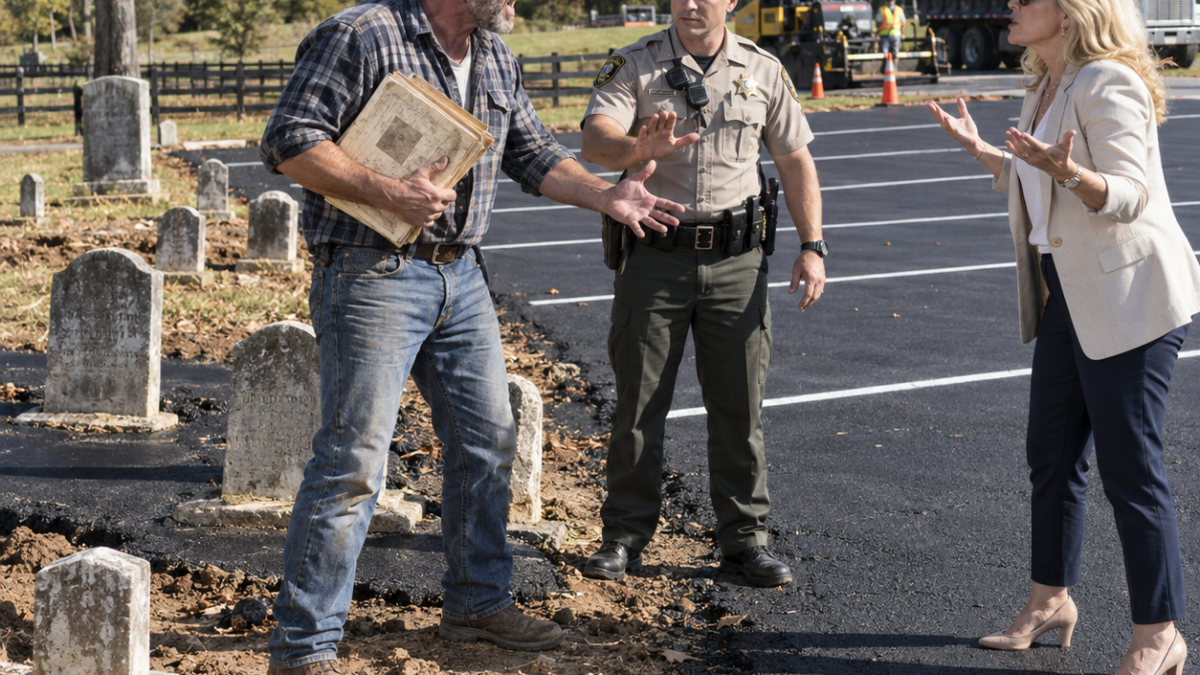
The first patrol car came around the curve less than five minutes later.
A young deputy stepped out.
He took in the scene slowly.
The machine.
The ripped ground.
Karen.
Me.
Then the fragments of stone.
“What happened here?”
Karen answered before I could open my mouth.
“Officer, thank goodness. This man is trespassing and disrupting an authorized HOA improvement project.”
The deputy looked at me.
“Sir?”
“My name is Jack Caldwell. This acre is a private family cemetery. My family has buried people here since the nineteenth century.”
The deputy looked again at the bulldozed land.
“Cemetery?”
“Yes.”
Karen made an impatient sound.
“It has not functioned as an active cemetery in decades.”
“That doesn’t mean the graves disappear.”
“They were never properly documented.”
I walked toward the marble fragment.
“Officer, look at this.”
He followed.
I crouched and lifted the fragment only enough to expose more lettering without moving it from where it lay.
**ELEAN—**
The deputy’s expression changed.
“Don’t touch anything else.”
“I wasn’t planning to.”
He stepped away and used his radio.
Karen crossed her arms.
“This is ridiculous.”
The deputy looked at her.
“Ma’am, did you authorize this clearing?”
“I’m the HOA president.”
“That wasn’t my question.”
Her lips pressed together.
“The board authorized it.”
“And you were project lead?”
“I supervised implementation.”
“Who owns the parcel?”
“The association.”
I said, “No, it doesn’t.”
The deputy held up one hand.
“Everybody stop.”
A second patrol unit arrived.
Then a sergeant.
He was older, maybe late fifties, with gray at his temples and the deliberate manner of someone accustomed to arriving after younger officers had realized they needed help.
He introduced himself as Sergeant Daniel Reeves.
Karen immediately repeated her explanation.
Permits.
Abandoned parcel.
Community improvement.
Overflow parking.
Reeves listened without interrupting.
When she finished, he asked, “What made you believe nobody was buried here?”
Karen shifted.
“Our consultant found no active cemetery registration.”
“Did you see grave markers?”
“There were some decorative stones.”
I felt something inside me tighten.
Reeves noticed.
He turned toward me.
“Mr. Caldwell?”
“My parents are buried here.”
His expression softened.
“How recently?”
“My father ten years ago. My mother twelve.”
“So these weren’t nineteenth-century graves nobody remembered.”
“No.”
“Who maintains the cemetery?”
“Our family.”
“How often?”
“My cousin Sarah lives twenty minutes away. She cuts the grass. I come several times a year. We have a family trust for maintenance.”
Reeves looked back at Karen.
“That sounds fairly active.”
Karen snapped, “Maintenance does not establish legal ownership.”
“No,” Reeves said. “Deeds usually help with that.”
For the first time, I almost smiled.
He walked the perimeter.
At the far side, a construction worker had stopped beside a dump truck.
Reeves motioned him over.
“Were you operating equipment here?”
The man shook his head rapidly.
“No, sir. I drive haul.”
“Who ran the dozer?”
“Pete.”
“Where’s Pete?”
“He went to lunch.”
“When?”
The driver looked toward Karen.
She stared back.
“About twenty minutes ago.”
“Call him.”
Karen objected immediately.
“Officer, these workers are contracted by the HOA. You cannot interfere—”
Reeves turned.
“Ma’am, I am investigating whether graves were disturbed. Nobody operates anything until I know what I’m standing on.”
“This is outrageous.”
“Maybe.”
He pointed toward the bulldozer.
“That machine stays.”
Then toward the trucks.
“They stay.”
Then at everyone.
“Nobody removes dirt, stone, debris, or equipment.”
Karen’s face flushed.
“You don’t have authority to shut down our project.”
Reeves looked at her for a long second.
“Today, I do.”
That was the first moment I saw Karen understand that her title had limits.
She hated it.
I called my cousin Sarah while officers began photographing the site.
She answered on the first ring.
“Jack?”
“They stopped the work.”
“Oh, thank God.”
“Sarah, I need something.”
“What?”
“Every deed, survey, maintenance receipt, cemetery trust record—anything connected to the plot.”
“I have some.”
“Get everything.”
“I already called Uncle Robert.”
“Good.”
Her voice broke.
“Did you find Mom and Uncle Henry’s stones?”
“Not yet.”
“Jack…”
“I know.”
“No, you don’t.”
She was crying now.
“I was there last Sunday.”
I closed my eyes.
“I put flowers on Aunt Louise’s grave.”
I didn’t know what to say.
Behind me, Karen was arguing with one of the deputies.
“I’m going to find them,” I told Sarah.
“All of them.”
After that I called my attorney.
Ben Carter had helped me with a land purchase years earlier.
He was younger than me by fifteen years and possessed the kind of personality judges probably found either refreshing or exhausting.
“Jack?”
“I need you.”
“What happened?”
“Somebody bulldozed our cemetery.”
Silence.
“What?”
“The Oakhaven HOA.”
Another silence.
“Start again.”
I told him.
He stopped me twice.
Once when I mentioned permits.
Again when I said my parents were buried there.
“Police involved?”
“Yes.”
“Do not argue ownership with the HOA anymore.”
“Fine.”
“Do not threaten anyone.”
“Fine.”
“Do not move anything.”
“Police already said that.”
“Good. Photograph everything you’re legally able to photograph.”
“Already doing it.”
Ben exhaled.
“I keep forgetting you’re you.”
“What does that mean?”
“It means normal clients call me before creating a chain-of-custody spreadsheet.”
“I haven’t created one yet.”
“Yet.”
He told me to meet him at the county records office the next morning.
By late afternoon, crime-scene tape surrounded the acre.
Detective Nathan Morrison arrived from the sheriff’s investigations division.
Unlike the patrol officers, he asked almost no questions at first.
He walked.
Looked.
Photographed.
Stood near the uprooted oak stump for nearly a minute.
Then he found me.
“Mr. Caldwell?”
“Yes.”
“I’m told you can identify where specific graves were.”
“Most of them.”
“Don’t walk the site yet.”
“I understand.”
“We may bring in specialists.”
“For remains?”
“Yes.”
That word hit harder than anything Karen had said.
Remains.
My parents.
My grandparents.
Eleanor.
People reduced, legally and scientifically, to remains.
Morrison must have seen something in my face.
“I’m sorry.”
I nodded.
“Do you believe bodies were disturbed?”
“I don’t know yet.”
“What happens now?”
“We preserve the site.”
“And Karen?”
“She’s giving us documents.”
“Are you arresting her?”
“Not today.”
The answer irritated me more than it should have.
He saw that too.
“This isn’t television, Mr. Caldwell.”
“I know.”
“Good. Because ownership, permits, knowledge, what workers saw, what she represented on applications—those facts matter.”
I looked toward Karen.
She stood beside her SUV speaking urgently into her phone.
“What if she lied?”
“Then lying tends to create documents.”
That sentence helped.
Documents.
I understood documents.
The next morning, Ben and I met at the county courthouse annex.
The records clerk was a woman named Margaret Cole who had worked there thirty-two years.
She knew Ben.
That saved us time.
“I need the original subdivision conveyance for Oakhaven,” he said. “Late seventies.”
Margaret typed.
“Developer?”
“Harrison Residential.”
“Caldwell parcel.”
Her eyebrows rose.
“Oh.”
“What?” I asked.
“You’re that cemetery.”
The news had traveled fast.
“Yes.”
She disappeared into a back office.
When she returned, she carried a thick folder and a large archival envelope.
Inside was the 1978 deed.
My grandfather had sold 299 acres.
Not 300.
One acre was explicitly excluded.
**Caldwell Family Burial Ground.**
There was also a permanent ingress-and-egress easement.
The language was plain enough that even I could understand it without Ben translating.
Ben pointed at the exclusion.
“This is good.”
“How good?”
“As in your ownership question is not remotely ambiguous based on this document.”
Margaret found later plats.
Every one preserved the acre.
Even Oakhaven’s original common-area map showed a rectangular hole in the development.
The cemetery.
My family’s land.
Not theirs.
We ordered certified copies.
Then Margaret frowned at her screen.
“What?” Ben asked.
“There’s a grading permit.”
My stomach tightened.
“For what?”
“Oakhaven overflow parking.”
“Parcel?”
She read the number.
Not ours.
It referenced adjacent HOA common land.
Ben leaned over the counter.
“Can you pull the application?”
“That’s planning.”
“Call them.”
She did.
Twenty minutes later, we were sitting with a county planning supervisor named Melissa Grant.
She looked sick.
The permit file was on her desk.
The application map showed the parking area extending directly across our cemetery.
“Who submitted this?” Ben asked.
Melissa turned the page.
Oakhaven Homeowners Association.
Project representative:
Karen Miller.
The application contained a certification that the HOA controlled the entire work area.
It also asked whether known burial grounds, archaeological sites, or protected cultural resources existed within the project footprint.
Karen had checked:
**NO.**
I stared at it.
“She knew.”
Melissa said carefully, “I can’t tell you what she knew.”
“I told you. My cousin maintains that cemetery.”
“I understand.”
“There were headstones.”
“I understand.”
Ben put a hand on my arm.
Not restraining me.
Reminding me.
Facts.
“Melissa,” he said, “did anyone from your office inspect before permit issuance?”
She looked embarrassed.
“This category of minor site work sometimes relies on applicant representations and electronic mapping.”
“So the county map didn’t flag the cemetery?”
“It should have.”
“Did it?”
“No.”
“Why?”
“We’re investigating.”
I asked, “Could somebody have intentionally omitted it?”
Melissa chose every word.
“The application overlay submitted by the HOA did not identify the cemetery parcel separately.”
Ben and I exchanged a look.
“What does that mean?”
She rotated the screen.
The map Karen submitted had combined the cemetery acre visually with surrounding HOA property.
Just like that.
A line deleted.
A parcel swallowed.
“Can we get a copy?”
Ben asked.
“You can file a request.”
“I’ll do it before I leave.”
We walked out carrying enough paper to fill another binder.
In the parking lot Ben stopped me.
“Jack.”
“What?”
“This just changed.”
“How?”
“The HOA’s deed claim is weak.”
“We knew that.”
“Now we may have misrepresentations on a government permit.”
“Criminal?”
“Maybe.”
“You hate that word.”
“I love it when it belongs in an indictment. I hate it when clients use it before prosecutors do.”
I looked back at the building.
“She erased the cemetery from the map.”
“It appears somebody submitted a map that did not show it.”
“You’d make a terrible headline writer.”
“I’d make an excellent defense attorney.”
That afternoon Karen struck back.
Ben received an email from Oakhaven’s counsel accusing me of harassing the board and interfering with contracted construction.
They also claimed the cemetery had been abandoned.
Attached were board minutes from three months earlier.
The board had declared the parcel “unused, unmanaged, and reverted to common neighborhood purposes.”
Reverted.
As if property ownership worked like an expired coupon.
“They can’t vote themselves my land,” I said.
“No.”
“Then what is this?”
“Confidence.”
Ben scrolled.
“Or stupidity.”
The minutes said notices had been sent to “known heirs.”
None of us received one.
Sarah checked.
Uncle Robert checked.
Aunt Carol.
Cousins.
Nothing.
Then Sarah found something.
The address list used by the HOA came from an old 1984 family genealogy booklet.
Several recipients were dead.
One address had been demolished in 1997.
A certified notice allegedly mailed to my father was dated seven years after his death.
I stared at the copy.
“They mailed Dad?”
“Supposedly.”
“To the old house?”
“Yes.”
“He was dead.”
“I know.”
“Who signed?”
“Nobody. Returned.”
Ben leaned back.
“So they knew their notice failed.”
“And proceeded anyway.”
“Looks that way.”
The sheriff’s investigation continued.
The bulldozer operator eventually returned for questioning.
His name was Peter Lawson.
He was forty-three, worked for an excavation subcontractor, and looked like he had not slept.
Morrison interviewed him privately.
I didn’t know what he said until days later.
What I did know was that deputies searched a drainage ravine behind Oakhaven’s maintenance building.
Sarah called me while I was driving.
“Jack.”
“What?”
“They found stones.”
I pulled onto the shoulder.
“What stones?”
“Headstones.”
Everything inside me stopped.
“Where?”
“Behind the maintenance shed.”
“How many?”
“I don’t know.”
“Who told you?”
“Uncle Robert. Morrison called him because his number was on the family contact list.”
I turned the truck around.
By the time I reached Oakhaven, police tape blocked the maintenance road.
Morrison met me.
“You can’t go down there.”
“Are they ours?”
“We believe so.”
“How did they get there?”
“We’re working on that.”
“Can I see them?”
“Not yet.”
My hands curled.
“Morrison.”
His voice softened.
“Jack, some are badly damaged.”
I looked away.
For all the discipline I had carried through the previous days, that sentence nearly broke me.
Not missing.
Damaged.
My father had chosen his and Mom’s marker himself.
Gray granite.
Nothing elaborate.
Their names.
Dates.
And one line:
**HOME IS WHERE WE FOUND EACH OTHER.**
I could see it in my mind.
Then I imagined it shattered in a ravine.
I sat down on the tailgate of my truck.
Morrison stood beside me without speaking.
After a while he said, “Lawson told us he saw stones.”
I looked up.
“He knew?”
“He says he questioned them.”
“And?”
“He claims Mrs. Miller told him they were decorative memorial stones from the old subdivision landscaping.”
“That makes no sense.”
“I agree.”
“What did he do?”
“He removed several larger stones rather than grinding them because he felt uncomfortable.”
“And dumped them back here?”
“At the direction of the site supervisor.”
“Karen?”
“We are still establishing who gave which instruction.”
I rubbed both hands over my face.
“Did he hit graves?”
Morrison hesitated.
“Yes.”
The word hollowed me out.
“What did he say?”
“He said the ground collapsed unexpectedly in two locations.”
I couldn’t speak.
“He stopped.”
“And then?”
“He says he called the project contact.”
“Karen.”
“He called Mrs. Miller.”
“What did she tell him?”
Morrison looked directly at me.
“That is part of the investigation.”
I stood.
“If she told him to keep digging—”
“Jack.”
“If she knew—”
“Go home.”
I stared at him.
“That’s an order?”
“No. Advice.”
“I don’t want advice.”
“I know.”
His voice became firmer.
“You want something you can do with your anger. Right now there is nothing useful for you to do here.”
I hated him for saying it.
Because he was right.
I went home.
That night I sat at my kitchen table until after midnight.
Sarah joined me at eleven.
Not my cousin Sarah.
My wife, Laura.
She had been quiet since this started.
Too quiet.
She placed a mug beside me.
“You have to sleep.”
“I can’t.”
“You haven’t slept properly in four days.”
“My parents might be in evidence bags.”
Her eyes filled.
I immediately regretted saying it.
“I’m sorry.”
Laura sat beside me.
For thirty years she had watched me leave for deployments.
Watched me come home changed.
Watched me build routines around control because control felt safer than uncertainty.
“You’re doing it again,” she said.
“What?”
“Trying to turn grief into a mission.”
“What should I do instead?”
“Grieve.”
I looked toward the window.
“I don’t know how until I know where they are.”
Laura took my hand.
“You know where they are.”
I looked at her.
“In your family.”
That was exactly the kind of sentence I usually hated.
Too gentle.
Too abstract.
But that night it landed.
The next morning, Aunt Carol arrived.
Eighty-eight years old.
Five feet tall.
White hair.
Cane.
Terrifying.
“You look awful,” she told me.
“Good morning to you too.”
“I’ve buried three brothers, a husband, and a son. You don’t get points for suffering theatrically.”
Laura kissed her cheek.
“I made coffee.”
“Strong?”
“Yes.”
“Then you may stay in the family.”
Aunt Carol sat at the table.
She brought photographs.
The cemetery before destruction.
Birthday picnics.
Memorial Day gatherings.
My parents’ funeral.
One photograph showed the oak in 1952.
Young Carol stood beneath it beside her husband Frank.
Another showed my father placing flowers at Eleanor’s grave.
“They say it was abandoned,” I said.
Carol snorted.
“I was there six weeks ago.”
“You were?”
“Robert drove me.”
She pulled out her phone.
Not a smart phone.
An old flip phone.
She handed me a photograph printed at a pharmacy.
Date stamped.
There she was.
Standing beside the cemetery gate.
Six weeks earlier.
Markers clean.
Grass cut.
Roses blooming.
“That,” Carol said, “is what abandoned looks like according to Mrs. Miller.”
Ben nearly hugged her when he saw it.
More relatives came forward.
Maintenance checks.
Receipts.
Photographs.
Christmas visits.
Flowers.
Memorial Day flags.
We could prove continuous family use.
But something else happened.
Oakhaven residents began contacting us.
The first were the Hendersons.
Robert Henderson used a wheelchair after a spinal stroke.
His wife, Nancy, showed me a stack of HOA notices regarding their accessibility ramp.
Wrong stain color.
Wrong rail design.
Wrong angle according to architectural guidelines.
Late fines.
Legal charges.
Threatened lien.
“Why didn’t you fight?” I asked.
Nancy looked toward her husband.
“We did.”
Robert spoke quietly.
“Until the lawyer cost more than repainting.”
Then came Priya and Sameer Patel.
Karen had cited their Diwali decorations as excessive exterior lighting.
A single mother named Monica Reyes had been fined repeatedly over a basketball hoop.
A couple on Pine Hollow Court had been forced to remove a vegetable garden because it violated ornamental-landscaping standards.
Not every complaint was legally outrageous.
Some rules had been valid.
Some residents had technically violated them.
But a pattern emerged.
Karen escalated quickly against people who challenged her.
Fines multiplied.
Hearings were delayed.
Legal fees accumulated.
People paid to make the problem stop.
I told Ben.
“This is bigger.”
He shook his head.
“Careful.”
“You’ve seen their files.”
“Yes.”
“She’s been doing this for years.”
“Maybe. But our cemetery case is strong because we have deeds, permits, physical destruction, and witnesses.”
“So we ignore everyone else?”
“No.”
He leaned forward.
“We don’t mix every injustice into one lawsuit just because we’re angry.”
That was why Ben was useful.
He separated vengeance from strategy.
“Then what do we do?”
“We help them get independent counsel.”
“And Karen?”
“We let her keep talking.”
Karen obliged.
The story reached local television after my cousin Daniel, a documentary editor in California, contacted a reporter he knew.
I resisted at first.
I did not want my parents’ graves turned into spectacle.
Then Aunt Carol said, “If we stay quiet, she gets to call it weeds.”
So we agreed.
Reporter Allison Reed came to my house.
No dramatic interview at the damaged cemetery.
No shouting beside police tape.
We sat around the dining table.
I showed her photographs.
The old oak.
Eleanor’s marker.
My parents’ stone.
The family burial after my father died.
Then Carol placed a photograph of Thomas Caldwell on the table.
World War I uniform.
Twenty-one years old.
“He died overseas,” Carol said. “His body never came home.”
The cemetery had a memorial stone for him.
Not a grave.
A place where his mother could bring flowers.
“Was that stone destroyed?” Allison asked.
Carol nodded.
“He was lost once in war.”
Her voice shook.
“I don’t appreciate losing him again to a parking lot.”
Nobody in the room spoke.
That clip became the center of the broadcast.
The story aired that evening.
The reaction was immediate.
Oakhaven residents flooded the HOA board with questions.
The regional event that had motivated the parking expansion withdrew from the clubhouse.
The HOA’s management company announced it was conducting an internal review.
More importantly, the state historic-preservation office became involved because the site potentially contained historic burials.
Archaeologists arrived.
This changed everything emotionally.
The cemetery became quiet again.
Not peaceful.
Clinical.
Measured grids.
Evidence markers.
Small brushes.
Screens for soil.
People working slowly where bulldozers had moved quickly.
I watched from beyond the restricted perimeter.
Dr. Maya Ellison, the lead archaeologist, came over after several hours.
“We will treat every fragment as human remains until we establish otherwise.”
“Can you identify individuals?”
“Sometimes.”
“How?”
“Location, coffin hardware, previous records, grave layouts, forensic work if necessary.”
“I have a map.”
Her eyes sharpened.
“What kind?”
“My grandfather had the cemetery surveyed in 1978.”
“That could be extremely helpful.”
I brought it the next morning.
Every grave location was marked.
Names.
Dates.
Rows.
There were forty-three known burials.
Plus three memorial markers for relatives whose bodies rested elsewhere.
Maya studied the map.
“This might save weeks.”
I stared across the torn earth.
“Can you put them back?”
She chose her words carefully.
“We can restore the cemetery.”
“That’s not what I asked.”
“No.”
Silence.
“Some graves may have been disturbed enough that perfect individual reassociation won’t be possible.”
I looked down.
“I’m sorry.”
Everyone kept telling me that.
They meant it.
But sorry is a small word beside a grave.
A major breakthrough came from Peter Lawson.
The bulldozer operator.
His attorney arranged a formal statement.
Morrison later summarized the parts relevant to us.
Peter arrived at the site at 6:30 that morning.
He saw several markers.
He called Karen.
She arrived before work started.
He asked about the stones.
Karen told him the land had been legally reclaimed.
He asked if they were grave markers.
She said they were “old memorial decorations.”
Then Peter found a footstone.
Not decorative.
A small granite slab.
Initials.
He stopped again.
Karen allegedly told him everything had been cleared through the county and instructed him to continue.
Later, when the blade exposed what Peter believed could be coffin material, he stopped a third time.
This time he refused to continue until another supervisor arrived.
By then much of the acre had already been damaged.
“Why didn’t he call police?” I asked Morrison.
“He thought permits existed.”
“He saw a cemetery.”
“He says he didn’t understand what he was looking at until the damage began.”
“Do you believe him?”
“I believe evidence decides whether his account holds.”
Peter had saved the larger markers instead of crushing them.
That fact mattered to me.
He had made mistakes.
Terrible ones.
But somewhere in him, something had said stop.
Karen’s permit application mattered more.
She had certified no known burials existed.
Investigators obtained emails showing the HOA board had discussed the cemetery months earlier.
One message from Dave Palmer, a board member, was especially important.
**We need to clarify ownership because Caldwell family members still visit and maintain graves. We cannot assume this is common property.**
Karen replied:
**We have already discussed this. The parcel is effectively abandoned and blocking community use. Stop complicating a straightforward improvement.**
I read that email in Ben’s office.
“She knew.”
Ben nodded.
“That is certainly evidence she knew people claimed and maintained the cemetery.”
“What did Dave do?”
“Abstained from the parking vote.”
“Why didn’t he tell anyone?”
“He may have believed the project would stop.”
“Coward.”
Ben closed the folder.
“Maybe.”
“You disagree?”
“I’m saying fear makes people weak in ordinary ways.”
I hated that too.
Because it was probably true.
Then Laura found the clause.
We had obtained the HOA bylaws through discovery and resident requests.
One night, she was reading them because she said if she had to hear me talk about Karen every evening, she deserved source material.
At 12:17 a.m., she came into the bedroom.
“Wake up.”
I opened one eye.
“What?”
“I found something.”
“That is never a good sentence after midnight.”
She handed me the bylaws.
Article Nine.
Capital Projects.
Any non-budgeted capital project above $25,000 required a supermajority homeowner approval.
The parking project cost $48,600.
No homeowner referendum had occurred.
The board minutes showed only four directors voting yes.
One no.
One abstention.
The project should not have proceeded even under the HOA’s own rules.
There was also an indemnification clause.
Not the magical personal-bankruptcy clause the story Karen told herself about authority might have suggested.
The real language was narrower.
Board officers could lose association indemnification for acts committed knowingly outside their authority or involving intentional misconduct.
Ben became very interested.
“This matters.”
“Personally?”
“Potentially.”
“Meaning?”
“If she acted knowingly outside HOA authority, the association’s insurance and indemnification protections may not shield everything.”
“So she could be personally liable.”
“Possibly.”
“For restoration?”
“Possibly.”
“You say possibly a lot.”
“Because judges enjoy deciding things.”
The emergency HOA meeting happened six weeks after the bulldozer entered the cemetery.
Karen called it.
That was her mistake.
She wanted to regain control.
The notice described the destruction as a “construction-related misunderstanding.”
Misunderstanding.
Forty-three graves.
Misunderstanding.
The clubhouse filled before the meeting started.
Residents stood along the walls.
News cameras remained outside at first because the board tried to exclude them.
Homeowners voted to allow recording.
Karen lost that vote.
I sat with Laura.
Aunt Carol on my left.
Ben beside her.
The Hendersons in front.
Patels behind us.
Peter Lawson was not there.
Neither was Detective Morrison.
At seven, Karen struck her gavel.
“This meeting will come to order.”
The room quieted.
She looked thinner than when I first met her.
Tired.
But still defiant.
She began reading a statement.
“The board deeply regrets the distress caused by recent events surrounding the clubhouse parking improvement.”
Someone called, “Distress?”
Karen continued.
“The project was undertaken in good faith based upon permits and historical property information available to the association.”
Murmurs.
“There has been significant misinformation.”
Aunt Carol whispered, “There always is when facts become inconvenient.”
Karen continued.
“No intentional desecration occurred.”
I felt Laura take my hand.
Karen blamed outdated county mapping.
Ambiguous deeds.
Contractor errors.
Media sensationalism.
Then she said the sentence that changed the room.
“The area in question had not functioned as a legitimate cemetery for many years.”
Aunt Carol stood.
She didn’t ask permission.
Karen stopped.
“Mrs. Caldwell—”
“Carol.”
“I’m sorry?”
“My name is Carol Caldwell.”
“You’ll have an opportunity during public comment.”
“I am eighty-eight years old.”
A few people smiled.
Karen looked uncertain.
Carol held up her photograph.
“I stood in that cemetery six weeks before you destroyed it.”
Silence.
“I buried my husband there.”
Her voice shook.
“I buried my sister there.”
She pointed toward me.
“I watched Jack bury both of his parents there.”
Karen began, “I understand emotions—”
“No.”
Carol’s voice strengthened.
“You understand parking.”
Applause erupted.
Karen hit the gavel.
“Please.”
Carol remained standing.
“You called it abandoned because dead people cannot argue with you.”
The room went still.
I had never loved my aunt more.
She sat down.
Karen tried to continue.
The Hendersons stood next.
Nancy described the ramp.
Robert described the lien.
Priya Patel described repeated citations after she challenged Karen publicly.
Monica Reyes described choosing between a legal consultation and groceries one month because of accumulated fees.
The atmosphere changed from anger to testimony.
That mattered.
People stopped shouting.
They started telling the truth.
One by one.
Documents in hand.
Karen’s authority had always depended on isolating people.
Tonight nobody was isolated.
Then Ben stood.
“My name is Benjamin Carter. I represent the Caldwell family.”
Karen folded her arms.
“This is not a courtroom.”
“No.”
Ben walked to the front.
“That is why I will keep this short.”
He placed enlarged copies of documents on an easel.
First:
The 1978 deed.
“This excludes the cemetery from the developer’s conveyance.”
Second:
The recorded subdivision plat.
“This shows the cemetery outside Oakhaven common property.”
Third:
The permanent family access easement.
“This establishes continuing legal access.”
Fourth:
Aunt Carol’s photograph.
“Taken six weeks before demolition.”
Fifth:
Karen’s grading permit application.
Ben did not accuse.
He read.
**No known burial grounds.**
The room reacted instantly.
Karen leaned toward her microphone.
“That form was prepared by a contractor.”
Ben turned a page.
“Signed by Karen Miller.”
Her face changed.
Then Ben displayed the email from Dave Palmer.
**Caldwell family members still visit and maintain graves.**
A murmur moved through the room.
Dave was present.
He stood near the side wall.
Everyone looked at him.
Karen did too.
“Dave,” she said.
He stared at the floor.
Ben asked, “Mr. Palmer, is that your email?”
Karen slammed the gavel.
“He is not under oath.”
Dave raised his head.
“Yes.”
Karen froze.
“Dave.”
He looked at her.
“I told you we needed an attorney’s title opinion.”
“We had permits.”
“I told you permits weren’t ownership.”
“You voted for planning.”
“I voted for studying parking.”
His voice became louder.
“I did not vote to bulldoze graves.”
The room erupted.
Karen stood.
“This is becoming a mob.”
“No,” Mr. Henderson said from his wheelchair.
“This is becoming a meeting.”
Laughter.
Karen’s face went white with fury.
Ben waited.
Then displayed the capital-project bylaw.
He explained the cost threshold.
The missing homeowner vote.
The board’s failure to follow its own approval process.
Karen interrupted.
“The board has emergency authority.”
“For emergency preservation expenses.”
“This was necessary for event safety.”
“The event was a bake-off.”
The laughter this time was brutal.
Even I felt uncomfortable.
Karen wasn’t a cartoon anymore.
She was a woman watching years of control disappear.
She gripped the podium.
Ben continued.
“The association’s insurers and attorneys will determine what coverage exists. Courts will determine liability. Prosecutors will determine whether criminal charges are appropriate.”
That was one of the things I appreciated about Ben.
He did not promise things he couldn’t guarantee.
“But one thing is not in dispute,” he said.
He held up the deed.
“The cemetery did not belong to this HOA.”
Silence.
“And no board vote changed that.”
Frank Henderson’s voice came from the front.
“I move that Karen Miller be removed as president.”
Karen shouted, “That motion is not properly noticed.”
A resident responded, “Then schedule the removal vote.”
Another homeowner stood.
“I second that.”
Then another.
Twenty hands.
Thirty.
Forty.
Karen pounded the gavel.
“This meeting is adjourned.”
Nobody moved.
Ben leaned toward me.
“Do not say anything.”
“I wasn’t going to.”
“You are thinking loudly.”
“I’m watching.”
Karen collected her papers.
Then the doors opened.
Detective Morrison entered.
With him were two uniformed deputies.
Nobody applauded.
Thank God.
This was not entertainment.
Morrison walked to Karen.
“Mrs. Miller?”
She stared at him.
“Yes?”
“Could we speak outside?”
Her eyes flicked around the room.
“About what?”
“The cemetery investigation.”
“My attorney is not here.”
“You can contact counsel.”
“Am I being detained?”
Morrison paused.
“Yes.”
The room went dead silent.
Karen’s face collapsed.
Not dramatically.
Just suddenly.
The anger disappeared.
“What are the charges?”
“I’ll explain outside.”
She looked at the cameras.
Then at the residents.
Then at me.
For the first time, I saw fear without arrogance around it.
Pure fear.
“Jack.”
My name came out softly.
I stood.
Ben immediately whispered, “Careful.”
Karen looked at me.
“I never meant—”
I waited.
She couldn’t finish.
I could have destroyed her in that moment.
I had imagined doing it.
Telling her she deserved everything.
Telling her my family would take her house.
Telling her my dead parents had more dignity than she ever would.
Instead I said the only thing that mattered.
“You should have stopped the machine.”
Karen looked away.
Morrison led her outside.
We learned later that prosecutors had approved charges related to the destruction of protected burial sites, property damage, and false statements associated with the permit process.
Not every initial allegation survived.
Some charges changed.
Some were combined.
The legal process took months.
That was reality.
What happened in the clubhouse mattered less than what happened afterward.
The HOA board fractured.
Two directors resigned within days.
Dave Palmer stayed long enough to turn over records.
A temporary board was appointed under the bylaws.
Then homeowners held a proper election.
Robert Henderson did not become president.
He laughed when people suggested it.
“I spent eighteen months arguing about a ramp. I’m retiring from government.”
Nancy joined the compliance committee instead.
Her first proposal was simple.
“No daily fines against disabled residents while an accommodation request is pending.”
It passed unanimously.
Franklin Moore, a quiet accountant who had lived in Oakhaven for fourteen years, became president.
His first announcement contained no slogans.
No vision.
No threats.
“We are going to figure out what we actually own, what we actually owe, and what our documents actually say.”
That sounded excellent to me.
The new board formally acknowledged that the Caldwell cemetery had never been association property.
It recorded a corrective document confirming the cemetery exclusion and access easement.
They also suspended disputed enforcement actions from Karen’s tenure for independent review.
Some fines were valid.
Some were reduced.
Others were voided.
The Henderson lien was released after counsel determined that accommodation procedures had not been handled correctly.
Robert cried when the release arrived.
He later framed it.
“I put it right beside our wedding picture.”
Nancy rolled her eyes.
“That is why I control the decorating.”
The cemetery restoration took almost a year.
That was the hardest part.
Dr. Maya Ellison’s team worked slowly.
Some grave locations remained identifiable.
Others had been disrupted.
We learned that restoration is not the same as undoing.
Nothing could undo what happened.
Some stones could be repaired.
Others could not.
The large pieces recovered from the ravine were transported to a conservator.
My parents’ marker had broken into three sections.
But the inscription survived.
**HOME IS WHERE WE FOUND EACH OTHER.**
When Maya showed me the cleaned fragments, I sat down.
I touched the edge.
Not the lettering.
Just the granite.
Laura stood behind me.
“It’s them,” I said.
“I know.”
“They saved it.”
She put her hand on my shoulder.
“Yes.”
My father’s grave had been disturbed but remained largely identifiable.
My mother’s too.
Several older graves were not so fortunate.
For those, our family made a decision.
We created a protected common reinterment area within the cemetery for commingled historical remains that could not be confidently assigned.
No names lost.
Every known Caldwell remained listed.
But we refused to pretend science could restore certainty where a bulldozer had destroyed it.
Aunt Carol approved.
“That is what families do,” she said.
“What?”
“Keep everybody together when we no longer know exactly where they belong.”
The old oak could not be replaced.
Not really.
A tree that had lived nearly two centuries is not replaced with a sapling.
But we planted another live oak near the same spot.
Aunt Carol insisted.
“I’m not waiting two hundred years to see if you pick a decent tree.”
We chose one twelve feet tall.
When it went into the ground, she placed the first shovel of soil.
Mr. Henderson built benches.
The Patels organized a fundraiser for restoration landscaping.
Monica Reyes brought native flowers.
Children from Oakhaven helped plant bulbs along the access path.
That moved me more than the lawsuits.
People who had never known a Caldwell buried there arrived Saturday mornings carrying rakes.
They cleaned stone.
Spread mulch.
Painted the restored gate.
A cemetery Karen had called useless became one of the few places where old Oakhaven and new Oakhaven actually met.
Her criminal case ended eleven months after the bulldozing.
Karen pleaded guilty to reduced charges involving unlawful damage to protected burial property and false statements connected to the permit process.
The plea spared everyone a long trial.
Including my family.
The judge ordered restitution.
Community service was obviously not going to repair the graves, so the financial consequences focused heavily on restoration costs and other damages determined through the civil process.
She also received a period of incarceration followed by supervised probation.
Not decades.
Not a cinematic life sentence.
Enough to make what she had done unmistakably serious.
Her civil situation hurt too.
The HOA’s insurer contested portions of coverage.
The association sued its former management partners and contractors where appropriate.
Karen faced personal claims because investigators and civil attorneys argued some of her conduct fell outside ordinary protected board activity.
Eventually, the parties reached settlements.
I never received millions.
I didn’t want millions.
Our family trust received funds sufficient to pay for cemetery restoration, long-term maintenance, security, and legal costs.
A permanent preservation agreement was recorded.
The cemetery boundaries were monumented with stone markers.
Any future construction within a defined buffer would require formal review.
Nobody was going to “lose” that cemetery on a subdivision map again.
Karen sold her house.
Her marriage did not survive the aftermath.
I did not celebrate that.
Her husband had not driven the bulldozer.
Their private pain was theirs.
For a long time, residents asked what I thought Karen deserved.
I stopped answering.
Justice had stopped being about punishment for me somewhere around month six.
I wanted my parents’ stone back.
I wanted Eleanor’s name readable again.
I wanted Aunt Carol to walk through that gate before she died and recognize the place.
That happened exactly one year after the destruction.
The rededication ceremony began at ten in the morning.
Sunlight came through the young oak.
Not much shade yet.
But enough promise.
Hundreds of Caldwells attended.
Some I hadn’t seen since childhood.
Others I had never met.
Oakhaven residents came too.
The Hendersons.
The Patels.
Monica.
Franklin Moore.
Even Dave Palmer.
He stood near the back.
I didn’t know how I felt about him.
He had warned Karen privately.
Then failed to stop her publicly.
Eventually he walked toward me.
“Jack.”
“Dave.”
“I should’ve done more.”
“Yes.”
He flinched.
I didn’t soften it.
Some truths shouldn’t be.
“I thought if I kept questioning her internally, the project would die.”
“It didn’t.”
“I know.”
“You saw the cemetery.”
“Yes.”
“You knew families maintained it.”
“Yes.”
“Then why didn’t you call us?”
Dave looked toward the restored stones.
“Because I didn’t want Karen coming after me.”
There it was.
The ordinary weakness Ben had described.
Not evil.
Fear.
“I’m sorry,” he said.
I believed him.
Believing him didn’t erase anything.
“I hope next time you’re afraid, you remember this place.”
He nodded.
“I will.”
Aunt Carol wore blue.
She insisted on cutting the ribbon at the restored gate.
“Why blue?” Laura asked.
“Because I look terrible in black.”
Nobody argued.
Before the ceremony, I walked alone to my parents’ grave.
The restored marker stood on a new foundation.
The repair seams were visible if you looked closely.
We chose not to hide them completely.
A conservator had suggested making the stone appear new.
I said no.
The damage was part of its history now.
I touched my father’s name.
“Sorry it took so long.”
My voice broke.
There was nobody there to hear except the dead.
“Mom.”
I took a breath.
“I tried.”
For months, I had wondered whether I failed them by not protecting the cemetery before Karen arrived.
Maybe I should have installed cameras.
More signs.
A fence.
Maybe I should have checked county filings more often.
Grief is creative that way.
It can manufacture responsibility from things you never could have predicted.
Laura later told me the truth.
“You did not fail your parents because you didn’t anticipate a woman bulldozing their graves for parking.”
Simple.
Obvious.
Hard to accept.
I stood there until Aunt Carol shouted from the gate.
“Jack! Unless you intend to become a permanent resident today, get over here.”
I laughed.
My father would have too.
Uncle Robert spoke during the ceremony.
He talked about Eleanor.
The first burial.
The early farm.
The family.
Then he talked about Oakhaven.
Not as an enemy.
That surprised me.
“When our grandfather sold this land,” he said, “he believed families would live here after ours stopped farming most of it.”
He looked at the residents.
“He could not have imagined homeowners associations, architectural committees, or people arguing about mailbox colors.”
Laughter.
“But he understood neighbors.”
He pointed toward the new benches.
“Neighbors built those.”
Toward the flowers.
“Neighbors planted those.”
Then the restored gate.
“Neighbors painted that.”
He paused.
“One board destroyed something.”
“An entire community helped rebuild it.”
That was the line people remembered.
Not anything I said.
Because I didn’t give a speech.
By then I was tired of speeches.
After the ceremony, children ran through the grass.
Not across graves.
They understood the paths.
Families sat under temporary tents eating barbecue.
Mr. Henderson rolled his wheelchair onto the new crushed-stone path he had helped design.
He stopped beside me.
“You know what Karen would say?”
“What?”
“Wrong gravel color.”
I laughed so hard my ribs hurt.
Nancy slapped his shoulder.
“Behave.”
“I am behaving.”
Aunt Carol approached carrying lemonade.
She looked toward the young oak.
“Too small.”
“It’s a tree, Carol.”
“The old one had standards.”
“Give it time.”
“I don’t have two hundred years.”
“You’ll complain wherever you are.”
She considered that.
“Yes.”
Then she looked toward Eleanor’s restored marker.
Her expression changed.
Softer.
“You did good, Jackie.”
Nobody had called me Jackie since my mother died.
My throat tightened.
“We did.”
“Don’t get humble on me now. It doesn’t suit you.”
She walked away.
Three months later, Aunt Carol died in her sleep.
Ninety years old.
She became the first Caldwell buried in the restored cemetery.
I had expected that day to feel unbearable.
It didn’t.
Sad.
Yes.
But peaceful.
Her grave was beneath the edge of the young oak’s growing canopy.
The tree had put out a surprising amount of growth that summer.
At the funeral, Nancy Henderson stood beside Laura.
The Patels came.
Monica came.
Franklin came.
Dave came and stayed near the back.
Oakhaven residents filled half the chairs.
After the service, I found a small envelope tucked under the windshield wiper of my truck.
No name on the outside.
Inside was a card.
**Mr. Caldwell,**
**I am sorry for what I did. I know that sentence is smaller than the damage. I thought authority meant I was responsible for making decisions others were too weak to make. I eventually stopped seeing disagreement as information and started seeing it as disobedience. By the time anyone forced me to stop, I had convinced myself every objection proved I was right.**
**I do not expect forgiveness.**
**I am sorry about your parents.**
**Karen**
I stood there a long time.
Laura found me.
“What is it?”
I handed her the card.
She read it.
“What do you think?”
“I don’t know.”
“Are you going to respond?”
“No.”
She folded the card.
“Are you keeping it?”
I looked toward Carol’s fresh grave.
“Yes.”
“Why?”
“Because I want to remember she was human.”
Laura slipped the card back into the envelope.
“And?”
“And humans can do terrible things without thinking they’re villains.”
That frightened me more than hatred.
Karen had not woken up one morning wanting to destroy my mother’s grave.
She had wanted parking.
Then convenience.
Then control.
Then she discounted a warning.
Then another.
Then another.
At every stage, stopping became harder because stopping required admitting the previous decision had been wrong.
By the end, she was defending something indefensible because admitting error would have cost her authority.
So instead it cost her almost everything else.
Oakhaven changed.
Not overnight.
Rules remained.
People still argued.
One man became furious because his neighbor painted a shed blue.
Somebody still complained about trash cans.
That was life.
But the system changed.
Violation hearings required independent review.
Accessibility issues went through a formal accommodation process.
Daily fines were capped.
Board financial records became easier to inspect.
Capital projects required documented homeowner votes when bylaws demanded them.
Meeting minutes were posted.
Most important to me, the cemetery became protected on every Oakhaven map.
Not HOA property.
Not common space.
Not potential expansion.
**CALDWELL FAMILY CEMETERY — PRIVATE HISTORIC BURIAL GROUND.**
Sometimes I drove there just to read those words.
Years passed.
The oak grew.
Its trunk thickened.
The repair seams on the old stones weathered.
Moss returned.
That pleased me.
Cemeteries should not look newly manufactured.
They should look lived with.
Remembered.
One autumn afternoon, I took my granddaughter Emma there.
She was seven.
She had heard the family story in the vague way children hear adult stories.
She knew “a bad lady broke the cemetery.”
Children compress complexity efficiently.
Emma walked beside me carrying yellow flowers.
“Was that Grandma’s grandma?”
She pointed.
“No. Much farther back.”
“How far?”
“Your great-great-great-great…”
She stared at me.
I stopped.
“Eleanor was family.”
“That’s easier.”
We placed flowers.
Then Emma saw the restored seam through my parents’ marker.
“Why is the rock cracked?”
“Someone broke it.”
“Why didn’t you get a new one?”
I looked at the stone.
“We could have.”
“Why didn’t you?”
I crouched beside her.
“Because this is the one Grandma and Grandpa chose.”
“But it’s broken.”
“Yes.”
She thought about it.
“Did you fix it?”
“Yes.”
“Then it’s okay.”
Seven years old.
Entire philosophy in four words.
Then it’s okay.
Not perfect.
Not unchanged.
Okay.
She ran toward the oak.
“Grandpa!”
“What?”
“It’s bigger than last year!”
I walked over.
She wrapped both arms around the trunk.
Still small enough for her to almost reach around it.
“How old is it?”
“About seven years.”
“My age?”
“Pretty close.”
She grinned.
“So it’s my tree.”
“Aunt Carol would fight you on that.”
“Who’s Aunt Carol?”
I laughed.
“That is a very long story.”
We sat on one of Henderson’s benches.
Robert had died the year before.
Nancy had placed a small brass plate underneath.
**ROBERT HENDERSON — BUILDER, NEIGHBOR, TROUBLEMAKER.**
He would have loved it.
Emma kicked her feet.
“Grandpa?”
“Yes?”
“Why do people bury people?”
I looked across the cemetery.
Eleanor.
My parents.
Carol.
Generations.
“So we have somewhere to bring flowers.”
She considered that.
“Can’t you bring flowers anywhere?”
“Yes.”
“Then why here?”
There it was.
The question beneath everything.
Why fight over dirt?
Why spend months in court?
Why rebuild shattered stone?
Why care where bones rest?
Because memory needs places.
Not always.
But often.
Places let grief become something we can walk toward.
I pointed toward my parents.
“I can remember them anywhere.”
Emma nodded.
“But when I come here, I remember with other people.”
She looked around.
“So cemeteries are for people who are alive?”
“Mostly.”
That satisfied her.
We stayed until the light turned gold.
Before leaving, Emma found a small acorn beneath the young oak.
“Can I keep it?”
“Yes.”
She put it in her jacket pocket.
“Maybe I’ll plant it at my house.”
“You should.”
“What if I move?”
“Then plant another.”
She took my hand.
As we walked toward the gate, I looked back.
The cemetery was quiet.
No bulldozer.
No yellow tape.
No television cameras.
Just stone.
Grass.
Leaves.
Names.
Exactly what it had been before Karen Miller decided an old place could be erased because a newer purpose seemed more useful.
For a long time, I thought our victory was the criminal case.
Then I thought it was the civil settlement.
Later I believed it was the restoration.
I was wrong each time.
The victory was that Emma knew where her family rested.
The victory was a repaired crack instead of a replacement pretending nothing had happened.
The victory was Robert Henderson’s bench under a growing oak.
The victory was Oakhaven children learning why there was one acre in the middle of their subdivision where nobody parked.
Years after the bulldozing, the clubhouse finally expanded its parking.
Legally.
On land the HOA actually owned.
Franklin called me before construction.
“Jack, I figured I’d warn you before you see equipment.”
“Appreciated.”
“We surveyed it twice.”
“Only twice?”
“Three times.”
“Better.”
He laughed.
“We’re also planting a buffer.”
“What kind?”
“Native trees.”
“Aunt Carol would approve.”
“Is that good?”
“No idea.”
The new lot opened in October.
Seventy-two spaces.
No graves.
No lawsuits.
No police.
Apparently progress could occur without destroying anybody’s ancestors.
Who knew.
That Thanksgiving, our family gathered at the cemetery in the morning.
It became a tradition.
Flowers.
Stories.
Coffee.
Children complaining about the cold.
Emma placed her hand on the oak.
Now too thick for her arms to circle.
She looked at me.
“It beat me.”
“Trees do that.”
She had planted the acorn from years earlier behind her parents’ house.
That sapling was now almost six feet tall.
She called it Eleanor.
Nobody had suggested the name.
That made me smile.
Before we left, I stopped at my parents’ stone.
The repaired granite had weathered enough that the seams no longer looked fresh.
But they were still visible.
I traced one with my thumb.
For years I had wanted justice to make us whole.
That was impossible.
Justice can punish.
Compensate.
Restore.
Protect.
But it cannot reverse time.
Whole was the wrong goal.
We were something else.
Scarred.
Remembered.
Still here.
Laura called from the gate.
“Jack?”
“Coming.”
I rested my hand once on the top of the marker.
Then walked toward my family.
Behind me, wind moved through the oak leaves.
In front of me, Emma was telling everyone that her tree at home would someday become taller than this one.
Nobody argued.
And for the first time in years, I realized I no longer thought of that acre as the place Karen Miller destroyed.
It was simply the Caldwell cemetery again.
That was enough.
[TITLE]
They Bulldozed Six Generations of My Family Cemetery for HOA Parking—Then the Police Found What They Buried
[FACEBOOK OPENING — 700–800 WORDS]
The first thing I noticed when I reached the old Caldwell cemetery wasn’t the bulldozer, the torn earth, or even the shattered pieces of my parents’ headstone—it was the empty sky where our two-hundred-year-old oak tree had stood that morning. By the time I crossed the mud and saw fragments of marble pushed into the dirt beneath a yellow loader, I understood that someone had not merely damaged family property; they had driven heavy equipment across six generations of graves to create overflow parking for an HOA clubhouse. And when the woman responsible smiled at me and said she had permits proving the cemetery had been “abandoned,” I realized the worst part of what happened might still be buried somewhere inside her paperwork.
“Can I help you?”
The woman asking stood beside a white SUV with a clipboard tucked beneath one arm.
Pastel-pink tracksuit.
Perfect hair.
No mud on her shoes.
Behind her, nearly an acre of land looked like it had been shelled.
“My name is Jack Caldwell,” I said. “What happened here?”
Her smile widened.
“Oh. You’re one of the descendants.”
One of the descendants.
As if she were discussing former tenants.
She gestured toward the destruction.
“The HOA approved this area for overflow parking. We have a major regional event next month, and the clubhouse lot is inadequate.”
I stared at her.
“This is a cemetery.”
Her expression barely changed.
“According to our records, it was an abandoned parcel.”
I stepped closer to the torn ground.
A pale piece of marble lay half buried beside my boot.
I bent down.
Three carved letters remained.
ELL.
Eleanor Caldwell.
My great-great-grandmother.
I had stood beside that marker at my father’s funeral ten years earlier.
The woman behind me sighed.
“I understand old families can become sentimental about unused land.”
I turned.
“What’s your name?”
“Karen Miller. President of the Oakhaven Homeowners Association.”
“Karen, there are people buried here.”
She tapped the clipboard.
“There were old stones and overgrowth. Nobody had maintained the parcel to community standards.”
“My cousin mowed this cemetery three weeks ago.”
“That may be your interpretation.”
“My interpretation?”
I pointed toward the churned earth.
“My mother is buried there.”
For the first time, Karen’s smile weakened.
But only slightly.
“This project was properly approved.”
“By whom?”
“The board.”
“Who owns this acre?”
“The HOA.”
“No.”
Her jaw tightened.
“Mr. Caldwell, I’m not going to stand here debating land records with someone who arrived after construction began.”
I took out my phone.
That changed her tone immediately.
“What are you doing?”
“Documenting the site.”
“You cannot film me without permission.”
“I’m standing on my family’s property.”
“This is common area.”
I slowly recorded the bulldozer.
The uprooted stump.
Broken granite.
Tracks running through the cemetery.
Then Karen.
“Please stop recording.”
I ignored her.
“Who operated the bulldozer?”
“That is none of your concern.”
“Did they remove the remains first?”
Karen blinked.
“What?”
“The graves. Were they professionally relocated before you cleared the land?”
She hesitated.
Only a second.
But I saw it.
“There were no confirmed graves.”
I looked back toward the marble fragment in the dirt.
Then I dialed 911.
Her face went red.
“What are you doing?”
“I’m reporting possible cemetery desecration.”
“You are wasting police resources.”
The dispatcher answered.
I gave the address.
Explained what I was looking at.
Then she asked whether construction equipment remained at the site.
“Yes.”
Karen stepped toward me.
“Tell them this is an HOA dispute.”
I moved away.
“The bulldozer is still here, and the people who authorized the work are present.”
Karen pointed toward my truck.
“You need to leave immediately. I’ll have you cited for trespassing.”
I looked at the ground beneath us.
“My grandfather carried my grandmother’s casket across this grass.”
Her hand slowly lowered.
In the distance, I heard sirens.
Karen glanced toward the subdivision entrance.
Then at the bulldozer.
Then down at the papers on her clipboard.
And for the first time since I had arrived, the woman who claimed everything was legal looked genuinely afraid.
[END OF FACEBOOK OPENING]
[FULL STORY CONTINUATION]
The first patrol car came around the curve less than five minutes later.
A young deputy stepped out.
He took in the scene slowly.
The machine.
The ripped ground.
Karen.
Me.
Then the fragments of stone.
“What happened here?”
Karen answered before I could open my mouth.
“Officer, thank goodness. This man is trespassing and disrupting an authorized HOA improvement project.”
The deputy looked at me.
“Sir?”
“My name is Jack Caldwell. This acre is a private family cemetery. My family has buried people here since the nineteenth century.”
The deputy looked again at the bulldozed land.
“Cemetery?”
“Yes.”
Karen made an impatient sound.
“It has not functioned as an active cemetery in decades.”
“That doesn’t mean the graves disappear.”
“They were never properly documented.”
I walked toward the marble fragment.
“Officer, look at this.”
He followed.
I crouched and lifted the fragment only enough to expose more lettering without moving it from where it lay.
ELEAN—
The deputy’s expression changed.
“Don’t touch anything else.”
“I wasn’t planning to.”
He stepped away and used his radio.
Karen crossed her arms.
“This is ridiculous.”
The deputy looked at her.
“Ma’am, did you authorize this clearing?”
“I’m the HOA president.”
“That wasn’t my question.”
Her lips pressed together.
“The board authorized it.”
“And you were project lead?”
“I supervised implementation.”
“Who owns the parcel?”
“The association.”
I said, “No, it doesn’t.”
The deputy held up one hand.
“Everybody stop.”
A second patrol unit arrived.
Then a sergeant.
He was older, maybe late fifties, with gray at his temples and the deliberate manner of someone accustomed to arriving after younger officers had realized they needed help.
He introduced himself as Sergeant Daniel Reeves.
Karen immediately repeated her explanation.
Permits.
Abandoned parcel.
Community improvement.
Overflow parking.
Reeves listened without interrupting.
When she finished, he asked, “What made you believe nobody was buried here?”
Karen shifted.
“Our consultant found no active cemetery registration.”
“Did you see grave markers?”
“There were some decorative stones.”
I felt something inside me tighten.
Reeves noticed.
He turned toward me.
“Mr. Caldwell?”
“My parents are buried here.”
His expression softened.
“How recently?”
“My father ten years ago. My mother twelve.”
“So these weren’t nineteenth-century graves nobody remembered.”
“No.”
“Who maintains the cemetery?”
“Our family.”
“How often?”
“My cousin Sarah lives twenty minutes away. She cuts the grass. I come several times a year. We have a family trust for maintenance.”
Reeves looked back at Karen.
“That sounds fairly active.”
Karen snapped, “Maintenance does not establish legal ownership.”
“No,” Reeves said. “Deeds usually help with that.”
For the first time, I almost smiled.
He walked the perimeter.
At the far side, a construction worker had stopped beside a dump truck.
Reeves motioned him over.
“Were you operating equipment here?”
The man shook his head rapidly.
“No, sir. I drive haul.”
“Who ran the dozer?”
“Pete.”
“Where’s Pete?”
“He went to lunch.”
“When?”
The driver looked toward Karen.
She stared back.
“About twenty minutes ago.”
“Call him.”
Karen objected immediately.
“Officer, these workers are contracted by the HOA. You cannot interfere—”
Reeves turned.
“Ma’am, I am investigating whether graves were disturbed. Nobody operates anything until I know what I’m standing on.”
“This is outrageous.”
“Maybe.”
He pointed toward the bulldozer.
“That machine stays.”
Then toward the trucks.
“They stay.”
Then at everyone.
“Nobody removes dirt, stone, debris, or equipment.”
Karen’s face flushed.
“You don’t have authority to shut down our project.”
Reeves looked at her for a long second.
“Today, I do.”
That was the first moment I saw Karen understand that her title had limits.
She hated it.
I called my cousin Sarah while officers began photographing the site.
She answered on the first ring.
“Jack?”
“They stopped the work.”
“Oh, thank God.”
“Sarah, I need something.”
“What?”
“Every deed, survey, maintenance receipt, cemetery trust record—anything connected to the plot.”
“I have some.”
“Get everything.”
“I already called Uncle Robert.”
“Good.”
Her voice broke.
“Did you find Mom and Uncle Henry’s stones?”
“Not yet.”
“Jack…”
“I know.”
“No, you don’t.”
She was crying now.
“I was there last Sunday.”
I closed my eyes.
“I put flowers on Aunt Louise’s grave.”
I didn’t know what to say.
Behind me, Karen was arguing with one of the deputies.
“I’m going to find them,” I told Sarah.
“All of them.”
After that I called my attorney.
Ben Carter had helped me with a land purchase years earlier.
He was younger than me by fifteen years and possessed the kind of personality judges probably found either refreshing or exhausting.
“Jack?”
“I need you.”
“What happened?”
“Somebody bulldozed our cemetery.”
Silence.
“What?”
“The Oakhaven HOA.”
Another silence.
“Start again.”
I told him.
He stopped me twice.
Once when I mentioned permits.
Again when I said my parents were buried there.
“Police involved?”
“Yes.”
“Do not argue ownership with the HOA anymore.”
“Fine.”
“Do not threaten anyone.”
“Fine.”
“Do not move anything.”
“Police already said that.”
“Good. Photograph everything you’re legally able to photograph.”
“Already doing it.”
Ben exhaled.
“I keep forgetting you’re you.”
“What does that mean?”
“It means normal clients call me before creating a chain-of-custody spreadsheet.”
“I haven’t created one yet.”
“Yet.”
He told me to meet him at the county records office the next morning.
By late afternoon, crime-scene tape surrounded the acre.
Detective Nathan Morrison arrived from the sheriff’s investigations division.
Unlike the patrol officers, he asked almost no questions at first.
He walked.
Looked.
Photographed.
Stood near the uprooted oak stump for nearly a minute.
Then he found me.
“Mr. Caldwell?”
“Yes.”
“I’m told you can identify where specific graves were.”
“Most of them.”
“Don’t walk the site yet.”
“I understand.”
“We may bring in specialists.”
“For remains?”
“Yes.”
That word hit harder than anything Karen had said.
Remains.
My parents.
My grandparents.
Eleanor.
People reduced, legally and scientifically, to remains.
Morrison must have seen something in my face.
“I’m sorry.”
I nodded.
“Do you believe bodies were disturbed?”
“I don’t know yet.”
“What happens now?”
“We preserve the site.”
“And Karen?”
“She’s giving us documents.”
“Are you arresting her?”
“Not today.”
The answer irritated me more than it should have.
He saw that too.
“This isn’t television, Mr. Caldwell.”
“I know.”
“Good. Because ownership, permits, knowledge, what workers saw, what she represented on applications—those facts matter.”
I looked toward Karen.
She stood beside her SUV speaking urgently into her phone.
“What if she lied?”
“Then lying tends to create documents.”
That sentence helped.
Documents.
I understood documents.
The next morning, Ben and I met at the county courthouse annex.
The records clerk was a woman named Margaret Cole who had worked there thirty-two years.
She knew Ben.
That saved us time.
“I need the original subdivision conveyance for Oakhaven,” he said. “Late seventies.”
Margaret typed.
“Developer?”
“Harrison Residential.”
“Caldwell parcel.”
Her eyebrows rose.
“Oh.”
“What?” I asked.
“You’re that cemetery.”
The news had traveled fast.
“Yes.”
She disappeared into a back office.
When she returned, she carried a thick folder and a large archival envelope.
Inside was the 1978 deed.
My grandfather had sold 299 acres.
Not 300.
One acre was explicitly excluded.
Caldwell Family Burial Ground.
There was also a permanent ingress-and-egress easement.
The language was plain enough that even I could understand it without Ben translating.
Ben pointed at the exclusion.
“This is good.”
“How good?”
“As in your ownership question is not remotely ambiguous based on this document.”
Margaret found later plats.
Every one preserved the acre.
Even Oakhaven’s original common-area map showed a rectangular hole in the development.
The cemetery.
My family’s land.
Not theirs.
We ordered certified copies.
Then Margaret frowned at her screen.
“What?” Ben asked.
“There’s a grading permit.”
My stomach tightened.
“For what?”
“Oakhaven overflow parking.”
“Parcel?”
She read the number.
Not ours.
It referenced adjacent HOA common land.
Ben leaned over the counter.
“Can you pull the application?”
“That’s planning.”
“Call them.”
She did.
Twenty minutes later, we were sitting with a county planning supervisor named Melissa Grant.
She looked sick.
The permit file was on her desk.
The application map showed the parking area extending directly across our cemetery.
“Who submitted this?” Ben asked.
Melissa turned the page.
Oakhaven Homeowners Association.
Project representative:
Karen Miller.
The application contained a certification that the HOA controlled the entire work area.
It also asked whether known burial grounds, archaeological sites, or protected cultural resources existed within the project footprint.
Karen had checked:
NO.
I stared at it.
“She knew.”
Melissa said carefully, “I can’t tell you what she knew.”
“I told you. My cousin maintains that cemetery.”
“I understand.”
“There were headstones.”
“I understand.”
Ben put a hand on my arm.
Not restraining me.
Reminding me.
Facts.
“Melissa,” he said, “did anyone from your office inspect before permit issuance?”
She looked embarrassed.
“This category of minor site work sometimes relies on applicant representations and electronic mapping.”
“So the county map didn’t flag the cemetery?”
“It should have.”
“Did it?”
“No.”
“Why?”
“We’re investigating.”
I asked, “Could somebody have intentionally omitted it?”
Melissa chose every word.
“The application overlay submitted by the HOA did not identify the cemetery parcel separately.”
Ben and I exchanged a look.
“What does that mean?”
She rotated the screen.
The map Karen submitted had combined the cemetery acre visually with surrounding HOA property.
Just like that.
A line deleted.
A parcel swallowed.
“Can we get a copy?” Ben asked.
“You can file a request.”
“I’ll do it before I leave.”
We walked out carrying enough paper to fill another binder.
In the parking lot Ben stopped me.
“Jack.”
“What?”
“This just changed.”
“How?”
“The HOA’s deed claim is weak.”
“We knew that.”
“Now we may have misrepresentations on a government permit.”
“Criminal?”
“Maybe.”
“You hate that word.”
“I love it when it belongs in an indictment. I hate it when clients use it before prosecutors do.”
I looked back at the building.
“She erased the cemetery from the map.”
“It appears somebody submitted a map that did not show it.”
“You’d make a terrible headline writer.”
“I’d make an excellent defense attorney.”
That afternoon Karen struck back.
Ben received an email from Oakhaven’s counsel accusing me of harassing the board and interfering with contracted construction.
They also claimed the cemetery had been abandoned.
Attached were board minutes from three months earlier.
The board had declared the parcel “unused, unmanaged, and reverted to common neighborhood purposes.”
Reverted.
As if property ownership worked like an expired coupon.
“They can’t vote themselves my land,” I said.
“No.”
“Then what is this?”
“Confidence.”
Ben scrolled.
“Or stupidity.”
The minutes said notices had been sent to “known heirs.”
None of us received one.
Sarah checked.
Uncle Robert checked.
Aunt Carol.
Cousins.
Nothing.
Then Sarah found something.
The address list used by the HOA came from an old 1984 family genealogy booklet.
Several recipients were dead.
One address had been demolished in 1997.
A certified notice allegedly mailed to my father was dated seven years after his death.
I stared at the copy.
“They mailed Dad?”
“Supposedly.”
“To the old house?”
“Yes.”
“He was dead.”
“I know.”
“Who signed?”
“Nobody. Returned.”
Ben leaned back.
“So they knew their notice failed.”
“And proceeded anyway.”
“Looks that way.”
The sheriff’s investigation continued.
The bulldozer operator eventually returned for questioning.
His name was Peter Lawson.
He was forty-three, worked for an excavation subcontractor, and looked like he had not slept.
Morrison interviewed him privately.
I didn’t know what he said until days later.
What I did know was that deputies searched a drainage ravine behind Oakhaven’s maintenance building.
Sarah called me while I was driving.
“Jack.”
“What?”
“They found stones.”
I pulled onto the shoulder.
“What stones?”
“Headstones.”
Everything inside me stopped.
“Where?”
“Behind the maintenance shed.”
“How many?”
“I don’t know.”
“Who told you?”
“Uncle Robert. Morrison called him because his number was on the family contact list.”
I turned the truck around.
By the time I reached Oakhaven, police tape blocked the maintenance road.
Morrison met me.
“You can’t go down there.”
“Are they ours?”
“We believe so.”
“How did they get there?”
“We’re working on that.”
“Can I see them?”
“Not yet.”
My hands curled.
“Morrison.”
His voice softened.
“Jack, some are badly damaged.”
I looked away.
For all the discipline I had carried through the previous days, that sentence nearly broke me.
Not missing.
Damaged.
My father had chosen his and Mom’s marker himself.
Gray granite.
Nothing elaborate.
Their names.
Dates.
And one line:
HOME IS WHERE WE FOUND EACH OTHER.
I could see it in my mind.
Then I imagined it shattered in a ravine.
I sat down on the tailgate of my truck.
Morrison stood beside me without speaking.
After a while he said, “Lawson told us he saw stones.”
I looked up.
“He knew?”
“He says he questioned them.”
“And?”
“He claims Mrs. Miller told him they were decorative memorial stones from the old subdivision landscaping.”
“That makes no sense.”
“I agree.”
“What did he do?”
“He removed several larger stones rather than grinding them because he felt uncomfortable.”
“And dumped them back here?”
“At the direction of the site supervisor.”
“Karen?”
“We are still establishing who gave which instruction.”
I rubbed both hands over my face.
“Did he hit graves?”
Morrison hesitated.
“Yes.”
The word hollowed me out.
“What did he say?”
“He said the ground collapsed unexpectedly in two locations.”
I couldn’t speak.
“He stopped.”
“And then?”
“He says he called the project contact.”
“Karen.”
“He called Mrs. Miller.”
“What did she tell him?”
Morrison looked directly at me.
“That is part of the investigation.”
I stood.
“If she told him to keep digging—”
“Jack.”
“If she knew—”
“Go home.”
I stared at him.
“That’s an order?”
“No. Advice.”
“I don’t want advice.”
“I know.”
His voice became firmer.
“You want something you can do with your anger. Right now there is nothing useful for you to do here.”
I hated him for saying it.
Because he was right.
I went home.
That night I sat at my kitchen table until after midnight.
My wife, Laura, joined me at eleven.
She had been quiet since this started.
Too quiet.
She placed a mug beside me.
“You have to sleep.”
“I can’t.”
“You haven’t slept properly in four days.”
“My parents might be in evidence bags.”
Her eyes filled.
I immediately regretted saying it.
“I’m sorry.”
Laura sat beside me.
For thirty years she had watched me leave for deployments.
Watched me come home changed.
Watched me build routines around control because control felt safer than uncertainty.
“You’re doing it again,” she said.
“What?”
“Trying to turn grief into a mission.”
“What should I do instead?”
“Grieve.”
I looked toward the window.
“I don’t know how until I know where they are.”
Laura took my hand.
“You know where they are.”
I looked at her.
“In your family.”
That was exactly the kind of sentence I usually hated.
Too gentle.
Too abstract.
But that night it landed.
The next morning, Aunt Carol arrived.
Eighty-eight years old.
Five feet tall.
White hair.
Cane.
Terrifying.
“You look awful,” she told me.
“Good morning to you too.”
“I’ve buried three brothers, a husband, and a son. You don’t get points for suffering theatrically.”
Laura kissed her cheek.
“I made coffee.”
“Strong?”
“Yes.”
“Then you may stay in the family.”
Aunt Carol sat at the table.
She brought photographs.
The cemetery before destruction.
Birthday picnics.
Memorial Day gatherings.
My parents’ funeral.
One photograph showed the oak in 1952.
Young Carol stood beneath it beside her husband Frank.
Another showed my father placing flowers at Eleanor’s grave.
“They say it was abandoned,” I said.
Carol snorted.
“I was there six weeks ago.”
“You were?”
“Robert drove me.”
She pulled out a pharmacy print.
Date stamped.
There she was.
Standing beside the cemetery gate.
Six weeks earlier.
Markers clean.
Grass cut.
Roses blooming.
“That,” Carol said, “is what abandoned looks like according to Mrs. Miller.”
Ben nearly hugged her when he saw it.
More relatives came forward.
Maintenance checks.
Receipts.
Photographs.
Christmas visits.
Flowers.
Memorial Day flags.
We could prove continuous family use.
But something else happened.
Oakhaven residents began contacting us.
The first were the Hendersons.
Robert Henderson used a wheelchair after a spinal stroke.
His wife, Nancy, showed me a stack of HOA notices regarding their accessibility ramp.
Wrong stain color.
Wrong rail design.
Wrong angle according to architectural guidelines.
Late fines.
Legal charges.
Threatened lien.
“Why didn’t you fight?” I asked.
Nancy looked toward her husband.
“We did.”
Robert spoke quietly.
“Until the lawyer cost more than repainting.”
Then came Priya and Sameer Patel.
Karen had cited their Diwali decorations as excessive exterior lighting.
A single mother named Monica Reyes had been fined repeatedly over a basketball hoop.
A couple on Pine Hollow Court had been forced to remove a vegetable garden because it violated ornamental-landscaping standards.
Not every complaint was legally outrageous.
Some rules had been valid.
Some residents had technically violated them.
But a pattern emerged.
Karen escalated quickly against people who challenged her.
Fines multiplied.
Hearings were delayed.
Legal fees accumulated.
People paid to make the problem stop.
I told Ben.
“This is bigger.”
He shook his head.
“Careful.”
“You’ve seen their files.”
“Yes.”
“She’s been doing this for years.”
“Maybe. But our cemetery case is strong because we have deeds, permits, physical destruction, and witnesses.”
“So we ignore everyone else?”
“No.”
He leaned forward.
“We don’t mix every injustice into one lawsuit just because we’re angry.”
That was why Ben was useful.
He separated vengeance from strategy.
“Then what do we do?”
“We help them get independent counsel.”
“And Karen?”
“We let her keep talking.”
Karen obliged.
Three days later, the HOA sent every homeowner a glossy four-page newsletter.
The front page showed a computer rendering of the new clubhouse parking lot.
Trees along the perimeter.
Decorative lamps.
A walking path.
Not one grave.
Across the top, in blue script, were the words:
BUILDING OAKHAVEN’S FUTURE.
Franklin Moore, who would later become board president, brought me a copy.
At the time he was simply a homeowner I had never met.
He stood in my driveway holding the newsletter as though it smelled bad.
“You Jack Caldwell?”
“Yes.”
“I’m Franklin Moore.”
He handed it to me.
“You need to see page three.”
Inside, Karen had written a president’s message.
She described the cemetery controversy as “an unfortunate misunderstanding amplified by individuals unfamiliar with Oakhaven’s long-term planning needs.”
Then came the sentence that made my hands shake.
The board remains committed to completing necessary improvements once temporary legal obstacles are resolved.
Temporary legal obstacles.
My parents’ graves.
A police investigation.
A recorded deed.
All of it was merely temporary to her.
Franklin watched me reading.
“She hasn’t stopped.”
“No.”
“Half the neighborhood thinks construction might resume.”
“It won’t.”
“You sure?”
“Police have the site closed.”
“I mean after.”
I folded the newsletter.
“If she thinks she’s going back in there with a bulldozer, she’s more reckless than I thought.”
Franklin looked toward the road.
“People are scared to oppose her.”
“I’ve noticed.”
“I’m not.”
“Then why are you whispering?”
He smiled without humor.
“My wife is.”
That answer told me more than a speech could have.
Franklin had spent twenty-nine years as a corporate accountant.
His wife, Beth, ran a home-based bookkeeping service.
Their livelihood depended partly on neighborhood clients.
Karen had once threatened to challenge Beth’s business as an unauthorized commercial use after Franklin questioned an HOA landscaping contract.
“She never filed anything,” Franklin said. “She just mentioned it.”
“A threat.”
“She called it a reminder.”
“And now?”
“Now I’m tired.”
He looked at the newsletter.
“She bulldozed a cemetery and still thinks the problem is public relations.”
That conversation started something.
Franklin began quietly reviewing budgets and board reports available to homeowners.
He found irregularities.
Not crimes.
Not yet.
But questions.
The parking project had been split across three vendor invoices.
Site preparation.
Surface work.
Lighting.
Each invoice sat just below an internal threshold requiring additional competitive bids.
When combined, the project was nearly fifty thousand dollars.
Franklin showed the numbers to Ben.
Ben frowned.
“Could be legitimate phasing.”
“Could be.”
“Or?”
“Or somebody structured it to avoid review.”
“Can you prove that?”
“No.”
“Then we call it a question.”
Franklin nodded.
I was learning Ben’s language.
Question.
Evidence.
Possibility.
Never run faster than the documents.
The story reached local television after my cousin Daniel, a documentary editor in California, contacted a reporter he knew.
I resisted at first.
I did not want my parents’ graves turned into spectacle.
Then Aunt Carol said, “If we stay quiet, she gets to call it weeds.”
So we agreed.
Reporter Allison Reed came to my house.
No dramatic interview at the damaged cemetery.
No shouting beside police tape.
We sat around the dining table.
I showed her photographs.
The old oak.
Eleanor’s marker.
My parents’ stone.
The family burial after my father died.
Then Carol placed a photograph of Thomas Caldwell on the table.
World War I uniform.
Twenty-one years old.
“He died overseas,” Carol said. “His body never came home.”
The cemetery had a memorial stone for him.
Not a grave.
A place where his mother could bring flowers.
“Was that stone destroyed?” Allison asked.
Carol nodded.
“He was lost once in war.”
Her voice shook.
“I don’t appreciate losing him again to a parking lot.”
Nobody in the room spoke.
That clip became the center of the broadcast.
The story aired that evening.
The reaction was immediate.
Oakhaven residents flooded the HOA board with questions.
The regional event that had motivated the parking expansion withdrew from the clubhouse.
The HOA’s management company announced it was conducting an internal review.
But the news story brought something else I hadn’t expected.
People began showing up at the cemetery fence.
Not trespassing.
Just standing outside the police tape.
Some left flowers.
One man left a folded American flag beneath a temporary sign near Thomas Caldwell’s memorial location.
A woman I didn’t know left a note.
My son is buried three counties away. I cannot imagine someone calling his grave unused land. I’m sorry.
For several days, I found myself driving to Oakhaven every morning before work simply to read the notes.
Then somebody left something ugly.
A sheet of printer paper taped to the fence.
STOP USING DEAD PEOPLE TO DESTROY OUR COMMUNITY.
No signature.
I pulled it down.
Then another appeared the next day.
THE HOA MADE A MISTAKE. MOVE ON.
Laura saw the second one.
“That’s enough.”
“I can handle paper.”
“That’s not what I mean.”
She looked toward the houses.
“You’re starting to think everybody over there is the enemy.”
“I don’t.”
“Yes, you do.”
I started to argue.
Then Franklin came walking down Azalea Drive carrying a trash bag.
He had already removed three similar notes from utility poles.
When he reached us, he held up the bag.
“Idiots.”
Laura looked at me.
“See?”
I understood.
Oakhaven wasn’t Karen.
Karen wasn’t Oakhaven.
That distinction would matter later.
More importantly, the state historic-preservation office became involved because the site potentially contained historic burials.
Archaeologists arrived.
This changed everything emotionally.
The cemetery became quiet again.
Not peaceful.
Clinical.
Measured grids.
Evidence markers.
Small brushes.
Screens for soil.
People working slowly where bulldozers had moved quickly.
I watched from beyond the restricted perimeter.
Dr. Maya Ellison, the lead archaeologist, came over after several hours.
“We will treat every fragment as human remains until we establish otherwise.”
“Can you identify individuals?”
“Sometimes.”
“How?”
“Location, coffin hardware, previous records, grave layouts, forensic work if necessary.”
“I have a map.”
Her eyes sharpened.
“What kind?”
“My grandfather had the cemetery surveyed in 1978.”
“That could be extremely helpful.”
I brought it the next morning.
Every grave location was marked.
Names.
Dates.
Rows.
There were forty-three known burials.
Plus three memorial markers for relatives whose bodies rested elsewhere.
Maya studied the map.
“This might save weeks.”
I stared across the torn earth.
“Can you put them back?”
She chose her words carefully.
“We can restore the cemetery.”
“That’s not what I asked.”
“No.”
Silence.
“Some graves may have been disturbed enough that perfect individual reassociation won’t be possible.”
I looked down.
“I’m sorry.”
Everyone kept telling me that.
They meant it.
But sorry is a small word beside a grave.
A major breakthrough came from Peter Lawson.
The bulldozer operator.
His attorney arranged a formal statement.
Morrison later summarized the parts relevant to us.
Peter arrived at the site at 6:30 that morning.
He saw several markers.
He called Karen.
She arrived before work started.
He asked about the stones.
Karen told him the land had been legally reclaimed.
He asked if they were grave markers.
She said they were “old memorial decorations.”
Then Peter found a footstone.
Not decorative.
A small granite slab.
Initials.
He stopped again.
Karen allegedly told him everything had been cleared through the county and instructed him to continue.
Later, when the blade exposed what Peter believed could be coffin material, he stopped a third time.
This time he refused to continue until another supervisor arrived.
By then much of the acre had already been damaged.
“Why didn’t he call police?” I asked Morrison.
“He thought permits existed.”
“He saw a cemetery.”
“He says he didn’t understand what he was looking at until the damage began.”
“Do you believe him?”
“I believe evidence decides whether his account holds.”
Peter had saved the larger markers instead of crushing them.
That fact mattered to me.
He had made mistakes.
Terrible ones.
But somewhere in him, something had said stop.
Karen’s permit application mattered more.
She had certified no known burials existed.
Investigators obtained emails showing the HOA board had discussed the cemetery months earlier.
One message from Dave Palmer, a board member, was especially important.
We need to clarify ownership because Caldwell family members still visit and maintain graves. We cannot assume this is common property.
Karen replied:
We have already discussed this. The parcel is effectively abandoned and blocking community use. Stop complicating a straightforward improvement.
I read that email in Ben’s office.
“She knew.”
Ben nodded.
“That is certainly evidence she knew people claimed and maintained the cemetery.”
“What did Dave do?”
“Abstained from the parking vote.”
“Why didn’t he tell anyone?”
“He may have believed the project would stop.”
“Coward.”
Ben closed the folder.
“Maybe.”
“You disagree?”
“I’m saying fear makes people weak in ordinary ways.”
I hated that too.
Because it was probably true.
Then Laura found the clause.
We had obtained the HOA bylaws through discovery and resident requests.
One night, she was reading them because she said if she had to hear me talk about Karen every evening, she deserved source material.
At 12:17 a.m., she came into the bedroom.
“Wake up.”
I opened one eye.
“What?”
“I found something.”
“That is never a good sentence after midnight.”
She handed me the bylaws.
Article Nine.
Capital Projects.
Any non-budgeted capital project above $25,000 required a supermajority homeowner approval.
The parking project cost $48,600.
No homeowner referendum had occurred.
The board minutes showed only four directors voting yes.
One no.
One abstention.
The project should not have proceeded even under the HOA’s own rules.
There was also an indemnification clause.
Not a magical personal-bankruptcy provision.
The real language was narrower.
Board officers could lose association indemnification for acts committed knowingly outside their authority or involving intentional misconduct.
Ben became very interested.
“This matters.”
“Personally?”
“Potentially.”
“Meaning?”
“If she acted knowingly outside HOA authority, the association’s insurance and indemnification protections may not shield everything.”
“So she could be personally liable.”
“Possibly.”
“For restoration?”
“Possibly.”
“You say possibly a lot.”
“Because judges enjoy deciding things.”
The week before the emergency HOA meeting, Karen tried one more move.
She sent a letter to every resident accusing “outside agitators” of attempting to seize control of the association.
Franklin brought me his copy.
I read it twice.
“She means me?”
“And Ben.”
“Ben will be thrilled.”
“He already framed his.”
The letter urged residents to defend Oakhaven from “hostile legal pressure.”
Then it asked them to sign proxies allowing Karen to vote on their behalf at the emergency meeting.
Franklin’s face tightened.
“How many did she get?”
“Don’t know.”
“Enough to survive?”
“Maybe.”
That word again.
Maybe.
For the first time, I understood that Karen could actually win the political part of this.
She could remain HOA president.
The criminal investigation would continue regardless.
Our ownership case would continue regardless.
But she could still keep institutional control long enough to obstruct records, influence residents, and shape the narrative.
I hated that possibility.
Ben didn’t.
“Good.”
I stared at him.
“Good?”
“You need to stop imagining this as one decisive battle.”
“You’ve seen too many movies.”
“So have you.”
He pointed at the folders.
“The cemetery belongs to your family whether Karen gets fifty proxies or five hundred.”
“The board controls records.”
“Temporarily.”
“She can keep harassing people.”
“Then residents deal with that through their governing process.”
“What if they’re too scared?”
Ben leaned back.
“Then you cannot save them by becoming their Karen.”
That shut me up.
I went home angry.
Not at Ben.
At the idea that I had limits.
Then Nancy Henderson called.
“We got forty-two signatures.”
“For what?”
“Petition for an independent audit.”
I sat up.
“How?”
“I knocked on doors.”
“You?”
“Yes, Jack. People in wheelchairs can knock on doors.”
“I didn’t mean—”
“I know what you meant.”
She sounded amused.
“Robert kept the clipboard.”
Of course he did.
“The meeting is going to be different than she thinks,” Nancy said.
“How different?”
“You’ll see.”
The emergency HOA meeting happened six weeks after the bulldozer entered the cemetery.
Karen called it.
That was her mistake.
She wanted to regain control.
The notice described the destruction as a “construction-related misunderstanding.”
Misunderstanding.
Forty-three graves.
Misunderstanding.
The clubhouse filled before the meeting started.
Residents stood along the walls.
News cameras remained outside at first because the board tried to exclude them.
Homeowners voted to allow recording.
Karen lost that vote.
I sat with Laura.
Aunt Carol on my left.
Ben beside her.
The Hendersons in front.
Patels behind us.
Peter Lawson was not there.
Neither was Detective Morrison.
At seven, Karen struck her gavel.
“This meeting will come to order.”
The room quieted.
She looked thinner than when I first met her.
Tired.
But still defiant.
She began reading a statement.
“The board deeply regrets the distress caused by recent events surrounding the clubhouse parking improvement.”
Someone called, “Distress?”
Karen continued.
“The project was undertaken in good faith based upon permits and historical property information available to the association.”
Murmurs.
“There has been significant misinformation.”
Aunt Carol whispered, “There always is when facts become inconvenient.”
Karen continued.
“No intentional desecration occurred.”
I felt Laura take my hand.
Karen blamed outdated county mapping.
Ambiguous deeds.
Contractor errors.
Media sensationalism.
Then she said the sentence that changed the room.
“The area in question had not functioned as a legitimate cemetery for many years.”
Aunt Carol stood.
She didn’t ask permission.
Karen stopped.
“Mrs. Caldwell—”
“Carol.”
“I’m sorry?”
“My name is Carol Caldwell.”
“You’ll have an opportunity during public comment.”
“I am eighty-eight years old.”
A few people smiled.
Karen looked uncertain.
Carol held up her photograph.
“I stood in that cemetery six weeks before you destroyed it.”
Silence.
“I buried my husband there.”
Her voice shook.
“I buried my sister there.”
She pointed toward me.
“I watched Jack bury both of his parents there.”
Karen began, “I understand emotions—”
“No.”
Carol’s voice strengthened.
“You understand parking.”
Applause erupted.
Karen hit the gavel.
“Please.”
Carol remained standing.
“You called it abandoned because dead people cannot argue with you.”
The room went still.
I had never loved my aunt more.
She sat down.
Karen tried to continue.
The Hendersons stood next.
Nancy described the ramp.
Robert described the lien.
Priya Patel described repeated citations after she challenged Karen publicly.
Monica Reyes described choosing between a legal consultation and groceries one month because of accumulated fees.
The atmosphere changed from anger to testimony.
That mattered.
People stopped shouting.
They started telling the truth.
One by one.
Documents in hand.
Karen’s authority had always depended on isolating people.
Tonight nobody was isolated.
Then Ben stood.
“My name is Benjamin Carter. I represent the Caldwell family.”
Karen folded her arms.
“This is not a courtroom.”
“No.”
Ben walked to the front.
“That is why I will keep this short.”
He placed enlarged copies of documents on an easel.
First:
The 1978 deed.
“This excludes the cemetery from the developer’s conveyance.”
Second:
The recorded subdivision plat.
“This shows the cemetery outside Oakhaven common property.”
Third:
The permanent family access easement.
“This establishes continuing legal access.”
Fourth:
Aunt Carol’s photograph.
“Taken six weeks before demolition.”
Fifth:
Karen’s grading permit application.
Ben did not accuse.
He read.
No known burial grounds.
The room reacted instantly.
Karen leaned toward her microphone.
“That form was prepared by a contractor.”
Ben turned a page.
“Signed by Karen Miller.”
Her face changed.
Then Ben displayed the email from Dave Palmer.
Caldwell family members still visit and maintain graves.
A murmur moved through the room.
Dave was present.
He stood near the side wall.
Everyone looked at him.
Karen did too.
“Dave,” she said.
He stared at the floor.
Ben asked, “Mr. Palmer, is that your email?”
Karen slammed the gavel.
“He is not under oath.”
Dave raised his head.
“Yes.”
Karen froze.
“Dave.”
He looked at her.
“I told you we needed an attorney’s title opinion.”
“We had permits.”
“I told you permits weren’t ownership.”
“You voted for planning.”
“I voted for studying parking.”
His voice became louder.
“I did not vote to bulldoze graves.”
The room erupted.
Karen stood.
“This is becoming a mob.”
“No,” Mr. Henderson said from his wheelchair.
“This is becoming a meeting.”
Laughter.
Karen’s face went white with fury.
Ben waited.
Then displayed the capital-project bylaw.
He explained the cost threshold.
The missing homeowner vote.
The board’s failure to follow its own approval process.
Karen interrupted.
“The board has emergency authority.”
“For emergency preservation expenses.”
“This was necessary for event safety.”
“The event was a bake-off.”
The laughter this time was brutal.
Even I felt uncomfortable.
Karen wasn’t a cartoon anymore.
She was a woman watching years of control disappear.
She gripped the podium.
Ben continued.
“The association’s insurers and attorneys will determine what coverage exists. Courts will determine liability. Prosecutors will determine whether criminal charges are appropriate.”
That was one of the things I appreciated about Ben.
He did not promise things he couldn’t guarantee.
“But one thing is not in dispute,” he said.
He held up the deed.
“The cemetery did not belong to this HOA.”
Silence.
“And no board vote changed that.”
Frank Henderson’s voice came from the front.
“I move that Karen Miller be removed as president.”
Karen shouted, “That motion is not properly noticed.”
A resident responded, “Then schedule the removal vote.”
Another homeowner stood.
“I second that.”
Then another.
Twenty hands.
Thirty.
Forty.
Karen pounded the gavel.
“This meeting is adjourned.”
Nobody moved.
Ben leaned toward me.
“Do not say anything.”
“I wasn’t going to.”
“You are thinking loudly.”
“I’m watching.”
Karen collected her papers.
Then the doors opened.
Detective Morrison entered.
With him were two uniformed deputies.
Nobody applauded.
Thank God.
This was not entertainment.
Morrison walked to Karen.
“Mrs. Miller?”
She stared at him.
“Yes?”
“Could we speak outside?”
Her eyes flicked around the room.
“About what?”
“The cemetery investigation.”
“My attorney is not here.”
“You can contact counsel.”
“Am I being detained?”
Morrison paused.
“Yes.”
The room went dead silent.
Karen’s face collapsed.
Not dramatically.
Just suddenly.
The anger disappeared.
“What are the charges?”
“I’ll explain outside.”
She looked at the cameras.
Then at the residents.
Then at me.
For the first time, I saw fear without arrogance around it.
Pure fear.
“Jack.”
My name came out softly.
I stood.
Ben immediately whispered, “Careful.”
Karen looked at me.
“I never meant—”
I waited.
She couldn’t finish.
I could have destroyed her in that moment.
I had imagined doing it.
Telling her she deserved everything.
Telling her my family would take her house.
Telling her my dead parents had more dignity than she ever would.
Instead I said the only thing that mattered.
“You should have stopped the machine.”
Karen looked away.
Morrison led her outside.
We learned later that prosecutors had approved charges related to the destruction of protected burial sites, property damage, and false statements associated with the permit process.
Not every initial allegation survived.
Some charges changed.
Some were combined.
The legal process took months.
That was reality.
What happened in the clubhouse mattered less than what happened afterward.
The HOA board fractured.
Two directors resigned within days.
Dave Palmer stayed long enough to turn over records.
A temporary board was appointed under the bylaws.
Then homeowners held a proper election.
Robert Henderson did not become president.
He laughed when people suggested it.
“I spent eighteen months arguing about a ramp. I’m retiring from government.”
Nancy joined the compliance committee instead.
Her first proposal was simple.
“No daily fines against disabled residents while an accommodation request is pending.”
It passed unanimously.
Franklin Moore became president.
His first announcement contained no slogans.
No vision.
No threats.
“We are going to figure out what we actually own, what we actually owe, and what our documents actually say.”
That sounded excellent to me.
His second week in office nearly broke him.
He discovered the HOA had less cash than residents believed.
Karen’s parking project had consumed deposits.
Legal expenses were climbing.
The management company wanted unpaid invoices.
Insurance had issued a reservation-of-rights letter, meaning the carrier had not yet agreed to pay every claim associated with the cemetery.
Franklin called me.
“I need to tell you something before rumors do.”
“What?”
“We may not be able to pay for restoration immediately.”
My chest tightened.
“That’s not acceptable.”
“I know.”
“No, Franklin. You don’t.”
He was silent.
Then I heard myself.
The tone.
Cold.
Controlling.
The same kind of voice Karen used when somebody inconvenienced her plan.
I stopped.
Franklin said quietly, “I’m not refusing.”
I closed my eyes.
“I know.”
“I’m trying to keep the HOA solvent while we figure out who is legally responsible.”
“I know.”
“We have elderly owners here. Young families. If we levy a massive emergency assessment tomorrow, innocent people pay for Karen’s decision.”
That landed.
I had been thinking of Oakhaven as the institution that hurt us.
Franklin was thinking about the people who would receive the bill.
“What are you asking?”
“Time.”
“How much?”
“Thirty days to get coverage positions, contractor claims, and counsel aligned.”
I wanted to say no.
Instead I asked Ben.
He said, “Give him thirty.”
“Why?”
“Because reasonable people remember when you are reasonable.”
I hated lawyer wisdom almost as much as archaeological uncertainty.
But we agreed.
Twenty-seven days later, Franklin called again.
“We have a framework.”
The contractor’s insurer would contribute.
The HOA insurer would fund portions subject to later allocation.
The association would place reserve money into a restoration escrow.
Karen’s civil exposure would be litigated separately.
Nobody got everything.
But restoration could begin.
“That’s enough,” I said.
Franklin exhaled.
“I haven’t slept in a month.”
“Welcome to leadership.”
“Don’t ever say that to me again.”
For the first time, we laughed together.
The new board formally acknowledged that the Caldwell cemetery had never been association property.
It recorded a corrective document confirming the cemetery exclusion and access easement.
They also suspended disputed enforcement actions from Karen’s tenure for independent review.
Some fines were valid.
Some were reduced.
Others were voided.
The Henderson lien was released after counsel determined that accommodation procedures had not been handled correctly.
Robert cried when the release arrived.
He later framed it.
“I put it right beside our wedding picture.”
Nancy rolled her eyes.
“That is why I control the decorating.”
The cemetery restoration took almost a year.
That was the hardest part.
Dr. Maya Ellison’s team worked slowly.
Some grave locations remained identifiable.
Others had been disrupted.
We learned that restoration is not the same as undoing.
Nothing could undo what happened.
Some stones could be repaired.
Others could not.
The large pieces recovered from the ravine were transported to a conservator.
My parents’ marker had broken into three sections.
But the inscription survived.
HOME IS WHERE WE FOUND EACH OTHER.
When Maya showed me the cleaned fragments, I sat down.
I touched the edge.
Not the lettering.
Just the granite.
“It’s them,” I said.
“I know,” Laura whispered.
“They saved it.”
“Yes.”
My father’s grave had been disturbed but remained largely identifiable.
My mother’s too.
Several older graves were not so fortunate.
For those, our family made a decision.
We created a protected common reinterment area within the cemetery for commingled historical remains that could not be confidently assigned.
No names lost.
Every known Caldwell remained listed.
But we refused to pretend science could restore certainty where a bulldozer had destroyed it.
Aunt Carol approved.
“That is what families do,” she said.
“What?”
“Keep everybody together when we no longer know exactly where they belong.”
There was one night during restoration when I almost gave up on the whole thing.
A summer storm came through.
Wind tore down temporary fencing.
Rain flooded one excavation trench before crews could fully cover it.
Nothing irreplaceable was lost, but when I arrived the next morning, water stood in the cemetery like a shallow brown mirror.
I looked at the tarps.
The mud.
The exposed restoration stones.
And something inside me simply collapsed.
Maya found me sitting beneath the temporary field tent.
“I can’t do this anymore.”
She pulled up a folding chair.
“You don’t have to be here every day.”
“Yes, I do.”
“No.”
“They’re my family.”
“They were your family before we found them.”
I looked at her.
“That sounds like Laura.”
“Smart woman.”
I rubbed my eyes.
“I keep thinking if I don’t watch every piece, something else will disappear.”
Maya nodded.
“That is trauma.”
“I don’t need a diagnosis.”
“Good. I’m an archaeologist.”
Despite myself, I laughed.
She pointed toward the cemetery.
“We record everything twice.”
“I know.”
“We photograph everything.”
“I know.”
“We use numbered containers.”
“I know.”
“We have chain-of-custody logs.”
“I know.”
“Then trust the process you demanded.”
That shut me up.
She stood.
“Go home, Jack.”
I did.
Laura and I ate dinner on the porch without discussing Karen, courts, graves, or bylaws.
For the first time in months.
Halfway through dessert, Laura said, “I missed you.”
I put my fork down.
“I’m sitting right here.”
“No.”
Her eyes held mine.
“You’ve been somewhere else.”
I knew exactly what she meant.
The case had occupied every empty space in me.
Morning.
Night.
Driving.
Eating.
I had justified it as duty.
Some of it was.
Some wasn’t.
“I’m sorry.”
“I don’t want sorry.”
“What do you want?”
“My husband back.”
I reached across the table.
“You have him.”
“Prove it.”
So the next day I did not visit the cemetery.
We drove to the lake.
Turned off our phones.
Ate terrible sandwiches.
Laura beat me at cards.
Nothing important happened.
It was one of the best days of that year.
The old oak could not be replaced.
Not really.
A tree that had lived nearly two centuries is not replaced with a sapling.
But we planted another live oak near the same spot.
Aunt Carol insisted.
“I’m not waiting two hundred years to see if you pick a decent tree.”
We chose one twelve feet tall.
When it went into the ground, she placed the first shovel of soil.
Mr. Henderson built benches.
The Patels organized a fundraiser for restoration landscaping.
Monica Reyes brought native flowers.
Children from Oakhaven helped plant bulbs along the access path.
That moved me more than the lawsuits.
People who had never known a Caldwell buried there arrived Saturday mornings carrying rakes.
They cleaned stone.
Spread mulch.
Painted the restored gate.
A cemetery Karen had called useless became one of the few places where old Oakhaven and new Oakhaven actually met.
Her criminal case ended eleven months after the bulldozing.
Karen pleaded guilty to reduced charges involving unlawful damage to protected burial property and false statements connected to the permit process.
The plea spared everyone a long trial.
Including my family.
The judge ordered restitution.
Community service was obviously not going to repair the graves, so the financial consequences focused heavily on restoration costs and other damages determined through the civil process.
She also received a period of incarceration followed by supervised probation.
Not decades.
Not a cinematic life sentence.
Enough to make what she had done unmistakably serious.
Her civil situation hurt too.
The HOA’s insurer contested portions of coverage.
The association sued its former management partners and contractors where appropriate.
Karen faced personal claims because investigators and civil attorneys argued some of her conduct fell outside ordinary protected board activity.
Eventually, the parties reached settlements.
I never received millions.
I didn’t want millions.
Our family trust received funds sufficient to pay for cemetery restoration, long-term maintenance, security, and legal costs.
A permanent preservation agreement was recorded.
The cemetery boundaries were monumented with stone markers.
Any future construction within a defined buffer would require formal review.
Nobody was going to “lose” that cemetery on a subdivision map again.
Karen sold her house.
Her marriage did not survive the aftermath.
I did not celebrate that.
Her husband had not driven the bulldozer.
Their private pain was theirs.
For a long time, residents asked what I thought Karen deserved.
I stopped answering.
Justice had stopped being about punishment for me somewhere around month six.
I wanted my parents’ stone back.
I wanted Eleanor’s name readable again.
I wanted Aunt Carol to walk through that gate before she died and recognize the place.
That happened exactly one year after the destruction.
The rededication ceremony began at ten in the morning.
Sunlight came through the young oak.
Not much shade yet.
But enough promise.
Hundreds of Caldwells attended.
Some I hadn’t seen since childhood.
Others I had never met.
Oakhaven residents came too.
The Hendersons.
The Patels.
Monica.
Franklin Moore.
Even Dave Palmer.
He stood near the back.
I didn’t know how I felt about him.
He had warned Karen privately.
Then failed to stop her publicly.
Eventually he walked toward me.
“Jack.”
“Dave.”
“I should’ve done more.”
“Yes.”
He flinched.
I didn’t soften it.
Some truths shouldn’t be.
“I thought if I kept questioning her internally, the project would die.”
“It didn’t.”
“I know.”
“You saw the cemetery.”
“Yes.”
“You knew families maintained it.”
“Yes.”
“Then why didn’t you call us?”
Dave looked toward the restored stones.
“Because I didn’t want Karen coming after me.”
There it was.
The ordinary weakness Ben had described.
Not evil.
Fear.
“I’m sorry,” he said.
I believed him.
Believing him didn’t erase anything.
“I hope next time you’re afraid, you remember this place.”
He nodded.
“I will.”
Aunt Carol wore blue.
She insisted on cutting the ribbon at the restored gate.
“Why blue?” Laura asked.
“Because I look terrible in black.”
Nobody argued.
Before the ceremony, I walked alone to my parents’ grave.
The restored marker stood on a new foundation.
The repair seams were visible if you looked closely.
We chose not to hide them completely.
A conservator had suggested making the stone appear new.
I said no.
The damage was part of its history now.
I touched my father’s name.
“Sorry it took so long.”
My voice broke.
There was nobody there to hear except the dead.
“Mom.”
I took a breath.
“I tried.”
For months, I had wondered whether I failed them by not protecting the cemetery before Karen arrived.
Maybe I should have installed cameras.
More signs.
A fence.
Maybe I should have checked county filings more often.
Grief is creative that way.
It can manufacture responsibility from things you never could have predicted.
Laura later told me the truth.
“You did not fail your parents because you didn’t anticipate a woman bulldozing their graves for parking.”
Simple.
Obvious.
Hard to accept.
I stood there until Aunt Carol shouted from the gate.
“Jack! Unless you intend to become a permanent resident today, get over here.”
I laughed.
My father would have too.
Uncle Robert spoke during the ceremony.
He talked about Eleanor.
The first burial.
The early farm.
The family.
Then he talked about Oakhaven.
Not as an enemy.
That surprised me.
“When our grandfather sold this land,” he said, “he believed families would live here after ours stopped farming most of it.”
He looked at the residents.
“He could not have imagined homeowners associations, architectural committees, or people arguing about mailbox colors.”
Laughter.
“But he understood neighbors.”
He pointed toward the new benches.
“Neighbors built those.”
Toward the flowers.
“Neighbors planted those.”
Then the restored gate.
“Neighbors painted that.”
He paused.
“One board destroyed something.”
“An entire community helped rebuild it.”
That was the line people remembered.
Not anything I said.
Because I didn’t give a speech.
By then I was tired of speeches.
After the ceremony, children ran through the grass.
Not across graves.
They understood the paths.
Families sat under temporary tents eating barbecue.
Mr. Henderson rolled his wheelchair onto the new crushed-stone path he had helped design.
He stopped beside me.
“You know what Karen would say?”
“What?”
“Wrong gravel color.”
I laughed so hard my ribs hurt.
Nancy slapped his shoulder.
“Behave.”
“I am behaving.”
Aunt Carol approached carrying lemonade.
She looked toward the young oak.
“Too small.”
“It’s a tree, Carol.”
“The old one had standards.”
“Give it time.”
“I don’t have two hundred years.”
“You’ll complain wherever you are.”
She considered that.
“Yes.”
Then she looked toward Eleanor’s restored marker.
Her expression changed.
Softer.
“You did good, Jackie.”
Nobody had called me Jackie since my mother died.
My throat tightened.
“We did.”
“Don’t get humble on me now. It doesn’t suit you.”
She walked away.
Three months later, Aunt Carol died in her sleep.
Ninety years old.
She became the first Caldwell buried in the restored cemetery.
I had expected that day to feel unbearable.
It didn’t.
Sad.
Yes.
But peaceful.
Her grave was beneath the edge of the young oak’s growing canopy.
The tree had put out a surprising amount of growth that summer.
At the funeral, Nancy Henderson stood beside Laura.
The Patels came.
Monica came.
Franklin came.
Dave came and stayed near the back.
Oakhaven residents filled half the chairs.
After the service, I found a small envelope tucked under the windshield wiper of my truck.
No name on the outside.
Inside was a card.
Mr. Caldwell,
I am sorry for what I did. I know that sentence is smaller than the damage. I thought authority meant I was responsible for making decisions others were too weak to make. I eventually stopped seeing disagreement as information and started seeing it as disobedience. By the time anyone forced me to stop, I had convinced myself every objection proved I was right.
I do not expect forgiveness.
I am sorry about your parents.
Karen
I stood there a long time.
Laura found me.
“What is it?”
I handed her the card.
She read it.
“What do you think?”
“I don’t know.”
“Are you going to respond?”
“No.”
She folded the card.
“Are you keeping it?”
I looked toward Carol’s fresh grave.
“Yes.”
“Why?”
“Because I want to remember she was human.”
Laura slipped the card back into the envelope.
“And?”
“And humans can do terrible things without thinking they’re villains.”
That frightened me more than hatred.
Karen had not woken up one morning wanting to destroy my mother’s grave.
She had wanted parking.
Then convenience.
Then control.
Then she discounted a warning.
Then another.
Then another.
At every stage, stopping became harder because stopping required admitting the previous decision had been wrong.
By the end, she was defending something indefensible because admitting error would have cost her authority.
So instead it cost her almost everything else.
Oakhaven changed.
Not overnight.
Rules remained.
People still argued.
One man became furious because his neighbor painted a shed blue.
Somebody still complained about trash cans.
That was life.
But the system changed.
Violation hearings required independent review.
Accessibility issues went through a formal accommodation process.
Daily fines were capped.
Board financial records became easier to inspect.
Capital projects required documented homeowner votes when bylaws demanded them.
Meeting minutes were posted.
Most important to me, the cemetery became protected on every Oakhaven map.
Not HOA property.
Not common space.
Not potential expansion.
CALDWELL FAMILY CEMETERY — PRIVATE HISTORIC BURIAL GROUND.
Sometimes I drove there just to read those words.
Years passed.
The oak grew.
Its trunk thickened.
The repair seams on the old stones weathered.
Moss returned.
That pleased me.
Cemeteries should not look newly manufactured.
They should look lived with.
Remembered.
One autumn afternoon, I took my granddaughter Emma there.
She was seven.
She had heard the family story in the vague way children hear adult stories.
She knew “a bad lady broke the cemetery.”
Children compress complexity efficiently.
Emma walked beside me carrying yellow flowers.
“Was that Grandma’s grandma?”
She pointed.
“No. Much farther back.”
“How far?”
“Your great-great-great-great…”
She stared at me.
I stopped.
“Eleanor was family.”
“That’s easier.”
We placed flowers.
Then Emma saw the restored seam through my parents’ marker.
“Why is the rock cracked?”
“Someone broke it.”
“Why didn’t you get a new one?”
I looked at the stone.
“We could have.”
“Why didn’t you?”
I crouched beside her.
“Because this is the one Grandma and Grandpa chose.”
“But it’s broken.”
“Yes.”
She thought about it.
“Did you fix it?”
“Yes.”
“Then it’s okay.”
Seven years old.
Entire philosophy in four words.
Then it’s okay.
Not perfect.
Not unchanged.
Okay.
She ran toward the oak.
“Grandpa!”
“What?”
“It’s bigger than last year!”
I walked over.
She wrapped both arms around the trunk.
Still small enough for her to almost reach around it.
“How old is it?”
“About seven years.”
“My age?”
“Pretty close.”
She grinned.
“So it’s my tree.”
“Aunt Carol would fight you on that.”
“Who’s Aunt Carol?”
I laughed.
“That is a very long story.”
We sat on one of Henderson’s benches.
Robert had died the year before.
Nancy had placed a small brass plate underneath.
ROBERT HENDERSON — BUILDER, NEIGHBOR, TROUBLEMAKER.
He would have loved it.
Emma kicked her feet.
“Grandpa?”
“Yes?”
“Why do people bury people?”
I looked across the cemetery.
Eleanor.
My parents.
Carol.
Generations.
“So we have somewhere to bring flowers.”
She considered that.
“Can’t you bring flowers anywhere?”
“Yes.”
“Then why here?”
There it was.
The question beneath everything.
Why fight over dirt?
Why spend months in court?
Why rebuild shattered stone?
Why care where bones rest?
Because memory needs places.
Not always.
But often.
Places let grief become something we can walk toward.
I pointed toward my parents.
“I can remember them anywhere.”
Emma nodded.
“But when I come here, I remember with other people.”
She looked around.
“So cemeteries are for people who are alive?”
“Mostly.”
That satisfied her.
We stayed until the light turned gold.
Before leaving, Emma found a small acorn beneath the young oak.
“Can I keep it?”
“Yes.”
She put it in her jacket pocket.
“Maybe I’ll plant it at my house.”
“You should.”
“What if I move?”
“Then plant another.”
She took my hand.
As we walked toward the gate, I looked back.
The cemetery was quiet.
No bulldozer.
No yellow tape.
No television cameras.
Just stone.
Grass.
Leaves.
Names.
Exactly what it had been before Karen Miller decided an old place could be erased because a newer purpose seemed more useful.
For a long time, I thought our victory was the criminal case.
Then I thought it was the civil settlement.
Later I believed it was the restoration.
I was wrong each time.
The victory was that Emma knew where her family rested.
The victory was a repaired crack instead of a replacement pretending nothing had happened.
The victory was Robert Henderson’s bench under a growing oak.
The victory was Oakhaven children learning why there was one acre in the middle of their subdivision where nobody parked.
Years after the bulldozing, the clubhouse finally expanded its parking.
Legally.
On land the HOA actually owned.
Franklin called me before construction.
“Jack, I figured I’d warn you before you see equipment.”
“Appreciated.”
“We surveyed it twice.”
“Only twice?”
“Three times.”
“Better.”
He laughed.
“We’re also planting a buffer.”
“What kind?”
“Native trees.”
“Aunt Carol would approve.”
“Is that good?”
“No idea.”
The new lot opened in October.
Seventy-two spaces.
No graves.
No lawsuits.
No police.
Apparently progress could occur without destroying anybody’s ancestors.
Who knew.
That Thanksgiving, our family gathered at the cemetery in the morning.
It became a tradition.
Flowers.
Stories.
Coffee.
Children complaining about the cold.
Emma placed her hand on the oak.
Now too thick for her arms to circle.
She looked at me.
“It beat me.”
“Trees do that.”
She had planted the acorn from years earlier behind her parents’ house.
That sapling was now almost six feet tall.
She called it Eleanor.
Nobody had suggested the name.
That made me smile.
Before we left, I stopped at my parents’ stone.
The repaired granite had weathered enough that the seams no longer looked fresh.
But they were still visible.
I traced one with my thumb.
For years I had wanted justice to make us whole.
That was impossible.
Justice can punish.
Compensate.
Restore.
Protect.
But it cannot reverse time.
Whole was the wrong goal.
We were something else.
Scarred.
Remembered.
Still here.
Laura called from the gate.
“Jack?”
“Coming.”
I rested my hand once on the top of the marker.
Then walked toward my family.
Behind me, wind moved through the oak leaves.
In front of me, Emma was telling everyone that her tree at home would someday become taller than this one.
Nobody argued.
And for the first time in years, I realized I no longer thought of that acre as the place Karen Miller destroyed.
It was simply the Caldwell cemetery again.
That was enough.
[END OF STORY]








