PART 2: They Broke a Five-Month-Old Puppy’s Jaw—Then Left Him Waiting Three Days for Help
PART 2
The nurse reached Himtchan first.
I could not hear what she said through the glass.
I only saw hands moving.
One person checked the monitors.
Another adjusted the line attached to his front leg.
The surgeon returned.
My body went cold.
“What’s happening?”
Nobody answered immediately.
That was the worst part.
People imagine fear arrives as screaming.
Sometimes it arrives as silence.
The kind where you watch trained professionals moving quickly around a five-month-old puppy and realize you are useless.
I stood outside the treatment room with my hands pressed together.
“Come on, Himtchan.”
The heart monitor steadied.
A minute later, the surgeon walked toward me.
“He’s okay.”
My knees nearly gave way.
“What happened?”
“His blood pressure dropped. We corrected it.”
“Is that normal?”
“After a procedure this extensive, instability can happen.”
I hated the word instability.
It meant nothing was promised.
“Can I see him?”
“Not yet.”
I nodded.
Then sat down.
There was nothing else to do.
That became the first lesson Himtchan taught me.
Sometimes love looks like action.
Sometimes it looks like waiting because the people who know more than you are doing the action.
I waited for nearly two hours.
When they finally allowed me into the recovery area, Himtchan looked even smaller.
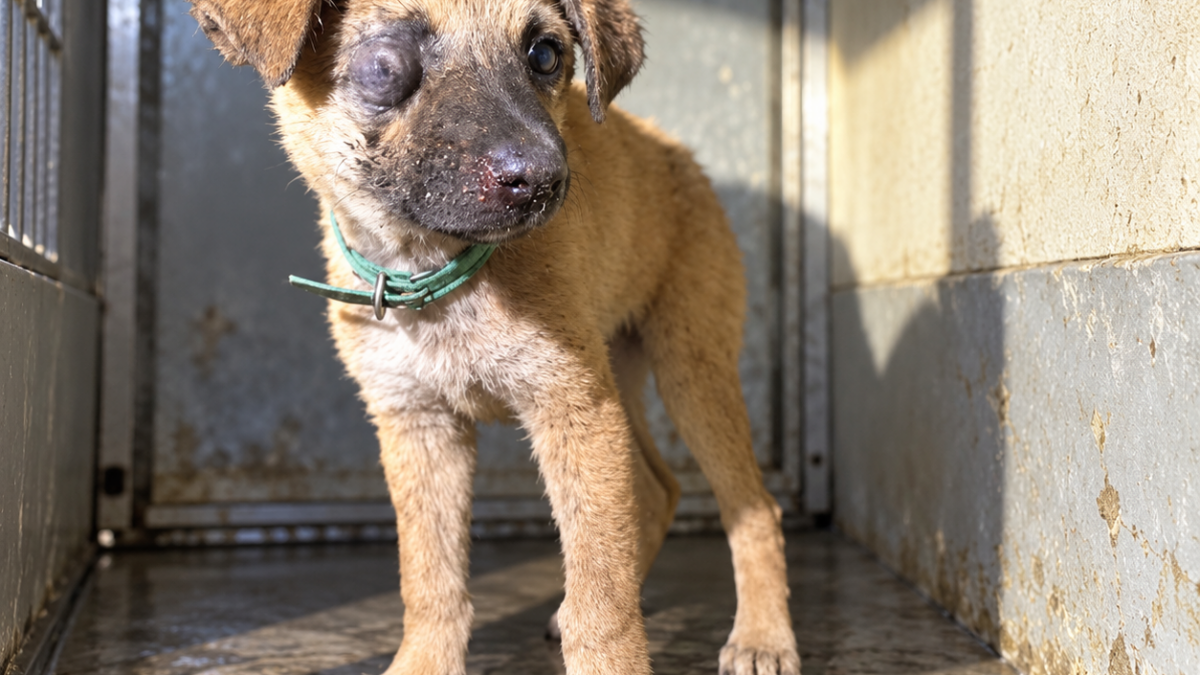
The injured eye had been surgically removed and covered.
His jaw was stabilized.
His mouth could not move normally.
Several damaged teeth were gone.
The swelling remained significant.
I sat beside him.
“Hey.”
His remaining eye opened slightly.
I do not know whether he recognized me.
Maybe my scent.
Maybe my voice.
Maybe nothing at all.
His body was full of medication.
Still, I placed my hand near his paw.
He did not move away.
“You made it through one.”
I forced myself to smile.
“One down.”
The veterinarian had warned me there would be another operation.
The first surgery addressed the most urgent damage, cleaned infected tissue, stabilized the jaw, removed teeth that could not be saved, and treated the injured eye.
But the fracture was complicated.
Himtchan was growing.
That mattered.
Bones in a young puppy are not simply miniature adult bones.
His jaw still had development ahead of it.
The surgeons needed to restore enough stability for healing while avoiding additional damage.
The second procedure could not happen until they knew he was strong enough.
For the next several days, our world became measurements.
Temperature.
Bloodwork.
Swelling.
Infection markers.
Pain response.
Hydration.
Nutrition.
Every number meant something.
Himtchan could not eat normally.
So the medical team carefully provided nutrition in ways that would not place dangerous stress on his damaged jaw.
I learned more about canine facial fractures in a week than I had ever wanted to know.
I also learned how much pain a puppy can hide.
When Himtchan slept, he looked peaceful.
Then a nurse would reposition him and his body would tense.
That was when I saw the truth.
He hurt.
The pain medication helped.
But healing was not painless.
On the second day after surgery, I visited early.
A technician smiled when she saw me.
“He’s been watching the door.”
I stopped.
“For me?”
She laughed.
“I can’t prove it.”
I entered slowly.
“Himtchan?”
His ear moved.
His good eye found me.
Then he tried to get up.
“Don’t.”
I hurried toward him.
He pushed with his front legs anyway.
Weak.
Unsteady.
But intentional.
I knelt beside the kennel.
“You know me.”
His body relaxed.
That moment almost broke me more than seeing his injuries.
Because trust, after what had happened to him, felt unreasonable.
He had been hurt by people.
Then placed somewhere people failed to help.
Then strangers lifted him.
Needles.
Surgery.
Pain.
Still, he recognized my voice and moved toward it.
I stroked the side of his neck far from the surgical area.
“I told you I was coming back.”
His tail moved.
Barely.
One small tap against the blanket.
I laughed.
“There you are.”
That became our ritual.
I visited every day I could.
Sometimes twice.
I entered using the same words.
“Hey, brave boy.”
At first, Himtchan responded only with his eye.
Then his ear.
Then the tip of his tail.
By the fourth day, he tried standing when I entered.
The veterinarian saw him.
“Don’t encourage that yet.”
“I didn’t.”
“You said his name like you were calling him to dinner.”
“I said hello.”
“You said it enthusiastically.”
I lowered my voice.
“Hello.”
The veterinarian laughed.
Himtchan looked between us.
Even with one eye, his expression made it clear he thought both humans were ridiculous.
That was the first glimpse of personality beyond pain.
I treasured it.
But beneath the recovery, anger kept building.
The factory owner who had rescued Himtchan from the teenagers contacted us.
His name was Mr. Park.
He wanted to know whether the puppy had survived.
I called him myself.
“He survived the first surgery.”
The man was silent.
Then I heard him breathe out.
“Thank God.”
“You were the person who stopped them?”
“Yes.”
“Can you tell me what happened?”
His voice changed.
“I was leaving the factory.”
He explained that he heard noise near a service lane.
Several teenagers were gathered around something near the wall.
At first, he could not see what.
Then one moved.
He saw the puppy.
Mr. Park shouted.
The teenagers ran.
When he reached Himtchan, the puppy was badly injured and terrified.
“I thought he was dying.”
Mr. Park’s voice cracked.
“I picked him up.”
“Why did you take him to that shelter?”
“It was nearby.”
Of course.
That was the logical choice.
Injured dog.
Animal shelter.
Help.
“I thought they would call a veterinarian.”
He became quiet.
“Three days?”
“Yes.”
“I went back the next morning.”
That surprised me.
“What happened?”
“They told me he was resting.”
My grip tightened around the phone.
“Did you see him?”
“No.”
“They wouldn’t let you?”
“They said not to disturb him.”
I closed my eyes.
Mr. Park continued.
“I believed them.”
“You brought him somewhere that was supposed to help. You had reason to believe them.”
“I should have checked.”
That sentence again.
I should have.
Rescue work is full of people punishing themselves because they trusted somebody else to do the right thing.
The blame belonged where the decisions were made.
With the teenagers who hurt Himtchan.
And with the adults who watched his condition for days without getting medical help.
Not with the man who interrupted the attack and carried him to safety.
“You saved him,” I said.
“I left him there.”
“You stopped what was happening.”
“If I had taken him directly to a hospital—”
“You didn’t know.”
Silence.
Then Mr. Park asked, “Can I pay something toward the surgery?”
I looked through the glass at Himtchan.
“You can help if you want.”
“I want.”
That mattered.
Not because money could undo anything.
Because Mr. Park was trying to finish the responsibility he had started when he stepped between a puppy and violence.
After the call, I sat beside Himtchan.
“Your first rescuer asked about you.”
His tail tapped once.
“He feels guilty.”
Another tap.
“I told him he shouldn’t.”
Himtchan stared at me.
“Good talk.”
The investigation into the attack had already begun.
Mr. Park had given police what details he remembered.
Security cameras near the factory were checked.
The teenagers had not been identified immediately.
I wanted them found.
I will admit that.
Not because I wanted someone to hurt them.
Because actions need consequences.
There is a dangerous lesson when cruelty disappears without accountability.
It teaches the person who committed it that nothing happens.
Still, I tried to keep my anger separate from Himtchan.
He did not need his recovery room filled with rage.
He needed calm.
On day five, the surgeons decided the swelling was decreasing enough to begin preparing for the second operation.
The date was set.
I hated having a date.
It became a countdown.
Three days.
Two.
One.
The morning before surgery, I sat beside Himtchan longer than usual.
“You know we’re doing this again tomorrow?”
He placed his chin carefully against the edge of his blanket.
“Of course you don’t.”
I touched his paw.
“Probably better.”
The veterinarian came in.
“You’re worried.”
“That obvious?”
“Yes.”
“What if he doesn’t handle another four hours?”
“He handled the first procedure.”
“That was three.”
“And now he has several days of stabilization behind him.”
“Still.”
“Still risky.”
I looked at him.
I appreciated that he did not lie.
People sometimes think reassurance means saying everything will be fine.
Real reassurance is different.
It is someone telling you the risk honestly and then saying there is a plan.
The doctor continued.
“The jaw cannot heal properly without further repair.”
“I know.”
“If we do nothing, he may face chronic pain, inability to eat normally, recurrent infection, deformity.”
“I know.”
“We’re giving him the best chance.”
I looked at Himtchan.
“That’s what I promised.”
The second surgery began early the next morning.
Four hours.
Four.
I watched every minute on the waiting-room clock.
At forty minutes, I checked my phone.
At seventy minutes, I walked outside.
At ninety-three, Mr. Park called.
“Anything?”
“No.”
“Is that good?”
“I don’t know.”
At two hours, I drank coffee I could not taste.
At three, I stopped pretending to read.
At three hours and forty-five minutes, I stood near the treatment doors.
At four hours and twelve minutes, the surgeon emerged.
I searched his face.
He removed his cap.
“The repair is complete.”
I breathed.
“How is he?”
“Stable.”
“Stable good or stable concerning?”
The doctor smiled faintly.
“Stable good.”
I nearly cried.
“What did you have to do?”
He explained the reconstruction in careful language.
The fracture had required more work than anyone hoped.
They adjusted the stabilization.
Cleaned additional damaged areas.
Protected the healing structures.
The biggest danger now was movement.
Himtchan could not be allowed to open his jaw too widely.
No chewing hard toys.
No rough play.
No pulling.
No sudden trauma.
“If the repair shifts,” the surgeon said, “we may have to operate again.”
My stomach turned.
“He’s had enough surgery.”
“I agree.”
“So how do we stop a five-month-old puppy from acting like a five-month-old puppy?”
The doctor looked almost amused.
“Very carefully.”
That answer proved prophetic.
The first week after surgery was not dramatic.
It was exhausting.
Pain control.
Monitoring.
Rest.
Himtchan hated some of the medication.
He became skilled at turning his head away.
The nurses became more skilled.
Everyone learned.
He also began feeling better.
That was good medically.
Terrible for keeping him still.
A weak puppy rests because weakness gives him no choice.
A recovering puppy begins having opinions.
Himtchan developed many.
By the fifth day after the second operation, he wanted out of the hospital kennel.
He stood when anyone entered.
He pawed at the door.
He tried to bounce.
“No.”
He stared at me.
“No bouncing.”
Tail wag.
“I’m serious.”
Another wag.
“You can ruin a four-hour surgery.”
He sat.
I smiled.
“Thank you.”
Then stood again.
I sighed.
A technician walked past.
“He’s feeling better.”
“Unfortunately.”
She laughed.
“That’s what you wanted.”
“I wanted controlled enthusiasm.”
“You rescued a puppy.”
Fair point.
The hospital created a safe movement plan.
Short, controlled walks.
No pressure on the jaw.
No tugging.
No toys requiring chewing.
Soft bedding.
Close supervision.
The first time Himtchan stepped outside after the second surgery, he froze.
Hospital doors closed behind us.
Sunlight fell across his back.
His body looked thin from weeks of treatment.
One eye remained.
The fur around the surgical areas had been clipped.
He did not look like the puppies people use in advertisements.
He looked like a survivor.
And he was beautiful.
Himtchan sniffed the air.
Then took one step.
Another.
His tail lifted.
“Easy.”
He walked faster.
“Easy.”
He looked back at me.
I swear his expression said I was ruining everything.
“You can complain when your jaw is healed.”
He moved toward a patch of grass.
Sniffed it.
Then sneezed.
I laughed.
For five minutes, we walked slowly.
No running.
No jumping.
Himtchan wanted both.
When we turned back toward the hospital, he stopped.
“No.”
He planted his feet.
“We have to go inside.”
He stared toward the grass.
“Himtchan.”
Nothing.
I tugged gently on the harness.
He leaned away.
The technician with me smiled.
“I think that’s his first protest.”
I looked at the puppy.
“You’re refusing?”
Himtchan sat.
“Fantastic.”
I crouched beside him.
“You understand that being difficult is actually wonderful?”
Tail wag.
“But we’re still going inside.”
I lifted him carefully.
He protested with his front legs.
That tiny act made my heart soar.
Weeks earlier, he had cried because pain was all he could feel.
Now he was angry because outdoor time had ended.
Normal problems.
I began loving normal problems.
On day ten after the second surgery, Himtchan ate with stronger interest.
His weight started climbing.
Slowly.
His mouth still required strict protection.
But nutrition no longer felt like a crisis every day.
The infection markers continued dropping.
The wound healed.
His eye surgery site looked clean.
The veterinary team became cautiously optimistic.
Cautiously.
I learned to respect that word.
Optimism without arrogance.
Hope with memory.
Because the jaw was still vulnerable.
At one month after the initial rescue, imaging showed healing.
Not complete.
Enough to make us breathe easier.
The surgeon pointed to the screen.
“See this?”
I leaned closer.
“Is that new bone?”
“Yes.”
I smiled.
“That’s good?”
“Very.”
“How much movement does he have?”
“Improving.”
“When can he eat normally?”
“Not yet.”
“Run?”
“Controlled activity.”
“Play?”
“Depends what you mean.”
“He thinks everything is play.”
“That’s the problem.”
Himtchan sat beneath us, staring at the treat container.
I looked down.
“He is not listening to this conversation.”
“No.”
“He has plans.”
“Definitely.”
The biggest challenge became boredom.
A puppy cannot chew normally.
Cannot roughhouse.
Cannot play tug.
Cannot jump around.
But his brain is waking up.
We had to entertain him without jeopardizing his jaw.
We used scent games.
Soft food puzzles that did not require hard biting.
Gentle training.
Touch targets.
Simple cues.
Sit.
Wait.
Follow.
Himtchan learned quickly.
Especially if food was involved.
One afternoon, I placed several cups upside down with a soft treat hidden beneath one.
“Find it.”
He sniffed the first.
Nothing.
Second.
Nothing.
Third.
He pawed it.
The cup tipped.
Food appeared.
Himtchan looked at me.
Then at all the cups.
I could almost see the calculation.
By the fourth round, he was cheating.
Instead of sniffing carefully, he knocked every cup over.
“Himtchan.”
He found the food.
“That is not the game.”
He wagged.
A veterinarian passing through the room laughed.
“He solved the problem.”
“He destroyed the methodology.”
“Still counts.”
The puppy was smart.
That made thinking about his assault harder.
He should have been learning toys.
Grass.
People.
Instead, someone had introduced him to pain.
Yet he was not becoming the sum of what happened.
That distinction mattered more every day.
The teenagers were eventually identified through a combination of witness information and camera footage.
When police contacted us for medical records, I felt relief.
Then anger.
Then something else.
They were young.
Old enough to know better.
Young enough that everyone began asking why.
Why hurt an animal?
Peer pressure?
Showing off?
Something worse?
I did not know.
I refused to invent excuses.
Understanding causes matters for preventing future cruelty.
But understanding is not the same as erasing responsibility.
Mr. Park agreed to provide a formal statement.
The veterinary records documented the severity of Himtchan’s injuries.
The case moved into the juvenile legal process.
Because of their ages, details were limited.
Some people in our rescue wanted harsher public consequences.
Others wanted rehabilitation.
I wanted one thing above all.
I wanted them prevented from hurting another animal.
If education, supervision, restitution, mandated counseling, community work, or legal penalties could accomplish that, then those were the consequences that mattered.
I did not want cruelty answered with cruelty.
That would have made Himtchan’s suffering the beginning of more suffering.
Still, I wanted accountability to be real.
The factory owner wanted something else too.
He wanted the shelter questioned.
“Those three days mattered,” Mr. Park said.
“Yes.”
“He could have died.”
“Yes.”
“I brought him there because the sign said shelter.”
I understood his anger.
The shelter owner’s explanation remained money.
No veterinary funds.
No resources.
No way to pay.
But a lack of money does not explain a lack of phone calls.
Other rescues existed.
Veterinary clinics existed.
Emergency surrender existed.
At minimum, someone could have asked for help.
Instead, Himtchan lay there.
That failure haunted me.
I met with the shelter owner weeks later.
Not to scream.
Although part of me wanted to.
To understand.
He looked tired.
Defensive.
Embarrassed.
“You’re here about the puppy.”
“Yes.”
“He’s alive?”
“He is.”
The man nodded.
“That’s good.”
I waited.
No apology.
“How many animals are you caring for?”
He gave me a number.
Too many for the building.
“Do you have a veterinarian on call?”
“No.”
“Emergency protocol?”
He looked away.
“No.”
“What happens when an injured animal arrives?”
“We do what we can.”
“What did you do for Himtchan?”
Silence.
“Water?”
“Yes.”
“Food?”
“He couldn’t eat.”
“Pain medication?”
“No.”
“Antibiotics?”
“No.”
“Call another rescue?”
“No.”
“Why?”
The man became angry.
“Because everyone judges after the fact.”
I stayed quiet.
He continued.
“You think I don’t care?”
“I think a five-month-old puppy with a shattered jaw waited three days without medical treatment.”
“I had no money.”
“Then say that out loud on the phone to someone who does.”
He stared at me.
“You could have called us.”
“I didn’t know you.”
“You could have called ten organizations.”
“Maybe none would come.”
“But you didn’t try.”
The room became quiet.
That was the truth neither of us could avoid.
He sat down.
“I thought maybe he would improve.”
“A broken jaw does not improve because you wait.”
“I know that now.”
“You knew he was badly hurt.”
He rubbed his face.
“I was overwhelmed.”
For the first time, his defensiveness weakened.
There it was.
Not evil.
Not hatred.
Overwhelm turned into paralysis.
That did not absolve him.
But it explained something.
People imagine neglect always comes from monsters.
Sometimes it comes from systems collapsing around animals while humans keep telling themselves tomorrow will be easier.
Tomorrow can kill.
“What are you going to change?” I asked.
He looked at me.
“What?”
“If another Himtchan comes through your door tonight, what happens?”
The question landed.
He had no answer.
I stood.
“Then the same thing can happen again.”
I left him with contact numbers.
Ours.
Two veterinary clinics that accepted emergency rescue cases under certain arrangements.
Another larger shelter.
An animal welfare organization.
A page of phone numbers did not undo three days.
But if his failure had come partly from not knowing where to turn, then I wanted ignorance removed as an excuse.
Later, authorities and rescue groups pushed for changes in the shelter’s emergency procedures.
Not dramatic revenge.
Something more useful.
A written protocol.
Injured animals would have to be referred immediately.
Emergency contacts posted.
Medical triage documented.
When I heard that had finally happened, I felt a satisfaction deeper than imagining the man punished.
The next Himtchan might not have to wait.
That was accountability with a future attached to it.
Meanwhile, Himtchan kept healing.
Six weeks.
Seven.
Eight.
His face changed.
The swelling disappeared.
The surgical wounds became thin scars.
His remaining eye grew bright and expressive.
His weight improved.
His coat looked glossy again.
He became ridiculous.
There is no more accurate word.
One-eyed, medically restricted, endlessly supervised—and ridiculous.
He learned that nurses carried treats in certain pockets.
He recognized the sound of the treat jar.
He began sitting automatically whenever anyone approached it.
One afternoon, three staff members walked through the hall one after another.
Himtchan sat for each.
No treat.
Third person.
Sit.
Nothing.
Fourth.
Sit.
Nothing.
He looked at me.
I laughed.
“You’ve been lied to by the system.”
He huffed.
“Yes. Terrible injustice.”
Finally I gave him one.
The puppy had survived real cruelty and still had room in his life to be offended by missing snacks.
I loved him more every day.
At the two-month mark, the surgeon allowed slightly more jaw movement.
Carefully.
Still no hard chewing.
But muscles needed to begin functioning normally again.
We watched him eat soft food.
Every bite felt miraculous.
At first, he was cautious.
Then hunger overruled fear.
He finished the bowl.
I cried.
A technician stared at me.
“You’ve watched him eat before.”
“Not like that.”
“He eats all the time.”
“Not like that.”
The jaw moved.
Controlled.
Functional.
His body remembered how.
The veterinarian smiled.
“This is good.”
“How good?”
“Very good.”
“Normal-life good?”
“Potentially.”
Potentially.
Another word I learned to love.
Not promised.
Possible.
Himtchan’s world became larger.
Hospital hallway.
Rehabilitation room.
Outdoor path.
Then a small enclosed yard.
The first day we let him explore without me holding the leash tightly, he walked three feet.
Then five.
He looked back.
“Go.”
He took off.
Not a full sprint.
More of a bouncing puppy trot.
His ears flew.
His tail curved upward.
He circled a bush.
Sniffed dirt.
Found a leaf.
Tried to pick it up.
“No chewing!”
He dropped it.
Looked insulted.
I laughed.
“You can chew things someday.”
He ran toward me.
At the last second, I worried he would jump and damage his jaw.
I held both hands out.
“Slow!”
Himtchan slowed.
Barely.
He bumped into my legs.
I crouched.
He pressed his forehead against my chest.
I wrapped my arms around him.
This time he did not cry.
The memory hit me so hard I almost could not breathe.
The first day.
Himtchan trembling in my lap.
Crying when I moved him.
Terrified I would let go.
Now he pushed into my arms because he wanted affection, then immediately pulled away because a butterfly had crossed the yard.
That was recovery.
Not becoming dependent on rescue.
Becoming free enough to leave my arms.
At nine weeks, we introduced him carefully to a calm young dog named Bori.
Bori was slightly older.
Gentle.
Social.
We worried about rough play.
So the first meeting happened through a barrier.
Himtchan saw Bori.
Stopped.
Bori wagged.
Himtchan’s tail began moving.
They sniffed.
Bori bounced backward.
Himtchan tried to bounce too.
I nearly had a heart attack.
“Easy.”
Himtchan looked at me.
Bori barked.
Himtchan barked back.
His first proper playful bark startled all of us.
The sound came out slightly strange because his jaw mechanics were still healing.
But it was unmistakable.
A puppy demanding play.
The staff laughed.
Bori ran along the barrier.
Himtchan followed.
Back and forth.
Back and forth.
No contact.
Safe.
Still joyful.
The next stage involved controlled interaction.
Himtchan wore a harness.
Bori remained calm.
They sniffed.
Circled.
Then Bori lowered into a play bow.
Himtchan froze.
He looked at me.
Almost asking.
I smiled.
“Careful.”
He lowered his front half.
Tail wagging.
Bori hopped sideways.
Himtchan followed.
For several minutes, they played at half speed.
When Himtchan became too excited, we stopped.
He protested.
Of course.
But that night he slept deeply.
The puppy who had once spent days unable to eat because his jaw was broken had exhausted himself playing with a friend.
The contrast still felt impossible.
Mr. Park visited around that time.
It was the first time he had seen Himtchan since the rescue day.
He stood outside the yard.
“Is that him?”
I smiled.
“That’s him.”
Mr. Park’s eyes filled immediately.
Himtchan noticed the stranger.
Approached cautiously.
Mr. Park crouched.
“Hey.”
His voice broke.
Himtchan sniffed him.
Then stepped closer.
Mr. Park covered his mouth.
“He looks…”
He could not finish.
“Good?”
“Alive.”
That word mattered more.
Himtchan wagged.
Mr. Park extended one hand.
The puppy licked his fingers.
The man began crying.
“I’m sorry.”
I knelt beside him.
“You have nothing to apologize for.”
“I should’ve taken you somewhere else.”
Himtchan licked his hand again.
“You stopped them,” I reminded him. “Without you, we might never have known he existed.”
Mr. Park nodded but continued crying.
Guilt does not always obey logic.
He reached into his pocket.
“I brought something.”
I tensed.
“What?”
A soft stuffed toy.
I smiled.
“He still can’t chew hard things.”
“It’s soft.”
We showed it to the veterinarian first.
Approved.
Mr. Park placed it on the grass.
Himtchan sniffed.
Pawed.
Then gently picked it up.
The movement was careful.
Everyone froze.
He carried the toy three steps.
Dropped it.
Picked it up again.
Mr. Park laughed through tears.
“That’s the first thing I’ve ever given him that wasn’t an emergency.”
That sentence stayed with me.
The first time he had given Himtchan anything, it had been rescue.
Now he could give him a toy.
Normal kindness.
Himtchan deserved more of that.
By the end of the second month, adoption conversations began.
I resisted them immediately.
“He’s not ready.”
The veterinarian raised an eyebrow.
“I said conversations.”
“He still needs monitoring.”
“Yes.”
“Jaw restrictions.”
“Yes.”
“Follow-ups.”
“Yes.”
“So not ready.”
“Eventually.”
I crossed my arms.
The doctor smiled.
“You’re attached.”
“Of course I’m attached.”
“At least you admit it.”
I looked toward Himtchan.
He was lying with his stuffed toy.
One eye.
Crooked little smile.
A face I had stopped seeing as damaged.
That was another change.
At first, I noticed what was missing.
The eye.
The teeth.
The symmetry.
Later, I noticed Himtchan.
His expression.
His ridiculous ears.
The way his tail moved when he was planning something.
Disability stopped being the first fact.
That is what happens when you know someone long enough.
The medical description becomes smaller than the personality.
Still, adoption frightened me.
What if the family mishandled him?
What if somebody ignored restrictions?
What if children pulled at his mouth?
What if another dog played too rough?
What if they saw medical costs and returned him?
Himtchan had already been failed after someone believed he was safe.
I did not want to repeat that mistake.
So we built an adoption profile that told the truth.
Not pity.
Reality.
Five-month-old puppy recovering from severe jaw trauma.
One eye removed.
Multiple teeth missing.
Jaw repair requiring ongoing veterinary monitoring.
Activity restrictions.
Potential future dental and orthopedic complications.
Needs a patient household willing to continue care.
I expected applications to be rare.
I was wrong.
People had followed his recovery.
Applications arrived.
Many.
Some emotional.
“I cried when I saw his story.”
“I need to save him.”
Those worried me.
Himtchan did not need someone attracted only to the tragedy.
He needed a person who would still want him after the story became ordinary.
After the posts stopped.
After the scars became familiar.
After veterinary bills arrived.
After he chewed something he should not.
After he became a normal annoying adolescent dog.
We rejected several applications.
Not because the people were bad.
Because the fit was wrong.
One family had toddlers who loved dogs but might struggle with the handling restrictions.
Another had three large, extremely playful dogs.
Another lived too far from reliable veterinary follow-up.
Then came an application from a couple named Ethan and Grace.
No children.
One older calm dog named Maple.
Both adults worked flexible schedules.
Fenced yard.
Excellent veterinary references.
Previous experience caring for a dog after orthopedic surgery.
I read the application twice.
Then a third time.
A staff member looked over my shoulder.
“Problem?”
“I’m checking.”
“You’ve been checking twenty minutes.”
“They have stairs.”
“Baby gates.”
“Wood floors.”
“They wrote that they’ll add rugs.”
“Maple weighs fifty pounds.”
“Calm dog. References confirm.”
I narrowed my eyes.
The technician laughed.
“You are searching for crimes.”
“I am protecting him.”
“You can protect him by choosing carefully. Not by keeping him forever.”
I knew.
Still hated hearing it.
Ethan and Grace came to meet Himtchan.
They did not rush.
That helped.
Grace sat on the floor.
Ethan remained nearby.
Himtchan entered.
He noticed them.
Stopped.
Then noticed Maple through the barrier.
His tail moved.
Grace smiled.
“Hi, buddy.”
No reaching.
No calling repeatedly.
Himtchan approached.
Sniffed Grace’s shoes.
Then Ethan.
Then returned to me.
I scratched his shoulder.
“It’s okay.”
He approached Grace again.
She held one hand low.
Himtchan sniffed.
Licked.
Then sat beside her.
My heart sank.
Not because anything was wrong.
Because everything looked right.
Grace looked at me.
“Can I pet him?”
“Yes. Neck and shoulder are safest.”
She touched him gently.
Himtchan leaned.
Traitor.
Ethan laughed.
“Looks like you’re done for.”
Grace whispered, “I hope so.”
Maple entered later.
The older dog barely reacted.
Sniff.
Tail wag.
Move on.
Perfect.
Himtchan tried to initiate play.
Maple looked at him with exhausted adult-dog judgment.
Everyone laughed.
Ethan said, “She’s going to teach him manners.”
I looked at Maple.
“I support that.”
The couple asked detailed questions.
Not when will he be normal?
Not will his face always look like that?
They asked:
“What signs would mean the jaw is painful?”
“What kind of dental follow-up will he need?”
“What foods are safest?”
“How do we prevent rough play?”
“Should we use a harness permanently instead of a collar?”
“What happens if the jaw shifts?”
“What emergency hospital has his records?”
I began liking them against my will.
Then Grace asked a question nobody else had.
“Does he get scared when someone reaches quickly toward his face?”
I stopped.
“Yes.”
“Then we’ll make sure visitors know.”
That was it.
Not his appearance.
Not the inspirational story.
His fear.
She was thinking about what living inside Himtchan’s body might feel like.
That mattered.
The home check went well.
Annoyingly well.
Rugs.
Gates.
Separate feeding spaces.
Low bed.
Secure yard.
Maple calm.
The couple had already selected a veterinary clinic willing to coordinate with Himtchan’s surgeon.
They even asked whether they could continue bringing him back to the hospital for the remaining follow-ups.
I had no reason to say no.
So I said, “We’ll see.”
The adoption coordinator laughed later.
“You are impossible.”
“I’m thorough.”
“You’re grieving an adoption that has not happened.”
I looked at Himtchan.
He was asleep.
“I carried him when he thought I was abandoning him.”
“I know.”
“I promised I wouldn’t.”
“You aren’t.”
“It feels like it.”
She softened.
“Then remember what the promise meant.”
I looked at her.
“It meant you wouldn’t leave him alone in pain. It didn’t mean he had to belong to you forever.”
That hurt because it was true.
Love is strange in rescue.
You prove it by letting go.
At the three-month mark, the day we had been waiting for arrived.
Himtchan’s surgeon reviewed the latest imaging.
The jaw had healed well.
Not perfectly.
There would always be differences.
Some missing teeth.
Altered structure.
One eye.
Possible future dental issues.
But the bone was stable.
Range of motion had improved.
Eating was functional.
No infection.
The surgeon smiled.
“He can leave hospital-based care.”
I stared.
“Leave?”
“Routine follow-up can happen outpatient.”
“Are you sure?”
“Yes.”
“Completely?”
“As much as medicine ever lets me be.”
I looked down.
Himtchan was sitting beneath the examination table, staring at a treat bag.
Three months.
I remembered the first day.
His body in my lap.
The broken jaw.
The ruined eye.
The fear when I tried to set him down.
I crouched.
“Himtchan.”
He looked at me.
“You’re getting out of here.”
Tail wag.
He had no idea how big those words were.
The hospital staff gathered before he left.
Nurses.
Technicians.
Doctors.
People who had changed dressings.
Monitored medication.
Cleaned kennels.
Fed him.
Walked him.
Protected the jaw from a puppy determined to use it.
Someone brought the soft toy Mr. Park had given him.
Himtchan carried it proudly.
The surgeon laughed.
“Careful.”
Everyone said that to him constantly.
Careful.
Himtchan had survived cruelty and two major surgeries only to spend the next months being told not to have too much fun.
He disagreed philosophically.
Outside, I opened the vehicle.
Himtchan looked at the car.
Then at me.
The first transport had been desperate.
The second after surgery.
Now?
He jumped his front feet onto the low step.
I nearly screamed.
“Careful!”
He looked back.
The staff laughed.
I helped him in.
We drove to the rescue facility where Ethan and Grace would complete several supervised transition visits before adoption.
Himtchan pressed his nose toward the window.
The world moved past.
Trees.
Cars.
People.
Sunlight.
He watched everything with one bright eye.
I wondered what he remembered.
Maybe nothing in the narrative way humans remember.
Maybe sensations.
Pain.
Hands.
Smells.
Fear.
But dogs live beautifully in the present when given the chance.
I hoped the future would become strong enough that the past no longer mattered every minute.
The first transition day at Ethan and Grace’s house went well.
Himtchan explored everything.
Kitchen.
Hallway.
Living room.
Yard.
Maple followed him reluctantly.
He found the water bowl.
Then the toy basket.
We had warned them about chewing restrictions, so only safe soft toys were available.
Himtchan selected one.
Carried it.
Grace looked at me.
“He seems comfortable.”
“Don’t say that yet.”
She smiled.
“I know.”
He found Maple’s bed.
Lay in it.
Maple stared.
Ethan said, “Well, negotiations have begun.”
Maple walked to Himtchan’s prepared bed and lay there instead.
I laughed.
“Problem solved.”
At one point, Grace went into another room.
Himtchan followed.
Then Ethan.
He followed.
Then Maple.
He followed.
He needed to know where everyone was.
That made sense.
The first months of his life had taught him people could disappear.
The second visit lasted longer.
Third included dinner.
Fourth, an afternoon nap.
Himtchan slept in the middle of the living room.
Not against a wall.
Not hidden.
Middle.
Exposed.
Safe.
I stood in the kitchen watching.
Grace whispered, “You okay?”
“Yes.”
“You look like you’re going to cry.”
“I always look like that now.”
She laughed quietly.
Himtchan rolled slightly onto his side.
His scarred face relaxed.
That image became my answer.
He was ready.
Adoption day arrived on a clear morning.
I hated it.
I loved it.
Both feelings fit.
I packed his medical records.
Medication instructions.
Follow-up dates.
Soft toys.
Harness.
Food.
Mr. Park’s stuffed toy.
A blanket from the hospital.
Then I sat beside Himtchan.
“Remember this?”
He sniffed the blanket.
“You spent three months trying to escape that place.”
Tail wag.
“And now I’m voluntarily sending you away.”
He leaned against me.
I swallowed.
“You cannot do that today.”
He licked my wrist.
“You especially cannot do that.”
More licking.
I wrapped my arms around him.
The first time I held him, he cried.
Now he sighed.
Relaxed.
Trusted.
I wanted to freeze the moment.
Then Ethan and Grace arrived.
Himtchan heard their voices.
His head lifted.
Tail moved.
He stood.
That helped.
He knew them.
Wanted them.
This was not being taken.
This was going.
We signed the final paperwork.
I reviewed instructions even though they knew everything.
“No hard toys.”
“We know.”
“Watch the jaw.”
“Yes.”
“Harness.”
“Already on.”
“Any swelling, pain, reduced appetite—”
“Call immediately.”
“No rough play.”
Grace looked at Maple.
“She has filed a formal refusal to rough play.”
Maple yawned.
I laughed.
Finally, there was nothing left.
I crouched.
Himtchan approached me.
I held his face carefully between my hands, avoiding pressure.
“You were five months old when somebody tried to teach you the world was cruel.”
His eye stayed on mine.
“They were wrong.”
My voice broke.
“Do you hear me?”
Tail wag.
“They were wrong.”
Grace cried.
Ethan looked away.
I continued.
“Mr. Park was right.”
Himtchan tilted his head.
“The doctors were right.”
I kissed the top of his head.
“And you were right to keep fighting.”
I released him.
He walked toward Grace.
Then turned back.
Came to me again.
Pressed his body against my legs.
I laughed through tears.
“Okay.”
I knelt one more time.
“I’m not disappearing.”
He licked my chin.
“Go.”
Grace opened the door.
Himtchan walked through.
Three months earlier, he had been carried everywhere because his face was broken and pain controlled his world.
Now he walked into sunlight.
Maple waited by the car.
Himtchan joined her.
Ethan helped him safely into the back seat.
The car left.
I stood outside until I could not see it.
That night, Grace sent a photo.
Himtchan asleep beside Maple.
His head rested near her back.
The stuffed toy beside him.
Message:
HE ATE. HE EXPLORED. HE TRIED TO STEAL MAPLE’S BED. HE’S HOME.
Home.
I stared at that word for a long time.
Then another message arrived.
THANK YOU FOR NOT GIVING UP ON HIM.
I replied:
HE DID MOST OF THE HARD PART.
That was true.
But not entirely.
Himtchan survived because people kept forming a chain.
Mr. Park interrupted the attack.
Rescuers removed him after the shelter failed.
Veterinarians repaired what could be repaired.
Technicians watched him at night.
Donors helped pay.
Investigators documented.
Ethan and Grace opened their home.
Himtchan fought.
Nobody saved him alone.
That mattered.
A few weeks after adoption, we received an update from the legal process involving the teenagers.
Because they were minors, much remained confidential.
The outcome included consequences designed around supervision, accountability, and preventing future cruelty.
Required counseling.
Restitution connected to veterinary expenses.
Animal welfare education.
Community service that did not involve unsupervised access to animals.
Court monitoring.
Some people wanted harsher punishment.
I understood.
When you see a puppy’s broken face, anger becomes easy.
But I asked myself one question.
What outcome makes another animal safer?
If punishment becomes humiliation with no change, maybe nothing has been learned.
If those teenagers were forced to confront the consequences, understand animal suffering, receive supervision, and carry legal accountability forward, perhaps Himtchan’s injuries could become the last cruelty they ever committed.
I could live with that hope.
Mr. Park attended one of the hearings.
He called afterward.
“I saw their families.”
“How was it?”
“Sad.”
That surprised me.
“Sad?”
“Everyone crying.”
He paused.
“I thought I’d feel satisfied.”
“And?”
“I just kept thinking how stupid the whole thing was.”
He was right.
A puppy suffered.
Families suffered.
Months of medical care.
Court.
Money.
Fear.
All because a group of teenagers decided hurting something smaller than them was entertainment.
There is nothing impressive about cruelty.
Nothing powerful.
Nothing mature.
It is waste.
Mr. Park continued.
“One of the boys looked at me before he left.”
“What happened?”
“He said he was sorry.”
I stayed quiet.
“Do you believe him?”
“I don’t know.”
Neither did I.
Apologies are beginnings, not proof.
Behavior afterward is proof.
“I told him the dog lived.”
“What did he say?”
“He cried.”
I looked at the newest photo of Himtchan on my phone.
Running in a yard.
One eye.
Mouth open in what looked like a grin.
“Maybe he needed to know.”
“Why?”
“So he understands survival doesn’t erase what he did.”
Mr. Park was quiet.
“Yes.”
That was the balance.
Himtchan survived.
That did not make the attack less serious.
But his survival meant the story did not belong entirely to cruelty.
Months passed.
His jaw continued gaining strength.
At first, Grace sent nearly daily updates.
Then every few days.
Then weekly.
That change made me happy.
Emergency had become life.
The posts became boring in the best way.
Himtchan slept on Maple.
Himtchan stole a sock.
Himtchan refused to come inside because he found a stick.
Himtchan barked at a delivery box.
Himtchan learned stairs.
Himtchan discovered the refrigerator.
Himtchan tried to convince Ethan he had not been fed despite Grace standing behind him saying, “I literally just fed you.”
Normal problems.
Beautiful.
At his first major follow-up after adoption, the surgeon examined him.
I asked permission to be there.
Of course I did.
Himtchan entered the clinic and recognized me immediately.
He ran.
Actually ran.
I crouched.
He crashed into my arms.
“Himtchan!”
His tail whipped against my legs.
Grace laughed.
“He remembers.”
“Yes.”
I held him.
“He definitely remembers.”
Then the surgeon entered.
Himtchan became suspicious.
“Interesting,” the doctor said. “I receive less enthusiasm.”
“You did surgery.”
“Twice.”
“Exactly.”
The examination went well.
Jaw stable.
Good functional movement.
No infection.
Dental monitoring needed.
One eye healthy.
Weight excellent.
The surgeon stepped back.
“He can live a normal life.”
I stared.
“Normal?”
“With reasonable precautions.”
“What does that mean?”
“It means stop treating him like glass.”
Grace started laughing.
I looked at the doctor.
“I do not treat him like glass.”
Grace laughed harder.
Himtchan wagged.
The surgeon smiled.
“He can run.”
I swallowed.
“Run run?”
“Yes.”
“Play?”
“Yes, with appropriate supervision.”
“Chew?”
“Appropriate toys.”
“What about—”
The doctor held up one hand.
“He’s a dog.”
That sentence hit me.
He’s a dog.
Not a patient.
Not a cruelty case.
Not a broken jaw.
Not one-eyed puppy.
A dog.
Himtchan looked at me.
I smiled.
“You heard him.”
Grace took him home.
That afternoon, she sent a video.
No caption.
Just video.
The yard gate opened.
Maple trotted out.
Himtchan followed.
Then accelerated.
His body stretched into a run.
A real run.
Full speed.
Across grass.
Around a tree.
Back toward the camera.
His one eye bright.
Ears flying.
Mouth open.
He turned so fast I instinctively whispered, “Careful,” even though I was watching a recording.
Then Himtchan chased Maple.
Maple finally accepted that retirement was impossible.
The two dogs crossed the yard.
Himtchan stumbled once.
Recovered.
Kept going.
I watched the video again.
And again.
And again.
Three months in a hospital.
Seven hours of surgery across two operations.
Days of pain.
Weeks of restrictions.
And there he was.
Running.
That was the revenge.
Not seeing teenagers punished.
Not confronting the shelter.
This.
Someone had tried to make pain the defining event of his life.
It failed.
Himtchan had a yard now.
He had Maple.
He had people who worried when he sneezed.
He had food.
A bed.
Veterinary care.
Toys.
He had a future.
Cruelty got minutes.
Love got years.
That was the proportion I wanted.
Himtchan’s story continued changing people around him too.
The shelter that had kept him untreated for three days adopted the emergency protocol we had pushed for.
The owner called me several months later.
“We used the list.”
“What happened?”
“Dog hit by a car.”
My stomach tightened.
“And?”
“We called the hospital immediately. Another rescue helped transport.”
“How long?”
“Twenty minutes.”
I sat down.
Twenty minutes.
Himtchan had waited three days.
“Did the dog survive?”
“Yes.”
The man’s voice was quiet.
“I wanted you to know.”
I closed my eyes.
“Thank you.”
“I should have done that before.”
“Yes.”
No comfort.
No attack.
Just truth.
He continued.
“I think about him.”
“Himtchan?”
“Yes.”
“He’s doing well.”
“I saw a photo.”
“How?”
“Someone showed me.”
Silence.
Then he said, “I’m sorry.”
Months earlier, I had wanted those words.
Now they felt different.
Smaller.
Still meaningful.
“What matters is what happens to the next animal.”
“I know.”
And this time, maybe he did.
That was another form of justice.
Not revenge that ends with someone destroyed.
Consequence that forces change.
The teenagers faced intervention.
The shelter changed procedure.
Mr. Park stopped blaming himself.
Himtchan healed.
A future animal received emergency care within minutes.
Pain had moved outward and become responsibility.
That is the best thing we can do with a terrible story.
Use it to close the path that created it.
Himtchan became something of a local celebrity.
I disliked the phrase.
He did not care.
People recognized his one-eyed face during walks.
Some asked before petting.
Grace taught everyone the rule.
“Let him come to you.”
Most people respected it.
Children were especially curious.
“What happened to his eye?”
Grace never dramatized.
“He was hurt when he was young, but he’s okay now.”
“Does he see?”
“With one eye.”
“Is he sad?”
Grace smiled.
“Ask him.”
Himtchan usually responded by attempting to steal something.
Once, a little boy held a soft toy.
Himtchan took it gently.
The boy gasped.
“He stole it!”
Grace laughed.
“He’s not sad.”
The child chased him.
Himtchan ran.
That image stayed with me.
A child laughing behind a dog.
Not hurting him.
Playing.
Same species of human.
Completely different lesson.
Himtchan did not need to fear every teenager because some had hurt him.
With careful introductions, he learned that young people could mean play.
That may have been one of the hardest recoveries.
Physical wounds heal according to biology.
Trust heals according to experience.
You need enough safe experiences to outweigh the dangerous ones.
Grace made sure he got them.
Slowly.
No forcing.
No crowds.
One person.
Then another.
Treats.
Space.
Choice.
Himtchan became social.
Still disliked sudden hands near his face.
That was okay.
Healing does not require forgetting.
It requires having a life large enough that the memory does not control everything.
A year after his rescue, Mr. Park visited Himtchan at home.
Grace invited him.
Maple met him first.
Himtchan followed.
The factory owner knelt.
“Hey, little guy.”
Himtchan wagged.
Mr. Park brought another soft toy.
I laughed.
“You realize he has about forty now.”
“I owe him.”
“You don’t.”
He ignored me.
Himtchan took the toy.
Carried it across the room.
Mr. Park watched.
“He was smaller when I found him.”
“Much.”
“I thought he’d die in my arms.”
“So did I later.”
Mr. Park looked toward Grace.
“Thank you.”
Grace shook her head.
“No. Thank you for stopping.”
He became emotional.
“I almost kept driving.”
We all looked at him.
“What?”
“I heard them.”
He sat slowly.
“I was tired. It was late. I had paperwork.”
His voice dropped.
“For maybe five seconds, I thought, kids being loud. None of my business.”
He looked at Himtchan.
“Five seconds.”
Grace sat beside him.
“But you stopped.”
“Yes.”
Himtchan dropped the toy at his feet.
Mr. Park picked it up.
“Best decision I ever made.”
That became another lesson.
Courage does not always arrive without hesitation.
Sometimes courage is what happens after the five seconds when you consider walking away.
Mr. Park stopped.
That was enough to change everything.
At the first anniversary of Himtchan’s adoption, Grace sent us a photograph.
Himtchan sitting in the yard.
Maple beside him.
A little party hat tilted between his ears.
He looked deeply offended.
Message:
HE SURVIVED THE HAT. BARELY.
I laughed.
Then looked closely at his face.
The jaw was not perfectly symmetrical.
One eye.
Scars if you knew where to look.
But he looked whole.
Whole does not mean untouched.
That is something Himtchan taught me.
Whole can include missing parts.
Scars.
Adaptations.
Whole means the life belongs to you again.
Himtchan’s life belonged to him.
He could eat.
Run.
Sleep.
Play.
Choose.
Love.
Be loved.
That was enough.
His second year became even more ordinary.
He learned to swim badly.
Grace sent a video of him entering a shallow lake wearing a flotation vest.
Maple glided.
Himtchan paddled like he was fighting the entire concept of water.
He turned around within ten seconds.
Ethan laughed.
“You’re doing great!”
Himtchan climbed out.
Shook water everywhere.
Refused to re-enter.
I replied:
SURVIVED TWO SURGERIES. DEFEATED BY LAKE.
Grace answered:
HE HAS BOUNDARIES.
He loved hiking.
Short trails at first.
Then longer.
His depth perception with one eye required adjustment.
He sometimes misjudged small obstacles.
But dogs adapt remarkably.
He learned to angle his head.
Used smell.
Used hearing.
Used memory.
Within months, most people forgot to think about the missing eye.
Himtchan certainly seemed to.
A child once asked Grace, “Does he know he only has one?”
She told me later.
“What did you say?”
“I said I don’t think he counts.”
I loved that answer.
Humans count losses.
Dogs often count what remains.
One eye was enough to find Maple.
Enough to watch Grace enter a room.
Enough to chase a ball.
Enough to see sunlight.
Enough.
Around that time, one of the teenagers involved in the case completed a required animal welfare education program and wrote a letter.
Because he was a minor, the letter came through proper channels.
We were not obligated to respond.
I read it.
The boy did not excuse himself.
At least not in the letter.
He wrote that he had been trying to impress friends.
That he understood now how serious the injuries were.
That hearing about the surgeries had made him sick.
That he was ashamed.
He asked whether Himtchan lived.
I struggled with whether to answer.
Part of me wanted silence.
Let him wonder.
Then I thought about what accountability was for.
Not torment.
Change.
I sent one photograph through the appropriate intermediary.
Himtchan in the yard.
Healthy.
No dramatic message.
Only:
He survived. He lives with a family now.
Weeks later, another note came.
Thank you.
Nothing else.
I never learned what became of that teenager.
I hope he changed.
I cannot promise that.
But I know Himtchan did not need his future to depend on whether the person who hurt him became good.
That is important.
Victims do not need offenders to transform in order for their own lives to become meaningful.
Himtchan’s happiness stood independently.
His life was not waiting for an apology.
He ran whether they regretted it or not.
He ate whether they understood or not.
He loved people whether they deserved redemption or not.
His healing belonged to him.
That may have been the most satisfying revenge of all.
Years passed.
Maple grew older.
Himtchan matured.
The wild puppy energy softened.
Not completely.
He remained capable of stealing socks well into adulthood.
But he developed gentleness.
Especially with Maple.
When her joints became stiff, Himtchan stopped crashing into her.
He waited.
Walked beside her.
Once, Grace sent a video.
Maple struggled slightly with the porch step.
Himtchan stood at the bottom.
He did not rush.
He simply waited until she came down.
Then they walked together.
I thought about the hospital.
Himtchan had once been the fragile one everybody waited for.
Now he waited for someone else.
Pain can make some animals fearful.
Sometimes it also seems to make them patient.
Not magically.
Not because suffering is good.
Suffering is not a gift.
But when a life survives suffering and then receives kindness, that kindness can become part of what the animal gives back.
Maple died peacefully several years later.
Himtchan searched for her.
Her bed.
Yard.
Hallway.
Grace called me.
“He keeps checking.”
I visited.
Himtchan greeted me but returned to Maple’s bed.
He sniffed.
Lay down.
I sat nearby.
No speeches.
Grief does not need speeches.
After a while, he placed his head on my shoe.
Same puppy.
Older.
Strong.
Still capable of missing someone.
I stroked his neck.
“You loved her.”
His tail moved once.
Loss hurt.
But I found myself strangely grateful.
Himtchan had lived long enough to have something worth grieving.
That was not guaranteed when we met.
He had a relationship.
Routine.
Companionship.
Years beside Maple.
A real life includes heartbreak.
Rescue cannot promise a life without pain.
Only a life where pain is not deliberately inflicted and where love surrounds the unavoidable kind.
Months later, Grace fostered a shy dog named Milo.
Himtchan was unimpressed.
Then curious.
Then protective.
Milo had never lived inside a house.
He feared doorways.
The first evening, Milo refused to cross from the kitchen into the living room.
Grace sat on one side.
No pressure.
Himtchan walked through.
Turned around.
Came back.
Walked through again.
Milo watched.
Third time, Milo followed.
Grace called me crying.
“He taught him the door.”
I thought about Himtchan’s hospital door.
His first yard.
The world expanding one threshold at a time.
Now he was showing another dog.
That was the kind of circle I liked.
Not fate.
Behavior.
A safe dog demonstrating safety.
Grace eventually helped Milo find a permanent home.
Then fostered another.
Himtchan became the unofficial welcome committee.
One-eyed.
Slightly crooked jaw.
Former patient.
Now teacher.
Sometimes the animals we fight hardest to save later make our work easier simply by being who they become.
Mr. Park stayed in touch too.
His factory began supporting a local animal welfare fund.
Nothing enormous.
A small yearly donation.
But he told employees the story.
Not to make himself heroic.
To make one point.
“If you see something, stop.”
That became his message.
One worker later reported an injured stray near the industrial road.
The dog received treatment.
Another employee brought water to a dog chained outside during extreme heat and contacted authorities.
Small actions.
Different animals.
Himtchan’s story kept producing consequences no court could order.
That satisfied me more than punishment.
The shelter owner also changed.
Years later, I visited unexpectedly.
The building was still modest.
Still underfunded.
But on the wall near the desk was an emergency chart.
INJURED ANIMAL — IMMEDIATE VETERINARY REFERRAL.
Three clinic numbers.
Two rescue contacts.
Transport volunteers.
No waiting.
I stood there.
The owner saw me.
“You noticed.”
“Yes.”
He looked embarrassed.
“We used it last week.”
“For what?”
“Cat with a fractured leg.”
“How long before treatment?”
“Forty minutes.”
I nodded.
“Good.”
He hesitated.
“I think about your dog.”
“He’s not my dog.”
“Himtchan.”
“Yes.”
“I should have called.”
“Yes.”
No comforting lie.
Then I added, “But you call now.”
He looked at the chart.
“Yes.”
That was as close to closure as we needed.
The past remained wrong.
The future became less likely to repeat it.
People sometimes confuse forgiveness with pretending consequences no longer matter.
I did not need to forgive every person in Himtchan’s story.
I needed systems to change.
Behavior to change.
Animals to be safer.
That was enough.
As Himtchan entered middle age, his jaw required periodic dental monitoring.
The altered structure meant certain teeth wore differently.
Grace never skipped appointments.
Once, a minor dental procedure was recommended.
She called me immediately.
“I know it’s routine.”
“You’re scared.”
“Yes.”
“Because of the surgeries.”
“Yes.”
Trauma does not belong only to the patient.
Caregivers remember too.
“I’ll come.”
“You don’t have to.”
“I know.”
We sat together in the same hospital waiting room years after the original surgeries.
Different day.
Different stakes.
Still, my body remembered.
Clock.
Doors.
Coffee.
Grace looked at me.
“Is this what it was like?”
“The second surgery?”
“Yes.”
“Worse.”
She squeezed my hand.
“I’m glad I didn’t know him then.”
“I’m glad you know him now.”
The dental procedure went smoothly.
Himtchan emerged groggy and offended.
When he saw us, his tail moved.
Grace cried.
I laughed.
“Some things don’t change.”
The veterinarian said his jaw remained stable.
That word again.
Stable.
Once, I feared it.
Now I loved it.
Himtchan went home the same day.
A decade after his rescue, he began showing gray around his muzzle.
I almost refused to believe it.
Grace sent a photo.
LOOK WHO’S GETTING OLD.
I replied:
FAKE NEWS.
She answered:
HE GROANS WHEN HE STANDS.
I wrote:
DRAMATIC PERSONALITY.
But photographs told the truth.
The five-month-old puppy became an old dog.
That may be the most beautiful sentence I can write about him.
He became old.
The puppy whose body had been so badly injured that surgeons were uncertain what kind of future he would have lived long enough for age itself to become his problem.
His walks shortened.
His sleep deepened.
He still enjoyed food.
Still followed Grace.
Still carried soft toys occasionally.
The original toy from Mr. Park survived in fragments, repaired many times.
Grace kept it on a shelf when it became too delicate.
“He’ll destroy it.”
“He’s supposed to.”
“It will disintegrate.”
“Then let it.”
She refused.
Some memories are allowed retirement too.
Himtchan developed arthritis.
His remaining eye remained healthy.
That became increasingly important.
Grace adjusted the house.
Night lights.
Rugs.
Ramp.
No furniture moved unnecessarily.
The puppy once adapted to losing an eye.
Now the family adapted to an aging dog.
That is love over time.
It changes shape.
At five months old, love meant surgery.
At five years, exercise and dental checks.
At ten, medication and slower walks.
The commitment is not to one version of the animal.
It is to all the versions age brings.
One afternoon, I visited.
Himtchan walked toward me slowly.
Tail wagging.
I crouched.
He pressed his forehead against my chest.
I closed my eyes.
The first day returned.
His tiny broken body in my lap.
The fear when I tried to let him go.
I whispered, “You got heavy.”
Grace laughed.
“He likes snacks.”
“Clearly.”
Himtchan sat beside me.
His jaw had a slight permanent irregularity.
I touched beneath it gently.
No pain.
Just history.
“You know something?”
He looked up with his one cloudy-but-bright eye.
“You won.”
Grace heard.
“Won what?”
“Everything.”
She smiled.
Maybe that sounded dramatic.
But I meant it.
The people who hurt Himtchan got minutes of his life.
The shelter failure got three days.
The hospital got three difficult months.
His family got years.
Years.
That is how I count the outcome.
Cruelty did not get the largest share.
Love did.
As his health declined later, Grace involved me in the conversations.
Kidneys first.
Then arthritis.
Then age-related neurological changes.
Nothing to do with the old assault, according to the doctors.
Just life.
Himtchan had finally reached illnesses that came not because somebody hurt him, but because he had lived long enough to grow old.
Again, miraculous.
His good days still outnumbered bad ones.
He ate.
Wanted sunlight.
Enjoyed gentle walks.
Watched Grace cook.
Slept near Ethan.
Accepted foster dogs with less enthusiasm but continued tolerating them.
One evening, Grace sent a photo of Himtchan lying beside a frightened new foster puppy.
The puppy’s body pressed against his.
Himtchan slept.
Caption:
HE’S THE SAFE DOG NOW.
I cried.
The safe dog.
Not injured dog.
Not victim.
Safe dog.
A younger animal looked at Himtchan and saw security.
That was transformation beyond anything surgeons could build.
Eventually, difficult decisions came.
They always do if we are lucky enough to love an animal through old age.
Himtchan stopped wanting long walks.
Then most walks.
His appetite changed.
Pain medication helped, then helped less.
Grace tracked good days and bad.
She called one morning.
“I need you to tell me if I’m being selfish.”
That question.
Again.
Every devoted owner asks it eventually.
“Tell me what today looks like.”
She did.
Himtchan had eaten a little.
Could stand.
Still wanted affection.
But struggled.
“We’re not at zero joy,” she said.
“No.”
“But it’s smaller.”
“Yes.”
The veterinarian adjusted his medications.
We gained more time.
Good time.
Several weeks.
Then one morning, Himtchan refused breakfast.
Grace knew.
Not because one missed meal means death.
Because she knew him.
Years of routine teach you when something is different.
The veterinarian examined him.
Options existed.
Hospitalization.
Aggressive treatment.
Tests.
Potential days away from home.
Possible improvement.
Possible suffering.
Grace looked at Himtchan.
He was tired.
Not frightened.
Just tired.
“What would you do if he were yours?”
The veterinarian hated that question.
Good veterinarians do.
They know they cannot decide for you.
She answered carefully.
“If the goal is comfort, I would consider letting him stay home.”
Grace cried.
Ethan cried.
I stood near the window.
Himtchan slept.
The same puppy who had once needed everything done to save him was now an old dog who needed us to know when enough treatment had become too much.
That is one of the hardest reversals in rescue.
At the beginning, love says fight.
At the end, love sometimes says you do not have to fight anymore.
We arranged a home visit.
Himtchan lay on his favorite bed near the back door.
Sun warmed part of his body.
His remaining eye opened when I entered.
Tail moved.
Slow.
I knelt.
“Hey, brave boy.”
Same words.
Years later.
His head lifted.
I placed my hand beneath his chin.
The jaw that had once been fractured beyond recognition rested gently in my palm.
Whole enough.
Strong enough.
It had carried food.
Toys.
Balls.
Years of life.
It had done its job.
Grace sat beside him.
“I keep thinking about five months old.”
“So do I.”
“I wasn’t there.”
“No.”
She stroked his shoulder.
“But I got everything after.”
“Yes.”
Himtchan breathed slowly.
Mr. Park joined us briefly.
Grace had invited him.
The factory owner arrived holding no toy this time.
Just himself.
He knelt.
Himtchan sniffed his hand.
Mr. Park cried immediately.
“Hey.”
Himtchan’s tail moved once.
The man whispered, “I’m glad I stopped.”
I looked down.
So was I.
The veterinarian arrived later.
We kept the room quiet.
No crowd beyond the people closest to him.
Himtchan received a sedative first.
His body relaxed.
Grace held his head.
Ethan rested a hand on his back.
I touched his paw.
Mr. Park stayed nearby.
“I’m sorry,” Mr. Park whispered.
Grace shook her head.
“No apologies today.”
He nodded.
Himtchan looked toward us with his one eye.
No panic.
No fear.
The five-month-old puppy who once cried in my lap because he thought letting go meant abandonment now lay surrounded by people who had spent years proving the opposite.
Nobody was leaving.
Grace kissed his forehead.
“You’re safe.”
His breathing slowed.
“You’re home.”
Another breath.
“You don’t have to be brave anymore.”
I closed my eyes.
The final medication was administered.
Himtchan’s jaw rested in Grace’s hands.
The broken jaw.
The repaired jaw.
The jaw everyone had protected for months.
Then years.
His body softened.
One final breath.
Stillness.
Grace sobbed against him.
Ethan held her.
Mr. Park covered his face.
I kept my hand on Himtchan’s paw.
For several minutes, nobody said anything.
What could we say?
The puppy survived.
The dog lived.
The old dog died loved.
That was the entire arc.
Afterward, Grace handed me something.
The first soft toy Mr. Park had given Himtchan.
Patched.
Faded.
One side almost flat.
“I think this belongs with you.”
I shook my head.
“No. It belongs here.”
She smiled through tears.
“We kept his others.”
Mr. Park touched the toy.
“I remember buying this.”
“You thought it might last a week,” I said.
He laughed weakly.
“It lasted longer than I expected.”
We all had.
Himtchan most of all.
At the rescue, we placed the toy near a photograph.
Not the hospital photograph.
Not the image of his injuries.
A photo of Himtchan running.
One eye.
Mouth open.
Grass beneath him.
Under it, only his name.
HIMTCHAN.
The name meant something like strength.
When we chose it, he was still fragile.
The name had been a hope.
By the end, it felt like a description.
But not because strength meant never needing help.
Himtchan needed enormous help.
Surgery.
Medication.
People.
Time.
Strength meant something else.
It meant accepting help long enough to become yourself.
People sometimes ask whether I hate the teenagers who hurt him.
I do not know them.
I hated what they did.
I wanted accountability.
I wanted change.
I wanted future animals protected.
But if I spent Himtchan’s entire life hating them, I would have given them more ownership over his story than they deserved.
They did not get his whole story.
They got one terrible chapter.
The rest belonged to Himtchan.
To Mr. Park.
To surgeons.
To Grace and Ethan.
To Maple.
To every foster dog that later slept beside him.
To the yard.
To the lake he hated.
To the stolen socks.
To the walks.
To old age.
That was the revenge.
Not destroying the people who caused the pain.
Making sure their cruelty failed to define the life.
Himtchan did that completely.
The shelter that delayed his treatment changed emergency procedures.
The next severely injured animal did not wait three days.
The teenagers entered a legal process meant to confront what they had done and reduce the chance they would do it again.
Mr. Park turned his guilt into years of supporting animal welfare.
Grace and Ethan turned Himtchan’s second chance into a safe place for other foster dogs.
One act of cruelty created pain.
But the response created more kindness than the cruelty could contain.
I wish Himtchan had never been hurt.
Nothing good that followed makes the injury necessary.
We do not need suffering to teach compassion.
But once suffering happens, we get to decide whether it spreads or stops.
With Himtchan, we tried to make it stop.
That is what I remember when I look at his running photograph.
Not the broken jaw.
Movement.
Not the missing eye.
The eye that remained.
Not the three days untreated.
The years afterward when people responded immediately whenever he needed care.
Not the teenagers.
The factory owner who stepped in.
Not the failed shelter system.
The new protocol on the wall.
Not surgery.
The yard.
A life can contain terrible facts without becoming a terrible life.
Himtchan proved that.
Years after his death, I visited Grace.
She still had his photograph near the living room.
Maple’s photo beside it.
A new foster dog slept on the rug.
I noticed the old soft toy on a shelf.
“I thought you gave that to me.”
She smiled.
“You have the second one.”
I laughed.
“There were two?”
“Mr. Park bought backups.”
Of course he did.
She picked up the toy.
“Himtchan never cared which one was first.”
“That sounds right.”
We sat.
The foster dog woke.
Approached slowly.
Scared.
Unsure.
Grace held out her hand.
No pressure.
The dog sniffed.
Retreated.
Returned.
I watched.
“You still use his rules.”
“What rules?”
“Let them decide.”
She looked at the dog.
“Yeah.”
Himtchan remained present that way.
Not magically.
Not as some spirit moving objects.
Through learned behavior.
Grace had learned patience.
I had learned restraint around fearful faces.
Mr. Park had learned to stop.
The shelter owner had learned to call.
Those lessons remained.
Maybe that is one of the most real forms of legacy.
Someone changes how you behave after they are gone.
When another injured puppy arrived at our rescue years later, a new volunteer panicked.
The dog had a fractured leg.
Not life-threatening.
Still painful.
She asked, “Should we wait until morning? The clinic charges emergency fees.”
The question hit me.
Three days.
Himtchan.
I answered immediately.
“No.”
She looked startled.
“We call now.”
We did.
The puppy was at the hospital within forty minutes.
Treatment began.
That night, I looked at Himtchan’s photograph.
“Still working.”
I smiled.
He would have preferred a snack.
If there is one thing I wish people understood from Himtchan’s story, it is this:
Do not confuse a shelter, rescue, clinic, police station, neighbor, or owner with an automatic guarantee that someone else will handle suffering.
If you see an animal in serious pain, keep asking until you know care has actually happened.
Mr. Park brought Himtchan to a shelter and reasonably believed the responsibility had transferred.
Usually, that should be enough.
But when something feels wrong, follow up.
Make the second call.
Ask for the veterinarian.
Ask whether transport happened.
Not because you must personally solve everything.
Because systems can fail.
Himtchan lived in the space between assumption and action for three days.
He should not have.
And yet, I do not want his story remembered mainly as a warning.
I want the final image.
A yard.
Late afternoon.
Grace filming.
Maple running ahead.
Himtchan chasing.
One eye fixed forward.
Four legs carrying him.
Jaw healed enough to hold a soft ball.
He reaches the far side of the yard.
Turns.
Runs back.
The camera shakes because Grace is laughing.
Himtchan passes her.
She calls his name.
He circles.
Returns.
Stops directly in front of her.
Looks up.
That face.
Slightly crooked.
One-eyed.
Happy.
That was the face I wanted the world to remember.
Someone tried to break a puppy.
They broke bones.
They damaged an eye.
They caused pain.
But they did not break Himtchan.
They did not get his trust forever.
They did not get his future.
They did not get his home.
They did not get the old dog sleeping safely beside the people who loved him.
Those belonged to him.
And when I think back to the day I picked him up in that shelter, there is one moment I replay.
I began lowering him.
He panicked.
His paws clung to me.
He thought I was letting go.
I pulled him close.
“No,” I told him.
“I’m coming with you.”
At the time, I meant the car.
The hospital.
That afternoon.
I did not know the promise would stretch across surgeries.
Months.
Adoption.
Years.
Old age.
But in a way, it did.
Not because I physically stayed beside him every day.
Because once people finally chose Himtchan, nobody made him face the hard parts alone again.
That was what had been missing during those three days.
Someone to say:
I see your pain.
I believe it matters.
I’m not waiting for somebody else.
I’m coming with you.
Himtchan eventually no longer needed to cling to my clothes.
He walked away from me willingly.
Into a family.
Into a yard.
Into a life.
That was not abandonment.
That was the promise fulfilled.
The best rescue stories do not end with the animal needing the rescuer forever.
They end with the animal becoming safe enough to need them less.
Himtchan did.
And the day I watched him run toward Grace instead of back toward me, part of my heart hurt.
The other part understood.
He was no longer the puppy in my lap.
He had somewhere else to go.
Someone else waiting.
A home.
After everything he survived, there could not have been a better ending.
Five months old when we met.
A broken jaw.
One eye beyond saving.
Three days waiting for treatment.
Seven hours of surgery.
Three months in a hospital.
Then years.
Years of food.
Years of grass.
Years of toys.
Years of people touching him gently.
Years of waking without pain.
Years of being somebody’s dog.
Cruelty had been loud.
But it was brief.
Love was quieter.
And it lasted.
That is why, when I remember Himtchan now, I do not hear the cry he made in my lap.
I hear Grace laughing behind the camera while he runs.
I do not see the shelter floor.
I see the yard.
I do not see the ruined eye.
I see the one bright eye looking toward home.
And I do not remember him as the puppy somebody broke.
I remember him as the dog who kept going long enough to discover how much of his life they had failed to take.








