PART 2: They Bought an Empty House and Found a Skeleton Behind the Locked Gate—No One Knew Valentine Was Still Alive
PART 2
Valentine moved slowly.
Every step looked calculated, as if his body had learned not to waste energy.
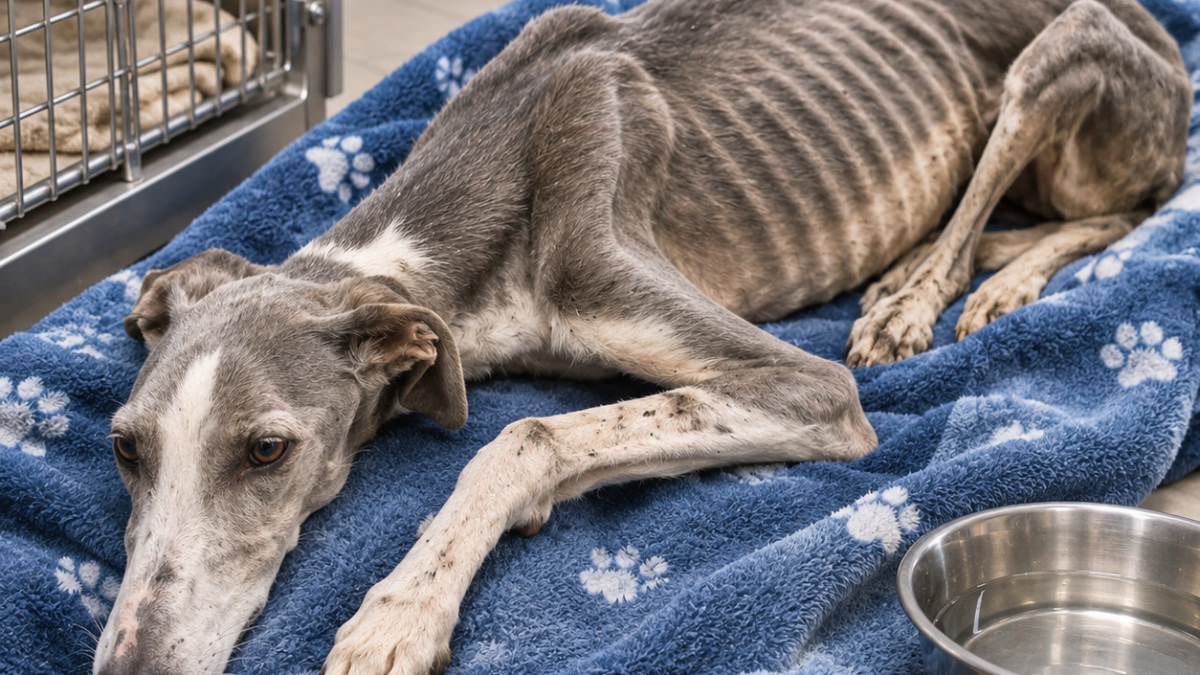
I could see fleas moving through his coat.
The skin underneath looked irritated.
His belly was tucked so tightly upward that there seemed to be almost nothing between his ribs and spine.
I put a leash on him carefully.
He didn’t resist.
That worried me.
Dogs who have strength often tell you what they think.
They pull.
They back away.
They investigate.
They object.
Valentine simply accepted whatever happened.
I kept one hand beneath his chest as we moved.
“You’re coming with me.”
The couple who found him stood nearby.
The woman’s eyes were wet.
“We had no idea.”
“I know.”
“How long do you think he was in there?”
“I honestly don’t know.”
“There wasn’t food.”
I looked around.
“I saw.”
“We found places where rainwater collected.”
That matched what we had suspected.
If Valentine had truly been trapped for weeks, rainwater might have been the reason he was still alive.
A dog can survive without food longer than without water.
But surviving is not the same as living.
Valentine had survived long enough to become almost skeletal.
That was all.
The man looked toward the house.
“Who would put him here?”
“I don’t know.”
“You think somebody threw him over?”
“It’s possible.”
“But you don’t know.”
“No.”
He nodded.
I appreciated that.
Anger makes people want certainty.
But Valentine did not need a story invented around him.
His actual condition was enough.
I lifted him into the car.
He weighed so little that I almost overcompensated when I picked him up.
The absence of weight is difficult to describe.
You expect resistance.
Muscle.
Substance.
Instead, there was bone beneath fur.
I settled him on a blanket.
He looked around the vehicle.
Then toward me.
I closed the door.
For the first time in however long, there was no gate between Valentine and the person trying to help him.
—
## THE DRIVE TO THE VET
Valentine did not sleep.
He stayed curled on the blanket with his head raised just enough to watch me.
Whenever the car slowed, his eyes moved.
Whenever I spoke, his ears reacted.
“Almost there.”
His gaze stayed on me.
“You’re going to see a doctor.”
Nothing.
“You’re going to get food, but not too much at once.”
Still watching.
“And you’re going to hate some of what we have to do.”
His ears twitched.
“Baths. Medicine. Probably needles.”
For the first time, I thought I saw a tiny change in his expression.
I smiled.
“Yeah, I know. Terrible service.”
That small joke was more for me than for him.
The reality was frightening.
Dogs this emaciated can deteriorate quickly.
Dehydration.
Anemia.
Parasites.
Infection.
Organ stress.
Electrolyte imbalance.
We needed to know what his body was still capable of handling.
At the clinic, the veterinary team was ready.
One of the technicians saw Valentine and immediately said, “Oh, sweetheart.”
He was placed on the examination table.
The scale confirmed what our eyes already knew.
Far too little weight.
The veterinarian ran her hands gently along his body.
Ribs.
Spine.
Hips.
Legs.
Abdomen.
She examined his mouth.
Eyes.
Gums.
Skin.
Then she parted the coat.
“Fleas.”
“A lot?”
“A lot.”
Parasite treatment would be necessary, but everything had to be considered in the context of his weakness.
When an animal is strong, medicine is straightforward.
When an animal is depleted, every intervention becomes a calculation.
What can his body tolerate?
What must happen now?
What can wait?
Blood was drawn.
Valentine barely reacted to the needle.
Again, that worried me.
I touched the top of his head.
“You’re allowed to complain.”
He looked at me.
“You know that, right?”
The veterinarian glanced over.
“Some of them stop.”
“Stop what?”
“Reacting.”
I knew what she meant.
Animals who have lived through prolonged deprivation sometimes become quiet in a way that is not peace.
They conserve themselves.
Energy.
Movement.
Emotion.
Everything.
I wanted Valentine angry.
Hungry.
Demanding.
Annoying.
Those would be good problems.
We just had to get him strong enough to have them.
—
## THE FIRST FOOD
Everyone wanted to feed him.
That instinct is immediate.
You see a starving dog and you want to put a giant bowl in front of him.
But severe starvation has to be handled carefully.
His system had been running on almost nothing.
Too much food too fast could create additional problems.
So we began with controlled portions.
The first bowl was small.
Valentine smelled it immediately.
His entire expression changed.
He stood.
Not strongly.
But fast enough that I had to steady him.
“Easy.”
His nose went toward the food.
The veterinarian lowered the bowl.
Valentine began eating.
Fast.
Too fast.
“Slow him down.”
I put my hand near the bowl, controlling access gently.
Valentine pushed forward.
“No one’s taking it.”
He kept eating.
“Slow down, sweetheart.”
He did not understand.
Of course he didn’t.
A dog who has been hungry for weeks does not believe in the next meal.
He believes in this one.
Right now.
Before it disappears.
I let him take another bite.
Paused.
Another.
Paused.
His eyes stayed fixed on the bowl.
When the measured portion was finished, Valentine licked the bottom.
Then the edges.
Then the floor beneath it.
I had to turn my face away.
The veterinarian noticed.
“Don’t give him more yet.”
“I know.”
“You’re thinking about it.”
“I’m absolutely thinking about it.”
She smiled gently.
“He’ll get another meal.”
I looked at Valentine.
That was the promise he needed to learn.
Another meal.
Later.
Then another after that.
And another tomorrow.
Food would no longer be an accident.
—
## THE BLOODWORK
While Valentine rested, we waited for the initial results.
The veterinarian came back with the chart.
“He’s severely malnourished.”
“No surprise.”
“No.”
“Anything worse?”
“He has parasites. We’ll need to treat those. He’s depleted, but at the moment I’m not seeing something that makes me think we can’t bring him back.”
I exhaled.
I had not realized I was holding my breath.
“So he has a chance.”
“Yes.”
A chance.
That word can feel enormous.
Not a guarantee.
Not a promise.
A chance.
I crouched beside Valentine.
“You heard that?”
He was lying on the blanket.
“You have work to do.”
His eyes stayed half closed.
“I’ll do my part.”
The veterinarian said quietly, “He’ll need time.”
“I know.”
“Weight gain has to be gradual.”
“I know.”
“Parasite control, nutrition, monitoring.”
“I know.”
She looked at me.
“You say that now.”
I smiled.
“I’m very patient.”
She laughed.
“No rescue person has ever said that honestly.”
Fair.
—
## THE QUESTION OF HOW HE GOT THERE
While Valentine was receiving care, we kept getting the same question.
How did he end up inside that house?
The real estate agent remained consistent.
The previous owner did not have a dog.
The property had been empty.
Valentine could not open the gate himself.
We had theories.
So did everyone else.
The most upsetting possibility was that someone had deliberately put him inside because they wanted to abandon him somewhere hidden.
An empty property would accomplish exactly that.
No neighbors expecting a dog.
No owner checking daily.
No immediate alarm.
But possibility is not proof.
I repeated that every time someone asked.
“We suspect he may have been dumped there.”
“By who?”
“We don’t know.”
“Was it the previous owner?”
“There is no evidence of that, and the agent said the previous owner didn’t have a dog.”
“So somebody threw him in?”
“Maybe.”
People hated the word maybe.
They wanted a face.
A name.
Someone to hate.
I understood.
I felt it too.
But anger without truth can create another kind of injustice.
Valentine’s body was evidence of suffering.
It was not evidence of a specific person’s guilt.
So I focused on what we could prove.
He was starving.
He had fleas.
He had parasites.
He had been unable to escape.
He needed help.
That was enough to keep us busy.
—
## THE FIRST NIGHT
Valentine stayed under medical supervision.
I visited before leaving.
He was lying on his side.
A blanket covered part of his body.
His breathing was calm.
His belly contained food.
Not enough to make him full in the way he wanted.
But enough for his body to begin working.
I touched his paw.
“I’ll see you tomorrow.”
His eyes opened.
For a second, I hated leaving.
Then I remembered where he had come from.
A locked house.
Silence.
Nobody knowing.
This was different.
People knew where he was.
People knew his name.
People were watching him.
If Valentine made a sound during the night, someone would hear it.
That difference mattered.
—
## THE NEXT MORNING
He was awake when I returned.
More importantly, he was hungry.
The technician laughed when she saw me.
“Your boy has opinions now.”
I looked toward Valentine.
He was standing near the front of his kennel.
Tail low, but body alert.
“What kind of opinions?”
“Mostly about breakfast.”
I smiled.
“Excellent.”
Valentine saw the food.
His ears lifted.
The bowl came down.
He ate eagerly.
Still too fast.
Still convinced every bite might be the last.
We continued controlling the portions.
I sat beside him afterward.
He licked his lips.
Then looked at me.
“No.”
He stared.
“You are not getting another full bowl.”
Stare.
“You can’t manipulate me.”
Stare.
I lasted about four seconds before asking the technician, “When is his next scheduled portion?”
She laughed.
“Told you. Opinions.”
Good.
I wanted every one of them.
—
## CORAÇÃO100DONO
The next day, Valentine was stable enough for me to bring him to our shelter.
That drive felt completely different from the first.
The first time he had been a question.
Would he survive?
Would he tolerate treatment?
Was there something hidden that we hadn’t found?
Now he was still fragile, but he had begun answering.
Yes, he wanted food.
Yes, his body responded to care.
Yes, he was still in there.
At Coração100dono, I prepared a quiet space.
Clean bedding.
Fresh water.
Controlled food.
No crowd.
No overwhelming introductions.
Just somewhere he could rest.
When Valentine entered, he stopped at the doorway.
I wondered whether enclosed spaces frightened him after being trapped.
He sniffed.
Looked at me.
Then stepped inside.
He circled the bed.
Once.
Twice.
Then lay down.
His body curled tightly.
I sat nearby.
“You know you can stretch out.”
He did not.
Not yet.
Dogs who have spent time protecting themselves do not immediately use all the comfort you offer.
Sometimes they need to discover that comfort remains available even when they stop guarding it.
—
## HIS APPETITE RETURNED BEFORE HIS TRUST
Food was simple.
People were complicated.
Valentine learned the feeding schedule quickly.
Morning meal.
Small controlled portion later.
Another meal.
His appetite became strong almost immediately.
He would hear the sound of bowls and stand.
His body still looked skeletal.
But his eyes sharpened.
He became more present.
When I approached without food, however, he remained cautious.
He did not run away.
He didn’t have much energy for that.
But he watched.
I sat near him.
No touching.
No pressure.
Just presence.
One afternoon I opened the door to his area and sat on the floor.
Valentine was on his bed.
For ten minutes, nothing happened.
I looked at my phone.
Answered messages.
Pretended not to care whether he came closer.
Eventually I heard his nails against the floor.
One step.
Pause.
Another.
I did not look at him.
He moved closer.
Then I felt his nose against my sleeve.
I smiled but kept still.
A second sniff.
Then Valentine backed away.
That was enough.
Trust is not measured by dramatic leaps.
Sometimes it is six inches of distance voluntarily crossed.
—
## THREE DAYS
Three days after his rescue, we weighed him again.
I watched the numbers.
Then blinked.
“One kilogram?”
The caregiver nodded.
“One.”
I almost asked her to weigh him again.
“That much?”
“He’s been eating well.”
I looked at Valentine.
He stood beside us.
Still painfully thin.
One kilogram did not transform his appearance.
His ribs were still visible.
His hips still sharp.
His legs still narrow.
But inside that number was evidence.
His body was accepting nourishment.
Holding it.
Using it.
Building.
I crouched.
“You gained a whole kilogram.”
Valentine looked at the treat in my hand.
“You have absolutely no idea why I’m excited.”
He stared at the treat.
“Fine.”
I gave it to him.
That kilogram meant more than weight.
It meant momentum.
—
## THE FIRST WALK
Once Valentine was stable enough, I decided to take him outside for a short walk.
I held the leash.
We approached the gate.
He stopped.
I noticed immediately.
His body became still.
The gate in front of us was not the same gate.
Different place.
Different shape.
Different metal.
But I wondered what he saw.
I crouched.
“We don’t have to rush.”
Valentine looked at the opening.
Someone had already unlocked it.
I pushed it wider.
“See?”
He stared.
The first gate had kept him inside.
This one was open.
I stepped through.
Valentine did not follow.
I waited.
No pulling.
No tension on the leash.
“Your choice.”
His nose moved.
Then one front paw crossed the threshold.
Pause.
Second paw.
He looked around.
I walked one step.
Valentine followed.
We were outside.
Together.
That difference hit me so hard that I had to swallow before speaking.
The last time he had stood behind a gate, nobody knew he was there.
Now someone had opened it for him.
And someone went with him.
—
## THE WORLD OUTSIDE
Valentine’s walk was short.
Very short.
His muscles were weak.
His body had not carried normal weight for some time.
We did not need distance.
We needed experience.
Grass.
Air.
Sun.
Smells.
Freedom without abandonment.
He sniffed the ground.
Stopped at a plant.
Moved forward.
Then looked back at me.
I was still there.
We continued.
Every few steps, he checked again.
Still there.
That became a pattern over the next days.
Valentine would walk.
Look back.
Walk.
Look back.
At first I thought he was nervous about the leash.
Then I realized he was checking me.
Had I left?
Was I still following?
Or maybe:
Was he still allowed to keep moving?
Dogs do not tell us which interpretation is correct.
We infer from behavior.
What I knew was this:
Every time Valentine looked back, I made sure he saw someone.
—
## THE LOCKED GATE IN MY HEAD
I kept thinking about the old property.
People expected me to be angry at whoever had put him there.
I was.
But there was a deeper anger underneath.
The gate itself had become a symbol in my mind.
A barrier.
Not because gates are cruel.
We use them every day to keep dogs safe.
But that gate had combined with abandonment to become a trap.
Someone—or some chain of circumstances—had placed Valentine where he could not meet his own basic needs.
Then time did the rest.
Hunger.
Parasites.
Fleas.
Weakness.
Isolation.
That is how neglect often works.
Not one explosive act.
A closing gate.
Then nobody coming back.
Day after day.
The suffering grows quietly.
That was what frightened me most.
Violence gets attention.
Silence can kill just as effectively.
—
## HIS BODY BEGAN TO CHANGE
The transformation was not dramatic at first.
You had to know where to look.
His eyes.
Brighter.
His posture.
Slightly higher.
The way he stood near food.
More stable.
The way his skin sat over his ribs.
A fraction less tight.
Each day we watched.
Each meal mattered.
Parasite treatment began doing its work.
The fleas disappeared.
His skin became calmer.
His digestive system adjusted.
He drank normally.
He slept deeply.
There were no miracles.
There was routine.
And routine, applied consistently to a starving body, can look miraculous from the outside.
—
## VALENTINE’S BED
At first he curled tightly on the smallest part of the bed.
Almost as though he were afraid to occupy too much space.
Then one afternoon I found him sleeping differently.
Sideways.
Front legs extended.
Back legs loose.
His belly visible.
He took up nearly the whole cushion.
I stopped at the doorway.
A caregiver whispered, “He’s been like that twenty minutes.”
I smiled.
“Don’t wake him.”
We stood watching.
There is something powerful about seeing a previously neglected animal sleep deeply.
A sleeping animal is vulnerable.
To sleep fully means surrendering control.
Valentine had spent weeks—possibly longer—having no control over his own survival.
Now he could close his eyes.
Food would still be there later.
Water would still be there later.
The door would not lock him in and disappear.
People would come back.
That was what the bed represented.
Not softness.
Certainty.
—
## HIS FIRST FRIEND
Valentine was eventually introduced carefully to another calm dog at the shelter.
We kept the interaction controlled.
No crowd.
No pressure.
The other dog approached with loose body language.
Valentine froze at first.
The dog sniffed.
Valentine sniffed back.
Then stepped away.
Fine.
Several minutes later, he returned.
The other dog gave a small play bow.
Valentine stared.
No response.
Again.
Play bow.
Tiny bounce.
Valentine took one uncertain sideways step.
The other dog bounced away.
Something changed.
Valentine followed.
Only two steps.
Then stopped.
I laughed.
“What was that?”
His ears lifted.
The other dog invited again.
This time Valentine moved faster.
Not running.
Not yet.
But participating.
That afternoon, he learned something starvation had probably pushed out of his world.
Another dog could be a friend rather than competition for food.
—
## FOOD SECURITY
Valentine had one predictable emotional problem.
He worried about food.
When the bowl arrived, he ate quickly.
If another dog was visible at a distance, Valentine became even more focused.
We fed him separately.
No competition.
No need to defend.
No hands taking food away.
We wanted him to learn abundance through repetition.
Meal arrives.
Eat.
Nothing bad happens.
Meal arrives later.
Eat.
Nothing bad happens.
Tomorrow:
Meal again.
Over time, his pace slowed.
Not much at first.
Then noticeably.
One day he paused halfway through eating and looked toward a sound.
I froze.
He had stopped eating voluntarily.
That mattered.
A dog who believes food may disappear does not pause.
Valentine listened for a few seconds.
Then returned to the bowl.
I smiled.
“You’re starting to believe us.”
—
## PEOPLE WANTED TO KNOW WHO DID IT
As Valentine’s story spread, messages came in.
“Who locked him there?”
“Did you find the person?”
“Was the old owner charged?”
“Who abandoned him?”
I answered the same way.
“We do not know.”
Some people became frustrated.
“How can you not know?”
Because reality does not always provide a camera.
Because animals cannot give statements.
Because an empty house does not record everyone who comes near it.
Because suspicion is not evidence.
The real estate agent said the former owner did not have a dog.
We had no verified proof identifying who placed Valentine inside.
That was the truth.
I would not strengthen Valentine’s story by making part of it false.
He did not need fiction.
His ribs were real.
The locked gate was real.
The fleas were real.
The parasites were real.
The hunger was real.
The recovery was becoming real too.
—
## THE REVENGE PEOPLE EXPECTED
Some followers wanted a dramatic punishment.
They wanted someone found.
Confronted.
Humiliated.
Maybe they imagined Valentine facing the person responsible.
Dogs do not need that.
Humans do.
We want moral balance.
We want cruelty to receive an equal and opposite force.
I understand.
The first night, I imagined it too.
I imagined putting Valentine’s veterinary report in front of whoever had abandoned him.
I imagined asking:
“Look at those ribs. Tell me how long you expected him to survive.”
But the more Valentine healed, the less interested I became in building my days around an unknown person.
Whoever had failed Valentine had already taken too much time from him.
They did not deserve ours too.
So I began thinking of revenge differently.
—
## REVENGE WAS BREAKFAST
Valentine learned the sound of the food container.
The second he heard it, he stood.
Then came the stare.
“Not yet.”
Stare.
“It’s being prepared.”
Stare.
“You ate earlier.”
Stare.
He became shameless.
I loved it.
A dog who once had no way to find food now complained about waiting sixty seconds.
That was revenge.
—
## REVENGE WAS THE OPEN GATE
Every morning we opened the shelter gate for his walk.
Valentine eventually stopped hesitating.
He learned the sound of the latch.
Click.
Gate opens.
Valentine steps through.
Sometimes he pulled forward with excitement.
The first gate had meant:
You cannot leave.
This gate meant:
Let’s go.
That was revenge.
—
## REVENGE WAS A WARM BED
Valentine became possessive of comfort.
Not aggressively.
Comically.
If another dog occupied his favorite cushion, Valentine stood nearby looking offended.
He would look at the dog.
Then at me.
Dog.
Me.
Dog.
Me.
As if filing a formal complaint.
“You have three other beds.”
Stare.
“That one is occupied.”
Stare.
“You’ll survive.”
Eventually he would choose another.
Five minutes later, he’d be asleep.
The dog who once had concrete and emptiness now had opinions about mattresses.
That was revenge.
—
## HIS WEIGHT CONTINUED TO RISE
The scale became something we looked forward to.
Each weigh-in showed progress.
Not always dramatic.
Sometimes a small gain.
Sometimes more.
The important thing was the direction.
Up.
His hips softened beneath new tissue.
His ribs became less sharp.
Muscle returned slowly.
His legs stopped looking fragile.
When he walked, he no longer appeared to be negotiating with gravity.
One afternoon, he trotted.
Only a few steps.
I stared.
“Did you see that?”
A caregiver laughed.
“I saw.”
“He trotted.”
“Yes, Marisa.”
“He TROTTED.”
Valentine looked at us as if we were ridiculous.
We were.
But he had earned the celebration.
—
## THE FIRST TIME HE RAN
It happened with another dog.
They were outside in a secure area.
Valentine had become more social.
One of his friends grabbed a toy and ran.
Valentine watched.
The dog circled back.
Ran again.
This time Valentine followed.
Walk.
Trot.
Then:
Run.
His body stretched farther than I had ever seen.
He was still rebuilding.
Still thinner than he should be.
But he ran.
Three seconds.
Maybe four.
Then stopped.
The other dog returned.
Valentine bounced sideways.
I felt tears immediately.
A few weeks earlier, his life had been measured by whether his body could remain standing behind a gate.
Now he was using energy for something unnecessary.
Play.
That is what recovery gives back.
The ability to spend energy on joy.
—
## THE NAME VALENTINE
People asked why we called him Valentine.
Names come for different reasons.
Sometimes appearance.
Sometimes personality.
Sometimes timing.
For me, the name began to feel more appropriate as he recovered.
Not because his story was romantic.
Because Valentine became a dog defined by the opposite of what happened to him.
Someone had left him where love was absent.
Then he entered a place where care became repetitive.
Food.
Medicine.
Walks.
Hands.
Companionship.
Rest.
Love is often less dramatic than people imagine.
It is repetition.
You come back tomorrow.
That was what Valentine needed most.
—
## HE BEGAN GREETING ME
Early in recovery, Valentine watched me approach.
Later, he stood.
Then one day, his tail moved before I reached him.
I stopped.
“Was that for me?”
More wagging.
I crouched.
Valentine walked over.
He pressed his head against my chest.
I closed my eyes.
There are moments in rescue that feel like someone quietly hands you something valuable.
Trust is one of them.
You cannot demand it.
You cannot rush it.
You can only behave in ways that make giving it reasonable.
Valentine gave a little.
Then more.
—
## THE HOUSE THAT ALMOST BECAME HIS GRAVE
I received updated pictures of the property later.
The image unsettled me.
Empty rooms.
Locked entrance.
Ordinary walls.
Nothing about it looked like a place where a dog had nearly starved.
That is important.
Danger does not always look dramatic.
There was no dungeon.
No visible torture chamber.
Just an empty house.
A gate.
A dog nobody knew existed.
The ordinariness made it worse.
Valentine could have died there quietly.
The couple might have arrived days later.
Weeks later.
Maybe his body would have been found instead.
That thought stayed with me.
—
## THE COUPLE WHO FOUND HIM VISITED
The couple who had discovered Valentine asked about him.
Eventually, they came to see him.
The woman stopped when he approached.
“Oh my God.”
Valentine looked completely different.
Still recovering.
But alive in a way he had not looked that first day.
She crouched.
“Do you remember us?”
He sniffed her.
Tail moved.
She started crying.
“I thought he was going to die.”
“So did I.”
Her husband looked at Valentine’s body.
“He’s filling out.”
“Yes.”
“I keep thinking about opening that gate.”
The woman wiped her face.
“So do I.”
They had not planned to rescue a dog on November 1.
They had planned to enter their new house.
Instead, they changed the direction of a life simply because they noticed what was inside.
That is how rescue often begins.
Not with heroes searching for danger.
With ordinary people refusing to ignore what they unexpectedly find.
—
## “WHAT IF YOU HADN’T BOUGHT THE HOUSE?”
The woman asked me that before leaving.
I did not answer immediately.
Because we both knew.
If they had not purchased the property when they did…
If they had delayed visiting…
If nobody had opened the gate…
Valentine’s body had very little left.
Maybe rainwater would have kept him alive longer.
Maybe not.
But starvation does not negotiate forever.
“I try not to think about it,” I said.
She nodded.
“Me too.”
Then she looked at Valentine.
He was sniffing her husband’s shoe.
“Lucky boy.”
I thought about that.
Lucky.
Eventually, yes.
But luck should not be confused with what he deserved.
Valentine deserved food from the beginning.
Safety from the beginning.
Care from the beginning.
Being rescued from near death is not a substitute for never being abandoned.
We celebrate survival because we cannot change the past.
—
## HIS SKIN IMPROVED
With flea control, parasite treatment and nutrition, Valentine’s coat began looking healthier.
The changes were gradual.
The dullness softened.
The skin looked less irritated.
Areas where scratching had damaged him began healing.
He tolerated grooming cautiously.
At first, the brush made him step away.
I stopped.
Let him sniff it.
Touched it to his shoulder once.
Reward.
Again.
Reward.
Eventually, brushing became something he enjoyed.
He leaned into it.
One caregiver laughed.
“Look at this spoiled dog.”
I smiled.
“Perfect.”
Spoiled is a beautiful word when applied to an animal who once had nothing.
—
## A FULL BELLY CHANGES EVERYTHING
One evening I saw Valentine after dinner.
His stomach looked gently rounded.
Not swollen.
Not sick.
Just fed.
I stared at him.
A full belly seems like the most ordinary thing in the world until you know what an empty one can do.
Hunger changes behavior.
Movement.
Thought.
Trust.
Sleep.
Everything becomes organized around survival.
Valentine curled on his bed after that meal.
He sighed.
A long, deep exhale.
Then closed his eyes.
I sat nearby.
“You’re full.”
No response.
“You’re warm.”
He slept.
“And the gate is open tomorrow.”
Still sleeping.
That was enough.
—
## THE DOG FRIENDS
Valentine gradually became more comfortable with the other dogs.
At first, he stayed near the edges.
Later, he joined.
He learned play bows.
Chasing.
Taking turns with toys.
He occasionally tried to steal someone else’s treat.
We corrected that.
He occasionally stole beds.
We were less successful there.
One dog became his favorite companion.
They slept near each other.
Walked together.
Played outside.
When Valentine became uncertain, he sometimes watched the other dog.
If his friend approached a new situation calmly, Valentine followed.
Dogs can teach dogs things humans cannot.
Safety by example.
—
## THE FIRST TIME HE CHOSE TO GO BACK INSIDE
This moment sounds small.
It mattered to me.
After a walk, we returned to the shelter.
The gate was open.
Valentine stood outside.
I expected him to hesitate.
Instead, he walked through willingly.
Back inside.
That might seem opposite to freedom.
Wasn’t escaping confinement the goal?
But choice changes everything.
The old house trapped him.
The shelter held him safely.
The difference was not walls.
It was care.
Valentine chose to return because inside meant:
Food.
Bed.
Friends.
People.
That was home beginning to form.
—
## WE NEVER FOUND A CERTAIN VILLAIN
People continued asking.
The answer never changed.
No verified person emerged whom we could honestly identify as the one who placed Valentine inside.
That frustrated some followers.
It frustrated me too.
But truth does not become more satisfying simply because we demand it.
We had suspicion.
Circumstance.
Questions.
Not proof.
So Valentine’s story could not responsibly end with a courtroom scene.
There was no confirmed attacker for me to confront.
No proven owner for Valentine to reject dramatically.
But I realized something.
A satisfying ending does not require a villain standing in front of us.
It requires the victim no longer living under the power of what happened.
Valentine was reaching that point.
—
## THE PERSON WHO ABANDONED HIM—IF SOMEONE DID—LOST EVERYTHING IMPORTANT
I sometimes imagined the unknown person who may have left Valentine there.
Not their face.
Just the act.
Someone closing a gate.
Walking away.
Maybe believing Valentine would disappear from their life.
In one sense, they were right.
Valentine did disappear from that life.
But he did not disappear from the world.
He became visible.
People knew his name.
People cared whether he ate.
People celebrated one kilogram.
People opened gates for him.
People watched him play.
If someone had wanted Valentine forgotten, they failed completely.
That was satisfying enough.
—
## HIS EYES CHANGED
Photographs told the story better than I could.
First day:
Eyes large.
Exhausted.
Unsure.
Body rigid.
Weeks later:
Eyes soft.
Alert.
Curious.
Sometimes mischievous.
People often focus on weight in rescue transformations.
I focus on eyes.
Weight tells you what the body received.
Eyes sometimes tell you what the animal began to believe.
Valentine was beginning to believe the world contained more than hunger.
—
## THE DAY HE STOLE MY FOOD
I was sitting near the dogs eating a snack.
A mistake.
Valentine approached.
I saw him.
“You have already eaten.”
He sat.
“Do not look at me like that.”
Stare.
“No.”
I turned to answer someone.
Half a second.
When I looked back, Valentine had taken a piece from my hand.
I gasped.
He backed away chewing.
“VALENTINE.”
People laughed.
He swallowed.
Tail wagging.
I should have been annoyed.
Instead I started laughing too.
The dog who had nearly died from hunger had become bold enough to steal food from the person who rescued him.
Excellent.
We would work on manners later.
—
## PROGRESS IS SOMETIMES MISCHIEF
That became a theme.
As Valentine became healthier, he became more difficult.
He followed caregivers.
Got underfoot.
Tried to investigate food bins.
Wanted longer walks.
Became impatient while waiting for leashes.
Pushed toward the gate when he knew outside time was coming.
All the behaviors that would annoy someone caring for an ordinary healthy dog delighted us.
Because they required energy.
Expectation.
Confidence.
Valentine was no longer conserving everything.
He had enough life to waste some on trouble.
—
## THE FIRST RAIN
Rain made me emotional.
The first rainy day after Valentine recovered enough to go outside, he stood near the shelter entrance.
Drops hit the ground.
He watched.
I thought about the old house.
Rainwater collecting somewhere.
Possibly the only thing keeping him alive.
I did not know whether he connected the sound with those days.
He stepped outside.
Sniffed.
Then quickly returned beneath the cover.
I laughed.
“You survived on rainwater and now you don’t want your feet wet?”
Valentine looked at me.
Apparently hardship had not made him appreciative of bad weather.
Good.
He had permission to be picky now.
—
## A DOG DOES NOT NEED TO BE GRATEFUL FOR BASIC CARE
People sometimes say rescued animals are “grateful.”
Maybe.
But I don’t want Valentine grateful for food.
Food should be normal.
I don’t want him grateful for water.
Water should be normal.
A bed.
Normal.
Safety.
Normal.
Kindness.
Normal.
The goal was not to make him spend his life remembering what we saved him from.
The goal was to make the new life ordinary enough that starvation became distant.
That is a better ending.
—
## THE WARM BED
One of the updates that touched people most was Valentine sleeping on a warm bed.
No dramatic action.
No medical procedure.
No rescue.
He curled against the soft bedding with another dog nearby.
His body had filled out enough that bones no longer dominated the image.
His face looked peaceful.
I stared at that picture and remembered the empty property.
There, rest probably meant collapsing because he had no energy.
Here, rest meant comfort.
Two poses can look similar.
Their meanings can be completely different.
—
## THE GATE BECAME HIS FAVORITE PLACE
Ironically, once Valentine recovered, he often waited near the shelter gate before walks.
I would approach and find him there.
Tail moving.
Eyes bright.
Ready.
He learned that gates were not always the enemy.
A gate could keep danger out.
A gate could open.
A gate could lead to a walk.
A gate could close after you returned and still open again tomorrow.
That distinction may sound abstract.
For Valentine, it became routine.
I loved watching him hear the latch.
Click.
Instant excitement.
The sound that might once have meant confinement now predicted freedom.
—
## THE WALK THAT MADE ME CRY
Weeks into recovery, we went farther than usual.
Valentine’s body was stronger.
His weight healthier.
He moved confidently.
At one point, he walked ahead of me.
The leash remained loose.
Sunlight fell across his back.
He stopped.
Looked over his shoulder.
I was there.
Then he continued.
That image broke me.
Because the first time I saw him, he was behind a gate waiting for someone to come toward him.
Now he was in front.
Choosing the direction.
Looking back only to make sure his person was still coming.
That was the entire transformation in one moment.
—
## PEOPLE SAID HE LOOKED LIKE A DIFFERENT DOG
He did.
But he wasn’t.
That phrase always bothers me slightly.
The healthy dog was not a new Valentine.
He was the same Valentine with access to what he needed.
The playful dog existed inside the starving one.
The affectionate dog existed behind the locked gate.
The dog who stole food from my hand was there too.
Hunger had simply hidden him.
Care revealed him.
—
## THE MOST PAINFUL QUESTION
“Did he wait for whoever left him?”
I don’t know.
That question hurts because we imagine him hearing sounds outside.
Footsteps.
Cars.
Voices.
Maybe lifting his head each time.
Maybe expecting someone familiar.
Maybe nobody.
We cannot know.
I refuse to put thoughts into his mind just to make the story sadder.
The facts are sad enough.
But if Valentine did wait for someone, eventually he stopped needing that person.
He had us.
He had his dog friends.
He had meals.
Walks.
A bed.
The past gradually lost its monopoly on his attention.
—
## ONE MONTH LATER
By the time a month had passed, Valentine had changed dramatically.
His body had filled out.
His coat looked better.
His stamina improved.
He played longer.
He walked farther.
He rested more comfortably.
He greeted familiar people.
He had preferences.
Favorite dogs.
Favorite sleeping spots.
Favorite foods.
He had become an individual again rather than a medical emergency.
That was one of my favorite stages in any rescue.
The moment you stop talking constantly about what is wrong.
And start talking about who the dog is.
—
## WHO WAS VALENTINE?
He was food motivated.
Extremely.
He loved company.
He liked sleeping pressed against soft surfaces.
He became playful once he felt secure.
He checked frequently for familiar people during walks.
He disliked being rushed.
He preferred certain dogs.
He could be cheeky.
He had mastered the tragic stare whenever he wanted more food.
He was gentle.
He was learning.
He was not broken.
That last one mattered most.
Neglected does not mean broken.
Starved does not mean ruined.
Traumatized does not mean incapable of joy.
Valentine proved that every day.
—
## THE REVENGE FANTASY FADED
As he improved, I noticed something about myself.
I thought less about the unknown person who might have put him there.
At first:
Who did this?
Who closed the gate?
Who left him?
Later:
Did Valentine eat?
Did he gain?
How was his walk?
Did he play?
What did he steal today?
The center moved.
From perpetrator to survivor.
That felt healthier.
Valentine’s life was no longer organized around the person who failed him.
Neither should our attention be.
—
## IF THE PERSON RESPONSIBLE EVER SAW HIM
Sometimes I imagined they came across a photograph.
Maybe they recognized him.
Maybe not.
If they did, I hoped they saw everything.
The healthy body.
The bright eyes.
The dog friends.
The bed.
The open gate.
Not because I wanted them emotionally destroyed.
Because I wanted one truth to be impossible to ignore:
Valentine had value.
If someone discarded him because they thought he was a burden, they were wrong.
If someone assumed he would vanish unnoticed, they were wrong.
If someone believed his life was disposable, they were wrong.
Valentine lived long enough to make that undeniable.
—
## THE GATE REVERSAL
One morning, I filmed Valentine going out.
The gate opened.
He hurried through.
Then stopped several feet away and turned back.
His tail wagged.
He waited.
“For me?”
He bounced once.
I walked through.
He continued.
I watched the video later.
The symbolism almost felt too perfect.
Once, a locked gate separated him from everything he needed.
Now an open gate was something he crossed voluntarily, knowing someone would follow.
That became the ending in my mind.
Not revenge through punishment.
Revenge through reversal.
—
## HIS FRIENDS
Valentine built a little social world.
Dogs who rested beside him.
Dogs who chased him.
Dogs who stole toys from him.
Dogs whose toys he stole back.
There were small arguments.
Normal canine disagreements.
Nothing dramatic.
Every one of them made me happy.
You cannot have social problems when you are completely isolated.
Even irritation can be evidence of belonging.
Valentine was no longer alone enough for silence to define his days.
—
## THE BEDTIME ROUTINE
He developed a routine.
Evening meal.
Last walk.
Water.
Bed.
Sometimes another dog nearby.
Sometimes alone.
He would circle.
Settle.
Sigh.
That sigh.
I loved it.
No urgency.
No hunger driving him toward the gate.
No need to search for rainwater.
No unknown night stretching ahead.
Just sleep.
He knew morning would come with breakfast.
Security is repetitive.
That is why it works.
—
## THE COUPLE SENT US A MESSAGE
The couple who found Valentine stayed interested in his recovery.
One message said:
“We keep thinking about that first day. We’re so glad he’s okay.”
I sent them a recent photo.
Valentine was lying on a bed with his stomach full and paws stretched forward.
The reply came:
“That can’t be the same dog.”
I smiled.
It was.
Exactly the same dog.
That was the point.
—
## WHAT RESCUE CHANGED
Rescue did not change Valentine’s worth.
It changed his circumstances.
He had been worth feeding before we found him.
Worth protecting before the couple bought the house.
Worth opening the gate for before his ribs became visible.
We did not create value.
We responded to it late.
That distinction matters.
Otherwise people begin thinking rescue workers transform worthless animals into valuable ones.
No.
The value was always there.
The tragedy is that someone failed to see it.
—
## THE FINAL STAGE OF RECOVERY
Eventually Valentine was no longer treated like a fragile dog.
That was a milestone too.
At first:
Careful.
Small meals.
Close monitoring.
Short walks.
Controlled introductions.
Later:
Normal portions.
Longer walks.
Play.
Routine.
He became robust enough to be ordinary.
People stopped gasping when they saw him.
New visitors did not immediately know what happened.
That felt strange.
Wonderful.
A stranger could look at Valentine and see simply a dog.
Not starvation.
Not abandonment.
A dog.
That was success.
—
## WHAT HAPPENED TO THE LOCKED HOUSE?
It became just a house again.
New owners.
New life.
The gate still existed, but not in the same meaning.
People repaired things.
Changed things.
Moved forward.
I was glad.
Places do not need to remain memorials to suffering.
Valentine moved forward too.
The house had almost become his ending.
Instead, it became his beginning.
—
## THE DAY HE STOPPED LOOKING BACK SO OFTEN
On walks, Valentine gradually stopped checking me every few steps.
At first I missed it.
Then I understood.
He was not worried.
He trusted the connection.
The leash was loose.
I was behind him.
He knew.
No need to verify constantly.
Confidence can look like not checking.
One day we walked nearly an entire stretch before Valentine glanced back.
I smiled.
“I’m still here.”
He turned forward.
Of course.
He already knew.
—
## THE MOST SATISFYING ENDING
People wanted me to choose one moment.
Was it the rescue?
The kilogram?
The first walk?
The first run?
The full belly?
The warm bed?
For me, the most satisfying moment was ordinary.
Valentine finished dinner.
Walked toward his bed.
Another dog was already there.
Valentine paused.
Looked annoyed.
Then climbed onto the remaining space anyway.
The other dog shifted.
Valentine curled against him.
Both fell asleep.
That was it.
No gate.
No hunger.
No mystery.
No emergency.
Just bedtime.
A normal night.
After what Valentine had survived, normal was extraordinary.
—
## EPILOGUE — THE GATE THAT COULD NO LONGER HOLD HIM
When people first saw Valentine, the locked gate was the defining image.
A starving dog behind metal.
Bones visible.
No way out.
No one even knew he was there until a couple bought an empty house and walked inside on November 1.
They could have arrived too late.
That thought will always stay with me.
Valentine’s body had already begun shrinking into survival.
He had fleas.
Parasites.
Severe malnutrition.
Very little strength.
No reliable food.
We believed rainwater may have been what kept him alive.
There were questions we could not answer.
Who put him there?
Had someone deliberately thrown him inside?
How many weeks?
Did anyone know before the couple arrived?
The real estate agent said the previous owner did not have a dog.
That made deliberate abandonment seem possible.
But possibility is where I stop.
I will not fabricate certainty.
Valentine’s suffering does not need exaggeration.
He was real.
His hunger was real.
His isolation was real.
His rescue was real.
I took him to the veterinarian.
The team examined him.
Treated the parasites.
Controlled the fleas.
Fed him carefully.
Monitored his weakened body.
Then the next day, I brought him to Coração100dono.
There, Valentine discovered repetition.
Food that came back.
Water that did not depend on rain.
Beds that stayed.
People who returned.
He ate.
And ate.
And ate.
Three days after rescue, he had gained a kilogram.
One kilogram.
To some people, that is just a number.
To us, it was proof that Valentine’s body had accepted the invitation to live.
Then came the walk.
The gate opened.
Valentine hesitated.
And I waited.
Nobody dragged him.
Nobody forced him.
The opening remained.
He stepped through.
Then I stepped through with him.
That moment mattered more than I could explain at the time.
Because freedom is not merely an open gate.
A starving stray can be free and still be alone.
Valentine got something better.
An open gate and someone beside him.
Over the weeks, his ribs became less visible.
His body filled out.
His coat improved.
His eyes changed.
He made dog friends.
He learned to play.
He discovered comfortable beds.
He stole food when he thought I wasn’t looking.
He became impatient at mealtime.
He learned the sound of the gate latch before walks.
He began running through the opening instead of fearing it.
And eventually, the dog who once stood silently behind metal became the dog waiting excitedly for someone to open it.
People asked about revenge.
They wanted to know what happened to whoever abandoned him.
I understand that hunger for justice.
I felt it too.
But we never had a verified person we could honestly identify.
So there is no courtroom scene in Valentine’s ending.
No invented confession.
No dramatic punishment I can truthfully give you.
Instead, I can give you something real.
Whoever left Valentine powerless—if someone deliberately did—lost that power.
Completely.
The gate no longer held him.
Hunger no longer controlled him.
The empty house no longer defined him.
The person who may have wanted him forgotten failed.
Valentine became known.
Cared for.
Fed.
Protected.
Loved.
He went from surviving on what rain happened to leave behind to finishing meals and looking for more.
He went from sleeping in an abandoned property to curling into a warm bed beside dog friends.
He went from having nobody know he existed to having people celebrate a single kilogram of weight gain.
And he went from standing behind a locked gate to walking through an open one with someone who would never leave him there alone.
That is the revenge I choose for Valentine.
Not pain returned for pain.
A life returned for abandonment.
Every full bowl was an answer.
Every pound gained was an answer.
Every nap on a warm bed was an answer.
Every time he played with another dog was an answer.
Every open gate was an answer.
The strongest one came during an ordinary walk.
Valentine was several steps ahead of me.
Healthy enough now to move with confidence.
The gate behind us had already closed.
Ahead was open space.
He stopped.
Turned.
Looked back at me.
For a moment I remembered the first photograph.
A starving dog staring through metal, waiting for someone he did not know would ever come.
Now the expression was completely different.
I smiled.
“I’m coming.”
His tail moved.
Then Valentine turned forward and kept walking.
He did not need me to rescue him anymore.
He only needed to know I was still there.
And I was.
That is where I choose to leave his story.
Not behind the locked gate.
Not in the empty house.
Not with the mystery of who abandoned him.
I leave him walking forward.
Belly full.
Body stronger.
Friends waiting.
A warm bed waiting.
And whenever another gate appears in front of him, someone reaches for the latch.
It opens.
Valentine steps through.
And this time, he never has to cross it alone.








