PART 2: They Abandoned Zuul When His Body Began Failing—Then the Vet Found Out What Had Been Done to Him
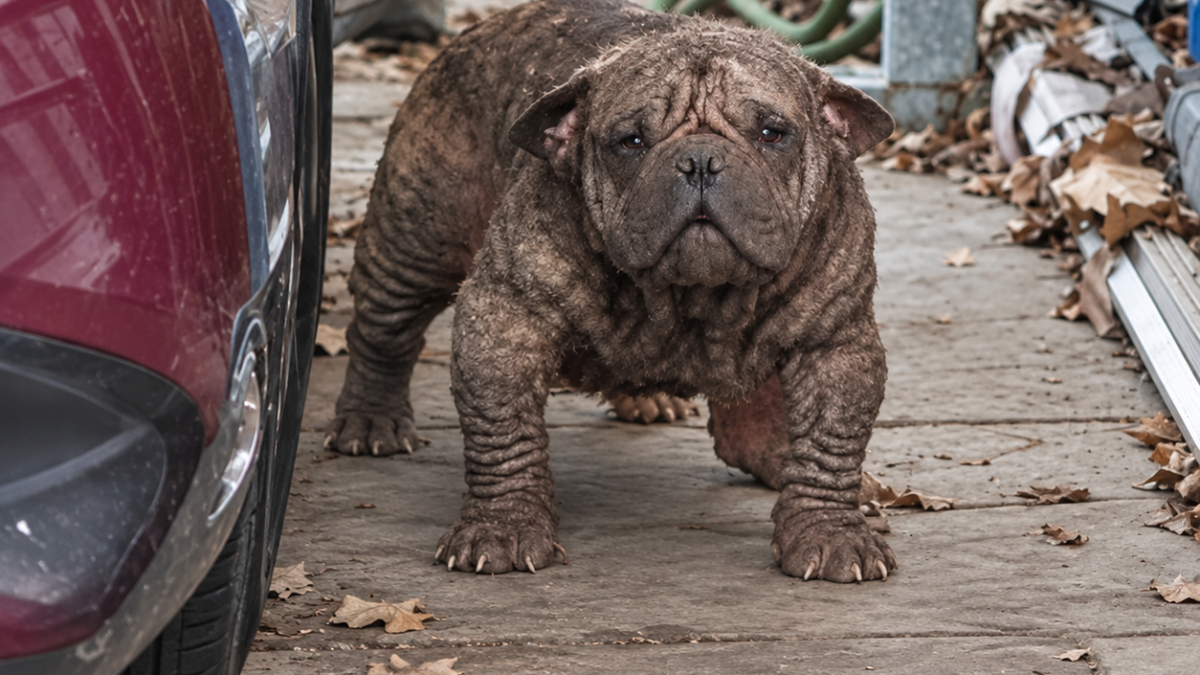
PART 2
I wish I could say that little squeaky toy marked the beginning of a smooth recovery.
It didn’t.
Rescue stories often get compressed into a few photographs.
The terrible first picture.
Then a picture where the dog looks slightly better.
Then the happy ending.
What those pictures cannot show are the nights between them.
The setbacks.
The bills.
The fear.
The moment you begin wondering whether love will be enough when medicine isn’t giving you the answers you hoped for.
Zuul taught me that recovery could move forward and backward in the same twenty-four hours.
That evening, only a few hours after he discovered the squeaky toy, he stopped eating.
Melissa noticed first.
She brought his bowl back from the kennel nearly untouched.
“Rachel.”
I looked up from the treatment chart.
“What?”
“He won’t eat.”
Zuul loved food.
Even on his worst first day, he had accepted a little boiled chicken from my hand.
I walked immediately to his kennel.
He was curled on his blanket wearing blue cotton pajamas that covered most of his damaged skin.
“Hey, handsome.”
His eyes opened.
His tail moved weakly.
I crouched.
“Chicken?”
Nothing.
I offered a small piece beneath his nose.
He sniffed.
Turned away.
That scared me far more than people might understand.
I checked his gums.
Temperature.
Respiratory rate.
Heart rate.
His breathing was faster.
Dr. Ellen Hayes, our veterinarian, came in from the surgery room.
“What changed?”
“Stopped eating. Respirations are up.”
She listened to his chest.
The room went silent.
Zuul looked from one of us to the other as though he could tell the mood had shifted.
Ellen listened longer.
Then she said, “Let’s image him.”
We carried him to radiology.
I kept my hand on his shoulder while the images were taken.
His heart was enlarged.
Not catastrophically, but enough to deepen our concerns.
The murmur was no longer simply another problem on a long list.
It was something that could determine how aggressively we treated everything else.
We arranged a cardiology consult.
Until then, we had to balance his medications carefully.
His skin needed treatment.
His infection needed treatment.
His eyes needed treatment.
His body needed nutrition.
But his heart had its own rules.
When I returned him to his kennel, I sat on the floor.
“You couldn’t just have one problem?”
Zuul licked my wrist.
“I’m serious.”
Another lick.
“You’re expensive.”
Tail tap.
“And you smell like medicated shampoo.”
He put his chin on my leg.
That was Zuul.
He had every reason to be miserable, but he kept reaching toward us.
The next morning, he ate.
Not much.
But enough.
By lunch, he finished most of his meal.
The relief in our clinic was ridiculous.
Melissa walked past me holding the empty bowl above her head.
“Victory.”
“You realize we have become people who celebrate dirty dog dishes.”
“I’m comfortable with that.”
So was I.
During his second week, Zuul began to recognize our routines.
When Melissa entered carrying towels, he knew a bath was coming.
He would look toward the back of his kennel as though considering escape.
“You’re not subtle,” she told him.
His medicated baths were necessary, but he hated being wet.
The first few times, we had to support him because standing in the tub exhausted him.
I would hold his chest while Melissa worked shampoo carefully into his skin.
“Sorry, buddy.”
Zuul would sigh dramatically.
“You’re suffering?”
Another sigh.
“You have no idea how good you have it.”
He looked personally offended.
Afterward we wrapped him in towels.
That part he loved.
He would sit between us like an enormous baby while we dried him.
Then came his pajamas.
We had several pairs.
Blue.
Red plaid.
Gray with tiny bones printed on them.
Zuul developed opinions.
For reasons known only to him, he disliked the gray ones.
Whenever I brought them out, he turned his head.
“You cannot have a fashion preference.”
He could.
The red plaid became his favorite.
Or perhaps mine.
Within seventeen days, his skin looked calmer.
The swelling around his muzzle had gone down.
His eyes, although still painful from the eyelid problem, looked brighter.
The biggest visual change was his coat.
Damaged fur continued shedding.
Some visitors saw him and assumed his condition was worsening.
I understood why.
His back was almost naked in places.
His shoulders had patchy islands of surviving fur.
His face looked too large for the thin hair around it.
But when I ran my fingertips gently along his side, I could feel something we hadn’t seen before.
Stubble.
New hair.
“Melissa.”
She came over.
“What?”
“Feel.”
She touched his side.
Her face lit up.
“Is that new?”
“It’s new.”
We both bent over him like scientists discovering a new species.
Zuul rolled onto his back.
Melissa laughed.
“He thinks we’re petting him.”
“We are now.”
His new coat appeared slowly.
Tiny dark hairs pushing through healed skin.
It felt like watching spring arrive after a brutal winter.
But his personality returned faster than his fur.
Three weeks into care, another rescue dog named Penny walked past his kennel.
Penny was a small mixed-breed dog with endless energy.
She bounced sideways.
Zuul stood.
Penny play-bowed.
Zuul stared.
Then he tried to copy her.
His front legs went down.
His rear stayed up.
For about two seconds.
Then his hind legs slipped and he sat down heavily.
I rushed forward.
“Easy.”
Zuul ignored me.
Penny bounced again.
He made a strange sound.
Half bark.
Half grunt.
Penny took off down the hallway with her handler.
Zuul tried to follow.
His body simply could not keep up.
He managed three awkward hopping steps before stopping.
The disappointment on his face made my heart hurt.
“You’ll get there.”
He looked toward the hallway where Penny had disappeared.
“You will.”
That became our next goal.
Not running.
Not even walking far.
Just getting stronger.
Short controlled walks began in the treatment room.
Six feet.
Rest.
Another six.
Then outside onto the grass.
At first, two staff members accompanied him.
One holding the leash.
One ready to support him.
Every few yards Zuul stopped.
Not because he didn’t want to continue.
Because he couldn’t.
His breathing became noisy.
His muscles trembled.
We gave him time.
There was no pushing.
No “come on.”
No dragging.
When his body said stop, we stopped.
Sometimes I sat directly on the grass beside him.
Cars passed on the road.
Birds moved through the trees.
Zuul would lift his nose and smell everything.
I often wondered how little of the world he had been allowed to experience before us.
A backyard breeding dog does not necessarily get walks.
Or parks.
Or rides for fun.
Or afternoons sleeping in sunlight because somebody placed a bed in the perfect spot.
Sometimes his entire universe is a yard, a kennel, or a breeding pen.
The more I learned about where Zuul had come from, the angrier I became.
His microchip led us backward through paperwork.
The person who surrendered him was not listed as his original breeder.
According to the documents, Zuul had been purchased as a puppy from a man named Travis Borden.
Borden described himself online as a breeder of “rare exotic bullies.”
I hated that phrase before I ever saw his page.
Melissa found it first.
“Rachel.”
She was sitting at the office computer.
“What?”
“Come here.”
Photographs filled the screen.
Dogs with exaggerated heads.
Shortened muzzles.
Wide chests.
Thick bodies.
Advertisements promised “extreme structure.”
“Massive bone.”
“Premium bloodlines.”
Prices were listed in the thousands.
I scrolled.
One photograph stopped me.
A puppy.
Dark coat.
White chest.
Round face.
The caption called him “Z-Man.”
My hands went cold.
“Is that him?”
Melissa leaned closer.
The facial markings matched.
So did one white toe on his right front foot.
I clicked through older posts.
There he was.
Eight weeks old.
Ten weeks.
Four months.
Then nothing.
We compared the breeder’s records with Zuul’s original veterinary paperwork.
It was him.
A dog now struggling to breathe had once been advertised proudly as a product of selective breeding.
Dr. Hayes joined us.
I showed her the photographs.
She remained quiet.
Then she pointed toward one puppy picture.
“Look at the nostrils.”
Even then they were narrow.
The facial structure was already extreme.
His eyelids had likely been predisposed to turning inward.
His cardiac condition could not be blamed on appearance alone, and we were careful not to make assumptions medical records couldn’t support.
But one fact was impossible to ignore.
This dog had been bred.
Sold.
Then, when his health became complicated, passed along until he finally became somebody else’s problem.
I felt sick.
“He was money when he was cute,” Melissa said.
“And now he’s a rescue.”
I printed the relevant public information.
Not because I wanted revenge yet.
At least that’s what I told myself.
I wanted records.
There is a difference.
At the same time, Zuul’s cardiology appointment approached.
That mattered more.
The specialist clinic was almost two hours away.
I drove.
Melissa came with us.
Zuul rode on a thick orthopedic bed in the back of the rescue van.
Every fifteen minutes one of us checked him in the mirror.
“You know we’re watching you?” I asked.
He snored.
At the clinic, an echocardiogram confirmed significant heart disease.
The cardiologist explained every finding carefully.
I listened.
Took notes.
Asked questions.
The good news was that Zuul was stable enough to continue treatment.
The bad news was that his heart would have to be considered in every major procedure.
Especially surgery.
And surgery was coming.
His eyelids needed correction.
Every blink caused hair and tissue to rub against the surface of his eyes.
His nostrils also restricted airflow.
Watching him struggle made the need obvious.
But anesthesia with a severe murmur was not something anyone took lightly.
That night, after returning to the rescue, I sat beside his bed.
Zuul was exhausted.
His breathing had settled.
He wore his red plaid pajamas.
“You make things complicated.”
His tail moved.
“You understand you’re supposed to be four?”
He rolled onto his side.
“Four-year-olds are supposed to annoy everybody.”
One eye opened.
“You’re getting better at that.”
I stroked the side of his head.
The surgery decision was made after multiple conversations between Dr. Hayes, the cardiologist, and the surgical team.
Benefits.
Risks.
Alternatives.
We scheduled the procedures only after his skin infection had improved enough and his heart medication had stabilized him.
The night before surgery, I barely slept.
Zuul did.
He spent the night in my foster room because I wanted him observed closely.
At three in the morning, I woke to pressure against my arm.
Zuul’s face was inches from mine.
“You need something?”
He licked my cheek.
“Go back to sleep.”
He did.
I didn’t.
At seven, we drove to the surgical hospital.
I signed paperwork with hands I hated for shaking.
The surgeon reviewed the plan.
Neuter.
Correct the entropion affecting his eyelids.
Widen the nostrils to improve airflow.
Careful anesthesia.
Continuous cardiac monitoring.
I knew the language.
Knowing it made me more afraid, not less.
When the technician came for him, Zuul followed willingly.
Then he turned back toward me.
I crouched.
“Hey.”
He walked over.
I held his face gently.
“You come back.”
Zuul kissed my nose.
Then the technician led him through the door.
Waiting during surgery is a special kind of helplessness.
You can do nothing useful.
So your mind does destructive things instead.
What if his heart stops?
What if we pushed too far?
What if he had been comfortable enough and we risked everything trying to give him more?
Melissa brought coffee.
I didn’t drink it.
An hour passed.
Then another.
My phone stayed on the table in front of me.
When it finally rang, I jumped.
“Rachel?”
The surgeon.
“Yes.”
“He’s out.”
I closed my eyes.
“Everything went well.”
My shoulders collapsed.
Melissa grabbed my arm.
“He’s okay?”
I nodded.
The surgeon continued.
“He handled anesthesia better than we expected. He’s awake. Still groggy, obviously.”
“Can I see him?”
“In a little while.”
When they brought me back, Zuul looked terrible.
Swollen eyes.
Small sutures.
Sleepy.
A little blood around his nose.
An Elizabethan collar around his neck.
And still, when he recognized my voice, his tail moved.
I crouched beside the recovery kennel.
“You look ridiculous.”
Tail.
“You scared ten years off my life.”
Tail.
“You owe me.”
His tongue came out.
One weak kiss against my hand.
I cried.
Not dramatically.
Just enough that the technician handed me tissues without saying anything.
Recovery from surgery added another layer to his routine.
More medications.
More monitoring.
No rough play.
Eye drops.
Checkups.
The difference in his breathing, however, became noticeable surprisingly quickly.
Not perfect.
His anatomy and heart disease did not disappear.
But the harsh effort through his nose eased.
When swelling decreased, his eyes no longer endured constant inward rubbing.
The first morning he opened both of them comfortably, I stared at him.
They were softer than I expected.
Dark brown.
Curious.
“You’ve been hiding those.”
He leaned into my hand.
By the sixth week, Zuul looked like another dog.
Not a healthy dog yet.
But unmistakably alive.
His coat was filling in.
His face had definition instead of swelling.
His skin no longer glowed red.
He gained muscle.
He walked farther.
He discovered squeaky toys properly.
That became a problem.
The louder the toy, the more he loved it.
Melissa bought him one shaped like a pig.
It made an awful grunt when bitten.
Zuul became obsessed.
The first afternoon he had it, he grunted that pig for forty-three minutes.
I know because I timed it.
“Melissa.”
She pretended not to hear.
“Melissa.”
“Yes?”
“You bought this.”
“He likes it.”
“I don’t.”
The pig grunted.
Zuul’s tail wagged.
“Take it away from him yourself.”
I looked at Zuul.
He put one paw over the pig.
“Coward.”
She laughed.
Zuul began meeting other dogs under careful supervision.
Penny was first.
The same dog who had once play-bowed outside his kennel.
When she entered the yard, Zuul recognized her.
His entire back end moved.
Penny raced in a circle.
Zuul attempted to chase her.
His version of running was still an awkward combination of trot, hop, and determined wobble.
But he moved.
He made it halfway across the yard.
Penny came back.
Circled him.
He barked.
She bowed.
He bowed.
This time he stayed upright.
I had to turn my face away for a second.
Melissa noticed.
“You crying?”
“No.”
“You are.”
“Sun.”
“It’s cloudy.”
“Mind your business.”
Zuul liked dogs.
Then we tested him carefully with cats.
Our shelter cat, Marvin, had the temperament of a retired judge who had seen everything and found most of it disappointing.
Zuul approached.
Marvin stared.
Zuul sniffed.
Marvin raised one paw.
Zuul stopped.
Good decision.
After a few seconds, Zuul sat down.
Marvin walked past him as if granting temporary permission for his existence.
“Congratulations,” I told Zuul. “You passed.”
Zuul followed Marvin with his eyes.
“He can destroy you.”
Zuul believed me.
It was around this time that the first complaint about Travis Borden came to us.
Not directly.
A woman named Erica called asking about Zuul.
She had seen one of the rescue’s public updates.
“I think I know where that dog came from.”
I sat straighter.
“What makes you say that?”
She described Borden.
The property.
The breeding operation.
Then she said, “I bought a dog from him.”
My pen stopped.
“What happened?”
Silence.
Then:
“She died at eighteen months.”
I closed my eyes.
“I’m sorry.”
“Heart problem.”
That got my attention.
“What kind?”
“I don’t remember the name. I have the records.”
“Would you be willing to share copies?”
“Yes.”
Erica was not trying to start a war.
She was grieving.
Her dog, Luna, had collapsed after playing in the yard.
Emergency veterinarians discovered a serious congenital cardiac condition.
Erica contacted Borden.
She still had the messages.
His response was blunt.
Not my problem after sale.
Then he blocked her.
One case did not prove anything about Zuul.
Two cases did not prove a systematic medical pattern.
I knew that.
Dr. Hayes knew that.
But Erica’s call gave us a reason to stop simply wondering.
I contacted the county animal welfare officer.
I did not accuse Borden of causing Zuul’s heart disease.
I did not claim things we could not prove.
I reported what we could document.
Zuul’s origin.
His condition.
The public breeding advertisements.
Erica’s records.
Concerns about welfare.
The officer, Maya Rodriguez, listened.
“Do you have an address?”
“Yes.”
“Send me everything.”
That could have been the end of it.
Instead, three days later Maya called.
“You need to understand I can’t discuss an active investigation.”
“I understand.”
“But I can tell you your report was not the first.”
I gripped the phone.
“How many?”
“I can’t answer that.”
“Are there dogs there now?”
Pause.
“I can’t answer that either.”
Her silence answered enough.
I looked through the office window.
Zuul was outside with Melissa, lying in the sun.
His coat had grown into a strange patchwork.
Dark fur on his shoulders.
Thin areas along his sides.
His enormous head resting on Melissa’s shoe.
I had spent weeks trying to keep my anger from becoming the center of his story.
Now I understood something.
Justice did not have to be his story.
It could be something we did while Zuul got on with living.
So that was what we did.
Maya investigated.
We treated Zuul.
Two worlds moved forward side by side.
By week eight, Zuul could walk from our building to the small park behind the clinic without being carried.
That distance was perhaps two hundred yards.
It took us almost fifteen minutes.
I didn’t care.
Every step mattered.
We reached a patch of grass beneath a maple tree.
Zuul lowered himself.
His tongue hung out.
“You made it.”
He looked toward a group of dogs playing in a fenced area.
I knew that look.
“No.”
He watched them.
“You are not joining a wrestling match.”
Tail.
“Cardiologist says controlled exercise.”
Tail harder.
“You cannot negotiate cardiac recommendations.”
He turned his head away.
“You are extremely immature for a medically complicated patient.”
He leaned against my shin.
We stayed beneath the tree for half an hour.
People passed.
Several stopped.
One woman asked, “Is he a rescue?”
“Yes.”
“He looks sweet.”
Zuul immediately rolled partially onto his back.
Traitor.
“He knows what that means,” I said.
She rubbed his chest.
He closed his eyes.
There was a time when touching him had hurt.
Now he actively requested it.
That mattered more to me than the fur.
The next major milestone happened accidentally.
I arrived one morning at seven.
Usually Zuul waited on his bed until I opened his kennel.
That day, he stood before I even reached it.
His tail wagged.
I opened the door.
He walked directly toward me.
Then past me.
“Excuse me?”
He went toward the storage room.
I followed.
He stopped in front of the shelf where we kept toys.
“No.”
Zuul looked at the shelf.
“You have toys.”
Stare.
“Your pig is in your kennel.”
Stare.
“There are dogs starving in the world and you have preferences.”
Stare.
I reached up and took down a blue squeaky ball.
He grabbed it from my hand.
Then trotted away.
Trotted.
I stood frozen.
“Melissa!”
She came around the corner.
“What happened?”
“Look.”
Zuul was returning with the ball.
Not walking.
Not stumbling.
Trotting.
Melissa covered her mouth.
He reached us.
Dropped the ball.
I threw it perhaps ten feet.
Zuul went after it.
Slowly.
But he went.
He picked it up.
Came back.
We played three rounds.
Then I stopped before he overexerted himself.
Zuul protested by holding the ball and refusing to surrender it.
“That’s enough.”
He backed away.
I laughed.
“You’re becoming a normal terrible dog.”
That afternoon, Dr. Hayes examined him.
His skin was dramatically improved.
Weight stabilized.
Eyes healing.
Airflow improved.
Cardiac condition remained serious but medically managed.
She listened to his chest for a long time.
I watched her face.
“Same?”
“Still significant.”
My happiness dimmed.
She noticed.
“Rachel.”
“I know.”
“He can have a good life with heart disease.”
“I know.”
“Don’t confuse chronic with hopeless.”
I looked at Zuul.
He was trying to steal the pen from her coat pocket.
She pushed his nose away.
“Especially this idiot.”
I smiled.
He was not cured.
That distinction mattered.
Rescue was not magically turning a medically fragile dog into a perfectly healthy one.
His heart would still need lifelong monitoring.
His airway would always deserve attention.
His skin might flare.
His eyes needed follow-up.
His body carried consequences that love could not erase.
But love could make treatment possible.
It could make his life bigger than treatment.
That was what we wanted.
Then Maya called.
“Rachel.”
Her tone told me immediately that something had happened.
“What?”
“We served a warrant this morning.”
I sat down.
“At Borden’s?”
“I can confirm animals were removed from a property connected to your complaint.”
My pulse accelerated.
“How many?”
“I can’t give all details yet.”
“Maya.”
She exhaled.
“Twenty-three dogs.”
I closed my eyes.
Twenty-three.
“Condition?”
“Mixed.”
That word frightened me.
“Any critical?”
“We have veterinarians evaluating them.”
“Do you need help?”
“Yes.”
The rescue mobilized within an hour.
We did not go to Borden’s property.
The seized dogs were transported to a county facility, then distributed among approved veterinary and rescue partners.
Four came to us that afternoon.
The first was a female bully-type dog with overgrown nails and infected ears.
The second was a young male with severe skin disease.
The third had breathing problems.
The fourth was pregnant.
Melissa stood beside me as carriers and crates arrived.
“This is Zuul all over again.”
“No.”
She looked at me.
“No?”
I shook my head.
“This ends differently.”
Zuul was in another part of the building, safely separated from new arrivals until medical testing was complete.
Still, when one of the frightened dogs cried, he lifted his head.
I wondered whether the sounds meant anything to him.
Whether scent could bring back a place.
Whether dogs remember pain in pictures or only in feelings.
We would never know.
The county veterinarian documented everything.
Photographs.
Body-condition scores.
Skin problems.
Dental disease.
Airway abnormalities.
Records.
Not vengeance.
Evidence.
That distinction became important when Borden appeared publicly and denied wrongdoing.
His attorney released a statement claiming his animals had been properly cared for and that critics were “activists” unfairly targeting a legitimate breeding business.
I read the statement twice.
My anger returned immediately.
Melissa looked over my shoulder.
“Don’t respond.”
“I’m not.”
“You have the face.”
“What face?”
“The one where you’re about to type something that gets screenshotted forever.”
I closed the laptop.
“Fine.”
We let the evidence speak.
More former buyers contacted authorities.
Some had healthy dogs.
That mattered too.
We were not interested in distorting facts.
Others provided veterinary records involving congenital problems, breathing issues, skin disease, orthopedic conditions, and eye problems.
Medical causation was complex.
No responsible veterinarian would claim every condition came from one breeding choice without evidence.
But welfare conditions on the property were a separate question.
Those could be documented directly.
Several dogs had untreated infections.
Some lacked appropriate veterinary records.
Housing deficiencies were photographed.
Medication logs were incomplete.
Borden’s operation came under intense scrutiny.
For me, though, the most difficult part was not the investigation.
It was meeting one particular seized dog.
Her identification listed her as female, approximately six years old.
She had a dark coat.
White chest.
One white toe on her right front foot.
Exactly like Zuul.
The moment I saw her, I stopped.
Melissa whispered, “Rachel.”
“I see it.”
Her face was older.
Her body showed signs of repeated litters.
She was nervous but gentle.
We scanned her microchip.
Then compared registration information.
Her registered name was Delilah.
Breeding records seized from the property later confirmed what we suspected.
She was Zuul’s mother.
I sat outside her kennel for a long time.
Delilah stayed at the back.
Not shut down like Zuul had been.
Just cautious.
I placed a treat halfway between us.
She waited until I moved away.
Then ate it.
I remembered Zuul’s first days.
Food only when no one watched.
Water only at a distance.
My chest hurt.
“Hey, Mama.”
Her eyes followed me.
“You made one very ridiculous son.”
Ear movement.
“He likes pajamas.”
Nothing.
“And squeaky pigs.”
She put her head down.
We kept Zuul and Delilah separated initially for health and behavior reasons.
There was no reason to assume dogs separated for years would recognize one another in some sentimental human way.
We did not manufacture a reunion.
We waited.
Veterinary clearance first.
Then scent introductions.
Then visual contact through barriers.
Zuul noticed her.
That much was obvious.
He sniffed the air.
His tail moved uncertainly.
Delilah stared at him.
Neither reacted dramatically.
No movie scene.
No instant embrace.
Just two dogs studying each other.
Their first controlled meeting took place outside.
Two handlers.
Loose leashes.
Plenty of space.
Zuul approached sideways.
Delilah sniffed his face.
He sniffed her shoulder.
Then she walked away.
Zuul followed.
She stopped.
He stopped.
For ten minutes they explored the yard.
Then Delilah lay down.
Zuul lowered himself several feet away.
Melissa looked at me.
“That’s it?”
I smiled.
“What did you expect? DNA results?”
She laughed.
Later, Delilah became more comfortable around him.
She tolerated his toy obsession.
He respected her boundaries.
Sometimes they slept near each other.
Whether they knew their biological relationship did not matter.
What mattered was that both dogs were safe.
The seizure case moved slowly.
Investigations do.
People expecting instant justice often become frustrated by that.
Reports take time.
Veterinary findings need interpretation.
Witnesses need interviewing.
Defense attorneys challenge claims.
Evidence must withstand scrutiny.
Months passed.
Meanwhile, Zuul kept becoming himself.
His coat returned almost completely.
Not perfect.
There were thinner patches where his skin had suffered most.
But the transformation was remarkable.
He gained healthy weight until he reached approximately fifty pounds.
His muscles strengthened.
His eyes became expressive.
His favorite things formed a list.
Squeaky toys.
Chicken.
Sunshine.
Soft blankets.
Penny.
Melissa.
Me.
And, surprisingly, cats.
Marvin eventually decided Zuul was acceptable furniture.
One afternoon I found the cat sleeping against Zuul’s stomach.
Zuul looked at me with an expression that clearly said he had not authorized it.
I took a photograph.
“You move, he’ll kill you.”
Zuul remained absolutely still.
Our biggest concern remained his heart.
Every cardiology follow-up carried anxiety.
Some visits brought stable results.
Others required adjustments.
One day, the cardiologist showed me imaging and explained that although the murmur remained severe, Zuul’s overall clinical condition was far better than when he first arrived.
“Does that mean he’s safe?”
“No dog is safe from biology.”
“Doctor.”
She smiled.
“It means treatment is working, and his quality of life is good.”
That was the answer I needed.
Quality of life.
Not perfection.
Zuul did not know his echocardiogram numbers.
He knew whether breakfast happened.
Whether Penny came outside.
Whether the sun reached his bed.
Whether someone scratched his chest.
Whether the squeaky pig remained available.
Dogs are wiser than we are in that respect.
They live inside what is happening.
We live inside what might.
Six months after the seizure, the county prosecutor filed multiple charges related to animal neglect and violations of local breeding and business regulations.
Some allegations were later amended.
Some did not proceed.
The final case focused on what could be proved.
I respected that.
I wanted accountability, not exaggeration.
Borden’s operation was shut down while legal proceedings continued.
The remaining dogs entered foster care under court authorization.
Several required surgeries.
Others simply needed nutrition, clean housing, exercise, and socialization.
Delilah stayed with us longer than most.
She had medical issues to address.
Her ears healed.
Her skin improved.
She was spayed once veterinarians determined it was safe.
That mattered to me more than I expected.
When she returned from surgery wearing a recovery suit, I sat beside her.
“No more puppies.”
She looked sleepy.
“You’re retired.”
Tail tap.
“You hear me? Nobody makes money from your body again.”
I had to stop speaking because my throat tightened.
Melissa sat beside me.
“This is the revenge part, isn’t it?”
I looked at her.
“What?”
“You’ve been talking for months about accountability.”
She rubbed Delilah’s shoulder.
“But this.”
I understood.
The real revenge was not Borden being humiliated.
It was Delilah sleeping safely after being spayed.
It was Zuul playing with a toy instead of producing somebody’s income.
It was twenty-three dogs becoming individuals instead of inventory.
Still, there would be a courtroom.
And I would eventually have to face the man connected to the place Zuul came from.
The subpoena arrived on a Monday.
I was asked to testify about Zuul’s condition at intake.
I stared at the paper.
My stomach tightened.
Melissa read my face.
“Nervous?”
“No.”
“Liar.”
“Fine.”
Court was six weeks away.
I prepared with the prosecutor.
“Stick to what you personally observed.”
“I know.”
“Don’t diagnose motive.”
“I won’t.”
“Don’t say breeding caused conditions unless that medical conclusion is supported.”
“I won’t.”
“Describe condition, treatment, records, costs, and behavior.”
That was enough.
Facts are powerful when you don’t decorate them.
The courtroom was smaller than I expected.
Borden sat beside his attorney.
I recognized him immediately from social media photographs.
He looked ordinary.
That irritated me.
Some primitive part of me wanted someone capable of neglect to look obviously cruel.
Life rarely gives us that convenience.
When my name was called, I took the stand.
The prosecutor asked how Zuul arrived.
“Unable to walk consistently without assistance.”
“Describe his skin.”
“Severely inflamed with widespread hair loss and evidence of significant dermatologic disease.”
“His eyes?”
“Painful. He later required surgery for entropion.”
“Breathing?”
“Labored and restricted, particularly through the nostrils.”
“Heart?”
“A grade five murmur had been documented and required specialist evaluation.”
“Age?”
“Approximately four.”
The prosecutor paused.
“What was his behavior toward staff?”
I looked toward Borden before answering.
“Gentle.”
“How so?”
“He sought human contact. He licked our hands. He allowed treatment even when touching him was uncomfortable.”
Borden looked down.
The prosecutor showed photographs.
Zuul on arrival.
Raw skin.
Swollen face.
Thin coat.
Then another.
Zuul several months later.
Fuller coat.
Bright eyes.
Standing in grass with a blue ball.
“Same dog?”
“Yes.”
“What explains the difference?”
“Veterinary care. Medication. Surgery. Nutrition. Controlled exercise. Skin treatment. Monitoring. Time.”
“And anything else?”
I knew what she wanted.
I answered carefully.
“Consistent daily care.”
Cross-examination was harder.
Borden’s attorney was doing his job.
He asked whether I could prove exactly when each condition developed.
“No.”
Whether Zuul’s surrendering owner had failed to provide care after purchasing him.
“Some neglect may have occurred after sale. Yes.”
Whether heart disease could occur even in carefully bred dogs.
“Yes.”
Whether mange could happen in many circumstances.
“Yes.”
Whether I could testify that Borden personally caused every medical issue.
“No.”
The attorney nodded.
“No further questions.”
I should have felt frustrated.
Instead, I felt relieved.
Truth didn’t need me to overreach.
The case was larger than Zuul’s genetics.
Welfare conditions documented during the seizure stood on their own.
Veterinary evidence from the dogs on the property stood on its own.
Business and care records stood on their own.
Several witnesses testified after me.
One former employee described dogs needing treatment.
Another explained cleaning routines.
Experts discussed conditions.
Erica testified about Luna, carefully limited to her own experience.
Maya testified about the warrant and what officers documented.
The proceedings stretched over multiple dates.
I attended only when necessary.
Zuul did not care.
He had developed a new hobby.
Stealing blankets.
Not sleeping on them.
Stealing them.
He would drag one bed’s blanket into another bed.
Then another.
One afternoon Melissa found him sitting on four blankets while Penny had none.
“You’re a criminal.”
Zuul wagged.
“He has no remorse,” I said.
“Maybe he needs a lawyer.”
“He’d eat the retainer.”
The court eventually accepted a plea agreement.
Borden admitted to offenses involving animal-care and licensing violations.
He faced fines, probationary restrictions, and significant limits on possessing or breeding dogs for a period established by the court.
Some people online wanted more severe punishment.
Others argued authorities had targeted him unfairly.
I stopped reading comments.
The outcome that mattered to me was concrete.
The breeding operation was gone.
The seized dogs were legally cleared for placement.
The county strengthened inspection and licensing requirements.
And Zuul was safe.
That should have been the ending.
But life had one more frightening turn waiting for us.
It happened ten months after Zuul first arrived.
He had been playing gently in the yard.
Nothing strenuous.
Penny ran past.
Zuul followed for several yards.
Then stopped.
His body swayed.
I saw it from the doorway.
“Zuul?”
He collapsed.
I reached him in seconds.
His eyes were open, but he seemed disoriented.
His breathing was fast.
“Melissa! Car!”
We lifted him onto a blanket and carried him.
The drive to emergency care felt endless.
I sat in the back with him.
“Stay with me.”
His eyes moved toward my voice.
“You have fought too hard.”
I knew those words made no medical difference.
I said them anyway.
At the hospital, staff took him immediately.
I stood in the waiting room with his leash wrapped around my hand.
The blue leash.
The one we had started using once he could walk properly.
Melissa sat beside me.
Neither of us spoke.
The cardiologist called after diagnostic testing.
Zuul had experienced a cardiac episode.
Not the final one.
Not yet.
But a warning.
His medication needed adjustment.
His exercise restrictions needed tightening.
“We expected heart disease to remain part of his life,” the cardiologist said.
“I know.”
“He may still have meaningful time.”
“How much?”
There it was.
The question everybody asks.
The one medicine cannot answer cleanly.
“I can’t give you a calendar.”
I looked through the glass toward the treatment area.
“Is he suffering?”
“Not right now.”
“Can he still enjoy his life?”
“Yes.”
That decided everything.
We brought Zuul home the next day.
His world became smaller physically.
No chasing Penny.
No long park walks.
No overexcited play.
But we made sure smaller did not mean emptier.
Puzzle toys.
Sniffing games.
Slow walks.
Sunshine.
Visitors.
Car rides with windows cracked enough for smells but not enough to stick his giant head outside.
Marvin.
Blankets.
Food.
Affection.
Zuul adapted faster than I did.
I watched him constantly.
Every cough frightened me.
Every long nap.
Every hesitation standing up.
One evening Dr. Hayes caught me counting his breaths while he slept.
“Stop.”
“I’m monitoring.”
“You’re obsessing.”
“He has severe heart disease.”
“He also has a life.”
I looked at her.
She softened.
“You cannot turn every good day into a rehearsal for his last one.”
That sentence stayed with me.
So I tried.
I stopped staring at Zuul only for signs of decline.
I started looking at what he was actually doing.
Sleeping comfortably.
Eating.
Demanding toys.
Following me.
Begging from Melissa.
Allowing Marvin to use him as furniture.
That was his life.
Not the murmur.
The murmur was part of him.
It was not all of him.
Delilah found a home soon afterward.
A couple named Andrew and Kate had fostered senior bully breeds for years.
They met her three times.
No rushing.
They sat on the ground.
Let her decide.
On their third visit, Delilah placed her head in Kate’s lap.
I knew.
The adoption day was difficult.
I had cared for her for months.
She had become part of our routine.
When Andrew clipped on her new leash, I crouched.
“You never have to come back here.”
Delilah licked my chin.
Exactly the way Zuul had that first day.
I laughed through tears.
“Apparently your family does that.”
Kate hugged me.
“We’ll send pictures.”
“You’d better.”
They did.
Delilah on a couch.
Delilah walking beside a lake.
Delilah under a Christmas tree.
Delilah asleep between Andrew and Kate.
No puppies.
No breeding advertisements.
No price tag.
Just a dog.
One photograph showed her wearing ridiculous pink pajamas.
I sent it to Melissa.
She replied immediately.
ZUUL STARTED A FASHION DYNASTY.
I showed Zuul.
He sneezed.
“I agree.”
A year after his arrival, we organized a small gathering.
Not a birthday, because we didn’t know Zuul’s exact date of birth.
We called it his Freedom Day.
Nothing public or dramatic.
Just the people involved in his care.
Melissa.
Dr. Hayes.
Maya.
The cardiology technician who had fallen in love with him.
Andrew and Kate brought Delilah.
Erica came and carried a photograph of Luna.
Penny was there.
Marvin was not invited because Marvin considered celebrations beneath him.
Zuul arrived wearing red plaid pajamas even though most of his fur had returned.
Tradition.
He walked into the yard.
Slowly.
Confidently.
His tail moved.
Delilah approached.
They sniffed noses.
Then settled near each other.
I looked around.
People were laughing.
Dogs were lying in the grass.
Zuul had a squeaky pig between his paws.
The same kind Melissa bought months earlier.
The original had died a violent squeaker-related death.
This was pig number six.
Maya sat beside me.
“You realize your complaint changed county policy?”
“Our complaint.”
“You made the call.”
“Zuul did the hard part.”
She watched him.
“He doesn’t know any of this happened.”
“Good.”
She looked at me.
“What do you mean?”
“I don’t want him to be a symbol when he’s with us.”
I pointed toward the pig.
“I want him to be that idiot.”
Maya smiled.
Zuul bit the toy.
GRUNT.
Everyone laughed.
Later, Erica sat beside me.
“I used to think getting Borden punished would make me feel better about Luna.”
“Did it?”
“No.”
I understood.
“But seeing this helps.”
She looked toward Delilah.
“Knowing fewer dogs might go through what she did.”
I nodded.
“Justice doesn’t bring them back.”
“No.”
“But it can protect whoever comes next.”
That was the closest thing to revenge I ever wanted again.
Not suffering returned for suffering.
Interruption.
Breaking the pattern.
Taking the thing somebody treated as disposable and proving its life mattered.
Zuul became something of a celebrity around the clinic, although he had no idea.
New volunteers knew him.
Visitors asked about him.
I protected his peace fiercely.
If he was tired, nobody bothered him.
If he wanted attention, he received enough to become obnoxiously entitled.
He developed one especially manipulative technique.
He would sit beside a stranger.
Look upward.
Then place one paw gently on their shoe.
Almost everyone melted.
“You planned that,” I told him.
Paw on my shoe.
“You’re doing it now.”
Big eyes.
“You are shameless.”
The first time a family asked if Zuul himself was available for adoption, I felt something unexpected.
Panic.
A wonderful family had met him during a clinic visit.
They understood medical needs.
They had experience with cardiac dogs.
A fenced yard.
No financial concerns about specialist care.
Everything looked good.
Melissa asked, “Should we let them apply?”
I opened my mouth.
Nothing came out.
She smiled.
“Oh.”
“What?”
“You’re keeping him.”
“I didn’t say that.”
“You didn’t have to.”
“I’m fostering.”
“You have purchased him five pairs of pajamas.”
“Medical clothing.”
“He only needs two.”
“He gets cold.”
“You bought an orthopedic bed for your office.”
“He needs support.”
“And another for your house.”
I stared at her.
She folded her arms.
“Rachel.”
Zuul appeared in the doorway carrying his pig.
I looked at him.
He dropped it on my shoe.
Melissa laughed.
“You’re done.”
She was right.
I had spent months telling potential adopters that foster families should not feel guilty if they became attached.
Then it happened to me.
The truth was uncomfortable.
I did not trust anybody else to count his medications correctly.
To recognize when his breathing changed.
To know which grunt meant “play” and which meant “I’m tired.”
To understand that he liked blankets tucked under his chin but hated them over his paws.
To know he would pretend he didn’t want a bath and then refuse to leave the warm towels.
I had become his person.
Or perhaps he had become mine.
The adoption paperwork was completed on a Thursday.
Melissa insisted on taking a photograph.
Zuul sat beside me wearing his red plaid pajamas.
I held a small sign that said ADOPTED.
He tried to eat the corner.
“Can we get one normal picture?”
No.
Every photograph showed either his tongue, the side of his head, or his attempt to steal the sign.
Finally I gave up.
“That’s the one.”
“The blurry one?”
“It’s accurate.”
That night, I took him home not as a foster.
As my dog.
He had slept there many times before.
Nothing physical changed.
Yet everything felt different.
I removed the temporary rescue tag from his collar.
His new tag said:
ZUUL
RACHEL
HOME
I ran my thumb over the word.
Home.
Zuul was asleep before I finished attaching it.
“Emotional moment ruined.”
He snored.
His second year with me taught me that happy endings are not frozen pictures.
They move.
They change.
They include specialist appointments.
Medication refills.
Skin flare-ups.
One terrifying emergency visit because he ate part of a towel.
“Why?” I asked him afterward.
Zuul looked innocent.
“You have toys.”
Innocent.
“Food.”
Nothing.
“Human companionship.”
Blank stare.
“Why the towel?”
We never solved that mystery.
His heart disease remained serious but relatively stable for long stretches.
Some months were better than others.
He never became athletic.
That wasn’t the goal.
He became joyful.
There is a difference.
He loved walking to the mailbox.
He loved riding in the car.
He loved lying in warm patches of sunlight.
He loved meeting calm dogs.
He loved cats inexplicably.
And he loved children, though interactions were always supervised because his size could surprise them.
One little boy met him during a rescue education event.
The child stared at the thin patches in Zuul’s coat.
“What happened?”
I kept the explanation simple.
“He was very sick.”
“Did he get better?”
“Much better.”
The boy rubbed Zuul’s shoulder.
“Does it hurt?”
“Not like it used to.”
Zuul licked the boy’s hand.
The boy smiled.
“He’s nice.”
“Yes.”
“Even though people were mean?”
I looked at Zuul.
“Yes.”
The child considered this.
Then said, “That means he’s better than them.”
I had no answer.
Sometimes children say things adults spend paragraphs avoiding.
On the second anniversary of Zuul’s rescue, Maya sent me a photograph.
The former breeding property had been sold.
The kennels were gone.
The makeshift structures had been removed.
Grass was growing where rows of dogs had once been housed.
I stared at the image.
There was the revenge.
Not a ruined man.
Not a courtroom victory.
Empty cages.
I printed the photograph.
Then decided not to hang it anywhere.
Zuul didn’t need reminders of where he came from.
Neither did I.
His future deserved more wall space than his past.
I hung a different photograph instead.
Zuul running.
Or what counted as running for him.
Four paws moving.
Mouth open.
Eyes bright.
Penny just ahead of him.
It had been taken before the cardiac episode when he was still allowed brief playful bursts.
The image was slightly blurry.
Perfect.
People sometimes looked at it and said, “He looks so healthy.”
I always corrected them gently.
“He was happy.”
Those are not the same thing.
A medically complicated animal does not have to become medically normal for rescue to be worthwhile.
Zuul would always need care.
He would always carry the consequences of his body.
The victory was not erasing that.
It was giving him enough support that pain stopped being the center of his existence.
His third year with me began quietly.
He was around six now.
Still younger than he looked.
His muzzle had some premature gray.
His coat remained full except for a few scars.
His favorite pig had reached version eleven.
Melissa still visited.
Dr. Hayes still called him “the most expensive free dog in America.”
One Sunday morning, I woke and found Zuul beside the bed.
He usually slept on his orthopedic mattress.
That morning his head rested on the edge of mine.
I opened my eyes.
He licked my nose.
“Absolutely not.”
Another lick.
“It is six thirteen.”
Tail wag.
“Normal dogs sleep.”
He put one paw on the mattress.
“No.”
Second paw.
“Zuul.”
He hauled the front half of his fifty-pound body onto the bed.
His back legs remained on the floor.
I laughed.
“You cannot even commit to being bad correctly.”
I helped him up.
He turned twice.
Collapsed beside me.
Within thirty seconds he was snoring.
I stared at him.
This was the dog who once couldn’t stand.
The dog whose raw skin made touch painful.
The dog who struggled for breath.
The dog who had been passed along when care became difficult.
Now he had climbed into my bed without permission and stolen half the pillow.
That was success.
Not perfection.
Not cure.
Belonging.
Later that month, his heart check showed mild progression.
I knew it would happen eventually.
The cardiologist adjusted medication again.
On the drive home, I cried.
Not because Zuul was dying that day.
Because loving a medically fragile dog means living beside a clock you cannot see.
At a red light, Zuul pushed his nose between the seats.
He licked the side of my face.
I laughed despite myself.
“Do you ever respect sadness?”
He sneezed.
“No.”
At home, I gave him dinner.
Medication.
A slow walk.
Then we sat outside.
The sun dropped behind the trees.
Zuul stretched in the grass.
A neighbor’s dog barked.
He lifted his head but didn’t answer.
“You tired?”
He looked at me.
I placed a hand against his side.
His heartbeat was never something I could ignore.
Even with my palm, I sometimes imagined I could feel the force behind that murmur.
That imperfect heart.
The heart that had frightened us from day one.
The heart that still somehow had enough room for everyone.
I thought about all the people who had touched his life.
Melissa.
Dr. Hayes.
The specialists.
Maya.
Erica.
Delilah’s family.
Volunteers.
Donors.
People who washed blankets.
People who drove him.
People who sat beside him.
People who handled paperwork.
Rescue is rarely one heroic person.
It is a chain of people refusing to be the person who looks away.
Zuul rolled onto his side.
His eyes closed.
I whispered, “You know what your biggest revenge was?”
His ear moved.
“You survived long enough to become spoiled.”
Tail tap.
“And expensive.”
Another tap.
“And deeply annoying.”
His tail thumped harder.
I laughed.
Three months later, we visited Delilah.
She had transformed too.
Her coat gleamed.
Her body was stronger.
She greeted us at Andrew and Kate’s front door with a toy in her mouth.
Zuul became excited.
Too excited.
I made him settle before entering.
“Heart, remember?”
He did not care.
Delilah sniffed him.
Then walked toward the living room.
Zuul followed.
Two dogs who had once belonged to a breeding operation spent the afternoon sleeping on separate couches in an air-conditioned house while Kate made lunch.
At one point, Andrew looked at them.
“You know what gets me?”
“What?”
“They’re boring.”
I laughed.
He continued.
“All that drama. Investigations. Court. Vet hospitals.”
He pointed.
“And now look at them.”
Delilah snored.
Zuul’s back leg twitched in a dream.
“Boring is good,” I said.
“It’s perfect.”
He was right.
Safety is often boring.
That is what makes it beautiful.
No emergency.
No hunger.
No untreated infection.
No breeding cycle.
No buyer.
No seller.
No cage.
Just afternoon.
A couch.
Sunlight.
Someone washing dishes.
That was the life Zuul had almost been denied.
His condition did worsen eventually.
Not suddenly.
Slowly.
Longer naps.
Shorter walks.
Less tolerance for heat.
We adjusted.
Early-morning outings.
Cooling mats.
More rest.
He remained enthusiastic about food, which Dr. Hayes called an excellent sign and I called his defining personality trait.
Then one autumn evening he refused dinner.
Every part of me went cold.
“Zuul.”
He sniffed.
Walked away.
I checked his breathing.
Faster than normal.
I called emergency care.
We went immediately.
Fluid in the lungs.
His heart disease had progressed into congestive failure.
The words were not unexpected.
They still felt like impact.
Treatment helped.
Diuretics.
Medication changes.
Oxygen during stabilization.
By morning, his breathing had improved.
The veterinarian sat with me.
“This changes things.”
“I know.”
“Some dogs respond for months. Sometimes longer. Sometimes less.”
“Quality?”
“Right now, acceptable.”
That remained our standard.
Not how desperately I wanted more time.
Not how many people loved him.
His experience.
Could he breathe comfortably?
Eat?
Rest?
Seek affection?
Enjoy small things?
For several months, the answer was yes.
So we lived them.
I stopped saving anything.
The expensive treats came out.
The softest blanket.
Car rides.
Visits.
Delilah came over.
Melissa brought pig number fourteen.
We took photographs, but not constantly.
I didn’t want to experience Zuul’s life through a phone screen.
One morning after fresh snow, I opened the back door.
Zuul stared at the yard.
He had seen snow before, but rarely much.
He stepped outside.
Sniffed.
Licked it.
Looked betrayed by the temperature.
I laughed.
“You thought the ground became food?”
He turned around immediately and walked back inside.
That became one of my favorite memories.
No inspirational message.
No dramatic rescue.
Just a dog deciding winter was stupid.
His final crisis came almost four years after I first met him.
He was around eight.
Older than anyone had promised me he would become when we heard that grade five murmur.
Older than the terrified version of me had dared expect.
It happened at night.
His breathing became difficult despite medication.
I knew before we reached the hospital.
The emergency team placed him in oxygen.
Imaging showed significant progression.
The cardiologist came in early.
We discussed options.
Hospitalization might stabilize him temporarily.
Aggressive treatment could possibly gain time.
But the likelihood of repeated respiratory distress was high.
I looked through the oxygen chamber.
Zuul saw me.
His tail moved.
Even then.
“Can I take him home?”
The cardiologist understood immediately.
“Yes.”
“With medication to keep him comfortable?”
“Yes.”
“Can Dr. Hayes come?”
“Yes.”
So I took him home.
Not because I had stopped fighting for him.
Because I had finally learned the difference between fighting disease and fighting the dog’s need for peace.
Melissa arrived.
So did Dr. Hayes.
Andrew and Kate brought Delilah but kept her in another room initially so Zuul could rest.
Later we allowed a quiet visit.
Delilah walked over.
Sniffed his face.
Then lay beside his bed.
No drama.
No human interpretation.
Just presence.
Zuul slept.
When he woke, I gave him a little chicken.
He ate two pieces.
Refused the third.
“That may be the first time in history.”
Melissa laughed through tears.
His pig toy was beside him.
Red plaid pajamas folded nearby.
He no longer needed them.
His coat had been back for years.
I kept them anyway.
Toward evening, we carried his bed outside.
The weather was mild.
He loved the backyard at sunset.
I sat beside him.
His head rested across my thigh.
Dr. Hayes waited inside until I called.
Melissa sat on the porch steps.
Delilah lay near the door.
I stroked Zuul’s face.
His eyes were still the same.
Brown.
Gentle.
The eyes that had once barely opened because his eyelids hurt.
“You know, the first time I saw you, I thought you were going to collapse.”
His tail moved slightly.
“You looked terrible.”
Another tiny movement.
“And then you kissed me.”
I laughed.
“That was manipulative.”
His breathing remained slow but more effortful than I wanted.
I touched the scar near his eye.
“I kept thinking we were rescuing you.”
I looked around the yard.
Melissa crying quietly.
Dr. Hayes watching through the door.
Delilah resting safely.
“And somehow you changed everything.”
Because of Zuul, dogs had been removed from conditions investigators deemed unacceptable.
A breeding operation ended.
Rules changed.
Buyers came forward.
Delilah stopped having litters.
Other dogs found homes.
But that was not what I wanted to tell him.
Dogs don’t need legacies.
People do.
“You got four good years.”
His eye opened.
“Not enough.”
My voice broke.
“Never enough.”
I leaned over.
“But they were yours.”
Nobody sold them.
Nobody bred him.
Nobody abandoned him.
Nobody decided treatment cost too much.
Those years belonged entirely to Zuul.
Breakfasts.
Walks.
Toys.
Sunshine.
Friends.
Blankets.
Pajamas.
Snow he hated.
Cats he tolerated.
A bed he stole.
A home.
I called Dr. Hayes.
She came outside carrying her bag.
She sat beside me first.
“No hurry.”
I nodded.
Zuul lifted his head.
He kissed her hand.
She laughed through tears.
“Of course.”
Melissa came down from the porch.
Zuul licked her too.
“Save some dignity,” she whispered.
He never had much.
Finally, I held his face.
I remembered the first exam room.
Raw skin beneath my hands.
Swollen eyes.
The terrible murmur.
The sound of his breathing.
And that first kiss.
I pressed my forehead against his.
“You don’t owe us another fight.”
His eyes stayed on mine.
“You hear me?”
I stroked his cheek.
“You already won.”
When Dr. Hayes gave the medication, Zuul remained in my arms.
His body relaxed.
His breathing became easier.
Then slower.
The last thing he did before falling asleep was lick the inside of my wrist.
Exactly where he had kissed me during his first week.
His heart stopped quietly.
The same heart that had frightened us for four years.
The same heart specialists had monitored again and again.
The same imperfect heart that somehow carried more kindness than many healthy ones.
I stayed on the grass long after he was gone.
Nobody rushed me.
Eventually Delilah approached.
She sniffed the blanket.
Then sat beside me.
I put my hand on her back.
That was when I cried hardest.
Not because Zuul had lost.
Because he had finally reached the ending every rescued animal deserves.
Not dying alone.
Not disappearing when care became expensive.
Not treated as defective inventory.
Loved.
Known.
Home.
We cremated Zuul.
I kept his ashes in a simple wooden box.
His collar rests beside it.
So does the last surviving squeaky pig.
I washed the red plaid pajamas and folded them into a drawer.
For months I could not move them.
Then one day a new dog came into the rescue.
Severe skin disease.
Almost no fur.
Cold.
Frightened.
He needed something to protect his healing skin.
Melissa looked at me.
I knew what she was thinking.
I went home.
Opened the drawer.
Held Zuul’s pajamas.
For a minute, I couldn’t breathe.
Then I brought them back.
The new dog wore them that night.
Seeing another body inside that red plaid fabric hurt.
But it also felt right.
Zuul had never cared about possessions.
Except squeaky pigs.
Those he cared about excessively.
The legal case became history.
Borden’s breeding business never reopened at that location.
County inspection practices remained stricter.
The dogs taken from the property moved into permanent homes.
Some required lifelong medical care.
Some did not.
We stayed careful about the story we told.
Not every health problem could be traced to one person.
Not every sick dog came from intentional cruelty.
But there was one lesson no medical uncertainty could erase.
When humans deliberately create animals, we inherit responsibility for what happens to them.
Not only while they are cute.
Not only while they are profitable.
Not only until the veterinary bill becomes uncomfortable.
Their lives do not become disposable when biology becomes expensive.
Zuul taught me that before anyone else.
People still ask about him.
They remember the early photographs.
The bald skin.
The swollen face.
Then the later ones.
The dark coat growing back.
The goofy smile.
The giant body squeezed into pajamas.
Some people call what happened a miracle.
I don’t.
Miracle makes it sound easy.
Zuul’s recovery was medication given on schedule.
Baths.
Surgery.
Cardiology.
Money.
Volunteers.
Laundry.
Driving.
Monitoring.
Cleaning.
Fear.
Skill.
Records.
Advocacy.
And thousands of ordinary decisions made by people who kept showing up.
That is better than a miracle.
Because it means we can do it again.
Not always with the same ending.
We cannot save every animal from every disease.
But we can make sure pain is treated.
We can refuse to abandon them when care becomes inconvenient.
We can document neglect.
We can improve systems.
We can give them soft places to sleep.
And sometimes we can take a dog whose entire world has become discomfort and make his world large again.
Zuul’s world became enormous.
It included Penny.
Marvin.
Delilah.
Melissa.
Dr. Hayes.
Specialists.
The backyard.
The park.
Fourteen squeaky pigs.
An embarrassing number of blankets.
My bed, which he technically was never given permission to use.
And me.
Especially me.
I still sometimes wake expecting his face beside the mattress.
For a second, I forget.
Then I remember.
Grief arrives.
But so does gratitude.
Because when Zuul came through our clinic doors, I feared he might not have weeks.
Instead, he gave us years.
Years in which his fur returned.
His eyes stopped hurting.
His breathing improved.
His legs carried him toward his friends.
Years when he learned toys made ridiculous noises.
Years when he discovered sunlight.
Years when an abandoned dog became somebody’s spoiled dog.
That was his revenge.
The people who treated him as a product once decided his complicated body was no longer worth the trouble.
Then that same body carried him into a life bigger than anything they had given him.
They gave him a number in a breeding record.
We gave him a name people remembered.
They saw medical expense.
We saw personality.
They let him go when he became difficult.
We held him until the final heartbeat.
And if there is one image of Zuul I hope stays with me when I am old, it is not the first photograph.
Not the raw skin.
Not the swollen eyes.
Not the day he collapsed.
It is an ordinary summer afternoon about two years after his rescue.
Penny was lying under a tree.
Marvin had somehow escaped onto the enclosed porch and was glaring at everyone.
I was sitting in the grass.
Zuul was several yards away with his blue ball.
I called his name.
He turned.
For one second he stood perfectly still.
Then he started toward me.
Not fast.
He could never run beautifully.
His back end bounced.
His front legs landed too heavily.
His mouth opened in that ridiculous grin.
But he kept coming.
Step after step.
Toward me.
Toward his friends.
Toward the life waiting for him.
The young dog who once had to be carried because his legs could barely hold him was moving under his own power simply because he wanted to be where we were.
That is the Zuul I remember.
Not the dog somebody abandoned.
The dog who kept coming back to life.








