PART 2: They Abandoned Their German Shepherd—He Walked 25 Miles to Find Them, Only to Be Rejected at Their Door Again
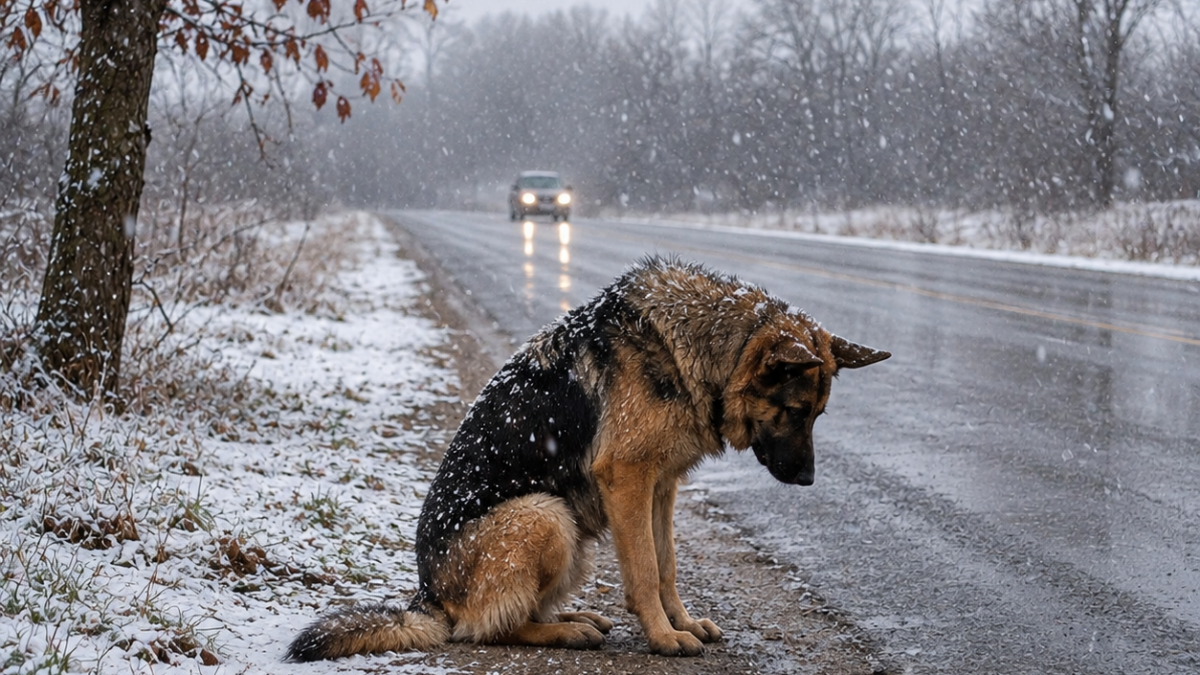
They left their eight-year-old German Shepherd behind when they moved, as if the dog who had spent his entire life protecting their family was just another piece of furniture they no longer wanted.
For days, Henry waited on their empty porch through the November cold, convinced the people he loved would come back for him—and when they didn’t, he did something none of us believed possible.
He followed them nearly twenty-five miles to their new home, but what happened when that exhausted dog finally reached their front door was far crueler than the abandonment itself.
I had lived across the road from the Ashwoods for almost eleven years, and for eight of those years, Henry had been part of the landscape.
Every morning, I saw him sitting near their porch while the children waited for the school bus. Every afternoon, he appeared at the fence ten minutes before the bus returned, somehow knowing when it was time. When Mr. Ashwood’s truck came down the road after work, Henry’s ears would rise before I could even hear the engine.
That dog knew his family.
More importantly, he loved them.
So when I saw two vehicles packed with boxes in their driveway one cold November morning, I assumed Henry was going with them.
Why wouldn’t he?
I watched the children carry backpacks and blankets outside. Mrs. Ashwood loaded bags into the SUV. Her husband tied something beneath a tarp in the back of his pickup.
Henry moved between them with nervous energy, his dark eyes following every person who passed.
He knew something was changing.
He just didn’t understand what.
When the vehicles finally pulled away, Henry ran behind them.
At first, I smiled.
I thought someone had forgotten to put him in the car.
He chased the pickup to the end of the lane.
Then onto the road.
“Henry!” I shouted.
He stopped only when the vehicles were too far away.
He stood in the middle of the road watching them disappear.
Then he slowly turned around.
That was when I felt something cold settle in my stomach.
Henry walked back to the house.
He climbed the porch steps.
He sat in front of the locked door.
And he waited.
I crossed the road twenty minutes later.
“Come here, sweetheart.”
He looked at me, then at the road.
I touched his collar.
No new address.
No note.
No phone number.
Just his old brass tag.
HENRY ASHWOOD.
I called the number engraved beneath the name.
It rang until voicemail.
I called again that afternoon.
Again that evening.
No answer.
The first night, Henry slept on the porch.
The temperature dropped close to freezing.
I brought him a blanket.
He sniffed it, allowed me to place it beside him, but refused to follow me home.
The second day, I brought food.
He ate only a little.
He spent most of the afternoon staring toward the road.
On the third morning, I found him lying against the front door.
His body was curled tightly against the cold.
When he heard my footsteps, his head lifted immediately.
For one hopeful second, his tail moved.
Then he realized it was only me.
I will never forget that.
Not because Henry disliked me.
He had known me for years.
But I was not who he was waiting for.
“Henry,” I whispered, kneeling beside him, “they’re not coming back.”
He rested his chin on his paws.
I don’t know whether dogs understand sentences like that.
I hope he didn’t.
Because saying it aloud nearly broke me.
On the fourth day, I tried to take him home.
I clipped a spare leash to his collar and gently pulled.
Henry stood.
For one second, I thought he had finally surrendered.
Instead, he walked to the edge of the driveway, looked toward the road where the Ashwoods had disappeared, then pulled backward until I released the leash.
He returned to the porch.
Still waiting.
The next morning, snow began falling.
Only a thin layer.
Enough to cover the grass.
Enough to show footprints.
I carried a warm bowl of chicken and rice across the road.
The porch was empty.
“Henry?”
Nothing.
His blanket was still there.
The food from the night before had barely been touched.
Then I saw the tracks.
Large paw prints led from the porch, across the yard, down the driveway and east toward the highway.
Henry hadn’t given up.
He had gone looking for them.
And at that moment, none of us knew that the abandoned dog walking alone into the November snow was about to uncover exactly what kind of people his family had become.
PART 2
I followed the paw prints as far as I could.
For almost half a mile, they were easy to see in the thin snow.
Then they reached the paved road.
After that, nothing.
I stood beside the shoulder staring east, imagining Henry walking through traffic, crossing intersections, following whatever scent, memory, or instinct told him where to go.
He was eight years old.
Not ancient for a German Shepherd, but not young either.
His hips had started stiffening during cold weather the previous winter. I had watched him rise slowly after long naps in the sun.
Now he was somewhere alone.
No food.
No shelter.
No family.
I called the Ashwoods again.
Straight to voicemail.
This time, I didn’t leave a polite message.
“Robert, this is Margaret Kelley. Henry is gone. He waited at your house for four days and now he’s gone looking for you. Call me immediately.”
Nothing.
I called the county animal shelter.
Then local police.
Then every veterinary office between our road and the nearest town.
I posted his photograph online.
**MISSING: HENRY. EIGHT-YEAR-OLD GERMAN SHEPHERD.**
I didn’t write that he had been abandoned.
Not yet.
Part of me still wanted to believe there had been some impossible misunderstanding.
Maybe the Ashwoods thought someone was taking Henry.
Maybe their new landlord prohibited dogs.
Maybe they had planned to return.
Maybe.
Humans are remarkably talented at inventing explanations when the truth is too ugly.
By noon, volunteers were searching.
Henry was well known in our little community.
The mail carrier knew him.
The school bus driver knew him.
The mechanic two miles away knew him because Henry used to ride in the Ashwoods’ truck.
Even people who had never touched him recognized the large black-and-tan shepherd who often sat at the edge of the property watching cars pass.
Someone reported seeing a shepherd near Route 19 around seven that morning.
Another person thought they saw one near a gas station six miles east.
I drove there.
Nothing.
At the gas station, a young cashier checked the security camera.
There he was.
Henry.
At 8:13 a.m., he appeared at the edge of the parking lot.
He stopped near a trash can.
Sniffed around.
Then continued east.
The video lasted seventeen seconds.
I watched it six times.
His tail was low.
His head was forward.
He wasn’t wandering.
He was going somewhere.
The cashier looked at me.
“He looks like he knows where he’s headed.”
That frightened me more than if he’d been lost.
Because there was only one place Henry would deliberately search for.
His family.
The problem was that I didn’t know where they had moved.
I knew they were staying somewhere near Harrisburg because Mrs. Ashwood had mentioned her husband’s new job months earlier, but Harrisburg was far too broad an area.
I drove back to their abandoned house.
There was a real estate sign in the yard.
I called the agent.
“I’m trying to locate the former owners.”
“I can’t provide a private address.”
“They abandoned their dog.”
Silence.
“What?”
I explained.
The agent’s voice changed.
“You’re saying the shepherd is still there?”
“He was. Now he’s walking somewhere looking for them.”
“Oh my God.”
She couldn’t legally give me the address.
But she promised to contact the Ashwoods.
Twenty minutes later, my phone rang.
Unknown number.
“Margaret?”
It was Susan Ashwood.
I pulled my car to the shoulder.
“Where is Henry?”
No greeting.
No explanation.
Just those four words.
She hesitated.
“I don’t know.”
“What do you mean you don’t know?”
“He left the house this morning looking for you.”
Another pause.
Then she sighed.
Not cried.
Not gasped.
Sighed.
“Margaret, we can’t keep him.”
I gripped the steering wheel.
“You left him behind.”
“We had no choice.”
“You had every choice.”
“You don’t know our situation.”
“Then explain it.”
“Our new place doesn’t allow large dogs.”
“Then you find him another home.”
“We tried.”
That was the first lie.
I knew it immediately.
Henry had been outside their house every day.
No rescue organization had visited.
No foster family had visited.
No one had asked me whether I knew anyone who could take him.
Nothing.
“You didn’t try.”
“Please don’t turn this into something.”
I actually laughed.
“Turn this into something?”
“He’s a dog, Margaret.”
I stopped breathing for a second.
She must have realized how that sounded because she immediately added, “I mean, obviously we care about him, but we have two children and Robert’s job and this move has been overwhelming.”
“He waited on your porch for four days.”
“I didn’t ask him to do that.”
There are moments when anger becomes so intense that it almost turns calm.
That was one.
“Where do you live?”
“No.”
“Susan.”
“We don’t want him brought here.”
My hand tightened around the phone.
“You think he’s trying to find you.”
Silence.
Then she said something I will never forget.
“He’ll stop eventually.”
I looked through my windshield at the gray road ahead.
“No,” I said. “I don’t think he will.”
I ended the call.
For the next six hours, we searched.
By late afternoon, the snow had changed to freezing rain.
Temperatures were dropping.
Someone saw Henry crossing near an old farm.
Another person found paw prints beside a drainage ditch.
A truck driver reported nearly hitting a German Shepherd about twelve miles east of the Ashwood house.
Each report pushed the search farther.
At sunset, I received a call from a woman named Rachel Monroe.
“Are you looking for a German Shepherd?”
My heart jumped.
“Yes.”
“I saw one near the old state road. He was limping.”
“Where?”
She gave me an intersection.
I was there fifteen minutes later.
Rachel was waiting beside her car.
We searched with flashlights.
Mud.
Frozen grass.
A discarded plastic bottle.
Then Rachel found blood.
Just a few drops.
On the roadside.
I crouched.
My stomach turned.
“Henry.”
We called his name.
Nothing.
The road stretched black between trees.
The thought of him injured somewhere in those woods was unbearable.
We searched until almost midnight.
No Henry.
The next morning, I found out why.
While we had been searching the woods, Henry had kept moving.
Sixteen miles.
Then eighteen.
Then twenty.
We reconstructed it later from doorbell cameras, store surveillance and people who had seen him.
He drank from a drainage ditch.
He rested beneath an abandoned trailer.
At some point, he injured his front paw, probably on broken glass or road debris.
He stole a discarded sandwich from behind a convenience store.
A woman tried to approach him near a church.
Henry backed away.
She put down food.
He sniffed it.
Then continued east.
He was losing weight.
He was limping.
But something kept pulling him forward.
People often say dogs have an incredible sense of smell.
That’s true.
But twenty-five miles through roads, towns, rain and traffic isn’t just scent.
Henry had ridden those roads with the Ashwoods for years.
Perhaps he recognized turns.
Perhaps he caught their smell somewhere.
Perhaps he followed the direction their vehicles had taken.
I don’t know.
Maybe love has its own compass.
On the third day of Henry’s journey, just after sunrise, a doorbell camera recorded him entering a suburban neighborhood outside Harrisburg.
He was soaked.
Mud covered his legs.
His injured paw barely touched the pavement.
He walked past four houses.
Stopped.
Lifted his head.
Then crossed the street.
The camera lost him.
Another camera caught him three minutes later.
Henry turned onto Willow Creek Lane.
And there, halfway down the block, stood a newly rented two-story house with a silver SUV in the driveway.
The Ashwoods’ SUV.
Henry stopped.
Even in the grainy video, you can see his body change.
His ears rose.
His tail lifted.
Then he ran.
Not quickly.
His leg was too injured for that.
But he tried.
He limped faster and faster toward the house.
He climbed the steps.
And scratched the door.
Inside, Susan Ashwood heard him.
So did Robert.
So did their children.
Their older son, Caleb, later admitted he knew immediately who it was.
“Henry!” he shouted.
He ran toward the door.
His father stopped him.
Outside, Henry scratched again.
His tail was wagging.
Imagine that.
Twenty-five miles.
Cold nights.
Hunger.
Traffic.
An injured paw.
And when he finally reached them, he wasn’t angry.
He wasn’t confused.
He was happy.
He had found his family.
Robert opened the door.
Henry tried to step inside.
Robert blocked him with his leg.
“Back.”
Henry stopped.
His tail continued wagging.
Caleb was crying somewhere behind his father.
“Dad, let him in!”
“We can’t.”
Henry tried again.
Robert pushed him backward with his foot.
Not a violent kick.
That would almost have been easier to understand.
Just a firm shove.
The kind you give something that doesn’t belong.
“Go.”
Henry stared at him.
Susan came to the doorway.
“Oh, God.”
Henry’s tail wagged harder.
He tried to approach her.
She backed up.
“Robert, don’t let him inside.”
Their daughter, Emily, appeared behind them.
She screamed Henry’s name.
Henry began whining.
A neighbor across the street, Claire Benson, heard the commotion and looked through her window.
What she saw bothered her enough that she began recording from her porch.
Robert stepped outside.
He closed the door behind him.
Henry immediately leaned against his legs.
Robert grabbed Henry’s collar.
For one second, Henry probably thought he was finally going inside.
Instead, Robert led him down the steps.
Across the front yard.
To the sidewalk.
Then released him.
“Go home.”
Henry stood there.
Robert walked back toward the house.
Henry followed.
Robert turned.
“No!”
Henry stopped.
The front door closed.
For the second time in less than a week, Henry sat outside a locked door belonging to the people he loved.
But this time, there was no confusion about whether they were coming back.
They were inside.
He could hear them.
He could smell them.
He had traveled twenty-five miles to reach them.
And they would not let him through the door.
Claire Benson watched Henry lie down on the doormat.
She waited five minutes.
Then ten.
Nobody opened the door.
Finally, she crossed the street.
“Hey, buddy.”
Henry lifted his head.
His injured paw was bleeding.
Claire knocked on the Ashwoods’ door.
Robert answered.
“Is this your dog?”
Robert looked at Henry.
“Technically.”
Claire frowned.
“What does technically mean?”
“We can’t keep him here.”
“He’s injured.”
“I know.”
“Then are you taking him to a veterinarian?”
“No.”
Claire later told me there was something about the way he said it that made her skin crawl.
Not angry.
Not embarrassed.
Just inconvenienced.
“Did he run away?”
Robert hesitated.
“No.”
“How did he get here?”
“I don’t know.”
Henry tried to stand.
His leg buckled.
Claire immediately knelt beside him.
“You need to do something.”
Robert said, “If you want him, take him.”
Those words were captured on the recording.
They would matter later.
At 8:47 that morning, Claire called animal control.
At 8:54, she photographed Henry’s paw.
At 9:02, she posted a message in a local neighborhood group.
**Does anyone recognize this dog? He apparently walked a very long distance to reach his former owners, who say they don’t want him. He’s hurt and needs help.**
Someone shared it.
Then someone else.
Within an hour, one of the people helping me search saw the post.
My phone rang.
“Margaret.”
It was Rachel.
“I think we found him.”
I don’t remember much of the drive.
I remember speeding.
I remember my hands shaking.
I remember calling the animal control officer while driving and demanding that nobody remove Henry until I arrived.
When I turned onto Willow Creek Lane, I saw a county vehicle.
A small crowd.
And Henry.
He was lying beneath a gray blanket on Claire’s porch.
I parked badly.
Half the car was probably in the street.
I ran.
“Henry!”
His head lifted.
For a moment, he stared.
Then his tail struck the porch.
Once.
Twice.
Again.
I dropped to my knees.
“Oh, sweetheart.”
He tried to stand.
I stopped him.
“No, no. Stay down.”
He licked my chin.
I had cried several times during those three days.
That was the first time I completely lost control.
I wrapped my arms around his neck and buried my face in his wet fur.
“You stupid, beautiful dog.”
Henry whined softly.
The animal control officer crouched beside us.
“Ma’am, you know this dog?”
“I’ve known him eight years.”
“Are you the owner?”
I looked toward the house across the street.
Robert Ashwood was watching through the front window.
“No.”
I stood.
“But I know who is.”
I crossed the street.
The officer followed me.
I knocked.
Robert opened the door halfway.
His face changed when he recognized me.
“Margaret.”
I looked at him for several seconds.
There are speeches you imagine giving people.
Then the moment arrives and the truth is simpler.
“You left him.”
Robert’s jaw tightened.
“We couldn’t take him.”
“So you left him locked outside an empty house?”
“He had food.”
“No, he didn’t.”
“We put some out.”
“For how long?”
He didn’t answer.
“He waited four days, Robert.”
Susan appeared behind him.
“We didn’t know what else to do.”
“You call a rescue. You call a shelter. You call me. You call literally anyone.”
Susan crossed her arms.
“It’s easy for you to judge.”
I stared at her.
“He walked twenty-five miles.”
Her expression changed slightly.
I continued.
“He walked twenty-five miles through freezing rain with a torn paw because he thought he’d lost you.”
Caleb appeared behind his mother.
His face was red from crying.
“Can Henry stay?”
Robert turned sharply.
“Go upstairs.”
“But Dad—”
“Now.”
Caleb disappeared.
I lowered my voice.
“You did this in front of your children.”
Robert stepped closer.
“Don’t tell me how to raise my kids.”
“I’m not talking about how you raise them.”
I glanced at Henry across the road.
“I’m talking about what you’re teaching them.”
His face darkened.
The animal control officer stepped forward.
“Mr. Ashwood, I need to ask you some questions regarding the dog.”
Robert looked irritated.
“We already told your people we don’t want him.”
The officer’s expression changed.
“That’s not the only issue.”
Susan went pale.
“What issue?”
“Abandoning a domestic animal without making reasonable provisions for its care can lead to an investigation.”
Robert laughed.
“Are you serious?”
“Yes.”
“He was on our property.”
“An empty property you had vacated.”
“We left food.”
“How much?”
Silence.
The officer wrote something down.
“Did you arrange for anyone to feed or check on him?”
“No.”
“Did you contact a shelter?”
“No.”
“A rescue?”
“No.”
“A veterinarian?”
“No.”
“Anyone?”
Robert pointed at me.
“She lives across the street.”
My mouth actually fell open.
“You never asked me!”
“We knew you’d see him.”
The officer stopped writing.
Even he looked stunned.
“So your plan,” he said slowly, “was to leave the dog and assume a neighbor would notice?”
Robert realized too late what he’d admitted.
Susan stepped forward.
“This is getting ridiculous.”
“No,” Claire said from behind us.
Everyone turned.
She was holding her phone.
“This is ridiculous.”
She pointed toward Henry.
“You rejected him at this door after he walked all the way here.”
Susan’s face hardened.
“You were filming us?”
“I was filming an injured dog being pushed away from the house he was trying to enter.”
Robert moved toward her.
The officer stepped between them.
“Sir.”
Robert stopped.
Claire looked at me.
“I have the whole thing.”
That was when the Ashwoods’ bad week became much worse.
Henry went straight to a veterinary hospital.
The cut in his paw required stitches.
He was dehydrated.
He had lost almost nine pounds.
His pads were raw.
There were abrasions along his legs and chest.
His hips were badly inflamed from the distance he had walked.
But he had survived.
The veterinarian told me something that made me sit down.
“If he’d been out another night in that condition, we might be having a different conversation.”
I stayed beside Henry while they gave him fluids.
He hated the IV.
He hated the slippery floor.
He hated being separated from the door.
Every time a person walked past the room, his head lifted.
Still looking.
Still waiting.
Part of me hated the Ashwoods then.
Not anger.
Hatred.
I wanted them to feel what Henry felt.
I wanted them to sit outside a locked door and wonder why the people they’d trusted most no longer wanted them.
But revenge rarely gives you exactly what you imagine.
Sometimes life creates something better.
The story spread first through local groups.
Then regional pages.
Then news outlets began calling Claire because her video showed everything.
Henry reaching the house.
Henry trying to enter.
Robert blocking him.
The children calling for him.
Henry being led to the sidewalk.
The door closing.
People reacted exactly as you would expect.
Angrily.
Too angrily in some cases.
I made one public statement.
“Do not threaten this family. Do not go to their house. Do not contact their children. Henry needs help, not a mob.”
I meant every word.
The children had already lost enough.
Caleb and Emily loved Henry.
That much was obvious.
They hadn’t abandoned him.
Their parents had made that decision.
The animal welfare investigation moved forward.
The Ashwoods suddenly claimed the story was misleading.
Robert said Henry had become “difficult” as he aged.
Susan said he had developed “behavioral concerns.”
That caught my attention.
Henry had never shown aggression toward me.
Never toward my grandchildren.
Never toward delivery drivers.
Never toward the schoolchildren who sometimes leaned over the fence to pet him.
The veterinarian examined him.
No history of aggression was found.
Then Robert claimed Henry had become destructive.
I asked what he destroyed.
No answer.
Next they claimed their new lease prohibited him.
That part turned out to be partly true.
Their rental had a weight restriction.
But the landlord told investigators something interesting.
Robert had never asked for an exception.
Never mentioned an eight-year-old family dog.
Never asked whether a pet deposit was possible.
And, more importantly, the landlord had offered them another property before they signed the lease.
A property that allowed large dogs.
They chose the newer house because it had an extra bedroom and granite countertops.
I learned that from Claire.
When she told me, I stared at her.
“Granite countertops?”
She nodded.
I looked down at Henry.
He was sleeping beside my chair at the veterinary hospital.
Eight years.
Christmas mornings.
Children growing up.
School buses.
Family dinners.
Storms.
Birthdays.
Eight years of loyalty.
And apparently, somewhere in the calculation, granite countertops had won.
The investigation produced another detail.
Three weeks before the move, Susan had posted Henry online.
Not on a rescue page.
On a local classified page.
**Free German Shepherd. Older dog. Must go quickly.**
There were two responses.
One person asked whether Henry was good with cats.
Susan never replied.
Another family asked to meet him.
Robert told them Henry was already gone.
He wasn’t.
When investigators asked why, Robert said he didn’t like the family’s neighborhood.
Maybe that was true.
Maybe not.
But they never tried again.
The public anger intensified.
I kept Henry away from it.
For his first week after the hospital, he stayed at my house.
Technically, he was in temporary protective custody while ownership was sorted out.
Practically, he took over my living room.
The first night, I placed a thick bed beside the fireplace.
Henry ignored it.
He slept beside my front door.
I woke at 2:00 a.m. and found him there.
Head resting on his paws.
Facing the entrance.
Waiting.
I sat beside him.
“You’re not going back.”
His ears moved.
“I know you don’t understand me yet.”
I touched his shoulder.
“But you’re not sleeping outside another locked door.”
Henry looked at me.
Then laid his head against my knee.
That became our routine.
He followed me into the kitchen.
Then back to the door.
If a car slowed outside, he ran to the window.
If children laughed on the road, his ears rose.
Once, when a pickup sounded like Robert’s old truck, Henry ran outside so quickly he nearly pulled me down.
He reached the fence.
The truck passed.
Henry watched until it disappeared.
Then slowly returned.
That moment taught me something painful.
Being rescued doesn’t mean you immediately stop loving the people who hurt you.
Humans don’t work that way.
Neither do dogs.
For two weeks, Henry still expected the Ashwoods to come.
Then something began to change.
He started sleeping farther from the door.
First three feet.
Then beside the couch.
Then one night, I woke and found him stretched across the rug in front of the fireplace.
His legs twitched in his sleep.
I smiled.
Progress.
The legal hearing regarding Henry’s ownership was scheduled almost a month after he was found.
By then, his paw had healed.
His weight was returning.
His coat looked better.
I assumed the Ashwoods would formally surrender him.
Instead, Robert challenged the seizure.
When the animal control officer called me, I thought I’d misunderstood.
“He wants Henry back?”
“He’s asserting ownership.”
I sat down.
“Why?”
“I can’t tell you his motivation.”
I knew.
Public pressure.
The video had damaged them badly.
Robert’s employer had received calls, though the company publicly asked people to stop contacting employees.
Susan had removed her social media accounts.
Neighbors avoided them.
Their children were hearing about Henry at school.
Suddenly, being the family that wanted their dog back looked much better than being the family that abandoned him twice.
I was furious.
But the officer warned me.
“Don’t contact them.”
“I wasn’t going to.”
That was a lie.
I absolutely wanted to.
But I didn’t.
At the hearing, Robert wore a suit.
Susan sat beside him.
Caleb and Emily were not there.
Their attorney argued that the Ashwoods never intended to relinquish ownership.
I nearly choked.
They claimed leaving Henry at the old house was temporary.
The judge asked, “Temporary until when?”
Their attorney said they had hoped to find suitable placement.
“Did they arrange daily care?”
“No formal arrangement.”
“Did they notify the neighbor?”
“No.”
“Did they contact a shelter?”
“No.”
“Did they return to the property to feed the dog?”
A pause.
“No.”
The judge looked over his glasses.
“Then I’m struggling to understand what part of the arrangement was temporary rather than abandonment.”
Their attorney shifted strategy.
He argued that because Henry had independently traveled to their new residence, the family had not “transported and discarded” him elsewhere.
I remember looking at the animal control officer beside me.
He looked back.
Neither of us could believe what we were hearing.
The judge could.
He had probably heard worse.
Then Claire’s video was shown.
The room became very quiet.
There was Henry.
Limping toward the door.
Tail wagging.
Robert opening it.
Henry trying to enter.
The children calling his name.
Robert forcing him back.
Then the door closing.
The judge watched the entire recording.
When it finished, he asked Robert one question.
“Why didn’t you take the dog to a veterinarian?”
Robert answered, “We didn’t believe the injury was serious.”
The judge replayed the section showing Henry barely putting weight on his paw.
“Mr. Ashwood.”
Silence.
The judge continued.
“You are asking this court to recognize your right to possess an animal you left unattended at one home and refused medical care at another.”
Robert looked at his attorney.
His attorney didn’t look back.
Then came the part none of us expected.
The courtroom door opened.
Caleb Ashwood entered.
His mother turned.
Her face drained.
Behind him was an older woman I recognized as Susan’s sister.
Caleb was fourteen.
He walked toward the front.
“Your Honor?”
The judge frowned.
Susan stood.
“Caleb, what are you doing?”
Her sister put a hand on Susan’s shoulder.
Caleb’s voice trembled.
“I want to say something about Henry.”
The judge considered it.
Because Caleb was a minor, there were several procedural discussions I won’t pretend I understood.
Eventually, with his aunt present and after speaking privately with the relevant officials, Caleb was allowed to give a limited statement.
He sat down.
His hands shook.
“Henry wasn’t difficult.”
Robert closed his eyes.
Caleb continued.
“He didn’t bite anyone. He didn’t destroy things. Dad just didn’t want him in the new house.”
Susan whispered, “Caleb.”
The judge looked at her.
“Please do not interrupt.”
Caleb stared at the table.
“I heard them talking before we moved.”
My chest tightened.
“Dad said Henry was old and the new house was going to be nicer.”
Robert’s face turned red.
“He said he didn’t want dog hair everywhere.”
The courtroom was silent.
Caleb wiped his face.
“Mom said maybe Mrs. Kelley would take him if we left him.”
Susan began crying.
Caleb looked toward me.
“They told me Henry was going to a farm.”
I felt something break inside me.
Of course.
The oldest lie adults tell children about unwanted animals.
A farm.
Caleb continued.
“When we drove away, I asked why he was running behind us.”
His voice cracked.
“Dad said he’d stop.”
I remembered Susan saying almost the same thing to me.
**He’ll stop eventually.**
But Henry hadn’t.
Caleb looked at his father.
“He didn’t stop.”
Nobody moved.
“He found us.”
Then the boy said the sentence that ended whatever sympathy remained in that room.
“And Dad still wouldn’t let him inside.”
Robert leaned toward his attorney.
The attorney whispered sharply.
Caleb looked at the judge.
“I love Henry.”
He was crying openly now.
“But I don’t think he should come back with us.”
Susan covered her mouth.
I did too.
Caleb’s aunt placed her arm around him.
“Why?” the judge asked gently.
Caleb looked toward his parents.
“Because he keeps choosing us.”
Then he looked at me.
“And we keep hurting him.”
You could have heard a pin drop.
The hearing ended with Henry remaining in protective care while the abandonment case proceeded.
But after Caleb’s statement, the Ashwoods’ position collapsed.
Two days later, their attorney contacted the county.
They would surrender Henry permanently.
There was one condition.
They wanted the surrender kept private.
The county refused.
Not because officials wanted to humiliate them.
Because Henry’s case was already public, and the ownership status needed to be clear.
Robert eventually signed.
Susan signed.
Eight years of Henry’s life ended with two signatures on a piece of paper.
I expected to feel victorious.
I didn’t.
I looked at Henry sleeping beside my chair and thought about Caleb.
Victory is complicated when children are involved.
The criminal case was less dramatic than the internet wanted.
There was no grand prison sentence.
No handcuffs in a courtroom.
That disappointed people online who wanted a spectacular ending.
Real consequences are usually quieter.
Robert and Susan faced animal abandonment and neglect proceedings.
They were ordered to pay substantial veterinary and boarding costs associated with Henry’s recovery.
They received fines and court supervision.
They were restricted from acquiring another animal during the relevant period.
They also had to complete an animal welfare education program.
Robert hated that last part.
I learned later he tried unsuccessfully to have it removed.
Maybe sitting in a room while someone explained what abandonment does to an animal felt humiliating.
Good.
But that still wasn’t the revenge that mattered.
The real consequence started in their own house.
Caleb barely spoke to his father.
Emily stopped asking for another dog.
When Susan suggested months later that they might get a small breed permitted by the lease, Emily reportedly said, “Why? So we can leave that one too?”
That story came from Susan’s sister.
I almost felt sorry for them.
Almost.
What adults sometimes forget is that children remember hypocrisy with incredible clarity.
Robert had taught his son a lesson.
Just not the one he intended.
Meanwhile, Henry became a local celebrity.
I hated calling him that.
Henry didn’t know he was famous.
He knew breakfast.
He knew walks.
He knew which kitchen cabinet contained treats.
He knew that if he stared at me long enough while I ate roast chicken, I eventually became weak.
He also learned my grandchildren arrived every Sunday.
The first time my six-year-old granddaughter Lily visited after Henry moved in, I watched closely.
Henry had always been gentle, but he’d been through enormous stress.
Lily sat on the floor.
She didn’t approach.
I had taught her to let him decide.
Henry watched her.
She held out one hand.
He walked over slowly.
Sniffed.
Then lowered his enormous head into her lap.
Lily looked at me.
“Grandma?”
“Yes?”
“Can he stay forever?”
I looked at Henry.
“We’ll see.”
That wasn’t good enough.
She frowned.
“He already found the house.”
I laughed.
“What?”
“He found your house.”
Technically, I had brought him there.
But children sometimes understand things differently.
Maybe better.
“He found where he’s supposed to be.”
I turned away because my eyes were filling.
Henry’s formal adoption became possible three months later.
The shelter director called me.
“Margaret, we’ve completed everything.”
I held the phone tighter.
“Everything?”
“He can be adopted.”
I looked at Henry.
He was lying near the fireplace chewing something that had once belonged to me and would apparently never belong to me again.
“What do I need to do?”
The director laughed.
“I had a feeling.”
The adoption paperwork asked whether I had experience with German Shepherds.
I wrote:
**Eight years next door to this one.**
It asked why I wanted to adopt Henry.
I stared at that question for a while.
Finally, I wrote:
**Because nobody should have to earn the right to come home twice.**
When I brought Henry back from the shelter that afternoon, I made one mistake.
I opened the car door without attaching his leash first.
Henry jumped out.
For one terrifying second, I thought he might run.
He didn’t.
He walked directly to my porch.
Climbed the steps.
Then turned around and looked at me.
I opened the front door.
Henry hesitated.
It lasted only a second.
But I saw it.
Doors had become complicated for him.
Behind one door, the family he loved had disappeared.
Behind another, they had refused him.
So I stepped inside.
I left the door wide open.
“Come when you’re ready.”
I didn’t pull him.
Didn’t call again.
Didn’t reach for his collar.
I walked into the kitchen.
A few seconds passed.
Then I heard his nails on the floor.
Henry came in.
I closed the door behind him.
He never slept beside it again.
Months passed.
His story faded from national attention.
That’s what stories do.
People get angry.
They share.
They cry.
Then another story arrives.
But our town didn’t forget him.
The shelter received thousands of dollars in donations after Henry’s case.
Not because I asked.
People simply wanted to help.
The director called me.
“We want to use some of the funds to build an emergency foster network.”
“What does that mean?”
“It means when families move, enter hospitals, lose housing or face emergencies, we’ll have temporary options so an animal doesn’t get left behind.”
I liked that.
They called it Henry’s Home Project.
I hated the name at first.
It sounded too sentimental.
Then I attended the launch.
On the wall was a simple photograph.
Henry sitting on my porch.
Underneath were the words:
**MOVING SHOULD NEVER MEAN ABANDONING FAMILY.**
I stopped complaining about the name.
The project grew.
Local veterinary offices joined.
Foster families registered.
A pet-friendly housing list was created.
People donated crates, food and transportation.
Within the first year, thirty-seven animals avoided surrender or abandonment because temporary help existed.
Thirty-seven.
People kept telling me Henry’s suffering had created something good.
I understood what they meant.
But I never liked that sentence.
Henry shouldn’t have had to suffer for humans to learn compassion.
The good belonged to the people who chose to act afterward.
Not to the cruelty that made action necessary.
One of those people was Caleb Ashwood.
Almost a year after the hearing, I received a letter.
Handwritten.
No return address I recognized.
Dear Mrs. Kelley,
I don’t know if you hate us.
I would understand if you do.
I wanted to ask how Henry is.
I think about him every day.
I didn’t know Mom and Dad were leaving him until we drove away. They told me someone was taking him later.
When Henry came to our new house, I tried to open the door after Dad closed it, but Mom stopped me.
I should have done more.
Please tell Henry I am sorry.
Caleb.
I read the letter twice.
Then a third time.
The sentence **I should have done more** bothered me.
He was fourteen.
Adults had failed.
Not him.
I wrote back.
I told him Henry was healthy.
His paw had healed.
His hips still bothered him on cold mornings.
He had gained eleven pounds.
He liked sleeping near the fireplace.
He stole gloves.
He hated vacuum cleaners.
He loved roast chicken.
Then I wrote:
**You were a child put in an impossible position. You told the truth when it mattered. Henry does not need your apology.**
I paused.
Then added:
**But I think he would like to see you.**
Two weeks later, Susan’s sister drove Caleb to my house.
I didn’t invite Robert or Susan.
Not yet.
Caleb climbed out of the car carrying Henry’s old blue rubber ball.
He stood beside the driveway.
Henry was in the backyard.
The second he saw Caleb, he froze.
Caleb whispered, “Hey, buddy.”
Henry’s ears rose.
Then he ran.
Not the desperate run toward Willow Creek Lane.
Not the exhausted limp toward a closed door.
This was different.
Fast.
Joyful.
Henry hit Caleb square in the chest.
The boy fell onto the grass.
Henry covered his face in kisses.
Caleb laughed and cried at the same time.
I stood on the porch watching.
His aunt stood beside me.
“Thank you.”
I shook my head.
“That dog still loves him.”
She wiped her eyes.
“Caleb needed to know.”
For almost an hour, they played.
Then Henry got tired and lay beside him.
Caleb rested one hand on his back.
“He looks happy.”
“He is.”
“Does he ever wait for us?”
The question hurt.
I answered honestly.
“Not anymore.”
Caleb nodded.
There was sadness in his face.
But also relief.
“Good.”
That told me everything I needed to know about the boy.
He visited several more times.
As he got older, he began volunteering with Henry’s Home Project.
At sixteen, he helped transport dogs.
At seventeen, he organized a school donation drive.
His parents didn’t approve.
I knew because eventually Robert called me.
It was almost two years after Henry’s abandonment.
“Margaret.”
I recognized his voice immediately.
“What do you want?”
“I need you to stop encouraging Caleb.”
“Encouraging him to do what?”
“This animal rescue stuff.”
I almost laughed.
“He volunteers four hours a month.”
“He’s using it to punish us.”
“No, Robert.”
“You don’t know what’s happening in my family.”
“No. But I know what happened to Henry.”
Silence.
“He keeps bringing it up,” Robert said.
“Maybe because you’ve never dealt with it.”
“I paid the fines.”
There it was.
As if payment was accountability.
“You think this is about money?”
“What else do you want from us?”
I looked at Henry asleep beside the couch.
“Nothing.”
“Then leave us alone.”
“I have.”
“You keep letting Caleb come there.”
“He’s almost eighteen.”
“He’s my son.”
“And Henry was your dog.”
Silence.
I shouldn’t have said it.
Maybe.
But I did.
Robert’s voice became hard.
“You’ve turned that dog into a weapon against my family.”
“No.”
I spoke slowly.
“You did that when you shut the door.”
Then I hung up.
That should have been the end.
It wasn’t.
Three months later, Henry disappeared again.
This time from my yard.
I came home from grocery shopping and found the side gate open.
My stomach dropped.
“Henry!”
Nothing.
The latch had been lifted.
Henry couldn’t do that.
At least, I didn’t believe he could.
I ran into the road.
Called neighbors.
Checked the woods.
Then I saw tire tracks near the gate.
My hands began shaking.
I called Caleb.
“Have you seen Henry?”
“No. Why?”
“He’s gone.”
Caleb became silent.
Then he said, “Oh, no.”
“What?”
“My dad was asking about him.”
The world seemed to tilt.
“Asking what?”
“He asked if Henry still wore the same collar.”
I stopped breathing.
“When?”
“Yesterday.”
I called the police.
Then animal control.
Then Robert.
He didn’t answer.
Susan didn’t answer.
Caleb’s aunt didn’t know anything.
For two hours, I drove every road around my house.
I could barely think.
Henry had been stolen once before in a different way.
I could not lose him again.
Then a police officer called.
“We located your dog.”
My knees almost gave out.
“Where?”
There was a pause.
“At the Ashwood residence.”
I don’t remember driving there.
When I arrived, two police vehicles were parked outside.
Robert stood in the driveway.
Susan was crying.
Henry was inside the back of an animal control van.
The moment he saw me, he stood.
I ran to him.
“What happened?”
The officer looked at Robert.
Robert said nothing.
Caleb was standing on the porch.
His face was furious.
He walked toward me.
“Dad took him.”
Susan shouted, “Caleb!”
“No!”
The boy—nearly a man now—turned toward her.
“I’m done lying for you.”
Robert snapped, “Go inside.”
Caleb ignored him.
“He drove to Mrs. Kelley’s house and took Henry from the yard.”
Robert stepped forward.
“I owned that dog for eight years.”
The officer interrupted.
“You surrendered that dog.”
“I made a mistake.”
My head snapped toward him.
“What?”
Robert looked at me.
“For God’s sake, Margaret. This has gone on long enough.”
I stared.
“You stole him.”
“I brought him home.”
I laughed.
Actually laughed.
Henry began whining from the van.
Robert pointed.
“That dog was part of our family.”
I walked toward him.
The officer moved closer, ready to intervene.
I stopped several feet away.
“Then why did he have to walk twenty-five miles to remind you?”
Robert’s face reddened.
“I made a bad decision.”
“No.”
My voice shook.
“You made the same decision twice.”
“I want to fix it.”
“You don’t get to fix guilt by taking him away from the home where he’s finally safe.”
Susan was crying harder.
“We’ve been destroyed over this.”
There it was.
Not Henry.
Them.
Their reputation.
Their family arguments.
Their shame.
Robert wanted Henry back because Henry had become the living evidence of what he’d done.
If Henry returned, maybe the story changed.
Maybe he could tell himself they’d reconciled.
Maybe people would stop seeing a closed door.
I understood suddenly.
This wasn’t love.
It was control.
I looked through the van window.
Henry wasn’t looking at Robert.
He was staring at me.
I opened my arms.
The animal control officer released him.
Henry jumped down.
He came straight to me.
I didn’t call him.
Didn’t touch the leash.
He chose.
Robert watched.
“Henry.”
Henry stopped.
His ears moved.
For a second, my heart hurt for all of them.
Then Robert crouched.
“Come here, boy.”
Henry looked at him.
Once, that voice had meant home.
Once, Henry would have crossed twenty-five miles to reach it.
Robert held out his hand.
“Come on.”
Henry took one step.
Robert’s face changed.
Hope.
Henry sniffed the air.
Then he turned around.
Walked back to me.
And sat on my foot.
Nobody spoke.
Robert slowly lowered his hand.
That was the revenge people wanted when they heard the story later.
The moment Henry rejected him.
But I never saw it that way.
Henry wasn’t taking revenge.
Dogs don’t care about poetic justice.
He had simply learned.
Home was no longer the place where Robert Ashwood stood.
Home was where the door opened.
Police charged Robert in connection with taking Henry from my property.
The legal consequences were more serious this time because there was no confusion about ownership.
I had adoption records.
Microchip registration.
Veterinary bills.
County documentation.
And a neighbor’s security camera showed Robert’s vehicle near my gate.
He eventually accepted a plea arrangement.
Restitution for property damage.
Additional supervision.
Community service.
A no-contact requirement regarding Henry and my property.
The judge reportedly asked him whether he understood that surrendering ownership meant exactly that.
This time, Robert said yes.
The larger consequence came from Caleb.
The day after the incident, he moved temporarily to his aunt’s house.
He was nearly eighteen.
His relationship with his parents had deteriorated badly.
I worried he blamed himself.
He didn’t.
Not anymore.
He told me something that stayed with me.
“My dad keeps saying Henry ruined our family.”
I shook my head.
“Henry didn’t.”
“I know.”
Caleb looked at the dog lying between us.
“Henry just made it impossible to pretend.”
That boy had become wiser than many adults I knew.
Years passed.
Henry slowed down.
German Shepherds don’t stay young long enough.
None of our dogs do.
His face turned gray.
The dark fur around his muzzle faded.
His hips worsened.
Walks became shorter.
Eventually, the dog who had once traveled twenty-five miles sometimes struggled with the distance from my porch to the mailbox.
But he never stopped watching me.
Never stopped following me from room to room.
Never stopped appearing in the kitchen whenever cheese was involved.
Henry’s Home Project expanded into three counties.
Caleb went to college.
Not for veterinary medicine, as people sometimes assume when they hear the story.
He studied social work.
When I asked why, he shrugged.
“I think I know what it’s like when adults make decisions and kids don’t get a voice.”
That answer made sense.
Emily eventually contacted me too.
She had been younger when everything happened.
Her memories were different.
For years, she apparently believed Henry had run away from them.
Her parents didn’t tell her the truth.
Caleb eventually did.
At fifteen, she came to see Henry.
She sat on my floor.
Henry sniffed her.
Then lay down beside her.
Emily cried quietly while stroking his gray face.
“He remembers me?”
“Yes.”
“How?”
I smiled.
“Because you were his girl.”
She buried her face against his neck.
“I thought he left.”
My throat tightened.
“No, honey.”
I hesitated.
“He came back.”
The cruelty of that truth hit her.
“He came back?”
“All the way.”
She looked toward me.
“And we didn’t keep him?”
I didn’t answer.
I didn’t need to.
She already knew.
Henry forgave both children instantly.
I don’t know whether dogs call it forgiveness.
Maybe there is nothing to forgive when they understand who actually hurt them.
Neither child had made the decisions.
They had simply been trapped inside them.
Robert never contacted me again.
Susan did.
Once.
Seven years after Henry’s journey.
By then, Henry was fifteen.
Very old for a German Shepherd.
His legs were weak.
His hearing had faded.
Cataracts clouded his eyes.
But he was still Henry.
Susan sent a letter.
Not a message.
A real letter.
I almost threw it away.
Instead, I read it.
She did not make excuses.
That surprised me.
She wrote about the move.
The pressure.
Robert’s new job.
Money.
The rental.
Her embarrassment over having an old dog in a newly renovated house.
Then one sentence stopped me.
**I kept telling myself Henry would be fine because accepting what we were doing would have meant admitting what kind of person I was becoming.**
I reread it.
She apologized.
Not to me.
To Henry.
She asked whether she could see him before he died.
I didn’t know what to do.
Part of me wanted to say no.
The same word they’d effectively said when Henry reached their door.
No.
You can’t come in.
No.
You don’t belong here.
But revenge has a strange way of changing shape as you get older.
At sixty-eight, I didn’t need Susan to hurt.
I needed Henry to be peaceful.
So I did something I hadn’t done since the day he arrived at my house.
I let Henry decide.
Susan came on a Sunday afternoon.
Alone.
She parked near the road and walked up the driveway.
Henry was lying on the porch in the sun.
He didn’t hear her at first.
She stopped when she saw him.
Her hands covered her mouth.
“Oh, Henry.”
His ears moved.
Slowly, he lifted his head.
Susan knelt.
For several seconds, Henry stared at her.
I watched carefully.
No leash.
No pressure.
No command.
Susan held out her hand.
“Hi, sweetheart.”
Henry stood.
His legs shook slightly.
He walked toward her.
One step.
Then another.
Susan began crying.
Henry reached her.
Sniffed her hand.
Then her coat.
She whispered his name again.
And Henry did something only Henry could have done.
He licked her fingers.
Susan collapsed onto her knees.
She wrapped her arms around his neck.
He stood quietly.
His tail moved once.
Maybe twice.
She cried into his fur.
“I’m sorry.”
Henry didn’t understand those words.
Or maybe he did.
But he did not stay with her.
After a few moments, he stepped out of her arms.
Turned.
Walked back across the porch.
And lay down beside my chair.
Susan watched.
I looked at Henry.
Then at her.
Neither of us said anything.
We didn’t need to.
He had forgiven her as much as a dog knows how.
But forgiveness hadn’t changed where he belonged.
Susan left twenty minutes later.
Before she walked to her car, she turned.
“Thank you for taking him.”
I wanted to tell her she shouldn’t thank me for doing what she should have done.
Instead, I said:
“I didn’t take him.”
She looked confused.
“He came home.”
She nodded.
Then left.
Henry died four months later.
It happened in early spring.
The weather had finally warmed.
For several days, he had eaten less.
His breathing changed.
The veterinarian came to the house.
She examined him on the rug beside the fireplace.
Afterward, she looked at me.
I knew.
“No.”
She didn’t speak immediately.
I shook my head.
“No.”
Henry lifted his head at the sound of my voice.
He tried to stand.
His legs failed.
That was when I understood.
Love becomes selfish at the end if you aren’t careful.
I wanted another week.
Another month.
One more summer.
Henry had already spent enough of his life waiting for people to make the right decision.
I wouldn’t make him wait through pain because I wasn’t ready.
I called Caleb.
Then Emily.
Both came.
Caleb drove nearly three hours.
Emily arrived twenty minutes later.
The three of us sat around Henry.
He looked so old.
Nothing like the powerful dog who used to chase school buses along the fence.
Nothing like the dog who crossed twenty-five miles because love told him not to stop.
Caleb placed the old blue rubber ball beside him.
Henry sniffed it.
His tail moved weakly.
Emily laughed through her tears.
“He remembers.”
“Of course he remembers,” Caleb said.
I brought Henry’s blanket from the bedroom.
Not the blanket I’d placed on the Ashwoods’ porch all those years before.
I had thrown that one away.
This was his blanket.
From my house.
Blue.
Warm.
Covered in his hair.
I spread it beneath him.
Henry placed his head in my lap.
Caleb sat on one side.
Emily on the other.
The veterinarian prepared the medication.
I bent close to Henry’s ear.
“Do you know what you did to me?”
His tired eyes looked toward mine.
“I was supposed to be the neighbor.”
Caleb smiled weakly.
I stroked Henry’s gray face.
“You turned me into a dog person.”
His tail tapped the blanket.
Once.
I laughed.
Then cried harder.
“You don’t have to look for anybody anymore.”
That was the last thing I wanted him to hear.
“You’re home.”
Henry exhaled.
The veterinarian gave the medication.
His body relaxed.
His breathing slowed.
I kept my hand on his head.
Caleb whispered, “Good boy.”
Emily whispered, “We love you.”
And the dog who had once waited outside a locked house died surrounded by people who would have opened every door in the world for him.
Afterward, I sat on the porch until dark.
I couldn’t bring myself to remove his water bowl.
For weeks, I still looked toward the door expecting to see him.
I heard phantom nails on the floor.
I woke thinking I needed to let him outside.
Grief is full of habits that suddenly have nowhere to go.
The Henry’s Home Project held a small memorial.
I asked them not to make it public.
They ignored me.
Hundreds of people came.
Some brought dogs.
Many were animals helped by the program.
A woman approached me with a husky.
“When my husband went into the hospital, I almost lost my apartment because I couldn’t afford boarding,” she said. “Henry’s program found him a foster home.”
She hugged the dog.
“He’s still with me because of Henry.”
Another man had a pit bull who had stayed in temporary care while his family escaped a house fire.
A military family brought a Labrador housed for three months during an emergency relocation.
Then a young woman stepped forward holding a tiny terrier.
I recognized her.
Claire Benson.
The neighbor who had filmed Henry at the Ashwoods’ second house.
“You remember me?”
I hugged her.
“Of course.”
She looked toward the memorial photograph.
“I’ve always wondered what would’ve happened if he hadn’t walked onto my street.”
I looked at the dogs around us.
“So have I.”
At the center of the shelter’s garden, they placed a stone.
I didn’t know what was written on it until the cloth was removed.
It said:
**HENRY**
**HE WALKED 25 MILES LOOKING FOR HOME.**
**IN THE END, HOME FOUND HIM.**
I cried.
Caleb stood beside me.
He was twenty-one now.
Tall.
Older than Robert had probably realized.
“I helped choose it.”
“I figured.”
“Too sentimental?”
“Terrible.”
He laughed.
Then put an arm around me.
Below Henry’s name were smaller words:
**Because no loyal heart should ever be left behind.**
The project crossed its thousandth assisted animal the following year.
One thousand pets kept with families, placed safely with fosters or rescued after abandonment.
News stations wanted interviews.
I refused most of them.
But one reporter asked a question that made me agree.
“What do you think Henry’s story was really about?”
We stood beside the old Ashwood house.
It had new owners now.
A young couple.
Two children.
And a Golden Retriever who slept on the porch.
The reporter expected me to say loyalty.
Henry’s loyalty was obvious.
But that wasn’t the lesson.
“It’s about responsibility,” I said.
She waited.
“People love stories about loyal dogs because their love is uncomplicated. Henry walked twenty-five miles because the people he loved had disappeared.”
I looked toward the porch where he once waited.
“But loyalty isn’t impressive only when a dog gives it to us.”
The reporter lowered her microphone slightly.
“It matters what we do with it.”
I looked down the road.
“For eight years, Henry gave one family everything he had. Then, when he became inconvenient, they decided his loyalty was his problem.”
I paused.
“That is what we should remember.”
The interview aired that evening.
Someone sent it to Susan.
I know because she wrote once more.
This time her letter contained one sentence.
**You’re right.**
I never heard from Robert again.
Years later, people would still approach me in grocery stores.
“Are you the woman with Henry?”
I always corrected them.
“Henry was the dog with me.”
Because that’s closer to the truth.
I didn’t rescue him from twenty-five miles of road.
He survived that himself.
I didn’t teach him loyalty.
He arrived knowing more about loyalty than most humans ever learn.
I didn’t even choose him first.
For eight years, Henry chose someone else.
Again and again.
Every morning.
Every school bus.
Every truck pulling into the driveway.
Every night he slept beneath the same roof.
Even when they drove away, he chose them.
He waited.
Then followed.
He crossed roads.
Cold fields.
Rain.
Snow.
Twenty-five miles.
He arrived injured and starving.
And still, when their door opened, his tail wagged.
Think about that.
He wasn’t coming for revenge.
He wasn’t coming to punish them.
He only wanted to go home.
They rejected him again.
That should have been the end of Henry’s story.
It wasn’t.
Because a neighbor saw.
A stranger cared.
An animal control officer asked questions.
A boy told the truth.
A community paid attention.
And eventually, Henry discovered something humans often take much longer to understand.
Home isn’t always the place you spent the most years.
It isn’t always the people whose name is engraved on your tag.
It isn’t the house you can find from twenty-five miles away.
Home is the place where you don’t have to beg at the door.
Home is where someone notices when you’re missing.
Where your empty bowl matters.
Where your pain matters.
Where age doesn’t make you disposable.
Where loyalty runs in both directions.
I still have Henry’s original brass tag.
HENRY ASHWOOD.
For a long time, it sat in a drawer.
After he died, I attached it to the frame containing my favorite photograph of him.
He’s lying on my porch.
His muzzle is already gray.
The afternoon sun is on his face.
The front door behind him is open.
I could have chosen hundreds of photographs.
Henry playing with Lily.
Henry with Caleb.
Henry in the shelter garden.
Henry wearing the ridiculous Christmas scarf Emily bought him.
But I chose that one because of the door.
Open.
Always open.
Sometimes visitors ask why I kept the Ashwood name on his tag.
Why not replace it?
I did replace it while he was alive.
His later tag read:
**HENRY KELLEY**
But I kept the first one because it tells part of his story.
Not the most important part.
Just the beginning.
A family once gave Henry their name.
Then abandoned him.
Henry walked twenty-five miles trying to earn his way back into a family he already belonged to.
Years later, when Susan apologized, I finally understood something.
The Ashwoods hadn’t rejected Henry because he wasn’t loyal enough.
They rejected him because they were not worthy of the loyalty he kept offering.
And that is why their punishment never needed to be violence.
They had to live knowing exactly what they threw away.
They watched their own children choose Henry’s side.
They watched strangers care for the dog they had discarded.
They watched his story inspire hundreds, then thousands, of people to protect animals from the same fate.
And Robert, who once stood at his new front door and ordered Henry to “go home,” eventually had to face the simplest truth of all:
Henry did go home.
Just not with him.
The last years of Henry’s life were not spent waiting.
He never again slept outside a locked door.
He never again chased a disappearing car.
He never again had to wonder whether somebody was returning.
Every morning when I opened my bedroom door, Henry was there.
Every night when I turned off the lights, he knew exactly where I was.
And when his legs became too weak to follow me through the house, I moved my chair closer to him.
That was our agreement.
He had already traveled far enough for one lifetime.
For years, people called Henry’s twenty-five-mile journey extraordinary.
Maybe it was.
But the distance isn’t the part that stays with me.
It’s what happened when he arrived.
Because if Robert had opened that door, Henry would have forgiven everything.
Immediately.
No questions.
No punishment.
No resentment.
That’s how completely that dog loved them.
They had one final chance.
Henry stood on their porch injured, exhausted and still wagging his tail.
All they had to do was open the door.
They didn’t.
And somewhere in that terrible moment, without knowing it, they gave Henry the chance to find something better than the family he had spent his whole life chasing.
He found people who chased him back.
People who searched roads at midnight.
People who stopped traffic.
People who paid veterinary bills.
People who testified.
People who fostered animals because his story moved them.
Two children who grew old enough to reject the cruelty they had witnessed.
A community that built something lasting from one dog’s pain.
And an old woman across the road who thought she was simply bringing food to an abandoned dog.
Henry changed all of us.
But if you ask me how I remember him, I don’t think first about the news cameras.
I don’t think about the court hearing.
I don’t think about Robert.
I don’t even think about those twenty-five miles.
I remember one cold morning before any of this happened.
Years before.
I had stepped outside carrying my coffee.
Henry was sitting across the road.
The school bus had just taken Caleb and Emily away.
I waved.
“Morning, Henry.”
He looked at me.
Then turned toward the road to wait for the children.
That was Henry.
Always waiting for someone he loved.
In the end, I like to believe we finally taught him that love could wait for him too.
And whenever I look at that photograph of Henry sleeping peacefully with the door open behind him, I think about the dog who once traveled twenty-five miles just to hear the word “no.”
Then I remember how his story ended.
Not abandoned.
Not unwanted.
Not standing in the snow.
Not waiting at a locked door.
Henry died an old dog in his own home, beneath his own blanket, surrounded by the people who loved him enough to stay.
And after everything he had endured, there could not have been a better revenge than that.








