PART 2: The Tiny Chihuahua Cried at the Shelter Door Every Night—Then One Morning, She Heard a Sound She Never Forgot
PART 2
Mulia was standing on her hind legs, both front paws pressed against the kennel door.
I had never seen her like that.
Her ears were forward.
Her eyes were huge.
Her entire five-pound body trembled so violently that the metal gate rattled beneath her paws.
“Mulia?”
She didn’t look at me.
She stared past me toward the hallway.
Then the keys jingled again.
Mulia cried out.
The sound went straight through me.
I opened her kennel before I even had time to think.
Normally we followed strict procedures about taking dogs into the lobby, but something in her reaction told me this was different.
The moment the latch clicked, Mulia shot past my legs.
“Mulia!”
I ran after her.
She rounded the corner so fast her paws slipped against the polished floor.
By the time I reached the lobby, she had stopped.
A woman stood near the front desk.
She was probably in her early sixties, with short gray hair and a dark blue coat. A leather purse hung from one shoulder.
In her right hand was a ring of keys.
Attached to the ring was a tiny silver charm.
A bell.
Mulia stood ten feet away from her.
The woman looked down.
“Oh.”
For one strange second, neither of them moved.
Then Mulia took two cautious steps forward.
The woman smiled.
“Well, hello there.”
Mulia stopped again.
Her tail moved once.
Then twice.
I could almost see the confusion crossing her face.
The sound was familiar.
The person wasn’t.
Mulia approached the woman, sniffed the bottom of her coat, then slowly lowered her head.
The excitement disappeared.
She turned around and walked back toward me.
I knelt.
She climbed immediately into my lap.
“What was that?” the woman asked.
“I don’t know.”
But I did know one thing.
Those keys had reminded her of someone.
The woman introduced herself as Carol. She had come to donate blankets after losing her elderly terrier a few months earlier.
I asked to see the key ring.
She handed it to me.
There was nothing unusual about it except the small bell.
I shook it gently.
Mulia’s ears shot up.
She stared at it.
Then toward the front door.
I did it again.
Same reaction.
Carol’s smile vanished.
“Oh, sweetheart.”
Mulia lowered her head against my arm.
That morning changed the way I thought about her.
Until then, I had assumed she was suffering from ordinary abandonment anxiety.
Dogs surrendered to shelters often wait for their owners.
Some stop eating.
Some bark.
Some shut down.
But Mulia wasn’t simply frightened by the shelter.
She was listening for specific pieces of her old life.
A car door.
Footsteps.
Keys.
Maybe a voice we hadn’t heard yet.
Maybe a smell.
Maybe the person who had once slept beside her.
I became obsessed with finding out what had happened.
Not because I wanted to satisfy my curiosity.
Because every night I watched that tiny dog build herself a substitute human from a rolled-up blanket.
And I couldn’t accept that three lines on a surrender form were the only explanation she would ever get.
I asked our director, Linda, if I could review Mulia’s intake paperwork.
She hesitated.
“Why?”
“I think something’s wrong.”
“Wrong how?”
“I don’t know yet.”
Linda leaned back in her chair.
“You know we can’t investigate every surrender because an animal is sad.”
“I know.”
“And whoever signed the paperwork legally declared they were the owner.”
“I know that too.”
She studied me for a moment.
Then she pulled open a filing cabinet.
“Five minutes.”
That was all I needed.
The form was exactly as vague as Viktor had said.
The person who surrendered Mulia had identified himself as Dylan Reeves.
Relationship to animal: Owner.
Length of ownership: Three years.
Reason for surrender: Unable to continue care.
The signature was sloppy.
The address listed was an apartment building twenty minutes from the shelter.
No phone number had been written in the primary contact line.
Instead, there was a secondary number.
I recognized it.
Our intake worker had tried calling it.
Disconnected.
I stared at the form.
Something bothered me.
Three years.
Mulia was approximately three years old.
According to Dylan Reeves, he’d had her for essentially her entire life.
Yet the dog arrived with no veterinary records.
No favorite food listed.
No medication.
No behavioral quirks.
Nothing.
People who had owned a dog for three years usually had something to say.
Even people who surrendered because they could no longer cope often cried.
They brought toys.
Blankets.
Old paperwork.
They asked us to find a good home.
Dylan had brought nothing.
Mulia arrived wearing no collar.
Just herself.
“What time did he bring her in?” I asked.
Linda checked the computer.
“Eleven eighteen in the morning.”
“Who handled the surrender?”
“Michelle.”
I found Michelle in the laundry room.
She remembered him immediately.
“Oh, yeah. The little Chihuahua.”
“What was he like?”
Michelle frowned.
“In a hurry.”
“Did Mulia react when he left?”
That question made her stop folding a towel.
“Actually… no.”
“No?”
“She was terrified, but not of him leaving.”
My chest tightened.
“What do you mean?”
“She wouldn’t go near him.”
I stared at her.
Michelle lowered her voice.
“When I took the leash, she moved behind my legs. I assumed she was nervous because of the shelter.”
“Did he say goodbye?”
“No.”
“Pet her?”
“No.”
“Call her by name?”
Michelle thought.
“I don’t remember him using her name at all.”
That was when I felt it.
The first cold drop of suspicion.
“What did he call her?”
“He said, ‘Here’s the dog.’”
I went back to Mulia.
She was sitting beside her kennel door.
Waiting.
I crouched in front of her.
“Who are you waiting for, little girl?”
Mulia tilted her head.
I wished more than anything she could answer.
For the next several days, I watched her closely.
I started writing down every sound that caused a reaction.
Keys.
A woman’s laugh.
Certain cars.
The sound of heels on tile.
One afternoon, another volunteer walked through the kennel wing wearing a lavender hand cream.
Mulia went wild.
She followed the woman as far as the kennel bars allowed.
The volunteer looked startled.
“What?”
“What lotion are you wearing?”
She held up her hands.
“Lavender and vanilla.”
I stared at Mulia.
Another piece.
That night, I couldn’t sleep.
I kept seeing her pressed against that rolled blanket.
Around midnight, I searched the address from the intake form online.
The building existed.
I told myself that was enough.
I should stop.
The shelter had rules.
There were privacy concerns.
And perhaps I was inventing a mystery because I couldn’t stand seeing a small dog grieve.
But the next morning, Mulia refused breakfast.
By lunchtime, she still hadn’t eaten.
I sat inside her kennel.
She crawled onto my lap.
“Mulia.”
Her ears moved.
“Did someone take you away from your person?”
Her eyes lifted toward mine.
“Is that what happened?”
Of course she didn’t understand the question.
Not the way a human would.
But she pushed her forehead against my chest.
And I made a decision.
I was going to find out.
I started with the only safe, legitimate thing we could do.
I asked Linda to call the surrender contact again.
Disconnected.
She emailed the address provided on the form.
It bounced back.
Then we checked the emergency contact field.
Blank.
Linda folded her arms.
“It’s unusual.”
“Exactly.”
“Unusual doesn’t mean illegal.”
“I know.”
She looked toward Mulia’s kennel through the office window.
The little dog was staring at us.
Linda sighed.
“I’ll check her microchip record again.”
Mulia had been scanned at intake and no active registration appeared.
But Linda ran the number manually through a second database.
A few seconds later, she stopped.
“What?”
She leaned closer to the monitor.
“There was a registration.”
“Was?”
“It expired.”
My heart began pounding.
“Name?”
Linda read silently.
Then looked at me.
“Sophia Bennett.”
Not Dylan Reeves.
Sophia Bennett.
For the first time, we had another name.
And that name changed everything.
The registration showed a veterinary clinic about fifteen miles away.
Linda called.
Because of privacy rules, the clinic wouldn’t release detailed information.
But when Linda explained that we were trying to verify ownership of a surrendered animal, the receptionist agreed to check whether the chip number appeared in their records.
We waited.
Thirty seconds.
One minute.
Then the receptionist returned.
“Yes,” she said.
Her voice had changed.
“That chip belongs to a Chihuahua named Mulia.”
I grabbed the edge of Linda’s desk.
Linda asked, “Registered owner?”
There was a pause.
“We have Sophia Bennett listed.”
“Do you have any record of Dylan Reeves?”
Another pause.
“No.”
I looked at Linda.
She was no longer skeptical.
“What was the last appointment date?”
The receptionist hesitated.
“I can’t provide medical details without authorization.”
“Understood.”
Then she added quietly, “But I can tell you this. Sophia Bennett was the person who brought Mulia to every appointment in our system.”
Every appointment.
I went cold.
Linda thanked her and hung up.
For several seconds, neither of us spoke.
Then I said, “Dylan lied.”
“We don’t know that yet.”
“He claimed he’d owned her for three years.”
“I know.”
“The vet has another owner.”
“I know, Marina.”
“He didn’t bring records. He didn’t know her history. Mulia hid from him.”
Linda stood.
“We still need facts.”
That afternoon, we tried locating Sophia Bennett.
The phone number attached to the old microchip record went straight to voicemail.
The veterinary clinic couldn’t give us her new contact information.
We sent a letter to the address on the expired registration.
It came back.
No longer at this address.
Mulia kept waiting.
Days became weeks.
Her body was healthy.
Her heart seemed to be disappearing.
She had begun sleeping more.
She stopped racing to every car door.
That worried me more than the crying.
Hope was exhausting her.
Viktor noticed it too.
“One day she won’t get up,” he said.
“You mean physically?”
“No.”
He looked toward her kennel.
“She’ll stop expecting anyone.”
I understood exactly what he meant.
Animals adapt.
That sounds comforting until you realize sometimes adaptation means giving up.
I refused to let Mulia reach that point.
So we did something we often did for animals who were struggling emotionally.
We posted her story on the shelter’s public page.
Not the mystery.
Not Dylan.
Not Sophia.
Just Mulia.
A photograph showed her sitting on her rolled blanket, ears slightly lowered, looking toward the kennel door.
The caption explained that she was a tiny three-year-old Chihuahua who had been surrendered and seemed to miss the home she once knew.
Within a day, people started sharing it.
Within three days, thousands had seen it.
Then something unexpected happened.
A message arrived.
It came from a woman named Hannah Bennett.
The message was only one sentence.
“Where did you get this dog?”
Linda called me into her office.
“Marina.”
I saw her expression and knew immediately.
“What?”
She pointed at the screen.
I read the message.
My hands started shaking.
“Bennett.”
“Could be coincidence.”
But neither of us believed that.
Linda replied through the shelter account, asking Hannah to contact us by phone.
She did.
Ten minutes later, Linda put her on speaker.
“I’m looking at your picture,” Hannah said breathlessly. “I need to know if that’s Mulia.”
Linda answered carefully.
“We can’t confirm ownership based only on a photograph. Can you describe the dog?”
“She’s a Chihuahua. Beige back. White chest. There’s a tiny darker patch behind her left ear. She hates thunderstorms. She sleeps under blankets. And if you scratch the right side of her neck, she’ll kick her back leg.”
My eyes filled.
Every detail matched.
Hannah continued.
“She belongs to my sister.”
Linda asked, “Your sister’s name?”
“Sophia Bennett.”
The room went silent.
Linda closed her eyes briefly.
I covered my mouth.
“Where is Sophia?” Linda asked.
There was a pause.
Then Hannah said something I will never forget.
“She has been looking for Mulia for almost two months.”
I sat down.
“What?”
Hannah heard me.
“Who is that?”
“One of our volunteers.”
I leaned toward the phone.
“Why couldn’t she find her?”
Hannah’s voice broke.
“Because she didn’t know where Dylan took her.”
There it was.
The name.
Dylan.
Linda’s face hardened.
“What happened?”
Hannah inhaled shakily.
“My sister and Dylan lived together for about a year. Mulia was Sophia’s dog long before she met him.”
I stared at the surrender paperwork.
Three years.
A lie.
“About two months ago,” Hannah continued, “Sophia was in a car accident.”
My stomach dropped.
“She was hospitalized. She had surgery. For the first several days she wasn’t fully conscious. Dylan had access to the apartment because they lived together.”
“And Mulia?” I asked.
“He told us he’d arranged for a friend to take care of her.”
I felt sick.
Hannah started crying.
“When Sophia was finally awake enough to ask about Mulia, Dylan said she’d run away.”
I couldn’t speak.
“He said the apartment door had been left open and she disappeared.”
I looked through the office window.
Mulia was sitting at the bars.
Waiting.
“He lied,” I whispered.
“Yes.”
Hannah’s voice trembled with anger now.
“We searched everywhere. We put up flyers. Sophia was barely able to walk, and she was calling shelters from her hospital bed. Dylan kept saying the dog was gone.”
Linda asked the question we were all thinking.
“Why would he do this?”
Hannah was silent for several seconds.
“Because he hated how much Sophia loved her.”
The sentence landed heavily.
“He used to complain Mulia slept in the bed,” Hannah continued. “He said Sophia treated the dog like a child. They argued about it. Sophia told him Mulia had been with her through the worst years of her life and wasn’t going anywhere.”
“What happened between Sophia and Dylan?”
“They broke up while she was still recovering.”
“Why?”
“Because Sophia discovered he’d been using her debit card while she was hospitalized.”
Linda and I exchanged a look.
Hannah continued.
“She told him to get out. That’s when he said he was done helping search for Mulia.”
I felt anger rise through me so sharply that I had to stand.
This tiny dog hadn’t been abandoned by the person she loved.
She had been stolen out of her life.
She had waited every night because, in her mind, Sophia had never said goodbye.
Because Sophia hadn’t.
“When can Sophia come here?” I asked.
Hannah went quiet.
Then she whispered, “She’s sitting next to me.”
My heart stopped.
“Put her on.”
There was rustling.
Then a woman spoke.
Her voice was soft.
Weak.
“Hello?”
I closed my eyes.
“Sophia?”
“Yes.”
“My name is Marina.”
I could barely keep my voice steady.
“I’m with Mulia.”
Silence.
Then I heard a broken breath.
“Is she alive?”
That question destroyed me.
“Yes.”
Sophia started sobbing.
I turned away from Linda because I was crying too.
“Yes,” I repeated. “She’s alive.”
“Is she okay?”
“Physically, yes.”
“Does she…”
Sophia couldn’t finish.
“Does she what?”
“Does she still remember me?”
I looked toward the kennel.
Mulia had heard my voice change.
She was standing.
I thought about the keys.
The lavender scent.
The car doors.
The blanket rolled into the shape of a body.
“Sophia,” I said, “I don’t think she’s forgotten you for a single minute.”
Sophia made a sound somewhere between a laugh and a sob.
“I need to come.”
“We’ll be here.”
“I can’t drive yet.”
“Hannah will bring me,” she said immediately.
Then Sophia asked, “Can I talk to her?”
I hesitated.
I didn’t know whether it would help or confuse Mulia.
But instinct won.
I walked to the kennel with the phone.
Mulia stood.
I crouched.
“Sophia, I’m putting you on speaker.”
My hand shook as I lowered the phone.
For two seconds there was only the hum of the shelter.
Then Sophia whispered:
“Mulia?”
The little dog’s ears moved.
Her body froze.
Sophia said it again.
“Baby?”
Mulia’s eyes widened.
She stepped toward the phone.
“Mulia, it’s Mommy.”
The sound that came out of that dog was unlike anything I’d heard before.
A tiny, breathless whine.
She pawed at the phone.
Then she started searching around me.
Behind me.
Toward the hallway.
Toward the door.
Sophia was crying so hard she could barely speak.
“I’m coming, baby. I’m coming.”
Mulia barked once.
Then again.
She hadn’t barked in weeks.
That afternoon, the entire shelter seemed to hold its breath.
Viktor cleaned Mulia’s kennel twice.
I told him that made no sense.
He said, “I’m nervous.”
“You’re nervous?”
“I’ve been waiting for this longer than she has.”
At 3:17 p.m., a silver SUV pulled into the parking lot.
Mulia heard it.
She stood.
But she didn’t immediately run to the bars.
By then, she had learned that cars didn’t necessarily mean anything.
The lobby door opened.
I heard Hannah first.
Then the soft clicking of another pair of footsteps.
Slow footsteps.
Careful.
A woman appeared at the end of the hallway.
She was thin.
Pale.
One hand held a cane.
The other held a set of keys.
A little silver bell hung from the ring.
Mulia stopped breathing.
At least that’s what it looked like.
Sophia saw her.
Her face crumpled.
“Mulia.”
The Chihuahua’s entire body jerked.
For one second she remained frozen.
Then she ran.
I’ve seen dogs reunite with soldiers.
I’ve seen lost dogs find families after years.
I’ve seen animals respond to people they hadn’t seen since they were puppies.
But I had never seen anything like Mulia.
She launched herself at Sophia so hard I thought she might knock her over.
Hannah caught Sophia’s arm.
Sophia dropped the cane.
She went down to her knees.
Mulia climbed her.
Paws against her chest.
Face against her neck.
Whining.
Crying.
Licking her cheeks.
Backing away just enough to look at her, then throwing herself forward again.
Sophia wrapped both arms around her.
“I’m sorry.”
Mulia cried.
“I’m so sorry.”
She buried her face in Mulia’s fur.
“I didn’t leave you.”
That sentence made every person in the hallway cry.
“I didn’t leave you, baby.”
Mulia pressed herself under Sophia’s chin.
“You thought I left.”
Sophia’s shoulders shook.
“Oh God. You thought I left you.”
I had to turn away.
Viktor didn’t.
He stood openly crying.
Mulia began making a strange little sound deep in her throat.
Hannah smiled through tears.
“She used to do that when Sophia came home.”
Sophia sat on the floor for nearly twenty minutes because Mulia refused to leave her lap.
Then I noticed something.
Mulia wasn’t looking toward the door anymore.
For the first time since she’d arrived, the door didn’t matter.
Her person was already there.
We should have been able to end the story there.
I wish we could have.
But when a person lies once, sometimes the truth doesn’t end the trouble.
It begins it.
Because the next morning, Dylan Reeves came back.
He walked into the shelter at 10:06 a.m.
I recognized him from the copy of his ID attached to the surrender form.
He was tall, broad-shouldered, wearing a black jacket and an expression that told me he already knew exactly what had happened.
“I need my dog back.”
I stared at him.
Linda came out of her office.
“Can I help you?”
“The Chihuahua.”
He pointed toward the kennel wing.
“The one I surrendered.”
Linda’s voice became professionally calm.
“You surrendered ownership.”
“I changed my mind.”
“That isn’t how surrender works.”
He leaned against the counter.
“Then I’ll adopt her.”
I felt my hands curl.
Linda said, “She’s not available.”
“Why?”
“Because there is an ownership dispute under review.”
His jaw tightened.
“What dispute?”
“You listed yourself as her owner.”
“I was.”
“Our records indicate otherwise.”
For the first time, his confidence flickered.
“Whose records?”
Linda didn’t answer.
He gave a short laugh.
“Sophia called you, didn’t she?”
There it was.
He knew.
Linda’s expression went cold.
“Mr. Reeves, I’m going to ask you to leave.”
“I’m not leaving without the dog.”
I stepped forward.
“You already left without her once.”
His eyes snapped toward me.
“Who are you?”
“The person who listened to her cry every night.”
He scoffed.
“It’s a dog.”
I will never forget those three words.
It’s a dog.
As though that erased fear.
Memory.
Attachment.
Grief.
As though five pounds of living, breathing trust could be thrown away because it was inconvenient.
I looked him straight in the eye.
“She waited for Sophia every night.”
Something flashed across his face.
Not guilt.
Annoyance.
“You people are being dramatic.”
“No,” I said. “She was grieving.”
He pointed a finger at me.
“You don’t know anything about what happened.”
“Then tell us.”
Linda tried to interrupt.
“Marina—”
But I couldn’t stop.
“Tell me why you told Sophia Mulia ran away.”
He froze.
That was all the answer I needed.
His voice became quieter.
“That’s between me and Sophia.”
“You brought it into this shelter.”
“She was in the hospital. Someone had to deal with the dog.”
“Deal with her?”
“She barked. She had accidents. I was working. I couldn’t spend my whole day babysitting a Chihuahua.”
“So you surrendered her.”
“Yes.”
“And lied that you owned her.”
“We lived together.”
“That doesn’t make her yours.”
His face hardened.
“You have no idea what Sophia was like about that animal.”
“Actually, I think I do.”
“She treated that dog better than people.”
“And that offended you?”
He laughed bitterly.
“You think this is some cute little love story?”
“No.”
I glanced toward the kennel wing.
“I think it’s a story about someone helpless being punished because you were angry at someone else.”
His expression changed.
That one hit him.
Linda stepped between us.
“Mr. Reeves, leave.”
He slapped one hand against the counter.
“I signed the surrender form.”
“Yes,” Linda said. “And you certified that you were the legal owner.”
“I was responsible for the apartment.”
“That wasn’t the question.”
“I took care of the dog.”
“Our veterinary records list Sophia Bennett as the owner.”
“They were old.”
“The microchip was registered to her.”
“She forgot to update it.”
“To you?”
Silence.
Linda continued.
“And the clinic confirmed Sophia was the person who brought Mulia to her appointments.”
Dylan glanced at the front door.
He finally understood that the situation had changed.
“This is ridiculous.”
Linda’s voice remained calm.
“Maybe.”
Then she placed a copy of his surrender form on the counter.
“But signing someone else’s property over as your own may be something you’ll want to explain somewhere other than our lobby.”
He stared at the paper.
Then at us.
“You called the cops?”
“I said you’ll want to leave.”
He swore under his breath.
Then he looked at me.
“Tell Sophia she can have her stupid dog.”
I stepped closer.
“She always could.”
Dylan left.
But that wasn’t the end.
Because Sophia didn’t want revenge.
Not at first.
When I told her what happened, she went silent.
We were sitting in the shelter office.
Mulia slept in her lap.
Sophia’s fingers moved slowly through the dog’s fur.
“I just want to take her home.”
“I understand.”
“I don’t want more fighting.”
“I understand that too.”
Sophia looked exhausted.
Not physically.
Deeply.
The kind of tired that comes from months of discovering that someone you trusted had been willing to hurt you in ways you didn’t even imagine.
Hannah sat beside her.
“You can’t let him do this.”
Sophia shook her head.
“I got Mulia back.”
“He lied to you for weeks.”
“I know.”
“He watched you search.”
Sophia closed her eyes.
I looked down at Mulia.
She was asleep against Sophia’s stomach.
No rolled blanket.
No door watching.
Just sleep.
Sophia whispered, “I called him from the hospital crying.”
Nobody spoke.
“I asked if he thought she was cold.”
Her hand stopped moving.
“I asked him if he thought she was scared somewhere.”
Tears filled her eyes.
“And he kept telling me, ‘She’s probably fine.’”
Hannah’s face hardened.
Sophia continued.
“He watched me blame myself.”
Her voice broke.
“I thought maybe I hadn’t locked the door properly before the accident. I thought maybe she’d been searching for me.”
I said gently, “She was.”
Sophia looked at me.
“Just not outside.”
That was the moment something changed in her.
Not into rage.
Into certainty.
She looked down at Mulia.
Then back at us.
“What do I need to do?”
The shelter’s legal counsel advised Sophia to file a police report.
She did.
We provided the surrender form.
The microchip history.
The veterinary confirmation.
Security footage from the day Dylan brought Mulia in.
In the footage, Mulia could be seen pulling backward when Dylan tried to hand her leash to Michelle.
Then moving immediately behind Michelle’s legs once the transfer was complete.
There was no goodbye.
No hesitation.
He simply signed.
Turned.
Walked out.
But another piece of evidence mattered even more.
The signature.
On the surrender form, Dylan hadn’t signed his own name.
Not exactly.
He had originally started writing “Dylan,” then crossed it out.
Below it, he had written:
“S. Bennett.”
Sophia stared at the enlarged copy.
“That isn’t my signature.”
Linda looked at me.
I remembered the messy handwriting.
At intake, someone had entered Dylan’s identification information because he’d shown his driver’s license, but the physical ownership declaration had been signed with Sophia’s name.
He hadn’t merely lied.
He had tried to make it look as though Sophia surrendered Mulia herself.
Sophia sat down.
“He wanted me to believe she was gone.”
Hannah put a hand on her shoulder.
“No.”
Sophia’s face went pale.
“He wanted everyone else to believe I gave her away.”
That realization hurt her almost as much as losing Mulia.
Because abandonment wasn’t only something Dylan had done to the dog.
It was the story he had tried to write for Sophia.
A story in which she had willingly thrown away the one creature that trusted her completely.
The police investigation didn’t become some dramatic television case.
There were no flashing lights outside Dylan’s home.
No handcuffs in the shelter lobby.
Real consequences often happen slowly.
Paperwork.
Interviews.
Phone calls.
Evidence.
Waiting.
But for the first time since the accident, Dylan wasn’t the one controlling the story.
Sophia was.
And there was another problem Dylan hadn’t anticipated.
Mulia’s photograph was still circulating online.
We had never posted Dylan’s name.
We never needed to.
But after Sophia gave permission, we updated the shelter page.
We wrote only the truth.
Mulia had been reunited with her rightful owner after being surrendered without that owner’s knowledge.
The response was enormous.
People who had followed Mulia’s story were relieved.
But for Sophia, the public attention mattered less than something much smaller.
The first night Mulia returned home, Sophia sent me a photograph.
I opened it at almost midnight.
Mulia was lying on a large bed.
Her body was pressed against Sophia’s side.
No rolled blanket.
No cold concrete.
No kennel gate.
Under the photograph, Sophia had written:
“She hasn’t looked at the door once.”
I cried.
So did Viktor when I showed him.
For several weeks, things improved.
Mulia followed Sophia everywhere.
Into the kitchen.
Into the bathroom.
Beside the couch.
If Sophia stood, Mulia stood.
If Sophia disappeared behind a closed door, Mulia waited directly outside it.
At night, she slept pressed against Sophia’s ribs.
But the trauma hadn’t vanished.
If Sophia picked up her purse, Mulia panicked.
If keys jingled, she started shaking.
If Sophia walked toward the apartment door without her, Mulia raced ahead and blocked it with her tiny body.
The first time Sophia tried leaving for physical therapy alone, Mulia screamed.
Sophia called me from the hallway.
“I can’t do it.”
“You have to.”
“She thinks I’m abandoning her again.”
“I know.”
“I can’t make her feel that.”
“You aren’t.”
“But she doesn’t know.”
I paused.
“Then teach her.”
“How?”
“One minute at a time.”
Sophia started small.
She put on her coat.
Sat down.
Took it off.
Then she picked up her keys.
Walked to the door.
Returned.
Next, she stepped into the hallway for three seconds.
Then five.
Then ten.
Every time she came back.
At first Mulia threw herself at her as though she’d been gone for years.
Eventually, she began understanding the new pattern.
Sophia leaves.
Sophia returns.
Sophia leaves.
Sophia returns.
Again.
Again.
Again.
A promise rebuilt through repetition.
Two months later, I visited them.
Sophia opened the apartment door before I knocked.
Mulia barked furiously from behind her.
Then she saw me.
Her entire expression changed.
“Hey, palm-sized girl.”
Mulia ran toward me.
I scooped her up.
She licked my chin.
The apartment was warm and bright.
There were photographs everywhere.
Mulia as a puppy.
Mulia wearing a ridiculous Christmas sweater.
Mulia sitting beside Sophia on a beach.
Mulia with a birthday hat tilted over one ear.
Three years of proof.
Three years Dylan had erased in one line on a form.
Unable to continue care.
Sophia noticed me staring.
“I put those back up.”
“Back up?”
“Dylan hated them.”
I looked at her.
“He said I had too many pictures of the dog.”
Mulia climbed onto the sofa.
Sophia smiled.
“So now I have more.”
That made me laugh.
It was the first time I’d heard Sophia joke about him.
Healing sometimes arrives disguised as a tiny act of defiance.
We sat with coffee.
Mulia moved between us, finally settling against Sophia.
“How’s the case?” I asked.
Sophia exhaled.
“His attorney wants everything resolved without trial.”
“How do you feel about that?”
“I don’t care about humiliating him.”
She scratched behind Mulia’s ear.
“I just don’t want him to walk away believing what he did was nothing.”
I nodded.
Sophia had learned that Dylan had admitted taking Mulia to the shelter.
His defense was that he’d considered himself a joint owner because they’d lived together.
But the veterinary records, purchase records, microchip history, and old photographs all contradicted him.
There were also text messages.
Lots of them.
The worst one had been sent months before the accident.
Dylan had written:
“One day you’re going to come home and that dog won’t be here.”
Sophia had responded:
“Touch Mulia and we’re done.”
He had answered with a laughing emoji.
When Sophia showed me the screenshot, I felt sick.
That wasn’t a moment of frustration after an accident.
It was a threat made long before.
Another message came from the day Sophia was hospitalized.
Hannah had texted Dylan:
“Please make sure Mulia eats. She’s probably scared without Sophia.”
Dylan replied:
“She’s handled.”
Twenty-four hours later, he surrendered her.
Sophia stared at that message for a long time.
“She was handled.”
Her voice was flat.
“Like furniture.”
Mulia lifted her head.
Sophia immediately softened.
“Sorry, baby.”
The dog licked her hand.
Several months after the reunion, Dylan accepted a negotiated resolution.
He admitted making false statements on the surrender documentation and relinquished any claim he tried to assert over Mulia.
There were fines.
Restitution for shelter costs.
Mandatory community service.
And a court order forbidding him from contacting Sophia directly.
Some people would probably call that disappointing.
They would want a dramatic punishment.
A destroyed career.
A public humiliation.
Something that looked more like revenge.
But Sophia didn’t.
When she called me after the hearing, her voice was calm.
“It’s over.”
“How do you feel?”
She thought about it.
“Free.”
“Not angry?”
“Oh, I’m still angry.”
Then she laughed quietly.
“But anger isn’t the same thing as wanting him back in my life, even as an enemy.”
That stayed with me.
Because revenge isn’t always watching someone suffer.
Sometimes the most complete revenge is becoming unreachable to the person who once controlled your pain.
Dylan had wanted Mulia gone.
Instead, losing Mulia exposed exactly what kind of man he was.
He had wanted Sophia helpless.
Instead, she rebuilt her life.
He had wanted to erase the bond between them.
Instead, that bond became stronger.
And Mulia?
Mulia changed too.
Slowly.
The first time Sophia left the apartment for an entire hour, Hannah stayed with her.
Mulia sat by the door for twenty minutes.
Then she walked away.
That was progress.
The first time Sophia jingled her keys and Mulia didn’t shake, Sophia called me crying.
The first time Mulia slept in her own bed for part of the night, Sophia took six photographs.
The first time she heard a car door slam outside and didn’t run to the window, Sophia whispered:
“You know you’re home now, don’t you?”
By spring, Sophia was walking without the cane.
She returned to work part-time.
Mulia sometimes spent the day with Hannah.
She still preferred Sophia.
That never changed.
But she no longer treated every separation like the end of the world.
Then, almost one year after Mulia first arrived at the shelter, Sophia asked if she could bring her back.
“For what?”
“You’ll see.”
Saturday morning, the front door opened.
I heard the bell.
Then the familiar click of tiny nails.
Mulia came marching through the lobby wearing a pink harness.
Sophia followed behind her carrying a large cardboard box.
“Well, look who’s back,” Viktor said.
Mulia barked at him.
He bent down.
She ran into his arms.
I hadn’t realized how emotional it would feel to see her there again.
The same lobby.
The same hallway.
But a completely different dog.
Her tail was high.
Her eyes were bright.
She wasn’t scanning faces.
She wasn’t listening for someone.
She already knew where her person was.
Sophia placed the box on the counter.
Inside were blankets.
Dozens of them.
Some soft.
Some thick.
Some small enough for tiny dogs.
Attached to every blanket was a little tag.
I picked one up.
The words were simple:
“For someone still waiting.”
I swallowed.
“Sophia.”
She smiled.
“Mulia doesn’t need hers anymore.”
I looked down.
Mulia had found an old folded towel near the donation table.
She pawed it once.
Twice.
Then stepped onto it.
I waited for her to roll it.
She didn’t.
Instead, she lay flat across it.
Sophia sat beside her.
Mulia immediately got up, turned in a circle, and pressed herself against Sophia’s leg.
Viktor looked at me.
We both remembered.
The rolled blanket.
The cold floor.
The tiny dog trying to create the shape of a person who wasn’t there.
I knelt.
“Mulia.”
She looked at me.
“Remember that kennel?”
Her ears moved.
“Remember how you used to wait by that door?”
Of course she couldn’t answer.
Maybe that was better.
Dogs don’t need to explain survival.
They simply live beyond it.
A few minutes later, a family entered the shelter.
A mother.
A father.
A little girl who couldn’t have been older than eight.
They had come to meet a nervous terrier named Pepper.
The little girl noticed Mulia first.
“She’s so small.”
Sophia smiled.
“She is.”
“Is she up for adoption?”
“No.”
The girl looked disappointed.
Sophia scratched Mulia’s chin.
“She already found her person.”
The girl considered that.
Then asked, “Did she have to wait long?”
Sophia’s eyes met mine.
“Yes.”
The child knelt carefully.
Mulia sniffed her fingers.
“But somebody came?”
Sophia’s voice shook just slightly.
“Yes.”
“Good.”
The girl smiled.
“Everyone should get somebody who comes back.”
I turned away before she saw me cry.
That afternoon, after Sophia left, I walked past Mulia’s old kennel.
Another dog was inside now.
A young mixed breed named Jasper.
He was curled in the corner.
Waiting.
For a moment, I heard Mulia’s soft crying in my memory.
I thought about all the animals who arrive with stories we will never know.
A collar without a tag.
A scar.
A fear of raised voices.
A strange reaction to a particular sound.
A habit that makes no sense until you imagine the home that came before.
People sometimes say animals forget.
I don’t believe that anymore.
Maybe they don’t remember dates.
Maybe they don’t understand betrayal the way we describe it.
But they remember safety.
They remember voices.
They remember scents.
They remember the rhythm of the person they slept beside.
And Mulia remembered.
She remembered so completely that every key ring became a possibility.
Every car door became hope.
Every footstep became a promise.
Until the right footsteps finally returned.
Months later, Sophia sent me one last photograph.
It was winter.
Snow pressed against the apartment window.
Mulia was buried beneath a thick blanket, only her face visible.
Sophia’s hand rested beside her.
The little dog had one paw wrapped over Sophia’s wrist.
The message underneath read:
“She still has to touch me when she sleeps.”
I stared at the photograph for a long time.
Then another message appeared.
“But she doesn’t cry anymore.”
That was the sentence that stayed with me.
Not because Mulia had forgotten what happened.
She hadn’t.
Not because the person who hurt her had been punished.
He had faced consequences, but punishment wasn’t what healed her.
Mulia stopped crying because the question she had been asking every night had finally been answered.
Are you coming back?
Yes.
Sophia came back.
Again the next morning.
Again the next evening.
Again after work.
Again after therapy.
Again after taking out the trash.
Hundreds of ordinary returns slowly erased the terror of one terrible disappearance.
Dylan had taken Mulia away in a single morning.
Sophia gave her safety back one day at a time.
And in the end, that became the justice neither of them knew they needed.
Because the man who wanted to prove a tiny dog didn’t matter ended up proving exactly the opposite.
Mulia mattered enough to be searched for.
Enough to be fought for.
Enough to be remembered.
Enough for strangers at a shelter to notice her tears.
Enough for a sister to refuse to stop looking.
Enough for a woman still recovering from an accident to walk into a shelter on a cane and fall to her knees.
Enough for the truth to catch up with the man who tried to erase her.
And most importantly, enough to be loved long after the doors closed and the lights went out.
For nearly two months, Mulia had fallen asleep against a rolled blanket because she needed to believe someone was beside her.
She never had to do it again.
Years later, when Sophia sent me a picture on Mulia’s sixth birthday, I noticed something in the background.
A soft dog bed sat beside the couch.
Huge compared with Mulia.
Fluffy.
Warm.
Exactly the kind of bed she had once refused to touch at the shelter.
Mulia was lying in the middle of it on her back, legs in the air, completely relaxed.
I called Sophia.
“Look at her.”
Sophia laughed.
“I know.”
“She finally likes soft beds.”
“She loves them.”
“What changed?”
There was a pause.
Then Sophia said something I think about every time another frightened animal arrives at our shelter.
“She learned that sleeping comfortably doesn’t mean waking up alone.”
I couldn’t speak for a second.
In the background, I heard Mulia bark.
Sophia laughed again.
“She heard your voice.”
“Put me on speaker.”
A moment later, I heard the tiny snuffling sound of Mulia approaching the phone.
“Hey, palm-sized girl.”
She barked.
I smiled.
“You still remember me?”
Another bark.
Sophia said, “She remembers everyone who helped her.”
Maybe she did.
Maybe she didn’t.
But I like believing she remembered.
Not the kennel.
Not the fear.
Not those endless nights staring toward a door.
I like believing she remembered the hands that opened it.
And somewhere between losing everything and finding her way back home, the smallest dog in our shelter taught me something I have never forgotten:
A heart doesn’t have to be big to break.
It doesn’t have to be human to grieve.
And when someone has been abandoned, betrayed, or made to believe they weren’t worth coming back for, sometimes the most powerful ending isn’t revenge.
It’s proof.
Proof that they mattered.
Proof that the person who hurt them didn’t get the final word.
Proof that one cruel goodbye can be defeated by a lifetime of coming home.
That was Mulia’s ending.
Not a kennel.
Not a rolled blanket.
Not a door she stared at all night.
Home.
Sophia.
A warm bed.
A tiny silver bell on a set of keys.
And every time those keys jingled now, Mulia no longer ran toward the door afraid someone might disappear.
She simply lifted her head, watched Sophia walk back into the room, and let her eyes close again.
Because this time, she knew.
Her person always came back.
Every night, the smallest dog in our shelter cried toward a door that never opened for her.
She never begged for food or attention. She never barked wildly at visitors or threw herself against the kennel gate demanding to be noticed. She simply waited, as if someone had promised they would come back.
And the longer I watched her, the more convinced I became that Mulia wasn’t waiting for just anyone.
She was waiting for one person.
Mulia was so tiny that the staff started calling her “the palm-sized girl.”
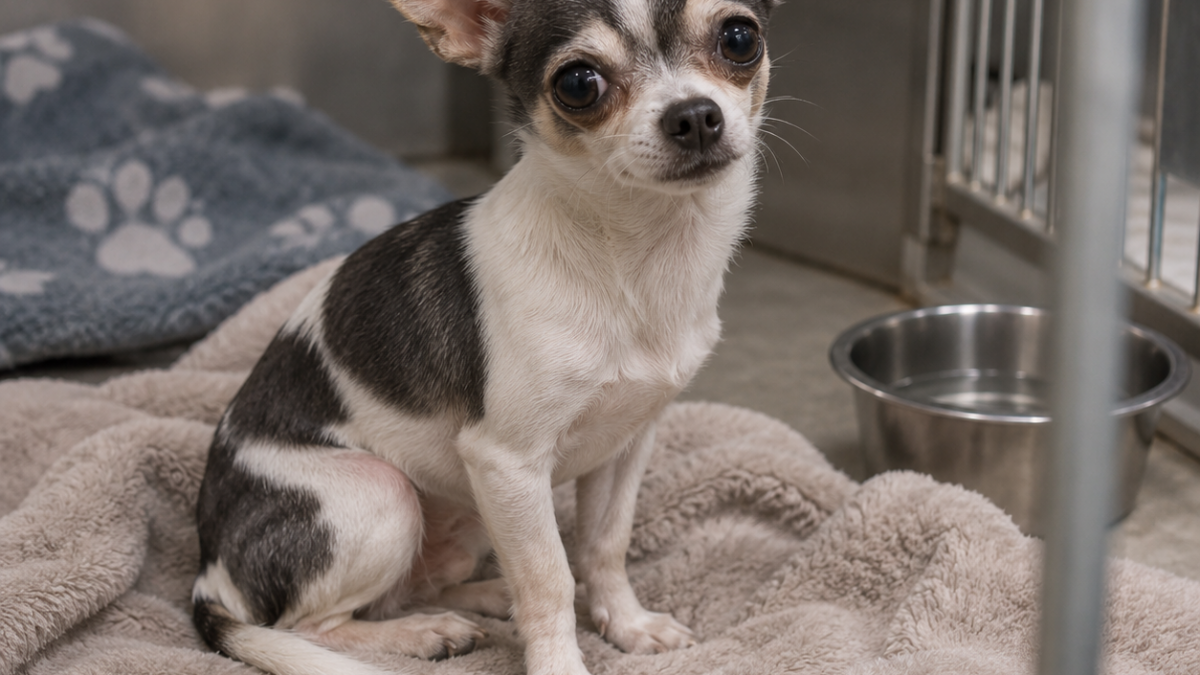
She was a three-year-old Chihuahua who weighed barely five pounds. Her coat was a soft beige along her back, with a clean white chest and a narrow white stripe running beneath her chin. Her ears looked almost too large for her little head, and they moved constantly, reacting to footsteps, doors, voices, keys, even the distant hum of cars in the parking lot.
But it was her eyes that made people stop.
They were huge, dark, and heartbreakingly alert.
She watched everyone.
Not with the hopeful excitement of a dog waiting to be adopted.
It was different.
She studied faces.
She listened to voices.
She searched.
Whenever someone entered the kennel wing, Mulia stood immediately.
If the footsteps came closer, she moved toward the bars.
If they passed her, her body slowly sank again.
That happened dozens of times every day.
At first, I told myself I was imagining the sadness in her expression.
Working in a shelter can do that to you. After a while, you start filling in the stories animals can’t tell. A scar becomes a history. A flinch becomes a betrayal. A strange habit becomes evidence of some invisible wound.
Sometimes you’re right.
Sometimes you’re not.
But with Mulia, there was something unmistakable.
Every evening, after the final visitors left and the building settled into its nighttime rhythm, she began the same ritual.
She sat facing the door.
Not for five minutes.
Sometimes for an hour.
Then, when the hallway stayed empty and the lights dimmed, she would slowly turn around and curl herself into a tiny ball.
A few minutes later, the crying started.
It was never loud.
That made it worse.
She didn’t howl.
She didn’t scratch at the gate.
She made a tiny, broken whimper that sounded almost embarrassed, like she was trying not to bother anyone.
The first time I heard it, I thought an animal was hurt.
I followed the sound through the hallway and found Mulia lying on her side, staring toward the door.
“Mulia?”
Her ears moved.
I crouched.
“What’s wrong, sweetheart?”
She looked at me.
Then she looked back at the door.
That was all.
One night, Viktor found me sitting outside her kennel.
He was one of our oldest caretakers, a broad-shouldered man with gray hair and the quiet patience of someone who had spent decades around frightened animals.
“She started again?” he asked.
I nodded.
Mulia whimpered once.
Viktor leaned against the wall.
“She still thinks someone’s coming.”
“You think that’s what it is?”
He gave me a tired look.
“What else would she be doing?”
I watched her.
“How long do dogs wait?”
“For what?”
“For someone who isn’t coming.”
Viktor was silent.
Then he said, “Longer than people deserve.”
That answer stayed with me.
We knew almost nothing about Mulia’s past.
Her surrender paperwork was painfully short.
Female.
Chihuahua.
Approximately three years old.
Owner surrender.
Reason: Unable to continue care.
No medical history.
No detailed notes.
No favorite toys.
No feeding schedule.
Nothing about whether she liked children, hated thunderstorms, slept in a crate, knew commands, or had ever bitten anyone.
People often think surrender paperwork doesn’t matter.
It does.
Even one sentence can help.
“She’s scared of men.”
“She sleeps under blankets.”
“She hates vacuum cleaners.”
“She loves chicken.”
Those tiny details tell you an animal belonged somewhere.
Mulia’s form felt empty.
Too empty.
And yet, her behavior was full of memories.
She never ate immediately when we put food down.
First, she went to the kennel door.
Sat.
Waited.
Only after several minutes would she turn and approach the bowl.
Keys were even worse.
If someone jingled a set of keys in the hallway, Mulia shot upright.
Car doors had the same effect.
So did certain women’s voices.
Every time, she reacted as though her entire life had just appeared on the other side of the wall.
Then nothing happened.
And she slowly folded back into herself.
A week after she arrived, we received a donation of new dog beds.
They were thick, soft, washable, and much warmer than the old blankets.
Most of the dogs climbed onto them immediately.
Mulia wouldn’t.
I placed one in her kennel.
She approached cautiously.
Sniffed it.
Touched it with one paw.
Then backed away.
That night, she slept on the bare floor beside it.
The next morning, I tried again.
Same reaction.
On the third evening, I sat inside her kennel.
“Okay,” I said. “Let’s figure this out.”
Mulia watched me.
I spread a small fleece blanket on the floor.
Then I lay down on it.
Viktor passed by and raised an eyebrow.
“What are you doing?”
“Science.”
He snorted.
I ignored him.
“Come here, Mulia.”
She didn’t move.
I patted the blanket.
“Come on.”
A full minute passed.
Finally, she took one step.
Then another.
She reached the blanket.
But instead of lying down, she grabbed the edge with her teeth.
She pulled.
Folded.
Pulled again.
Then she rolled part of the blanket into a thick ridge.
After that, she turned around and pressed her back firmly against it.
I stopped breathing.
Viktor stopped too.
“She made a pillow,” I whispered.
He shook his head.
“No.”
I looked at him.
“Then what?”
His voice was quiet.
“She made someone.”
My throat tightened.
From that night on, I noticed the pattern.
Mulia always rolled the blanket.
Always pressed herself against it.
Always slept with her spine touching the fabric.
She wasn’t looking for softness.
She was looking for contact.
I started wondering who used to sleep beside her.
Then came the morning that changed everything.
It was just after eight when the front door opened.
A woman entered the lobby carrying two bags of donated towels.
She wore a blue coat and had a large ring of keys in one hand.
Attached to the ring was a tiny silver bell.
The keys jingled.
Mulia’s head snapped up.
She froze.
Then she screamed.
I had never heard a sound like that from her.
I dropped the water bowl I was holding and ran.
Mulia stood on her hind legs, front paws braced against the bars.
Her body shook so hard the gate rattled.
“Mulia!”
She didn’t look at me.
The keys jingled again.
She cried out.
I opened the kennel.
She exploded past me.
“Mulia!”
She tore down the hallway, slipped around the corner, and stopped in the lobby.
The woman looked down.
“Oh!”
Mulia stood ten feet away.
Every muscle in her body was rigid.
The woman smiled uncertainly.
“Well, hello, sweetheart.”
Mulia took two steps forward.
Her tail moved.
Then she stopped.
I could see the confusion.
The sound was familiar.
The face wasn’t.
Mulia approached, sniffed the woman’s shoes, then the hem of her coat.
Her excitement disappeared almost instantly.
She turned around.
Walked back to me.
And climbed into my lap.
The woman introduced herself as Carol.
She had recently lost an elderly terrier and had come to donate blankets.
I asked to see her key ring.
She handed it to me.
I shook it gently.
Mulia’s ears shot forward.
She stared toward the door.
Carol’s smile faded.
“Oh,” she whispered.
That moment bothered me all day.
That night, I couldn’t stop thinking about it.
Keys.
Car doors.
Certain voices.
The rolled blanket.
This wasn’t a dog who had simply adjusted badly to shelter life.
Mulia was recognizing fragments.
Pieces of someone.
I asked Linda, our shelter director, if I could review the surrender form.
She looked at me over her glasses.
“You think something’s wrong.”
“I do.”
“Based on what?”
“Her behavior.”
“That isn’t evidence.”
“I know.”
Linda leaned back.
“We have more than forty dogs here, Marina.”
“I know.”
“We can’t investigate every surrender because an animal is sad.”
“I know.”
She stared at me.
Then sighed.
“Five minutes.”
The paperwork listed the surrendering owner as Dylan Reeves.
Length of ownership: three years.
Reason for surrender: unable to continue care.
I frowned.
“Three years?”
Mulia was three.
According to the form, Dylan had owned her virtually her entire life.
But he had brought no records.
No vaccination documents.
No medication.
No collar.
No favorite toy.
Nothing.
“Who handled intake?” I asked.
“Michelle.”
I found Michelle sorting laundry.
“Do you remember the guy who surrendered Mulia?”
“The Chihuahua?”
“Yes.”
She nodded.
“Barely. He was in a hurry.”
“What was Mulia like with him?”
Michelle paused.
“That was actually weird.”
My stomach tightened.
“How?”
“She wouldn’t go near him.”
“What?”
“When he handed me the leash, she moved behind my legs.”
“Did she cry when he left?”
“No.”
“Did she try to follow him?”
“No.”
“Did he say goodbye?”
Michelle thought.
“I don’t think so.”
“Did he use her name?”
Another pause.
“I don’t remember him saying it.”
“What did he say?”
Michelle folded a towel.
“He said, ‘Here’s the dog.’”
A cold feeling moved through me.
The next morning, I brought it up with Linda.
She listened.
She didn’t dismiss me this time.
Instead, she reopened Mulia’s microchip information.
The chip had shown no active registration during intake, but Linda searched another database.
Suddenly she leaned toward the screen.
“What?”
“There was an old registration.”
“To who?”
Linda looked at me.
“Sophia Bennett.”
Not Dylan Reeves.
Sophia Bennett.
There was also a veterinary clinic attached to the record.
Linda called.
The receptionist wouldn’t release private medical information, but after Linda explained we were verifying ownership of a surrendered animal, she agreed to confirm basic details.
“Yes,” the woman said. “That microchip belongs to a Chihuahua named Mulia.”
Linda put the call on speaker.
“Registered owner?”
“Sophia Bennett.”
“Do you have Dylan Reeves in the file?”
A pause.
“No.”
“Who usually brought Mulia to appointments?”
Another pause.
Then:
“Sophia.”
Every appointment.
Linda thanked her and hung up.
I looked toward the kennel wing.
“She didn’t belong to him.”
“We don’t know the full situation yet.”
“He lied on the form.”
“Yes.”
That was the first time Linda admitted it.
We tried contacting Sophia.
The old number went straight to voicemail.
The address linked to the microchip was outdated.
A letter was returned.
No longer at this address.
Meanwhile Mulia became quieter.
That frightened me.
At first she had run to every sound.
Now sometimes she didn’t get up.
Viktor noticed too.
“She is learning,” he said.
“Learning what?”
“That nobody comes.”
I hated those words.
Eventually, with Linda’s approval, we posted Mulia’s picture on the shelter’s public page.
We didn’t mention the ownership issue.
We simply explained that she was a tiny Chihuahua who seemed heartbroken and had difficulty adjusting after being surrendered.
The photograph showed her sitting on the rolled blanket.
Within three days, thousands of people had seen it.
Then a message arrived.
“Where did you get this dog?”
The sender’s name was Hannah Bennett.
When I saw the last name, my heart began pounding.
Linda messaged back and asked her to call.
Ten minutes later, the phone rang.
Hannah’s voice was shaking.
“Is that dog named Mulia?”
Linda answered carefully.
“Can you describe her?”
“Beige back. White chest. Dark patch behind her left ear. She sleeps under blankets. She’s terrified of thunder. If you scratch the right side of her neck, her back leg kicks.”
Every detail matched.
“Who does she belong to?” Linda asked.
“My sister.”
“Name?”
“Sophia Bennett.”
My eyes filled instantly.
Then Hannah said something that made my entire body go cold.
“My sister has been looking for her for almost two months.”
I sat down.
“What happened?”
There was a long silence.
Then Hannah began.
Sophia had been in a car accident.
She’d undergone surgery and spent days heavily medicated in the hospital.
At the time, she lived with her boyfriend.
Dylan Reeves.
Mulia was Sophia’s dog.
She had owned her long before Dylan entered the picture.
While Sophia was hospitalized, Dylan told the family he had arranged for someone to care for Mulia.
Then, when Sophia was finally alert enough to ask for her, Dylan claimed Mulia had run away.
I gripped the edge of the desk.
“He told her the dog escaped?”
“Yes.”
Hannah’s voice broke.
“Sophia was calling shelters from her hospital bed. She could barely sit up. She made me drive around neighborhoods looking for Mulia.”
“And Dylan?”
“He kept saying he didn’t know where she went.”
I felt sick.
“Why would he surrender her?”
Hannah didn’t answer immediately.
Then she said, “Because he hated her.”
“Mulia?”
“No. Not exactly.”
She inhaled.
“He hated what she meant to Sophia.”
The room went silent.
“He used to complain Mulia slept in the bed. He said Sophia treated her like a child. They fought about it constantly.”
“Did he ever threaten the dog?”
“Yes.”
My stomach dropped.
“Once he said, ‘One day you’re going to come home and that dog won’t be here.’”
I closed my eyes.
“Where’s Sophia now?”
There was another pause.
“She is sitting beside me.”
“Can I speak to her?”
Rustling.
Then a weak voice came through the speaker.
“Hello?”
“Sophia?”
“Yes.”
“My name is Marina. I’m a volunteer at the shelter.”
She said nothing.
I could hear her breathing.
Then I said, “I’m with Mulia.”
Sophia made a broken sound.
“She’s alive?”
That question crushed me.
“Yes.”
She began to cry.
“She’s alive.”
“Is she hurt?”
“No. Physically, she’s okay.”
“Does she remember me?”
I looked through the office window.
Mulia was sitting inside her kennel.
Watching the hallway.
“Sophia, I don’t think she ever stopped remembering you.”
The crying on the other end became louder.
“Can I talk to her?”
I carried the phone to Mulia’s kennel and put it on speaker.
For a moment, there was only silence.
Then Sophia whispered:
“Mulia?”
The dog froze.
Her ears lifted.
Sophia’s voice broke.
“Baby?”
Mulia stepped toward the phone.
Her whole body started trembling.
“It’s Mommy.”
Mulia made a tiny, breathless sound.
Then she pawed at the phone.
Sophia started crying harder.
“I’m coming, baby. I’m coming.”
Mulia barked.
Once.
Then again.
It was the first time we’d heard her bark in days.
Three hours later, a silver SUV pulled into the parking lot.
Mulia heard it.
She stood.
The front door opened.
Footsteps entered the hallway.
Slow.
Careful.
Then a woman appeared.
She was thin and pale.
One hand held a cane.
The other held a set of keys.
A tiny silver bell hung from the ring.
Mulia froze.
Sophia froze too.
For one second, neither moved.
Then Sophia whispered:
“Mulia.”
The Chihuahua exploded forward.
I opened the kennel just in time.
Mulia ran.
Sophia dropped her cane and fell to her knees.
The dog launched herself against Sophia’s chest.
Sophia wrapped both arms around her.
Mulia cried.
Licked her face.
Clawed at her coat.
Backed away just enough to stare at her, then threw herself into her arms again.
Sophia sobbed.
“I didn’t leave you.”
Mulia pressed her face into Sophia’s neck.
“I didn’t leave you, baby.”
Every person in the hallway was crying.
“You thought I left you.”
Sophia buried her face in Mulia’s fur.
“Oh, God. You thought I left you.”
For twenty minutes, Mulia refused to leave her lap.
And for the first time since arriving at the shelter, she didn’t look toward the door.
Her person was already there.
I wanted that to be the end.
But the next morning, Dylan walked into the shelter.
“I want the Chihuahua back.”
Linda came out of her office.
“You surrendered her.”
“I changed my mind.”
“She isn’t available.”
“Then I’ll adopt her.”
“No.”
His face hardened.
“Why not?”
Linda folded her arms.
“Because there is a dispute over whether you ever had the legal right to surrender her.”
His eyes changed.
“Sophia called you.”
That was enough.
He knew exactly what he’d done.
I stepped forward.
“You told her Mulia ran away.”
He looked at me.
“Who are you?”
“The person who listened to that dog cry every night.”
He scoffed.
“It’s a dog.”
Those words made something inside me snap.
“She waited for Sophia every night.”
“You people are insane.”
“She slept against a rolled blanket because she was used to sleeping beside someone.”
“So?”
“She ran to every car door she heard.”
He rolled his eyes.
“Seriously?”
“She recognized a key ring because Sophia had one with a bell.”
His face flickered.
Just slightly.
I saw it.
“You knew.”
He said nothing.
“You knew exactly what she was waiting for.”
Linda stepped between us.
“Marina.”
But I couldn’t stop.
“You watched Sophia search for her.”
Dylan’s jaw tightened.
“You have no idea what our relationship was like.”
“I don’t care.”
“She chose that dog over me constantly.”
“That wasn’t Mulia’s fault.”
“She acted like the dog mattered more than I did.”
I stared at him.
“And that made you angry enough to make her disappear?”
Silence.
There it was.
Not an accident.
Not inconvenience.
Punishment.
He hadn’t surrendered Mulia because he couldn’t care for her.
He did it to hurt Sophia.
Linda picked up the phone.
“You need to leave.”
Dylan laughed bitterly.
“What, you’re calling police now?”
“If necessary.”
He looked toward me.
“Tell Sophia she can keep her stupid dog.”
I stepped closer.
“She always could.”
After he left, Sophia came to the shelter.
When I told her what he’d said, she sat with Mulia sleeping in her lap.
For a long time she said nothing.
Then:
“I called him from the hospital every night.”
I sat beside her.
“He listened to me cry.”
Her fingers trembled against Mulia’s fur.
“I asked him if he thought she was cold.”
I swallowed.
“I asked if he thought she was scared.”
Her eyes filled.
“And he kept saying, ‘She’s probably fine.’”
Hannah sat beside her.
“He wanted you to suffer.”
Sophia looked down.
“I thought it was my fault.”
“It wasn’t.”
“I thought maybe the door hadn’t latched.”
Her voice cracked.
“I kept imagining her outside somewhere looking for me.”
I glanced at Mulia.
“She was looking for you.”
Sophia raised her head.
I added softly, “Just not where you thought.”
That broke her.
For the first time since I’d met her, Sophia didn’t cry quietly.
She sobbed.
Not just because Mulia had been taken.
Because now she understood the cruelty behind it.
Later, we discovered another detail.
On the surrender paperwork, Dylan had not only claimed he had ownership.
He had attempted to sign Sophia’s name.
The signature looked wrong.
Sloppy.
He had started writing his own first name, crossed it out, then written “S. Bennett.”
Sophia stared at the copy.
“That isn’t my signature.”
“No.”
“He wanted it to look like I gave her away.”
No one answered.
Her face slowly hardened.
For weeks, she had thought Mulia was lost.
But Dylan had been constructing a different story.
A story where Sophia had abandoned her.
A story where, if anyone ever found the paperwork, it might look like Sophia had willingly surrendered the dog she loved most.
That was when Sophia decided to fight.
Not to destroy him.
Not to humiliate him.
To make sure the truth existed somewhere official.
The police report was filed.
The shelter provided records.
The veterinary clinic confirmed Sophia’s ownership history.
The microchip registration matched her name.
Old photos showed years of life together.
Then there were the text messages.
Months before the accident, Dylan had sent:
“One day you’re going to come home and that dog won’t be here.”
Sophia had replied:
“Touch Mulia and we’re done.”
He had answered with a laughing emoji.
Another message came from Hannah on the day Sophia was hospitalized.
“Please make sure Mulia eats. She’s probably scared.”
Dylan replied:
“She’s handled.”
Twenty-four hours later, he surrendered her.
When Sophia saw that message again, her expression changed.
“She was handled.”
Her voice was almost a whisper.
“Like an object.”
Mulia lifted her head.
Sophia immediately stroked her.
“Not anymore.”
The case moved slowly.
There were interviews.
Statements.
Documents.
Dylan claimed he believed he had authority because he lived with Sophia and sometimes cared for Mulia.
But the evidence made his story harder to sustain.
Eventually, he accepted a negotiated resolution.
He admitted making false statements related to the surrender.
He relinquished any claim over Mulia.
He paid fines and restitution related to shelter costs.
He was ordered not to contact Sophia directly.
Some people might not call that revenge.
There were no handcuffs.
No dramatic courtroom confession.
No ruined life.
But the day Sophia called me after the hearing, she sounded different.
Lighter.
“It’s finished.”
“How do you feel?”
She thought for a moment.
“Free.”
“Not angry?”
She laughed softly.
“Oh, I’m angry.”
Then she said something I never forgot.
“But I don’t want him in my life anymore. Not even as someone I hate.”
That was the real victory.
Dylan had wanted to control Sophia through loss.
Instead, the truth removed his last connection to her.
He had wanted Mulia gone.
Instead, Mulia became the reason everything he had done came into the light.
He had tried to erase a bond.
Instead, that bond became stronger.
Healing, however, took longer than justice.
When Mulia returned home, she followed Sophia everywhere.
If Sophia moved from the sofa to the kitchen, Mulia followed.
If she stepped into the bathroom and closed the door, Mulia waited outside.
If Sophia picked up her purse, Mulia panicked.
Keys were worst of all.
The same sound that once meant homecoming had become tangled with fear.
The first time Sophia tried leaving for physical therapy without her, Mulia screamed.
Sophia called me from the hallway.
“I can’t do this.”
“You can.”
“She thinks I’m leaving forever.”
“I know.”
“I don’t want her to feel that again.”
“You aren’t causing the fear.”
“But I’m triggering it.”
“Yes.”
Silence.
Then I said, “So teach her a new ending.”
Sophia started small.
She picked up her keys.
Put them down.
Put on her coat.
Sat on the couch.
Walked to the door.
Came back.
Then she stepped into the hallway for three seconds.
Returned.
Five seconds.
Returned.
Ten seconds.
Returned.
Every time, Mulia reacted as though Sophia had returned from another country.
But slowly, something changed.
Sophia leaves.
Sophia returns.
The door closes.
The door opens.
Keys jingle.
Nothing terrible happens.
Again.
Again.
Again.
Trust rebuilt through ordinary repetition.
Two months later, I visited their apartment.
Photographs of Mulia covered the walls.
As a puppy.
At the beach.
In a Christmas sweater.
Wearing a birthday hat.
Sitting beside Sophia on the couch.
Three years of memories Dylan had reduced to one empty line:
Unable to continue care.
I stared at the photos.
Sophia noticed.
“I put them all back.”
“Back?”
“Dylan hated them.”
I looked at her.
“He said there were too many pictures of Mulia.”
She smiled.
“So now there are more.”
I laughed.
That was when I knew Sophia was truly healing.
Not because she had forgotten.
Because she could reclaim things without imagining his reaction.
Nearly a year after Mulia first entered our shelter, Sophia returned carrying a large cardboard box.
Mulia walked beside her in a pink harness.
Viktor saw them first.
“Well, look who’s back.”
Mulia barked and ran toward him.
The box was filled with blankets.
Soft ones.
Thick ones.
Small ones.
Each had a tag attached.
I picked one up.
It read:
“For someone still waiting.”
My eyes burned.
“Sophia.”
She smiled.
“Mulia doesn’t need hers anymore.”
At that moment, Mulia spotted a folded towel on the floor.
She walked over.
Pawed it.
For one second, I expected her to roll it into the shape of a body.
She didn’t.
She simply lay down.
Then Sophia sat beside her.
Mulia immediately stood, turned around, and pressed herself against Sophia’s leg.
Viktor looked at me.
Neither of us needed to say anything.
We remembered.
The cold floor.
The rolled blanket.
The tiny body pretending someone was there.
A family entered the shelter a few minutes later.
A little girl saw Mulia.
“She’s so tiny.”
Sophia smiled.
“She is.”
“Can we adopt her?”
“No. She already has a home.”
The girl looked disappointed.
Then she asked, “Did she wait a long time?”
Sophia’s eyes met mine.
“Yes.”
“But somebody came back?”
Sophia swallowed.
“Yes.”
The girl smiled.
“Good.”
Then she said:
“Everyone should have somebody who comes back.”
I had to turn away.
Months later, Sophia sent me a photograph late at night.
Mulia was asleep beneath a thick blanket.
Only her face and one tiny paw were visible.
That paw rested over Sophia’s wrist.
The message underneath said:
“She still has to touch me when she sleeps.”
Then another message arrived.
“But she doesn’t cry anymore.”
I stared at those words for a long time.
Mulia hadn’t stopped crying because she forgot what happened.
She stopped because the question she had asked every night had finally been answered.
Are you coming back?
Yes.
Sophia came back after work.
She came back after therapy.
She came back after buying groceries.
She came back after taking out the trash.
Hundreds of ordinary returns replaced one terrible disappearance.
Years later, Sophia sent me another picture.
Mulia was lying upside down in an enormous, fluffy dog bed.
Legs in the air.
Completely relaxed.
I called her.
“She likes soft beds now?”
Sophia laughed.
“She loves them.”
“What changed?”
There was a pause.
Then Sophia said:
“She learned that sleeping comfortably doesn’t mean waking up alone.”
I couldn’t answer for a moment.
In the background, Mulia barked.
Sophia laughed.
“She heard your voice.”
“Put me on speaker.”
A few seconds later, I heard the familiar snuffling sound near the phone.
“Hey, palm-sized girl.”
Mulia barked again.
I smiled.
Some people think animals forget quickly.
Maybe they forget details.
Maybe they don’t remember dates or explanations.
But they remember what safety feels like.
They remember voices.
Scents.
Footsteps.
The shape of a body beside them at night.
Mulia remembered enough to wait.
And Sophia loved her enough to come back.
Dylan had taken her away in one morning.
Sophia gave her security back one day at a time.
That became the ending he could never take from either of them.
Because the man who treated a five-pound Chihuahua like she didn’t matter ended up proving exactly how much she did.
She mattered enough to be searched for.
Enough to be fought for.
Enough for strangers to notice her grief.
Enough for shelter workers to question the empty story written on a form.
Enough for Sophia to walk into a shelter with a cane and drop to her knees.
Enough for the truth to catch up with the man who tried to erase her.
And enough to spend the rest of her life knowing the one thing she had once been terrified to believe.
Her person came back.
And this time, she stayed.








