PART 2: The Three-Legged Dog Stared at My Prosthetic Leg—Then I Learned Why Someone Had Left Him at a Dump
PART 2
I turned the collar toward the light and wiped dirt from the inside with my thumb.
R-O-M-E-O.
Under the name were four engraved digits.
Not enough for a telephone number.
Possibly the ending of one.
Possibly part of an old registration code.
Possibly nothing.
The dog watched me touch the collar.
I stopped immediately when his body stiffened.
“All right.”
I let the leather fall back against his neck.
“No more.”
Romeo.
The name changed him somehow.
Not physically.
He was still a starving three-legged hound standing between a rusted washing machine and a broken refrigerator.
But now he was not simply “the dog at the dump.”
He was Romeo.
Somebody had said that name before.
Maybe with affection once.
Maybe not.
Names create history.
That bothered me.
A dog born on the street might never have known a kitchen floor or a hand filling a bowl.
Romeo had.
Someone had put money into that collar.
Someone had known him well enough to have his name engraved inside it.
Then somehow he ended up scavenging spoiled food among broken glass.
Claire arrived twenty minutes later in a battered rescue van.
She climbed out carrying a slip lead, a blanket, and a bag that smelled strongly enough to get Romeo’s attention from twenty feet away.
Claire was sixty-two, small, silver-haired, and completely unimpressed by every motorcycle rider she had ever met.
She looked at me first.
Then my motorcycle.
Then the dump.
Then Romeo.
“You really know how to spend a Sunday.”
“He found me.”
Romeo’s ears shifted at our voices.
Claire did not approach.
She sat on an overturned plastic crate and opened a container of wet dog food.
The smell changed everything.
Romeo took one step.
Then another.
Claire put the bowl down.
Backed away.
Romeo reached it and ate so quickly that I felt ashamed just watching.
“Slow,” Claire murmured.
She slid another bowl with water closer.
Romeo drank.
Then drank more.
Too fast.
Claire pulled it back for a moment.
“He’s dehydrated.”
“He’s starving.”
“Yes.”
“How long?”
She looked at his hips.
“Long enough.”
Romeo finished what she allowed.
Then sat.
His single back leg shook.
That was something I understood too.
When you lose one leg, the remaining one carries a bill it never agreed to pay.
I had learned that through years of socket adjustments, physical therapy, phantom pain, falls, and strangers saying things like, “You walk so well I almost forgot.”
My body never forgot.
Romeo’s didn’t either.
He had adapted enough to survive.
That was not the same as being well.
Claire took out the slip lead.
Romeo backed away immediately.
“Don’t.”
She stopped.
“I’m not.”
His eyes moved between us.
Then back to the food container.
Claire smiled.
“Good. He’s still bribable.”
She placed another spoonful in the bowl.
Romeo came forward.
Closer.
Claire looped the lead loosely over his head while he ate.
He froze.
I expected him to bolt.
He didn’t.
He looked directly at me.
Then down at my prosthetic.
Click.
I shifted my foot.
Romeo relaxed a fraction.
That moment stayed with me.
I do not pretend he saw himself in me.
Dogs do not build symbolic narratives because a man and a dog are missing corresponding limbs.
But something about the sound of the prosthetic had become familiar enough that he stopped retreating.
That was all I needed.
We loaded Romeo into Claire’s van.
He resisted the ramp.
The angle was difficult for three legs.
I stood beside it.
“Yeah. I hate ramps too.”
Claire laughed.
“You’re lying.”
“I hate bad ramps.”
Romeo tried once.
Slipped.
Immediately panicked.
“Stop.”
Claire moved forward.
I raised a hand.
“Give me a second.”
I sat on the edge of the van floor and removed my prosthetic.
Claire stared.
“Marc.”
“What?”
“You’re not seriously doing this.”
“I need him to stop thinking I’m fast.”
“That has never been anyone’s concern about you.”
I ignored her.
The socket released.
I set the prosthetic beside me.
Romeo stared.
For a moment, his attention left everything else.
I tapped the empty pant leg below my knee.
“See?”
I knew he didn’t understand the speech.
But I could change my posture.
Lower myself.
Remove the hard clicking object.
Make myself smaller.
Romeo approached.
Sniffed the prosthetic.
Then my pant leg.
Claire whispered, “Don’t move.”
“I wasn’t planning to.”
Romeo sniffed again.
Then put one front paw onto the ramp.
A second.
Claire placed food just inside the van.
Romeo climbed.
Slow.
Unsteady.
But he climbed.
Claire secured him safely.
I put my leg back on.
“Never tell anybody I did that.”
“Oh, I’m telling everyone.”
The veterinary clinic was fifteen minutes away.
Romeo lay curled on the blanket during the drive.
At every hard turn, his body braced.
He looked toward the door whenever we slowed.
Not frantic.
Just prepared.
Prepared is another word for an animal who has learned not to assume anything good comes next.
At the clinic, Dr. Sophie Laurent examined him.
Romeo was significantly underweight.
Dehydrated.
His remaining rear leg had sores along the paw from overuse and rough terrain.
Several cuts were embedded with dirt.
His teeth showed wear consistent with scavenging hard objects or trying to tear packaging.
There were intestinal parasites.
His bloodwork showed anemia, though not yet at the level requiring transfusion.
No fever.
No current major infection.
That was the first good news.
Then Sophie examined the amputation site.
“This was done surgically.”
“You’re sure?”
“Very.”
She moved the fur carefully around the old scar.
“Clean line. Proper closure. Whoever removed the limb was a veterinarian.”
Claire and I looked at each other.
“So somebody paid for surgery.”
“Yes.”
“And then he ended up at a dump.”
Sophie did not answer.
Medicine could tell us how a leg was removed.
Not why love disappeared afterward.
She scanned for a microchip.
The scanner beeped.
Claire inhaled sharply.
Romeo had a chip.
That meant we might not need the collar numbers at all.
The chip registration gave us a name.
Owner: Julien Moreau.
Address: a village about twenty-five miles outside Limoges.
Phone number disconnected.
Sophie checked the old veterinary network.
The chip had been registered four years earlier.
There were vaccine records.
One emergency orthopedic surgery.
I leaned closer.
“Is that the amputation?”
She nodded.
Two years earlier.
Romeo had apparently suffered severe trauma to the left hind leg.
The surgical notes stated the limb could not be saved.
Cause listed as vehicular trauma.
“Hit by a car?”
“Apparently.”
“Owner brought him in?”
“Yes.”
I felt something inside me tighten.
Julien Moreau had once taken Romeo to a clinic after an accident.
Paid for an amputation.
At least authorized it.
Romeo had received follow-up care for six weeks.
Then nothing.
No later records.
Claire crossed her arms.
“That doesn’t fit abandonment.”
“It can.”
“I know.”
She looked at Romeo.
“But people who spend that much getting a leg amputated usually don’t throw the dog away immediately.”
That bothered me too.
The timeline mattered.
Two years between surgery and dump.
Something had changed.
Sophie tried the listed number again.
Disconnected.
We contacted local authorities and the animal welfare unit because Romeo had been found emaciated at an illegal dumping site and his registered ownership needed to be established.
While paperwork began, Romeo stayed at the clinic.
His first meal had to be carefully portioned.
He wanted everything.
Of course he did.
Sophie explained that after prolonged food deprivation, aggressive feeding could cause serious problems.
So we started slowly.
Small amounts.
Frequent meals.
Water monitored.
Parasite treatment.
Pain relief for the overused paw.
Nutritional support.
A clean bed.
Romeo hated the kennel.
Not violently.
He simply refused to lie in the center.
He pressed himself into the far corner.
Claire visited twice a day.
I visited once.
Then twice.
Then started pretending I was only there because my motorcycle route happened to pass the clinic.
Claire eventually said:
“You live in the opposite direction.”
“I like scenery.”
“You hate this road.”
“I’m expanding.”
Romeo began recognizing the click.
That became our language.
Every time I entered:
Click.
His ears lifted.
Click.
Head up.
By the fourth day, tail movement.
Small.
But there.
I started calling him Romeo because it was his name, but it felt strange.
Somebody else had named him.
Somebody else’s voice must once have made those ears rise.
Mine did now.
On day five, an investigator named Étienne Fabre called Claire.
They had located Julien Moreau.
He was no longer at the registered address.
He lived in a small apartment in Limoges with his mother.
“Did he abandon Romeo?” I asked.
Étienne paused.
“We haven’t interviewed him yet.”
“Then why are you calling?”
“Because there’s something you should know before you assume too much.”
That sentence irritated me.
“What?”
“The former residence burned eighteen months ago.”
I went quiet.
“What?”
“House fire. Extensive damage.”
Claire was beside me.
I put the phone on speaker.
Étienne continued.
“Julien’s wife died in the fire.”
Everything in the room changed.
Claire lowered herself into a chair.
“What about Romeo?”
“We’re trying to establish that.”
For the first time since finding the dog, my anger lost its target.
A house fire.
A dead wife.
A displaced man.
A missing dog.
Nothing fit neatly anymore.
The next day, Étienne interviewed Julien.
Then he called us.
Julien cried when he heard Romeo was alive.
That was the first thing Étienne said.
I didn’t know how to process it.
“He thought Romeo was dead?”
“No.”
“What did he think?”
“He thought Romeo was taken.”
“Taken by who?”
“The situation after the fire was chaotic. Julien was hospitalized with smoke inhalation. His wife, Amélie, died. Romeo survived the fire but was placed temporarily with a relative.”
“Which relative?”
“Julien’s brother-in-law, Patrice Vannier.”
Claire leaned forward.
“And Patrice abandoned him?”
“Possibly.”
Possibly.
Again.
Facts.
Always slower than anger.
Julien said that after the fire he spent weeks in the hospital and then months moving between relatives while recovering emotionally and financially.
He could not keep Romeo where he was staying.
Patrice offered to take the dog temporarily.
For several months, Julien received occasional messages saying Romeo was fine.
Then communication became tense.
Julien’s life deteriorated.
Depression.
Debt.
Loss of work.
Family conflict after Amélie’s death.
He admitted something painful.
Eventually, he stopped asking often enough.
That mattered.
Love can fail through paralysis too.
Not only cruelty.
Julien said the last time he asked about Romeo, Patrice told him the dog had “run off.”
That was almost eight months before I found him.
“Eight months?”
Claire whispered.
“Could he have survived that long?”
“Possibly,” Sophie said later. “But not necessarily at the dump the whole time.”
Étienne investigated Patrice.
That was where the story turned again.
Patrice initially denied ever keeping Romeo.
Then messages surfaced.
Julien had saved old texts.
**He ate fine today.**
**Took him outside.**
**The stump looks okay.**
**Don’t worry about him. Take care of yourself.**
Patrice had Romeo.
No question.
When investigators confronted him with the messages, he changed his story.
Romeo had been difficult.
Expensive.
Too needy.
He damaged flooring.
Had accidents indoors.
Struggled with stairs.
Needed special food.
Julien wasn’t sending enough money.
Patrice said he eventually gave Romeo “to someone.”
Who?
He could not provide a name.
No number.
No address.
Just “a guy from work.”
There was no evidence this person existed.
Then we found something worse.
A scrap dealer near the dump recognized Patrice’s van.
Not Romeo.
The van.
Patrice had used that dumping area before.
Old furniture.
Construction waste.
Illegal disposal.
A trail camera on private land bordering the dumping area had captured vehicles occasionally because the landowner had grown tired of people leaving trash.
Étienne obtained the footage.
One recording from six weeks before I found Romeo showed Patrice’s white van.
Night.
Rear doors opening.
A dark animal jumping—or being lowered—out.
The image quality was poor.
But enough.
Three-legged gait.
Blue collar.
Romeo.
My stomach turned.
Claire whispered:
“He left him with the trash.”
That was exactly what he had done.
Patrice later claimed he believed someone would find the dog.
No food visible.
No water.
No shelter.
An illegal dump on a rural side road.
Romeo already thin in the footage.
He had not just been abandoned.
He had been discarded.
That word made me furious because it matched the setting too perfectly.
Broken furniture.
Old appliances.
Wet clothes.
A three-legged dog.
Things somebody decided were too inconvenient to keep.
I rode my motorcycle for three hours that night because if I had stayed home, I might have done something stupid.
The road helps me when anger gets too loud.
People romanticize motorcycles as freedom.
Sometimes they are simply somewhere to put rage so it burns fuel instead of relationships.
I thought about Romeo.
I thought about my own accident.
I thought about waking without a leg and hearing people tell me I was lucky.
I thought about all the months when showering was hard.
Stairs were hard.
Sleeping was hard.
Accepting help was hardest.
Romeo had become more work after losing his leg.
That was not his failure.
Disability does not turn the injured into a burden.
It reveals what kind of people are around them.
The next morning, I went to the clinic.
Romeo heard the click before he saw me.
His head lifted.
Tail moving.
“You know what?”
I sat beside the kennel.
“You and I are officially bad at being disposable.”
Romeo walked toward me.
Three steps.
Then pressed his forehead against the door.
I put my hand there.
That was the moment I knew I was in trouble.
Not because I wanted revenge.
Because I wanted the dog.
Claire knew before I admitted it.
“You’re fostering him.”
“No.”
“Temporary.”
“No.”
“He trusts you.”
“He trusts meat.”
“He knows your motorcycle.”
“That’s not possible.”
“He perks up when he hears it.”
“Coincidence.”
Claire stared.
“You removed your prosthetic in a garbage dump to get him into a van.”
“That was tactical.”
“You are fostering the dog.”
I folded my arms.
“No.”
Three days later, Romeo was in my house.
Temporary.
That was the lie.
My house was not designed for a three-legged dog.
It was barely designed for one-legged me.
One-story building, yes.
But slippery tile in the kitchen.
Two steps at the back door.
Old hardwood.
A narrow hallway.
I spent the morning laying rugs.
Claire arrived carrying a ramp.
“I hate ramps.”
“You said bad ramps.”
“This is a bad ramp.”
“It cost eighty euros.”
“Terrible ramp.”
Romeo used it before I did.
Traitor.
His first night was difficult.
He paced.
Could not settle.
Kept checking the front door.
Every noise outside brought his head up.
At three in the morning, I found him sitting in the kitchen.
Not eating.
Not sleeping.
Just sitting.
I lowered myself to the floor.
My prosthetic lay beside the bed in the other room.
Without it, I moved awkwardly on one knee and my hands.
Romeo watched.
I reached the wall and sat.
“No legs competition tonight.”
He approached.
Slowly.
Then lay down six feet away.
That was enough.
The next night, four feet.
Then two.
Within a week, Romeo slept beside my bed.
He snored.
Loudly.
I loved him immediately and denied it for another month.
His body improved.
Weight gained slowly.
The ribs softened.
His coat turned glossy.
The sores on his remaining back paw healed.
Sophie fitted him for a protective boot for longer walks to reduce wear.
Romeo hated it.
I understood.
The first time somebody puts a medical device on you and says, “You’ll get used to it,” you want to throw it at them.
“Try again.”
Romeo lifted the booted paw.
Shook it.
Stared at me.
“Yeah.”
He shook again.
“I did that with my first socket.”
Claire laughed.
“You shook your leg?”
“I threw it across a room.”
Sophie looked impressed.
Romeo eventually adapted.
We walked.
Short distances first.
My stride was uneven.
His was too.
People stared.
I pretended not to notice.
Sometimes children asked.
One little boy pointed at Romeo.
“Why does he only have three legs?”
His mother looked horrified.
I answered.
“Because four was too easy.”
The boy laughed.
Then he pointed at me.
“What about you?”
“Same problem.”
His mother nearly died.
Romeo wagged.
We became known around the neighborhood.
Gravel and Romeo.
Two missing left legs.
One old motorcycle.
Too much attitude.
That was the easy part.
Julien was the harder part.
He wanted to see Romeo.
When Claire told me, I reacted badly.
“No.”
“Marc.”
“He lost him.”
“He was lied to.”
“He stopped asking.”
“Yes.”
“That matters.”
“Yes.”
“And Romeo almost died.”
“Yes.”
Claire sat across from me.
“You can hold more than one truth.”
I hated when she used my own arguments against me.
Julien had failed Romeo in a way.
Not through active abandonment.
Through collapse.
Through grief.
Through surrendering responsibility to somebody he should have checked more carefully.
That did not make him innocent.
It also did not make him Patrice.
There was a difference.
I agreed to meet Julien without Romeo first.
We met at Claire’s rescue facility.
Julien was forty-one.
Thin.
Tired.
Eyes that looked older.
A burn scar extended along one wrist.
He carried a photograph.
Romeo with a woman.
Amélie.
Julien’s wife.
Romeo had all four legs in the picture.
Young.
Healthy.
He looked almost unrecognizable.
“Amélie chose him,” Julien said.
I didn’t answer.
“She saw him online at the shelter.”
He looked at the photograph.
“He was terrified of men.”
“How’d that work with you?”
“Badly.”
A small smile.
“For three weeks.”
Then Romeo started sleeping beside Julien.
Two years later, the car accident took the leg.
Julien cried while telling me.
“I thought that was the worst thing that could happen to him.”
“Was it your fault?”
“No. Gate blew open. He ran. Car hit him.”
“You got him surgery.”
“Yes.”
“Rehab?”
“Yes.”
“Then the fire.”
He nodded.
Amélie died from smoke inhalation after being trapped upstairs.
Julien tried reaching her and suffered burns and smoke injury.
Romeo was found outside by firefighters.
Julien woke in the hospital asking for two names.
Amélie.
Romeo.
One was dead.
One alive.
“That dog was the last thing I had of her.”
His voice cracked.
I stayed quiet.
“Then why did you stop checking?”
There it was.
The question I had wanted to ask.
Julien wiped his face.
“Because I stopped doing almost everything.”
“That isn’t an answer.”
“It’s the only one I have.”
He lost work.
Stopped opening mail.
Ignored calls.
Moved in with his mother.
Drank too much for a period.
Patrice kept telling him Romeo was fine.
Then Patrice grew angry that Julien wasn’t paying enough toward food.
They fought.
Julien said Patrice eventually told him Romeo had escaped.
“Why didn’t you search?”
“I did. For two days.”
“Two?”
“I posted. Drove around. Called shelters.”
“Then?”
He looked down.
“I gave up.”
That answer made me angrier than an excuse would have.
“You gave up on him.”
“Yes.”
No defense.
No blame.
Just yes.
“I have hated myself for that every day since Claire called.”
I looked at the photograph again.
Amélie’s hand rested on Romeo’s head.
“You want him back?”
Julien looked up.
That was the question neither of us wanted.
“I don’t know if I deserve him.”
“That wasn’t what I asked.”
He breathed slowly.
“I want to see him.”
Claire watched me.
I agreed.
The reunion happened in a fenced field.
Romeo wore his boot.
I stayed twenty feet away.
Julien entered alone.
Romeo saw him.
Stopped.
No dramatic sprint.
No music.
No miracle.
He stood still.
Julien crouched.
“Romeo.”
One ear lifted.
Then the other.
Julien started crying.
“Hey, Ro.”
Romeo took one step.
Then stopped.
Sniffed the air.
Another step.
Then five.
When he reached Julien, he smelled his hands.
His coat.
His face.
Julien did not touch him.
He waited.
Romeo circled once.
Then leaned his shoulder against Julien’s chest.
Julien folded.
He buried his face in Romeo’s neck.
“I’m sorry.”
I looked away.
Not because I was moved.
Because I was.
And that complicated everything.
Romeo remembered him.
That much seemed obvious from behavior.
Did he forgive him?
That is a human question.
Romeo accepted him.
That was all.
After twenty minutes, Romeo left Julien and came to me.
Click.
Click.
I moved toward the gate.
Romeo followed.
Julien watched.
There was sadness in his face.
And understanding.
“He chose you.”
I shook my head.
“He knows you too.”
“No.”
Julien wiped his eyes.
“He came back to you.”
We eventually agreed Romeo would remain with me.
Julien signed ownership transfer through the rescue.
Not because I demanded revenge.
Because his housing still didn’t allow a dog, his finances were unstable, and Romeo had already settled.
Julien asked for one thing.
Updates.
I said yes.
That relationship became strange but important.
Every few months, I sent a photograph.
Romeo asleep beside my motorcycle.
Romeo on a trail.
Romeo wearing his stupid boot.
Romeo stealing sausage.
Julien replied briefly.
Thank you.
Sometimes:
Amélie would have loved this.
I believed him.
Patrice’s case moved forward separately.
The trail camera footage became central.
So did the texts proving he had responsibility for Romeo.
So did the false claim that the dog had been given to someone else.
Authorities also investigated the illegal dumping.
It turned out Patrice had used the site repeatedly for construction waste from side jobs.
That opened another set of consequences.
Animal abandonment.
Neglect.
Illegal dumping.
False statements during the investigation.
I attended one hearing.
Not because I needed to.
Because I wanted to see him.
That was probably unhealthy.
Patrice looked younger than I expected.
Clean shirt.
Short hair.
No visible cruelty.
Again, ordinary.
It annoyed me.
He avoided looking toward Julien.
Then saw me.
His eyes dropped to my prosthetic.
I felt heat rise in my chest.
After the hearing, he passed near me in the corridor.
For one second, every ugly fantasy I had entertained during those motorcycle rides came back.
I could have said something threatening.
Could have stepped into his path.
Could have made the moment about me.
Instead, my prosthetic clicked once against the floor.
Patrice glanced down.
I said:
“He learned to run.”
That was all.
Patrice’s face changed.
Not much.
Enough.
I continued walking.
That sentence became my revenge.
He had left Romeo among trash believing inconvenience had ended the problem.
Romeo learned to run.
The court later imposed penalties and animal-ownership restrictions consistent with the evidence, along with restitution obligations and sanctions related to the illegal dumping.
Patrice was barred from having animals in his care for a significant period.
The dump violations cost him money.
The animal case cost him more.
His contracting side work came under scrutiny because of the waste disposal.
Consequences spread in boring, administrative ways.
That is often what real accountability looks like.
Paper.
Money.
Restrictions.
Records that follow you.
Not dramatic enough for some people.
Enough to protect future animals.
That mattered.
Romeo knew nothing.
Good.
He had better things to do.
His favorite thing became my motorcycle.
Not riding it.
He was never allowed loose near it.
He loved lying beside it in the garage while I worked.
The first time I started the engine after he moved in, he startled.
Then stared.
Eventually the sound became normal.
I bought a sidecar months later.
Claire called me insane.
“It’s not for him.”
“What is it for?”
“Balance.”
“You’ve ridden for forty years.”
“New interests.”
The sidecar was for Romeo.
I fitted it with a secure harness system, low entry, padded floor, and windscreen.
We trained gradually.
Engine off.
Sit inside.
Treat.
Then engine idle.
Treat.
Then ten meters.
Then around the block.
Romeo tolerated everything for food.
Our first real ride was seven miles.
Slow roads.
No highway.
When we stopped, Romeo refused to get out.
I laughed until my ribs hurt.
“You hated the ramp.”
He remained.
“You’re ridiculous.”
Soon, Romeo became locally famous.
Gray-bearded amputee biker.
Three-legged hound in sidecar.
People took photographs.
I hated that at first.
Then I started using the attention.
Claire’s rescue needed money.
So Romeo and I appeared at a charity ride.
Then another.
People donated.
Not because he looked pathetic.
I refused pity marketing.
The posters showed Romeo upright in the sidecar, ears blowing backward, tongue out.
Underneath:
**Three legs. Full speed.**
We raised enough for orthopedic care for two injured dogs that year.
That felt right.
Romeo’s missing leg became not his tragedy but part of how strangers noticed him.
Then the money helped dogs who needed surgery.
I began visiting rehabilitation clinics with him.
Not therapy in the medical sense.
Just volunteer visits.
Veterans.
Motorcycle crash survivors.
People learning to walk with prosthetics.
Children with limb differences.
Romeo was good at entering rooms without making disability ceremonial.
He sniffed everybody.
Looked for food.
Ignored wheelchairs.
Ignored prosthetics.
One sixteen-year-old boy named Nathan had lost his right leg after osteosarcoma.
He refused to use his new prosthetic in public.
Romeo walked toward him.
Nathan looked at the missing hind leg.
Then at me.
“This is stupid.”
“What?”
“You brought a dog to make me feel better?”
“No.”
Romeo put his nose into Nathan’s backpack.
“I brought a thief.”
Nathan laughed despite himself.
Romeo stole a sandwich.
We became friends.
Months later, Nathan attended one of our charity rides using his prosthetic.
He limped badly.
Nobody cared.
Romeo limped worse.
At the end Nathan said:
“I hate when people call me inspiring.”
“Then don’t inspire them.”
He laughed.
“What?”
“Live badly. Complain. Be annoying.”
Romeo barked.
“See? Professional.”
That became part of what Romeo gave me too.
After my own accident, I spent years trying to prove I was unchanged.
That was exhausting because it was false.
I had changed.
My gait.
My work.
My pain.
My patience.
My fear.
Romeo didn’t pretend to have four legs.
He used three.
Badly some days.
Brilliantly others.
He rested when necessary.
He demanded help climbing into high places.
He did not apologize.
Dogs are excellent at accepting functional truth without turning it into moral failure.
I needed that lesson more than I knew.
Two years after I found him, Romeo could run.
Not like a four-legged hound.
His body moved in a three-beat rhythm.
Front.
Front.
Rear.
Hop.
Front.
Front.
Rear.
Hop.
Fast enough.
Joyful enough.
The first time I saw him sprint across Claire’s field, I heard myself shouting.
“Go!”
Romeo ran.
Ears flying.
Tail high.
No boot that day because the ground was soft.
Claire stood beside me.
“You crying?”
“Rain.”
“Sunny.”
“Dust.”
“Grass.”
“Shut up.”
Romeo reached the fence.
Turned.
Ran back.
Straight toward me.
I thought about Patrice.
He learned to run.
Exactly what I had said.
But in that field, Patrice no longer mattered.
That was when I understood the difference between punishment and victory.
Patrice’s consequences protected future animals.
Good.
Romeo’s joy belonged to Romeo.
Better.
Julien continued receiving updates.
Eventually, he visited again.
By then he had stopped drinking entirely.
Found steady work.
Moved into his own apartment.
Started therapy.
I respected that.
We talked more honestly.
He did not ask for Romeo back.
That made it easier.
One afternoon, he brought a box of Amélie’s things.
Inside was Romeo’s original red rubber ball.
A photograph album.
A small raincoat.
And the paperwork from the amputation.
“I thought you should have these.”
I looked through the photos.
Romeo with four legs.
Romeo after surgery.
Romeo sleeping beside Amélie.
Romeo wearing a ridiculous holiday hat.
A life before me.
For a moment, jealousy surprised me.
Then disappeared.
Love before me did not reduce love after.
Romeo had chapters.
That was good.
Julien watched him playing in the yard.
“He’s happier than he was with us after the surgery.”
“You don’t know that.”
“I do.”
He smiled sadly.
“Amélie loved him. I loved him. But after he lost the leg, I became afraid all the time.”
“Afraid of what?”
“Him falling. Getting hurt. Doing too much.”
I understood.
“So you stopped letting him do things.”
“Too often.”
Romeo ran past us.
Julien laughed.
“Clearly you don’t.”
“I’m reckless.”
“That helps.”
Maybe.
Or maybe disability needs opportunity as much as protection.
Romeo taught me that too.
At six years after I found him, his remaining hind leg developed arthritis.
I knew it would.
So did Sophie.
One rear leg had been doing double work for years.
We adjusted.
Joint medication.
Weight control.
Hydrotherapy.
More boot use.
Shorter runs.
Romeo hated the underwater treadmill.
I loved watching him hate it.
He stood in the water glaring through the glass like I had personally betrayed him.
“Therapy.”
Bark.
“You need it.”
Bark.
“I had therapy too.”
Longer bark.
“Exactly.”
His sidecar rides continued.
Shorter.
Slower.
He no longer jumped in.
Used the ramp.
The ramp I once insulted became essential.
Claire reminded me every time.
“Good ramp.”
“Acceptable.”
“Eighty euros well spent.”
“It took seven years to prove itself.”
Age arrived quietly.
Gray around Romeo’s muzzle.
Longer naps.
Less interest in long walks.
More interest in food.
That never changed.
If anything, he became more manipulative.
He learned that strangers gave more treats to an old three-legged dog.
He exploited this shamelessly.
At charity events, I wore a sign:
**DO NOT FEED THE ACTOR.**
Nobody listened.
Romeo became overweight briefly.
Sophie blamed me.
“I didn’t give him all of it.”
“You accepted all of it.”
“He has agency.”
“He is a dog.”
“Debatable.”
We corrected his diet.
Romeo considered this persecution.
At eight years after rescue, Julien called with news.
He had met someone.
Her name was Élodie.
Months later, they married quietly.
He asked if Romeo could attend.
I hesitated.
Then said yes.
Romeo wore a blue bow tie.
He slept through half the ceremony.
At the reception, Julien knelt beside him.
“Amélie would laugh at this.”
I believed that too.
Grief had changed shape.
Julien had not stopped loving his first wife by building another life.
He had stopped turning survival into punishment.
I recognized that.
For years after my accident, I thought enjoying myself betrayed the version of me who lost a leg.
Ridiculous.
But grief is not always rational.
Romeo had helped me understand survival is not an obligation to remain solemn.
You get to laugh again.
Ride again.
Love again.
Steal sausage.
At ten years after I found Romeo, I stopped riding long distances.
My residual limb had developed skin problems.
My good knee hurt.
Back pain worsened.
I hated every concession.
Romeo watched me put the motorcycle cover on more often.
He did not care.
Walk.
Food.
Couch.
Good.
One evening, I fell in the kitchen.
Nothing dramatic.
My prosthetic slipped on water.
I went down hard.
For a second, I just lay there furious.
Romeo came from the living room.
Old now.
Slow.
Three-legged.
He stood beside me.
Then sat.
I laughed.
“Great.”
He looked at me.
“Two cripples on the floor.”
His tail moved.
I sat up.
Romeo stayed.
That moment completed something for me.
Years earlier, I found him struggling over broken glass.
Now he found me on a kitchen floor.
Neither rescued the other dramatically.
We simply stayed until the other stood.
I used the counter.
Got my foot beneath me.
Rose.
Romeo rose too.
“Still here?”
Wag.
“Good.”
The final years were like that.
Mutual inconvenience.
Romeo needed help into the sidecar.
I needed longer to get my prosthetic on.
He needed medication.
I needed medication.
He woke stiff.
So did I.
We took shorter walks and complained equally.
People called us a matched set.
I finally stopped objecting.
At twelve years after I found him, Romeo’s kidney values began changing.
Sophie had retired, but her younger colleague, Dr. Marion Lefèvre, managed his care.
Diet.
Medication.
Monitoring.
His arthritis progressed.
There was discussion of a canine prosthetic for the missing limb earlier in life, but Romeo had adapted so well on three legs that specialists had never believed it necessary.
Now, at an advanced age, fitting one would not have meaningfully improved his comfort.
So we worked with the body he had.
Rugs everywhere.
Low bed.
Ramp.
Harness support.
Romeo accepted help more gracefully than I ever had.
That annoyed me.
One rainy morning, he refused breakfast.
I panicked.
Food had been his religion.
I drove to Marion immediately.
Kidneys worse.
Not catastrophic.
Yet.
Fluids helped.
Appetite returned.
For months, we managed.
Then a year.
Romeo reached an age no one at the dump could have imagined.
Old.
Very old.
His black muzzle turned mostly white.
His remaining rear leg bowed slightly from years of work.
He slept beside the motorcycle even when we no longer rode.
Sometimes I started the engine just for the sound.
Romeo’s ears lifted.
Tail movement.
Then he went back to sleep.
That was enough.
Patrice’s name almost disappeared from my mind.
That surprised me.
I once thought anger would stay forever.
It didn’t.
Accountability had happened.
Romeo had lived.
Nothing more was required from rage.
One afternoon, Claire visited.
She was older too.
Walked with a cane after hip surgery.
She looked at Romeo asleep beside me.
“Remember the dump?”
“Unfortunately.”
“You took your leg off.”
“Never happened.”
“I have photographs.”
“You’re a bad friend.”
She laughed.
Then became quiet.
“I didn’t think he’d get this old.”
“Neither did I.”
Romeo opened one eye.
Claire touched his face.
“Lucky boy.”
I corrected her.
“No.”
She looked at me.
“Loved boy.”
That was better.
Luck found him once.
Love did the rest.
Julien visited during Romeo’s final winter.
He knew the end was approaching.
He brought the old photograph of Amélie and Romeo.
We sat together.
Romeo lay between us.
Julien placed the picture on the floor.
Romeo sniffed it.
No recognition we could prove.
Just paper.
Julien laughed softly.
“She would be so happy you found him.”
“I didn’t find him.”
“What?”
“He found my prosthetic irritating.”
Julien smiled.
Then cried.
“I wish I had been stronger.”
I had heard versions of that sentence for years.
This time, I answered differently.
“You were sick too.”
“Not like Romeo.”
“No.”
“You think that excuses me?”
“No.”
He looked at me.
“But understanding isn’t excusing.”
Julien nodded.
“You failed him.”
His face tightened.
“I know.”
“And then you did something useful with that truth.”
He had volunteered with grief-support groups.
Donated to Claire’s rescue.
Helped fund temporary foster care for pets of people hospitalized after emergencies.
That program mattered.
It existed partly because Julien knew what happened when a grieving, hospitalized person hands an animal to the wrong relative and assumes everything will somehow work.
Temporary pet guardianship.
Verified foster homes.
Check-ins.
Written transfer plans.
Not emotionally dramatic.
Extremely practical.
That was Julien’s response to failure.
Patrice’s abandonment had one consequence.
Julien’s guilt created another.
Again, pain did not become necessary.
People made something useful afterward.
Romeo’s final decline began the next spring.
He stopped enjoying longer walks.
Then stopped wanting the yard.
He still ate.
Then less.
His kidneys failed gradually.
Pain increased despite medication.
Marion came to the house more often.
One day she sat with me at the kitchen table.
“You know where we are.”
“I do.”
“You don’t have to decide today.”
“I know.”
Romeo was asleep nearby.
“Can I ask something?”
“Anything.”
“If he had four legs, would this be different?”
“No.”
That answer helped.
I had become so used to interpreting every weakness through disability that I needed reminding.
Romeo was not dying because he had three legs.
He was dying because he was old.
That mattered enormously.
His missing leg had been part of his life.
Not the cause of its end.
I looked down at my own prosthetic.
For years, I had feared every health issue would somehow trace back to losing my leg.
Bodies are more complicated.
Life is too.
Romeo’s last good day came unexpectedly.
He ate breakfast.
Wanted outside.
Even walked to the garage.
Stopped beside the sidecar.
I stared.
“You want a ride?”
Tail wag.
I should have said no.
Instead, I called Marion.
“He wants the sidecar.”
“How far?”
“Five miles.”
“Two.”
“Three.”
“Two.”
We went two.
Slow.
Harness secure.
Warm day.
No traffic.
Romeo sat upright for the first half-mile.
Then lay down.
Ears moving in the wind.
I drove to a small overlook we had visited dozens of times.
Stopped.
Romeo stayed inside the sidecar.
I sat beside him.
No need to climb out.
Below us, fields.
Trees.
A road threading through them.
I touched his shoulder.
“You know something?”
Romeo looked at me.
“You ruined my reputation.”
Tail movement.
“I was frightening before you.”
Another wag.
“Now children approach me.”
He sneezed.
“Exactly.”
We sat there twenty minutes.
Then drove home.
That night, Romeo slept deeply.
The next morning, he refused food.
The decline accelerated.
Two days later, Marion came.
Romeo could no longer stand comfortably without help.
I knew.
Knowing did not make the decision easier.
Claire came.
Julien came.
Not because I needed witnesses.
Because Romeo had belonged to all of us differently.
Claire had helped catch him.
Julien had loved him first and failed him during the worst period of his own life.
I had loved him last.
There was room for all of that.
Romeo lay on his bed in the garage beside the motorcycle.
That was where he chose.
I removed my prosthetic and sat on the floor.
Old habit.
Romeo looked toward the sound when I placed it beside me.
Click.
His ear moved.
I laughed.
“Remember that?”
Maybe.
Maybe not.
I touched the metal foot.
“You looked at this thing like I was a robot.”
Claire smiled through tears.
“You still look like a robot.”
“Terrible timing.”
Julien was crying quietly.
Romeo rested his head on my thigh.
I put one hand against his neck.
His blue collar was different now.
The old faded collar had been stored years earlier.
This one was soft leather with a simple tag.
ROMEO.
My phone number.
My address.
No ambiguity.
Home made official in metal.
I whispered:
“You weren’t trash.”
His breathing remained slow.
“You hear me?”
I knew he didn’t understand words the way I did.
I needed to say them anyway.
“You were never trash.”
The veterinarian gave the first medication.
Romeo relaxed.
His remaining back leg stopped trembling.
For the first time in days, his body looked completely loose.
Julien moved closer.
“Tell Amélie I’m sorry.”
I closed my eyes.
Romeo breathed.
Claire touched his shoulder.
I leaned forward.
“You learned to run.”
Tail movement.
Tiny.
Maybe reflex.
Maybe not.
I smiled.
“That’s the part I’m keeping.”
The final medication went in.
Romeo’s breathing slowed.
His head remained on my leg.
I kept one hand on his chest until I could no longer feel the heartbeat.
Then longer.
Nobody rushed.
The garage remained quiet.
Motorcycle.
Sidecar.
Ramp.
My prosthetic on the floor.
Romeo between us.
The dog I had first seen scavenging among broken appliances died old in a home where people rearranged their bodies around making him comfortable.
That was the ending.
Not the dump.
Not Patrice.
Not even the missing leg.
Old age.
Home.
People who stayed.
After Romeo died, I did not ride for nearly six months.
The sidecar hurt to look at.
Claire suggested removing it.
I refused.
“It belongs there.”
Eventually, I rode again.
Alone.
The motorcycle felt wrong.
Too light.
Every turn reminded me nobody was beside me.
I almost sold it.
Then Nathan called.
The teenager from the rehabilitation center was no longer a teenager.
He had finished school.
Worked as a mechanical technician.
Still used a prosthetic.
Still hated being called inspiring.
He asked:
“Can I borrow the sidecar setup?”
“For what?”
“A charity event.”
I almost said no.
Then I heard Romeo in my head.
Not literally.
Just memory.
Three legs.
Full speed.
I said yes.
Nathan brought a rescue dog recovering from an amputation.
Not to ride fast.
Just for a controlled event display.
People donated toward prosthetic and orthopedic care.
The sidecar became useful again.
That helped.
Eventually, we converted the charity ride into an annual event.
Romeo’s Run.
I hated the name.
Claire chose it.
People loved it.
Funds went toward dogs needing amputations, rehabilitation, pain management, mobility equipment, and temporary foster care for pets whose owners were hospitalized.
That last part was Julien’s addition.
Good.
Romeo’s whole life deserved representation.
Not just disability.
Not just abandonment.
The systems around it.
One year, Patrice’s name surfaced in conversation.
Someone asked whether he ever contacted us after his sentence and restrictions ended.
He did once.
A letter.
I had kept it unopened for three months.
Eventually, I read it.
Patrice did not ask for forgiveness.
Good.
He said he had told himself Romeo was “just a dog.”
Then said he had convinced himself leaving him near a road meant someone would find him.
He admitted the truth was simpler.
He wanted the problem gone.
He wrote:
**I treated his disability like an inconvenience I had a right to throw away.**
That sentence hit harder than any apology.
He offered money to the rescue.
Claire accepted it only through proper channels.
No contact with animals.
No public redemption tour.
Just restitution.
I never replied.
I didn’t need to.
Years earlier, I had already said everything in the courthouse hallway.
He learned to run.
That was enough.
The revenge had happened.
Patrice wanted Romeo gone.
Romeo became unforgettable.
Patrice treated him as waste.
Romeo’s name ended up on a fund that helped injured animals.
Patrice left him because three legs made life inconvenient.
Romeo spent years showing children, veterans, amputees, and ordinary strangers that inconvenience is not the same as worthlessness.
No punishment could reverse abandonment.
But life could contradict it.
Romeo did.
That was more satisfying.
As I grew older, my own mobility worsened.
I began using a cane more often.
Then, on bad days, a wheelchair for longer events.
At first, I hated it.
Old habits.
I had spent years refusing to let equipment feel like defeat.
Then I remembered Romeo.
Three legs when three worked.
Boot when needed.
Ramp when useful.
Harness when helpful.
No philosophy.
Use what works.
So I used what worked.
At Romeo’s Run one year, a little girl saw my wheelchair and asked:
“Where’s your dog?”
Her mother immediately apologized.
I smiled.
“He got old.”
“Where is he now?”
“That’s a hard question.”
She thought.
“Was he happy?”
That one was easy.
“Yes.”
She nodded.
“Then okay.”
Children sometimes understand endings better than adults.
Years passed.
Romeo’s original blue collar stayed in a drawer at my house.
Faded.
Too large now even in memory.
Inside:
ROMEO.
Four numbers.
Those numbers had once helped us trace his veterinary history.
The collar was evidence.
Then history.
Eventually, just an object.
I took it out less often.
That was healing.
I did not need to keep the worst chapter physically close to prove it happened.
The photograph I displayed showed Romeo in the sidecar.
Mouth open.
Ears flying.
Three legs visible.
My prosthetic visible too.
Neither hidden.
Neither centered like a tragedy.
Just two bodies moving through the world differently.
That picture became my favorite.
Not because we matched.
We didn’t.
He was a dog.
I was a man.
His amputation was his.
Mine was mine.
The similarity opened a door.
Love built everything after.
When people asked how Romeo changed me, they expected me to say he taught me resilience.
I hated that word after my accident.
Resilience often sounds like pressure placed on injured people to make everyone else comfortable.
Romeo taught me something else.
Adaptation without shame.
Need help?
Use the ramp.
Tired?
Rest.
One leg missing?
Move with the ones you have.
Want affection?
Lean into somebody.
Pain today?
Go slower.
None of those things make a life smaller.
They make it specific.
That was Romeo.
Specific.
Stubborn.
Greedy.
Affectionate.
Three-legged.
Fast enough.
Loved completely.
If I could return to the dump one last time, I would not change what I said.
“Easy, buddy.”
I would still place food on cardboard.
Still back away.
Still let him decide.
But if I could tell that starving dog one thing he would somehow understand, it would not be that the man who abandoned him would face consequences.
It would not be that his old owner still loved him.
It would not even be that he would eventually have a motorcycle sidecar with his name painted inside.
I would say:
“You’re going to become inconvenient again.”
Because that is what safety gave Romeo.
The right to need things.
Food.
Veterinary care.
Boots.
Ramps.
Medication.
Time.
Patience.
Help climbing.
Room in my house.
Money.
Attention.
Love.
Patrice had looked at those needs and seen burden.
I looked at them and eventually saw relationship.
That was the entire difference.
We do not prove someone has value by making them easy to care for.
We prove it by caring when they are not.
Romeo had been abandoned because somebody wanted life simplified.
He spent the rest of his years making mine beautifully complicated.
Rugs everywhere.
Dog hair in the sidecar.
Vet bills.
Slow walks.
Cancelled rides.
Medication alarms.
An old hound snoring beside my bed.
I would take every inconvenience back.
Every one.
At the end, Romeo was not the three-legged dog at the dump.
He was not the abandoned dog.
Not the amputation survivor.
Not even my mirror.
He was Romeo.
And maybe that is the happiest ending any rescued animal can get.
To become so completely loved that the tragedy that introduced him no longer gets to be his name.
For a long time after Romeo died, I kept hearing the click of my own prosthetic as if it belonged to both of us.
That sound had been the first thing that made him stop at the dump.
Click.
He had lifted his head.
Click.
He had stared at my leg.
Years later, after he was gone, that same sound followed me through the house and sometimes made me turn toward the hallway before I remembered there would be no three-legged hound coming around the corner.
Grief makes fools of routines.
I still stepped around the place where his water bowl used to sit.
Still left the garage door open wider than necessary because Romeo had always paused at narrow spaces.
Still bought dried meat at the gas station before long rides, even though there was no dog waiting for his share.
One afternoon, almost a year after his death, I opened the refrigerator and found a sealed package of the same cheap sausage Romeo had loved.
I stood there holding it.
Then laughed.
“Of course.”
I had bought it automatically.
For twelve years, nearly every shopping trip had included something for Romeo.
He didn’t care whether I called it medicine reward, training treat, rehabilitation incentive, or bribery.
Food was food.
I sat at the kitchen table and ate one piece myself.
Terrible.
Too salty.
Romeo would have considered it perfect.
That was the day I finally understood that I didn’t miss the dramatic parts most.
Not the first time he ran.
Not the courtroom.
Not the charity rides.
I missed being inconvenienced.
The medication schedule.
The muddy paws.
The ramps.
Stopping every half mile on old-age walks because Romeo had found a smell apparently more important than time itself.
Lifting him when his remaining hind leg became tired.
Moving rugs because he slipped.
Waking at 5:40 because his stomach had decided breakfast should happen before civilization.
We tell ourselves we want uncomplicated love.
Then someone dies, and we discover the complications were where most of the love lived.
Romeo had made my life inconvenient from the moment I stopped beside that illegal dump.
I wouldn’t trade a single inconvenience back.
Romeo’s Run continued every year.
The first one after his death was the hardest.
People arrived wearing shirts with a small three-legged hound printed on the back.
Motorcycles lined the parking lot.
A few families brought dogs who had undergone amputations.
One German Shepherd rolled in using a rear-wheel mobility cart.
A pit bull named Stella had lost a front leg to cancer.
A tiny terrier named Beans had been born with a malformed hind limb and moved faster than nearly every four-legged dog there.
I sat beside my motorcycle looking at all of them and thought:
Romeo would hate this.
Not the dogs.
The attention.
He would have spent the entire event under a food table waiting for something to fall.
Claire walked over with her cane.
“You’re scowling.”
“I’m thinking.”
“You always look angry when you think.”
“That sounds like a you problem.”
She sat beside me.
A volunteer started speaking into the microphone about Romeo.
I immediately wanted to leave.
Then she said something that stopped me.
“Romeo’s story is not about proving disabled animals are extraordinary.”
I turned.
“It’s about refusing to decide that needing more help makes a life worth less.”
That was better.
Much better.
The fundraiser paid for a custom mobility cart for a senior dog named Hector.
It also helped cover surgery for a young mixed-breed dog whose rear leg had been shattered after being hit by a car.
The owners loved him desperately but could not afford the entire procedure.
Years earlier, I would have heard “amputation” and thought first about loss.
Romeo changed that.
I watched the young dog wake after surgery with three legs.
Confused.
Drugged.
Alive.
His owner sat beside him crying.
“I’m sorry.”
I knew that sentence.
I had said versions of it to myself after my own amputation.
Sorry the body changed.
Sorry I couldn’t protect it.
Sorry survival didn’t return everything exactly as before.
I sat beside the man.
“He doesn’t need you to apologize.”
The man wiped his eyes.
“He lost his leg.”
“Yes.”
“He’s going to hate this.”
“Maybe for a while.”
He looked at me.
“How do you know?”
I tapped my prosthetic.
Click.
Then pointed toward Romeo’s photograph on the fundraiser banner.
“Experience.”
Months later, that dog attended Romeo’s Run on three legs.
No cart.
No brace.
Just three legs and a dangerous interest in hot dogs.
His owner found me.
“You were right.”
“I usually am.”
“He doesn’t care.”
“That part I was right about.”
Dogs often accept what humans spend years arguing with.
Not because they are emotionally simple.
Because they respond to function.
Can I move?
Can I eat?
Can I sleep without pain?
Is someone beside me?
Good.
Continue.
Romeo had taught me that dignity has almost nothing to do with looking unchanged.
That lesson became more important as I aged.
My own body deteriorated in ways that had nothing to do with the accident and everything to do with time.
Arthritis in my right knee.
Lower-back pain from decades of compensation.
Skin irritation around the socket.
Then shoulder problems from years of using crutches during flare-ups.
At seventy-three, I began using a wheelchair at large events.
The first time, I hated every second.
Not physically.
Emotionally.
I felt watched.
Then a little boy walked toward me at Romeo’s Run.
Maybe six years old.
He looked at the chair.
Then at my prosthetic.
Then at the photograph of Romeo.
“Did Romeo need wheels too?”
“Not usually.”
“Did you?”
“Sometimes.”
He thought.
“Cool.”
Then he ran away.
That was the entire conversation.
Cool.
Children are occasionally useful.
I stopped treating mobility devices as a referendum on my character.
Romeo would have.
If a cart had helped, he would have used it.
Then demanded sausage.
Simple.
Julien became more involved with the temporary pet foster program as the years passed.
He rarely talked about the fire anymore unless somebody asked.
But he talked openly about what happened afterward.
Depression.
Alcohol.
Ignoring responsibilities.
Trusting Patrice because he wanted one problem removed from an already unbearable life.
He never defended himself.
That gave him credibility.
At one meeting, a man whose wife had entered intensive care asked why the program required written check-ins from temporary pet guardians.
Julien answered:
“Because love is not a system.”
The room went quiet.
“You can love an animal and still fail to protect them if you assume someone else is doing what they promised. We verify because the animal cannot call us.”
That sentence became part of the program handbook.
Love is not a system.
Verification is.
Romeo had almost died in the gap between those two things.
Julien used that failure.
Not to punish himself forever.
To close the gap for somebody else.
Patrice, meanwhile, disappeared from our lives almost completely.
That was healthy.
People sometimes wanted updates about him because dramatic stories train us to keep checking whether the villain has suffered enough.
I stopped caring.
The legal restrictions had mattered.
The dumping penalties had mattered.
The record mattered.
But if I spent every year asking whether Patrice regretted Romeo, then Patrice still occupied too much of Romeo’s life.
He already had his chapter.
He didn’t deserve the epilogue.
Romeo’s epilogue belonged to dogs walking on three legs.
To people learning new prosthetics.
To owners discovering that amputation is not the end.
To foster programs checking that animals do not vanish when human lives collapse.
To sidecars.
To bad ramps that eventually become good ramps.
To ordinary inconvenience.
That was enough.
One year, a letter arrived at Claire’s rescue from a woman named Sophie—not our veterinarian, another Sophie—who had adopted an elderly three-legged beagle after seeing Romeo’s story.
She wrote that she almost walked past the kennel because the dog was ten, missing a leg, and required medication.
Then she remembered something she had heard at Romeo’s Run:
Need does not reduce worth.
She went back.
Adopted him.
The beagle lived three more years.
When he died, she wrote again.
Three years.
People say “only three.”
She didn’t.
She said:
“He had three winters in front of my heater, three birthdays, three summers stealing tomatoes, and one thousand mornings when he knew where breakfast came from.”
I read that sentence twice.
Then a third time.
That was Romeo’s philosophy, though he never had one.
Count what happened after.
Not only what was lost.
I began speaking less at events as I got older.
Nathan took over much of it.
The boy who once told me he hated being called inspiring had become exactly the kind of adult who could speak honestly about disability without turning it into motivational theater.
At one event, he stood beside the sidecar and said:
“People kept telling me after cancer that losing a leg wouldn’t define me.”
He paused.
“That annoyed me. Losing a leg absolutely affected me. It changed how I moved, what hurt, what I could do easily, what took planning. The trick isn’t pretending it doesn’t define anything. The trick is not letting it define everything.”
I looked toward Romeo’s photograph.
Exactly.
Romeo had been three-legged.
That fact mattered.
It affected his joints.
His balance.
His stairs.
His walks.
His old age.
But Romeo was also greedy.
Stubborn.
Affectionate.
Suspicious of umbrellas.
Obsessed with motorcycles.
Terrible around unattended sausages.
Loved by Amélie.
Failed by Julien.
Abandoned by Patrice.
Found by me.
Each part true.
No single part sufficient.
That is what a whole life looks like.
On the tenth anniversary of Romeo’s death, Claire and I went back to the dump.
The place was different.
Authorities had finally cracked down on illegal dumping.
Concrete barriers blocked vehicle access.
Most large trash had been removed.
Wild grass covered areas once filled with appliances.
The rusted washing machine was gone.
I stood where I thought it had been.
Claire pointed with her cane.
“Over there.”
“You sure?”
“You have terrible memory.”
“I’m older.”
“You were old then.”
I laughed.
We found nothing recognizable.
Good.
I had wondered whether returning would make me emotional.
Instead, I felt strangely calm.
Romeo was not there.
That sounds obvious.
But grief sometimes attaches people and animals to places where they suffered.
As if part of them remains trapped.
Romeo had left that place decades ago.
First in Claire’s van.
Then in every mile afterward.
I looked at the gravel.
My prosthetic clicked.
Same sound.
Different man.
“You hear that?”
Claire asked.
“What?”
“You still sound annoying.”
“Thank you.”
We stood there for another minute.
Then left.
No flowers.
No plaque.
Nothing.
A garbage dump had introduced us.
It did not deserve a memorial.
The sidecar eventually became too old to use safely.
Metal fatigue.
Rust.
Replacement parts difficult to source.
Nathan wanted to restore it.
I let him.
He rebuilt the frame.
Replaced the padding.
Updated the restraint system.
Then asked what color to paint it.
“Black.”
“Boring.”
“Black.”
“What about blue?”
I stared.
Romeo’s first collar.
Faded blue.
“No.”
Nathan understood immediately.
“Black.”
Good.
When the restoration finished, we didn’t put another dog in it right away.
It remained on display at the rescue center for a while with Romeo’s photograph.
Then a foster dog named Jasper arrived.
Amputated front leg.
Terrified of vehicles.
The foster family asked whether controlled stationary exposure might help.
So Jasper sat in the sidecar with the motorcycle off.
Treat.
Again.
Treat.
Later engine noise from far away.
Treat.
Weeks of patient desensitization.
Eventually Jasper could rest inside while the motorcycle idled.
He never became a riding dog.
That wasn’t the goal.
The goal was less fear.
The sidecar helped anyway.
Objects change jobs too.
Romeo’s sidecar stopped carrying Romeo.
Then carried memory.
Then became a training tool.
Nothing has to remain frozen in grief.
Not even metal.
As I entered my late seventies, I started sorting through belongings because I had accumulated too much.
Leather jackets.
Old motorcycle parts.
Tools I had not touched in years.
Boxes of rescue paperwork.
Romeo’s original blue collar appeared again.
I held it.
The leather was stiff.
Inside, his name remained visible.
ROMEO.
The four numbers below it had almost worn away.
That collar had once been the first clue that he belonged to someone.
Then evidence.
Then a symbol of abandonment.
Then simply Romeo’s old collar.
I considered donating it to the rescue display.
Changed my mind.
Some things can remain private.
I put it back.
Beside it was the photograph of Romeo in the sidecar.
That one I left out.
A friend once asked which object I would save if the house caught fire.
Terrible question to ask someone whose dog’s first owner lost his wife in one.
I answered anyway.
“None.”
He looked surprised.
“Not Romeo’s collar?”
“No.”
“The photo?”
“No.”
“Then what?”
“Myself.”
That answer would have been impossible for me twenty years earlier.
After my accident, objects and routines became ways to preserve the life I thought I had lost.
After Romeo, I understood memory is not stored safely by sacrificing the person carrying it.
If the house burned, I would leave.
Romeo would approve.
He liked exits.
As long as food came too.
Near the end of Claire’s life, we sat together outside the rescue one afternoon.
She had become frail.
Oxygen tubing under her nose.
Still bossy.
Some traits resist disease.
She watched a young volunteer walk a three-legged dog across the yard.
“Remember when you said no?”
“To what?”
“Fostering Romeo.”
“I never said no.”
“You said no six times.”
“Fabrication.”
“You were terrified.”
I looked at her.
“I was not.”
“You were.”
She smiled.
“Not of the dog. Of needing him.”
That landed harder than I expected.
She was right.
I had built a life after my accident around self-sufficiency.
Motorcycle.
Workshop.
Friends, but not too close.
Help only when unavoidable.
Romeo needed me.
Then I discovered I needed him too.
That had frightened me more than any prosthetic adjustment.
Depending on someone creates the possibility of losing them.
I had tried avoiding that.
Romeo ruined the strategy.
Good.
Claire died six months later.
At her memorial, there were more dogs than people wanted.
Exactly right.
I brought Romeo’s photograph.
Julien brought Amélie’s old picture.
For one moment, the two photographs sat side by side.
Romeo young with four legs beside Amélie.
Romeo old with three legs beside my motorcycle.
Same dog.
Different lives.
No competition.
That image gave me peace.
Romeo had not been rescued once.
He had been loved in different ways by imperfect people across different chapters.
Amélie loved him first.
Julien loved him and failed him.
Claire helped recover him.
I loved him last.
Patrice harmed him.
Then law intervened.
No single relationship explained Romeo.
That complexity made the ending richer, not weaker.
I am an old man now.
Older than I expected to become after a motorcycle crash nearly killed me.
My prosthetic technology improved.
My body did not always cooperate.
I ride rarely.
Mostly short distances.
Some mornings, I sit in the garage with coffee and look at the empty space where Romeo used to sleep.
The sadness remains.
But it is no longer sharp.
It feels more like pressure from an old socket.
Noticeable.
Manageable.
Part of how the body remembers.
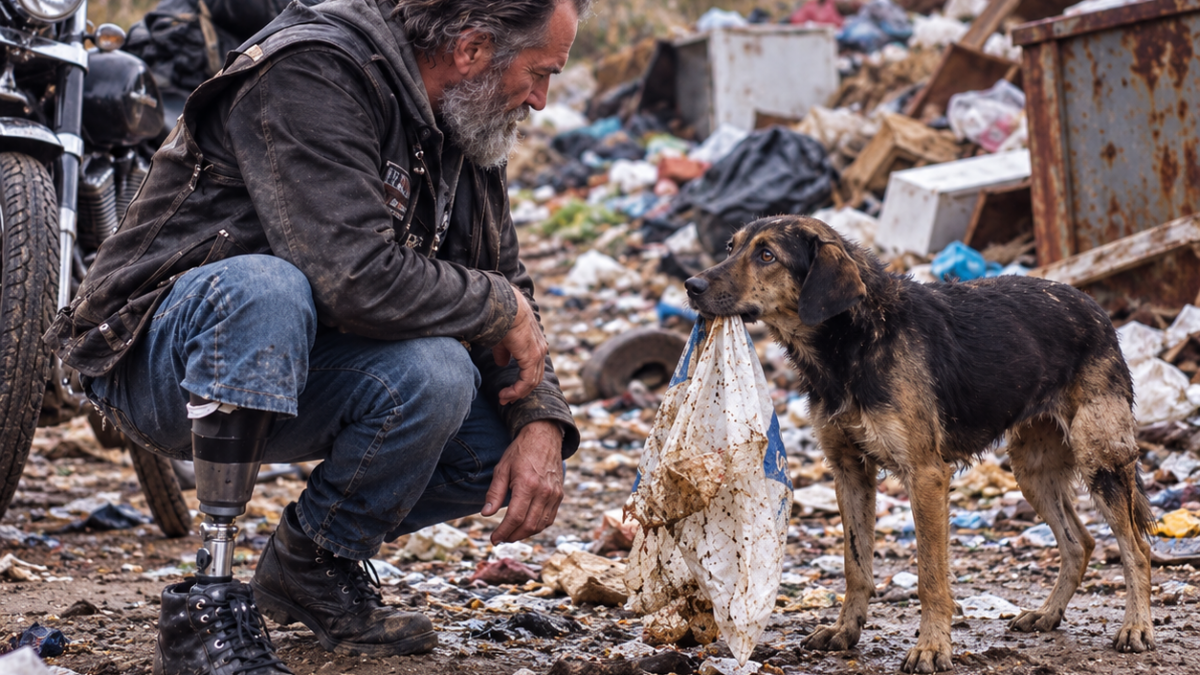
If I close my eyes, I can still see the dump.
Plastic bag tearing.
Scraps falling.
A black-and-tan dog lowering his head.
My foot moving.
Click.
His head rising.
That moment changed both our lives, though neither of us knew it.
People like to call encounters like that fate.
Maybe.
I prefer responsibility.
I noticed him.
Then I had choices.
Leave.
Call somebody.
Wait.
Help.
Romeo had choices too within the limits humans left him.
Hide.
Run.
Approach.
Trust.
He chose one piece of meat.
Then another.
Then a ramp.
Then my house.
Trust was never one grand leap.
It was a sequence of small permissions.
That may be the most important thing he taught me.
People do not always need to become fearless.
Animals don’t either.
Sometimes healing is simply saying yes to the next safe thing.
One bite.
One hand.
One night indoors.
One walk.
One ride.
One year.
Then another.
Until the place that almost killed you becomes geographically small compared with everywhere else you have been.
Romeo’s dump became tiny.
His life became huge.
That is the ending I carry.
Not that cruelty disappeared.
It didn’t.
Not that every person became good.
They didn’t.
Not that consequences magically repaired what was broken.
They couldn’t.
The satisfying ending was simpler.
The discarded dog became impossible to discard.
Not because he turned famous.
Because he belonged.
To routines.
To people.
To places.
To memory.
Patrice had left Romeo beside broken furniture because he believed the dog had become too difficult.
Years later, Romeo’s difficulties became the reasons entire communities learned to build better ramps, fund surgeries, create temporary foster systems, and stop seeing disabled animals as damaged property.
That reversal still satisfies me.
Patrice saw a burden.
We saw a life.
Patrice wanted the problem out of sight.
Romeo ended up in photographs, charity rides, rehabilitation rooms, family albums, and the memories of people who never even met him.
He learned to run.
He learned to ride.
He learned to grow old.
And in the process, he taught me something I wish I had understood when I first woke in the hospital without my leg.
A changed body is not a ruined life.
A life that requires adaptation is still a full life.
And needing someone does not make you disposable.
Romeo proved that every ordinary day he stayed beside me.
Even now, when my prosthetic strikes the garage floor with that familiar sound—
Click—
I still sometimes smile before I remember why.
Because for one starving three-legged dog at a dump outside Limoges, that sound once meant a stranger had stopped.
And everything good came after.








