PART 2: The Starving Dog Couldn’t Even Bark—Weeks Later, He Walked Into My Police Station and Silenced the Whole Room
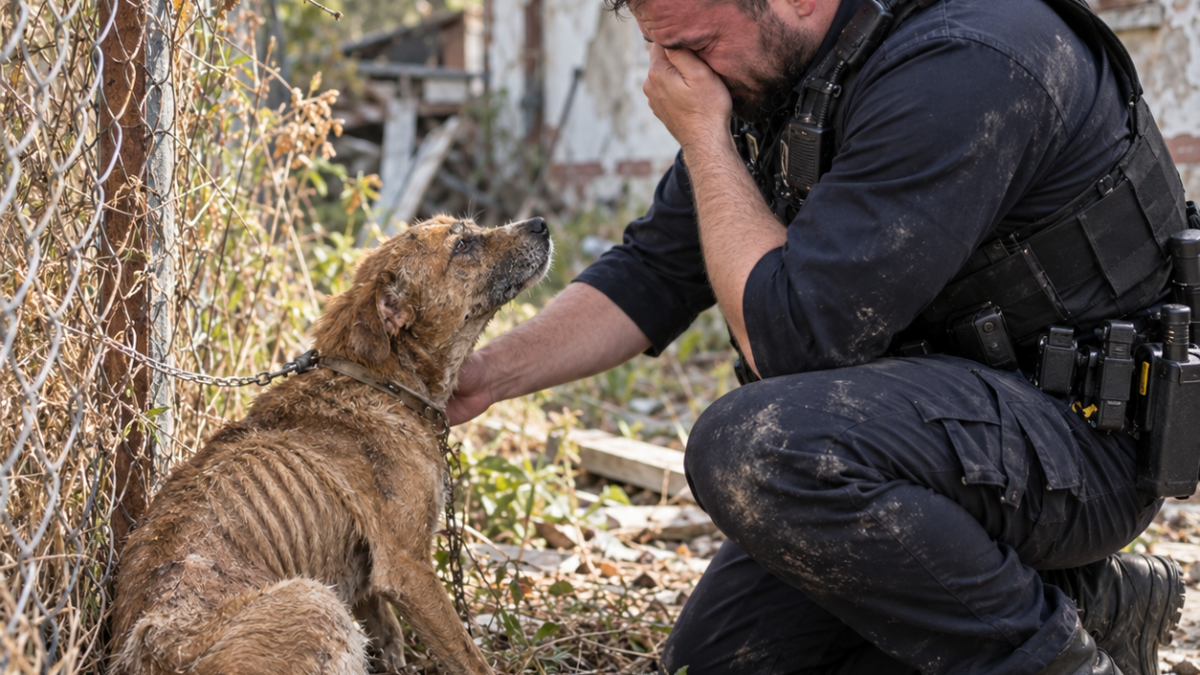
PART 2
I carried him to the patrol car because waiting for the animal welfare transport suddenly felt impossible.
One of the responding volunteers had arrived just as I cut the rope. She took one look at the dog and said, “He needs a clinic now.”
“I know one ten minutes away.”
“Can you transport?”
I looked down at him.
His eyes were half closed.
“Yes.”
Technically, there were procedures.
Forms.
Custody questions.
Evidence.
But nobody was going to stand beside an emaciated dog arguing over which vehicle he was allowed to ride in.
The volunteer helped me place him across the rear seat on two folded blankets.
He did not resist.
That frightened me.
A healthy frightened dog often struggles when strangers lift him.
This dog simply allowed the world to move him.
Before closing the door, I put my hand near his nose.
“Stay with me.”
His nostrils moved slightly.
That was enough.
I radioed dispatch, explained that I was transporting an animal in immediate distress, and drove.
No siren.
No dramatic high-speed run.
The dog was too fragile for that.
Every pothole made me check the mirror.
At one stoplight, his head lifted.
Then dropped.
“Hey.”
One amber eye opened.
“Don’t disappear on me.”
The light turned green.
We reached the clinic eleven minutes later.
A veterinary nurse met me at the entrance with a stretcher.
I hated seeing it.
Stretchers make situations feel official.
Serious.
She looked into the back seat.
“Oh, sweetheart.”
The dog’s ear moved.
The nurse leaned toward me.
“Do we have a name?”
“No.”
“Owner?”
“Unknown. Investigation pending.”
She nodded.
“Then for now he’s John Doe.”
I looked at the dog.
“No.”
The word came out too fast.
She raised an eyebrow.
I glanced at the yellow fibers still caught around his dirty collar.
The rope.
The fence.
The tiny tail movement.
“He needs something better than John Doe.”
“You have a suggestion?”
I didn’t.
Not yet.
“Later.”
They rushed him inside.
I stood in the treatment room while Dr. Claire Bernard examined him.
She was in her fifties, calm in the way experienced veterinarians become calm around emergencies.
Not casual.
Controlled.
Her hands moved over his body carefully.
She listened to his heart.
Checked gums.
Eyes.
Abdomen.
Paws.
Skin.
Temperature.
Then she looked at me.
“How long was he there?”
“We don’t know.”
“Last meal?”
“Unknown.”
“Water?”
“None when I arrived.”
She exhaled through her nose.
“Weight is critically low.”
The number on the scale made my stomach turn.
He should have weighed far more.
Blood was drawn.
IV access placed.
They began fluids cautiously.
His body was severely dehydrated, but extreme correction too quickly can create its own complications.
I knew none of this then.
I learned because I refused to leave.
The nurse looked at me after almost an hour.
“Officer, we’ll call.”
“I know.”
“You can go back to work.”
“I know.”
I stayed.
Dr. Bernard eventually sat across from me.
“His condition is serious, but I think he has a chance.”
That sentence became the first good thing anyone had said all afternoon.
“What’s wrong?”
“Severe malnutrition. Dehydration. Anemia. Skin infection. Parasites, almost certainly. His muscle wasting is significant. His paws are inflamed. There’s also a pressure wound beneath the collar.”
My jaw tightened.
“Anything irreversible?”
“Too soon to say.”
“Can he eat?”
“Small amounts, carefully.”
“Why carefully?”
She explained refeeding syndrome.
I had assumed hunger had one obvious cure.
Food.
Give the dog as much as he wants.
Apparently, after prolonged starvation, that can be dangerous.
The body’s chemistry changes.
Too many calories too quickly can overwhelm systems already under stress.
So the first meal would be small.
Measured.
Controlled.
I hated the idea.
He had been starved and we were going to feed him slowly.
But medicine is not emotional justice.
It is physiology.
You do what the body needs, not what your anger demands.
The nurse brought a tiny portion of soft food.
The dog smelled it.
His head lifted.
The movement was weak but immediate.
He tried to stand.
Failed.
“Easy,” she whispered.
She moved the bowl closer.
He ate.
Not politely.
Not normally.
He swallowed so fast she had to pull the dish away.
He looked at her.
Then at the food.
Then back.
His tail moved against the blanket.
Once.
There it was again.
That ridiculous little tail.
Still trying.
I looked at the nurse.
“He needs a name.”
She smiled.
“Yes.”
I thought about the amber eyes.
The brown coat.
The fact that he had been silent behind that house until someone finally saw him.
“Hope?” she suggested.
I shook my head.
Too obvious.
“Lucky?”
“No.”
“Copper?”
I looked at his eyes again.
Then something came to me.
“Milo.”
The nurse repeated it.
“Milo.”
The dog’s ear twitched.
“That’s not proof,” she said.
“Good enough.”
So he became Milo.
Not abandoned dog.
Not evidence.
Not case number.
Milo.
I wrote it on the intake form myself.
That evening, I returned to the station to finish reports.
My partner, Laurent, looked at my uniform.
There was dried mud on my knees.
Dog hair across my shirt.
“What happened to you?”
“Dog.”
He stared.
“You got attacked?”
“No.”
“Then why do you look like you lost a fight with one?”
I sat at the desk.
“He was tied behind the abandoned property on Rue Delacroix.”
Laurent’s expression changed.
“The brown one?”
I looked up.
“You know about him?”
“I drove past that property months ago. Saw something in the back.”
My stomach tightened.
“You saw the dog?”
“Maybe.”
“Did you report it?”
He hesitated.
That hesitation hurt.
“I thought somebody lived there.”
“Why didn’t you check?”
“Julien—”
“Why?”
His face hardened.
“I didn’t know what I was looking at.”
I said nothing.
Because I understood.
And because understanding did not make it easier.
That became the theme of Milo’s case.
People had seen pieces.
Nobody had seen enough.
Or nobody wanted to be the person responsible for looking closer.
The property belonged to a man named Patrick Vasseur.
He had inherited it from an uncle.
He did not live there permanently.
Neighbors described him coming every few days.
Sometimes once a week.
Sometimes less.
Nobody knew exactly when Milo had first appeared.
One neighbor thought six months.
Another said closer to a year.
A woman two houses away remembered seeing him in winter.
“He had a tarp,” she said.
“What kind of tarp?”
“Blue plastic tied to the fence.”
“Shelter?”
“I suppose.”
“Was it still there?”
“No.”
“When did it disappear?”
She did not know.
Another neighbor admitted throwing leftovers over the fence.
A teenager brought water “sometimes.”
A retired man said he assumed Milo belonged to a squatter.
Someone else thought the dog was aggressive because he had barked months earlier.
Again, nobody called.
Not until a delivery driver finally heard scratching behind the property and contacted authorities.
That call brought me.
I interviewed Patrick the following morning.
He arrived at the station irritated.
Not worried.
I remember that distinction clearly.
“Why am I here?”
“Do you own the property on Rue Delacroix?”
“Yes.”
“Do you own a brown dog named Milo?”
He frowned.
“That’s not his name.”
“What is his name?”
“Dog.”
I stared.
“His name is Dog?”
“I never named him.”
That sentence sat between us.
“How long has he been at the property?”
“A while.”
“How long?”
“Maybe eight months.”
“Why?”
“Security.”
“Security for an abandoned house?”
“People break in.”
“So you chained a dog behind it.”
“I gave him food.”
“How often?”
“When I went.”
“How often was that?”
Patrick shifted.
“Every few days.”
“Water?”
“There was a bowl.”
“The bowl was overturned and dry when I arrived.”
“He knocks it over.”
“Then why wasn’t there another?”
He stared at me.
I continued.
“Veterinary care?”
“He didn’t need it.”
“He currently has severe malnutrition, dehydration, anemia, infection, parasites, paw injuries, and a wound beneath his collar.”
Patrick’s face changed slightly.
Not horror.
Calculation.
“How much is that going to cost?”
I leaned back.
“That’s your first question?”
“I’m asking.”
“The investigation will determine financial responsibility.”
“He’s just a dog.”
There it was.
Three words.
Just a dog.
They still make my teeth clench.
“Did you see his condition the last time you visited?”
“He looked skinny.”
“How skinny?”
“Dogs lose weight.”
“Not like that.”
Silence.
“Why didn’t you surrender him?”
“To who?”
“A shelter. Rescue. Police. Veterinarian. Anyone.”
Patrick shrugged.
“He was supposed to watch the place.”
“He could barely stand.”
“Not my fault he got sick.”
I thought of the tail movement.
The bowl.
The rope.
The body against mine.
I kept my voice level.
“Was the rope always that short?”
“He pulled.”
“That does not answer the question.”
“It kept him from getting tangled.”
“He could not reach shade.”
Patrick crossed his arms.
“He was alive, wasn’t he?”
For one second, I understood every officer who has ever needed to count silently before answering.
“Yes.”
I said it quietly.
“Because somebody finally came.”
The investigation moved forward.
Animal welfare officers collected records.
The clinic documented Milo’s condition extensively.
Photographs.
Body score.
Blood values.
Skin lesions.
Parasites.
Collar wound.
Length of rope.
Empty bowl.
Environmental exposure.
Neighbors were interviewed.
One detail strengthened the case significantly.
A shopkeeper had security footage from the street.
Not enough to show Milo behind the house.
Enough to establish Patrick’s visits.
The pattern was worse than he claimed.
Sometimes six days passed.
Once nine.
Nine days.
Maybe someone else gave Milo food during those gaps.
Maybe not.
The dog’s body suggested not enough.
We also found bags of cheap dry dog food inside a storage room at the property.
One open.
Still partly full.
Food existed twenty feet from where Milo had been starving.
That image angered me in a way I cannot explain.
Not no food available.
Food behind a locked door.
Dog outside.
That became evidence too.
Patrick’s lawyer later argued other people could have fed Milo.
True.
They could have.
That did not remove the owner’s duty.
While investigators worked, Milo fought his own battle.
The first three days were difficult.
His appetite remained intense, but portions were controlled.
He developed diarrhea as his system adjusted.
Bloodwork fluctuated.
His temperature rose slightly.
The skin infection required treatment.
Parasites were confirmed.
His paws needed daily cleaning.
The wound beneath the collar was swollen and painful.
The clinic removed the collar.
I asked to keep it as evidence.
The nurse placed it in a bag.
Seeing that collar separated from him affected me more than expected.
Without it, Milo looked younger.
Less like a neglected yard dog.
More like somebody’s pet.
I visited after every shift.
Sometimes before.
Laurent stopped teasing me after the second visit.
By day four, he came too.
Milo was lying on a blanket.
Laurent stood several feet away.
“Hey.”
Milo lifted his head.
Tail movement.
Laurent swallowed.
“That’s the thing?”
“What?”
“The tail?”
“Yes.”
“He did that when you found him?”
“Barely.”
Laurent crouched.
Milo watched.
Then, slowly, dragged himself two feet closer.
Laurent looked at me.
“I should’ve checked.”
There was no defensiveness this time.
“Yes.”
He nodded.
“I know.”
Milo sniffed his hand.
Then laid his head down.
Laurent sat there twenty minutes.
On the way out, he donated money to the clinic account anonymously.
I knew because the receptionist told me.
I never mentioned it.
Some guilt becomes useful when people convert it into action.
Day five, Milo stood for seven seconds.
Day six, eleven.
Day seven, he walked four steps.
That was the first time I saw him move under his own power.
The physiotherapist supported him lightly beneath the abdomen.
Milo placed one paw forward.
Then another.
His rear legs trembled.
Third.
Fourth.
He stopped.
I knelt several feet ahead.
“Come on.”
The therapist glanced at me.
“No pressure.”
“I know.”
Milo looked at me.
His tail moved.
Then he took a fifth step.
I laughed.
He collapsed gently into the support sling.
“Five.”
The therapist smiled.
“Five.”
I went back to the station and wrote five on a sticky note.
Laurent saw it.
“What is that?”
“Nothing.”
“Dog?”
“Yes.”
“You’re hopeless.”
Probably.
The second week brought progress and fear together.
Milo gained weight.
Slowly.
His gums became pinker.
Hydration improved.
The skin infection responded.
But one morning he refused food.
The clinic called.
I left my apartment before the nurse finished explaining.
By the time I arrived, Milo was resting with IV fluids running.
Dr. Bernard met me.
“Calm down.”
“I’m calm.”
“You came in wearing two different shoes.”
I looked down.
She was right.
One black sneaker.
One brown boot.
Laurent later called it the finest moment of my career.
“What happened?”
“Possible gastrointestinal irritation. We’re checking everything.”
“Is he crashing?”
“No.”
“Then why no food?”
“Because recovery fluctuates.”
I hated that answer.
“He ate yesterday.”
“Yes.”
“Everything.”
“Yes.”
“Then today nothing?”
“Yes.”
She put a hand on my shoulder.
“This is what healing from severe neglect looks like. Forward does not mean straight.”
Milo opened his eyes.
I sat beside him.
“You are making me ridiculous.”
Tail tap.
“Thank you.”
He ate later that afternoon.
I kept both shoes on anyway.
By the third week, Milo could walk across the rehabilitation room.
His gait was awkward.
Muscles had to rebuild.
Paws remained sensitive.
But he walked.
He also developed preferences.
Chicken.
Yes.
Liver treats.
Absolutely.
Carrots.
Offensive.
Soft bed.
Maybe.
Blanket directly beside soft bed.
Better.
Men with loud voices.
No.
Women with quiet voices.
Usually yes.
Police radios.
Strangely comforting.
That surprised me.
Whenever mine crackled, Milo’s ears lifted.
Maybe he associated the sound with rescue.
Maybe coincidence.
Still, it became part of our routine.
I would sit beside him after work.
Radio on low.
Milo would sleep.
One evening, the clinic director asked:
“What happens when he’s medically cleared?”
I looked at her.
“What do you mean?”
“Where does he go?”
“Rescue placement.”
“You know what I’m asking.”
I pretended not to.
She smiled.
“You visit more than some owners.”
“That is not legally relevant.”
“You paid the emergency deposit.”
“Temporary.”
“You bring him chicken.”
“Doctor-approved.”
“You bought him a harness.”
“The clinic one rubbed.”
“You named him.”
I looked through the glass.
Milo was asleep.
“I’m a police officer. My schedule is terrible.”
“Plenty of police officers have dogs.”
“I live alone.”
“Dogs tolerate bachelors.”
“I’m not discussing this.”
She laughed.
“Of course not.”
The legal case reached a preliminary hearing around week four.
Patrick appeared with counsel.
Evidence was presented.
His lawyer emphasized that Patrick had not intentionally tried to kill Milo.
The prosecution did not need to prove that.
Neglect can be criminal without an explicit plan to cause death.
Duty.
Knowledge.
Failure to act.
Those mattered.
One neighbor testified that she had told Patrick Milo looked sick two months earlier.
He replied:
“He’s just thin.”
Another text message surfaced.
A friend had asked Patrick why he did not move the dog somewhere warmer.
Patrick responded:
“He’s there to stop thieves.”
That single sentence connected ownership, purpose, and continued tethering.
He knew Milo was there.
He intended Milo to stay there.
The defense argued financial hardship.
Bank records were not the point.
Even if Patrick could not afford veterinary care, surrender remained an option.
As Dr. Bernard later said in a statement:
“An inability to finance treatment does not require an animal to remain untreated until collapse.”
The court authorized permanent removal while the case continued.
Milo would not be returned.
When I heard that, I sat in my patrol car and cried.
Not dramatically.
Just two minutes with both hands on the steering wheel.
Because until that decision, some part of me feared paperwork could send him back.
It would not.
That evening, Milo walked toward me without support.
Ten feet.
Then fifteen.
At the end, he leaned against my knees.
I crouched.
“You’re not going back.”
His tail moved.
“You hear me?”
Another wag.
“Never.”
That night, I filled out a foster application.
Not adoption.
Foster.
I was still pretending to be reasonable.
The clinic discharged Milo after five weeks.
He was not fully recovered.
But stable enough to continue rehabilitation in a home.
Mine.
I spent two days preparing.
Dog bed.
Bowls.
Baby gate.
Nonslip rugs.
Food.
Medication.
Another bed.
Laurent saw the receipts.
“Foster.”
“Yes.”
“Of course.”
“Temporary.”
He laughed for nearly a minute.
Milo arrived on a rainy evening.
The clinic nurse walked him to my apartment door using the harness.
He stopped at the threshold.
The open doorway seemed to confuse him.
He looked at me.
Then inside.
Then behind us.
“You can go in.”
No movement.
I stepped inside.
Sat on the floor.
Milo sniffed.
One paw crossed.
Then another.
He entered.
I closed the door gently.
He immediately turned.
Watched it.
I wondered what doors meant in his life.
People leaving?
Food disappearing?
Being tied outside?
No way to know.
So I left the door alone.
Milo explored the apartment slowly.
Perimeter first.
Living room.
Kitchen.
Bedroom doorway.
He did not enter the bedroom.
He found the water.
Drank.
Found the bed.
Ignored it.
Lay on the rug.
Expected.
I slept on the sofa that night.
Around two in the morning, I woke to a sound.
Scratching.
Milo was standing near the apartment door.
I sat up.
“Hey.”
He looked back.
Tail low.
Maybe he needed outside.
I took him.
The moment we reached the courtyard, he urinated.
Then stood still.
“Good.”
He looked at me.
“Very good.”
We returned inside.
At the apartment door, he walked through without hesitation.
Tiny milestone.
Home had begun.
The first week was structured.
Meals.
Medication.
Short walks.
Rest.
Physiotherapy.
No overwhelming visitors.
Milo followed me from room to room.
Not close.
Always five or six feet behind.
If I turned suddenly, he stopped.
If I sat, he lay where he could see me.
At night, he slept near the front door.
I hated that.
Not because he disturbed me.
Because it looked like duty.
So I never praised alert barking.
Never asked him to watch anything.
When someone knocked, I called him away from the door and rewarded him for coming to the living room.
Slowly, the entrance stopped becoming his station.
The first night he slept beside the sofa instead of the door, I noticed immediately.
I said nothing.
Did not want to make the moment about me.
But I smiled for ten minutes.
Milo gained weight.
His fur changed.
Dirty brown became warm chestnut with darker markings.
The amber eyes seemed brighter.
His ribs disappeared gradually.
The neck wound closed.
Hair began covering the bald strip.
His paws healed enough for longer walks.
Not long.
Fifteen minutes.
Then twenty.
Milo loved grass.
He stopped at every patch.
Smelled everything.
A walk that should take ten minutes became forty.
Before Milo, I had been impatient.
Fast walker.
Fast coffee.
Fast paperwork.
Fast life.
Milo spent seven minutes smelling one lamppost.
I learned surrender.
One Sunday, Laurent joined us.
Milo greeted him.
Not wildly.
But with a definite tail wag.
Laurent crouched.
“Look at you.”
Milo pressed his head into Laurent’s chest.
Laurent looked at me.
“I hate this dog.”
“No, you don’t.”
“I have feelings now. Unprofessional.”
Milo licked his chin.
Laurent laughed.
“You’re disgusting.”
That was the first time I saw Milo play.
Laurent had dropped one glove.
Milo picked it up.
Walked away.
Laurent reached.
Milo moved farther.
Tail up.
I froze.
“Do that again.”
“What?”
“Reach for the glove.”
Laurent did.
Milo moved.
Faster.
Not running yet.
Playing.
Laurent smiled.
“You little thief.”
He followed.
Milo went around the coffee table.
I laughed so hard I had to sit.
The starving dog who could not bark was stealing a police officer’s glove.
That night, Milo slept deeply.
On the bed.
Not the rug.
Another milestone.
His bark returned in month two.
I was making coffee.
Something fell in the hallway outside.
Milo barked once.
I dropped the spoon.
He froze.
I looked at him.
He looked at me.
Then barked again.
Deep.
Normal.
Strong.
I started laughing.
Milo tilted his head.
“You have a voice.”
He wagged.
I knelt.
“You have an actual voice.”
For the first time since finding him, I heard what he should always have sounded like.
Not silence from weakness.
A dog.
The police case against Patrick reached final disposition months later.
The court found him responsible for serious neglect under applicable animal welfare provisions.
He received fines, restitution toward veterinary costs, and restrictions on future animal ownership.
The property conditions were formally documented.
Could the punishment have been harsher?
Some people thought so.
I understood.
But something mattered more to me than the number written on the judgment.
Milo was permanently safe.
Patrick could not take him back.
The case was in the record.
And neighbors who had spent months saying “I thought someone else would call” now knew exactly what silence could cost.
Patrick left the courthouse angry.
I was outside.
He saw me.
Walked over.
“You happy?”
“No.”
That surprised him.
“You got what you wanted.”
“What do you think I wanted?”
“My dog.”
“Milo is not a prize.”
“That’s not his name.”
“It is now.”
He laughed without humor.
“You think he loves you?”
I looked at him.
“I think he feels safe.”
“That’s not what I asked.”
“It’s the only answer that matters.”
Patrick stepped closer.
“He was mine.”
I kept my voice low.
“Then you should have acted like it.”
For several seconds, neither of us moved.
Then he said:
“Dogs forget.”
I thought of the yellow rope.
Maybe he was right about some things.
Animals move through life differently than we do.
But forgetting was not necessary.
“Good,” I said.
Patrick frowned.
“What?”
“I hope he forgets you.”
Then I walked away.
That was the closest thing to revenge I ever wanted personally.
Not violence.
Not humiliation.
Irrelevance.
Milo deserved a life so full that Patrick became a tiny, useless part of the past.
By then, fostering had become a joke.
Everyone knew.
Everyone except me officially.
The rescue coordinator finally brought adoption papers to the station.
She placed them on my desk.
I looked at the folder.
“What is this?”
“Your denial treatment.”
Laurent burst out laughing from across the room.
“I am fostering.”
“You have fostered for three months.”
“Yes.”
“You replaced your sofa because Milo took it over.”
“The old sofa was bad.”
“You changed shifts for his physical therapy.”
“Scheduling issue.”
“You installed a camera to check on him.”
“Security.”
“You bought him a birthday cake.”
“It was dog-safe.”
She pushed the papers closer.
“Sign.”
I stared at the signature line.
Milo Morel.
They had already printed my surname beside his name in one section.
Something tightened in my chest.
“I never said yes.”
Laurent shouted:
“Everyone else did.”
The room laughed.
I looked around.
Officers.
Dispatchers.
People who had followed Milo’s recovery through photographs taped near my desk.
The first showed him behind the fence.
I hated that one.
The newest showed him lying upside down on my sofa.
No ribs visible.
Mouth open.
Completely shameless.
I signed.
Milo became mine legally.
Or I became his.
Probably more accurate.
The first anniversary of his rescue came quietly.
No party.
I took the day off.
We walked near a lake outside the city.
Milo wore a harness.
No collar except a loose identification band.
He walked ahead.
Stopped.
Looked back.
I unclipped the long line inside a secure fenced dog meadow.
For a moment, he stood there.
Free.
I waited for him to run.
That expectation again.
Milo walked twenty feet.
Smelled grass.
Went farther.
Then suddenly accelerated.
Not fast like a young athletic dog.
But running.
Really running.
His ears bounced.
Tail lifted.
He crossed the field.
Turned.
Came back.
Passed me.
Turned again.
I laughed.
“Where was this dog?”
Milo ran another circle.
Then returned and leaned against my legs.
Breathing hard.
Happy.
I crouched.
“You done?”
Tail wag.
He lay down.
Of course.
Milo always understood rest.
That afternoon, I received a message from an unknown number.
A woman introduced herself as Patrick’s sister.
I almost deleted it.
Then read.
She said she had learned about the case too late.
She had not known Patrick kept a dog at the abandoned property.
She wanted to apologize.
Not excuse him.
Apologize.
I replied with one sentence:
Milo is safe and doing well.
She asked for a photograph.
I considered.
Then sent the running photo.
No response for ten minutes.
Then:
Thank you.
Nothing else.
That was enough.
Milo’s story did not need more people entering it.
The second year became normal.
That may sound anticlimactic.
It was everything I wanted.
Normal vet visits.
Normal walks.
Normal food.
Normal rain.
Normal arguments because Milo stole socks.
Normal frustration when he refused to move from my side of the bed.
Normal bills.
Normal life.
The exceptional part was over.
One evening, I came home late after a difficult shift.
A teenager had been injured in a crash.
His parents were at the hospital.
I carried too much of that day inside.
The apartment was dark.
Milo met me at the door.
No barking.
Just tail.
I sat on the floor still wearing my uniform.
He came close.
Pressed against me.
I put both arms around him.
For ten minutes, I said nothing.
That was when I understood the strange reversal.
I had thought I rescued Milo.
Sometimes he simply absorbed the weight of my work by being there.
Not therapy dog.
Not trained.
Just companion.
People underestimate ordinary presence.
He did not fix anything.
He gave the sadness somewhere quiet to sit.
A year later, our station started an informal partnership with a local animal welfare group.
Not because of me alone.
Milo’s case exposed a gap.
Officers sometimes responded to animal calls without specific training.
What signs of neglect matter?
How do you document tether length?
When can immediate removal be justified?
Who transports?
Which clinics accept emergency cases?
We created a contact sheet.
Basic training.
Evidence photography guidelines.
Emergency veterinary numbers.
One dispatcher joked:
“Milo has a policy now.”
In a way, yes.
His suffering became a practical change.
The next winter, an officer responded to another dog chained without water.
This time, no uncertainty.
Photos.
Call.
Veterinary assessment.
Immediate action.
The dog was removed within hours.
The officer later told me:
“I remembered yours.”
Not mine.
Milo.
I looked at him sleeping at home that night.
“You’re still working.”
He ignored me.
Retirement suited him.
Three years after rescue, Milo walked into the station for the first time.
Not the dramatic visit from the hook.
That came earlier, but I need to explain how.
About seven weeks after Milo had moved into my apartment—before adoption was final—I was working a late shift.
Milo was still officially under rescue foster status.
A volunteer named Sophie sometimes watched him when my schedule stretched unexpectedly.
That afternoon, Sophie took Milo for a walk near the station because she had errands nearby.
According to her later account, Milo heard my voice through the open side entrance.
I had been standing just inside, arguing with Laurent over a report.
Milo stopped.
Sophie tried to continue.
He refused.
Then he pulled toward the building.
Not violently.
Determined.
The outer door opened as another officer exited.
Milo slipped through before Sophie could reposition the leash.
She shouted:
“Milo!”
By the time anyone understood what was happening, a brown dog in a blue harness had entered the front hall.
The station went quiet for a completely different reason than people might expect.
Most officers knew exactly who he was.
They had seen the intake photograph.
The skeleton behind the fence.
Now this dog was walking.
Thin still.
But standing.
Tail wagging.
Head up.
He looked around.
Then heard my voice.
I stepped from the corridor.
“Milo?”
His entire body changed.
Tail.
Ears.
Movement.
He came toward me.
At first walking.
Then a trot.
He reached me and put both front paws against my thighs.
The room went silent.
Milo had never done that before.
I held his shoulders.
“What are you doing here?”
He licked my chin.
People laughed.
Then I noticed something in his mouth.
A yellow strip of fabric.
My stomach tightened.
I took it carefully.
“What is this?”
Sophie had reached us, breathless.
“I can explain.”
The strip was yellow nylon.
Not the old rope.
I knew that immediately.
Still, the color hit me.
Sophie held up a torn shopping bag.
“He pulled this out of a bush near the station. I tried to take it from him.”
Milo had refused.
Then heard my voice and carried it inside.
Laurent stared at the yellow strip.
Then Milo.
Then me.
“No way.”
It was coincidence.
I knew that.
Dogs do not construct symbols the way humans do.
But the entire station had seen the photograph of the yellow rope.
The color was nearly identical.
Milo dropped the strip at my feet.
Then sat.
Alive.
Standing.
Free.
That was why the room went quiet.
No mystical reason.
No secret message.
A coincidence powerful only because we gave it meaning.
Still, I picked up the nylon.
Looked at Milo.
And laughed through tears.
Laurent muttered:
“You couldn’t script this.”
No.
You shouldn’t.
Reality was enough.
Someone photographed Milo sitting beside me.
Yellow strip on the floor.
That image later became famous inside the station.
We never shared it publicly.
It belonged to us.
The starving dog returning to the police station carrying something that resembled the rope that once held him.
Not revenge.
Not fate.
But a picture of before and after in one frame.
After that, Milo occasionally visited the station with permission.
He liked reception.
Too many people willing to give treats.
He learned which desk belonged to Laurent.
He stole another glove.
Tradition.
The officers began calling him Sergeant Milo.
I refused.
They continued.
Someone printed a fake badge.
Absolutely ridiculous.
Milo wore it for thirty seconds.
Then tried to eat the strap.
Promotion revoked.
His visits had another effect.
Victims waiting for statements sometimes relaxed around him.
One elderly woman who had been robbed held his head in her lap while we arranged transport home.
A frightened child asked whether Milo was police.
I said no.
The boy whispered:
“He looks police.”
I asked what that meant.
“He’s brave.”
I looked at Milo.
Sleeping.
“Sometimes.”
We never turned him into an official therapy animal.
That would require training, standards, evaluation.
I respected that.
Milo was just Milo.
Occasional visitor.
Former case.
My dog.
That was enough.
Years passed.
His exact age remained uncertain.
We estimated he was around six when found.
At ten or eleven, he slowed.
The muscle wasting from neglect had improved dramatically, but arthritis appeared earlier than I hoped.
Dr. Bernard said chronic malnutrition and inactivity may have contributed.
We managed it.
Medication.
Weight control.
Shorter walks.
Rugs on slippery floors.
Ramp into the car.
Milo hated the ramp.
Naturally.
First day, refused.
Second, stepped beside it.
Third, used halfway and jumped.
Fourth, finally used properly when chicken was involved.
“Coward,” I told him.
He wagged.
Police officer successfully bribed by dog.
Again.
He still visited the station once or twice a year.
Older officers knew him.
New recruits heard the story.
One young officer said:
“So you rescued him?”
I answered:
“I cut a rope. A lot of people did the rest.”
Important distinction.
Rescue stories become myths too easily.
One hero.
One victim.
Reality requires teams.
Delivery driver called.
Dispatch sent.
I responded.
Animal welfare came.
Veterinarians treated.
Neighbors testified.
Rescue coordinated.
Sophie foster-sat.
Milo survived.
No single person owned the good outcome.
That mattered to me.
At twelve or thirteen, Milo’s muzzle turned gray.
His amber eyes remained soft.
The tail still moved whenever I came home.
Not always enthusiastically.
Sometimes one thump from the bed.
I would say:
“Bare minimum effort.”
Another thump.
“Pathetic.”
Third.
Our old language.
One winter, a new officer visited my apartment to drop off paperwork.
Milo did not rise.
The officer looked concerned.
“He okay?”
“He’s old.”
That sentence felt miraculous.
Old.
Not dying of starvation.
Not abandoned.
Old.
Exactly what rescue had purchased with all those early hours.
Time.
The officer crouched.
Milo sniffed.
Tail thump.
“He’s nice.”
“Yes.”
“Always?”
“No.”
Milo once snapped at a groomer who touched the old collar scar without warning.
Fair.
We changed groomers.
Boundaries remained important.
I never wanted his story flattened into perfect gratitude.
Milo could be stubborn.
Possessive about one blue blanket.
Suspicious of men wearing hooded jackets.
Terrible around vacuum cleaners.
He disliked rain.
Loved roasted chicken.
Refused carrots until the day he died.
Personality.
Not symbolism.
That is how you know rescue has succeeded.
The animal stops being a lesson and becomes annoying.
At thirteen or fourteen, bloodwork showed kidney changes.
Early.
Manageable.
Diet.
Monitoring.
More water.
Milo hated the new food.
We negotiated.
Dr. Bernard laughed.
“He survived starvation and now critiques prescription cuisine.”
“That’s success.”
She agreed.
Months passed.
Then a year.
Kidneys slowly worsened.
Arthritis too.
Good days still dominated.
Milo slept more.
Walked less.
Loved sitting outside cafés.
He had become an old French gentleman.
I told Laurent.
“He needs a scarf.”
Laurent bought one.
Milo looked ridiculous.
We have photographic evidence.
Around that time, Patrick’s name appeared again.
Not because he returned.
Because animal welfare contacted us during another ownership application review.
Patrick had completed his restriction period and apparently wanted to register a dog again.
The prior case was part of the assessment.
I was asked for factual records.
Nothing more.
My anger returned immediately.
“He wants another dog?”
Laurent looked at me.
“Records. Facts. That’s your job.”
He was right.
I submitted the case documentation.
No commentary.
No revenge.
The authority made its own decision based on current law and history.
The application was denied at that time due to unresolved compliance concerns related to prior welfare obligations.
When I heard, I felt relief.
Not triumph.
Another animal would not be placed in that risk immediately.
That was enough.
Milo knew nothing.
He was asleep upside down.
Again, the victim’s life moved independently of the offender.
That became my favorite form of justice.
At fifteen, Milo had more difficult mornings.
I helped him stand.
The first time I used a support harness, he looked offended.
“I know.”
He leaned.
“Humiliating.”
Tail thump.
“We’ll keep your secret.”
We walked to the courtyard.
Slow.
He urinated.
Sniffed one bush.
Returned.
That became enough.
My own hair had gone grayer.
Laurent retired before me.
He visited Milo on his last station day.
Brought the old stolen glove.
The same style, not the original.
“Milo.”
Tail thump.
“You ruined government property.”
Milo slept.
“I forgive you.”
I laughed.
Laurent sat beside him.
“He changed you.”
“Maybe.”
“You were unbearable before.”
“I’m still unbearable.”
“Different kind.”
Milo opened one eye.
Laurent looked at him.
“Good job.”
That phrase stayed with me.
Not because Milo had a job.
Because sometimes existing long enough to change people is work of its own.
The final year was difficult.
Kidney disease progressed.
Appetite varied.
We adjusted medication.
Fluids later.
Milo tolerated them because he trusted me.
Or because age reduced protest.
Hard to know.
Quality-of-life charts appeared on my refrigerator.
Good day.
Mixed day.
Bad day.
I hated marking them.
At first, mostly green.
Then more yellow.
A red.
Two green.
Another red.
Life narrowing.
One morning, Milo refused chicken.
That frightened me more than anything.
I called Dr. Bernard.
She came to the apartment because traveling had become stressful for him.
She examined him on the blue blanket.
Kidneys failing.
Arthritis severe.
Nausea.
Weakness.
Could hospitalize.
IV fluids.
Maybe stabilize.
Maybe days.
Maybe weeks.
I sat on the floor.
Milo’s head rested on my boot.
The same place as the first day.
“How much would hospitalization help him enjoy?”
Dr. Bernard did not answer immediately.
“That’s the right question.”
“What’s the answer?”
“Uncertain.”
“Would he hate being there?”
“Probably.”
Milo disliked clinics in old age.
“Could he come home?”
“Possibly.”
“Could he get back to good walks?”
“Unlikely.”
“Eating normally?”
“Maybe briefly.”
I knew.
Still, knowing is not deciding.
Dr. Bernard left us several hours to think with comfort medication.
I called Laurent.
He came.
Sophie too.
Not a crowd.
Only people Milo knew.
He greeted them with tail movements.
Barely.
Laurent knelt.
“Sergeant.”
I almost corrected him.
Did not.
Milo licked his fingers.
Sophie cried.
“You were so skinny.”
Milo closed his eyes.
She touched the scar at his neck very gently.
“I remember this.”
I did too.
The rope.
Yellow.
Three cuts.
Collapse.
Emergency blanket.
Milo had lived almost a decade after that afternoon.
That was the answer.
Not enough?
Never.
More than we once knew existed.
I called Dr. Bernard back.
“We’re ready.”
Saying it felt like betrayal.
Then Milo tried to stand, failed, and looked at me.
I helped him.
We went to the courtyard one final time with the support harness.
Cold but dry.
He sniffed the air.
Walked three steps.
Stopped.
I let him choose.
He lay down in a patch of weak sunlight.
I sat beside him.
No rush.
Cars passed beyond the wall.
A siren far away.
Milo’s ears moved.
Police sound.
Our sound.
I smiled.
“You remember those?”
Impossible question.
He rested his head on my thigh.
We stayed twenty minutes.
Then he looked toward the building.
Home.
I helped him up.
Inside, Milo walked straight past the front door.
To the living room.
To the blue blanket.
Another detail that broke me.
He no longer stopped at entrances.
He knew where he belonged.
Dr. Bernard arrived in the afternoon.
Milo was on his bed.
I sat beside him.
Laurent stood by the window.
Sophie near the wall.
Dr. Bernard explained each step even though I knew.
Sedative first.
Then final medication.
I removed Milo’s identification collar.
He rarely wore it indoors, but that day it had been on after the courtyard.
I placed it aside.
No collar at the end.
That felt right.
I touched his neck.
The old scar was almost invisible beneath fur.
“You know something?”
His amber eyes opened.
“You never had to earn any of this.”
Tail moved faintly.
“You didn’t have to be good.”
Another breath.
“You didn’t have to be brave.”
His eyes softened.
“You didn’t have to wag your tail at me that first day.”
My voice broke.
“But I’m glad you did.”
The sedative went in.
Milo relaxed.
His head became heavy on my leg.
I remembered carrying him beneath my chin.
So light.
Now he was old, healthy-weighted, warm.
Years inside that body.
I whispered:
“No more ropes.”
Laurent covered his face.
“No more waiting.”
Sophie cried quietly.
“No more proving you can stand.”
Milo breathed.
Once.
Again.
I put my hand against his side.
“Rest.”
Dr. Bernard gave the final medication.
His breathing slowed.
Then stopped.
Silence.
Not the terrible silence behind the abandoned house.
A different one.
Full.
Safe.
Home.
I kept my hand on him.
Minutes passed.
Nobody rushed.
Eventually Laurent said:
“He came looking for you once.”
I smiled through tears.
“The station?”
“Yes.”
“With that yellow strip.”
I looked at Milo.
“Coincidence.”
Laurent nodded.
“Best coincidence I ever saw.”
After cremation, I kept Milo’s ashes at home for several months.
Then I made a decision.
Part stayed with me.
Part went to a field outside Lille where we had walked for years.
I scattered them beneath a tree.
Not tied.
Not marked.
Nothing holding him there.
The rest remained in a simple wooden box.
No dramatic inscription.
Just:
MILO.
Years later, I retired.
On my final day at the station, Laurent returned.
Older.
Still loud.
Someone had placed the photograph of Milo’s first station visit on my desk.
Milo sitting.
Me crouched beside him.
Yellow nylon strip on the floor.
I picked it up.
A young officer asked:
“That the dog?”
“Yes.”
“The famous one?”
“He was famous here.”
“Why did he come to the station?”
“To find me.”
The officer smiled.
“That’s amazing.”
I looked at the picture.
“Yes.”
But the amazing part was not that he found me.
It was that a dog who once had no strength to bark developed enough trust to go searching for a person.
That is different.
Trust is movement toward someone when your past taught you humans could fail.
Milo did that.
The station had changed because of him too.
Animal welfare numbers posted near dispatch.
Training.
Protocols.
No one laughed at “just a dog” calls anymore.
Not because every call was severe.
Because severity cannot always be heard through the radio.
“Dog tied behind vacant house. Condition unknown.”
That had sounded routine.
Behind those words was Milo.
Now officers knew to look.
One of the last cases I handled before retirement involved an elderly dog left on a balcony without adequate water during heat.
A young officer arrived first.
He documented everything.
Called welfare authorities.
Contacted a vet.
Did exactly what training required.
When I got there, the dog was already in shade with controlled water access.
I looked at him.
“Good work.”
The officer shrugged.
“Milo protocol.”
It had become a joke.
Also a standard.
Fine.
I retired knowing the next dog had a slightly better chance.
That may be the only revenge worth preserving.
Patrick eventually disappeared from my life completely.
I heard he moved south.
No idea what happened after.
I stopped caring.
That was another victory.
For years, anger kept him present.
Then one day I realized I had gone months without thinking about him.
Milo had taken up more space.
As he should.
The offender should become smaller than the life he tried to diminish.
That is justice emotionally, even when law has already finished its work.
People still ask whether I forgave Patrick.
Wrong question.
It was never mine to forgive on Milo’s behalf.
I accepted that legal consequences occurred.
I hoped he changed.
I cared more that future animals stayed safe.
Milo did not need Patrick’s apology to live well.
Neither did I.
The yellow rope remained in evidence storage until the case closed.
Afterward, the welfare organization asked whether I wanted it.
“No.”
They looked surprised.
“Not for memory?”
“I have enough.”
The rope was disposed of.
Good.
No shrine to cruelty.
I kept the photograph of Milo stealing Laurent’s glove instead.
That was more accurate.
When I tell the story now, people focus on the first moment.
The tail.
I understand why.
I do too.
But the story was not about one tail movement.
It was about thousands that followed.
Tail when I entered the clinic.
Tail at the apartment.
Tail when Laurent came.
Tail in the field.
Tail at the station.
Tail on old mornings when getting up hurt.
The first one mattered because it proved something remained.
Not gratitude.
Not forgiveness.
A capacity to connect.
That was enough.
Milo’s body had been stripped down almost to survival.
Still, social instinct remained.
Hello.
One tiny sweep through dust.
Maybe that is why it stayed with me.
Not the empty bowl.
Not the rope.
Not the ribs.
The tail.
Evidence of who Milo was underneath what had been done to him.
Care did not create that dog.
It gave him room to reappear.
There is a difference.
That lesson followed me into everything.
People too.
After terrible things, we are tempted to describe someone only by damage.
Victim.
Homeless.
Addict.
Troubled teenager.
Abused animal.
Sometimes the most important part is the thing still moving underneath.
The joke.
The hope.
The tail.
Something saying:
I’m still here.
That is what I learned kneeling in dirt behind an abandoned house.
Years after retirement, I visited the station for a ceremony.
New officers.
New furniture.
Same building.
The old photo of Milo had somehow survived.
Framed now.
Someone had placed it near the welfare contact board.
I laughed.
“You people are ridiculous.”
The current commander smiled.
“Tradition.”
“Take it down when it gets embarrassing.”
“No.”
Below the photograph was a small line:
LOOK CLOSER.
That was all.
Not Milo’s whole story.
Not my name.
Look closer.
Perfect.
Because that was the failure before Milo.
People looked.
They did not look closer.
Brown shape behind fence.
Somebody’s dog.
Someone else’s responsibility.
Probably fine.
Probably fed.
Probably reported.
Probably.
Milo almost died inside probably.
So the line stayed.
Look closer.
If the water bowl is empty, ask why.
If the dog is quiet, do not assume calm.
If ribs show, notice.
If a rope is too short, measure it.
If something feels wrong, make the call.
Maybe you are mistaken.
Fine.
Better embarrassed than too late.
That is the practical legacy.
The emotional one belongs to me.
It is simpler.
Every night for years, Milo slept near my bed.
Sometimes snoring.
Sometimes twitching in dreams.
I would wake.
Hear him breathing.
And feel irrational relief.
Still there.
Even after he was healthy.
Even after years.
Some part of me never stopped checking.
That is what rescue does to you when you meet an animal too close to the edge.
You keep counting breaths long after counting is unnecessary.
Eventually, I learned to trust his life too.
Not just he is alive tonight.
He has a life.
That was different.
Walk tomorrow.
Vet next month.
Birthday next year.
Old age someday.
Future became normal.
The dog behind the house had no visible future.
Milo created one day by day.
That is why his death did not erase the happy ending.
I want to be clear about that.
People think a satisfying ending means the animal lives forever.
Impossible.
Milo died.
I grieved.
I still miss him.
The ending is satisfying because he got old.
Because kidney disease came after years of meals.
Because arthritis came after miles of walks.
Because the final bed was inside a home.
Because I had to make an old-dog decision, not an emergency-starvation decision.
Those are gifts.
His life did not end behind the fence.
That is the ending.
The rest is time doing what time does.
If I could return to that first afternoon, I would not change the fear.
The fear made me act quickly.
I would change only one thing.
When Milo’s tail moved once, I would not think:
Please survive.
I would think:
You have no idea what is coming.
A clinic where nurses will celebrate you growling.
A man named Laurent whose gloves you will steal.
A blue blanket you will refuse to share.
A police station you will walk into by choice.
A field you will run across.
A home where nobody cares whether you guard anything.
An old age nobody thought was waiting.
I would tell him:
This yard is not your whole story.
The rope is not your whole story.
The person who left you here is not your whole story.
You are going to become so much more ordinary than this.
And ordinary will be beautiful.
Breakfast.
Rain.
Shoes by the door.
Vet bills.
Socks stolen.
Slow walks.
Old joints.
Someone complaining because you take up too much space on the sofa.
That is what rescue should give.
Not permanent heroism.
Ordinary belonging.
Milo got it.
And in the end, the most powerful moment in his life was not the day I cut the yellow rope.
It was years later, on an unremarkable evening, when someone knocked on my apartment door.
Milo was lying on his blue blanket.
He heard the sound.
Opened one amber eye.
Looked at me.
Then put his head back down and went to sleep.
He no longer believed every sound outside required his attention.
He no longer believed survival depended on watching.
Someone else would answer.
Someone else would protect the home.
Someone else would make sure food came.
Milo could rest.
That was the revenge.
Not that Patrick suffered.
Not that a court wrote his name into a judgment.
Not even that the rope was cut.
The revenge was that the dog somebody treated as disposable became so secure that he could stop trying to survive.
He could simply live.
And the final time Milo closed his eyes beside me, he was not behind an abandoned house.
There was water in the kitchen.
Food in the cupboard.
His medication on the counter.
A worn blue blanket beneath him.
People nearby who loved him.
No rope.
No empty bowl.
No waiting for somebody to notice.
He had been noticed.
He had been chosen.
And long before his final breath, Milo had already learned the one thing I wished I could have told him when his tail first moved through that dirt:
You matter even when you are too tired to prove it.
Years after Milo was gone, I still kept his blue blanket folded in the bottom drawer of my bedroom.
I tried putting it away properly once.
Washed it.
Dried it.
Folded it into a neat square.
Then stood there holding it against my chest like an idiot because one corner still had several short brown hairs woven into the fabric.
I couldn’t bring myself to remove them.
So the blanket stayed.
Not because I wanted my apartment to become a museum to grief.
Milo would have hated that.
He had spent too much of his life trapped inside one terrible story already.
I wanted to remember everything that came after.
The stolen gloves.
The slow Sunday walks.
The ridiculous way he refused carrots but somehow always heard a cheese wrapper from two rooms away.
The nights he slept sideways across my bed until I had six inches of mattress left.
The mornings he stood at the kitchen doorway pretending breakfast had never happened.
That was Milo.
Not the rope.
Not the empty bowl.
Not the starving body behind the abandoned house.
Milo.
One evening, several years into retirement, someone knocked at my door.
When I opened it, a young police officer stood there with a cardboard box in his arms.
I recognized him from the station.
His name was Thomas.
He looked nervous.
“Sorry to bother you, sir.”
“Don’t call me sir. It makes me feel older.”
He smiled awkwardly.
Then I heard something inside the box.
A tiny whine.
I looked down.
Inside was a puppy.
Maybe ten weeks old.
Black and tan.
Too thin.
One front paw wrapped in a temporary bandage.
“What happened?”
Thomas swallowed.
“Traffic call. We found him hiding under a parked van. No chip. No owner. The rescue is full until morning.”
I looked at him.
“So why are you here?”
Thomas glanced toward the apartment.
“Commander said you might know what to do.”
I almost laughed.
Of course they had.
Twenty years earlier, I would have complained.
That evening, I simply stepped aside.
“Come in.”
Thomas placed the box on the floor.
The puppy stared up at us.
Terrified.
Silent.
I crouched.
Didn’t touch him.
“Hey.”
One ear moved.
And suddenly, for half a second, I was back behind that abandoned house.
Brown dog.
Amber eyes.
Yellow rope.
A tail moving once through the dust.
My throat tightened.
Thomas noticed.
“You okay?”
“Yes.”
I sat on the floor.
The puppy watched me.
Then, slowly, his tail tapped the cardboard.
Once.
I laughed.
A broken little laugh.
“Of course.”
“What?”
“Nothing.”
I reached into the bottom drawer and pulled out Milo’s old blue blanket.
For years, I had protected it as if using it would somehow erase him.
That night, I finally understood something.
Milo had never taught me to preserve love.
He had taught me to pass it forward.
I unfolded the blanket and placed it inside the box.
The puppy sniffed it.
Turned twice.
Then curled up.
Within minutes, he was asleep.
Thomas sat across from me.
“Was that Milo’s?”
I nodded.
He had heard the story.
Everyone at the station eventually had.
“Are you sure you want to use it?”
I looked at the puppy sleeping safely in the same blanket Milo had loved for years.
“Yes.”
For the first time, I meant it without pain.
The blanket had done its job for Milo.
Now it could do its job again.
The puppy stayed overnight.
Then two nights.
Then four because the rescue needed a foster.
Thomas kept saying he would arrange transport.
I kept saying there was no hurry.
On the seventh morning, the puppy followed me into the kitchen carrying one of my slippers.
I stared at him.
He stared back.
Then ran.
I laughed so loudly my neighbor knocked to see if I was all right.
That afternoon, I called the rescue.
“Take my name off the temporary foster list.”
The coordinator paused.
“You’re returning him?”
“No.”
Silence.
Then laughter.
“You people are unbearable.”
I named him Leo.
Not after Milo.
He deserved his own name.
His own habits.
His own story.
But some nights, Leo slept on the blue blanket.
And when he did, I imagined Milo somewhere beyond all the things I understood, deeply annoyed that another dog had stolen his bed.
That thought made me smile.
A year later, I took Leo to the police station.
The building had changed again.
New officers.
New computers.
Different paint.
But Milo’s photograph was still there beneath the welfare board.
LOOK CLOSER.
Leo stopped in front of it.
Sniffed the frame.
Thomas, now more confident and a little grayer around the temples, stood beside me.
“Think he knows?”
“No.”
I smiled.
“But I do.”
That was enough.
I realized Milo’s happy ending had never really been the day the rope was cut.
It wasn’t the court case.
It wasn’t even adoption.
Those things mattered.
But the deeper ending was what happened after he was gone.
People behaved differently because he had lived.
Thomas stopped for an injured puppy instead of assuming someone else would.
Officers took animal welfare calls more seriously.
Neighbors called sooner.
A rescue received more volunteers.
Laurent still donated every Christmas and claimed it had nothing to do with Milo.
Nobody believed him.
And I, a man who had spent years convincing himself that survival required keeping every painful story at a distance, learned that sometimes carrying one story changes what you notice forever.
Milo had been left behind a house because people kept looking away.
His legacy became people looking closer.
That satisfied me more than any punishment ever could.
Patrick faded into irrelevance.
The yellow rope disappeared into evidence disposal.
The abandoned house was renovated.
The empty bowl was gone.
All the objects associated with Milo’s suffering eventually vanished.
But the things created by his survival remained.
That was justice.
One spring afternoon, I took Leo to the field where I had scattered part of Milo’s ashes.
The grass was high.
Wind moved through it in long waves.
Leo ran ahead, then doubled back.
He had more energy than sense.
I sat beneath the tree.
He eventually flopped beside me, panting.
I put my hand on his back.
For a while, we simply watched the field.
Then I said quietly, “You know, there was another dog before you.”
Leo chewed grass.
“Much smarter.”
More grass.
“Better behaved.”
He rolled onto his back.
“Fine. That part is a lie.”
I looked across the open field.
There was no marker showing where Milo’s ashes had fallen.
I had wanted it that way.
Nothing tying him to one place.
No post.
No rope.
No stone demanding that he remain.
Just open ground.
I thought about the day I found him.
The tail.
That one weak movement.
At the time, I believed I was witnessing the final little piece of hope inside a dying animal.
Years later, I understood it differently.
It had been an invitation.
Not consciously.
Not magically.
Milo had simply responded to kindness because that was still somewhere inside him.
But when I answered, my life changed too.
One tiny tail movement eventually reached farther than either of us could have imagined.
Into a courtroom.
Into police training.
Into another rescue.
Into Thomas’s decision to stop for Leo.
Into an old retired officer opening a drawer and finally letting a blue blanket belong to the future.
Leo rested his head on my boot.
I smiled.
The position was so familiar it hurt.
But it was a good hurt now.
The kind that comes when grief has stopped being only absence and becomes gratitude too.
I scratched behind his ear.
“Come on.”
We walked back toward the car.
Slowly.
I was older.
Leo kept looking back to make sure I was coming.
At the edge of the field, I turned once.
Wind moved through the grass.
Nothing else.
And for the first time since Milo died, I didn’t imagine him starving behind a fence.
I didn’t imagine the clinic.
I didn’t imagine the final bed.
I pictured him young enough to run again, crossing that field with no rope behind him, no hunger in his body, no door he needed to guard.
Then I let the image go.
Because Milo did not need me to keep rescuing him in my memory.
He had already been rescued.
He had already lived.
He had already been loved.
That was complete.
I opened the car door.
Leo jumped in.
On the seat lay Milo’s old blue blanket.
Leo circled twice and settled onto it.
I laughed.
“Yeah. He would’ve complained about that.”
Leo closed his eyes.
I started the engine.
And as we drove away, I finally understood the most beautiful part of Milo’s story.
The dog who had once been left to disappear had become impossible to erase.
Not because people remembered his suffering.
Because his life kept creating kindness long after he was gone.
The rope had held Milo for months.
Love carried him for years.
And in the end, love traveled farther.
Much farther.








