PART 2: The Shelter’s Happiest Rottweiler Was Adopted—Then He Froze in a Corner Until We Heard the Tiny Cry He Refused to Leave Behind
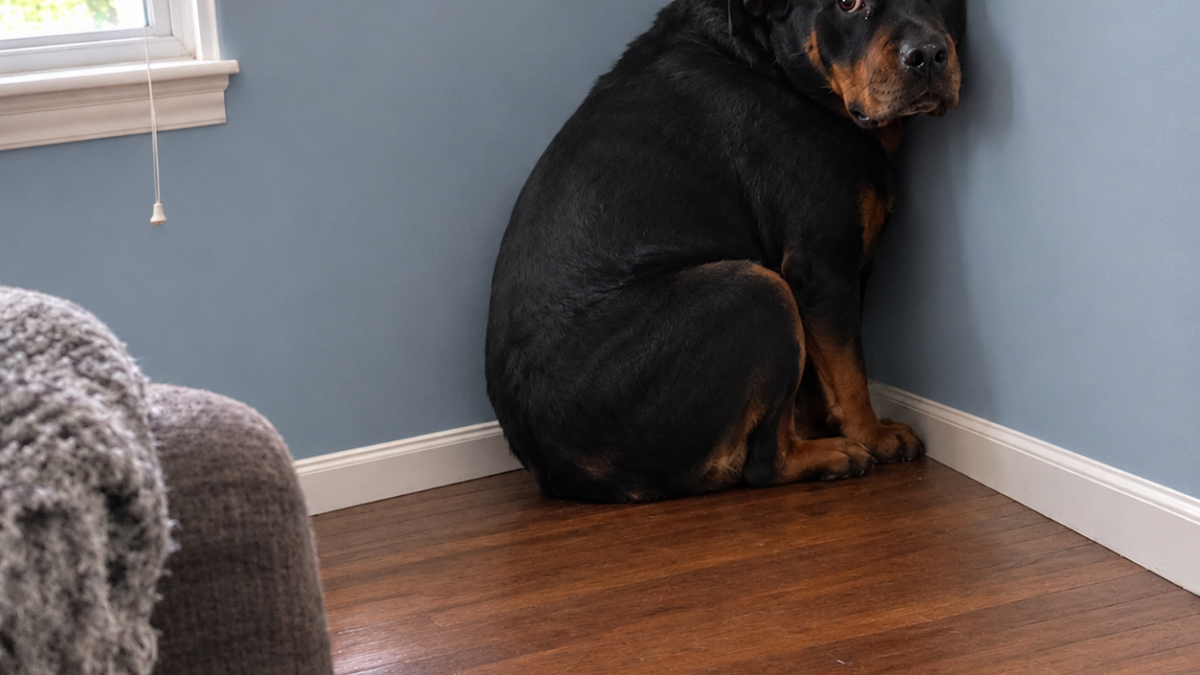
PART 2
Peter and I stood in the hallway listening to that puppy cry while Bruno transformed in front of us.
Five minutes earlier, I had practically carried him from the car because he moved as though every limb had become heavy. Now he was standing at the end of the leash, body forward, ears raised, eyes fixed on the isolation-room door.
Peter looked at me.
“What do we do?”
“Let me think.”
The puppy cried again.
Bruno whined.
Not the deep, defeated sound I had heard at Peter’s house. This was urgent. Focused.
I walked toward the isolation room.
Bruno followed immediately.
Peter came behind us.
At the door I stopped.
“Bruno stays outside.”
Peter nodded.
I slipped inside.
The puppy was maybe five weeks old, though later our veterinarian would estimate closer to six. She was painfully small, black with tan markings over her eyes and chest. Not a pure Rottweiler, but close enough that the resemblance to Bruno was impossible to miss.
She had been found taped inside a cardboard produce box beside an old farm-access road.
No mother.
No siblings.
No collar.
No microchip.
She had arrived dehydrated, chilled, and terrified.
We had named her Penny for paperwork purposes because shelters need to call animals something.
Penny was standing against the front of her crate, crying.
The moment Bruno’s nails clicked on the hallway floor outside, she stopped.
I froze.
So did Peter.
Penny sniffed beneath the door.
Outside, Bruno lowered himself.
I could see his shadow through the narrow gap.
Penny gave one tiny whine.
Bruno answered.
A soft rumble from deep in his chest.
Not a growl.
Almost a hum.
Penny lay down.
Just like that.
No crying.
No pacing.
Nothing.
Peter whispered through the door:
“What the hell?”
I had no answer.
—
I brought Penny’s crate closer to the doorway but kept the animals separated. She had not completed infectious-disease screening, and Bruno’s emotional state made me unwilling to rush physical contact.
He lay against the other side of the door.
Peter lowered himself beside him.
Bruno finally looked at him.
Peter’s face changed.
“Hey.”
His voice cracked.
Bruno moved his tail once.
Peter looked at me.
“He doesn’t hate me.”
“No.”
I sat across from them.
“This was never about you.”
“What is it about?”
I looked at the closed door.
“I don’t know yet.”
Peter touched Bruno’s shoulder.
This time Bruno leaned into him.
Then Penny whimpered again.
Immediately Bruno turned toward the door.
Peter followed his gaze.
“He thinks she needs him.”
“Yes.”
“Why?”
“That’s what I want to find out.”
—
Bruno stayed at the shelter that night.
So did Peter.
Not officially.
Visitors weren’t supposed to sleep on our waiting-room couch, but our director, Amanda, looked at Peter curled beneath his jacket at midnight and decided there were more important rules to enforce.
I stayed too.
At one in the morning, I checked Bruno.
He was asleep directly outside Penny’s room.
At three, same position.
At five, Penny woke and began crying.
Bruno was on his feet before I reached the hallway.
He pressed his nose beneath the door.
Penny quieted.
I sat on the floor.
Something about it unsettled me.
Not because it was frightening.
Because it was specific.
Dogs can be nurturing toward puppies they don’t know. Adult males sometimes show remarkable patience.
But Bruno’s behavior felt less like interest and more like obligation.
He wasn’t curious.
He was responsible.
At six thirty I opened his file.
I had read it dozens of times.
**Male Rottweiler mix. Approx. 5 years. Found stray. Transferred from Daviess County holding facility. Social. Dog-friendly. No known bite history.**
Nothing about puppies.
Nothing about shutdowns.
Nothing explaining why a cry could turn a dog from joyful to catatonic.
Then I noticed the transfer number.
Not our standard format.
It referenced an older case.
I called the county facility when they opened.
A woman named Joanne answered.
I gave Bruno’s intake number.
Long pause.
“Oh.”
That was never a good sound.
“What?”
“You don’t have the original seizure report?”
“Seizure?”
Another pause.
“He didn’t come in as a normal stray.”
My spine straightened.
“What did he come from?”
“A court case.”
I looked toward Bruno sleeping beside Penny’s door.
“What kind of court case?”
Joanne exhaled.
“Backyard breeding operation.”
—
The facility emailed me archived documents.
I printed everything.
Thirty-eight pages.
Photos.
Veterinary notes.
Officer reports.
Animal inventory.
The property had belonged to a man named Wade Collier.
Two years earlier, county animal control responded to complaints about dogs being kept in inadequate outdoor runs behind a machine shop.
They found fourteen dogs.
Mostly Rottweilers and shepherd mixes.
Several females had recently given birth.
Three litters were present.
Bruno was animal number eleven.
But he wasn’t housed like the others.
He had been chained between two nursery pens.
The officer’s note read:
**Adult male highly social with staff but becomes distressed when neonatal puppies vocalize. Attempts to move toward puppy enclosures. Chain damage suggests repeated pulling.**
I read it twice.
Then another note.
**During removal, puppies separated for transport. Adult male vocalized continuously and refused loading until crates containing puppies were placed within visual range.**
My chest tightened.
There it was.
Buried in paperwork nobody had transferred into Bruno’s behavioral summary.
I kept reading.
One veterinary note mentioned old scars across his shoulders and neck.
Another:
**Two healed rib fractures. Pattern not diagnostic but consistent with prior blunt trauma.**
Then a statement from a former worker:
**Collier used the big male as a “nursery guard” because he stayed near litters and alerted when pups cried.**
I sat back.
Nursery guard.
Bruno had spent years being conditioned to respond when puppies cried.
Maybe not intentionally at first.
Maybe instinct became useful to someone.
Then obligation became trauma.
I kept reading.
The final line was the one that made me stop.
**Worker reports Collier punished adult male when he attempted to reach distressed puppies without permission.**
I put the papers down.
Bruno had learned two things at once.
Puppies crying meant they needed him.
And being unable to reach them meant something terrible might happen.
Peter found me still sitting there twenty minutes later.
“What did you find?”
I handed him the report.
He read silently.
His face changed.
Then:
“So when we left…”
“He heard Penny.”
“And thought we abandoned her.”
“Maybe.”
Peter looked toward the hallway.
“And when he couldn’t get back…”
“He shut down.”
Peter closed his eyes.
“God.”
Then he whispered:
“I thought I broke him.”
“No.”
He opened his eyes.
“Someone else did that a long time ago.”
—
Penny cleared her initial health screening two days later.
Dr. Lila Chen, our veterinarian, allowed a controlled introduction.
Peter sat with Bruno in one corner of the quiet room.
I carried Penny inside.
The second she saw Bruno, she squeaked.
Bruno flattened himself to the floor.
Not fearfully.
Making himself smaller.
Penny waddled toward him.
He didn’t move.
She sniffed his muzzle.
Then climbed directly between his front paws.
Bruno closed his eyes.
His whole body seemed to release tension at once.
Peter covered his mouth.
Penny licked Bruno’s chin.
He began grooming her.
Slowly.
Ears.
Head.
Back.
The puppy rolled onto her side.
Within five minutes, she was asleep against his chest.
I had seen maternal behavior.
Surrogate parenting.
Bonded dogs.
This was different only because I knew the history now.
Bruno wasn’t simply being gentle.
He was finishing a task his nervous system believed he had been prevented from finishing.
He was making sure the crying stopped because the puppy was safe.
—
Peter sat on the floor for nearly an hour.
Finally he asked:
“What happens now?”
I knew what he meant.
Could Bruno still go home?
Could Penny?
Were we about to create a dependence problem?
I said:
“We don’t make decisions based on one emotional day.”
Peter smiled faintly.
“That sounds like something you say before making an emotional decision.”
“Probably.”
He looked at Penny sleeping on Bruno.
“I want him.”
“I know.”
“I still want him.”
“I know.”
“And if this means he needs time here…”
“It does.”
Peter nodded.
“What about her?”
“She’s too young to adopt yet.”
“Eventually?”
I gave him a look.
He laughed softly.
“I’m asking.”
“You came here for one Rottweiler.”
“I also bought one dog bed.”
“Exactly.”
“But I have a credit card.”
“That is the worst reason to adopt a second dog.”
Bruno opened one eye.
Peter scratched behind his ear.
“I’m not deciding today.”
“Good.”
Then:
“But I’m not walking away.”
That mattered more.
—
For the next three weeks, Peter came every day.
Not every weekend.
Every day.
He worked as an electrician and rearranged jobs so he could stop at the shelter before closing.
Bruno learned that Peter leaving did not mean Bruno had to leave Penny.
Then he learned Bruno could leave the puppy room for five minutes and come back.
Ten minutes.
Twenty.
We built new associations.
Penny can cry and still be safe.
Penny can sleep while Bruno goes outside.
Humans can take responsibility too.
Bruno does not have to monitor every breath.
It was behavior work, but it was also something larger.
We were teaching a dog he was allowed to share the burden.
Peter became part of that lesson.
He would sit beside Penny’s pen while Bruno went with me on a walk.
The first few times Bruno constantly looked back.
Peter would say:
“I’ve got her.”
Bruno didn’t understand the sentence.
But he understood consistency.
Peter remained.
Penny remained.
Nothing bad happened.
—
Then Penny’s story changed.
Animal control officer Karen Mills came to the shelter carrying photographs from where Penny had been found.
The cardboard box.
Roadside.
Pieces of green nylon cord.
A torn feed bag.
And one small plastic tag.
Number **27**.
My stomach tightened.
Bruno’s old seizure inventory listed nursery pens by number.
I opened the archive.
Pen 27.
I stared.
Coincidence?
Maybe.
Karen asked:
“What?”
I showed her.
Her expression changed.
“Wade Collier?”
“Yes.”
She looked toward Penny.
“He’s not supposed to be breeding dogs.”
“What?”
“Three-year restriction under the plea agreement.”
The old case had resulted in neglect convictions and a temporary prohibition on commercial breeding.
That restriction was still active for another six months.
Karen said:
“We’ve had rumors he started again under someone else’s name.”
“Whose?”
“His girlfriend.”
I looked at Penny.
“Where was she found?”
Karen gave me the road.
I knew it immediately.
Less than four miles from Collier’s old property.
—
We didn’t accuse anyone.
Not yet.
A plastic tag wasn’t proof.
Feed bags weren’t proof.
Breed resemblance definitely wasn’t proof.
Then a woman named Melissa Grant called.
She had seen a shelter post about Penny.
Not the dramatic version.
Just a found-puppy photograph.
Her first words were:
“Please don’t let Wade get that dog back.”
My grip tightened around the phone.
“You know her?”
“I think so.”
“Why?”
“I worked for him.”
The room seemed to get smaller.
“When?”
“Until last month.”
I glanced toward Bruno.
He was sleeping beside Penny’s playpen.
“What happened?”
Melissa took a breath.
“Wade started breeding again.”
—
We met her after hours.
Melissa was thirty-eight, exhausted, and frightened enough that she parked two blocks away and walked to the shelter.
She showed us photographs.
A rented barn.
Temporary kennel runs.
Females.
Puppies.
Wade Collier.
Not his girlfriend.
Wade himself.
One photograph showed a litter of five black-and-tan puppies.
Penny was almost certainly one of them.
Same white spot beneath the chin.
Same unusual tan patch on one rear paw.
“What happened to the litter?”
Melissa stared at her hands.
“They got sick.”
“With what?”
“Diarrhea. Coughing.”
“Veterinarian?”
“Wade didn’t want records.”
Dr. Chen’s face hardened.
“What did he do?”
“Sold two.”
My stomach turned.
“And the others?”
“One died.”
“What about Penny?”
Melissa looked toward the puppy room.
“She was the smallest.”
“Meaning?”
“Wade called her a waste.”
I closed my eyes.
Of course.
“What happened?”
“He told one of the guys to dump her.”
“Where?”
Melissa named the access road.
Exactly where animal control found Penny.
Dr. Chen whispered something I won’t repeat.
Then Karen asked:
“Can you prove any of this?”
Melissa slid her phone across the table.
Text messages.
**Wade: Get rid of 27.**
**Employee: Shelter?**
**Wade: I don’t care. Just not here.**
Another:
**Weak pups eat the same as strong ones.**
And another:
**No vet. We’re already hot from the old case.**
That was enough to begin asking harder questions.
—
Then Melissa saw Bruno.
She froze.
“Oh.”
Bruno lifted his head.
“What?” I asked.
She stared through the glass.
“That’s Bear.”
Peter looked at me.
“Bear?”
Melissa nodded slowly.
“He was Wade’s.”
I felt cold.
“You knew him?”
“Years ago.”
Bruno stood.
Melissa didn’t approach.
“Wade called him Bear. He kept him near the nursery runs.”
The old report confirmed that.
Melissa’s eyes filled.
“He loved puppies.”
Peter said quietly:
“We know.”
“No.”
She shook her head.
“You don’t understand.”
She looked at Bruno.
“If one started crying, he would tear his paws up trying to reach it.”
I swallowed.
“Why?”
Melissa’s voice broke.
“Because one died while he was chained outside.”
Silence.
Peter stopped breathing for a second.
“What happened?”
Melissa stared at the floor.
“A female stopped nursing. One puppy got weak. Bruno heard it crying all night.”
My chest tightened.
“Did nobody help?”
“Wade said it wasn’t worth a vet bill.”
Bruno was watching us now.
Melissa continued.
“By morning the puppy was dead.”
Peter looked away.
“The next time a litter cried, Bruno broke part of the fence.”
“What did Wade do?”
Melissa’s face told me before her words.
“Beat him.”
That explained the ribs.
The scars.
The shutdown.
Bruno had not simply been trained to respond to puppies.
He had learned that a puppy crying behind a barrier could die while he listened helplessly.
Then he learned trying to help could bring pain.
Peter sat down.
For a long time, nobody spoke.
Finally he said:
“So he heard Penny.”
“Yes.”
“And I drove away with him.”
“Yes.”
Peter pressed both hands over his face.
“Jesus.”
I crouched beside him.
“You didn’t know.”
“He did.”
“Not the way you mean.”
“He knew enough to think I was taking him away from something that needed him.”
I didn’t argue.
Then Peter looked at Bruno.
“I’m going to fix that.”
I said:
“You can’t fix the past.”
“No.”
His voice steadied.
“But I can make sure nobody makes him choose like that again.”
—
The investigation into Collier’s new operation moved quickly after Melissa’s statement.
Not quickly enough for my patience.
But legally quickly.
Animal control gathered veterinary opinions, property records, utility bills, purchase receipts, and photographs.
The rented barn belonged to Collier’s cousin.
The breeding business was registered to his girlfriend, Kendra Price.
On paper, Wade had nothing to do with it.
In photographs, he was everywhere.
Feeding.
Selling.
Handling puppies.
Taking cash.
The old court order was clear.
He was prohibited from operating or materially participating in a commercial breeding business during the restriction period.
He had simply moved the activity and changed the name.
Then one more former employee came forward.
A young man named Corey.
He was the person who had left Penny beside the road.
He admitted it.
“I thought somebody would find her.”
I hated that sentence.
People use it when they want chance to carry the moral responsibility they refused.
I asked:
“Why not take her to a shelter?”
“Wade said no.”
“Why?”
“He said the shelter might connect her to him.”
There it was.
Intent.
Karen asked:
“What exactly did Wade say?”
Corey swallowed.
“‘Don’t be stupid. They know my dogs.’”
Peter, sitting at the far end of the room, leaned forward.
“He knew.”
“Yes.”
Corey continued.
“He told me to put her somewhere busy enough someone would see her.”
“And you put her in a taped box?”
His face reddened.
“It was cold.”
“So you taped the box?”
“Not all the way.”
I wanted to scream.
Instead I wrote.
Facts.
Always facts.
Emotion helps you care.
Facts help you win.
—
We did not publicize the case.
That changed when Wade Collier came to the shelter.
He walked through our front doors on a Thursday afternoon wearing a work jacket and carrying a folder.
I recognized him from case photographs.
Bruno recognized him faster.
I heard the growl from thirty feet away.
Not loud.
But different from any sound I had ever heard from Bruno.
Peter was visiting.
He stood beside Bruno’s kennel.
Collier looked toward them.
Then smiled.
“Well, hell.”
My skin crawled.
He pointed.
“That’s Bear.”
I stepped between him and the dog wing.
“Can I help you?”
“I’m here for my puppy.”
“Which puppy?”
He smiled again.
“The little Rottie mix. Number twenty-seven.”
He had just confirmed the tag mattered.
I kept my voice neutral.
“Do you have proof of ownership?”
“Plenty.”
He held up the folder.
Peter had come closer.
Bruno remained behind the gate.
Collier looked at him.
“Bear.”
Bruno backed away.
Peter’s jaw tightened.
Collier whistled.
Bruno’s body dropped lower.
I said:
“Stop.”
Collier laughed.
“He always was soft.”
Peter stepped beside me.
“That’s enough.”
Collier looked him up and down.
“You the guy trying to take my dog?”
Peter’s face became very calm.
“Bruno is legally adopted pending final behavioral clearance.”
“Bruno.”
Collier laughed.
“He’s Bear.”
Peter said:
“He’s whichever name makes him turn toward people who love him.”
I almost looked at Peter.
Good line.
Collier’s smile disappeared.
“I paid for that dog.”
“You lost him through a cruelty case.”
“Allegations.”
“Convictions.”
His face hardened.
Then Penny cried from the medical wing.
It was tiny.
Barely audible.
Bruno reacted instantly.
He moved toward the sound.
Collier rolled his eyes.
“Still doing that stupid crap.”
My stomach dropped.
Peter heard it too.
“What did you say?”
Collier looked at him.
“The puppy thing. Always acted like every squeal was his business.”
Peter’s hands tightened.
I stepped slightly in front of him.
Collier continued.
“Cost me good fences.”
Then he made the mistake that later mattered most.
“Should’ve gotten rid of him after the first litter.”
Silence.
He seemed to realize we were all staring.
I said:
“What first litter?”
He smiled thinly.
“Old story.”
“You mean the puppy that died while he was chained nearby?”
His face changed.
Tiny.
Enough.
“Melissa talks too much.”
There it was.
He knew exactly which incident I meant.
Our lobby cameras recorded audio.
Collier did not know that.
Not yet.
Karen arrived twenty minutes later.
Collier left without Penny.
He also left behind more evidence than he realized.
—
That evening, Peter and I took Bruno and Penny into the exercise room.
Peter sat on the floor.
Bruno leaned against him.
Penny attacked Peter’s shoelace with great determination.
Peter laughed.
Then his laughter disappeared.
“What if he never wants to leave her?”
“We work on it.”
“What if he does this with every puppy he hears?”
“We work on that too.”
“What if he’s only happy when he’s guarding something?”
I looked at Bruno.
“That’s not what I see.”
“What do you see?”
“A dog who was given responsibility he should never have had.”
Peter remained quiet.
I continued.
“He can care about Penny without believing her survival depends entirely on him.”
“How do we teach that?”
“By proving it.”
“How?”
“You feed her.”
Peter nodded.
“I treat her.”
Another nod.
“Other staff comfort her.”
Bruno watched us.
“You take Bruno somewhere enjoyable while Penny stays safe.”
Peter stroked his head.
“And we keep coming back.”
“Yes.”
Peter smiled slightly.
“Sounds simple.”
“It won’t be.”
“Good.”
I looked at him.
“Good?”
“I’ve had simple.”
There was something behind that.
I had never asked why Peter spent months at the shelter before choosing a dog.
That night he told me.
—
Peter had been married.
Her name was Dana.
She died of ovarian cancer three years earlier.
Forty-one years old.
No children.
Afterward, Peter spent nearly two years doing almost nothing except working and sleeping.
His sister eventually told him:
“Either get a therapist, a dog, or both.”
Peter got both.
The therapist came first.
Then Bruno.
“I kept coming here because I didn’t trust myself to choose quickly.”
“Why?”
“Everything I loved felt temporary.”
He looked embarrassed after saying it.
I understood.
“Then Bruno acted like every day was the greatest day he’d ever experienced.”
“He does that.”
“Did.”
Peter looked toward Penny.
“I want him back.”
“He’s still there.”
“I know.”
Then:
“But maybe happiness isn’t him running around all the time.”
Exactly.
Shelters make the same mistake people do.
We see a wagging dog and assume that is the truest version.
We see shutdown and call it failure.
Both are information.
Neither is the whole animal.
—
A week later, Peter fostered Bruno again.
This time, not permanently.
One night.
Penny stayed at the shelter with me.
We had cameras.
Staff.
Everything controlled.
Bruno resisted leaving.
He looked back.
Whined.
Then Peter said:
“Rachel’s got her.”
No magic.
But he followed.
At Peter’s house, Bruno explored.
Then waited by the front door for twenty minutes.
Peter sent me a picture.
**Still standing.**
I replied:
**Ignore him. Normal routine.**
An hour later:
**He ate.**
Then:
**He brought me the pig.**
I smiled.
The squeaky pig.
At ten:
**He’s asleep on my couch.**
At six the next morning Peter returned.
Bruno ran straight to Penny.
Checked her.
Licked her.
Then—
walked away.
That was enormous.
He didn’t collapse over her.
Didn’t refuse to leave.
Just checked.
Safe.
Done.
Peter understood.
“He trusted us.”
“Yes.”
“No.”
He smiled.
“He trusted *you*.”
“Temporary.”
“Still counts.”
—
We extended the foster.
Two nights.
Three.
A week.
Penny remained at the shelter initially.
Then she moved into a foster home with one of our vet techs for continued socialization.
Bruno handled it.
Not perfectly.
The first night Penny wasn’t in the building, Bruno searched.
He paced to her old room.
Sniffed.
Whined.
But he did not shut down.
I sat with him.
Then Peter came.
Bruno leaned against him.
Another lesson.
Someone can leave and still be safe.
Someone can be gone and still exist.
That lesson mattered to Peter too.
Maybe more than he admitted.
—
Penny’s health improved.
She gained weight.
The cough cleared.
Her personality appeared.
Unfortunately, her personality was criminal.
She stole socks.
Bit shoelaces.
Climbed barriers.
Screamed when meals arrived eight seconds late.
Dr. Chen called her “a tiny organized crime unit.”
Bruno adored her.
But he also began correcting her.
Gently.
If she bit his ears too hard, he stood.
If she climbed onto his head while he slept, he moved.
Healthy boundaries.
That delighted me more than constant cuddling.
Bruno was not becoming Penny’s nervous system.
He was becoming an adult dog who liked a puppy.
Different.
Important.
—
Then the court authorized a search of the Collier property.
Seventeen dogs were removed from the rented barn.
Three litters.
Four adult females.
Two males.
Several juveniles.
Conditions varied.
Some were healthy.
Some underweight.
One female had an untreated skin infection.
Another had a wound beneath her collar.
The worst discovery was not visual.
Records.
Collier had falsified ownership documents to hide his involvement.
Veterinary care was routinely avoided because, in his words:
**Paper trails are how idiots get caught.**
That message was on his phone.
I wish I could say I felt triumphant.
I didn’t.
I felt tired.
Every dog removed meant more kennels.
More foster homes.
More medical bills.
Cruelty doesn’t end when police arrive.
It becomes paperwork someone compassionate has to carry.
Still—
the dogs were out.
That mattered.
—
One female Rottweiler changed everything again.
Her shelter number was 418.
She was six.
Black-and-tan.
A scar across her muzzle.
When she entered our dog wing, Bruno stopped.
I had never seen him look that way.
Not even at Penny.
He stood completely still.
The female smelled the air.
Then began whining.
Bruno answered.
Peter looked at me.
“Do they know each other?”
I didn’t know.
The female’s name from Collier’s records was Mara.
Melissa confirmed she had been at the original property years earlier.
“She was one of the breeding females.”
“Same time as Bruno?”
“Yes.”
“Were they housed near each other?”
“All the time.”
Then Melissa said:
“Oh.”
“What?”
“Mara was the mother.”
My chest tightened.
“Of the litter where the puppy died?”
She nodded.
Suddenly Bruno’s reaction made even more sense.
He had not been listening to random puppies.
He had been chained beside Mara while one of her babies cried all night.
He had watched the mother panic.
He had been unable to help.
Now Mara stood twenty feet away.
Alive.
Older.
Returned to the same building as him.
Peter whispered:
“Can they meet?”
“Eventually.”
Not immediately.
Mara was frightened.
Medical hold.
Evidence status.
We did it slowly.
Scent cloth.
Parallel walks.
Visual access.
Then contact.
The first time they touched noses, Mara leaned her forehead against Bruno’s.
He stood there.
No jumping.
No tail explosion.
Just stillness.
Penny bounced around behind us, furious that adults were being emotional without her.
Peter laughed through tears.
“So this is his family.”
I said:
“Part of it.”
Then I realized something.
Bruno had spent his life caring for other dogs because humans around him failed to.
Now we had a chance to change the arrangement.
He could have family without being responsible for everyone’s survival.
—
Mara went into foster care.
Not with Peter.
I refused.
Three dogs—including a high-needs adult and a puppy—would have turned an emotional story into an irresponsible placement.
Peter agreed.
Reluctantly.
A retired veterinary technician named Louise fostered Mara.
She had two quiet acres and experience with breeding survivors.
Bruno visited.
He and Mara walked together.
Sometimes they slept near each other.
Then separated without panic.
That was healing.
Not restoring the old world.
Building a safer new one.
—
Collier’s attorney began sending letters.
He claimed the seized dogs were valuable property.
Claimed Penny had been stolen by Corey.
Claimed Bruno’s old case records were prejudicial.
Then he filed a civil claim connected to several animals.
That included Mara.
Not Bruno—his ownership had been legally terminated years earlier.
Not Penny at first.
Then suddenly Penny appeared in an amended filing.
Peter read it.
“He wants her back?”
“He wants leverage.”
“Why?”
“Because she’s evidence he violated the breeding restriction.”
Peter stared toward Penny, who was chewing a cardboard box.
“That dog can barely control her own feet.”
“Legal significance doesn’t require dignity.”
He laughed despite himself.
Then became serious.
“If somebody says she has to go back—”
“They won’t.”
“You can’t promise.”
“No.”
I looked at him.
“But I can tell you the evidence is strong.”
“That’s not the same.”
“No.”
He nodded.
“I hate that.”
“Welcome to animal welfare.”
—
The case went public after a local reporter connected Collier’s new operation to his previous conviction.
Bruno and Penny’s story leaked too.
The headline was sentimental:
**ROTTWEILER’S FAILED ADOPTION LEADS TO DISCOVERY OF ILLEGAL BREEDING OPERATION**
Not exactly.
But close enough.
The story spread.
Bruno became the “puppy protector.”
I hated that nickname.
Not because it was false.
Because it risked turning trauma into a cute personality trait.
People began emailing:
**Can Bruno visit my puppy?**
No.
**Would Bruno be good with newborn litters?**
Absolutely not.
**Can we adopt him for our breeding female?**
I wanted to throw the computer away.
Peter read one message and said:
“People really miss the point.”
“Yes.”
“The point is that he shouldn’t have to do that anymore.”
Exactly.
—
Collier hated the publicity.
He posted online that animal control was targeting him.
He said former employees were lying.
He called Bruno “an unstable dog” and suggested the shelter had exaggerated the shutdown.
Then he wrote:
**That dog was never right in the head after the pup incident.**
Screenshot.
Saved.
His lawyer must have called him quickly because the post disappeared.
Too late.
The “pup incident.”
Again confirming knowledge.
Again linking Bruno’s trauma directly to the event witnesses described.
Arrogance is often evidence with a Wi-Fi connection.
—
Then someone came to Peter’s house.
Two in the morning.
His security camera alerted him.
A man in a hood stood near the side gate.
Peter called police before going downstairs.
Bruno woke.
Penny—by then temporarily staying with Peter for a weekend trial—began barking.
The man tried the gate.
Locked.
Then whistled.
Two short notes.
Bruno froze.
Peter’s blood went cold.
The man said quietly:
“Bear.”
Bruno backed away from the window.
Peter called me while officers were en route.
I could hear Penny barking.
“What’s happening?”
“Someone’s outside.”
“Stay inside.”
“I am.”
“Bruno?”
“Scared.”
“Peter, do not confront him.”
“I’m not stupid.”
“Emotion makes people stupid.”
“Fair.”
The man moved around the side of the house.
Camera caught part of his face.
Wade Collier.
Peter saw it live.
“He’s here.”
My chest tightened.
“Police?”
“Three minutes.”
Collier reached through the gate with something.
Food.
He tossed it.
Bruno did not move toward it.
Penny did.
Peter grabbed her collar before she reached the door.
Then Collier rattled the gate.
Bruno suddenly moved.
Not toward Collier.
Toward Penny.
He placed himself between the puppy and the door.
Old reflex.
But then Peter said:
“Bruno.”
The dog looked at him.
“I’ve got her.”
Bruno hesitated.
Peter pulled Penny behind him.
“I’ve got her.”
Bruno stepped away.
That moment never appeared in any court record.
It was more important to me than many things that did.
Bruno surrendered responsibility.
He trusted Peter to protect the puppy.
That was the breakthrough we had been working toward for months.
—
Police arrived.
Collier ran toward his truck.
Didn’t get far.
He was detained for violating temporary conditions connected to the ongoing case and for trespass-related conduct.
The security footage showed the whistle.
The gate.
The food.
His voice saying Bruno’s old name.
The prosecutor later argued he had attempted to interfere with animal evidence and intimidate a key adopter/witness.
His legal problems multiplied.
Peter’s patience ended.
Not into violence.
Into resolve.
At the next hearing, when Collier’s lawyer offered a settlement that would involve surrendering claims to Penny and Mara in exchange for reduced civil exposure, Peter said:
“No.”
I looked at him.
“This isn’t your decision alone.”
“I know.”
“Then why are you saying no?”
“Because he isn’t offering accountability. He’s trading dogs like poker chips again.”
That was Peter.
He understood the point now.
So did I.
—
The criminal trial began nearly a year after Bruno’s failed adoption.
By then, Bruno lived with Peter permanently.
Penny did too.
Yes.
Eventually.
We tried separate placements for Penny.
Good homes.
Bruno tolerated them.
Peter was the one who failed.
After a week-long foster elsewhere, he came to the shelter and said:
“I miss the tiny criminal.”
I stared.
“You understand this cannot be about keeping Bruno calm.”
“It isn’t.”
“You will have two dogs.”
“I can count.”
“Penny will become large.”
“I bought another bed.”
“Bruno sleeps on the couch.”
“Then Penny gets both beds.”
I tried every argument.
He passed.
Financially.
Practically.
Emotionally.
So Penny was adopted by Peter too.
The adoption certificate listed her name as **Penny Dana Mercer**—Dana after Peter’s late wife.
He didn’t tell me until afterward.
I cried.
He pretended not to notice.
—
At trial, Melissa testified first.
She described the old operation.
The puppy that died.
Bruno’s panic.
The beating.
Then the new breeding setup.
Collier’s lawyer attacked her credibility.
“You continued working there.”
“Yes.”
“You accepted wages.”
“Yes.”
“So you participated.”
Melissa swallowed.
“Yes.”
That answer surprised him.
“Then why should the jury trust you?”
“Because I’m not asking them to think I was brave.”
She looked toward Collier.
“I’m telling them I was scared, dependent on the paycheck, and wrong.”
Silence.
“Then I saw it start again.”
She pointed toward the prosecutor’s photographs.
“And I decided being ashamed wasn’t enough.”
That mattered.
—
Corey testified about Penny.
The box.
The road.
Collier’s instruction.
The defense asked:
“Did Mr. Collier personally place the puppy in the box?”
“No.”
“Did he personally abandon her?”
“No.”
“You did.”
“Yes.”
“So perhaps you are blaming my client to reduce your own responsibility.”
Corey nodded.
“I am responsible.”
The lawyer looked momentarily confused.
Then Corey added:
“But he told me exactly why not to use a shelter.”
“Why?”
“Because they’d know his dogs.”
The room went still.
—
Dr. Chen testified about Penny’s condition.
Dehydration.
Parasites.
Respiratory infection.
Underweight.
She explained how easily a young puppy could deteriorate.
The defense asked whether Penny would definitely have died if not found.
“No.”
“So we cannot say she was in mortal danger.”
Dr. Chen’s expression remained calm.
“We also cannot say a child left beside a highway will definitely be struck by a car. Risk does not require certainty to be irresponsible.”
The judge reminded her to stick to veterinary facts.
She apologized.
I bought her coffee afterward.
—
I testified about Bruno.
The adoption.
Shutdown.
The puppy cry.
Old records.
Behavior rehabilitation.
Collier’s shelter visit.
The defense attorney tried hard to turn me into a sentimental shelter worker creating a dramatic story.
“Ms. Carter, is it possible Bruno became overwhelmed simply because he changed environments?”
“Yes.”
“Possible he would have shut down regardless of the puppy?”
“Possible.”
“So your theory is not provable.”
“Behavior rarely gives us courtroom certainty.”
He looked satisfied.
Then:
“Yet you’ve publicly connected Bruno’s behavior to my client.”
“I didn’t make the old records.”
“Answer the question.”
“Yes.”
He continued.
“You want this jury to believe a dog remembered a puppy crying years earlier.”
“No.”
He frowned.
“What?”
“I want them to understand Bruno had a documented history of distress around crying puppies and a documented history of punishment connected to that behavior. Whether he remembered one specific puppy is not something I can prove.”
The prosecutor looked at me.
The defense did not like that answer.
Because careful truth is harder to attack than dramatic certainty.
—
Then the lobby footage played.
Collier:
**Still doing that stupid crap.**
Then:
**Should’ve gotten rid of him after the first litter.**
My question:
**You mean the puppy that died while he was chained nearby?**
Collier:
**Melissa talks too much.**
No interpretation needed.
His own words connected him.
—
The footage from Peter’s house came next.
Collier at the gate.
Whistle.
“Bear.”
Food tossed.
Penny barking.
Bruno moving between her and the door.
Then Peter:
**Bruno. I’ve got her.**
Bruno stepping away.
I looked at Peter in the courtroom.
He was crying.
Quietly.
Not because of Collier.
Because he saw the moment too.
The exact second Bruno trusted him.
—
Collier testified.
I still don’t understand why.
Pride, probably.
He said breeding dogs was a business and emotional shelter workers failed to understand practical decisions.
He said sick puppies sometimes die.
True.
He said not every weak animal can justify unlimited veterinary spending.
Also, in abstract, true.
Then the prosecutor asked:
“Is that why you instructed an employee to leave Penny beside a service road?”
“I didn’t instruct him to endanger her.”
“You told him not to use a shelter.”
“I didn’t want complications.”
“What complications?”
“Paperwork.”
“Or identification?”
Collier hesitated.
Then she showed the message:
**Don’t be stupid. They know my dogs.**
He shifted.
The prosecutor moved on.
“Did a puppy die while Bruno was chained near a nursery pen years earlier?”
“I don’t remember.”
“Did you punish Bruno for breaking a fence after puppies cried?”
“He destroyed property.”
“With what did you punish him?”
“Correction.”
“What kind?”
“Physical.”
“Did you strike him?”
His lawyer objected.
The judge allowed a narrower question.
Collier eventually admitted hitting Bruno.
Not how many times.
Not how hard.
Enough.
Then the prosecutor asked:
“Why did Bruno attempt to reach the puppies?”
Collier shrugged.
“He was stupid about puppies.”
That sentence ended whatever sympathy remained in the room.
—
The search records showed Collier had violated his breeding restriction.
The financial evidence showed sales under Kendra’s name.
Messages showed he controlled decisions.
Veterinary evidence showed neglect in several dogs.
Penny’s abandonment was documented.
Bruno’s historical abuse was supported by witnesses and records, though limitations on older charges meant not everything could be prosecuted anew.
That frustrated Peter.
It frustrated me too.
Justice has statutes.
Dogs do not.
But the newer conduct was enough.
—
The jury returned guilty verdicts on multiple animal neglect, abandonment, licensing, and court-order violation counts associated with the renewed operation, along with related offenses stemming from his conduct during the investigation. Some charges failed.
Enough didn’t fail.
At sentencing, I expected Peter to speak.
He declined.
“Why?”
He looked at Bruno’s photograph on his phone.
“Because I don’t want Wade being the most important thing in Bruno’s story.”
Instead Melissa spoke.
Then Dr. Chen.
Then one family who had purchased a sick puppy.
Finally, the prosecutor read a brief statement Peter had written.
Only four sentences.
**Bruno was taught that when something vulnerable cried, nobody else would help. That was never a personality trait he should have had to carry. In my house, he is allowed to care without being responsible for everybody’s survival. Whatever sentence the court imposes, I hope Mr. Collier never again gets to teach an animal that lesson.**
That was better than revenge.
—
Collier received incarceration, probation afterward, fines, restitution, and a lengthy prohibition on breeding, selling, or commercially handling animals. His operation was dissolved. The animals seized from the barn were forfeited and eventually placed through rescues and screened homes.
Kendra lost the business license registered in her name.
Corey received his own lesser consequences for the abandonment but cooperated and later completed community service with an animal transport program.
Melissa began working for a legitimate veterinary boarding facility.
Mara was adopted by Louise.
Bruno visited her until age and arthritis made trips harder.
Penny remained with Peter.
And the man who had once treated puppy cries as an annoyance lost the thing he had valued most:
control over animals.
That was enough for me.
—
Bruno’s story spread after the trial.
People loved the idea that the “happiest dog in the shelter” had shut down because he refused to leave a crying puppy behind.
I understood why.
It was emotional.
But I kept correcting one part.
Bruno had not rescued Penny by himself.
He noticed.
That mattered.
Then humans had to do the rest.
Peter.
Dr. Chen.
Melissa.
Karen.
Foster staff.
Investigators.
The court.
Bruno’s old life taught him that he had to respond because humans wouldn’t.
His new life taught him he could sound the alarm and someone else would carry the weight.
That was the real healing.
—
At home, Penny grew.
And grew.
And grew.
She eventually reached sixty-five pounds.
Peter complained.
“You said she was a tiny puppy.”
“She was.”
“This feels like false advertising.”
“That is how mammals work.”
Penny became taller than anyone expected and developed an absurd habit of sitting directly on Bruno.
Bruno tolerated this until a limit.
Then he would stand.
Penny would slide off.
Peter would laugh.
The first time Bruno growled at her over a stolen chew, Peter panicked and called me.
“He growled!”
“Good.”
“Good?”
“He communicated.”
“Isn’t that bad?”
“No. A dog setting a reasonable boundary is healthy.”
Peter looked at Bruno, who had reclaimed the chew.
“So he’s allowed to tell her no?”
“Yes.”
Peter smiled.
“That might be the healthiest thing he’s ever done.”
I hadn’t thought of it that way.
He was right.
For years Bruno’s relationship to puppies had only one direction.
Protect.
Monitor.
Suffer.
Now he could love Penny and still say:
Enough.
Not mine.
Move.
That is what safety gives.
Choice.
—
Peter’s house changed too.
When Dana died, he had closed her sewing room and left it untouched.
I didn’t know that until Penny discovered the door didn’t latch properly.
One afternoon Peter came home and found her asleep beneath Dana’s old cutting table.
He called me.
“I should be mad.”
“Did she destroy something?”
“No.”
“Then why?”
“I haven’t gone in there in three years.”
Silence.
“What are you going to do?”
Peter looked at Penny.
“Apparently clean it.”
He turned the room into a small office.
Kept Dana’s sewing machine.
Kept photographs.
Removed the hospital equipment boxes he had never unpacked.
Bruno slept near the doorway while he worked.
Penny stole fabric scraps.
Life entered a room grief had sealed.
That mattered too.
—
On the first anniversary of Bruno’s adoption attempt, Peter brought both dogs to the shelter.
Not because they needed anything.
Because Peter had a sense of humor.
He walked into my office carrying a squeaky pig.
“Recognize this?”
Bruno’s entire rear end started wagging.
I laughed.
“There he is.”
The dog who had once ignored that exact toy in Peter’s living room snatched it from his hand and ran through my office.
Penny chased.
They crashed into a chair.
Peter looked at me.
“Very moving.”
“Deeply.”
Then Bruno returned.
Dropped the pig at my feet.
I crouched.
He put his head against my chest.
I whispered:
“You were trying to tell us.”
Peter heard.
“Yeah.”
I looked at him.
“We just didn’t understand the language yet.”
—
Mara died first.
Cancer.
She was eleven or twelve.
Louise gave her three safe years.
When Bruno visited during Mara’s final week, he sniffed her carefully.
Lay beside her.
No frantic behavior.
No panic.
He stayed for an hour.
Then stood.
Walked to Peter.
Ready to leave.
I watched him.
Years earlier, separation had meant emergency.
Now he understood goodbye could be painful without being catastrophic.
Mara died at home two days later.
Peter told Bruno.
Again, maybe dogs don’t understand sentences.
Still worth saying.
“She was safe.”
Bruno rested his head on Peter’s knee.
“She knew you were safe too.”
That was enough.
—
Bruno aged beautifully.
Slowly at first.
Gray around the muzzle.
Then stiffness in his hips.
The old rib injuries never caused major trouble, but arthritis did.
Penny adjusted without anyone teaching her.
She stopped jumping onto him.
Waited on stairs.
Walked slower.
One afternoon Peter sent me a picture.
Penny standing halfway down the porch steps, looking back.
Bruno behind her.
Caption:
**She learned from him.**
I replied:
**Yes.**
Because she had.
Not just habits.
Patience.
Awareness.
Bruno had once been conditioned to monitor vulnerable animals out of fear.
Eventually that care became something gentler.
Penny absorbed the gentler version.
That felt like a kind of inheritance.
—
When Bruno was around ten, Peter had a minor heart procedure.
Nothing immediately life-threatening.
But he spent two nights in hospital.
Penny stayed with Peter’s sister.
Bruno stayed at my house because he was more comfortable with me.
The first evening, he watched the door.
My stomach tightened.
Old history.
I sat beside him.
“Peter’s coming back.”
He looked at me.
“I know.”
At midnight, Peter video-called.
He looked terrible.
Hospital gown.
Hair everywhere.
Bruno heard his voice.
His ears lifted.
Peter laughed.
“Hey, big guy.”
Bruno stood.
Tail moved.
“Don’t give Rachel trouble.”
Bruno looked at the screen.
Then at me.
After the call, he ate.
No shutdown.
No corner.
No wall.
I cried after he fell asleep.
Not because Peter was sick.
Because Bruno had learned absence did not always mean catastrophe.
That lesson had taken years.
It held.
—
Peter came home.
Penny nearly knocked him over.
Bruno didn’t.
He walked slowly toward him.
Peter crouched.
Bruno placed his head against Peter’s chest.
No frenzy.
No panic.
Peter wrapped both arms around him.
“I told you.”
Bruno’s tail moved.
“I came back.”
I stood in the doorway thinking about the adoption night.
Peter had believed Bruno hated him.
Bruno had believed somebody vulnerable had been left without help.
Both had been wrong.
Or rather, both had been interpreting pain without enough information.
How many relationships fail that way?
Probably more than we admit.
—
The shelter changed our intake process because of Bruno.
Transfer summaries were no longer enough for behavior cases.
When available, we requested original seizure notes.
Old foster reports.
Veterinary comments.
Anything that might explain patterns.
Amanda complained about paperwork.
I said:
“Bruno.”
She stopped complaining.
We also changed how we described shutdown after adoption.
We stopped assuming every frozen dog was scared of the adopter or home.
Sometimes the trigger happened before the car ride.
A sound.
A scent.
A separation.
An old association.
Context matters.
Dogs live in sequences humans often don’t notice.
—
Penny eventually became a certified reading-program dog.
That amused everyone.
The puppy found taped in a box grew into a calm adult who lay beside children while they read aloud at the library.
Peter said:
“She cannot read.”
“Most therapy dogs can’t.”
“Then this program is fraudulent.”
Penny fell asleep while a seven-year-old read *Charlotte’s Web* beside her.
Bruno sometimes attended early training sessions.
He hated the library floor.
Too slippery.
Eventually he retired from public outings.
He preferred the couch.
A reasonable choice.
—
The most satisfying moment involving Wade Collier came years after his sentencing.
Not dramatic.
I was at an adoption event when a young couple approached with a Rottweiler puppy.
They recognized Bruno’s photo on our senior-dog wall.
The man said:
“We got our dog because of him.”
I frowned.
“What do you mean?”
They had been considering buying from an online breeder.
Then they read Bruno’s story and started researching.
Instead, they adopted from a breed rescue.
The woman said:
“We realized cheap puppies have a cost somewhere.”
That sentence stayed with me.
Collier had treated dogs as units.
Profit.
Expense.
Output.
Bruno’s story quietly taught people to look behind the transaction.
The operation was gone.
But more importantly, the mindset lost customers.
That was a form of justice no court could order.
—
Bruno was twelve when cancer arrived.
Lymphoma.
I hated the word before Dr. Chen finished saying it.
Peter sat in the exam room with one hand on Bruno’s back.
Penny lay under the chair.
“What can we do?” he asked.
Dr. Chen explained options.
Chemotherapy.
Steroids.
Expected response.
Quality of life.
Cost.
Time.
Peter asked good questions.
Not desperate ones.
Years earlier he might have said:
Do everything.
Instead:
“What gives him the best days?”
That was love matured by loss.
We chose treatment.
Bruno responded well for several months.
Good appetite.
Comfortable walks.
Pig toy.
Penny.
Peter.
Then the cancer stopped responding.
—
During Bruno’s final weeks, something strange happened.
Penny became vigilant.
Not anxiously.
She stayed near him.
Waited when he walked.
Slept beside his bed.
Peter called me one night.
“She’s doing what he used to do.”
I understood.
“Yes.”
“Is that bad?”
“No.”
“What if she can’t handle losing him?”
“She will grieve.”
Peter was quiet.
“I don’t want her to become Bruno.”
“She won’t.”
“How do you know?”
“Because Bruno’s trauma didn’t come from caring.”
I paused.
“It came from caring while nobody reliable helped.”
Peter looked toward Penny.
“So we help.”
“Yes.”
“We don’t make her responsible.”
“Yes.”
He nodded.
“I’ve got him.”
Penny’s ears moved.
Peter laughed through tears.
“Maybe she understands after all.”
—
Bruno’s last day came in late October.
Cool.
Sunny.
Perfect Kentucky fall weather.
Peter opened every window.
Bruno lay in a patch of sunlight in the living room.
The corner where he had frozen years before was only eight feet away.
I noticed.
Peter did too.
“Same room.”
“Yeah.”
“Do you remember?”
“Every inch.”
The wall had been painted.
Bookcase moved.
Different couch.
Different dog.
Same house.
Penny lay beside Bruno.
Dr. Chen arrived around noon.
No clinic.
Peter wanted home.
I agreed.
Bruno’s breathing was tired.
He had refused breakfast.
Then even cheese.
The dog who once ignored food because of panic now ignored it because his body was finished.
Different reason.
Same ache in my chest.
—
Peter sat on the floor.
Bruno’s head rested in his lap.
Penny pressed against Bruno’s side.
I sat nearby.
Dr. Chen prepared the medication.
Peter looked at me.
“Do you know what I thought that first night?”
“What?”
“That he’d made a mistake choosing me.”
I swallowed.
“He hadn’t.”
“No.”
Peter stroked Bruno’s gray muzzle.
“I had.”
“What mistake?”
“I thought adoption meant I was taking him away from something.”
He looked at Penny.
“I didn’t understand sometimes you have to bring the important things with you.”
My eyes filled.
He smiled.
“Very expensive lesson.”
Penny sighed.
“Especially that one.”
We laughed softly.
Bruno’s tail moved once.
—
Before the sedative, Peter picked up the old squeaky pig.
Faded.
Cracked.
Barely squeaked anymore.
He pressed it.
Tiny sound.
Bruno opened one eye.
I laughed.
“There he is.”
Peter placed the toy beside him.
Then he leaned close.
“Bruno.”
The dog looked at him.
“You spent your whole life thinking every cry was yours to answer.”
Peter’s voice broke.
“You don’t have to do that anymore.”
Penny lifted her head.
Peter touched her.
“I’ve got her.”
Bruno’s eyes stayed on him.
“I promise.”
Those words traveled years backward.
To nursery pens.
Chains.
One dying puppy.
A shelter hallway.
Penny crying.
A living room corner.
Everything.
Peter repeated:
“I’ve got her.”
Dr. Chen gave the sedative.
Bruno relaxed.
His head became heavy in Peter’s lap.
Penny sniffed his face.
No panic.
Just presence.
I touched his shoulder.
“You were a good boy.”
Too simple.
Still true.
Peter whispered:
“You were never supposed to save everybody.”
Bruno’s breathing slowed.
“Just be my dog.”
Another breath.
“You did that perfectly.”
The final medication entered.
Penny rested her chin across Bruno’s paw.
Peter kept one hand on each dog.
Bruno breathed out.
And was still.
—
For almost an hour, Penny stayed beside him.
We let her.
She sniffed.
Moved away.
Returned.
Eventually she walked to Peter.
He opened his arms.
Penny climbed against his chest.
That mattered.
She did not sit by Bruno forever believing nobody else would help.
She went to her human.
Peter held her.
“I’ve got you too.”
I looked away.
Some endings are private even when you are in the room.
—
Bruno’s ashes stayed in Peter’s living room.
Not the corner.
On a shelf beside Dana’s photograph.
Peter added one picture of Bruno and Penny.
Penny as a tiny puppy curled between his paws.
On the frame:
**I’VE GOT HER.**
No explanation.
None needed.
—
Penny grieved.
Of course she did.
For two weeks she searched Bruno’s bed every morning.
She ate less.
Slept near Peter.
Sometimes stood in the hallway listening.
Peter did not panic.
He kept routine.
Walks.
Meals.
Library visits.
Quiet nights.
When she wanted closeness, he gave it.
When she wanted space, he gave that too.
He understood grief better by then.
Don’t force recovery.
Don’t abandon it either.
Stay.
—
Three months later, Peter brought Penny to the shelter.
She walked into the hallway where she had first cried as a puppy.
I wondered whether she remembered.
Probably not the way humans do.
She greeted staff.
Stole a treat.
Then stopped outside a kennel.
Inside was a frightened little hound puppy who had arrived that morning.
The puppy cried.
Penny’s ears lifted.
My chest tightened.
She approached the kennel.
Sniffed.
Then looked at me.
For one terrible second, I thought history was repeating.
Instead, Penny sat.
The puppy quieted.
Then Penny stood.
Walked back to Peter.
That was it.
Care.
Without captivity.
Concern.
Without responsibility.
Maybe she had learned the lesson Bruno spent a lifetime trying to learn.
You can notice suffering.
You can help.
And then you can trust someone else to continue.
—
Peter eventually adopted another dog.
Not a puppy.
A nine-year-old Rottweiler mix named Gus.
Penny tolerated him immediately.
Gus snored.
Stole blankets.
Had terrible breath.
Peter called me after one week.
“I think Bruno would hate him.”
“Probably.”
“Good.”
“Why good?”
“Means he’s not a replacement.”
Exactly.
Nobody replaces anybody.
New love grows beside the old shape.
—
Years later, when new staff ask about Bruno’s photograph in our behavior office, I tell them the short version first.
“Happiest dog in the shelter.”
“Great adopter.”
“Went home.”
“Shut down.”
“Came back.”
“Heard a puppy cry.”
“Came alive.”
Then they ask:
“Why?”
That is where the real story begins.
Because behavior never exists alone.
A dog can wag every day and still carry something terrible.
A dog can freeze and still trust the person standing beside him.
A dog can love puppies and still need freedom from the belief that every puppy is his responsibility.
We are always seeing the current behavior.
We are rarely seeing the first day the behavior made sense.
That is why judgment should be slow.
Curiosity should come first.
—
I think often about the first night at Peter’s house.
Bruno facing the wall.
Peter standing behind me believing he had been rejected.
Me trying every technique in my toolbox.
Chicken.
Toys.
Signals.
Nothing.
We were asking the wrong question.
We asked:
**What is wrong with Bruno?**
The better question was:
**What happened just before Bruno changed?**
Three minutes of crying.
That was all.
A tiny sound in a busy shelter hallway.
Most of us barely registered it.
Bruno did.
Because trauma has excellent hearing.
—
Wade Collier eventually became less important.
At first, everybody wanted updates.
When would he be released?
Could he own animals again?
Did he apologize?
Was he miserable?
I understood the interest.
But years passed.
Bruno aged.
Penny became a therapy dog.
Peter opened Dana’s sewing room.
Mara found a home.
Other seized dogs did too.
The shelter improved its systems.
People learned.
Collier became smaller.
That is how I prefer justice.
Not endless obsession with the person who caused harm.
Expansion of everything they failed to destroy.
—
I once asked Peter whether he regretted adopting Bruno and Penny together.
He stared at me.
“Financially?”
“Generally.”
“Financially, yes.”
I laughed.
“Generally?”
He looked at Penny asleep beside his chair.
“No.”
Then:
“I went to the shelter because my house was too quiet after Dana died.”
He smiled faintly.
“I chose the loudest, happiest dog you had.”
“And got a traumatized Rottweiler plus a screaming puppy.”
“False advertising.”
“Absolutely.”
He looked around the living room.
Gus snoring.
Penny dreaming.
Bruno’s photograph on the shelf.
Then he said:
“Best scam I ever fell for.”
—
Penny lived a long life.
She died at fourteen with Peter beside her.
I was there.
Older.
More gray in my hair.
Different shelter director.
Same strange privilege of being invited into people’s hardest goodbyes.
Before Penny died, Peter placed his hand on her head and said:
“He kept his promise.”
I knew who he meant.
Bruno.
He had protected Penny when she was tiny.
Then trusted Peter to take over.
Peter had.
For fourteen years.
That made the first adoption night feel almost impossibly far away.
One crying puppy.
One frozen dog.
One confused man.
None of us knew where it would lead.
—
After Penny’s death, Peter gave the shelter Bruno’s old squeaky pig.
“What am I supposed to do with this?”
“Put it somewhere.”
“It’s disgusting.”
“It’s history.”
“It smells terrible.”
“History usually does.”
We put it inside a small display box in the behavior office.
Beside it is a plaque:
**BEFORE YOU CALL IT FAILURE, ASK WHAT THE DOG IS TRYING TO TELL YOU.**
New employees think it’s funny.
Then they hear Bruno’s story.
They stop laughing.
Not because the story is only sad.
It isn’t.
It’s one of the happiest stories I know.
Not because Bruno was cheerful.
Because he eventually learned he was allowed to be more than the job trauma had assigned him.
—
That is the part people miss.
Bruno did not need us to erase his instinct to care.
That would have erased part of him.
He needed us to separate care from fear.
Penny can cry.
Someone will help.
Penny can leave.
She can still be safe.
Peter can leave.
He can come back.
Mara can die.
Bruno can grieve without collapsing.
A puppy can need help without Bruno destroying himself trying to provide all of it.
Those were the real victories.
—
And when people ask me whether Peter was the right adopter, I always smile.
At first, even Peter thought the answer was no.
The happiest dog in our shelter went home with him and turned toward a wall.
What clearer rejection could there be?
Except it wasn’t rejection.
It was grief.
Fear.
Memory.
Responsibility.
All tangled together.
Peter could have returned Bruno and disappeared.
Nobody would have blamed him.
Instead he slept on a shelter couch.
Came back every day.
Helped retrain him.
Opened his home to Penny.
Sat through court.
Learned the difference between protecting someone and controlling them.
Then years later, on Bruno’s final day, he gave the dog the sentence Bruno had needed his entire life.
**I’ve got her.**
Three words.
That was all.
Bruno had spent years believing if he stopped watching, something vulnerable would die.
Finally, someone he trusted told him he could stop.
And he believed him.
—
So if I had to tell Bruno’s story in one image, it wouldn’t be the courtroom or the seizure or even Penny asleep between his paws.
It would be that living room corner.
The first night.
Bruno facing the wall.
Peter behind him.
No one understanding yet.
Because everything that came later depended on us refusing to interpret that moment as the end.
The adoption wasn’t broken.
The dog wasn’t broken.
Peter wasn’t wrong.
We were simply missing one piece of the story.
A tiny cry.
Three minutes.
Easy for humans to forget.
Impossible for Bruno to ignore.
Once we understood why he had stopped moving, we stopped asking him to simply “get over it.”
We gave him something better.
Proof.
Again and again.
Other people will help.
The puppy is safe.
You can leave the room.
You can eat.
You can sleep.
You can play.
You can go home.
You do not have to stand guard forever.
And eventually, the dog who once froze in a corner because he believed he had abandoned one crying puppy learned how to walk away from a kennel, climb into Peter’s car, and trust that love did not require him to save everyone before he was allowed to have a life of his own.








