PART 2: The Shelter Dog Wouldn’t Look at Anyone—Then a 74-Year-Old Veteran Sat Beside Him Facing the Same Wall
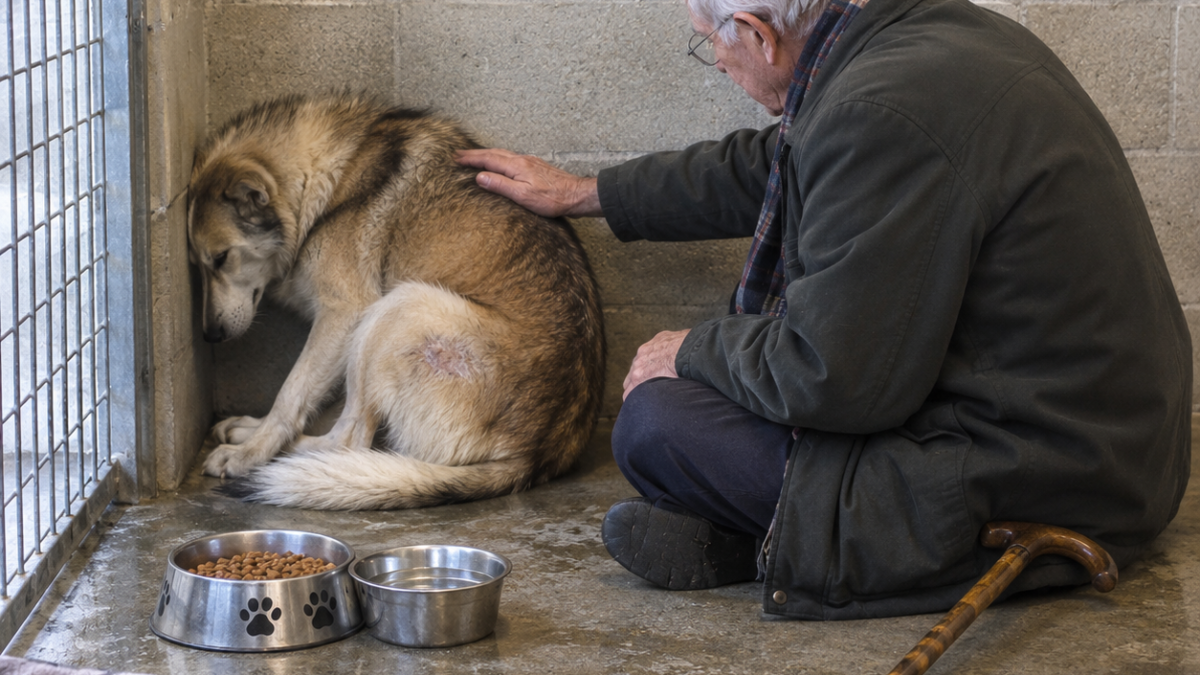
—
Sophie eventually gave me the records they had.
Not because I asked for confidential information.
Because if I was seriously considering adoption, she wanted me to understand what they knew.
Oslo had been found by police responding to a report about an abandoned warehouse.
The business renting the property had shut down unexpectedly.
Someone heard barking inside.
When officers entered, they found Oslo locked in a concrete storage room.
No bed.
No window at dog height.
An empty water bucket.
A chain attached to a wall ring.
Food scattered on the ground.
The shelter estimated he’d been alone several days.
Maybe longer.
My eyes stopped at one sentence.
Dog initially refused to leave wall area after chain removal.
I read it twice.
That explained something.
Not everything.
But something.
“The wall was where he was chained?”
Sophie nodded.
“Probably most of the time.”
“Who owned him?”
“Microchip was never updated. The original registered owner sold him years ago.”
“To who?”
“We don’t know.”
“The warehouse company?”
“Maybe.”
“Did police investigate?”
“Yes.”
“And?”
“Business owner claimed the dog belonged to a former employee. Former employee denied it. Nobody produced records.”
I hated that.
People become very forgetful when responsibility arrives.
“What was he used for?”
“We think guard work.”
I looked toward Oslo.
He was sleeping beside the back wall.
One ear twitched at voices.
Guard dog.
People hear those words and picture something tough.
Teeth.
Barking.
Aggression.
They don’t picture a frightened animal chained to concrete after the business closes.
Sophie added:
“He reacts badly to shouting, metal impacts, and sudden raised hands.”
My stomach tightened.
“How badly?”
“He shuts down.”
“Not aggression?”
“No. He freezes.”
That told me more than I wanted to know.
—
For two weeks, I visited every day.
I never touched him without invitation.
The first physical contact happened on day twelve.
I was sitting sideways, reading the sports section.
Oslo stood.
Walked toward me.
Stopped.
Then lowered his head until his forehead touched my elbow.
That was it.
One second.
Then two.
I slowly turned my hand over, palm upward.
He sniffed it.
I didn’t reach.
Finally, Oslo moved his muzzle under my fingers himself.
Permission.
I touched him behind one ear.
His entire body trembled.
I almost stopped.
Then he leaned in.
Not much.
Enough.
“Okay.”
My voice came out rough.
“We can do that.”
He closed his eyes.
I scratched gently.
Six seconds later, he walked away.
I let him.
That afternoon, when I returned home, the house felt more silent than usual.
For the first time in six years, I noticed the silence rather than hiding inside it.
—
Claire came with me that weekend.
She stood outside the kennel while I sat with Oslo.
He was closer now.
Not touching me.
But within arm’s reach.
Claire’s eyes filled.
“Don’t.”
She laughed softly.
“I didn’t say anything.”
“You’re making a face.”
“What face?”
“The Madeleine face.”
My wife’s name made the air shift.
Claire looked down.
“What does that mean?”
“Your mother used to look at me like that when she’d already decided something and was waiting for me to catch up.”
Claire smiled.
“Maybe she was usually right.”
“Occasionally.”
“Papa.”
“Frequently.”
Oslo lifted his head at my voice.
Claire crouched.
“Can I come in?”
I looked at Sophie.
Sophie looked at Oslo.
“Slowly.”
Claire entered and sat near the door.
She didn’t approach him.
Good girl.
I’d raised her well.
For fifteen minutes, Oslo ignored her.
Then he sniffed the air.
After another five, he walked halfway toward her.
Stopped.
Claire whispered:
“Hello, Oslo.”
He returned to me.
She looked offended.
“I drove you here.”
“He respects rank.”
“You’ve been retired for twenty years.”
“Rank is eternal.”
For the first time in a very long while, I laughed hard enough that my stomach hurt.
Oslo startled.
Then, unexpectedly, his tail moved.
One wag.
Claire saw it.
I saw it.
Neither of us said anything.
Some moments become smaller when you name them too quickly.
—
The shelter required several steps before adoption.
Home visit.
Veterinary plan.
Trial walks.
A discussion about Oslo’s behavior.
Sophie was careful.
“He isn’t a therapy dog.”
“I know.”
“He may never be comfortable with crowds.”
“Neither am I.”
“He may always react to certain noises.”
“So do I.”
“He needs patience.”
“So do I.”
She studied me.
“You’re using yourself as an argument.”
“Is it working?”
“A little.”
The first walk outside the shelter nearly ended the whole idea.
Oslo froze at the exit.
One paw over the threshold.
Then nothing.
Cars passed beyond the fence.
A metal gate slammed somewhere.
He backed up.
I didn’t pull the leash.
Sophie waited.
Five minutes.
Ten.
I sat down on a bench near the doorway.
“We don’t have to.”
Oslo watched me.
A volunteer opened another gate across the yard.
Clang.
Oslo flinched violently.
Then moved toward me.
He pressed his shoulder against my knee.
My bad knee.
I didn’t care.
“Okay.”
We sat.
Eventually, he stepped outside.
Not because I dragged him.
Because he chose to.
We walked twelve meters.
Returned.
Sophie smiled.
“That’s enough for today.”
It was.
—
The trial adoption began three weeks after I first saw him.
Claire drove us home.
Oslo sat in the back seat.
He didn’t lie down.
He watched everything.
Trees.
Cars.
Reflections.
Every red light made him tense.
When we reached my house, he refused to get out.
I opened the door.
Waited.
Claire said:
“Should we carry him?”
“No.”
“He’s been sitting there ten minutes.”
“He waited three months in a shelter.”
“Fair.”
I sat on the front steps.
After another seven minutes, Oslo climbed out.
He approached the house.
Stopped at the doorway.
Again.
Thresholds.
I entered first.
Then sat on the hallway floor.
Claire sighed.
“Your knee.”
“My knee has survived worse.”
“You’re impossible.”
“So I’ve been told.”
Oslo stepped inside.
One paw.
Then another.
He immediately found the nearest wall.
My chest tightened.
He stood facing it.
Old habit.
Safe habit.
I didn’t tell him to stop.
Instead, I sat on the floor beside him.
Facing the wall.
Claire watched us from the doorway.
Two ridiculous old soldiers.
One human.
One dog.
Both pretending walls were enough.
After a while, Oslo turned around.
He walked into the living room.
That was how he entered my life.
—
The first night was difficult.
Every sound woke him.
Heating pipes.
A car door outside.
The refrigerator motor.
At midnight, he was still pacing.
I couldn’t sleep either.
I sat in my chair.
Oslo stood near the hallway.
“Bad night?”
He stared.
“Me too.”
I turned off the television.
Silence.
He walked toward me.
Stopped three feet away.
Lay down.
Not close enough to touch.
Close enough to stay.
At two in the morning, I woke in the chair.
Oslo was still there.
I went to bed.
He followed.
He did not enter the bedroom.
Instead, he slept in the doorway.
Guarding it, perhaps.
Or simply afraid to come farther.
In the morning, I found him in the exact same place.
“Coffee?”
He yawned.
“That’s a no.”
I made breakfast.
For the first time in years, I spoke aloud while eating.
Not because Oslo understood my complaints about the weather.
Because there was somebody in the room to complain to.
—
Our routines formed slowly.
Coffee at seven.
Oslo’s food at seven-ten.
Newspaper at eight.
Walk at nine if my knee cooperated.
At first, our walks barely reached the end of the street.
Oslo hated trucks.
He hated construction noise.
He hated men carrying long objects.
A broom once made him back into a hedge.
I put it down immediately.
“Fine.”
He watched me.
“No sweeping today.”
My house became slightly dirtier.
Worth it.
The bakery was four blocks away.
It took three weeks before Oslo made the entire trip.
The baker, Luc, saw us through the window.
“Well, André! You got a wolf.”
“He’s a dog.”
“He’s enormous.”
“That’s not the same thing.”
Luc came around the counter.
Oslo backed up.
I raised a hand.
“Slow.”
Luc stopped.
He crouched sideways.
Smart man.
“Hello, monsieur.”
Oslo stared.
Luc placed a tiny piece of plain chicken on the pavement.
Then went back inside.
Oslo waited until he was gone.
Ate it.
The next day, same thing.
By the seventh visit, Oslo approached the bakery window on his own.
Luc pointed from behind the glass.
“He only likes me for chicken.”
“So do most people.”
—
My daughter noticed changes before I did.
One Sunday she came for lunch.
“You opened the curtains.”
I looked at the windows.
“So?”
“You haven’t opened those in years.”
“I open them.”
“No, you tilt them.”
“What’s the difference?”
“Sunlight.”
Oslo was asleep in a bright rectangle on the floor.
I shrugged.
“He likes the sun.”
Claire smiled.
Later she found my walking shoes by the door.
“You’re going out every day?”
“Mostly.”
“How far?”
“Depends on Oslo.”
“Not your knee?”
“Also the knee.”
She looked toward him.
“He’s good for you.”
I stiffened.
People saying that made me defensive.
Oslo wasn’t medicine.
He wasn’t a treatment plan.
He wasn’t Madeleine’s replacement.
Claire saw my expression.
“I didn’t mean he fixed you.”
“Good.”
She sat beside me.
“I mean you’re showing up for things again.”
That was harder to argue with.
I looked at Oslo.
He was dreaming.
One paw moved against the floor.
“He shows up too.”
—
Then came our first thunderstorm.
I heard it before Oslo did.
A low roll beyond the hills.
My body recognized it faster than thought.
Shoulders tight.
Jaw clenched.
The room suddenly too small.
Another rumble.
Closer.
Oslo stood.
His ears flattened.
I saw myself in him.
He looked toward the hallway.
Then the wall.
Thunder cracked.
He ran.
Not outside.
Into the small storage room beside the kitchen.
I followed.
Oslo was pressed into the corner, trembling.
Then another thunderclap exploded overhead.
My own heart kicked violently.
For a second, the room disappeared.
Not literally.
That would be easier to explain.
But I wasn’t entirely in my house anymore.
There are sounds that open old doors in the mind.
You don’t choose them.
My hands began shaking.
Oslo looked at me.
I looked at him.
Two frightened creatures in a storage room.
I laughed once.
It wasn’t funny.
“All right.”
I lowered myself to the floor.
My knee screamed.
“Looks like we’re doing this together.”
I didn’t touch him.
Thunder.
Oslo trembled.
So did my hands.
I put my palms flat against the floor.
Concrete.
Wood.
House.
France.
Now.
Not then.
I said the words quietly.
“We’re here.”
Oslo’s eyes stayed on me.
“House.”
Thunder.
“Kitchen.”
My breathing slowed slightly.
“You.”
He moved one paw.
“Me.”
Another crack.
Oslo came forward.
He pressed his chest against my shoulder.
I froze.
Then slowly put one arm around him.
His heart was racing.
So was mine.
We sat there until the storm passed.
Neither of us cured.
Neither of us brave.
Just not alone.
That night, Oslo slept beside my bed instead of in the doorway.
—
Weeks became months.
The shelter completed the adoption.
Officially.
Claire brought champagne.
I told her that seemed excessive.
She brought it anyway.
Sophie visited.
Oslo greeted her at the door.
Not with wild excitement.
With a careful tail wag.
Sophie cried.
She denied it.
“Dust,” she said.
“In my hallway?”
“Very dusty house.”
“I stopped sweeping because of him.”
“Clearly.”
We drank one glass each.
Oslo received a new toy.
A rabbit.
Almost identical to the old one.
He ignored it and carried the old faded rabbit to his bed.
Some things are not improved by replacement.
I understood that.
Madeleine’s cup was still in the kitchen cabinet.
I never used it.
I never threw it away either.
—
Oslo’s past remained incomplete.
Until a photograph changed it.
The shelter posted an adoption update online.
Nothing dramatic.
Just Oslo lying in my garden with his old rabbit beside him.
A week later, Sophie called.
“André, someone recognized him.”
My stomach tightened.
“Who?”
“A man named Karim Bensaïd. He says he worked at the warehouse where Oslo was found.”
I stopped.
“What does he know?”
“He wants to speak to us.”
“Us?”
“You don’t have to come.”
“I’ll be there.”
Karim was forty-something, nervous, and ashamed before he said a word.
We met at the shelter.
The moment Sophie showed him Oslo’s file photograph, he nodded.
“That’s Rex.”
I hated the name immediately.
“Rex?”
“That’s what the owner called him.”
“Owner?”
Karim looked down.
“My former boss.”
The warehouse company had belonged to a man named Bernard Laville.
Security equipment.
Industrial materials.
Cash problems.
Labor disputes.
And a dog.
Oslo.
Or Rex, back then.
“He bought him for security,” Karim said.
“From who?”
“Somebody online. I don’t know.”
“How did he treat him?”
Karim didn’t answer.
I leaned forward.
“How?”
“He kept him chained in the back storage room during the day.”
“And at night?”
“Sometimes outside.”
“Food?”
“Workers fed him.”
“Bernard?”
“Rarely.”
“Why the wall?”
Karim looked confused.
“What?”
“At the shelter, he faced walls.”
Karim’s face changed.
Then I knew I didn’t want the answer.
“Bernard punished him by chaining him short.”
My hands tightened around my cane.
“For what?”
“Barking too much. Not barking enough. Getting excited. Whatever mood Bernard was in.”
Sophie went very still.
Karim continued.
“Sometimes he’d make the chain so short the dog had to stay right beside the wall.”
My jaw clenched.
“He hit him?”
A long silence.
“Yes.”
I stood.
Too quickly.
My knee nearly gave.
Sophie reached for my arm.
“André.”
I walked to the window.
I wanted Bernard Laville’s address.
I wanted to see his face.
I wanted sixty seconds alone with him.
Seventy-four years old or not.
Some instincts don’t age.
Karim said behind me:
“I should have done something.”
I turned.
He looked miserable.
“You did nothing?”
“I fed the dog.”
“That isn’t what I asked.”
“No.”
“Why?”
“I needed the job.”
Anger rose.
Then I remembered all the times fear had made me silent about things I should have said.
Not the same.
But enough to stop me from enjoying his shame.
“Why talk now?”
“Because I thought the dog died when the business closed.”
I looked at him.
“And now?”
“I saw the picture.”
He swallowed.
“He looked different.”
“How?”
“Like a dog.”
That sentence broke through my anger.
Like a dog.
Not equipment.
Not security.
Not a chained alarm system.
A dog.
Karim handed Sophie a folder.
“I kept some things when the company shut down.”
Employment records.
Messages.
Photographs from the warehouse.
One showed Oslo chained beside the wall.
Another showed his food bowl.
Another accidentally captured Bernard in the background holding the chain.
There were text messages too.
One from Bernard to Karim:
Don’t feed the dog until night. He needs to stay sharp.
Another:
If he keeps whining, shorten the chain.
Sophie stopped reading.
“We need to give these to the authorities.”
Karim nodded.
“That’s why I came.”
—
I drove home furious.
Oslo met me at the door.
He carried the rabbit.
I stared at him.
He stopped.
Something in my face worried him.
He lowered his head.
Instantly, I hated myself.
Not because I’d done anything.
Because my anger had entered the house before I did.
I put my cane down.
Kneeled as far as my knee allowed.
“Not you.”
Oslo watched.
“Never you.”
He came closer.
I put one hand against his chest.
His heart was steady.
Mine wasn’t.
That evening, I sat in Madeleine’s chair.
I hadn’t sat there since she died.
Oslo lay beside me.
I thought about revenge.
I won’t lie and pretend I was above it.
I wanted Bernard frightened.
I wanted him chained to something.
I wanted him to understand helplessness.
But cruelty doesn’t become justice because you aim it at someone who deserves consequences.
I knew that.
Even angry.
So I did the harder thing.
I called Sophie.
“What do the police need?”
—
The investigation reopened.
Karim gave a formal statement.
Two other former workers eventually came forward.
One had video.
Short.
Ugly.
Bernard shouting.
Oslo backing against a wall.
A chain jerking tight.
No dramatic beating caught on film.
Just enough.
Enough to establish treatment.
Enough combined with veterinary records.
Enough with the abandonment.
The company closure had happened fast.
Bernard claimed he’d assumed an employee would take the dog.
The employee denied ever agreeing.
Records showed Bernard had visited the property after everyone else left.
Oslo was still there.
Then Bernard left.
The dog remained chained.
That detail mattered.
A lot.
I didn’t follow every legal step.
I didn’t want Bernard living inside my head.
But Sophie kept me informed.
Charges related to abandonment and animal mistreatment moved forward.
There were fines.
Court dates.
Arguments.
Bernard’s attorney described Oslo as a “working security animal.”
I nearly broke my television when I heard that.
Working animal.
As though work erased pain.
As though usefulness excused anything.
Claire took the remote from me.
“Papa.”
“He called him equipment.”
“He called him an animal used for security.”
“Same thing.”
Oslo raised his head.
Claire lowered her voice.
“Don’t let that man upset the dog in his own house.”
That stopped me.
His own house.
Yes.
Bernard had already occupied too much space.
I turned off the television.
We went for a walk.
—
The court process wasn’t the biggest crisis.
That came on July 14.
Bastille Day.
Fireworks.
I had forgotten how close the neighborhood celebration would be.
The first explosion came at 10:17 p.m.
Oslo was in the garden.
He bolted toward the door.
I opened it.
Another explosion.
Bigger.
The sound hit me too.
My chest seized.
Oslo ran through the kitchen.
A third blast.
The front door had not fully latched after Claire left earlier.
Oslo hit it.
The door opened.
He disappeared.
“Oslo!”
I ran.
Or tried to.
My knee failed at the front steps.
I caught the railing.
Fireworks exploded above the houses.
Red.
White.
Noise.
Too much noise.
For half a second, my body wanted to do what it had done for decades.
Find cover.
Close down.
Wait for danger to stop.
Then I saw the open gate.
Oslo.
I grabbed my cane and went.
—
Claire arrived twenty minutes later.
So did Sophie.
We searched streets.
Gardens.
Alleys.
The bakery.
The park.
I called his name until my throat hurt.
Fireworks continued.
Every explosion made my hands tremble.
Claire kept asking:
“Are you okay?”
“No.”
That was the truth.
“Can you keep going?”
“Yes.”
That was also the truth.
We found no sign.
At midnight, police had been notified.
At one, volunteers were searching.
At two, rain began.
I refused to go home.
Claire finally shouted:
“You’ll collapse before we find him!”
“I am not leaving him out here.”
“You can barely walk.”
“He spent months facing a wall because people left him alone!”
The words came out too loud.
Claire froze.
So did I.
I lowered my voice.
“I am not doing it again.”
She stepped closer.
“Then neither am I.”
We kept searching.
At 3:40 a.m., Sophie received a call.
A sanitation worker had seen a large dark dog near an old railway underpass.
Three kilometers away.
I was in the car before she finished speaking.
—
We found Oslo beneath the underpass.
There was a concrete retaining wall.
He was pressed against it.
Facing it.
Exactly as he had been at the shelter.
My heart broke.
“Oslo.”
He didn’t move.
Claire whispered:
“Papa, don’t rush him.”
I knew.
I approached until I was about fifteen feet away.
Then I stopped.
My clothes were wet.
My knee felt like broken glass.
I lowered myself to the ground.
Facing the wall.
Again.
Just like the first day.
Sophie started crying behind us.
I ignored her.
“Hello, old friend.”
Oslo’s ears moved.
Fireworks were distant now.
A few final booms.
He trembled.
“So.”
I looked at the concrete.
“We’re back to walls.”
Nothing.
I put my cane beside me.
“I don’t blame you.”
Oslo turned his head slightly.
I saw one eye.
“That’s better.”
He looked away again.
I waited.
Five minutes.
Ten.
Rainwater dripped from the edge of the bridge.
My knee went numb.
Then I heard claws.
One step.
Pause.
Another.
I didn’t turn.
Something touched my shoulder.
Oslo’s nose.
I closed my eyes.
“Found you.”
His head pressed against the side of mine.
I put one hand slowly over his neck.
He collapsed against me.
And for the first time that entire night, both of us stopped shaking.
—
After that, something changed.
Not magically.
He didn’t stop fearing fireworks.
I didn’t stop reacting to sudden explosions.
Healing is not a door you walk through and lock behind you.
But Oslo stopped facing walls as often.
And I stopped pretending that surviving something meant I had to be unaffected by it forever.
Claire convinced me to attend a veterans’ support group.
I’d refused for years.
“I don’t need to sit in a room talking about the past.”
“You sit in a room talking to a dog.”
“He’s a good listener.”
“So are some veterans.”
“Debatable.”
She won.
The first meeting, Oslo came only as my companion, not as any certified service animal.
He stayed beneath my chair.
I said almost nothing.
The second meeting, a man named Lucien talked about waking at night with his boots on.
I looked up.
That sounded familiar.
At the fourth meeting, I spoke.
Not much.
Enough.
Oslo rested one paw on my shoe.
A man across from me noticed.
He didn’t smile.
He just nodded.
That was better.
—
The case against Bernard concluded months later.
He didn’t go to prison for years.
Real life rarely provides punishments dramatic enough to satisfy anger.
But he was convicted on animal cruelty and abandonment-related charges.
He received a substantial fine.
A suspended sentence with conditions.
And, most importantly to me, a prohibition from owning or keeping animals for a lengthy period under the court’s order.
The authorities also examined another property connected to him.
They found two neglected dogs belonging to an associate.
Those dogs were removed and later rehomed.
When Sophie told me, I sat quietly.
“That’s it?” she asked.
“What do you mean?”
“You’ve been waiting months.”
I thought about Bernard.
Then Oslo.
“Yes.”
“That’s it?”
“Yes.”
I expected triumph.
Instead, I felt tired.
“Are you disappointed?”
“No.”
I looked at Oslo sleeping beside the radiator.
“I thought revenge would feel louder.”
Sophie smiled sadly.
“What does it feel like?”
“Like he doesn’t get Oslo back.”
That was enough.
Bernard had spent years deciding where Oslo stood.
When he ate.
When he barked.
How far his chain reached.
Now he couldn’t decide anything about him.
Not one step.
Not one meal.
Not one nap.
That was justice I could understand.
—
A journalist called after the case.
I refused.
Another called.
I refused again.
Then Claire said:
“You might help people understand why scared dogs need time.”
“I don’t want Oslo turned into a spectacle.”
“Then don’t make him one.”
So I agreed to one interview.
At my house.
No dramatic photographs.
No forcing Oslo to pose.
The reporter asked:
“Why do you think he trusted you?”
“I didn’t ask him to.”
She waited.
I continued.
“Everyone who met him wanted him to turn around. Look at them. Take food. Accept affection. Show progress.”
“And you didn’t?”
“No.”
“Why?”
I looked at Oslo.
“Because I knew what it was like when people needed you to recover for them.”
She stopped writing for a second.
That quote appeared in the article.
I wasn’t thrilled.
But letters came afterward.
From veterans.
Widows.
Shelter volunteers.
People with frightened dogs.
People who had been told they should be “over” something by now.
One letter came from a woman in Lyon.
Her husband had died.
She wrote:
I realized I have been angry with myself for still facing my own wall.
I kept that letter.
—
Oslo’s world continued expanding.
He learned to enjoy the park.
Not crowded afternoons.
Early mornings.
He loved cold weather.
Hated rain.
He liked Luc at the bakery.
Eventually.
The first time Oslo allowed Luc to touch him, Luc came inside afterward and announced to everyone:
“I have been accepted.”
I said:
“Don’t become arrogant.”
Luc gave Oslo two pieces of chicken.
Traitor.
At home, Oslo developed a ridiculous habit of carrying his stuffed rabbit from room to room.
Kitchen.
Living room.
Bedroom.
Garden.
One morning I found the rabbit in Madeleine’s chair.
I stared at it.
Then Oslo.
“Really?”
He wagged once.
I sat in the chair.
Oslo lay at my feet.
For years, I had avoided that chair because grief made objects sacred in strange ways.
That morning I drank coffee there.
Nothing terrible happened.
Madeleine remained dead.
I remained alive.
Both facts could exist in the same room.
That was another thing Oslo taught me.
Moving forward is not the same as leaving someone behind.
—
On the anniversary of Madeleine’s death, I normally visited the cemetery alone.
That year, Oslo came.
I sat beside the grave.
He lay in the grass.
“You would have liked him.”
Oslo sniffed a flower.
“Maybe too much.”
A breeze moved through the trees.
“I know what you’d say.”
I could almost hear my wife.
André, you spend six years refusing company and then choose the largest, most emotionally complicated dog in France.
I smiled.
Oslo looked up.
“She was funny.”
He put his head on my knee.
For the first time since Madeleine died, I stayed at the cemetery without feeling like I wanted to disappear into the ground beside her.
I was sad.
Deeply.
But sadness was no longer the only thing in me.
There was also a dog impatient for lunch.
Life is rude that way.
It keeps asking for ordinary things.
Food.
Walks.
Medicine.
Doors opened.
And sometimes ordinary demands save you.
—
A year passed.
Then another.
Oslo became known at the shelter.
Not as the dog who faced the wall.
As André’s dog.
I volunteered there twice a week.
Mostly sitting with fearful dogs.
Sophie joked:
“Your official position is Furniture.”
“Good. I have experience.”
I never forced interaction.
I sat.
Read.
Waited.
Sometimes nothing happened.
That was fine.
One afternoon, a small brown dog named Miette spent two hours under a bench while I read the newspaper.
A young volunteer asked:
“Do you think this is working?”
I said:
“Stop needing it to work.”
She frowned.
Twenty minutes later, Miette came out.
Not to me.
To drink water.
The volunteer smiled.
I whispered:
“That counts.”
Oslo sometimes waited outside the kennel with Sophie.
He was calm around many dogs now.
Not all.
Again, no miracles.
Just choices becoming easier.
—
Then Bernard came back into our lives once more.
Not directly.
His lawyer sent a letter arguing over property ownership connected to old company equipment, including Oslo’s original microchip registration and veterinary expenses.
Legally, it went nowhere.
Oslo’s adoption had been completed properly.
The court orders were clear.
But seeing Bernard’s name on an envelope brought back anger I thought I’d put down.
“He wants him?”
Claire asked.
“No.”
“Then what?”
“Control.”
I tore the letter in half.
Then stopped.
Made myself tape it back together because Sophie said legal documents should not be destroyed.
Claire laughed so hard she had to sit down.
“Very mature.”
“I was making a point.”
“To paper?”
“It knew what it did.”
The matter disappeared after one response from the shelter’s legal representative.
That was the last attempt Bernard ever made.
And I realized something.
The old version of me would have spent weeks thinking about it.
Planning arguments.
Imagining confrontations.
This time?
I took Oslo to the park.
He rolled in something disgusting.
My entire emotional universe shifted immediately.
“Oslo!”
He looked delighted.
“You are seventy pounds of betrayal.”
He rolled again.
Bernard vanished from my mind.
That was freedom.
—
By my seventy-seventh birthday, Oslo’s muzzle was almost completely white.
Mine too.
Claire took a photograph of us on the garden bench.
I looked at it afterward.
“You made me look old.”
“You are old.”
“You’re no longer in the will.”
“You say that every year.”
Oslo sat between us.
Claire kissed his head.
“He’s old too.”
“Don’t tell him.”
Oslo sneezed.
We had a quiet dinner.
Luc came from the bakery with a cake.
Sophie brought wine.
Two men from the veterans’ group joined us.
My house had eight people inside it.
Eight.
For years, I had avoided having more than Claire over.
At one point, a glass fell in the kitchen.
It shattered.
My body reacted.
Shoulders tight.
Breath stopped.
But I didn’t leave.
Oslo stood.
Looked at me.
I touched his back.
“Glass.”
He leaned into me.
“Kitchen.”
My breathing steadied.
“Home.”
Then Luc shouted:
“Don’t move! Nobody step on it!”
Normal.
Just broken glass.
I helped sweep after Oslo went into the other room.
Later, I realized Claire had been watching me.
She didn’t say anything.
Good girl.
—
There was one question reporters and strangers kept asking.
“Who rescued whom?”
I hated it.
Too neat.
People like symmetry.
Old veteran saves traumatized dog.
Traumatized dog saves old veteran.
A perfect circle.
Life isn’t that clean.
Oslo didn’t rescue me.
I didn’t rescue Oslo alone.
Sophie rescued him.
Police rescued him.
Workers who eventually spoke rescued him.
Claire helped rescue both of us from our routines.
A veterinarian treated him.
A court protected him.
I gave him a house.
He gave me companionship.
We both did the rest badly, slowly, inconsistently.
Some nights I still woke sweating.
Some storms still sent Oslo under a table.
Sometimes I wanted silence.
Sometimes he wanted the wall.
The victory wasn’t that those things vanished.
The victory was that neither of us had to face them alone.
—
Three years after adoption, the shelter renovated the old kennel wing.
Sophie called.
“We’re taking down Oslo’s wall.”
I understood immediately.
The final kennel.
Concrete partitions.
Everything was being rebuilt.
“Do you want a piece?”
“That sounds ridiculous.”
“I know.”
“Yes.”
She laughed.
I kept a small square of concrete.
Claire thought I’d lost my mind.
“What are you going to do with it?”
“I don’t know.”
Eventually, Luc’s brother, who worked with stone, smoothed one side and mounted it onto a wooden base.
I had a small metal plate attached.
It read:
A WALL ASKS NOTHING.
BUT SOMETIMES SOMEONE WILL SIT BESIDE YOU UNTIL YOU’RE READY TO TURN AROUND.
I put it in the shelter lobby.
Not my house.
It belonged there.
—
The most unexpected chapter began with a teenager named Mathieu.
Sixteen.
His father had served in the military.
His father had also died by suicide.
Mathieu stopped speaking much afterward.
Claire knew his aunt.
She asked if bringing him to the shelter might help.
I nearly refused.
I was not a therapist.
Oslo was not a therapy dog.
Then I remembered the first day.
Nobody needed to perform a role.
So Mathieu came.
He didn’t want to talk.
Fine.
We went to the shelter.
A frightened dog named Paco was hiding in the back of a kennel.
Mathieu stood at the gate.
“What am I supposed to do?”
“Nothing.”
He looked at me.
“Seriously?”
“I’m very experienced at nothing.”
I entered.
Sat facing the wall.
Mathieu almost smiled.
Then he sat beside me.
For thirty minutes, Paco didn’t move.
Mathieu said quietly:
“What’s the point?”
“No point.”
“That doesn’t make sense.”
“Most useful things don’t at first.”
Ten minutes later, Paco sniffed Mathieu’s shoe.
The boy froze.
I whispered:
“Don’t ruin it.”
He stayed still.
Paco sniffed again.
Mathieu’s eyes filled.
He looked at me.
I looked at the wall.
Privacy matters.
After that, Mathieu came back every Saturday for months.
He eventually began talking.
Not to me first.
To Paco.
That seemed right.
—
Oslo grew slower.
Not sick.
Old.
His hips stiffened.
We shortened walks.
The bakery became our main destination again.
Luc always had chicken ready.
“You’re spoiling him.”
“He has suffered.”
“That excuse expired three years ago.”
“Suffering has no expiration date.”
Oslo agreed with Luc.
Naturally.
At home, I built a small ramp for the back steps.
Oslo refused to use it.
He preferred taking each stair carefully.
“Stubborn.”
He looked at me.
“Yes. Both of us.”
Eventually, on bad days, he accepted the ramp.
So did I.
Claire installed a handrail beside it.
We became a highly efficient old-man-and-old-dog transportation system.
—
One autumn morning, Sophie called and asked whether I could come to the shelter.
A new dog had arrived.
Large shepherd mix.
Female.
Terrified.
Facing the wall.
I almost laughed at the cruelty of coincidence.
Oslo came with me.
We stood outside the kennel.
The female never turned.
A volunteer asked:
“What should we do?”
I opened the gate.
Sat down carefully.
Facing the wall.
Oslo remained outside with Sophie.
For twenty minutes, nothing happened.
Then I heard movement.
Not the dog.
Oslo.
He had walked into the kennel.
Sophie hadn’t stopped him because the female showed no aggression.
Oslo passed me.
Slowly.
He approached the back corner.
Not too close.
Then lay down.
Facing the wall too.
My throat tightened.
The female’s ear moved.
Oslo rested his chin on his paws.
No pressure.
No demand.
No miracle.
Just company.
I looked toward Sophie.
She had tears in her eyes.
“Dust?” I asked.
“Shut up, André.”
I smiled.
—
That dog was eventually adopted.
Months later.
Not because Oslo magically transformed her.
Because many patient people gave her enough time to decide the world might contain something besides danger.
That distinction mattered.
I told the volunteers often:
“Don’t turn patience into another deadline.”
If a dog took two days, fine.
Two months, fine.
Progress was not owed to us.
Trust was a gift.
—
Bernard Laville eventually faded into irrelevance.
I heard he left the region.
I never searched for him.
Never asked where.
That was intentional.
For a while, I had imagined revenge as making him see Oslo.
I wanted to stand in front of him with this healthy, loved dog and say:
Look.
Look at what you tried to break.
But years later, I realized Bernard didn’t deserve an audience with Oslo.
He didn’t deserve to use even Oslo’s recovery as another experience centered around himself.
The best revenge was absence.
He had become unnecessary.
Oslo had a life completely unrelated to him.
Breakfast.
Walks.
The bakery.
My garden.
Thunderstorms survived together.
Claire’s visits.
Sophie.
Old veterans.
Afternoons sleeping near my chair.
Bernard was not part of any of it.
A man who once controlled the length of Oslo’s chain had become someone Oslo never needed to see again.
That was satisfying enough.
—
One winter evening, snow began falling.
Rare enough around us that I stood by the window watching.
Oslo was asleep.
I opened the back door.
Cold air entered.
He woke.
“Come see.”
He approached the threshold.
Snow covered the garden.
For a moment, Oslo hesitated.
Then stepped outside.
His paws sank slightly.
He sniffed.
Looked at me.
Then did something I had never seen him do.
He ran.
Not fast.
His hips were too old.
But he ran across the garden.
Turned.
Ran back.
Then lowered his front half and jumped sideways like a puppy.
I laughed so loudly Claire later told me she heard me from the driveway.
Oslo pushed his nose into snow.
Sneezed.
Ran again.
No chain.
No wall.
No command.
No purpose.
Just movement.
I stood in the doorway and cried.
I wasn’t ashamed.
At seventy-eight, you begin conserving embarrassment for things that actually matter.
Claire came through the gate.
“What happened?”
I pointed.
Oslo ran another crooked circle.
She started crying too.
“Don’t.”
“You’re crying.”
“Snow in my eyes.”
“It’s not snowing under the porch.”
“Very aggressive snow.”
We laughed.
Oslo barked.
A real bark.
Loud.
Joyful.
Then looked surprised at himself.
That became one of my favorite memories.
—
People assume the opposite of fear is courage.
I’m not sure.
For Oslo, I think the opposite of fear was choice.
Choosing to look.
Choosing to approach.
Choosing to leave a doorway.
Choosing to sleep without watching the room.
Choosing to bark.
Choosing to run through snow.
For me, maybe it was the same.
Choosing to attend dinner even if a dropped plate might trigger me.
Choosing to talk in the veterans’ group.
Choosing to sit in Madeleine’s chair.
Choosing to open the curtains.
Choosing company.
Not because fear disappeared.
Because choice grew larger around it.
—
By the time I turned seventy-nine, Oslo had arthritis.
So did I.
We took medication together.
Mine with coffee.
His hidden in cheese.
“You get the better system.”
He swallowed the cheese.
“I have to taste my pills.”
Oslo demanded another piece.
“No.”
He stared.
“That’s manipulation.”
Stare.
“One.”
I gave him another.
We were both weak.
—
Our walks shortened to the bakery and back.
Some mornings even that was too much.
Then Luc began delivering bread.
“I don’t need delivery.”
“It isn’t for you.”
He handed Oslo chicken.
Traitor.
On warm afternoons, Oslo slept in the garden.
I read beside him.
Sometimes I stopped reading and simply watched his chest rise and fall.
Age makes you notice breathing.
Maybe because you understand its temporary nature more honestly.
I knew our time wasn’t infinite.
That didn’t make it less good.
It made ordinary afternoons brighter.
—
One evening, thunder rolled in the distance.
Oslo lifted his head.
I felt my own shoulders tighten.
We looked at each other.
“Storage room?”
He stood.
We walked there together.
Not running anymore.
Just walking.
I sat on the floor.
Much harder at seventy-nine.
Oslo lowered himself beside me.
Thunder.
His body tensed.
My hand shook slightly.
I rested it against his shoulder.
“We’re here.”
His eyes closed.
“House.”
Another rumble.
“Kitchen.”
Oslo exhaled.
“You.”
I smiled.
“Me.”
We had said those words for years.
Not magic.
A map.
A reminder.
The storm passed.
Eventually they all do.
—
Oslo never became fearless.
I never became unbroken.
I’m glad.
Not glad for what happened to either of us.
But glad our ending didn’t require pretending damage had disappeared.
Scars remained.
His shoulder.
My memories.
His fear of sudden hands.
My reaction to explosions.
His bad hip.
My bad knee.
Our life had room for all of it.
That’s what healing became.
Not erasure.
Room.
—
The last time I visited the shelter with Oslo before his age made the trip too tiring, we stopped near the lobby display.
The piece of wall.
The plaque.
A young couple was reading it.
They had a frightened dog with them.
Small.
White.
Hiding behind the woman’s legs.
The man read the words aloud:
“A wall asks nothing. But sometimes someone will sit beside you until you’re ready to turn around.”
He noticed me.
“Do you know the story?”
I looked at Oslo.
He was sniffing the floor.
“Yes.”
“Was it your dog?”
“Yes.”
The woman crouched beside hers.
“How long did it take?”
There was the question.
The dangerous one.
People always want a timetable.
I smiled.
“It took as long as it took.”
She nodded slowly.
Then stopped trying to coax her dog out.
She simply sat beside him.
Good.
—
That afternoon, Oslo and I went home.
I made coffee.
He slept beside Madeleine’s chair.
Sunlight crossed the floor.
Nothing dramatic happened.
No court.
No fireworks.
No rescue.
No breakthrough.
And I realized this was the ending I had wanted all along.
Ordinary peace.
The thing both of us had been denied in different ways.
—
I sometimes think about the first day.
The last kennel.
The noise from the shelter hallway.
Metal bowls.
Barking.
Footsteps.
Oslo facing the wall.
Me standing outside wondering why looking at him felt like looking into a mirror I hadn’t asked for.
If Sophie had told me then what would happen, I wouldn’t have believed her.
That I would return the next morning.
That Oslo would eventually touch my elbow.
That I’d bring him home.
That we’d spend a thunderstorm shaking together in a storage room.
That I’d search through the night after fireworks sent him running.
That I’d find him beneath an underpass, facing another wall.
That I’d sit beside him exactly as before.
That workers would come forward and the person who mistreated him would finally lose the right to own animals.
That I’d start attending veterans’ meetings.
That I’d volunteer at the shelter.
That my curtains would open.
That my house would fill with people again.
That a frightened teenager would learn patience sitting beside another frightened dog.
That Oslo would run through snow like a puppy.
None of it would have sounded believable.
But the strangest part is this:
Nothing began with courage.
It began with refusing to demand courage from either of us.
—
People still occasionally call what happened between Oslo and me a rescue story.
That’s fine.
But if you want the truth, this is what I think happened.
A frightened dog sat facing a wall because people had taught him that walls were safer than faces.
An old man recognized the logic.
So instead of asking the dog to turn around, the old man sat down and faced the wall too.
That was all.
No command.
No treat.
No promise.
Just:
You don’t have to perform for me.
And apparently, for Oslo, that was enough to become curious.
Curiosity became a glance.
The glance became a step.
The step became trust.
Trust became home.
And home became years.
—
As for revenge?
Yes.
Oslo got it.
Not the kind I imagined when Karim showed me those photographs.
Bernard was punished.
He lost the legal right to control animals.
He paid fines.
His treatment of Oslo became part of a public record instead of disappearing quietly inside a warehouse.
Other neglected dogs were found because people finally spoke.
That mattered.
But Oslo’s real revenge happened every morning after.
Bernard shortened his chain.
Oslo eventually wandered my garden without one.
Bernard used hunger as control.
Oslo spent his old age negotiating shamelessly for extra cheese.
Bernard punished noise.
Oslo learned to bark when he was happy.
Bernard left him facing concrete.
Oslo slept in sunlight.
Bernard treated him like security equipment.
Oslo became family.
Bernard made him afraid of human hands.
Oslo eventually fell asleep with his head inside mine.
And the man who once controlled Oslo’s whole world?
He became irrelevant to it.
That’s the kind of revenge I can live with.
—
One spring morning, Oslo woke before me.
I felt his nose against my hand.
I opened my eyes.
“Seven already?”
He stared.
I checked the clock.
6:41.
“You’ve become dishonest.”
Tail wag.
“Breakfast is at seven.”
Another wag.
“Military schedules matter.”
He put one paw on the mattress.
I laughed.
“All right.”
I got up slowly.
My knee hurt.
His hips were stiff.
We walked to the kitchen together.
Two old men pretending not to limp.
I prepared his food.
Made coffee.
Opened the curtains.
Sunlight entered.
Oslo ate.
I sat in Madeleine’s chair.
Outside, a bird landed on the garden fence.
Oslo noticed.
Watched it.
Then looked at me.
Not the wall.
Me.
Even after all those years, that still mattered.
“Good morning,” I said.
He walked over and lowered himself beside my chair.
I rested one hand on his back.
Nothing more was required.
Not from him.
Not from me.
And I think that was what both of us had been looking for from the beginning.
A place where love didn’t demand proof that we were healed.
A place where silence wasn’t abandonment.
A place where fear could exist without controlling every door.
A place where an old dog could finally turn away from the wall because he knew nobody behind him was going to hurt him.
A place where an old soldier could do the same.
Home.








