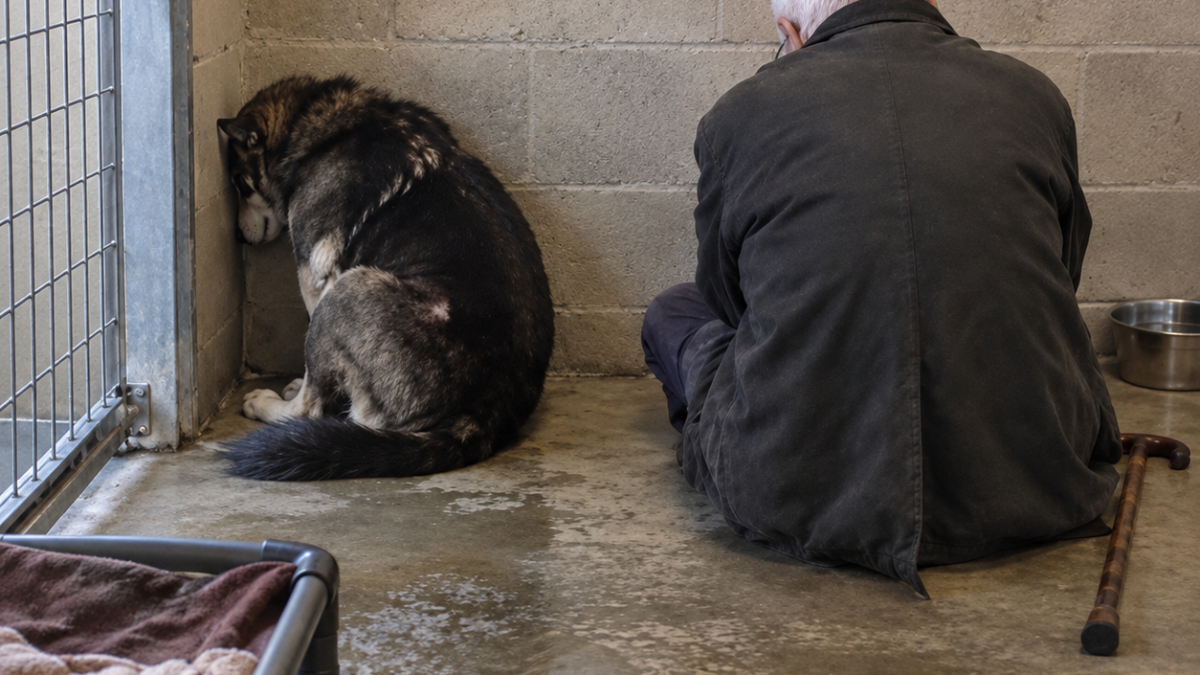
PART 2: The Shelter Dog Refused to Look at Anyone—Until a 74-Year-Old Veteran Sat Beside Him Facing the Same Wall
PART 2
“He has never protected anyone here.”
For several seconds, I thought Sophie might be exaggerating.
People do that around wounded animals.
They search for meaning because meaning hurts less than randomness.
But Sophie wasn’t smiling.
Her eyes were fixed on Oslo.
The dog remained pressed against me, every muscle rigid beneath his coarse gray fur.
He wasn’t growling at the volunteer.
He wasn’t trying to attack.
He was afraid.
That distinction mattered.
I had known frightened men who shouted.
I had known frightened men who became violent.
And I had known frightened men who quietly put themselves between danger and someone beside them because protecting another person felt easier than admitting they were terrified themselves.
Oslo was doing the third thing.
“Don’t touch him yet,” Sophie murmured.
“I wasn’t planning to.”
The volunteer slowly backed away.
The hallway settled.
Oslo kept staring through the gate.
Thirty seconds passed.
Then a minute.
Finally, his shoulders lowered.
His breathing changed.
He turned his head.
For the first time since I entered the kennel, he looked directly at me.
His eyes were brown.
From across the kennel they had seemed almost black.
Up close, they were the color of old chestnuts, with tiny gold flecks around the pupils.
My right hand trembled against my thigh.
Oslo noticed.
His nose moved.
He leaned forward.
I stayed still.
He sniffed my sleeve.
Then my wrist.
Then the back of my hand.
The instant his nose touched my skin, Claire made a sound behind the gate.
Half laugh.
Half sob.
I looked toward her.
“Don’t start.”
“I didn’t say anything.”
“You’re making the face.”
“What face?”
“The face your mother used to make when she knew she’d won an argument.”
Sophie laughed softly.
Oslo startled.
I turned back toward the wall.
A few seconds later, he did the same.
That was our first meeting.
Two damaged old creatures staring at concrete because neither of us was ready to look directly at what hurt.
When I finally tried to stand, my left knee refused.
I placed one hand on the floor.
Sophie moved toward the gate.
Oslo immediately stepped closer.
His shoulder touched my forearm.
Not enough to support me.
Just enough to be there.
I used the wall to push myself upright.
Once I was standing, Oslo backed away.
But he did not return to the far corner.
He stayed in the middle of the kennel.
Watching me.
I stepped outside.
Sophie locked the gate.
Claire waited exactly four seconds.
“So?”
“So what?”
“Dad.”
“We came to look.”
“Yes.”
“We looked.”
She crossed her arms.
“You sat with one dog for nearly half an hour.”
“My knee was stiff.”
“Of course.”
I walked down the hallway.
Three steps.
Maybe four.
Then I heard claws scrape behind me.
I turned.
Oslo had come to the gate.
He stood there with his nose between the bars.
Watching me leave.
I went home without him.
People like neat stories.
A lonely widower meets a traumatized dog.
They understand each other instantly.
The dog comes home.
Everybody cries.
Life improves.
Real life does not move that quickly.
Fear certainly doesn’t.
That night, I heated canned soup and cut two slices of bread.
Madeleine’s blue ceramic bowl still sat above the kitchen sink.
Her gardening gloves still hung in the utility room.
Her green coat remained on the second hook near the back door.
Six years after her death, I had changed almost nothing.
Grief can make a museum out of an ordinary house.
You tell yourself you are preserving memories.
Sometimes you are simply afraid that moving a coat means admitting its owner is never coming back.
I ate half the soup.
Turned on the television.
A detective show.
Someone slammed a door.
My shoulders jumped.
My heart accelerated.
I reached for the remote.
Then I remembered Oslo throwing himself between me and the kennel entrance.
“Ridiculous,” I muttered.
I switched off the television.
At 2:14 in the morning, I woke from a dream.
I couldn’t remember all of it.
Dust.
An engine.
A young man shouting.
The smell of burning rubber.
A name I had spent fifty years trying not to hear too clearly.
I sat on the edge of my bed.
Fully awake.
Hands trembling.
Usually, when that happened, I stayed there until my breathing slowed.
That night I thought about Oslo.
I wondered whether he also woke in darkness expecting something bad to happen.
At nine the next morning, I called the shelter.
Sophie answered.
“This is André Morel.”
“I know.”
“How?”
“You are the only seventy-four-year-old man who sat on Oslo’s kennel floor yesterday.”
I heard amusement in her voice.
“How is he?”
A short pause.
“He ate his breakfast.”
“That’s good.”
“He also slept near the gate.”
I said nothing.
“He normally sleeps against the back wall,” she added.
“What does that mean?”
“I try not to tell people what dogs are thinking.”
“Good.”
“But behavior matters.”
I stared through the kitchen window.
Rain slid down the glass.
“Can I come back?”
“Yes.”
So I did.
The next day too.
Then the day after.
For the first week, I never touched Oslo unless he approached first.
I sat.
Sometimes facing the wall.
Sometimes reading the newspaper.
Once, I brought a paperback and discovered that Oslo disliked the sound of pages being turned too quickly.
He flinched every time.
So I slowed down.
It is strange what patience teaches you.
Humans think communication begins when someone speaks.
With Oslo, communication began when I stopped expecting anything to happen.
On the fifth visit, he lay down three feet from me.
On the seventh, he rested his chin on his paws.
On the ninth, I sneezed.
He jumped so hard he knocked over his water bowl.
I apologized.
Claire told everyone I apologized to a dog for sneezing.
I told her she had inherited her mother’s terrible habit of making private matters public.
On the twelfth visit, Oslo let me touch his shoulder.
Two fingers.
Three seconds.
Then he walked away.
I did not follow.
The next day, he came closer.
By the end of the second week, Sophie suggested we try the enclosed exercise yard.
The first problem was the leash.
The moment she clipped it to Oslo’s collar, he flattened himself to the floor.
Not crouched.
Flattened.
His pupils widened.
His mouth closed.
His legs began shaking.
“Stop,” I said.
Sophie unclipped it immediately.
Oslo took one long breath.
Then another.
That was when I noticed something beneath the fur around his neck.
A pale groove.
Old.
Mostly healed.
But unmistakable.
I looked at Sophie.
“What caused that?”
“We don’t know.”
“Was he tied?”
“We don’t know.”
“You say that a lot.”
“Because guessing is dangerous.”
She was right.
I hated that she was right.
“Where did you find him?”
“He was picked up on a forest service road south of Limoges.”
“Alone?”
“That’s what the intake report says.”
“Was there a collar?”
Sophie hesitated.
“A heavy leather one.”
“With those marks underneath?”
“Yes.”
I looked through the gate.
Oslo had returned to the corner.
Facing the wall.
“Can we use something else?”
“A harness.”
The next morning, she brought a padded harness.
Oslo allowed it after ten minutes.
We walked outside.
For the first twenty feet, he crouched low.
Then wind moved through the poplar trees.
He stopped.
Lifted his nose.
And smelled the world.
Wet grass.
Mud.
Leaves.
Distant chimney smoke.
Other dogs.
Perhaps a rabbit under the hedge.
He stood there so long Sophie finally asked, “Should we keep going?”
“No.”
“No?”
“He’s busy.”
We waited.
Five minutes later, Oslo looked at me.
I took one step.
He followed.
That became our routine.
Ten o’clock every morning.
At first twelve minutes.
Then twenty.
Eventually thirty.
I learned his triggers.
Metal chains were the worst.
One afternoon, a maintenance worker dragged a chain across concrete fifty feet away.
Oslo threw himself beneath a picnic table.
I sat ten feet from him.
Did not call.
Did not reach.
Eventually he crawled out.
Men carrying long objects frightened him too.
Umbrellas.
Shovels.
Brooms.
Especially if the man wore a dark work jacket.
One afternoon, a delivery driver entered the reception building with a cardboard tube beneath his arm.
Oslo saw him through two glass doors.
The dog urinated where he stood.
I called Sophie that evening.
“Someone hurt him.”
She was quiet.
“Yes.”
It was the first time she said it without qualification.
“Do the police know?”
“They know what can be documented.”
“Which is?”
“Not enough.”
I hated those two words.
Not enough.
They had followed me through other parts of my life.
Not enough warning.
Not enough time.
Not enough evidence.
Not enough medicine.
Not enough luck.
I heard them now and felt anger begin settling somewhere behind my ribs.
Not hot anger.
Hot anger burns quickly.
This was colder.
More useful.
“What exactly do you know?” I asked.
“André, there are privacy rules.”
“I’m not asking for gossip.”
“I know.”
“Is Oslo safe?”
“Yes.”
“Can anyone claim him?”
Sophie did not answer immediately.
That silence told me more than words would have.
“What aren’t you telling me?”
She sighed.
“His legal status hasn’t been completely resolved.”
“What does that mean?”
“It means you cannot adopt him yet.”
I gripped the telephone.
“I thought he was available.”
“For visits.”
“You let me spend two weeks with him.”
“Because it was helping him.”
“And because you thought his status would be resolved.”
“Yes.”
“Resolved how?”
Another silence.
Sophie finally said, “There is a former owner.”
My stomach tightened.
“Does Oslo belong to him?”
“That is being disputed.”
“Why?”
“I can’t discuss the active case.”
“Can the man take him back?”
“It is possible.”
“No.”
“The court decides.”
“No.”
“André.”
I knew she could hear my breathing.
I forced my voice lower.
“Does the man know where Oslo is?”
“Yes.”
I hardly slept.
Three days later, I understood why.
It happened at 10:18 in the morning.
Oslo and I were halfway around the exercise yard.
A black van entered the shelter parking lot.
Oslo saw it before I did.
His body stopped.
Not slowed.
Stopped.
His tail tucked so tightly it disappeared beneath him.
He lowered his head.
A man stepped from the van.
Late fifties.
Heavy shoulders.
Short dark hair streaked with gray.
Black work jacket.
Gray trousers.
He slammed the door.
Oslo dropped to the ground.
Flat.
Belly in the dirt.
I had seen that posture before.
Not in dogs.
In young soldiers around men who had taught them fear.
The stranger walked toward the shelter.
Oslo began shaking.
“Easy,” I said.
The man passed within thirty feet of the fence.
Oslo made a sound.
Not a growl.
Not a bark.
A tiny broken whine.
The sound disturbed me more than screaming would have.
I looked at the man.
He turned.
Our eyes met.
His attention moved past me.
Toward Oslo.
Recognition crossed his face.
He stopped.
Oslo scrambled backward.
His harness twisted.
I stepped between him and the man.
The shelter door flew open.
Sophie came outside.
“Mr. Vautrin.”
Her voice had changed.
No warmth.
No politeness.
“You cannot be here.”
The man stared at her.
“I have every right.”
“No.”
“That dog is mine.”
Behind me, Oslo hit the fence trying to retreat farther.
I removed my coat.
Held it low to block his view.
“Look at me,” I whispered.
He could not.
“That’s all right.”
Vautrin started toward us.
I turned.
“Stop.”
He looked at me as if only then noticing I existed.
“And you are?”
“The person asking you to stop.”
“Do you work here?”
“No.”
“Then stay out of this.”
“The dog is terrified of you.”
His jaw hardened.
“That animal has always been unstable.”
Oslo shook harder.
Vautrin pointed toward him.
“I trained working dogs for twenty-five years. I know him better than anyone here.”
Trained.
The word caught me.
“What kind of training?”
“Security.”
Sophie stepped between us.
“Leave now.”
Vautrin ignored her.
He looked directly at me.
“When that dog bites someone, remember I warned you.”
Then he turned and walked away.
The van left.
Oslo remained on the ground.
It took forty-five minutes before he would stand.
That afternoon, Sophie finally told me what she could.
Marc Vautrin had owned a private security-dog training facility outside Saint-Yrieix-la-Perche.
Officially, he trained guard dogs for warehouses, industrial sites, farms, and construction properties.
Unofficially, people had complained for years.
Neighbors reported dogs barking all night.
A former employee claimed animals were chained for excessive periods.
Another said Vautrin used what he called pressure correction.
Heavy collars.
Forced restraint.
Noise.
Fear.
Most allegations had been difficult to prove.
Then police investigating an unrelated burglary found a loose shepherd mix on a forest road.
Oslo.
His identification chip led officers to Vautrin’s facility.
An inspection followed.
Seven more dogs were found.
Two were severely underweight.
One had an untreated leg injury.
Another had deep sores around its neck.
Vautrin denied abuse.
He blamed an employee.
Oslo became legally complicated because he had been found away from the property before the seizure.
Vautrin argued that the dog had escaped and therefore should be returned as private property.
The shelter and prosecutor opposed him.
He appealed.
The case dragged on.
“So he may get Oslo back.”
Sophie looked at me.
“Yes.”
That night I sat at my kitchen table with a notebook.
At the top of one page I wrote:
OSLO.
Below it:
COLLAR MARKS.
CHAINS.
BLACK JACKETS.
LONG TOOLS.
SPECIFIC COMMANDS?
VAUTRIN’S VAN.
Then underneath:
WHAT CAN BE PROVEN?
I had spent part of my military career in logistics and reconnaissance.
People who have never done that work imagine intelligence means knowing secrets.
Most of the time, it means noticing details.
Times.
Routes.
Patterns.
What changed.
What remained the same.
What was missing.
I could not investigate Vautrin.
I was not police.
I was not a lawyer.
But I could observe Oslo.
Sophie agreed.
With her permission, we documented every session.
Date.
Time.
Trigger.
Distance.
Reaction.
Recovery.
A dropped metal bowl caused a brief startle.
Forty seconds.
A dragging chain caused seven minutes of shaking.
A man in a black jacket carrying an umbrella required twelve minutes before Oslo would walk again.
A black van resembling Vautrin’s produced nearly half an hour of hypervigilance.
Sophie contacted a veterinary behavior specialist from Bordeaux.
Dr. Elise Marceau.
She came twice.
The first evaluation lasted almost two hours.
The second included controlled exposure to common objects.
Dr. Marceau was careful.
She refused to claim that Oslo’s reactions proved exactly who had harmed him.
“A dog cannot testify,” she told me.
“I understand.”
“Behavior can show fear conditioning. It cannot identify a perpetrator by itself.”
“I understand that too.”
Then a young volunteer entered the yard carrying cleaning supplies.
He saw Oslo and casually said, “Au pied.”
Heel.
Oslo collapsed.
His rear legs folded.
His ears flattened.
He stared at the dirt.
Dr. Marceau ended the test immediately.
I felt cold.
“What does that tell you?”
“That the command delivered in that tone has an extremely negative association.”
“Could ordinary training do that?”
She looked at me.
“No properly conducted training should produce terror at this intensity.”
That sentence went into her report.
A week later, Vautrin’s attorney submitted a valuation document.
Oslo, he claimed, was a professionally trained security dog worth several thousand euros.
That argument was meant to strengthen his ownership claim.
Instead, it created a problem.
Professional training creates records.
Invoices.
Clients.
Vaccination files.
Transport logs.
Session schedules.
Someone had worked with Oslo.
Someone had seen him.
The prosecutor requested records.
One name appeared repeatedly.
Luc Bernard.
Former assistant trainer.
Authorities contacted him.
Two days later, I was at the shelter when a thin thirty-eight-year-old man walked through the reception door.
He had a burn scar across the back of his right hand.
Oslo saw him through glass.
He stood.
He did not retreat.
Luc saw Oslo.
His face collapsed.
He turned away.
Covered his mouth.
“I’m sorry,” he whispered.
Sophie led him into an office.
He stayed there for nearly an hour.
When he came out, I was sitting in the waiting area.
Luc looked at me.
“You’re André.”
“Yes.”
“The man from the video.”
“What video?”
“The shelter posted a short clip of you reading beside him.”
I made a mental note to complain to Claire.
Luc sat across from me.
For a long time, neither of us spoke.
Then he said, “They didn’t call him Oslo.”
“What did they call him?”
“Rex Seven.”
Something about the name bothered me.
It sounded less like a dog than an inventory number.
“Why seven?”
“Vautrin numbered them.”
I looked toward the kennel hallway.
“What happened to him?”
Luc rubbed the scar on his hand.
“At first, the business looked legitimate.”
He swallowed.
“Basic obedience. Property work. Guard training.”
“And later?”
“Vautrin started taking clients who wanted dogs to look terrifying.”
Luc stared at the floor.
“He believed fear made dogs reliable.”
My jaw tightened.
“He used to say a dog should be more afraid of disappointing the handler than of whatever was in front of him.”
I thought about Oslo facing the wall.
“What did he do to Oslo?”
Luc’s eyes closed.
“He hated Oslo.”
“Why?”
“Because Oslo shut down.”
“What does that mean?”
“When Vautrin pushed him too hard, Oslo wouldn’t attack. Wouldn’t engage. He’d turn his head away.”
“Toward a wall?”
Luc looked at me sharply.
“Yes.”
My chest tightened.
“He called it defiance,” Luc said.
“And punished him.”
“Yes.”
I did not ask for details.
There are facts you need.
There are details that only feed anger.
I had enough anger.
“Why didn’t you stop it?”
“I tried.”
“Not hard enough.”
The words came out before I could soften them.
Luc nodded.
“No.”
I expected him to defend himself.
He didn’t.
“I was afraid of losing my job.”
“And later?”
“I reported him.”
“When?”
“After he hurt me.”
He raised his scarred hand.
“One night I moved Oslo inside during freezing rain. Vautrin found out.”
“He did that to you?”
Luc nodded.
“He shoved me against a heater.”
“You went to police?”
“The next morning.”
“And?”
“Vautrin said I was a bitter employee who had been fired.”
“Were you fired?”
“I quit.”
“Did anyone believe you?”
“Some people.”
“But not enough.”
Luc shook his head.
I hated those words again.
Then he looked toward the hallway.
“I went back.”
“What?”
“Three weeks later.”
“Why?”
“To get Oslo out.”
I stared at him.
Luc continued.
“I knew where Vautrin kept the keys. I went at night. I opened Oslo’s run.”
“So Oslo didn’t escape.”
“I let him out.”
“Why only him?”
Luc’s face twisted.
“I couldn’t get the others without making noise. Oslo was closest.”
“Did you call police afterward?”
“Yes. But I couldn’t admit I had broken in.”
“Why?”
“I was scared.”
He laughed bitterly.
“I spent months being scared.”
“Can you prove any of this now?”
Luc looked at me.
“Yes.”
From his coat he removed an old telephone sealed inside a clear evidence bag.
“I thought this phone was destroyed.”
“What’s on it?”
“A video.”
My heartbeat changed.
“What kind of video?”
“The kind Marc Vautrin has spent almost a year saying never existed.”
The hearing was nineteen days later.
I had never expected to sit in a courtroom at seventy-four because of a dog.
Yet there I was.
Claire sat beside me.
Sophie sat two rows ahead.
Dr. Marceau had been called as an expert witness.
Luc waited in another room.
Vautrin entered wearing a dark suit.
Without the work jacket, he appeared less threatening.
That meant nothing.
Some of the worst men I had known looked harmless when properly dressed.
His attorney spoke first.
Oslo was property.
Oslo had financial value.
Oslo had escaped before authorities seized the facility.
Behavioral reactions were subjective.
No witness could prove Vautrin had personally injured that specific dog.
Some previous allegations had been dismissed.
The argument was clean.
Technical.
Almost convincing if Oslo existed only on paper.
Then Dr. Marceau testified.
She explained conditioned fear.
Hypervigilance.
Shutdown behavior.
Avoidance.
Negative associations with neck restraint, chains, certain command tones, and threatening body movements.
Vautrin’s lawyer asked the question he had clearly prepared.
“Can you state scientifically that Mr. Vautrin caused these reactions?”
“No.”
Vautrin smiled.
Dr. Marceau continued.
“I can state that this dog displays a pattern consistent with repeated coercive handling and significant trauma.”
The smile vanished.
Then the prosecutor introduced Oslo’s intake photographs.
I had never seen them.
The first showed his ribs.
The second showed raw skin beneath his leather collar.
The third showed bruising.
The fourth showed the shoulder wound.
Claire took my hand.
For years, she had watched my fingers tremble.
That morning hers did.
Luc testified next.
He was pale.
His voice failed twice.
But he continued.
He described Vautrin’s methods.
The chains.
The commands.
The freezing rain.
The heater.
The night he opened Oslo’s run.
Vautrin’s attorney attacked him.
“You trespassed.”
“Yes.”
“You removed an animal without authority.”
“Yes.”
“You had a dispute with my client.”
“Yes.”
“You had motive to damage his reputation.”
Luc looked across the room at Vautrin.
Then back at the attorney.
“I had motive to stop him.”
The prosecutor stood.
“And the recording?”
The old phone was connected to a courtroom monitor.
The video lasted ninety-three seconds.
Poor quality.
Dark.
Shaking.
But clear enough.
Oslo was there.
Vautrin was there.
A heavy chain was visible.
A concrete wall.
Vautrin’s voice.
I will not describe everything.
Some suffering does not become more meaningful because we repeat it.
What mattered was one moment.
Oslo turned his face away.
Toward the wall.
Exactly as he had in the shelter.
Vautrin’s voice came from the recording.
“Look at me.”
Oslo did not.
The chain moved.
Vautrin called him useless.
Defiant.
Broken.
The video ended.
The courtroom went silent.
I looked at Marc Vautrin.
For the first time, he did not look angry.
He looked exposed.
There is a difference.
Anger still believes it controls the room.
Exposure understands the room can finally see.
The judge recessed.
Claire and I went outside.
Rain had darkened the courthouse steps.
My knee hurt badly.
Claire offered her arm.
For once, I accepted without complaint.
“You okay?” she asked.
“No.”
“Me neither.”
We stood under the stone entrance.
After a while she said, “Mom would have loved Oslo.”
“You never met him with your mother.”
“I know.”
“Then how do you know?”
“Because he’s stubborn, suspicious, and attached to you.”
I looked at her.
She smiled.
“Sounds familiar.”
Despite myself, I laughed.
When we returned, the judge spoke for almost twenty minutes.
Legal language.
Property law.
Animal welfare authority.
Evidentiary findings.
I understood only pieces.
Then came the sentence I needed.
“The animal currently known as Oslo will not be returned to Mr. Vautrin.”
Sophie lowered her head.
Claire squeezed my arm.
Luc stared at the floor.
The judge continued.
The ownership claim was denied.
Custody remained with the shelter.
Evidence from the hearing would be referred to prosecutors considering additional cruelty and falsification charges.
Oslo could proceed toward permanent adoption.
Outside the courtroom, Vautrin passed us.
He stopped near me.
“That dog is damaged.”
I looked at him.
He smiled without warmth.
“You really think sitting beside him changed what he is?”
I stepped closer.
Not aggressively.
At seventy-four, there is little dignity in pretending you want a fistfight.
“I never sat beside him to fix him.”
His smile faded.
“That is what you never understood.”
Then I walked away.
The criminal case continued for months.
There were more records.
More witnesses.
Two former clients came forward.
Another employee produced photographs.
Vautrin’s license to operate a commercial dog-training facility was revoked.
He was convicted on multiple animal-welfare and record-related charges supported by the evidence.
He paid fines.
He received restrictions preventing him from operating another training facility for years.
The property was closed.
The remaining dogs were permanently rehomed.
Some people said the punishment was too light.
Others said losing his business was enough.
I stopped caring about whether Vautrin suffered exactly the correct amount.
Revenge is an attractive idea when you are angry.
Justice is more useful.
I wanted him away from dogs.
He was.
I wanted Oslo never to see him again.
He didn’t.
That was enough.
Now I had a new problem.
I had to convince the shelter that a seventy-four-year-old widower with a bad knee should adopt a sixty-pound traumatized shepherd.
Sophie made me complete every form.
I complained.
She ignored me.
There was a home inspection.
I complained again.
She ignored me again.
Claire installed a second railing beside my back steps.
I accused her of conspiring with Sophie.
She said, “Absolutely.”
Dr. Marceau prepared a transition plan.
Harness only.
No neck restraint.
No crowded dog parks.
No forced greetings.
No surprise visitors.
A quiet room always available.
Slow introduction to household sounds.
Then one line Sophie underlined twice.
DO NOT EXPECT AFFECTION ON A SCHEDULE.
I tapped the paper.
“I like this rule.”
“I thought you might.”
The adoption was approved on a Thursday morning.
Sophie handed me a blue leash.
Oslo stood beside her wearing his padded harness.
“You ready?” she asked.
“No.”
She blinked.
I looked at Oslo.
“But we’re going anyway.”
Outside, Oslo stopped halfway to my car.
I stopped too.
A minute passed.
Then two.
He took four steps.
Stopped.
Then six.
At the car, he refused to climb inside.
So I sat on the rear bumper.
Facing away from him.
Ten minutes later, he placed his front paws inside.
Five minutes after that, he climbed in.
I drove home slowly.
Claire followed behind because apparently my daughter believed seventy-four years of life had left me incapable of navigating twelve kilometers without supervision.
When we arrived, Oslo refused to enter the house.
I opened the door.
Then sat on the front step.
Claire carried his bed from her car.
“Want help?”
“No.”
“Dad.”
“He needs time.”
She put down the bed.
Then sat beside me.
Oslo stood in the yard.
Wind moved through the chestnut tree.
A delivery truck passed.
A mower started somewhere beyond the hedges.
Oslo watched everything.
Twenty-seven minutes later, he walked through my front door.
He investigated the hallway.
The kitchen.
The living room.
He refused the bedroom.
Refused Madeleine’s sewing room.
Then found the utility room beside the back door.
He turned twice.
Lay down.
And faced the wall.
Claire touched my arm.
“Is that bad?”
“No.”
“You sure?”
“No.”
I walked away.
That first night, he ate half his dinner.
At 8:30, he stood behind my chair.
I pretended not to notice.
At 8:46, he lay down.
At 10:12, I turned off the television.
He startled.
Recovered.
At 10:30, I went upstairs.
Oslo stayed below.
Just after midnight, I woke.
Something had changed in the hallway.
I reached toward the lamp.
Then heard breathing.
Oslo lay outside my bedroom door.
Facing away from me.
Toward the staircase.
Guarding it.
I sat on the edge of the bed.
“Old habits,” I whispered.
His ear moved.
“Me too.”
The first month was mostly negotiation.
Oslo learned that I woke early.
I learned that he hated rain striking the metal gutter.
He learned that the paper bag from Nadine’s bakery sometimes contained a small piece of cheese.
I learned that he could hear cheese wrapping from two rooms away.
He learned Claire visited every Wednesday.
I learned he liked Claire much more when she sat down and stopped trying.
He hated the vacuum cleaner.
So did I.
We had that in common.
The first thunderstorm came eleven days after he moved in.
At 1:37 in the morning, thunder cracked directly over the house.
I woke standing beside the bed.
Not sitting.
Standing.
My heart hammered.
For one horrible second I did not know where I was.
Lightning lit the room.
Another boom followed.
Claws scraped downstairs.
Oslo.
I reached the hallway.
He stood at the bottom of the stairs.
Panting.
He would not come up.
I could not make myself go down.
We stared at each other across twelve wooden steps.
Another flash.
My hands began shaking.
Oslo lowered his body.
Neither of us was brave.
That is important.
People later told me the story sounded beautiful.
It wasn’t.
It was humiliating.
Two frightened creatures trapped at opposite ends of a staircase because weather had turned into memory.
I sat on the top step.
Oslo remained below.
“Fine,” I said, my voice shaking. “We’ll be idiots together.”
Thunder rolled.
Oslo climbed one step.
Then another.
Stopped halfway.
I stayed still.
Ten minutes later, he reached me.
He did not lick my face.
Did not crawl into my arms.
He sat beside me.
Facing the stairs.
I placed my hand on the floor.
After a while, his paw moved.
It touched two of my fingers.
We stayed that way until the storm passed.
Not healed.
Not fearless.
Together.
By autumn, Oslo could walk with me toward the bakery.
The first attempt failed halfway when construction workers dropped metal poles.
He froze.
We turned around.
The second time, we reached the corner.
The third time, we made it to the bakery door.
Nadine came outside with a piece of plain chicken.
Oslo refused it.
On the fifth visit, he ate it.
Nadine cried.
I told her to stop being dramatic.
She gave me free bread for a week.
My world expanded because Oslo needed his to expand.
Before him, I left home only when necessary.
After Oslo, necessity grew four legs.
He needed air.
Movement.
Routine.
New smells.
Short exposures to bicycles, garbage trucks, umbrellas, children, and men carrying tools.
He needed me outside.
So I went.
At first for him.
Then eventually because I wanted to.
I began sitting outside the bakery with three retired men I had known for years without really knowing.
Jean-Paul had lost his younger brother.
Michel’s wife had advanced dementia.
René pretended his hearing aid malfunctioned whenever anybody mentioned taxes.
None of us were as unique in our loneliness as we had imagined.
Oslo lay beneath the table.
Perhaps because he asked nothing of us, we started asking more of each other.
“How was your night?”
“How is your wife?”
“You seeing your daughter Sunday?”
Small questions.
But small questions can reopen a life.
Claire noticed before I did.
One Wednesday evening she came to dinner.
I had cooked stew.
Actually cooked.
She stared at the pot.
“What?”
“You cooked.”
“I have cooked before.”
“When?”
“Many times.”
“Name one.”
I pointed at Oslo.
“Don’t encourage her.”
His tail wagged.
Claire stopped breathing.
I stared.
Oslo had moved his tail before.
Tiny nervous movements.
But this was a real wag.
Once.
Twice.
Three times.
Claire whispered, “Dad.”
“I saw.”
She crouched instinctively.
Oslo stopped.
Claire immediately sat back.
“Sorry.”
A few seconds later, his tail moved again.
She began crying.
I sighed.
“You people cry every time this dog moves a body part.”
Claire laughed through the tears.
“Maybe because you do too.”
“I am not crying.”
“You are.”
“My eyes are old.”
“Of course.”
Christmas became our biggest test.
Claire wanted me at her house.
Nine people.
Two grandchildren.
Music.
Plates.
Doors opening.
Children running.
I said no.
Then surprised myself.
“What if you all come here?”
Claire stared.
“All of us?”
“Yes.”
“With Oslo?”
“It’s his house.”
We made rules.
People arrived gradually.
No one approached Oslo.
No one touched him unless he initiated.
The utility room remained his safe space.
Children were told never to follow him.
Music stayed low.
Dinner went well for thirty-seven minutes.
Then someone dropped a serving spoon.
Oslo vanished.
My heart jumped too.
I almost stood.
Then stopped.
I didn’t chase him.
Five minutes passed.
Then ten.
Conversation resumed.
At eleven minutes, Oslo appeared in the hallway.
He looked at me.
I sat at the table.
Did not call him.
He walked into the room.
Then lay beneath my chair.
My granddaughter Emma whispered, “Grandpa, he came back.”
“Yes.”
“Why?”
I looked down.
Oslo’s white muzzle rested beside my shoe.
“Because he knows he can leave.”
That sentence stayed with me.
At seventy-four, a dog taught me something I had not understood about people.
Safety is not believing nothing bad will happen.
Nobody can promise that.
Safety is knowing you have a way out.
That you can say no.
That you may retreat.
That you can return without being punished.
The following spring, Sophie called.
“I need a favor.”
“No.”
“You haven’t heard it.”
“It involves the shelter.”
“Yes.”
“Then no.”
“A former firefighter came in.”
I remained silent.
“Seventy-two. Wife died two years ago.”
“That is sad.”
“He keeps leaving before meeting any dogs.”
“Perhaps he doesn’t want one.”
“He came back three times.”
I sighed.
“What do you want from me?”
“Sit with him.”
“I am not a therapist.”
“I know.”
“I am not a dog trainer.”
“I know.”
“Then why me?”
“Because you know how to sit without trying to fix people.”
Three days later I was sitting beside Gérard in the shelter parking lot.
We talked about nothing important.
Weather.
Road repairs.
Knee pain.
Coffee.
Eventually he said, “Sophie told me about your dog.”
“Then Sophie talks too much.”
“Did Oslo fix it?”
“Fix what?”
He shrugged.
“The nights.”
“No.”
“The memories?”
“No.”
“The loneliness?”
“Sometimes.”
He frowned.
I continued.
“He gives me somewhere to be when the memories show up.”
Gérard stared across the parking lot.
After a while he nodded.
A month later, he adopted an elderly spaniel with one eye.
That was how it began.
Sophie occasionally asked me to sit near dogs who were not ready for visitors.
Not train them.
Not rehabilitate them.
Sit.
Some ignored me.
Some barked.
One urinated on my shoe.
A tiny terrier hated me so intensely I began to respect his commitment.
But sometimes a frightened dog moved two feet closer.
That was enough.
Luc Bernard also returned.
For months after the trial, he could not work around dogs.
Guilt convinced him that failing Oslo once had permanently disqualified him from helping any animal again.
Then Sophie asked him to repair a fence.
He came after closing.
Oslo happened to be with me.
When Luc entered the yard, he stopped.
Oslo looked at him.
No collapse.
No panic.
He walked forward.
Luc crouched but kept his hands down.
Oslo sniffed the scar on his hand.
Then moved away.
Luc cried.
Again.
I handed him a handkerchief.
“You need to start carrying your own.”
He laughed.
“I know.”
“You cry too much.”
“So people say.”
We sat on a low concrete wall.
Luc stared at Oslo.
“I still think about that night.”
“The night you let him out?”
“Yes.”
“You saved him.”
“I left seven dogs.”
There it was.
The mathematics of guilt.
One saved.
Seven left.
As if courage counts only when it is complete.
“I should have done more,” he said.
“Yes.”
He looked at me sharply.
Most people would have comforted him.
I had no interest in lying.
“You should have.”
His eyes dropped.
“But that does not mean what you did was nothing.”
He said nothing.
“You reported Vautrin.”
“Too late.”
“You testified.”
“Too late.”
“You brought the recording.”
“Too late.”
“Some of it was too late.”
Luc swallowed.
“So how do I forgive myself?”
“I didn’t say you should.”
He frowned.
“Forgiveness can become another demand.”
I nodded toward the shelter.
“Do something useful.”
Six months later, Luc completed additional training in low-stress, force-free animal handling.
Sophie supervised him closely.
He started part-time.
Quiet dogs first.
Then fearful ones.
He never raised his voice.
Never dragged a leash.
Never demanded eye contact.
One afternoon I watched him sit outside a kennel for forty minutes while a frightened hound remained beneath a cot.
He did nothing.
When the dog finally crawled out, Luc looked toward me.
I gave him a small nod.
That was enough.
Two years passed.
Oslo’s muzzle became almost completely white.
My hair already was.
His hips stiffened.
My knee worsened.
We became a familiar sight in the neighborhood.
Two old males walking badly toward the bakery.
People learned not to rush Oslo.
Children asked before approaching.
Nadine kept chicken behind the counter.
Oslo eventually allowed Jean-Paul to scratch his chest.
It took eighteen months.
Jean-Paul bragged about it for weeks.
Then something happened I had not expected.
Oslo began noticing my bad nights before I did.
It started during winter.
I woke from a dream and found myself standing in the hallway.
My breathing was shallow.
My hands were shaking.
Oslo stood several feet away.
He did not approach.
He simply sat.
Watching.
When I looked at him, he turned and walked toward the living room.
Then looked back.
I followed.
He lay beside my chair.
I sat.
My breathing slowed.
The same thing happened again two weeks later.
And again in March.
He was not trained to do it.
I never taught him.
Perhaps he heard my breathing change.
Perhaps he smelled stress.
Perhaps he only knew that wandering the hallway at two in the morning was not normal.
Whatever the reason, he gave me a routine.
Wake.
Find Oslo.
Follow.
Sit.
Breathe.
Return to bed.
My bad nights did not disappear.
But they became less lonely.
That mattered more than I expected.
At seventy-seven, I attended a military reunion I had avoided for almost fifteen years.
Claire nearly fell out of her chair when I told her.
“Why now?”
I looked at Oslo.
She followed my gaze.
“You’re taking the dog?”
“No.”
“Then what does he have to do with it?”
I shrugged.
“He has been practicing being uncomfortable for three years.”
Claire’s eyes softened.
“So have you.”
I hated when she was right.
The reunion was held in a hotel outside Paris.
I almost left twice.
The first time happened in the lobby.
Too many men.
Too much noise.
The second was during dinner when a waiter dropped a metal tray.
The sound shot through me.
For one second, I was twenty-two again.
Then I remembered a gray dog beneath a picnic table.
I did what I had taught him.
I stepped outside.
Breathed.
Waited.
Returned when ready.
Nobody punished me.
Nobody demanded an explanation.
That night, an old friend named Henri found me by the hotel elevator.
We had not spoken in decades.
He touched my shoulder.
“You vanished after Madeleine died.”
“I know.”
“I should have called more.”
“I would not have answered.”
He smiled sadly.
“Probably.”
We sat until almost midnight.
We talked about men whose names we had avoided.
Things we remembered differently.
Things we remembered exactly the same.
When I returned home the next afternoon, Oslo sniffed every centimeter of my trousers as if reconstructing my journey through scent.
Then he followed me into the kitchen.
I gave him a piece of chicken.
“You missed the boring parts.”
His tail wagged.
“Lucky dog.”
At seventy-eight, I had a heart problem.
Nothing dramatic.
A blockage discovered early.
Four nights in the hospital.
Claire stayed at my house.
The first night, Oslo slept beside the front door.
The second night too.
On the third night, he ate only half his dinner.
When I came home, Claire made me sit before letting him into the room.
“He’s older,” she warned. “Don’t expect him to—”
The door opened.
Oslo entered.
Stopped.
His eyes met mine.
His whole body became still.
For one second, I saw the dog from the last shelter kennel.
Then his tail moved.
Once.
Twice.
He crossed the room faster than his hips should have allowed.
He pressed his head into my chest.
Not beside me.
Into me.
I put both arms around him.
It was the first time I had held him tightly.
For years, I had avoided trapping him with affection.
That afternoon, he leaned closer.
So I held on.
Claire turned away.
I heard her sniff.
“Don’t start.”
“I’m not doing anything.”
“You sound exactly like your mother when you lie.”
Oslo was with me for six years and nine months.
That sounds like a long time until it is over.
Then it feels like an afternoon.
His hips failed first.
Then his eyesight faded.
His hearing became selective, although I suspected some of that was deliberate.
He still heard cheese.
Always.
Our bakery walks became shorter.
One block.
Then half.
Eventually Nadine brought chicken to the house.
Sophie visited.
Luc visited.
Gérard came with his old spaniel, who was somehow even older than both of us expected.
Oslo tolerated him.
Which, from Oslo, was practically a declaration of love.
One cold November evening, Oslo tried to stand from his blanket and failed.
His rear legs slipped.
He looked at me.
Embarrassed.
That expression broke something in me.
I used his support harness.
Helped him upright.
“No shame in this house,” I whispered.
His legs trembled.
“No shame.”
The next morning Dr. Marceau came.
She had treated him for arthritis.
She knew his history.
She examined him carefully.
Then we sat at my kitchen table.
“There are things we can try.”
“How much time?”
“I don’t know.”
“Good time?”
She looked at me.
That was the only question that mattered.
“Maybe some.”
“Pain?”
“More than before.”
I stared at the table.
A scratch Oslo had made years earlier ran through the wood.
“What would you do?”
Dr. Marceau did not answer quickly.
Good doctors understand that question is dangerous.
Finally she said, “I would ask whether I was extending his life or extending my goodbye.”
I closed my eyes.
Claire came over.
So did Sophie.
I hated all three women for being kind to me.
Kindness becomes unbearable when you already know what you must do.
That afternoon, Oslo chose the utility room.
His first room.
The quiet room.
I sat beside him.
Facing the wall.
Exactly as I had the first day.
For a long time, neither of us moved.
Then I said, “Everybody thinks I saved you.”
His ear moved.
“They’re idiots.”
His breathing was slow.
“You got me out of the chair.”
I placed my hand on the floor.
“You made me walk.”
His paw rested near mine.
“You got me back to the bakery.”
My voice began failing.
“You got me to Christmas dinners.”
I stopped.
Swallowed.
“You got me to Paris.”
Oslo turned his head.
His eyes were cloudy.
Still brown.
Still him.
“I didn’t save you.”
I touched his shoulder.
“You just sat with me long enough that I followed you home.”
Dr. Marceau returned before sunset.
Oslo lay on his blanket near the back door.
Claire sat behind me.
Sophie stood by the window.
The first injection relaxed him.
His head rested on my thigh.
I stroked the side of his face.
For years, I had been cautious with every touch.
That evening, I let my hand remain there.
I told him about Madeleine.
About the bakery.
About our first storm.
About the terrier who hated me.
About Jean-Paul bragging because Oslo had allowed one chest scratch.
About Luc.
About Christmas.
About the first time he wagged his tail.
I told him he had been a terrible passenger in the car.
That made Claire laugh through tears.
Then Oslo took a breath.
And another.
Then one softer breath.
Then none.
I did not cry immediately.
That surprised me.
I simply sat.
My hand remained on his shoulder.
For a while, the room had no sound except Claire breathing.
Finally she placed her hand on my back.
I stared at the wall.
Then I understood something I had never understood before.
Sometimes grief is too large to look at directly.
Sometimes you need one blank, quiet thing in front of you while your entire world changes behind your eyes.
I stayed there until dark.
The weeks after Oslo died were worse than I expected.
People worried I would become the man I had been before him.
I worried too.
His bowl remained by the cabinet.
His harness hung near the back door.
His blanket stayed in the utility room.
For three mornings, I woke expecting claws on the floor.
On the fourth morning I remained in bed until ten.
The fifth, almost noon.
Then Claire knocked.
I ignored her.
She knocked again.
“Dad.”
“Go away.”
“I brought bread.”
“I have bread.”
“No. You have something in the kitchen that could be used to construct a retaining wall.”
I almost smiled.
“Go home.”
“No.”
She waited.
The old André would have stayed silent until she left.
Instead, I opened the door.
Claire held a bakery bag.
Her eyes moved toward the empty hook where Oslo’s harness had been.
Neither of us spoke.
Finally she said, “Walk with me.”
“My knee hurts.”
“I know.”
“I don’t have a dog.”
The sentence left my mouth before I knew how much it would hurt.
Claire’s face changed.
“I know.”
She touched my arm.
“I’m sorry.”
I put on my coat.
We walked to the bakery.
Slowly.
Without Oslo.
Nadine saw us through the window.
She came outside.
No one said his name at first.
Then René raised his coffee cup.
“To Oslo.”
Michel lifted his.
Jean-Paul too.
I sat.
“To Oslo.”
We talked for two hours.
That was Oslo’s final trick.
He left me in a world I had learned how to return to.
Three months later, Sophie called.
“I need you.”
“No.”
“You don’t know what I’m asking.”
“If it involves a dog, no.”
Silence.
Then she said, “An eighty-one-year-old man came in yesterday.”
I rubbed my forehead.
“Sophie.”
“He’s a widower.”
“Of course he is.”
“Former railway worker.”
“No.”
“He sat outside kennel fourteen for forty minutes.”
I said nothing.
“He won’t go inside.”
“Good.”
“André.”
“No.”
“He keeps facing the wall.”
I closed my eyes.
That woman knew exactly which weapon to use.
The next morning, I returned to the shelter.
Everything smelled the same.
Disinfectant.
Food.
Wet fur.
Metal.
The sounds were the same.
Barking.
Footsteps.
Bowls.
For one second, I expected Oslo to be in the last kennel.
He wasn’t.
Of course he wasn’t.
Sophie stood beside me.
“You okay?”
“No.”
She nodded.
We walked to kennel fourteen.
An elderly man sat on a plastic chair.
Marcel.
Inside the kennel, a small brown dog hid beneath a cot.
Marcel looked at me.
“You’re André?”
“Unfortunately.”
“Sophie says you know dogs.”
“Sophie exaggerates.”
“She says you know how to sit.”
“That I can do.”
I pulled another chair beside him.
We sat.
Neither of us looked directly at the dog.
After several minutes Marcel whispered, “What do we do?”
“Nothing.”
“How long?”
“As long as it takes.”
“What if he never comes out?”
I looked at the wall.
“Then we make sure he knows he was allowed to stay.”
Twenty minutes later, a nose appeared beneath the cot.
Marcel inhaled sharply.
“Don’t stare,” I whispered.
He faced forward again.
One paw appeared.
Then another.
The little dog crawled out.
I felt something move inside me.
Not happiness.
Not yet.
Something quieter.
Continuation.
Oslo never became a therapy dog.
He never won obedience competitions.
He never performed impressive tricks.
He never learned to love strangers.
He never stopped disliking chains.
Thunder bothered him until he was old.
And despite what some people wanted to believe, he did not cure everything inside me.
That would be a prettier story.
It would also be a lie.
He did something better.
He gave me practice.
Practice leaving the house.
Practice being afraid without running forever.
Practice letting people sit beside me.
Practice returning after retreating.
Practice living with a past that did not disappear simply because the present improved.
A dog who had learned that people demanded too much met an old man who had run out of things to give.
I did not ask him to trust me.
He did not ask me to become cheerful.
I gave him space.
He gave me a reason to move.
I faced his wall.
He faced my nights.
Eventually, both of us turned around.
Years after Oslo died, Sophie put a small brass plaque outside the shelter’s quiet kennel.
I argued against it.
She ignored me, naturally.
There was no photograph.
No description of what Vautrin had done.
No dramatic story.
No mention of the man who hurt him.
I was grateful for that.
Men like Vautrin already take too much space from the lives they damage.
He did not deserve Oslo’s wall too.
The plaque contained only eleven words:
SOMETIMES THE KINDEST THING YOU CAN DO IS ASK FOR NOTHING.
Beneath those words was one name.
OSLO.
The first time I saw it, I stood there longer than I intended.
Then I heard a scrape behind me.
A frightened dog in the kennel had moved closer to the gate.
I didn’t turn immediately.
I lowered myself carefully onto the bench.
My knee complained.
My hands were older now.
Somewhere down the corridor, a metal bowl fell.
The dog flinched.
So did I.
Neither of us apologized.
I looked at the wall.
And waited.
A few minutes passed.
Then I heard paws against concrete.
Closer.
Another pause.
Then closer again.
I kept my hands on my knees.
Didn’t speak.
Didn’t turn.
Finally, warm breath touched my sleeve.
For one brief second, I closed my eyes.
Not because I imagined Oslo had returned.
He hadn’t.
Some losses should not be erased by pretending another animal can replace the one who died.
This dog was different.
Different smell.
Different breathing.
Different fear.
Different story.
That was all right.
I opened my eyes.
The wall remained in front of me.
Behind me, a frightened dog had chosen to come closer.
I smiled.
Very slightly.
And for the first time in my life, I understood that a wall does not always mean the end of a road.
Sometimes it is simply where two wounded creatures sit until one of them is ready to turn around.
And sometimes, if nobody demands too much too soon, the other one turns around too.
[FULL STORY END]








