PART 2: The Puppy Could Have Escaped—But He Kept Coming Back to the Abandoned Garage for One Heartbreaking Reason
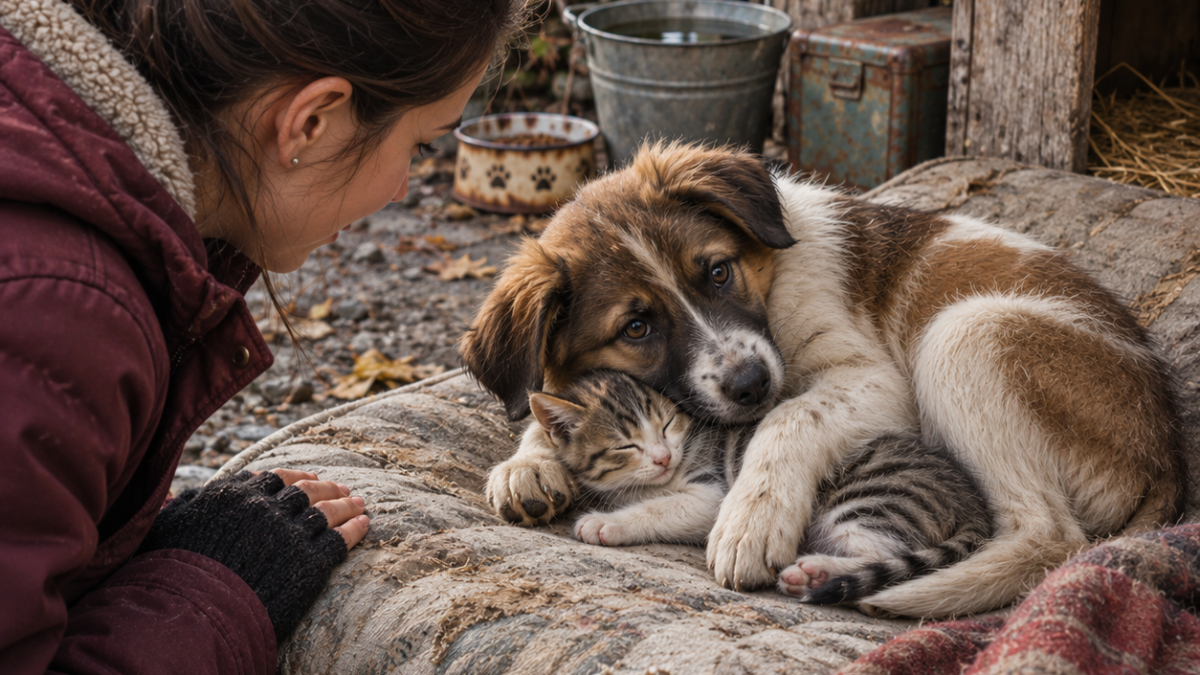
PART 2
I did not simply place Milo beside Oscar and hope for the best.
People sometimes imagine animal rescue as instinct and emotion.
It is not.
Not if you do it properly.
Milo was medically fragile.
Oscar was young, stressed, and much larger than him.
Even a loving movement could have hurt the kitten accidentally.
So I called Dr. Perrin.
Yes, at two in the morning.
She answered sounding exactly like a woman who had been asleep thirty seconds earlier.
“Marion?”
“I’m sorry.”
“What happened?”
“Milo won’t settle.”
A pause.
“Breathing?”
“Stable.”
“Temperature?”
I gave her the number.
“Feeding?”
“Refusing.”
Another pause.
“What are you thinking?”
I looked at Oscar.
He had not moved.
“I want to let Oscar lie beside him.”
Silence.
Then:
“Supervised.”
“Obviously.”
“Not inside Milo’s medical enclosure.”
“No.”
“Use the padded recovery pen. Keep Milo wrapped. You control the distance.”
“I will.”
“And if Oscar gets excited—”
“I stop.”
“If Milo becomes stressed—”
“I stop.”
Dr. Perrin sighed.
“You already decided, didn’t you?”
“I called you.”
“That is not an answer.”
I smiled despite myself.
“I wanted permission.”
“You wanted me to take responsibility.”
“That too.”
She groaned.
“Fine. Supervised contact. Ten minutes.”
I ended the call.
Then I opened Oscar’s enclosure.
He came out immediately.
Not toward me.
Toward Milo.
“Easy.”
I sat on the floor.
I placed a thick folded blanket beside me and laid Milo on it.
Oscar stopped about two feet away.
His whole body became careful.
That is the only way I can describe it.
Careful.
He lowered his head.
Moved one paw.
Stopped.
Looked at me.
Then at Milo.
“You can come.”
Oscar approached.
One step.
Another.
He sniffed Milo’s blanket.
Milo made a weak sound.
Oscar’s ears changed instantly.
He lowered himself.
Slowly.
Then curled his body beside the kitten exactly as he had in the garage.
Not crushing him.
Not leaning over him.
Just close.
His warmth reached Milo without his weight touching him.
Then Oscar stretched his neck and licked the kitten’s head.
Milo stopped crying.
I froze.
Oscar licked him again.
Milo’s trembling did not stop completely.
But it changed.
His body seemed to loosen.
His head lowered.
He pressed one tiny paw into the blanket near Oscar’s chest.
I looked at the clock.
Two minutes.
Dr. Perrin had said ten.
At four minutes, Milo’s breathing became more regular.
At seven, he was asleep.
I felt tears filling my eyes.
“Of course.”
Oscar looked at me.
“You knew.”
His tail moved once.
I almost laughed.
At ten minutes, I should have separated them.
Instead, I called Dr. Perrin again.
She answered with:
“What now?”
“He’s asleep.”
“Good.”
“Beside Oscar.”
Silence.
“Temperature?”
“Stable.”
“Breathing?”
“Better.”
“Is Oscar calm?”
“He hasn’t moved.”
Another silence.
“Send me a picture.”
I did.
Thirty seconds later she called back.
“You can continue under supervision.”
I smiled.
“For how long?”
“As long as both remain stable and you stay awake.”
“I’m awake.”
“You sound emotional.”
“I am not.”
“Marion.”
“Fine.”
She laughed softly.
“Monitor them.”
I sat on the floor until sunrise.
Oscar barely moved all night.
Whenever Milo stirred, he opened his eyes.
Whenever Milo cried, Oscar touched his nose gently to the blanket or licked the top of his head.
Around four-thirty, Milo woke.
I offered the feeding syringe again.
He resisted at first.
Then Oscar moved closer.
Milo turned toward the warmth.
I placed a tiny amount of formula at his mouth.
He swallowed.
Once.
Then again.
I did not breathe.
Another drop.
Swallow.
By five, he had taken more than he had managed in several previous feedings.
Not enough.
But more.
When Dr. Perrin arrived at seven-thirty, she walked into the room and stopped.
Oscar was lying on the floor.
Milo was wrapped against his chest.
I sat beside them looking half dead.
Dr. Perrin stared.
“How long?”
“Since two.”
“You stayed here?”
“Yes.”
“All night?”
“Yes.”
“You’re insane.”
“Probably.”
She crouched.
Oscar lifted his head.
Dr. Perrin checked Milo’s temperature.
Then his breathing.
Then hydration.
She looked at me.
“What?”
“He looks calmer.”
“That’s what I said.”
“I’m a veterinarian. I am allowed to confirm things.”
“Of course.”
She touched Milo’s head.
He opened his mouth.
Oscar watched.
“Interesting,” she whispered.
“What?”
“Nothing miraculous.”
“I know.”
“Don’t start telling people Oscar medically cured him.”
“I won’t.”
She looked at the two animals again.
“But reducing stress matters.”
I nodded.
“And if his presence helps Milo rest, conserve energy, and tolerate feeding…”
She smiled.
“We use what helps.”
That became our new routine.
Not constant contact.
Milo still needed controlled warmth, medical care, and careful feeding.
But several times each day, under supervision, Oscar lay beside him.
The difference was obvious.
Milo cried less.
He slept more deeply.
Feedings became easier.
At first I told myself it might be coincidence.
Then one afternoon, Oscar had to be taken for his own veterinary examination.
Milo became restless within minutes.
Whining.
Turning.
Refusing food.
Oscar returned forty minutes later.
The sound of his paws in the hallway was enough.
Milo lifted his head.
Oscar entered.
The kitten cried.
Oscar answered.
Within ten minutes, Milo was calm.
Dr. Perrin stood in the doorway.
“All right.”
I looked at her.
“What?”
“I’m convinced.”
“Say it.”
“No.”
“Say Oscar matters.”
She rolled her eyes.
“Oscar matters.”
“Thank you.”
“Professionally irritating.”
Laurent visited that afternoon.
When he saw them together, he stood quietly for a long time.
“You remember the garage?”
I asked.
“Yes.”
“I think this is how Milo survived.”
Laurent nodded.
“Probably.”
I looked at Oscar.
The puppy was asleep.
Milo tucked against him.
“Do you think Oscar was sharing food?”
“With a kitten?”
“I don’t know.”
“Maybe.”
We had found no obvious food supply inside the garage.
No bowls.
No packaging.
Only old debris.
The question began bothering us.
How had they survived?
How long had they been there?
Who left them?
The woman who called us said she had first heard cries three days before contacting us.
That did not mean the animals had arrived three days earlier.
They could have been there much longer.
We went back.
The garage felt colder without them.
Smaller too.
Maybe because the emergency had disappeared.
Laurent and I searched carefully.
Near the mattress we found an empty plastic container with bite marks.
A torn food wrapper.
A flattened cardboard tray.
Nothing that explained much.
Then Laurent called from near a broken side panel.
“Marion.”
I walked over.
“What?”
“Look.”
There was a gap beneath the wall.
Small.
Too small for us.
Large enough for Oscar.
Outside, the ground was muddy.
Faint tracks remained.
Puppy-sized.
Going in.
And out.
I crouched.
“He was leaving.”
Laurent nodded.
“And coming back.”
We followed the path.
It led toward the road.
Then disappeared.
For the next several days, we asked around.
A woman about half a mile away remembered seeing a young dog near her trash cans.
Another resident had seen a honey-colored puppy carrying something in its mouth.
“What?” I asked.
“I don’t know. Food maybe.”
“When?”
“Couple days before you found them.”
Laurent looked at me.
Oscar had not been trapped.
At least not physically.
He could leave.
He had chosen to return.
That changed everything.
Milo, tiny and weak, could not follow.
Oscar could.
And yet he came back.
Over and over.
We could not prove exactly what he brought.
Scraps.
Food.
Perhaps water on his coat or from whatever source he found.
Maybe nothing some trips.
But he had access to the outside world.
And every night, according to the mattress and their position, he returned to Milo.
I kept thinking about one question.
Why?
They were different species.
Probably not raised together from birth.
Oscar was only six months old himself.
Still a baby.
Yet he behaved like Milo was his responsibility.
The answer came from the most unexpected place.
A man named Monsieur Favre called our association after seeing a post asking for information.
“I know that puppy.”
I stopped typing.
“You do?”
“I think so.”
“How?”
“My nephew used to live near that garage.”
“Name?”
He gave it.
“Did he own Oscar?”
“Maybe. He had a young dog like that.”
“And a kitten?”
Pause.
“Yes.”
My whole body tightened.
“What happened?”
“He left.”
“What do you mean?”
“Moved.”
“When?”
“About two weeks ago.”
“Did he take the animals?”
Another pause.
“I assumed he did.”
Laurent was across the office.
I put the call on speaker.
Monsieur Favre continued.
“My nephew had problems.”
“What kind?”
“Money. Housing. Other things.”
“Did he abandon them?”
“I don’t know.”
“But he had both?”
“Yes.”
“How long?”
“The puppy maybe three months. The kitten… not long.”
“Were they close?”
He laughed sadly.
“The dog carried that kitten everywhere.”
I looked at Laurent.
“What?”
“The kitten was found near a road. Very young. My nephew brought him home.”
“And Oscar?”
“Wouldn’t leave him alone.”
There it was.
Not a relationship formed inside the garage.
Older than that.
Oscar had already chosen Milo.
We asked authorities to investigate.
The situation was not simple.
There was no dramatic villain who had locked them in a cage and walked away laughing.
There was a young man who had lost housing, apparently struggled with addiction and unstable living conditions, and disappeared from the area.
But he had left two dependent animals in an abandoned garage.
Whatever his circumstances, that decision had nearly killed Milo.
I felt anger immediately.
Then guilt about the anger.
Then anger again.
Laurent said, “You can understand why someone falls apart without excusing what they do.”
I hated when he was reasonable.
“Exactly.”
The investigation found more information.
Oscar and Milo had indeed belonged to the same young man.
Neighbors remembered them.
One said Oscar slept with Milo in a laundry basket.
Another remembered seeing the puppy carrying the kitten by the scruff when Milo wandered too far.
The man had been evicted.
He apparently brought the animals to the abandoned garage temporarily while arranging somewhere to stay.
Then he left.
For days.
No reliable food.
No secure shelter.
No care.
Oscar became the care.
That sentence made me furious.
A six-month-old puppy had been forced into a responsibility an adult human abandoned.
He had kept Milo warm.
Protected him.
Left the garage to search for food.
Returned.
Again.
Again.
Again.
And Milo had survived long enough for a neighbor to hear him.
That was Oscar’s revenge, if you want to call it that.
Not biting anyone.
Not attacking the person who failed him.
Living.
Making sure Milo lived too.
Every day they survived made the abandonment less powerful.
But survival was still uncertain.
On Milo’s sixth day at the clinic, he developed a fever.
Dr. Perrin called me before dawn.
“Come in.”
Those two words terrified me.
I drove too fast.
When I arrived, Milo was back in intensive monitoring.
Oscar stood outside the treatment area.
Whining.
“What happened?”
Dr. Perrin met me.
“Possible infection.”
“How serious?”
“Potentially very.”
My heart dropped.
“But he was improving.”
“He still is fragile.”
“Can he see Oscar?”
“Not yet.”
Oscar pressed against my legs.
I touched his head.
For the first time since rescue, he looked frightened in a way I recognized.
Not cautious.
Not uncertain.
Terrified.
Like the garage again.
Milo’s condition worsened through the morning.
Temperature unstable.
Weakness.
Poor feeding.
We started treatment immediately.
I sat beside Oscar.
He refused food.
I brought chicken.
Nothing.
Wet food.
Nothing.
He stared at the treatment room door.
“Not you too.”
No response.
“Oscar.”
He looked at me.
“You have to eat.”
Nothing.
I almost laughed bitterly.
He had spent so long making sure Milo survived that he seemed to have no idea what to do when he could not reach him.
At noon, Dr. Perrin came out.
“He’s stable.”
I stood.
“Stable good?”
“Stable not worse.”
“Can Oscar see him?”
She hesitated.
“Through glass.”
We brought Oscar close.
Milo was in a heated enclosure.
Tiny.
Eyes closed.
Oscar saw him.
His body became completely still.
Then Milo moved.
One paw.
Oscar whimpered.
The kitten’s ear shifted.
Oscar pressed his nose against the glass.
Milo lifted his head.
Barely.
But he did.
Dr. Perrin watched.
“Okay.”
“What?”
“When we can safely allow contact, we will.”
For eighteen hours, Oscar remained near the glass.
He finally ate when I put his bowl there.
Not much.
Enough.
The next morning, Milo’s fever began dropping.
By afternoon, Dr. Perrin allowed brief supervised contact.
Oscar lay down.
Milo was placed beside him.
The puppy sniffed him everywhere.
Head.
Back.
Legs.
As if checking whether all the parts were still there.
Then he licked Milo’s face.
The kitten made a weak sound.
Oscar’s tail hit the floor.
Once.
Twice.
Milo slept.
The crisis passed slowly.
Not dramatically.
Recovery rarely does.
One lab result improves.
Then another.
One feeding works.
Then two.
One night without emergency.
Then another.
Milo gained twenty grams.
We celebrated.
Then thirty.
Then more.
After nearly two weeks, he stood without collapsing.
Oscar was there.
Milo took one step.
Wobbled.
Oscar immediately moved closer.
Not touching him.
Just close.
Milo took another step.
Then fell against Oscar’s front leg.
Oscar froze.
Milo stayed there.
I cried.
Laurent walked in.
Saw me.
Looked at the animals.
“Again?”
“Go away.”
“You cry a lot.”
“I have allergies.”
“To kittens?”
“Yes.”
The first time Milo ate from a small dish by himself, Oscar watched from inches away.
Milo stepped in the food.
Of course.
Orange kitten.
White formula on his paws.
Oscar licked him clean.
Dr. Perrin laughed.
“Efficient.”
Milo eventually started playing.
At first, tiny movements.
A paw toward a string.
A bite at the blanket.
Then one morning, he attacked Oscar’s tail.
Oscar looked behind him.
Confused.
Milo attacked again.
Oscar moved the tail.
Milo chased.
I covered my mouth.
Dr. Perrin said, “There’s your patient.”
Milo was becoming a kitten.
Not a medical case.
Not a dying body.
A kitten.
He climbed Oscar.
Bit his ears.
Slept on his paws.
Oscar tolerated everything.
Almost.
One day Milo pounced directly onto Oscar’s nose while he was sleeping.
Oscar jumped up.
Barked once.
Milo froze.
Everyone in the room froze.
Oscar stared.
Milo stared back.
Then Milo raised one paw and hit Oscar on the nose.
Oscar lay down.
Laurent laughed so hard he had to leave.
Their roles changed as Milo grew stronger.
At first Oscar had protected him.
Then Milo became the nuisance.
He stole Oscar’s toys.
Climbed into his bed.
Sat in his food bowl once.
Oscar looked at me as though requesting intervention.
“You created this.”
Oscar sighed.
The clinic could not keep them forever.
Eventually, they moved to our rescue facility.
Together.
No discussion.
We placed them in a quiet foster room rather than standard kennels.
Milo had recovered enough to no longer need constant medical supervision.
Oscar needed socialization, training, and his own puppy life.
That mattered to me.
People began treating him like a tiny saint.
He was not.
He chewed a shoe.
Destroyed a cushion.
Stole Laurent’s sandwich.
Barked at a broom.
Tried to chase a bicycle.
I loved every bad behavior.
Because it meant he finally had permission to be six months old.
One afternoon, Laurent found the remains of a shredded roll of paper towels.
“Oscar.”
The puppy stared.
“Who did this?”
Milo walked through the mess.
Laurent pointed.
“Do not blame the cat.”
Oscar wagged.
“He has manipulated you.”
“That’s rich coming from someone who gives him cheese.”
“Training rewards.”
“You gave him cheese for sitting in the doorway.”
“He sat.”
Oscar learned quickly.
Sit.
Stay.
Recall.
Leash walking.
He was nervous around men wearing dark hoodies.
We could guess why but could not know.
Milo had his own issues.
He became anxious if Oscar left the room too long.
At first, we assumed this meant they should never be separated.
Our behavior specialist corrected us.
“Bonded does not mean dependent to the point of panic.”
We worked carefully.
Oscar would leave for two minutes.
Milo stayed with a familiar volunteer.
Then five.
Then ten.
Oscar also learned Milo could leave and return.
We wanted them bonded.
Not terrified of independence.
That took months.
Adoption interest came quickly.
Everyone loved their story.
People wrote:
I want the hero puppy.
Can I adopt Oscar?
Can I adopt the orange kitten?
Almost nobody initially said:
I want both.
Our answer remained the same.
They would be placed together if at all possible.
Some people argued.
“Dogs and cats aren’t usually adopted as a pair.”
“These two are.”
“Couldn’t they adjust?”
“Maybe.”
“Then why not separate them?”
Because “maybe” was not enough for me.
They had already lost a home.
Already been left.
Already survived because they had each other.
If a perfect joint home existed, we would wait.
Weeks passed.
Applications.
Many unsuitable.
One family wanted Oscar but had two cats already and did not want Milo.
No.
Another wanted Milo but lived in an apartment and thought a young dog would be too much.
No.
A couple wanted both but worked twelve-hour shifts and had no plan for Oscar.
No.
I worried.
Not that they would never be adopted.
We could foster them.
But growing puppies become bigger dogs.
Cute rescue stories fade.
People move on.
Then came an application from a woman named Sophie and her teenage son, Lucas.
They lived twenty-five minutes from Limoges.
House.
Fenced yard.
One older cat.
Sophie worked partly from home.
Lucas was fourteen.
Their old dog had died the year before.
They wanted another animal.
Lucas had seen our post.
He insisted they apply for both.
During the first visit, I watched carefully.
Oscar liked them immediately.
That was almost too easy.
Milo hid.
Sophie did not chase him.
Good.
Lucas sat on the floor.
Said nothing.
Even better.
Oscar brought him a toy.
Lucas played gently.
Milo watched from beneath a chair.
After twenty minutes, Milo came out.
He approached Oscar first.
Then sat beside him.
Lucas kept playing.
Milo moved closer.
Eventually, he climbed onto Lucas’s leg.
The boy froze.
I smiled.
“Don’t move.”
“I’m not breathing.”
“You can breathe.”
“Are you sure?”
Milo curled against him.
Oscar immediately lay beside Lucas too.
Sophie covered her mouth.
“Okay.”
I looked at her.
“What?”
“I understand.”
“Understand what?”
“Why you won’t separate them.”
That mattered.
They visited again.
We brought their older cat’s scent on blankets.
Slow introductions.
No rushing.
Their cat, Céleste, was twelve and deeply unimpressed by the entire idea.
She hissed at Oscar through a barrier.
Oscar backed away.
Good.
Milo hissed back.
Less good.
We took it slowly.
A third visit.
Fourth.
Céleste accepted Milo first.
Oscar learned to ignore her.
The home inspection passed.
Veterinary references good.
Backup care arranged.
Adoption day approached.
I became miserable.
Laurent noticed.
“You know this is the job.”
“I know.”
“You’re supposed to be happy.”
“I am.”
“You look like someone canceled your wedding.”
“I hate you.”
“Professional relationship.”
The night before adoption, I stayed late.
Oscar slept.
Milo curled on his back.
I sat on the floor.
“You two caused a lot of trouble.”
Oscar opened one eye.
“Milo, you nearly died.”
Milo slept.
“Oscar, you refused to let him.”
Tail movement.
I swallowed.
“You don’t need us anymore.”
That sentence hurt.
Then I corrected myself.
“No.”
I looked at them.
“You still need people.”
“You just don’t need rescuing anymore.”
That felt better.
The next morning, Sophie and Lucas arrived with two carriers.
I laughed.
“No.”
Sophie looked confused.
“What?”
“Leave one in the car.”
She smiled.
“I thought so.”
Oscar went on leash.
Milo in a carrier.
For the drive, Milo’s carrier was secured where Oscar could see him.
At Sophie’s house, we started slowly.
One room.
Doors controlled.
Céleste separated.
Oscar sniffed everything.
Milo stayed in the carrier.
Lucas sat nearby.
Eventually, Milo came out.
Oscar returned from investigating the hallway.
Milo saw him.
Walked directly over.
Then began exploring.
That was the pattern.
Oscar first.
Milo followed.
Two hours later, I knew it was time to leave.
Lucas asked, “Will they think you abandoned them?”
The question struck me.
I answered carefully.
“They might be confused.”
He looked worried.
“So what do we do?”
“Be predictable.”
“What does that mean?”
“Food at regular times.”
“Same sleeping areas.”
“Don’t disappear suddenly if you can avoid it.”
“Give them time.”
“And most important…”
Lucas waited.
“Always come back.”
He nodded.
“I can do that.”
I believed him.
When I left, Oscar stood near the door.
My throat tightened.
“Stay.”
He tilted his head.
“Sophie.”
She stepped beside him.
Oscar looked at her.
Then back at me.
I left.
In my car, I cried for ten minutes.
Laurent called.
“You okay?”
“No.”
“Good adoption?”
“Yes.”
“Then why are you crying?”
“Because you’re irritating.”
“Excellent.”
The first photo arrived that evening.
Oscar asleep under the dining table.
Milo on top of him.
Caption:
THEY HAVE CLAIMED THE HOUSE.
The second day, Milo discovered Lucas’s bed.
The third, Oscar dug a hole in the garden.
Sophie sent:
YOUR HERO IS A CRIMINAL.
I replied:
HE CONTAINS MULTITUDES.
A week later, Céleste allowed Milo onto the sofa.
Oscar remained banned.
By week three, all three slept in the same room.
Not touching.
But together.
Two months later, we visited.
Oscar saw our vehicle.
He ran toward the gate.
I barely had time to get out.
He jumped.
Licked my face.
Whined.
I hugged him.
“Hi.”
Then Milo appeared.
No longer tiny.
Still small.
But healthy.
Orange coat bright.
Eyes clear.
He ran behind Oscar.
Then straight toward me.
I picked him up.
He immediately reached one paw toward Oscar.
Oscar licked his head.
Same movement as the garage.
I closed my eyes.
That image never left.
Except now Milo was strong enough to complain.
He bit Oscar’s ear.
Oscar sneezed.
Lucas laughed.
Some things change.
Some do not.
The investigation into their abandonment continued.
Authorities eventually located the former owner.
He admitted leaving them in the garage.
His explanation was desperate.
He had been evicted.
Was sleeping wherever he could.
Thought he would return the next day.
Then he relapsed into drug use.
Days disappeared.
He said he never intended for them to die.
I believed that part.
Intent and consequence are different things.
He still abandoned two dependent animals.
He faced legal consequences and restrictions related to animal ownership.
Our organization was consulted.
I expected to feel satisfied.
I did not.
I felt tired.
He asked once, through an intermediary, whether Oscar and Milo survived.
I struggled with the question.
Part of me wanted him to live forever with uncertainty.
Then I looked at a photograph Sophie had sent.
Oscar on his back.
Milo asleep across his chest.
I said:
“Yes.”
Tell him they lived.
Laurent asked, “Why?”
“Because their survival belongs to them.”
Not to his punishment.
He had already lost them legally.
He did not get them back.
That was enough.
I did not want Oscar and Milo’s life to become a weapon.
Their life was theirs.
The real revenge was ordinary.
That phrase came to me years later.
Ordinary revenge.
Oscar growing into a big goofy dog.
Milo becoming a confident cat.
Lucas finishing school with both animals in his graduation photographs.
Sophie complaining about hair on the sofa.
Céleste eventually accepting Oscar enough to slap him whenever he stood too close.
Oscar learning boundaries.
Mostly.
Milo stealing his bed.
The abandoned garage being torn down.
The mattress thrown away.
The place where they nearly died becoming an empty lot and then, eventually, a small workshop.
Their story moved forward.
The abandonment became smaller.
Not erased.
Smaller.
Oscar turned one.
We attended the birthday.
Lucas made a ridiculous dog-safe cake.
Milo stole part of it.
“Cat!”
Oscar looked betrayed.
Sophie laughed.
I watched them.
A year earlier, Oscar had been lying in dirt.
Milo had barely been breathing.
Now everyone was arguing because the cat stole birthday cake.
That is rescue.
Not dramatic music.
Normal problems.
At two, Oscar became calmer.
Not calm.
Calmer.
He loved long walks.
He hated umbrellas.
Nobody knew why.
He still reacted instantly to any distressed animal sound.
Sophie once played a video of a crying kitten without thinking.
Oscar ran from another room.
Searched.
Whined.
She never played that kind of video around him again.
Some memories live in the body.
Milo grew into a surprisingly bossy cat.
He slept wherever he wanted.
Often on Oscar.
Especially when Oscar was warm from walking.
Lucas sent me a photograph one winter.
Oscar under a blanket.
Milo tucked beneath his chin.
Caption:
SOME THINGS NEVER CHANGE.
I printed it.
Placed it beside the original rescue photo.
One showed dirt.
Fear.
A kitten near death.
The other showed a couch.
Blankets.
Fat Milo.
Older Oscar.
I kept both.
Because recovery deserves before and after.
Not to sensationalize suffering.
To prove distance.
Years passed.
I remained in rescue.
More animals came.
Different stories.
Some happier.
Some worse.
Not every animal survived.
That matters to say.
Rescue does not guarantee miracles.
Sometimes we arrive too late.
Sometimes medicine cannot fix damage.
Sometimes love is present and death still wins.
Milo had been lucky.
Oscar had been lucky.
We had been lucky.
But luck had needed help.
A neighbor made a phone call.
Laurent and I drove.
Dr. Perrin worked.
Oscar stayed.
One event connected to another.
Whenever new volunteers joined, I told them about Oscar and Milo.
Not because I wanted them to believe every bonded animal would create a miracle.
Because I wanted them to understand behavior has context.
A puppy refusing to leave a kitten is not necessarily aggression.
A dog pacing at a treatment-room door may be afraid, not difficult.
A weak animal eating better near a companion may need emotional safety as part of recovery.
We still followed medical rules.
We still separated animals when necessary.
But we looked.
Listened.
Asked.
What relationship existed before we arrived?
What does this animal consider safety?
Who are we removing when we “rescue” them?
Those questions came from two babies in a garage.
Dr. Perrin began joking that Oscar had made us all sentimental.
“Science first.”
She would say it every time.
Then she would walk through the clinic and quietly allow bonded animals visual contact whenever medically safe.
I never let her forget.
“You changed.”
“No.”
“You did.”
“I updated protocols.”
“That is veterinarian language for changed.”
She glared.
One winter, almost five years after the rescue, Sophie called.
Her voice sounded wrong.
My heart dropped.
“Which one?”
She paused.
“Milo.”
I sat down.
“What happened?”
“He’s sick.”
Milo had developed a serious urinary blockage.
Emergency.
Painful.
Potentially fatal.
They got him to the clinic quickly.
Treatment started.
Oscar panicked.
Exactly like years earlier.
Pacing.
Refusing food.
Waiting near doors.
Sophie called because she remembered.
“Should I bring him?”
“To the clinic?”
“Yes.”
I contacted their veterinarian.
They allowed Oscar to wait in a quiet area where Milo’s scent could be brought to him.
Not direct contact immediately.
But enough.
Milo stabilized.
Two days later, when he came home, Sophie recorded the reunion.
Oscar heard the carrier.
Ran.
Milo came out wearing a small recovery collar.
Oscar approached.
Stopped.
Sniffed.
Then licked the top of Milo’s head.
One time.
Exactly.
I watched the video repeatedly.
Six-month-old Oscar.
Dying kitten.
Adult dog.
Adult cat.
Same gesture.
Sophie said, “He still does that.”
Of course he did.
That was their language.
Milo recovered.
Oscar aged faster.
Dogs do.
By nine, white appeared around his muzzle.
At ten, his hips became stiff.
Milo was still energetic enough to jump onto furniture.
Oscar began taking stairs slowly.
Lucas was in college by then.
He came home on weekends.
Oscar still slept outside his old bedroom.
One summer, Lucas called me himself.
“Marion?”
His voice was deeper than I remembered.
“Hi.”
“Can I ask you something?”
“Of course.”
“Do you think Oscar remembers the garage?”
I thought.
“I don’t know.”
“Sometimes he has dreams.”
“Dogs dream.”
“He whines.”
“That doesn’t mean the garage.”
“I know.”
Pause.
“Do you think animals remember trauma?”
“Yes.”
“How?”
“Sometimes clearly.”
“Sometimes through reactions.”
“Sometimes probably in ways we don’t understand.”
He was silent.
“Why?”
“I just hate thinking he might still be scared.”
I understood.
“Lucas.”
“Yes?”
“Look at him right now.”
Silence.
“What’s he doing?”
“Sleeping.”
“Where?”
“On the patio.”
“And Milo?”
“On his back.”
I smiled.
“Does Oscar look scared?”
“No.”
“Then whatever he remembers, it isn’t the only thing inside him.”
That became something I told myself too.
Trauma can remain.
It does not have to remain alone.
Memory can hold the garage and the patio.
Hunger and birthday cake.
Fear and safety.
Both.
Oscar’s final years were gentle.
His world shrank.
Shorter walks.
Longer naps.
More medication.
Milo adjusted.
When Oscar stopped climbing onto the couch, Milo began sleeping on the dog bed with him.
When Oscar’s hearing faded, Milo sometimes seemed to notice sounds first.
Door.
Food.
Lucas arriving.
Milo would stand.
Oscar would see him.
Then follow.
The kitten once protected by the puppy became, in tiny ways, the old dog’s guide.
Sophie sent a video.
Someone knocked.
Oscar did not hear.
Milo ran toward the hallway.
Oscar lifted his head.
Saw Milo.
Followed.
I cried.
Laurent, now older and mostly administrative, saw the video.
“Well.”
“What?”
“Now the cat is doing the job.”
“Yes.”
He smiled.
“Took long enough.”
Oscar reached eleven.
Then twelve.
A remarkable age for a medium-large mixed-breed dog.
His back legs weakened.
Not paralyzed.
Just old.
Milo, now around twelve too, remained beside him.
One autumn afternoon, Sophie called again.
This time I knew immediately.
“Is he comfortable?”
“For now.”
“Has the vet seen him?”
“Yes.”
Cancer.
Advanced.
There were options.
None curative.
Palliative care.
Time.
Weeks perhaps.
Maybe months.
Lucas came home.
They made decisions together.
No heroic over-treatment.
No refusing reality.
Comfort.
Food.
Sun.
Family.
Milo.
Oscar’s appetite remained surprisingly strong.
Especially for cheese.
They let him have small pieces.
“Veterinary-approved?” I asked.
Sophie said, “Emotionally approved.”
Fair.
We visited.
Oscar recognized me.
Slowly.
His tail moved.
I sat beside him.
“You got old.”
He put his head on my knee.
Milo walked over.
Stared at me.
“You too.”
He ignored me.
Then climbed onto Oscar’s bed.
Oscar lifted his head enough to lick Milo’s forehead.
I had to look away.
Lucas saw.
“You remember?”
“Yes.”
“The first day?”
“Yes.”
He sat beside us.
“What would have happened if you separated them?”
I looked at him.
“I don’t know.”
“Would Milo have died?”
“Maybe.”
“Would Oscar?”
“Probably not physically.”
Lucas nodded.
“But?”
I looked at Oscar.
“Something in him would have broken.”
Maybe that was too human.
Maybe not.
We never needed certainty.
The bond was obvious.
In Oscar’s final week, he stopped eating.
Then drinking.
He still reacted to Milo.
Still lifted his eyes when the cat approached.
The veterinarian came to the house.
Sophie asked me to be there.
So did Lucas.
I arrived that morning.
Oscar lay on his bed near the window.
Sunlight across his paws.
Milo beside him.
The veterinarian examined him.
Then looked at Sophie.
“It’s time.”
Sophie cried immediately.
Lucas went outside.
Then came back.
He knelt.
Oscar looked at him.
Tail.
One movement.
Milo stayed.
The veterinarian asked whether they wanted Milo removed during the procedure.
Sophie looked at me.
I said nothing.
Their veterinarian answered carefully.
“If he is calm, he can remain.”
He remained.
Oscar relaxed after the first medication.
Milo sniffed his face.
Oscar’s eyes were half closed.
I touched his ear.
“You did enough.”
The words came without planning.
“You were six months old.”
My throat tightened.
“You should never have had to keep anyone alive.”
Oscar breathed.
“But you did.”
Milo pressed against him.
“You did.”
Sophie covered her face.
Lucas whispered, “Good boy.”
I continued.
“You can stop watching now.”
That was the sentence that broke me.
Because Oscar had watched for twelve years.
Milo’s breathing.
Milo’s movements.
Doors.
Treatment rooms.
People.
The world.
He had always watched.
“You can rest.”
The veterinarian gave the final medication.
Oscar’s breathing slowed.
Milo stayed touching him.
Then Oscar was gone.
Nobody moved Milo immediately.
We let him smell.
Let him understand as much as he could.
He pressed his nose against Oscar’s face.
Waited.
Then walked around him.
Returned.
Sat.
No dramatic cry.
No panic.
Just stillness.
Eventually Milo lay beside him.
Exactly as Oscar had lain beside Milo in the garage.
The circle closed so quietly it almost hurt more.
Sophie whispered, “He knows.”
Maybe.
I think he did.
Milo grieved afterward.
Less eating.
Searching.
Sleeping on Oscar’s bed.
But this time he had people.
Sophie.
Lucas.
Céleste was long gone by then.
But the house remained familiar.
Routine remained.
Food.
Warmth.
Hands.
No abandoned garage.
No silence.
Milo recovered.
Slowly.
He lived another three years.
He became very old.
Very orange.
Very demanding.
Lucas graduated university.
Milo attended the photographs in a tiny bow tie that he hated.
When Milo finally died at fifteen, it happened at home.
Lucas held him.
Sophie beside them.
No Oscar physically there.
But years of Oscar everywhere.
The old dog bed.
Photographs.
Stories.
The habit Milo had of sleeping curled into a space shaped like another body.
Afterward, Lucas sent me one final image.
Two framed photographs on a shelf.
The first was our rescue picture.
Oscar curled around a dying kitten on a filthy mattress.
The second was taken years later.
Milo asleep against old Oscar on the patio.
Underneath, Lucas had written:
HE KEPT HIM ALIVE LONG ENOUGH FOR US TO LOVE THEM BOTH.
I stared at those words for a long time.
That was the story.
Not just a puppy saving a kitten.
Not just a kitten surviving.
Not only abandonment.
The important part was time.
Oscar created time.
Time for us to find them.
Time for medicine.
Time for Milo to grow.
Time for a family.
Time for Lucas to become an adult.
Time for Oscar himself to experience a life where protecting Milo was no longer a desperate responsibility but simply something he did because he loved him.
The person who abandoned them faced consequences.
But that stopped mattering to me years earlier.
Punishment has an ending.
Life continued.
That was the revenge.
They were left in darkness.
They got sunlight.
They were hungry.
They became spoiled.
They were alone.
They became family.
Oscar once had to leave a garage searching for scraps because nobody else was coming.
Later, food appeared every morning without him asking.
Milo once shook from cold against a dirty mattress.
Later, he slept beneath blankets and complained if Lucas moved him.
That is the ending cruelty never predicts.
Ordinary abundance.
Years.
Routine.
Love becoming boring.
I have rescued many animals since.
Some stories blur.
Faces.
Dates.
Locations.
Not Oscar and Milo.
I still remember entering that garage.
The flashlight crossing the floor.
The tiny body.
The puppy wrapped around him.
I remember thinking:
How long have you been doing this?
I never got an exact answer.
Maybe days.
Maybe longer.
But eventually I realized it did not matter.
Oscar did it until we came.
That is what mattered.
He stayed.
He left only to search for what they needed.
Then returned.
Stayed again.
A six-month-old puppy.
No training.
No command.
No promise.
Just loyalty.
People often call dogs loyal as if it is something simple.
Oscar taught me loyalty can be exhausting.
It can look like refusing sleep.
Watching every movement.
Returning to an empty building.
Sharing warmth.
Going hungry.
And years later, it can look like an old dog lifting his head one more time to lick the cat he once protected.
Milo taught me something too.
Being saved does not mean remaining weak.
He grew.
He became difficult.
Independent.
Annoying.
Strong.
Eventually he helped Oscar navigate old age in small ways.
There was justice in that too.
Not debt.
Not repayment.
Love changing direction.
Oscar carried Milo first.
Later, Milo stayed beside Oscar.
Then Sophie and Lucas carried both.
That is how rescue should work.
Not one hero forever.
Hands changing.
Bodies aging.
Responsibility passing.
Nobody abandoned.
That is why I no longer describe the day we found them as the day we saved Oscar and Milo.
We interrupted something Oscar had already started.
He was the first rescuer.
We were reinforcements.
And when I remember that two-in-the-morning decision in the clinic, I still see Milo trembling in my hands.
Oscar behind the bars.
Waiting.
Watching.
The moment I lowered Milo beside him.
Oscar curling carefully around the kitten.
The crying stopping.
The tiny body relaxing.
At the time, I thought I was trying an experiment.
Years later, I understood I was simply returning Milo to the place he had already learned meant safety.
Oscar.
That puppy had become home before either of them had a real one.
And once Sophie and Lucas gave them a house, Oscar spent the rest of his life proving that home was not a building at all.
It was the one who stayed beside you when the lights went out.
The one who noticed when you cried.
The one who kept coming back.
Oscar did that from the beginning.
Until the very end.
When I lifted the kitten from the filthy mattress, the six-month-old puppy beside him rose immediately.
He did not growl.
He did not show his teeth.
He did not try to bite me.
Instead, he stepped closer to my hands and gently licked the kitten’s head as if he were terrified that even my touch might make the tiny body disappear.
The kitten barely reacted.
He was so thin that I could feel every rib through his dirty fur. His breathing came in weak, uneven bursts, and his paws trembled whenever I moved him.
Yet the puppy never took his eyes off him.
That was the moment I understood we had not found two abandoned animals.
We had found one animal who had been surviving because another had refused to leave him behind.
My name is Marion.
I had been working with an animal-protection organization in Haute-Vienne for several years when we received the call that Thursday morning.
A woman living outside Limoges had heard strange cries coming from an old abandoned garage.
She could not tell whether the sound came from a dog or a cat.
“It’s been happening for a few days,” she told us. “Mostly early in the morning and at night.”
My colleague Laurent and I drove there immediately.
The garage stood away from the nearest houses, partly hidden behind weeds and rusting fencing.
Inside, the air smelled of damp concrete, old wood, and dust.
Our flashlight moved over cardboard boxes, broken boards, pieces of metal, and an old mattress torn open in one corner.
Then the beam stopped.
A kitten lay on his side.
At first I thought his fur was gray.
Later, after we cleaned him, we discovered he was orange beneath all the dirt.
His eyes were almost closed.
He looked impossibly small.
But what I remember most clearly was the puppy curled around him.
Honey-colored coat.
Folded ears.
Probably no more than six months old.
His body formed a barrier around the kitten, shielding him from the cold floor.
When Laurent took one step closer, the puppy lifted his head.
We both froze.
A frightened dog protecting something vulnerable can become dangerous very quickly.
But this puppy did nothing.
He simply watched us.
“Marion,” Laurent whispered.
“I know.”
“Look how he’s positioned.”
I was already kneeling.
I moved slowly.
“It’s okay.”
The puppy’s eyes followed my hand.
I reached toward the kitten.
Still no growl.
When I slipped my fingers beneath the tiny body and lifted him, the puppy stood.
He came forward.
For one second, I thought he might try to take the kitten from me.
Instead, he stretched his neck and licked the kitten’s forehead.
The kitten made a faint sound.
The puppy whimpered.
I looked at Laurent.
“We are not separating them.”
He stared at them.
Then nodded.
“Agreed.”
We carried them together to the rescue vehicle.
I wrapped the kitten in blankets and kept him close to the heat.
The puppy was secured beside him, close enough to see him.
Every time the kitten made a sound, the puppy’s ears lifted.
Every time I adjusted the blanket, he watched my hands.
He barely looked out the window.
At the veterinary clinic, Dr. Perrin took the kitten immediately.
The puppy sat beside me in the hallway.
He stared at the treatment-room door.
A tiny cry came from inside.
The puppy stood.
Another cry.
He whined.
I touched his back.
“It’s okay.”
He did not look at me.
The examination took a long time.
When Dr. Perrin finally came out, I knew from her face that the situation was serious.
“He’s severely malnourished.”
“How severe?”
“Very.”
She continued.
“Significant dehydration. Weakness. We need to monitor him for infection, metabolic problems, and complications from prolonged starvation.”
I swallowed.
“Can he survive?”
She hesitated.
I hated that hesitation.
“We will do everything we can.”
“That isn’t what I asked.”
“I know.”
She looked toward the treatment room.
“But I can’t promise anything. Honestly, I’m surprised he has survived this long.”
I looked down at the puppy.
He was still staring at the door.
That was when the question first entered my mind.
Maybe Milo had not survived this long by accident.
We named the kitten Milo.
The puppy became Oscar.
The names were temporary at first.
Then they became theirs.
The first four days were awful.
Milo was too weak to eat normally.
Every feeding had to be slow.
Measured.
Careful.
Sometimes he swallowed.
Sometimes he turned away.
He could barely lift his head.
We kept him warm and monitored constantly.
Oscar had his own bed only a few feet away.
He almost never used it.
Instead, he lay beside Milo’s enclosure.
His nose rested against the bars.
Whenever Milo cried, Oscar lifted his head.
Whenever we removed Milo for treatment, Oscar stood and watched.
Not once did he interfere.
He simply needed to know where the kitten was.
On the fourth night, I was on duty.
It was just after two in the morning when Milo began crying again.
I picked him up carefully.
His tiny body trembled in my hands.
“Come on, sweetheart.”
I adjusted the blanket around him.
“You’re safe.”
The crying continued.
I tried offering food.
He turned his face away.
“Please.”
Nothing.
Across the room, Oscar stood.
He left his bed and pressed his nose against the bars.
His eyes stayed fixed on Milo.
I looked at him.
Then at the kitten.
And suddenly I remembered the garage.
Oscar curled around Milo.
The licking.
The way Milo had relaxed against him.
I called Dr. Perrin.
She answered sounding half asleep.
“Marion?”
“I’m sorry.”
“What happened?”
“Milo won’t settle.”
“Vitals?”
I gave them.
“Temperature?”
I told her.
“Feeding?”
“Refusing.”
A pause.
“What do you want to do?”
I looked at Oscar.
“I want to let him lie beside Milo.”
Silence.
Then she said, “Supervised only.”
“Of course.”
“Not in the medical enclosure.”
“No.”
“Use the padded recovery area.”
“Yes.”
“And if Oscar becomes excited—”
“I stop.”
“If Milo becomes distressed—”
“I stop.”
She sighed.
“You already decided.”
“I wanted your approval.”
“You wanted somebody to blame if it goes wrong.”
“That too.”
She laughed quietly.
“Fine. Ten minutes.”
I hung up.
Then I opened Oscar’s enclosure.
He came out immediately.
Not toward me.
Toward Milo.
I placed a thick blanket on the floor and lowered Milo onto it.
Oscar stopped two feet away.
His entire posture changed.
He became careful.
That is the only word for it.
He lowered his head.
Took one step.
Stopped.
Looked at me.
Then at Milo.
“It’s okay.”
Oscar came closer.
Milo made a weak sound.
Oscar’s ears lifted.
Then he lowered himself beside the kitten.
Exactly as he had in the garage.
He curled his body near Milo without putting weight on him.
Then he licked the top of Milo’s head.
Milo stopped crying.
I froze.
Oscar licked him again.
Milo’s trembling began to ease.
His breathing slowed.
Within minutes, he was asleep.
I stared at the clock.
Ten minutes.
I should have separated them.
Instead, I called Dr. Perrin again.
She answered with:
“What now?”
“He’s asleep.”
“Good.”
“Beside Oscar.”
Silence.
“Vitals?”
“Stable.”
“Is Oscar calm?”
“He hasn’t moved.”
“Send me a photo.”
I did.
Thirty seconds later, she called back.
“Continue under supervision.”
I smiled.
“How long?”
“As long as both remain stable and you stay awake.”
“I’m awake.”
“You sound emotional.”
“I’m not.”
“Marion.”
“Fine.”
I stayed on the floor until sunrise.
Oscar barely moved.
If Milo stirred, he opened his eyes.
If Milo cried, Oscar touched his nose to the blanket or licked his head.
Around four-thirty, Milo woke.
I offered food again.
This time, with Oscar beside him, he swallowed.
Once.
Then again.
By morning, he had taken more than he had managed during several previous feedings.
Not enough.
But more.
When Dr. Perrin arrived, she found me sitting on the floor beside them.
“You look terrible.”
“Thank you.”
She crouched.
Checked Milo.
Temperature.
Breathing.
Hydration.
Then she looked at Oscar.
“He’s calmer.”
“That’s what I said.”
“I’m allowed to confirm things.”
I smiled.
She studied the pair.
“Stress reduction matters.”
I nodded.
“If Oscar helps him rest, conserve energy, and tolerate feeding, then we use that.”
From then on, Oscar became part of Milo’s recovery.
Not constantly.
Milo still needed medical care.
But several times each day, under supervision, Oscar lay beside him.
Milo cried less.
Slept better.
Fed more easily.
Then, on the sixth day, everything went wrong.
Milo developed a fever.
Dr. Perrin called before sunrise.
“Come in.”
I drove too fast.
When I arrived, Milo was in intensive monitoring.
Oscar stood outside the treatment area.
Whining.
“What happened?”
“Possible infection.”
“How serious?”
“Very.”
“But he was improving.”
“He’s still extremely fragile.”
Oscar pressed against my leg.
His eyes never left the door.
For the first time since we found him, he looked truly terrified.
He refused breakfast.
Chicken.
Nothing.
Wet food.
Nothing.
He only stared at the treatment room.
At noon, Dr. Perrin came out.
“He’s stable.”
“Stable good?”
“Stable means not worse.”
“Can Oscar see him?”
She hesitated.
“Through the glass.”
We brought Oscar closer.
Milo lay inside a heated enclosure.
Tiny.
Still.
Oscar saw him.
His body went rigid.
Then Milo moved one paw.
Oscar whimpered.
The kitten’s ear twitched.
Oscar pressed his nose against the glass.
Milo lifted his head.
Barely.
But he did.
Dr. Perrin watched.
“When it’s safe, we’ll let them have contact.”
Oscar stayed near the glass for hours.
He finally ate when we placed his bowl there.
The next morning, Milo’s fever began dropping.
By afternoon, we allowed Oscar beside him again.
Oscar approached slowly.
Sniffed Milo’s head.
Back.
Legs.
As though checking whether every part was still there.
Then he licked his forehead.
Milo made a weak sound.
Oscar’s tail hit the floor.
Once.
Twice.
That was the beginning of the real recovery.
Slow.
Uneventful.
Beautiful.
Milo gained a little weight.
Then more.
One morning he stood without collapsing.
Oscar watched.
Milo took one step.
His legs shook.
Another.
Then he fell against Oscar’s front leg.
Oscar froze so he would not knock him over.
Milo stayed there.
I cried.
Laurent walked in.
Saw me.
“Again?”
“Go away.”
“You cry a lot.”
“Allergies.”
“To animals?”
“Yes.”
Within another week, Milo began behaving like a kitten.
He attacked string.
Bit blankets.
Pounced on Oscar’s tail.
Oscar seemed deeply confused by this development.
One morning Milo jumped directly onto his nose while he was asleep.
Oscar barked once.
Milo froze.
Oscar froze.
Then Milo hit him on the nose with one tiny paw.
Oscar lay back down.
Laurent laughed so hard he had to leave the room.
Milo had gone from dying to annoying everyone.
It was perfect.
Oscar changed too.
He finally began behaving like the puppy he was.
Chewing shoes.
Stealing sandwiches.
Destroying a cushion.
Barking at a broom.
I loved every bad behavior.
Because for the first time, he did not have to spend every waking second protecting someone.
We returned to the abandoned garage to understand how they had survived.
Near one damaged wall, we discovered a small opening.
Large enough for Oscar.
Too small for us.
Outside were old tracks.
Going in.
And out.
Neighbors later told us they had seen a honey-colored puppy searching trash cans.
One woman remembered him carrying food in his mouth.
Oscar had been able to leave.
Milo could not.
And every time Oscar went out, he came back.
That discovery affected me more than the garage itself.
Oscar had freedom.
He could have run.
Found another home.
Followed people.
Survived alone.
Instead, he returned to a dark building because Milo was still inside.
We eventually traced their previous owner.
A young man who had been evicted.
He had brought both animals to the garage temporarily, then disappeared during a period of addiction and instability.
Neighbors confirmed that Oscar and Milo had been together before the abandonment.
Oscar had always been protective of the kitten.
One man told us:
“That puppy carried the kitten around like it was his baby.”
I felt furious.
A six-month-old dog had been forced into a responsibility an adult human abandoned.
I could understand that someone’s life could fall apart.
I could understand addiction.
Poverty.
Desperation.
What I could not excuse was leaving two dependent animals with no reliable food, water, or care.
Authorities investigated.
The former owner later admitted what happened.
He faced legal consequences and restrictions involving future animal ownership.
But by then, punishment mattered less to me than what happened next.
Milo recovered.
Oscar relaxed.
And eventually they were ready for adoption.
We decided they would stay together.
That reduced the number of applications.
Many people wanted the heroic puppy.
Others wanted the adorable orange kitten.
Few wanted both.
We refused to separate them just because it was easier.
Weeks passed.
Then Sophie and her fourteen-year-old son, Lucas, applied.
House.
Fenced yard.
Stable schedule.
Experience with animals.
Their older cat, Céleste, already ruled the home.
The first meeting told me more than the paperwork.
Oscar liked Lucas immediately.
Milo hid beneath a chair.
Lucas did not reach for him.
He sat on the floor and played quietly with Oscar.
After twenty minutes, Milo appeared.
He approached Oscar first.
Then Lucas.
Eventually, the kitten climbed onto the boy’s leg.
Lucas froze.
“I’m not moving.”
“You can breathe.”
“Are you sure?”
Milo curled against him.
Oscar lay beside them.
Sophie covered her mouth.
“I understand now.”
“Understand what?”
“Why they have to stay together.”
They came back several times.
We introduced Céleste slowly.
She hated Oscar at first.
Oscar learned quickly that older cats have very clear opinions.
Eventually, the home was approved.
The night before adoption, I stayed late.
Oscar slept on the floor.
Milo was curled across his back.
“You two caused a lot of trouble.”
Oscar opened one eye.
“Milo, you nearly died.”
No response.
“Oscar, you refused to let him.”
Tail movement.
I swallowed.
“You don’t need rescuing anymore.”
That was the sentence that finally made me cry.
The next day, Sophie and Lucas took them home.
For the first few hours, Oscar explored.
Milo followed him.
That became their pattern.
Oscar first.
Milo behind.
A week later, Sophie sent me a picture.
Oscar under the dining table.
Milo asleep across his neck.
Caption:
THEY HAVE TAKEN OVER.
Months passed.
Then years.
Oscar grew into a strong, ridiculous adult dog.
Milo became a confident orange cat who stole Oscar’s toys, bed, and food whenever possible.
Lucas grew up with them.
When he finished school, both animals were in the photographs.
The former owner’s legal case faded into the background.
That was the revenge.
Not anger.
Not punishment alone.
Life.
They had been left in darkness.
Now they had sunlight.
They had been hungry.
Now they were spoiled.
They had been abandoned.
Now somebody came home every night.
Oscar no longer had to search trash cans.
Milo no longer had to survive because one puppy refused to stop trying.
Their biggest problems became ordinary ones.
Muddy paws.
Hair on furniture.
Stolen food.
Veterinary bills.
Normal life was the victory.
Years later, Milo became sick with a urinary blockage.
Sophie rushed him to the clinic.
Oscar panicked.
He paced.
Refused food.
Waited near the door.
Exactly like he had years earlier.
When Milo finally returned home, Sophie recorded the reunion.
Oscar ran toward the carrier.
Milo stepped out wearing a recovery collar.
Oscar stopped.
Sniffed him.
Then gently licked the top of his head.
Once.
The same gesture.
I watched the video repeatedly.
Time had changed their bodies.
Not their language.
Oscar aged faster.
By ten, white surrounded his muzzle.
His hips became stiff.
His hearing weakened.
Milo remained more agile.
And slowly, something beautiful happened.
The kitten Oscar had once protected began helping the old dog.
When somebody knocked and Oscar did not hear it, Milo ran toward the hallway.
Oscar saw him and followed.
When Oscar stopped climbing onto the couch, Milo slept beside him on the floor.
When Oscar moved more slowly, Milo waited.
Their roles never completely reversed.
But they softened.
Oscar had carried Milo first.
Now Milo stayed close when Oscar needed him.
Then Oscar was diagnosed with cancer.
Advanced.
No cure.
Sophie called me.
I visited.
Oscar was old now.
Gray.
Slow.
But he recognized me.
His tail moved.
I sat beside him.
“You got old.”
He rested his head on my knee.
Milo climbed onto the bed next to him.
Oscar lifted his head.
Licked Milo’s forehead.
I looked away.
Lucas sat beside me.
“Do you remember the garage?”
“Yes.”
“Do you think Milo would have survived without Oscar?”
I looked at them.
“I don’t know.”
He nodded.
“What about Oscar?”
“Physically? Probably.”
“And otherwise?”
I watched the old dog.
“Something important in him would have been missing.”
In Oscar’s final week, he stopped eating.
Then drinking.
The veterinarian came to the house.
Sophie asked if Milo could remain.
The veterinarian said yes as long as he was calm.
He was.
Oscar lay near the window.
Sunlight across his paws.
Milo beside him.
The veterinarian gave the first medication.
Oscar relaxed.
I touched his folded ear.
“You were six months old.”
My voice broke.
“You should never have had to keep anyone alive.”
Oscar breathed slowly.
“But you did.”
Milo pressed closer.
“You did enough.”
Sophie cried.
Lucas whispered:
“Good boy.”
I looked at Oscar.
For twelve years, he had watched.
Watched Milo breathe.
Watched treatment rooms.
Watched doors.
Watched people.
“You can stop watching now.”
That sentence broke all of us.
“You can rest.”
Oscar’s breathing slowed.
Milo stayed pressed against him.
Then Oscar was gone.
We let Milo remain.
He sniffed Oscar.
Walked around him.
Returned.
Then lay beside him.
Exactly as Oscar had once lain beside him on the mattress.
No panic.
No dramatic cry.
Just closeness.
Milo lived three more years.
He became old.
Very orange.
Very demanding.
When he died at fifteen, Lucas held him at home.
Afterward, he sent me a photograph.
Two framed pictures.
One showed Oscar curled around a starving kitten in that abandoned garage.
The other showed old Oscar sleeping on a patio with Milo pressed against him.
Underneath, Lucas had written:
HE KEPT HIM ALIVE LONG ENOUGH FOR US TO LOVE THEM BOTH.
I stared at those words for a long time.
That was everything.
Oscar had not only saved Milo.
He had created time.
Time for us to arrive.
Time for medicine.
Time for Milo to grow.
Time for adoption.
Time for Lucas to become an adult.
Time for both animals to discover what ordinary safety felt like.
People often ask me who rescued them.
I always answer the same way.
We helped.
Dr. Perrin helped.
Laurent helped.
Sophie and Lucas gave them a home.
But Oscar was the first rescuer.
Before we ever entered that garage, a six-month-old puppy had already made his decision.
Milo was not being left behind.
Oscar could not call a veterinarian.
He could not ask for help.
He could not understand dehydration, infection, or starvation.
He only knew one thing.
Stay close.
Keep him warm.
Leave when necessary.
Come back.
Again.
Again.
Again.
That was enough to keep a tiny flame alive until humans finally arrived.
And when I think about that night at two in the morning, I no longer remember it as the moment I tried something clever.
I remember it as the moment I stopped assuming I knew more than Oscar.
I lowered Milo beside him.
Oscar curled around the kitten.
The crying stopped.
The breathing slowed.
And I finally understood that before Milo had a clinic, before he had a foster home, before he had Sophie and Lucas, he had already learned what safety felt like.
Safety had honey-colored fur.
Folded ears.
A warm body.
And a puppy who refused to leave.
Oscar had become Milo’s home long before either of them had one.
And until the very end of their lives, that never really changed.








