PART 2: The Power Failed at –31°F With My Three Children Inside—At Sunrise They Found Our Old Cat Frozen on the Porch
By midnight, frost was spreading across the inside of my bedroom windows, my two-year-old’s hands felt frighteningly cold beneath the blankets, and every call I made to 911 died before a dispatcher could answer.
I had three children trapped with me in a rented house in northern Minnesota, no electricity, no fireplace, no generator, and a wind chill approaching fifty below zero, so I kept piling blankets over them while pretending I wasn’t terrified that morning might come too late.
What I didn’t know, as I sat on the floor making my eleventh emergency call, was that our fourteen-year-old cat Bear had already left the shelter where he had survived thirteen winters and gone somewhere on the porch I never would have thought to check.
February nights in northern Minnesota had always been cold, but that night was different.
The county warning came around six in the evening. Stay home. Stay off the roads. Temperatures were expected to fall to around thirty-one below zero, with winds strong enough to push the wind chill close to fifty below.
I had three children then—Mason was eight, Lily was five, and Noah had turned two only a few months earlier.
I remember trying to keep the evening ordinary.
“Movie night,” I told them.
Mason looked toward the window. “What if the power goes out?”
“It won’t.”
I said it too quickly.
At nine that night, every light in the house went black.
The furnace stopped with it.
For the first few minutes, the children thought it was exciting. I found flashlights, lit two battery lanterns, and let them sit together under blankets in the living room.
Then the house started getting cold.
Fast.
By eleven, I could see my breath near the kitchen.
I moved all three children into the smallest bedroom because I thought one closed room would hold warmth better. I stuffed towels beneath the door, pulled blankets from every closet, and put Noah between Mason and Lily.
“Pretend we’re camping,” I said.
Mason looked at me.
“Mom, you hate camping.”
“Tonight I love it.”
He knew I was lying.
The temperature inside had dropped below forty degrees before midnight.
That was when I started calling for help.
911 rang.
Then disconnected.
I tried again.
Nothing.
Again.
Busy.
Again.
By my sixth attempt, my hands were shaking so badly I kept hitting the wrong numbers.
Outside, wind battered the house hard enough to make the siding pop. Snow moved horizontally past the windows, and somewhere behind the house something metal kept rattling against the porch.
I thought about Bear.
He had lived outside almost his entire life.
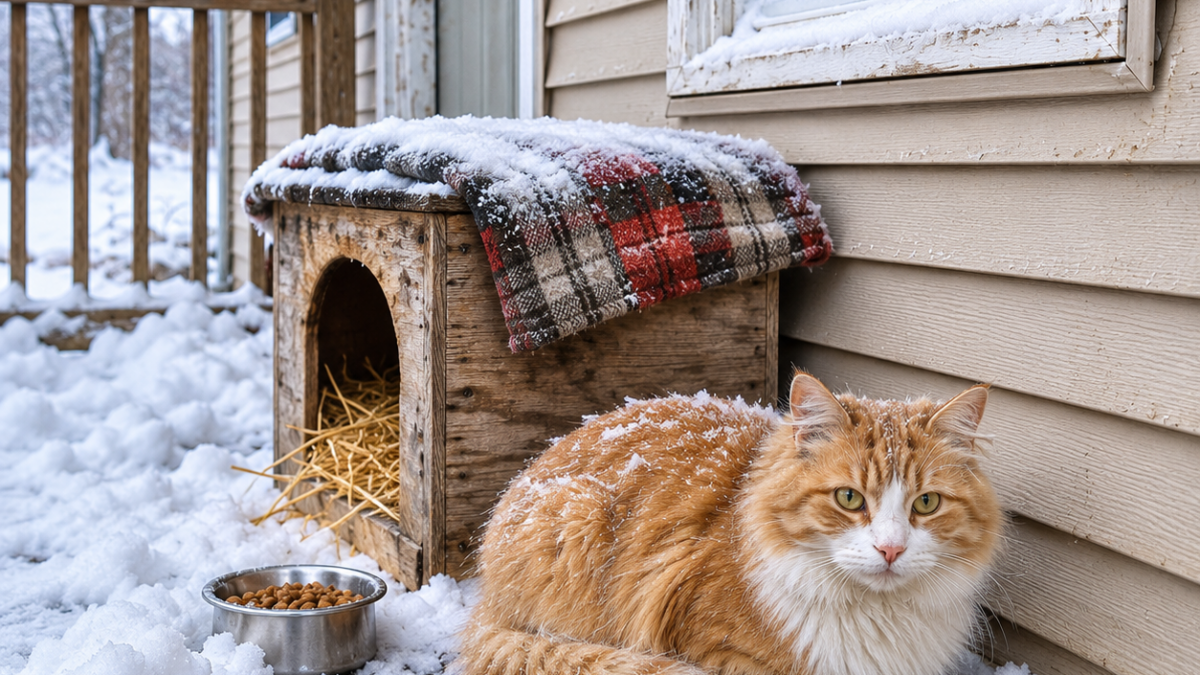
He was a massive orange-and-white Maine Coon mix, seventeen pounds even in old age, with damaged ear tips and a crooked tail left over from frostbite years earlier.
I had built him a plywood shelter beneath the porch roof and filled it with straw.
Every winter I tried to bring him inside.
Every winter he refused.
Bear wanted food, a dry shelter, and the freedom to decide everything else himself.
“He’ll be okay,” I whispered.
Mason heard me.
“Bear?”
“Yes.”
“Can we bring him inside?”
I looked at the bedroom door.
Leaving the room meant opening the part of the house I was desperately trying to keep warm.
And Bear had survived thirteen Minnesota winters.
“He knows what he’s doing.”
I wish I could forget saying that.
Around one in the morning, Noah stopped complaining about being cold.
That frightened me more than his crying had.
I rubbed his hands between mine.
“Stay awake, baby.”
He opened his eyes.
“I’m tired.”
“I know.”
Lily started crying.
Mason wrapped another blanket around her shoulders.
I called 911 again.
Then again.
Eleven attempts over roughly three hours.
Nobody answered.
What I couldn’t understand was why the floor beneath us felt so much colder than the rest of the room.
I didn’t know there was an exterior air vent directly beneath the back porch, connected to ductwork running beneath that bedroom.
Freezing wind was pushing through it.
While I was stuffing towels beneath the door, cold air was entering from underneath us.
At some point before dawn, I heard a strange scraping sound outside.
Then silence.
I thought it was snow.
I pulled the children closer.
None of us knew that something had just moved across the vent.
PART 2
The first light of morning came slowly.
Not sunlight exactly.
Just a pale gray change behind the frost-covered windows that told me the night had finally started losing its grip.
I had never been so relieved to see a sky turn gray.
And I had never felt less safe.
Noah was in my lap.
His body felt cold even beneath three blankets.
Mason and Lily were pressed together beside me.
I had spent most of the night making them move their fingers and toes, asking simple questions, giving them tiny sips of water, telling stories I barely remember now.
At some point, Mason said, “Mom, stop asking if I’m awake.”
“I need to know.”
“I’m awake.”
“Tell me your teacher’s name.”
He gave me an annoyed look.
That was good.
Annoyed meant alert.
“Mrs. Carter.”
“What did you eat for lunch yesterday?”
“Pizza.”
“Favorite superhero?”
“Mom.”
“What?”
“I’m awake.”
Lily laughed weakly beneath the blankets.
That laugh probably saved me from falling apart.
I kept telling myself daylight meant rescue crews could reach us.
The roads would be visible.
The wind might ease.
Someone had to be coming.
But my phone showed almost no signal, and the battery had dropped below twenty percent.
I tried 911 again.
This time the call connected for four seconds.
“911, what is—”
Then silence.
“Hello?”
Nothing.
“Hello!”
Call failed.
I nearly threw the phone across the room.
Instead, I pressed it against my forehead and cried without making a sound.
I didn’t want the children to see.
Mason saw anyway.
“Mom?”
“I’m okay.”
“You’re crying.”
“My eyes are cold.”
Even at eight years old, he knew that was ridiculous.
He didn’t challenge me.
He just pulled Lily closer.
I remember looking at him and thinking he seemed older than he had the day before.
No child should become older during one night because an adult cannot fix what is happening around them.
Around seven, we heard an engine.
Faint.
Then gone.
I froze.
“Did you hear that?”
Mason lifted his head.
Another engine.
Closer.
I dropped the blankets and went to the window.
The frost was too thick to see through.
I rubbed it with my sleeve until my fingers hurt.
Nothing but white.
Then someone pounded on the front door.
“County road crew!”
I almost collapsed.
“Here!”
My voice came out broken.
“WE’RE HERE!”
I ran through the house.
The hallway felt like a refrigerator.
The front door resisted because snow had piled against it.
I pulled.
Nothing.
Someone pushed from outside.
The door opened six inches.
A man shouted, “Back up!”
A shovel scraped.
Snow moved.
Then the door opened.
Two men in heavy winter gear came inside.
Cold air followed them, but I didn’t care.
One man was older, maybe in his sixties, with ice on his beard. The other looked around forty.
“Kids?”
“Bedroom.”
They moved immediately.
The older man called into his radio while the other followed me.
Noah had started crying again.
I have never been happier to hear one of my children cry.
The road crew had not originally been coming for us.
A neighbor named Mrs. Hanson, who lived almost half a mile away, had seen their truck on the county road and flagged them down.
She knew I had three children.
She knew we had no generator.
She had apparently been trying to reach me all night too.
The crew diverted toward our house.
Later, I would think about how many small things had to happen in the right order for them to arrive when they did.
That morning, I only cared that they were there.
The older man knelt beside Noah.
“Hey there, buddy.”
Noah barely looked at him.
The man removed one glove and touched his neck.
His expression changed.
“We need EMS.”
He spoke into the radio.
The other worker wrapped Lily in his own insulated coat.
Mason insisted he was fine.
He was not.
None of them were.
The road crew had emergency blankets in the truck.
They carried the children outside one at a time.
I followed with Noah.
The wind hit my face like needles.
The cold was impossible to describe.
It didn’t feel like weather.
It felt hostile.
A county vehicle idled in the driveway with the heater running full blast.
They got the children inside.
I climbed in after them.
For the first time since the power failed, warm air touched our faces.
Noah started screaming.
The older road worker smiled.
“That’s good.”
“How is that good?”
“Means he’s got fight left.”
I held Noah against me.
The man asked, “How long were you without heat?”
“Since nine.”
His smile disappeared.
“All night?”
“Yes.”
“Jesus.”
He caught himself.
“Sorry.”
“I don’t care.”
He looked toward the house.
“You got any other people inside?”
“No.”
“Pets?”
My stomach dropped.
“Bear.”
“What?”
“My cat.”
“Inside?”
“No. Porch.”
I moved toward the truck door.
The worker stopped me.
“You stay with the kids.”
“I need to get him.”
“We’ll check.”
“He’s old.”
“We’ll check.”
“I should—”
“Ma’am.”
His voice became firm.
“You have three kids who need you right here.”
That stopped me.
I nodded.
The younger worker went around the house.
The older man stayed with us until EMS arrived.
The ambulance reached us at 7:40 that morning.
I remember the exact time because later it appeared on every report.
The paramedics checked the children.
Noah’s core temperature was 95.8 degrees.
Hypothermia.
Not the worst number they had ever seen, they told me later.
But dangerous.
Lily and Mason were cold too, though not as low.
They loaded all three into the ambulance.
I was getting ready to climb in when I saw the younger road worker coming around the corner of the house.
He wasn’t walking normally.
He was carrying something.
At first, all I saw was orange fur.
I knew.
“Bear.”
The worker looked at me.
His face said everything before he spoke.
I jumped down.
“Bear!”
The older road worker intercepted me.
His name was Dale.
I learned that later.
At that moment he was simply the man standing between me and my cat.
“Let me see him.”
“Ma’am—”
“Let me see him.”
The younger worker carried Bear closer.
I stopped.
Bear’s body was stiff.
His thick orange-and-white coat was covered in frost.
Tiny pieces of ice clung to his whiskers.
His paws were curled slightly beneath him.
He looked asleep.
But Bear never slept like that.
“Where was he?”
The younger worker pointed toward the back porch.
“On the grate.”
“What grate?”
“The exterior vent.”
I stared.
“What are you talking about?”
“There’s a large air vent underneath the porch.”
Dale looked toward his coworker.
“He was lying directly across it?”
“Whole body.”
The younger man shifted Bear carefully.
“His fur was frozen to the metal. I had to pour warm water from the truck thermos to get part of him loose.”
I felt sick.
“The vent?”
Then something clicked.
The bedroom floor.
The freezing air.
The strange scraping sound before dawn.
Dale must have seen the realization on my face.
“That vent feeds the ductwork?”
“I didn’t know.”
“Looks like it runs under the house.”
I stared at Bear.
His seventeen-pound body had been stretched across the grate.
The entire opening.
“Oh God.”
I touched his head.
Hard.
Cold.
“Bear?”
Nothing.
“Bear.”
Dale put two fingers near his mouth.
Then against his chest.
He waited.
Shook his head.
I made a sound I had never heard myself make.
Not quite crying.
Not quite screaming.
I reached for Bear.
Dale pulled off his heavy county jacket.
“What are you doing?”
He wrapped Bear inside it.
“I don’t know.”
He lifted him against his chest.
“Dale,” the other worker said quietly.
“He’s gone.”
Dale looked at Bear.
Then at me.
“I know.”
He climbed into the road truck.
The engine was still running.
He turned the heater all the way up.
I stood there in the snow.
“Why?”
Dale didn’t answer.
Maybe he couldn’t.
He cradled Bear against his chest inside that jacket like the cat weighed nothing.
The ambulance driver called for me.
I looked between my children and Bear.
Dale said, “Go with your kids.”
I hesitated.
“I’ve got him.”
“He’s not breathing.”
“I know.”
“You can’t—”
“I said I’ve got him.”
Something in his voice made me believe him.
I climbed into the ambulance.
The doors closed.
The last thing I saw was Dale sitting in the county truck with Bear wrapped against his chest and the heater blowing directly toward them.
I thought that was goodbye.
For nineteen minutes, Bear did not breathe.
That was what Dale told me later.
Nineteen minutes from the time he picked Bear up until the first movement.
He didn’t perform some miracle technique.
He didn’t know if what he was doing was medically useful.
He had spent thirty years working rural roads and had been first on scene for wrecks, stranded drivers, house fires, animals hit on frozen highways, and people lost in storms.
He knew cold.
He knew what death looked like.
Bear looked dead.
Dale simply could not leave him behind.
So he held him.
He warmed him gradually.
Not with boiling water.
Not directly against a heater vent.
Just inside his jacket, against his own chest, in the heated truck.
He talked to him too.
Dale was embarrassed when he admitted that.
“What did you say?” I asked weeks later.
He shrugged.
“Stupid things.”
“Like what?”
“I told him he had scared everybody enough.”
I laughed through tears.
“What else?”
“Told him your kids were okay.”
My throat closed.
“You knew?”
“I guessed he might want to know.”
At nineteen minutes, Dale felt something against his arm.
A movement.
Barely there.
He thought he imagined it.
Then Bear’s chest moved.
One breath.
A long pause.
Then another.
Dale shouted so loudly his coworker nearly drove into a snowbank.
They radioed ahead.
One of the emergency veterinary clinics had staff who could meet them.
When my phone finally rang at the hospital, I was sitting between Mason and Lily while a nurse warmed Noah carefully.
I almost didn’t answer because I didn’t recognize the number.
“Hello?”
“Is this Bear’s owner?”
My heart stopped.
“Yes.”
“My name is Dr. Elaine Foster. I’m a veterinarian in Bemidji. Your cat was brought in by a county road employee.”
I closed my eyes.
“I know.”
“He’s alive.”
For several seconds, I heard nothing else.
The hospital disappeared.
The monitors.
The nurses.
The children.
Everything.
“What?”
“He’s alive.”
“No.”
“I understand that sounds surprising.”
“He wasn’t breathing.”
“I know.”
“He was frozen.”
“I know.”
I stood.
Mason looked at me.
“Mom?”
I covered my mouth.
Dr. Foster continued.
“His condition is extremely critical.”
I pressed the phone tighter.
“What does that mean?”
“His core body temperature is eighty-seven point two degrees Fahrenheit.”
I didn’t know what normal was.
“Is that bad?”
“For a cat? Very.”
“How bad?”
“Normal feline temperature is typically around one hundred to one hundred two and a half. Below ninety is severe hypothermia. Once you get close to eighty-five, survival becomes increasingly unlikely.”
I sat down again.
“But he’s alive.”
“Yes.”
“Then save him.”
There was a pause.
“We’re trying.”
“No. I mean—”
My voice broke.
“Whatever you need to do.”
“We are warming him slowly. We’ve started warmed IV fluids. We’re monitoring his heart. He has severe frostbite injuries, and there may be damage we can’t fully assess yet.”
“Will he die?”
Another pause.
“I don’t know.”
I hated her for that answer.
Not because it was wrong.
Because I wanted her to lie.
I wanted somebody in authority to say Bear would be fine.
Instead, she gave me the truth.
“I have never personally seen a cat his age come in this cold and recover,” she said. “But he has already done something unusual by breathing again.”
I looked at my children.
Noah was asleep beneath warmed blankets.
Lily held Mason’s hand.
“Keep trying.”
“We will.”
All three children were admitted for observation.
Noah needed the closest monitoring.
By afternoon, his temperature had improved.
Lily began asking for crackers.
Mason asked when we could go home.
The doctors told me none of them appeared to have suffered lasting damage.
I should have felt relief.
I did.
But every time my phone vibrated, my stomach turned.
Bear’s first day was touch and go.
His heart rate was unstable at first.
His blood pressure was low.
Frostbite had damaged tissue in several areas.
The metal grate had been so cold that the fur and skin across his chest froze against it.
Dr. Foster sent me a photograph.
I wish she hadn’t.
I understood why she did.
She needed my consent for treatment.
Still, I stared at Bear’s chest and cried.
A rectangular section of skin was dark red and injured.
The exact shape of the vent.
He had lain there long enough for the grate to mark him.
The doctors began asking questions.
“How long could he have been there?”
“I don’t know.”
“When did you last see him?”
“Around dinner.”
“Six?”
“Maybe six thirty.”
“Was he in his shelter?”
“Yes.”
“When did you hear something outside?”
I thought about the scraping noise.
“After midnight. Maybe one. I don’t know.”
Dr. Foster estimated Bear had likely spent six to eight hours directly exposed on or near that grate.
Six to eight hours.
Minus thirty-one degrees.
Wind around thirty-five miles per hour.
A wind chill near fifty below.
He was fourteen years old.
The question everybody asked afterward was why.
Why would an outdoor cat leave a straw-filled shelter during the coldest part of the night?
Why lie on exposed metal?
Why stay?
I didn’t have proof of what he understood.
Nobody did.
Bear couldn’t explain it.
But I knew that cat.
He had lived on that porch almost his entire life.
He knew every board.
Every gap.
Every sound.
Every warm place.
Every draft.
When the furnace ran, warm air moved through those ducts.
When the power failed, the same system became a path for freezing air.
Bear knew the vent.
He had slept near it in spring.
He had sniffed it.
Sat beside it.
Once, I had even chased him away because he liked watching mice near the opening.
That night, the vent was roaring cold air beneath the bedroom where my children were huddled.
At some point, Bear left his straw shelter.
Walked across the porch.
And lay down over it.
Seventeen pounds of thick fur covered the grate almost completely.
The cold draft underneath the bedroom floor diminished.
Would my children have died if Bear had not done it?
No doctor could say.
I would never make that claim.
The room was still dangerously cold.
Noah still developed hypothermia.
But the rescue crew later told me the vent had been one of the largest direct cold-air entry points into that bedroom.
Bear blocked it.
That was fact.
How much difference did it make?
I will never know.
But when a journalist eventually asked what I believed, I gave the only answer that made sense to me.
“He knew.”
The reporter looked at me.
“Knew what?”
“He knew where the cold was coming from.”
“How?”
“He lived on that porch for fourteen years.”
I pointed toward the vent.
“He knew that house better from underneath than I did from inside.”
“You believe he deliberately covered it?”
I stared at her.
“He left a straw shelter in minus thirty-one degrees and lay directly over the one opening blowing freezing air under my children.”
The reporter didn’t write for a second.
I continued.
“You can call that whatever you want.”
I looked toward the porch.
“I call it knowing.”
Bear survived the first forty-eight hours.
Then came the damage.
The frostbite in both ear tips was worse than doctors initially hoped.
Several toes had suffered irreversible tissue death.
His already damaged tail had frozen badly enough that circulation could not be restored.
Dr. Foster called me after my children were released.
“I need to talk about surgery.”
I sat at the kitchen table in my sister’s house because we still had no power at home.
Mason was playing cards with Lily.
Noah slept on the couch.
“What surgery?”
“The tail.”
I closed my eyes.
Bear’s tail had always been crooked.
Years earlier, before we moved into that house, he had injured it during another winter.
It bent slightly near the end.
I used to call it his question mark.
“Can you save it?”
“No.”
“What about his ears?”
“We’ll probably lose the damaged tips.”
“His toes?”
“Some.”
I pressed my hand against my forehead.
“He’s fourteen.”
“I know.”
“Is this cruel?”
Dr. Foster did not rush her answer.
“That’s the right question.”
I appreciated her for that.
Not “Do you have the money?”
Not “Do you want us to proceed?”
The right question.
Is this for Bear?
Or is it because I couldn’t bear losing him?
“How is he otherwise?”
“His kidney values concern me, but they’re improving somewhat with fluids. He’s alert intermittently. He ate a small amount this morning.”
“He ate?”
“Yes.”
“What?”
“A little wet food.”
I laughed.
Dr. Foster sounded confused.
“What?”
“He hates wet food.”
“Well, apparently severe hypothermia has expanded his tastes.”
That was the first time I smiled since the storm.
“Does he seem like he wants to fight?”
“Yes.”
That answered it.
“Do the surgery.”
Bear lost most of his tail.
Both damaged ear tips.
Several toes.
The chest wound took weeks to heal.
When the dead tissue finally separated and healthier skin formed beneath it, a permanent rectangular scar remained.
Exactly where his body had covered the vent.
The first time I visited him after surgery, I almost didn’t recognize him.
Bandages.
Shortened tail.
Ears wrapped.
IV line.
The giant outdoor cat who had always seemed indestructible looked old.
Small.
I approached the kennel.
“Hey, Bear.”
His eyes opened.
Slowly.
He lifted his head.
Then made the same low sound he had made every evening for fourteen years when he expected dinner.
Not a meow exactly.
More of a rough chirp.
I started crying.
“You idiot.”
His eyes narrowed.
“You absolute idiot.”
He tried to stand.
His back legs shook.
“Don’t.”
He stood anyway.
One step.
Then another.
He pushed his head against the kennel door.
I put my fingers through the bars.
Bear pressed his forehead against them.
Dr. Foster stood behind me.
“He knows you.”
“I would hope so.”
“He’s stubborn.”
“You have no idea.”
She smiled.
I looked at his tail.
Or what remained.
“Will he walk normally?”
“I don’t know.”
“Will he go outside?”
“I wouldn’t recommend it.”
I actually laughed.
“Good luck telling him.”
“I’m telling you.”
That was the beginning of our next battle.
Bear had spent fourteen years living mostly outdoors.
Now I wanted him inside.
He disagreed.
Strongly.
When he finally came home, our electricity was back.
The bedroom vent had been inspected and sealed more effectively.
The property owner replaced damaged duct insulation and added a proper exterior cover.
A county volunteer group helped weather-seal parts of the house after hearing what happened.
I hated accepting help.
I accepted it anyway.
Pride had almost no value after a night spent wondering whether your children would wake up.
Bear came home in a carrier.
He hated that too.
The children made signs.
WELCOME HOME BEAR.
Mason drew a picture of Bear wearing a superhero cape.
Lily colored Bear orange, purple, blue, and green because she said orange alone was boring.
Noah drew something that looked like a potato.
“That’s Bear,” he insisted.
“It’s beautiful,” I told him.
Bear exited the carrier.
He took two uneven steps.
Stopped.
Looked toward the back door.
“No.”
He walked toward it.
“No.”
He looked at me.
“You almost froze to death.”
Bear scratched once at the door.
“Absolutely not.”
He scratched again.
“Bear.”
Mason whispered, “He looks mad.”
“He is mad.”
“Are you going to let him outside?”
“No.”
Bear turned.
Walked slowly to the living room.
And peed on the rug.
Mason covered his mouth.
I stared.
Bear looked back at me.
“Oh, we’re doing this?”
He limped away.
That was Bear.
Heroism had not improved his personality.
The first weeks were difficult.
His hind legs never recovered completely.
The severe hypothermia had damaged circulation and weakened his muscles.
Some days were better than others.
He could walk.
But slowly.
Carefully.
His rear steps had a slight uneven rhythm.
At first, he fell.
That made him furious.
Bear did not tolerate help gracefully.
I put rugs over the slick flooring so he had traction.
He hated one of them and refused to walk across it.
I bought shallow food dishes.
He knocked one over.
I bought a soft orthopedic cat bed.
He slept beside it.
I bought stairs to help him reach the couch.
He ignored them and tried jumping.
He fell.
I cried.
Then yelled at him.
“You are fifteen years old!”
Bear stared.
“You have missing toes!”
Nothing.
“You do not get to act like you’re six!”
He started licking one paw.
“I am talking to you.”
Mason walked into the room.
“Mom.”
“What?”
“You’re arguing with a cat.”
“I know.”
“Is he winning?”
I looked at Bear.
“Yes.”
The children recovered much faster than he did.
Within weeks, Noah’s hypothermia became something I remembered more vividly than he did.
Lily became afraid of power outages.
Every time lights flickered, she grabbed a blanket.
Mason pretended the storm had not affected him.
Then I found a flashlight, batteries, two granola bars, and an extra pair of socks hidden under his bed.
“Emergency kit,” he said.
“You know we have a real emergency kit now.”
“This is mine.”
I did not take it away.
I bought each child a small flashlight instead.
I also bought a battery-powered radio.
Then a portable indoor-safe emergency heater.
Then more blankets.
Then a carbon monoxide detector with battery backup.
Then another.
For months, I overprepared.
I checked weather forecasts obsessively.
If temperatures were expected below zero, I slept badly.
If wind rattled the siding, I woke.
Sometimes I went to the back porch and touched the vent cover.
Just to make sure.
Bear watched me once from the kitchen doorway.
“You think I’m crazy?”
He blinked.
“You almost died on that thing.”
His scar was visible when he lay on his side.
A rectangular patch across his chest where fur grew differently around damaged skin.
I hated looking at it.
I also couldn’t stop.
It was evidence.
Not of some magical story.
Of a price.
That mattered to me.
People told the story and called Bear a hero.
Local news picked it up.
Neighbors brought food.
A church group paid part of his veterinary bill.
A hardware store gave us weather-stripping and insulation.
Someone mailed Bear a red pet blanket with his name embroidered into it.
He refused to sleep on it.
Of course.
People wanted photographs.
I said no to most of them.
One journalist came to the house because she was respectful and because I wanted people to understand that the children had survived without turning Bear into some cartoon animal.
She sat at my kitchen table.
Bear was under it.
That surprised her.
“He stays inside now?”
“He has no choice.”
She smiled.
“What changed?”
“He nearly died.”
“I mean emotionally.”
I looked at her.
“For Bear?”
“Yes.”
“Nothing.”
She seemed surprised.
“He’s still Bear.”
“He didn’t become more affectionate?”
“He was already affectionate with us.”
“More protective?”
“I don’t know.”
I pointed toward the children.
“He always watched them.”
Mason was doing homework.
Lily was coloring.
Noah sat on the floor with blocks.
Bear lay where he could see all three.
The reporter asked, “Do you think he understood they were in danger?”
That was when I gave the answer people repeated later.
“He knew.”
I looked toward the porch.
“He’s lived there fourteen years. He knew where the cold was coming in, and he just went and stopped it.”
She wrote it down.
I continued.
“I’m not saying he understood hypothermia. I’m not saying he knew temperatures or wind chills.”
I rubbed my hands together.
“He knew that vent.”
I looked at Bear.
“And he knew those kids.”
That was enough.
February became March.
Bear healed.
Slowly.
His ears ended in rounded scarred edges now.
His tail was just a short stump.
His missing toes changed how one front paw landed.
His hind legs remained weak.
But he was home.
He learned to tolerate indoor life.
Mostly.
He spent hours beside the back door.
Then he discovered the front window.
I put a chair beneath it because he could no longer jump to the sill.
He used the chair.
From there, he watched the porch.
Birds.
Snow.
Cars.
People.
His old world.
Sometimes I wondered if keeping him inside was cruel.
Then I remembered the frozen grate.
The eighty-seven-degree body temperature.
Nineteen minutes without a breath.
I left the door closed.
Spring arrived late.
When the first warm afternoon came, Bear sat beside the screen door.
He made that rough chirp.
“No.”
Another chirp.
I sighed.
“I know.”
The temperature was fifty-two.
No snow.
No wind.
I carried him outside.
Bear hated being carried almost as much as he hated carriers, but his legs were not ready for the porch steps.
I set him down.
He stood.
Lifted his nose.
The air smelled like wet earth and melting snow.
Bear looked toward his plywood shelter.
It was still there.
I had not had the heart to move it.
He walked toward it.
Slow.
Uneven.
One step at a time.
Then he stopped.
The air vent was three feet away.
My chest tightened.
Bear looked at it.
I know people will want me to say he did something dramatic.
That he touched it.
That he remembered.
That he stood guard.
He didn’t.
He simply looked.
For maybe five seconds.
Then turned away.
That was enough to destroy me.
I sat on the porch step.
Bear walked toward me.
His back leg dragged slightly.
“Come here.”
He ignored me.
Passed me.
Stopped in a patch of sunlight.
Then lay down.
I sat beside him.
Not touching.
Just watching.
Spring sunlight on scarred fur.
That was the first moment I believed he might really make it.
Not just survive the hospital.
Live.
For a while.
The children joined us.
Noah climbed onto my lap.
Lily sat beside Bear.
Mason stretched out on the porch boards.
Nobody talked about February.
We didn’t need to.
Bear closed his eyes.
His chest rose.
Fell.
Rose again.
I watched every breath.
For months after the storm, Bear had good weeks.
His appetite returned.
His coat became thick again.
He gained some weight.
He still patrolled the house at night, though his patrol had become a slow circuit from bedroom to kitchen to living room.
Sometimes I woke at two in the morning and found him sitting in the hallway outside the children’s rooms.
“You’re retired,” I whispered once.
Bear looked at me.
“Seriously. Job’s over.”
He stayed.
I went back to bed.
We developed new routines.
Mason fed him before school.
Lily brushed him, though Bear only tolerated about thirty seconds before walking away.
Noah gave him pieces of dry food one at a time.
Bear was suspicious of everybody else.
Delivery drivers.
Repairmen.
My sister.
Our neighbor.
He tolerated Dale.
That surprised me.
Dale started visiting occasionally.
The first time he came over after Bear returned home, he stood in the kitchen looking uncomfortable.
“I brought something.”
He held a bag.
Inside was canned salmon.
“Bribery?”
“Payment.”
“For what?”
Dale looked toward Bear.
“For coming back.”
Bear approached.
He sniffed Dale’s boots.
Dale froze.
“Can I pet him?”
“Try.”
“That isn’t reassuring.”
“Nothing about Bear is reassuring.”
Dale extended one hand.
Bear sniffed it.
Then pushed his forehead against Dale’s fingers.
Dale’s face changed instantly.
That sixty-something-year-old man who had worked wrecks, storms, rescues, and county roads for three decades looked toward the ceiling.
“Dale?”
“I’m fine.”
“You’re crying.”
“Dust.”
“In my kitchen?”
“Lots of dust.”
Bear rubbed against his leg.
Dale crouched.
“I thought you were gone, old man.”
Bear sniffed the salmon bag.
Dale laughed through tears.
“Yeah. Of course.”
We became friends after that.
Not best friends.
Not the kind who talked every week.
But there are some people who become part of your life because they were present on the worst day.
You don’t need constant contact.
The day itself creates a connection.
Dale was the last person I saw holding Bear when I believed Bear was dead.
He was also the first person to feel him breathe again.
Nothing could make that ordinary.
In May, Bear’s bloodwork showed changes in his kidneys.
Dr. Foster called.
I knew something was wrong from her voice.
“What?”
“His kidney values are increasing.”
I sat on the edge of my bed.
“How bad?”
“Concerning.”
“From the freezing?”
“Possibly related. Severe hypothermia and low blood pressure can injure organs. He’s also an elderly cat, so we can’t say the storm is the only factor.”
“Can we fix it?”
“Manage, maybe. Fix? Probably not.”
I looked through the doorway.
Bear was sleeping in the hall.
“What do we do?”
Diet changes.
Hydration.
Medication when needed.
Monitoring.
More bloodwork.
I did everything.
Bear hated the kidney-support food.
Naturally.
I mixed it gradually.
He ate around it.
I tried different brands.
He rejected two.
Accepted one.
Changed his mind.
I threatened him.
Begged him.
Bribed him.
Finally found something he tolerated.
By June, he drank more water than before.
Some days he seemed tired.
Other days he acted almost like his old self.
The children noticed.
“Is Bear sick?” Lily asked.
“He’s old.”
“That’s not what I asked.”
Five-year-olds are ruthless.
I sat beside her.
“Yes.”
“Is he going to die?”
Every part of me wanted to say no.
I had done enough lying during the storm.
“I don’t know when.”
Her eyes filled.
“But someday?”
“Yes.”
She leaned against me.
“Because he got frozen?”
“Maybe partly.”
She started crying.
I pulled her close.
“That’s not fair.”
“No.”
“He saved us.”
I closed my eyes.
“I know.”
Mason overheard.
He left the room.
I found him later sitting beside Bear near the front window.
He was not petting him.
Just sitting.
I stood in the doorway.
“You okay?”
“Yeah.”
“You sure?”
“Yeah.”
Bear’s head rested against Mason’s leg.
Mason looked down.
“He’s going to die because of us.”
“No.”
“He was outside because of us.”
“He lived outside.”
“He covered the vent.”
“Mason.”
“If we weren’t cold—”
I crossed the room.
I sat beside him.
“Listen to me.”
He refused to look at me.
“Bear made a choice.”
“He’s a cat.”
“Yes.”
“He didn’t know he’d get hurt.”
“Probably not.”
“Then it’s our fault.”
“No.”
I turned him toward me.
“No.”
My voice came out harder than I intended.
He looked startled.
I softened.
“You did not cause the power outage. You did not cause the storm. You did not tell Bear to lie there.”
“But—”
“No.”
I put my hand on his shoulder.
“If Bear did what we think he did, he did it because he cared about this family.”
Mason’s chin trembled.
“That does not turn his love into your guilt.”
He started crying.
I did too.
Bear got up.
Walked between us.
Then sat directly on Mason’s foot.
Mason laughed through tears.
“Why does he do that?”
“Because your sock probably smells terrible.”
Bear stayed.
By July, the community story about Bear had grown bigger than I liked.
People called him “the Minnesota porch cat.”
Somebody wanted to nominate him for an animal hero award.
A local business offered to build a monument.
I declined.
Bear did not need a monument while he was alive.
He needed medicine.
Food.
Warm floors.
Children near him.
Quiet afternoons.
He got those.
A veterinary fundraiser covered much of his ongoing care.
I accepted that too.
Before the storm, accepting help had felt like admitting failure.
Afterward, I began seeing it differently.
Mrs. Hanson had helped by stopping the road crew.
Dale had helped by refusing to leave Bear behind.
Dr. Foster had helped by treating a cat other people might have considered too old or too far gone.
Neighbors helped repair the house.
People helped pay for care.
None of us had done everything alone.
Not even Bear.
He blocked the vent.
But he needed somebody to pick him up afterward.
That thought stayed with me.
Sometimes love looks heroic only because somebody else arrives in time to carry the hero.
August was warm.
Bear loved it.
His porch became his favorite place again, but I never allowed him out alone.
I bought a baby gate system and mesh panels, creating a little enclosed area where he could sit safely.
He hated the restrictions.
But he loved the sun.
On good mornings, he walked outside by himself.
Slowly.
Crookedly.
Scarred chest low.
Short tail held slightly up.
He looked ridiculous and magnificent.
One morning, I brought coffee outside.
Bear was lying near the vent.
Not on it.
Near it.
My body tensed automatically.
I almost moved him.
Then stopped.
It was seventy degrees.
Warm breeze.
No danger.
Bear rolled onto his side.
The rectangular scar across his chest showed through thinner fur.
I sat down.
“You really did that, didn’t you?”
His eyes remained closed.
“I keep trying to convince myself I made it bigger than it was.”
One ear moved.
“Maybe you just liked the warm vent and didn’t understand the furnace stopped.”
Bear opened his eyes.
“You want that version?”
He yawned.
I laughed.
“Fine.”
I looked toward the children’s bedroom window.
Whatever Bear understood in human terms did not matter.
The physical fact remained.
The vent had been blowing freezing air.
Bear covered it.
Stayed there for hours.
My children survived.
He nearly didn’t.
That was enough.
September began with cooler nights.
Bear started eating less.
At first, I blamed the food.
Then heat.
Then age.
Then everything except what I already knew.
His kidneys were getting worse.
Dr. Foster repeated bloodwork.
Her face told me.
“How long?”
“I can’t give you an exact timeline.”
“Days?”
“Could be.”
“Weeks?”
“Maybe.”
“Months?”
She hesitated.
“Less likely.”
I stared at Bear on the exam table.
He had lost weight again.
His back legs trembled.
He looked tired.
I hated that word.
Tired.
People used it when they didn’t want to say dying.
“Is he hurting?”
“Not severely right now.”
“Can we keep him comfortable?”
“Yes.”
That became the goal.
Comfort.
Not more miracles.
Bear had already spent enough.
I told the children that night.
Noah was too young to fully understand.
Lily sobbed.
Mason went silent.
Then he said, “Can Bear sleep in my room?”
Bear had never enjoyed sleeping with anybody.
I said, “You can ask him.”
Mason put a blanket on the floor beside his bed.
Bear ignored it.
The first night.
And second.
On the third, I checked around midnight.
Bear was sleeping on the blanket.
Mason was lying on the floor beside him.
Not in bed.
I covered Mason with another blanket.
He opened his eyes.
“Don’t move Bear.”
“I won’t.”
“Promise?”
“Promise.”
For the next week, Bear divided his time among the children.
Not equally.
Cats don’t care about fairness.
Some nights he slept near Mason.
Some afternoons he sat while Lily brushed him.
Noah fed him treats he wasn’t technically supposed to have.
I stopped enforcing the diet quite so strictly.
Dr. Foster agreed.
At some point, extending life stops being as important as making the remaining life feel like living.
Bear got chicken.
Roast turkey.
A little tuna.
He ate in sunlight.
He sat at the window.
He watched the children go to school and come home.
On September 18, he stopped eating.
I offered everything.
Nothing.
Water.
A few laps.
Then none.
That evening, he walked toward the back door.
I opened it.
Cool autumn air entered.
Bear stepped outside.
His hind legs almost gave out.
I reached for him.
He growled.
“Fine.”
I walked beside him.
One step.
Pause.
Another.
Pause.
He went toward the porch.
Toward the vent.
My throat closed.
He stopped beside it.
Not on it.
Beside it.
Then lay down.
The children came outside.
Nobody spoke.
Mason sat first.
Then Lily.
Noah crawled into my lap.
I sat beside Bear.
We stayed there until sunset.
Wind moved through the trees.
Nothing like February.
Gentle.
Bear’s breathing was slow.
At one point Lily whispered, “Does he remember?”
I knew what she meant.
“I don’t know.”
“I think he does.”
Mason said, “Cats remember places.”
I looked at Bear.
Maybe.
Maybe not.
We did not need certainty.
Bear fell asleep.
I carried him inside before it became too cold.
He did not protest.
That scared me more than growling would have.
He had spent his entire life objecting to being carried.
Now his head rested against my arm.
The next morning, I called Dr. Foster.
“I think it’s time.”
She was quiet.
“I think you’re right.”
Saying those words felt like betrayal.
I had promised Bear warmth.
Safety.
Care.
Now I was arranging his death.
Dr. Foster understood.
She said, “You’re not choosing death. His body is already making that choice. You’re choosing whether it has to hurt.”
I repeated that to myself all day.
The children wanted to be there.
I struggled with that.
They were young.
Dr. Foster spoke to me privately.
“There’s no universal right answer. If they understand what will happen and they want to say goodbye, it can be okay.”
We talked.
Mason stayed.
Lily wanted to stay.
Noah stayed with my sister in another room.
Bear lay on his red blanket.
The same embroidered blanket he had refused for months.
Of course he decided to use it at the end.
Dale came too.
He stood near the door.
Bear saw him.
The old cat made one faint rough chirp.
Dale covered his mouth.
“Hey, old man.”
Bear’s eyes closed.
Mason knelt beside him.
“Thank you.”
That nearly destroyed me.
I put an arm around my son.
Lily touched one scarred ear.
“You saved us.”
Dr. Foster gave the first medication.
Bear relaxed.
His breathing became easier.
I rested my hand on his chest.
Over the rectangular scar.
That scar had once been pressed against frozen metal while my children lay above him.
Now it was warm beneath my palm.
Dale stood behind me.
Crying openly this time.
No dust.
No excuses.
Bear’s eyes were almost closed.
I whispered, “You can stop now.”
His ear moved.
“You don’t have to watch the house.”
One slow breath.
“You don’t have to stay by the door.”
Another.
“You don’t have to be cold again.”
Dr. Foster gave the final medication.
Bear’s breathing slowed.
Then stopped.
September 2023.
Seven months after the storm.
He was fifteen.
For a long time, nobody moved.
Then Lily asked, “Is he warm?”
Dr. Foster looked at her.
“Yes.”
That answer mattered.
I buried Bear behind the porch.
Beside the vent.
Some people questioned that choice.
Why put him beside the place where he suffered?
I never saw it that way.
The vent was where Bear made the decision that defined the last chapter of his life.
It was where the road crew found him.
Where Dale lifted him.
Where he should have died.
Where, somehow, his story kept going.
Dale helped dig the grave.
The ground was softer in September than it would have been in February.
Mason carried Bear’s red blanket.
Lily placed a small drawing into the grave.
Noah brought a toy truck because he thought Bear needed one.
I didn’t correct him.
I placed Bear inside wrapped in his blanket.
Before covering him, I touched the top of his head.
Still orange.
Still my Bear.
“Thank you.”
Then we buried him.
I didn’t put up a fancy monument.
Just a flat stone.
BEAR
2008–2023
Underneath, Mason asked if we could add something.
I expected “hero.”
He surprised me.
He said, “Put ‘He stayed.’”
So that’s what the stone says.
BEAR
2008–2023
HE STAYED
That line means more to me than hero ever could.
Because that was what he did.
He stayed when moving would have been easier.
He stayed when the metal beneath him became colder than his body could withstand.
He stayed as his ears froze.
As his toes froze.
As the wind blew.
As the temperature fell.
He stayed.
Months after Bear died, winter returned.
The first truly cold night was difficult.
The power remained on.
The furnace worked.
The house was safer than before.
The vent had been redesigned and insulated.
I checked it anyway.
Three times.
At midnight, I went into the children’s rooms.
Noah slept sideways across his bed.
Lily had kicked off her blanket.
Mason’s flashlight was still under his pillow.
I pulled Lily’s blanket over her.
Then went to the back door.
Snow had started falling.
I switched on the porch light.
Bear’s stone was partly covered.
For a moment, I could almost see him there.
Huge orange-and-white body.
Crooked tail.
Damaged ears.
Watching the yard.
I opened the door.
Cold air entered.
Not dangerous that night.
Just winter.
I walked onto the porch and brushed snow from the stone.
HE STAYED.
I sat beside it.
People had asked me whether Bear sacrificed himself for my children.
I never knew exactly how to answer.
Sacrifice sounds like something planned.
Like Bear understood the consequences.
Maybe he did.
Maybe he only understood cold air was coming from the vent and the children were inside.
Maybe instinct told him to block the opening.
Maybe he had lain there before when warm air came through and only realized too late that the metal was freezing.
I cannot climb inside the mind of a cat.
I refuse to invent what I cannot know.
But I know where he was found.
I know what the road crew saw.
I know the vent was completely covered by his body.
I know his chest carried its shape for the rest of his life.
I know the bedroom became less exposed to the direct draft once that grate was covered.
I know Bear could have stayed inside his straw shelter.
He didn’t.
And I know my three children woke up.
That is enough for me.
By the following February, exactly a year after the outage, Mason was nine.
Lily was six.
Noah was three.
Their memories of that night were already changing.
That made me happy.
Children should not carry every detail of their worst night forever.
I carried it for them.
I remembered the failed 911 calls.
The frost on the windows.
Noah telling me he was tired.
Mason wrapping Lily in a blanket.
The scraping sound outside.
The road crew.
Bear’s frozen fur.
Dale’s jacket.
The phone call.
“He’s alive.”
I remembered all of it.
On the anniversary, the children wanted to visit Bear’s grave.
We brought no flowers.
Flowers seemed wrong in February.
Mason brought a little battery lantern.
We set it beside the stone.
Lily placed a piece of orange yarn on top because Bear used to steal yarn from her craft box.
Noah put another toy truck there.
Apparently Bear had developed a collection.
We stood in the snow.
The temperature was ten degrees.
Almost warm compared with the year before.
Mason looked at the vent.
“Mom?”
“Yeah?”
“Would we have died?”
There it was.
The question I had avoided for a year.
I looked at him.
“I don’t know.”
“Because of Bear?”
“I don’t know that either.”
He looked disappointed.
Maybe he wanted a clean story.
Children like clean stories.
So do adults.
I knelt.
“What I know is that the room was getting very cold.”
He listened.
“And Bear covered the vent where more cold air was getting in.”
“On purpose?”
“I believe he did.”
“Then he saved us.”
I looked toward the stone.
“He helped keep you alive.”
That was as far as I could honestly go.
Mason nodded.
He seemed satisfied.
Then Lily said, “I think that counts.”
Maybe she was right.
The road crew had also helped.
Mrs. Hanson had helped.
The paramedics.
Doctors.
Dale.
Dr. Foster.
Everybody was part of the chain.
But Bear’s part was the one none of us expected.
An elderly outdoor cat had no training.
No emergency plan.
No radio.
No protective equipment.
Only instinct.
Fur.
Seventeen pounds of body heat.
And whatever connection tied him to the children inside that house.
Years from now, my children may remember less.
Mason might remember the lantern.
Lily might remember blankets.
Noah may remember nothing at all except the story we told afterward.
That’s okay.
I will remember Bear for them.
I’ll remember that he was not a perfect animal.
He scratched furniture when he came inside.
Stole meat from the counter.
Hated carriers.
Ignored expensive beds.
Peed on my rug because I wouldn’t let him outside.
Growled at strangers.
Once bit my sister because she tried touching his tail.
He was old.
Stubborn.
Scarred before the worst night ever happened.
Maybe that’s why the story means so much to me.
Bear wasn’t some mythical creature.
He was just our cat.
A worn-out, weather-beaten old Minnesota cat who had spent thirteen winters learning every inch of one porch.
Then came winter fourteen.
The power failed.
The house went dark.
Cold started moving through the ductwork.
And somewhere outside, Bear noticed something.
Whatever he understood, he acted.
That decision cost him.
Both ear tips.
Several toes.
His tail.
Strength in his hind legs.
A scar across his chest.
Probably damage inside his body we could not see until his kidneys began failing.
Seven months of additional life was what he got after that night.
Seven months.
I used to think that was unfair.
Sometimes I still do.
Then I remember what those seven months contained.
Spring sunlight.
Children beside him.
Dale bringing salmon.
Warm floors.
An open porch on mild days.
Sleeping near Mason.
Lily brushing him.
Noah slipping him treats.
A house where he finally chose to live indoors.
Seven months mattered.
They gave us time to thank him.
Time to care for him.
Time for the children to understand that the stiff body on the grate had not been the end.
Time for Bear to wake up warm.
That matters most.
He woke up warm.
When I think about his final morning, I don’t picture the veterinary room first.
I picture the porch the evening before.
Bear lying beside the vent.
Autumn air moving through his fur.
Three children around him.
Nobody freezing.
Nobody dialing 911.
Nobody wondering whether rescue would come.
Just a family sitting quietly with an old cat.
That was the ending Bear deserved.
Not the frozen grate.
That was only the moment everyone heard about.
His story did not end there.
It continued for seven months.
Long enough for snow to melt.
Long enough for grass to return.
Long enough for him to lie in sunlight.
Long enough for my children to tell him they loved him.
Long enough for a man who had held him against his chest for nineteen minutes to visit and see that his decision had mattered.
Long enough for me to understand that surviving is not always the greatest gift.
Sometimes the greater gift is the time that comes afterward.
The ordinary days.
Bear gave us those too.
We gave some back.
Now, when the temperature drops, I still check the vent.
I probably always will.
I check the furnace.
Emergency batteries.
Blankets.
Phones.
Carbon monoxide detectors.
Everything.
Then sometimes I step outside.
Bear’s stone sits behind the porch.
Snow gathers around it every winter.
In spring, grass grows beside it.
The vent is a few feet away.
Properly sealed now.
Safe.
There are nights when wind comes hard across the yard and I think about minus thirty-one.
Eight hours.
Seventeen pounds.
One body covering a metal grate.
People sometimes say animals do not understand sacrifice.
Maybe they are right.
I don’t need Bear to have understood the word.
Love existed long before anybody named it.
Bear never needed a word for what he did.
He only needed to know where his family was.
Where the cold was entering.
And where he needed to stay.
His stone says exactly that.
HE STAYED.
And inside the house he refused to let the cold take, three children kept growing.
[END OF STORY]








