PART 2: The Paralyzed Kitten Could Only Watch the Other Cats Run—Then One Tiny Movement Made His Family Burst Into Tears
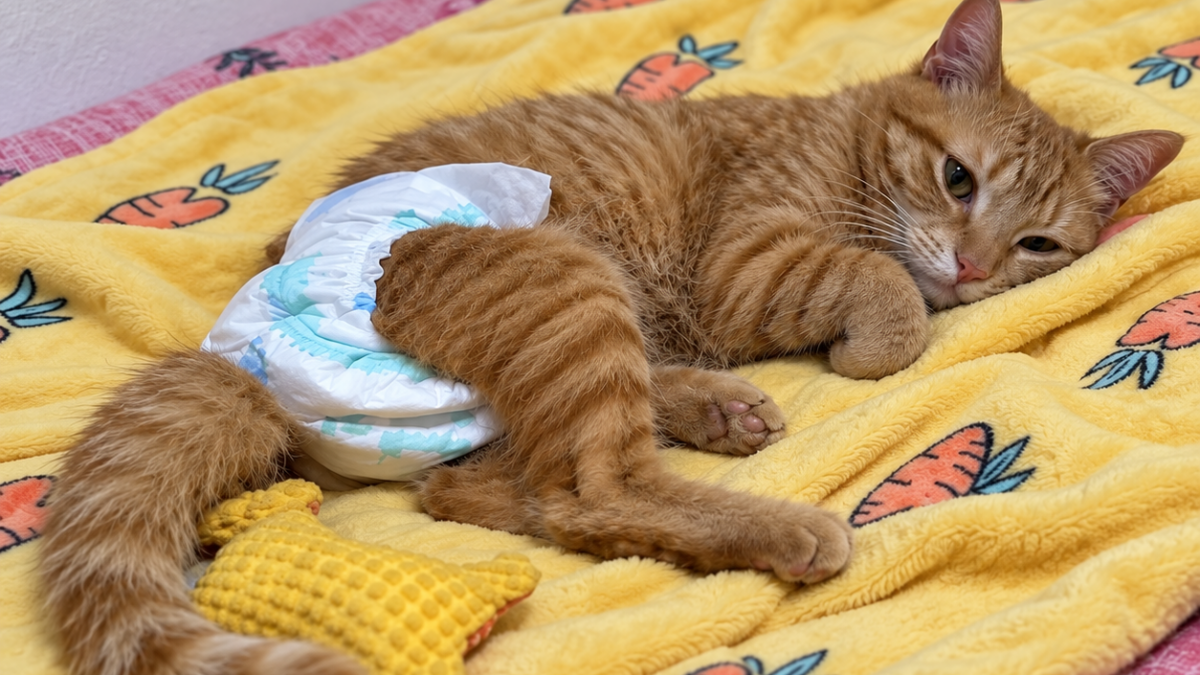
I had rescued injured animals before, but I had never seen a kitten watch the world with such quiet heartbreak. Simba could pull himself forward with his front paws, but his back legs lay motionless behind him while the other cats ran, climbed, and played just inches away. And when that tiny orange kitten finally looked up at me from the corner where he had hidden himself, I had no idea how completely he was about to change our family.
The first thing I remember about Simba was his silence.
Most frightened kittens made themselves known somehow. They hissed, cried, scratched, scrambled for somewhere to hide, or flattened their ears as a warning not to come closer. Simba did none of those things.
He had tucked himself into the back corner of a small room, his thin orange body pressed against the wall. His front paws were under his chest. His back legs stretched awkwardly behind him.
At first, I thought he was simply too scared to move.
Then another cat crossed the room.
Simba’s head lifted immediately.
His eyes followed it.
The cat hopped onto a low chair.
Simba leaned forward.
For one beautiful second, his expression changed completely. The fear disappeared. He looked exactly like what he was supposed to be—a curious kitten who wanted to know where the other cat was going.
Then he tried to follow.
His front paws gripped the floor.
His little shoulders pulled.
His body moved several inches.
His back legs did not.
They dragged behind him.
I stopped breathing.
Simba tried again.
Pull.
Slide.
Pull.
Slide.
His front half worked desperately while the back half seemed disconnected from everything he wanted to do.
He stopped after only a few feet.
The other cat had already disappeared.
Simba lowered his head.
I knelt beside him.
“Hey, sweetheart.”
His eyes moved toward me.
He didn’t run.
He couldn’t.
I extended one hand slowly.
“You’re okay.”
I had no idea whether that was true.
He allowed me to touch the top of his head.
His fur was soft but dirty. His body felt too thin beneath it.
He didn’t purr.
He didn’t lean into me.
He simply watched.
That look stayed with me all the way home.
I had told myself I was bringing him home temporarily.
Just until we understood what had happened.
Just until we learned what kind of care he needed.
Just until there was a better plan.
Those words sounded practical.
They also turned out to be completely meaningless.
By the first evening, my kitchen counter was covered with towels, wipes, food, medication instructions, and notes.
Simba needed far more help than I had first understood.
He could not reliably move away when he soiled himself.
He needed help staying clean.
He had to be repositioned often so that one area of his body did not remain under constant pressure.
Eating sometimes required support.
His back legs needed to be handled carefully.
There were moments when a tiny diaper was the easiest way to keep him comfortable and clean.
I had never imagined I would stand in my kitchen measuring something small enough to fit around a kitten while my husband read instructions from his phone.
“This one says we should make sure it isn’t too tight.”
“I know.”
“I’m just telling you what it says.”
“I know what too tight means.”
“Well, I’m trying to help.”
“Then hold him.”
My husband carefully lifted Simba’s front half.
Simba looked at both of us with the exhausted expression of someone deeply disappointed in the competence of his staff.
My daughter started laughing.
“He hates us.”
“He doesn’t hate us,” I said.
Simba immediately tried to bite the diaper.
My husband raised an eyebrow.
“He may have concerns.”
It was the first time any of us laughed since bringing him home.
That mattered.
Because underneath the practical work was fear.
Real fear.
We did not know whether Simba would ever use his back legs normally.
We did not know whether the paralysis was permanent.
We did not know exactly what had caused it.
An old injury was possible.
A neurological problem was possible.
Something congenital could not immediately be ruled out.
There were questions everywhere and very few answers.
The only thing we knew for certain was that Simba was alive.
And somehow, he had survived long enough for someone to notice him.
The first few nights were difficult.
I slept lightly.
Every sound woke me.
Sometimes Simba made no sound at all, and that worried me more.
I would get out of bed, walk quietly into the room where we had made his sleeping area, and find him awake.
He would be lying on his blanket with his head raised.
Watching.
Always watching.
I would sit beside him.
“You should be sleeping.”
His ears would move toward my voice.
I began talking to him.
Not because I believed he understood the words.
Because the room felt less lonely when I spoke.
I told him what time it was.
I complained about my back hurting.
I told him the other cats were spoiled.
I promised him breakfast even though breakfast was still four hours away.
Sometimes I placed my hand beside him and left it there.
At first, he merely tolerated it.
Then one night, after several minutes, Simba moved his front paw.
He rested it against my finger.
It was such a small gesture that I almost convinced myself it was accidental.
But I sat there another twenty minutes because I didn’t want to move.
The veterinary appointments began almost immediately.
PART 2
Every trip filled me with equal parts hope and dread.
I wanted someone to say, “Here is the problem. Here is the treatment. Here is when he will be better.”
Instead, I heard words like uncertain.
Monitor.
Therapy.
Possibility.
Response.
Time.
One veterinarian examined Simba carefully and then looked at me.
“There are things we can try.”
“Will he walk?”
“I can’t promise that.”
It was the sentence I had been afraid to hear.
I looked down at Simba.
He was busy trying to reach a corner of the towel.
“What are the chances?”
She paused.
“That’s difficult to quantify without knowing the exact origin and extent of the damage. What I can tell you is that he’s young. He’s alert. He’s eating. Those are good things.”
“But his legs?”
“We need to see what his body tells us.”
I hated that answer.
Not because it was careless.
Because it was honest.
I wanted certainty.
Simba had none to give me.
We started therapy.
The first exercises looked almost too simple to matter.
Gentle positioning.
Supported standing.
Careful range-of-motion movements.
Encouraging him to shift weight.
Helping his muscles work without overstraining his body.
Then came the balance cushion.
It was soft, round, and slightly unstable.
The idea was to make Simba’s body respond to subtle changes beneath him.
The first time we placed him on it, he spread his front paws wide.
His claws gripped the surface.
His shoulders trembled.
His back legs remained nearly still.
I supported him beneath the belly.
“Easy.”
He looked at me.
“You don’t have to do everything today.”
He wobbled.
His front paws adjusted.
One slid.
I steadied him.
“Good.”
He lasted only a few seconds.
Then his body sagged.
I lifted him immediately.
“That’s enough.”
I gave him food.
The way he attacked that food made me laugh.
“You would think we starve you.”
He buried his face deeper into the bowl.
Food became our most effective therapy assistant.
Simba would tolerate almost anything if he believed food was involved.
Each day we repeated the exercises.
Support.
Balance.
Rest.
Try again.
At first, nothing changed.
Or at least nothing I could see.
The other cats continued moving through the house with effortless confidence.
They jumped onto the couch.
They chased each other down the hallway.
They climbed onto furniture they were not supposed to touch.
Simba watched them.
Sometimes that was the hardest part.
I began imagining what he must be feeling.
Did he understand that his body was different?
Did he feel frustrated?
Was he jealous?
Was I projecting human feelings onto an animal who simply accepted the body he had?
I didn’t know.
But every time one of the cats ran past and Simba lifted his head, my chest tightened.
One afternoon, my daughter sat beside him while another cat, Milo, chased a toy across the room.
Simba watched closely.
My daughter looked at me.
“Do you think he knows he can’t do that?”
I almost said no.
I wanted to protect her.
Instead, I answered honestly.
“I don’t know.”
She looked down at Simba.
“I wish he could.”
“So do I.”
She reached out and stroked his head.
Simba’s eyes slowly closed.
That night, I cried in the bathroom where no one could hear me.
Not because Simba was dying.
He wasn’t.
Not because he was in constant pain.
We were watching that carefully.
I cried because I was already grieving things he had never been promised.
Running.
Jumping.
Climbing.
Chasing.
Ordinary kitten things.
It took me a long time to understand that I was grieving a life Simba himself had never lived.
He wasn’t comparing today with yesterday.
I was.
He wasn’t mourning an imaginary version of himself.
I was.
That realization came later.
In the beginning, I only knew I wanted him to get better.
We added laser therapy as part of his care plan.
The sessions were calm.
There was no dramatic reaction.
No moment where Simba suddenly stood.
No immediate change.
He lay on a padded surface while the treatment was carefully applied.
I watched everything.
Every twitch.
Every blink.
Every shift.
I became obsessed with his back legs.
I watched them while he ate.
While he slept.
During therapy.
When he stretched.
When he became excited.
I was terrified I would miss something.
Then came acupuncture.
I had mixed emotions about it.
I wanted every reasonable option.
I also feared putting Simba through treatments that might only stress him.
The first session surprised me.
He settled more calmly than expected.
He tolerated the process.
At one point, he looked directly at me.
I placed my hand near his face.
He pushed his cheek against my fingers.
“Good boy.”
That was the first time he actively leaned into my hand.
I nearly cried right there.
It had nothing to do with his legs.
For weeks, Simba had accepted our touch because he needed us.
That moment felt different.
He chose contact.
When we returned home, he slept for hours.
I sat beside him and realized that somewhere between feeding schedules and medical appointments, the frightened kitten had begun learning who we were.
We were becoming familiar.
Safe.
Predictable.
That mattered.
A few days later, the first movement happened.
It was so small I almost missed it.
We were doing balance exercises.
My husband was nearby.
My daughter was sitting on the floor.
Simba had his front paws planted firmly on the cushion.
I supported his abdomen.
“Come on, sweetheart.”
I shifted him slightly.
His right hind leg moved.
Not much.
Maybe an inch.
I froze.
My husband noticed my expression.
“What?”
“Nothing.”
“What happened?”
“I think…”
I stopped.
I repositioned Simba.
Nothing.
My heart sank.
Maybe I had imagined it.
Then Simba leaned forward toward a treat.
His right back leg shifted again.
This time I felt it beneath my hand.
“Oh my God.”
My daughter stood.
“What?”
“He moved.”
“What moved?”
“His leg.”
She dropped back to her knees.
“Which one?”
“The right.”
My husband came closer.
“Are you sure?”
“No.”
I laughed and cried at the same time.
“I don’t know.”
We waited.
Simba became impatient because the treat was still out of reach.
He stretched forward.
His back leg tightened.
Everyone saw it.
Nobody spoke for several seconds.
Then my daughter covered her mouth.
“He did it.”
My husband exhaled hard.
“He actually did.”
I bent over Simba and kissed the top of his head.
“You moved.”
Simba looked completely unimpressed.
He wanted the treat.
I gave it to him.
That tiny movement changed the atmosphere in our house.
It did not change Simba’s disability.
The next morning, his legs still dragged.
He did not stand.
He did not walk.
He did not suddenly become a different cat.
But the movement proved one thing.
His body still had something to say.
We did not know how much.
We did not know what it meant long-term.
But hope had become physical.
It was no longer just something we were imagining.
The next appointment brought us back to reality.
I excitedly described everything.
The veterinarian listened carefully.
“That’s encouraging.”
My heart jumped.
“So this means he’ll walk?”
She looked at me gently.
“It means we saw a response. That is good. But I don’t want you to convert one response into a guarantee.”
I hated how disappointed I felt.
I knew she was right.
She continued.
“Progress with neurological or mobility conditions can be inconsistent. He may improve in some ways and plateau in others. We need to keep evaluating the cat in front of us.”
I nodded.
On the drive home, Simba slept in his carrier.
I kept replaying her words.
The cat in front of us.
Not the cat I desperately wanted him to become.
The actual Simba.
That distinction would save me later.
For the moment, we kept working.
His routine became the rhythm of our days.
I woke before everyone else.
Checked him.
Cleaned him if necessary.
Prepared food.
Therapy.
Rest.
Later, more exercises.
Appointments when scheduled.
More cleaning.
More food.
More rest.
My laundry doubled.
Then tripled.
I learned things I never expected to know about caring for a disabled kitten.
I learned which fabrics protected his skin best.
I learned how quickly irritation could develop.
I learned how to support him without making him feel trapped.
I learned to recognize the small differences between tired, annoyed, hungry, uncomfortable, and simply bored.
Most importantly, I learned Simba had opinions.
Lots of them.
The quiet kitten disappeared.
In his place emerged a tiny orange dictator.
He began announcing when breakfast was late.
He objected to certain towels.
He disliked being repositioned if he was comfortable.
He developed a personal war against the diaper.
One morning, I found him halfway out of it.
“How did you do that?”
He stared.
“Seriously.”
One back leg was still inside.
The rest of him had somehow wriggled free.
My daughter walked in.
“Maybe he doesn’t want to wear it.”
“He doesn’t get a vote.”
Simba immediately grabbed the edge with his teeth.
My daughter laughed.
“I think he disagrees.”
We began calling him Houdini.
His personality grew faster than his body.
And the stronger his front legs became, the faster he moved.
At first he had crawled slowly.
Then he learned technique.
He planted both front paws.
Pulled hard.
Shifted.
Pulled again.
He could cross a room surprisingly fast when motivated.
Food motivated him.
My voice motivated him.
Toys motivated him.
But nothing motivated Simba like Milo.
Milo was an older cat who had initially regarded Simba with cautious suspicion.
He sniffed him once and walked away.
For days, that was their entire relationship.
Then I began finding Milo nearby.
Not touching Simba.
Just existing close to him.
One afternoon, they were both lying in the same patch of sunlight.
The next day, their paws were touching.
A week later, Simba was asleep with his head pressed against Milo’s side.
I took a photograph.
My daughter saw it.
“He likes him.”
“Milo?”
“Yeah.”
“Milo barely likes us.”
She laughed.
“That means Simba is special.”
Maybe he was.
Milo treated Simba differently from the way we did.
We watched every movement.
Milo did not.
We worried constantly.
Milo did not.
We saw disability.
Milo seemed to see another cat who happened to move strangely.
That relationship changed Simba.
He began following Milo.
Sometimes only a few feet.
Sometimes across the room.
Milo would walk.
Simba would pull himself behind.
One day, Milo picked up a toy mouse.
Simba’s eyes locked onto it.
Milo walked away.
Simba followed.
Pull.
Slide.
Pull.
Slide.
“Milo,” I said, “don’t tease him.”
Milo looked back.
Then kept going.
Simba did too.
Five feet.
Seven.
Ten.
He stopped only when his front legs finally tired.
Milo dropped the mouse.
Simba grabbed it.
For a moment, he looked triumphant.
I opened the notebook where I recorded therapy details.
Ten feet.
I wrote it down.
It felt ridiculous and enormous at the same time.
The weeks passed.
Simba gained weight.
His shoulders developed.
His front legs became muscular.
He began lifting his chest more easily.
His balance improved slightly.
His tail flicked more.
Sometimes the right hind leg responded when we changed his position.
The left leg remained far less active.
I began celebrating differences no one else would have noticed.
Two seconds upright.
A better shift.
A stronger push.
A paw flex.
My husband sometimes found me staring at Simba.
“What?”
“I think his hip moved differently.”
He would crouch.
Simba would immediately stop doing whatever I had been watching.
“Of course.”
“What?”
“He waits until you come over and then becomes completely still.”
My husband smiled.
“Maybe he thinks you’re spying on him.”
“I am spying on him.”
“That might be the problem.”
The humor helped.
We needed it.
Because not every week brought progress.
Some brought setbacks.
One week Simba seemed weaker.
His right leg, the one that had started moving, barely responded.
He tired quickly.
I panicked.
Had we done too much?
Had I hurt him?
Was the improvement disappearing?
At the clinic, I asked question after question.
The veterinarian examined him.
“His body is growing.”
“Is that bad?”
“No. But growth changes mechanics. Muscles fatigue. Neurological responses vary.”
“So he hasn’t lost everything?”
“I don’t see evidence of a dramatic new injury.”
I felt myself breathe again.
She looked at me.
“You’re measuring him day by day.”
“Of course.”
“That can make normal fluctuation feel catastrophic.”
“What should I do?”
“Watch patterns, not moments.”
Patterns, not moments.
I wrote that down too.
It became one of the hardest lessons.
I wanted every day to be better than the last.
Real healing was not that polite.
Sometimes Simba progressed.
Sometimes nothing changed.
Sometimes he seemed to go backward before regaining ground.
Recovery was not a staircase.
It was a trail.
Uneven.
Messy.
Full of turns.
One night after an especially exhausting day, I stood in the laundry room holding a stack of wet towels.
I was tired.
The kind of tired that makes simple objects feel heavy.
Simba had needed cleaning three times that day.
We had an appointment coming up.
Bills were accumulating.
I was worried about the future.
My husband walked in.
“You okay?”
“No.”
He leaned against the doorway.
“What happened?”
“Nothing.”
“That doesn’t sound like nothing.”
I stared at the towels.
“What if this is forever?”
He was quiet.
I continued.
“What if he never improves beyond this?”
“He might not.”
The answer stung.
“I know.”
“What are you really asking?”
I looked at him.
“I don’t know if I can do this forever.”
There.
The sentence I had been ashamed to say.
My husband did not look shocked.
He did not judge me.
He walked closer.
“You’re tired.”
“That’s not the same thing.”
“It matters.”
“I love him.”
“I know.”
“But love doesn’t make me less tired.”
“No.”
“It doesn’t make appointments cheaper.”
“No.”
“It doesn’t give me more hours.”
“No.”
“It doesn’t fix his legs.”
“No.”
I started crying.
“What if loving him isn’t enough?”
My husband looked toward the hallway.
Simba was asleep in the next room.
Then he looked back at me.
“Maybe enough doesn’t mean fixing him.”
I said nothing.
“Maybe enough means he’s safe. Fed. Comfortable. Loved. Maybe enough means he has a good life.”
“But what if he never becomes normal?”
My husband shook his head.
“He is normal.”
I looked at him.
“You know what I mean.”
“I do. But I think that’s the problem.”
His words hurt because they were true.
I had been using other cats as the measurement.
Running.
Jumping.
Climbing.
I had made those abilities the finish line.
But Simba did not know he was failing to reach someone else’s finish line.
He knew whether he was hungry.
Whether he was comfortable.
Whether he wanted affection.
Whether Milo had stolen his toy.
Whether the sun was warm.
Whether he trusted us.
That night I sat beside Simba for a long time.
“I’m sorry,” I whispered.
He opened one eye.
“I keep asking you to become somebody else.”
He blinked.
“You don’t owe me that.”
He went back to sleep.
The next morning, I changed.
Not completely.
I still hoped.
I still watched his legs.
But I stopped turning every therapy session into a test.
Three seconds became three seconds.
Not a failure to reach five.
One movement became one movement.
Not proof that another should follow.
If Simba was tired, we stopped.
If he wanted affection instead of exercises, sometimes affection won.
Oddly, once I stopped demanding visible progress, I started noticing more of it.
His front strength was remarkable.
His balance was genuinely better.
His tail moved with more intention.
He showed more awareness of his lower body.
He could sometimes reposition himself in ways he had not before.
And emotionally, he was becoming a different animal.
He sought us out.
One afternoon, I sat on the floor reading.
I heard the familiar scraping sound.
Pull.
Slide.
Pull.
I looked up.
Simba was coming toward me.
No food.
No toy.
No therapy.
Just me.
I stayed still.
He crossed the space slowly.
When he reached my knee, he placed one front paw against my leg.
Then he leaned.
I put down the book.
“You came over here just to sit with me?”
He pushed his face against my hand.
My eyes filled.
The kitten who had once tolerated touch was asking for it.
I lifted him into my lap.
He settled immediately.
That was when I understood something I wish more people knew.
Healing is not always about restoring the body.
Sometimes healing is learning that the world is safe enough to move toward.
Simba was doing that.
He became more confident everywhere.
We created low, padded spaces he could explore.
A soft tunnel became his favorite possession.
The first time we placed it on the floor, he stared at it.
Milo walked through.
Simba watched.
Milo walked through again.
Simba moved closer.
We put a toy near the entrance.
Simba reached.
Then pulled himself inside.
The tunnel shook.
His orange tail disappeared.
My daughter crouched at the other end.
“Come on.”
His face appeared.
She gasped.
“He did it.”
Within days, Simba owned the tunnel.
He hid toys inside.
He ambushed Milo.
He waited for feet.
One morning, my husband walked past and Simba shot one paw out.
My husband jumped.
“What was that?”
I started laughing.
“Your son.”
“He attacked me.”
“He’s practicing.”
“For what?”
“Crime.”
Simba’s reputation grew.
Visitors who expected to meet a sad disabled cat instead met a determined orange thief.
He stole pens.
Shoelaces.
Paper.
Anything that moved near his front paws.
One friend sat on the floor beside him and said softly, “Poor little guy.”
Simba immediately grabbed the string from her hoodie.
She laughed.
“Okay. Maybe not poor.”
Exactly.
I began correcting people gently.
Simba had challenges.
Yes.
He required care.
Yes.
His body worked differently.
Yes.
But pity did not describe him.
His life had become far too full for that.
We gave him a low platform near the window.
It was heavily padded.
He could not climb onto it by himself, but we could place him there safely.
The first time I did, Milo was already watching birds.
Simba sat beside him.
A bird landed near the feeder.
Both cats became completely still.
Their heads moved together.
The bird hopped.
Milo’s tail twitched.
Simba’s tail twitched too.
Then the bird fluttered against the window.
Simba slapped one front paw against the glass.
I laughed.
“There you are.”
He slapped again.
The bird flew.
Simba looked deeply offended.
For twenty minutes, he watched the yard with Milo.
That scene broke something open inside me.
Months earlier, Simba had watched other cats experience the world from a corner.
Now he was beside them.
Not doing everything the same way.
But participating.
That mattered more than I could explain.
Around that time, we faced another decision.
When I first brought Simba home, I had never officially said we were keeping him forever.
The word temporary still hovered somewhere in the background.
I told myself that was responsible.
Special-needs animals can require experienced homes.
Maybe someone else would be better equipped.
Then I received a message.
A woman who had experience with disabled cats had heard about Simba.
She had ramps.
Protective flooring.
Experience with mobility issues.
She asked whether he might be available for adoption.
I stared at the message.
This was what I had once told myself I wanted.
The perfect home.
Someone prepared.
Someone knowledgeable.
I showed my husband.
He read it.
“Well?”
“I don’t know.”
“You do.”
“What if she’s better for him?”
“Maybe.”
I looked at him sharply.
He continued.
“She might be more experienced.”
“Exactly.”
“But is that the only thing that matters?”
I looked toward the living room.
Simba was sleeping against Milo.
“What if we’re not enough?”
My husband smiled sadly.
“We’ve had this conversation.”
“I know.”
“Do you want him to go?”
My throat tightened.
“That’s not fair.”
“It’s the question.”
“No.”
“Then why are we talking like adoption is a requirement?”
“Because I don’t want to be selfish.”
We were silent.
Then Simba woke.
He lifted his head.
He saw me.
And he started moving.
Pull.
Slide.
Pull.
Slide.
He crossed the floor.
Slowly.
Directly.
Until he reached my shoe.
He placed one paw on it.
My husband looked at me.
I bent down and lifted Simba.
He tucked his head beneath my chin.
The decision was over.
I wrote the woman a grateful message.
I thanked her.
I explained that Simba had found his home.
The relief I felt was immediate.
So was the fear.
Because keeping him meant accepting everything.
The costs.
The work.
The uncertainty.
The possibility that he might never walk normally.
We accepted it.
Nothing became magically easier.
But after that, the question changed.
We stopped asking, “Can we do this forever?”
We started asking, “What does Simba need next?”
That was manageable.
One day at a time.
One need at a time.
One adjustment at a time.
His therapy continued.
A few weeks later, I felt a stronger push from his right hind leg.
Not a twitch.
Pressure.
I supported him on a textured mat.
He leaned forward toward a treat.
His right rear paw pressed downward.
His hips shifted.
I froze.
“Again.”
He reached.
The paw pushed.
My heart started pounding.
The left leg barely responded.
But the right was doing something new.
At the next session, the therapist saw it too.
“That’s purposeful.”
I stared at her.
“Purposeful?”
“Yes.”
“So he’s walking?”
“No.”
The word came gently but firmly.
“He’s showing a more organized response. That’s encouraging.”
I nodded.
Encouraging.
That word had become precious.
We worked with that response.
Carefully.
Never forcing.
Never assuming.
Simba sometimes cooperated.
Sometimes he refused.
One day, he bit the therapy towel three times.
“Simba.”
Bite.
“This is supposed to help you.”
Bite.
“That towel has never harmed you.”
Bite.
The therapist laughed.
“Resistance training.”
We started calling everything therapy.
Chasing Milo was cardio.
Stealing pens was occupational therapy.
Fighting the diaper was flexibility training.
Attacking shoelaces was coordination.
Humor made the difficult parts lighter.
Then came a day I will never forget.
There was nothing special about the morning.
No appointment.
No treatment scheduled.
I had finished cleaning the room.
Simba was on a mat.
Milo walked past carrying the old toy mouse.
Simba immediately became alert.
Milo dropped it several feet away.
Simba started toward it.
Pull.
Slide.
Pull.
Then something changed.
His right hind paw came under him.
It pressed.
His hips lifted.
His belly rose slightly from the floor.
I stopped moving.
“Simba.”
He looked at the mouse.
His front paws advanced.
The right hind leg pushed again.
The left leg jerked inward.
His body moved.
Not normally.
Not smoothly.
But differently.
“Simba.”
He tried again.
For one second, maybe two, he held more of his own weight than I had ever seen.
Then he collapsed sideways.
I rushed forward.
He ignored me.
He reached for the mouse.
I started laughing.
My daughter came running.
“What?”
“He stood.”
“What?”
“He pushed up.”
“Show me.”
“I can’t.”
“What do you mean?”
“I don’t control him.”
We both laughed.
Then I cried.
I called my husband.
“I saw him lift himself.”
“Are you sure?”
“Yes.”
This time I was sure.
At the next appointment, we described everything.
Again, no one promised a miracle.
Again, I appreciated that.
Because I had come to understand that “miracle” sometimes erases work.
Simba’s progress was built from hundreds of ordinary acts.
Feeding.
Cleaning.
Holding.
Repositioning.
Stretching.
Appointments.
Rest.
Trying again.
Love was not magic.
Love was consistency.
The pushing movements returned occasionally.
Then disappeared.
Then returned again.
His right side remained stronger.
The left side lagged.
He never woke up and suddenly ran.
His story was not that simple.
But his world kept expanding.
We tried a supportive mobility device under guidance.
The first time we placed him in it, Simba looked betrayed.
“You’re okay.”
He stared at me.
“Don’t look at me like that.”
His expression suggested I had violated several international laws.
We put a treat ahead.
He reached.
The support helped keep his body aligned.
He pulled forward.
Another treat.
Another movement.
Then Milo appeared.
Everything changed.
Simba forgot his suspicion.
He followed.
Slowly.
Awkwardly.
But forward.
Milo walked across the room.
Simba went after him.
My daughter recorded part of it.
Her hands shook.
When we watched the video later, we could hear her crying.
There was no dramatic music.
No perfect lighting.
Just a cat moving toward another cat.
That was enough.
Simba still needed support after that.
We never claimed he was cured.
We never pretended the disability disappeared.
His back legs remained impaired.
He still required cleaning.
Monitoring.
Therapy.
Assistance.
But he had more options than before.
That mattered.
At the clinic, staff members began greeting him by name.
“There’s Simba.”
He expected attention.
Usually he got it.
One day, a woman in the waiting room looked at his legs.
“What happened?”
“We don’t know exactly. Possibly an early injury or neurological damage.”
She lowered her voice.
“Poor thing.”
Simba immediately reached toward the ribbon on her handbag.
She laughed.
“Oh.”
“He doesn’t agree with ‘poor thing.’”
She scratched under his chin.
“He seems happy.”
“He is.”
Those three words stayed with me.
He seems happy.
For so long I had focused on ability.
Could he stand?
Could he move?
Could he use the leg?
Could he improve?
But happiness had been developing beside those questions the whole time.
Simba loved warm laundry.
He loved chicken.
He loved Milo.
He loved cardboard boxes with low sides.
He loved sitting by the window.
He loved being carried into whatever room had the most people.
He loved stealing pens.
He loved waking us before sunrise.
He loved life.
That was not a consolation prize.
It was the point.
The first time I left home overnight after bringing Simba in, I almost canceled.
My husband stayed with him.
I received updates constantly.
Photo.
Text.
Video.
“He ate.”
“He’s sleeping.”
“He attacked Milo.”
“He’s fine.”
I still worried.
When I returned the next afternoon, Simba was resting across the room.
I put down my bag.
“Hi, baby.”
His head snapped up.
His eyes widened.
Then he started moving.
Fast.
Pull.
Slide.
Push.
Pull.
His right leg tried to join.
I sat on the floor.
He came straight toward me.
The distance was not huge.
Maybe fifteen feet.
It felt endless.
When he reached me, he climbed as far onto my lap as he could.
I lifted him.
He pressed his face against my hand.
I cried.
Not because I had been gone.
Because I remembered the first day.
The kitten in the corner had not come toward me.
He had only watched.
Now he crossed rooms to find me.
That was healing too.
Maybe the biggest kind.
We reached Simba’s first year with us without any single dramatic ending.
That surprised me.
I had once imagined there would be a moment when the story became complete.
A first full step.
A run.
A jump.
Something obvious.
Instead, completion arrived quietly.
I realized one morning that Simba was simply part of our life.
His towels were folded with everything else.
His therapy equipment had a permanent place.
His schedule was built into ours.
His food was on the shopping list.
His appointments went on the calendar.
No one asked whether keeping him was temporary.
No one wondered whether we could manage.
We were managing.
Not perfectly.
But enough.
Simba had grown from a tiny kitten into a bright, handsome orange cat.
His body still told the story of his disability.
His back legs did not move like those of the other cats.
His posture was different.
His movement was different.
His needs were different.
But the first thing visitors noticed was usually his personality.
He greeted people.
Reached for them.
Demanded attention.
One friend visited and sat on the couch.
Simba dragged himself across the room.
She leaned down.
“Hi.”
He immediately tried to steal her bracelet.
She laughed.
“He’s terrible.”
“Yes.”
“I love him.”
“Exactly.”
His revenge against the life he had almost been given was complete.
Not revenge against a person.
Not anger.
Not punishment.
Something better.
Simba’s revenge was joy.
Joy against the corner where he once stayed silent.
Joy against every assumption that disability meant misery.
Joy against the fear that his world would always be smaller than everyone else’s.
He could not climb the way Milo did.
So we built low spaces.
He could not run normally.
So he developed his own speed.
He could not always follow the other cats everywhere.
So sometimes they waited.
That last part became one of my favorite changes.
Milo began adjusting.
If Simba followed him, Milo sometimes slowed down.
He would walk several feet.
Stop.
Look back.
Wait.
Simba would catch up.
Then Milo would continue.
The first time I noticed it, I thought I was imagining things.
Then my daughter saw it too.
“He waits for him.”
“I know.”
“That’s so cute.”
It was more than cute.
Once, Simba had watched life disappear ahead of him.
Now another cat sometimes paused until he arrived.
No one taught Milo to do that.
He simply did.
One evening, the two of them sat near the window.
A bird landed outside.
Milo crouched.
Simba lifted his head.
The bird hopped closer.
Both tails moved.
Milo suddenly jumped onto the windowsill.
Simba could not.
He remained below.
For a second, my old sadness returned.
Then Milo looked down.
He jumped back onto the floor.
Sat beside Simba.
They watched from there.
I covered my mouth.
My husband saw me.
“What?”
“Nothing.”
He followed my gaze.
“Oh.”
We stood quietly.
There was nothing to say.
That was the world Simba had built.
Not a world where every obstacle disappeared.
A world where love adjusted.
The therapy never completely stopped.
We continued exercises as appropriate.
Some days Simba cooperated beautifully.
Some days he behaved as if therapy was a personal insult.
His balance cushion became worn.
Claw marks covered the surface.
One evening, close to the anniversary of his arrival, I brought it out.
Simba recognized it.
He pulled himself toward it.
“You remember this?”
He sniffed.
I placed him on the cushion with support.
His front paws steadied.
His body wobbled.
But not like the first time.
He corrected.
His right hind leg pressed downward.
Then the left shifted slightly.
Three seconds.
Five.
Eight.
Ten.
I stared.
My husband stood behind me.
“He looks different.”
“He’s bigger.”
“That’s not what I mean.”
I knew.
The kitten had once seemed swallowed by his situation.
Now Simba seemed larger than it.
He balanced several more seconds.
Then leaned toward me.
I caught him.
“That’s enough.”
He rubbed his head against my chin.
Later that night, I opened the photographs from his first week.
There he was.
Tiny.
Thin.
Motionless behind the hips.
Eyes huge.
Then another photo.
The balance cushion.
Another.
Therapy.
Another.
Wrapped in a towel.
Another.
Sleeping beside Milo.
Another.
Watching birds.
Another.
Pulling himself toward my daughter.
Another.
Caught halfway out of a diaper.
I laughed.
Then I reached a recent photo.
Simba was lying in sunlight.
His front paws crossed.
His back legs stretched behind.
His eyes half closed.
He looked peaceful.
Not triumphant.
Not miraculous.
Peaceful.
And suddenly that became my favorite image.
Because peace was something the frightened kitten in the corner had not possessed.
Safety had changed him.
Love had changed him.
Routine had changed him.
Therapy had changed him.
Time had changed all of us.
If I could speak to the woman I had been that first week, I know exactly what I would tell her.
I would not promise Simba would walk normally.
Even now, I would not make a promise his body never made.
I would not say caring for him would become easy.
It didn’t.
I would not say she would stop being afraid.
Some fears stayed.
I would tell her something better.
I would say:
One day, you will stop seeing only the legs that do not work.
You will see the eyes that search for you.
The paws that grab your shoelaces.
The ears that recognize your voice.
The body that crosses a room because you came home.
You will realize that the miracle you are waiting for is already happening.
It just doesn’t look the way you expected.
And when you finally understand that, you will stop asking whether Simba’s life is complete.
You will know.
One winter morning, Simba woke before everyone.
I heard him moving in the hallway.
Scratch.
Pause.
Scratch.
Pause.
I looked at the clock.
5:12 a.m.
“No.”
Scratch.
Pause.
Scratch.
He appeared at the bedroom doorway.
“Simba.”
Meow.
“It is five in the morning.”
Meow.
“You are not starving.”
Meow.
My husband opened one eye.
“Feed him.”
“You feed him.”
“He likes you more.”
“That is not true.”
Simba meowed louder.
My husband sighed.
“Fine.”
He got out of bed.
Simba immediately turned toward the kitchen.
I started laughing.
“What?”
“He got what he wanted.”
My husband looked down.
Simba was moving ahead of him.
“That cat is manipulative.”
“Very.”
“Remember when we thought he was quiet?”
I laughed harder.
That was the greatest proof of his recovery.
Not his legs.
His audacity.
The silent kitten was gone.
In his place was a cat who expected the world to respond.
And most of the time, it did.
There were still difficult days.
Disability did not vanish because the story became happy.
Sometimes Simba’s skin became irritated.
Sometimes he was tired.
Sometimes we worried about bowel or bladder issues.
Sometimes his mobility seemed worse.
Sometimes appointments brought new questions instead of answers.
One afternoon, after a difficult week, I found myself falling into old thinking.
Other cats his age could leap onto counters.
Simba still needed help reaching a low bed.
It felt unfair.
I sat on the floor.
Simba was nearby.
Milo suddenly ran through the room.
Simba’s head snapped toward him.
Then he took off in pursuit.
Pull.
Push.
Slide.
Pull.
His right hind leg contributed.
His left moved awkwardly.
He was not fast.
He was not graceful.
He was delighted.
Milo stopped.
Waited.
Simba reached him.
Then Milo darted away again.
Simba followed.
I watched them.
My sadness disappeared.
Not because the difference disappeared.
Because Simba had no time for my grief.
He was busy playing.
I laughed.
“Okay.”
He ignored me.
“Message received.”
That became my promise to him.
I would help where he needed help.
I would hope without demanding.
I would grieve without turning his life into tragedy.
I would never pretend his challenges were easy.
But I would stop measuring his happiness by someone else’s body.
Years from now, I know there will be more decisions.
Bodies change.
Needs change.
We will adapt again.
That no longer frightens me the way it once did.
Because Simba taught us the method.
Look at today.
Solve today.
Love today.
Tomorrow will arrive when it arrives.
People occasionally ask whether I would do it again knowing how much work caring for Simba required.
The question always surprises me.
Because once you know someone, you cannot imagine replacing them with convenience.
Would I choose the laundry?
No.
The worry?
No.
The bills?
Obviously not.
Would I choose Simba?
Every time.
Even knowing everything.
Especially knowing everything.
He changed our house.
He changed how my daughter understands disability.
He changed how my husband and I talk about caregiving.
He changed how I think about rescue.
Before Simba, I thought rescue meant taking an animal from a bad situation and making it better.
Now I know that is only the beginning.
Sometimes rescue means accepting that better will not look perfect.
Sometimes it means building a life around what remains possible.
Sometimes it means replacing the question “Can this animal become normal?” with “Can this animal have joy?”
That question is much more important.
Simba’s answer is yes.
Loudly.
Repeatedly.
Usually before breakfast.
One afternoon, I took the old toy mouse from a basket.
It was barely recognizable.
The fabric had been repaired several times.
One ear was missing.
I tossed it a short distance.
Simba’s eyes locked onto it.
Milo saw it too.
For a second, both cats froze.
Milo ran.
Simba moved after him.
Pull.
Push.
Slide.
Pull.
His body twisted.
His tail lifted.
He was slower.
Milo reached the mouse first.
Then something unexpected happened.
Milo picked it up.
Walked halfway back.
Dropped it in front of Simba.
My daughter gasped.
“Did he just give it to him?”
“I think so.”
Simba grabbed the mouse.
Milo lay down beside him.
I felt tears rise.
My daughter looked at me.
“Mom.”
“I know.”
“You’re crying again.”
“I know.”
“You cry about everything he does.”
“That is also true.”
She sat beside them.
Simba rolled slightly against her hand.
The four of us remained there—my daughter, Milo, Simba, and me—for several minutes.
No one needed anything.
No appointment.
No exercise.
No measurement.
Just an ordinary afternoon.
Those became my favorite milestones.
Not the dramatic ones.
The ordinary ones.
Because ordinary meant Simba was not surviving anymore.
He belonged to routine.
To family.
To everyday life.
One day, I found him asleep in the middle of the living room floor.
Milo was curled nearby.
Sunlight came through the window.
The television was on.
My husband was reading.
My daughter was doing homework.
I stood in the doorway and realized nobody was watching Simba.
Nobody was worried.
Nobody was measuring.
He was simply there.
Home.
I think that is the moment I finally let go of the last piece of fear I had carried since the beginning.
The fear that Simba’s life would always be defined by what had happened to him.
It wasn’t.
His disability remained part of him.
But it was not all of him.
He was funny.
Demanding.
Affectionate.
Persistent.
Greedy.
Curious.
Jealous when Milo got attention.
Suspicious of new objects.
Obsessed with chicken.
Terrible with personal boundaries.
Brave.
And deeply loved.
That was Simba.
Not a diagnosis.
Not a rescue story.
Not a sad kitten.
Simba.
The last time we used the balance cushion before replacing it with a newer one, I almost threw the old one away.
Then I stopped.
It was scratched.
Worn.
Flattened in places.
My husband saw me holding it.
“You’re keeping that, aren’t you?”
“Yes.”
He smiled.
“Of course.”
I put it in the closet.
Maybe one day I will throw it away.
Maybe not.
It reminds me of the first movement.
That tiny shift of a back leg.
The movement we thought might be the beginning of a miracle.
In a way, it was.
Just not the miracle I expected.
The miracle was not that Simba became indistinguishable from every other cat.
He didn’t.
The miracle was that a body with limitations still built a full life.
The miracle was that strangers became family.
The miracle was that a kitten who once stayed silent in a corner learned to demand breakfast at dawn.
The miracle was that hands he once watched cautiously became the hands he searched for.
The miracle was Milo waiting.
My daughter learning.
My husband adapting.
Me finally understanding.
A life does not have to look ordinary to be complete.
One evening, long after sunset, Simba was beside me on the couch.
I had lifted him there.
Milo was at the other end.
My daughter was telling us about school.
My husband was pretending not to fall asleep.
Simba stretched.
His right hind leg moved.
Not dramatically.
Just a small motion.
I saw it.
Months earlier, I would have called everyone’s attention.
“Look!”
“Did you see?”
“Do it again.”
This time I didn’t.
I smiled.
I rested my hand on him.
That movement no longer needed to prove anything.
Simba had already proven enough.
Later, I carried him to the floor.
He looked toward the window.
The other cats were gathering there.
I placed him on his padded platform beside them.
Outside, something moved in the dark.
Three heads turned.
Then Simba’s.
Three tails shifted.
Then Simba’s.
I stood behind them.
Once, Simba could only watch other cats move.
Now he was part of the group watching the world together.
And for the first time, I did not think about what he could not do.
I only saw what he had.
A home.
A family.
Friends.
Safety.
Curiosity.
Comfort.
A body that worked in its own imperfect way.
A future no longer measured by a promise.
I reached down.
“Goodnight, Simba.”
He turned toward my hand.
Pressed his face against my fingers.
And I thought about the corner where I first saw him.
That frightened orange kitten had looked up at me as if he had no idea what would happen next.
Neither did I.
Maybe that was the point.
We never know which tiny decision will change a life.
Pick him up.
Take him home.
Try one more treatment.
Do one more exercise.
Wash one more towel.
Wake up one more night.
Stay.
Sometimes love is dramatic.
Most of the time, it is repetitive.
Simba’s life was built from repetition.
Meals.
Medicine.
Cleaning.
Therapy.
Touch.
Voices.
Safety.
Again.
Again.
Again.
Until the frightened kitten stopped waiting for the world to leave him behind.
He joined it.
Not on anyone else’s terms.
On his own.
If there was revenge in his story, it was the best kind.
He answered limitation with curiosity.
He answered silence with a voice.
He answered loneliness with trust.
He answered every sad prediction with another ordinary day of happiness.
And every morning, when Simba begins dragging himself toward the kitchen before the rest of us are ready to wake up, I hear that familiar sound.
Pull.
Slide.
Push.
Pull.
Then a meow.
Demanding.
Impatient.
Alive.
I get out of bed.
“Okay, okay.”
Another meow.
“I’m coming.”
He waits at the doorway.
Sometimes his right leg presses beneath him.
Sometimes it doesn’t.
Sometimes his tail flicks.
Sometimes Milo appears and walks beside him.
I follow them into the kitchen.
Simba looks up.
Bright eyes.
Expecting breakfast.
Expecting care.
Expecting another day.
There was a time when I looked at him and saw everything that might never happen.
Now I look at him and see everything that did.
He trusted us.
He grew.
He played.
He followed.
He loved.
He became family.
The kitten who could only watch the other cats run never needed to become one of them to find his happy ending.
He only needed someone willing to stay long enough to discover what his own ending could look like.
And we stayed.
So did he.
That was enough.
More than enough.
It was everything.








