PART 2: The One-Year-Old Doberman Had Given Up on Life—Then a Blind 12-Year-Old Shepherd Found Him in the Dark
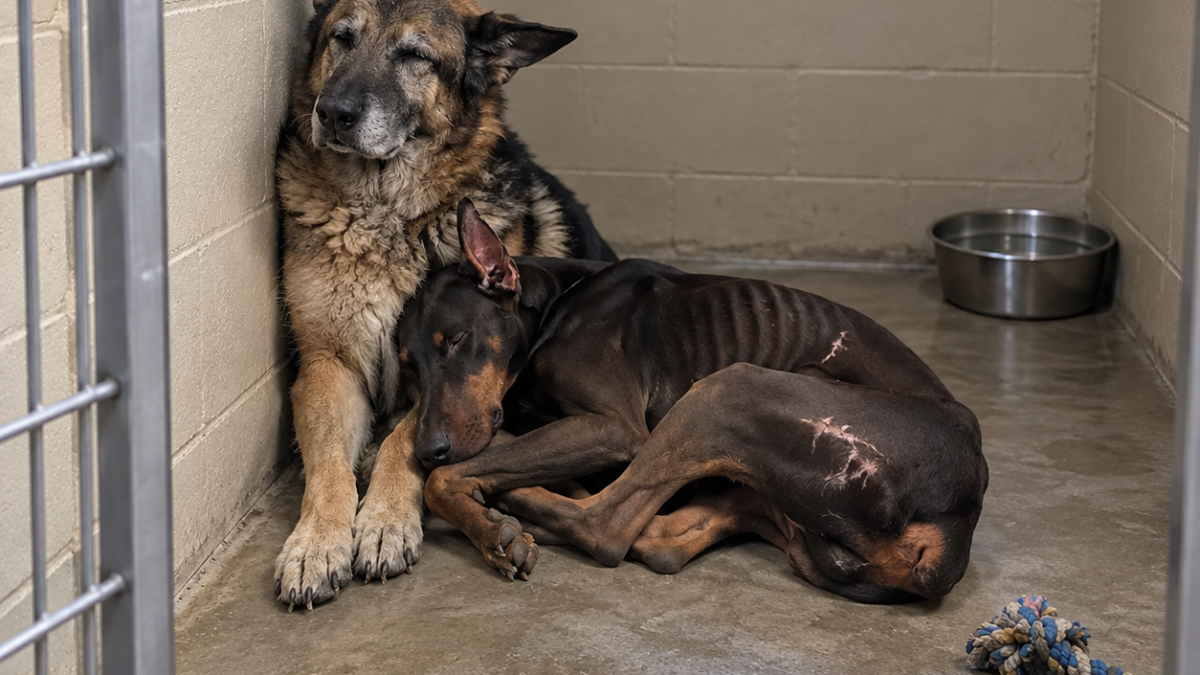
The one-year-old Doberman had survived an illegal fighting operation, but by the time he reached our shelter, there was nothing left in his eyes—not even fear.
Three kennels away lived Bella, a twelve-year-old blind German Shepherd nobody ever chose, a dog who had spent months listening to families walk past her without stopping.
We thought putting those two broken animals together was our last desperate gamble, but sometime after midnight, something happened inside that kennel that none of us could have predicted.
My name is Thomas.
I had worked at the county shelter for almost sixteen years when Rex arrived.
I had seen terrified dogs.
Aggressive dogs.
Dogs that snapped at every hand because experience had taught them that a hand usually meant pain.
Rex was different.
He did almost nothing.
That frightened me more.
He was barely a year old, a black-and-rust Doberman with long legs, a narrow chest, and the body of a young athlete beneath skin stretched too tightly over his ribs.
Scars crossed his shoulders.
One ear had a torn edge.
There were healed puncture wounds around his neck and forelegs.
But it was his eyes that stopped me.
There was no panic in them.
No curiosity.
No anger.
Nothing.
He walked into kennel fourteen, turned toward the back wall, lowered himself onto the concrete, and pressed his muzzle into the corner.
“Hey, buddy.”
Nothing.
I sat outside the kennel.
“My name’s Thomas.”
His ear moved once.
That was all.
We offered chicken.
Wet food.
Warm broth.
Peanut butter.
He refused everything.
On the second day, Dr. Sarah Collins knelt beside me.
“He needs calories.”
“I know.”
“If he keeps refusing food, we may have to intervene medically.”
“I know.”
She watched him.
“Has he responded to anyone?”
“No.”
“Other dogs?”
“We haven’t tried.”
That was when I thought about Bella.
Bella had been with us for seven months.
Twelve years old.
German Shepherd.
Completely blind after progressive retinal disease.
Her family had moved away and left her behind in an empty rental house.
A landlord found her lying beside the front door.
She still wore her collar.
She still knew sit, stay, down, come.
And every afternoon, when visitors walked through the adoption wing, Bella stood at her gate.
She could hear them.
Children laughing.
Shoes on concrete.
People whispering about puppies.
She would raise her head and wag.
Sometimes someone stopped.
They would read her card.
**12 YEARS OLD. BLIND. SENIOR CARE REQUIRED.**
Then came the same sentence.
“Oh, poor thing.”
And they moved on.
Bella never barked after them.
She simply waited for the next footsteps.
But Bella had something Rex did not.
Peace.
She navigated the shelter by sound and scent.
She knew exactly where her water bowl was.
Exactly how many steps separated her bed from the gate.
If a frightened dog cried in another kennel, Bella often sat facing the sound.
Listening.
That afternoon, I stood outside her run.
“Bella.”
Her ears lifted.
She walked toward my voice.
I scratched her chest.
“I need you to meet somebody.”
Sarah was skeptical.
“A traumatized young Doberman and a blind senior?”
“She’s calm.”
“He has an unknown dog history.”
“He hasn’t shown aggression.”
“He hasn’t shown anything.”
“That’s exactly the problem.”
We introduced them through fencing first.
Bella approached slowly.
Rex remained against the wall.
She sniffed.
He did not move.
Bella sat.
Five minutes passed.
Then ten.
Finally, Rex lifted his head.
He looked at her.
Bella could not look back.
She simply sat there, breathing quietly.
Rex lowered his head again.
But he did something he had not done in three days.
He moved closer.
Only a few inches.
That evening, after long discussion and careful supervision, we moved Bella into the larger recovery kennel with Rex.
No toys.
No food between them.
Two beds.
Plenty of space.
Bella immediately found one bed.
Rex stayed in the corner.
I left the shelter at nine that night telling myself we had done everything correctly.
At 12:37 a.m., I was still awake.
At 1:10, I gave up.
I put on my shoes and drove back.
The shelter was dark when I entered.
I walked quietly down the kennel corridor.
Then I reached kennel fourteen.
And stopped.
Bella was no longer on her bed.
She was sitting beside Rex.
Not touching him.
Just close.
Rex was trembling.
Bella tilted her blind face toward the sound.
Then she slowly stood.
Took one step.
Another.
And gently lowered her head across the young Doberman’s shoulders.
Rex went completely rigid.
I held my breath.
He waited for pain.
None came.
Bella simply stayed there.
And then, little by little, Rex stopped shaking.
PART 2
I stood in that dark hallway for nearly five minutes without moving.
The shelter was never truly silent at night.
There was always something.
The soft rattle of tags against a water bowl.
A dog turning circles before lying down.
The ventilation system humming through the ceiling.
Occasionally a bark from the quarantine wing.
But that night, all I could hear was Rex breathing.
At first, every breath came fast.
Sharp.
Almost shallow enough to be panting.
Bella’s head remained across his shoulders.
She didn’t lick him.
Didn’t paw at him.
Didn’t push closer.
She simply gave him the weight of her presence.
Rex’s muscles slowly softened.
His front legs, which had been locked beneath him, relaxed.
His head lowered.
Then something happened I had not seen since he arrived.
His eyes closed.
Not from exhaustion.
Not from shutting us out.
He slept.
I backed away before either dog could hear me.
I wanted the moment to belong to them.
When I returned at six the next morning, Sarah was already in the medical room reviewing charts.
“You’re early.”
“I was here at one.”
She looked up.
“What?”
“I came back.”
“You went home and then came back?”
“Yes.”
“You need hobbies.”
“I found one.”
“What happened?”
I told her.
She listened without interrupting.
When I finished, she set the chart down.
“You’re certain she put her head on him voluntarily?”
“Yes.”
“And he relaxed?”
“Yes.”
Sarah walked toward kennel fourteen.
“Show me.”
We reached the gate.
Bella and Rex were asleep.
Together.
Not merely in the same kennel.
Rex was curled on one side.
Bella lay against his back.
Their bodies touched from shoulder to hip.
For the first time since entering the shelter, Rex looked young.
That sounds strange.
He had always been young.
One year old.
But trauma had made him look ancient.
Now, sleeping beside Bella, something in his face had softened.
Sarah crouched.
“Rex.”
His eyes opened.
His body tightened automatically.
Then Bella lifted her head.
She touched her nose to his neck.
Rex looked at her.
Then at us.
And stayed where he was.
Sarah whispered, “That’s new.”
I opened the kennel slowly.
Rex watched my hands.
I sat on the floor.
Did not approach.
Bella stood and walked toward me.
Her nose bumped my shoulder.
“Good morning, old lady.”
She leaned into my chest.
Behind her, Rex watched.
I scratched Bella beneath the chin.
“Want to show him I’m not terrible?”
Rex’s ears moved.
Bella turned.
Walked back toward him.
Then did something that made Sarah smile.
She nudged his shoulder.
Hard.
Rex blinked.
Bella nudged again.
Almost impatiently.
“Apparently she thinks he’s being dramatic,” Sarah said.
“Bella has standards.”
Rex stood.
Slowly.
His legs looked weak.
He took one step toward Bella.
Then another.
She walked toward me.
He followed.
Halfway across the kennel, Rex stopped.
I kept my hand on the floor.
Nothing hidden.
No food.
No leash.
Just my hand.
He stretched his neck forward.
Sniffed.
Pulled back.
Bella stood beside him.
Rex looked at her.
Then lowered his head.
His nose touched my fingers.
For less than a second.
He jumped backward immediately.
But he had touched me.
I did not move.
“Good boy.”
His eyes stayed on my face.
Bella walked forward and pushed her head against my knee.
Rex watched.
Then he came forward again.
This time, when he sniffed my fingers, he stayed.
A few seconds.
Then he turned away.
I looked at Sarah.
Her eyes were wet.
“Don’t,” I said.
“I’m not doing anything.”
“You’re crying.”
“I have allergies.”
“To Dobermans?”
“Severe.”
That morning Rex ate.
Not much.
Maybe four mouthfuls of chicken mixed with warm food.
Bella ate from a separate bowl several feet away.
Rex kept looking at her.
Every time she lowered her head to eat, he copied her.
Every time she paused, he paused.
Sarah noticed too.
“He’s taking cues from her.”
“She’s his safety signal.”
“That fast?”
“Maybe.”
Sarah leaned against the wall.
“Or maybe he simply needed one living thing that didn’t want anything from him.”
That sentence stayed with me.
Humans had wanted something from Rex his entire short life.
Obedience.
Strength.
Aggression.
Money.
Entertainment.
Survival.
Bella wanted nothing.
She couldn’t even see the scars everyone else stared at.
She knew only the sound of his breathing.
The smell of his fear.
The tremor in his body.
And for some reason, she decided to sit beside him.
Over the next week, Rex changed in increments so small you could miss them if you weren’t watching.
Day one, four bites of food.
Day two, half a bowl.
Day three, full breakfast.
Day four, he came to the kennel gate when Bella approached it.
Day five, he accepted a treat from my palm.
Day six, his tail moved when I entered.
Day seven, he followed Bella into the outdoor yard.
That first trip outside nearly broke me.
Bella knew the yard.
We had trained her with sound markers.
A wind chime near the door.
A textured mat at the edge of the patio.
A low wooden border around the grass.
She stepped outside confidently.
Rex followed like her shadow.
The yard was empty.
No other dogs.
No visitors.
Just grass, sunlight, and a young Doberman who did not seem to know what to do with any of it.
He stood frozen.
Bella walked onto the grass.
Stopped.
Lowered her nose.
Then rolled onto her back.
Rex stared at her.
Bella kicked all four legs in the air and rubbed herself into the grass like a dog half her age.
I laughed.
Rex’s head tilted.
Bella rolled again.
Then sneezed.
Something changed in Rex.
His mouth opened.
Not a growl.
A pant.
He stepped into the grass.
Sniffed.
Another step.
Then he moved faster.
Three steps.
Five.
He circled Bella.
She stood.
He jumped sideways.
Clumsy.
Uncertain.
Almost like he was testing a movement he had forgotten.
Bella barked.
One sharp bark.
Rex startled.
Then barked back.
His own voice surprised him.
He jumped again.
Bella turned toward the sound.
Rex ran three circles around her.
I laughed so hard that one of the kennel attendants came outside.
“What happened?”
I pointed.
Rex was running.
Not fighting.
Not escaping.
Running because running felt good.
Bella stood in the center of his circles with her ears forward.
Every time he passed, she tracked him by sound.
Then Rex stopped.
Walked to her.
And rested his chin across her back.
The same gesture.
Her gesture.
Returned.
From that day on, they became inseparable.
But recovery was not a straight line.
People like stories where a traumatized animal experiences one beautiful moment and becomes healed forever.
That is not how trauma works.
Three nights later, a metal food bowl fell in the kennel across the hall.
The clang echoed.
Rex hit the floor.
Instantly.
His legs folded beneath him.
He crawled backward into the corner.
Eyes wide.
Breathing violently.
I rushed toward the kennel.
Sarah grabbed my arm.
“Wait.”
“What?”
“Bella.”
The old shepherd had already moved.
She followed Rex’s breathing.
Reached him.
Sat beside him.
Rex continued shaking.
Bella did nothing.
One minute.
Two.
Three.
Then she leaned against him.
Rex pressed his face into her shoulder.
His breathing slowed.
I realized we had nearly made a mistake.
My instinct was to rescue him from fear.
Bella understood something I did not.
Sometimes frightened animals don’t need someone reaching in.
They need someone staying beside them until fear passes.
So we learned from her.
Loud sound?
Give Rex space.
New person?
Let Bella enter first.
Leash introduction?
Let Bella wear hers beside him.
Vet exam?
Bella stayed in the room.
He began trusting us because she did.
But something else was happening.
Bella was changing too.
Before Rex, she had been gentle but withdrawn.
Not depressed exactly.
She ate.
Walked.
Enjoyed affection.
But she seemed to have accepted that life was mostly waiting.
Waiting for meals.
Waiting for walks.
Waiting for visitors who never chose her.
Rex gave her a job.
Bella began waking before breakfast.
When she heard staff approaching, she stood immediately.
If Rex remained sleeping, she walked over and nudged him.
If he refused to rise, she barked in his face.
The first time I saw it, I laughed.
“Bella, he’s traumatized.”
She barked again.
Rex stood.
“Apparently trauma does not excuse sleeping late.”
During yard time, Bella no longer sat near the door.
She explored.
Rex moved beside her.
At first we thought he was simply following.
Then we noticed something remarkable.
He began guiding her.
Bella occasionally bumped into things when we changed the yard layout.
One afternoon, a maintenance worker left a plastic chair near the grass.
Bella was walking toward it.
Rex saw.
He ran between her and the chair.
Bella bumped into his side instead.
Stopped.
Turned.
Walked around.
Rex followed.
I stared.
“Did he just…”
Sarah nodded.
“I think so.”
We tested carefully.
Not as a trick.
Just observation.
When Bella approached obstacles, Rex increasingly placed himself beside her.
If she walked toward the wrong gate, he nudged her shoulder.
If another dog barked suddenly from behind fencing, Rex stepped between Bella and the sound.
The blind dog who had taught him the world could be safe became the dog he helped move through that world.
They were rescuing each other in real time.
Then the past came looking for Rex.
It started with a phone call from Detective Marcus Hayes.
Our shelter worked with county investigators whenever animals came from suspected organized cruelty cases.
Marcus had helped seize Rex.
Until then, I had deliberately avoided asking for details.
I knew enough.
Illegal fighting operation.
Multiple dogs recovered.
Several people under investigation.
That was all I needed while trying to keep Rex alive.
Marcus called three weeks after Rex arrived.
“We found records.”
“What kind?”
“Photos. Breeding information. Training logs.”
My stomach tightened.
“Rex?”
“He’s in them.”
I looked through the window.
Rex was lying in the yard.
Bella beside him.
“Do I need to know?”
“Eventually.”
“Why?”
“Because the case may require medical testimony. Possibly behavioral documentation.”
“Are they trying to claim him?”
“No.”
That answer came immediately.
Good.
“Then what?”
Marcus hesitated.
“We think Rex wasn’t a fighting dog.”
I sat down.
“What do you mean?”
“He was used as a bait dog.”
For several seconds, I couldn’t speak.
I had heard the term.
Everyone in rescue has.
A dog used to provoke or train others.
Restrained.
Unable to defend itself properly.
Exposed to violence so another animal could be conditioned.
I looked at his scars through the glass.
“He was a year old.”
“I know.”
“How long?”
“We can’t establish exactly.”
I closed my eyes.
Marcus continued.
“We found videos.”
“No.”
“Thomas—”
“I don’t want to see them.”
“You don’t have to.”
“Good.”
“We need Sarah’s injury documentation.”
“You’ll get it.”
“And your notes.”
“Fine.”
“Thomas.”
“What?”
“There’s more.”
I hated those words.
“One of the defendants is claiming Rex belonged to someone else and was only boarded there.”
I laughed.
There was no humor in it.
“Boarded?”
“That’s the story.”
“With those injuries?”
“I didn’t say it was believable.”
“What are they trying to do?”
“Reduce the number of cruelty counts tied directly to them.”
I looked at Rex again.
He had rolled onto his side.
Bella’s paw rested across his front leg.
“What do you need from us?”
“Truth. Documentation. Nothing exaggerated.”
“You’ll get it.”
That became important.
Because anger wanted exaggeration.
Truth did not need it.
Sarah documented every scar.
Every healing stage.
Every stress response.
We provided intake photographs.
Weight records.
Behavior logs.
The refusal to eat.
The shutdown.
His reaction to metal sounds.
His fear of restraint.
Then Marcus found something even worse.
One of the seized phones contained a message thread.
Rex was referred to by a number.
**D-17.**
One message read:
**D-17 won’t fight back. Good for the young ones.**
Another:
**Keep him hungry enough to move.**
I read that one sentence and had to put the paper down.
Sarah was beside me.
“Stop.”
“I’m fine.”
“You’re not.”
“I need to know what they did.”
“No.”
She took the page.
“You need to know what Rex needs now.”
I looked at her.
“That is not the same thing.”
She was right.
Anger can disguise itself as concern.
I did not need every detail of Rex’s abuse to care for him.
I needed to know what frightened him.
What soothed him.
What gave him choice.
The rest belonged to investigators.
So I stopped reading.
The shelter director, Karen Lewis, agreed.
“No videos.”
“Good.”
“No staff needs to see them unless legally required.”
“Good.”
“We don’t turn suffering into proof of devotion.”
That sentence should be written on every rescue wall.
Rex was not a crime-scene photograph.
He was a dog.
Alive.
Changing.
Learning.
And Bella, apparently unaware that anyone considered her old, continued running his rehabilitation program with ruthless efficiency.
She made him eat.
Made him walk.
Made him sleep beside her.
Made him stop hiding.
One Saturday morning, an adoption family arrived.
They had come for Rex.
Not Bella.
That happened after a local article mentioned the fighting-ring seizure.
I hated the attention immediately.
The couple seemed kind.
Mid-thirties.
Large fenced yard.
Previous Doberman experience.
They spent almost an hour with Rex.
He behaved beautifully.
Because Bella was there.
Then the man asked, “Can we meet him alone?”
I hesitated.
Karen nodded.
We moved Bella to the adjoining run.
The door closed.
Rex’s entire body changed.
He stopped exploring.
His eyes went to the door.
The woman offered a treat.
He ignored it.
The man called his name.
No response.
Bella whined from the other side.
Rex ran to the gate.
Pressed his nose beneath it.
Bella pushed her muzzle toward him from the other side.
The couple watched.
The woman’s face changed.
“Oh.”
I said nothing.
She looked at me.
“They’re bonded.”
“Yes.”
“Would he recover without her?”
Maybe.
Probably.
Eventually.
That wasn’t the right question.
“He can survive without her,” I said.
The woman understood.
“That isn’t the same.”
“No.”
They left without Rex.
I expected disappointment.
Instead, the woman touched Bella’s kennel card before leaving.
“She deserves somebody too.”
“Yes.”
The next family asked for Rex alone.
The next one too.
Then someone wanted Bella.
Surprisingly.
A retired man who had owned German Shepherds his entire life.
He knew how to care for blind dogs.
It was a wonderful application.
On paper.
But when he spent time with Bella, Rex cried from the neighboring run.
Not barked.
Cried.
Bella stopped responding to the man.
Turned toward Rex’s voice.
Walked to the divider.
The retired man watched them.
Then looked at me.
“I can’t do it.”
“You’d give her a great home.”
“I know.”
He placed his hand against the fence.
“But I’d be taking her from hers.”
That was the first person outside our staff who said it.
Rex was Bella’s home.
Bella was Rex’s.
We changed their adoption profile.
**BONDED PAIR. MUST BE ADOPTED TOGETHER.**
Applications dropped almost overnight.
A one-year-old Doberman?
Popular.
A twelve-year-old blind German Shepherd?
Hard.
Both together?
Very hard.
Weeks became months.
I worried.
Bella was twelve.
Time mattered.
Rex was improving, but shelter life was still shelter life.
Noise.
Concrete.
Constant strangers.
They needed a home.
Then the criminal case moved toward trial.
Three men were formally charged with multiple counts related to animal fighting, cruelty, conspiracy, and illegal wagering.
I am not going to give them dramatic names.
They do not deserve more presence in this story than necessary.
The man who had controlled Rex most directly was named Darren Pike.
Forty-one.
Owned a small automotive detailing business.
To most customers, he looked ordinary.
Married.
Two children.
Paid taxes.
Posted photographs of backyard barbecues.
And behind a warehouse he rented under another person’s name, investigators found kennels.
Training equipment.
Medical supplies.
Records.
Blood-stained collars.
Dogs.
That disturbed me more than if Darren had looked like some obvious monster.
We want cruelty to look different from us.
Often it does not.
The defense argued that some animals belonged to other people.
That the warehouse was used by multiple individuals.
That videos lacked context.
That injuries could have come from ordinary dog fights.
Then they reached Rex.
Darren claimed Rex had been “aggressive toward other dogs” and therefore restrained for safety.
Marcus called me after the filing.
“He’s saying Rex was dangerous.”
I nearly laughed.
“The dog who wouldn’t look at a wall?”
“Current behavior doesn’t necessarily prove past behavior.”
“I know.”
“But our videos help.”
“I’m not watching them.”
“You don’t need to.”
“Good.”
He hesitated.
“There’s footage showing Rex restrained while other dogs are released near him.”
I closed my eyes.
Bella was sleeping beside him in the office.
Rex’s paw rested over hers.
“Enough.”
“I know.”
“No. I mean enough.”
Marcus understood.
The defense also suggested Rex’s scars might predate Darren’s possession.
Then veterinary timestamps surfaced.
One photograph had been sent from Darren’s own phone six months before the raid.
Rex was visible.
Younger.
Healthy.
No scars along his shoulders.
Another photograph from four months later showed the injuries.
Timeline.
Evidence.
Facts.
The case tightened.
But the investigation created an unexpected threat to Rex’s recovery.
Media arrived.
A television station requested footage inside the shelter.
We refused.
A newspaper wanted photographs of Rex’s scars.
We refused.
One online outlet published an old seized image anyway.
The picture spread.
People called.
Dozens.
Some wanted to adopt Rex.
Some wanted to donate.
Some wanted to know exactly what had happened to him.
One caller asked whether Rex “still had visible fighting scars” because her son wanted to meet “a real survivor.”
Karen hung up.
Rex was becoming famous for something we desperately wanted him to forget.
Bella saved him again.
Whenever the shelter grew noisy, we moved them into the quiet senior room.
Bella had no idea what reporters were.
No idea what social media was.
No idea anyone considered Rex symbolic.
She knew lunch was at noon.
She knew the sunny patch moved across the floor at approximately two.
She knew Rex’s breathing changed when strangers crowded the hallway.
And when it did, she moved closer.
That was all.
One afternoon I sat beside them.
“Bella, you may be the wisest creature in this building.”
She sneezed.
Rex put his chin on my knee.
Six months after Rex arrived, we finally received an application that looked almost suspiciously perfect.
Names:
Daniel and Rachel Foster.
Ages fifty-four and fifty-one.
Married twenty-eight years.
Five-acre fenced property outside the city.
No small children.
One adult daughter living elsewhere.
Previous dogs: two German Shepherds, one Doberman, all deceased from old age.
Rachel worked from home as a medical transcriptionist.
Daniel was a retired firefighter.
Under “Which animal are you interested in?” they had written:
**Bella and Rex. Together. We will not separate them.**
I read that sentence three times.
Karen read it over my shoulder.
“Call them.”
“You call them.”
“Why?”
“I’m nervous.”
“You investigate fighting rings and you’re nervous about adopters?”
“I don’t investigate anything.”
“You argue with investigators like you do.”
“Call them.”
Rachel answered.
I introduced myself.
“We received your application.”
“I hope that’s good.”
“It’s promising.”
“That sounds cautious.”
“I’m professionally suspicious.”
She laughed.
“Fair.”
“Why both?”
There was a pause.
“Because your profile says they need each other.”
“That’s it?”
“Is there supposed to be another reason?”
I liked her immediately.
“People usually want Rex.”
“I understand.”
“And Bella is twelve.”
“I can read.”
“Blind.”
“Yes.”
“Senior care could get expensive.”
“So can roofs.”
I smiled.
“What?”
“Nothing.”
Rachel continued.
“Our last Shepherd was thirteen when she died. Arthritis, kidney disease, eventually hospice care. We know what old dogs require.”
“And Rex?”
“Daniel grew up with Dobermans.”
“Any other pets?”
“One cat.”
I stiffened.
“How old?”
“Seventeen.”
“Dog friendly?”
“More like dog indifferent.”
“We’ll need careful introductions.”
“Obviously.”
“Home visit.”
“Anytime.”
“Veterinary references.”
“Already included.”
“Multiple meetings.”
“We expected that.”
I finally asked, “Why now?”
Rachel became quieter.
“Our daughter had a baby last year.”
I waited.
“My husband started talking about getting another young dog. I told him I wasn’t ready. Then I saw Bella’s profile.”
“Why Bella?”
“Because everyone wrote about Rex.”
That surprised me.
Rachel continued.
“The article said he survived terrible things. It said Bella helped him recover. But almost nobody said Bella had been waiting seven months before he arrived.”
I looked through the office window.
Bella was sleeping.
“She had already been invisible once,” Rachel said. “I didn’t want her to be invisible inside Rex’s story too.”
I had to clear my throat.
“Come Saturday.”
Their first meeting lasted two hours.
Daniel sat on the grass.
Did not call Rex.
Rex circled him.
Bella walked directly into Rachel’s legs and nearly knocked her sideways.
Rachel laughed.
“Well, hello.”
Bella leaned against her.
Rachel scratched her shoulders.
Rex noticed.
He approached.
Daniel let him sniff.
No reaching.
No looming.
Rex walked away.
Returned ten minutes later.
Sat beside Daniel.
That was promising.
Then the cat test.
We used controlled distance and barriers over several meetings.
Rex was curious.
Alert.
But responsive.
Bella could smell the cat and appeared to believe seventeen-year-old Oliver was profoundly uninteresting.
Oliver hissed once.
Bella walked away.
Good.
The Foster home visit was even better.
Five acres did not mean Rex would simply be released into open space.
There was a secure fenced yard near the house.
A quiet room.
Non-slip flooring for Bella.
Rachel had already placed textured mats near doorways after researching blind-dog navigation.
“You did this before approval?” I asked.
“If you reject us, I’ll have very expensive floor decorations.”
Daniel had built low wooden guards around the basement stairs.
“Bella won’t use those stairs,” he said.
“She could.”
“Then she won’t fall.”
They had thought about the dog they were adopting.
Not the story.
The dog.
That mattered.
The court case reached its conclusion two weeks before the adoption could be finalized.
I attended one day.
Not because I wanted revenge.
At least that is what I told myself.
I wanted to see accountability.
Darren Pike sat at the defense table.
Clean shirt.
Short haircut.
He looked bored during procedural arguments.
Then Sarah testified.
She described Rex’s condition.
Underweight.
Multiple healing injuries.
Behavioral shutdown.
Refusal to eat.
Stress response.
The defense attorney asked:
“Doctor, can you state with medical certainty that every scar on this animal was caused by my client?”
“No.”
“Can you state that his refusal to eat was definitely related to abuse at this specific property?”
“No.”
The attorney looked satisfied.
Sarah continued.
“But I can state that the injuries documented are consistent with repeated trauma, that their healing stages align with the time period established by other evidence, and that his behavioral presentation was consistent with profound fear and shutdown.”
The attorney frowned.
Sarah remained calm.
Truth did not need anger.
Marcus testified later about the messages and videos.
I left before the videos played.
I went to the shelter.
Rex was in the yard.
He saw me and ran over.
A full run.
Strong.
Healthy.
His black coat shone.
He put both front paws against my chest.
“Terrible manners.”
He licked my chin.
Bella barked from across the grass.
Rex immediately ran back to her.
I realized then that the trial did not contain the most important evidence.
This did.
A dog who wanted to live.
A dog who played.
A dog who had become annoying.
A dog who trusted.
The court later convicted Darren and another principal defendant on multiple animal-fighting and cruelty-related counts.
Sentences included incarceration, fines, forfeiture of animals, restitution, and long-term prohibitions against possessing animals.
The warehouse was closed.
Equipment was seized.
Several dogs were transferred into rehabilitation programs.
Some recovered enough for adoption.
Some required lifelong specialized placement.
The criminal network lost its animals, property used in the operation, and its ability to continue quietly as though none of those lives mattered.
People asked me whether I felt satisfied.
Not really.
A sentence does not erase a scar.
It does not return a stolen year.
It does not make Rex forget the sound of metal.
But it draws a line.
This happened.
It was wrong.
There are consequences.
That matters.
My real satisfaction came four days later.
Adoption day.
Rachel and Daniel arrived at nine in the morning.
Daniel carried two new harnesses.
Rachel carried paperwork and cried before anyone said anything.
“Don’t start,” Karen told her.
“I’m not.”
“You are.”
“Allergies.”
“Everyone at this shelter has allergies.”
Rex wore a dark red harness.
Bella wore a soft blue one with a small embroidered patch:
**I’M BLIND — PLEASE SPEAK TO ME**
Daniel knelt.
Rex walked into him.
Not cautiously now.
Confidently.
Rachel crouched beside Bella.
“Ready to go home?”
Bella’s tail wagged.
Rex heard it against the floor and immediately turned toward her.
We walked outside.
At the Foster SUV, Rex jumped in first.
Then jumped back out.
He stood beside Bella.
She raised her head.
Couldn’t see the step.
Daniel reached toward her.
Paused.
“May I?”
Bella sniffed his hand.
Then leaned forward.
Daniel lifted her gently.
Rex jumped back inside.
He stood beside her until she settled.
I watched through the open hatch.
Bella lay down.
Rex circled twice.
Then curled against her.
His chin rested on her shoulder.
Rachel started crying again.
So did Karen.
Sarah arrived late and immediately joined.
I remained a professional adult.
Mostly.
Daniel held out his hand.
“Thank you.”
I shook it.
“Take care of them.”
“We will.”
“Bella needs blood work every six months.”
“I know.”
“Rex still startles at metallic noises.”
“I know.”
“He doesn’t like being grabbed from behind.”
“I know.”
“Bella navigates by keeping furniture consistent.”
“I know.”
“Rex—”
Rachel put a hand on my arm.
“Thomas.”
“What?”
“We know.”
I stopped.
Of course they knew.
We had talked for weeks.
This wasn’t about instructions.
I was having trouble letting go.
I looked inside.
Rex stared at me.
Bella was already asleep.
I reached in.
Rex pressed his forehead into my palm.
“You listen to her.”
Rachel laughed.
“He does that already.”
“Bella?”
The old Shepherd’s ears lifted.
“You keep him out of trouble.”
She sighed.
Then put her head back down.
Daniel closed the hatch.
The SUV pulled away.
Rex remained visible through the rear window until they turned at the gate.
Then he disappeared.
I stood there longer than necessary.
Karen came beside me.
“You okay?”
“No.”
“Good.”
“What is wrong with people around here?”
She laughed.
The first update came twenty-seven minutes later.
Rachel sent a photograph.
Bella asleep on a thick bed.
Rex lying beside her.
Caption:
**Home.**
The second arrived three hours later.
Rex running through the yard.
Bella standing near Rachel, listening.
The third:
Rex lying next to Oliver the cat, who looked deeply offended.
Then silence.
I told myself that was good.
No emergency.
No panic.
No reason to contact us.
Still, I checked my phone every twelve minutes.
The next morning Rachel called.
My heart jumped.
“What happened?”
She laughed.
“Nothing.”
“Why are you calling?”
“Because you sound like a worried father.”
“I do not.”
“You absolutely do.”
I sat down.
“How was the night?”
“Interesting.”
“Meaning?”
“Rex refused the dog bed.”
“Where did he sleep?”
“Beside Bella.”
“Good.”
“Bella refused the bedroom.”
“Where?”
“Hallway outside our room.”
“And Rex?”
“Beside Bella.”
I smiled.
“Breakfast?”
“Both ate.”
“Bathroom?”
“Thomas.”
“What?”
“They’re alive.”
“Good.”
There was a pause.
Then Rachel’s voice softened.
“Rex woke around three.”
I straightened.
“Panic?”
“Bad.”
“What happened?”
“He was running in his sleep. Then he woke and hit the wall.”
My hand tightened.
“Bella?”
“Already beside him before we turned the light on.”
Of course.
“What did you do?”
“What you told us.”
“Which thing?”
“Nothing.”
I exhaled.
“We sat on the floor. Bella leaned against him. Daniel talked quietly. We waited.”
“How long?”
“Maybe fifteen minutes.”
“And then?”
“He came to us.”
I closed my eyes.
“Good.”
“Thomas?”
“Yes?”
“We’re not sending him back because he has nightmares.”
“I didn’t think you would.”
“Yes, you did.”
She was right.
Some part of me still expected every adoption to have conditions.
Good dog.
Easy dog.
Healthy dog.
Convenient dog.
Rachel continued.
“He doesn’t have to be healed to be home.”
I wrote that sentence down after we hung up.
He doesn’t have to be healed to be home.
The months that followed proved how true that was.
Rex improved dramatically.
Not perfectly.
He still had triggers.
Metal bowls were replaced with heavy ceramic ones.
Unexpected shouting upset him.
Men wearing thick leather gloves made him wary.
Once, Daniel dropped a chain while repairing a gate.
Rex ran thirty yards and hid behind the shed.
Daniel did not chase.
He sat on the ground.
Bella followed the sound of Rex’s breathing.
She reached him first.
Daniel stayed where he was.
Eventually Rex came back.
That was the pattern.
Fear.
Space.
Bella.
Return.
But Bella’s age began catching up with her.
Her hips stiffened.
She slept more.
A year after the adoption, Sarah diagnosed early kidney disease.
Manageable.
Not curable.
Rachel called me after the appointment.
“He’s acting different.”
“Rex?”
“Yes.”
“How?”
“He follows her constantly.”
“He always does.”
“No. This is different.”
I visited.
Rachel was right.
Rex had become almost vigilant.
Bella stood.
Rex stood.
Bella drank.
Rex watched.
Bella slept.
Rex lay facing her.
If she stumbled, he appeared instantly.
The young dog Bella had once guarded now guarded her.
One evening, Bella became disoriented in the yard.
Wind had shifted.
Rachel had moved a planter.
Bella lost her usual scent reference.
She turned in the wrong direction.
Rex ran to her.
Touched his shoulder against hers.
Bella paused.
He moved.
She followed.
Slowly.
He guided her back toward the porch.
Rachel filmed only the last few seconds.
Not for social media.
For me.
I watched it six times.
Bella’s face turned toward him.
Rex took three steps.
Waited.
Three more.
Waited.
He had learned patience from a blind old dog.
Now he was giving it back.
Their story became known again after the Fosters shared one shelter update with permission.
This time I worried.
But Rachel was careful.
No old abuse images.
No sensational headlines.
Just a photograph.
Bella sleeping in the grass.
Rex beside her.
The caption:
**She taught him he was safe. Now he makes sure she never gets lost.**
That photograph traveled farther than any image of Rex’s scars.
I was grateful.
For once, his suffering was not the most interesting thing about him.
Their bond was.
Then came a letter.
Not to the shelter.
To Daniel and Rachel.
From Darren Pike.
Prison mail.
Rachel called me.
“What do we do?”
“What does it say?”
“I haven’t opened it.”
“Good.”
“Should we give it to police?”
“Yes.”
Marcus reviewed it.
No threat.
No claim of ownership.
No attempt to contact Rex directly.
It was an apology.
At least that was what Darren called it.
He wrote that he had made “serious mistakes.”
That prison had “given him time to think.”
That he hoped Rex was “doing better.”
He asked whether someday he could receive a photograph.
Daniel’s response was immediate.
“No.”
Rachel was quieter.
Marcus asked what they wanted.
Legally, they owed Darren nothing.
Rex belonged to them.
His past owner had no right to updates.
I expected them to throw the letter away.
Rachel didn’t.
She kept it sealed inside another envelope.
Months later, she asked me something.
“Do you think people can change?”
“Sometimes.”
“Do you think he has?”
“I have no idea.”
“Do you hate him?”
I thought about it.
Once, yes.
I had imagined confronting whoever hurt Rex.
Making them see the dog’s fear.
Making them feel ashamed.
But hatred had lost some of its energy.
Rex was no longer at the shelter wall.
He was running through five acres.
Sleeping beside Bella.
Stealing Daniel’s socks.
Darren’s punishment had happened.
Rex’s life had continued.
“I don’t know him well enough to hate who he is now.”
Rachel nodded.
“But I know what he did was wrong.”
“Yes.”
“And forgiveness?”
“That belongs to whoever was harmed.”
She looked toward Rex.
“He’s a dog.”
“Exactly.”
“He doesn’t need to forgive Darren.”
“No.”
“He just needs to never see him again.”
“That sounds right.”
They never responded.
I supported that.
Consequences do not require endless revenge.
But remorse does not create entitlement to the life you harmed.
Darren had no claim on Rex’s healing.
Two years after the adoption, Bella turned fourteen.
Nobody had expected that.
Her kidney disease progressed slowly.
Arthritis worsened.
She could no longer manage long walks.
Daniel built a ramp to the yard.
Rex hated the ramp.
Bella loved it.
Eventually Rex used it simply because she did.
On Bella’s fourteenth birthday, Rachel invited shelter staff to their house.
Sarah came.
Karen.
Me.
Marcus, surprisingly.
Even Oliver the cat survived long enough to appear briefly and judge everyone.
Bella wore a ridiculous paper crown.
She could not see it.
This improved her dignity.
Rex tried to eat it.
Daniel made a cake safe for dogs.
Bella ate slowly.
Rex inhaled his piece.
Then tried to steal hers.
She growled.
Everyone froze.
Bella, blind, fourteen, arthritic, kidney disease, still had authority.
Rex backed away immediately.
The entire patio erupted in laughter.
“There she is,” I said.
Bella finished every crumb.
That evening, after everyone left, Rachel sent me a photograph.
Bella asleep.
Rex’s head across her shoulders.
Same pose.
Same as the first night.
Only now both dogs looked different.
Rex filled out.
Strong.
Glossy coat.
Relaxed.
Bella older.
Whiter face.
Thin around the hips.
But the gesture had not changed.
I saved the image beside the first shelter photograph.
Beginning.
Almost ending.
I knew what was coming.
We all did.
Knowing did not help.
Three months later, Bella stopped eating breakfast.
Rachel called Sarah.
Blood work.
Kidney values much worse.
Medication adjustments.
Fluids.
A few good days.
Then another decline.
Rex noticed before anyone.
One night he refused dinner.
Daniel placed the bowl down.
Rex sniffed.
Walked away.
Went to Bella.
She was sleeping heavily.
Rex lay beside her.
Rachel called me the next morning.
“He knows.”
I did not ask what she meant.
I drove out after work.
Bella was on a thick bed near the window.
Rex beside her.
I sat down.
“Hey, old lady.”
Her ears lifted.
I placed my hand near her nose.
She sniffed.
Tail moved.
Still knew me.
“That’s enough.”
I scratched her neck.
Rex watched.
I looked at him.
“You remember what she did for you?”
His eyes stayed on mine.
“Probably better than I do.”
Bella shifted.
Rex immediately moved closer.
She rested her head against him.
We had days.
Maybe.
Sarah was honest.
At fourteen, blind, arthritic, advanced kidney failure, there was no miracle treatment.
The goal became comfort.
That night Daniel and Rachel made a decision.
No hospital if Bella was not suffering from something reversible.
No repeated stressful interventions simply to gain hours.
Home.
Rex.
People she knew.
That was the plan.
Bella surprised us.
She gave us twelve more days.
Twelve slow days.
Chicken when she wanted it.
Warm sun.
Short walks.
Long naps.
Rex never left her more than a few feet.
On day nine, Bella could not find the water bowl.
Rex heard her searching.
He walked to it.
Drank once.
Then walked back to her.
Touched her.
Returned to the bowl.
Bella followed.
Rachel saw.
“He’s showing her.”
He was.
Bella drank.
Rex sat beside her.
The student had become the guide.
On day twelve, Bella could no longer stand comfortably.
Sarah came to the house.
I came too.
Not because the Fosters needed me.
Because I needed to be there.
We sat on the floor.
Bella rested on her favorite blanket.
Rex paced.
He knew something was happening.
Sarah let him investigate everything.
Bag.
Stethoscope.
Blanket.
Her hands.
No surprises.
Rachel lay beside Bella.
Daniel held her paw.
I scratched behind her ear.
“Fourteen years,” Daniel whispered.
Rachel corrected him.
“More.”
“Fourteen that we know.”
Rex approached.
Bella lifted her head weakly.
He lay down.
Pressed his body against hers.
Sarah waited.
No rush.
Eventually Bella rested her head across Rex’s shoulders.
Again.
The same gesture.
I had to look away.
The first night she had used that gesture to tell him, in the only language available, that he did not need to be afraid.
Now she did it one final time.
Rex stopped pacing.
Stopped trembling.
Bella’s breathing became slower after the medication.
Rachel whispered into her ear.
“You were never invisible.”
That sentence broke me.
Because for seven months at the shelter, Bella had been exactly that to most people.
The old blind dog.
The one visitors pitied and passed.
But she had changed a life.
Then another.
Rex.
Mine.
Rachel’s.
Daniel’s.
Everyone who heard their story.
She had never needed eyes to see what mattered.
Sarah administered the final medication.
Bella exhaled.
Her head remained on Rex.
Then she was gone.
Nobody moved.
Rex stayed completely still.
One minute.
Two.
He sniffed Bella’s face.
Her ears.
Her neck.
Then he stood.
Walked around her.
Returned.
Lay down.
I had seen grieving dogs before.
There is no single reaction.
Some search.
Some withdraw.
Some seem unaffected.
Rex knew.
At least, I believe he did.
He remained beside Bella until the veterinary transport arrived.
When Daniel lifted her body, Rex followed.
Rachel opened the vehicle door.
Rex tried to climb in.
That was the moment Daniel broke.
He knelt on the driveway.
Held Rex.
“No, buddy.”
Rex pulled toward the vehicle.
Daniel cried into his neck.
“She has to go.”
Rex whined.
I will never forget that sound.
Not the terrified whine from the shelter.
This was grief.
Pure.
Confused.
Heavy.
When the vehicle disappeared, Rex sat at the end of the driveway.
Waiting.
Rachel sat beside him.
It began to rain.
Neither moved.
Eventually Daniel brought an umbrella.
Rachel shook her head.
“Let him.”
So they stayed.
Rex at the driveway.
Rachel beside him.
The way Bella had once stayed beside Rex.
That is what love teaches.
Presence.
The next weeks were hard.
Rex stopped playing.
Ate less.
Searched rooms.
Slept on Bella’s bed.
At night, he sometimes woke and walked to the hallway.
Waited.
The Fosters did not rush him.
No new dog.
No forced distraction.
No removal of Bella’s things.
Grief was allowed to exist.
One month after Bella died, Rex carried one of his toys into the yard.
Dropped it.
Looked at Daniel.
Daniel threw it.
Rex chased.
Only once.
But once mattered.
The next day, twice.
A week later, Rex ran again.
Rachel called me.
“He’s coming back.”
I thought about that phrase.
Rex had come back many times.
From abuse.
From shutdown.
From panic.
Now from grief.
Not unchanged.
Never unchanged.
But alive.
Six months after Bella’s death, the Fosters planted a small tree near her favorite sunny place.
Beneath it they placed a flat stone.
No long story.
No dates.
Just:
**BELLA**
**SHE COULDN’T SEE HIM.**
**SHE UNDERSTOOD HIM ANYWAY.**
I stood there with Rex.
He sniffed the stone.
Then lay beneath the tree.
That became his place.
He was three now.
Still young.
A life ahead.
For months people asked Rachel whether she would get another dog for Rex.
“No.”
“Why not?”
“Because Bella is not a role to fill.”
I admired that.
Then, almost a year later, a new dog arrived at our shelter.
Female mixed breed.
Six years old.
Terrified.
Would not leave the back of her kennel.
Karen called me.
“You’re thinking what I’m thinking.”
“No.”
“Rex.”
“No.”
“We could try an introduction.”
“No.”
“Why?”
“Because this story does not need a sequel.”
Karen folded her arms.
“This isn’t a story.”
That stopped me.
She was right.
These were dogs.
Not narrative symmetry.
Not symbols.
If Rex could help another dog safely, maybe that mattered.
I called Rachel.
She hesitated.
Then said, “Let Rex choose.”
Perfect answer.
They came.
The new dog’s name was Daisy.
Rex entered the meeting yard.
Daisy hid beneath a bench.
Rex noticed.
Did not approach.
He sniffed the grass.
Walked around.
Lay down about eight feet away.
Nothing happened.
Five minutes.
Ten.
Daisy looked at him.
Rex stayed.
Twenty minutes.
Daisy crawled forward.
Rex lifted his head.
She froze.
He lowered it again.
Thirty-five minutes.
Daisy walked to him.
Sniffed his back.
Rex did not move.
Then she lay down beside him.
I felt my throat tighten.
Not because Rex had become Bella.
He had not.
But because Bella had taught him something.
How to stay without demanding.
How to be close without forcing.
How to let another frightened animal decide the distance.
Daisy was eventually adopted by another family.
Not the Fosters.
Rex met her three more times during rehabilitation.
Each meeting helped.
That became his occasional job.
Not therapy dog in the formal sense.
Not every frightened dog liked him.
But some did.
Rex had learned a language Bella spoke fluently.
Quiet presence.
Years passed.
Rex grew into the dog we once thought trauma had stolen.
Confident.
Playful.
Sometimes ridiculous.
He loved sprinklers.
Hated the vacuum cleaner.
Stole Daniel’s work gloves.
Slept sideways across the bed despite being explicitly banned from the bedroom.
He loved Rachel’s daughter’s little boy, although introductions were slow and supervised.
The first time the toddler dropped food, Rex discovered children had strategic value.
He became devoted.
Metal sounds still startled him occasionally.
Scars remained.
Not all damage vanished.
It did not need to.
Healing is not returning to the animal you would have been if nothing bad happened.
That animal never existed.
Healing is becoming safe enough to live as the animal you are now.
Rex did.
Darren Pike eventually finished his sentence.
Marcus mentioned it once.
I felt almost nothing.
That surprised me.
Years earlier, his name could make my heart race with anger.
Now I pictured Rex running through the Foster yard.
Bella’s tree.
Daisy lying beside him.
The criminal case had become history.
Rex’s life had become present.
That was how it should be.
A few months later, Darren attempted to volunteer at a private rescue several counties away.
Background screening flagged the animal-ownership prohibition still attached to his release conditions.
He was denied.
Someone asked me whether that felt satisfying.
Yes.
Not because he was humiliated.
Because the system remembered when animals could not speak for themselves.
Accountability working quietly is still accountability.
Later, after the prohibition expired, Darren wrote publicly about his conviction.
He did not minimize it.
He called what he had participated in cruelty.
He said prison had not been the hardest consequence.
Knowing he could never undo what the dogs experienced was.
I read the statement once.
Then closed it.
I did not need more.
People can change.
Maybe he had.
Rex did not owe him participation in that change.
Neither did we.
At age nine, Rex began slowing.
Nothing alarming.
More naps.
Less sprinting.
A little stiffness after cold mornings.
At age ten, his muzzle turned gray.
Rachel sent me a photograph.
**He’s becoming distinguished.**
I replied:
**He’s becoming expensive.**
She sent back:
**Also true.**
At eleven, Rex developed heart disease.
Dobermans are vulnerable to it.
Sarah had monitored him for years.
Medication helped.
He continued having good days.
Then age twelve arrived.
The same age Bella had been when Rex first met her.
That realization hit all of us.
Rachel invited me for dinner.
Afterward, Rex walked slowly toward Bella’s tree.
He lay beneath it.
I sat beside him.
Twelve.
Bella had been twelve when visitors ignored her.
Twelve when we considered her old.
Twelve when she saved a one-year-old Doberman.
I scratched Rex’s silver muzzle.
“You’re her age now.”
He sighed.
“You understand what that means?”
Nothing.
“You’re officially ancient.”
His tail moved once.
Rachel sat beside us.
“He still runs when cheese is involved.”
“Medical miracle.”
She leaned against the tree.
“Do you ever think about that first night?”
“All the time.”
“What if you hadn’t put them together?”
I had wondered.
Maybe Rex would eventually have eaten.
Maybe humans alone would have reached him.
Maybe not.
Maybe Bella would have been adopted by someone else.
Maybe she would have spent the rest of her life at the shelter.
We never know the lives that did not happen.
“I try not to.”
Rachel nodded.
“Me too.”
Rex shifted.
Rested his head on my knee.
I remembered the morning after Bella first touched him.
Rex approaching my hand.
One second of trust.
Then another.
All of it had grown from that.
At thirteen, Rex’s heart disease worsened.
He had good months.
Then shorter good stretches.
Daniel and Rachel refused to let fear of losing him turn his last year into constant medical crisis.
Medication.
Comfort.
Monitoring.
Joy where possible.
He still visited Bella’s tree daily.
Some days he slept there for hours.
On his final week, I came every afternoon.
Rex was very thin again.
That resemblance to his arrival hurt.
But the eyes were completely different.
At one year old, his body had been young and his eyes empty.
At thirteen, his body was failing and his eyes were full.
Recognition.
Trust.
Affection.
Life.
On the last morning, Sarah came to the Foster house.
Same as Bella.
Home.
Blanket.
People.
No sterile room.
Rex lay beneath Bella’s tree because that was where he had chosen to spend the morning.
Rachel sat on one side.
Daniel on the other.
I sat near his head.
Sarah examined him gently.
“Ready?”
Nobody ever is.
Rachel touched Rex’s cheek.
“You found her when you needed someone.”
Daniel rubbed his chest.
“And she found you.”
I looked at the stone beneath the tree.
BELLA.
SHE COULDN’T SEE HIM.
SHE UNDERSTOOD HIM ANYWAY.
Rex’s breathing was shallow.
I put my hand against his shoulder.
The same place Bella had rested her head twelve years earlier.
“You did good, buddy.”
His eyes turned toward me.
“You came in here wanting nothing from us.”
Tail moved.
Barely.
“And somehow you gave us everything.”
Sarah administered the medication.
Rex relaxed.
A breeze moved through Bella’s leaves.
Rachel whispered, “Go find your girl.”
I don’t know what I believe about what comes after.
I don’t pretend dogs think about death the way humans do.
But I liked the sentence.
Rex exhaled.
And was still.
Thirteen years old.
Twelve years of life after the night we were afraid he would not survive.
Daniel buried Rex’s ashes beneath the same tree as Bella’s.
A second stone went beside hers.
It read:
**REX**
**SHE TAUGHT HIM TO TRUST.**
**HE SPENT THE REST OF HIS LIFE PROVING SHE WAS RIGHT.**
I stood between the two stones.
For years, people had called it Rex and Bella’s story.
The fighting dog and the blind shepherd.
The broken young dog and the forgotten old one.
The dramatic rescue.
But that framing had never felt entirely right.
Rex was never “the fighting dog.”
He had been used by people involved in fighting.
There is a difference.
Bella was never “the useless blind dog.”
She was blind.
There is a difference.
People confused what happened to them with who they were.
That was the mistake.
Rex was gentle.
Bella was brave.
Rex was frightened.
Bella was lonely.
Rex needed someone who would not hurt him.
Bella needed someone who still needed her.
They met.
That was all.
And it was everything.
Years later, after I retired from shelter work, I kept one photograph on my desk.
Not the intake photograph showing Rex’s scars.
Not the picture of Bella’s cloudy eyes.
Not the court evidence.
Not even the adoption photograph.
The picture I kept was taken in the Foster yard about a year after adoption.
Rex is running in the background.
He is slightly blurred because Rachel took the picture on her phone.
Bella sits in the foreground.
Her ears are raised.
Her blind face is turned toward the sound of him.
If you study the photograph, you can almost feel what she is doing.
Listening.
Knowing where he is.
Knowing he is alive.
That photograph explains them better than anything I could write.
Bella never saw Rex run.
Not once.
She never saw the healthy coat that grew back.
Never saw him gain weight.
Never saw the scars fade beneath fur.
Never saw him become strong.
But she knew.
She heard his paws across the grass.
Heard his breathing.
Heard his bark change.
Heard the difference between panic and play.
She knew the young dog beside her had returned to life.
And Rex saw something everyone else kept missing.
Visitors saw Bella’s age.
Her blindness.
Her medical needs.
Rex saw the dog who stayed.
That was enough.
People sometimes ask which one saved the other.
They want one answer.
Bella saved Rex.
Or Rex gave Bella purpose.
But love rarely works in one direction.
Bella taught Rex safety.
Rex gave Bella belonging.
Bella gave him quiet.
He gave her movement.
She stayed beside him through nightmares.
He guided her around obstacles.
She showed him human hands could become gentle again.
He made sure she was never ignored again.
Neither saved the other alone.
They built something between them that neither could have created separately.
That is why the ending still feels satisfying to me even though both are gone.
Darren Pike lost his freedom for a time.
The fighting operation disappeared.
The dogs were removed.
The law imposed consequences.
That was justice.
But the most complete defeat of what those people had done to Rex happened somewhere else.
It happened every time Rex rolled onto his back in the grass without expecting an attack.
Every time he ate until he was full.
Every time Daniel dropped a metal tool and Rex eventually learned the sound did not predict pain.
Every night he slept beside Bella.
Every morning he woke in the same home.
Every year he grew older.
The people who used him had treated his body as disposable.
He lived to thirteen.
They tried to teach him that another dog meant danger.
A dog became his safest place.
They tried to turn fear into his entire world.
A blind old shepherd showed him there was more.
That was the revenge.
Not pain returned for pain.
Not cruelty answered with cruelty.
A life so full that the people who hurt him became a shrinking part of the story.
Bella had a victory too.
Her former family left her behind because she was old and blind.
For months, visitors looked at her and saw inconvenience.
Nobody chose her.
Then one terrified young dog did.
Rex chose Bella every day.
When she stood, he stood.
When she slept, he lay beside her.
When she got lost, he guided her.
When she weakened, he watched over her.
When she died, he waited.
The dog nobody wanted became the center of another creature’s world.
I cannot imagine a more complete answer to abandonment than that.
I am older now.
My shelter badge sits in a desk drawer.
Sometimes I still wake at night thinking I hear kennels.
Tags.
Water bowls.
A nervous dog pacing behind a gate.
Then I remember that night.
1:10 a.m.
Dark hallway.
Bella moving through a kennel she could not see.
Rex trembling in the corner.
One old blind dog taking a few measured steps toward a young animal who had learned that closeness meant pain.
Bella stopped beside him.
She placed her head across his shoulders.
And waited.
That was it.
No miracle light.
No music.
No words.
She did not know she was rescuing him.
Rex did not know his life was changing.
I certainly did not know I was watching the beginning of twelve more years.
A home.
A family.
A yard.
A tree.
A thousand ordinary mornings.
We spend too much time waiting for love to look dramatic.
Often it looks like Bella.
Old.
Blind.
Ignored.
Quietly sitting beside someone who is afraid.
It asks for nothing.
It explains nothing.
It simply says:
I am here.
You do not have to face this alone.
Rex understood.
Eventually.
And when he was strong enough, he gave the same thing back.
That is what those two dogs taught me.
Sometimes being saved does not mean somebody fixes what happened to you.
Sometimes nobody can.
Sometimes being saved means one living thing stays close enough that you decide to try again.
Bella stayed.
Rex tried.
Then Rex stayed.
Bella lived.
And for one unforgettable stretch of years, two dogs the world had already given up on became each other’s reason to keep going.
They did not merely survive one another’s pain.
They transformed it.
And that is why, after all these years, I still believe the most important thing that happened in kennel fourteen was not that Rex finally trusted a human.
It was that before he was ready to trust us, a blind old dog gave him one safe place to begin.








