PART 2: The Old Dog Trembled at My Gate—Then She Put Her Head in My Shaking Hand, and I Stopped Giving Up
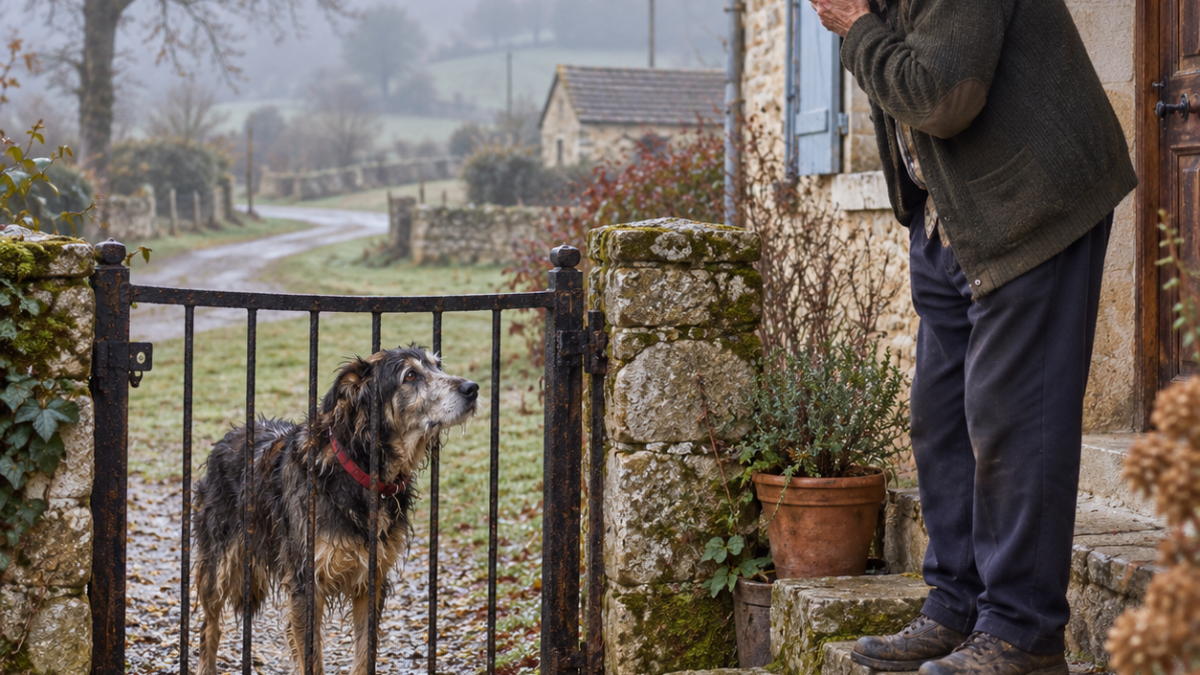
The old dog stood outside my gate trembling so badly that, for a moment, I couldn’t tell whether the metal rattling came from her body or from my own shaking hand.
When I finally knelt beside her, she pressed her gray muzzle into my palm as if she somehow understood exactly what was happening to me.
I thought I was rescuing an abandoned dog that morning, but before the day was over, I would learn why someone had made sure she could never find her way home.
My name is André Lemaire.
I was seventy-six years old, four years widowed, and living alone in an old pale-stone house several miles outside a small village in Maine-et-Loire, France.
The countryside around me was beautiful in the way lonely places often are.
Fields.
Hedgerows.
A narrow road where tractors passed more often than cars.
And enough silence to hear your own body slowly stop obeying you.
Parkinson’s disease had entered my life five years earlier.
At first, it was only my right thumb.
A tiny tremor.
Nothing serious, I told myself.
Then came the stiffness in the mornings. Shorter steps. Handwriting so small I could barely read it. Coffee cups rattling against saucers. Shirt buttons that could turn an ordinary morning into twenty minutes of quiet rage.
My children worried.
My doctor adjusted medications.
Neighbors pretended not to notice when I had to hold a fence post longer than necessary.
And whenever anybody asked how I was doing, I gave them the same answer.
“I’m fine. I manage.”
It wasn’t completely true.
That morning, my right hand was shaking against the porch rail when I noticed her.
She was black and tan, painfully thin, with a muzzle that had gone almost completely white. Mud covered her legs. A faded red collar hung loosely around her neck.
One ear stood halfway up.
The other folded sideways.
She didn’t bark.
She didn’t scratch.
She simply stared at my house and trembled.
I walked toward the gate.
The latch made a soft tapping sound.
Tap.
Tap.
Tap.
For several seconds, I couldn’t tell whether it was the gate moving or my fingers knocking against the railing.
“Well,” I muttered, “which one of us is knocking?”
The dog lowered her head.
That did it.
I went inside for food.
What should have taken thirty seconds took several minutes.
My fingers refused to cooperate with a container of leftover chicken. Two pieces fell onto the kitchen floor. The water bowl struck the sink twice as I filled it.
“Damn it,” I snapped at my own hand.
The house remained silent.
My wife Claire had been gone four years, but sometimes silence still felt like something newly broken.
When I returned outside, the dog had collapsed beside the gate.
She wasn’t sleeping.
She just looked too tired to stand.
I opened the gate slowly.
I expected her to run.
She didn’t.
I set the food and water several yards away, then backed toward the porch.
For a long time, she watched me.
Then she moved.
Not walked.
Crawled.
And something inside me cracked.
No old dog should have to crawl toward kindness.
She ate slowly, one piece at a time, almost as if she expected the plate to disappear before she reached the next bite.
When she tried to stand, her back legs shook.
She fell.
She tried again.
She fell again.
I grabbed my cane.
My hand was trembling so hard that the handle knocked against the porch rail.
The dog looked at my hand.
I looked at her legs.
Neither of us was particularly steady.
I made my way into the yard and lowered myself beside her.
Getting down was easy.
Getting up would become tomorrow’s problem.
When I reached toward her shoulder, she flinched.
I stopped immediately.
“It’s all right,” I whispered. “I won’t force you.”
For several seconds, neither of us moved.
Then she stretched her neck forward.
Her gray muzzle touched my fingertips.
And slowly, deliberately, she lowered her head into my shaking palm.
Her body trembled.
My hand trembled.
Between the two of us, absolutely nothing was still.
Yet for the first time in months, I wasn’t thinking about Parkinson’s.
I wasn’t thinking about Claire.
I wasn’t thinking about everything I could no longer do.
I was thinking about keeping this frightened old animal safe for the next five minutes.
I believed I had simply found somebody’s lost dog.
But later that afternoon, a veterinarian would scan the tiny chip beneath her skin, look at the information on his computer, and become strangely quiet.
“What is it?” I asked.
He turned the screen away from me.
Then he looked at the old dog sleeping with her head against my shoe.
“Her name is Ruby,” he said.
I smiled.
But he didn’t.
And when I asked him to call the registered family, his expression changed completely.
“André,” he said softly, “I think you need to hear what they told me before we decide where Ruby goes next.”
PART 2
I stared at the veterinarian.
Dr. Mathieu Bernard had treated every dog Claire and I had owned during forty-three years of marriage. He was not a dramatic man. He was the kind who could tell you a dog needed surgery while calmly sharpening a pencil.
So when I saw concern on his face, I knew something was wrong.
Ruby lay on a folded blanket beside the examination table.
She had eaten a little more and drunk enough water that Mathieu was less worried about immediate dehydration, but her ribs still showed beneath her coat.
Her nails were overgrown.
There was an old scar along one back leg.
Her teeth suggested she was somewhere between twelve and fourteen.
And whenever Mathieu moved too quickly, Ruby’s eyes followed his hands.
Not aggressive.
Just careful.
The way an animal watches when experience has taught it that hands can mean different things.
“What did they say?” I asked.
Mathieu hesitated.
“The registered number belongs to a man named Laurent Fournier.”
I waited.
“He confirmed the dog was Ruby.”
“That’s good, isn’t it?”
Mathieu didn’t answer.
I felt my stomach tighten.
“What did he say?”
Mathieu pulled his stool closer.
“He said she doesn’t belong to him anymore.”
I frowned.
“But the chip—”
“I explained that.”
“And?”
“He said he gave her away.”
“To whom?”
“He refused to give me a name.”
I looked down at Ruby.
She was sleeping now, but one paw twitched against the blanket.
“Maybe someone lost her.”
“Maybe.”
Mathieu’s voice told me he didn’t believe it.
I knew that tone.
“What else?”
He sighed.
“When I told him where she’d been found, he asked whether she was sick.”
“What kind of question is that?”
“The kind that concerned me.”
I tightened my grip on my cane.
“And then?”
“I told him she was elderly, underweight, arthritic, but stable.”
Mathieu paused.
“He said, ‘Then do whatever you want with her. We don’t want her back.’”
Something hot rose in my chest.
Not the spectacular anger of youth.
Older anger is different.
It sits deeper.
It knows how much damage people can do while speaking calmly.
“He said that?”
“Yes.”
“Those exact words?”
“Yes.”
I looked at the old red collar.
There was no name tag.
No phone number.
Nothing.
“Did he say why?”
Mathieu looked at me carefully.
“He said she was becoming inconvenient.”
I laughed once.
It came out without humor.
“Inconvenient.”
Mathieu nodded.
“He said she was having accidents in the house, struggling with stairs and requiring medication. Then he said his family had ‘moved on from that stage.’”
I stared at Ruby.
Moved on.
As if loyalty had stages.
As if fourteen years could expire like milk in a refrigerator.
My right hand began shaking harder.
Mathieu noticed.
“You should sit.”
“I am sitting.”
“You know what I mean.”
“No, Mathieu. Tell me everything.”
He rubbed the bridge of his nose.
“When I asked directly whether he had abandoned her, he became defensive. He said she had been taken to live ‘somewhere in the country.’”
“Where?”
“He wouldn’t say.”
“And somehow she ends up outside my gate?”
“That is what we need to understand.”
We.
I noticed the word.
Not you.
Not they.
We.
I looked down again.
Ruby opened her eyes.
The moment she saw me, her tail tapped the blanket once.
Just once.
That tiny movement hurt more than I expected.
“Can I take her home?”
Mathieu leaned back.
“André…”
“What?”
“You can barely manage yourself some mornings.”
There was no cruelty in the statement.
That almost made it worse.
“I can feed a dog.”
“I know.”
“I have a fenced yard.”
“I know.”
“I can pay for medication.”
“I know.”
“Then what’s the problem?”
He looked at my cane.
Then at my hand.
“The problem is that Ruby needs somebody stable.”
I stared at him.
He realized immediately what he had said.
“André, I didn’t mean—”
“I know exactly what you meant.”
“No. Listen to me.”
“I am listening.”
“I mean physically stable. She may need help standing. You fall once while lifting her, and I have two patients instead of one.”
I wanted to be offended.
Instead, I looked at Ruby.
He was right.
That was the maddening thing about people who care about you.
Sometimes they are right at exactly the moment you most need them to be wrong.
“I can figure it out,” I said.
Mathieu studied me.
“You always say that.”
“So?”
“So maybe this time you don’t have to figure it out alone.”
That sentence stayed with me.
He walked to the computer and printed several pages.
Medication schedule.
Joint supplement.
Feeding instructions.
Warning signs.
Then he handed me a number.
“What’s this?”
“Animal welfare investigator in Angers. I already called.”
I looked up.
“You called the authorities?”
“I made a report.”
“Good.”
“There may not be enough evidence.”
“Then we find some.”
He almost smiled.
“Since when did you become a detective?”
“Since somebody threw an old dog away.”
He crouched beside Ruby.
“She has no serious infection. Bloodwork isn’t terrible for her age. Her arthritis is significant, and she’s underweight. I want her back in forty-eight hours.”
“She’ll be here.”
“And you need help getting her into your car.”
“I can manage.”
“André.”
I sighed.
“All right.”
Mathieu called his assistant.
Together they lifted Ruby gently onto a padded blanket in the back of my little Renault.
Before I closed the hatch, Ruby raised her head.
Her eyes found mine.
I had owned dogs before.
Good dogs.
Stubborn dogs.
A ridiculous spaniel named Gaston who once ate half a Christmas ham.
But there was something different in Ruby’s expression.
Maybe I imagined it.
Lonely men become excellent at imagining conversations.
Still, I could have sworn she was asking a question.
Are you leaving too?
I touched her cheek.
“No,” I said.
“I’m right here.”
That first night changed everything.
I had forgotten the sound of another living creature moving through my house.
The click of nails on tile.
The soft shake of a collar.
The breath from a dog sleeping near the radiator.
Ruby refused the new bed I made beside the fireplace.
Instead, she followed me to the hallway and collapsed three feet from my bedroom door.
“You’re stubborn,” I told her.
Her tail moved once.
“So was my wife.”
Another tail tap.
I laughed.
It surprised me.
A real laugh.
The first one in longer than I could remember.
At two in the morning, I woke to scraping.
Ruby was trying to stand.
Her back legs kept sliding across the wooden floor.
I reached automatically for my cane.
Then stopped.
Mathieu’s warning returned to me.
You fall once while lifting her…
I turned on the light.
Ruby looked embarrassed.
Dogs can look embarrassed.
Anyone who claims otherwise has never lived with one.
“All right,” I said. “We do this intelligently.”
I found two bath towels, folded one lengthwise and slipped it beneath her belly like a sling.
“Ready?”
She stared at me.
“I’ll take that as yes.”
I lifted gently.
My hand shook.
Her legs shook.
We both swayed.
“Excellent,” I muttered. “A professional operation.”
Ruby took one step.
Then another.
Then another.
We reached the back door together.
She went outside.
When she returned, I helped her across the threshold.
Halfway to the hallway, my cane slipped.
I lurched sideways.
Ruby immediately stopped moving.
Instead of pulling forward, she planted her front paws and remained perfectly still while I regained my balance.
I looked down at her.
“Well.”
She looked back.
“You’re helping me too.”
By morning, I had slept perhaps three hours.
I felt better than I had in months.
That should have made no sense.
But there are forms of exhaustion that drain you, and others that remind you why you bothered getting out of bed.
At seven thirty, my daughter Sophie called.
She called every morning.
Usually I let it ring twice so she wouldn’t think I had been waiting.
That day I answered immediately.
“Papa?”
“Yes.”
“You sound awake.”
“I am awake.”
“You hate mornings.”
“I have a dog.”
Silence.
Then:
“You have what?”
“A dog.”
“Papa.”
“Her name is Ruby.”
“Papa.”
“What?”
“You cannot just announce at seven thirty in the morning that you have acquired a dog.”
“I did not acquire her. She appeared.”
“That is worse.”
“She’s old.”
“That is not helping.”
“She was abandoned.”
Another pause.
Sophie knew me.
More importantly, she knew the tone in my voice when something had already been decided.
“Where is she now?”
“Standing beside me.”
Ruby was not standing.
She was lying beside me.
Details.
“I’m coming over.”
“You have work.”
“I’m coming at lunch.”
“You don’t need to.”
“I know.”
She arrived at twelve fifteen carrying groceries, a dog bed large enough for a small pony, two nonslip mats, and the expression children wear when they have come prepared to reverse one of their elderly parent’s bad decisions.
Then Ruby walked toward her.
Slowly.
Painfully.
Sophie stopped talking.
Ruby sniffed her shoes.
Then sat against her legs.
My daughter looked at me.
“Oh no.”
I smiled.
“What?”
“I already love her.”
By evening, she had ordered a ramp for the back steps.
My son Marc was less easily conquered.
He lived near Nantes and called that night.
“You’re seventy-six.”
“I am aware.”
“You have Parkinson’s.”
“Also aware.”
“And you’ve adopted a fourteen-year-old dog with arthritis?”
“Approximately fourteen.”
“That was not the important part.”
“Mathieu says she may be thirteen.”
“Papa.”
I leaned back in my chair.
Ruby slept with her head on my slipper.
“Marc, what do you want me to do? Send her away because she’s old and difficult?”
“That isn’t what I’m saying.”
“Sounds similar.”
He became quiet.
I regretted it.
Marc had spent years worrying that I would fall alone and lie on the floor for hours before anyone discovered me.
His concern was not selfishness.
Sometimes love arrives sounding exactly like control.
“I’m sorry,” I said.
He exhaled.
“I’m not asking you to send her away.”
“Good.”
“I’m asking you to let us help.”
That word again.
Us.
“I’ll think about it.”
“That means no.”
“It means I’ll think about it.”
“Papa.”
“All right. You can help.”
There was a stunned silence.
“Did you just agree with me?”
“Don’t become emotional.”
That weekend Marc installed two handrails, a small outdoor ramp, brighter lights in the hallway, and rubber-backed runners on the floors.
He claimed everything was for Ruby.
We both knew half of it was for me.
I allowed the lie.
Sometimes dignity survives through small agreements between people who love each other.
Ruby settled into the house faster than any of us expected.
She learned the medication drawer.
She learned that Sophie brought roast chicken.
She learned Marc pretended not to allow dogs on furniture but would make room on the couch the moment he thought nobody was watching.
And she learned my bad mornings.
Those were the strangest.
On days when my medication took longer to work, I woke stiff.
My right arm sometimes felt as if it belonged to somebody else.
Simple movements required planning.
Stand.
Pause.
Balance.
Turn.
Step.
Ruby began waiting beside the bed.
Not whining.
Not licking my face.
Just waiting.
The first time I noticed it, I thought it was coincidence.
The second time, maybe habit.
By the fifth time, I understood.
She watched my feet.
When I stood, she rose.
When I stopped, she stopped.
If I became unsteady, she moved close enough that my leg could touch her shoulder.
I never leaned my full weight on her.
She was too old for that.
But the contact told my brain where I was in space.
A point of reference.
A heartbeat at knee level.
One morning my right foot froze in the hallway.
People who know Parkinson’s understand what I mean.
Your mind tells the foot to move.
The foot simply refuses.
You are not paralyzed.
You are trapped inside a command that will not execute.
I stood there gripping my cane.
“Come on,” I whispered.
Nothing.
I tried again.
Nothing.
Frustration rose.
Then Ruby stepped in front of me.
She looked up.
Took one slow step backward.
Stopped.
Took another.
Something about following her broke the block.
My foot moved.
One step.
Then another.
I started laughing.
Ruby wagged her tail.
“Are you a neurologist now?”
She sneezed.
“Excellent credentials.”
At Ruby’s forty-eight-hour checkup, Mathieu listened while I described it.
He didn’t laugh.
“Visual cueing can sometimes help people with freezing episodes.”
I stared at him.
“So she did help.”
“She may have.”
“Tell Marc.”
“I’m a veterinarian.”
“Still a doctor.”
“Absolutely not how medicine works.”
Ruby received another injection and a better anti-inflammatory plan.
She had gained half a kilogram.
Then Mathieu’s expression changed.
“The investigator called me.”
I sat straighter.
“And?”
“There’s more.”
The animal welfare officer’s name was Camille Renaud.
She came to my house the following Tuesday.
Late thirties.
Dark hair tied back.
Practical boots.
No nonsense.
Ruby barked once when Camille reached the gate.
It was the first time I had heard her bark.
Camille stopped.
“That’s interesting.”
“What?”
“She recognized my car?”
“Maybe.”
Camille walked inside slowly.
Ruby retreated behind my legs.
Not fear exactly.
Recognition.
“Have you seen her before?” I asked.
Camille crouched.
“Not personally.”
She opened her folder.
“But I may know where she came from.”
We sat at the kitchen table.
Ruby lay beneath it with her body against my shoes.
Camille placed three photographs in front of me.
The first showed a large cream-colored farmhouse.
The second showed a fenced yard.
The third showed a gravel pullout beside a road surrounded by fields.
I recognized the place immediately.
“That’s eight kilometers from here.”
“Yes.”
“What does it have to do with Ruby?”
“A farmer found dog food scattered there six days ago.”
My stomach tightened.
“When?”
“The night before Ruby appeared at your house.”
I stared at her.
Camille continued.
“The farmer also has a trail camera because people have been dumping trash near his field.”
I stopped breathing for a second.
“He recorded a car.”
Camille placed another photograph on the table.
It was grainy.
Nighttime.
Rear view.
A dark Peugeot parked on the shoulder.
A man standing beside the open passenger door.
Something low and dark near his legs.
Ruby.
Even blurred, I recognized the faded red collar.
“Is that Fournier?”
“We believe so.”
“Believe?”
“The license plate is readable.”
My hand tightened around the edge of the table.
“Then why isn’t he arrested?”
“Because animal abandonment cases still require evidence and procedure. We need to establish who was driving, whether Ruby was intentionally left, whether somebody else had legal custody—”
“He dumped her.”
“André.”
“He dumped her on the side of the road.”
“I agree the image is concerning.”
“Concerning?”
Camille remained calm.
“That is the word I use before a judge gives me permission to use stronger ones.”
That shut me up.
She placed another photograph down.
The same man.
Different frame.
Door closed.
Car leaving.
Ruby standing alone in the gravel.
Her head turned toward the departing taillights.
I had to look away.
There are pictures you understand immediately.
And there are pictures your heart refuses to accept because accepting them means admitting that somebody made a deliberate decision.
Not an accident.
Not a moment of panic.
A decision.
Drive.
Stop.
Open the door.
Remove the dog.
Leave.
Ruby pushed her nose against my knee beneath the table.
I lowered my shaking hand.
She rested her head against it.
Camille watched.
“When was this taken?” I asked.
“10:43 p.m.”
“It was cold that night.”
“Six degrees Celsius.”
“She walked eight kilometers?”
“Maybe more. We don’t know her route.”
I looked at the photograph again.
“Why?”
Camille pulled out another document.
“Laurent Fournier’s mother, Évelyne, was Ruby’s original owner.”
“What happened to her?”
“She died nine months ago.”
I felt something drop inside me.
“Ruby belonged to his mother?”
“Yes.”
“And he inherited her?”
“Essentially. The chip information had never been updated.”
Camille hesitated.
“Évelyne had Ruby from a puppy.”
Fourteen years.
My gaze went to the old dog beside my chair.
Fourteen years with one person.
Then loss.
Then somebody deciding she was inconvenient.
Camille continued.
“Several neighbors said Madame Fournier adored this dog. Ruby slept beside her bed. After Évelyne died, Laurent took possession of the house.”
“Possession,” I repeated.
“Yes.”
“What about Ruby?”
“According to one neighbor, Ruby remained at the property.”
“For nine months?”
“Approximately.”
“And then?”
Camille’s mouth tightened.
“Laurent put the house on the market.”
There it was.
I knew before she finished.
“An old dog made the property harder to sell.”
“We’re still interviewing people.”
“He wanted the house empty.”
“André.”
“I know. Judge. Stronger words later.”
For the first time Camille smiled.
“Exactly.”
Then she pulled out one more sheet.
“This part may matter.”
“What is it?”
“A statement from Madame Fournier’s neighbor. Évelyne apparently told people she had made arrangements for Ruby in her estate.”
I looked up sharply.
“What kind of arrangements?”
“We don’t know yet.”
“Money?”
“Possibly.”
“Then Laurent may have had another reason to get rid of her.”
Camille did not confirm it.
She didn’t need to.
That evening I sat beside the fireplace with Ruby sleeping at my feet.
I kept seeing the trail-camera image.
Ruby beside the road.
Taillights leaving.
The next day I drove to the pullout.
Sophie insisted on coming.
“You should not be doing this alone.”
“I’m driving eight kilometers, not crossing the Atlantic.”
“You nearly fell putting on your coat.”
“That was unrelated.”
“To balance?”
“Yes.”
“How?”
“I was also angry.”
She gave me the look Claire used to give me.
Sophie had inherited it perfectly.
At the pullout, we parked.
The road ran between fields and low hedges.
Traffic was light.
A drainage ditch bordered one side.
I stood where Ruby had stood.
The thought nearly undid me.
“How did she know where to go?” Sophie whispered.
I didn’t answer.
My house was not visible from there.
No direct line.
No familiar scent carried eight kilometers through wet fields.
Ruby had simply walked.
Maybe toward lights.
Maybe away from traffic.
Maybe nowhere.
I looked down and saw something red caught beneath the hedge.
For one ridiculous second I thought it was part of her collar.
It was fabric.
A strip torn from a blanket.
Sophie crouched.
“Don’t touch it.”
“I know.”
We called Camille.
She arrived forty minutes later.
The fabric itself proved little.
But ten meters farther down the ditch, she found an empty medication packet.
Veterinary label.
Ruby Fournier.
Pain medication.
Prescribed three months earlier.
Camille put on gloves.
“Well,” she said.
“What?”
“This is considerably less ambiguous.”
The investigation moved faster after that.
Not fast enough for me.
Justice feels slow when anger wakes before breakfast.
But while Camille built her case, Ruby and I built a routine.
Morning medication.
Her pills hidden in cheese.
Mine beside coffee.
Short walk to the mailbox.
Rest.
Breakfast.
Another walk in the afternoon if weather allowed.
Every day we went a little farther.
At first I thought I was exercising Ruby.
Then Sophie showed me the numbers from the step counter she had convinced me to carry.
I had doubled my daily walking.
My physical therapist noticed.
“You’re moving differently.”
“I have a coach.”
She looked around.
“Where?”
“At home.”
“Human?”
“Mostly dog.”
The therapist laughed.
I did not.
Ruby genuinely changed how I moved.
When I walked alone, I thought about every step.
Heel.
Toe.
Balance.
Don’t fall.
With Ruby, I thought about her.
Is she tired?
Is she limping?
Did she smell something?
My body became secondary.
The anxiety loosened.
That mattered.
Parkinson’s did not disappear.
I did not wake cured.
My hands still shook.
Buttons remained enemies.
Some afternoons fatigue dropped over me like wet cement.
But something had changed.
Before Ruby, every symptom felt like evidence in a trial proving my life was shrinking.
After Ruby, symptoms became obstacles inside a day that still contained purpose.
A month after she arrived, Marc came on Saturday.
He found me in the garden repairing an old raised flower bed.
He stared.
“What are you doing?”
“Building.”
“You stopped gardening two years ago.”
“I stopped bending.”
He looked at the wooden box.
It was higher than the old one.
Waist level.
“You built a standing garden?”
“I adapted.”
Marc smiled.
“Who are you?”
“Your father.”
“Not the one I remember.”
I pointed my hammer at him.
“That one was better-looking.”
Ruby barked from the porch.
Marc laughed.
“She disagrees.”
That afternoon, Camille called.
“We found the will.”
I sat down.
“Tell me.”
“Évelyne Fournier left a written provision concerning Ruby.”
My heart began beating harder.
“What provision?”
“Twenty thousand euros.”
I went silent.
“The money was placed in a separate account,” Camille continued, “intended for Ruby’s lifetime veterinary care, food and boarding. Whatever remained after Ruby’s death was to go to a local animal shelter.”
I closed my eyes.
There it was.
Not just inconvenience.
Money.
“What happened to the account?”
“That is now being examined.”
“By whom?”
“Police and the notary.”
“And Laurent?”
“He claimed the money had been used for Ruby.”
“For what?”
“That is the question.”
“How much remains?”
Camille paused.
“Less than two thousand.”
I stood too fast.
The room shifted.
I grabbed the table.
Ruby rose immediately.
“André?”
“I’m fine.”
“No, you’re furious.”
“Yes.”
“Sit down.”
I sat.
Barely.
“He stole from his mother’s dog.”
“Potentially.”
“Camille.”
“I know.”
“He takes nearly twenty thousand euros, dumps her, then says she became inconvenient?”
“The financial side is not my jurisdiction. But yes, investigators are looking at whether funds were misappropriated.”
My hand hammered against the tabletop.
Ruby came closer.
I forced my fingers open.
“She trusted him.”
“His mother?”
“Yes.”
“To care for Ruby.”
Camille’s voice softened.
“That seems clear.”
I looked at the dog.
“No. Ruby trusted him too.”
Three days later, somebody came to my gate.
I recognized Laurent Fournier before he said his name.
Not because I had met him.
Because I had stared at the trail-camera photograph enough times to know the shape of his shoulders.
He was in his early fifties.
Expensive jacket.
Clean boots.
The posture of a man who expected doors to open.
Ruby was in the yard.
The moment she saw him, she froze.
Her body lowered.
Tail tucked.
Then she backed toward me.
Laurent noticed.
“Ruby.”
The dog pressed against my leg.
I stepped between them.
“What do you want?”
He looked at me.
“You’re Lemaire?”
“Yes.”
“I’ve come for the dog.”
I almost laughed.
“Interesting.”
“She belongs to my family.”
“You told the veterinarian you didn’t want her.”
“That was a misunderstanding.”
“No.”
“I was frustrated.”
“No.”
He glanced toward the house.
“I’d rather discuss this privately.”
“We are private.”
He lowered his voice.
“There are complications involving my mother’s estate.”
“I know.”
His jaw tightened.
“So you understand.”
“I understand enough.”
“The dog is legally connected to the estate. My lawyer says she needs to be returned until everything is resolved.”
Ruby trembled behind me.
My own hand started shaking.
Laurent looked at it.
Something changed in his face.
Not sympathy.
Calculation.
“You’re ill.”
I stared at him.
“So?”
“I don’t think somebody in your condition should be responsible for an elderly animal.”
The sentence landed exactly where he intended.
I had heard versions of it from doctors, relatives, even myself.
But coming from him, it became something else.
I stepped closer to the gate.
“My condition?”
“Yes.”
“You mean because my hand shakes?”
“I mean this arrangement is obviously temporary.”
“Ruby seems to disagree.”
“She’s a dog.”
“So was she a dog when you left her beside the road?”
His face changed.
“I did not abandon her.”
“The camera did.”
“You don’t know the full circumstances.”
“I know your car drove away.”
“I was told somebody would collect her.”
“Who?”
He said nothing.
I nodded.
“Exactly.”
He gripped the gate.
“I am asking you one time. Give me the dog.”
Behind me, Ruby whined.
A small sound.
But it changed me.
My fear vanished.
I looked at Laurent.
“No.”
His expression hardened.
“You have no right to keep her.”
“Then let the authorities decide.”
“You think you’re some kind of hero?”
“No.”
“An old sick man rescuing an old sick dog?”
I stared at him.
“Yes.”
That surprised him.
“So what?”
He blinked.
“What?”
“I’m old. I’m sick. She’s old. She’s sick. You say those things like they cancel our value.”
“I didn’t say—”
“You didn’t have to.”
My hand shook harder.
I raised it anyway.
“You see this?”
He glanced at it.
“This hand spills coffee. Drops forks. Can barely write my own name some mornings.”
I put that same trembling hand on Ruby’s head.
“She has never once cared.”
Laurent looked away.
I continued.
“And those legs of hers? They collapse sometimes. She can’t climb stairs. She needs medicine.”
Ruby leaned against me.
“I have never once cared.”
His mouth tightened.
“Very moving.”
“No. Very simple.”
I opened the small pedestrian gate.
For a second, he thought I was letting him in.
Instead I stepped outside and closed it behind me, leaving Ruby safely inside.
Then I looked him directly in the face.
“Leave.”
“This is not finished.”
“I hope not.”
His eyes narrowed.
“What is that supposed to mean?”
“It means I hope your mother’s money has very good records.”
All the color left his face.
That was when I knew.
Not suspected.
Knew.
He took one step toward me.
“What have you been told?”
I smiled.
“You should probably ask your lawyer.”
He stared at me for several seconds.
Then he turned and walked to his car.
I waited until he drove away.
Only then did my legs weaken.
I held the gate.
Ruby stood on the other side.
Watching.
I opened it.
She came straight to me.
That evening I called Camille.
She was furious that Laurent had approached me.
“You should have called immediately.”
“I handled it.”
“That sentence seems to be your family motto.”
“You’ve met Sophie?”
“Yes.”
“Then you understand.”
Camille told me Laurent’s lawyer had indeed raised a temporary ownership claim.
But the case was becoming much larger.
Bank statements showed withdrawals from Ruby’s care account.
Not veterinary bills.
Restaurant charges.
Home renovations.
A television.
Two months of payments on a leased car.
And, almost unbelievably, landscaping for the house he was preparing to sell.
Money left by his mother to care for Ruby had apparently helped make the property more attractive after Ruby was removed from it.
The cruelty of that detail kept me awake.
For the next several weeks, Laurent’s life began unraveling not because anybody shouted louder than him, but because documents are patient.
Receipts.
Bank transfers.
Veterinary records.
Witness statements.
The trail-camera footage.
A neighbor’s doorbell recording showing Ruby still living at Évelyne’s house only days before Laurent claimed he had “given her away.”
The will.
The separate account.
His signature on withdrawal forms.
All the small pieces people assume will never stand in the same room together.
Then they did.
The notary froze what remained of the estate distribution.
The property sale was delayed.
Police questioned Laurent.
The local prosecutor reviewed the abandonment evidence and the financial allegations separately.
I did not celebrate.
Not exactly.
But I slept better.
Ruby improved.
Her coat began to shine.
She gained weight.
Her back legs remained weak, but the falls became less frequent.
One Saturday morning, she followed me beyond the mailbox for the first time.
Then another fifty meters.
Then another.
We reached an old oak tree at the edge of the lane.
I stopped.
Not because Ruby needed rest.
Because I did.
I leaned against the trunk.
Ruby stood beside me.
The fields stretched gold and green under an enormous sky.
For four years after Claire died, I had viewed every beautiful thing through subtraction.
Claire should see this.
Claire would have liked that.
Claire should be here.
Grief had turned the world into a list of absences.
That morning, for the first time, I noticed something without immediately measuring who was missing.
Ruby sniffed wild grass.
A tractor moved in the distance.
Wind passed through the hedgerow.
I was there.
Ruby was there.
And for a few minutes, that was enough.
I put my hand on her back.
“You miss her too, don’t you?”
Ruby looked up.
I meant Évelyne.
Of course she could not answer.
But perhaps grief is one of the languages animals and humans share without translation.
In November, I received a letter.
Handwritten.
The envelope bore the return address of a woman named Jeanne Moreau.
Évelyne’s former neighbor.
She had heard through Camille that Ruby was living with me.
Inside was a photograph.
Évelyne, perhaps seventy, sitting in a garden chair.
Ruby beside her.
Younger.
Black muzzle instead of gray.
Red collar.
On the back, Jeanne had written:
“Évelyne used to say Ruby knew when her hands hurt before she did.”
I read the sentence twice.
Then a third time.
There was another note.
“She had severe arthritis and struggled to grip things during the last years of her life. Ruby would rest her head beneath Évelyne’s hand and remain perfectly still until the pain passed. Your story reminded me of that.”
I sat at the kitchen table for a long time.
Ruby slept nearby.
My right hand trembled.
I called her.
“Come here.”
She rose slowly.
Walked toward me.
I held out my hand.
Without hesitation, she placed her gray muzzle into my palm.
Exactly as she had at the gate.
A dog remembers things we cannot ask about.
Maybe Ruby had not chosen my house because of a scent.
Maybe she had simply recognized something.
An old person alone.
A hand that did not work properly.
A quiet house.
A familiar kind of brokenness.
I cried then.
Not loudly.
At seventy-six, you learn there are tears that do not need witnesses.
Ruby remained with her head in my palm.
I thought about Évelyne.
A woman I had never met.
A woman whose dog now slept beside my bed.
I whispered, “I’ll take care of her.”
Then I corrected myself.
“We’ll take care of each other.”
Winter came.
Cold mornings were difficult for both of us.
I bought Ruby a ridiculous waterproof coat.
Red.
Sophie laughed for five straight minutes.
“She looks like a retired firefighter.”
“She’s warm.”
“She looks furious.”
“She is dignified.”
Ruby sneezed.
Sophie laughed harder.
At Christmas, the entire family came to my house.
That had not happened since Claire died.
Usually I went to Sophie’s because everyone worried about me hosting.
That year I insisted.
Marc cooked.
Poorly.
Sophie corrected him.
Constantly.
My grandchildren decorated the tree.
Ruby stole exactly one piece of turkey and denied everything.
At dinner my youngest granddaughter, Lucie, looked under the table.
“Grand-père?”
“Yes?”
“Ruby has her head on your foot.”
“She does that.”
“Why?”
I looked down.
“Maybe she likes knowing where I am.”
Lucie considered this.
“Do you like knowing where she is?”
“Yes.”
She smiled.
“Then it’s fair.”
Children are annoyingly good at reducing philosophy to one sentence.
In January, the court proceedings began.
I was asked to give a statement about finding Ruby.
Not a dramatic trial.
No packed courtroom.
No shouting attorneys.
Real justice is usually quieter than television.
Paper folders.
Dates.
Questions repeated three different ways.
Still, Laurent was there.
He sat across the room from me.
I had imagined that seeing him again would fill me with anger.
It didn’t.
Mostly I felt tired.
He looked older than before.
Not ruined.
Not transformed into some monster.
Just a man being forced to answer for decisions he had assumed nobody would examine.
When my turn came, I described the morning Ruby appeared.
The trembling.
The mud.
The hunger.
Her inability to stand.
Then the prosecutor asked:
“What was the dog’s behavior when you approached?”
“Afraid.”
“Aggressive?”
“No.”
“Did she appear accustomed to people?”
“Yes.”
“Why do you say that?”
“Because she wanted contact. She just didn’t trust that contact would be safe.”
Laurent shifted in his seat.
The prosecutor continued.
“What happened when Mr. Fournier came to your home?”
“He demanded Ruby.”
“Did Ruby approach him?”
“No.”
“What did she do?”
I looked at Laurent.
“She hid behind me.”
His eyes dropped.
His lawyer questioned whether an elderly dog’s behavior could reliably indicate mistreatment.
Fair question.
I answered simply.
“I’m not an expert.”
That surprised everyone.
“So you cannot say why Ruby moved away from Mr. Fournier?”
“No.”
“Then your interpretation is speculation.”
“Yes.”
The lawyer nodded as if he had scored a point.
I continued.
“But the camera showing him leaving her beside the road isn’t my interpretation.”
Silence.
The judge looked at me.
The lawyer sat down.
I should admit I enjoyed that moment.
Just a little.
The evidence eventually established enough for action.
Laurent was penalized for animal abandonment under applicable law.
The separate financial investigation concluded that significant portions of Ruby’s care fund had been used for expenses unrelated to her welfare.
He was ordered to restore money to the estate arrangement and faced additional legal consequences for the misuse.
The property sale was no longer the easy transaction he had expected.
Legal fees accumulated.
The notary’s accounting became exhaustive.
And the money remaining after restitution was placed under independent administration so Laurent could never touch Ruby’s care funds again.
But the moment that mattered most came at the end of a hearing about Ruby’s custody.
Laurent’s lawyer argued that Ruby was technically part of unresolved estate property.
Camille testified.
Mathieu provided veterinary records.
Jeanne described Évelyne’s wishes.
My children provided evidence that Ruby had a stable home and continuing care.
Then the judge asked me a question.
“Mr. Lemaire, given your age and medical condition, are you confident you can continue caring for this dog?”
The room became very still.
Months earlier, the question would have humiliated me.
I would have heard only the hidden accusation.
You are old.
You are sick.
You are becoming incapable.
But Ruby had changed something.
I no longer needed to pretend I could do everything alone.
“No,” I said.
The judge looked surprised.
Laurent looked almost pleased.
I continued.
“I am not confident I can care for Ruby alone.”
Sophie’s eyes filled.
I looked toward my children.
“But I’m not alone.”
Marc nodded.
“My daughter comes several times a week. My son installed ramps. My veterinarian is fifteen minutes away. My neighbors have keys. My grandchildren fight over who gets to walk her. And if I become unable to care for her tomorrow, my family has already agreed where she goes.”
I looked down at my hand.
It was shaking.
I did not hide it.
“So no, Your Honor. I cannot promise my body will cooperate forever.”
Then I looked across the room at Laurent.
“But I can promise that Ruby will never be left beside a road because she becomes inconvenient.”
Nobody spoke.
The decision came shortly afterward.
Ruby would remain with me under a formal adoption and welfare arrangement, with Sophie named as secondary caretaker.
Laurent relinquished any remaining claim.
When Camille told me outside the courthouse, I looked down at Ruby.
Sophie had brought her in the car but kept her outside during the hearing.
I crouched slowly.
“Official now.”
Ruby licked my chin.
I nearly fell backward.
Sophie grabbed my coat.
“Very dignified.”
“Quiet.”
Camille laughed.
For months, I had imagined revenge.
I imagined Laurent losing the house.
Losing money.
Being publicly embarrassed.
I imagined shouting at him.
I imagined making him understand.
But standing outside that courthouse, I realized the best revenge had already happened.
Ruby was alive.
Ruby was loved.
The money meant for her care was protected.
And the man who had treated her as worthless had been forced to watch strangers fight for the privilege of caring for her.
That was enough.
Or I thought it was.
Then Jeanne gave us one final surprise.
She contacted Sophie several weeks later.
While cleaning old boxes from Évelyne’s house before the property finally changed hands, the estate representative had found a sealed envelope inside a desk.
On the front:
FOR WHOEVER CARES FOR RUBY IF I CANNOT.
Inside was a letter.
The handwriting was shaky.
I understood immediately.
Évelyne had known difficult hands too.
The letter read:
“If you are reading this, then my girl has outlived me.
Please understand something about Ruby.
She has never been ‘just a dog’ to me.
After my husband died, she gave structure to days that had lost their shape.
When my arthritis became severe, she learned to wait when I dropped things.
When I moved slowly, she moved slowly.
When I cried, she never tried to stop me. She simply stayed.
That is her gift.
She stays.
I have left money for her care because I do not want age or illness to make her unwanted.
She may become slow.
She may have accidents.
She may need help standing.
Please do not punish her for surviving long enough to become difficult.
Old age is not betrayal.
Need is not betrayal.
Please let her finish her life beside somebody who understands that.”
I stopped reading.
Sophie took the letter.
My vision had blurred.
She finished the last lines aloud.
“If Ruby puts her head beneath your hand, let her.
It means she trusts you.
And if you are lucky, you may discover that sometimes the creature you believe you are taking care of is quietly taking care of you too.
— Évelyne”
Nobody spoke for a long time.
Ruby was sleeping near the fireplace.
Her red coat lay on a chair.
Outside, rain touched the windows.
I looked at my right hand.
It was trembling badly that evening.
I used to hate that hand.
I used to hide it beneath tables.
Put it inside my pocket when strangers looked.
Hold cups with both hands so people would not notice.
Parkinson’s had made that hand feel like evidence that I was disappearing.
Ruby never saw it that way.
To Ruby, it was simply the hand that opened the gate.
The hand that carried food.
The hand that scratched behind her ear.
The hand she chose for her tired head.
Spring came.
Ruby turned fourteen according to Mathieu’s best estimate.
We held a birthday party.
Completely unnecessary.
Embarrassingly elaborate.
Sophie bought a cake for humans and made a smaller dog-safe one for Ruby.
Marc brought a banner.
I objected to the banner.
Then insisted it be hung straighter.
My grandchildren gave Ruby a new red collar with a silver tag.
RUBY LEMAIRE.
Beneath it:
HOME.
I pretended the word did not make me emotional.
Nobody believed me.
Our walks became slower again that summer.
Ruby’s arthritis progressed.
My Parkinson’s progressed too.
There is no sentimental bargain where love cures disease.
That is not how life works.
There were harder mornings.
A fall in the kitchen that frightened everyone.
Medication changes.
A walker that I resisted for two weeks and then admitted was useful.
Ruby had bad days as well.
Sometimes she needed the sling.
Sometimes she slept almost the entire afternoon.
But we had rules.
No pity before breakfast.
No pretending we were younger.
No apologizing for needing help.
And never leaving the other one behind.
One July morning, I woke before sunrise.
Ruby was not beside the bed.
I found her in the hallway.
She had tried to stand and could not.
My heart sank.
I knelt beside her.
“Come on, girl.”
She tried.
Her legs failed.
I called Mathieu.
The drive to the clinic was quiet.
Too quiet.
Ruby lay with her head in my lap while Sophie drove.
My fingers moved across her gray fur.
Mathieu examined her.
His face told me before he spoke.
“Her heart is weaker.”
I swallowed.
“How weak?”
“We need to talk about time.”
I hated him for saying it.
Only for a second.
Then I hated time itself.
“How much?”
“Nobody can tell you exactly.”
“Days?”
“Maybe.”
“Weeks?”
“Possibly.”
“Months?”
He hesitated.
“Possibly. But I don’t want you measuring her life only in numbers.”
I stared at Ruby.
“What do I measure?”
“Comfort.”
So we did.
Good meals.
Warm sun.
Pain control.
Short walks.
Long naps.
Visitors.
And every morning I asked myself one question.
Is she still enjoying being Ruby?
For several weeks, the answer remained yes.
She still wanted chicken.
Still barked at the mail carrier.
Still became offended when Marc sat in “her” chair.
Still followed me to the garden.
Then one September morning, almost a year after she first appeared at my gate, she stopped eating.
Not even chicken.
I knew.
Sophie knew when she arrived.
Marc drove in an hour later.
Nobody said much.
We carried Ruby outside on her blanket.
The weather was warm.
The gate stood open.
I wanted her to smell the fields.
Mathieu came to the house.
I had asked him to.
Ruby hated the clinic.
She loved the garden.
He sat beside me.
“We can wait.”
I shook my head.
Ruby’s breathing was shallow.
“No.”
“You’re sure?”
I looked at her.
She had given me an entire year of honest answers.
I owed her one.
“I promised she wouldn’t suffer because I couldn’t let go.”
Mathieu nodded.
My children stood behind me.
Ruby’s head rested in my lap.
I placed my right hand beneath her muzzle.
It trembled.
Just as it had that first morning.
Her eyes opened.
She looked at me.
“You found the right gate,” I whispered.
Her tail moved once.
I laughed through tears.
“Yes. I know.”
Mathieu administered the sedative.
Ruby relaxed.
For the first time since I had known her, every muscle in her body seemed completely still.
Except my hand.
That kept trembling against her fur.
I thought about the morning we met.
Her body shaking.
My hand shaking.
Nothing between us still.
Now she was peaceful.
I was the one trembling for both of us.
“You can go,” I whispered.
“I’m right here.”
Ruby took one slow breath.
Then another.
Then she was gone.
I bent over her.
At seventy-seven years old, I cried like a child.
Nobody stopped me.
Nobody told me to be strong.
My children simply stayed.
Exactly as Ruby had taught us.
We buried her beneath the old oak tree at the edge of the lane.
The place where we had taken our first long walk.
Jeanne came.
Camille came.
Mathieu came.
Even neighbors who had only known Ruby for months stood quietly beneath the branches.
Her silver tag remained with me.
RUBY LEMAIRE.
HOME.
The restored money from Évelyne’s fund had more than covered Ruby’s final year of medical care.
Under the terms of the original will, the remaining balance went to the local animal shelter.
I added money of my own.
Then Marc had an idea.
We created a small assistance fund specifically for elderly dogs whose owners had died, become hospitalized, or could no longer care for them.
We called it the Ruby and Évelyne Fund.
I insisted Évelyne’s name come first.
Sophie disagreed.
We compromised.
That fund helped its first dog three months later.
A thirteen-year-old spaniel named Milo whose owner had entered a nursing home.
Then a twelve-year-old shepherd named Tess.
Then two elderly terriers whose owner had died suddenly.
None were abandoned.
That was the point.
Laurent eventually heard about the fund.
I know because he wrote me.
I almost threw the letter away.
Instead, I read it.
He did not ask forgiveness.
Not exactly.
He wrote that what happened had destroyed relationships inside his family.
That he had spent months blaming investigators, the court, me, his mother’s neighbors.
Then eventually he had run out of people to blame.
He wrote:
“I told myself Ruby was an animal and that practical decisions had to be made.
The truth is I wanted the house sold, the bills finished, and my mother’s death put behind me.
Ruby reminded me of everything I was trying not to feel.
I convinced myself that made her the problem.
It did not.
I was.”
I stopped reading.
There was more.
“I know this does not repair what I did.
I saw the article about the fund.
I sent the shelter the amount I was required to restore, but I have enclosed an additional donation separately.
You do not have to accept it.”
I called Camille.
We verified the donation.
It was legitimate.
Substantial.
I accepted it for the fund.
Not because Laurent deserved absolution.
Forgiveness and consequences are different things.
A person may regret harm and still need to live with what that harm says about the choices they made.
I never became friends with Laurent.
I never told him everything was fine.
It wasn’t.
But I wrote one sentence back.
“Use the rest of your life to become the man your mother thought you were.”
Then I mailed it.
That was enough.
Two years have passed since Ruby died.
I am seventy-nine now.
Parkinson’s continues its stubborn work.
I use the walker more often.
My handwriting is nearly illegible.
Marc says I should dictate messages into my phone.
I tell him phones are destroying civilization.
Then I dictate messages into my phone.
The raised garden is larger.
My grandchildren visit often.
And I no longer automatically say, “I’m fine,” when I am not.
That may be the biggest thing Ruby taught me.
Need does not reduce worth.
A trembling hand can still comfort.
Weak legs can still carry love across eight kilometers.
Old age does not make a life disposable.
And accepting help does not mean you have stopped being useful.
Last month the shelter called.
They had an old dog.
Of course they did.
Fifteen-year-old mixed breed.
Gray face.
One cloudy eye.
Owner recently died.
The shelter worker said, “Mr. Lemaire, we understand if you’re not ready.”
I looked toward the empty space beside the fireplace.
Ruby’s old red collar still hung above it.
For a long time after she died, I thought adopting another dog would somehow replace her.
Then I realized nobody replaces anybody.
Love is not a chair with only one seat.
“What’s his name?” I asked.
“Arthur.”
“What does Arthur need?”
“A quiet home. Medication twice a day. Short walks. Somebody around most of the time.”
I laughed.
“What?”
“Nothing.”
“Would you like to meet him?”
I looked at my shaking hand.
“Yes.”
Arthur arrived two days later.
He walked through my gate slowly.
Very slowly.
He sniffed the yard.
Then the porch.
Then me.
I held out my right hand.
It trembled.
Arthur stared at it.
For one second, memory hit so hard I could barely breathe.
A muddy black-and-tan dog.
A faded red collar.
A gray muzzle settling into my palm.
Ruby.
Then Arthur stepped closer.
He sniffed my fingers.
And rested his head beneath them.
I closed my eyes.
Not because I believed Ruby had sent him.
Life does not need magic to be meaningful.
I closed my eyes because I finally understood what Évelyne had known long before I did.
Sometimes you open a gate for an old animal because you believe it needs somewhere safe to spend whatever time remains.
Then somehow, quietly, without asking permission, that animal opens something inside you.
Ruby did not cure my Parkinson’s.
She did not erase grief.
She did not make me young.
She gave me something much more honest.
A reason to stop measuring my life by what I was losing.
The morning she arrived, I thought my shaking hand was proof that my body was betraying me.
By the time she left, I understood that the same trembling hand could feed someone, protect someone, comfort someone, and become the safest place an abandoned dog had left in the world.
Arthur pushed his head harder into my palm.
I smiled.
“All right,” I whispered.
“The gate is open.”
And this time, so was I.
The Old Dog Trembled at My Gate—Then She Put Her Head in My Shaking Hand, and I Stopped Giving Up
[FACEBOOK CAPTION — 700–800 WORDS]
The old dog stood outside my gate trembling so badly that, for a moment, I couldn’t tell whether the metal rattling came from her body or from my own shaking hand.
When I finally knelt beside her, she pressed her gray muzzle into my palm as if she somehow understood exactly what was happening to me.
I thought I was rescuing an abandoned dog that morning, but before the day was over, I would learn why someone had made sure she could never find her way home.
My name is André Lemaire.
I was seventy-six years old, four years widowed, and living alone in an old pale-stone house several miles outside a small village in Maine-et-Loire, France.
The countryside around me was beautiful in the way lonely places often are.
Fields.
Hedgerows.
A narrow road where tractors passed more often than cars.
And enough silence to hear your own body slowly stop obeying you.
Parkinson’s disease had entered my life five years earlier.
At first, it was only my right thumb.
A tiny tremor.
Nothing serious, I told myself.
Then came the stiffness in the mornings. Shorter steps. Handwriting so small I could barely read it. Coffee cups rattling against saucers. Shirt buttons that could turn an ordinary morning into twenty minutes of quiet rage.
My children worried.
My doctor adjusted medications.
Neighbors pretended not to notice when I had to hold a fence post longer than necessary.
Whenever anybody asked how I was doing, I gave them the same answer.
“I’m fine. I manage.”
It wasn’t completely true.
That morning, my right hand was shaking against the porch rail when I noticed her.
She was black and tan, painfully thin, with a muzzle that had gone almost completely white. Mud covered her legs. A faded red collar hung loosely around her neck.
One ear stood halfway up.
The other folded sideways.
She didn’t bark.
She didn’t scratch.
She simply stared at my house and trembled.
I walked toward the gate.
The latch made a soft tapping sound.
Tap.
Tap.
Tap.
For several seconds, I couldn’t tell whether it was the gate moving or my fingers knocking against the railing.
“Well,” I muttered, “which one of us is knocking?”
The dog lowered her head.
That did it.
I went inside for food.
What should have taken thirty seconds took several minutes.
My fingers refused to cooperate with a container of leftover chicken. Two pieces fell onto the kitchen floor. The water bowl struck the sink twice as I filled it.
“Damn it,” I snapped at my own hand.
The house remained silent.
My wife Claire had been gone four years, but sometimes silence still felt like something newly broken.
When I returned outside, the dog had collapsed beside the gate.
She wasn’t sleeping.
She just looked too tired to stand.
I opened the gate slowly.
I expected her to run.
She didn’t.
I set the food and water several yards away, then backed toward the porch.
For a long time, she watched me.
Then she moved.
Not walked.
Crawled.
And something inside me cracked.
No old dog should have to crawl toward kindness.
She ate slowly, one piece at a time, almost as if she expected the plate to disappear before she reached the next bite.
When she tried to stand, her back legs shook.
She fell.
She tried again.
She fell again.
I grabbed my cane.
My hand was trembling so hard that the handle knocked against the porch rail.
The dog looked at my hand.
I looked at her legs.
Neither of us was particularly steady.
I made my way into the yard and lowered myself beside her.
When I reached toward her shoulder, she flinched.
I stopped immediately.
“It’s all right,” I whispered. “I won’t force you.”
For several seconds, neither of us moved.
Then she stretched her neck forward.
Her gray muzzle touched my fingertips.
And slowly, deliberately, she lowered her head into my shaking palm.
Her body trembled.
My hand trembled.
Between the two of us, absolutely nothing was still.
Yet for the first time in months, I wasn’t thinking about Parkinson’s.
I wasn’t thinking about Claire.
I wasn’t thinking about everything I could no longer do.
I was thinking about keeping this frightened old animal safe for the next five minutes.
I believed I had simply found somebody’s lost dog.
But later that afternoon, a veterinarian would scan the tiny chip beneath her skin, look at the information on his computer, and become strangely quiet.
“What is it?” I asked.
He turned the screen away from me.
Then he looked at the old dog sleeping with her head against my shoe.
“Her name is Ruby,” he said.
I smiled.
But he didn’t.
And when I asked him to call the registered family, his expression changed completely.
“André,” he said softly, “I think you need to hear what they told me before we decide where Ruby goes next.”
[END OF FACEBOOK CAPTION]
[FIRST COMMENT / FULL STORY CONTINUATION]
Dr. Mathieu Bernard had treated every dog Claire and I had owned during forty-three years of marriage.
He was not a dramatic man.
If Mathieu looked troubled, there was a reason.
Ruby lay on a folded blanket beside the examination table. She had drunk some water and eaten enough that he was no longer worried about immediate collapse, but her ribs showed beneath her coat.
Her nails were overgrown.
Her hips were arthritic.
There was an old scar on one rear leg.
And whenever someone moved too quickly, Ruby’s eyes followed the movement.
Not aggressively.
Carefully.
“What did they say?” I asked.
Mathieu pulled his stool closer.
“The registered number belongs to Laurent Fournier.”
“And?”
“He confirmed the dog is Ruby.”
“Then why do you look like that?”
Mathieu sighed.
“He said they don’t want her back.”
For a moment I assumed I had misunderstood.
“What?”
“He claims Ruby no longer belongs to him.”
“But her chip—”
“I explained that.”
“What did he say?”
“That she had been given away.”
“To whom?”
“He refused to give me a name.”
Ruby shifted on the blanket.
One paw touched my shoe.
Mathieu continued.
“When I told him she had been found exhausted and underweight, he asked whether she was dying.”
A cold anger settled in my chest.
“Why would he ask that?”
“I wondered the same thing.”
“And when you told him she wasn’t?”
“He said, ‘Then do whatever you want. We’ve moved on from that stage.’”
I stared at him.
“That stage?”
“He said Ruby was old, incontinent, expensive, and difficult.”
I looked down at her.
Four words.
Old.
Inconvenient.
Expensive.
Difficult.
I had used similar words about myself on my worst mornings.
Maybe not aloud.
But I had thought them.
“Can I take her home?”
Mathieu studied me.
“André, caring for an elderly dog may be physically difficult.”
“So is getting dressed.”
“That isn’t my point.”
“It sounds like your point.”
He leaned forward.
“My point is that she may need help standing, and you are already at risk of falling.”
That hurt because it was true.
I tightened my hand around my cane.
“I can figure it out.”
Mathieu gave me the look he had been giving me since my Parkinson’s diagnosis.
“You always say that.”
“Because I usually do.”
“Perhaps this time you let people help.”
I almost argued.
Then Ruby raised her head.
Her eyes met mine.
I thought about putting her into another stranger’s car, another unfamiliar room, another night wondering who would disappear next.
“All right,” I said.
Mathieu blinked.
“All right?”
“I’ll accept help.”
He smiled.
“Write down the date. Nobody will believe it.”
That night Ruby slept outside my bedroom door.
I had made her a comfortable bed beside the fireplace, but she ignored it.
At two in the morning, I woke to scraping.
Her rear legs were sliding across the wooden floor as she tried to stand.
I reached for my cane.
Then remembered Mathieu’s warning.
Instead of lifting Ruby directly, I folded a bath towel and slipped it carefully beneath her belly.
“All right,” I whispered. “We do this together.”
She looked up.
“You have bad legs. I have bad hands. Between us, we should have one functioning animal.”
Her tail moved.
I helped her stand.
My hand shook.
Her legs shook.
We swayed together.
Then she took one step.
Another.
Halfway to the back door, my cane slipped.
I lurched.
Ruby stopped instantly.
She planted her front paws and waited while I caught my balance.
I stared down at her.
“Well.”
She stared back.
“You’re helping me too.”
The following morning my daughter Sophie arrived carrying groceries, nonslip mats, and a dog bed large enough for livestock.
She entered the kitchen ready to argue.
Then Ruby walked toward her, sniffed her shoes, and leaned against her legs.
Sophie looked down.
“Oh no.”
“What?”
“I already love her.”
My son Marc resisted longer.
“You’re seventy-six,” he told me on the phone.
“I remember.”
“You have Parkinson’s.”
“That information has also reached me.”
“And now you have an arthritic dog.”
“Yes.”
There was a pause.
“Papa, I’m not telling you to give her away.”
“Good.”
“I’m telling you to stop pretending you have to do everything alone.”
The sentence struck deeper than I expected.
After Claire died, independence had become something almost sacred to me.
Asking for help felt like surrender.
But Ruby did not seem ashamed when she needed help standing.
She simply trusted me.
Maybe I could learn something from that.
Marc came two days later and installed a ramp over the back steps, another handrail beside my porch, and rubber runners along the hallway.
He claimed everything was for Ruby.
We both knew half of it was for me.
I allowed him the lie.
Over the next weeks, Ruby developed routines.
She learned where I kept her medication.
She learned that Sophie always brought chicken.
She learned that Marc claimed dogs were not allowed on the couch, then moved over whenever Ruby stared at him long enough.
And she learned my bad mornings.
Some mornings Parkinson’s made my feet feel glued to the floor.
My brain would give the command.
Move.
My body refused.
One morning I froze in the hallway, gripping my cane.
“Come on,” I whispered at my own foot.
Nothing.
Ruby stepped in front of me.
She looked at me.
Then backed away one slow step.
Stopped.
Another step.
I focused on following her.
My foot moved.
One step.
Then another.
I laughed.
Ruby wagged her tail.
“Are you a neurologist now?”
She sneezed.
“Very impressive qualifications.”
At her next veterinary appointment, I told Mathieu.
He explained that visual cues sometimes helped people with Parkinson’s overcome freezing episodes.
“So Ruby really helped me?”
“She may have.”
“Tell Marc.”
“I am a veterinarian.”
“Still a doctor.”
“That is absolutely not how this works.”
But he was smiling.
Then he became serious.
“There’s something else.”
The animal welfare officer had called.
Her name was Camille Renaud.
She came to my house the following Tuesday carrying a folder.
When Ruby saw her vehicle, she moved behind my legs.
Camille noticed.
“Interesting.”
“What?”
“Nothing conclusive.”
We sat at my kitchen table.
Camille placed a photograph in front of me.
A gravel pullout eight kilometers away.
Then another.
A nighttime trail-camera image.
A dark Peugeot.
A man standing beside the passenger door.
Something low and black near his feet.
Ruby.
I recognized the red collar immediately.
My stomach tightened.
“The farmer who owns that field has a camera because people dump trash there,” Camille explained.
Another photograph.
The man was back inside the vehicle.
Ruby stood alone.
The taillights were disappearing down the road.
I looked away.
“What time?”
“10:43 p.m.”
“That night was cold.”
“Six degrees.”
“She walked from there to my house?”
“Possibly. We don’t know her exact route.”
“Is that Laurent Fournier?”
“The plate belongs to his vehicle.”
My hand began to hammer against the table.
Ruby pressed herself against my knee.
Camille laid down another document.
“There is more.”
Laurent’s mother, Évelyne, had originally owned Ruby.
She had died nine months earlier.
Ruby had lived with her almost fourteen years.
After Évelyne’s death, Laurent inherited the house.
And the dog.
A neighbor said Évelyne had adored Ruby.
“She slept beside her bed every night,” Camille said.
“Then why did he abandon her?”
“We’re investigating.”
A week later, they found the answer.
Évelyne had left twenty thousand euros in a protected account specifically for Ruby’s lifetime care.
Veterinary treatment.
Food.
Medication.
Boarding if necessary.
Anything left after Ruby died was to go to an animal shelter.
But most of the money was gone.
Investigators found withdrawals for restaurant bills, home renovations, a television, car payments, and landscaping.
Landscaping on the same house Laurent was preparing to sell.
Money left to care for Ruby had helped renovate the property from which Ruby had been removed.
I was furious.
Then Laurent came to my gate.
Ruby recognized him immediately.
She froze.
Her tail disappeared beneath her body.
Then she backed behind me.
“Ruby,” Laurent called.
She did not move.
“What do you want?” I asked.
“I’ve come for the dog.”
I almost laughed.
“You didn’t want her when the veterinarian called.”
“That conversation was misunderstood.”
“No, it wasn’t.”
“There are estate complications. My lawyer says Ruby must be returned.”
“She’s staying here.”
His eyes dropped to my shaking hand.
“You’re ill.”
“So?”
“Someone in your condition shouldn’t be responsible for an animal this demanding.”
The words should have embarrassed me.
Instead, they made me strangely calm.
“My condition?”
“You know what I mean.”
I raised my trembling hand.
“This hand spills coffee. Drops forks. Barely writes some mornings.”
Then I placed it on Ruby’s head.
“She has never once cared.”
I pointed toward Ruby’s weak hind legs.
“She falls. She can’t climb stairs. She needs medication.”
I looked directly at him.
“I have never once cared.”
His jaw tightened.
“You’re being sentimental.”
“No. I’m being very practical.”
I opened the pedestrian gate, stepped outside, and closed it behind me so Ruby remained protected.
“You treated age like a defect.”
He said nothing.
“You treated need like a burden.”
Still nothing.
“And you treated your mother’s trust like spending money.”
His face changed.
“What have you been told?”
“Enough.”
He took a step closer.
“You think you’re some hero?”
“No.”
“An old sick man rescuing an old sick dog?”
“Yes.”
That answer surprised him.
“So what?”
He blinked.
I continued.
“You say ‘old’ and ‘sick’ like those words erase value. They don’t.”
Behind me, Ruby whined.
I pointed toward the road.
“Leave.”
“This isn’t finished.”
“I certainly hope not.”
The investigation moved slowly.
But documents are patient.
Bank records.
Receipts.
Veterinary files.
The trail-camera footage.
Witness statements.
Everything Laurent had assumed would remain separate eventually came together.
His mother’s estate was reopened for review.
The remaining assets were frozen.
He was ordered to account for Ruby’s money.
The animal abandonment case proceeded separately.
While Laurent’s world narrowed beneath paperwork and legal consequences, Ruby’s world expanded.
She gained weight.
Her coat became shiny.
She walked farther each week.
And somehow, so did I.
Before Ruby, every symptom of Parkinson’s had felt like proof that my life was shrinking.
After Ruby, I still shook.
I still had bad mornings.
I still needed medication.
But the symptoms stopped being the center of every day.
One afternoon we reached an old oak tree at the end of my lane.
I leaned against the trunk.
Ruby sniffed the grass.
For four years after Claire died, every beautiful moment came with an ache.
Claire should see this.
Claire would have liked this.
Claire should be here.
That afternoon, I watched Ruby standing in sunlight and realized I had gone several minutes without thinking about what was missing.
I was simply there.
So was she.
That was enough.
Then a letter arrived from Évelyne’s former neighbor.
Inside was a photograph of Évelyne sitting in a garden chair with a much younger Ruby beside her.
On the back, the woman had written:
“Évelyne used to say Ruby knew when her hands hurt before she did.”
Évelyne had severe arthritis.
Ruby would rest her head beneath Évelyne’s painful hand and remain perfectly still.
I stared at that sentence.
Then I called Ruby.
She came slowly.
I held out my trembling hand.
Without hesitation, she lowered her gray muzzle into my palm.
Exactly as she had the first morning.
I cried.
Not because something magical had happened.
Because something simple had.
Ruby had spent years comforting one old person whose hands hurt.
Then she had lost her.
And somehow she had arrived at the gate of another.
Months later, I was asked to testify during the legal proceedings.
The judge eventually asked me something I had feared hearing.
“Mr. Lemaire, given your age and medical condition, are you confident you can continue caring for Ruby?”
Months earlier, the question would have humiliated me.
Not anymore.
“No,” I said.
Laurent looked up.
I continued.
“I am not confident I can care for Ruby alone.”
Sophie squeezed my shoulder.
“But I’m not alone.”
I explained about my children.
My neighbors.
Mathieu.
The ramps.
The medications.
The plan if my illness progressed.
Then I looked at Laurent.
“I cannot promise my body will always cooperate.”
My hand shook visibly.
“But I can promise Ruby will never be left beside a road because she becomes inconvenient.”
Ruby was eventually placed permanently in my care.
Laurent relinquished his claim.
He faced penalties for abandonment and was required to restore money taken from Ruby’s care fund.
The remaining money was placed under independent administration.
I had imagined revenge many times.
I had imagined seeing Laurent humiliated.
Ruined.
Begging.
But when the decision came, I understood something.
The best revenge was not watching him suffer.
It was watching Ruby become safe.
The dog he had treated as worthless became surrounded by people willing to fight for her.
That was enough.
Almost.
Several months later, Évelyne’s estate representative found a sealed letter.
On the envelope:
FOR WHOEVER CARES FOR RUBY IF I CANNOT.
Sophie read it aloud.
Évelyne wrote that Ruby had stayed beside her after her husband died.
That when arthritis made her hands useless, Ruby waited patiently when she dropped things.
That when she became slow, Ruby became slow too.
Then came the sentence that broke me.
“Please do not punish her for surviving long enough to become difficult.”
I covered my face.
Sophie continued.
“Old age is not betrayal. Need is not betrayal.”
Then the final lines:
“If Ruby places her head beneath your hand, let her. It means she trusts you. And perhaps you will discover that the creature you believe you are caring for is quietly caring for you too.”
Ruby was asleep beside the fireplace.
My right hand trembled.
I looked at it differently after that.
For years I had hated that hand.
Hidden it under tables.
Put it inside my pocket.
Used both hands to hold a cup so strangers wouldn’t notice.
Parkinson’s had made me believe that hand was evidence of everything I was losing.
Ruby saw only the hand that opened the gate.
The hand that brought food.
The hand that scratched behind her ear.
The hand she trusted enough to sleep beneath.
Ruby lived with me for almost another year.
Her health eventually declined.
One September morning, she stopped eating.
Not even chicken.
I knew.
Mathieu came to the house.
Ruby hated clinics.
She loved my garden.
So we carried her outside on her blanket beneath the old oak tree.
My children stood nearby.
Ruby rested her head in my lap.
I placed my trembling hand beneath her muzzle.
Just like the first day.
“You found the right gate,” I whispered.
Her tail moved once.
I laughed through tears.
“Yes. I know.”
Mathieu gave her the sedative.
Her breathing softened.
Her body became still.
For the first time since I had met her, Ruby was no longer trembling.
But my hand still was.
I leaned down.
“You can go,” I whispered.
“I’m right here.”
She took one last slow breath.
Then she was gone.
We buried Ruby beneath the oak tree.
The remaining money from Évelyne’s fund went to a local shelter as her will required.
I added money of my own.
My children and I created a small assistance fund for elderly dogs whose owners died or could no longer care for them.
It helped an old spaniel.
Then a shepherd.
Then two terriers.
Dogs who might otherwise have become “inconvenient.”
Two years later, I was seventy-nine.
Parkinson’s had progressed.
I used a walker more often.
My handwriting was almost unreadable.
But something else had changed too.
I stopped telling people I was fine when I wasn’t.
I stopped treating help as humiliation.
And I stopped measuring my life only by what disease had taken away.
One afternoon, the shelter called.
“We have an old dog,” the woman said.
I looked at Ruby’s red collar hanging above the fireplace.
“How old?”
“Fifteen.”
“Name?”
“Arthur.”
“What does Arthur need?”
“A quiet home. Medication. Short walks. Someone around most of the day.”
I smiled.
“That sounds familiar.”
Two days later, Arthur came through my gate.
He had one cloudy eye, a gray face, and the slow cautious walk of an animal who had already lost too much.
He sniffed the garden.
Then the porch.
Then me.
I held out my right hand.
It trembled.
Arthur stared at it.
For one second, the memory of Ruby hit me so hard I could barely breathe.
Then Arthur stepped forward.
He sniffed my fingers.
And rested his head beneath my palm.
I closed my eyes.
Ruby had never cured my Parkinson’s.
She had never erased grief.
She had never made me young again.
What she gave me was more honest than a miracle.
She taught me that a trembling hand could still comfort someone.
Weak legs could still walk toward home.
Old age did not make a life disposable.
Need did not erase dignity.
And accepting help did not mean surrender.
Arthur pressed his head harder into my palm.
I smiled.
“All right,” I whispered.
“The gate is open.”
And this time, so was I.