PART 2: THE OLD DOG THREW HIMSELF AGAINST THE SHELTER GATE WHEN HE SAW ME—THEN ONE CRY BROUGHT BACK THE SEVEN YEARS I HAD TRIED TO BURY
PART 2
The volunteer’s name was Sophie.
She didn’t interrupt.
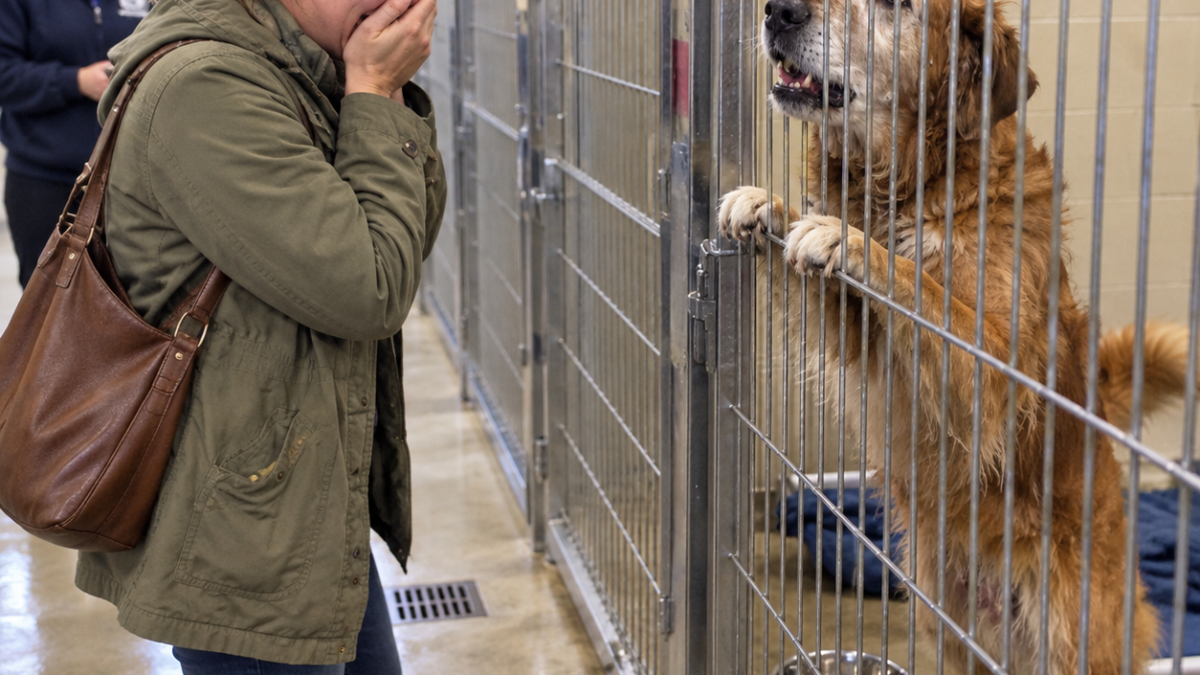
She simply sat down beside me on the cold tile while Milo continued pushing his muzzle between the bars.
For several seconds, I couldn’t continue.
I had told myself the story so many different ways over seven years that I no longer knew which version hurt least.
I had abandoned him.
I had saved him.
I had failed him.
I had loved him enough to leave.
Depending on the night, I believed all four.
Sophie finally spoke.
“Do you want me to open the kennel?”
Every part of me screamed yes.
But fear arrived first.
“What if he’s afraid of me?”
She looked at Milo.
He was whining so hard his whole chest trembled.
“I don’t think fear is what we’re seeing.”
“What if he remembers me leaving?”
“He probably remembers more than we understand.”
That did not make me feel better.
Sophie stood.
“Stay there.”
She disappeared through a side door.
Milo watched her go.
Then immediately turned back to me.
“Milo.”
His tail struck the kennel wall.
Thump.
Thump.
Thump.
“I never thought I’d see you again.”
He whined.
I slipped both hands through the bars now.
He pressed his entire face against them.
His muzzle had gone almost completely white.
There was a small wart above his right eye.
His once-muscular shoulders had narrowed.
His coat was still that warm brown-gold I remembered, but age had softened the color.
How old was he?
Sixteen?
Seventeen?
My chest hurt.
I had missed almost half his life.
Sophie returned with an older woman wearing a navy sweater and a shelter badge.
“This is Marianne, our director.”
Marianne looked from me to Milo.
Then back again.
“Sophie says you believe you used to own him.”
“I did.”
“What was his name?”
“Milo.”
“We call him Marcel.”
A tiny laugh escaped through my tears.
“Marcel?”
“He came to us with that name.”
I reached through the gate.
“Milo.”
His ears lifted instantly.
Marianne’s expression changed.
“Again.”
“Milo.”
His whole body shook.
He pawed at the bars.
Marianne crouched.
“What year did you surrender him?”
“Seven years ago.”
“Where?”
“A small association in the Drôme.”
She became very still.
“Do you remember the name?”
I told her.
Marianne and Sophie exchanged a look.
“What?”
Marianne stood.
“Wait here.”
She left.
I stared after her.
“What does that mean?”
Sophie shook her head.
“I honestly don’t know.”
Twenty minutes felt like an hour.
I sat with my back against Milo’s kennel.
He finally stopped crying.
Instead, he lay down on the other side of the gate, his body pressed as close to mine as the metal allowed.
Just like the car.
My throat tightened at the memory.
Seven years earlier, winter had come early.
The first frost appeared on the windshield while Milo and I were still sleeping inside my little hatchback.
I had woken before sunrise because my feet were numb.
Milo was curled across the back seat beneath two blankets.
I touched his ribs.
Too easy to feel.
“Milo?”
His eyes opened.
Usually, the sound of his name meant movement.
Tail.
Stretching.
His nose searching for breakfast.
That morning he simply looked at me.
I poured kibble into his bowl.
He sniffed it.
Turned away.
“No.”
I tried again.
“Come on, buddy.”
Nothing.
By noon he had vomited twice.
I had forty-seven euros in my bank account.
I remember the number because shame has a way of preserving useless details.
Forty-seven euros and twelve cents.
I drove to a veterinary clinic anyway.
A woman named Dr. Bellier examined him.
She was kind.
That made everything harder.
If she had been cold, maybe I could have become defensive.
Instead, she listened to his heart.
Pressed his abdomen.
Asked questions.
“How long has he been eating less?”
“Two days.”
“Any diarrhea?”
“Yes.”
“Where are you staying?”
My face must have changed.
She noticed.
“Claire?”
I looked at Milo.
He was lying on the examination table with his head against my arm.
“Nowhere permanent.”
She waited.
And then everything came out.
The lost job.
The rent.
Sleeping in the car.
My mother.
The shelter for women that had offered me a bed but would not take Milo.
The two times I had refused it.
The cheap food.
The nights when I had eaten bread so Milo could have meat.
Dr. Bellier did not judge me.
She didn’t say, *You shouldn’t own a dog.*
She said something worse.
Something true.
“He needs stability.”
I nodded.
“So do you.”
I cried in that examination room until I could barely see.
Milo’s illness was treatable.
A gastrointestinal infection.
Medication.
Special food.
Warmth.
Rest.
Nothing catastrophic.
Unless you had nowhere warm to go.
Dr. Bellier gave me names of rescue groups.
Temporary foster networks.
Associations.
I called all of them.
Some were full.
Some didn’t answer.
One said they might have space in three weeks.
I did not know if I had three weeks.
That night I parked behind a grocery store.
Rain hit the windshield.
Milo lay under my coat because I had used the last clean blanket to dry him after he vomited.
I stared at him for hours.
“I’m trying.”
His eyes followed me.
“I swear I’m trying.”
He moved his head onto my knee.
That almost destroyed me.
People like to say love means never giving up.
Sometimes love means recognizing that the person you refuse to give up is drowning beside you.
For three days, I fought the decision.
On the fourth morning, I drove Milo to the small shelter in the Drôme.
I told myself I was only going to ask questions.
Then I walked inside.
A woman behind the desk listened.
“We can take him.”
I felt sick.
“Today?”
“Yes.”
“He’s on medication.”
“We can continue it.”
“He doesn’t like thunder.”
“We’ll note it.”
“He sleeps better if he can see someone.”
“We’ll note that too.”
“He likes pieces of apple, but not the peel.”
The woman’s face softened.
“You can write everything down.”
So I did.
Two pages.
Food.
Commands.
Habits.
The place behind his ear he liked scratched.
The fact that he would pretend not to understand “down” if food was nearby.
The way he nudged a person twice when he needed to go outside.
The way he slept.
The way he loved.
At the bottom was a surrender form.
**Reason: Housing difficulties.**
Four words.
I stared at them.
How could four words explain months of sleeping in a car?
How could four words explain choosing between gasoline and kibble?
How could four words say:
*I am giving you the living thing I love most because I am afraid loving him beside me will eventually kill him?*
I signed.
Then I knelt.
Milo immediately climbed halfway into my lap.
I took his face in both hands.
“I’m sorry, buddy.”
He licked my nose.
I almost changed my mind.
I actually stood up and said, “I can’t.”
The woman waited.
“I’ll figure something out.”
She said gently, “You can.”
Hope rose inside me.
Then she added, “But does he have time for you to figure it out?”
I looked down.
Milo’s ribs showed.
That answer was enough.
When I walked toward the exit, he followed.
Of course he did.
A staff member held his leash.
He pulled.
I kept walking.
Then came the bark.
One sharp bark.
I stopped.
Another.
“Milo…”
I turned.
He was pulling so hard toward me that the leash was taut.
I nearly ran back.
The staff member said, “Go.”
I hated her for it.
“Please.”
“If you come back now, you’ll have to leave him twice.”
So I opened the door.
Milo barked again.
That was the sound I carried for seven years.
Not his playful bark.
Not the bark he used when somebody knocked.
That one.
The last one.
I sat in my car outside the shelter for forty-three minutes.
Then I drove away without him.
Three days later, I accepted the bed at the women’s shelter.
I cried my first night because I had a mattress.
A real mattress.
A radiator.
A bathroom down the hallway.
And no Milo.
I almost left.
A counselor named Isabelle stopped me.
“Where will you go?”
“My car.”
“Why?”
I couldn’t answer.
She sat beside me.
“You gave up something to get here, didn’t you?”
That was when I told another human being the whole story for the first time.
Isabelle listened.
Then she said, “Make the sacrifice mean something.”
Those five words became my life.
I found temporary work.
Then a permanent administrative position.
I saved.
Paid debt.
Helped my mother.
Eventually rented a tiny studio.
Then a better apartment.
Every improvement hurt.
The first time I bought a full refrigerator of groceries, I cried because Milo was not there to steal anything.
The first time I rented an apartment that allowed dogs, I stood in the empty living room and imagined his paws on the floor.
But I never went looking for him.
That is the part people may not understand.
I was afraid.
I had been told surrendered animals could be adopted quickly.
I imagined Milo in a house.
A yard.
A family.
Children.
Another dog.
Someone richer than me.
Someone better.
What right did I have to appear and disturb that?
So I did nothing.
Every year, on the date I surrendered him, I thought about calling.
Every year I found a reason not to.
Then seven years passed.
At thirty-eight, my life finally looked ordinary.
Stable job.
Bills paid.
Savings.
Apartment with a balcony facing trees.
A blue couch no one used.
The couch bothered me.
It looked like a place a dog should sleep.
So one morning, I opened the shelter website.
Senior dogs.
That was all I searched.
I did not search Milo.
I told myself I was ready to help somebody else.
Maybe I was really trying to apologize to him through another dog.
Then I walked down that shelter hallway.
And a metal bowl hit a wall.
“Claire?”
Marianne’s voice brought me back.
She stood several feet away holding a folder.
I got up carefully.
“What did you find?”
“A lot.”
My stomach tightened.
“Is he Milo?”
“Yes.”
I closed my eyes.
Hearing someone else confirm it made everything real.
“What happened to him?”
Marianne glanced toward Sophie.
Then at me.
“You may want to sit.”
“No.”
“Claire—”
“Please.”
She took a breath.
“Milo stayed at the Drôme shelter for almost four months.”
My heart sank.
“Four months?”
“He was older than the puppies people were looking for, but eventually a man named Henri adopted him.”
Relief hit me so hard I grabbed the gate.
“He had a home?”
“Yes.”
“For how long?”
“Almost six years.”
I covered my mouth.
Six years.
Six years Milo had slept somewhere warm.
“Was he good to him?”
Marianne smiled.
“From everything in the file, very.”
I started crying again.
“Thank God.”
Henri Laurent had been sixty-seven when he adopted Milo.
Widowed.
Retired railway worker.
Small house outside Valence.
Fenced garden.
He had seen Milo lying quietly behind his kennel door and asked one question.
“Which dog has been here the longest?”
They showed him Milo.
Henri took him home three days later.
The file contained photographs.
Marianne handed them to me.
My hands shook.
Milo asleep beside a fireplace.
Milo standing in a garden beside tomato plants.
Milo wearing a ridiculous yellow raincoat.
Milo on a couch.
Milo older.
Grayer.
Happy.
I pressed the photographs against my chest.
“He was loved.”
“Yes.”
That was what I had prayed for.
Then Marianne’s expression changed.
“What?”
“Henri died eleven months ago.”
My joy collapsed into sadness.
“What happened to Milo?”
“Henri’s daughter lives in Canada. She came back after his death, but Milo was already very old and couldn’t travel easily. She tried family members. No one could keep him permanently.”
“So he came here?”
“Eventually.”
Milo had moved through two foster homes.
Then into the Grenoble shelter.
Arthritis.
A heart murmur.
Poor hearing.
Older dogs were hard to place.
He had been there five months.
“And nobody wanted him?”
“That isn’t fair,” Marianne said. “People liked him. But they kept choosing younger dogs.”
I looked at him.
Milo watched every movement I made.
“He waited again.”
Marianne did not answer.
I turned.
“Can I go inside?”
She hesitated.
“There’s something we need to discuss first.”
My heart dropped.
“What?”
“You surrendered him legally.”
“I know.”
“That means you don’t have an ownership claim.”
“I know.”
“If you want him now, this has to be treated as an adoption.”
“Fine.”
“You’ll go through the same process as anyone else.”
“Fine.”
“Home inspection.”
“Yes.”
“Veterinary planning.”
“Yes.”
“Financial assessment because he has ongoing medical needs.”
“Yes.”
“Possibly a trial period.”
I stared at her.
“Yes.”
Marianne studied me.
“Why?”
“What?”
“Why now?”
I almost laughed.
“He just recognized me.”
“That doesn’t answer my question.”
I looked at Milo.
“Because seven years ago, keeping him would have been selfish.”
My voice shook.
“And walking away nearly destroyed me.”
I faced her again.
“But I did it because I thought he deserved stability more than I deserved comfort.”
Marianne said nothing.
“Today I have stability.”
I pointed toward Milo.
“And if he still wants me after what I did, I’m not walking away twice.”
Silence.
Then Sophie wiped her cheek.
Marianne looked at her.
“You’re supposed to be professional.”
“I am professionally crying.”
For the first time, Marianne smiled.
She unlocked the kennel.
I stopped breathing.
The gate opened six inches.
Milo pushed through before Sophie could widen it.
His legs were stiff.
He stumbled.
I dropped to my knees.
He hit me in the chest.
Not hard.
He was too old for that.
But enough.
His head buried beneath my chin.
I wrapped both arms around him.
For a few seconds, he went completely still.
Then he made a sound.
A low moan.
I remembered it.
He used to make that noise when I came home after being gone too long.
“Oh, Milo.”
He licked my neck.
I held him tighter.
“I’m sorry.”
His tail hit the floor.
“I’m so sorry.”
Another thump.
I cried into his fur.
Seven years of speeches disappeared.
Every apology I had rehearsed sounded ridiculous now.
Milo did not want explanations.
He wanted contact.
My hand on his chest.
My face near his.
My smell.
My voice.
The things dogs understand better than guilt.
Marianne let us sit there for almost twenty minutes.
Then Milo tried to climb into my lap.
His back legs slipped.
I caught him.
“He’s having trouble.”
“Arthritis,” Marianne said. “Mostly hips.”
“Pain medication?”
“Yes.”
“Heart?”
“Grade-two murmur. Monitored.”
“Kidneys?”
“Good for his age.”
“Eyes?”
“Cataracts starting.”
“Hearing?”
“Selective.”
Sophie laughed.
“He hears food packaging perfectly.”
“That hasn’t changed.”
Milo looked at me.
I touched the notch in his ear.
“You still hate apples with the peel?”
Sophie blinked.
“How did you know that?”
I laughed through tears.
“Some things you don’t forget.”
We spent an hour together in the visiting room.
Milo explored for perhaps thirty seconds.
Then returned to me.
Every time.
I moved to another chair.
He followed.
I went to the water fountain.
He followed.
I used the restroom.
When I returned, he was standing with his nose against the door.
Sophie shook her head.
“This is absurd.”
“What?”
“He’s seventeen years old and suddenly acting twelve.”
Seventeen.
The number hurt.
“How much time does he have?”
Marianne answered carefully.
“Nobody can tell you that.”
“A year?”
“Maybe.”
“Two?”
“Maybe.”
“Months?”
“Possible.”
I looked at Milo.
I had found him.
And immediately learned I might lose him again.
That night I went home alone.
The shelter required the process.
I understood.
Still, leaving nearly broke me.
Milo tried to follow.
When Sophie held his leash, panic flashed through me.
Seven years disappeared.
“No.”
Sophie immediately loosened the leash.
“What?”
“I can’t leave like this.”
Marianne stepped closer.
“Claire.”
“He thinks I’m leaving him again.”
Milo whined.
I knelt.
This time, instead of apologizing, I put both hands around his face.
“I’m coming back tomorrow.”
His eyes searched mine.
“Tomorrow.”
I touched my forehead to his.
“I know I broke this promise once.”
My voice cracked.
“But not this time.”
The next morning I arrived twenty minutes before opening.
Marianne found me outside with coffee.
“You know we aren’t open.”
“I know.”
“You’re early.”
“I know.”
Milo heard my voice from inside.
He began barking.
Marianne sighed.
“Fine.”
She opened the door.
The next six days became the longest week of my life.
Home inspection.
Landlord confirmation.
Veterinary consultation.
References.
Income records.
Emergency plan.
I answered everything.
Then came the problem I had not expected.
Another adoption application.
A couple had met Milo three days before I arrived.
They were interested.
“They applied before me?”
“Yes,” Marianne said.
My stomach twisted.
“Are they good?”
“Yes.”
That was the worst answer.
If they had been careless, I could have hated them.
They weren’t.
Paul and Nadia were in their sixties.
House.
Garden.
Retired.
Excellent veterinary history.
They wanted a calm senior dog.
Exactly the home I once would have begged for Milo.
“You have to consider them.”
Marianne stared at me.
“You understand that?”
I wanted to say no.
Instead I whispered, “Yes.”
That night I barely slept.
Seven years earlier, I had let Milo go because I believed another home could give him more.
Now I faced the same question again.
Did loving him mean taking him?
Or letting him choose comfort without the burden of my guilt?
The next day, I asked Marianne for one thing.
“Let Milo meet all of us.”
“What?”
“Me. Paul. Nadia.”
“That’s unusual.”
“I don’t want you choosing based on my story.”
“You’re sure?”
“No.”
I almost laughed.
“But do it anyway.”
Paul and Nadia arrived Saturday morning.
They were exactly as kind as I feared.
Nadia brought an orthopedic harness after hearing about Milo’s hips.
Paul sat on the floor instead of making Milo approach.
I hated how much I liked them.
Milo sniffed Nadia.
Accepted a treat.
Let Paul scratch his chest.
Then he looked across the room.
At me.
I had been told to stay quiet.
So I did.
Milo walked past Paul.
Past Nadia.
Across the room.
And put his head on my knee.
No one spoke.
Paul finally smiled.
“Well.”
Nadia’s eyes filled.
“I think we have our answer.”
I shook my head.
“You don’t have to—”
She stopped me.
“Yes, we do.”
She crouched beside Milo.
“You old traitor.”
Milo wagged.
Nadia laughed.
Then looked at me.
“Take him home.”
I cried again.
I seemed to do nothing else that week.
Paul shook my hand.
“Make the years count.”
The adoption was approved Monday morning.
Marianne placed the paperwork in front of me.
My hand froze above the signature line.
Seven years earlier, I had signed Milo away.
Now I signed him back.
When we reached my apartment, Milo stood outside the door.
I unlocked it.
He did not move.
“Come on.”
Nothing.
I stepped inside.
“Milo?”
He looked down the hallway.
Then at me.
For one second, I wondered whether he remembered every temporary place that had disappeared beneath him.
Henri’s house.
Foster homes.
Shelters.
Maybe even my car.
I sat on the floor inside the doorway.
“I’m not pulling you in.”
He watched me.
“This is yours if you want it.”
Five minutes passed.
Then Milo stepped over the threshold.
One paw.
Two.
His nails clicked across the floor.
He sniffed the wall.
The table.
The kitchen.
Then saw the blue couch.
He walked toward it.
I had bought an orthopedic dog bed.
Expensive.
Memory foam.
Washable cover.
He ignored it.
He stood beside the couch and looked at me.
“No.”
Tail wag.
“You are seventeen.”
Wag.
“That couch is higher than your knees should tolerate.”
Wag.
I sighed.
“Fine.”
I helped him up.
Milo turned twice.
Lay down.
And fell asleep.
The blue couch finally had someone on it.
That first night I slept on the floor beside him.
Not because Milo needed me to.
Because I needed him close enough to touch.
At 2:14 a.m., I woke.
For one horrible second, I thought I was back inside the car.
Then I heard Milo snoring.
I reached up.
My fingers touched his paw.
Warm.
Real.
“Still here?”
His tail moved once in his sleep.
I smiled.
“Me too.”
Our second life together began quietly.
Morning medication hidden in cheese.
Short walks.
Long naps.
Appointments.
Milo could no longer climb stairs safely, so I carried him when the elevator broke.
He weighed twenty-eight kilos.
My back protested.
Milo did not care.
“Some gratitude would be nice.”
He licked my chin.
“Accepted.”
At first, he followed me everywhere.
Kitchen.
Bathroom.
Balcony.
Bedroom.
If I closed a door, he waited against it.
I stopped closing doors.
When I went to work, a neighbor named Amélie checked on him at noon.
The first week, I installed a camera.
I spent more time watching Milo than doing my job.
He paced for eight minutes after I left.
Then lay beside the front door.
That broke me.
The next day, I left one of my sweaters on his bed.
He slept on it.
By the third week, he stopped waiting at the door.
He chose the couch.
That should not have made me emotional.
It did.
It meant he believed I would return.
One evening, rain began tapping against the balcony.
Milo stood at the glass.
I sat beside him.
“Remember the car?”
His ears moved.
“Probably better than I do.”
Rain had been the soundtrack of our worst year.
Water hitting metal while I tried to sleep.
Milo’s breath fogging the windows.
My clothes damp.
The smell of wet fur.
That night, we watched rain from a warm apartment.
His dinner bowl was empty.
His medication was paid for.
A blanket covered his back.
My refrigerator held enough food for a week.
I thought about twenty-four-year-old me—
No.
Thirty-one.
Tired enough to lose track of my own age.
Living from coins.
Believing failure was permanent.
I wished I could reach backward through time and tell her:
*You survive.*
*So does he.*
*And one day, you find each other again.*
But our reunion was not perfect.
Milo had nightmares.
Or what looked like them.
His paws would twitch.
He would whine.
Sometimes he woke suddenly and searched the room.
The first time, I reached toward him too quickly.
He startled and snapped the air.
Then froze.
I froze too.
He lowered his head.
“Oh, buddy.”
I waited.
Milo approached.
I put my hand on the floor.
He rested his muzzle against it.
“No apologies.”
That became our rule.
No apologies for age.
No apologies for fear.
No apologies for the years neither of us could change.
The bigger problem came six weeks after the adoption.
Milo collapsed during our evening walk.
One second he was sniffing a tree.
The next, his legs folded.
“Milo!”
I dropped beside him.
His eyes were open.
Breathing.
But shallow.
I called the emergency clinic from the sidewalk.
Within twenty minutes, we were there.
The veterinarian listened to his heart.
Ran tests.
I stood against the wall shaking.
“Is this the murmur?”
“Possibly more.”
“What does that mean?”
“His heart disease has progressed.”
The room tilted.
“How long?”
“We treat the dog, not a calendar.”
I hated that answer because it sounded exactly like truth.
Medication changed.
Activity shortened.
Monitoring increased.
Milo came home that night.
I sat on the kitchen floor.
He ate chicken from my hand.
“Seven years.”
He chewed.
“I get seven years without you, and now you’re going to give me what?”
He licked my finger.
“A month?”
Another piece.
“Six?”
Milo stared at the chicken.
I laughed through tears.
“You’re terrible at serious conversations.”
The next morning, I called in sick.
Then the next.
On the third day, my supervisor called.
“Claire.”
“I know.”
“No, you don’t.”
I prepared myself.
“You have vacation days.”
“What?”
“Use them.”
I started crying.
She sighed.
“Is this about the dog?”
“Yes.”
“The one you found after seven years?”
“Yes.”
“Then stop answering work email.”
For two weeks, Milo and I did almost everything his body could still manage.
Not a bucket list.
I hated that phrase.
Milo did not know he was dying.
He only knew today smelled interesting.
So we had good todays.
A park beside the river.
A café patio where the owner brought him water.
Henri’s old town.
That trip mattered most.
I had written to Henri’s daughter, Lucie, through the shelter.
She answered immediately.
**I hoped you would contact me.**
We met outside Henri’s house.
Lucie had flown from Montreal to settle the final sale.
She was fifty-two, with her father’s gray eyes.
The moment she saw Milo, she cried.
“Oh, Marcel.”
Milo wagged.
I smiled.
“Milo.”
She laughed.
“Papa would be offended. He thought Marcel was elegant.”
We sat in the garden where Milo had spent six years.
Lucie showed me photographs.
Hundreds.
Henri and Milo beside a lake.
Milo asleep under a Christmas table.
Milo wearing a paper crown.
Henri reading with one hand resting on Milo’s back.
I cried until I was embarrassed.
Lucie touched my arm.
“My father loved him.”
“Thank you.”
“You don’t have to thank me.”
“Yes.”
I looked at Milo sleeping in the grass.
“Yes, I do.”
Lucie hesitated.
“There’s something you should know.”
My stomach tightened.
“What?”
“When Papa adopted Milo, the shelter gave him the surrender notes.”
“My notes?”
“Some of them.”
I stared.
“He knew about you?”
“Not your name.”
She reached into an envelope.
“But he knew somebody had loved this dog very much.”
Inside was a photocopy.
My handwriting.
Seven years old.
**He’s afraid of thunder.**
**He likes apple pieces without peel.**
**If he nudges twice, he needs to go outside.**
**Please let him sleep somewhere he can see a person.**
At the bottom, I had written something I did not remember.
**He is a very good dog. None of this is his fault.**
I pressed the paper against my mouth.
Lucie continued.
“My father used to say, ‘Whoever gave this dog up must have been devastated.’”
I cried.
For seven years, I had imagined strangers thinking I was heartless.
Henri had understood me without ever knowing me.
Lucie handed me another paper.
A letter.
My name was not on it.
It had never been sent.
Henri had written it two years before he died.
**To the person who loved Milo before me,**
**I don’t know your circumstances. I only know you left unusually detailed notes and that this dog watched the front door for months after I adopted him. I want you to know he is safe. He sleeps on my couch, steals bread, hates the rain, and has trained me to peel apples. If you ever wonder whether he was loved, the answer is yes.**
I stopped reading.
“I can’t.”
Lucie took my hand.
“Read the last line.”
I forced myself.
**You did not disappear from his story. You are the reason he reached mine.**
I broke.
Not delicately.
I leaned over Milo and cried into his fur.
Seven years of guilt cracked open.
Milo woke.
He licked my face.
Lucie cried too.
Henri had died without knowing what his letter would mean.
But somehow it had waited for me.
Just like Milo.
That afternoon, before we left, Lucie gave me Milo’s old collar from Henri’s house.
Blue leather.
Worn soft.
A little brass tag.
**MARCEL — HENRI LAURENT**
I kept it.
Not to replace Milo’s first name.
To honor the man who had loved him when I could not.
At home, I placed the collar beside Milo’s old shelter photograph.
Two lives.
Two names.
One dog.
His heart stabilized for a while.
Spring came.
Then summer.
Milo reached eighteen.
The shelter held a small anniversary event.
I brought him.
Sophie saw us at the entrance.
“Oh my God.”
“What?”
“He’s even grayer.”
“Rude.”
Milo wagged at her.
Marianne came out next.
She crouched carefully.
“Hello, troublemaker.”
Milo licked her.
People who had heard his story gathered.
I hated attention.
Milo loved it.
He worked the room like a politician.
Then a woman I did not recognize approached.
She looked nervous.
“Claire?”
“Yes?”
“My name is Anaïs.”
She glanced at Milo.
“I volunteered at the Drôme shelter seven years ago.”
Everything inside me stopped.
“I was there the day you surrendered him.”
I stared.
“You were?”
She nodded.
“I was the person holding his leash.”
The hallway seemed suddenly too warm.
“You told me to go.”
Her face fell.
“Yes.”
For seven years, I had remembered that voice.
Go.
If you come back, you’ll have to leave him twice.
I had hated her.
“I thought about you for years,” Anaïs said.
“Why?”
“Because after you left, Milo screamed for almost an hour.”
My eyes filled.
She continued quickly.
“I’m sorry. I shouldn’t have told you that.”
“No.”
I swallowed.
“Keep going.”
“He stayed by the front door.”
I looked down at him.
“But he ate that night.”
I looked up.
“What?”
“He ate.”
Anaïs smiled through tears.
“The medication worked. He slept in the office because we didn’t want him alone.”
I had imagined him alone in a kennel that first night.
Instead, someone had stayed.
“I slept on a camping mat beside him.”
“You?”
She nodded.
“The next morning he stole half my croissant.”
A laugh burst out of me.
“That sounds right.”
Anaïs took a photograph from her bag.
Young Milo.
Much younger.
Sleeping under an office desk.
A woman’s shoe visible beside his head.
“He wasn’t alone, Claire.”
That sentence healed something no court, no adoption paper, no reunion could reach.
He wasn’t alone.
Anaïs looked ashamed.
“For years I worried you thought we were cruel.”
“I did.”
“I know.”
“I hated you.”
“I know.”
“I’m sorry.”
“Don’t be.”
She looked at Milo.
“You did the hardest thing in that room.”
I shook my head.
“No.”
“Yes.”
She met my eyes.
“You left because staying with you was hurting him.”
I could not answer.
She touched my shoulder.
“That isn’t abandonment.”
For seven years, I had called it that.
Abandonment.
Even when others used softer words.
Surrender.
Placement.
Sacrifice.
I chose the cruelest one because punishment felt deserved.
But standing there with Milo leaning against my leg, Henri’s collar in my bag, and Anaïs beside me, I finally allowed another word.
Love.
Not perfect love.
Not victorious love.
Love that ran out of money.
Love that slept in a car.
Love that made mistakes.
Love that signed a form with shaking hands because the dog needed food more than the woman needed forgiveness.
Milo’s final decline began that autumn.
Slowly.
He stopped wanting long walks.
Then medium walks.
Eventually, the park across the street was enough.
His appetite changed.
Chicken still mattered.
Cheese always mattered.
Kibble became negotiable.
His back legs weakened.
I bought a support harness.
The first time I used it, Milo looked offended.
“Listen, Grandpa.”
He stared at me.
“You are not falling because of pride.”
Tail wag.
“Exactly.”
One cold November morning, he refused breakfast.
I knew.
Before the vet said anything, I knew.
Blood tests showed kidney decline.
His heart was worse.
Arthritis severe.
We adjusted everything.
For a few weeks, he rallied.
Then one night, he could not stand.
I lay beside him on the floor.
His breathing was heavy.
“Milo.”
His eyes opened.
“No hospital tonight.”
I had learned the difference between saving a life and extending fear.
The mobile veterinarian arrived at nine the next morning.
She examined him beside the blue couch.
“He isn’t in crisis this minute.”
I held onto that.
“But?”
“But we’re close.”
I looked at Milo.
“How close?”
“Claire.”
“I need numbers.”
“There aren’t good numbers.”
“Days?”
“Possibly.”
“Weeks?”
“Possibly.”
“Months?”
She was silent.
I understood.
After she left, I called Sophie.
Then Marianne.
Lucie.
Anaïs.
Dr. Bellier, whom I had found again after the reunion.
I did not call because Milo knew these people.
Most of them he barely remembered.
I called because I did.
Because his life had become a bridge connecting strangers.
That afternoon, Lucie sent a voice message from Canada.
I played it beside Milo.
“Hello, Marcel.”
His ears moved.
“My father loved you very much.”
I cried.
“And Claire loves you too.”
Milo looked toward me.
The message continued.
“You were a very lucky dog, even if some parts were hard.”
I stopped the recording.
“No.”
Milo rested his head on my hand.
“We were lucky.”
His last good day came unexpectedly.
Sunlight.
Cold air.
Milo ate scrambled eggs.
Then stood at the door.
“You want outside?”
Tail wag.
We went to the river.
I brought the wagon I had bought for longer distances.
Milo rode most of the way.
At our usual bench, he surprised me by standing.
I helped him down.
He walked six steps.
Stopped.
Sniffed.
Then six more.
I remembered another lifetime.
A younger Milo pulling me through streets.
A homeless Milo sleeping in a car.
An old Milo crashing against a kennel gate.
Every version existed inside those twelve slow steps.
We sat beside the water.
I peeled an apple.
Milo looked interested.
“Of course.”
I cut a piece.
Removed the peel.
He ate it.
“Henri spoiled you.”
Another piece.
“You had two people peeling apples for you across one lifetime.”
Milo leaned against me.
“Not bad.”
That night, he slept on the couch.
I slept beside him.
At 3:17 a.m., I woke because his breathing changed.
“Milo?”
He lifted his head.
Tried to stand.
Couldn’t.
I supported him.
He looked toward the front door.
For a second, panic hit me.
Then I understood.
Outside.
I carried him to the balcony.
Cold air moved across us.
The city was silent.
Milo lifted his nose.
Smelled the trees.
Rain somewhere far away.
Smoke from a chimney.
Morning not yet here.
I wrapped him in a blanket.
“You know what?”
His eyes moved toward me.
“For seven years, I thought our story ended with me walking through a door.”
I kissed his forehead.
“But it didn’t.”
His tail moved weakly.
“You had Henri.”
Another tiny movement.
“You had gardens.”
I cried.
“You had apples.”
His head settled against my chest.
“And then somehow you found me again.”
The veterinarian came at eight.
I had already made the decision.
People sometimes call it letting go.
That phrase sounds gentle.
It is not.
It is choosing to have your heart broken at the exact moment someone trusts you most.
But seven years earlier, I had learned that love is not proved by how long you keep someone beside you.
Sometimes it is proved by refusing to make them suffer because you are afraid to be alone.
I lay beside Milo on the rug.
His head rested on my arm.
The veterinarian gave him a sedative first.
His body relaxed.
For the first time in weeks, every muscle softened.
“Oh, buddy.”
His eyes remained on me.
“You can sleep.”
His tail moved once.
Barely.
“I’m here.”
That mattered.
Seven years earlier, I had walked away because I could not stay.
This time, I stayed because I could.
I kissed the notch in his ear.
“Thank you for finding me.”
His breathing slowed.
“I love you.”
One breath.
Then another.
Then quiet.
I did not move.
The veterinarian waited.
Finally she whispered, “He’s gone.”
I shook my head.
“No.”
Not because I denied it.
Because the words were incomplete.
Milo was not gone.
His body was still beneath my hand.
His hair was still on my couch.
His bowls were in the kitchen.
Henri’s collar was on my shelf.
His claw marks were probably still somewhere in the old shelter door of my memory.
He existed in too many places to become nothing in one moment.
Still, the apartment became unbearable after.
The first morning, I woke before my alarm because there was no snoring.
I stood in the kitchen.
Reached for his medication.
Then remembered.
I left the apartment without breakfast.
For weeks, I avoided the blue couch.
People told me I had given him a beautiful ending.
I hated them for being correct.
A beautiful ending is still an ending.
Then one afternoon, Marianne called.
“I need help.”
“With what?”
“A dog.”
“No.”
She laughed softly.
“I didn’t ask you to adopt.”
“Good.”
“We have a twelve-year-old female whose owner died.”
My heart tightened.
“Marianne.”
“She’s not Milo.”
“I know.”
“She never will be.”
“I know.”
“She stopped eating.”
Silence.
“What do you want me to do?”
“Sit with her.”
That was all.
So I went.
The dog’s name was Alma.
Black coat.
Gray face.
Scared eyes.
She lay facing the back of her kennel.
I sat outside.
Said nothing.
Twenty minutes passed.
Then Alma turned her head.
I remembered Milo.
Not the last day.
The first reunion.
The metal bowl.
The cry.
The way hope had exploded through an old body.
I put my hand near the bars.
Alma sniffed.
I did not adopt her.
Not that day.
I simply sat.
I returned the next afternoon.
Then again.
A month later, Alma went home with a retired teacher named Véronique.
I helped carry her blanket to the car.
As they drove away, Marianne stood beside me.
“You realize what you’re doing.”
“What?”
“Making the sacrifice mean something.”
I looked at her.
Isabelle’s words.
Seven years earlier.
I smiled.
“I guess.”
I began volunteering every Saturday.
Senior dogs only, at first.
I told myself puppies had enough admirers.
Old dogs needed advocates.
I walked the slow ones.
Sat with the frightened ones.
Learned medication schedules.
Helped write adoption profiles that described more than age and diagnosis.
**Likes morning sun.**
**Prefers soft treats.**
**Sleeps through vacuum cleaners.**
**Will put his entire head in your lap.**
**Still believes every car ride might become an adventure.**
I wanted people to see what I had learned.
An old dog is not a sad ending.
An old dog is a whole story asking someone to read the last chapters carefully.
One year after Milo died, the shelter installed a small plaque outside the senior wing.
I had not asked for it.
I arrived one Saturday and found Sophie waiting.
“Don’t be mad.”
“That sentence guarantees I will be.”
She pointed.
The plaque was simple.
**MILO’S ROOM**
Underneath:
**FOR THE ONES WHO ARE STILL WAITING TO BE RECOGNIZED.**
I could not speak.
Marianne appeared behind us.
“It was Lucie’s idea.”
“I hate all of you.”
Sophie hugged me.
“You’re crying.”
“I can cry and hate simultaneously.”
Inside Milo’s Room were four senior dogs.
One was snoring.
One barked at my shoelaces.
One ignored me.
The fourth sat in the corner.
Brown-gold coat.
White muzzle.
Not Milo.
Not even close.
But for one second my chest hurt anyway.
I crouched.
“Hi.”
He approached slowly.
No dramatic recognition.
No bowls flying.
No miracle.
Just an old dog sniffing my hand.
That was enough.
Years later, people sometimes asked me whether I regretted surrendering Milo.
There is no simple answer.
I regret that poverty cornered us.
I regret every cold night.
Every meal I could not guarantee.
Every mile Milo spent in that car.
I regret that I did not have help sooner.
I regret seven years without him.
But do I regret signing the form?
If I had refused, Milo might not have survived that winter.
He might never have met Henri.
Never slept beside a fireplace.
Never had a garden.
Never worn the ridiculous yellow raincoat.
Never trained a retired railway worker to peel apples.
So no.
I do not regret saving him in the only way I could.
What I regret is that for seven years I punished myself for it.
I thought love only counted when it looked successful.
A home.
Money.
Vet bills paid without checking the bank balance.
A yard.
Stability.
But Milo taught me something harder.
Love can exist inside failure.
It can exist inside poverty.
Inside a car.
Inside a surrender form.
Inside the hands of a woman who walks away crying because staying would be easier for her and worse for the dog.
He also taught me that leaving once does not mean every goodbye is the same.
The first time I left Milo, I heard him barking behind me.
The second time, years later, I lay beside him while he fell asleep with his head on my arm.
For a long time, I thought the first goodbye defined me.
It didn’t.
Neither did the second.
What defined us was everything between them.
A puppy stealing food.
A young woman sleeping badly so he could stretch across a car seat.
A veterinarian telling the truth gently.
A shelter worker staying with him his first night.
Henri choosing the dog who had waited longest.
A garden.
A fireplace.
A letter that waited years to be read.
An old dog throwing himself against a kennel gate.
My hand reaching through.
His face pressing into it.
A blue couch.
Medicine hidden in cheese.
Apples without peel.
One last morning beside the river.
And a promise finally kept.
I said I would come back.
It took seven years.
But I did.
Sometimes I still dream about the shelter corridor.
In the dream, I hear the metal bowl hit the wall.
I turn.
Milo is behind the gate.
But he is not seventeen.
His muzzle is not white.
He is young again.
Golden-brown.
Oversized paws.
Ridiculous tail.
He looks exactly as he did the first night I brought him home.
I say his name.
He runs.
There is no gate.
No leash.
No surrender form.
He runs straight toward me.
Then I wake.
For a few seconds, grief returns.
Then gratitude arrives behind it.
Because in real life there was a gate.
There were seven missing years.
There was age.
There was illness.
Nothing erased those things.
But when I said his name after seven years, Milo still knew exactly who I was.
He did not count the nights I had been absent.
He did not ask what took so long.
He did not demand an explanation for the worst decision of my life.
He simply tried to get to me.
And maybe that is why, whenever someone at the shelter tells me they are ashamed of a choice they made when they were struggling, I never say, “You shouldn’t feel guilty.”
Guilt is not something another person can switch off.
Instead I tell them about Milo.
I tell them about the car.
The forty-seven euros.
The winter.
The form.
Henri.
The seven years.
The metal bowl.
And the old dog who remembered.
Then I tell them what took me far too long to understand.
Sometimes losing someone is not proof that you did not love them enough.
Sometimes it is proof that, when love and possession became two different things, you chose what they needed instead of what would hurt you less.
Milo spent six beautiful years with Henri because I let him go.
Then, somehow, life gave us one more year together.
I used to rage at how unfair that was.
Only one year.
After seven apart.
Now I think differently.
We were given a year neither of us had any reason to expect.
Three hundred and sixty-five ordinary miracles.
A full bowl.
A warm apartment.
A ridiculous couch.
A walk beside the river.
My hand on his back while he slept.
The chance to say his name thousands more times.
The chance to leave a room and come back.
The chance to prove that this time, whenever Milo looked for me, I was there.
That was our revenge on the seven years.
Not anger.
Not punishment.
Not finding someone to blame.
We took the years that were left and filled them so completely that the empty years stopped being the largest part of our story.
Seven years had once felt enormous.
Then Milo came home.
And suddenly one year of being together again carried more weight than all the years I had spent imagining the worst.
Even now, the blue couch is still in my apartment.
I have replaced almost everything else.
New table.
New curtains.
Different shelves.
But not the couch.
There is a pale worn patch on one cushion where Milo slept.
People have suggested replacing it.
I won’t.
His old blue collar from Henri’s house hangs inside a small wooden frame above it.
Beside it is a photograph Lucie gave me.
Henri sitting in his garden.
Milo beside him.
On the other side is my favorite photograph from Milo’s final year.
He is standing by the river.
White muzzle lifted.
Sun on his face.
He looks old.
He looks tired.
He looks happy.
Sometimes, before I leave for the shelter on Saturday morning, I touch the frame.
“Going to see your old friends.”
Then I laugh at myself.
Milo would not care.
Unless the shelter had cheese.
Years have passed, but once in a while a metal bowl falls somewhere in the kennel hallway.
The sound still stops me.
For half a second, my heart believes something impossible.
I turn.
There is never an old golden-brown dog waiting behind the gate.
But that is all right.
Milo already waited once.
Long enough.
He does not have to wait for me anymore.
And neither do I.
For a long time, I believed that would be the final lesson Milo left me.
That he had waited once.
That I had returned.
That neither of us needed to wait anymore.
But I was wrong.
Because even after Milo was gone, his story kept opening doors.
Three months after the plaque went up outside Milo’s Room, I arrived at the shelter on a freezing Saturday morning and found Marianne standing at the reception desk with an expression I recognized immediately.
“What happened?”
She pointed toward the senior wing.
“New intake.”
“How old?”
“Estimated fourteen.”
“Medical?”
“Not great.”
I sighed.
“What’s his name?”
“We don’t know.”
That stopped me.
“Owner surrender?”
“No.”
“Found?”
Marianne nodded.
“Highway rest area. Tied to a bench.”
I closed my eyes.
There are details in rescue work you never become used to.
You simply become better at continuing after hearing them.
“Overnight?”
“Possibly longer.”
I removed my coat.
“Where is he?”
Kennel six.
The dog inside was black except for gray spreading around his muzzle and eyebrows.
His body was thin.
Not dangerously thin, but neglected.
His coat had mats behind his ears.
There was a red mark around his neck where the rope had rubbed.
He lay facing the wall.
I sat outside the gate.
“Hi.”
Nothing.
I waited.
Ten minutes.
Fifteen.
Eventually one ear moved.
“I’m Claire.”
Still nothing.
“I knew another old dog who was very good at ignoring people.”
That was not true.
Milo had rarely ignored anyone.
But talking to senior dogs had become something I did mostly for myself.
“You don’t need to come over.”
The dog breathed slowly.
“You don’t even need to look at me.”
Twenty minutes later, his head turned slightly.
Amber eyes.
My heart stumbled.
Not Milo’s eyes.
I knew that.
But similar enough to hurt.
“Yeah,” I whispered. “That’s unfair.”
The dog watched me.
I slid one hand along the floor outside the bars.
He did not move closer.
So I stayed.
An hour later, Marianne entered.
“You planning to spend all day there?”
“Possibly.”
“He needs a name.”
“Why are you telling me?”
“You name the old ones better than Sophie.”
From the hallway, Sophie shouted, “That is slander.”
I almost smiled.
Then the dog slowly lifted himself.
His legs trembled.
He walked toward the front of the kennel.
One step.
Two.
Three.
He stopped inches from my fingers.
Sniffed.
And sat.
I felt the old ache rise.
Not the same ache.
Nothing would ever be the same.
But close enough to remind me that grief does not close the heart.
It changes the shape of the doorway.
“What about August?” I said.
Marianne frowned.
“It’s February.”
“I know.”
“Then why August?”
I looked at the old dog.
“Because maybe he deserves a warmer month.”
August was adopted six weeks later.
A widow named Monique took him home.
She had lost her husband the year before and said she did not want a puppy because she did not know what the next ten years of her own life looked like.
“I can promise an old dog today,” she told me.
“That feels more honest.”
I understood exactly what she meant.
When August left, I cried in the parking lot.
Not because I wanted him.
Because I did not.
That realization mattered.
For a while, every senior dog had felt like an echo of Milo.
August was the first who became himself.
Not replacement.
Not symbol.
August.
A dog who hated carrots, loved radiators, and barked at motorcycles.
Milo’s story had brought me back to the shelter.
But eventually the other dogs kept me there.
Years passed.
Milo’s Room filled and emptied.
Some dogs stayed three days.
Some stayed months.
Some went home.
Some became too sick before anyone came.
Those were the hardest.
Whenever possible, somebody stayed with them.
A volunteer.
A foster.
Me.
No dog left Milo’s Room alone if we could prevent it.
That became our unofficial rule.
One rainy evening, Marianne found me sitting beside a tiny spaniel named Coco.
She was sixteen.
Kidney failure.
Blind.
Nobody had adopted her.
We had known for two weeks that time was short.
I sat on the floor with Coco wrapped in a blanket against my chest.
Marianne leaned against the wall.
“You know,” she said, “this started because of him.”
I looked down at Coco.
“What did?”
“This.”
“What?”
She gestured toward the room.
“The way we handle the old ones now.”
I frowned.
“We always cared about senior dogs.”
“Of course.”
“But?”
“But before Milo, they were part of the shelter.”
She looked around.
“Now they have a program.”
She was right.
Without anyone announcing it, things had changed.
We had recruited specialized foster homes.
Built a fund for senior medical care.
Created adoption profiles focused on quality of life rather than years remaining.
Veterinary clinics donated discounted exams.
A local pet store sponsored orthopedic beds.
Someone donated a washing machine after discovering how many blankets our old dogs used.
We called the program Second Home.
I had argued against naming it after Milo.
“Why?” Sophie had asked.
“Because this shouldn’t be about one dog.”
So Milo got the room.
The others got the future.
Coco died in my arms that night.
Quietly.
Afterward, I sat in my car and cried.
I still cried.
Years of doing this had not made me stronger in the way people assumed.
I had simply learned that being broken open again was part of caring.
The next morning, I returned.
There was another dog waiting.
That was how healing worked for me.
Not by forgetting the one before.
By allowing the next one to matter too.
On the fifth anniversary of Milo’s death, I drove back to the small town where Henri had lived.
Lucie was visiting from Canada.
The house no longer belonged to her family, but the new owners had agreed to let us stand in the garden for a few minutes.
The tomato beds were gone.
A child’s swing hung from one tree.
The fence had been repainted.
Nothing looked exactly like the photographs.
Lucie stood beside me.
“Papa would hate that color.”
The fence was bright white.
“What color was it?”
“Green.”
“Milo probably didn’t care.”
“He cared where the sun hit in the afternoon.”
We both smiled.
Lucie handed me a small box.
“I found one more thing.”
Inside was a brass dog tag.
Older than the blue collar she had already given me.
One side read:
MARCEL.
On the other:
HOME.
I ran my thumb across the word.
“That’s all?”
“That’s all Papa put.”
No phone number.
No address.
Just HOME.
“That’s a terrible identification tag.”
Lucie laughed.
“I told him that.”
“What did he say?”
“He said, ‘Everyone in the village knows where he lives.’”
I laughed too.
Then cried.
Of course.
Milo had spent years with a man so certain he belonged somewhere that his identification tag needed only one word.
Home.
I kept that tag beside his first collar.
Years later, it became the symbol for Second Home.
Not officially.
We never printed it on merchandise.
Never used Milo’s face in fundraising.
But above the inside doorway to the senior wing, Marianne mounted a small wooden sign.
HOME.
That was all.
New volunteers often asked what it meant.
I usually told them:
“It means don’t treat this like a waiting room.”
A shelter is temporary.
But temporary does not have to mean loveless.
A dog should not need adoption papers before someone learns his favorite place to be scratched.
A dog should not need a permanent family before someone remembers that she likes her food warmed.
A dog should not have to earn tenderness by promising us years.
That was what Milo’s last chapter taught me.
Years later, I finally replaced the blue couch.
Not because I wanted to.
Because one spring morning, I sat down and heard something crack beneath me.
I froze.
Then sank three inches.
The wooden frame had split.
I stared at the ceiling.
“You win.”
The furniture delivery men arrived two days later.
One pointed toward the pale worn patch on the cushion.
“Dog?”
“Yes.”
“Big one?”
“Big enough.”
“You want us to take it away?”
I looked at the couch.
Every instinct said no.
For years, I had treated that worn fabric like a memorial.
Then I remembered what I told adopters.
Love is not the object.
The leash is not the dog.
The bowl is not the dog.
The couch is not the dog.
Memory does not become more faithful because furniture survives.
“Yes,” I said.
“Take it.”
After they left, the room looked wrong.
Too clean.
The new couch smelled like fabric and packaging.
No dog hair.
No dent.
No history.
I sat down.
And cried anyway.
Then I took Milo’s framed photograph from the shelf and placed it on the table beside me.
“Don’t get dramatic.”
I laughed at myself.
The apartment was silent.
But no longer empty.
That difference had taken years to understand.
A week later, Sophie came over.
She inspected the couch.
“Terrible.”
“I know.”
“No character.”
“I know.”
“You need a dog.”
“No.”
She smiled.
“I didn’t say adopt one.”
“I know exactly what you meant.”
“You have a spare room.”
“No.”
“A balcony.”
“No.”
“Flexible hours.”
“Sophie.”
She raised both hands.
“Fine.”
I did not adopt again.
Not for many years.
People assumed Milo had made me afraid.
He hadn’t.
The truth was simpler.
My life after him became full in other ways.
Work.
My mother.
Volunteering.
Friends.
Senior dogs who needed temporary rides to veterinary appointments.
Dogs who stayed one weekend.
Dogs who needed medication while foster families traveled.
I loved dozens of them.
But none stayed.
Then, at fifty-one, I met June.
She was thirteen.
White face.
Brown ears.
Overweight.
Mild arthritis.
She had been surrendered after her owner entered assisted living.
I was not looking.
That is how people always begin these stories.
I was not looking.
June was not dramatic.
She did not throw herself against a kennel gate.
She did not cry when she saw me.
She barely acknowledged me.
The first time we met, she sniffed my shoe, turned around, and went back to sleep.
“Charming,” I said.
Marianne smiled.
“She’s selective.”
“For affection?”
“For effort.”
Three weeks later, June still had no applications.
Not because anything was wrong with her.
Because she was thirteen.
Because she was brown.
Because she slept during meet-and-greets.
Because people imagined grief before they imagined companionship.
One Saturday, I took her home for the weekend.
“Temporary,” I told Sophie.
“Obviously.”
“Two nights.”
“Certainly.”
“No jokes.”
“I would never.”
June entered my apartment.
Walked to the new couch.
Looked at me.
“No.”
She climbed up anyway.
I laughed so hard I had to sit on the floor.
“Of course.”
She turned three circles.
Lay exactly where Milo used to sleep.
Not the same dog.
Not the same story.
But suddenly I could breathe through the memory.
June stayed Sunday night.
Then Monday.
Then forever.
I signed the adoption papers on a rainy Tuesday afternoon.
My hand trembled.
Not because I was afraid.
Because paper still remembered.
Once, I had signed Milo away.
Years later, I signed him back.
Now I signed my name beside another old dog who had nothing to do with that history.
That mattered.
June did not heal Milo’s absence.
She did not need to.
She made her own place.
She snored louder.
Hated apples entirely.
Loved carrots.
Refused to walk in rain.
Had no interest in the blue collar hanging on the wall.
Never learned to enjoy the balcony.
And unlike Milo, June believed my bed belonged to her.
Completely.
Unconditionally.
Without negotiation.
The first night she slept beside me, I woke at 2:14.
The exact time I had once woken and reached for Milo’s paw.
For a moment, memory and present overlapped.
Then June kicked me in the ribs while dreaming.
I laughed into the darkness.
“Very subtle.”
She continued sleeping.
I realized then that grief had finally stopped asking me to choose.
I did not have to preserve Milo by refusing another dog.
I did not have to diminish him by loving one.
The heart is not a kennel with one available space.
Years later, when June became old enough that our walks shortened to the end of the block, I carried her into Milo’s Room for the shelter’s anniversary.
Sophie had gray hair now.
Marianne had retired but came back for special events.
Anaïs visited.
Lucie joined by video from Montreal.
The plaque remained on the wall.
MILO’S ROOM.
FOR THE ONES WHO ARE STILL WAITING TO BE RECOGNIZED.
June sat beneath it and scratched her ear.
“You have no respect for history,” I told her.
Marianne laughed.
“Good.”
I looked at her.
“Why good?”
“Because dogs live forward better than we do.”
That sentence stayed with me.
Dogs live forward.
Not perfectly.
Fear remains.
Bodies remember.
Habits remain.
But given enough safety, most dogs eventually begin asking a simpler question than humans do.
Not Why did this happen to me?
But What happens next?
Food?
Walk?
Nap?
You coming with me?
Milo had never needed me to punish myself for seven years.
That was my invention.
He needed me when I came back.
So I came back.
And when the time came, he needed me to stay.
So I stayed.
That was enough.
On the tenth anniversary of the day I found him again, I went to the river alone.
June had died peacefully the previous winter.
She had been fifteen.
Another good ending that still hurt.
I carried two things in my pocket.
Milo’s brass tag.
June’s old identification tag.
I sat on our bench.
The river moved slowly.
Cold wind came through the trees.
I peeled an apple.
Then laughed because there was no dog beside me demanding a piece.
I ate it myself.
With the peel.
“Sorry, Milo.”
A dog barked somewhere behind me.
My heart still turned.
It probably always would.
A young man walked past with a golden-brown dog.
Not Milo.
Not even similar once I looked properly.
Still, I smiled.
The young man nodded.
“Beautiful day.”
“Yes.”
His dog pulled toward the grass.
He apologized.
I said, “Don’t.”
He looked confused.
“Let him sniff.”
The dog buried his nose in wet leaves.
The man laughed.
“He takes forever.”
“That’s all right.”
They continued.
I sat there another hour.
Before leaving, I took Milo’s tag from my pocket.
HOME.
The word had worn smooth around the edges.
I closed my hand around it.
For decades, I had thought home was a place you either had or lost.
An apartment.
A car.
A shelter bed.
Henri’s house.
My blue couch.
But Milo had taught me otherwise.
Home had been my lap when I was twenty-one.
Then a terrible little car when we had nothing else.
Then a shelter office floor beside Anaïs.
Then Henri’s garden.
Then my apartment.
Then, in his last moments, my arm beneath his head.
Home moved because love moved.
That was why losing one building had never truly been the end of us.
And maybe that was why our reunion had felt impossible and inevitable at the same time.
We had spent seven years in different places.
But some part of the road between us had remained open.
I stood.
The sun was beginning to disappear behind the trees.
I put Milo’s tag back into my pocket.
Not in the river.
Not under a tree.
Not on a memorial.
With me.
That was where it belonged.
As I walked toward my car, my phone buzzed.
A message from Sophie.
A photograph.
A very old dog sat inside Milo’s Room.
White muzzle.
One crooked ear.
Ridiculous expression.
Below it she had written:
Sixteen. Owner died. No applications yet. Coming Saturday?
I stopped.
Looked at the picture.
Then at the river.
For one second, I could almost hear Milo’s metal bowl strike the shelter wall again.
Not as a wound this time.
As an invitation.
I typed back:
I’ll be there when you open.
Sophie replied immediately.
You’re always early.
I smiled.
Then walked toward the car.
There would be another old dog.
Another story.
Another person who might eventually walk through a shelter hallway and see more than gray fur and medical bills.
Maybe I would help them recognize each other.
Maybe all I would do was sit beside a kennel for an hour.
Either way, I knew where I would be.
Because Milo’s story had never really ended at the river.
Or on the blue couch.
Or beneath the plaque bearing his name.
It continued every time an old dog was given one more morning.
Every time a frightened animal heard footsteps coming back instead of walking away.
Every time someone chose the dog nobody else had noticed.
And every time I opened the door to Milo’s Room, I still remembered the sound that began everything.
A metal bowl striking a wall.
An old dog crying out.
My own voice whispering a name I thought I had lost forever.
“Milo?”
I used to remember what came next as heartbreak.
Now I remember it differently.
The gate opened.
That is the part that matters.
The gate opened.
And this time, neither of us walked away.








