PART 2: The Injured Dog Wouldn’t Let Us Search the Burning House—Then He Started Digging Beneath Our Feet
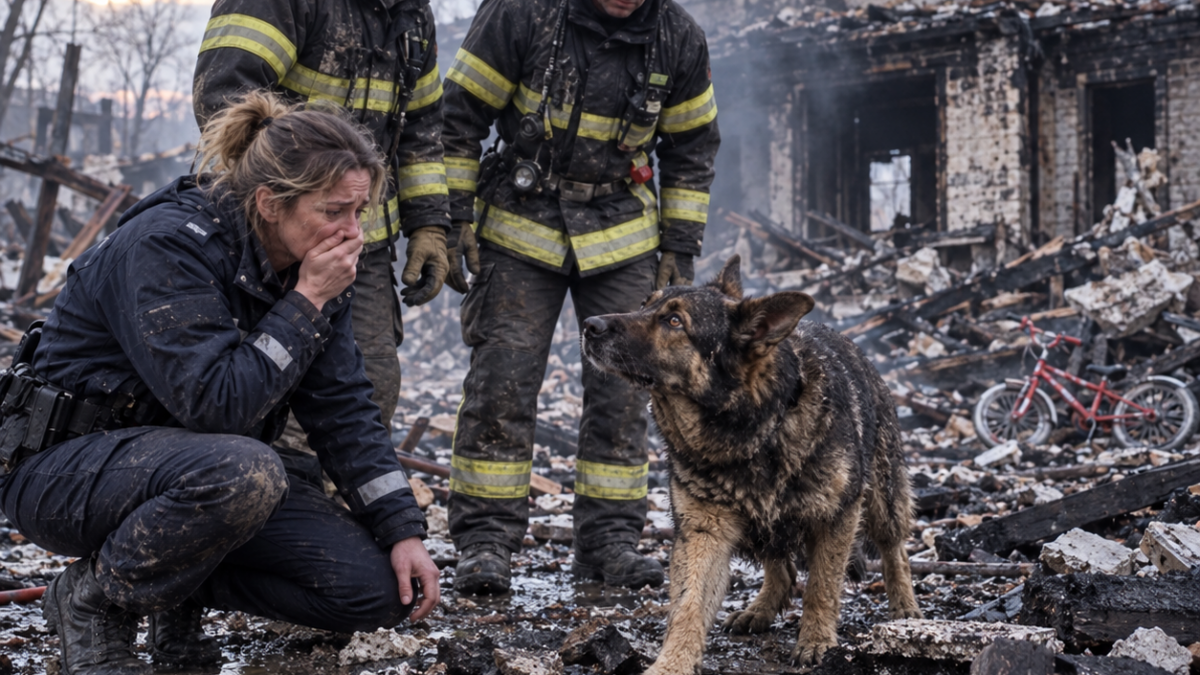
Two children were missing inside a house that was still smoking, and the only witness left standing was a badly burned dog who refused to let us search where everyone insisted they had been sleeping.
At 4:31 that morning, he struck the same patch of debris for the seventh time, then looked straight at me as though he was waiting for the humans around him to finally understand.
What frightened me most wasn’t the growl in his throat—it was the possibility that the dog knew something about that fire none of us did.
Clang.
The sound came from beneath his soot-blackened paw.
The dog froze.
Then he slowly lowered his head toward the debris.
Behind him, what remained of the two-story farmhouse smoldered beneath the gray light of dawn. Water from the fire hoses ran through broken roof tiles, plaster, insulation, and charred beams, carrying ash down the driveway in dark streams.
Against the garage wall, a small red bicycle had melted almost completely on one side.
Nine-year-old Léa Morel and her six-year-old brother, Mathis, were missing.
Their parents swore both children had been upstairs when the fire began.
The firefighters had already searched the bedrooms.
They were empty.
And the dog kept telling us to look somewhere else.
His name, I would later learn, was Mistral.
He was a black-and-tan shepherd mix with one ear standing straight and the other folding slightly at the tip. Beneath his chin was a small white patch that looked almost painted on.
That morning, though, most of him was gray with ash.
The fur over his right shoulder had been singed.
His paw pads were raw.
Every few breaths ended in a dry cough from the smoke.
A green collar, warped by the heat, still hung around his neck.
No tag.
No identification.
One of the firefighters stepped toward the wreckage.
Mistral immediately moved in front of him.
His chest dropped low.
His lips pulled back.
A deep warning growl came from his throat.
“He’s going to bite somebody,” the firefighter said.
I watched the dog.
Then I watched what happened when the man backed away.
Mistral stopped growling.
He turned.
Walked back to exactly the same place.
And began digging.
Scratch.
Scratch.
Clang.
“No,” I said quietly. “He isn’t guarding the ruins.”
The firefighter looked at me.
“What is he doing, then?”
“He’s showing us something.”
My name is Élodie Martin.
At the time, I was a senior officer with the gendarmerie in the Puy-de-Dôme region of central France.
The emergency call had come in at 3:52 a.m.
Neighbors reported flames behind the Morel family’s kitchen and screaming from inside the house.
By the time the first crews arrived, Julien Morel had smashed the small bathroom window on the ground floor and helped his wife, Claire, climb through.
Then he jumped after her.
But their children never came out.
Julien tried to run back inside twice.
Twice, firefighters dragged him away because the heat had become impossible.
When the crews finally reached the upper floor, part of the staircase had collapsed.
The hallway ceiling was unstable.
They still searched both children’s bedrooms.
Empty beds.
No bodies.
No sign of Léa or Mathis.
Then somebody noticed Mistral near what had once been the kitchen door.
An animal handler tried to slip a soft lead around his neck.
Mistral backed away.
I placed water near him.
He ignored it.
He watched only the house.
The moment I stepped toward one particular mound of debris, he blocked me.
When I stepped back, he returned to it.
Scratch.
Scratch.
Clang.
The third time I heard the metallic sound, I realized his paws were tracing something.
A rectangle.
I crouched beside a firefighter.
Together, keeping enough distance not to frighten the dog, we pulled away wet insulation, fragments of plaster, and blackened wood.
A steel edge appeared underneath.
Then another.
“A hatch,” the firefighter whispered.
I turned toward Julien.
His face changed instantly.
“The cellar.”
He had mentioned an old vaulted storage cellar beneath an extension of the house, but nobody had realized it had once been accessible from outside.
Mistral stopped digging.
He lay down.
Pressed one side of his face against the metal.
And listened.
Everybody around us became silent.
One second.
Two.
Then—
Tap.
A tiny sound came from beneath our feet.
The fire captain dropped to one knee.
“Léa? Mathis? Can you hear me?”
Nothing.
Claire covered her mouth.
Julien took one step forward.
Then three faint knocks answered from the darkness below.
Mistral closed his eyes.
And in that moment, while everyone around me realized there might still be two children alive beneath the ruins, I noticed something on the dog’s damaged collar that made me look at the burned house very differently.
PART 2
It was not the collar itself.
It was what was caught beneath it.
A thin strip of bright blue plastic had melted against the green nylon.
At first I thought it was packaging.
Then I saw two tiny copper wires running through it.
“Mistral,” I whispered.
The dog did not move.
The fire captain was already calling for tools.
Nobody else was looking at the collar.
I reached toward it slowly.
Mistral lifted his head.
His eyes met mine.
There was no aggression in them anymore.
Only exhaustion.
“Easy,” I said.
I let him smell the back of my hand.
He breathed once against my fingers, then laid his face back on the hatch.
I touched the blue plastic.
It came loose with almost no resistance.
A firefighter standing beside me frowned.
“What is that?”
“I don’t know yet.”
Then we heard another knock below us.
That ended every other thought.
The cellar came first.
The steel hatch was warped by heat and buried beneath part of a fallen exterior wall. Two firefighters cleared debris while another inserted a hydraulic spreader beneath one corner.
Mistral refused to move more than three feet away.
Even when a paramedic tried to examine his shoulder, he pulled free and crawled closer to the hatch.
“Leave him,” I said. “For now.”
The tool screamed against the steel.
Claire stood twenty feet away with both hands pressed over her mouth.
Julien paced beside her.
Every few seconds he called his children’s names.
The firefighters made him stop.
“Save your voice,” one told him. “And let us listen.”
The hatch lifted half an inch.
Smoke escaped.
Not black smoke.
Thin gray smoke, trapped below.
“Ventilation?” I asked.
Julien shook his head.
“There’s an old air pipe. On the garden side.”
“Still open?”
“I don’t know.”
The captain pointed.
“Check it.”
Two firefighters ran around the remaining wall.
The spreader groaned again.
The opening widened.
Then a voice came from underneath.
Not a knock this time.
A voice.
“Papa?”
Claire collapsed against Julien.
He shouted before anyone could stop him.
“Léa! I’m here!”
Mistral stood.
His tail moved once.
Only once.
It was the first sign of relief I had seen from him.
“We’re opening it!” the captain shouted. “Stay where you are!”
A child began crying below.
Then another voice said something too weak for us to understand.
The hatch finally lifted high enough for a firefighter to shine a lamp inside.
I remember his face changing.
Not fear.
Relief.
“I see them.”
Claire screamed.
Julien covered his face with both hands.
The firefighter lowered himself halfway down.
“There are two children. Conscious. Smoke exposure. One has a cut on the forehead. I need pediatric oxygen down here.”
Everything moved at once.
Medical bags.
Blankets.
Masks.
Another firefighter descending.
A paramedic kneeling beside the opening.
Through all of it, Mistral stayed beside the hatch.
When Léa appeared first, wrapped in a silver emergency blanket, she was coughing and crying so hard that she could barely speak.
Her hair was streaked with soot.
There was dried blood near her temple.
Claire rushed toward her.
Léa looked past her mother.
“Mistral?”
The dog tried to stand.
His injured shoulder gave way.
He collapsed.
Léa screamed his name again.
That was when Mistral dragged himself forward.
Not toward Claire.
Not toward Julien.
Toward Léa.
She dropped from the paramedic’s arms before anyone could stop her and wrapped both arms around his neck.
“You came back,” she sobbed.
Mistral licked the side of her face.
Once.
Then his head dropped against her chest.
Mathis came out next.
He was weaker.
The moment he saw the dog, he began crying too.
“He pushed me,” the boy whispered.
I leaned closer.
“What did you say?”
Mathis pointed at Mistral.
“He pushed me down the stairs.”
Julien stared at his son.
“What?”
“The smoke was in the hallway,” Léa said between coughs. “Mistral kept barking. Mathis wouldn’t wake up, so Mistral pulled his blanket.”
She looked down at the dog.
“Then he made us follow him.”
Nobody spoke.
The little girl continued.
“The stairs were hot. He wouldn’t let us go up.”
“You were upstairs?” I asked.
She nodded.
“What happened after that?”
“Mistral took us through Mom’s sewing room.”
Julien frowned.
“The sewing room doesn’t go anywhere.”
“There’s the little door.”
Julien looked at Claire.
“What little door?”
Léa pointed toward the ruins.
“The one behind the shelves.”
Claire went pale.
I saw it before anyone said a word.
She knew exactly what her daughter meant.
Julien turned toward her.
“What door?”
Claire said nothing.
“Claire.”
“It was sealed years ago.”
“What was?”
She looked at me instead of her husband.
“There used to be a service stairway from the old part of the house to the cellar.”
Julien stared at her.
“You told me that wall was solid.”
“I thought it was.”
“You thought?”
“My father closed it before we bought the house from him.”
Léa shook her head.
“Mistral scratched it.”
We eventually reconstructed what happened.
Smoke had reached the upstairs hallway before the children understood the house was burning.
Mistral woke Léa first.
Then Mathis.
The normal route downstairs was already blocked by heat.
The dog led them into the sewing room.
Behind a storage cabinet stood a narrow wooden panel that looked like part of the wall.
Mistral scratched until Léa opened it.
Behind the panel was the old service staircase.
They descended into the cellar.
Then something collapsed behind them.
The children became trapped.
There was no light.
No phone signal.
The exterior hatch was too heavy for Léa to move from underneath because debris had already begun falling onto it.
Mistral stayed with them.
For a while.
Then, somehow, he left.
That was the question that bothered me.
Why?
If his instinct was to protect the children, why abandon them in a dark cellar surrounded by a burning house?
The answer would become the most important part of the investigation.
But first we had to keep him alive.
The veterinary clinic in Issoire opened its emergency entrance before sunrise.
I followed the ambulance carrying the children while another officer drove Mistral.
Léa refused to leave until someone promised the dog would be treated too.
At the hospital, the doctors confirmed that both children had suffered smoke inhalation, but neither was in immediate danger.
Mathis had a bruised shoulder.
Léa needed three stitches near her hairline.
They were lucky.
Mistral was not.
The veterinarian found burns on all four paw pads, significant smoke irritation, dehydration, and a deep laceration across his right shoulder.
There were also tiny cuts along his muzzle and gums.
“From what?” I asked.
The veterinarian pointed to the pattern.
“Wood. Or maybe metal.”
“Could he have chewed through something?”
“Absolutely.”
That stayed with me.
So did the blue plastic from his collar.
I sealed it in an evidence bag.
By seven thirty, the fire was fully controlled.
By eight fifteen, our first forensic fire investigator arrived.
His name was Laurent Besson.
He had been investigating suspicious fires for more than twenty years.
He walked through the ruins without saying much.
Then he called me over to the rear of the kitchen.
“This wasn’t where it started.”
“Where?”
He pointed toward a narrow utility room beside the garage.
“There.”
The room contained the electrical panel, boiler controls, freezer, and a shelf where Julien stored paint thinner, fuel for a lawn mower, and cleaning products.
Laurent crouched.
“See the burn pattern?”
I did.
A dark V-shaped mark rose along the wall.
“Accidental?”
“Maybe.”
That word meant the opposite when Laurent said it.
He collected samples from the floor.
Then he examined the remains of the electrical panel.
“No obvious arc damage.”
“Meaning?”
“Meaning the electrical fire theory your neighbors are already repeating may be premature.”
I glanced toward the driveway.
Several people from nearby farms and houses had gathered beyond the barrier.
One of them was talking loudly.
A tall man in a dark coat.
I recognized him from statements taken earlier.
Marc Delorme.
Julien Morel’s business partner.
They owned a regional construction company together.
Marc had arrived shortly after the firefighters.
He had hugged Julien.
Comforted Claire.
And told three different people that the old wiring in the house had always worried him.
I walked toward him.
He stopped talking when he saw me.
“Madame Martin.”
“Mr. Delorme.”
“Any news about the children?”
“They’re alive.”
His expression changed quickly.
Too quickly for me to decide what it meant.
Relief.
Shock.
Something else.
“Thank God.”
He closed his eyes.
“Thank God.”
Then he looked at the ruined house.
“And the dog?”
“Alive too.”
That time, the reaction was different.
A pause.
Very small.
But there.
“You found him?”
“He found us.”
Marc smiled, but it didn’t reach his eyes.
“I always said that animal was smarter than most people.”
“How well do you know Mistral?”
“Julien brings him to the workshop sometimes.”
“Does he know you?”
“Of course.”
“Does he like you?”
Marc laughed.
“What kind of question is that?”
“A simple one.”
He shrugged.
“Most of the time.”
“Most?”
“He’s a dog.”
Then he added something I had not asked.
“He gets nervous around strangers.”
I looked at him.
“You’re not a stranger.”
“No.”
His smile faded.
“I suppose I’m not.”
Behind us, Laurent called my name.
I left Marc standing near the road.
When I returned to the utility room, Laurent was holding part of a melted container with metal tongs.
“Accelerant,” he said.
“You’re sure?”
“I’ll wait for the lab.”
“But?”
“But I can smell it.”
My stomach tightened.
“Gasoline?”
“Possibly.”
A house fire with two children inside had just become something else.
We sealed the property.
By noon, we had statements from Julien and Claire.
They were interviewed separately.
Neither knew of anyone who wanted to harm their family.
Then I asked about money.
That changed everything.
Julien looked away.
“My company has problems.”
“What kind?”
“Cash flow.”
“How bad?”
He rubbed both hands over his face.
“Bad.”
“Bankruptcy?”
“Not yet.”
“Insurance?”
He stared at me.
“Are you asking whether I burned my house with my children inside?”
“I’m asking what the insurance coverage was.”
His face hardened.
“One million two hundred thousand euros for the house and contents.”
“And the company?”
“Separate.”
“Who knew you were in financial trouble?”
“Claire. Marc. The accountant. The bank.”
“Any conflict with Marc?”
Silence.
“Julien?”
“We argued.”
“About?”
“Money.”
“What money?”
He looked toward the hospital corridor.
“My children almost died.”
“I understand.”
“No, you don’t.”
“Then help me understand.”
He leaned forward.
“Marc has been taking money from the company.”
That was the first real crack.
“How much?”
“I don’t know.”
“You confronted him?”
“Three days ago.”
“What did he say?”
“He told me I was imagining things.”
“Were you?”
“No.”
Julien lowered his voice.
“I found invoices for materials we never ordered. Payments to subcontractors I’d never heard of. Equipment rentals for machines that were never on our sites.”
“How much?”
“At least eighty thousand. Maybe more.”
“And what did you plan to do?”
“Call the accountant. Then the police.”
“When?”
“Today.”
The fire had started hours before he was supposed to expose his business partner.
That did not make Marc guilty.
But it made the timing impossible to ignore.
I asked Julien whether Marc had access to the house.
He nodded.
“We’ve known each other fifteen years.”
“A key?”
“There’s one in the office for emergencies.”
“Alarm code?”
“He knows it.”
“Was the alarm set?”
Julien shook his head.
“It hasn’t worked properly for two weeks.”
“Who knew?”
He stared at me.
“Marc.”
By afternoon, the fire lab had not yet confirmed accelerant, but Laurent had found something more immediate.
The back utility door showed no forced entry.
The lock had been opened normally.
Inside, near the burned remains of the boiler, investigators recovered a fragment of a blue plastic device.
When Laurent showed it to me, I removed the evidence bag containing the object from Mistral’s collar.
They matched.
“What is it?” I asked.
He turned the fragment under a light.
“Looks like part of a small electronic igniter.”
“For what?”
“Could be homemade.”
“Remote?”
“Possibly timed.”
I thought about Mistral’s cuts.
Wood.
Metal.
Chewing.
And suddenly the dog’s decision to leave the children made sense.
Not completely.
But enough.
Mistral had not abandoned them.
He had gone back toward the danger.
We returned to the burned house.
Inside the remains of the sewing room, firefighters had uncovered the hidden stairway.
It was narrow enough that an adult would have struggled to descend quickly.
At the bottom, a broken wooden door opened toward the cellar.
The lower portion was splintered.
There were tooth marks.
Mistral had forced it.
From the cellar, another narrow passage led toward the utility room.
An old coal chute connected the two spaces.
The metal grate over the chute had been bent outward.
There was blood on one edge.
Dog blood.
Mistral had found a second way out.
Why?
We followed the path.
The chute ended behind the utility room.
Near it, investigators found several lengths of electrical wire.
One had been chewed completely through.
Laurent crouched beside it.
His expression changed.
“What?”
He pointed.
“This was connected to the igniter.”
I stared at him.
“You’re saying the dog disabled it?”
“Not the first ignition.”
“No?”
He shook his head.
“This setup looks redundant.”
“Explain.”
“One device starts the initial fire. Another could ignite additional fuel after a delay.”
“For what purpose?”
“To make sure the structure is destroyed.”
I looked toward the blackened opening where the kitchen had been.
“If that second device had activated…”
Laurent did not finish.
He didn’t need to.
The old cellar was directly beneath the extension.
Additional fire could have collapsed the remaining floor.
Léa and Mathis might have been buried before rescuers ever heard them.
Mistral had led the children underground.
Then he had left them.
Crawled through a coal passage.
Chewed through the wire.
Escaped the house.
And spent whatever strength remained in his body digging at the exterior hatch until we noticed.
I had worked cases involving people who had done remarkable things under pressure.
But that dog had made a sequence of decisions many humans would not have managed in smoke and darkness.
Protect.
Escape.
Disable the danger.
Return.
Find help.
Show us where to dig.
Yet one question remained.
Who had put the device there?
The answer began with a security camera nobody knew existed.
The Morels’ nearest neighbor, seventy-two-year-old Alain Dubois, had installed a wildlife camera near his chicken enclosure after losing several hens to a fox.
It faced the dirt road.
At 2:47 a.m., the camera recorded headlights.
A dark van.
At 2:49, it recorded a man walking toward the Morel property.
The image was grainy.
His face was partly hidden by a cap.
At 3:18, the same man returned.
This time, his right hand was visible.
He was carrying something.
A blue plastic toolbox.
At 3:20, the van left.
Thirty-two minutes later, the emergency call came in.
We found Marc Delorme’s van before sunset.
The blue toolbox was gone.
But beneath the passenger seat, technicians found a roll of electrical wire.
Same manufacturer.
Same gauge.
Same color coding.
Still not enough.
Then we checked his phone.
He claimed he had been home asleep.
Cell tower records told a different story.
Between 2:36 and 3:24 that morning, his phone moved from his residence toward the Morel property and back.
When we confronted him, he changed his explanation.
“I couldn’t sleep.”
“So you went driving?”
“Yes.”
“Near Julien’s house?”
“I drive everywhere.”
“At three in the morning?”
He leaned back.
“You’re making something out of nothing.”
I placed a photograph of the wildlife camera image on the table.
He barely looked at it.
“That could be anyone.”
I placed another photograph beside it.
His van.
Same damaged left rear light.
Same dent in the lower door.
Marc’s jaw tightened.
“Coincidence.”
Then I placed the blue plastic fragment on the table.
His eyes went to it.
Just once.
But I saw it.
“Recognize this?”
“No.”
I added the fragment taken from Mistral’s collar.
His face drained slightly.
“What does a dog have to do with this?”
I said nothing.
That was deliberate.
Marc realized his mistake before I spoke.
“I never said it came from the dog.”
He looked away.
I leaned forward.
“How did you know?”
“I assumed.”
“You assumed correctly.”
“This is ridiculous.”
“Then explain the wire.”
“What wire?”
“The wire beneath your passenger seat.”
He stopped moving.
“The same type used in the device found inside Julien’s utility room.”
Marc shook his head.
“I own a construction company. I have wire.”
“You also had access to Julien’s house.”
“So did other people.”
“You knew the alarm was malfunctioning.”
“So did half the office.”
“You knew Julien planned to confront the accountant today.”
Marc’s eyes lifted.
That was the moment.
He had not expected us to know.
I continued.
“You knew an audit would expose false invoices.”
“They weren’t false.”
“Payments to a subcontractor registered to your brother-in-law’s old address?”
No answer.
“Equipment rentals paid to a company created six months ago by your girlfriend?”
His face hardened.
“You’ve been busy.”
“Yes.”
“So you already decided I did it.”
“No. Evidence is deciding.”
He gave a short laugh.
“Evidence?”
Then he leaned toward me.
“Julien is drowning in debt. His house is insured for over a million. Maybe you should ask him.”
“We did.”
“Maybe he started the fire himself.”
“With his children upstairs?”
Marc shrugged.
“People do terrible things for money.”
I held his gaze.
“Yes,” I said. “They do.”
He was released that evening because we did not yet have enough to charge him with attempted murder or arson.
That angered Julien.
He confronted me outside the hospital.
“You’re letting him go?”
“For now.”
“He tried to kill my children.”
“We need evidence that survives a courtroom.”
“What more do you need?”
“Proof he entered the house. Proof he built or placed the devices. Proof of motive. Proof connecting him to the accelerant.”
Julien pointed toward the road.
“My daughter has stitches in her head. My son can’t stop shaking. My dog can barely breathe.”
“I know.”
“And Marc gets to sleep in his own bed?”
“For one more night, maybe.”
Julien stepped closer.
“I could make sure he doesn’t.”
I lowered my voice.
“Then your children would spend the next years visiting you in prison while the man you hate used your actions to destroy the case against him.”
He stared at me.
His hands were shaking.
“I want him to pay.”
“So do it the right way.”
I pointed toward the hospital doors.
“Go back to Léa and Mathis.”
His shoulders dropped.
“And Mistral?”
“The veterinarian says tonight is critical.”
Julien closed his eyes.
That broke him more than anything else had.
“I should’ve listened to that dog.”
“What do you mean?”
He sat on a concrete bench.
“Three weeks ago, Marc came to the house. Mistral wouldn’t let him through the kitchen.”
“Had that happened before?”
“Never.”
“What did Marc say?”
“That Mistral was getting territorial.”
“What happened?”
“I locked the dog in the garage.”
Julien swallowed.
“He barked the entire time Marc was inside.”
“What was Marc doing there?”
“Helping me look at the alarm system.”
That gave us another lead.
The security alarm had failed two weeks earlier.
We sent the control board for examination.
Someone had manually damaged a circuit.
Not enough to make the system obviously dead.
Just enough to create intermittent failures.
The fingerprints on the panel were mostly Julien’s and Claire’s.
But one partial print belonged to Marc.
Again, not proof by itself.
He had admitted touching the system.
Then the accountant called.
Her name was Sophie Renard.
She had spent the entire day reviewing company records.
At 10:14 p.m., she phoned me.
“I found it.”
“What?”
“The reason Julien was supposed to meet me.”
“How much?”
There was a pause.
“Two hundred and eighty-six thousand euros.”
I sat straighter.
“Missing?”
“Redirected.”
“To where?”
“Three shell companies.”
“Connected to Marc?”
“One directly. Two indirectly.”
“And could Julien prove it?”
“He already had.”
“What do you mean?”
“He downloaded everything.”
“When?”
“Yesterday afternoon.”
“Where are the copies?”
“He told me he put them on a drive at home.”
The burned house.
I called Julien immediately.
He answered from the hospital.
“The drive,” I said. “Where did you put it?”
Silence.
“Elodie…”
“Where?”
“In the study.”
“Upstairs?”
“Yes.”
“Was it visible?”
“No.”
“Where?”
“In Léa’s old school pencil case. Bottom drawer.”
“Who knew?”
“Nobody.”
Then he hesitated.
“Except Marc may have seen me.”
“When?”
“He came into the office yesterday while I was copying files. I closed the drawer.”
Now we had more than theft.
We had a possible reason for destroying the house.
Destroy the evidence.
Make it look like a financially desperate man burned his own property.
And if the children died too, their father would either be blamed or left too devastated to investigate anything.
It was cold.
Calculated.
And almost perfect.
Almost.
The next morning, investigators recovered the metal drawer rails from Julien’s study.
The desk had collapsed into the room below.
Most of its contents were destroyed.
But deep inside the debris, protected by the metal frame of the drawer, they found the melted remains of a child’s pencil case.
Inside was a USB drive.
Charred.
Warped.
Possibly unreadable.
Our technicians sent it to a digital forensic laboratory.
We expected nothing.
Three days later, they recovered most of the data.
Invoices.
Bank transfers.
Messages.
Scanned signatures.
And one document that transformed the case.
A draft agreement transferring Julien’s share of the company to Marc if Julien became unable to manage the business due to death, permanent disability, or criminal conviction.
The document had never been signed.
But Marc had created it.
Two months earlier.
That told us he had been thinking about a future without Julien for some time.
Still, a defense attorney could call it business planning.
We needed more.
Mistral gave it to us.
Six days after the fire, the veterinarian called.
“He’s improving.”
I drove to the clinic.
Mistral was lying on a thick blanket with bandaged paws and a shaved patch along his shoulder.
When I entered, one ear rose.
The folded one followed halfway.
“Hello, hero.”
His tail tapped once.
The veterinarian smiled.
“He does that for exactly three people.”
“Who?”
“Léa, Mathis, and you.”
I crouched.
Mistral sniffed my hand.
Then he suddenly turned his head toward the hallway.
His body changed.
Rigid.
A low growl formed in his chest.
Someone had entered reception.
I stood.
Through the glass panel in the door, I saw Marc Delorme.
He was holding flowers.
I opened the door before he reached Mistral.
“What are you doing here?”
“I came to see the dog.”
“Why?”
“He saved my best friend’s children.”
Mistral growled behind me.
Marc heard it.
His face tightened.
“He always hated me.”
“That’s not what Julien said.”
Marc shrugged.
“Julien doesn’t understand animals.”
“What do you want?”
“To show support.”
He lifted the flowers.
“For the family.”
“The family is not here.”
“I know.”
That caught my attention.
“How?”
“What?”
“How do you know they’re not here?”
He looked at me for a second too long.
“I assumed.”
There was that word again.
Assumed.
I stepped into the hallway and closed the treatment room door behind me.
“Who told you Mistral was here?”
“Everybody knows.”
“No. The clinic has not released his location publicly.”
His jaw tightened.
“This town talks.”
“Who told you?”
Marc lowered the flowers.
“You’re really obsessed with me, aren’t you?”
Before I could answer, Mistral barked.
Not a normal bark.
A violent, hoarse burst.
Marc flinched.
Then something remarkable happened.
Mistral lunged toward the treatment room door.
The veterinarian caught his harness.
As he struggled, the dog stared not at Marc’s face.
At his shoes.
Marc looked down.
So did I.
Work boots.
Heavy construction boots.
There was nothing unusual about them.
Except for a dark reddish stain caught deep in one tread.
“Don’t move,” I said.
Marc looked at me.
“What?”
“Your boots.”
He stepped backward.
That was enough.
I called another officer.
Marc tried to leave.
We stopped him.
He protested loudly while technicians photographed and bagged the boots.
The stain was not blood.
It was a reddish clay mixed with limestone dust.
Common in our region.
But not everywhere.
The soil around the Morel house contained an unusual concentration of volcanic basalt particles from an old landscaping project.
The material lodged in Marc’s boot matched samples from behind the Morels’ utility room.
His attorney argued that Marc had visited the property many times.
True.
So we examined the layers.
The uppermost soil contamination was mixed with microscopic glass particles from the utility-room window.
Glass that had shattered during the fire.
Marc’s boots had been near the house after the window broke.
He claimed he had walked through the yard after arriving that morning.
He had not.
The police barrier logs showed he never crossed the perimeter.
For the first time, his story became impossible.
We arrested him.
But arrest was not the end.
It was the beginning.
Marc denied everything.
Then his attorney offered an explanation.
Marc had visited the house during the night because Julien had called him.
There was no record of that call.
Marc claimed Julien used another phone.
No second phone existed.
He claimed the blue device belonged to Julien.
No purchase record supported that.
Then he claimed the fire was an insurance scheme planned by both men and that Julien had betrayed him afterward.
That accusation nearly destroyed Julien emotionally.
I had to tell him in person.
He stared at me across the hospital family room.
“He says I helped him?”
“Yes.”
Claire stood behind her husband.
“That’s insane.”
“I know what the evidence currently shows.”
“What if people believe him?” Julien asked.
“Some will.”
“And my children?”
“They’ll hear things.”
He looked down.
“What am I supposed to tell them?”
“The truth.”
Julien laughed bitterly.
“The truth is that I invited that man into our lives.”
Claire touched his shoulder.
“He fooled me too.”
“I made him Mathis’s godfather.”
That detail explained something I had wondered about.
Marc had known the children intimately.
He knew where they slept.
He knew the layout.
He knew the alarm.
He knew Mistral.
And if he set that fire knowing the children were inside, then greed alone did not describe what he had done.
It was betrayal at its most deliberate.
The investigation lasted four months.
Every week added another piece.
Receipts showed Marc purchasing two electronic timers in cash from a hardware store forty kilometers away.
The store camera captured him.
A fuel station camera recorded him filling a portable container the night of the fire.
Traces of the same gasoline blend were found in the utility room.
Investigators discovered internet searches on a laptop from his office:
“electrical fire signs after total burn”
“insurance investigation accidental wiring”
“how long house fire destroys computer hard drive”
“remote ignition delay circuit”
His lawyer argued that a construction contractor might search technical topics for legitimate reasons.
Then we recovered deleted messages.
Marc had sent one to his girlfriend eleven days before the fire.
Soon everything will be mine.
Another:
He thinks he caught me. He has no idea what I’m capable of.
The girlfriend, confronted with the evidence, began talking.
Marc had been stealing money for nearly two years.
He had gambling debts.
Private loans.
A second apartment.
He told her Julien was “the only obstacle.”
She claimed she never knew he intended to hurt anyone.
Then she gave us one final piece.
A spare key.
Marc had given it to her two days before the fire.
“Keep this somewhere safe,” he told her.
It was the office emergency key to the Morel house.
The same key that had disappeared after the fire.
When investigators tested it, traces of soot from the Morel utility door remained in the grooves.
Marc’s attorney could explain many things.
He could not explain all of them.
The trial began the following spring.
By then, the Morels had moved into a rented house outside Issoire.
Léa had returned to school.
Mathis still slept with a light on.
Claire had nightmares whenever she smelled smoke.
Julien had sold his interest in the construction company after bankruptcy proceedings exposed the full extent of Marc’s theft.
And Mistral?
Mistral survived.
The burns healed.
His shoulder left a narrow scar beneath the fur.
One paw remained sensitive in cold weather.
His cough slowly disappeared.
But some things changed permanently.
He no longer slept downstairs.
Every night he positioned himself between the children’s bedrooms.
If Léa got up for water, he followed.
If Mathis had a nightmare, Mistral pushed open his door and climbed beside the bed.
The family called him their shadow.
The prosecutor wanted Léa to testify.
I argued against it unless absolutely necessary.
She was ten by then.
She had already repeated the story to investigators, doctors, psychologists, and child specialists.
Marc’s defense eventually agreed that her recorded statement could be used.
Mathis was spared entirely.
But the court did hear about Mistral.
Not as some magical witness.
Not as an animal capable of identifying a criminal in the legal sense.
We were careful about that.
The physical evidence mattered.
The timers.
The fuel.
The soil.
The broken alarm.
The stolen key.
The financial theft.
The phone data.
The camera footage.
The internet searches.
The deleted messages.
The USB drive.
And the chewed electrical wire.
That wire became one of the most powerful objects in the courtroom.
Laurent Besson held it up while explaining the second ignition system.
“The circuit was severed before activation.”
“By what?” the prosecutor asked.
“Based on tooth marks, saliva traces, and blood recovered from the nearby grate, by the family dog.”
A photograph of Mistral appeared on the screen.
Not injured.
Not burned.
Just Mistral before the fire, sitting in the Morels’ garden.
One ear up.
One ear folded.
Léa’s arm around his neck.
Marc looked away.
The prosecutor continued.
“What would have happened if the circuit had remained intact?”
Laurent answered carefully.
“The second ignition would likely have accelerated structural failure above the cellar.”
“Where were Léa and Mathis?”
“In that cellar.”
The courtroom became completely silent.
Marc’s attorney objected to the prosecutor’s next question.
The judge sustained it.
But the point had already landed.
Marc had not just started a fire.
He had built insurance into his crime.
If the first flames failed to destroy the house quickly enough, the second system would finish the job.
And a wounded dog had chewed through it.
On the seventh day of trial, Marc testified.
It was a gamble.
His attorney apparently believed he could appear reasonable.
For the first hour, he did.
He described Julien as desperate.
Unstable.
Obsessed with the company’s financial problems.
He said they argued often.
He admitted stealing money, but claimed Julien discovered only a small portion.
Then he made the mistake that ended everything.
The prosecutor asked about the hidden cellar.
“Did you know it existed?”
“No.”
“Never?”
“No.”
“Did Julien ever discuss it?”
“No.”
“Did Claire?”
“No.”
“Did the children?”
Marc shook his head.
“I didn’t know there was a cellar.”
The prosecutor paused.
Then she opened a folder.
“Your police interview, page forty-two.”
Marc’s attorney shifted.
The prosecutor read his own words back to him.
When I saw the smoke, I thought maybe the kids got into the old cellar.
Marc stared at the page.
The prosecutor looked at him.
“How could you think children were in a cellar you just told this court you didn’t know existed?”
Marc tried to answer.
“I may have heard about it afterward.”
“The interview took place before the existence of the cellar had been released publicly.”
“I don’t remember.”
“You remembered enough to mention it.”
“I was confused.”
“You also told investigators that Mistral ‘must have crawled out through the coal chute.’”
Marc’s face changed.
The prosecutor stepped closer.
“Mr. Delorme, at the time you made that statement, investigators had not yet discovered the coal chute.”
No answer.
“Who told you about it?”
“I don’t remember.”
“Did Julien?”
“No.”
“Claire?”
“No.”
“Léa?”
“No.”
“Mathis?”
“No.”
“Then how did you know?”
Marc looked toward his lawyer.
The courtroom held its breath.
“Maybe I saw it years ago.”
“You testified five minutes ago that you did not know the cellar existed.”
Marc’s attorney stood.
“Objection.”
The judge overruled.
The prosecutor did not raise her voice.
She didn’t need to.
“You knew because you had been in that utility room that night, didn’t you?”
“No.”
“You knew where the coal chute was.”
“No.”
“You knew the children could survive the first fire if they reached the cellar.”
“No.”
“You installed a second ignition device above them.”
“No!”
That was the first time Marc shouted.
The prosecutor stopped.
Marc realized what he had done.
His breathing changed.
She returned to the table.
Picked up an evidence bag.
Inside was the piece of wire Mistral had chewed apart.
She held it where Marc could see it.
“Then this dog ruined a plan that never existed?”
Marc said nothing.
His face had become gray.
The jury deliberated for less than six hours.
Marc Delorme was convicted on multiple counts, including attempted murder, aggravated arson, fraud, embezzlement, and destruction of property.
When the verdict was read, Julien did not smile.
Claire did not cheer.
Neither did I.
Revenge looks exciting in movies.
In real life, there is something much more satisfying than revenge.
Accountability.
Marc had spent months telling himself he was smarter than everyone.
He had tried to erase his theft by destroying a house.
He had tried to make Julien look responsible.
He had gambled with two children’s lives.
And the smallest detail he failed to control was the one living creature in that house who could not testify.
A dog.
At sentencing, Léa’s statement was read aloud.
She had written it herself.
It was only one page.
Most of it was about Mistral.
She wrote about waking to his barking.
About how he pulled Mathis’s blanket.
About how he blocked the hot staircase.
About following him into the sewing room.
About the hidden door.
About sitting in darkness while he stayed between them and the smoke.
Then she described the moment he left.
For months, adults had wondered why.
Léa already knew.
She wrote:
“I told Mistral to stay, but he heard something upstairs. He kissed my hand and went away. I thought he left us. Now I know he went to stop the fire and find someone.”
Julien cried when that line was read.
So did Claire.
Even the judge had to pause.
Marc received a long prison sentence.
The civil proceedings that followed stripped away what remained of his stolen assets.
Properties purchased with company money were seized.
Vehicles were sold.
Accounts were frozen.
Some money returned to creditors.
Some compensated the Morel family.
It could not replace their home.
It could not erase Mathis’s nightmares.
It could not restore Léa’s childhood exactly as it had been before 3:52 that morning.
But it gave the family something they desperately needed.
An ending.
Not a perfect ending.
A truthful one.
Almost a year after the fire, I visited the Morels at their new house.
It was smaller.
A pale stone place with blue shutters and a garden behind it.
The first thing I saw was a red bicycle leaning against the wall.
Not the same one.
A new one.
Léa was riding circles around the driveway.
Mathis was kicking a football against the garden fence.
Mistral lay in the sun.
He was heavier now.
Healthy.
His coat had grown back over most of the burned shoulder.
The green collar was gone.
Léa had chosen a new one.
Blue.
I walked through the gate.
Mistral raised his head.
One ear stood straight.
The other folded.
Then he got up and walked toward me.
No barking.
No growling.
He pushed his nose into my hand.
“Still remember me?” I asked.
His tail began moving.
Julien came outside carrying coffee.
“He remembers everyone who listened to him.”
I looked at Mistral.
“I wasn’t very quick.”
“You were quicker than the rest of us.”
Claire followed him out.
She looked different.
Less fragile.
But there was a seriousness in her face that had not been there before the fire.
“You know what Mathis told his teacher?” she asked.
“What?”
“That firefighters saved him, police caught the bad man, but Mistral did both jobs first.”
I laughed.
“That sounds accurate.”
Léa rode over and stopped beside us.
“Do you want to see something?”
“Of course.”
She jumped from the bicycle and ran inside.
A minute later she returned carrying a small wooden frame.
Inside was the warped green collar Mistral had worn during the fire.
The veterinarian had cut it off him.
The family kept it.
Beside it was the small blue plastic fragment that had been returned after the trial.
Underneath, Léa had placed a photograph.
Mistral standing beside the rebuilt garden fence.
No medals.
No uniform.
No dramatic ceremony.
Just a dog.
“I’m going to keep it forever,” Léa said.
“I think you should.”
She looked toward Mistral.
“Everybody says he was brave.”
“He was.”
“But I think he was scared.”
I looked at her.
“Why?”
“Because he was shaking in the cellar.”
That surprised me.
“You saw him shaking?”
She nodded.
“His whole body.”
Léa crouched beside him.
“But he still went back upstairs.”
I looked down at Mistral.
That child had understood courage better than most adults ever do.
Courage is not the absence of fear.
It is knowing what fear feels like and moving anyway because someone you love needs you.
Before I left, Julien walked me to my car.
“There’s something I never told you,” he said.
“What?”
“The night before the fire, I was angry at Mistral.”
“Why?”
“He tore one of Marc’s jackets.”
I stopped.
“When?”
“Marc came to dinner. Mistral kept sniffing him. Then he grabbed the bottom of his jacket and ripped it.”
“Did Marc have anything in the pockets?”
“I don’t know.”
Julien smiled faintly.
“I put Mistral outside as punishment.”
He looked toward the garden.
“I spent months feeling guilty about that.”
“You couldn’t have known.”
“No.”
He paused.
“But he knew something.”
Maybe he did.
Dogs understand the world through details humans miss.
Scents.
Movements.
Changes in breathing.
Chemicals on clothing.
Fear.
Intent expressed through posture.
We will never know exactly what Mistral sensed that evening.
Maybe gasoline.
Maybe electrical components.
Maybe Marc’s tension.
Maybe nothing more than a man he suddenly did not trust.
But I knew this:
When the house caught fire, Mistral did not hesitate.
He woke the children.
He found a route through a forgotten wall.
He led them away from the flames.
He forced open a cellar door.
He stayed until they were protected.
Then, even with burned paws and smoke filling his lungs, he crawled back toward the danger.
He found the wires.
He chewed until his mouth bled.
He squeezed through a coal chute.
He escaped outside.
And instead of running away, he returned to the one place where the children were trapped beneath him.
Scratch.
Scratch.
Clang.
Again.
Again.
Again.
Until somebody listened.
Years have passed since that morning.
I have worked other fires.
Other missing-person cases.
Other crimes involving people who believed destruction could hide what they had done.
Most investigations eventually become files.
Numbers.
Statements.
Photographs placed in evidence boxes.
That case never did.
Whenever I think about it, I do not remember Marc Delorme first.
I do not remember the courtroom.
I do not remember the burned house.
I remember 4:31 in the morning.
Gray dawn.
Water running through ash.
A melted red bicycle against a wall.
And one exhausted dog standing over a piece of buried steel.
His paws were burned.
His shoulder was bleeding.
Smoke had damaged his lungs.
He could have disappeared into the fields.
Nobody would have blamed him.
Instead, he stayed.
He scratched until we noticed the shape.
He struck metal until we heard the sound.
Then he pressed his face against the hatch and waited.
Tap.
Three tiny knocks came from underneath.
That was the moment everything changed.
At the time, I thought we had found two children because a dog refused to leave the ruins.
Only later did I understand the truth.
Mistral had never really been asking us to rescue them.
He had already done that.
He had brought Léa and Mathis as far as he possibly could.
He had placed himself between them and the fire.
He had stopped the second ignition.
He had escaped only because there was one final thing he could not do alone.
Lift the steel hatch.
So he came outside to find someone who could.
And he stayed there, injured and coughing, guarding that buried door against every person who tried to search in the wrong direction.
Until finally, one human stopped trying to make the dog move.
And listened to what he had been saying all along.
The jury returned shortly before six that evening.
By then, nobody in the courtroom looked the way they had that morning.
Julien sat with both hands clasped so tightly between his knees that his knuckles had turned white. Claire was beside him, one arm folded across her stomach, the other gripping a tissue she had stopped using an hour earlier. Every few minutes she looked toward the doors as if some part of her still expected Léa and Mathis to come running through them.
The children were not there.
Julien and Claire had agreed on that.
Whatever happened inside that courtroom belonged to the adults.
Their children had already carried enough.
Marc Delorme entered with his attorney and took his seat without looking toward the Morel family.
For months, he had maintained the same posture whenever cameras were present—chin level, expression controlled, shoulders straight.
That evening was different.
His face looked gray.
The confidence was gone.
The jury foreperson stood.
The clerk asked Marc to rise.
And one verdict after another was read.
Guilty.
Attempted murder.
Guilty.
Aggravated arson.
Guilty.
Fraud.
Guilty.
Embezzlement.
Guilty.
Destruction of property.
By the third verdict, Claire had stopped breathing normally.
By the fifth, Julien lowered his head.
I had expected anger.
Maybe relief.
Perhaps even satisfaction.
Instead, when the final guilty verdict filled the courtroom, Julien began to cry.
Silently.
Not because he felt sorry for Marc.
Because for the first time since the fire, somebody with the authority to say it publicly had confirmed what Julien had spent months trying to explain to himself.
He had not imagined the betrayal.
He had not caused his children’s suffering.
He had not failed because he trusted a friend.
Marc had made choices.
Calculated ones.
And now those choices had a name.
Guilty.
Marc finally turned toward the Morels.
His eyes met Julien’s.
There had once been fifteen years of friendship between those two men.
Birthdays.
Construction projects.
Sunday meals.
Fishing trips.
Family vacations.
Marc had held Mathis at his baptism.
He had helped Julien replace the roof over the old garage.
He had sat at the Morels’ kitchen table dozens of times while Claire poured coffee and Mistral slept beneath it.
Now two police officers stood behind him.
Julien did not speak.
That seemed to bother Marc more than anger would have.
He looked away first.
There was no shouting when the officers led him from the room.
No dramatic confession.
No final threat.
Just the metallic sound of handcuffs closing.
Click.
It was strangely quiet.
As if a door had finally shut.
But justice did not immediately make the Morels whole.
That is the part people often misunderstand.
A verdict can end a trial.
It cannot end a fire.
The Morels still had no home to return to.
Their old house was eventually demolished because too much of the structure had become unstable. Before the machines arrived, investigators released a handful of surviving possessions.
A cast-iron pan.
Several scorched photographs.
Claire’s grandmother’s ceramic bowl, cracked but intact.
Mathis’s small wooden airplane, blackened along one wing.
And Mistral’s old green collar.
The veterinarian had cut it from his neck on the morning of the fire.
One side had hardened from the heat.
A buckle was partially melted.
The fabric smelled faintly of smoke even after months inside an evidence bag.
Claire held it for almost ten minutes when it was returned.
Then she handed it to Léa.
The girl pressed it against her chest.
“That’s what he wore when he found us,” she whispered.
Nobody corrected her.
Because she was right.
The family rented a stone house outside Issoire while the insurance company finished its investigation.
There were no legal accusations against Julien anymore.
Marc’s claims about an insurance scheme had collapsed under the evidence.
But paperwork moved slowly.
Money moved even slower.
Julien’s business did not survive.
Marc’s theft had gone deeper than anyone initially understood.
Suppliers were unpaid.
Taxes were overdue.
Accounts had been manipulated.
Loans had been taken against equipment that no longer existed.
Julien spent weeks sitting with accountants, attorneys, investigators, and creditors.
One afternoon I found him outside the courthouse after another bankruptcy hearing.
He was sitting on a bench alone.
“You all right?” I asked.
He laughed without humor.
“My children survived an attempted murder, my company is gone, my house is gone, and tomorrow I have to explain to a bank why I can’t repay money my partner stole.”
He looked at me.
“So no. Not particularly.”
I sat beside him.
For several seconds neither of us spoke.
Then he said, “Do you know what bothers me most?”
“What?”
“I keep replaying all the moments I should have noticed.”
“Julien—”
“No. Listen.”
He leaned forward.
“Marc stopped letting me see certain invoices. I noticed. I let it go.”
He rubbed his hands together.
“Mistral started growling at him. I punished the dog.”
His voice broke slightly.
“I locked Mistral outside.”
“You did not know.”
“I should have.”
“No.”
I said it firmly enough that he looked at me.
“You should have known your business partner was stealing money because numbers didn’t add up. That’s reasonable.”
I paused.
“You were not supposed to know your best friend was preparing to burn your house while your children slept upstairs.”
Julien stared toward the street.
“That distinction matters.”
“To the court?”
“To you.”
He was quiet.
Then he nodded once.
Healing came differently for each member of the family.
Claire struggled with kitchens.
That surprised everyone, including Claire.
The fire had begun near the utility room beside the kitchen, and for months afterward, any smell of overheated oil or burned toast could send her heart racing.
Once, in the rented house, bread became stuck in the toaster.
Smoke rose.
The alarm sounded.
Claire froze.
She could not move.
Mathis found her standing in the hallway with both hands over her ears.
It was Mistral who reached her first.
He pressed his body against her legs until she looked down.
Then Léa unplugged the toaster.
Julien opened the windows.
And the four of them sat on the kitchen floor until Claire could breathe again.
They never told me that story directly.
Léa did.
Months later.
She said, “Mistral saved Mom too.”
I asked, “From the toaster?”
Léa shook her head.
“From thinking the fire was happening again.”
Mathis had different scars.
He became afraid of closed doors.
At school, his teacher noticed he always chose the desk nearest the exit.
At home, he refused to sleep unless his bedroom door remained fully open.
If someone closed it accidentally, he woke screaming.
Nobody forced him to change.
His therapist taught him small routines.
Check the smoke detector.
Look at the window.
Find the door.
Take a breath.
Name five things he could see.
Four things he could touch.
Three things he could hear.
Two things he could smell.
One thing he knew was true.
Whenever they reached that final question, Mathis usually said the same thing.
“Mistral is here.”
And he was.
The dog developed his own routines.
Before the fire, Mistral had slept wherever he pleased.
Sometimes the kitchen.
Sometimes beside the sofa.
Sometimes outside when the weather was warm.
Afterward, he chose the upstairs landing every night.
Exactly between Léa’s and Mathis’s doors.
The family bought him three expensive beds.
He ignored all of them.
Instead, he slept on the wooden floor.
His body stretched across the hallway.
His head toward the stairs.
Julien eventually stopped trying to move him.
“He has a job,” he told Claire.
Apparently Mistral agreed.
Every night he checked both rooms before lying down.
If Léa coughed, one ear rose.
If Mathis cried, he went inside.
If someone came upstairs after midnight, Mistral opened his eyes before their foot touched the final step.
The children healed because adults helped them.
Doctors.
Teachers.
Therapists.
Parents.
But I have always believed Mistral gave them something none of us could.
Continuity.
The house changed.
Their routines changed.
Their father’s work changed.
Their neighborhood changed.
Mistral did not.
He was the same dog who had been there before the fire.
The same smell.
The same rough fur behind the ears.
The same ridiculous folded ear.
The same weight against their legs.
He connected the life they had lost to the one they were building.
Marc’s sentencing came several weeks after the verdict.
This time, Léa asked to attend.
Her parents said no.
She argued.
Julien remained firm.
“You don’t need to see him again.”
“But he should see me.”
That stopped him.
“Why?”
“Because I’m alive.”
Julien later told me he had to leave the room after she said it.
In the end, Léa did not enter the courtroom.
Instead, she wrote a statement.
One page.
Large handwriting.
A few words crossed out and rewritten.
The prosecutor read it aloud.
Léa described waking to Mistral barking.
She described smoke entering the hallway.
Mathis not waking quickly enough.
Mistral pulling the blanket.
His teeth catching the edge.
His barking becoming frantic.
She wrote about trying to reach the normal staircase and feeling the heat before she could even see flames.
Mistral stood in her way.
She tried to push past him.
He pushed back.
Then he ran toward the sewing room.
She followed.
He scratched at the old panel behind the shelves.
Again.
Again.
Until she understood.
When the panel opened, Mistral descended first.
Then Léa.
Then Mathis.
In the cellar, the children cried.
Mistral stayed against them.
Léa remembered his body trembling.
That detail mattered to her.
“He was scared too,” her statement said.
“But he did everything anyway.”
Then she described hearing something above them.
A faint electronic clicking sound.
Mistral lifted his head.
He moved toward the old coal passage.
Léa grabbed his collar.
“Don’t go.”
He licked her hand.
Then slipped away.
She thought he had abandoned them.
For several terrible minutes, she hated him for leaving.
She admitted that.
Then they heard crashing.
Scratching.
Something moving above the cellar.
Eventually Mistral returned from another direction, bleeding from the mouth and limping.
He stayed only a short time.
Then he crawled out again.
This time he did not return.
Léa believed he had died.
Until she heard us shouting above the hatch.
Her final sentences were the ones that silenced the courtroom.
“I used to think Mistral left because he was scared. Now I know he left because we could not save ourselves. He went where the fire was because he knew somebody had to find us. Marc tried to make our house a place nobody could escape from. Mistral made a way out.”
Even Marc stopped moving while it was read.
The judge imposed a severe sentence.
There was no celebration afterward.
Julien simply walked outside.
Claire joined him.
They stood on the courthouse steps beneath a cold blue sky.
I expected Julien to say something about justice.
Instead he asked me, “Can we go get the kids now?”
That was what mattered.
The financial consequences for Marc continued long after he entered prison.
Investigators traced money through his shell companies.
Two investment apartments were seized.
A luxury SUV purchased through company funds was sold.
Machinery registered to one of the fraudulent subcontractors was recovered.
A vacation property partially financed with stolen money entered litigation.
The girlfriend who had helped investigators avoided prosecution for the arson but testified extensively regarding the financial crimes.
Marc lost his business interests.
His property.
His reputation.
Most of the money recovered went toward creditors and compensation.
Julien did not become rich from Marc’s downfall.
That would have made the ending too simple.
What he received was enough to settle several obligations and begin again.
At first, he wanted nothing to do with construction.
Then an old client called.
A farmer whose barn Julien had rebuilt twelve years earlier.
“I need a small workshop,” the man told him.
“I’m not running a company anymore.”
“I didn’t ask for a company.”
Julien hesitated.
“I asked for you.”
That first job led to another.
Then another.
Within a year, Julien was working again.
Smaller crew.
No partner.
No complicated corporate structure.
He handled every invoice himself.
Claire joked that he now checked receipts like a detective.
He did not laugh the first time.
Later, he did.
The new house came almost eighteen months after the fire.
They did not rebuild on the old foundation.
Claire could not.
Instead, they bought a modest house with thick stone walls, blue shutters, and a garden large enough for Mistral to patrol.
There were smoke detectors in every hallway.
A fire extinguisher on both floors.
Two clearly marked exit routes.
A professionally inspected electrical system.
And no hidden cellar.
Mathis personally checked.
Twice.
On the day they moved in, Julien carried boxes.
Claire organized the kitchen.
Léa decorated her bedroom.
Mathis inspected every closet.
Mistral walked through the entire house.
Room by room.
Door by door.
Window by window.
Then he went upstairs.
He looked into Léa’s room.
Then Mathis’s.
Then he lay down on the landing.
Julien found him there twenty minutes later.
“You’ve got an entire garden,” he said.
Mistral did not move.
“A rug downstairs.”
Nothing.
“A very expensive bed.”
One ear lifted.
Julien sighed.
“Fine.”
That evening, he carried the expensive dog bed upstairs.
Mistral slept beside it.
Not on it.
Beside it.
Léa laughed so hard she cried.
That was another part of recovery nobody talks about enough.
The first real laugh after something terrible.
Not nervous laughter.
Not polite laughter.
The kind that hurts your stomach.
The kind that surprises you because for a few seconds you forget you were ever afraid.
Those moments returned slowly.
Mathis scored his first goal at school.
Claire began baking again.
Julien bought a secondhand work truck.
Léa started riding bicycles.
The red bicycle destroyed in the fire had been impossible to save.
For almost a year, Léa refused another one.
Then on her eleventh birthday, Julien wheeled a red bicycle into the garden.
She stared at it.
Nobody spoke.
Mistral sniffed one tire.
Léa touched the handlebars.
Then she climbed on.
Her first lap around the driveway was slow.
The second was faster.
By the fifth, Mathis was chasing her.
Mistral ran after both of them.
Julien stood beside me near the gate.
“I wasn’t sure about the color,” he said.
“Why red?”
“Because I’m tired of that color belonging to the fire.”
I understood.
Sometimes healing is reclaiming ordinary things.
A kitchen.
A closed door.
A bicycle.
A night’s sleep.
A dog collar.
The family mounted Mistral’s burned green collar inside a small wooden frame.
Beside it they placed the blue fragment from the ignition device after the court released the evidence.
Underneath was a photograph of Mistral before the fire.
Healthy.
Alert.
Sitting in the garden.
There was no plaque calling him a hero.
Léa refused one.
“He knows his name,” she said. “That’s enough.”
Years later, I would still visit occasionally.
Not often.
Cases move on.
Officers move on.
Children grow.
The first time I returned after a long absence, Mathis had become tall enough that I almost did not recognize him.
Léa was a teenager.
Mistral had gray around his muzzle.
He moved more slowly.
The injured paw stiffened during winter.
But when I walked through the gate, his head rose.
He stared at me.
Then his tail struck the ground.
Once.
Twice.
I knelt beside him.
“You still remember.”
Léa answered from behind me.
“He remembers everybody from that night.”
I scratched beneath his chin.
“Even the bad ones?”
Her expression changed.
“No. Just the ones who came back.”
That stayed with me.
We sat in the garden that afternoon.
At some point Mathis brought out the framed collar.
He had been given a school assignment about courage.
He wanted to write about Mistral.
“What should I say?” he asked me.
I thought about all the official language we had used.
Evidence.
Accelerant.
Ignition circuit.
Smoke inhalation.
Attempted homicide.
Structural collapse.
None of it explained what happened.
“Write what you remember,” I said.
“I don’t remember everything.”
“You don’t have to.”
He looked toward the dog.
“I remember holding Léa’s hand.”
“That’s enough.”
“I remember being cold.”
“Write that.”
“I remember Mistral coming back with blood on his mouth.”
Léa looked down.
Mathis continued.
“And I remember thinking he looked ugly.”
Julien laughed from across the table.
“Ugly?”
“All his fur was burned.”
Mathis smiled.
“He looked terrible.”
Mistral opened one eye as if offended.
We laughed.
Then Mathis became serious again.
“But when I saw him, I knew somebody would find us.”
There it was.
The entire story reduced to one sentence.
Not that Mistral was fearless.
Not that he understood fire.
Not that he somehow knew the law or evidence or murder.
He gave two frightened children one essential thing.
Hope long enough for help to arrive.
Mistral lived several more years.
When he finally died, it was not dramatic.
No fire.
No emergency.
No sirens.
He was old.
His legs had weakened.
One winter morning, he refused breakfast.
The veterinarian came to the house.
Léa was home from university.
Mathis sat on the floor beside him.
Claire held his head.
Julien kept one hand against his shoulder.
The same shoulder that had burned years earlier.
Mistral went to sleep surrounded by the people he had once refused to leave behind.
When Julien called me, I did not know what to say.
Police work teaches you many sentences.
How to tell someone there has been an accident.
How to explain an arrest.
How to deliver bad news.
There is no professional vocabulary for saying goodbye to a dog who once changed the outcome of an entire case.
So I said the only thing that felt true.
“He finished his job.”
Julien was quiet.
Then he said, “Yes.”
The family buried Mistral beneath an old apple tree at the edge of the garden.
Not in some grand memorial.
Just there.
Where he could have seen both the house and the upstairs windows.
They placed his blue collar with him.
The burned green one stayed inside.
Years later, when I visited for the last time, the apple tree had grown wider.
Mathis was nearly an adult.
Léa was studying veterinary medicine.
That did not surprise me.
On the wall inside the house was the wooden frame.
The damaged collar.
The blue plastic fragment.
The photograph.
I stood in front of it longer than I expected.
Then Léa came beside me.
“You know what I used to hate?”
“What?”
“That everybody called him a hero.”
I looked at her.
“Why?”
“Because it made him sound like he wasn’t scared.”
She touched one corner of the frame.
“He was terrified.”
“You could tell?”
“He shook the whole time.”
She smiled sadly.
“I think that makes it better.”
I nodded.
“So do I.”
Because courage was never the absence of fear.
Mistral taught me that more clearly than any person ever had.
Courage was burned paws returning toward heat.
Courage was an injured shoulder squeezing through a narrow coal chute.
Courage was bleeding gums chewing through a wire because something smelled wrong.
Courage was leaving two children only because staying beside them would not save them.
Courage was reaching open air and choosing not to run.
The simplest thing for Mistral would have been to disappear into the fields.
He had escaped.
He was alive.
He had every instinctive reason to keep moving away from smoke.
Instead, he turned around.
He returned to the buried hatch.
He scratched.
And scratched.
And scratched.
Until someone heard metal.
That is still the image I remember most clearly.
Not Marc in handcuffs.
Not the guilty verdict.
Not the sentencing.
Not even Léa and Mathis emerging from the cellar.
I remember a dog standing in gray dawn while the ruins behind him smoked.
One ear straight.
One folded.
Ash covering his coat.
Blood on one shoulder.
His paws damaged so badly that every step must have hurt.
And still he placed one paw over that steel hatch.
Clang.
Then he looked at me.
At the time, I thought he was asking us to save the children.
Years later, I understood it differently.
Mistral had already saved them again and again.
He woke them.
He stopped them from entering the burning staircase.
He found the hidden passage.
He brought them underground.
He forced open the cellar route.
He found the ignition system.
He severed the wire.
He crawled outside.
He found us.
There was only one thing left in the entire chain of survival that required human hands.
The hatch.
He could not lift it.
So he stayed above it.
He guarded the exact spot.
And when we searched in the wrong direction, he stopped us.
When we moved toward the bedrooms, he growled.
When we backed away, he returned to the metal.
Scratch.
Scratch.
Clang.
He repeated the message until one of us finally became quiet enough to understand.
Marc Delorme had spent months planning how to erase evidence.
He had considered money.
Timing.
Fire behavior.
Insurance.
Electrical systems.
Witnesses.
Hard drives.
Doors.
He had prepared a second ignition device in case the first fire failed.
He believed he had accounted for everything.
But he had forgotten one member of the Morel family.
The one who could not read an invoice.
Could not call the police.
Could not testify.
Could not unlock a courtroom.
Could not understand betrayal.
Mistral understood only that two children belonged to him.
And while Marc’s entire plan depended on everyone inside that house behaving predictably, the dog did the one thing Marc had not planned for.
He refused to leave his family behind.
That was how the plan failed.
Not because Marc suddenly found a conscience.
Not because the fire went out early.
Not because investigators arrived in time by chance.
It failed because an injured dog kept making the next right choice.
One after another.
Until two children came home.
Until the evidence survived.
Until the truth survived.
And until the man who believed fire could erase what he had done finally heard the word he had spent months trying to avoid.
Guilty.
Whenever I think about revenge in that case, I do not think about prison.
I think about the Morels’ new garden.
Léa riding a red bicycle again.
Mathis sleeping with his bedroom door closed for the first time.
Claire baking bread without panicking when the oven became hot.
Julien building something with his hands again.
And Mistral lying in the afternoon sun, too old to patrol the fence but still lifting one ear whenever one of the children called his name.
Marc tried to destroy a family.
Instead, he lost everything he had tried to protect.
The family remained.
Their laughter returned.
Their home returned in another form.
The children grew.
And Mistral lived long enough to see the people he had saved become unafraid of living again.
For me, that was the punishment Marc could never appeal.
He had wanted to erase them.
And they went on living.
Mistral made sure they could.








