PART 2: The HOA Took Over My Private Creek and Cut Down My Tree—Then the Sheriff Read My Deed
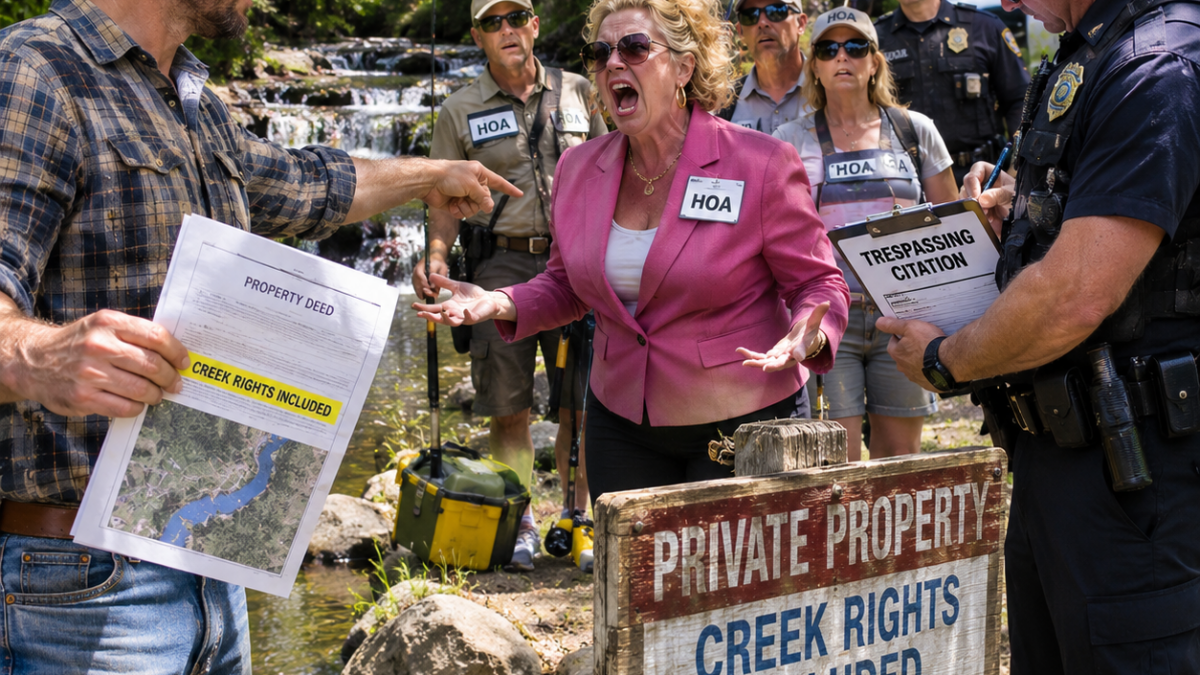
PART 2
I had installed the cameras during my first month in the house.
Not because I expected a war with the HOA.
Mostly because the property backed up to woods, and I liked knowing what moved around down there when I wasn’t home.
Deer.
Raccoons.
The occasional fox.
There had also been a few reports of people cutting across the creek from one road to another, so four small trail cameras felt like cheap insurance.
I mounted them high.
One near the path.
One facing the dock.
One covering the bend.
And one overlooking the sycamores.
The footage saved to a private server in my basement.
Most weeks, I barely checked it.
That changed the second Marla said they had been using my land for weeks.
I didn’t stand there arguing.
That surprised her.
She had expected anger.
A confrontation.
Maybe even a threat she could quote in an HOA letter later.
Instead, I slid my phone back into my pocket.
“You need to leave.”
Marla leaned back in her chair.
“We’re not hurting anything.”
“I said leave.”
“You don’t get to speak to board members like that.”
I almost laughed.
“You’re standing on my land.”
“That’s disputed.”
“No. It isn’t.”
Linda stood.
“This is ridiculous.”
“Good. Then you should have no problem leaving.”
Carol muttered something about hostile behavior.
Marla packed her things slowly.
Deliberately.
She wanted me to see that she wasn’t intimidated.
I wanted her to leave before I said something less useful.
As they walked up the trail, Marla turned.
“You’re going to regret turning this into an issue.”
I looked toward the creek.
“You already turned it into an issue.”
She left.
I waited until I heard the golf cart start on the other side of the trees.
Then I walked back to the house.
My hands had begun to shake.
Not from fear.
Anger.
There is something deeply unsettling about discovering strangers have been using your property while you thought you were alone.
Your home is supposed to be the place where your boundaries mean something.
The line on a survey.
The fence.
The sign.
The deed.
All of those things exist partly so you don’t have to stand outside every day defending your space.
When someone ignores them deliberately, the violation feels bigger than the square footage involved.
I went downstairs.
The server sat on a shelf beside my workbench.
I opened the camera archive.
Three weeks.
That was the phrase Marla had used.
So I went back twenty-one days.
The first few clips were normal.
Deer at dawn.
Wind moving branches.
A delivery driver taking the wrong path and turning around.
Then I saw Marla.
Date stamp: three weeks earlier.
She walked into frame with two men I recognized from HOA meetings.
One carried a chainsaw.
I sat forward.
The video had no sound.
It didn’t need any.
They walked toward one of the dogwoods near the bank.
A mature flowering dogwood.
The tree had been there when I bought the place.
Probably long before the subdivision was built.
Every spring, its white blossoms reflected in the creek.
I had taken photos of it the first week I moved in.
On the screen, one man started the chainsaw.
I whispered:
“No.”
As if the recording could hear me.
The blade touched the trunk.
A minute later, the dogwood fell.
I felt sick.
They cut branches away.
Dragged part of the trunk closer to the creek.
Then positioned it horizontally.
They had turned my tree into a bench.
My fingers tightened around the edge of the desk.
I clicked forward.
Next clip.
Marla.
Linda.
Carol.
Bags of gravel.
They spread it across a muddy section of the trail.
Another clip.
Someone hanging a rope swing from one of the sycamores.
Another.
Children.
Six or seven of them.
Running.
Splashing.
Adults sitting in chairs.
Beer cans.
Fishing poles.
A dog off leash.
Then another day.
Different families.
Then another.
My property had become a community recreation area.
Without my permission.
Without notice.
Without insurance.
Without any idea whether the bank was safe.
One child slipped near the water.
An adult grabbed him.
I paused the video.
The anger disappeared for a second.
Replaced by fear.
What if someone had drowned?
What if a branch broke?
What if somebody got injured on the trail they had altered?
Would Marla have suddenly remembered the deed then?
Would the HOA have said it was my responsibility?
Probably.
I backed up every clip.
Then backed up the backups.
I saved copies to an external drive.
Uploaded another set to encrypted storage.
Printed screenshots with timestamps.
Then I made two calls.
The first was to Rachel Moore.
Rachel had been a friend for years.
Property attorney.
Sharp.
Patient.
The kind of person who became quieter when she got angry.
I left a message.
The second call was to the county sheriff’s office.
By early afternoon, a deputy stood beside me in the basement watching the footage.
His name was Deputy Harris.
He watched the dogwood fall.
Then watched the gravel being spread.
Then watched families using the creek.
When the video ended, he leaned back.
“Let me make sure I understand this.”
“Okay.”
“You gave none of these people permission?”
“None.”
“The HOA never had a written agreement?”
“No.”
“No easement you know of?”
“No.”
“And you have a deed showing this stretch belongs to your parcel?”
“Yes.”
I handed him a copy.
He read it slowly.
Then looked back at the screen.
“This is not just people wandering across the property.”
“I know.”
“They altered the land.”
“I know.”
“Cut a tree.”
“Yes.”
“Installed a swing.”
“Yes.”
“Spread gravel.”
“Yes.”
“And they encouraged children to use it.”
“Yes.”
Harris shook his head.
“That’s a liability nightmare.”
I crossed my arms.
“Can I file charges?”
He looked at me.
“You can absolutely make a formal complaint.”
“Then I want to.”
He nodded.
“Good.”
For the next hour, he documented everything.
Photos.
Video timestamps.
Property map.
The location of the missing sign.
The stump.
The gravel.
The rope swing.
When we walked down to the creek, he crouched beside the cut dogwood.
“You know who cut it?”
“They’re on camera.”
“Then this part is easy.”
He stood.
“The harder question is what authority they thought they had.”
“I know exactly what they thought.”
“What?”
“That saying ‘HOA’ made it legal.”
He looked at me.
“HOA isn’t a magic word.”
I smiled without humor.
“Somebody should tell Marla.”
That evening, Rachel called.
“Ethan.”
Her voice was different.
Not casual.
Not friendly.
Professional.
“What happened?”
I told her.
Then emailed the deed.
The HOA notices.
The videos.
The screenshots.
She told me she would pull the county records and governing documents herself.
Two hours later, she called again.
This time she didn’t say hello.
“Why have you been paying HOA fines?”
I frowned.
“What?”
“Why have you been paying them?”
“Because they keep sending them.”
“That’s not what I asked.”
“I assumed I was under the HOA.”
She went silent for a second.
Then:
“You’re not.”
I stood up from the kitchen table.
“What?”
“Your parcel is outside the association boundary.”
I laughed.
A short, shocked sound.
“That’s impossible.”
“No.”
“They’ve been sending me violations for two years.”
“I know.”
“They said my mailbox—”
“I know.”
“My shed.”
“I know.”
“Trash cans.”
“I know.”
“Rachel.”
“You are not a member of Willow Creek Estates.”
I looked through the kitchen window toward the dark line of trees.
“That doesn’t make sense.”
“It makes perfect sense if nobody bothered to check.”
I sat down.
She continued.
“Your property was created from an older parcel. The subdivision developed beside it later. Your address looks like part of the neighborhood, but legally it isn’t within the recorded HOA boundary.”
“So all those fines?”
“Unauthorized.”
“The letters?”
“Potentially fraudulent.”
“The creek?”
“Definitely outside their jurisdiction based on what I’m seeing.”
I rubbed my face.
For years, I had assumed Marla was abusing legitimate authority.
Now Rachel was telling me she had never had authority over me at all.
The feeling that moved through me was difficult to describe.
Anger.
Embarrassment.
Relief.
Humiliation.
I thought about every check I had written just to make a problem disappear.
Every evening I had wasted responding to an HOA letter.
Every time I had stood in my driveway wondering whether my mailbox really was two inches too tall.
“They knew?”
“I don’t know yet.”
Rachel’s voice became colder.
“But they should have.”
“What happens now?”
“Now we stop treating this like a neighborhood disagreement.”
The next morning, Rachel filed for an injunction.
The request was straightforward.
The HOA and its agents were to stop entering my land.
Stop using the creek.
Stop altering the property.
Stop representing the creek as an HOA amenity.
Stop issuing unauthorized notices against my parcel.
She also sent the board a formal demand letter.
I read it three times.
Rachel had a gift for making fury sound like perfect grammar.
The letter identified my parcel.
Attached the recorded boundary.
Quoted the deed.
Listed prior unauthorized fines.
Documented the trespassing.
Referenced the sheriff’s report.
Then stated, in language so clear even Marla couldn’t pretend otherwise:
**Willow Creek Estates Homeowners Association has no jurisdiction over Mr. Calder’s property.**
Not limited jurisdiction.
Not disputed jurisdiction.
None.
Two days later, Marla appeared at my door.
Of course she did.
I saw her on the camera before I opened it.
Linda stood on one side.
Carol on the other.
Pressed jeans.
Pastel tops.
Marla held a folder.
I opened the door but stayed inside.
“Ethan.”
“Marla.”
“We need to talk.”
“My attorney says you should communicate through her.”
“This doesn’t require attorneys.”
“You cut down a tree on my property.”
Her jaw tightened.
“That was landscaping maintenance.”
“You spread gravel beside my creek.”
“Trail stabilization.”
“You installed a rope swing.”
“Recreational improvement.”
“You invited residents to trespass.”
“We were creating community access.”
“You fined me for two years when I wasn’t even part of your HOA.”
Silence.
Linda glanced at Marla.
Carol stared at the porch railing.
That was interesting.
I leaned against the doorframe.
“Did you know?”
Marla’s chin lifted.
“The boundaries have always been somewhat complicated.”
“That isn’t an answer.”
“We acted in good faith.”
I laughed.
“You cut down a mature tree without asking me.”
“We believed the creek corridor fell under shared-use authority.”
“Based on what?”
“The neighborhood’s longstanding relationship to the water.”
“My deed.”
“Documents can be interpreted.”
I stared at her.
“There’s the problem.”
“What?”
“You think everything can be interpreted until it says what you want.”
Her face hardened.
“We came here to resolve this without hostility.”
“You showed up at my creek with a chainsaw.”
“That was not hostile.”
I actually had to look away for a second.
Linda spoke.
“Ethan, people enjoyed the creek.”
“That doesn’t make it yours.”
“No one damaged anything intentionally.”
“You cut down my dogwood.”
Marla interrupted.
“The tree was obstructing access.”
“To people who weren’t supposed to be there.”
Silence again.
I looked at all three of them.
“You need to leave.”
Marla’s eyes narrowed.
“You’re overreacting.”
“No.”
“You’re trying to punish the entire community over a technical misunderstanding.”
“A technical misunderstanding is sending a letter to the wrong address.”
I pointed toward the creek.
“You built a recreation area on property you don’t own.”
Marla shook her head.
“You always have to make everything confrontational.”
Something in me snapped.
Not loudly.
I stepped closer to the doorway.
“For two years, you sent me fines you had no right to issue.”
She opened her mouth.
I kept going.
“You took money from me.”
“Those fines were for the benefit of neighborhood standards.”
“My property isn’t your neighborhood.”
“That’s a technicality.”
“No.”
I looked directly at her.
“That’s ownership.”
Her expression changed.
Not much.
But enough.
I finally saw what had always been hiding beneath the clipboard and HOA language.
Entitlement.
She genuinely believed that if something affected Willow Creek Estates, Willow Creek Estates had a right to control it.
My creek.
My mailbox.
My shed.
My trees.
My money.
“You don’t get to call someone else’s property a technicality,” I said.
Marla’s voice dropped.
“You should think carefully about how far you want to take this.”
I smiled.
“Too late.”
“What does that mean?”
“The sheriff already has the footage.”
Linda went pale.
Carol looked at Marla.
Marla stayed still.
“And my attorney has the financial records showing every fine you issued me.”
“You’re threatening us.”
“No.”
I shook my head.
“You keep confusing consequences with threats.”
Then I closed the door.
For the first time since moving into that house, I felt like I had finally put the boundary where it belonged.
Not at the creek.
At my front door.
The neighborhood started talking almost immediately.
The first people to come by were Tom and Elise.
They lived three houses inside Willow Creek Estates.
Tom worked construction and drove a large pickup.
Elise brought a pie.
I opened the door.
She held it out.
“Peace offering.”
“For what?”
“For living near us.”
I laughed.
“Come in.”
They sat at my kitchen table.
Tom looked uncomfortable.
“We heard about the creek.”
“Everybody heard.”
“Marla says you’re suing the HOA.”
“My attorney filed an injunction.”
“That sounds like suing.”
“Close enough.”
He nodded.
Then pulled an envelope from his jacket.
“I wanted you to see this.”
HOA violation.
Commercial-style work vehicle parked too near a curb.
Daily penalty.
I looked up.
“Your truck?”
“Yeah.”
“You use it for work.”
“Yeah.”
“It’s your driveway.”
“Mostly. Front tire was touching the curb line.”
“How much?”
He told me.
I whistled.
Elise leaned forward.
“She threatened to put a lien on the house.”
My stomach tightened.
“When?”
“Last year.”
“Did you fight it?”
Tom shook his head.
“I paid.”
That sounded familiar.
Then came Mrs. Holloway.
Wrong species of rose.
Derek.
Toddler swing in backyard.
Another family.
Fence stain supposedly too dark.
Another.
Holiday lights.
Another.
Temporary trailer.
The details changed.
The pattern didn’t.
Some violations were based on real rules.
Others seemed invented.
Some fines were inconsistent.
Some people got warnings.
Others went straight to penalties.
People who challenged Marla seemed to receive more notices afterward.
Rachel listened.
Then said:
“We need records.”
So we made a shared folder.
Nothing dramatic.
Just a secure online folder where homeowners could upload copies of notices, board emails, photographs, receipts, appeals, meeting minutes.
Within a week, it was overflowing.
Years of quiet resentment suddenly had documentation.
Rachel started organizing.
Dates.
Rule citations.
Properties.
Board signatures.
Fine amounts.
Appeal outcomes.
Patterns emerged.
The same board members appeared repeatedly.
Marla.
Linda.
Carol.
And mixed among everything were the photos from my creek.
The missing sign.
The dogwood.
The gravel.
The rope swing.
The fishing parties.
Evidence had a strange effect on people.
Complaints can be dismissed as emotion.
Stories can be called exaggeration.
But fifty documents arranged chronologically?
That feels different.
The board called an emergency meeting.
I didn’t attend.
Rachel advised me not to.
“You’re the easiest person for Marla to turn into the villain.”
“So you’re going?”
She smiled.
“I’m much harder to bully.”
Rachel carried a thick packet into the community center.
Later, she told me what happened.
Marla sat at the head of the table.
Same position.
Same posture.
Linda and Carol beside her.
Residents filled the room.
Rachel placed the packet on the table.
“What is this?” Marla asked.
“Your problem.”
Rachel opened it.
Sheriff’s report.
Property boundary.
Deed.
Screenshots.
Injunction request.
Formal notice.
List of unauthorized fines.
She read the legal position slowly.
When she reached the part stating that my parcel had never belonged to Willow Creek Estates, the room changed.
People started whispering.
Marla interrupted.
“This is disputed.”
Rachel looked at her.
“No. It is recorded.”
“We have historical access rights.”
“Show me.”
Marla didn’t.
Rachel continued.
“You entered Mr. Calder’s property without permission.”
“We believed—”
“You cut a tree.”
“It was necessary for safety.”
“You installed recreational equipment.”
“For residents.”
“On land you do not own.”
Marla’s face reportedly went white.
Not dramatic shock.
Something slower.
Recognition.
Rachel later told me:
“That was the moment she understood she couldn’t talk her way around the deed.”
The meeting fell apart.
One board member resigned before it ended.
Another stopped responding to emails the next morning.
Someone removed the rope swing overnight.
The gravel remained.
The dogwood stump remained.
Damage has a way of staying after authority disappears.
Then the sheriff’s office issued formal citations.
Trespassing.
Property damage.
Unauthorized alteration.
The details varied by individual involvement.
The important part was that the board members couldn’t simply write a check from the association account and make it disappear.
They had acted personally.
The consequences followed them personally.
Marla called Rachel.
Rachel put the call on speaker while I sat in her office.
“This is outrageous,” Marla said.
Rachel leaned back.
“What part?”
“Criminalizing volunteer board activity.”
“You entered private property.”
“We were maintaining community resources.”
“That was not a community resource.”
“You keep saying that.”
“Because the deed keeps saying it.”
Marla’s breathing became audible.
“You’re destroying this neighborhood.”
Rachel looked at me.
I raised an eyebrow.
Then Rachel said:
“No, Marla. I think we’re discovering who has been damaging it.”
Marla hung up.
I expected the trespassing citations to be the climax.
At that point, I still thought the story was about my creek.
I was wrong.
A few days later, the county planning department contacted me.
An inspector wanted to look at the gravel near the water.
I met him beside the bank.
He walked the path.
Crouched.
Moved gravel with his boot.
Then looked toward the drainage channel.
“Who put this here?”
“HOA board members.”
“Permit?”
“Not that I know of.”
He sighed.
“That’s going to be a problem.”
“What kind?”
“This section carries runoff during heavy rain.”
I looked at the gravel.
“They filled part of it.”
“Exactly.”
The inspector followed the channel.
Took photos.
Made measurements.
Then started asking questions about other HOA projects.
I didn’t know the answers.
But neighbors did.
Community garden near the far road.
Drainage work behind several houses.
A ditch redirected.
Small landscaping projects.
Structures.
Once inspectors start looking, they rarely limit themselves to the one thing that brought them there.
Within days, county staff found several questionable projects.
Some minor.
Some not.
A community garden extended onto land the HOA didn’t own.
A drainage ditch had been altered without proper approval.
Grading work lacked documentation.
The association had spent years behaving as though anything near Willow Creek Estates automatically belonged to Willow Creek Estates.
My creek wasn’t an exception.
It was part of a habit.
Then Rachel found the money.
She called one evening.
“I need you to come over.”
“What happened?”
“Don’t discuss this on the phone.”
That was enough to get me in the car.
Her office was twenty minutes away.
When I arrived, she had financial statements spread across a conference table.
A laptop sat open beside them.
“What am I looking at?”
“Reimbursements.”
“To who?”
“Marla.”
My stomach tightened.
“For what?”
“That’s the problem.”
She pointed to one entry.
Equipment reimbursement.
Another.
Landscaping supplies.
Another.
Beautification expense.
“Could be legitimate.”
“Could be.”
She clicked another document.
“Then explain this.”
Invoice from a landscaping company.
Same address as a relative of one board member.
“Maybe they hired family.”
“Possible.”
“Illegal?”
“Not automatically.”
She leaned back.
“But if the work was inflated, nonexistent, or hidden from the board, that changes things.”
“How much?”
“Enough that I’m not comfortable guessing.”
More records appeared.
Checks.
Expense reports.
Credit card charges.
Thousands of dollars routed through vague categories.
The same words kept appearing.
Maintenance.
Beautification.
Emergency repair.
Community improvement.
Words so generic they could hide almost anything.
I thought about Marla calling my creek a “community amenity.”
She had a talent for renaming reality.
Trespassing became access.
Cutting a tree became maintenance.
Spreading gravel became improvement.
Maybe money worked the same way.
I looked at Rachel.
“What do we do?”
“We don’t accuse anyone publicly.”
“Okay.”
“We preserve records.”
“Okay.”
“And we send what we have to the appropriate authorities.”
The investigation widened.
At first, quietly.
Requests for documents.
Emails.
Bank statements.
Vendor records.
The state attorney general’s office became involved.
Subpoenas followed.
The HOA stopped sending newsletters.
Meetings were canceled.
Marla’s golf cart disappeared from the streets.
For years, she had seemed to be everywhere.
Suddenly, I never saw her.
People started whispering again.
But the tone had changed.
Before, they whispered because they were afraid of her.
Now they whispered because they were waiting.
Two weeks later, I was sitting at my kitchen table drinking coffee.
Morning light came through the window.
The creek was barely visible through the trees.
A neighbor texted me.
**Police at Marla’s house.**
I stood.
Then another message.
**They’re taking her out.**
I walked to the front window.
Her house sat far enough away that I couldn’t see the porch clearly.
So I didn’t rush over.
I didn’t want to be one of those people standing on the sidewalk watching someone’s worst morning like entertainment.
But within minutes, the whole neighborhood knew.
Marla had been arrested.
Charges involving falsified financial records.
Conspiracy to defraud.
Misuse of association funds.
The woman who had tried to fine me because of my mailbox was now sitting in the back of a cruiser.
I expected satisfaction.
I got some.
I’d be lying if I said otherwise.
But mostly I felt stunned.
Because none of this had begun with an audit.
Or fraud allegations.
Or law enforcement.
It began with a floating sign.
If I had picked it up and hammered it back into place, none of us might have looked deeper.
The HOA operating account was frozen.
The board went into chaos.
A temporary board took over.
Residents started breathing differently.
That sounds strange.
But tension has a physical presence.
When it disappears, you notice.
People stood in driveways longer.
Talked.
Laughed.
One neighbor joked that nobody knew whether they were allowed to put their trash cans out anymore because Marla wasn’t there to tell them.
For about a month, I thought it was ending.
Then I received a certified letter from the county tax assessor.
I opened it at the kitchen counter.
My property had been flagged for an unreported structural addition related to recreational use.
I read the sentence twice.
“What structure?”
Attached was an aerial image.
Blurry.
Taken from above.
Near the creek, beyond my boundary, sat what looked like a wooden platform.
I had never seen it.
The next morning, I drove to the planning office.
The clerk pulled permit records.
Then she turned the monitor toward me.
A permit request.
Creekside observation deck.
Parcel number.
Mine.
Applicant.
Carol.
I stared at the screen.
“That’s my property ID.”
“Yes.”
“I didn’t submit this.”
She frowned.
“You’re the owner?”
“Yes.”
“You didn’t authorize the applicant?”
“No.”
Her face changed.
She printed the record.
I called Rachel from the parking lot.
She listened.
Then said:
“That’s bad.”
“How bad?”
“Potential identity fraud. False government filing. Depends on exactly what they submitted.”
“I thought we were finished.”
“So did I.”
“Why would Carol do this now?”
“Maybe it wasn’t now.”
She was right.
The permit request predated Marla’s arrest.
This wasn’t a new retaliation.
It was another old project finally becoming visible.
The county assessor provided drone footage.
Four workers.
Unmarked vests.
Lumber.
Posts.
A deck taking shape near the water.
Not technically on my parcel.
Just beyond it.
County-owned land.
But they had used my parcel number in the permit application.
I walked down there myself.
Past the dogwood stump.
Past the gravel path.
Past the sycamore.
Then I saw it.
A wooden platform overlooking the creek.
Small railing.
Fresh boards.
And a sign nailed into a tree.
**COMMUNITY OBSERVATION POINT
PROPERTY OF WILLOW CREEK HOA**
I stood there for a long time.
The audacity almost impressed me.
They had built on county land.
Filed the permit using my property information.
Then labeled the structure as HOA property.
Three kinds of ownership.
All wrong.
I called the sheriff.
Again.
Deputy Harris returned.
When he saw the sign, he actually laughed.
“You’ve got to be kidding me.”
“I wish.”
A representative from the Department of Public Lands arrived.
He checked maps.
GPS coordinates.
Permit files.
Then shook his head.
“This structure is on county land.”
Harris pointed toward the sign.
“And apparently owned by the HOA.”
The land representative looked at him.
“No.”
I said:
“They used my parcel number.”
He looked at me.
“No.”
“Yes.”
He rubbed his face.
This time, the consequences came fast.
The permit was flagged as fraudulent.
Carol was arrested before sunrise the next morning.
Two days later, Linda was picked up while staying with her sister in Raleigh.
Records connected her to payments for materials.
The little suburban HOA had gone from fining residents over roses to having multiple board members facing criminal allegations.
Local media noticed.
A news van parked near the community center.
Then another.
Residents who had spent years avoiding HOA meetings suddenly found reporters asking them questions in driveways.
I refused most interviews.
Rachel gave one statement.
Short.
Professional.
The point wasn’t spectacle.
We still had a civil case.
My dogwood was gone.
My land had been altered.
I had paid unauthorized fines.
Legal fees were mounting.
The creek bank needed restoration.
And I wanted a court order making it impossible for whoever came next to pretend the same boundaries were unclear.
Rachel filed.
The HOA’s attorney responded.
Then negotiated.
Then stopped negotiating.
The judge fast-tracked the matter because a governing organization had acted outside its authority and because the property records were unusually clear.
I sat beside Rachel during the hearing.
Marla wasn’t there.
Her own criminal case had already swallowed her.
The remaining HOA representatives looked tired.
Their attorney made arguments about historical practice.
Community expectations.
Mistaken boundary assumptions.
Good-faith maintenance.
Rachel stood.
“Your Honor, good faith does not authorize a homeowners association to govern property outside its recorded boundary.”
The judge looked at the deed.
Then the HOA map.
Then the deed again.
Rachel continued.
“They issued fines against a non-member.”
Another document.
“They collected money.”
Another.
“They entered his property.”
Photos.
“They removed signage.”
Video still.
“They cut a mature tree.”
Another still.
“They altered the bank.”
More evidence.
“They encouraged recreational use.”
Children at the creek.
“And when the owner objected, the board represented that it had voted to grant access to property it did not own.”
The judge looked over his glasses.
“Is that disputed?”
The HOA attorney hesitated.
“The board believed—”
“That was not my question.”
Silence.
“No, Your Honor.”
I looked down.
Sometimes vindication isn’t loud.
Sometimes it is one sentence in a courtroom after months of being told you are unreasonable.
We won.
Damages.
Restitution.
Legal costs.
Land restoration.
Return of unauthorized fines.
And an order requiring the HOA to make its jurisdictional boundaries clear.
That last part made me smile.
After years of Marla using signs and notices against everybody else, the association was ordered to put up signs explaining where its own authority ended.
The criminal cases continued separately.
Financial records told a story more complicated than anything I had first imagined.
Marla and others had used association funds in ways prosecutors believed crossed far beyond mismanagement.
False records.
Improper reimbursements.
Questionable vendor relationships.
The details were ugly.
People who had trusted the association to maintain roads, landscaping, drainage, and common property had instead been dealing with leadership that increasingly treated the organization like a personal instrument.
Marla’s power had not become corrupt overnight.
That was what struck me.
It grew in inches.
A fine nobody challenged.
A rule stretched slightly.
A boundary treated as flexible.
A resident pressured into paying.
A board member who stayed quiet.
Another who agreed because fighting was inconvenient.
Eventually, a woman could sit beside a creek she didn’t own and say:
“We voted.”
As if the vote created reality.
The old board collapsed.
Residents started talking seriously about what came next.
Nobody trusted the structure.
The name HOA itself made people tense.
A petition circulated.
More than forty homeowners signed.
Under the association’s own charter, residents moved to dissolve the existing board.
The irony was almost perfect.
The rules Marla had loved using against everyone else became the mechanism residents used to remove the system she controlled.
With two board members under indictment and others already resigned, resistance was weak.
The motion passed.
There was no celebration in the streets.
No champagne.
Just relief.
A different type of stewardship group formed.
Loose.
Volunteer-run.
A retired firefighter.
A nurse.
A biology teacher.
People who actually lived there.
No one wanted another Marla.
So the new structure was intentionally boring.
Transparent accounts.
Open meetings.
Clear authority.
Limited responsibilities.
No pretending every personal preference was an enforceable rule.
The county dismantled the observation deck.
I went down to watch.
Workers removed the railing.
Pulled posts.
Loaded lumber.
The ridiculous HOA sign came down.
One worker held it up.
“Want this?”
I thought about it.
Then shook my head.
“No.”
“You sure?”
“I’ve had enough signs.”
He laughed.
Volunteers helped restore the bank.
Native grass.
Willow.
Stabilization where the gravel had interfered with runoff.
I worked beside neighbors I had barely known before all this.
Tom hauled soil.
Elise planted.
Mrs. Holloway brought lemonade.
Derek’s little boy played nearby.
Safely away from the water.
At one point, I stood where the old dogwood had been.
The stump remained.
That hurt.
Trees don’t come back because a judge orders damages.
Money can pay replacement value.
It cannot make age reappear.
The dogwood had survived storms.
Winters.
Years before I ever knew it existed.
Marla erased it in minutes because it was inconvenient to the path she wanted.
That was the loss I felt most.
So we planted another.
Smaller.
Young.
Barely shoulder height.
The biology teacher helped choose it.
Native flowering dogwood.
When we lowered the root ball into the soil, I put one hand against the trunk.
Tom looked at me.
“You okay?”
“Yeah.”
I wasn’t sure that was true.
He nodded anyway.
Some things don’t need explaining.
The new tree looked almost ridiculous compared to the old stump.
Tiny.
Fragile.
But alive.
That mattered.
A few weeks later, the neighborhood held a potluck at the park pavilion.
Nothing formal.
Food.
Folding chairs.
Kids running.
People talking louder than they had in years.
Someone handed me a microphone.
I tried to give it back.
“Nope,” Tom said. “You started this.”
“I definitely did not start this.”
“You know what I mean.”
I stood in front of people I had passed on streets for two years without really knowing.
I looked at Mrs. Holloway.
Derek.
Elise.
Tom.
The new volunteer group.
People who had once lowered their voices when they said Marla’s name.
Now nobody looked afraid.
I held the microphone.
“I didn’t want to become the guy who sued his neighborhood.”
A few people laughed.
“I also didn’t want to be the guy who stood quietly while people used power like a weapon.”
The laughter faded.
I looked toward the creek beyond the trees.
“What happened to me started small.”
I paused.
“A sign disappeared.”
People listened.
“I could have replaced it.”
I looked around.
“I almost did.”
That was true.
The easiest response that first morning would have been to pull the sign out of the reeds.
Dry it.
Bolt it back into place.
Go inside.
Avoid the headache.
“If I had done that, maybe nothing else would have changed.”
I saw Rachel near the back.
She nodded slightly.
“I would still have been paying fines I never owed.”
“People here would still be afraid of letters that didn’t always mean what they said.”
“The money might still be disappearing.”
“The deck might still be there.”
“And maybe somebody would eventually get hurt on land nobody had the right to open to the public.”
I looked down at the microphone.
“Silence feels peaceful.”
Then I looked up.
“But silence becomes permission when the wrong people are counting on it.”
Nobody shouted.
The applause that came afterward wasn’t huge.
It didn’t need to be.
It was real.
That mattered more.
Life slowly returned to normal.
The criminal cases moved through the courts.
Marla’s name stopped appearing on association letterhead.
Linda and Carol disappeared from neighborhood life.
Properties changed hands.
Families moved.
The news vans stopped coming.
Eventually Willow Creek Estates became boring again.
And that was wonderful.
I kept my property.
Of course.
The court records made the boundary clearer than it had ever been.
The new stewardship group had no interest in pretending otherwise.
They even helped install new signage near the trail.
Simple.
Respectful.
**PRIVATE PROPERTY BEYOND THIS POINT**
No dramatic threats.
No legal language.
Just a boundary.
People followed it.
Imagine that.
The creek became quiet again.
At first, the quiet felt strange.
I had become used to checking the cameras.
Used to listening for voices.
Used to wondering whether another board member might appear holding a clipboard and a theory about community rights.
For months, I checked footage almost every evening.
Then every few days.
Then weekly.
Eventually, I stopped.
The new dogwood started growing.
Not quickly.
Trees don’t care about our impatience.
The first spring, it produced only a handful of blossoms.
I stood beside it longer than I want to admit.
The old tree had filled that space with white.
The new one looked almost shy.
But those few flowers felt important.
Proof that restoration doesn’t have to look like replacement.
Sometimes you don’t get back exactly what was taken.
Sometimes you get the chance to grow something new.
I began spending evenings by the creek again.
Beer.
Chair.
No meetings.
No lawyers.
No sheriff reports.
Just water.
One evening, Tom came down to the property line.
He stayed on his side.
That detail made me smile.
“You busy?”
“Not unless sitting counts.”
He held up two beers.
“I brought a permit.”
“What?”
He held one beer higher.
“Access fee.”
I laughed.
“Come down.”
He walked over.
We sat near the creek.
For a while neither of us talked.
Then he said:
“You know what’s crazy?”
“What?”
“I lived here seven years before all that.”
“Yeah.”
“I knew something was wrong.”
“With Marla?”
“With the whole thing.”
He looked at the water.
“But I never thought I could do anything.”
“Neither did I.”
“You did.”
“No.”
I shook my head.
“I checked a camera.”
He smiled.
“That’s annoyingly humble.”
“I’m serious.”
I took a drink.
“The camera gave us evidence. Rachel knew what to do with it. You brought records. Other people brought records. Inspectors checked the land. Police investigated.”
Tom thought about that.
“So what are you saying?”
“That this wasn’t one person beating the HOA.”
“What was it?”
“Everybody finally stopped assuming somebody else would handle it.”
He nodded.
The creek moved quietly.
After a while he said:
“I still think you should’ve let me keep the old HOA sign.”
“What sign?”
“Community Observation Point.”
I laughed.
“Why?”
“Hang it in my garage.”
“No.”
“Conversation piece.”
“No.”
“You have no sense of history.”
“I have enough history.”
He raised his beer.
“Fair.”
Years passed.
Not many.
Enough for scars to become stories.
The case involving Marla ended in convictions related to falsified records and conspiracy to defraud.
There were penalties.
Restitution.
The exact legal details stopped mattering to me as much as I expected.
For a long time I had imagined the final court result would bring some giant emotional release.
It didn’t.
The release had happened earlier.
When the board lost its grip.
When the residents voted.
When the deck came down.
When the creek bank started growing again.
Court outcomes mattered.
Accountability mattered.
But my life wasn’t waiting for a judge anymore.
That felt healthier.
One afternoon Rachel called.
“You sitting down?”
“Should I be?”
“No. I just enjoy making things dramatic.”
“What happened?”
“Final restitution payment cleared.”
I leaned back.
“That’s it?”
“That’s it.”
“Everything?”
“Everything ordered in the civil case.”
I looked toward the window.
The dogwood was visible through the glass.
Small branches moved in the wind.
“I thought I’d feel different.”
Rachel laughed softly.
“Everybody says that.”
“How am I supposed to feel?”
“However you feel.”
“That sounds like something lawyers say when they bill by the hour.”
“Most of us are secretly therapists with worse couches.”
I laughed.
Then became serious.
“Thank you.”
“You paid me.”
“Not for this.”
She understood.
“You’re welcome.”
I hesitated.
“Do you think I took it too far?”
“What part?”
“All of it.”
Rachel was quiet.
Then:
“You didn’t manufacture evidence.”
“No.”
“You didn’t lie.”
“No.”
“You didn’t vandalize their property.”
“No.”
“You used courts, records, law enforcement, and public processes.”
“Yes.”
“Then no.”
She paused.
“You didn’t take it too far.”
Another pause.
“They did.”
After we hung up, I walked down to the creek.
I sat beside the young dogwood.
That conversation stayed with me because the question had bothered me.
I had watched people lose positions.
Get cited.
Get arrested.
Face criminal charges.
The HOA collapsed.
Part of me wondered whether a dispute over fishing had detonated too much.
But that was the wrong way to frame it.
The fishing hadn’t caused the corruption.
The missing sign hadn’t caused the fake permits.
My complaint hadn’t created the false financial records.
The camera hadn’t caused them to cut the dogwood.
Evidence doesn’t create misconduct.
It reveals it.
That distinction mattered.
For years, Marla’s greatest protection had not been her clipboard.
Or the board.
Or the bylaws.
It had been everyone’s belief that challenging her would be more exhausting than tolerating her.
I had believed that too.
That was why I paid fines.
Why Tom paid.
Why Mrs. Holloway paid.
Why people whispered instead of acting.
Marla had learned that inconvenience was power.
Make the process difficult enough, and most people surrender.
Then she took that lesson farther.
If a resident challenged a fine, issue another.
If somebody questioned a rule, call them uncooperative.
If property sat near the neighborhood, treat it as community space.
If documents became inconvenient, reinterpret them.
If money moved through vague enough categories, maybe nobody would look.
It worked.
Until it didn’t.
And what broke it wasn’t rage.
That surprised me most.
I had been furious.
There were nights when I imagined confronting Marla in front of the whole neighborhood.
I imagined speeches.
I imagined embarrassing her.
I imagined tearing down every HOA sign.
None of that mattered.
What mattered was boring.
Files.
Deeds.
Dates.
Camera footage.
Receipts.
Maps.
Bank records.
Permits.
The more emotional Marla became, the calmer Rachel got.
The more Marla claimed authority, the more we asked for documentation.
By the end, the entire case came down to one simple question repeated in different forms:
**Show us where you have the right to do this.**
She couldn’t.
That question became the one I carried with me.
Not just about HOAs.
About authority generally.
Whenever somebody tells you, “That’s the rule,” ask to see the rule.
Whenever somebody says, “We’ve always done it this way,” ask whether they were ever allowed to.
Whenever somebody says, “Everyone knows,” ask who “everyone” is.
Real authority doesn’t usually fear documentation.
Fake authority hates it.
The new stewardship group understood that.
Their meetings were almost painfully transparent.
Budget on a projector.
Receipts available.
Votes recorded.
People argued.
Sometimes loudly.
But the arguments stayed attached to reality.
One evening, I attended a meeting because the group wanted to discuss erosion near the public park.
The biology teacher stood up.
“We need to reinforce the bank.”
Someone asked:
“Does the neighborhood own that strip?”
The room paused.
Then everyone laughed.
Not because it was a stupid question.
Because after Marla, it was the first question anybody asked.
The teacher pulled up the parcel map.
“Yes.”
Applause.
He laughed.
“Thank God.”
That was what changed.
Not perfection.
Memory.
The neighborhood remembered what happened when nobody checked.
Years later, newcomers didn’t understand the jokes.
They saw the stewardship group as ordinary.
They didn’t remember the golf cart patrols.
The fake notices.
The fear.
I liked that.
Communities shouldn’t have to live forever inside their worst chapter.
One new resident asked me once why the neighborhood didn’t have a traditional HOA.
I looked toward the creek.
“Long story.”
He laughed.
“Bad one?”
“Depends on how you feel about fishing.”
He stared.
I smiled.
“Very long story.”
The dogwood grew.
Second spring.
More blossoms.
Third spring.
Branches widened.
One evening, I sat beside it watching white petals move in the wind.
For a second, I could almost picture the old tree.
The one Marla had cut.
I used to think justice meant restoring things exactly as they were.
I don’t anymore.
You can repair damage.
You can recover money.
You can replace a sign.
You can replant a tree.
You can clear gravel.
You can dismantle an illegal deck.
But you cannot rewind time.
The goal isn’t pretending nothing happened.
The goal is making sure what grows afterward is healthier.
That tree became my favorite example.
It wasn’t the old dogwood.
It never would be.
But it grew because people who once barely knew one another came together to repair something.
That gave it a different kind of value.
One summer, Mrs. Holloway walked down with her granddaughter.
She stopped at the property line.
“May we come look at the creek?”
The question hit me harder than she knew.
“Of course.”
She smiled.
Her granddaughter ran toward the water.
Mrs. Holloway caught her hand.
“Slow down.”
They walked carefully.
The little girl crouched near the bank.
“Can I throw a rock?”
Mrs. Holloway looked at me.
I laughed.
“Yes.”
The girl threw one.
Splash.
That simple moment clarified something I had struggled with from the beginning.
I had never wanted to keep people away.
That wasn’t what the fight was about.
I had neighbors down all the time after everything settled.
Tom.
Elise.
Kids with parents.
Friends.
The difference was consent.
One word.
That was all.
Marla had called me territorial.
Selfish.
Hostile.
Because I objected to strangers using my property.
But community does not mean ownership disappears.
Sharing only means something when the person who owns the thing is allowed to say yes.
If you remove the choice, it isn’t sharing.
It’s taking.
That distinction had been lost under all the speeches about community resources.
Mrs. Holloway sat beside me while her granddaughter watched minnows.
“You know,” she said, “Marla used to say you hated the neighborhood.”
I laughed.
“Really?”
“Oh yes.”
“Why?”
“Because you wouldn’t join things.”
“I wasn’t actually in the HOA.”
“That didn’t stop her.”
“No.”
She smiled.
“She said you thought you were better than everyone.”
I looked toward the creek.
“I barely knew anyone.”
“That was probably the problem.”
“What?”
“She couldn’t categorize you.”
I looked at her.
Mrs. Holloway shrugged.
“People like her like everyone in a box.”
“Compliant.”
“Exactly.”
“And if you aren’t?”
“Trouble.”
The granddaughter threw another rock.
Mrs. Holloway watched the ripples.
“She made a lot of us think we were the problem.”
That sentence stayed with me.
Because I had felt it too.
Every absurd fine carried an implied message.
You are difficult.
You are irresponsible.
You are harming the neighborhood.
You are selfish.
Do that long enough and people start checking themselves before they check the rule.
Maybe my mailbox really is wrong.
Maybe my shed is too reflective.
Maybe my trash cans are offensive.
Maybe I am causing trouble.
That psychological pressure was more powerful than the fine itself.
Once the board was gone, residents talked about that openly.
People had internalized enforcement.
They trimmed.
Moved.
Removed.
Paid.
Apologized.
Often before anyone even proved a violation existed.
That was how Marla’s power became larger than the charter.
People carried her voice around inside their own heads.
The new group intentionally changed the tone.
When there was a real issue, someone talked to the resident first.
Not with a clipboard.
Not with a fine.
A conversation.
One afternoon, Tom accidentally left construction materials near the sidewalk.
The retired firefighter from the stewardship group knocked on his door.
“Hey, can you move that before kids get out of school?”
Tom moved it.
Problem solved.
No letter.
No penalty.
No humiliation.
It was almost shocking.
Rules didn’t have to be warfare.
One fall morning, years after the original incident, I found something caught near the reeds.
White plastic.
For one second, my chest tightened.
I walked closer.
A sign.
Old.
Weathered.
Partially broken.
My original **PRIVATE PROPERTY** sign.
The one I had watched float away.
It must have gotten trapped somewhere downstream and worked loose after heavy rain.
I pulled it from the water.
Mud covered one side.
The lettering had faded.
One bolt hole was torn.
I stood there holding it.
The object that had started everything.
I carried it home.
Washed it.
Set it against the garage wall.
For days, I didn’t know what to do with it.
Tom saw it.
“You found it?”
“Yeah.”
“Hang it up.”
“Where?”
“Garage.”
“You’re still obsessed with decorating my garage.”
“Somebody has to.”
I laughed.
Eventually I mounted it inside.
Not outside.
Inside.
Above my workbench.
Visitors sometimes ask why.
I usually say:
“Long story.”
For me, it became a reminder.
Boundaries matter.
But so does paying attention when someone removes them.
If I had not looked twice that morning, the sign would have disappeared downstream.
The HOA might have continued using the creek.
The dogwood was already gone.
The gravel already down.
The swing already hung.
The observation deck plans already moving.
Financial misconduct already happening.
Everything was in motion.
All I did was notice.
That idea humbled me.
Big scandals often imagine themselves as invisible.
Usually they’re not.
There are clues.
Small ones.
People explain them away.
A strange payment.
A missing sign.
An inconsistent fine.
A rule that nobody can find in writing.
A leader who becomes angry when questioned.
A board that avoids documentation.
None of those things alone proves corruption.
But they are invitations to look.
I stopped ignoring invitations.
That didn’t make me paranoid.
It made me harder to manipulate.
There’s a difference.
One morning Rachel visited.
She hadn’t been to the property since the restoration work.
We walked down to the creek.
She looked at the dogwood.
“That’s the replacement?”
“Yeah.”
“Looks good.”
“You should see it in spring.”
We reached the dock.
She sat.
“You ever miss the chaos?”
I stared at her.
“What kind of psychopath question is that?”
She laughed.
“You were interesting for a while.”
“I’m happy being boring.”
“Good.”
We listened to the water.
Then she said:
“I’ve had three HOA cases because of you.”
“What?”
“People heard about Willow Creek.”
“Oh no.”
“They call and say, ‘I want to do what Ethan did.’”
I groaned.
“What do you tell them?”
“That they probably don’t have your facts.”
“Thank you.”
“Everyone wants the satisfying ending.”
She looked toward the trees.
“They forget the satisfying ending came after months of records, stress, filings, inspections, and money.”
“That part doesn’t make a good neighborhood legend.”
“No.”
She looked at me.
“You know what does?”
“What?”
“HOA tried to steal man’s creek and got arrested.”
“That is wildly inaccurate.”
“Details.”
We laughed.
Then I became serious.
“Do people really ask?”
“All the time.”
“What do you tell them?”
“To read their documents first.”
I nodded.
“Good.”
“And not assume the loudest person knows what they’re talking about.”
“Better.”
“And to separate revenge from strategy.”
I looked at her.
“What does that mean?”
“It means if your goal is to hurt somebody, you make bad decisions.”
She pointed toward the water.
“If your goal is to protect your rights, you collect evidence.”
That described the entire story better than I ever had.
Revenge feels dramatic.
Evidence feels boring.
Evidence wins more often.
I remembered standing in the basement watching Marla cut down my dogwood.
In that moment, I wanted revenge.
I wanted her embarrassed.
Fined.
Removed.
I wanted every person she had bullied to watch her lose.
Some of that happened.
But none of it came because I chased humiliation.
It happened because misconduct had consequences once it became visible.
That difference kept me from becoming something I would regret.
I never went onto her property.
Never damaged anything.
Never threatened her.
Never invented claims.
I didn’t need to.
Truth turned out to be more destructive to her authority than anything I could have done.
Years later, the creek looks almost exactly as it did the day I bought the house.
Almost.
The new dogwood is still smaller.
Native grass covers the area where gravel once sat.
The illegal observation deck is gone.
The bank has recovered.
The rope swing never returned.
Sometimes deer come down near sunset.
Sometimes a heron stands in the shallow water.
Sometimes Tom joins me with beer.
Sometimes children come with parents after asking.
Most evenings, I’m alone.
That is still my favorite.
The water does what water has always done.
Moves.
Doesn’t care about bylaws.
Doesn’t care about board elections.
Doesn’t care who once tried to claim it.
I think that is why I love it.
The creek outlasted all of us.
Marla’s presidency.
The old board.
The citations.
The lawsuits.
The headlines.
The hearings.
Eventually every document went into a box.
The creek stayed.
One evening, late in fall, leaves floated past the dock.
I watched one catch against a reed.
For a second, it reminded me of that old private property sign.
I thought about the first morning.
How tired I had felt.
How tempted I was to avoid another fight.
What if I had?
Maybe Marla would have kept holding fishing days.
Maybe the deck would have opened.
Maybe the financial scheme would have continued.
Maybe Carol and Linda would still be approving paperwork.
Maybe residents would still be paying invented fines.
Or maybe something else would have exposed them eventually.
I’ll never know.
What I do know is that peace created by refusing to confront wrongdoing is fragile.
It looks calm.
Until you realize the calm depends on one person being allowed to keep taking.
That isn’t peace.
It’s surrender with better landscaping.
I learned that the expensive way.
But I also learned something better.
People can come back from years of being intimidated.
A neighborhood can rebuild trust.
Rules can become boring again.
A creek can become quiet again.
A tree can grow again.
And a person who spent years paying fines because an official-looking letter told him to can learn to ask one very simple question:
**Show me where it says you have the right.**
That question changed everything.
Marla had believed the creek belonged to the HOA because the board had voted.
The board believed my property was subject to its rules because nobody had challenged the assumption.
Carol believed she could use my parcel number because paperwork could be manipulated.
Linda believed association money could make questionable projects look legitimate.
They all relied on the same weakness.
Nobody checking.
Once people checked, the kingdom disappeared.
The final time I heard Marla’s name in any official capacity was when Rachel forwarded me a closing document related to restitution.
I opened it.
Read it.
Saved a copy.
Then closed the laptop.
No anger.
No satisfaction.
Just finality.
I walked outside.
Down the trail.
Past the new dogwood.
To the dock.
The sun was low.
The creek reflected orange light.
I sat where I had sat hundreds of evenings before.
For a long time, I listened.
Then a fish broke the surface.
Small splash.
Ripples moved toward the bank.
I smiled.
Because after everything, the creek had returned to what it had always been.
Not an HOA amenity.
Not a legal exhibit.
Not evidence.
Not a crime scene.
Not a community political symbol.
Just my quiet stretch of water.
And that was the ending I wanted more than revenge.
The people who trespassed faced consequences.
The people who falsified records faced much bigger ones.
The board that abused its power disappeared.
Residents took control.
The land healed.
The tree grew.
And I got to sit beside my creek without wondering who was coming down the trail with a clipboard.
Marla once believed she could vote herself ownership of something that was mine.
In the end, she learned the one rule she had spent years pretending didn’t apply to her.
You can bully people into silence.
You can frighten them with letters.
You can hide behind titles.
You can even get away with crossing boundaries for a while.
But you cannot make someone else’s property yours just because nobody stopped you the first time.
Eventually, somebody reads the deed.
And when that happens, the truth becomes a boundary even a clipboard can’t cross.








