PART 2: The HOA Blocked My Land Sale—So I Legally Mined the Gravel Right Under Her View
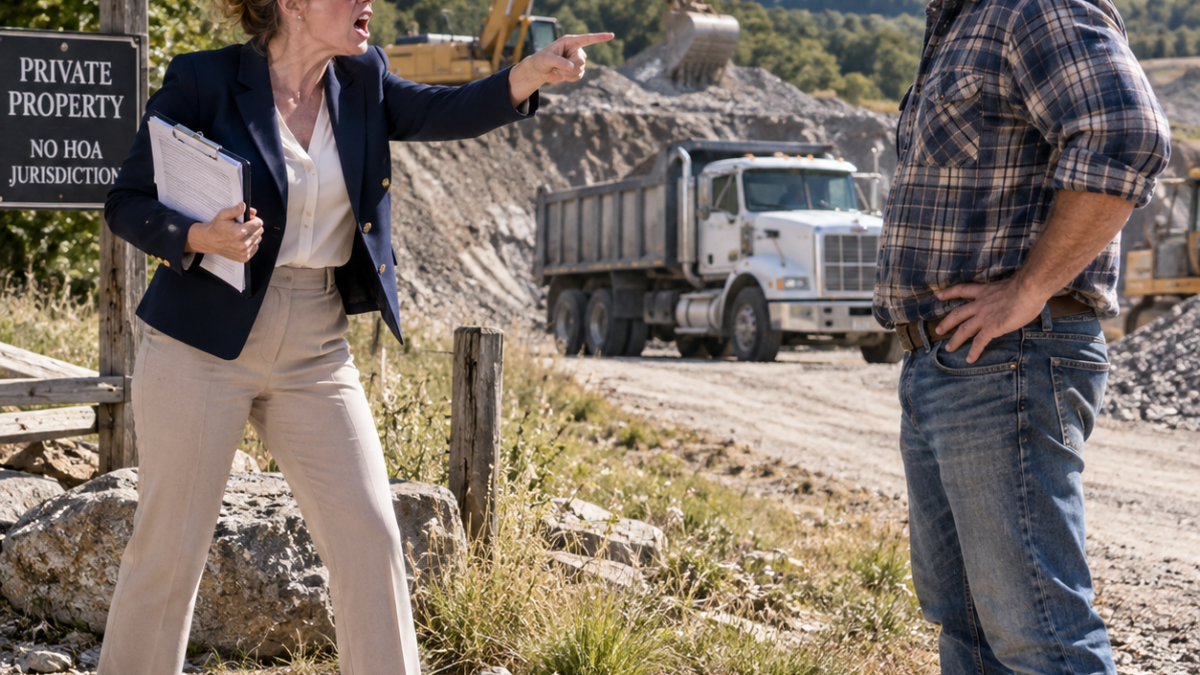
PART 2
Three days later, Karen made her first official move.
The letter wasn’t mailed.
It was wedged into the handle of my front door.
That detail bothered me almost more than the contents.
My mailbox sat at the end of a long driveway.
To leave the envelope where she did, somebody had driven onto my property, passed my barn, continued nearly a quarter mile, walked onto my porch, and placed it there.
It was theater.
A way of telling me she could reach my house whenever she wanted.
I carried the envelope into the kitchen.
My wife, Laura, looked up from the table.
“What’s that?”
“Apparently I’ve been promoted.”
“To what?”
“Resident of an HOA I don’t belong to.”
She gave me the expression she reserved for the moments when she wasn’t sure whether I was joking.
I opened the letter.
WHISPERING PINES ESTATES HOMEOWNERS ASSOCIATION.
Official Notice of Violation.
Karen had cited three provisions.
Unapproved structures.
Alteration of natural landscape.
Nuisance activity.
Then came the demand.
I was to stop all construction immediately and submit my building plans to the Whispering Pines Architectural Review Committee.
There was also a $500 nonrefundable application fee.
Laura read over my shoulder.
“They’re charging you five hundred dollars to ask permission to build on land they don’t control?”
“That seems to be the theory.”
“What are you going to do?”
I folded the letter.
“File it.”
She stared at me.
“That’s it?”
“That’s step one.”
One of the first things the Army Corps taught me was that people who misuse bureaucracy depend on everyone else hating paperwork more than they do.
I did not hate paperwork.
I respected it.
Good documentation builds bridges.
Bad documentation sinks people.
I created two folders.
One physical.
One digital.
On the label I wrote:
OPERATION KAREN.
Laura saw it.
“You named the folder?”
“Organization improves morale.”
“You’re enjoying this.”
“Not yet.”
I scanned the HOA letter.
Then I pulled the county records.
Parcel identification.
Survey.
Farm deed.
Whispering Pines master declaration.
The exemption was exactly where I remembered it.
The development had no jurisdiction, authority, covenant enforcement rights, assessment rights, or architectural review authority over Caldwell Farm.
No ambiguity.
No hidden language.
No “subject to.”
Nothing.
I drafted a response that afternoon.
It took less than one page.
I identified my property by parcel number.
I cited the recorded deed book and page.
I quoted the agricultural exemption.
Then I stated:
Caldwell Farm is not a member property of Whispering Pines Estates, is not subject to its covenants, and will not submit construction plans or fees to its architectural committee.
I added that future attempts to enforce HOA covenants against my property would be documented as harassment.
No insults.
No mention of “Queen Karen.”
No emotional language.
The most powerful letter is often the one that leaves the other person nothing emotional to fight.
I sent it certified mail.
Return receipt requested.
Six days later, the green card came back.
Karen Miller had signed for it personally.
I placed it behind the original violation letter.
Then nothing happened.
For almost a week.
That was worse.
Karen didn’t strike me as someone who accepted defeat quietly.
When loud people become silent, they are usually either reflecting or reloading.
I doubted she was reflecting.
So I visited the county planning office.
George Benton had been there long enough that the framed photographs on his wall included commissioners who had died before some of his employees were born.
He wore glasses low on his nose and had the patient expression of a man who had spent thirty years explaining setbacks to people who believed property lines were suggestions.
I placed my plans on his desk.
“George, I need you to check everything again.”
He glanced up.
“Something change?”
“The neighborhood next door thinks they own me.”
He groaned.
“Whispering Pines?”
“That obvious?”
“Who’s giving you trouble?”
“Karen Miller.”
George leaned back.
“Oh.”
That single syllable contained a history.
“You know her?”
“I know her phone number.”
“That sounds ominous.”
“She calls.”
“How often?”
He considered it.
“Enough.”
I showed him the HOA letter.
He read it.
Then the exemption.
Then he laughed.
“She sent this?”
“Personally.”
“You’re not even in the development.”
“I’m aware.”
“She’s aware?”
“She is now.”
George reviewed my workshop plans again.
Setbacks.
Drainage.
Access.
Electrical permit requirements.
Foundation design.
Everything.
Finally he stamped the plan set.
“County sees no issue. Get the trade permits when you reach those stages.”
“Can I get that in writing?”
His eyebrows rose.
“Planning something?”
“Preventing something.”
He signed a short compliance memorandum.
As I gathered my documents, he lowered his voice.
“Jack.”
“Yeah?”
“Be prepared.”
“For?”
“She’ll call code enforcement.”
“How do you know?”
“Because she calls code enforcement about everybody.”
Two days later, a county truck came up my driveway.
George deserved a raise.
The officer who stepped out looked embarrassed before he spoke.
“Mr. Caldwell?”
“That’s me.”
“County code enforcement. We received a complaint about unpermitted construction and possible hazardous-material dumping.”
“What hazardous materials?”
He glanced at his tablet.
“Industrial chemicals, petroleum waste, contaminated fill.”
I looked toward my neatly graded building site.
“You want the grand tour?”
He exhaled.
“Please.”
I showed him everything.
Stamped plans.
Concrete forms.
Brush pile.
Fuel tank.
The tractor diesel was stored in a regulation double-walled container on a concrete pad.
No runoff.
No chemicals.
No dumping.
Nothing remotely resembling the complaint.
He photographed the site.
Then he stood beside his truck writing.
“No violation observed,” he said.
“Can I get a copy?”
He looked at me.
“You expecting more complaints?”
“I’m documenting.”
He nodded knowingly.
“You military?”
“Army Corps.”
“That explains the binder.”
He signed the report.
Then, as he handed me the copy, he said, “Off the record?”
I waited.
“We get calls from your neighbor a lot.”
“Mrs. Miller?”
He shrugged in the universal bureaucratic way of saying I did not say that.
“Last week somebody’s garbage cans were visible too long.”
I almost laughed.
“Week before that?”
“Mailbox color.”
I added his report to Operation Karen.
The concrete crew arrived Monday.
By afternoon, a flawless slab rested where Karen had ordered me to stop.
I stood at the edge after the workers left.
The gray concrete reflected the autumn sky.
My father would have liked it.
Dad had been a difficult man in some ways.
Quiet.
Stubborn.
The kind of father who showed love by changing your oil rather than telling you he was proud of you.
He had kept an ancient red tractor running long after any rational farmer would have replaced it.
That tractor sat under a tarp beside the barn.
The workshop was supposed to be where I rebuilt it.
I could almost hear him asking why I had spent so much money on a floor.
“Concrete was cheaper in your day,” I muttered.
Laura stood behind me.
“Talking to your dad?”
“Complaining to him.”
“About?”
“Inflation.”
She slipped her arm through mine.
“Do you think Karen will stop?”
“No.”
“You sound very sure.”
“She hasn’t objected to anything real yet.”
“What does that mean?”
“She didn’t ask about drainage.”
I pointed.
“She didn’t ask about height. Lighting. Noise. Setback. Nothing technical.”
“What did she ask about?”
“Obedience.”
Laura was quiet.
She knew me well enough to understand why that mattered.
I could compromise over almost anything practical.
Height.
Color.
Hours.
Landscaping.
But I had spent twenty-five years serving inside actual chains of command.
Real authority came with limits.
Responsibility.
Accountability.
Karen wanted the authority without any of those.
The next phase began socially.
Cars slowed when they passed my property.
Some drivers stared openly.
Others looked away the moment I noticed them.
A week later, an SUV stopped beside my mailbox.
A woman lowered her window.
“Are you Mr. Caldwell?”
“Yes.”
“You’re the one building the commercial structure?”
“Workshop.”
She frowned.
“Karen told us you refused reasonable alternatives.”
“What alternatives?”
“She said you were offered screening.”
“No.”
“Relocation?”
“No.”
“Architectural review?”
“She demanded control she doesn’t legally have.”
The woman’s confidence slipped.
“She said your building could lower all our property values.”
“My workshop is over a hundred yards from the nearest HOA lot.”
She hesitated.
“Well, I just think neighbors should be considerate.”
“So do I.”
I nodded toward Whispering Pines.
“That’s why I haven’t called county enforcement because someone’s house is visible from my pasture.”
Her cheeks reddened.
She drove away.
That conversation bothered me.
Not because she disagreed.
Because Karen had already written the story.
To Whispering Pines, I was becoming the angry farmer.
The bitter holdout.
The man resentful that luxury homes had been built near his land.
If Karen controlled the story, facts wouldn’t matter until people heard them.
So I changed tactics.
I stopped thinking of Whispering Pines as Karen’s territory.
I started thinking about the people living there.
The first door I knocked on belonged to Frank and Eleanor Abernathy.
I brought tomatoes.
Dad had taught me that people distrust strangers less when the stranger arrives carrying food.
Eleanor opened the door.
“Yes?”
“Mrs. Abernathy? I’m Jack Caldwell. Farm next door.”
Recognition flashed across her face.
“Oh.”
Not warm.
Not hostile.
Cautious.
“I brought too many tomatoes into this world.”
I held out the basket.
Her mouth twitched.
“Frank!”
A thin man with silver hair appeared from the hallway.
“That Caldwell?”
“Apparently I’m famous.”
Frank looked at the tomatoes.
“Those from the farm?”
“Yes, sir.”
He opened the door wider.
“Come in before Eleanor adopts the basket and leaves you standing there.”
We sat in their living room.
I did not begin with Karen.
I asked about their roses.
Frank brightened.
Twenty minutes later, he was showing me photographs of hybrid teas.
Then he asked about the workshop.
I explained.
No accusations.
Just documents.
Their expressions changed as I spoke.
Finally Frank said, “She told us your farm became subject to Whispering Pines when the subdivision roads were built.”
“That’s false.”
I showed him the exemption.
He read it twice.
Eleanor sat down harder.
“She lied.”
“I don’t know what she believes.”
Frank laughed bitterly.
“I do.”
He walked to a drawer.
Pulled out an envelope.
HOA violation.
Then another.
And another.
The final document showed a $2,500 fine.
“For what?”
Frank pointed through the window.
At a garden gnome.
It stood beside the roses wearing a faded blue cap.
“My granddaughter gave us that when she was six.”
I stared at him.
“Two thousand five hundred dollars?”
“Accumulated fines.”
“For a gnome?”
Eleanor’s eyes filled.
“We paid it.”
Frank looked ashamed when he said that.
Not angry.
Ashamed.
That made something cold move through me.
“Why?”
Eleanor answered quietly.
“They threatened a lien.”
I looked around their house.
Photographs of children.
Grandchildren.
A wedding picture.
A framed teaching certificate.
Two people who had worked their entire lives and paid for their home.
Karen had made them afraid of losing it over a ceramic garden decoration.
Suddenly my workshop seemed less important.
On the way out, Frank touched my arm.
“Jack.”
“Yes?”
“If you can stand up to her…”
He stopped.
“I don’t know. Maybe people need to see somebody do it.”
My next ally found me.
Carlos Garcia approached me in the hardware store while I was comparing anchor bolts.
“You Caldwell?”
I turned.
He raised both hands.
“Friendly.”
I laughed.
“Good opening.”
“I’m Carlos. Whispering Pines.”
He shook my hand.
“I live near the Abernathys.”
“That may or may not improve your reputation.”
He grinned.
“They told me what really happened.”
His expression changed.
“She fined us over our kids’ swing set.”
“What was wrong with it?”
“Cedar.”
I waited.
“That’s the violation?”
“Approved play equipment is supposed to use earth-tone composite materials.”
I looked at the lumber aisle around us.
“Wood is pretty earth-toned.”
“Apparently not the correct earth.”
He told me several families were tired of Karen but frightened of the association’s lawyers.
“She uses the law firm like a weapon,” Carlos said.
“Anybody who pushes back gets letters.”
“Who sits on the board?”
“People who don’t challenge her.”
“Do residents vote?”
“Yes.”
“Then why hasn’t she been removed?”
He looked at me as if I had asked why they didn’t simply move a mountain.
“Because nobody wants to be first.”
That was the entire system.
Fear survives through sequence.
Everyone waits for someone else to move.
Nobody moves.
The first real lawyer’s letter reached me the following week.
City firm.
Expensive stationery.
Eight pages.
Private nuisance.
Diminution of property values.
Irreparable harm.
Injunctive relief.
It demanded I halt workshop construction pending “good-faith negotiations” with the association.
I read it twice.
Then I called Dave Mercer.
Dave and I had served together years earlier before he left active duty and eventually opened a property-law practice.
He answered on the fourth ring.
“Mercer.”
“Dave.”
“Caldwell?”
“Still ugly?”
“Worse. What did you break?”
“An HOA president.”
There was silence.
Then laughter.
“Oh, this sounds promising.”
I told him everything.
When I finished, Dave said, “Send me every document.”
“Already scanning.”
“Of course you are.”
An hour later, he called back.
“This exemption is gorgeous.”
“You need hobbies.”
“I have one. It’s watching arrogant people discover recorded instruments.”
“What about the nuisance letter?”
“Mostly pressure.”
“Mostly?”
“Never dismiss a nuisance theory automatically. But right now they appear to be trying to accomplish through litigation threats what the HOA cannot accomplish through covenant enforcement.”
“So?”
“Do not answer them yourself.”
“I wasn’t planning to.”
“Jack?”
“Yeah?”
“Keep building.”
The steel arrived two weeks later.
Three tractor-trailer loads.
Beams.
Trusses.
Roof panels.
Karen could see the delivery from her hill.
The next morning, another envelope appeared.
This one stunned even Dave.
NOTICE OF SPECIAL ASSESSMENT.
According to the letter, my farm received “incidental benefits” from the security, landscaping, and enhanced property environment created by Whispering Pines.
Therefore, the HOA board had decided I owed a proportional contribution.
Seven thousand dollars.
Laura read it.
Then looked at me.
“They’re billing a farm outside the HOA for their landscaping?”
“Yes.”
“Can they?”
“No.”
“Then why would she do this?”
“Because she thinks sending an invoice creates a debt.”
I scanned it to Dave.
Subject line:
They’ve gone kinetic.
His phone call came almost immediately.
“You magnificent stubborn idiot.”
“I assume that’s legal advice.”
“She just handed us something useful.”
“The assessment?”
“Absolutely. But I found something else.”
“What?”
“Your 1922 deed.”
“I have the deed.”
“You have the modern chain. I pulled the original conveyance.”
“Why?”
“Because their attorney tried to get clever.”
Dave explained that opposing counsel had hinted my construction might be vulnerable to older subsurface interests.
Perhaps someone else held mineral rights.
Perhaps future extraction rights could interfere.
It was supposed to frighten me.
Instead, it made Dave examine the original land grant carefully.
“Jack.”
“What?”
“Your great-grandfather retained the minerals.”
“All of them?”
“Oil, gas, and mineral rights. Broad language. In perpetuity to heirs and assigns.”
I sat down.
Outside my office window, I could see pasture stretching toward Whispering Pines.
Karen’s house sat high on the ridge.
White stone.
Huge windows.
A terrace positioned specifically to overlook my northern field.
“Dave.”
“I recognize that voice.”
“What minerals do we have around here?”
“Why?”
“Curiosity.”
“Jack.”
“Professional curiosity.”
He sighed.
“Clay. Stone. Sand. Gravel depending on geology.”
I looked toward the ridge.
Dad used to complain about the northern field.
Too rocky for crops.
Hard on equipment.
My grandfather’s old journals mentioned an abandoned creek channel.
“Gravel?”
“Potentially.”
“How would someone find out?”
Another silence.
Then Dave said carefully, “Please tell me you are not about to open a mine just to irritate a woman.”
“No.”
“Good.”
“I’m about to determine whether my land contains a commercially valuable mineral resource.”
“That answer is somehow worse.”
The geologist arrived eleven days later.
Dr. Harold Wynn had taught engineering geology for nearly thirty years.
He walked my northern pasture carrying old maps and talking to himself.
“This creek used to bend here.”
He pointed.
“Before channelization.”
“My grandfather mentioned that.”
“Old river channels can leave excellent aggregate deposits.”
He ordered test borings.
The drill rig came quietly.
Karen saw it.
Of course she did.
She drove past twice.
I waved the second time.
She did not wave back.
The report arrived Friday.
Twenty feet.
In some places slightly more.
Clean washed river gravel and sand.
Commercially valuable aggregate.
The richest section sat directly below the slope facing Karen’s terrace.
I spread the maps across my kitchen table.
Laura stared at them.
“You’re serious.”
“There’s a legitimate resource.”
“You’re serious.”
“I heard you the first time.”
“You were going to build a workshop.”
“I still am.”
“And now you want a gravel operation.”
“A limited one.”
“Because she insulted you?”
“No.”
Laura crossed her arms.
I knew that pose.
“Not only because she insulted me.”
“Jack.”
“Okay.”
I sat back.
“Do I enjoy the geographic coincidence?”
“Yes.”
“Very much.”
“Yes.”
“Is that why I would spend hundreds of thousands of dollars on engineering, permitting, equipment, insurance, reclamation, and operations?”
She waited.
“No.”
I pointed to the geologist’s valuation.
“This is real money.”
Her expression softened slightly.
“And if she had left us alone?”
I considered the question.
“I probably never would have looked.”
Laura shook her head.
“That woman may have accidentally shown you a business underneath your own pasture.”
“She’s very helpful.”
“Do not ever tell her that.”
The permit process was brutal.
Exactly as it should have been.
Mining changes land.
Anyone who treats that casually should not be mining.
We hired environmental consultants.
Civil engineers.
A hydrologist.
Traffic engineer.
Survey crew.
Dust-control specialist.
The operation would cover five acres.
Not forty.
We designed sediment basins.
Water trucks.
Limited hours.
Truck routes avoiding the Whispering Pines entrance.
Topsoil storage.
Erosion protection.
Noise controls.
Progressive reclamation.
The final landform would become a pond and wildlife area.
Dave reviewed every document.
Then reviewed them again.
“Assume Karen’s lawyer will attack commas,” he said.
“I served with people like that.”
“People who attack commas?”
“Engineers.”
The application grew past four hundred pages.
Maps.
Studies.
Calculations.
Tables.
Appendices.
My kitchen table disappeared beneath it.
Laura walked in one evening.
“You’ve built a paper mine before the real mine.”
“That’s usually how civilization works.”
“Romantic.”
“Very.”
One design question created a moment of moral temptation.
The engineers recommended visual berms.
One along the road.
One near the western boundary.
The eastern side—facing Karen—did not require one because existing terrain met the ordinance.
The engineer asked, “Want screening there anyway?”
I looked at the map.
I wish I could tell you I wrestled with the decision for hours.
I did not.
“No.”
He raised an eyebrow.
“Any reason?”
“Not required.”
He studied my face.
Then smiled.
“Understood.”
We filed.
State environmental office.
County planning commission.
Mining division.
Stormwater.
Every agency received what it needed.
Then the law did something I had been looking forward to.
It required notice to adjacent landowners.
Karen received hers by certified mail.
Two days later, Carlos called.
He was laughing so hard I could barely understand him.
“What?”
“Jack.”
“What?”
“What did you do?”
“I filed a permit.”
“She called an emergency HOA meeting.”
“Already?”
“The notice says ‘catastrophic industrial development adjacent to Whispering Pines.’”
“Catchy.”
“She says you’re turning the farm into an open-pit mine.”
“Technically surface aggregate extraction.”
“That sounds less terrifying.”
“It should.”
“People are losing their minds.”
“Good.”
“Good?”
“Fear is easiest to manipulate before people see facts.”
I paused.
“Come to the public hearing.”
“You think there will be one?”
“There has to be.”
“What are you planning?”
“To tell the truth in public.”
By then the workshop was finished.
Dark green steel.
Trim that matched the barn.
No glaring lights.
No smoke stacks.
No industrial horror.
Just a clean, practical building nestled against the tree line.
The building Karen had called a “peasant shed” was barely visible from the main road.
Ironically, the gravel permit she helped inspire was another matter entirely.
The emergency HOA meeting happened four days before the county hearing.
I couldn’t participate as a member.
I wasn’t one.
But the clubhouse sat in a common facility where I could lawfully wait in the lobby.
So I brought a book.
Residents streamed past.
Some glared.
Some whispered.
Karen swept inside without acknowledging me.
Through the closed doors, her voice carried.
“Devaluation.”
“Toxic dust.”
“Industrial devastation.”
“Hundreds of trucks.”
“Danger to children.”
Then I heard:
“Vindictive.”
That word came several times.
An hour later, residents emerged.
Carlos found me first.
“She wants a special assessment.”
“How much?”
“Hasn’t said yet.”
“For?”
“Environmental lawyers. Consultants. Lawsuit.”
Frank appeared beside him.
“She wants blank-check authority.”
His voice shook with anger now instead of fear.
“After she already spent our money threatening you.”
Eleanor held his arm.
“She called you unstable.”
“Original.”
Carlos winced.
“Unstable veteran.”
“That’s more creative.”
“She said the mine proves you’ve been planning revenge from the beginning.”
I closed my book.
“Then Tuesday should be educational.”
The county hearing was standing-room only.
Whispering Pines filled half the chamber.
Karen sat in front beside her husband and two attorneys.
I sat across the aisle with Dave.
Frank.
Eleanor.
Carlos.
Several other homeowners.
The commissioners entered.
Three people.
Chairman Pat Holloway was a farmer whose family had been in the county longer than mine.
He had a face built for skepticism.
The hearing officer explained the procedure.
Staff report first.
Applicant presentation.
Public comment.
Decision.
The planning staff summarized my application.
The mining area complied with zoning subject to the permit conditions.
Environmental agencies had reviewed the plans.
Traffic projections met roadway capacity.
Dust mitigation was adequate.
Reclamation bonding would be required.
Then my name was called.
I carried one binder.
Not four hundred pages.
One.
I stood behind the podium.
“My name is Jack Caldwell.”
I looked toward the commissioners.
“My family has owned Caldwell Farm since 1922.”
I presented the project exactly as we had designed it.
Five-acre extraction footprint.
Limited production.
Local aggregate sales.
Eight-to-five operating schedule.
No Sunday operations.
Water trucks.
Sediment control.
Designated truck access away from Whispering Pines.
Noise limits.
Bonded reclamation.
Projected two-to-three-year life.
Final pond.
Native vegetation.
Wildlife habitat.
I displayed the cross sections.
The groundwater study.
The traffic analysis.
The reclamation rendering.
Nobody gasped.
Nobody screamed.
Nobody discovered poisoned children hidden inside the engineering plans.
It was boring.
Beautifully boring.
When I finished, Chairman Holloway said, “Mr. Caldwell, that’s one of the more complete applications we’ve had.”
“Thank you, sir.”
Karen’s lawyer spoke next.
He used bigger words.
Irreparable injury.
Residential incompatibility.
Changed community character.
Private nuisance.
Disparate impact.
But whenever commissioners asked for numbers, he became vague.
“How many truck movements do you estimate exceed staff projections?”
“We dispute the methodology.”
“What dust model are you relying on?”
“We believe the applicant understates risk.”
“Based on what study?”
“We intend to commission one.”
The chairman leaned back.
“So none tonight.”
Karen took the microphone.
I knew immediately Dave was pleased.
He wrote one word on his legal pad.
Good.
Karen began quietly.
“This project is not about gravel.”
She pointed toward me.
“It is revenge.”
The room stirred.
“Mr. Caldwell was asked to be a considerate neighbor.”
Asked.
That word almost made me laugh.
“He refused.”
She described the workshop.
Except in her version, it was a massive industrial building.
She described my farm.
Except it had become abandoned blight.
She described herself.
Except she had become a helpless homeowner begging for peace.
Then emotion overtook strategy.
“This man is doing this because I told him no.”
Chairman Holloway adjusted his glasses.
“Mrs. Miller, does your association have jurisdiction over his parcel?”
Her attorney whispered to her.
Karen ignored him.
“He benefits from our community.”
“That wasn’t my question.”
“He uses the road.”
“No,” I said quietly to Dave.
Karen continued.
“Our property values are tied to everything surrounding us.”
Holloway repeated, “Does the Whispering Pines HOA have recorded covenant authority over Caldwell Farm?”
Her lawyer stood.
“No, Mr. Chairman.”
The room went silent.
Karen turned toward him.
He sat down.
I watched dozens of Whispering Pines homeowners process that answer.
No.
Not maybe.
Not disputed.
No.
Karen pressed on.
“He built that ugly structure specifically to antagonize me.”
One commissioner looked at a photograph of the workshop.
“Is that the green building?”
“Yes.”
He looked puzzled.
“That’s what this began over?”
Someone laughed.
Karen whipped around.
“This is not funny.”
That was when Frank Abernathy stood.
His hand trembled.
But his voice didn’t.
“Mr. Chairman, may residents of Whispering Pines speak?”
“Yes, sir.”
Frank walked slowly to the microphone.
“My name is Frank Abernathy.”
He glanced at Karen.
Then at me.
“I came here originally because I was worried about this mine.”
He swallowed.
“I’m still not excited about trucks. I doubt anybody is.”
That honesty mattered.
“But Mr. Caldwell answered my questions.”
He held up a packet.
“Mrs. Miller didn’t.”
Karen’s face tightened.
Frank continued.
“Our HOA fined my wife and me twenty-five hundred dollars over a garden gnome.”
A murmur moved through the chamber.
Karen called out.
“That is irrelevant.”
Chairman Holloway tapped his gavel.
“Mrs. Miller.”
Frank looked toward Eleanor.
“My granddaughter gave us that gnome.”
His voice nearly broke.
“My wife and I are retired. We paid the fine because we were afraid of a lien.”
He faced the commissioners.
“I don’t know enough about mining to tell you whether to approve the permit.”
Then he pointed toward me.
“But I know Mr. Caldwell has treated me with more respect in six months than our HOA president has in five years.”
Carlos stood next.
“Our children have a cedar swing set.”
People laughed uneasily.
“We were threatened with daily fines because cedar isn’t approved.”
A woman spoke about paint colors.
Another homeowner about basketball equipment.
Another about landscaping.
One by one.
Not rehearsed.
Not polished.
Real.
Karen watched her audience become witnesses against her.
When public comment ended, the commissioners deliberated.
They added two minor conditions.
Additional dust monitoring near the eastern property line.
A requirement to log truck departures.
I accepted both.
Then Chairman Holloway called the vote.
Three yes.
Zero no.
Permit approved.
Karen stood so abruptly her chair struck the wall.
“This is corruption!”
Her lawyer grabbed her arm.
“Karen.”
“No!”
She pointed toward the commission.
“You’re letting him destroy our community!”
Holloway looked exhausted.
“Ma’am, the applicant satisfied the ordinance.”
“He’s doing it to hurt me!”
The chairman paused.
Then said something I never forgot.
“The motive you assign to him does not replace the standards we are required to apply.”
The meeting ended.
In the parking lot, Carlos slapped my shoulder.
“You did it.”
“Permit isn’t operation.”
“Still.”
Frank approached.
“I owe you something.”
“What?”
“An apology.”
“For?”
“I believed her.”
“You had no reason to know me.”
“I had a reason to ask.”
He shook my hand.
“Next time I ask.”
Karen sued twelve days later.
Not Karen personally.
The HOA.
Under her direction.
Whispering Pines Estates Homeowners Association versus Caldwell and County.
Request for injunction.
Challenge to permit.
Nuisance claims.
I called Dave.
He sounded delighted.
“You need better emotional instincts.”
“She sued me.”
“Exactly.”
“How is that good?”
“Discovery.”
One word.
I understood.
By filing suit, the HOA had opened its records to scrutiny.
Not every record automatically.
But enough.
Board communications.
Decision-making materials.
Financial documents relevant to the authorization and funding of litigation.
Legal invoices.
Meeting minutes.
Assessments.
Emails.
I heard paper screaming from miles away.
Our answer denied their claims.
Then came the countersuit.
Interference with lawful business activity.
Harassment theories.
Improper attempts to impose HOA charges on a non-member parcel.
Claims tied to the $7,000 assessment.
We also challenged the board’s authority to use association funds for Karen’s personal conflict.
That last issue terrified people.
Not immediately.
At first, Whispering Pines residents received another letter.
Karen called the litigation “necessary defensive action.”
She warned that failure to stop my project would “permanently damage the community.”
Then residents received a special assessment proposal to fund the lawsuit.
Carlos called.
“How much?”
“Three thousand per house.”
I stopped speaking.
“What?”
“Three grand.”
“For her lawsuit?”
“Our lawsuit, according to Karen.”
“How are people reacting?”
“Poorly.”
That was an understatement.
Frank organized a meeting.
Not an anti-Karen rally.
A financial-information meeting.
Daniel Pierce, an accountant living two streets over, volunteered to review publicly available HOA budgets.
He saw something immediately.
Legal spending had tripled in three years.
Administrative expenses were vague.
Fine revenue appeared in strange places.
Reserve contributions were lower than required by the board’s own policy.
Then discovery produced the internal records.
Dave called me into his office.
He had stacks of documents arranged across a conference table.
“What am I looking at?”
“A woman who should not have sued an engineer.”
He handed me emails.
Karen directing counsel to send enforcement letters about personal disputes.
Karen discussing “making examples” of resistant homeowners.
Karen insisting that legal expenses be categorized broadly so residents would not “misunderstand their necessity.”
Then invoices.
Consultations about the Abernathys.
The Garcia swing set.
A dispute involving someone’s memorial landscaping.
Thousands upon thousands of dollars.
All billed to the association.
Then the finances became worse.
Fine revenue had been used to cover legal expenses.
Some expenditures lacked supporting documentation.
Several invoices were inconsistent.
The operating account had paid costs that appeared personal to board leadership.
Dave would not let me call it embezzlement.
“Not yet,” he said.
“Looks like theft.”
“Looks like evidence requiring explanation.”
“You’re less fun when billing.”
“I’m keeping you from saying something defamatory.”
The best document was an email Karen had sent to the HOA attorney after my certified response.
I read it twice.
“He told her?”
Dave nodded.
The attorney had warned the board that Caldwell Farm was not subject to Whispering Pines covenants.
He advised against attempting assessments.
Karen replied:
He lives next to us and enjoys the benefit of our standards. He needs to understand that refusing board authority has consequences.
I sat back.
“That’s before the seven-thousand-dollar bill.”
“Yes.”
“So she knew.”
“Yes.”
“That changes things.”
“Yes.”
Dave smiled.
“Quite a bit.”
Meanwhile, my mining contractor scheduled mobilization.
The first machine was a bulldozer.
Massive.
Yellow.
A machine that looked capable of moving geography through stubbornness.
It arrived on a lowboy Monday morning.
I was drinking coffee on the porch when the truck stopped near my gate.
The operator, a man everyone called Tiny despite being approximately the size of a refrigerator, began preparing to unload.
Then a white SUV came flying down from Whispering Pines.
Karen.
She stopped sideways across my driveway entrance.
Tiny shut down the truck.
He looked toward me.
“You expecting company?”
“Unfortunately.”
Karen jumped out.
“You are not bringing that machine onto this property!”
Tiny looked at my farm.
Then at me.
Then back at Karen.
“Is this her property?”
“No.”
“Okay.”
He climbed back into his cab.
Karen stepped in front of the lowboy.
“Do not move!”
I walked down the driveway.
No rush.
Phone in hand.
She was trembling.
“You think this is funny?”
“No.”
“You are destroying millions of dollars in property value.”
“You filed your lawsuit.”
“And we’ll win.”
“Then let the court decide.”
“You’re not operating until then.”
“My permit remains valid.”
“I will not allow it.”
“You don’t get that decision.”
“I am president of the HOA!”
I looked around.
We were standing inside the surveyed boundary of Caldwell Farm.
“Karen.”
“What?”
“You are not in the HOA.”
Her expression twisted.
“You know what I mean.”
“I know exactly what you mean.”
I dialed the sheriff.
The deputy arrived twenty minutes later.
He had already spoken with dispatch about the property dispute.
Karen immediately approached him.
“Officer, thank God. Arrest him.”
The deputy blinked.
“For?”
“Illegal industrial activity.”
He looked toward me.
“Mr. Caldwell?”
I handed him the permit packet.
“I own the parcel. Contractor is mobilizing under approved permit.”
He checked the documents.
Then turned to Karen.
“Ma’am, is that your SUV?”
“Yes.”
“You’re blocking his driveway.”
“I’m preventing a crime.”
“What crime?”
She pointed at the bulldozer.
“That!”
The deputy looked at the bulldozer.
Then at the permit.
“Ma’am, a bulldozer isn’t a crime.”
“He is under litigation.”
“Is there an injunction?”
Her silence answered.
The deputy’s tone became firmer.
“Move your vehicle.”
“No.”
“Ma’am.”
“You don’t understand what he’s doing.”
“I understand you are on private property blocking a permitted business operation.”
“This affects my home.”
“That does not give you control over his driveway.”
She looked at me.
I said nothing.
That made her angrier.
She wanted the argument.
I refused to give her one.
The deputy pointed toward her SUV.
“You need to move.”
“I want your supervisor.”
“You can request one after you move your vehicle.”
“I am not moving.”
His expression changed.
The patience left.
“Mrs. Miller, you have two choices. Move the SUV voluntarily, or I will address the obstruction through enforcement.”
For the first time since this began, Karen looked small.
Not physically.
Her certainty shrank.
She looked at the bulldozer.
The deputy.
My driveway.
My survey stakes.
All the symbols of real authority she could not override.
Then she got into the SUV.
She reversed.
The lowboy’s diesel engine started.
Tiny gave me a thumbs-up.
The ramps lowered.
The bulldozer crawled onto Caldwell Farm.
Steel tracks pressed into the soil.
Karen watched from the road.
I wish I could say I felt triumphant.
I did.
But there was something else.
Sadness.
Not for Karen exactly.
For the amount of destruction people will cause rather than simply admit one sentence:
I was wrong.
She could have said it months earlier.
Before lawyers.
Before lawsuits.
Before assessments.
Before mining equipment.
Before her own records became evidence.
She drove away.
The pit began operating.
Every rule mattered.
Eight a.m. start.
Never earlier.
Five p.m. shutdown.
Never later.
Water truck on dry days.
Truck tires cleaned.
Sediment basins inspected.
Noise monitored.
Dust logs maintained.
I knew Karen was watching.
I wanted her to.
Not because I planned to torment her.
Because the best answer to somebody accusing you of lawlessness is boring compliance.
The first commercial load left Caldwell Farm at 9:42 on a Thursday.
Twenty-two tons of washed aggregate.
Local concrete contractor.
The second went to a road crew.
Within three weeks, the operation was profitable.
Within two months, the county itself purchased material for repairs.
That irony delighted Carlos.
“Her HOA dues helped sue the gravel pit.”
He laughed.
“Then her taxes bought gravel from it.”
“I recommend not telling her.”
“I absolutely recommend telling her.”
The lawsuit collapsed slowly.
Not dramatically.
That was more satisfying.
The HOA’s experts could not overturn the technical findings.
No evidence showed permit violations.
My operation met its conditions.
The county defended its approval.
Then the financial discovery reached homeowners.
Frank requested a special meeting.
Karen tried to prevent it.
Too many signatures.
She challenged the signatures.
They were verified.
She changed the meeting date.
Residents forced compliance with notice requirements.
She accused Carlos of organizing a coup.
Carlos printed the email and framed it.
The special meeting filled the clubhouse.
I did not attend.
It was their association.
Their vote.
Their decision.
Laura and I sat on our porch.
At 8:17, my phone rang.
Carlos.
“She’s out.”
I stood.
“What?”
“Unanimous.”
“No opposition?”
“She didn’t show up.”
Frank had been elected interim president.
The first motion terminated the lawsuit against me and the county.
Passed.
Second motion rescinded the proposed special litigation assessment.
Passed.
Third motion authorized an independent forensic review of HOA finances.
Passed.
The fourth asked counsel to preserve every record associated with Karen’s tenure.
Passed unanimously.
Three days later, I received a letter.
Plain white paper.
No gold seal.
No embossed logo.
Frank’s signature.
Dear Mr. Caldwell,
On behalf of the newly constituted interim board of Whispering Pines Estates, I apologize for the prior board’s attempts to assert authority over Caldwell Farm and for the litigation and harassment arising from those attempts.
Whispering Pines recognizes that your property is independent from our association.
We have instructed counsel to dismiss the pending action.
We hope that future relations between our neighborhood and your farm can be based on mutual respect.
I read it at the kitchen table.
Laura sat across from me.
“Well?”
I handed it over.
She finished.
Then looked toward the window.
“The bulldozer won.”
“No.”
“The gravel won?”
“No.”
“You?”
“No.”
“Then what?”
“The deed.”
She laughed.
“Of course the engineer says paperwork won.”
The financial review became a different matter.
I stayed out of it except where my evidence was requested.
Residents found enough irregularities that the matter was referred to authorities for review.
Whether every suspicious expenditure was criminal was not mine to decide.
What mattered to me was that Karen could no longer hide behind the office.
Her husband listed their house.
The sign appeared at the top of the hill on a Monday.
FOR SALE.
The timing was unfortunate.
For Karen.
My excavator had just reached the best section of gravel.
From her terrace, the view was spectacular.
Yellow machines.
Stockpiles.
A water truck.
Dump trucks moving through my northern access lane.
All legal.
All permitted.
All stopping at five.
Carlos called one afternoon.
“Want to hear something cruel?”
“Probably.”
“Her realtor says buyers keep asking how long the gravel operation will last.”
“What does he tell them?”
“Two years.”
“That’s accurate.”
“Apparently accuracy is hurting the listing.”
I did not celebrate her financial loss.
At least, not publicly.
Privately, I would be lying if I said there wasn’t satisfaction.
Karen had looked down from that terrace and called my workshop poverty.
Now the view she believed money entitled her to control had become a working mineral site because she pushed me into researching rights I did not realize I had.
That kind of irony does not need embellishment.
Life occasionally writes better revenge than people do.
The operation ran for two years.
Two profitable years.
We sold gravel to contractors.
Driveway companies.
Concrete suppliers.
Road crews.
Part of the revenue paid the consultants and equipment.
Part restored the farm’s finances.
Part went into retirement.
And part went somewhere personal.
Dad’s tractor.
The old red machine had sat under that tarp through the entire fight.
One winter, I rolled it into the workshop Karen had tried to prevent me from building.
Ben—my nephew, who had grown up following Dad around the barn—came over to help.
We stripped the engine.
Rebuilt the fuel system.
Replaced hoses.
Repaired sheet metal.
Months later, the tractor started.
It coughed.
Shuddered.
Then settled into the same rough idle I remembered from childhood.
I sat behind the wheel.
For a moment, I was twelve again.
Dad standing beside me.
“Easy on the clutch, Jack.”
I turned my face away before Ben noticed.
Too late.
“You okay?”
“Dust.”
He looked around the spotless workshop.
“Right.”
I laughed.
Then wiped my eyes.
The gravel fight had begun over pride and property.
But beneath all of it was something simpler.
I wanted to preserve a place where my family’s history still felt alive.
The workshop did that.
The mining revenue helped secure the farm.
And eventually, even the mine itself became part of that story.
After twenty-four months, the richest gravel seam thinned.
We could have expanded farther.
The permit allowed additional phases subject to conditions.
The geologist said more material remained.
Dave asked the obvious question.
“Keep going?”
I walked the site that evening.
The excavation looked enormous compared with the pasture that had been there.
Machines had removed thousands of tons.
Money sat in the bank.
Karen was gone.
The lawsuit was gone.
Whispering Pines had changed.
I no longer needed the mine to prove anything.
“No.”
Dave sounded surprised.
“Economics?”
“Enough.”
“That’s not an economic term.”
“It is when you own the land.”
We initiated reclamation exactly as promised.
Saved topsoil came back.
Slopes were softened.
Banks stabilized.
The excavation basin was shaped carefully.
Groundwater began filling the low area.
Rain helped.
We planted cattails.
Willows.
Native grasses.
Along the boundary with Whispering Pines, I planted rows of white pines.
Not as revenge.
Not entirely.
They would stabilize soil.
Provide privacy.
Create wildlife cover.
And eventually block the view in both directions.
The first ducks arrived before the landscaping contractor finished.
Laura called me outside.
“Jack.”
“What?”
She pointed.
Two mallards floated on the shallow new pond.
I stood beside her.
For two years, that ground had been machines and noise.
Before that, pasture.
Before that, an old river channel.
Now water was returning.
“It’s beautiful,” Laura said.
“Give it time.”
“You know what’s funny?”
“What?”
“Karen tried to stop a green workshop because she wanted a pretty view.”
I looked across the pond.
Young trees reflected in the water.
“She might have ended up with one.”
The new owners of Karen’s house arrived that summer.
A young doctor named Eric Hammond.
His wife, Rachel.
Two children.
They walked over carrying a pie.
That made me instantly suspicious.
People who bring baked goods usually want something.
Eric shook my hand.
“Mr. Caldwell?”
“Jack.”
“Eric. We bought the house on the ridge.”
“I figured.”
He looked nervous.
“I wanted to introduce ourselves.”
Rachel smiled.
“We heard there was some history.”
“That is one word for it.”
Their daughter pointed toward the pond.
“Do turtles live there?”
“Not yet.”
“They should.”
“I’ll notify management.”
The girl looked confused.
Eric laughed.
“We were worried you’d hate us because we bought her house.”
“You didn’t do anything.”
He looked toward the pond.
“We actually like the view.”
“That may be the first time those words haven’t caused trouble.”
He laughed again.
Then hesitated.
“The realtor told us about the mine after we made our offer.”
“After?”
“Long story.”
“Those are usually expensive.”
“Very.”
He glanced toward his new mansion.
“We got the house for a little more than half what the previous owners paid.”
I whistled softly.
“Then you probably got a deal.”
“Assuming the mine really is finished.”
I pointed at the cattails.
“You’re looking at the reclamation.”
His shoulders relaxed.
“So that’s going to be a pond?”
“It already is.”
His daughter tugged his sleeve.
“With turtles.”
“Yes,” he said. “Apparently with turtles.”
I liked them immediately.
Weeks later, I built a small platform near the pond.
Not for Karen.
Not for Whispering Pines.
For Laura.
She wanted a place to sit in the evening.
Eric asked if his kids could fish once the pond matured.
“Ask me again when something besides mosquito larvae lives in it.”
He did.
Two years later, his son caught the first bass.
Whispering Pines changed under Frank’s board.
Slowly.
That mattered.
Real reform is usually dull.
Budgets became transparent.
Legal spending required approval.
Fines gained appeal procedures.
The garden gnome returned.
Frank held a ceremony.
He claims it was not a ceremony.
Carlos has photographic evidence.
The gnome was placed beside the rose bushes while Eleanor cried.
Someone brought cupcakes.
I stood near the back.
Frank saw me.
“This is ridiculous.”
“Completely.”
“You came.”
“I heard there was a historic restoration.”
He pointed at me.
“You started this.”
“No.”
“You absolutely did.”
I looked toward the gnome.
“No, Karen did.”
That silenced him.
Because it was true.
If she had ignored my workshop, none of this would have happened.
If she had accepted the recorded boundary, none of this would have happened.
If she had listened to her own lawyer, none of this would have happened.
If she had not tried to assess my farm seven thousand dollars, Dave might never have dug into the old deed.
If her attorney had not raised mineral rights, we might never have found the gravel.
Karen believed control meant eliminating resistance.
Instead, every escalation forced me to investigate another layer of my rights.
Until eventually the ground itself answered her.
Years later, the workshop still stands.
Dad’s tractor sits inside.
Restored.
The paint isn’t perfect.
I refused to make it perfect.
There was a dent in the hood from a fence post incident when I was fourteen.
Dad blamed me.
I blamed the post.
Neither of us ever changed our story.
I left the dent.
The gravel operation is gone.
Most people driving past Caldwell Farm would never know it existed.
The pond occupies the old excavation.
Willows shade the southern bank.
Frogs are everywhere.
Geese arrive every spring and behave as if they hold title.
The white pines are tall enough now that Whispering Pines is barely visible from my porch.
And my farm is barely visible from Eric’s.
Which is exactly how property boundaries should often work.
One evening, Frank came over carrying two beers.
We sat beside the pond.
He had aged.
So had I.
“Eleanor wants to know whether she can plant water lilies here.”
“She knows this isn’t HOA property, right?”
Frank laughed.
“She said to ask the dictator.”
“I charge a five-hundred-dollar review fee.”
He nearly spit out his beer.
Then his expression became thoughtful.
“You know, I was afraid of her.”
“I know.”
“That still bothers me.”
“Why?”
“I was a teacher for thirty-eight years.”
He looked down.
“I taught kids about democracy. Civic duty. Standing up for what’s right.”
He shook his head.
“Then I let a woman scare me into paying twenty-five hundred dollars because of a garden gnome.”
“That doesn’t make you a coward.”
“Felt like it.”
“You were protecting your house.”
“At what point does protecting something become surrendering it?”
That was a better question than I expected from a man drinking cheap beer beside a reclaimed gravel pit.
“I don’t know.”
He looked toward the pond.
“What made you different?”
“Nothing.”
“You weren’t afraid.”
“I was.”
He looked surprised.
I laughed.
“Frank, I spent nights wondering whether I had missed something. Whether some judge would issue an injunction. Whether I’d burn retirement money proving I was right.”
“But you kept going.”
“Because I had one advantage.”
“What?”
“She attacked the only subject I knew how to defend.”
“My land.”
I looked across the water.
“I knew the records. I knew how to read plans. I knew how to document. And when I didn’t know something, I hired people who did.”
Frank nodded.
“So the lesson is hire lawyers.”
“The lesson is don’t let somebody else’s confidence replace your homework.”
He raised his beer.
“I can drink to that.”
Sometimes people ask whether I regret mining the gravel.
The honest answer is complicated.
Mining changes land.
It creates noise.
Dust.
Traffic.
Even with controls, it isn’t invisible.
I would never pretend the Whispering Pines residents loved living beside an active aggregate operation.
Some didn’t.
A few complained legitimately.
When dust crossed farther than expected during a dry week, we increased watering.
When trucks queued too early one morning, I changed contractor rules.
When noise monitoring showed a backup alarm carrying across the ridge, we changed equipment positioning.
Being legally right did not give me permission to become inconsiderate.
That distinction mattered.
Karen had confused authority with entitlement.
I refused to make the same mistake from the opposite direction.
Revenge is intoxicating because it makes every inconvenience to the other side feel justified.
But if I had deliberately violated my permit, ignored dust, run trucks before dawn, or expanded solely to punish her, I would have become exactly what I claimed she was.
Someone using power simply because I could.
So I followed the rules.
Every one.
Especially when they were inconvenient.
That was what made the outcome satisfying.
Karen could say the mine was vindictive.
She could call it malicious.
She could tell people I hated her.
Maybe part of me did.
But she could never honestly say the operation was illegal.
The permits were real.
The mineral rights were real.
The deposit was real.
The customers were real.
The taxes were real.
The reclamation was real.
The pond is real.
Years after she disappeared, something happened that finally closed the story for me.
A violent summer storm hit the county.
Three inches of rain fell in less than an hour.
Ditches overflowed.
A culvert near Whispering Pines clogged with branches.
Water began backing toward several houses.
Carlos called.
“Jack, you got the tractor?”
“Which one?”
“Any one bigger than my lawn mower.”
I drove the restored red tractor out of the workshop.
Yes.
Dad’s tractor.
The one Karen had indirectly helped me rebuild by inspiring the fight that funded the workshop and the mine.
Carlos met me near the culvert.
Frank was there.
Eric too.
The blockage was outside HOA property on a county drainage easement bordering my farm.
I called the proper county contact.
Received authorization to clear debris pending their crew.
Then we went to work.
Rain soaked us.
Mud covered everything.
The tractor pulled branches free.
Water began moving.
One Whispering Pines homeowner stood ankle-deep in runoff watching his backyard drain.
“Thank God.”
Frank looked at me.
Then at the old tractor.
“You know what this means.”
“What?”
“The peasant shed saved the neighborhood.”
I laughed harder than I had in years.
When the rain stopped, we drove back toward the farm.
The pond was high but functioning exactly as designed.
The reclaimed slopes held.
The sediment controls had long since become permanent vegetated drainage features.
No erosion.
No failure.
Laura stood beneath the workshop roof waiting.
“You look terrible.”
“I’ve been informed the peasant shed saved Whispering Pines.”
She stared at me.
Then started laughing.
Dad’s tractor dripped mud onto the concrete floor.
I shut off the engine.
The workshop went quiet.
Rain ticked against the steel roof.
For a second, I could smell diesel and wet earth and old machinery.
Childhood.
Home.
Everything I had been trying to protect.
I ran my hand across the tractor hood.
Over that dent.
The one Dad blamed on me.
The one I still blamed on the fence post.
And I realized Karen had never understood what she was threatening that first afternoon.
She saw forty acres and thought empty land.
She saw a workshop and thought ugly shed.
She saw an old farmer’s field and thought scenery purchased with her house.
But land can hold things no assessor measures.
Memory.
History.
Work.
Grief.
Family.
The place where a father taught his son to drive a tractor.
The place where that son returned after twenty-five years away.
The place where one generation buried another.
The place where a workshop could become more valuable than its steel because of what happened inside it.
Karen thought the view belonged to whoever paid the most money to look at it.
My family knew something older.
You can buy a window.
You can buy a terrace.
You can buy a mansion on a hill.
But the land outside that window still belongs to the person whose deed says it does.
The following spring, I walked down to the pond at sunrise.
Mist hung low across the water.
A pair of ducks moved between the cattails.
The pines along the boundary whispered in the morning wind.
From where I stood, I could no longer see the mansion clearly.
Only part of its roof between the trees.
That felt right.
Eric’s daughter—the one who had asked about turtles—had been correct.
There were turtles now.
Three of them were sunning themselves on a log.
I sat on the small dock.
Behind me stood the workshop Karen had sworn would never be built.
Beyond it, Dad’s tractor waited for another excuse to run.
Across the water, the scar left by the gravel operation had disappeared beneath grass, trees, and reflected sky.
I thought about the first day Karen confronted me.
“This is a high-end community.”
“Your poverty is not part of the aesthetic.”
“I run this neighborhood.”
“I will stop you.”
She had meant those words to make me feel small.
Instead, they pushed me to open my records.
Those records led to the agricultural exemption.
Her illegal assessment led Dave deeper into the title history.
That title history revealed the mineral rights.
The mineral rights led to the gravel deposit.
The gravel deposit led to a legal business.
The lawsuit opened the HOA records.
The records exposed years of intimidation and financial misconduct.
The residents removed her.
The mine funded improvements to the farm.
The excavation became a pond.
And the community she had ruled through fear became healthier after she left.
I never planned any of that.
That may be the strangest part.
Karen spent months accusing me of some grand revenge strategy.
There wasn’t one.
Not in the beginning.
There was only a man trying to build a workshop on his own farm.
She created the rest by refusing to hear the word no.
Eventually, Laura came down the path carrying two mugs of coffee.
She handed one to me.
“You’re brooding.”
“Reflecting.”
“Old men call brooding reflecting.”
“I’m not old.”
She sat beside me.
A turtle slipped from the log.
Ripples moved across the pond.
“Worth it?” she asked.
“The mine?”
“All of it.”
I thought about lawyer bills.
Stress.
County hearings.
Karen blocking my driveway.
Frank’s fear.
Eleanor crying over the gnome.
Carlos worrying about his children’s swing set.
The months when every envelope felt like another attack.
Then I looked toward the workshop.
The farm.
The pond.
“Ask me something easier.”
She nodded.
We drank coffee.
After a while, she said, “You know what your father would say.”
I smiled.
“He’d say I should’ve charged more for the gravel.”
“Exactly.”
We both laughed.
The sun rose higher.
Light spread across the water.
Somewhere behind the pines, Whispering Pines Estates was waking up.
Garage doors opening.
Children getting ready for school.
People walking dogs.
Frank probably arguing with Eleanor about whether the gnome needed repainting.
Carlos’s kids were older now, but the cedar swing set still stood.
The HOA still existed.
That surprises people when I tell the story.
I didn’t destroy it.
Nobody needed to.
An HOA can be useful when it acts like an association of homeowners rather than a government ruling over them.
Frank eventually stepped down.
Carlos served a term.
Budgets stayed transparent.
Fines became rare.
Most disputes were solved through conversation before anyone printed an official notice.
Imagine that.
Karen’s greatest mistake had never been disliking my workshop.
People are allowed to dislike things.
She could have knocked on my door and said:
“Jack, that building will be very visible from our house. Is there anything we can do to soften the view?”
I might have planted trees.
I might have adjusted colors.
I might have discussed screening.
I might even have changed the position slightly if it didn’t interfere with the farm.
Neighbors compromise.
Owners negotiate.
Adults talk.
Instead, she crossed my property line and said:
“I run you.”
From that moment, compromise became harder because she wasn’t asking for cooperation.
She was demanding surrender.
And there is a difference.
Years later, I still receive Christmas cards from Frank and Eleanor even though they now spend winters in Florida.
One year, the photograph on the front showed the two of them standing beside their garden gnome.
Frank had taped a handwritten note inside.
“Still unapproved.”
I laughed for five minutes.
Carlos eventually told me something I hadn’t known.
The night before the recall vote, Karen visited several homeowners personally.
She told them removing her would create chaos.
Property values would collapse.
Lawsuits would consume the association.
Nobody else was qualified.
Without her, Whispering Pines would fall apart.
People once believed her.
That night, almost nobody did.
Carlos told her, “Karen, a neighborhood that only survives because one person controls it isn’t a neighborhood.”
She left without answering.
Maybe that was the real ending.
Not the mine.
Not the house sale.
Not Karen’s humiliation beside the bulldozer.
The moment the people she had frightened discovered her power existed only because they kept lending it to her.
My role was accidental.
I gave them evidence.
Karen gave them motivation.
They did the rest.
The gravel operation simply made the consequences impossible to ignore.
And yes, there was one last piece of irony.
A few years after reclamation, the county expanded a nearby road.
The contractor needed aggregate.
The pit was closed, but I still had a small certified stockpile remaining.
They bought it.
Some of that gravel went into improvements on the road serving the general area around Whispering Pines.
Carlos sent me a photograph of the finished pavement.
His message said:
KAREN’S VIEW IS NOW LOAD-BEARING.
I showed Laura.
She covered her face.
“Do not encourage him.”
“I didn’t.”
“You absolutely did.”
Maybe I did.
A little.
I keep one stone from the mine on my desk.
Nothing impressive.
Gray river gravel.
Smooth on one side.
Rough on the other.
Most people would throw it away.
To me it represents the strangest property dispute of my life.
Whenever someone asks why I keep a rock beside military plaques and family photographs, I tell them:
“That rock once cost an HOA president her kingdom.”
Then I explain the truth.
It wasn’t the rock.
It wasn’t even the law.
It was preparation.
Karen relied on intimidation.
I relied on records.
She relied on rumors.
I relied on surveys.
She relied on title.
I relied on the deed.
She weaponized lawyers.
I hired one who read what hers overlooked.
She told residents I was dangerous.
I showed them my plans.
She tried to block a workshop.
She led me to a mineral estate.
She sued to hide her authority behind legal process.
That same process opened her records.
Every weapon she picked up eventually pointed backward.
That is why I never needed to scream at her.
Never needed to vandalize her property.
Never needed to threaten her family.
Never needed to break one law.
My revenge was simpler.
I followed every law she assumed she could ignore.
I documented every step she assumed nobody would challenge.
I exercised every property right she assumed her view had erased.
Then I reclaimed the land when I was finished.
That last part matters.
Because revenge that leaves you living inside permanent damage isn’t much of a victory.
Today, where heavy machines once worked, dragonflies hover above the pond.
Where trucks once carried gravel away, deer cross the grass.
The pines have grown into a privacy wall.
The workshop doors open toward the pasture.
Dad’s tractor still starts, although not always on the first try.
And some evenings, when sunset turns the water orange, I sit on the porch and remember Karen standing in that field.
“You will not put your little peasant shed in my view.”
She had no idea how expensive that sentence would become.
Not merely for her.
For everybody.
That is why, if I could return to that afternoon, I would change only one thing.
I wouldn’t argue with her at all.
I would let her finish.
I would climb down from the tractor.
Brush the dust from my jeans.
And say:
“Ma’am, before you threaten a man over what he owns, you should probably find out exactly what he owns.”
Because underneath the grass she wanted frozen forever beneath her perfect view was twenty feet of high-quality gravel.
Underneath her HOA’s confidence was a deed excluding my farm.
Underneath her board’s authority was a community tired of being afraid.
And underneath my anger was something much stronger than revenge.
Patience.
Karen eventually learned that patience can be dangerous when the patient man keeps receipts.
I looked across the pond one last time that morning.
Sunlight flashed on the water where excavators once worked.
The land was quiet again.
Not the quiet Karen wanted.
Her version of quiet required everybody else to obey.
This was different.
This was the quiet that comes after the argument is finally finished.
After the paperwork is filed.
After the machines leave.
After frightened neighbors find their voices.
After something scarred is allowed to heal.
I finished my coffee and walked back toward the workshop.
Behind me, a turtle slipped into the water.
Ahead of me, Dad’s tractor waited beneath the lights.
And somewhere deep below the pond, beneath water and mud and roots, there was probably still more gravel.
I smiled.
Some things are better left exactly where they are.
Not because Karen would have wanted it that way.
Because now the decision was mine.








