PART 2: The HOA Bermed Off My Only Ranch Road—The Detour Cut Off Her Propane and Fire Trucks
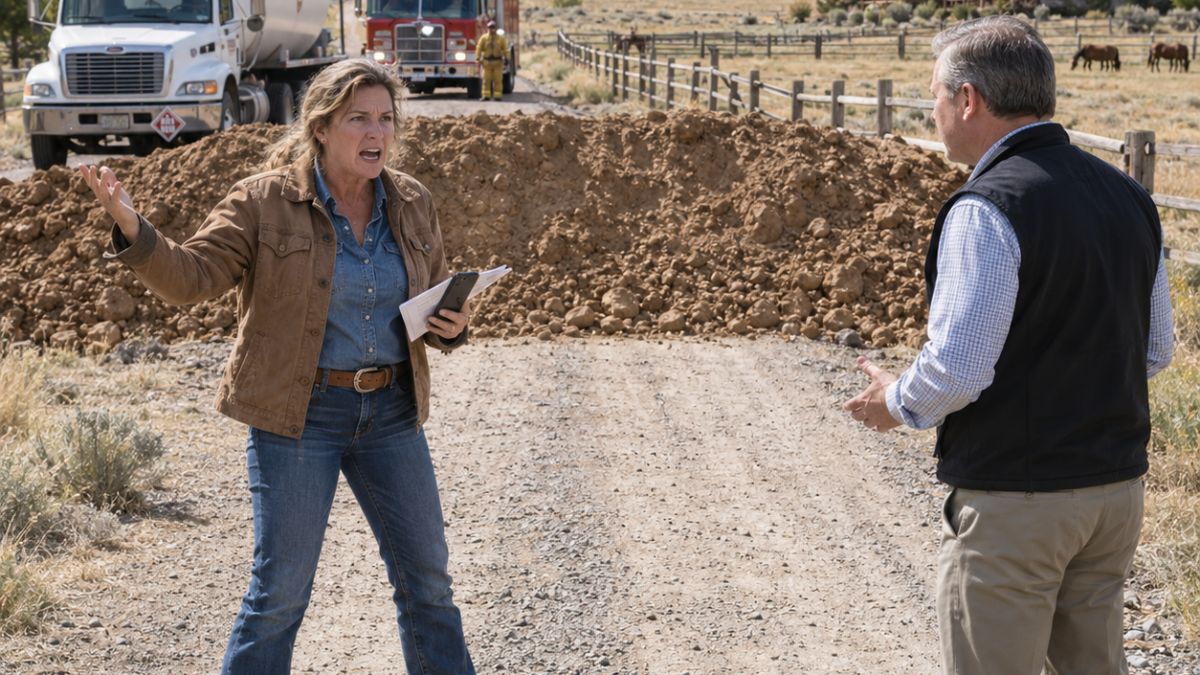
PART 2
I started with photographs.
Not angry photographs.
Not dramatic photographs.
Evidence.
There is a difference.
I took wide shots showing the entire width of the road and the berm crossing it from tree line to tree line.
I photographed the bulldozer tracks.
The exposed soil.
The drainage ditch they had crushed.
The uprooted shrubs.
The wooden easement marker partially buried beneath fresh dirt.
Then I took close photographs of my survey stakes and the county marker near the road.
After that I pulled my drone from the garage.
The view from two hundred feet above the ground told the story better than I ever could.
My house sat at the eastern end of the gravel lane.
Karen’s mansion occupied the hill beyond it.
The county road lay half a mile west.
And directly between all three sat an ugly brown scar.
The berm.
From above, another detail became impossible to ignore.
Karen’s driveway did not connect to another road.
There was no secret rear entrance.
No service lane.
No second gate.
The shared easement was her access too.
Her Lexus happened to be parked on the county-road side when the bulldozer arrived.
Her mansion, propane tank, garage, backup generator and everything else she owned were now sitting behind the same obstruction she had ordered built to trap me.
I hovered the drone near the road long enough to capture the entire configuration.
Then I brought it home.
At 8:46 a.m., I sat at my computer and created three folders.
COUNTY.
LEGAL.
INSURANCE.
Inside each folder I placed the photographs, video clips, copies of my deed, the recorded easement, Karen’s five-hundred-dollar assessment letter and the email in which she had threatened to “review my access privileges.”
That last one mattered.
It showed intent.
She hadn’t accidentally damaged the road.
She hadn’t misunderstood a contractor.
She had threatened to interfere with my access and then followed through.
I backed everything up twice.
Only then did I make my first phone call.
The woman who answered at county planning sounded tired.
“Planning and zoning.”
“My name is Arthur Donaldson. I need to report unpermitted grading that has blocked a recorded access easement.”
The fatigue disappeared from her voice.
“Blocked?”
“Completely.”
“Can vehicles pass?”
“No.”
“Emergency vehicles?”
“No.”
I heard typing.
“What kind of obstruction?”
“An earth berm. Roughly eight feet high, twenty feet thick at the base.”
The typing stopped.
“Eight feet?”
“Yes, ma’am.”
“Who constructed it?”
“The HOA president hired a bulldozer operator this morning.”
Another pause.
“Do you know whether a grading permit was issued?”
“I checked the county portal before calling. I couldn’t find one.”
“Address?”
I gave it to her.
More typing.
Then she said, “There’s nothing.”
“That’s what I thought.”
“Do you have photographs?”
“About a hundred.”
There was silence.
Then she laughed once.
Not because the situation was funny.
Because bureaucrats rarely encounter citizens who arrive with their evidence organized before making the complaint.
“Email them to me.”
I did.
My second call went to Frank Delaney.
Frank and I had served together years earlier. He had been an Army JAG officer then. Now he practiced real-estate and contract law.
He answered on the fourth ring.
“Arthur. Somebody die?”
“Not yet.”
“That sounds promising.”
“My HOA president bulldozed an eight-foot dirt wall across the only legal access road to my property.”
Silence.
Then:
“She did what?”
I told him everything.
The mailbox.
The garden.
The propane truck.
The five-hundred-dollar assessment.
The threat.
The bulldozer.
When I finished, Frank was quiet again.
“You have documentation?”
“Video of the construction. Drone footage. Survey. Recorded easement. Written threat.”
He exhaled slowly.
“Arthur.”
“Yeah?”
“Please tell me you have not yelled at her, threatened her or touched that berm.”
“I told her it was a recorded easement. Then I went inside.”
“I knew there was a reason I liked you.”
“What happens now?”
“Nothing.”
I frowned.
“Nothing?”
“You do nothing.”
“She has me trapped.”
“Exactly. And every hour that wall remains there improves your position.”
That sentence changed the way I looked at the berm.
Until then, it had felt like a prison wall.
Frank saw it differently.
It was evidence that was still growing.
County fines could accumulate.
Damages could accumulate.
The consequences could multiply.
“Let the county inspect it,” he continued. “Then we file for injunctive relief, interference with easement rights, nuisance and damages.”
“She’ll claim the HOA authorized it.”
“Good.”
“Good?”
“If she acted individually, Karen has a problem. If she claims she acted officially for the HOA, the HOA has a problem. Either way, people are going to start asking whether the board actually voted to authorize construction.”
I hadn’t thought of that.
Frank had.
Then he asked a question that seemed unrelated.
“You said both houses use propane?”
“Yes.”
“How much does her tank hold?”
“About a thousand gallons.”
“What does it run?”
“House. Pool heater. Generator.”
“And the propane truck uses that road?”
“It has to.”
There was another pause.
“Arthur, call the propane company.”
“For what?”
“Don’t threaten anybody. Don’t demand they shut off service. Just report an access and safety problem.”
He lowered his voice.
“Tell them an unpermitted earthwork has made the tank inaccessible to their delivery truck and possibly inaccessible for emergency shutoff.”
I leaned back in my chair.
“That could suspend deliveries.”
“Maybe.”
“Frank.”
“What?”
“You’re enjoying this.”
“A little.”
I called the propane company.
After explaining the issue three times, I eventually reached Bill Harmon, the regional safety manager.
Bill didn’t care about HOA politics.
He cared about one thing.
Could his employees safely reach the tank?
“No,” I said.
“Can you send photographs?”
“I can send drone footage.”
Ten minutes later his email arrived.
I uploaded the files.
Bill called back twenty minutes after that.
“Mr. Donaldson?”
“Yes.”
“That road is completely blocked.”
“Yes.”
“And Mrs. Miller’s tank is behind the obstruction?”
“Yes.”
“So is yours?”
“Yes.”
He sighed.
“We’re placing both accounts under temporary restricted-access status until our safety department inspects the site.”
That part surprised me.
“My account too?”
“We can’t send a delivery vehicle through there.”
Fair enough.
I had nearly seventy percent in my tank.
Karen, judging from the delivery schedule, probably had less.
I wasn’t going to manufacture an emergency.
I didn’t need to.
She had already done that herself.
The county inspector arrived the next morning.
His name was Paul Greer.
He stepped from a white pickup wearing work boots, a reflective vest and the expression of a man who had been told something ridiculous and was hoping the photographs had exaggerated it.
They had not.
Paul stood in front of the berm for almost a minute.
Then he said:
“Well.”
I walked toward him from my side but stopped several feet away.
“You Arthur?”
“Yes.”
“This the easement?”
I handed him a copy of the recorded plat.
He compared it with his tablet.
Then with the road.
Then with the dirt wall.
“Who owns the soil they excavated?”
“Some came from the roadside drainage area. Some from the shoulder near Karen’s side.”
“She cut the drainage ditch too?”
“Looks like it.”
His jaw tightened.
That was apparently worse.
Paul spent nearly an hour measuring.
He checked slope.
Drainage.
Setbacks.
He photographed everything.
Then he drove a wooden stake into the berm and attached a bright red notice.
STOP WORK ORDER.
Below that he attached another.
NOTICE OF VIOLATION.
Karen appeared about five minutes later.
She had apparently walked from her house.
“What are you doing?”
Paul turned.
“County planning and zoning.”
“I can see that.”
“This grading work has no permit.”
“I don’t need a permit. This is private property.”
“You need one for earthwork of this scope.”
“This is an HOA road.”
“That does not exempt you from grading regulations.”
Her eyes found me.
I was standing thirty yards away.
“This man filed a false complaint.”
Paul looked at me.
Then at the enormous wall behind him.
“Ma’am, I’m standing on the complaint.”
Karen’s face turned red.
“This road belongs to me.”
Paul tapped the plat.
“This says there’s an easement.”
“She violated HOA rules.”
“That is not my department.”
“She owes money.”
“Also not my department.”
“She has no right—”
Paul raised a hand.
“What is my department is an unpermitted earth structure obstructing vehicle access, interfering with roadside drainage and creating an unstable slope.”
Karen pointed at me.
“He caused this.”
Paul looked genuinely confused.
“He caused you to hire a bulldozer?”
For once, Karen had no response.
By noon, the stop-work order was visible from halfway down the road.
By evening, everybody in Willow Creek knew about it.
The next morning brought another visitor.
A red SUV stopped near the county road.
A man in a navy jacket climbed out.
Behind him came a woman carrying a clipboard.
They introduced themselves as Deputy Fire Marshal Owen Price and Captain Linda Mercer from the volunteer fire district.
The propane company had apparently contacted county emergency services after reviewing the access problem.
Owen stared at the berm.
“This is the only road?”
“Yes.”
“To both houses?”
“Yes.”
“No secondary access?”
“No.”
Captain Mercer walked along the edge.
“Engine won’t cross that.”
“I wouldn’t try.”
“Ambulance either.”
She turned toward me.
“You have anyone else living in your house?”
“Just me.”
“What about up there?”
She pointed toward Karen’s mansion.
“Karen and her husband.”
Owen made notes.
Then he asked something that made the situation much more serious.
“What happens if that propane tank has a leak?”
“The one-thousand-gallon tank?”
He nodded.
“Your delivery company says emergency access to the shutoff is compromised.”
I looked toward the mansion.
“That’s what they told me.”
Owen’s expression hardened.
“A thousand gallons of propane and no engine access is not an HOA dispute.”
That sentence traveled through Willow Creek faster than any newsletter ever could.
By that afternoon, Karen wasn’t simply fighting me.
She was fighting planning and zoning.
The propane company.
The fire district.
And soon, Frank.
His demand letter arrived two days later.
He sent me a copy first.
It was eleven pages long.
The opening paragraph was polite.
The remaining ten pages were not.
It demanded immediate restoration of the recorded easement.
Reimbursement for expenses.
Compensation for loss of access and interference with use of my property.
Preservation of all HOA emails, texts, meeting minutes and financial records related to the berm.
Then came the sentence I knew would frighten Karen most.
If the HOA claimed that the construction had been authorized as official association business, Frank demanded documentation of the board vote approving the expenditure.
There hadn’t been one.
I knew because I called Martin Bell, the HOA treasurer.
Martin answered nervously.
“Arthur, I probably shouldn’t talk to you.”
“Then don’t discuss anything confidential.”
He sighed.
“What do you want?”
“Did the board vote to authorize the bulldozer?”
Silence.
“Martin?”
“No.”
“Did you approve payment?”
“No.”
“Did the secretary?”
“I don’t know.”
“So Karen hired the contractor herself?”
Another silence.
“I have to go.”
That was enough.
Karen hadn’t merely abused HOA authority.
She had potentially obligated the association to a project the board had never approved.
Frank loved that.
“This is where communities turn on dictators,” he told me.
“Not when they discover the dictator was mean.”
“When they discover the dictator may have spent their money.”
He was right.
But money was only part of it.
Something else had been bothering me since I moved into Willow Creek.
People were afraid of Karen.
Not annoyed.
Afraid.
They lowered their voices when they said her name.
They closed garages when her golf cart passed.
They apologized for things that didn’t require apologies.
That kind of fear doesn’t come from one argument.
It accumulates.
So I started looking.
County property records gave me names of former homeowners.
Old HOA newsletters gave me dates.
Archived meeting minutes showed when Karen became president.
I made a list.
One name kept catching my attention.
Arthur and Eleanor Henderson.
They had owned a house in Willow Creek for fifteen years.
Then, two years after Karen became president, they sold abruptly.
The sale price had been noticeably below comparable properties.
I found Arthur Henderson living in a condominium downtown.
I almost didn’t knock.
Dragging an elderly man back into a painful chapter of his life felt wrong.
But before I could change my mind, the door opened.
Arthur Henderson was seventy-eight.
Thin.
Slightly stooped.
He wore a faded green sweater and held a pair of pruning scissors.
Behind him, on the balcony, were roses.
Dozens of them.
“You’re Mr. Henderson?”
“Depends who’s asking.”
“My name is Arthur Donaldson.”
He smiled faintly.
“Another Arthur.”
“I bought the property at the end of the easement in Willow Creek.”
His smile vanished.
“The road below the big house?”
“Yes.”
“You met Karen.”
“I did.”
He studied my face.
“What did she do?”
“Built an eight-foot wall of dirt across my driveway.”
Arthur blinked.
Then he started laughing.
Not because it was funny.
Because sometimes absurdity is the only thing left after years of anger.
“She actually did it,” he said.
“Did what?”
“Finally became so arrogant she stopped pretending.”
He invited me inside.
I told him the entire story.
When I mentioned the mailbox, he shook his head.
When I mentioned the garden, his fingers tightened around his coffee cup.
“You grow vegetables?”
“Trying to.”
“My Eleanor grew roses.”
His eyes moved toward the balcony.
For several seconds, he didn’t speak.
Then he told me.
Eleanor’s garden had once been one of the prettiest places in Willow Creek.
Neighbors brought their children by in spring.
Garden-club members photographed it.
She gave cuttings away.
After Karen became president, violation letters started.
One trellis was allegedly too tall.
Then the mulch color was wrong.
Then one rose variety wasn’t supposedly approved.
Then came fertilizer restrictions.
Inspection notices.
Threats.
Daily fines.
“They were roses,” Arthur said softly.
“I know.”
“She treated Eleanor like she was running an illegal factory.”
He laughed bitterly.
“My wife had survived breast cancer. She had buried a son. She was stronger than anybody I knew.”
His voice cracked.
“But eventually she stopped going outside.”
That sentence hurt more than I expected.
Arthur stared into his cup.
“She would sit at the kitchen window and look at those flowers.”
“What happened?”
“We sold.”
“Because of Karen?”
“Because I wanted my wife to have peace.”
He looked toward the roses outside.
“We moved here. Six months later Eleanor died.”
“I’m sorry.”
“The doctor said heart failure.”
His eyes met mine.
“I don’t blame Karen for her death.”
He paused.
“But I blame her for stealing the last peaceful year of Eleanor’s life.”
I didn’t know what to say.
So I didn’t say anything.
After a while, Arthur asked:
“Why are you here?”
“Because I’m fighting her.”
“Over your road?”
“At first.”
“And now?”
I looked toward his balcony.
“Now I think the road is just where she finally made a mistake big enough for everyone to see.”
Arthur sat straighter.
“What do you need?”
“Your story.”
He stared at me.
“A statement?”
“Only if you’re comfortable.”
“Sworn?”
“Yes.”
He stood slowly.
“Come with me.”
He led me to a bedroom closet.
From the top shelf he pulled down a cardboard storage box.
Inside were HOA letters.
Dozens.
Violation notices.
Photographs.
Certified-mail receipts.
Copies of checks.
A special assessment for sidewalk damage supposedly caused by the roots of their oak tree.
“They made us pay three thousand eight hundred dollars,” he said.
“Was the sidewalk on your property?”
“No.”
“Did anyone prove the tree caused it?”
“No.”
“Why did you pay?”
Arthur’s answer stayed with me.
“Because Eleanor cried every time another certified letter came.”
That was the moment my dispute with Karen changed.
I had been angry when she blocked my road.
After listening to Arthur Henderson, anger became purpose.
“I’m going to beat her,” I said.
He looked at me carefully.
“Don’t become like her doing it.”
“I won’t.”
“That matters.”
“I know.”
Arthur placed the box in my hands.
“Then use everything.”
Three days later, Miguel and Sarah Garcia walked half a mile down the blocked easement to see me.
Miguel was thirty-six, worked in graphic design and had the permanent tired look of a father with a young child.
Sarah was a paralegal.
She carried a thick folder.
“We heard you’re suing Karen,” Miguel said.
“News travels.”
Sarah glanced toward the berm.
“Hard to hide that.”
They had their own story.
Their son had a wooden swing set in the backyard.
Not a giant playground.
Not a commercial structure.
A cedar swing set.
Karen had declared it an unapproved recreational installation.
Fine: two hundred dollars per week.
“We submitted the approval form,” Sarah said.
“What happened?”
“No response.”
“Then why are you being fined?”
“Karen claims failure to receive approval is the same as denial.”
“That’s convenient.”
Sarah opened the folder.
“She’s done this to seven families that we know about.”
“Seven?”
“At least.”
She looked around my garage.
“You really planning to fight?”
“Yes.”
“Not settle quietly?”
“No.”
Miguel exchanged a glance with her.
Then Sarah smiled.
“In that case, you should read Article Nine.”
She opened the HOA bylaws.
Section 9.4 allowed homeowners holding twenty-five percent of the votes to petition for a special meeting to recall any board officer.
There were sixty houses in Willow Creek.
We needed fifteen signatures.
“That many people are terrified of her,” Miguel said.
“Fear disappears quickly when people discover they aren’t alone,” I said.
That night the three of us sat around my workbench.
Arthur Henderson joined us by video call.
We started building something Karen had never expected.
Not a revenge campaign.
A record.
Sarah insisted on it.
“No rumors,” she said.
“No exaggerations. No anonymous accusations we can’t support.”
“Agreed.”
“Every complaint gets documents.”
“Agreed.”
“If somebody says Karen fined them, I want the letter.”
“Agreed.”
“If they claim she threatened them, I want the email.”
Miguel grinned.
“You two are terrifying.”
Sarah smiled.
“Good.”
The first newsletter went out two evenings later.
It contained no insults.
No name-calling.
Just facts.
A recorded residential easement had been obstructed by unpermitted earthwork ordered by the HOA president.
County enforcement had issued notices.
Emergency vehicle access was compromised.
A propane company had suspended service because its tanker could no longer reach the affected properties.
Legal action had been filed.
The association could face financial exposure.
At the bottom was an email address.
IF YOU HAVE RECEIVED SIMILAR UNUSUAL FINES OR ENFORCEMENT ACTIONS, PLEASE CONTACT THE WILLOW CREEK CONCERNED HOMEOWNERS COMMITTEE.
Miguel hated the name.
“It sounds like five retired accountants.”
“Perfect,” Sarah said. “Karen expects angry rebels. Give her retired accountants.”
The first response arrived before midnight.
Then another.
Then four more.
By Sunday, we had fifteen.
A woman named Denise had been fined because her satellite dish could supposedly be seen from a side street.
A retired firefighter named Tom Reed had received notices for parking his restored 1968 pickup in his own driveway.
An immigrant family on Cedar Court had paid nearly two thousand dollars after Karen claimed their lawn color failed community standards.
One widow had been threatened with a lien because her trash cans remained visible for forty-five minutes beyond the permitted retrieval window.
Another homeowner showed us an email from Karen saying:
“People who cannot comply with Willow Creek standards should reconsider whether they belong here.”
Sarah read it twice.
“She actually wrote this?”
The homeowner nodded.
Sarah printed three copies.
The more evidence appeared, the clearer the pattern became.
Karen hadn’t maintained standards.
She had maintained fear.
And somewhere along the way she had stopped understanding the difference.
Meanwhile, the berm remained.
County penalties accumulated.
The fire district issued a formal emergency-access deficiency notice.
Captain Mercer called me after the second inspection.
“Arthur, I need you to understand something.”
“I’m listening.”
“If you have a medical emergency, call 911 immediately. Do not try to walk yourself out.”
“I understand.”
“We can reach you on foot with equipment, but transport time would be increased.”
“What about Karen’s place?”
“Same problem.”
That mattered because Karen’s husband, Richard, was in his late sixties.
I had only met him twice.
Quiet man.
Rarely seen.
The entire conflict had been Karen’s doing, not his.
I asked Captain Mercer whether there was any temporary solution.
“We could stage smaller equipment nearby if conditions become critical, but this road needs to be reopened.”
“I’m not stopping anyone from removing the berm.”
“You’re refusing access across your yard.”
“Yes.”
“That’s different.”
“Exactly.”
She understood.
Karen had another option.
She could have paid for smaller equipment capable of approaching from the county-road side and removing the berm piece by piece.
It would be expensive.
It would also require accepting responsibility.
Instead, she kept trying to force me to solve the problem she had created.
Monday afternoon, my phone rang.
“A1 Excavation. Dave speaking.”
“What can I do for you?”
“We’ve been hired to remove the berm on Willow Creek Road.”
“Good.”
“Mrs. Miller said we’re supposed to access it through your property.”
I nearly laughed.
“She said that?”
“Yes, sir.”
“Did she give you written permission from me?”
“No.”
“Then you don’t have permission.”
There was a long pause.
“Our excavator needs room.”
“I understand.”
“She said everything was arranged.”
“It isn’t.”
“Can we work something out?”
“Absolutely. Have your insurance company send proof of coverage. I’ll need a hold-harmless agreement, restoration bond and written approval from my attorney. Any damage to fencing, drainage, soil or landscaping gets restored at your expense.”
Dave whistled.
“That’s a lot.”
“It’s exactly the kind of paperwork your client believes property owners should require.”
He chuckled.
“Something tells me you two don’t get along.”
“That would be accurate.”
Two hours later Karen called.
I let it ring.
She called again.
I ignored it.
Then came a text.
STOP PLAYING GAMES. THE COUNTY REQUIRES ME TO REMOVE THE BERM.
I took a screenshot.
My reply contained seven words.
Please direct all legal matters to counsel.
Frank loved it.
Karen did not.
The temperature began falling the following week.
October gave way to the first hard cold front of the season.
Night temperatures dropped into the thirties.
That’s when Karen’s propane problem stopped being theoretical.
Her thousand-gallon tank had not been full when she created the blockade.
The pool heater consumed propane constantly.
So did the house.
So did the kitchen.
And because her backup generator also depended on propane, conservation became complicated.
One afternoon I saw her walking toward the berm.
It was raining.
She carried a red umbrella.
She stood there for nearly ten minutes staring at my house.
I watched from the kitchen.
Part of me felt satisfaction.
I won’t pretend otherwise.
This woman had used fear against people for years.
Now consequences had arrived.
But Arthur Henderson’s warning stayed with me.
Don’t become like her.
So when the temperature forecast dropped below freezing, I called Captain Mercer.
“Karen may be running low on propane.”
“I’m aware.”
“I don’t want anybody getting hurt.”
“Neither do we.”
“Can the department help if her heat fails?”
“We have emergency procedures.”
“Good.”
“You realize she caused this situation?”
“Yes.”
“And you’re still checking?”
“I want her accountable. I don’t want her dead.”
Captain Mercer was quiet.
Then she said, “That distinction matters.”
The next morning a utility safety technician walked to Karen’s property with two firefighters.
They inspected the tank.
The house still had heat.
There was no immediate emergency.
Karen had also purchased electric space heaters.
Good.
I could continue fighting without wondering whether my anger had put someone physically at risk.
Three days before the HOA annual meeting, Karen finally came to me.
I was outside near the garage cutting fallen branches.
I heard her before I saw her.
Not her voice.
Her breathing.
Climbing the berm had exhausted her.
She reached the top and stood there in a thick gray coat.
For the first time since I met her, Karen Miller looked small.
“Arthur.”
I set the saw down.
“We need to talk.”
“My lawyer told me not to discuss the lawsuit.”
“This isn’t about the lawsuit.”
“It always is now.”
She swallowed.
“This has gone too far.”
I looked at the eight-foot wall under her boots.
“We agree on that.”
“I was angry.”
“Yes.”
“The road was being damaged.”
“No.”
“The truck—”
“Delivered propane to both of us.”
Her mouth tightened.
“I shouldn’t have built the berm.”
That was the first honest sentence I had ever heard from her.
I waited.
She seemed to expect something.
Maybe forgiveness.
Maybe gratitude.
I gave her neither.
“I can fix this,” she said.
“Then fix it.”
“I need access.”
“You have legal options.”
“The excavator can’t reach it from my side.”
“There are smaller machines.”
“They cost three times as much.”
“That sounds unfortunate.”
Her face flushed.
“You’re enjoying this.”
I considered lying.
Instead I said, “Part of me is.”
She stared at me.
“At least you admit it.”
“You trapped me on my own land because I wouldn’t pay a fake five-hundred-dollar assessment.”
“It wasn’t fake.”
“The treasurer never approved it.”
Her eyes changed.
That surprised her.
“I’ve spoken to Martin.”
“You had no right—”
“He had every right to tell me the board never voted on the bulldozer either.”
Now she was silent.
I stepped closer.
“How much HOA money did you use?”
“That’s association business.”
“It became my business when association money built a wall across my road.”
Karen looked toward my house.
Then back at me.
“I’ll withdraw every violation against you.”
“No.”
“I’ll cancel the assessment.”
“No.”
“I’ll pay to repair the road.”
“You already owe that.”
Her hands tightened.
“What do you want?”
There it was.
For months, Karen had assumed everybody wanted something she controlled.
Permission.
Approval.
A waived fine.
Access.
Now she needed something from me.
“What do I want?”
“Yes.”
“I want you to stop doing this to people.”
Her expression hardened.
“This is about the Hendersons, isn’t it?”
“You remember them.”
“Of course I remember them.”
“Do you remember Eleanor?”
Karen looked away.
“She violated several landscaping regulations.”
“She grew roses.”
“She refused to cooperate.”
“She died six months after leaving the home she loved.”
“That has nothing to do with me.”
“I didn’t say you killed her.”
“Then why bring it up?”
“Because her husband still keeps every violation letter you sent.”
For the first time, Karen looked frightened.
Not cold.
Not inconvenienced.
Frightened.
“How do you know Arthur Henderson?”
“I visited him.”
“You had no right to drag former residents into this.”
“He volunteered.”
Her face went pale.
“How many?”
“Enough.”
She understood.
The recall petition.
The annual meeting.
The evidence.
The lawsuit.
The county fines.
The propane restriction.
The fire-access notice.
Suddenly all of it connected.
“You planned this.”
“No.”
She laughed bitterly.
“Don’t insult me.”
“I documented what you did. Other people decided they were tired of what you did to them.”
“You’re trying to destroy me.”
“No, Karen.”
I pointed at the berm.
“You did that when you ordered a bulldozer onto a recorded easement because someone wouldn’t pay you five hundred dollars.”
Her voice dropped.
“My house is cold.”
“I know.”
“They won’t deliver propane.”
“I know.”
“My generator is useless.”
“I know.”
“And now the fire department says they can’t guarantee vehicle access.”
“I know.”
She looked exhausted.
“What if something happens?”
That question stripped away my satisfaction.
Because behind all the paperwork was a simple truth.
She and Richard were human beings.
I picked up my phone.
“What are you doing?”
“Calling Captain Mercer.”
“Why?”
“Because if you lose heat entirely, I want the fire district to know.”
Karen stared at me.
“You’d help me?”
“I didn’t say I’d erase the consequences.”
I held her gaze.
“I said I don’t want anyone hurt.”
For several seconds, she said nothing.
Then she whispered:
“Why?”
“Because that’s the difference between us.”
She flinched.
I didn’t enjoy saying it.
That surprised me.
Karen climbed down from the berm and walked home.
The annual meeting was Friday night.
Normally, twelve or fifteen homeowners attended.
That year, one hundred and nine people packed into the clubhouse.
People stood along the walls.
Couples brought folding chairs.
Neighbors who had avoided HOA meetings for years showed up carrying folders.
Arthur Henderson wore a navy suit and a tie patterned with tiny roses.
When he entered, half the room recognized him.
People hugged him.
One woman cried.
“You came back.”
“For Eleanor,” he said.
Miguel sat beside him.
Sarah had three binders arranged on the table in front of her.
I sat on the aisle.
At seven fourteen, Karen entered.
The room went quiet.
She wore a heavy black sweater.
Her face looked tired.
Richard walked behind her.
I hadn’t expected him.
He took a seat near the back.
Not beside her.
Karen sat at the front table.
Martin Bell, the treasurer, sat two chairs away.
The secretary, Linda Walsh, shuffled papers nervously.
Karen struck the gavel.
“The annual meeting of the Willow Creek Homeowners Association will come to order.”
Nobody spoke.
She rushed through the treasurer’s report.
Martin interrupted.
“I need to amend that report.”
Karen looked at him sharply.
“Later.”
“No.”
The room shifted.
Martin had probably never told Karen no in public.
He swallowed.
“There is an outstanding expenditure related to excavation work on the shared access road.”
Karen’s face tightened.
“That matter is under legal review.”
“The membership deserves to know.”
“Martin.”
He opened a folder.
“Three thousand two hundred dollars was paid as a deposit to Miller Earthworks.”
Murmurs spread.
My head turned.
Miller Earthworks?
Frank, sitting behind me as legal observer, leaned forward.
“Related?” he whispered.
I shook my head.
Martin continued.
“The contractor is owned by Douglas Miller.”
Karen slammed the gavel.
“This is inappropriate.”
Sarah stood.
“Who is Douglas Miller?”
Martin looked miserable.
“Karen’s brother-in-law.”
The room exploded.
People shouted.
Karen hammered the gavel repeatedly.
“Order! Order!”
Frank leaned toward me.
“Well.”
That one word said everything.
This was worse than we knew.
Sarah raised her voice.
“Was there competitive bidding?”
“No,” Martin said.
“Board approval?”
“No.”
“Disclosure of the relationship?”
“No.”
Karen stood.
“This was an emergency road-maintenance action within presidential authority.”
I nearly laughed.
Sarah didn’t.
She held up the bylaws.
“Section 6.8 limits emergency discretionary spending by any single officer to one thousand dollars unless immediate action is required to prevent physical damage to common property.”
Applause erupted.
Karen shouted over it.
“The road was being destroyed!”
“By a propane truck that serves your house,” somebody called.
Laughter followed.
Karen’s face reddened.
Then came the recall motion.
Linda Walsh read it.
“Nineteen homeowners have petitioned pursuant to Article Nine for a vote of no confidence and removal of the sitting president.”
“Twenty-seven,” Sarah corrected.
She placed another page on the table.
“We received eight additional signatures tonight.”
Karen stared at the paper.
Her kingdom was disappearing by the minute.
Miguel spoke first.
He told the room about the swing set.
Not dramatically.
Just dates.
Letters.
Payments.
Threats.
Then Denise talked about her satellite dish.
Tom Reed talked about his truck.
Another homeowner described paying thirteen hundred dollars over lawn color.
Then Arthur Henderson stood.
Nobody moved.
He walked slowly to the front.
Karen wouldn’t look at him.
Arthur placed a small photograph on the table.
It showed Eleanor standing beside a wall of red roses.
She was smiling.
“This was my wife,” he said.
His voice trembled but remained clear.
“Most of you knew Eleanor.”
Several people nodded.
“She loved Willow Creek.”
He touched the photograph.
“She loved her house.”
Karen stared at her papers.
“When the violation letters started, Eleanor laughed about them.”
Arthur smiled sadly.
“She thought nobody could seriously object to roses.”
A few people laughed through tears.
“Then the letters kept coming.”
His voice weakened.
“Fines.”
“Inspections.”
“Threats.”
“She started asking me whether the mailbox had arrived every afternoon.”
Arthur looked toward Karen.
“You took a woman who had survived cancer and taught her to fear an envelope.”
The room was absolutely silent.
“We moved because I thought leaving would save her peace.”
His eyes filled.
“It was too late.”
Karen finally looked up.
Arthur’s next words were quiet.
“I am not here because I hate you.”
That surprised everyone.
“I came because I spent two years believing I had failed Eleanor by leaving.”
He breathed slowly.
“But I understand something now.”
“We weren’t weak.”
“We were isolated.”
He turned toward the homeowners.
“And isolation is how people like this keep power.”
Several people stood and applauded.
Arthur shook his head.
“Please.”
They sat.
“I only ask that what happened to my wife never happen to another family here.”
He returned to his chair.
I squeezed his shoulder.
Then Sarah called my name.
I stood.
I didn’t walk to the podium.
I faced the room from where I was.
“My name is Arthur Donaldson.”
I held up a large printed aerial photograph.
The berm stretched across the road like a wound.
“This is what started my involvement.”
I looked around the room.
“Karen Miller ordered an eight-foot earth berm built across the only vehicle access to my home because I refused to pay a five-hundred-dollar assessment.”
Karen shouted:
“That is your interpretation!”
I pulled out her email.
Then read one sentence.
“Then your access privileges will be reviewed.”
Silence.
“Forty-eight hours later, the bulldozer arrived.”
I placed the email beside the photograph.
“The county found the work unpermitted.”
Another document.
“The fire district determined emergency vehicle access was compromised.”
Another.
“The propane company suspended heavy-truck deliveries because the road became inaccessible.”
Another.
“My attorney filed suit for interference with the recorded easement.”
I lowered the documents.
“Karen told me this was about standards.”
I looked at the families around me.
“It wasn’t.”
“It was about what happens when one person becomes convinced rules belong to her instead of everyone.”
Karen stood.
“You are manipulating these people!”
A man near the back answered:
“No. You did.”
Another voice:
“You fined my mother six hundred dollars over curtains!”
Another:
“You threatened a lien over Christmas lights!”
Another:
“You told us to move!”
Karen looked toward Martin.
“Do something.”
Martin slowly removed his HOA board badge.
He placed it on the table.
“No.”
That was when Karen’s face changed.
For years, people had obeyed her because everyone assumed everyone else would continue obeying.
Now she could see the assumption collapsing.
The vote was taken by written ballot.
Fifty-eight votes supported removal.
Two opposed.
Karen and one other homeowner.
The secretary read the result.
“Karen Miller is removed as president effective immediately.”
For a second, nothing happened.
Then the room erupted.
People clapped.
Some stood.
Miguel hugged Sarah.
Arthur Henderson closed his eyes.
I looked toward Karen.
She remained seated.
No dramatic screaming.
No overturned table.
No final threat.
She simply stared at the gavel.
For the first time, it belonged to somebody else.
Sarah Garcia was elected interim president.
Her first motion was immediate.
“All enforcement actions initiated solely under presidential discretion during the previous eighteen months are suspended pending legal review.”
Unanimous.
Her second motion:
“Authorize immediate removal of the obstruction from the Donaldson-Miller easement.”
Unanimous.
Her third:
“Refer all unauthorized association expenditures connected to the berm to independent counsel and the HOA insurer.”
Even Martin raised his hand.
Unanimous.
Then something happened I had not expected.
Sarah looked at Arthur Henderson.
“Mr. Henderson.”
He looked up.
“Would you consider joining a temporary committee to rewrite our enforcement procedures?”
Arthur blinked.
“I don’t even live here anymore.”
“You lived here long enough to know what went wrong.”
Someone shouted:
“Bring Arthur back!”
People laughed.
For the first time that night, so did he.
“I’ll help.”
The next morning, excavation equipment arrived at eight.
This time I opened my gate.
The contractor placed heavy mats across one narrow section of my property.
He had insurance documentation.
A restoration bond.
Written permission.
Everything Karen had demanded from everybody else but had never bothered obtaining herself.
The irony wasn’t lost on me.
Neither was the relief.
Bucket by bucket, the wall disappeared.
Around noon, Captain Mercer arrived.
She watched from the county road.
“Looks better already.”
“Coffee?”
“Absolutely.”
We stood beside my truck drinking from paper cups while the excavator worked.
At 4:37 p.m., the operator made his final pass with the grader.
The road reopened.
Captain Mercer drove the fire district’s smaller engine through first.
She went all the way to my house.
Turned around.
Then drove up to Karen’s property.
A few minutes later she returned.
“Access restored.”
Those two words felt better than winning an argument ever could.
The propane truck came the next morning.
It stopped at my house first.
The driver climbed down.
“I’ve heard about this road.”
“I imagine you have.”
He looked toward the scraped earth where the berm had stood.
“You people really blocked this thing because of tire ruts?”
“I didn’t.”
He laughed.
“Fair point.”
He filled my tank.
Then drove uphill.
To Karen’s house.
I watched it go.
Some small part of me wondered whether I should feel disappointed.
After everything she had done, Karen was getting heat again.
But revenge had never been about making her suffer physically.
The real consequence was already underway.
She had lost authority.
The association’s insurer hired investigators.
HOA financial records were audited.
The undisclosed payment to her brother-in-law became a major issue.
So did several previous contracts.
Nothing criminal was ultimately proven.
But the audit found enough irregular procedures, undocumented approvals and conflicts of interest that the board adopted entirely new spending controls.
Two signatures became mandatory for expenditures above five hundred dollars.
Contracts involving relatives required full disclosure and competitive bids.
Fines could no longer be issued solely by the president.
Homeowners received appeal rights.
Inspection photographs had to include dates and specific rule citations.
Vague phrases like “inappropriate appearance” were removed.
So was Karen’s favorite weapon:
“Community incompatibility.”
When Sarah showed me the revised rules, I laughed.
“That was actually in there?”
“Page forty-two.”
“What did it mean?”
“Whatever Karen wanted it to mean.”
“Good riddance.”
Frank continued negotiating my lawsuit.
Karen initially refused settlement.
Then discovery began.
That changed everything.
Frank requested emails.
Board communications.
Invoices.
Contractor messages.
Text messages.
Records related to my property.
Records related to the Hendersons.
Records related to the Garcias.
Karen’s attorney called Frank three days later.
Suddenly they wanted to talk.
Frank met me at a diner off the county highway.
He slid a settlement proposal across the table.
I read the number.
“That’s a lot.”
“It should be.”
“What about the apology?”
“Still included.”
“To Henderson?”
“Yes.”
“Garcias?”
“Yes.”
“HOA?”
“Yes.”
“And she pays my legal expenses?”
“Her insurer covers most of them.”
I looked at him.
“What happens if I refuse?”
“We continue.”
“Could we win more?”
“Possibly.”
“Could it take another year?”
“Easily.”
I thought about Arthur’s warning again.
Don’t become like her.
Money wasn’t why I started.
Destroying Karen wasn’t why either.
I wanted my road.
My peace.
Accountability.
And a community where people didn’t fear certified mail.
“Take it,” I said.
Frank nodded.
“I thought you would.”
“You sound disappointed.”
“A little.”
I laughed.
“You really wanted trial.”
“Arthur, I had charts.”
Two weeks later, Karen signed.
Her apology arrived by certified mail.
The irony was almost perfect.
I opened mine at the kitchen table.
It wasn’t warm.
It wasn’t heartfelt.
It had obviously been negotiated by attorneys.
But it contained the words that mattered.
She acknowledged that constructing the berm had wrongfully obstructed my lawful access.
She acknowledged that the action should not have occurred.
She withdrew every outstanding violation and assessment against my property.
She agreed not to participate in HOA enforcement against me.
Then I called Arthur Henderson.
“You get something in the mail?”
There was a long pause.
“Yes.”
“How are you?”
Another pause.
“I’ve read it five times.”
“What does it feel like?”
“I don’t know yet.”
That worried me.
Then he continued.
“Eleanor would have laughed.”
“Why?”
“Because Karen spelled chrysanthemum wrong.”
I started laughing.
Arthur did too.
We laughed until both of us were quiet.
Then he said:
“Thank you.”
“You helped yourself.”
“No.”
His voice softened.
“You came looking.”
A month after the berm came down, a FOR SALE sign appeared outside Karen’s mansion.
Nobody celebrated publicly.
That mattered to me.
People had every reason to hate her.
Instead, the neighborhood simply kept moving.
Kids played outside.
Miguel rebuilt his son’s swing set.
This time the HOA approval form consisted of one page.
Sarah signed it.
APPROVED.
Denise installed flowers beneath her satellite dish.
Tom Reed parked his restored pickup in the driveway every Sunday and polished it where everybody could see.
Vegetable gardens began appearing behind houses.
Apparently, once people realized tomatoes were not a threat to civilization, enthusiasm spread quickly.
I expanded mine.
Peppers.
Cucumbers.
Beans.
Arthur Henderson visited one Saturday carrying a clay pot.
Inside was a young rose plant.
“Eleanor’s,” he said.
I stared at it.
“A cutting?”
“From one of the last bushes I saved from Willow Creek.”
I didn’t know what to say.
Arthur handed it to me.
“She called this one Peace.”
“That’s really the name?”
“Hybrid tea rose. Introduced after World War II.”
He smiled.
“Seemed appropriate.”
We planted it beside my front porch.
Arthur insisted on digging the hole himself.
His knees complained.
I tried to take the shovel.
He slapped my hand away.
“I’m old, not dead.”
“Yes, sir.”
When we finished, we sat on the porch drinking iced tea.
From where we sat, I could see the road.
Open.
Ordinary.
Nothing dramatic about it.
Exactly how roads should be.
A large moving truck appeared near the county entrance.
Arthur noticed it first.
“Well.”
We both knew where it was going.
Karen had sold the mansion.
Not to a developer, as rumors initially suggested, but to a younger couple who planned to keep most of the land intact.
The truck drove uphill.
Several hours later, a sedan came down.
Karen sat in the passenger seat.
Richard drove.
As they reached my property, the car slowed.
For one second, Karen looked toward my porch.
Our eyes met.
I stood.
Arthur remained seated beside me.
Karen’s face showed something I couldn’t identify.
Anger, maybe.
Embarrassment.
Exhaustion.
Possibly even regret.
I didn’t wave.
She didn’t either.
Then Richard drove on.
Down the road she had once claimed belonged to her alone.
Across the exact stretch where she had built the berm.
Past the county marker proving otherwise.
And out of Willow Creek.
Arthur watched until the car disappeared.
“Think she learned anything?”
“I don’t know.”
“That bother you?”
I thought about it.
“No.”
He nodded.
“Good.”
That surprised me.
“I thought you wanted her to understand.”
“I did once.”
Arthur looked toward the rose.
“But Eleanor taught me something.”
“What?”
“You can waste years waiting for someone who hurt you to become the kind of person capable of understanding what they did.”
The leaves moved softly in the afternoon breeze.
“Sometimes justice isn’t them understanding.”
He looked at the open road.
“Sometimes justice is simply making sure they can’t keep doing it.”
I never forgot that.
Willow Creek changed after Karen left.
Not overnight.
Trust returns slowly after people spend years expecting punishment.
At first homeowners still called Sarah before making minor changes.
“Can I paint my shed?”
“Can my daughter put a basketball hoop beside the garage?”
“Can I plant blueberries?”
Sarah’s standard response became:
“Is it dangerous?”
“No.”
“Is it on somebody else’s property?”
“No.”
“Then why are you calling me?”
People gradually stopped asking permission to live normal lives.
The HOA still existed.
We still needed road maintenance.
Drainage.
Insurance.
Common landscaping.
Actual responsibilities.
But something fundamental had changed.
The association became a tool instead of a throne.
Six months later, Sarah asked me to join the board.
I refused immediately.
“You led the whole recall,” she said.
“Exactly why I don’t want the job.”
“You’d be good at it.”
“That’s what everybody says before volunteering somebody else.”
She laughed.
“Fine.”
I agreed to serve on the road committee instead.
My first proposal was painfully simple.
Grade the gravel twice a year.
Repair drainage when necessary.
Split verified costs according to the recorded agreement.
No surprise assessments.
No threats.
No five-hundred-dollar punishment because a propane truck left tire marks.
The vote was unanimous.
The following autumn, the propane truck returned.
Same company.
Possibly even the same vehicle.
It had rained the night before.
The tandem rear wheels left two shallow tracks near the curve.
I stood looking at them after the driver left.
Miguel happened to be walking with his son.
He saw me staring.
“What are you thinking?”
I folded my arms.
“This is unacceptable.”
Miguel froze.
Then he saw my smile.
“You jerk.”
I pointed at the ruts.
“Five-hundred-dollar assessment.”
“For who?”
“The propane company.”
Miguel laughed.
His son looked confused.
“You had to be here,” Miguel told him.
I pulled my tractor from the garage.
Ten minutes with the box blade smoothed the road.
Ten minutes.
That was all the original problem had ever required.
Ten minutes.
Karen had turned it into months of litigation, thousands of dollars in damages, county enforcement, a fire-access problem, suspended propane deliveries, a recall election and the end of her presidency.
All because winning mattered more to her than solving the problem.
That realization stayed with me.
People often imagine revenge as something loud.
A confrontation.
A public humiliation.
A final speech where the villain understands everything.
Real revenge—if that is what mine was—looked different.
It looked like photographs labeled by date.
Certified letters.
Recorded plats.
Neighbors discovering they could speak without fear.
An elderly widower walking back into a clubhouse wearing a tie covered in roses.
A mother watching her son play on a swing set nobody could threaten anymore.
A propane truck driving freely down an open road.
A fire engine completing an access test without stopping at a wall of dirt.
And one rose blooming beside my porch.
The first flower appeared the following June.
Pale yellow petals edged faintly in pink.
Arthur Henderson drove out to see it.
He stood in front of that small bush for a long time.
“She always got excited about the first bloom,” he said.
“It’s beautiful.”
“She would have liked where you put it.”
From that spot you could see the road.
Arthur smiled when I pointed that out.
“So she gets to watch traffic?”
“Every truck.”
“Even propane?”
“Especially propane.”
He laughed.
We sat on the porch until evening.
At one point, a fire engine rolled slowly through Willow Creek.
Routine inspection.
Nothing wrong.
No emergency.
Its tires crunched over the gravel and disappeared uphill.
Arthur watched it.
“Funny,” he said.
“What?”
“All that because of a pile of dirt.”
I shook my head.
“No.”
He looked at me.
“The dirt just made everything visible.”
He considered that.
Then nodded.
That was the truth.
The berm didn’t create Karen’s abuse.
It exposed it.
She had spent years building invisible walls between neighbors.
Fear.
Fines.
Threats.
Embarrassment.
Isolation.
Then one morning she built a real wall where everybody could finally see it.
Eight feet high.
Twenty feet wide.
Made of mud, rock and arrogance.
And once people saw it, they started seeing everything else too.
She thought blocking my road would prove how much power she had.
Instead, it showed the entire neighborhood exactly how dangerous that power had become.
She thought isolation would make me surrender.
Instead, her actions brought neighbors together.
She thought the HOA rules were weapons that belonged only to her.
Instead, those same bylaws provided the mechanism that removed her.
She thought the county would stay out of a private dispute.
The county issued violations.
She thought the propane company would simply find another way.
They suspended access.
She never considered the fire district at all.
They documented that emergency vehicles could no longer reach either house.
And she never imagined the most important consequence.
The people she had spent years intimidating finally realized something.
There were more of them than there were of her.
Years later, people in Willow Creek still occasionally referred to that fall as “the berm war.”
I hated the name.
Not because it was inaccurate.
Because it made the whole thing sound like two stubborn neighbors fighting over dirt.
It was never really about dirt.
It was about what happens when ordinary authority goes unchecked for too long.
And what happens when decent people become so exhausted that silence feels easier than resistance.
Karen didn’t become powerful because everybody agreed with her.
She became powerful because everybody believed they were fighting her alone.
Arthur Henderson thought he was alone.
The Garcias thought they were alone.
Denise thought she was alone.
Tom thought he was alone.
I probably would have thought the same thing eventually.
Then Karen built a wall so ridiculous that we all started talking.
That was her real mistake.
Not the bulldozer.
Not the unpermitted excavation.
Not the propane tank.
Not even blocking emergency access.
Her fatal mistake was giving sixty households a reason to compare notes.
Once that happened, the fear disappeared.
And once the fear disappeared, so did her power.
Years after the lawsuit ended, I still kept one photograph in my office.
Not the dramatic drone shot.
Not the county violation notice.
Not Karen standing on top of the berm.
It was a photograph Miguel took the morning after the wall came down.
The sun was coming through the trees.
The gravel was smooth.
My truck was parked beside the garage.
Arthur Henderson was kneeling near the porch planting Eleanor’s rose.
And in the background, almost too small to notice, a propane truck was driving up the open road.
That picture reminds me what winning actually looked like.
Not Karen leaving.
Not the settlement check.
Not fifty-eight votes removing her.
Winning looked like access restored.
People breathing easier.
A widower smiling again.
A child swinging in his own backyard.
A neighborhood realizing rules could protect people instead of controlling them.
Karen wanted that road to teach me a lesson.
She succeeded.
Just not the lesson she intended.
She taught me that power built on fear looks permanent only until people stop being afraid.
She taught Willow Creek that paperwork can intimidate people—but it can also protect them.
She taught an entire neighborhood that authority without accountability eventually becomes its own evidence.
And she taught herself the most expensive lesson of all.
When you build a wall to trap someone else, you had better understand what lies on your side of it.
Because Karen Miller buried my only road beneath eight feet of dirt believing she had cut me off from the world.
Instead, she cut off her own propane truck.
She blocked her own emergency access.
She exposed years of complaints.
She triggered the investigation into her spending.
She united the neighbors she had kept divided.
And eventually, she lost the office, the influence and the house on the hill she had once treated like a throne.
The berm disappeared in a single day.
The damage it exposed took longer to repair.
But Willow Creek did repair it.
And every spring, when Eleanor’s rose blooms beside my porch, I look past it toward that ordinary gravel road and remember the morning Karen told me:
“You can find another way out.”
She was right about one thing.
We did find another way.
Not around the berm.
Through the fear that had allowed her to build it in the first place.
And once we got through that, there was nothing left standing between us and the road home.








