PART 2: The Golden Retriever Was Almost Safe—Then She Dove Back Into the Flooded SUV for Something None of Us Could See
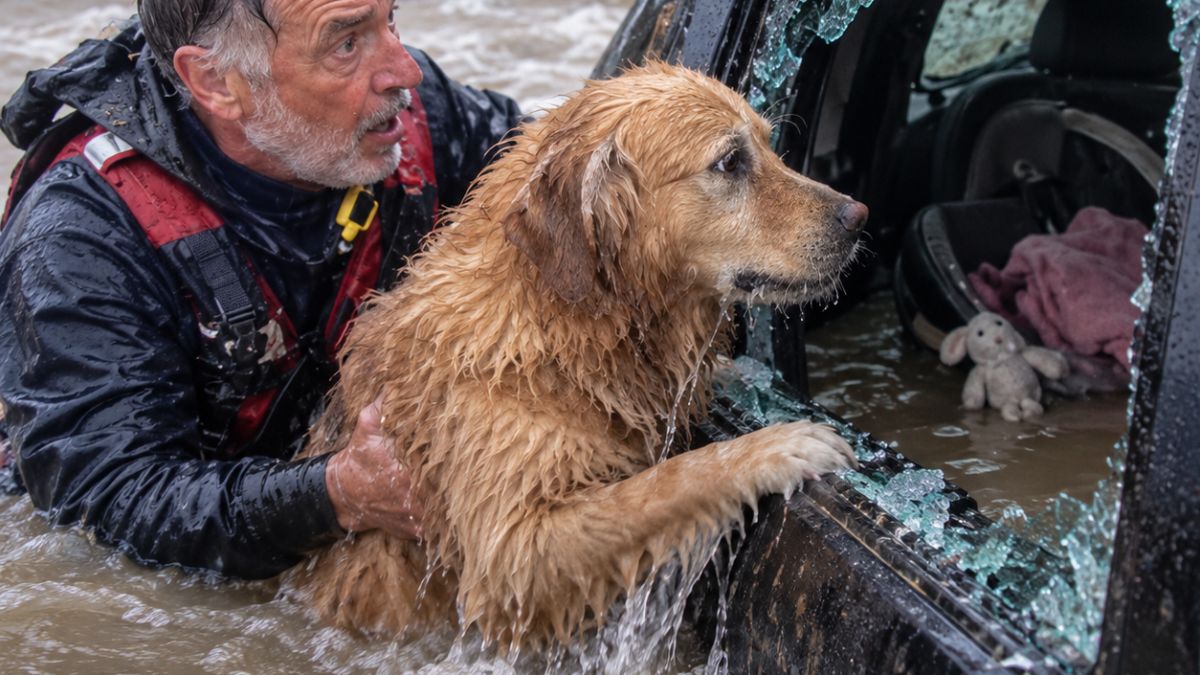
The Golden Retriever was already halfway into my arms when she suddenly kicked free, planted both back paws against my life jacket, and threw herself straight back through the shattered window of the flooded SUV.
For one stunned second, I thought panic had finally taken over and the exhausted dog had chosen the one place we were desperately trying to save her from.
Then she came back carrying something in her mouth, and the way she looked at me made every instinct I had left from thirty-two years as a firefighter start screaming.
My name is Raymond Delmas.
I was sixty-six that morning, retired from the fire service and old enough to know that floodwater never cared how experienced you were.
After two days of brutal rain, several villages in the Gard had become a maze of washed-out roads, flooded homes, and brown water moving with frightening speed.
I was volunteering with five friends from our motorcycle group, Les Cavaliers du Pont.
We had spent the morning carrying bottled water, blankets, flashlights, and first-aid supplies into neighborhoods emergency crews were struggling to reach.
None of us had come looking for danger.
Then a soaked man ran toward us near a blocked road and shouted that a vehicle had been swept off the pavement.
Thirty minutes later, I was clipped into a safety harness with six men holding my rope.
The SUV sat nearly a hundred feet from the last stretch of stable road, jammed sideways against a bent guardrail and a thick broken limb.
Every surge of water shoved it several inches downstream.
Then the metal caught.
Then it moved again.
That was what scared me most.
Nothing was truly holding it.
When I reached the rear quarter panel, the water was already above my waist.
I smashed the back window.
Inside, two amber eyes stared at me.
A large Golden Retriever stood trembling on the rear seat, her honey-colored coat plastered against her body.
She was exhausted.
One ear folded strangely against her head.
A small white patch showed beneath her chin.
But she wasn’t looking at me.
She kept staring toward the floor behind the front passenger seat.
“Come on, sweetheart,” I said.
I reached through the broken glass, slipped one arm beneath her chest, and pulled.
For a moment she came willingly.
Her front paws cleared the window.
Her body slid toward me.
I thought we had her.
Then she twisted violently.
“Easy!”
She pushed off my vest and vanished back into the vehicle.
“Ray!” Mathieu yelled from farther down the rope.
“I’ve got her!”
That wasn’t exactly true.
Seconds later, the dog reappeared.
A dripping stuffed rabbit hung from her mouth.
I almost laughed from pure relief.
“That’s what this is about?”
She dropped the toy against my shoulder.
Then she turned toward the dark interior and barked.
Once.
Twice.
Not frightened barks.
Demanding ones.
I raised my waterproof flashlight.
The beam moved across the back seat.
There was a baby-seat base locked into place with the vehicle belt.
Empty.
Two loose straps floated in the muddy water.
My stomach tightened.
“I’ve got a child-seat base,” I shouted toward shore. “Looks empty. I’m checking the back.”
The dog dove down again.
She came up with a pink blanket clamped between her teeth.
She pulled backward.
The blanket tightened beneath the surface as if it had snagged on something.
Then a black plastic handle rose through the brown water.
I stopped breathing.
The base on the seat was empty because the removable carrier was no longer attached to it.
It had fallen into the rear footwell.
A diaper bag had floated over it, hiding almost the entire thing beneath the filthy water.
The Golden Retriever dragged at the blanket again.
I shoved the bag aside.
My flashlight beam dropped into the carrier.
A tiny face appeared in the narrow space beneath the handle.
Still.
Pale.
Strapped inside.
For the first time that morning, I forgot the cold.
I forgot the current.
I forgot the SUV shifting beneath my hand.
I grabbed my radio.
“There’s a baby in the car!”
The men on shore went silent.
The dog looked directly at me.
And then the SUV moved.
Not inches this time.
Nearly two feet.
The guardrail screamed against the metal.
Mathieu shouted my name.
The safety rope snapped tight against my harness.
And I suddenly understood that nobody on that riverbank knew whether I had minutes left to reach that child—
or seconds.
PART 2
“Raymond, get out!”
Mathieu’s voice came through the water and wind like a command fired from another world.
I ignored it.
Not because I was brave.
People use that word too easily.
Bravery is clean when you talk about it afterward.
In the moment, it usually feels more like fear with nowhere useful to go.
The SUV shifted again.
I wrapped my left arm around the broken window frame and reached down with my right hand.
The baby carrier was wedged between the back of the passenger seat and the rear bench.
The vehicle had tilted toward the passenger side, forcing everything loose into that corner.
The carrier hadn’t simply fallen.
It had twisted.
The handle had caught beneath the seat rail.
That was probably the only reason it hadn’t disappeared completely underwater.
“Mathieu!”
“I’m coming!”
“No. Hold position.”
“Ray—”
“If this thing breaks loose, one of us needs to be able to pull the other.”
That ended the argument.
For three seconds.
Then I heard him swear.
The dog was beside me again.
She had somehow wedged herself between the rear seat and the broken window.
Her claws scratched against wet upholstery.
“Stay up,” I told her.
She stared at the carrier.
I pushed the floating diaper bag toward the rear hatch.
The water inside the SUV had risen another inch.
Maybe two.
It was hard to tell.
The baby’s face was not underwater.
Not yet.
The carrier had landed at an angle, leaving a small pocket above the child’s nose and mouth.
But every time the vehicle rocked, muddy water washed dangerously close to that tiny face.
I could see the baby’s lips.
Bluish.
I couldn’t tell whether the child was breathing.
I reached for the carrier release.
Nothing.
The handle was jammed.
I pulled again.
Still nothing.
The dog began whining.
“I know.”
My fingers slid beneath the plastic.
I found the blanket twisted around the handle.
The same blanket the dog had been pulling.
I tore it loose.
The carrier moved half an inch.
Then stopped.
Metal was trapping it.
“Knife!” I shouted.
One of the men on shore couldn’t possibly hear the word clearly, but Mathieu understood.
He unclipped the rescue knife from his vest and started toward me.
“Hold!”
The SUV shuddered.
Everyone froze.
The branch trapping the front bumper rolled beneath the water.
For one terrible second, the entire vehicle rotated.
The current slammed me against the door.
My shoulder hit metal hard enough to make my hand go numb.
The safety rope caught me before I disappeared underneath.
When I surfaced, I heard shouting.
“Raymond!”
“I’m good!”
I wasn’t.
My shoulder felt as if someone had driven a nail through it.
But the SUV had settled again.
Barely.
Mathieu reached me.
“Take the knife.”
He pressed it into my hand.
“What do you have?”
“Carrier trapped under the rail.”
“Baby breathing?”
“I can’t tell.”
His face changed.
That was all.
No wasted words.
No dramatic expression.
He turned toward the shore.
“We need the medical bag ready! Blankets! Clear the road for ambulance access!”
Then he looked back at me.
“Tell me what to do.”
That was why I trusted Mathieu.
He was twenty years younger than me and stronger by half, but when things turned bad, he never tried to become the loudest man in the water.
“Stabilize the carrier.”
He reached through the window.
The Golden Retriever squeezed backward enough to give him room.
I cut through one strap tangled around the seat frame.
The carrier shifted.
Water splashed over the baby’s chin.
“Lift!”
Mathieu pulled.
Nothing.
“Again!”
We pulled together.
The plastic handle scraped beneath the metal rail.
Then jammed harder.
I felt panic beginning to climb inside my chest.
Not wild panic.
The dangerous kind.
The quiet kind that makes your hands move too fast.
Thirty-two years in the fire service had taught me that panic doesn’t always look like screaming.
Sometimes it looks like a man repeating the same useless action because he cannot accept that it isn’t working.
So I stopped.
Looked.
Thought.
The carrier wasn’t trapped at the handle.
The lower shell was caught beneath something.
I pushed my hand underwater.
My fingers found a metal buckle.
Seat belt.
When the carrier had torn away from its base, part of the belt had twisted around the shell.
I couldn’t see it.
I could feel it.
I slid the knife underwater.
“Don’t move.”
Mathieu nodded.
The dog whimpered again.
I sawed through the belt.
Once.
Twice.
The blade slipped.
I cut my glove.
Cold water flooded around my fingers.
Third pull.
The belt snapped.
“Now!”
Mathieu lifted.
The carrier came free so suddenly he nearly fell backward.
I grabbed the handle.
“Baby coming out!”
The Golden Retriever lunged toward us.
“Easy!”
The carrier was heavy with water.
I turned it sideways to get it through the shattered opening.
A wave hit the opposite side of the SUV.
The vehicle lifted.
Not much.
Enough.
The carrier struck the window frame.
The baby’s head moved.
I heard myself say, “No, no, no.”
We tried again.
Mathieu pushed from inside.
I pulled from outside.
The carrier cleared the window.
“Take it!”
He grabbed the handle with both hands.
The dog jumped after it.
For the first time since I had reached the SUV, she willingly left the vehicle.
She swam straight toward Mathieu.
He tucked one arm through the carrier handle and used the other to keep the dog’s head above water.
“Pull them!”
The rope team began hauling.
I stayed against the SUV.
“Raymond!” someone shouted.
“Go!”
I checked the back seat one more time.
A stuffed rabbit floated near the window.
The pink blanket was caught against the door.
An open purse drifted beneath the surface.
No second child.
No adult.
No movement.
I took one breath and pushed away.
The men on shore pulled.
Halfway back, I heard metal tearing behind me.
I turned.
The guardrail had finally given way.
The SUV rotated into the current.
The branch snapped free.
And the entire vehicle began moving downstream.
It passed close enough that the rear bumper brushed my boot.
Then it vanished into the brown water beyond the trees.
If we had been inside another thirty seconds, maybe less, neither Mathieu nor I would have been telling this story.
But I wasn’t thinking about that.
I was thinking about the carrier.
When I reached shallower ground, I tore off my harness and stumbled toward the group.
The baby lay on a blanket.
A little girl.
Maybe eight or nine months old.
Her clothes were soaked.
Her skin looked gray.
One of our men, Luc, was kneeling beside her.
He had worked as an emergency nurse before retiring.
“No pulse I can feel,” he said.
The Golden Retriever stood two feet away.
Shaking.
Water poured from her fur.
She watched every movement.
“Start compressions.”
Luc already had.
Two fingers against the baby’s chest.
Careful.
Fast.
Controlled.
Mathieu opened the airway.
I dropped beside them.
“Bag?”
“Coming.”
Someone threw us the medical kit.
We had a small resuscitation mask.
Luc sealed it over the baby’s face.
He gave a breath.
Then another.
Nothing.
The dog made a sound I will never forget.
Not a bark.
Not exactly a whine.
It sounded almost human.
A low, broken cry.
“Come on, little one,” Luc whispered.
Compressions.
Breath.
Compressions.
Breath.
My hands were shaking now.
Not from the cold.
I had performed CPR more times than I could count.
Adults.
Children.
Once, years earlier, a newborn.
Experience does not make those moments easier.
It only teaches you exactly what can happen if you fail.
“Again.”
Luc gave another breath.
The baby’s chest rose.
Then—
a cough.
Small.
Wet.
Almost nothing.
Every man around us froze.
“Again.”
Another breath.
The baby coughed harder.
Water spilled from the corner of her mouth.
Then came a thin sound.
A cry.
Weak.
Angry.
Beautiful.
The Golden Retriever surged forward.
I caught her around the chest.
“Easy, girl.”
The baby cried again.
Louder.
The dog licked my wrist frantically and tried to climb over me.
Luc looked at me.
“We have a pulse.”
Nobody cheered.
Real rescues usually aren’t like movies.
You don’t celebrate when the danger hasn’t finished.
We wrapped the baby in dry blankets.
Someone handed over a foil thermal sheet.
A volunteer ambulance crew arrived minutes later, followed by firefighters from the departmental service.
The paramedic took one look at the child and started giving orders.
“Hypothermic. Oxygen. We move now.”
I grabbed his arm.
“There may be a parent missing.”
“We know.”
“How?”
“Woman found upstream twenty minutes ago. Unconscious. No identification yet. We’re checking whether they’re connected.”
My eyes went toward the river.
“How far upstream?”
“About a kilometer.”
“Alive?”
“Yes.”
That single word loosened something inside my chest.
The Golden Retriever pushed her nose beneath the edge of the baby’s blanket.
The paramedic tried to move her away.
The dog resisted.
“She’s been protecting the baby,” I said. “Let her see.”
He hesitated.
Then nodded.
I knelt.
The dog’s nose touched the child’s sock.
The baby moved one foot.
The Golden Retriever closed her eyes.
Just for a second.
Then she sat down in the mud.
As if she finally believed us.
As if her job was finished.
It wasn’t.
Neither was ours.
The ambulance left with the baby.
Another unit transported the dog to an emergency veterinary clinic because she had swallowed floodwater, cut two paws on broken glass, and was dangerously cold.
I rode with neither of them.
I stood on that road staring downstream where the SUV had disappeared.
Mathieu came beside me.
“You okay?”
“My shoulder hurts.”
“That’s not what I asked.”
I watched the muddy water.
“I thought the carrier was empty.”
“So did everyone.”
“The dog didn’t.”
“No.”
I looked at him.
“She brought the rabbit first.”
Mathieu nodded slowly.
“And the blanket.”
“She was showing us.”
“Yes.”
I had spent three decades being taught to trust training.
Trust procedure.
Trust what you can see.
That morning, a half-drowned dog had understood something six grown men had missed.
And it bothered me more than I wanted to admit.
We cleaned up our equipment.
Two hours later, I was sitting on the back step of a community hall drinking coffee that tasted like burnt cardboard when my phone rang.
The number was unknown.
“Raymond Delmas?”
“Yes.”
“This is Dr. Valette at Saint-Roch Hospital. You were involved in the flood rescue this morning?”
I stood.
“Yes. The baby?”
There was a pause.
“She is alive.”
I closed my eyes.
The room around me vanished.
“She is alive,” the doctor repeated. “Her body temperature was extremely low, but that may actually have helped protect her during the period of reduced oxygen.”
“Is she awake?”
“Not fully. We’re monitoring her closely. But she is responding.”
I sat back down.
My knees had stopped cooperating.
“And the woman found upstream?”
“Her mother.”
I covered my face with one hand.
“She’s alive too?”
“Yes. Multiple injuries, significant hypothermia, but conscious now.”
“Does she know?”
“She knows her daughter is alive.”
I heard something in the doctor’s voice.
Something careful.
“What is it?”
“She keeps asking about a dog named Sunny.”
I laughed once.
Then, unexpectedly, I started crying.
Not loudly.
Just tears.
I hadn’t cried at a rescue scene in years.
“Sunny’s alive,” I said. “Tell her Sunny’s alive.”
“I will.”
I called the veterinary clinic next.
The Golden Retriever had a name now.
Sunny.
Of course she did.
The veterinarian told me she was dehydrated, exhausted, and bruised.
One paw required stitches.
Her lungs sounded rough, so they were watching for aspiration pneumonia.
But she was stable.
“She’s refusing food,” the veterinarian said.
“That doesn’t sound good.”
“She isn’t interested in us. She keeps watching the entrance.”
“Waiting for someone?”
“I think so.”
Three days later, I met Sunny’s owner.
Her name was Claire Morel.
She was thirty-one.
She had dark hair, a fractured wrist, six stitches above one eyebrow, and bruising that covered the left side of her face.
Her daughter, Élodie, was nine months old.
Claire was sitting beside the baby’s hospital crib when I entered.
Sunny was not allowed inside the pediatric unit, but the veterinarian had sent a photograph.
I had printed it.
Claire saw the picture in my hand.
She stood too quickly.
Pain folded her at the waist.
“Easy.”
“You’re Raymond?”
“Yes.”
She crossed the room and hugged me.
I barely had time to move my injured shoulder.
“I don’t know how to thank you.”
“You don’t have to.”
“My daughter—”
“Sunny saved your daughter.”
Claire stepped back.
Her face collapsed.
“I know.”
She pressed one hand over her mouth.
“I know.”
Élodie slept behind her, surrounded by monitors.
Pink cheeks now.
A tiny hand curled beside her face.
I had seen thousands of sleeping babies.
That one felt different.
Claire looked at her daughter.
“I thought they were both dead.”
“What happened?”
Her expression changed.
Not grief.
Not exactly.
Fear.
“I don’t remember everything.”
“You don’t have to tell me.”
“No.”
She sat.
“I need to.”
So I listened.
Claire had been driving home from her mother’s house when the rain intensified.
Authorities had begun closing roads, but the route she was using was still open when she entered it.
Sunny was in the back.
Élodie was secured in her infant carrier.
Claire slowed near a low bridge because water was beginning to cross the pavement.
She was preparing to turn around when headlights appeared behind her.
A large utility truck.
Too fast.
“Did it hit you?”
“I don’t know.”
“You don’t know?”
“It came right up behind me. So close I couldn’t see its headlights anymore.”
She rubbed her uninjured wrist.
“I moved forward because I thought he was going to push me into the water.”
My stomach tightened.
“What happened next?”
“The truck tried to pass.”
“On that road?”
She nodded.
“There wasn’t room.”
The utility truck’s side mirror struck her SUV.
Claire jerked the steering wheel.
Her right tires dropped from the pavement.
The shoulder had already been weakened by floodwater.
It collapsed.
The SUV slid sideways into the current.
She remembered the first impact.
Remembered screaming Élodie’s name.
Remembered Sunny barking.
Then the driver’s-side window shattered.
Water entered.
“I unbuckled.”
Her voice became smaller.
“I was trying to reach the back seat when the car hit something. The door opened. Or broke. I don’t know.”
She closed her eyes.
“I got pulled out.”
“You were swept away.”
“I kept trying to get back.”
“Claire.”
“I left them.”
“You were dragged out by floodwater.”
“I left my baby.”
“You didn’t choose to.”
Her jaw trembled.
“I could hear Sunny barking while the car moved away.”
I let the silence sit between us.
Then I asked the question I hadn’t wanted to ask.
“The truck driver?”
Claire looked at me.
“He stopped.”
“Good.”
“No.”
One word.
Quiet.
Cold.
“He stopped on the road above me.”
I felt the muscles in my neck tighten.
“You saw him?”
“For a few seconds. I was caught against a tree.”
“What did he do?”
“He got out.”
“And?”
“He looked down at the SUV.”
Claire’s eyes filled.
“I screamed.”
My hands clenched.
“He heard me.”
“You’re sure?”
“He looked straight at me.”
Then she said the sentence that changed everything.
“He got back into the truck and drove away.”
I had believed the rescue was over.
It wasn’t.
The next morning, two gendarmes came to speak with Claire.
They had already been told about the utility truck.
But there was a problem.
Claire couldn’t identify the company.
White truck.
Orange light bar.
Dark lettering on the door.
Possibly road maintenance.
Possibly telecom.
Possibly construction.
She hadn’t seen a plate.
The rain had been too heavy.
The road had no traffic camera.
The SUV was somewhere downstream.
And according to the officer who later spoke with me, no driver had reported striking another vehicle in that area.
For most people, that might have been the end of it.
A terrible accident.
A vague description.
No plate.
No witness.
Floodwater destroying evidence by the minute.
But the driver had made one mistake.
He had passed six retired men who had spent their lives remembering details.
Our group had seen several utility vehicles that morning.
So we sat down.
Mathieu remembered a white truck parked near the old mill around 7:10.
Luc remembered an amber beacon.
Henri remembered mudguards with blue stripes.
I remembered something else.
A logo.
Not clearly.
Just a shape.
A black bridge arch over two blue lines.
“Bridge,” I said.
The room went quiet.
“What?”
“The logo looked like a bridge.”
Mathieu pulled out his phone.
We searched local contractors.
Road companies.
Drainage companies.
Telecommunications crews.
Then Henri turned his screen around.
A company logo filled it.
A black arch.
Two blue lines.
Vernier Infrastructure Services.
They maintained drainage systems, culverts, and roadside barriers under contracts across several municipalities.
“That truck?” Mathieu asked.
I stared at the logo.
“Could be.”
Could be wasn’t proof.
We knew that.
So we didn’t call the company.
We called the gendarmerie.
They took the information.
For two days, nothing happened.
On the third day, a representative from Vernier Infrastructure contacted Claire.
Not the police.
Claire.
She called me immediately afterward.
“Raymond?”
“What happened?”
“A man from the company came to the hospital.”
My stomach tightened.
“What did he want?”
“He said they heard I was asking questions.”
“Did he identify himself?”
“Regional operations manager. Pascal Vernier.”
Same surname as the company.
“What did he say?”
Claire hesitated.
“He said one of their trucks may have been in the general area.”
“May have?”
“He said their tracking records showed no contact with my vehicle.”
“How would tracking records show contact?”
“That’s what I asked.”
“And?”
“He said I was traumatized and might not remember accurately.”
I stood from my kitchen table.
“What else?”
“He offered to pay my insurance deductible.”
I stopped.
“He what?”
“And some medical expenses.”
“In exchange for what?”
Another pause.
“A document.”
Of course.
“What document?”
“He called it a goodwill agreement.”
“Did you sign?”
“No.”
“Good.”
“He said it wasn’t an admission of responsibility.”
“It never is.”
Claire’s voice broke.
“Raymond, why would he offer money if nothing happened?”
I didn’t answer because we both knew.
The next call went to the investigating officer.
The response was immediate.
“Do not sign anything,” he told Claire.
By evening, investigators had formally requested vehicle-location and dispatch records from Vernier Infrastructure.
The company turned them over.
According to the records, no company vehicle had been on Claire’s road at the time of the crash.
That should have ended the suspicion.
Instead, it made Mathieu suspicious.
“How many trucks do they have?” he asked.
“Dozens.”
“And every one tracked?”
“Apparently.”
He leaned back.
“Then why did the manager visit Claire before the police had publicly identified the company?”
That was a very good question.
Another week passed.
Élodie improved every day.
The neurologist found no obvious permanent damage.
Claire was discharged but stayed near the hospital.
Sunny recovered more slowly.
She developed a mild respiratory infection from inhaled water and needed several days of treatment.
When the pediatric staff finally arranged a controlled visit between Sunny and the baby in a hospital courtyard, I was invited.
I almost didn’t go.
It felt private.
Claire insisted.
Sunny walked through the gate wearing a blue veterinary harness.
She saw Claire first.
The dog’s entire body changed.
Her ears rose.
Her tail moved once.
Then she ran.
Claire dropped to her knees.
Sunny crashed into her.
Claire buried both hands in the dog’s wet-gold fur and sobbed into her neck.
“I’m sorry.”
Sunny licked her face.
“I’m so sorry.”
Then Sunny heard Élodie.
The baby made a soft sound from the stroller.
Sunny froze.
Her head turned.
She walked toward the stroller slowly.
Claire lifted Élodie.
Sunny stood on trembling legs and pressed her nose against the baby’s foot.
Élodie kicked.
Sunny’s tail began moving.
Once.
Twice.
Then faster.
Everyone in that courtyard cried.
Nurses.
Veterinary staff.
Mathieu.
Me.
Even Luc, who claimed afterward that pollen had somehow attacked him in November.
For a few minutes, the investigation didn’t matter.
The truck didn’t matter.
The flood didn’t matter.
A mother had her child.
A child had her dog.
Sunny had her family.
Then Claire received an email.
It arrived that night.
From Vernier Infrastructure’s insurance representative.
They were denying any involvement in the collision.
Not only that.
The letter suggested Claire had entered a flooded roadway after closure barriers had been installed.
In other words, they weren’t merely saying their truck wasn’t involved.
They were preparing to blame her.
Claire read the paragraph three times.
Then she called me.
“They’re saying I drove around a barricade.”
“Did you?”
“No.”
“Was there one?”
“No.”
“Are you certain?”
“Yes.”
“Then don’t let the letter scare you.”
“They’re making me sound reckless.”
“That’s what paperwork does when someone wants facts to feel less human.”
“What do I do?”
“Tell the investigators.”
She did.
And this time, I got angry.
I had spent enough of my life around accidents to understand that memory can fail.
People can genuinely believe things happened differently.
Companies can receive bad information.
Drivers can panic.
I wasn’t ready to condemn a man because Claire remembered headlights in a storm.
But offering money before denying involvement?
Then claiming she drove around a barrier?
That felt different.
Fortunately, floodwater destroys many things.
It doesn’t destroy everything.
Two weeks after the rescue, the SUV was found.
It had traveled nearly four miles downstream.
The front end was destroyed.
Three windows were gone.
The interior was filled with mud and branches.
But one small black device remained attached behind the rearview mirror.
A dash camera.
The memory card was damaged.
Not destroyed.
Investigators sent it for recovery.
We waited.
Claire waited.
Vernier Infrastructure continued denying involvement.
Then the footage came back.
I wasn’t allowed to see it immediately.
Claire was.
She called me afterward.
For several seconds, she couldn’t speak.
“Is it him?” I asked.
“Yes.”
The recording showed the final minutes before the SUV entered the water.
Rain hammered the windshield.
Claire slowed.
A white utility truck appeared behind her.
It approached rapidly.
Too rapidly.
The truck moved left.
Its front quarter entered the camera’s edge.
There was an impact.
The SUV swerved.
Then the image rotated violently as the vehicle dropped from the roadway.
But the most important footage came afterward.
The camera kept recording.
The SUV came to rest against the guardrail.
Through the cracked windshield, the road remained visible above.
The white truck stopped.
A man stepped out.
He walked toward the edge.
Claire’s screams could be heard faintly from somewhere outside.
He stood there.
Watching.
Then he returned to the truck.
And drove away.
There was no question anymore.
But there was something even worse.
The logo on the door was clearly visible.
Vernier Infrastructure Services.
The driver was identified as forty-three-year-old Alain Roussel, a site supervisor with seventeen years at the company.
He was questioned.
According to what Claire’s lawyer later told us, Roussel initially claimed he hadn’t realized the SUV had left the roadway.
The footage made that impossible.
Then he said he had feared for his own safety.
That part, I could understand.
No rescuer should enter fast-moving floodwater without equipment.
But nobody had asked him to jump into the river.
He had a phone.
A radio.
A company vehicle.
He could have called emergency services.
He could have stayed long enough to tell rescuers where the SUV was.
He could have done almost anything.
Instead, he drove away.
Investigators then examined Vernier’s dispatch records again.
Remember how the company records showed no truck on Claire’s road?
That changed too.
The original vehicle-tracking data had not said that.
Someone had modified the report before it was handed over.
Digital systems are less forgiving than paper.
Deleted entries leave traces.
Edited logs have timestamps.
The truck’s onboard tracker placed Roussel exactly where Claire said he had been.
At 7:42 that morning, it recorded a sudden deceleration.
At 7:43, the truck remained stationary.
At 7:46, it began moving again.
At 7:48, Roussel called his regional manager.
Not emergency services.
His manager.
Pascal Vernier.
The same man who later came to Claire’s hospital room with the “goodwill agreement.”
That call lasted four minutes.
Only after the investigation uncovered it did the entire story begin to come apart.
Roussel admitted he had reported “an incident.”
Pascal Vernier admitted he had been told there might have been contact between the truck and another vehicle.
But he claimed he didn’t understand the seriousness of the situation until later.
The investigators asked an obvious question.
If he didn’t understand the seriousness, why were internal GPS records altered?
He had no useful answer.
What followed was slow.
Real justice usually is.
There were interviews.
Statements.
Insurance reviews.
Company audits.
Lawyers.
Experts.
Claire had to tell the story repeatedly.
Every retelling exhausted her.
For months, Sunny woke whenever heavy rain struck the windows.
She would walk from Claire’s bedroom to Élodie’s crib and lie beside it.
If the rain grew louder, Sunny stood.
Sometimes she placed her nose between the crib bars.
Checking.
Always checking.
Élodie seemed untouched by the memory she was too young to understand.
She laughed whenever Sunny sneezed.
Pulled gently at the dog’s ears.
Learned to crawl by trying to follow that golden tail through the living room.
Claire was different.
She stopped driving in heavy rain.
If water crossed the road, even an inch, she turned around.
Sometimes she woke from dreams in which she could hear Sunny barking but couldn’t reach the car.
She started therapy.
She hated it at first.
Then she told me one afternoon that the therapist had asked her a question she couldn’t stop thinking about.
“What question?”
“Would I blame another mother for being swept out of a car?”
“And?”
“I said no.”
I waited.
Claire smiled sadly.
“Then she asked why I’m allowed to blame myself.”
That was the first time I believed Claire might eventually be all right.
Months later, I received a summons to give a formal statement connected to the case.
By then, prosecutors were considering several charges against Roussel, while the company’s handling of the incident had become part of a separate investigation.
I won’t pretend I understood every legal detail.
I didn’t.
I was a retired firefighter, not a lawyer.
But I understood the central facts.
A truck had struck a mother’s vehicle during a flood.
The driver had seen the consequences.
He had left without calling for help.
His manager had learned about the incident minutes later.
The company had later produced records that did not match the original data.
Then a representative had approached the injured mother with money before denying responsibility.
Those facts didn’t need drama.
They were bad enough by themselves.
The day of my testimony, Roussel sat across the room.
He looked smaller than I expected.
Gray hair.
Dark jacket.
Hands folded.
No monster’s face.
That matters.
People sometimes imagine wrongdoing must look obvious.
It doesn’t.
Most terrible decisions are made by ordinary-looking people.
When I finished answering questions, Roussel’s attorney asked me whether I had personally witnessed the collision.
“No.”
“Whether you saw Mr. Roussel at the roadway?”
“No.”
“Whether you could confirm what he understood at the time?”
“No.”
The lawyer nodded.
“So much of what you believe about my client comes from information you learned later.”
“Yes.”
“And emotions related to rescuing an infant.”
“No.”
He looked surprised.
“No?”
“My feelings came from rescuing the infant.”
I pointed toward the evidence file on the table.
“What I believe about your client comes from the video.”
Nobody spoke for several seconds.
I wasn’t proud of the line.
It wasn’t clever.
It was simply true.
The case continued.
The company changed its story more than once.
At one stage, Vernier Infrastructure argued that even if their truck had made contact with Claire’s SUV, the flood conditions were the primary cause of the vehicle leaving the road.
Claire’s attorney answered with accident reconstruction.
The experts concluded that Claire had been traveling slowly enough to remain on the paved surface until the truck attempted to pass.
The side contact caused the steering correction.
The saturated shoulder collapsed beneath the SUV.
Floodwater then carried it away.
Would the storm have been dangerous without the collision?
Absolutely.
Did that erase the collision?
No.
The company tried another argument.
They claimed Roussel had driven away to find a safer location to call for help.
Phone records destroyed that story.
His first call was to his manager.
No emergency call followed.
Not from Roussel.
Not from Vernier.
The first official report about the stranded SUV came from the local resident who eventually found us.
That delay was estimated at more than twenty minutes.
Twenty minutes.
I thought about those twenty minutes often.
About Sunny standing in rising water.
About the carrier tipped into the footwell.
About Élodie’s face inches above the flood.
About how many times the SUV had shifted while we worked.
Twenty minutes can be nothing.
Twenty minutes can be a lifetime.
One afternoon, almost a year after the rescue, Claire called.
“Can you come tomorrow?”
“Where?”
“The courthouse.”
“Why?”
“They’re resolving the civil case.”
“I thought that was still months away.”
“So did I.”
“What happened?”
“Vernier wants to settle.”
I understood immediately.
The criminal and regulatory investigations had exposed information the company did not want argued publicly in a long civil trial.
“What are they offering?”
“I can’t discuss the number yet.”
“Then don’t.”
“It’s enough that Élodie will never have to worry about medical care or education.”
I sat quietly.
“And you?”
“The house repairs. Lost work. Therapy. Everything.”
“Good.”
“But that’s not the part I wanted.”
“What did you want?”
Her voice changed.
“The apology.”
I frowned.
“From the company?”
“No.”
She paused.
“From him.”
Roussel.
I understood.
“I’ll be there.”
The next morning, the courthouse hallway smelled like old paper and coffee.
Claire stood near a window holding Élodie, now almost two years old.
Sunny was at home.
Animals weren’t permitted inside, and Claire joked that Sunny had already done more than enough courtroom work for one lifetime.
Pascal Vernier arrived first with two lawyers.
He looked nothing like the confident man who had entered Claire’s hospital room.
Roussel came later.
He avoided looking at her.
The settlement documents contained financial terms I won’t repeat.
What mattered to Claire were three nonfinancial conditions.
First, the company had to acknowledge in writing that Claire had not driven around any road closure.
Second, it had to correct the false statement that its vehicle had not been present.
Third, it had to fund additional emergency communication equipment for several flood-prone communities where its crews operated.
That last condition had been Claire’s idea.
“If somebody has a radio next time,” she told me, “maybe twenty minutes doesn’t disappear.”
There was one more thing.
Roussel asked to speak.
His lawyer clearly didn’t like it.
Claire agreed.
We entered a small conference room.
Roussel sat across from her.
For a long time, nobody spoke.
Then he looked at Élodie.
The little girl was playing with the sleeve of Claire’s coat.
“I thought she was gone,” he said.
Claire’s face became still.
“When?”
“When I saw the SUV in the water.”
“Then why didn’t you call?”
He looked down.
“I panicked.”
“You had three minutes standing on that road.”
“I know.”
“You had a phone.”
“Yes.”
“You had a radio.”
“Yes.”
“My daughter had neither.”
Roussel’s eyes filled.
Claire didn’t raise her voice.
That somehow made it harder to hear.
“My dog stayed.”
He closed his eyes.
“My dog had no rescue training. No phone. No radio. She was trapped in the same car. And she stayed.”
“I know.”
“No, you know it now.”
Roussel looked at her.
“That morning, you chose yourself.”
His mouth tightened.
“Yes.”
“And then?”
He glanced toward Pascal Vernier through the glass wall.
“I called my manager.”
“What did you tell him?”
“That I’d hit someone.”
“And what did he tell you?”
Pascal’s attorney moved instantly.
“You don’t have to answer that.”
Roussel kept looking at Claire.
“He told me not to say anything until he understood the exposure.”
The room changed.
You could feel it.
Pascal Vernier stood outside.
His face lost color.
His attorney opened the door.
“This conversation is over.”
But it wasn’t.
Not anymore.
Because several people had heard the statement.
Including attorneys.
Including a court officer.
Including Claire.
The settlement was temporarily halted.
Investigators were notified.
Pascal Vernier was questioned again.
Records that had previously been explained as clerical corrections were examined in a very different light.
The company eventually replaced its regional management.
Its government contracts were reviewed.
Several were suspended pending compliance audits.
Pascal Vernier left the business.
Roussel lost his job.
His criminal case ended with penalties that included a suspended custodial sentence, restrictions on driving professionally, restitution, and mandatory community service.
Some people thought it wasn’t enough.
Others thought it was severe.
Claire surprised everyone.
She said she didn’t care anymore.
“I wanted him to admit he saw us,” she told me.
“He did.”
“I wanted them to stop saying I caused it.”
“They did.”
“And I wanted Élodie protected.”
“She is.”
She looked at me.
“Then I’m done giving them space in my life.”
That was Claire’s revenge.
Not destroying someone.
Not spending years dreaming about punishment.
She made the truth too expensive to bury.
And then she walked away with her daughter.
The final settlement was reached months later.
Part of the money was placed in a protected account for Élodie.
Part covered Claire’s losses.
Vernier Infrastructure funded upgraded radios, warning lights, and flood-response equipment in several communities.
The company also adopted a mandatory emergency-reporting rule requiring drivers involved in or witnessing serious roadway incidents to contact emergency services directly before internal management.
Would that policy have saved Élodie?
Maybe.
Maybe not.
Policies don’t make people courageous.
But they remove excuses.
Claire asked for something unusual when everything was finally finished.
She wanted the damaged baby carrier.
Authorities still had it in evidence storage.
Eventually, after the case closed, it was returned.
The plastic shell was scratched.
One side was cracked.
The straps were stained permanently brown.
Claire brought it to my house.
Sunny came too.
By then, the dog had regained all her weight.
Her coat shone again.
The white patch under her chin looked brighter than I remembered.
Élodie was walking.
Poorly.
Enthusiastically.
She took four steps across my patio, fell onto her diaper, laughed, and tried again.
Sunny followed one pace behind her.
Always.
Claire set the carrier on my outdoor table.
“I don’t want this in my house.”
“I don’t blame you.”
“But I don’t want to throw it away either.”
“What are you thinking?”
She touched the cracked handle.
“I want part of it made into a plaque for the rescue station.”
I smiled.
“What would it say?”
She handed me a folded piece of paper.
There were only six words.
WHEN THEY CAN’T SPEAK, PAY ATTENTION.
I read it twice.
“Sunny?”
Claire nodded.
“She told you.”
“She did.”
“With the rabbit.”
“And the blanket.”
Claire looked down at the dog.
Sunny was lying on the patio while Élodie leaned against her.
“She kept trying until somebody understood.”
A month later, the plaque went up inside the volunteer rescue depot.
We mounted the broken black handle beneath it.
No company names.
No accusations.
No dramatic photograph.
Just the words.
WHEN THEY CAN’T SPEAK, PAY ATTENTION.
People assumed the sentence referred to babies.
It did.
But those of us who had been there knew it also belonged to a Golden Retriever with a folded ear who refused to save herself first.
Two years passed.
Then three.
Our motorcycle group continued volunteering.
We became a little more organized after the flood.
That happens when six stubborn retirees discover that people might actually need them.
We bought better water-rescue ropes.
Proper flotation equipment.
Two inflatable boats.
Portable radios.
Luc convinced everyone to complete updated first-aid training.
Mathieu became annoyingly serious about equipment inspections.
I complained.
Then checked everything twice.
Claire and Élodie visited us every year around the anniversary.
So did Sunny.
At age four, Élodie knew only a simplified version of the story.
“Sunny found me in the water.”
Claire never corrected her much.
Technically, the dog hadn’t found her.
Sunny had simply refused to abandon her.
I thought that distinction could wait.
One year, Élodie brought me a drawing.
It showed blue waves.
A brown car.
A yellow dog.
Six stick figures.
And one very large old man with gray hair.
“Is that me?”
She nodded.
“Why am I twice everyone else’s size?”
“Because Mommy says you were the big firefighter.”
Mathieu laughed so hard he nearly dropped his coffee.
“I was not big.”
Élodie considered this.
Then pointed at my stomach.
“You’re big now.”
Children have a gift for destroying heroic mythology.
Claire apologized while trying not to laugh.
I told Élodie the drawing was perfect.
I still have it.
It’s framed beside an old fire helmet in my study.
Sunny grew older.
Gold began fading to cream around her muzzle.
She moved more slowly.
But whenever Élodie wandered too close to water, Sunny transformed.
A pond.
A swimming pool.
Even a fountain.
The dog immediately placed herself between the child and the edge.
Claire once sent me a video from a family vacation.
Élodie, six years old, was splashing in ankle-deep water at the beach.
Sunny stood beside her barking furiously at every wave.
I called Claire.
“That dog thinks the Mediterranean is personally trying to steal your daughter.”
“She doesn’t trust water anymore.”
“Smart dog.”
“What about you?”
I looked out my window.
Rain had begun tapping softly against the glass.
“Neither do I.”
The truth was I had changed too.
Before that flood, I thought retirement had separated me from the worst days of my career.
I had packed the uniforms away.
Put my helmet on a shelf.
Told myself thirty-two years was enough.
But some part of you never retires from looking for the thing everyone else has missed.
An open window.
A second footprint.
A quiet room.
A dog staring in the wrong direction.
Years after the rescue, a young firefighter asked me what lesson I took from that morning.
He expected something technical.
Always secure a second rope.
Never trust a flood-damaged guardrail.
Check detachable infant carriers separately from their bases.
All good lessons.
But they weren’t the one I remembered most.
I told him this:
“Don’t assume someone is confused just because you don’t understand what they’re trying to tell you.”
He stared at me.
Then I told him about Sunny.
About the moment she was nearly safe.
About her paws against my life jacket.
About the way she launched herself back through the shattered window.
About how I thought fear had overwhelmed her.
About how wrong I was.
She wasn’t confused.
She wasn’t panicking.
She had priorities.
First, get the human’s attention.
Then bring him something connected to the baby.
The rabbit.
When that didn’t work—
the blanket.
When that still wasn’t enough—
go back again.
And again.
Until the slow human finally understood.
Sunny had been doing rescue work before any of us reached the vehicle.
She just didn’t have a radio.
The last time I saw her was on a warm Sunday afternoon almost nine years after the flood.
Claire had invited our entire group to Élodie’s birthday.
Élodie was nine.
Sunny was old.
Very old.
She spent most of the afternoon sleeping beneath a table in the garden.
Her legs were stiff.
Her hearing wasn’t good.
One eye had clouded.
But when Élodie ran across the yard, Sunny raised her head every time.
Still checking.
Still counting.
Still watching.
Before I left, I crouched beside her.
My knees complained loudly.
“Look at us,” I whispered. “Two old rescue workers.”
Sunny opened one eye.
Her tail tapped the grass.
Once.
I scratched beneath her chin.
Right over that little white patch.
“You did good, girl.”
Her tail moved again.
Claire stood behind me.
“She doesn’t get up for many people anymore.”
“She knows greatness when she sees it.”
Claire laughed.
Sunny didn’t.
She had fallen asleep.
Three months later, Claire called me late in the evening.
I knew before she said anything.
“She’s gone.”
I sat on the edge of my bed.
“When?”
“This afternoon.”
“Was she in pain?”
“No.”
Claire’s voice broke.
“She was in the living room. Élodie was lying beside her.”
I closed my eyes.
“They were together?”
“Until the end.”
That helped.
Not enough.
But some.
The following weekend, we gathered at Claire’s house.
No ceremony had been planned.
It became one anyway.
Mathieu brought the old stuffed rabbit.
I hadn’t known Claire still had it.
She had washed it after investigators returned the family’s property.
The fur was permanently discolored.
One ear sagged.
Élodie carried it outside.
She placed it beside a small wooden box containing Sunny’s ashes.
Then she stood in front of twelve adults and read something she had written.
“My dog Sunny saved me before I knew her name.”
Claire lowered her head.
Élodie continued.
“She couldn’t call firefighters, so she kept going back until they followed her.”
My eyes burned.
“She stayed with me when I learned to walk. She stayed outside the bathroom when I was sick. She slept near my bed when it rained.”
Élodie’s voice trembled.
Then she looked at me.
“Mr. Raymond says heroes aren’t people who aren’t scared. They’re the ones who know somebody needs them more than they need to run away.”
I had said something similar once.
I hadn’t expected her to remember.
Élodie touched the wooden box.
“Sunny was scared.”
She swallowed.
“But she came back for me.”
Nobody moved.
Even the birds seemed quiet.
Claire later buried a small portion of Sunny’s ashes beneath a young tree at the edge of the garden.
The rest remained with the family.
The plaque at our rescue depot was updated.
Beneath the original words, we added one small line.
SUNNY — SHE CAME BACK.
That’s all.
No date.
No explanation.
Visitors sometimes ask about it.
One of us tells the story.
Usually Mathieu.
He exaggerates how old I was.
I correct him.
He ignores me.
But there is one part nobody needs to exaggerate.
A Golden Retriever was almost out of a flooded vehicle.
She had every reason to keep swimming toward safety.
She was exhausted.
Injured.
Terrified.
The water was rising.
The vehicle was seconds from being ripped away.
And still she turned around.
Not because she wanted a toy.
Not because she was confused.
Not because panic had taken over.
She knew a nine-month-old girl was trapped where none of us could see her.
She knew the empty base on the seat didn’t mean the baby was gone.
She knew the carrier was beneath the water.
She knew the adults outside weren’t understanding.
So she found another way to tell us.
A stuffed rabbit.
A pink blanket.
A bark toward the floor.
Then one final dive into the place that had nearly killed her.
People later called what I did heroic.
I never liked that.
I had a life jacket.
A harness.
Six men holding my rope.
Thirty-two years of training.
A knife.
A radio.
Sunny had none of those things.
She had only instinct, loyalty, and the absolute refusal to leave her baby behind.
And if she had chosen herself for even thirty more seconds, the story might have ended very differently.
Élodie is a teenager now.
Healthy.
Sharp.
Funny.
She remembers none of the flood.
But she knows exactly who Sunny was.
Every year, on the anniversary of the rescue, Claire sends me a photograph.
Sometimes it’s Élodie beside Sunny’s tree.
Sometimes it’s the old stuffed rabbit sitting on a shelf.
Sometimes it’s simply the river under a clear sky.
Last year, the photograph showed Élodie standing inside our volunteer rescue depot beneath the plaque.
She had one hand resting on the broken handle from her old infant carrier.
Under the picture, Claire had written:
“She wants to become a paramedic.”
I stared at those words for a long time.
Then I walked into my study.
My old helmet was still there.
So was Élodie’s childhood drawing.
The brown SUV.
The blue water.
The yellow dog.
And the ridiculous giant firefighter.
I looked at Sunny in that drawing.
Then at the message on my phone.
Life is strange.
A frightened dog goes back into a sinking car.
A retired firefighter follows.
Six men pull a rope.
A baby takes another breath.
A mother gets another chance to hold her daughter.
A lie comes apart.
A company is forced to answer for what it tried to hide.
And years later, the child at the center of it all decides she wants to spend her life running toward people who need help.
Maybe that’s the part of the story that stays with me most.
The flood took almost everything from Claire in a matter of minutes.
A driver made a cowardly decision.
Other people tried to protect themselves afterward.
For a while, anger became part of every conversation.
Claire wanted answers.
I wanted consequences.
Mathieu wanted to put Pascal Vernier through a wall, although thankfully nobody allowed Mathieu to design the legal strategy.
But in the end, the best revenge wasn’t what happened to the men who failed that family.
It was what happened to the people they failed to destroy.
Claire rebuilt her life.
Élodie grew up surrounded by people who loved her.
Communities received better rescue equipment.
Emergency procedures changed.
The truth entered the record.
And Sunny got to spend the rest of her years exactly where she had fought so hard to remain—
beside her girl.
That was enough.
More than enough.
Because some victories don’t look like punishment.
Sometimes the strongest answer to the worst thing someone did is simply this:
You survived it.
You proved the truth.
And you built something better afterward.
I was sixty-six when Sunny taught me that.
I had spent thirty-two years wearing a firefighter’s uniform, and I thought I understood rescue.
I thought rescue was breaking the window.
Reaching the victim.
Pulling someone toward safety.
Sunny taught me there was another kind.
Sometimes rescue is refusing to leave while someone you love is still in danger.
Sometimes it’s going back when every instinct in your body is telling you to run.
Sometimes it’s making enough noise, enough times, until somebody finally understands what you’re trying to say.
And sometimes the smallest life in the entire disaster survives because the one creature everyone thought needed rescuing—
was actually the rescuer.
The last photograph Claire sent me came on a rainy Thursday morning.
I was standing in my kitchen, waiting for coffee to finish dripping, when my phone vibrated across the counter.
For a second, I almost ignored it.
Then I saw Claire’s name.
The picture opened slowly.
Élodie was standing outside a regional emergency medical training center.
She was seventeen now.
Tall.
Dark-haired like her mother.
A red training jacket hung slightly too large from her shoulders, and she was holding a helmet beneath one arm.
Pinned to the front of her jacket was a temporary student badge.
I enlarged the photograph.
She was smiling.
Not the awkward smile teenagers give adults with cameras.
A real one.
Proud.
Certain.
Under the photograph, Claire had written:
First day.
I sat down.
The coffee kept dripping behind me.
For several minutes, I didn’t move.
I thought about a baby strapped inside a carrier beneath muddy floodwater.
I thought about a Golden Retriever clawing her way back through a shattered window.
I thought about all the lives that can change because one creature refuses to give up.
Then another message appeared.
Élodie made me promise not to tell you, Claire wrote.
I smiled.
Which naturally meant Claire was going to tell me.
A second photograph appeared.
This one showed the inside of Élodie’s locker.
There were gloves.
A reflective vest.
Training manuals.
A small first-aid pouch.
And taped to the inside of the metal door was an old photograph of Sunny.
She was younger in that picture.
Golden coat shining.
One ear slightly folded.
White patch beneath her chin.
Élodie had written four words beneath it.
GO BACK IF NEEDED.
I had to take off my glasses.
The kitchen had suddenly become blurry.
A week later, Élodie called me herself.
“You weren’t supposed to see the locker.”
“Your mother is terrible at secrets.”
“I know.”
“You chose emergency medicine?”
“Yes.”
“Why?”
She was quiet for a moment.
Then she said, “Because somebody came for me.”
That answer stayed with me.
She didn’t say because I survived.
She didn’t say because Sunny saved me.
She said because somebody came.
There is a difference.
Survival is what happens afterward.
Coming is the choice someone makes before they know how the story will end.
Months later, Élodie began doing supervised ambulance shifts.
Claire worried constantly.
Of course she did.
Every time rain appeared in the forecast, she checked Élodie’s route.
Every time a storm warning went out, she called.
Élodie teased her.
But she always answered.
“I’m safe, Mom.”
Those three words became their ritual.
Years earlier, Claire had been the one trapped in the water wondering whether anyone knew where she was.
Now her daughter was the one wearing the radio.
Life has a strange sense of symmetry.
The story might have ended there.
For me, perhaps it should have.
But one final thing happened.
It happened eleven years after the flood.
I was seventy-seven.
My knees were worse.
My shoulder still complained before rain.
I had stopped joining water rescues.
Mathieu had finally convinced me that “experience” was not a medical exemption from aging.
I still helped train volunteers.
Mostly from dry ground.
Which, according to Mathieu, was where I should have stayed all along.
One autumn afternoon, our rescue group was invited to a ceremony at the municipal hall.
The town had received funding for a new flood-response vehicle.
Rescue ropes.
Thermal equipment.
Portable radios.
Medical supplies.
A small inflatable rescue craft.
Some of that funding came from the safety program created after Claire’s case.
That alone would have been enough reason to attend.
But Claire told me there was something else.
When I arrived, I saw Élodie standing near the front.
She was wearing a paramedic uniform.
A real one now.
Not a student’s jacket.
She saw me and walked over.
“You came.”
“I was told there would be free food.”
She hugged me.
“Still lying at seventy-seven.”
“I’m improving with age.”
Claire stood behind her.
Older.
A few silver strands in her hair.
Still the same eyes.
There were local officials, firefighters, paramedics, volunteers, and several families who had survived recent floods.
A covered object stood near the new rescue vehicle.
I assumed it was another plaque.
I was wrong.
When the mayor finished speaking, Élodie walked to the microphone.
She looked uncomfortable.
I recognized that expression.
It was the same one Claire made whenever she was trying not to cry.
“Most of you know why my family became involved in flood-response programs,” she began.
The room went quiet.
“I was nine months old when our vehicle was swept from a road during a storm.”
She didn’t dramatize it.
Didn’t mention lawsuits.
Didn’t mention money.
Didn’t mention revenge.
She simply told the truth.
“My mother was pulled from the vehicle by the current. I remained trapped inside.”
Then she looked at me.
“A retired firefighter named Raymond Delmas reached the SUV.”
I shifted in my chair.
Mathieu whispered beside me, “Your head is getting bigger.”
I elbowed him.
Élodie continued.
“But Raymond didn’t know I was still inside.”
Her voice changed.
“He thought the infant-seat base was empty.”
People turned toward me.
I looked down.
“Someone else knew.”
Behind Élodie, two volunteers removed the cloth covering the object.
A bronze sculpture stood beneath it.
Not large.
Maybe three feet high.
A Golden Retriever.
One paw forward.
Head turned back.
As if she had been moving toward safety and had suddenly decided to return.
Sunny.
I stopped breathing.
At the base of the statue was a small inscription.
SHE CAME BACK.
Nothing else.
No long explanation.
It didn’t need one.
Élodie looked toward the sculpture.
“My dog refused to leave.”
Her voice trembled.
“She returned to the vehicle again and again until Raymond understood what she was trying to show him.”
Someone behind me sniffed.
Mathieu suddenly found the floor extremely interesting.
Élodie continued.
“Sunny didn’t know about emergency response. She didn’t know what a rescue team was. She didn’t understand lawsuits, insurance, responsibility, or consequences.”
A few quiet laughs moved through the room.
“She understood one thing.”
Élodie placed one hand over the microphone.
“I was still there.”
That broke me.
Completely.
I bent forward and covered my face.
I could hear Claire crying somewhere near the front.
Then Élodie said something I had never heard before.
“My mother once asked me whether it bothered me that I don’t remember Sunny saving me.”
She paused.
“It doesn’t.”
She looked toward Claire.
“Because I remember everything Sunny did afterward.”
Claire put a hand over her mouth.
“She slept outside my bedroom.”
“She followed me when I learned to walk.”
“She stood between me and every swimming pool, pond, river, fountain, and garden hose she considered suspicious.”
People laughed through tears.
“She waited beside me when I was sick.”
“She watched me grow up.”
“And maybe that’s what rescue really means.”
Élodie looked around the room.
“It isn’t only getting someone out of danger.”
“It’s staying after.”
I closed my eyes.
Thirty-two years in the fire service.
Hundreds of calls.
Countless emergencies.
And a seventeen-year-old girl had just explained something I had never managed to put into words.
It’s staying after.
After the ambulance leaves.
After the cameras disappear.
After the paperwork begins.
After people stop asking how you’re doing.
After everyone else assumes surviving means you’re finished hurting.
Sunny stayed.
Claire stayed.
Our group stayed.
And eventually Élodie chose to stay for other people.
When the ceremony ended, people gathered around the statue.
Children touched Sunny’s bronze ears.
Firefighters posed for photographs.
An elderly woman placed a small flower near the base.
I waited until everyone moved away.
Then I walked over.
The sculptor had captured the folded ear.
Even the white patch beneath Sunny’s chin was represented by a different texture in the bronze.
I put my hand on the dog’s head.
Cold metal.
For just a second, I remembered warm wet fur beneath my fingers.
The river.
The shattered glass.
The dog fighting me because I was pulling her away from the person she loved.
“You stubborn girl,” I whispered.
Élodie stood beside me.
“She was.”
“You got that from her.”
“I’ll take it.”
We remained there for a while.
Then she asked me something.
“Do you ever think about the driver?”
The question surprised me.
“Sometimes.”
“Are you still angry?”
I thought about it carefully.
“At what he did? Yes.”
“At him?”
“That gets more complicated.”
She waited.
“He made a terrible choice. Then more terrible choices were made afterward to protect people from the consequences of the first one.”
I looked at her.
“But if I spend every year of my life thinking about him, then he gets years he doesn’t deserve.”
Élodie nodded slowly.
“That sounds like something Mom says.”
“Your mother is smarter than me.”
“I know.”
“Careful.”
She smiled.
Then her expression became serious.
“I read the case file.”
“All of it?”
“All of it.”
“That couldn’t have been easy.”
“No.”
She stared at Sunny’s statue.
“I used to think revenge would mean making them feel what Mom felt.”
I didn’t interrupt.
“But I don’t anymore.”
“What changed?”
She looked toward the new rescue vehicle.
“People are alive because procedures changed.”
That was true.
Over the years, the upgraded emergency communication network had been used in dozens of storms.
Drivers reported hazards sooner.
Crews received better location data.
Volunteer teams carried equipment we had once improvised.
I knew of at least three families rescued with gear purchased through the program created after Claire’s case.
Maybe more.
Élodie pointed toward the radios mounted inside the truck.
“They tried to hide what happened.”
“Yes.”
“Now the result of what happened is attached to emergency vehicles all over the region.”
I smiled.
“That is a fairly satisfying answer.”
“I thought you’d like it.”
I did.
Because she was right.
The men who tried to make the truth disappear had failed.
Not because Claire shouted louder.
Not because we destroyed them.
Because facts remained.
A damaged dash camera remained.
Tracking records remained.
Phone logs remained.
Witnesses remained.
And most of all, Claire remained.
She refused to sign away the truth when she was frightened and injured.
She refused to accept blame for something she hadn’t done.
She refused to allow someone else’s cowardice to become her daughter’s inheritance.
That mattered more than any punishment.
The driver eventually disappeared from our lives.
So did Pascal Vernier.
I heard rumors about both men from time to time.
I never checked them.
I didn’t need to.
Their story wasn’t ours anymore.
Sunny’s was.
Claire’s was.
Élodie’s was.
Years later, when people ask me about the flood, they often focus on the dramatic part.
The sinking SUV.
The rescue rope.
The baby underwater.
The dog diving back inside.
They ask whether I was scared.
Yes.
They ask whether I thought Élodie would survive.
I didn’t know.
They ask what I felt when she cried for the first time.
There are no good words for that.
But almost nobody asks about what happened afterward.
That’s the part I remember now.
A mother learning to drive in rain again.
A dog sleeping beside a crib.
A child learning to walk with golden fur always one step behind her.
A group of aging motorcyclists buying rescue equipment instead of chrome accessories.
A damaged camera proving that truth can survive even when almost everything else is washed away.
A teenager choosing emergency medicine.
A bronze dog looking forever over her shoulder.
Those things are the real ending.
Not punishment.
Not courtrooms.
Not settlement papers.
Life continuing.
Better than before.
One evening, after the ceremony, I returned home and took Élodie’s old childhood drawing from the wall.
The paper had yellowed slightly.
Blue water.
Brown SUV.
Yellow dog.
Six stick figures.
One absurdly large firefighter.
On the back, in a child’s handwriting, Claire had once helped Élodie write:
THANK YOU FOR FINDING ME.
I picked up a pen.
Underneath it, I added:
I DIDN’T.
SUNNY DID.
Then I thought for a moment and wrote one final line.
I JUST LISTENED.
I put the drawing back in its frame.
Outside, rain began tapping against the windows.
Years earlier, that sound would have taken me straight back to the river.
Now I thought about a girl in a paramedic uniform.
A mother who rebuilt everything.
A rescue truck carrying better radios.
And an old Golden Retriever who had taught all of us the same lesson.
When someone cannot speak, watch what they do.
When something doesn’t make sense, look again.
When everyone assumes there is nothing left to save, check one more time.
And when someone you love is still in danger—
sometimes you go back.
Even when you’re tired.
Even when you’re hurt.
Even when you’re terrified.
Sunny did.
And because she did, a baby lived.
A mother got her daughter back.
The truth survived.
Other families were protected.
And years later, that baby grew into someone willing to run toward danger for strangers.
That was Sunny’s final rescue.
She saved Élodie once from the water.
Then, without ever knowing it, she helped shape the woman Élodie would become.
And to me, no revenge could ever have been more complete than that.








