PART 2: The Golden Retriever Fought Me to Get Back Into a Sinking SUV—Then I Saw What Was Trapped Under the Rear Seat
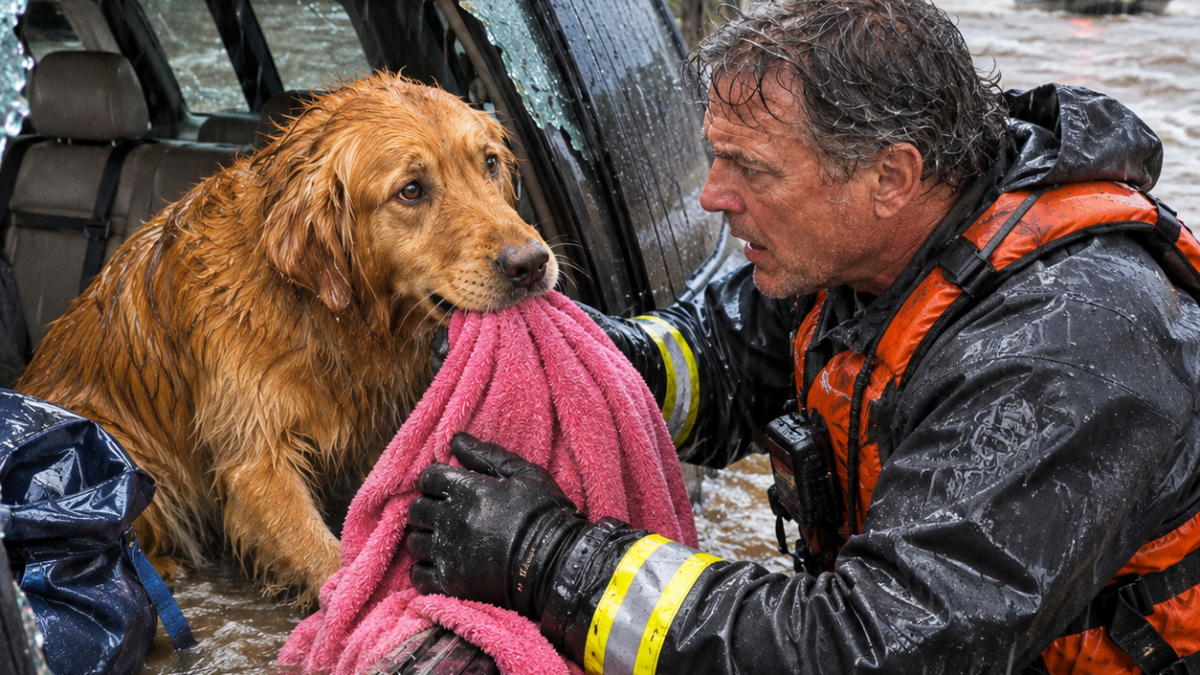
PART 2
She surfaced with a stuffed rabbit in her mouth.
For one confused second, all I could do was stare.
The rabbit had once been white, maybe cream-colored, but now it was brown with floodwater. One plastic eye was missing. Its soaked ears hung from either side of the dog’s mouth.
“You went back for a toy?”
The Golden Retriever shoved the rabbit against my forearm.
Then barked directly into my face.
Once.
Twice.
Not frantic this time.
Demanding.
I had worked around dogs my whole adult life, both on rescue scenes and at home, and I knew the danger of pretending animals thought exactly like humans.
But I also knew communication when I saw it.
She wasn’t asking me to admire the rabbit.
She was telling me I was missing something.
The dog dropped it.
The toy floated beside my shoulder.
Then she turned toward the rear floorboard.
She disappeared beneath the water again.
I leaned farther through the broken window.
The inside of the SUV was nearly dark.
Mud covered everything.
A diaper bag floated upside down between the seats.
A pink sippy cup bumped repeatedly against the center console.
Then I saw the infant car-seat base mounted on the far side of the rear bench.
My stomach tightened.
“Mateo!”
“What?”
“Car seat!”
He couldn’t hear clearly through the water and rain.
I shouted louder.
“INFANT SEAT BACK HERE!”
“Child?”
“I don’t know!”
The base looked empty.
Loose shoulder straps floated above it.
A yellow buckle tapped against the plastic.
I reached through.
Nothing.
No child.
For a brief moment, relief hit me.
Maybe whoever had been driving had already taken the baby.
Then the Golden Retriever surfaced again.
This time she had a corner of a pink blanket clamped between her teeth.
She pulled backward.
The blanket stretched beneath the muddy water.
Not floating.
Caught on something.
The dog braced both paws against the rear seat and pulled again.
I reached down.
My fingertips brushed fabric.
Then plastic.
A curved handle.
Every muscle in my body went cold.
The infant seat on the bench wasn’t an infant seat.
It was only the base.
The detachable carrier had broken loose during the impact.
It had fallen into the rear footwell.
Upside down at an angle.
Half-submerged.
Held beneath the seat by a twisted belt and some part of the locking mechanism.
“Oh, God.”
I shoved the diaper bag aside.
Reached deeper.
For half a second, muddy water hid everything.
Then the SUV rocked.
A tiny face appeared beneath the rim of the carrier.
Baby girl.
Maybe eight months old.
Wet brown hair plastered across her forehead.
Eyes closed.
Her head had fallen sideways against the padding.
The water was rising around her cheek.
I couldn’t see her chest moving.
“No.”
The dog pressed her muzzle against the carrier.
Then looked at me.
The whole scene rearranged itself in my head.
The three barks.
The rabbit.
The blanket.
The refusal to leave.
She hadn’t fought me because she was frightened.
She had fought me because I was taking her away from the baby.
“I see her.”
The words came out like a promise.
“I see her now.”
The Golden Retriever whined.
I reached for the carrier handle.
It moved half an inch.
Then stopped.
Something had it locked down.
I reached deeper.
My arm disappeared up to the shoulder.
The water inside the SUV was almost to my chin.
My fingers found webbing.
Seat belt.
Twisted.
Pulled impossibly tight by the weight of the carrier.
I grabbed the rescue knife clipped to my vest.
“Hammer!”
Mateo again.
“What?”
“Vehicle moved!”
“I know!”
“You have maybe two minutes!”
“Then give me two minutes!”
I slid the knife under the belt.
The Golden Retriever was beside me now, balancing against the rear seat.
“Back up.”
She didn’t.
“Come on. Give me room.”
Nothing.
Her nose stayed pressed near the baby.
I cut.
The belt fibers resisted.
I sawed harder.
The SUV lurched.
My chest slammed into the window frame.
The damaged guardrail bent another few inches.
Water surged through the vehicle.
The baby’s face disappeared.
“NO!”
I plunged both arms inside.
The Golden Retriever dove with me.
My knife found the belt again.
Cut.
Cut.
Cut.
It snapped.
The carrier shifted.
But still didn’t come free.
Something else held it.
I yanked upward.
Nothing.
The locking clip.
The carrier had twisted during the crash and jammed beneath the front seat rail.
I couldn’t see it.
I’d have to go under.
My hands stopped.
For less than one second.
But they stopped.
And suddenly I wasn’t standing beside an SUV outside Nashville.
I was forty-one years old again.
Inside a flooded drainage culvert.
Black water.
A broken rescue line.
My partner Cal shouting my name.
Then silence.
The memory hit me so violently that I couldn’t breathe.
Fifteen years earlier, during another flash flood, Cal Mercer and I had gone after a teenager trapped inside a pickup washed from a bridge.
The boy survived.
Cal didn’t.
A secondary surge came down the creek while we were inside the vehicle.
The truck rolled.
My line caught.
Cal cut me loose.
Then the current took him.
They found his body almost two miles downstream.
For years, people told me there was nothing I could have done.
I knew that.
Logically.
But fear isn’t logical.
After Cal died, water changed for me.
I still worked flood calls.
Still did my job.
But I never volunteered for swift-water operations again.
Never admitted why.
I retired with everyone believing fire had been the thing that scared me most.
It wasn’t.
Fire made sense.
Fire moved.
Consumed.
Cracked.
Warned you.
Water smiled.
Water looked flat until it pulled your feet out.
Water carried people away without making a sound.
And now a baby was under it.
The Golden Retriever surfaced.
She barked directly against my ear.
I blinked.
The past vanished.
There was the SUV.
The baby.
The dog.
Now.
Not Cal.
Not fifteen years ago.
Now.
I took one breath.
Then another.
“Okay.”
I looked at the dog.
“I’m going under.”
She whined.
“I know.”
I hooked one elbow through the window frame.
Then submerged my head.
Everything became brown.
Cold.
Metal against my shoulders.
I couldn’t see more than a few inches.
I worked by touch.
Carrier.
Handle.
Blanket.
Tiny leg.
Then the seat rail.
My hand followed the carrier shell downward.
There.
A twisted metal latch had caught beneath the front seat mount.
I pulled.
Nothing.
My lungs tightened.
I surfaced.
Mateo shouted something.
I couldn’t hear.
I inhaled.
Went down again.
The dog dove too.
Her body brushed my shoulder.
I found the latch.
Pushed.
Wrong direction.
Pulled.
Nothing.
My chest started burning.
Cal’s face appeared again.
Not now.
I forced it away.
I turned my wrist.
Felt something release.
The carrier shifted.
I pulled.
It rose six inches.
Then caught again.
The Golden Retriever grabbed the pink blanket and pulled.
I almost laughed underwater.
Of course she did.
I found the remaining strap.
Cut it.
The carrier came free.
I surfaced with it.
“GOT HER!”
The rescue line tightened.
Someone on shore cheered.
Too soon.
The baby’s face was gray.
Her lips were bluish.
“Come on.”
I pulled the carrier through the broken window.
It barely fit.
The Golden Retriever tried to follow.
“Stay with me!”
The SUV lurched again.
The tree limb under the bumper cracked.
The sound was unmistakable.
“Hammer!” Mateo screamed. “MOVE!”
I ripped the baby from the carrier.
She was limp.
I held her against my chest with one arm.
Grabbed the rescue line with the other.
The dog forced herself through the window.
“Pull!”
The Iron Harbor Riders hauled.
Water slammed us sideways.
The SUV moved.
The guardrail tore loose.
For one impossible second, the vehicle floated.
Then the front end swung toward the creek.
The broken window disappeared beneath water.
The Golden Retriever lost her footing.
“NO!”
I caught a fistful of wet fur at her shoulder.
The line jerked my body backward.
Baby against my chest.
Dog under one arm.
Current around my waist.
The SUV spun away.
Ten seconds later it vanished into the creek.
I watched its taillight disappear under brown water.
If we had been thirty seconds slower, we’d have gone with it.
But the baby wasn’t breathing.
“Mateo!”
He reached us first.
“Give her to me!”
I placed the child in his arms.
He looked at her face.
“Nothing.”
“Get her up!”
Men pulled us toward higher pavement.
The Golden Retriever fought the entire way.
Not to escape.
To stay near the baby.
“Let her come!”
We reached the road.
Mateo dropped to his knees.
I took the baby.
Tiny.
Cold.
Too cold.
No obvious pulse.
“Call EMS!”
“Already coming!”
I opened her airway.
Water and mucus at the mouth.
I cleared it.
Nothing.
I began infant CPR.
Two fingers.
Thirty compressions.
Breathe.
Again.
The Golden Retriever crawled toward us.
One of the riders tried to hold her back.
“No!”
I shouted.
“Let her.”
The dog stopped inches from the baby’s feet.
She trembled violently.
Not from cold alone.
Thirty compressions.
Two breaths.
Nothing.
“Come on, sweetheart.”
Again.
The rain beat against the pavement.
Someone held a jacket over us.
I could barely feel my hands.
“Come on.”
Compress.
Compress.
Compress.
The Golden Retriever started whining.
Soft.
Continuous.
I gave another breath.
The baby coughed.
I froze.
Then she coughed again.
Water spilled from her mouth.
“Turn her!”
We rolled her slightly.
She gasped.
The sound was weak.
But it was a sound.
Mateo laughed.
Actually laughed.
“There you go!”
The baby’s chest moved.
Shallow.
Fast.
Then she cried.
Not loudly.
A thin, angry, exhausted cry.
It was the most beautiful sound on that flooded road.
The Golden Retriever surged forward.
She licked the baby’s bare foot once.
Then sat down.
Just sat.
As if that was all she had been waiting for.
I looked at her.
“You knew.”
She stared back.
“You knew she was there.”
Sirens approached.
The dog leaned against my shoulder.
For the first time, she let herself be rescued.
The ambulance arrived within three minutes.
Paramedics took the baby.
I followed them to the stretcher.
“She was submerged?”
“Partially. Unknown duration. Pulseless or too weak to detect when extracted. CPR started immediately. She coughed after approximately ninety seconds.”
“Age?”
“Eight, nine months maybe.”
“Parents?”
“Unknown.”
“Name?”
“Unknown.”
They loaded her.
The Golden Retriever tried to climb into the ambulance.
A paramedic blocked her.
“No animals.”
The dog panicked.
She scratched at the step.
“Wait.”
Everyone looked at me.
“She saved that baby.”
“Sir—”
“She is the reason we found her.”
The paramedic hesitated.
Hospital rules.
Transport rules.
Logic.
Then the baby cried from inside.
The Golden Retriever stopped fighting.
Her entire body leaned toward the sound.
The paramedic looked at me.
“Animal control can follow.”
“I’ll take her.”
He nodded.
“Meet us at Vanderbilt.”
The ambulance pulled away.
The dog ran three steps after it.
I caught her collar.
She turned on me.
Not aggressively.
Desperately.
“I know.”
She pulled.
“I know where she’s going.”
Her eyes stayed on the ambulance.
“I swear to you.”
For some reason, that promise mattered to me.
I wrapped my arms around her chest.
This time she didn’t fight.
She shook against me.
My own hands were shaking too.
Mateo walked over.
“You okay?”
“Yeah.”
“You disappeared for a second back there.”
I knew what he meant.
“I’m fine.”
He looked at me.
Twenty years of friendship gives people permission not to believe you.
“Cal?”
I turned.
“How the hell—”
“I’ve known you fourteen years, Hammer.”
The dog leaned harder against me.
Mateo lowered his voice.
“You went under anyway.”
“Had to.”
“No.”
He looked toward the road where the ambulance had disappeared.
“You chose to.”
I didn’t want to talk about it.
Not then.
“Need to find whoever was driving.”
Mateo nodded.
That was the next problem.
A baby doesn’t arrive inside a flooded SUV alone.
We called the sheriff’s department.
Search teams were already moving along the creek.
The driver’s door of the SUV had been partly open when we first reached it, something I hadn’t noticed because all my attention had been on the dog.
That meant an adult might have escaped.
Or been thrown.
Or been swept away.
A deputy asked for anything we’d seen inside.
“Women’s jacket in front.”
“Color?”
“Green.”
“Purse?”
“Didn’t notice.”
“Phone?”
“No.”
The Golden Retriever paced beside me.
“What about the dog?”
“No tag.”
The collar was pink.
Mud covered it.
I wiped it clean.
There was a metal tag.
One side read:
SADIE.
The other had a phone number.
“Got a name.”
The deputy entered the number.
Tried calling.
We heard ringing.
Not from a pocket.
From somewhere downstream.
Everyone turned.
A faint electronic sound drifted from the flooded ditch.
One of the riders pointed.
“There.”
A phone was caught in debris near the guardrail.
The deputy retrieved it.
Screen cracked.
Still working.
Emergency contact information accessible from the lock screen.
ERIN WALKER.
Medical ID.
Age thirty-two.
Emergency contact: MICHAEL WALKER, HUSBAND.
The deputy called.
A man answered on the second ring.
I couldn’t hear his words.
I watched the deputy’s face.
“Mr. Walker? This is Deputy James Cole with Davidson County. Do you know where your wife is?”
Pause.
The deputy’s expression tightened.
“No, sir. Listen carefully. Her vehicle was involved in a flood incident.”
Even from ten feet away, I heard the man’s voice rise through the phone.
The deputy stepped aside.
I looked at Sadie.
She stared downstream.
Not toward the ambulance anymore.
Toward the creek.
Then she barked.
Three times.
Pause.
Three times.
The same pattern.
My stomach tightened.
“Mateo.”
He saw it too.
“She’s looking for someone.”
I followed Sadie’s gaze.
The road curved.
Beyond the broken guardrail, floodwater rushed through trees and brush toward the creek.
Search crews were working both banks.
“Sadie.”
Her ears moved.
“Where’s Erin?”
The name meant something.
Sadie pulled against me.
Hard.
“She’s reacting.”
The deputy looked over.
“Could be coincidence.”
“Maybe.”
Sadie pulled again.
Downstream.
“I don’t think it is.”
We followed.
Not into the main current.
Along higher ground beside it.
Sadie moved as fast as her exhausted body allowed.
Every thirty yards she stopped.
Sniffed.
Listened.
Then continued.
“Search team has this section,” the deputy said.
“Tell them the dog may be tracking.”
He radioed ahead.
For nearly ten minutes, nothing happened.
Then Sadie stopped.
She stared toward a cluster of sycamores.
Barked.
Three times.
Silence.
Then a voice.
So faint I thought I imagined it.
“Help.”
Sadie exploded forward.
“Hold her!”
We scrambled down the bank.
Branches tore at my arms.
Water covered the lower ground.
“Hello!”
A woman answered.
“Here!”
We found her wedged between two fallen trees approximately half a mile downstream.
Green jacket.
Face white with cold.
Blood along one temple.
One leg pinned beneath a branch.
She was conscious.
Barely.
Sadie nearly dragged me into the water trying to reach her.
“Erin?”
The woman’s eyes opened.
She saw the dog.
“Sadie.”
One word.
Sadie’s entire body changed.
She whined so loudly it sounded like crying.
Erin tried to lift herself.
“Lucy?”
I knelt.
“Your baby?”
Her face crumpled.
“Lucy. The car. Sadie—”
“Lucy is alive.”
Erin stopped breathing.
“What?”
“She’s alive.”
Her mouth opened.
No sound came out.
“The dog showed us where she was.”
Erin started sobbing.
“Lucy?”
“Ambulance took her to Vanderbilt.”
Erin covered her face.
Then screamed from the pain in her trapped leg.
“We need cutters!”
The search team arrived.
Hydraulic spreader.
Saw.
Medical kit.
Sadie refused to leave.
Erin reached one hand toward her.
The dog put her chin into it.
“She stayed,” Erin whispered.
I crouched beside her.
“What happened?”
“Road looked shallow.”
She started shaking harder.
“Then water hit us. Car spun. I tried to get Lucy. Something broke. Door opened. Current pulled me out.”
She looked at Sadie.
“I screamed at her to stay with Lucy.”
That sentence hit me.
“You told her?”
“I grabbed the door. Sadie was in back. I yelled, ‘Stay with Lucy.’”
Erin’s eyes filled.
“Then I lost the car.”
I looked at the dog.
She had obeyed.
Through a crash.
Floodwater.
A sinking vehicle.
A broken window.
A stranger trying to drag her away.
She had stayed with Lucy.
Not because she couldn’t escape.
Because Erin told her where she was needed.
The rescue crew freed Erin.
Her leg wasn’t broken, but badly bruised and cut.
Severe hypothermia.
Possible concussion.
They loaded her onto a litter.
Sadie walked beside her until the ambulance.
This time, nobody argued about the dog.
One medic opened the side compartment area and said, “She can ride with the deputy following us.”
Erin grabbed my sleeve before they loaded her.
“Are you the one who got Lucy out?”
I looked at Sadie.
“We both did.”
Erin shook her head.
“You don’t understand.”
“Understand what?”
“Sadie hates water.”
I stared.
“What?”
“She won’t even swim in our pool.”
I laughed once.
It didn’t make sense.
Then it did.
Courage isn’t the absence of fear.
I’d said that to rookies for decades.
I’d believed it when talking about fires.
About heights.
About entering buildings.
But somehow I’d forgotten it applied everywhere.
Sadie hated water.
And still stayed inside a sinking SUV because Lucy was there.
The ambulance left.
Mateo stood beside me.
“Well.”
I knew what was coming.
“Don’t.”
“You hear what she said?”
“Mateo.”
“Dog hates water.”
“Yeah.”
“And went back.”
I turned on him.
“I know.”
He softened.
“So did you.”
That shut me up.
I spent the rest of the afternoon at the hospital.
I didn’t need to.
I told myself I was there because Sadie had been transported to an emergency vet nearby and someone needed to coordinate.
That was partly true.
Mostly, I needed to know whether Lucy survived.
Michael Walker arrived first.
He ran through the emergency entrance wearing work boots and a fluorescent construction jacket.
I recognized him from the deputy’s call.
“Lucy Walker?”
A nurse directed him.
He saw me because Deputy Cole pointed.
Michael crossed the waiting room.
“You found her?”
“Your dog did.”
He grabbed me.
Not a handshake.
A hug.
Hard.
“Thank you.”
I stood awkwardly.
“Sadie found her.”
He stepped back.
“Where’s Erin?”
“Coming in. Conscious.”
His knees almost gave out.
“Both?”
“Yes.”
He covered his face.
For several seconds, a grown man stood in the middle of a hospital waiting room and cried into his hands.
Then he looked at me.
“What happened?”
I told him.
Not all at once.
The broken window.
Sadie fighting me.
The rabbit.
The blanket.
The carrier.
Michael began crying again when I mentioned the rabbit.
“What?”
I stopped.
He swallowed.
“That rabbit is Lucy’s.”
“I figured.”
“No.”
He shook his head.
“Sadie brings it to her every night.”
I looked at him.
“When Lucy cries, Sadie gets the rabbit.”
Something cold ran up my spine.
That’s why she brought it to me.
She wasn’t rescuing a toy.
She was giving me Lucy’s identifier.
Her signal.
Baby.
Rabbit.
Lucy.
I sat down.
Michael did too.
He stared at the floor.
“We almost gave Sadie away.”
I turned.
“What?”
“Before Lucy was born.”
Of course.
Stories have a way of repeating themselves in different clothes.
“She was too energetic. Dug up the yard. Chewed furniture. My wife was pregnant. We thought it would be too much.”
“What changed?”
“Erin refused.”
He smiled weakly.
“Said Sadie was family.”
I thought about the Golden Retriever fighting me in floodwater.
“Your wife was right.”
“Yeah.”
A doctor came out.
“Family of Lucy Walker?”
Michael stood.
The doctor walked him aside.
I remained seated.
Didn’t want to intrude.
But I watched Michael’s shoulders.
At first rigid.
Then dropping.
Then his hands covering his face.
The doctor smiled.
That told me enough.
Lucy had aspirated water.
She needed monitoring for respiratory complications.
Mild hypothermia.
Bruising.
No major head injury.
But she was awake.
Crying.
Angry.
Alive.
Erin arrived twenty minutes later.
Her stretcher stopped outside Lucy’s treatment room.
Mother and child saw each other through an open doorway.
Erin broke.
So did Michael.
I left.
Some moments belong to families.
Outside, rain still fell.
Lighter now.
I stood under the hospital overhang and realized my hands were shaking again.
Not from cold.
Mateo found me.
He always did.
“You vanished.”
“Family’s together.”
“Baby okay?”
“Looks like it.”
“Mother?”
“Cold, cut up. Alive.”
He nodded.
“Dog?”
“Vet.”
“You?”
“Fine.”
“Liar.”
I didn’t answer.
Mateo leaned against the wall.
“You never told me exactly what happened with Mercer.”
“Yes, I did.”
“You told me the report.”
There is a difference.
I stared at the parking lot.
“He cut my line.”
Mateo waited.
“Truck rolled. My line wrapped around the axle. Current was pulling me under. Cal had maybe five seconds.”
“You told me.”
“He cut me free.”
“And got swept away.”
“Yes.”
“What part didn’t you tell me?”
I swallowed.
“When I surfaced, I saw him.”
Mateo said nothing.
“Maybe twenty feet away. He grabbed a tree branch.”
I had never said this out loud.
“Then the branch broke.”
My throat tightened.
“I could’ve gone after him.”
“You were injured.”
“I could have.”
“You don’t know that.”
“I froze.”
There.
Fifteen years.
One word.
“I froze.”
Mateo stared at the rain.
“For how long?”
“I don’t know. Three seconds. Five.”
“Hammer.”
“Long enough.”
“You think that’s why he died?”
“I don’t know.”
“Yes, you do.”
I looked at him.
Mateo had the same expression captains used when a rookie was lying about being okay.
“Say it.”
“I think if I’d moved sooner—”
“No.”
“You don’t know.”
“Neither do you.”
He stepped closer.
“But you made yourself judge, jury, and executioner anyway.”
I hated him then.
Only for a moment.
Because he was right.
“I stayed away from swift water after that.”
“I noticed.”
“You never said.”
“Wasn’t my business.”
“It was cowardice.”
“No.”
“It felt like it.”
Mateo nodded.
“Fear usually does.”
I looked at him.
He pointed toward the road.
“You went under a sinking SUV today.”
“For a baby.”
“Exactly.”
“What does that prove?”
“That whatever you thought Cal’s death turned you into, it didn’t.”
I looked away.
Mateo continued.
“And before you start with the tough-guy nonsense, I’m not saying you conquered water.”
“Good.”
“I’m saying you stopped letting one day define every day after it.”
That stayed with me.
The following morning, I visited Sadie at the veterinary hospital.
She had cuts on two paws.
A bruised rib.
Water in one ear.
Mild exhaustion.
Otherwise fine.
The technician opened the kennel.
Sadie came straight toward me.
I braced for impact.
She stopped.
Sniffed my hands.
Then looked behind me.
Looking for Lucy.
“Not here.”
Her ears dropped.
“She’s okay.”
I don’t know whether she understood.
I showed her the stuffed rabbit.
I’d retrieved it from the roadway before leaving.
Cleaned now.
Still missing one eye.
Sadie grabbed it gently.
Then sat.
“Yeah.”
I scratched behind her folded ear.
“You knew exactly what you were doing.”
She put the rabbit in my lap.
A few hours later, Michael came to get her.
He brought Lucy’s hospital blanket.
The moment Sadie smelled it, she became frantic.
Whining.
Circling.
Michael crouched.
“She’s okay.”
Sadie jumped against his chest.
Then ran to the clinic door.
Michael laughed through tears.
“She wants to see her.”
Hospital rules didn’t allow it.
Not inside.
But someone made arrangements.
The following afternoon, Lucy was transferred to a room with a ground-floor courtyard outside.
Erin was discharged from the emergency department but remained at the hospital with her.
The staff allowed five minutes.
Sadie entered the courtyard.
Lucy was in Erin’s arms.
The dog stopped.
Every muscle in her body went still.
“Sadie.”
Erin’s voice.
The Golden Retriever walked forward.
Slowly.
No pulling.
No jumping.
She reached Erin’s knees.
Then lifted her nose.
Lucy made a small sound.
Sadie’s tail moved.
Once.
Then violently.
Her whole body began wagging.
Lucy reached out.
Tiny hand.
Sadie lowered her head.
The baby grabbed one wet-looking ear.
Sadie didn’t move.
Erin cried.
Michael cried.
I stood by the door pretending I had something in my eye.
Erin looked at me.
“Come here.”
“I don’t want to interrupt.”
“You are part of this.”
I stepped closer.
Lucy looked at me.
No recognition.
Why would there be?
To her, I was just another large gray-haired stranger.
Sadie knew.
She leaned against my leg.
Erin smiled.
“She trusts you.”
“She assaulted me first.”
Michael laughed.
“That’s basically how she makes friends.”
Erin’s expression changed.
“Tell me exactly what she did.”
So I did.
The barks.
The window.
Her fighting me.
The rabbit.
The blanket.
The carrier.
The diving.
When I described her going back into the SUV after I tried to remove her, Erin covered her mouth.
“I told her to stay.”
“I know.”
“I didn’t think—”
“You were being swept away.”
“I thought she might have gotten out.”
“She could have.”
Erin stared at Sadie.
“But she stayed.”
“Yes.”
The dog rested her chin on Erin’s knee.
“She always sleeps outside Lucy’s room.”
Michael looked at her.
“What?”
“You complain about it.”
“I thought she liked the hallway vent.”
Erin laughed.
“No. She watches the nursery.”
I looked at Sadie.
Some dogs guard because they’re trained.
Others decide for themselves what belongs to them.
Lucy clearly belonged to Sadie.
The story reached local news two days later.
Not because I contacted anyone.
One of the paramedics mentioned it.
Someone had filmed part of the rescue from shore.
The video showed only fragments.
Me at the SUV.
The line.
The dog.
Then the vehicle breaking free moments after we reached shore.
The headline called me a hero.
I hated that.
They called Sadie a hero too.
That part I didn’t mind.
A reporter came to the motorcycle clubhouse.
“Hammer, can you describe what went through your mind when you realized there was a baby in the car?”
“No.”
She blinked.
“No?”
“There wasn’t time for thoughts.”
“Were you afraid?”
“Yes.”
That answer surprised her.
People expect retired firefighters to lie.
“Of the SUV?”
“The water.”
She leaned forward.
“Why?”
I could have given her something generic.
Current.
Debris.
Unstable vehicle.
Instead, maybe because of the hospital courtyard, maybe because of Sadie, I told the truth.
“A friend of mine died in a flood rescue fifteen years ago.”
The reporter became quiet.
“Firefighter?”
“Yes.”
“Name?”
“Cal Mercer.”
“And you still went in.”
“I was already in.”
“You went underwater.”
I looked at the camera.
“There was a baby under the seat.”
The reporter waited for a heroic line.
I didn’t have one.
Finally, I said, “Being afraid doesn’t excuse leaving someone there.”
That became the quote they used.
For weeks afterward, strangers sent messages.
Firefighters.
Parents.
People who had survived floods.
People afraid of water.
One message came from Cal’s daughter.
I hadn’t seen her in more than ten years.
Her name was Rachel.
She had been twelve when Cal died.
Now she was twenty-seven.
The message said:
**Dad would have been proud of you.**
I stared at it for almost an hour.
I didn’t answer that night.
Didn’t know how.
The next morning, I wrote:
**I should have done more for him.**
Her reply came quickly.
**You brought him home.**
I stopped.
After Cal’s body was recovered, I had been one of the firefighters who carried the litter from the creek.
I hadn’t thought about that in years.
Rachel continued.
**My mom told me you stayed with him until the funeral home came. She told me Dad saved you because he loved you. Please stop turning the last thing he chose to do into a punishment for yourself.**
That one hurt.
In a necessary way.
I met Rachel for coffee a week later.
She brought something.
Cal’s old rescue knife.
Rust removed.
Handle scratched.
“He had it that day?”
“No. Different one. Mom found this in his gear.”
She pushed it toward me.
“I want you to have it.”
“I can’t.”
“You can.”
“Rachel—”
“You’ve carried the worst part long enough.”
I looked at the knife.
“You sound like your father.”
“So I’ve been told.”
I took it.
Not as forgiveness.
Not exactly.
As permission.
There are things people carry because they believe letting go would betray the dead.
Sometimes letting go is how you honor them.
Lucy left the hospital after four days.
No neurological injury.
No lasting respiratory damage.
The doctors called her recovery remarkable.
Sadie rode home beside her.
Michael sent me a photograph.
Lucy in her car seat.
A brand-new one.
Sadie sitting beside her.
The stuffed rabbit between them.
The Walkers replaced their SUV later that year.
Michael joked that Sadie should approve the vehicle before they bought it.
She did.
They chose one with rear-window child locks, emergency glass tools in both front doors, and a life hammer mounted where Erin could reach it.
They also stopped driving through standing water.
Forever.
Erin became almost evangelical about that.
“Turn around, don’t drown” wasn’t a slogan to her anymore.
It was the difference between a bad inconvenience and a funeral.
She spoke at community safety events.
Showed photographs of the destroyed SUV.
Explained how quickly water rose.
How a road she’d driven hundreds of times became lethal in less than a minute.
And she always ended with Sadie.
Not because people should depend on pets to rescue them.
Because loyalty had bought Lucy time.
I attended one event.
Erin held up the stuffed rabbit.
“This is how the rescuer understood my daughter was still inside.”
Then she pointed at me in the back.
I wanted to disappear.
She smiled.
“And the man who understood is sitting there pretending I can’t see him.”
Everyone turned.
I waved.
Afterward, a young firefighter approached me.
“Mr. Hammer?”
“Just Hammer.”
He looked nervous.
“Can I ask something?”
“You just did.”
He smiled.
“Were you really scared?”
“Yes.”
“When you went underwater?”
“Yes.”
“How do you make it stop?”
I knew exactly what he wanted.
A veteran trick.
Breathing technique.
Training secret.
Some sentence that removes fear.
“There isn’t an off switch.”
His face fell.
“You learn your job.”
I continued.
“You train until your hands can work while your brain is afraid. And you pay attention to when fear is warning you versus when fear is ordering you.”
He frowned.
“What’s the difference?”
“Warning says, ‘This is dangerous.’”
I tapped his chest.
“Ordering says, ‘Run because you can’t handle it.’”
He nodded slowly.
“Danger deserves respect. Fear doesn’t always deserve obedience.”
I wish someone had told me that fifteen years earlier.
Maybe they had.
Maybe I hadn’t been ready to hear it.
A year passed.
Then two.
I stayed close with the Walkers.
Not every week.
Life doesn’t work that way.
Birthdays.
Occasional dinners.
Motorcycle charity rides.
Sadie became a regular guest at the clubhouse, where six grown men who claimed to dislike dog hair competed to give her snacks.
Mateo bought her a leather collar with a tiny Iron Harbor emblem.
Michael laughed.
“You made my dog a club member?”
“She’s braver than half the prospects.”
Sadie wore it constantly.
Lucy grew from the baby in the submerged carrier into a toddler who followed Sadie everywhere.
At two, she called her “Say-dee.”
At three, she could throw the stuffed rabbit across the living room.
Sadie retrieved it every time.
At four, Lucy asked Erin why one of the rabbit’s eyes was missing.
Erin told her.
Not the whole story.
Just enough.
“You and Sadie were in an accident.”
“Was I scared?”
“You were very little.”
“Was Sadie scared?”
Erin looked at me.
We were sitting on their porch.
I answered.
“Yes.”
Lucy frowned.
“But she’s brave.”
“Those things can happen at the same time.”
She thought about it.
Then walked over and hugged Sadie’s neck.
“I’ll protect you now.”
Sadie licked her face.
That photograph ended up framed in their hallway.
By then, Sadie’s muzzle had begun turning white.
Years are unfair that way.
They move faster for dogs.
Lucy kept growing.
Sadie slowed.
At nine, arthritis appeared in her hips.
At ten, she stopped jumping into the SUV.
Michael built a ramp.
At eleven, she developed a heart murmur.
Manageable.
Medication.
Shorter walks.
More sleep.
But every night, she still lay outside Lucy’s bedroom.
Not because anyone asked.
The nursery had become a little girl’s room.
Pink walls replaced by pale green.
Crib replaced by a bed.
Stuffed animals multiplied.
The rabbit remained.
Sadie remained.
One evening, I visited after a club ride.
Lucy was seven then.
Sadie struggled to stand when she heard my voice.
“Don’t.”
She stood anyway.
Walked toward me.
Pressed her head against my leg.
I scratched behind the folded ear.
“Still stubborn.”
Lucy appeared in the hallway.
“She likes you.”
“She tried to drown me the first day.”
Lucy knew the story now.
The age-appropriate version.
“You were taking her away from me.”
“Yes.”
“She was right.”
I laughed.
“Apparently.”
She sat beside Sadie.
“Mom says you saved me.”
“Sadie found you.”
“But you got me out.”
“Yes.”
“Then you both did.”
Children are sometimes better at distributing credit.
I nodded.
“We both did.”
Lucy rested her hand on Sadie’s back.
“Good.”
As Sadie grew older, I began thinking about the end before anyone mentioned it.
That’s what happens after enough animals.
Enough people.
You recognize signs.
Longer sleep.
Slower rising.
Food left unfinished.
The Walkers saw them too.
Nobody talked about it.
Not at first.
Sadie turned twelve in June.
They gave her a small dog-safe cake.
Lucy made a paper crown.
Sadie hated the crown.
Everyone took pictures.
Three months later, she collapsed in the yard.
Michael called me from the emergency vet.
I arrived before I fully understood why.
Maybe because some stories create family where none existed before.
Sadie had advanced heart disease.
Fluid around the lungs.
Medication could help.
Maybe weeks.
Maybe months.
Lucy sat on the floor beside the examination table.
She was old enough to understand too much and young enough to believe love should change the result.
“Can you fix her?”
The veterinarian crouched.
“We can help her feel better.”
“But can you fix it?”
Silence.
Lucy looked at her mother.
Erin cried.
“No, baby.”
Lucy pressed her face into Sadie’s neck.
The dog licked her hair.
I walked into the hallway.
Michael followed.
“I can’t do this.”
I stared at him.
“Yes, you can.”
“No.”
His voice cracked.
“She saved my daughter.”
“I know.”
“How do I decide when—”
He couldn’t finish.
I knew the question.
When does helping become holding on?
Firefighters ask versions of that question too.
Doctors.
Families.
Anyone who loves something mortal.
“You don’t owe Sadie extra suffering because she gave you extra years with Lucy.”
Michael covered his face.
I continued gently.
“You owe her what you’ve always owed her.”
“What?”
“Don’t leave her alone when she’s scared.”
He looked at me.
That was all.
Sadie came home.
Medication bought her four more good months.
Not perfect.
Good.
She walked to the mailbox.
Ate chicken when she could convince Erin it was medically necessary.
Slept beside Lucy.
Visited the motorcycle clubhouse one final time.
Mateo grilled hamburger specifically for her and denied doing so.
Then one January morning, Michael called.
“It’s time.”
I drove over.
Snow had fallen during the night.
Only a little.
Enough to whiten the yard.
Sadie was lying on a blanket in the living room.
Breathing hard.
Lucy sat beside her with the stuffed rabbit.
The same rabbit.
Now repaired twice.
Still missing the original eye.
She placed it beside Sadie’s nose.
“Remember?”
Sadie’s tail moved weakly.
Lucy started crying.
Erin sat behind her.
Michael stood at the window because he couldn’t sit still.
The veterinarian arrived.
Home visit.
No clinic.
No stainless-steel table.
No strange smells.
Sadie would leave from the place she had spent her life protecting.
I knelt.
Her eyes opened.
She looked at me.
For a second, I saw the flooded SUV again.
Dark honey fur soaked against her body.
Three barks.
Rabbit.
Blanket.
Baby.
“You were a pain in the ass that day.”
Her tail moved.
I laughed through the knot in my throat.
“Best decision you ever made.”
Lucy looked at me.
“What decision?”
“To fight me.”
She smiled weakly.
“She won.”
“Yes.”
“She always wins.”
Michael finally sat down.
The vet explained the process.
Lucy asked to stay.
Erin let her.
I respected that.
Death isn’t easier because we hide it from children.
Sometimes being present teaches them that leaving can also be an act of love.
Lucy lay beside Sadie.
Her forehead against the dog’s.
“You saved me.”
Sadie’s breathing remained fast.
“You saved Mommy.”
Technically, Sadie led us to Erin.
Close enough.
“You stayed with me.”
Lucy put one hand on the rabbit.
“I’ll keep him.”
The veterinarian gave the sedative.
Sadie’s muscles slowly relaxed.
Her breathing eased.
For the first time that morning, she looked comfortable.
Michael stroked her chest.
Erin held one paw.
I kept my hand near her shoulder.
Lucy whispered.
“You don’t have to guard me anymore.”
Everyone broke.
Even the veterinarian looked away.
Sadie’s eyes closed.
The final medication went in.
Her chest rose.
Fell.
Rose once more.
Then stopped.
Lucy didn’t scream.
She simply pressed her face against Sadie and cried.
Erin wrapped herself around both of them.
Michael bent over the dog.
I stood because suddenly I couldn’t breathe in the room.
Outside, snow melted where it touched the porch.
I walked into the yard.
Mateo had arrived without telling anyone.
He stood near his truck.
“She gone?”
I nodded.
He came over.
Neither of us said anything for a while.
Then he asked, “You okay?”
“No.”
“Good.”
I looked at him.
“Good?”
“Means she mattered.”
Fair enough.
The Walkers had Sadie cremated.
They kept her ashes beside a photograph taken before the flood.
Not during it.
That mattered to me.
Sadie was more than the worst day of her life.
The photo showed her lying in the backyard with Lucy as a baby asleep against her side.
Underneath, Michael placed a small plaque.
It read:
**SADIE**
**SHE STAYED**
Two words.
Perfect.
The stuffed rabbit went to Lucy’s room.
Years later, when Lucy turned thirteen, she invited me to a school presentation.
The assignment was about courage.
I assumed she had chosen Sadie.
I was right.
But she surprised me.
Her presentation began with a photograph of the flooded SUV.
Then Sadie.
Then me.
I hated that.
She told the story.
How her mother lost control in floodwater.
How Sadie stayed.
How Sadie refused rescue.
How a retired firefighter went underwater.
Then Lucy said:
“People think courage means you’re not scared. But everyone in this story was scared.”
She looked toward me.
“My mom was scared.”
Next slide.
“Sadie was scared of water.”
Next.
“Hammer was scared because his friend died in a flood years earlier.”
I looked at Erin.
She shrugged apologetically.
I had given Lucy permission months earlier when she asked.
Still felt strange hearing it.
Lucy continued.
“Courage wasn’t that they weren’t afraid.”
She paused.
“It was that something mattered more.”
The room was silent.
I looked at this thirteen-year-old girl.
Alive because a dog refused to leave her.
Alive because six bikers held a line.
Alive because an SUV got stuck on a tree branch for a few extra minutes.
Alive because water, for once, didn’t get the final word.
She finished with the stuffed rabbit.
Still missing one eye.
She held it up.
“This is what Sadie brought Hammer because she couldn’t tell him my name.”
I looked down.
“Sometimes someone is trying to tell us something even when they don’t have words.”
Then she placed the rabbit on the desk.
“That’s why we have to pay attention.”
Afterward, I walked outside alone.
Rachel Mercer was waiting.
Cal’s daughter.
Lucy had invited her too.
“You didn’t tell me you were coming.”
“She did.”
Rachel smiled.
“She did a good job.”
“Better than most fire chiefs.”
We sat on a bench.
For several minutes, neither of us spoke.
Then Rachel said, “Dad would have liked that dog.”
“Yeah.”
“He hated Golden Retrievers.”
I laughed.
“What?”
“Too much hair.”
“That sounds like him.”
She handed me something.
A photograph.
Cal and me.
Young.
So young it hurt.
Standing beside Engine 12.
Cal’s arm around my shoulder.
My expression annoyed.
His grin enormous.
On the back, Rachel had written:
**Fear didn’t get the last word.**
I stared at it.
“You’ve been hanging around teenagers.”
“She’s smart.”
I turned the photograph over again.
For almost half my life, I had thought Cal’s death was the moment fear proved something about me.
That I could freeze.
That I could fail.
That underneath all the experience and confidence, there was a coward waiting.
I had punished myself with that belief.
Then Sadie dragged me back into water.
Not literally.
She didn’t know my history.
She didn’t know Cal.
She didn’t know anything about me except that I had broken her window and was trying to take her away from Lucy.
But because she refused to leave, I had a choice.
Back away.
Or go under.
I went under.
That didn’t erase Cal.
Didn’t change the past.
Didn’t prove I had never been afraid.
It proved something more useful.
Fear had never owned me.
I had simply believed it did.
The day my fear underestimated me was the day it began destroying itself.
Not because I became fearless.
Because I learned I could carry fear into the water and still move my hands.
Still cut the belt.
Still reach beneath the seat.
Still come back up holding someone who needed me.
Years later, the county replaced the guardrail where the Walker SUV went into the creek.
They also added flood-depth markers and a permanent warning sign.
I sometimes rode past.
Never stopped.
Then one autumn afternoon, Lucy—now old enough to drive—asked me to take her there.
“You sure?”
“Yes.”
Erin hated the idea.
Eventually agreed.
We parked on dry pavement.
The creek was low.
Calm.
Almost insulting.
Lucy stood beside the new guardrail.
“Where was the car?”
I pointed.
“About there.”
“And Mom?”
“Downstream.”
“Sadie?”
“With you.”
I smiled.
“Mostly fighting me.”
She looked at the water.
“I don’t remember any of it.”
“Good.”
“Sometimes I wish I did.”
“No.”
She turned.
“Why?”
“Some memories aren’t gifts.”
She thought about that.
Then looked toward the creek again.
“But I remember Sadie.”
“That’s the part that matters.”
Lucy reached into her backpack.
The rabbit.
Of course.
Older.
Repaired again.
She held it.
“Mom says I should put this away somewhere safe.”
“Probably.”
“I don’t want to.”
“Then don’t.”
She sat on the guardrail.
“What did you think when you saw my face?”
I sat beside her.
“That I was too late.”
She looked at me.
“Really?”
“Yes.”
“Were you?”
I smiled.
“You’re sitting here arguing with me.”
She smiled back.
“No.”
I looked toward the creek.
“No. Turns out I wasn’t.”
A breeze moved through the trees.
For a second, the surface of the water darkened.
My chest tightened automatically.
Old reflex.
Old fear.
Then it passed.
Not gone.
Probably never gone.
But smaller.
Lucy nudged me.
“You okay?”
Funny.
The baby I’d once given CPR asking whether I was okay.
“Yeah.”
She looked skeptical.
“You sound like Mateo.”
“That’s insulting.”
She laughed.
We sat there until sunset.
Before leaving, Lucy stood and walked toward the warning sign.
She touched its metal post.
“Do you think Sadie knew she might die?”
I took my time answering.
“I don’t know what dogs understand about death.”
“But she knew it was dangerous.”
“Yes.”
“And stayed.”
“Yes.”
Lucy looked down at the rabbit.
“Why?”
I could have said instinct.
Training.
Attachment.
Pack behavior.
All true possibilities.
Instead, I gave her the answer I believed.
“Because you were hers.”
She wiped one eye.
Then laughed at herself.
“I hate crying.”
“Runs in your family.”
“You cried?”
“No.”
She stared.
I surrendered.
“A little.”
“Mom said you sobbed.”
“Your mother exaggerates.”
Lucy smiled.
Then placed the rabbit back in her backpack.
We returned to the truck.
Before opening the door, she stopped.
“Hammer?”
“Yeah?”
“Thank you for going back.”
I knew she meant underwater.
The carrier.
The seat belt.
The place I had almost stopped looking.
I shook my head.
“Thank Sadie.”
“I did.”
She stepped closer.
“But she needed you.”
That sentence followed me home.
Because maybe that was the whole story.
Sadie needed me.
Lucy needed Sadie.
Erin needed search crews.
I needed Mateo.
And fifteen years earlier, I had needed Cal.
People like to imagine rescue as one brave person saving someone helpless.
It almost never works that way.
Rescue is a chain.
One person holds the rope.
Another enters the water.
Someone calls 911.
Someone spots the vehicle.
Someone refuses to leave.
Someone keeps barking.
Someone cuts the strap.
Someone gives compressions.
Someone remembers a name.
Someone waits at the hospital.
Someone comes back years later and reminds you that surviving isn’t the same as owing a debt.
Sadie was one link.
So was I.
The reason Lucy lived was not that one hero appeared.
It was that nobody in that chain let go.
The Iron Harbor Riders still tell the story sometimes.
They exaggerate, naturally.
Mateo claims the SUV was completely underwater.
It wasn’t.
Mercer says I punched a tree.
I did not.
Someone usually says Sadie bit me.
She didn’t.
She only hit me in the chest hard enough to bruise a rib.
But when they reach the part where she went back through the window, everyone gets quiet.
Because that part needs no exaggeration.
She had safety in front of her.
My arms around her.
A line to shore.
Dry land forty yards away.
And she chose the sinking SUV.
Not because she wanted to die.
Because Lucy was still inside.
That’s the difference between recklessness and courage.
Recklessness ignores what matters.
Courage knows exactly what matters and accepts the cost.
Sadie accepted it.
Then demanded the rest of us do our part.
I keep two things in my garage now.
Cal’s rescue knife.
And a photograph of Sadie beside Lucy’s hospital wheelchair.
In the picture, Lucy is tiny.
Sadie’s head is resting against her leg.
On the back, Erin wrote:
**She wouldn’t leave her.**
Whenever someone asks me what the most heroic thing I witnessed in twenty-seven years as a firefighter was, they expect flames.
A firefighter carrying someone from a second floor.
A dramatic collapse.
Something loud.
I think about floodwater.
A Golden Retriever.
Three barks.
A stuffed rabbit with one missing eye.
I think about how close I came to pulling Sadie away and leaving.
How close I came to believing the empty base was the whole car seat.
How close I came to deciding there was nothing else beneath the water.
Then I remember her eyes.
She looked at me like I was the stupidest man alive.
Maybe I was.
Because she understood something before I did.
The rescue wasn’t finished.
Someone was still missing.
That lesson stayed with me long after the flood receded.
Don’t stop looking because the obvious answer is convenient.
Don’t assume silence means nobody is there.
Don’t confuse fear with a command.
And when someone who cannot speak keeps telling you that you’re missing something, pay attention.
Sadie did not save Lucy alone.
Neither did I.
But if that dog had accepted the rescue I offered her, Lucy would have disappeared downstream inside that SUV.
Instead, Sadie fought me.
She went back.
She brought me the rabbit.
She brought me the blanket.
She led me to the child.
And when I hesitated before going under, she dove first.
A dog who hated water.
That fact will follow me forever.
People sometimes ask whether animals understand sacrifice.
I don’t know.
Maybe that’s the wrong question.
Maybe sacrifice doesn’t require understanding it as a concept.
Maybe it only requires knowing that someone you love is still in danger.
Sadie knew that.
She knew Lucy was there.
She knew leaving without her was impossible.
Everything after that was simply action.
Years later, when Sadie took her last breath with Lucy beside her, the flood was far behind us.
No sirens.
No current.
No shattered glass.
No desperate barking.
Just a family gathered around an old Golden Retriever who had once refused to save herself until everyone else was safe.
Lucy told her she didn’t have to guard anymore.
And for the first time since I had known that dog, Sadie finally listened.
She let go.
Her job was finished.
The baby she once refused to leave had grown into a girl strong enough to hold her at the end.
Erin was alive.
Michael was there.
The rabbit was safe.
And the old firefighter who had once believed water had taken the best part of him had finally learned something from a dog who was afraid of it too.
Fear can follow you for years.
It can learn your name.
It can memorize your worst memory.
It can convince you that one moment of helplessness is proof of who you are forever.
But fear makes one mistake.
It assumes that because you were afraid yesterday, you will obey it tomorrow.
Sadie didn’t.
Neither did I.
And on that flooded road outside Nashville, with an SUV disappearing into brown water and a baby hidden beneath a seat where I had almost stopped looking, my fear finally discovered that it had spent fifteen years haunting a man who could still move.
I went under afraid.
I came back up afraid.
The difference was that this time, I came back holding Lucy.
And Sadie came with us.
That was enough.








