PART 2: THE FLOOD WAS AT HIS NOSE—THEN I SAW THE CHAIN AROUND HIS NECK
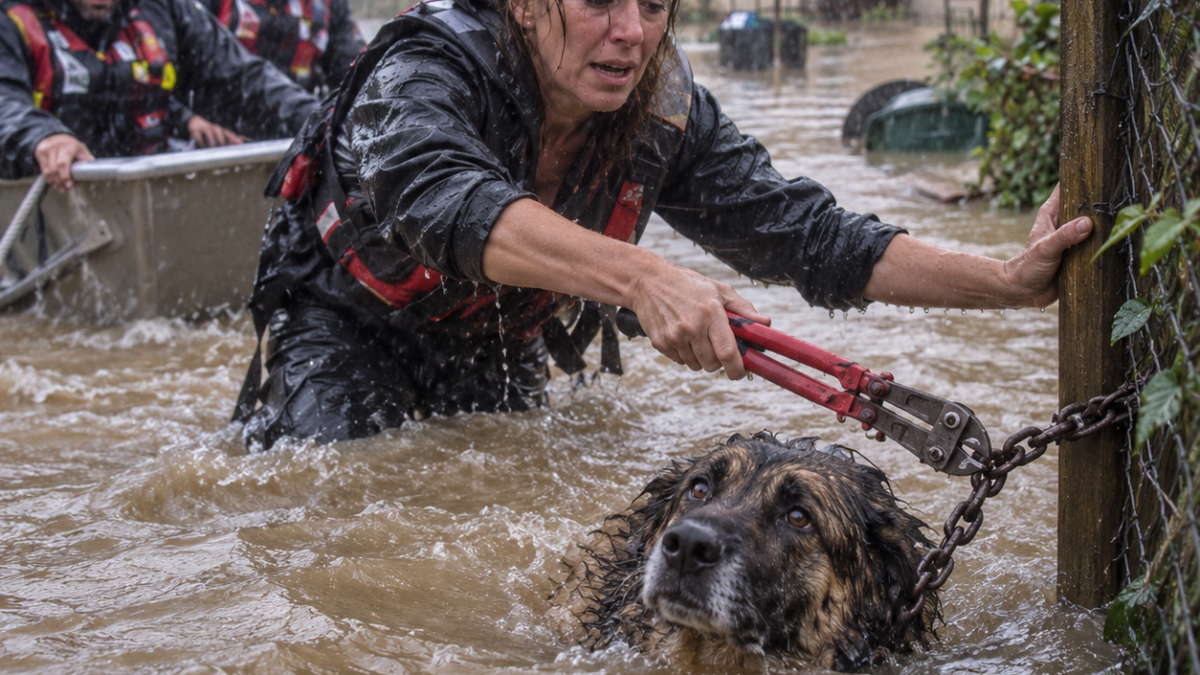
The dog had only inches of air left when our rescue boat turned into the flooded yard, and then I saw the chain around his neck disappear beneath the brown water.
He tried to come toward us once, but the chain snapped tight and dragged his muzzle under.
What happened in the next few seconds would stay with me long after the floodwater was gone.
My name is Maëlle Bernard, and I was thirty-nine that summer, volunteering with emergency crews after violent flooding tore through several villages in the Var region of southern France.
By then, I thought I understood what a flood could take.
We had passed homes with water halfway up the windows, cars floating crooked against stone walls, kitchen chairs drifting through streets, and families standing at upstairs windows waiting for rescue.
But I had never seen an animal waiting to drown because someone had made sure he couldn’t escape.
The rain had stopped before sunrise, yet the water was still rising.
Malik Benali, a forty-six-year-old firefighter with more than twenty years of experience, was steering our small rescue boat. Lucas Moreau, a twenty-seven-year-old emergency responder, crouched near the bow with a rope coiled beside him.
Nobody talked much anymore.
Every house had its own tragedy.
A child’s red ball drifted between two nearly submerged mailboxes.
A suitcase bumped against a gate.
A framed family photograph floated facedown through somebody’s kitchen.
We were moving toward another row of homes when I heard something.
Not barking.
A rough, choking sound.
“Stop.”
Malik cut the throttle.
For a moment there was only the slap of water against the aluminum hull.
Then we heard it again.
A cough.
And metal scraping against metal.
Lucas pointed toward a beige house with green shutters.
Its driveway had vanished beneath muddy water. A basketball hoop leaned over what had once been a garden.
Then I saw him.
A large black-and-tan German shepherd mix stood beside the fence.
Or tried to.
The water reached his neck.
His ears were pinned back, his gray muzzle was soaked, and his brown eyes followed our boat with an exhausted concentration that made my stomach turn.
Around his neck was an old leather collar.
Attached to it was a heavy chain.
The other end disappeared underwater and wrapped around a fence post.
Lucas stared.
“He’s chained.”
I was already reaching for the bolt cutters.
The dog tried to bark when we came closer.
Water entered his mouth.
The bark collapsed into coughing.
“Easy, big guy,” I called. “We see you.”
His eyes locked on mine.
That was the moment everything else vanished.
I stopped hearing the engine.
Stopped noticing the floating branches.
All I could see was the narrow strip of air between the water and that dog’s nose.
Malik studied the current crossing the yard.
“It’s moving faster than it looks.”
“I know.”
Lucas reached for the safety rope.
“I’m going with her.”
Malik shook his head.
“One person in the water. One on the line. If she loses her footing, you pull.”
I clipped the rescue line around my waist.
Then I climbed over the side.
The water hit harder than I expected.
From the boat, it had looked almost calm.
Inside it, the current shoved at my legs like a living thing.
Mud moved beneath my boots. Broken branches brushed against my knees.
Malik kept tension on the rope while Lucas leaned over the bow.
The dog watched me coming.
He was trembling so badly that ripples spread around his neck.
“I’m coming,” I said. “Just keep your head up.”
I was perhaps twelve feet away when his front paws slipped.
His body dropped.
His muzzle vanished beneath the water.
The chain jerked tight.
“No!”
I lunged.
The current caught me sideways.
My knee struck something hard beneath the surface, but I kept moving.
For one terrible second, there was nothing where the dog’s head had been except muddy water and bubbles.
Lucas shouted my name.
I reached beneath the surface and found fur.
My fingers closed around the dog’s collar.
I pulled upward with everything I had.
His head broke through the water.
He sucked in one ragged breath.
Then the chain pulled tight again.
I raised the bolt cutters.
But when I followed the chain down with my hand, I felt something that made my heart sink.
It wasn’t simply hooked around the fence.
Someone had looped it twice and locked it.
And beneath the water, my fingers had just touched the padlock.
PART 2
“Malik!” I shouted.
The dog coughed against my shoulder.
“What?”
“It’s locked!”
For half a second nobody answered.
Then Malik swore under his breath.
Lucas was already digging through the emergency gear.
“Can you cut the chain?”
“I’m trying.”
I wedged my left forearm beneath the dog’s chest and kept his head above water while reaching down with the bolt cutters in my right hand.
The current kept shoving us against the fence.
The dog was heavier than I expected. He wasn’t fat. Under that soaked coat I could feel ribs.
His back legs barely seemed to be working.
“Stay with me,” I told him.
His eyes were half closed.
I brought the cutters around one link.
The angle was terrible.
I squeezed.
Nothing.
Again.
The handles slipped.
The dog went under to his eyes.
I hauled him higher.
“Maëlle!” Lucas yelled. “I’m coming.”
“No!”
Malik’s voice cracked across the water.
“Stay in the boat.”
I understood why.
One victim could become two very quickly.
But logic is a difficult thing to respect when something is dying in your arms.
I reset the cutters.
This time I put one handle against my thigh and pushed with both hands.
The metal groaned.
Not enough.
The dog’s breathing changed.
That frightened me more than anything.
He wasn’t fighting anymore.
“Come on,” I whispered.
I wasn’t sure whether I meant the chain, the dog, or myself.
I pushed again.
The link bent.
“Again!” Lucas shouted.
I did.
The cutters snapped through.
The broken chain whipped away beneath the surface.
For one instant I almost fell backward.
Then the dog’s full weight collapsed against me.
“He’s loose!”
Lucas threw another line.
I clipped it through the dog’s collar.
Malik backed the boat toward us while Lucas pulled.
Between the three of us, we got the dog alongside the hull.
That should have been the easy part.
It wasn’t.
The shepherd was probably seventy pounds when dry. Water had soaked his coat, and exhaustion had turned him into dead weight.
Lucas leaned so far over the side Malik grabbed the back of his vest.
“Take his shoulders!”
“I’ve got him!”
I pushed from below while Lucas pulled.
The dog’s front legs came over the gunwale.
Then his body slid into the boat and landed on the floor with a wet, heavy thump.
I climbed in after him.
He didn’t stand.
He didn’t even lift his head.
He lay on his side, chest barely moving.
Lucas touched his gums.
“Pale.”
I dropped beside him.
“Hey. Look at me.”
Nothing.
Malik turned the boat toward higher ground.
“Nearest veterinary team is at the temporary command post.”
“How far?”
“Eight minutes if this current lets me.”
Eight minutes sounded like an hour.
The dog coughed.
Brown water came from his mouth.
Lucas rolled him slightly and cleared his airway.
“Come on, buddy.”
His chest rose.
Stopped.
Rose again.
I rubbed both hands over his ribs.
“You didn’t wait all night for us just to quit now.”
One ear twitched.
It was the smallest movement imaginable.
I nearly cried.
“There you are.”
We reached the temporary rescue station behind a municipal building where emergency workers had established a triage area for displaced residents and animals.
A veterinarian named Dr. Claire Roux met us at the boat ramp.
“What happened?”
“Near drowning. Chained in the yard.”
Her expression changed.
“Chained?”
“Locked.”
She looked at the piece of broken chain still attached to his collar.
Then she stopped asking questions.
Four people carried him inside on a blanket.
I followed until Claire turned.
“Give us room.”
I stood outside the makeshift veterinary station dripping floodwater onto the concrete.
Lucas sat beside me.
Neither of us spoke.
After perhaps twenty minutes, Malik came over carrying three paper cups of coffee.
I took one but didn’t drink it.
“He’s alive,” Malik said.
I looked up.
“You know that?”
“Claire just told me.”
The breath left my chest.
“How bad?”
“Cold. Exhausted. Aspirated water. She says the next few hours matter.”
Lucas leaned back against the wall and closed his eyes.
I stared at the bent link from the chain that I was still holding.
I hadn’t realized I’d carried it with me.
Malik noticed.
“Keep that.”
“Why?”
His face hardened.
“Because someone needs to explain it.”
At first, I assumed the dog’s owners had fled in panic.
It was the only explanation I wanted to believe.
Flood evacuations are chaos.
People wake to sirens.
Water rises through doors.
Children are crying.
Electricity fails.
Roads disappear.
A person might make a terrible decision in panic.
Maybe they intended to return.
Maybe emergency crews forced them out.
Maybe they thought the water would stop rising.
I repeated every possibility to myself because the alternative was harder to accept.
Then we went back to the house.
The water had dropped several inches by late afternoon.
Enough that the top of the fence was visible.
Enough that we could see the chain’s anchor point.
Lucas crouched beside the post.
The chain had been wrapped twice through the metal fencing and secured with a brass padlock.
“This wasn’t something he got tangled in,” Lucas said.
“No.”
Malik photographed everything.
A plastic doghouse floated upside down ten feet away.
Beside the back door was a metal food bowl trapped against a step.
The bowl was empty.
There was no raised platform.
No open shed.
Nothing the dog could climb onto once the water rose.
Then Lucas found something beneath the mud near the driveway.
A red nylon leash.
And beside it, tire tracks.
Fresh enough that floodwater had not completely erased them.
Malik looked toward the road.
“They drove out.”
I didn’t answer.
We entered the house only after confirming no one was trapped inside.
Most of the lower level was flooded.
Upstairs, the rooms were dry.
Closets had been emptied.
Several drawers were open.
Suitcases were gone.
Important items had clearly been removed.
That was when my hope began to die.
A refrigerator calendar hung crooked on the kitchen wall.
Across that day’s square someone had written in blue marker:
LEAVE BEFORE 5 AM — TAKE DOCUMENTS — CALL MARC.
I stared at it.
Lucas read over my shoulder.
“They planned it.”
Malik’s jaw tightened.
Planning didn’t necessarily mean cruelty.
They might still have forgotten him.
I clung to that possibility for another ten minutes.
Then we found the note.
It was taped to the inside of the back door.
Three words.
DOG STAYS OUTSIDE.
Underneath, somebody had drawn a line.
I felt physically sick.
Malik photographed the note.
Lucas walked away.
I followed him into the hallway.
He punched the wall once with the side of his fist, not hard enough to damage it, just hard enough to release something.
“Twenty-seven years old,” he said quietly. “And I still don’t understand people.”
I didn’t have an answer.
Neither did Malik.
By evening, the dog’s owners had names.
Étienne and Sophie Delmas.
They had owned the house for six years.
According to municipal records, the shepherd was registered to Étienne.
His name was Vasco.
He was eleven years old.
That age changed something in me.
Eleven.
Vasco hadn’t been some dog they’d recently taken in and never bonded with.
He had spent years with them.
There were old social media photographs later recovered by investigators.
Vasco as a younger dog beside a Christmas tree.
Vasco running on a beach.
Vasco sitting beside a little girl with a red bicycle.
Vasco wearing a ridiculous birthday hat.
For years, he had belonged in their family photographs.
And on the morning the water came, someone had locked him to a fence.
Dr. Roux called me that night.
“I thought you’d want to know.”
I stood outside the volunteer shelter wrapped in a donated sweatshirt.
“How is he?”
“Still critical, but warmer. His oxygen levels have improved.”
“Can I see him?”
There was a pause.
“Five minutes.”
He looked smaller lying beneath blankets.
An oxygen line ran beneath his nose.
The wet collar had been removed.
Without it, a raw strip of skin showed around his neck where the leather had rubbed.
I sat beside him.
“Hey, Vasco.”
One brown eye opened.
I put my hand near his paw rather than touching him.
He moved it.
Barely.
His toes rested against my fingers.
That was all.
But it felt like an answer.
“You don’t know me,” I whispered. “But I’m the woman who ruined your morning.”
His eye stayed open.
“And you’re going to be okay.”
I had no authority to promise that.
I promised anyway.
For the next two days, rescue work consumed us.
The flood affected hundreds of homes.
We carried elderly residents from apartments.
We delivered medication.
We helped a pregnant woman reach an ambulance.
We rescued three cats from the roof of a garage and a terrified goat from a vineyard.
Yet every few hours, I checked my phone.
Claire sent brief updates.
Vasco ate half a spoonful of food.
Vasco stood for seven seconds.
Vasco walked six steps.
Vasco slept.
Those messages became the small pieces of good news I carried through the mud.
Then, on the third afternoon, the investigation changed.
Malik found me outside the supply tent.
“You need to hear this.”
He handed me his phone.
A municipal police officer was speaking on speakerphone.
“We located the Delmas family.”
I gripped the phone tighter.
“Where?”
“With relatives near Toulon.”
“Did they say why Vasco was left?”
A pause.
“Mr. Delmas says the dog refused to get into the vehicle.”
I nearly laughed, but there was nothing funny in me.
“He was chained.”
“We know.”
“He says Vasco refused to leave?”
“That’s his statement.”
Malik folded his arms.
The officer continued.
“He also says they believed the property wouldn’t flood.”
“What about the padlock?”
Another pause.
“He says the dog was normally chained outside because he wandered.”
I looked at Malik.
“During an evacuation?”
“We are investigating.”
“Did they ask whether Vasco survived?”
Silence.
That answer was worse than words.
“Officer?”
“No.”
My throat tightened.
“They haven’t asked?”
“No.”
I handed the phone back.
For the first time since we’d found Vasco, I stopped searching for an innocent explanation.
What replaced it was anger.
Not wild anger.
Not the kind that makes you shout.
Something colder.
Clearer.
I wanted every fact documented.
Every photograph preserved.
Every witness interviewed.
I wanted no room for somebody to shrug and call it an unfortunate mistake.
That evening I returned to the veterinary station.
Vasco was standing.
His back legs trembled, and Claire supported him with a sling beneath his belly, but he was standing.
“Look who’s stubborn,” she said.
I crouched.
“Vasco.”
His ears lifted.
Then something happened that broke me.
His tail moved.
Once.
Not a wag.
More like a question.
I covered my mouth.
Claire smiled.
“He remembers you.”
I sat on the floor.
Vasco took one slow step.
Then another.
He reached me and pressed his forehead against my chest.
I wrapped my arms around him carefully.
For thirty seconds, I forgot the investigation.
I forgot the chain.
I forgot the house.
There was only a tired old dog leaning against me.
Then Claire said quietly, “His owners called.”
My arms tightened.
“When?”
“Twenty minutes ago.”
“What did they want?”
“To know when they could pick him up.”
I looked at her.
The room seemed to go silent.
“What did you tell them?”
“That animal control has placed an emergency hold pending investigation.”
I breathed again.
Claire crouched beside us.
“Maëlle, they may challenge it.”
“Can they get him back?”
“Possibly. Ownership laws don’t disappear because someone behaves terribly. That’s why evidence matters.”
I looked down at Vasco.
He had already fallen asleep with his head against my knee.
“No.”
Claire understood.
“I know.”
“No,” I said again. “He is not going back to that fence.”
The next morning, Étienne Delmas arrived at the veterinary station.
I recognized him immediately from the photographs investigators had shown us.
Mid-forties.
Expensive rain jacket.
Clean boots.
He looked irritated rather than worried.
Sophie followed several steps behind him.
She looked exhausted.
A municipal officer met them outside.
I was helping unload food donations when Étienne saw me.
“You’re the volunteer.”
I didn’t answer.
“You cut my chain.”
That was the first thing he said to me.
Not thank you for saving my dog.
Not how is Vasco?
You cut my chain.
I put down the box in my hands.
“Yes.”
“That chain cost almost a hundred euros.”
I stared at him.
Behind me, Lucas stopped walking.
Étienne continued.
“You had no right to damage private property.”
Lucas made a sound somewhere between disbelief and anger.
I held up one hand to stop him.
“Your dog was drowning.”
Étienne shrugged.
“Vasco is dramatic.”
That sentence will probably remain with me until I die.
Dramatic.
I took a step toward him.
“The water was over his mouth.”
“Then maybe he should have climbed into his doghouse.”
“The doghouse was floating.”
For the first time, Étienne’s expression shifted.
Not guilt.
Annoyance.
“Look, we had children to think about.”
“Then why didn’t you put him in the car?”
“He wouldn’t get in.”
“You locked him to the fence.”
“He gets nervous in vehicles.”
“So you locked him in rising water?”
“I didn’t know the water would rise that high.”
“There was an evacuation alert.”
“Those alerts exaggerate.”
Behind him, Sophie whispered, “Étienne.”
He turned.
“What?”
“Stop.”
He looked back at me.
“This is being blown out of proportion.”
The municipal officer stepped between us.
“Mr. Delmas, that’s enough.”
“I want my dog.”
“You will not be removing the animal today.”
“He’s legally mine.”
“The investigation is ongoing.”
Étienne pointed toward the clinic.
“I’ve had that dog eleven years.”
That did it.
I felt my temper break through.
“Exactly.”
Everyone went quiet.
I stepped closer, though the officer remained between us.
“Eleven years.”
Étienne stared at me.
“He trusted you for eleven years. He slept in your house, sat beside your family, followed you, waited for you, and depended on you for every decision he couldn’t make himself. Then the one morning he needed you to make the right decision, you locked a chain around his neck and drove away.”
His face reddened.
“You don’t know what happened.”
“I know where I found him.”
Sophie began to cry.
Étienne looked at her with irritation.
“Don’t.”
She covered her face.
Then she said something none of us expected.
“He wanted to leave him.”
Étienne spun around.
“Sophie.”
The officer immediately took out his notebook.
Sophie stepped backward.
“Don’t.”
“You need to stop talking.”
“No.”
Her voice shook.
But she kept speaking.
“We had room.”
Étienne’s face changed.
“Sophie.”
“We had room in the van.”
The courtyard went silent.
I didn’t move.
Sophie looked at the officer.
“We had room for him.”
Étienne grabbed her elbow.
The officer stepped forward.
“Take your hand off her.”
He did.
Sophie wiped her eyes.
“Our daughter kept asking where Vasco was. Étienne told her he was going to come with Marc later.”
“Sophie, shut up.”
The officer’s voice sharpened.
“Mr. Delmas.”
Sophie continued.
“He wasn’t coming later.”
Her shoulders began shaking.
“We were leaving, and Vasco was barking because everyone was moving things. He kept following us between the house and the van. Étienne got angry.”
I felt cold.
“What happened?” the officer asked.
Sophie stared at the ground.
“He said we couldn’t deal with an old dog at my sister’s house.”
Étienne walked away.
“That’s not what I said.”
“You said he smelled. You said he couldn’t climb stairs anymore.”
“You’re twisting this.”
Sophie looked up.
“And then you chained him.”
The officer wrote quickly.
Étienne pointed at her.
“You were standing there.”
The cruelty of that sentence landed on everyone.
Sophie flinched.
“Yes.”
“You didn’t stop me.”
“No.”
She began sobbing.
“I didn’t.”
The officer separated them.
Later, Sophie’s full statement became one of the most important pieces of evidence in the case.
She admitted that the family had received repeated flood warnings beginning the previous evening.
They packed documents, clothes, computers, family photographs, medication, and children’s belongings.
They loaded two vehicles.
Vasco repeatedly approached the vehicles.
At one point, their thirteen-year-old daughter, Élodie, tried to lead him toward the van.
Étienne stopped her.
He said there wasn’t room.
There was.
Sophie admitted that too.
Then Étienne attached Vasco’s chain to the fence.
Élodie protested.
Étienne told her Marc, a neighbor, would collect the dog later.
No arrangement with Marc existed.
The family left shortly before five in the morning.
The floodwater entered their yard less than two hours later.
By the time we reached Vasco, the water had risen almost four feet.
The investigation might still have become a contest of conflicting statements.
Then Élodie gave police her phone.
On it was a video.
Twenty-three seconds long.
She had recorded it through the van window while her father was loading the last suitcase.
Vasco stood in the driveway.
His tail was moving.
He was trying to follow.
Étienne took him by the collar.
Led him toward the fence.
Looped the chain.
Locked it.
In the video, Élodie’s voice could be heard.
“Papa, please.”
Étienne answered without looking toward the phone.
“We don’t have time for this.”
Then the recording ended.
When the officer later showed me the video, I had to look away.
Not because of what Étienne did.
Because of Vasco.
His tail was still wagging.
He trusted the man locking him there.
That was the part I couldn’t bear.
Within twenty-four hours, prosecutors authorized the continued seizure of Vasco.
The story spread locally.
Then farther.
Someone posted a photograph of the broken chain.
A journalist obtained footage of our rescue boat.
Soon television crews appeared.
I hated that part.
People wanted heroes and villains.
Real life is messier.
Malik refused most interviews.
Lucas gave one and spent the entire time talking about flood safety rather than himself.
I agreed to speak once, for one reason.
I wanted people to understand that animals cannot evacuate themselves when humans restrict them.
“Do not leave them chained,” I said. “Not because every flood becomes catastrophic. Because you don’t know which one will.”
The interviewer asked whether I hated Étienne Delmas.
I thought about it.
“No.”
She seemed surprised.
“I’m angry with what he did. But hate won’t protect the next animal. Consequences might.”
Those consequences came slowly.
Months passed.
Vasco recovered physically much faster than anyone expected.
Emotionally was different.
He hated metal sounds.
If someone dropped a leash buckle, he froze.
Rain made him restless.
He refused to stay alone outside.
The first time Claire tried clipping a lead to his collar, he flattened himself to the floor.
So we stopped using collars.
A padded harness worked better.
I began visiting him every day I could.
At first I told myself it was temporary.
Then temporary became a routine.
I would arrive after work.
Vasco would hear my car.
His ears would rise.
By the time I entered the rehabilitation yard, his entire back end was moving.
His tail had recovered before his trust did.
That seemed somehow appropriate.
One evening Claire leaned against the fence.
“You know he’s waiting for you.”
“I’m standing right here.”
“I don’t mean tonight.”
I looked at her.
She smiled.
“Don’t pretend you don’t understand.”
I did.
But there was a complication.
I lived alone in a modest house with a small enclosed garden.
My job required occasional travel.
I had never owned a large dog.
And Vasco was eleven years old with arthritis and trauma.
Adopting him would mean accepting that our time together might be short.
That frightened me.
Claire seemed to read my thoughts.
“Old dogs are not bad investments, Maëlle.”
“I didn’t say that.”
“You were thinking it.”
I looked at Vasco.
He was sleeping beneath a tree.
“What if I only get a year?”
Claire’s voice softened.
“Then make it his best year.”
I took Vasco home three weeks later.
The first night, he refused the expensive dog bed I’d bought and slept on the floor beside my bedroom door.
The second night, he moved halfway inside.
By the fifth night, he slept beside the bed.
Two weeks later, I woke because seventy pounds of German shepherd had somehow decided my feet were a reasonable pillow.
“Seriously?”
His tail thumped.
That became our life.
Slow walks.
Medication hidden in cheese.
A ramp into my car.
A ridiculous blue orthopedic bed he eventually loved.
Vasco discovered that my neighbor, Madame Laurent, dropped pieces of chicken accidentally on purpose.
He learned Lucas arrived with tennis balls.
He learned Malik pretended not to be affectionate while carrying dog biscuits in every jacket pocket.
And I learned something too.
Rescue is not one moment.
It is not cutting a chain.
It is everything that comes after.
The nights when Vasco woke panting during storms.
The afternoons when he suddenly froze beside a metal fence.
The patience required to show him, again and again, that nobody was leaving him.
Meanwhile, Étienne Delmas fought the case.
His attorney argued that he had made a poor decision during an emergency but never intended harm.
They emphasized that the family had evacuated under stress.
They pointed out that Sophie had also left.
They suggested flood predictions were uncertain.
Then prosecutors produced the warnings.
Six alerts sent to Étienne’s phone.
Two messages from municipal authorities.
One recorded emergency call advising residents in his sector to remove animals from low-lying areas.
And Élodie’s video.
The defense changed strategy.
They offered a settlement.
Reduced charges.
A fine.
No admission of intentional cruelty.
The prosecutor rejected the first offer.
I learned about it from the officer handling the case.
“Why?” I asked.
“Because the evidence shows more than negligence.”
The trial took place eight months after the flood.
I had never been inside that courthouse before.
The morning was cold.
Vasco stayed home with Madame Laurent because animals weren’t allowed in the courtroom.
I carried the broken chain link in my coat pocket.
Not because anyone asked me to.
Because I needed to remember exactly why I was there.
Étienne entered with his attorney.
Sophie sat separately.
They were in the process of divorcing.
Élodie did not attend.
Her recorded statement was submitted instead.
I was called as a witness before noon.
The prosecutor asked me to describe the rescue.
I did.
Where the water reached.
How the chain was secured.
How Vasco went under.
How difficult it was to cut the link.
“Did the dog appear capable of escaping without assistance?”
“No.”
“Was there any raised dry area within the length of his chain?”
“No.”
“What would have happened if your boat had arrived later?”
The defense objected.
The judge allowed me to answer only based on my rescue experience.
I looked at Étienne.
“He would have drowned.”
No one moved.
The defense attorney stood.
“Ms. Bernard, floods are chaotic, correct?”
“Yes.”
“Water levels can rise unpredictably?”
“Yes.”
“People make imperfect decisions during emergencies?”
“Yes.”
“You were not present when the Delmas family evacuated.”
“No.”
“So you cannot testify to Mr. Delmas’s mental state.”
“No.”
“Thank you.”
He started to sit.
I don’t know what came over me.
Maybe the broken chain in my pocket.
Maybe Vasco’s tail in that old video.
I said, “But I can testify to the lock.”
The attorney turned.
The judge looked at me.
“Ms. Bernard, answer only questions asked.”
“I’m sorry.”
The defense attorney smiled slightly.
Then, perhaps believing he could use my emotion against me, he asked, “What exactly do you mean by that?”
The prosecutor almost objected.
But didn’t.
I looked directly at the attorney.
“Panic can make someone forget a leash. Panic can make someone leave a gate open. Panic can make someone think the water won’t reach the yard.”
I paused.
“But a padlock requires you to close it.”
The courtroom went absolutely still.
The defense attorney did not ask another question.
Sophie testified that afternoon.
Her testimony was painful.
She did not excuse herself.
That mattered to me.
She admitted she was afraid of her husband.
She admitted that fear did not justify leaving Vasco.
She admitted she heard her daughter begging.
When asked why she hadn’t stopped Étienne, she said, “I told myself the neighbor would come. I chose to believe something I knew wasn’t true because it made getting into the car easier.”
That sentence stayed with me because it was honest.
Cowardice often sounds exactly like that.
Not cruelty.
Not hatred.
Just choosing the explanation that allows us to walk away.
Étienne testified last.
He insisted he never believed Vasco was in serious danger.
Then the prosecutor played Élodie’s video.
The courtroom watched Vasco wag his tail while Étienne secured the chain.
“Papa, please.”
“We don’t have time for this.”
The video ended.
The prosecutor waited.
Then asked, “Mr. Delmas, what exactly didn’t you have time for?”
Étienne had no good answer.
The judgment came two weeks later.
He was found guilty of animal abandonment and cruelty under applicable animal welfare law.
The court imposed a substantial fine, a suspended custodial sentence conditioned on compliance, mandatory community service, responsibility for a significant portion of Vasco’s veterinary and rehabilitation expenses, and a prohibition against owning or keeping animals for several years.
It wasn’t the dramatic revenge people online demanded.
No one dragged him through mud.
No one chained him to anything.
There was no cinematic moment where an angry crowd cheered.
There was something better.
A record.
A conviction.
A court stating in plain language that an animal dependent on you cannot simply be treated as disposable when caring for him becomes inconvenient.
Sophie faced a separate, lesser charge related to abandonment.
She accepted responsibility.
She also began counseling with Élodie.
Months later, through the investigating officer, I received a letter.
It was from Élodie.
I hesitated before opening it.
The handwriting looked young but careful.
Dear Maëlle,
I don’t know if you remember me. I’m Vasco’s girl from before.
That first sentence broke my heart.
She wrote that she watched the rescue video many times.
She thanked Malik.
Lucas.
Claire.
And me.
Then she wrote something I did not expect.
I was angry at you at first because Vasco became yours.
I stopped reading.
I stared out my kitchen window.
Vasco was asleep in a patch of sunlight.
Eventually, I continued.
I thought saving him meant we should get him back.
Then I realized getting him back would mean asking him to return to the place where we left him.
I don’t want that anymore.
Please tell him I’m sorry.
There was one more paragraph.
If it’s okay, I would like to see him once. I don’t want to take him. I only want him to know I didn’t forget him.
I called Claire.
“What do I do?”
“What do you want to do?”
“I don’t know.”
“Then ask what Vasco would choose if he could.”
That didn’t help.
Or maybe it did.
A week later, Élodie came with her mother.
We met in a public park.
Vasco was beside me in his blue harness.
The moment Élodie stepped from the car, he stopped.
His head lifted.
She stopped too.
Neither moved.
Then she whispered, “Vasco.”
His ears rose.
His tail moved.
Once.
Twice.
Then he ran.
At eleven years old, with arthritis in both hips, Vasco ran.
Élodie dropped to her knees.
He reached her and nearly knocked her backward.
She wrapped both arms around his neck.
“I’m sorry.”
She said it again.
And again.
“I’m sorry. I’m sorry. I’m sorry.”
Vasco licked her face.
Sophie stood ten feet away crying.
I cried too.
There are apologies people make because they want forgiveness.
And there are apologies made because the truth has finally become heavier than pride.
Élodie’s was the second kind.
She sat in the grass with Vasco for almost an hour.
Before leaving, she looked at me.
“Does he sleep inside?”
I smiled.
“Usually on my feet.”
“Does he still like cheese?”
“He has become dangerously skilled at detecting medicine inside cheese.”
She laughed.
Then her face became serious.
“You’re keeping him forever?”
“If he’ll keep me.”
She nodded.
“Good.”
That visit could have been the end of the story.
It wasn’t.
Because six months after the trial, Étienne Delmas violated the court’s animal prohibition.
A neighbor reported seeing a young Belgian Malinois repeatedly tied behind the apartment building where Étienne had moved.
Investigators visited.
Étienne claimed the dog belonged to a friend.
The friend claimed the dog belonged to Étienne.
Veterinary records showed Étienne had paid for vaccinations.
Messages on his phone referred to the animal as “my new dog.”
The court was not amused.
His suspended sentence suddenly mattered.
The violation hearing lasted less than an hour.
The judge reminded him that the original sentence had given him an opportunity to demonstrate that he understood the responsibility he had violated.
Instead, he had treated the prohibition as optional.
The court activated part of the suspended penalty and extended the animal ownership ban.
The Malinois was removed.
This time I wasn’t there.
I didn’t need to be.
When the officer called to tell me, I looked across the living room.
Vasco was asleep upside down, legs in the air, snoring so loudly the television subtitles were genuinely useful.
“Good,” I said.
The officer laughed.
“That’s all?”
“That’s all.”
Because by then I understood something important.
Justice didn’t require me to keep Étienne at the center of my life.
Vasco deserved that space.
The first anniversary of the flood arrived under a clear blue sky.
I almost didn’t notice the date until Malik texted our old rescue group.
One year.
Lucas responded with a photograph from the morning we found Vasco.
The picture had been taken from behind.
There I was waist-deep in brown water.
One arm around Vasco.
Bolt cutters raised in the other.
The chain disappeared beneath the surface.
I stared at that photograph for a long time.
Then I looked at the dog beside me.
His muzzle was whiter now.
He had slowed down.
But every morning at seven, he still reminded me that breakfast was an urgent constitutional right.
We drove back to the village.
Much had changed.
Walls had been rebuilt.
Gardens replanted.
Fresh paint covered the flood lines.
The beige house with green shutters had new owners.
A young couple with two children.
They recognized Vasco.
The woman crouched in the driveway.
“This is him?”
I nodded.
“The flood dog?”
“That’s what people call him.”
She scratched behind his ears.
“We replaced the fence.”
I looked toward the yard.
The old post was gone.
“So I see.”
Her husband came outside.
“We found something when we removed it.”
He disappeared into the garage and returned carrying a small object.
The brass padlock.
Mud-stained.
Corroded.
Still closed.
My stomach tightened.
“I thought you might want it,” he said.
I looked at Vasco.
Then at the lock.
For months, I had kept the broken chain link in a drawer.
Some nights I would find myself looking at it.
Not because I enjoyed remembering.
Because I was afraid forgetting would somehow diminish what had happened.
I finally understood I didn’t need it.
“Thank you,” I said. “But no.”
The man looked surprised.
“You sure?”
“Very.”
“What should we do with it?”
I thought for a moment.
“Throw it away.”
We walked to the small public square where residents had organized an anniversary gathering for rescue crews.
Malik was there.
Lucas too.
Claire arrived later.
Vasco moved between them receiving a shameful quantity of treats.
Someone had arranged photographs documenting the flood and rebuilding effort.
One photograph showed our boat.
Another showed residents being evacuated.
Then I saw Vasco.
The image was taken after his recovery.
He was standing beneath a tree at Claire’s clinic, gray muzzle lifted toward the camera.
Underneath was a simple caption:
VASCO — RESCUED, AUGUST 18.
Nothing about Étienne.
Nothing about cruelty.
Nothing about the chain.
Just rescued.
I liked that.
Survival deserved its own identity.
That evening, after everyone left, I took Vasco walking beside the river.
The water was calm.
He stopped once and looked toward it.
A year earlier, even the sound of rushing water frightened him.
Now he simply watched.
I crouched beside him.
“You okay?”
His tail moved.
We continued.
Vasco lived another three years.
Not one.
Three.
Claire had been right.
And they were good years.
He saw snow in the mountains.
He stole an entire roast chicken from Madame Laurent’s counter at age twelve and demonstrated absolutely no remorse.
He developed a passionate hatred of my vacuum cleaner.
He learned that Malik’s work van contained biscuits.
He became honorary mascot at the local volunteer rescue association.
Children who had heard his story would kneel beside him and touch the gray fur around his face.
I never let people turn him into a tragedy.
When they said, “Poor Vasco,” I usually corrected them.
“Lucky Vasco.”
Because pity focuses on what was done to someone.
Love pays attention to what happened afterward.
At thirteen, Vasco began slowing significantly.
At fourteen, stairs became impossible.
I installed ramps.
His hearing weakened.
His eyes clouded.
But his nose remained excellent whenever cheese appeared.
Élodie visited several times.
She grew taller.
Vasco recognized her every time.
Her relationship with her mother gradually improved.
Her relationship with her father did not.
That was their story, not mine.
But one afternoon, when she was sixteen, she told me she wanted to become a veterinarian.
“Because of Vasco?” I asked.
“Partly.”
She scratched his ears.
“Mostly because animals don’t get to choose which humans they depend on.”
I couldn’t think of a better reason.
Vasco’s final morning came quietly.
No flood.
No emergency.
No sirens.
Just sunlight through my bedroom window.
He didn’t get up for breakfast.
That alone told me.
I sat beside his bed.
“Not hungry?”
His eyes found me.
His tail tapped once.
The same small movement he had made at the clinic years before.
A question.
I called Claire.
She came to the house.
After examining him, she looked at me.
“You know.”
I did.
Knowing didn’t make it easier.
I lay on the floor beside him.
His head rested on my arm.
Lucas came.
Malik came.
Madame Laurent stood in the doorway crying.
Élodie arrived with Sophie.
Vasco looked around at all of us as if mildly confused about why his living room had become crowded.
Then Élodie sat beside him.
“Hey, old man.”
His tail moved.
She kissed his head.
“I’m glad you stayed.”
I don’t know whether dogs understand sentences.
I know they understand voices.
Hands.
Presence.
Safety.
Vasco’s breathing became slower.
I held him the way I had held him in the flood, one arm beneath his chest.
But this time nothing was pulling him away.
No chain.
No current.
No fear.
Claire administered the medication.
I whispered into his ear.
“You can go.”
His eyes stayed on mine.
“Nobody’s leaving you this time.”
One breath.
Then another.
Then quiet.
For several minutes none of us moved.
Finally Malik put his hand on my shoulder.
Lucas turned toward the window.
Élodie pressed her forehead against Vasco’s neck.
I cried harder than I had during the rescue.
Maybe because rescuing something allows you to believe love can defeat every ending.
It can’t.
What love can do is change the road leading there.
Vasco was cremated.
I scattered part of his ashes near the trail where we had taken our morning walks.
Élodie kept a small portion with my permission.
The rest stayed with me.
A month later, the volunteer rescue association asked whether they could name a new animal emergency transport program after him.
The Vasco Project began with one van.
Its purpose was simple.
During evacuations, volunteers helped elderly people, disabled residents, and families without transportation move their animals to safety.
Dogs.
Cats.
Birds.
Rabbits.
Once, memorably, three goats and a furious goose.
A photograph of Vasco was placed inside the van.
Not the flood photograph.
Not the one with the chain.
The picture from his twelfth birthday.
Gray face.
Blue bandana.
Mouth open in what looked remarkably like a smile.
Below it were five words:
NO ONE GETS LEFT BEHIND.
Years have passed since that flood.
I still volunteer.
When heavy rain is forecast, the old anxiety returns.
I check rivers.
I watch alerts.
I think about that beige house.
And sometimes, when the rescue van doors close and another frightened animal is safe inside, I think of the dog whose nose was barely above the water when our boat turned into his yard.
People sometimes ask whether I saved Vasco.
I used to say yes.
Now I think the answer is more complicated.
I cut the chain.
Lucas helped pull him into the boat.
Malik got us through the current.
Claire kept him alive.
Investigators protected him.
A judge gave the cruelty consequences.
Élodie gave him an apology.
Hundreds of strangers helped build something useful from what happened.
And Vasco?
Vasco taught every one of us what the rescue was actually for.
It wasn’t about punishing the person who left him.
It wasn’t even about the chain.
It was about making sure the chain did not get the final word.
The last word belonged to three warm years in a safe house.
To stolen chicken.
To slow walks.
To children scratching his ears.
To an old dog sleeping across my feet because he finally understood that when night came, nobody was going anywhere.
And whenever the rain starts hitting my windows hard enough to wake me, I still remember those brown eyes looking toward our boat.
I remember his muzzle disappearing.
I remember reaching beneath the water.
I remember the locked chain.
But that is no longer the image I carry longest.
I remember Vasco running across a sunny park toward Élodie.
I remember him asleep with his paws in the air.
I remember his tail tapping the floor on his final morning.
And I remember the simple truth he spent the rest of his life proving.
Someone had once locked him to a fence and driven away.
But that was never where his story ended.
THE FLOOD WAS AT HIS NOSE—THEN I SAW THE CHAIN AROUND HIS NECK
[FACEBOOK CAPTION — 700–800 WORDS]
The dog had only inches of air left when our rescue boat turned into the flooded yard, and then I saw the chain around his neck disappear beneath the brown water.
He tried to come toward us once, but the chain snapped tight and dragged his muzzle under.
What happened in the next few seconds would stay with me long after the floodwater was gone.
My name is Maëlle Bernard, and I was thirty-nine that summer, volunteering with emergency crews after violent flooding tore through several villages in southern France.
By then, I thought I understood what a flood could take.
We had passed homes with water halfway up the windows, cars floating crooked against stone walls, kitchen chairs drifting through streets, and families standing at upstairs windows waiting for rescue.
But I had never seen an animal waiting to drown because someone had made sure he couldn’t escape.
The rain had stopped before sunrise, yet the water was still rising.
Malik Benali, a forty-six-year-old firefighter with more than twenty years of experience, was steering our small rescue boat. Lucas Moreau, a twenty-seven-year-old emergency responder, crouched near the bow with a rope coiled beside him.
Nobody talked much anymore.
Every house had its own tragedy.
A child’s red ball drifted between two nearly submerged mailboxes.
A suitcase bumped against a gate.
A framed family photograph floated facedown through somebody’s kitchen.
We were moving toward another row of homes when I heard something.
Not barking.
A rough, choking sound.
“Stop.”
Malik cut the throttle.
For a moment there was only the slap of water against the aluminum hull.
Then we heard it again.
A cough.
And metal scraping against metal.
Lucas pointed toward a beige house with green shutters.
Its driveway had vanished beneath muddy water. A basketball hoop leaned over what had once been a garden.
Then I saw him.
A large black-and-tan German shepherd mix stood beside the fence.
Or tried to.
The water reached his neck.
His ears were pinned back, his gray muzzle was soaked, and his brown eyes followed our boat with an exhausted concentration that made my stomach turn.
Around his neck was an old leather collar.
Attached to it was a heavy chain.
The other end disappeared underwater and wrapped around a fence post.
Lucas stared.
“He’s chained.”
I was already reaching for the bolt cutters.
The dog tried to bark when we came closer.
Water entered his mouth.
The bark collapsed into coughing.
“Easy, big guy,” I called. “We see you.”
His eyes locked on mine.
That was the moment everything else vanished.
I stopped hearing the engine.
Stopped noticing the floating branches.
All I could see was the narrow strip of air between the water and that dog’s nose.
Malik studied the current crossing the yard.
“It’s moving faster than it looks.”
“I know.”
Lucas reached for the safety rope.
“I’m going with her.”
Malik shook his head.
“One person in the water. One on the line. If she loses her footing, you pull.”
I clipped the rescue line around my waist.
Then I climbed over the side.
The water hit harder than I expected.
From the boat, it had looked almost calm.
Inside it, the current shoved at my legs like a living thing.
Mud moved beneath my boots. Broken branches brushed against my knees.
Malik kept tension on the rope while Lucas leaned over the bow.
The dog watched me coming.
He was trembling so badly that ripples spread around his neck.
“I’m coming,” I said. “Just keep your head up.”
I was perhaps twelve feet away when his front paws slipped.
His body dropped.
His muzzle vanished beneath the water.
The chain jerked tight.
“No!”
I lunged.
The current caught me sideways.
My knee struck something hard beneath the surface, but I kept moving.
For one terrible second, there was nothing where the dog’s head had been except muddy water and bubbles.
Lucas shouted my name.
I reached beneath the surface and found fur.
My fingers closed around the dog’s collar.
I pulled upward with everything I had.
His head broke through the water.
He sucked in one ragged breath.
Then the chain pulled tight again.
I raised the bolt cutters.
But when I followed the chain down with my hand, I felt something that made my heart sink.
It wasn’t simply hooked around the fence.
Someone had looped it twice and locked it.
And beneath the water, my fingers had just touched the padlock.
[END OF FACEBOOK CAPTION]
[FIRST COMMENT / FULL STORY CONTINUATION]
“Malik!” I shouted.
The dog coughed against my shoulder.
“What?”
“It’s locked!”
For half a second nobody answered.
Then Malik swore under his breath.
Lucas was already digging through the emergency gear.
“Can you cut the chain?”
“I’m trying.”
I wedged my left forearm beneath the dog’s chest and kept his head above water while reaching down with the bolt cutters in my right hand.
The current kept shoving us against the fence.
The shepherd was heavier than I expected. He wasn’t fat. Under that soaked coat I could feel ribs.
His back legs barely seemed to be working.
“Stay with me,” I told him.
His eyes were half closed.
I brought the cutters around one link.
The angle was terrible.
I squeezed.
Nothing.
Again.
The handles slipped.
The dog went under to his eyes.
I hauled him higher.
“Maëlle!” Lucas yelled. “I’m coming.”
“No!”
Malik’s voice cracked across the water.
“Stay in the boat.”
I understood why.
One victim could become two very quickly.
But logic is a difficult thing to respect when something is dying in your arms.
I reset the cutters.
This time I put one handle against my thigh and pushed with both hands.
The metal groaned.
Not enough.
The dog’s breathing changed.
That frightened me more than anything.
He wasn’t fighting anymore.
“Come on,” I whispered.
I wasn’t sure whether I meant the chain, the dog, or myself.
I pushed again.
The link bent.
“Again!” Lucas shouted.
I did.
The cutters snapped through.
The broken chain whipped away beneath the surface.
For one instant I almost fell backward.
Then the dog’s full weight collapsed against me.
“He’s loose!”
Lucas threw another line.
I clipped it through the dog’s collar.
Malik backed the boat toward us while Lucas pulled.
Between the three of us, we got the dog alongside the hull.
That should have been the easy part.
It wasn’t.
The shepherd was probably seventy pounds when dry. Water had soaked his coat, and exhaustion had turned him into dead weight.
Lucas leaned so far over the side Malik grabbed the back of his vest.
“Take his shoulders!”
“I’ve got him!”
I pushed from below while Lucas pulled.
The dog’s front legs came over the gunwale.
Then his body slid into the boat and landed on the floor with a wet, heavy thump.
I climbed in after him.
He didn’t stand.
He didn’t even lift his head.
He lay on his side, chest barely moving.
Lucas touched his gums.
“Pale.”
I dropped beside him.
“Hey. Look at me.”
Nothing.
Malik turned the boat toward higher ground.
“Nearest veterinary team is at the temporary command post.”
“How far?”
“Eight minutes if this current lets me.”
Eight minutes sounded like an hour.
The dog coughed.
Brown water came from his mouth.
Lucas rolled him slightly and cleared his airway.
“Come on, buddy.”
His chest rose.
Stopped.
Rose again.
I rubbed both hands over his ribs.
“You didn’t wait all night for us just to quit now.”
One ear twitched.
It was the smallest movement imaginable.
I nearly cried.
“There you are.”
We reached the temporary rescue station behind a municipal building where emergency workers had established a triage area for displaced residents and animals.
A veterinarian named Dr. Claire Roux met us at the boat ramp.
“What happened?”
“Near drowning. Chained in the yard.”
Her expression changed.
“Chained?”
“Locked.”
She looked at the piece of broken chain still attached to his collar.
Then she stopped asking questions.
Four people carried him inside on a blanket.
I followed until Claire turned.
“Give us room.”
I stood outside the makeshift veterinary station dripping floodwater onto the concrete.
Lucas sat beside me.
Neither of us spoke.
After perhaps twenty minutes, Malik came over carrying three paper cups of coffee.
I took one but didn’t drink it.
“He’s alive,” Malik said.
I looked up.
“You know that?”
“Claire just told me.”
The breath left my chest.
“How bad?”
“Cold. Exhausted. Aspirated water. She says the next few hours matter.”
Lucas leaned back against the wall and closed his eyes.
I stared at the bent link from the chain that I was still holding.
I hadn’t realized I’d carried it with me.
Malik noticed.
“Keep that.”
“Why?”
His face hardened.
“Because someone needs to explain it.”
At first, I assumed the dog’s owners had fled in panic.
It was the only explanation I wanted to believe.
Flood evacuations are chaos.
People wake to sirens.
Water rises through doors.
Children are crying.
Electricity fails.
Roads disappear.
A person might make a terrible decision in panic.
Maybe they intended to return.
Maybe emergency crews forced them out.
Maybe they thought the water would stop rising.
I repeated every possibility to myself because the alternative was harder to accept.
Then we went back to the house.
The water had dropped several inches by late afternoon.
Enough that the top of the fence was visible.
Enough that we could see the chain’s anchor point.
Lucas crouched beside the post.
The chain had been wrapped twice through the metal fencing and secured with a brass padlock.
“This wasn’t something he got tangled in,” Lucas said.
“No.”
Malik photographed everything.
A plastic doghouse floated upside down ten feet away.
Beside the back door was a metal food bowl trapped against a step.
The bowl was empty.
There was no raised platform.
No open shed.
Nothing the dog could climb onto once the water rose.
Then Lucas found something beneath the mud near the driveway.
A red nylon leash.
And beside it, tire tracks.
Fresh enough that floodwater had not completely erased them.
Malik looked toward the road.
“They drove out.”
I didn’t answer.
We entered the house only after confirming no one was trapped inside.
Most of the lower level was flooded.
Upstairs, the rooms were dry.
Closets had been emptied.
Several drawers were open.
Suitcases were gone.
Important items had clearly been removed.
That was when my hope began to die.
A refrigerator calendar hung crooked on the kitchen wall.
Across that day’s square someone had written in blue marker:
LEAVE BEFORE 5 AM — TAKE DOCUMENTS — CALL MARC.
I stared at it.
Lucas read over my shoulder.
“They planned it.”
Malik’s jaw tightened.
Planning didn’t necessarily mean cruelty.
They might still have forgotten him.
I clung to that possibility for another ten minutes.
Then we found the note.
It was taped to the inside of the back door.
Three words.
DOG STAYS OUTSIDE.
Underneath, somebody had drawn a line.
I felt physically sick.
Malik photographed the note.
Lucas walked away.
I followed him into the hallway.
He struck the wall once with the side of his fist, not hard enough to break anything.
“Twenty-seven years old,” he said quietly. “And I still don’t understand people.”
I didn’t have an answer.
Neither did Malik.
By evening, the dog’s owners had names.
Étienne and Sophie Delmas.
They had owned the house for six years.
According to municipal records, the shepherd was registered to Étienne.
His name was Vasco.
He was eleven years old.
That age changed something in me.
Eleven.
Vasco hadn’t been some dog they’d recently taken in and never bonded with.
He had spent years with them.
There were old family photographs later recovered by investigators.
Vasco as a younger dog beside a Christmas tree.
Vasco running on a beach.
Vasco sitting beside a little girl with a red bicycle.
Vasco wearing a ridiculous birthday hat.
For years, he had belonged in their family photographs.
And on the morning the water came, somebody had locked him to a fence.
Claire called me that night.
“I thought you’d want to know.”
I stood outside the volunteer shelter wrapped in a donated sweatshirt.
“How is he?”
“Still critical, but warmer. His oxygen levels have improved.”
“Can I see him?”
There was a pause.
“Five minutes.”
He looked smaller lying beneath blankets.
An oxygen line ran beneath his nose.
The wet collar had been removed.
Without it, a raw strip of skin showed around his neck where the leather had rubbed.
I sat beside him.
“Hey, Vasco.”
One brown eye opened.
I put my hand near his paw rather than touching him.
He moved it.
Barely.
His toes rested against my fingers.
That was all.
But it felt like an answer.
“You don’t know me,” I whispered. “But I’m the woman who ruined your morning.”
His eye stayed open.
“And you’re going to be okay.”
I had no authority to promise that.
I promised anyway.
For the next two days, rescue work consumed us.
The flood affected hundreds of homes.
We carried elderly residents from apartments.
We delivered medication.
We helped a pregnant woman reach an ambulance.
We rescued three cats from the roof of a garage and a terrified goat from a vineyard.
Yet every few hours, I checked my phone.
Claire sent brief updates.
Vasco ate half a spoonful of food.
Vasco stood for seven seconds.
Vasco walked six steps.
Vasco slept.
Those messages became the small pieces of good news I carried through the mud.
Then, on the third afternoon, the investigation changed.
Malik found me outside the supply tent.
“You need to hear this.”
He handed me his phone.
A municipal police officer was speaking on speakerphone.
“We located the Delmas family.”
I gripped the phone tighter.
“Where?”
“With relatives near Toulon.”
“Did they say why Vasco was left?”
A pause.
“Mr. Delmas says the dog refused to get into the vehicle.”
I nearly laughed, but there was nothing funny in me.
“He was chained.”
“We know.”
“He says Vasco refused to leave?”
“That’s his statement.”
Malik folded his arms.
The officer continued.
“He also says they believed the property wouldn’t flood.”
“What about the padlock?”
Another pause.
“He says the dog was normally chained outside because he wandered.”
I looked at Malik.
“During an evacuation?”
“We’re investigating.”
“Did they ask whether Vasco survived?”
Silence.
That answer was worse than words.
“Officer?”
“No.”
My throat tightened.
“They haven’t asked?”
“No.”
I handed the phone back.
For the first time since we’d found Vasco, I stopped searching for an innocent explanation.
What replaced it was anger.
Not wild anger.
Not the kind that makes you shout.
Something colder.
Clearer.
I wanted every fact documented.
Every photograph preserved.
Every witness interviewed.
I wanted no room for somebody to shrug and call it an unfortunate mistake.
That evening I returned to the veterinary station.
Vasco was standing.
His back legs trembled, and Claire supported him with a sling beneath his belly, but he was standing.
“Look who’s stubborn,” she said.
I crouched.
“Vasco.”
His ears lifted.
Then something happened that broke me.
His tail moved.
Once.
Not a wag.
More like a question.
I covered my mouth.
Claire smiled.
“He remembers you.”
I sat on the floor.
Vasco took one slow step.
Then another.
He reached me and pressed his forehead against my chest.
I wrapped my arms around him carefully.
For thirty seconds, I forgot the investigation.
I forgot the chain.
I forgot the house.
There was only a tired old dog leaning against me.
Then Claire said quietly, “His owners called.”
My arms tightened.
“When?”
“Twenty minutes ago.”
“What did they want?”
“To know when they could pick him up.”
I looked at her.
The room seemed to go silent.
“What did you tell them?”
“That animal control placed an emergency hold pending investigation.”
I breathed again.
Claire crouched beside us.
“Maëlle, they may challenge it.”
“Can they get him back?”
“Possibly. Ownership laws don’t disappear because someone behaves terribly. That’s why evidence matters.”
I looked down at Vasco.
He had already fallen asleep with his head against my knee.
“No.”
Claire understood.
“I know.”
“No,” I said again. “He is not going back to that fence.”
The next morning, Étienne Delmas arrived at the veterinary station.
I recognized him immediately.
Mid-forties.
Expensive rain jacket.
Clean boots.
He looked irritated rather than worried.
Sophie followed several steps behind him.
She looked exhausted.
A municipal officer met them outside.
I was helping unload food donations when Étienne saw me.
“You’re the volunteer.”
I didn’t answer.
“You cut my chain.”
That was the first thing he said.
Not thank you for saving my dog.
Not how is Vasco?
You cut my chain.
I put down the box in my hands.
“Yes.”
“That chain cost almost a hundred euros.”
I stared at him.
Behind me, Lucas stopped walking.
Étienne continued.
“You had no right to damage private property.”
Lucas made a sound somewhere between disbelief and anger.
I held up one hand to stop him.
“Your dog was drowning.”
Étienne shrugged.
“Vasco is dramatic.”
That sentence will probably remain with me until I die.
Dramatic.
I took one step toward him.
“The water was over his mouth.”
“Then maybe he should have climbed into his doghouse.”
“The doghouse was floating.”
For the first time, Étienne’s expression shifted.
Not guilt.
Annoyance.
“Look, we had children to think about.”
“Then why didn’t you put him in the car?”
“He wouldn’t get in.”
“You locked him to the fence.”
“He gets nervous in vehicles.”
“So you locked him in rising water?”
“I didn’t know it would rise that high.”
“There was an evacuation alert.”
“Those alerts exaggerate.”
Behind him, Sophie whispered, “Étienne.”
He turned.
“What?”
“Stop.”
He looked back at me.
“This is being blown out of proportion.”
The municipal officer stepped between us.
“Mr. Delmas, that’s enough.”
“I want my dog.”
“You will not be removing the animal today.”
“He’s legally mine.”
“The investigation is ongoing.”
Étienne pointed toward the clinic.
“I’ve had that dog eleven years.”
That did it.
“Exactly.”
Everyone went quiet.
I stepped closer, though the officer remained between us.
“Eleven years. He trusted you for eleven years. He slept in your house, sat beside your family, followed you, waited for you, and depended on you for every decision he couldn’t make himself. Then the one morning he needed you to make the right decision, you locked a chain around his neck and drove away.”
His face reddened.
“You don’t know what happened.”
“I know where I found him.”
Sophie began to cry.
Étienne looked at her with irritation.
“Don’t.”
She covered her face.
Then she said something none of us expected.
“He wanted to leave him.”
Étienne spun around.
“Sophie.”
The officer immediately took out his notebook.
Sophie stepped backward.
“Don’t.”
“You need to stop talking.”
“No.”
Her voice shook.
But she kept speaking.
“We had room.”
Étienne’s face changed.
“Sophie.”
“We had room in the van.”
The courtyard went silent.
I didn’t move.
Sophie looked at the officer.
“We had room for him.”
Étienne grabbed her elbow.
The officer stepped forward immediately.
“Take your hand off her.”
He did.
Sophie wiped her eyes.
“Our daughter kept asking where Vasco was. Étienne told her he was going to come with Marc later.”
“Sophie, shut up.”
The officer’s voice sharpened.
“Mr. Delmas.”
Sophie continued.
“He wasn’t coming later.”
Her shoulders began shaking.
“We were leaving, and Vasco was barking because everyone was moving things. He kept following us between the house and the van. Étienne got angry.”
I felt cold.
“What happened?” the officer asked.
Sophie stared at the ground.
“He said we couldn’t deal with an old dog at my sister’s house.”
Étienne walked away.
“That’s not what I said.”
“You said he smelled. You said he couldn’t climb stairs anymore.”
“You’re twisting this.”
Sophie looked up.
“And then you chained him.”
The officer wrote quickly.
Étienne pointed at her.
“You were standing there.”
The cruelty of that sentence landed on everyone.
Sophie flinched.
“Yes.”
“You didn’t stop me.”
“No.”
She began sobbing.
“I didn’t.”
Her full statement became one of the most important pieces of evidence.
She admitted that the family had received repeated flood warnings beginning the evening before.
They packed documents, clothes, computers, family photographs, medication, and children’s belongings.
They loaded two vehicles.
Vasco repeatedly approached the vehicles.
At one point their thirteen-year-old daughter, Élodie, tried leading him toward the van.
Étienne stopped her.
He claimed there wasn’t room.
There was.
Sophie admitted that too.
Then Étienne attached Vasco’s chain to the fence.
Élodie protested.
Étienne told her Marc, a neighbor, would collect the dog later.
No arrangement with Marc existed.
The family left shortly before five in the morning.
Floodwater entered their yard less than two hours later.
By the time we reached Vasco, it had risen almost four feet.
The investigation might still have become a contest of statements.
Then Élodie gave police her phone.
On it was a video.
Twenty-three seconds long.
She had recorded it through the van window while her father loaded the last suitcase.
Vasco stood in the driveway.
His tail was moving.
He was trying to follow.
Étienne took him by the collar.
Led him toward the fence.
Looped the chain.
Locked it.
In the video, Élodie’s voice could be heard.
“Papa, please.”
Étienne answered without looking toward her.
“We don’t have time for this.”
Then the recording ended.
When an officer later showed me the video, I had to look away.
Not because of the lock.
Because Vasco’s tail was still wagging.
He trusted the man who was leaving him.
That was the part I couldn’t bear.
Within twenty-four hours, prosecutors authorized the continued seizure of Vasco.
The story began spreading locally.
Someone posted a photograph of the broken chain.
A journalist obtained footage of our rescue boat.
Soon television crews appeared.
I hated that part.
People wanted heroes and villains.
Real life is messier.
Malik refused most interviews.
Lucas gave one and spent the entire time talking about flood safety rather than himself.
I agreed to speak once for one reason.
I wanted people to understand that animals cannot evacuate themselves when human beings restrict them.
“Do not leave them chained,” I said. “Not because every storm becomes catastrophic. Because you don’t know which one will.”
The interviewer asked whether I hated Étienne Delmas.
I thought about it.
“No.”
She seemed surprised.
“I’m angry with what he did. But hate won’t protect the next animal. Consequences might.”
Those consequences came slowly.
Vasco’s recovery did too.
The physical part was easier to measure.
His lungs cleared.
His temperature stabilized.
He began eating.
He gained four pounds in a month.
His legs strengthened.
His coat regained shine.
But fear did not show up neatly on a chart.
He hated metal sounds.
If someone dropped a leash buckle, he froze.
Rain made him pace.
The first time Claire tried clipping a lead to his collar, he flattened himself against the floor and urinated.
She immediately removed it.
We stood there in silence.
Vasco looked ashamed.
That broke my heart almost as much as the flood.
I crouched several feet away.
“Hey.”
He wouldn’t look at me.
“Nothing bad happened.”
His ears remained flat.
Claire sat beside me.
“He thinks he did something wrong.”
“I know.”
“No collars for now.”
We bought him a padded harness.
For several days we simply left it on the floor near his blanket.
Then beside his food bowl.
Then over my knee while I sat with him.
Eventually I touched it to his shoulder.
He flinched.
I stopped.
The next day we tried again.
Healing became a collection of tiny permissions.
May I touch your neck?
May I stand behind you?
May I close this door?
May I leave the room and come back?
May I show you that not every goodbye means abandonment?
I began visiting daily.
At first I told myself it was temporary.
Then temporary became routine.
I would arrive after work.
Vasco would hear my car.
His ears would lift.
By the time I entered the rehabilitation yard, his entire back end moved.
His tail had recovered before his trust did.
That seemed appropriate.
One evening Claire leaned against the fence.
“You know he’s waiting for you.”
“I’m standing right here.”
“I don’t mean tonight.”
I looked at her.
She smiled.
“Don’t pretend you don’t understand.”
I did.
But I was afraid.
I lived alone in a modest house with a small enclosed garden.
My work required occasional travel.
I had never owned a large dog.
Vasco was eleven, arthritic, traumatized, and likely to need expensive care.
More than that, I knew the arithmetic.
Old dogs come with a clock.
“Claire.”
“Yes?”
“What if I only get a year?”
She looked toward Vasco, who was asleep beneath a tree.
“Then make it his best year.”
I stared at him for a long time.
A week later I filled out the foster paperwork.
I told everyone it was temporary.
Lucas laughed.
Malik said nothing.
Claire handed me the folder and smiled.
“What?”
“Nothing.”
“You’re smiling.”
“I’m a veterinarian. We enjoy predictable outcomes.”
“I’m fostering him.”
“Of course.”
“Temporary.”
“Naturally.”
Vasco came home on a Tuesday afternoon.
I had bought an orthopedic bed, stainless-steel bowls, two blankets, a harness, a ramp for the car, senior dog food, and enough toys for six dogs.
He ignored everything.
He walked through the house once.
Smelled every room.
Then lay down beside my front door.
I moved the expensive bed closer.
He stood.
Moved two feet away.
Lay down again.
“Fine.”
That first night, I left my bedroom door open.
At 1:13 a.m., I woke to nails clicking on the hallway floor.
Vasco stood in the doorway.
He would not enter.
“Come on.”
He remained still.
I turned on the bedside lamp.
He looked behind him.
Then at me.
I understood.
He wanted to know whether he was allowed.
“Yes.”
He took one step.
Then another.
He lay halfway across the threshold.
I fell asleep watching him.
The second night, he came farther inside.
The fifth night, he slept beside the bed.
Two weeks later, I woke because seventy pounds of German shepherd had decided my feet were a reasonable pillow.
“Seriously?”
His tail thumped.
That became our life.
Slow walks.
Medication hidden in cheese.
A ramp into my car.
A ridiculous blue orthopedic bed he eventually loved.
My neighbor, Madame Laurent, announced she did not like dogs.
Within four days she was cooking extra chicken.
“That is not for him,” she insisted.
“Then why is it chopped into dog-sized pieces?”
“For soup.”
“What soup?”
She frowned.
“Go home, Maëlle.”
Five minutes later Vasco was eating chicken from her hand.
Lucas visited with tennis balls.
Vasco had no interest in fetching.
He liked carrying them around and refusing to give them back.
Malik pretended not to be affectionate.
Then I caught him crouched in my garden whispering, “Who’s the toughest old man in France?” while scratching Vasco’s ears.
Malik saw me.
“Say nothing.”
“I wasn’t going to.”
“You were.”
“Definitely.”
Vasco learned the sound of my car.
He learned breakfast occurred at seven.
He learned that when rain started, he could come find me.
The first major storm after he moved in was difficult.
At 2:00 a.m., thunder rolled over the house.
I woke to panting.
Vasco was standing beside the bedroom window.
His whole body shook.
I sat on the floor.
“Come here.”
He wouldn’t.
Another thunderclap.
He paced into the hall.
Then to the front door.
Then back.
The panic in his eyes was immediate and ancient.
I realized he wasn’t afraid of thunder.
He was afraid I was leaving.
I grabbed a blanket and slept on the living-room floor beside him until morning.
Every time I woke, his head was resting against my ribs.
That night taught me something.
Rescue isn’t one dramatic moment.
It’s everything after.
It’s getting out of bed at two in the morning.
It’s buying a different harness because the first one makes him flinch.
It’s leaving the bathroom door open because a closed door reminds him of being separated.
It’s showing him a thousand times that nobody is driving away.
Meanwhile, Étienne fought the case.
His attorney argued that he had made a poor decision during an emergency but never intended harm.
They emphasized that the family had evacuated under stress.
They pointed out that Sophie had also left.
They suggested flood predictions had been uncertain.
Then prosecutors produced the warnings.
Six alerts sent to Étienne’s phone.
Two messages from municipal authorities.
One recorded emergency call advising residents in his sector to remove animals from low-lying areas.
And Élodie’s video.
The defense changed strategy.
They offered a settlement.
Reduced charges.
A fine.
No admission of intentional cruelty.
The prosecutor rejected the first offer.
I learned about it from the officer handling the case.
“Why?” I asked.
“Because the evidence shows more than simple negligence.”
The trial took place eight months after the flood.
I had never been inside that courthouse.
The morning was cold.
Vasco stayed with Madame Laurent because animals weren’t allowed in the courtroom.
I carried the broken chain link in my coat pocket.
Not because anyone asked me to.
Because I needed to remember exactly why I was there.
Étienne entered with his attorney.
Sophie sat separately.
They were in the process of divorcing.
Élodie did not attend.
Her recorded statement was submitted instead.
I was called before noon.
The prosecutor asked me to describe the rescue.
I did.
Where the water reached.
How the chain was secured.
How Vasco went under.
How difficult it was to cut the link.
“Did the dog appear capable of escaping without assistance?”
“No.”
“Was there any raised dry area within the length of his chain?”
“No.”
“What would have happened if your boat had arrived later?”
The defense objected.
The judge allowed me to answer only based on my rescue experience.
I looked at Étienne.
“He would have drowned.”
No one moved.
The defense attorney stood.
“Ms. Bernard, floods are chaotic, correct?”
“Yes.”
“Water levels can rise unpredictably?”
“Yes.”
“People make imperfect decisions during emergencies?”
“Yes.”
“You were not present when the Delmas family evacuated.”
“No.”
“So you cannot testify to Mr. Delmas’s state of mind.”
“No.”
“Thank you.”
He started to sit.
I don’t know what came over me.
Maybe the broken chain in my pocket.
Maybe Vasco’s tail in that old video.
I said, “But I can testify to the lock.”
The attorney turned.
The judge looked at me.
“Ms. Bernard, answer only questions asked.”
“I’m sorry.”
The defense attorney smiled slightly.
Then, perhaps believing he could use my emotion against me, he asked, “What exactly do you mean by that?”
The prosecutor almost objected.
But didn’t.
I looked at the attorney.
“Panic can make somebody forget a leash. Panic can make somebody leave a gate open. Panic can make somebody think the water won’t reach the yard.”
I paused.
“But a padlock requires you to close it.”
The courtroom went still.
The defense attorney did not ask another question.
Sophie testified that afternoon.
Her testimony was painful.
She did not excuse herself.
That mattered to me.
She admitted she had been afraid of her husband.
She admitted fear did not justify leaving Vasco.
She admitted hearing Élodie begging.
When asked why she hadn’t stopped Étienne, she said, “I told myself Marc would come. I chose to believe something I knew wasn’t true because it made getting into the car easier.”
That sentence stayed with me.
Cowardice often doesn’t arrive looking evil.
Sometimes it looks like accepting a lie because the truth would require you to act.
Then the prosecutor asked the question nobody expected.
“Mrs. Delmas, had there been previous discussions about getting rid of Vasco?”
Sophie froze.
Étienne’s attorney objected.
The judge allowed the question.
Sophie looked at her hands.
“Yes.”
My stomach tightened.
“When?”
“For months.”
“Why?”
“He was getting old.”
Étienne looked down.
Sophie continued.
“He had arthritis. Sometimes he had accidents in the house. He needed medication.”
“Whose idea was it to remove him from the household?”
“Étienne’s.”
“Did he suggest rehoming him?”
“At first.”
“And later?”
She swallowed.
“He said nobody would want an old dog.”
The courtroom was silent.
“What did he want to do?”
Sophie wiped her eyes.
“He wanted to take him to a shelter.”
“Why didn’t he?”
“Élodie cried.”
The prosecutor nodded.
“So Vasco remained?”
“Yes.”
“For how long?”
“About four months.”
“And during those four months, where did he begin sleeping?”
Sophie looked toward me.
“Outside more often.”
A cold heaviness filled my chest.
The flood hadn’t created the cruelty.
It had exposed where things had already been heading.
Then came the worst part.
Sophie admitted that two weeks before the flood, Étienne had asked a coworker whether old dogs could “just disappear” if no one claimed them.
The coworker later testified.
Étienne had laughed when saying it.
Maybe it was a joke.
Maybe it wasn’t.
The prosecutor did not claim the flood had been planned.
There was no evidence of that.
But a pattern now existed.
Vasco had become inconvenient.
The flood offered an excuse.
That changed the entire tone of the case.
Étienne testified last.
He insisted he loved the dog.
He said the comments were jokes.
He said he believed Marc might pass the property.
Then Marc testified that he had never been asked to collect Vasco.
The prosecutor played Élodie’s twenty-three-second video.
The courtroom watched Vasco wag his tail while Étienne secured the chain.
“Papa, please.”
“We don’t have time for this.”
The video ended.
The prosecutor waited.
Then asked, “Mr. Delmas, what exactly didn’t you have time for?”
Étienne stared ahead.
No answer came.
The prosecutor tried again.
“You had time to load computers?”
“Yes.”
“Family documents?”
“Yes.”
“Suitcases?”
“Yes.”
“Wine from your cellar?”
His attorney objected.
The judge overruled.
Étienne looked irritated.
“Yes.”
The prosecutor picked up a printed inventory from Sophie’s statement.
“Two crates?”
“Yes.”
“And yet you did not have time to place a seventy-pound dog into a vehicle with available space?”
“He resisted.”
The prosecutor turned toward the judge.
Then back.
“Would you like us to replay the video showing him walking willingly beside you?”
Étienne said nothing.
The judgment came two weeks later.
He was found guilty of animal abandonment and cruelty.
The court imposed a significant fine, a suspended custodial sentence conditioned on compliance, mandatory community service, responsibility for a substantial portion of Vasco’s veterinary and rehabilitation costs, and a prohibition against owning or keeping animals for several years.
The judge’s written remarks were later quoted by local newspapers.
He noted that emergency conditions may explain imperfect decisions, but they do not erase responsibility when an animal is intentionally restrained in a foreseeable danger.
It wasn’t the dramatic revenge people online demanded.
No crowd dragged Étienne through mud.
Nobody chained him outside.
There was no theatrical scene where everyone applauded.
There was something better.
A record.
A conviction.
A court stating plainly that an animal dependent on you cannot become disposable because caring for him is inconvenient.
Sophie faced a lesser charge related to abandonment.
She accepted responsibility.
She also began counseling with Élodie.
Months later, through the investigating officer, I received a letter.
It was from Élodie.
I hesitated before opening it.
The handwriting looked young but careful.
Dear Maëlle,
I don’t know if you remember me. I’m Vasco’s girl from before.
That first sentence broke my heart.
She wrote that she had watched the rescue video many times.
She thanked Malik.
Lucas.
Claire.
And me.
Then she wrote something I did not expect.
I was angry at you at first because Vasco became yours.
I stopped reading.
I stared out my kitchen window.
Vasco was asleep in a patch of sunlight.
Eventually I continued.
I thought saving him meant we should get him back.
Then I realized getting him back would mean asking him to return to the place where we left him.
I don’t want that anymore.
Please tell him I’m sorry.
There was one more paragraph.
If it’s okay, I would like to see him once. I don’t want to take him. I only want him to know I didn’t forget him.
I called Claire.
“What do I do?”
“What do you want to do?”
“I don’t know.”
“Then ask what Vasco would choose if he could.”
That didn’t help.
Or maybe it did.
A week later, Élodie came with her mother.
We met in a public park.
Vasco was beside me in his blue harness.
The moment Élodie stepped from the car, he stopped.
His head lifted.
She stopped too.
Neither moved.
Then she whispered, “Vasco.”
His ears rose.
His tail moved.
Once.
Twice.
Then he ran.
At eleven years old, with arthritis in both hips, Vasco ran.
Élodie dropped to her knees.
He reached her and almost knocked her backward.
She wrapped both arms around his neck.
“I’m sorry.”
She said it again.
And again.
“I’m sorry. I’m sorry. I’m sorry.”
Vasco licked her face.
Sophie stood ten feet away crying.
I cried too.
There are apologies people make because they want forgiveness.
And there are apologies made because the truth has finally become heavier than pride.
Élodie’s was the second kind.
She sat in the grass with Vasco for almost an hour.
She told me stories.
How Vasco used to sleep outside her bedroom when she was sick.
How he stole a sandwich from her lunchbox when she was seven.
How he once barked for ten minutes at a plastic snowman.
How he had been there on her first day of school.
How she used to read aloud to him because he never corrected her when she mispronounced words.
Those were the memories no police file contained.
For a moment I understood what she had lost too.
Not ownership.
Childhood.
The belief that adults always protect what children love.
Before leaving, she looked at me.
“Does he sleep inside?”
I smiled.
“Usually on my feet.”
“Does he still like cheese?”
“He has become dangerously skilled at detecting medicine inside cheese.”
She laughed.
Then her expression changed.
“You’re keeping him forever?”
“If he’ll keep me.”
She nodded.
“Good.”
That visit could have been the end.
It wasn’t.
Six months after the trial, Étienne violated the court’s animal prohibition.
A neighbor reported seeing a young Belgian Malinois repeatedly tied behind the apartment building where Étienne had moved.
Investigators visited.
Étienne claimed the dog belonged to a friend.
The friend claimed the dog belonged to Étienne.
Veterinary records showed Étienne had paid for vaccinations.
Messages on his phone referred to the animal as “my new dog.”
The court was not amused.
His suspended sentence suddenly mattered.
At the violation hearing, the judge reminded him that the original sentence had given him an opportunity to demonstrate that he understood the responsibility he had violated.
Instead, he treated the prohibition as optional.
The court activated part of the suspended penalty and extended the animal ownership ban.
The Malinois was removed.
This time I wasn’t there.
I didn’t need to be.
When the officer called, I looked across my living room.
Vasco was asleep upside down, legs in the air, snoring loudly.
“Good,” I said.
The officer laughed.
“That’s all?”
“That’s all.”
Because by then I understood something important.
Justice didn’t require me to keep Étienne at the center of my life.
Vasco deserved that space.
The first anniversary of the flood arrived beneath a clear blue sky.
I almost missed the date until Malik texted our old rescue group.
One year.
Lucas responded with a photograph from the morning we found Vasco.
The image had been taken from behind.
There I was waist-deep in brown water.
One arm around Vasco.
Bolt cutters raised in the other.
The chain disappeared beneath the surface.
I stared at that photograph for a long time.
Then I looked at the dog beside me.
His muzzle was whiter now.
He had slowed down.
But every morning at seven, he still reminded me breakfast was an urgent constitutional right.
We drove back to the village.
Much had changed.
Walls were rebuilt.
Gardens replanted.
Fresh paint covered the flood lines.
The beige house with green shutters had new owners.
A young couple with two children.
They recognized Vasco.
The woman crouched in the driveway.
“This is him?”
I nodded.
“The flood dog?”
“That’s what people call him.”
She scratched behind his ears.
“We replaced the fence.”
I looked toward the yard.
The old post was gone.
“So I see.”
Her husband came outside.
“We found something when we removed it.”
He disappeared into the garage and returned carrying a small object.
The brass padlock.
Mud-stained.
Corroded.
Still closed.
My stomach tightened.
“I thought you might want it,” he said.
I looked at Vasco.
Then at the lock.
For months, I had kept the broken chain link in a drawer.
Some nights I found myself looking at it.
Not because I enjoyed remembering.
Because I was afraid forgetting would diminish what happened.
I finally understood I didn’t need it.
“Thank you,” I said. “But no.”
The man looked surprised.
“You sure?”
“Very.”
“What should we do with it?”
I thought for a moment.
“Throw it away.”
His little boy, perhaps eight, had been listening.
“Why?”
His father looked embarrassed.
I crouched so I was closer to his height.
“Because some things aren’t worth keeping.”
The boy looked at Vasco.
“Did it hurt him?”
“Yes.”
He thought about that.
Then pointed toward their trash bin.
“I can throw it away.”
His father handed him the lock.
The boy carried it across the driveway with enormous seriousness.
He lifted the lid.
Dropped the lock inside.
Clang.
Vasco flinched.
Then looked at me.
I touched his shoulder.
“You’re okay.”
He breathed out.
And kept standing.
That sound had once been enough to flatten him.
Now he stayed.
Maybe healing sometimes sounds like a padlock hitting the bottom of a garbage bin.
We continued to the village square, where residents held an anniversary gathering for rescue crews.
Malik was there.
Lucas too.
Claire arrived later.
Vasco moved between them receiving a shameful number of treats.
Someone had arranged photographs documenting the flood and rebuilding effort.
One showed our boat.
Another showed residents being evacuated.
Then I saw Vasco.
The photograph had been taken after his recovery.
He stood beneath a tree at Claire’s clinic, gray muzzle lifted toward the camera.
Underneath was a simple caption:
VASCO — RESCUED, AUGUST 18.
Nothing about Étienne.
Nothing about cruelty.
Nothing about the chain.
Just rescued.
I liked that.
Survival deserved its own identity.
That evening, after everyone left, I took Vasco walking beside the river.
The water was calm.
He stopped once and looked toward it.
A year earlier, even the sound of rushing water frightened him.
Now he simply watched.
I crouched beside him.
“You okay?”
His tail moved.
We continued.
Vasco lived another three years.
Not one.
Three.
Claire had been right.
And they were good years.
He saw snow in the mountains.
He stole an entire roast chicken from Madame Laurent’s counter at age twelve and demonstrated absolutely no remorse.
He developed a passionate hatred of my vacuum cleaner.
He learned Malik’s work van contained biscuits.
He became honorary mascot at our volunteer rescue association.
Children who knew his story would kneel beside him and touch the gray fur around his face.
I never let people reduce him to a tragedy.
When they said, “Poor Vasco,” I usually corrected them.
“Lucky Vasco.”
Because pity focuses on what was done to someone.
Love pays attention to what happened afterward.
At thirteen, Vasco began slowing significantly.
At fourteen, stairs became impossible.
I installed ramps.
His hearing weakened.
His eyes clouded.
But his nose remained excellent whenever cheese appeared.
Élodie visited several times.
She grew taller.
Vasco recognized her every time.
Her relationship with her mother gradually improved.
Her relationship with her father did not.
That was their story.
One afternoon, when she was sixteen, she sat on my kitchen floor beside Vasco and told me she wanted to become a veterinarian.
“Because of him?” I asked.
“Partly.”
She scratched his ears.
“Mostly because animals don’t get to choose which humans they depend on.”
I couldn’t think of a better reason.
A year later she began volunteering at Claire’s clinic.
Her first patient was an elderly beagle who had been surrendered because his owner went into assisted living.
Élodie called me afterward.
“I cried in the supply room.”
“Why?”
“Because he kept watching the door.”
I knew exactly what she meant.
“What did you do?”
“Sat with him.”
“Good.”
“I couldn’t fix anything.”
“You did something.”
“What?”
“You made sure he wasn’t waiting alone.”
There was silence.
Then she said, “That’s what you did for Vasco.”
“No.”
“What?”
“I made sure he wasn’t drowning alone. Vasco did the harder part.”
“What harder part?”
“He decided humans were worth trusting again.”
Vasco’s final morning came quietly.
No flood.
No sirens.
No dramatic rescue.
Just sunlight through my bedroom window.
He didn’t get up for breakfast.
That alone told me.
I sat beside his bed.
“Not hungry?”
His eyes found me.
His tail tapped once.
The same small movement he’d made in the clinic years earlier.
A question.
I called Claire.
She came to the house.
After examining him, she looked at me.
“You know.”
I did.
Knowing didn’t make it easier.
I lay on the floor beside him.
His head rested on my arm.
Lucas came.
Malik came.
Madame Laurent stood in the doorway crying.
Élodie arrived with Sophie.
Vasco looked around at all of us as if mildly confused about why his living room had become crowded.
Then Élodie sat beside him.
“Hey, old man.”
His tail moved.
She kissed his head.
“I’m glad you stayed.”
I don’t know whether dogs understand sentences.
I know they understand voices.
Hands.
Presence.
Safety.
Vasco’s breathing slowed.
I held him the way I had held him in the flood, one arm beneath his chest.
But this time nothing was pulling him away.
No chain.
No current.
No fear.
Claire administered the medication.
I whispered into his ear.
“You can go.”
His eyes stayed on mine.
“Nobody’s leaving you this time.”
One breath.
Then another.
Then quiet.
For several minutes none of us moved.
Finally Malik put his hand on my shoulder.
Lucas turned toward the window.
Élodie pressed her forehead against Vasco’s neck.
I cried harder than I had during the rescue.
Maybe because rescuing something allows you to believe love can defeat every ending.
It can’t.
What love can do is change the road leading there.
Vasco was cremated.
I scattered part of his ashes near the trail where we had taken morning walks.
Élodie kept a small portion with my permission.
The rest stayed with me.
A month later, the volunteer rescue association asked whether they could name a new animal emergency transport program after him.
The Vasco Project began with one van.
Its purpose was simple.
During evacuations, volunteers helped elderly people, disabled residents, and families without transportation move their animals to safety.
Dogs.
Cats.
Birds.
Rabbits.
Once, memorably, three goats and a furious goose.
A photograph of Vasco was placed inside the van.
Not the flood photograph.
Not the one with the chain.
The picture from his twelfth birthday.
Gray face.
Blue bandana.
Mouth open in what looked remarkably like a smile.
Below it were five words:
NO ONE GETS LEFT BEHIND.
The first time the Vasco Project was called during another flood warning, I was terrified.
Not because the storm looked as severe.
Because memory has its own weather.
Rain began before dawn.
By six, the van was loaded.
Crates.
Leashes.
Blankets.
Food.
Medication boxes.
Portable kennels.
Lucas drove.
I sat beside him.
Malik followed in another vehicle.
Our first call came from an elderly man named Henri who refused evacuation because he had four cats and emergency transport wouldn’t take them.
When we arrived, he stood in the doorway holding one cat while three others hid beneath furniture.
“I’m not leaving without them,” he said.
“You don’t have to.”
He stared at me.
“What?”
“We came for all five of you.”
It took forty minutes.
One cat scratched Lucas.
Another urinated in the carrier.
Henri cried when we closed the van doors.
“I thought I’d have to choose.”
I looked at the photograph of Vasco mounted inside.
“No.”
That was when I finally understood what his story had become.
Not just a rescue.
A policy.
A van.
A reason someone else would not face the same choice.
Over the next two years, the Vasco Project helped evacuate more than a hundred animals during fires, floods, and emergency housing situations.
Local businesses donated supplies.
A veterinary foundation contributed equipment.
Claire trained volunteers in animal first aid.
Élodie, now preparing for university, helped build intake forms and medication protocols.
Sometimes people asked why we named it after one old shepherd.
I would tell them the short version.
“He nearly drowned because he was chained during a flood.”
Usually that was enough.
But sometimes someone would ask what happened afterward.
Then I told them the part that mattered.
“He lived.”
Years passed.
The story faded from newspapers.
Étienne completed his sentence.
His name stopped appearing in my life.
That was fine with me.
Justice had done what it could.
The rest belonged to us.
One autumn afternoon, long after Vasco was gone, I returned home to find a package by my door.
Inside was a letter from Élodie.
She was twenty-two.
She had been accepted into veterinary school.
There was also a photograph.
She stood beside a large black-and-tan shepherd mix at an animal shelter.
The dog was younger than Vasco had been when I found him, but old enough to have gray around the eyes.
On the back she had written:
His name is August.
Nobody wanted him because he’s ten.
I think Vasco would approve.
I sat on my front steps and laughed through tears.
Then I turned the photograph over again.
At the bottom she’d written one more sentence.
I learned from you that sometimes the best part of a life comes after the part everyone thinks ruined it.
I don’t know whether she learned that from me.
I think we both learned it from Vasco.
Years have passed since the flood.
I still volunteer.
Heavy rain still wakes something inside me.
I check river levels.
I listen for alerts.
Sometimes, when water runs loudly through storm drains, I see that beige house again.
I see the fence.
The muddy current.
The narrow strip of air beneath Vasco’s nose.
People still ask whether I saved him.
I used to say yes.
Now I think the answer is more complicated.
I cut the chain.
Lucas helped pull him into the boat.
Malik kept us from being swept away.
Claire kept him alive.
Investigators protected him.
A judge gave the cruelty consequences.
Sophie eventually told the truth.
Élodie gave him an apology.
Hundreds of people helped turn his story into something useful.
And Vasco?
Vasco did the part none of us could do for him.
He trusted again.
He walked through my front door.
He slept beside my bed.
He learned storms could end without abandonment.
He let a teenage girl who had once watched him being chained bury her face in his fur.
He grew old in a home where doors opened for him instead of closing behind him.
That is why, when people tell his story, I ask them not to end it at the fence.
Do not end it with the chain.
Do not end it with the flood.
Cruelty deserves to be remembered because forgetting it allows repetition.
But cruelty should not own the final paragraph.
The final paragraph belongs to the three extra years.
To the roast chicken stolen from Madame Laurent’s counter.
To the blue orthopedic bed.
To the park where he ran toward Élodie.
To the van carrying frightened animals away from rising water.
To the veterinary student who adopted an old shepherd because another old shepherd taught her that age does not make a life disposable.
And whenever rain strikes my windows hard enough to wake me, I still remember those brown eyes looking toward our boat.
I remember his muzzle disappearing.
I remember reaching beneath the water.
I remember the lock.
But that is no longer the image I carry longest.
I remember Vasco asleep on his back, paws in the air, completely unguarded.
I remember his tail tapping the floor when I came home.
I remember him leaning against my leg beside the river, watching water pass without fear.
I remember his final morning, when I held him the same way I had held him during the flood.
The first time, I was fighting to keep him from being pulled away.
The last time, I was helping him leave without fear.
And somewhere between those two moments, an abandoned old dog taught me something I had never understood before.
Saving a life is not only stopping death.
Sometimes it is giving someone enough safety, enough time, and enough love that the worst thing ever done to them becomes only one chapter.
Someone once locked Vasco to a fence and drove away.
But that was never where his story ended.








