PART 2: The Flood Took Two of My Dog’s Puppies—But She Guarded the Last One Until We Came Back for Her
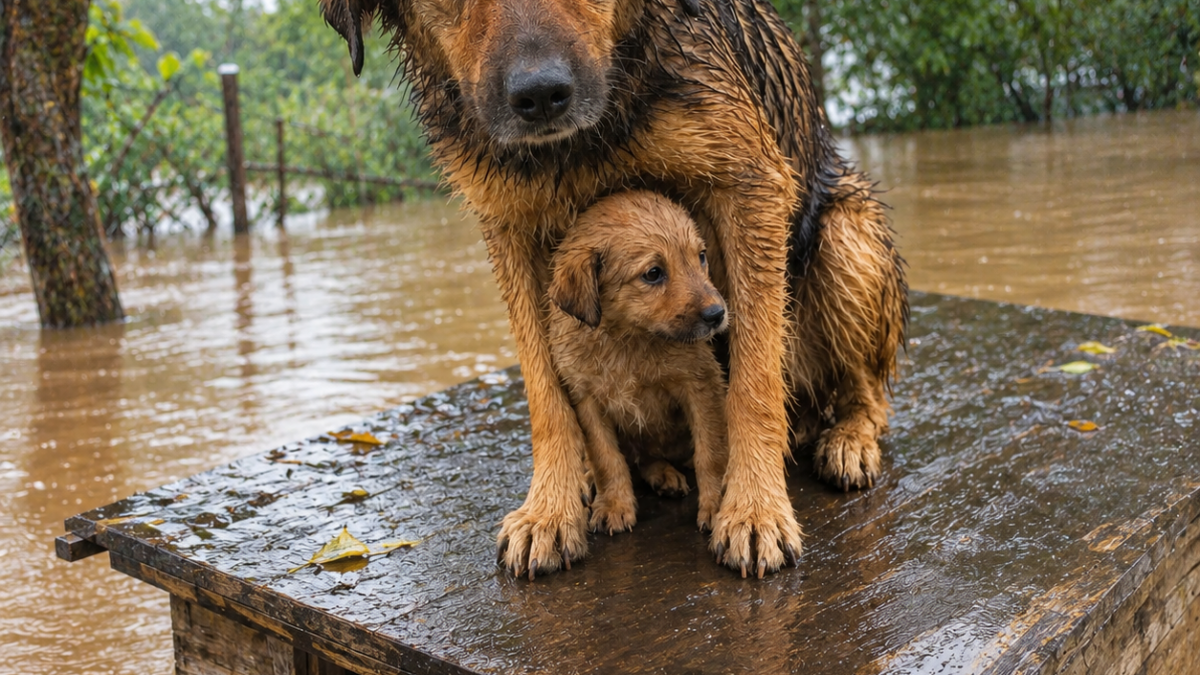
I will regret one decision for the rest of my life: when the evacuation truck pulled away from my house, my dog Luna was still somewhere behind us with her three newborn puppies.
By the time I fought my way back in a rescue boat, floodwater had swallowed my yard, two puppies were gone, and Luna was clinging to the only baby she had left as if her own body could hold back the river.
But when I finally saw what she had endured alone on that roof, I realized the flood had not finished taking things from us yet.
“I never should have left her.”
I must have said it twenty times while the rescue boat pushed through the muddy water that had once been our road.
Rain struck my face so hard I could barely keep my eyes open. The current carried branches, trash cans, pieces of fencing, children’s toys and things I couldn’t identify past us. Somewhere beneath that brown water were mailboxes, porches, flower beds and the little wooden bridge my neighbor had built over the drainage ditch.
Everything familiar had disappeared.
Across from me sat Marcus and David, two rescue volunteers who had already spent most of the morning pulling people out of flooded homes.
Neither of them told me to stop blaming myself.
Maybe they understood there was no point.
Luna was my dog.
Three years earlier, she had been nobody’s dog.
I first saw her behind a gas station, thin enough that her ribs showed through her dirty coat. She wouldn’t let me within twenty feet of her. For almost two weeks, I left food in the same place every evening, then sat on the curb and pretended not to watch.
She learned me slowly.
One step forward.
Two steps backward.
Then one rainy afternoon, I opened my front door and found Luna sitting on my porch.
She never left again.
I built her a wooden doghouse near the back fence and filled it with blankets. Eventually she started sleeping inside the house with me, but she still loved that little shelter. Whenever she wanted quiet, that was where she went.
Three weeks before the flood, Luna gave birth there.
Three puppies.
One gray.
One black.
One light brown.
I hadn’t even named them yet.
I kept telling myself I had time.
That morning, time disappeared.
The first flood alert came shortly after six.
By eight, water had crossed the lower road.
Neighbors were leaving.
Emergency crews were shouting that anyone near the river needed to move uphill immediately.
I searched the house for Luna.
Nothing.
Then I knew.
The puppies.
I ran into the backyard, but water was already pouring through the lower fence. Luna stood near the doghouse, soaked and terrified, refusing to move.
“Luna!”
She looked at me.
I called again.
She stayed with the puppies.
I tried to reach her.
A sheriff’s deputy grabbed my arm.
“You can’t go back there!”
“My dog has puppies!”
“The water is rising too fast.”
“I can get them!”
A section of fencing broke loose twenty feet from us and vanished in the current.
The deputy pulled me toward the evacuation vehicle.
“If you go in there, we may have four lives to rescue instead of three puppies.”
I hated him for saying it.
For hours afterward, I hated myself even more for listening.
Now, sitting in that rescue boat, I understood exactly what I had left Luna to face.
David steered around a floating propane tank.
Marcus pointed ahead.
“Is that your property?”
I looked.
At first, I saw only water.
Then the roof of my garage.
The top of my fence.
And farther back, barely visible above the current, the little doghouse.
“Over there.”
My voice came out as a whisper.
“There.”
David turned the boat.
As we came closer, I saw something on top of the doghouse.
A dark shape.
My heart stopped.
“Luna!”
Her head lifted.
She was alive.
Marcus exhaled.
“My God.”
Then we saw what she was holding.
Pressed tightly beneath her chest was one tiny puppy.
Just one.
I counted again even though I already knew.
One.
Not three.
The gray puppy and the black one were gone.
My hands began shaking.
Luna stared directly at me.
She didn’t bark.
She didn’t move.
Her soaked body was curled around that last little puppy, shielding it from the rain and wind while the river tore everything else away.
Then the boat drifted closer.
And I saw blood on the roof beneath her.
“Marcus.”
He saw it too.
Luna tried to stand.
Her legs buckled.
But instead of saving herself, she immediately twisted her body back around the puppy.
That was when I understood.
She had no intention of leaving that roof unless her baby left with her.
And the water was still rising.
PART 2
“Don’t jump,” Marcus warned me.
I was already moving.
The rescue boat rocked violently as another surge of water struck the side.
David shouted, “Sit down!”
“That’s my dog.”
“And you won’t help her if you’re under the boat.”
I forced myself back onto the bench.
Luna was less than fifteen feet away now.
Close enough that I could see every movement of her chest.
Too fast.
She was breathing much too fast.
Her back legs were tucked awkwardly underneath her. Blood ran from somewhere near her left hip and mixed with the rainwater streaming off the roof.
The puppy beneath her barely moved.
“Luna,” I called softly.
Her ears twitched.
For the first time since we arrived, her tail moved.
Only once.
That single movement nearly broke me.
“I came back.”
I don’t know why I said it that way.
Maybe because I needed her to know.
Maybe because I needed to hear myself say it.
“I came back, girl.”
Marcus secured a rope around his waist.
“We get alongside the roof, you stay in the boat until I tell you.”
“She won’t give the puppy to you.”
“You don’t know that.”
“I do.”
Luna liked Marcus. He had met her twice before while helping repair my fence.
But Luna had just spent hours fighting a flood.
She had lost two babies.
There was no universe in which she was calmly going to hand the last one to a man in a rain jacket.
David maneuvered the boat against what remained of the fence.
The current immediately pushed us sideways.
“Again,” Marcus said.
David backed off, corrected and tried from another angle.
This time Marcus caught the edge of the doghouse roof with a boat hook.
“Hold us!”
“I’m trying!”
The engine screamed.
Water slapped against the hull.
I stared at Luna.
She lowered her head over the puppy.
“Easy, girl.”
Marcus stepped onto the roof.
Luna’s entire body stiffened.
A low growl came from her chest.
Marcus froze.
“Okay.”
He slowly lifted both hands.
“Easy, mama.”
The growl became louder.
I knew that sound.
It wasn’t aggression.
It was terror.
“Get back in the boat,” I said.
Marcus looked at me.
“She knows me.”
“She knows me better.”
The boat shifted again.
There was no time to argue.
Marcus returned.
I clipped the safety rope around myself.
David looked furious.
“If you fall—”
“Then pull me back.”
“That is not a plan.”
“It’s the only one we have.”
I stepped onto the roof.
The wood moved beneath my boots.
For one terrifying second, I felt the whole structure tilt.
Luna tried to rise.
“Stay.”
Her body shook.
“Luna. It’s me.”
I crouched.
Rainwater streamed from my hair into my eyes.
“Remember me?”
Her ears flattened.
Then something changed.
She made a sound.
A small sound.
Almost like a cry.
I crawled closer.
“I’m sorry.”
Luna pushed herself toward me.
She could barely stand, but she moved until her nose touched my hand.
Then she licked my fingers.
Once.
I started crying.
“I’m so sorry.”
Her head dropped against my arm.
Behind me, Marcus said quietly, “We need to move.”
I nodded.
I reached toward the puppy.
Luna immediately lifted her head.
“No, no. I’m taking him with us.”
I slid both hands beneath the tiny body.
Cold.
Far too cold.
The puppy was light enough to fit against my chest.
His fur was plastered to his skin.
I felt for movement.
Nothing.
“Oh, God.”
“What?” Marcus asked.
“I don’t know if he’s breathing.”
Luna panicked.
She tried to climb toward me and nearly fell from the roof.
“Luna!”
Marcus caught her harness.
She twisted.
“Hold her!”
“I’ve got her!”
I pressed two fingers against the puppy’s chest.
There.
Maybe.
A tiny flutter.
“He’s alive.”
Marcus shouted toward David.
“Blanket! Now!”
I tucked the puppy beneath my raincoat.
Luna pushed her muzzle against my chest, desperately trying to reach him.
“He’s here.”
She whined.
“He’s here, girl.”
Now we had to get Luna into the boat.
That turned out to be far harder than getting me onto the roof.
Luna refused to step away from me.
Every time Marcus tried to guide her toward the boat, she twisted back toward the puppy.
Finally I climbed halfway down first, keeping the puppy against my body.
“Come on.”
Luna watched.
“Come to me.”
She took one step.
Her back leg collapsed.
She almost went into the water.
Marcus grabbed her.
David reached from the boat.
Together they lifted her.
The moment Luna landed inside, she scrambled toward me.
I opened my jacket enough for her to see the puppy.
She pushed her nose against him.
He made the faintest squeak.
Luna began licking his face.
Marcus sat down hard.
“Thank God.”
Then the doghouse moved.
Not slightly.
The entire structure shifted.
David saw it first.
“Go!”
A section of fence slammed into the back of the doghouse.
The roof where Luna had been sitting broke apart and vanished into the flood.
For several seconds, none of us spoke.
If we had arrived five minutes later, there would have been nothing left to rescue.
David pushed the engine hard.
We headed toward higher ground.
Luna lay beside me with her head across my thigh.
I kept the puppy against my chest.
“Where are the others?” I whispered.
Luna lifted her head.
Her eyes moved toward the flooded yard behind us.
That was all.
I knew we might never find them.
Still, I looked.
For branches.
For debris.
For any tiny dark shape.
Nothing.
The river had taken them.
At the emergency veterinary station, three people met us before the boat had fully stopped.
A veterinarian named Dr. Elena Ruiz took the puppy from me.
“How long has he been cold?”
“I don’t know.”
“Breathing?”
“Barely.”
She turned to a technician.
“Warm oxygen. Glucose. Now.”
Another veterinarian examined Luna.
The moment they separated her from the puppy, she tried to follow.
“Please,” I said. “Keep them where she can see him.”
“We’ll do our best.”
“She thinks she’s losing another one.”
The vet looked at Luna.
Then nodded.
They moved the puppy’s warming box beside Luna’s treatment table.
Even while they cleaned blood from her hind leg and checked her temperature, Luna never took her eyes off that box.
Her injuries were worse than I had realized.
A deep cut ran along her thigh.
Several claws were torn.
The pads of her paws were shredded.
She had swallowed floodwater.
Her body temperature was low.
But the wound that concerned Dr. Ruiz most was along Luna’s abdomen.
“What happened?”
“We don’t know yet.”
The veterinarian cleaned the area.
Under the mud was a jagged gash.
“Probably sheet metal or fencing.”
“Is it serious?”
“She’s lucky.”
That word almost made me laugh.
Lucky.
Two puppies gone.
House underwater.
Luna half-frozen.
One newborn fighting to breathe.
But I understood what the doctor meant.
A few inches deeper and Luna might have bled to death on the roof.
They sedated her enough to stitch the wound.
I sat nearby.
Every few minutes, I looked through the opening into the puppy’s incubator.
Sometimes I could see the blanket move.
Sometimes I couldn’t.
At one point Dr. Ruiz stopped beside me.
“We need to talk.”
I stood.
“Is he dying?”
“He’s critical.”
My hands went cold.
“He was exposed for hours. He’s severely hypothermic and dehydrated, and we’re concerned he aspirated water.”
“But he’s alive.”
“Yes.”
“Then save him.”
Her expression softened.
“We are trying.”
“No.”
I shook my head.
“I’m sorry. I know you are.”
I sat down again.
“I just can’t lose another one.”
Dr. Ruiz crouched beside me.
“You lost two?”
I nodded.
She looked toward Luna.
“Did she stay with all three?”
“As long as she could.”
The doctor was silent.
Then she said, “That dog probably kept this puppy alive.”
I looked at Luna.
“How?”
“Body heat. Protection from wind. She may have kept him high enough that he didn’t inhale as much water.”
I stared at the stitches along Luna’s side.
“She was bleeding.”
“Yes.”
“And she stayed.”
“Yes.”
Of course she had.
That was Luna.
Three years earlier, she had been starving behind a gas station and still waited until I walked away before touching food.
She trusted slowly.
But once she gave you that trust, she gave everything.
Hours passed.
Outside the emergency clinic, the flood continued.
People arrived carrying cats in laundry baskets.
Dogs wrapped in towels.
A rabbit inside a plastic storage bin.
One man came in with a chicken tucked under his coat.
Nobody laughed.
We had all lost the right to laugh at what someone else was trying to save.
Marcus sat beside me for a while.
David had returned to the water.
“You should eat.”
“I’m not hungry.”
“You’ve said that twice.”
“Then stop asking.”
He leaned back.
For several minutes, neither of us spoke.
Then he said, “You know you couldn’t have stayed.”
I stared at him.
“Don’t.”
“You need to hear it.”
“No.”
“If you had stayed in that yard when the water hit, we might have been recovering you too.”
“I left her.”
“You were ordered out.”
“I left her.”
Marcus looked toward Luna.
“She doesn’t seem to think that.”
I followed his eyes.
Luna was awake.
Weak.
Sedated.
But awake.
Watching me.
When I stood and walked toward her, her tail tapped the table.
I put my face against hers.
“I’m sorry.”
Luna licked my cheek.
Dogs are cruel that way.
They forgive you before you’ve forgiven yourself.
The puppy survived the first night.
Barely.
Dr. Ruiz called him “the little brown one” because I still had not named him.
By morning, his temperature was normal.
His breathing remained rough.
Luna refused food until they brought him beside her.
The moment she heard his tiny cry, she ate.
That became our routine.
The puppy slept inside the incubator.
Luna slept beside it.
Every two hours, the staff helped him nurse.
Luna cleaned him obsessively.
If a technician moved him more than three feet away, she stood.
Even with the stitches.
Even with the injured leg.
She stood.
On the second day, I finally gave him a name.
Noah.
Marcus raised an eyebrow.
“Because of the flood?”
I shook my head.
“Because he survived it.”
Noah weighed less than four pounds.
His whole body fit between Luna’s front paws.
The black and gray puppies never came back.
Search teams found animals for days.
Some alive.
Some not.
I walked the banks after the water receded.
I checked piles of debris.
Drainage fields.
Fences.
The ditch near the highway.
I knew what I was looking for.
I also knew what finding them would mean.
We never did.
For weeks afterward, Luna sometimes searched.
She returned to the place where the doghouse had stood.
Sniffed the mud.
Walked circles.
Then looked at me.
The first time she did it, I sat on the ground and cried.
“I’m sorry, girl.”
Luna walked to me.
Then returned to Noah.
People began sharing photographs from the rescue.
One image showed Luna curled around Noah on the roof.
Someone had taken it from another rescue boat farther away.
Another showed her being lifted into our boat.
The photographs spread far beyond our county.
Reporters called.
Television crews wanted interviews.
I said no to most of them.
Luna did not need fame.
She needed rest.
But one photograph created questions.
The doghouse roof was almost completely surrounded by water.
People began asking why homes on our road had flooded so much faster than predicted.
That question already existed among the neighbors.
Our official evacuation map had shown our properties in the secondary flood zone.
Water was supposed to reach us later, not first.
The county blamed unprecedented rainfall.
At first, I accepted that.
Then my neighbor, Tom Bennett, showed me a video.
He had filmed it two days before the flood.
A drainage channel about half a mile downstream had been partially blocked by construction debris.
Broken concrete.
Dirt.
Tree limbs.
Pieces of pipe.
The channel carried runoff away from our side of the neighborhood toward a larger basin.
A private contractor had been working on a new commercial development nearby.
Tom had complained.
Twice.
He had emails proving it.
Nobody came.
“This made it worse,” he said.
“You know that?”
“I know water was backing up where it never backed up before.”
The county initially dismissed the claim.
Then more residents found photographs.
One woman had complained about trucks dumping fill near the channel.
Another had sent a message to the planning office three weeks earlier.
A retired engineer named Russell Hall examined the site after the water fell.
He stood in the mud for almost an hour.
Then he said something that made my stomach turn.
“This wasn’t the cause of the flood.”
Tom frowned.
Russell continued.
“But it may have changed where the water went.”
That distinction mattered.
The rain had caused the river to rise.
Nobody could change that.
But if a blocked channel redirected water toward our homes faster, then people had lost precious time.
Time.
The word followed me home.
How much time had Luna needed?
Ten minutes?
Twenty?
Enough for me to carry the puppies out?
Enough for the water not to tear through the lower fence?
I tried not to think about it.
I failed.
County officials opened an investigation after local media obtained Tom’s emails.
The contractor, Grayson Development Services, insisted all work had been permitted.
The company president, Walter Grayson, gave an interview standing in front of a spotless office building.
He called the accusations “emotionally driven speculation.”
That phrase made me furious.
Emotionally driven.
As though grief disqualified us from reading photographs.
As though Luna bleeding on a roof made me too emotional to understand a drainage channel filled with debris.
Then Walter said something worse.
“No responsible pet owner should leave animals in a known flood zone.”
I watched that interview from my temporary apartment.
Luna was asleep beside Noah.
I replayed the sentence.
Once.
Twice.
A third time.
Then I turned the television off.
I had spent weeks blaming myself.
I did not need a stranger doing it for me.
The next morning, I agreed to my first interview.
Not about Luna’s heroism.
About the timeline.
I brought photographs.
The flood alert.
The evacuation notice.
Tom’s emails.
The contractor’s work schedule.
I told the reporter exactly what happened.
“At six, we were told to prepare.”
“At eight, the road was already going under.”
“How quickly did the water rise?”
“Faster than anyone in our neighborhood had seen.”
“Did you leave Luna?”
I swallowed.
“Yes.”
“Why?”
“Because a deputy physically stopped me from going back into water that was already dangerous.”
“Do you blame him?”
“No.”
That answer surprised even me.
“He probably saved my life.”
“Then who do you blame?”
I looked at the camera.
“I want to know whether someone knew that drainage channel was blocked and decided paperwork could wait.”
The report aired that night.
Within forty-eight hours, the state environmental office became involved.
Grayson Development stopped giving interviews.
Their attorney issued statements instead.
That was when the documents began appearing.
Inspection logs.
Internal emails.
Photographs.
A subcontractor had warned Grayson’s site manager that dumped fill was narrowing the drainage channel.
The message was sent eleven days before the flood.
The site manager replied:
**We’ll clear it after the next phase.**
After.
The next phase never came.
The rain did.
An engineer’s later analysis concluded the obstruction likely worsened local backflow and accelerated flooding along three residential properties, including mine.
They could not say it caused the deaths of Luna’s puppies.
Neither could I.
And I never claimed that.
But the difference between water reaching the doghouse at 8:15 and 8:35 might have been everything.
Twenty minutes.
Maybe fifteen.
Maybe five.
You can torture yourself forever with numbers like that.
Grayson’s attorneys offered several homeowners settlements.
Confidential.
I was offered one too.
My lawyer read the agreement.
“If you sign, you cannot publicly discuss the drainage issue or associate the company with Luna’s rescue.”
I stared at him.
“How much?”
He told me.
It was more money than I had ever seen in one place.
Enough to rebuild.
Enough to replace my car.
Enough to cover every veterinary bill and still leave a lot behind.
I looked at Luna.
She was lying on the floor nursing Noah.
“No.”
My attorney frowned.
“You should think about this.”
“I have.”
“This is a significant offer.”
“They want me to stop talking.”
“They want finality.”
“Same thing.”
He leaned forward.
“You may not win more in court.”
“This isn’t only about money.”
I hated how dramatic that sounded.
But it was true.
Two puppies were gone.
Nothing bought them back.
What I wanted was simple.
I wanted someone to say:
We were warned.
We ignored it.
We should have fixed it.
That admission turned out to cost far more than money.
The case dragged on for nearly a year.
During that year, Noah grew.
At first, he looked nothing like Luna.
He was light brown with oversized ears and paws that seemed to belong to a much larger dog.
Then, as he got older, his face changed.
His eyes became hers.
Not in color.
In expression.
Cautious.
Observant.
Deep.
Luna followed him everywhere.
If he wandered too far into the yard, she retrieved him by the scruff.
If another dog played too roughly, Luna appeared between them.
When Noah first learned to climb the porch steps, Luna stood at the top as if he were scaling a mountain.
I sometimes wondered whether she knew he was the only one.
I think she did.
Mother dogs count differently from us.
Not with numbers.
With smell.
Sound.
Bodies pressed beside them.
Empty spaces.
Luna never had another litter.
I had her spayed once she recovered fully.
Some people criticized that after hearing her story.
They said she was such a good mother she deserved more puppies.
They misunderstood.
Luna had already given enough.
The flood changed her.
Thunder frightened her.
Heavy rain made her pace.
If water collected near the back steps, she refused to go outside.
The first big storm the following spring was terrible.
Rain hammered the roof.
Luna began panting.
She pushed Noah into a corner of the living room and stood over him.
He was almost sixty pounds by then.
He did not need protecting.
Luna disagreed.
I sat beside them until sunrise.
“You’re safe.”
She trembled.
“You’re safe.”
Noah licked her face.
Eventually Luna lay down.
Trauma doesn’t care whether you are human.
The body remembers.
By summer, my house was rebuilt on a raised foundation.
I had argued against returning.
Friends told me to move.
For months, I considered it.
Then one afternoon I drove Luna to the property.
The new house was still unfinished.
She climbed out of the car.
Sniffed the yard.
Walked toward the back fence.
Stopped where the old doghouse had stood.
Noah followed.
Luna stood there for a long time.
Then she returned to me.
I made my decision.
We stayed.
But I never rebuilt the doghouse in the same place.
Instead, I built a large covered shelter on higher ground beside the house.
Not because Luna needed it.
She slept inside now.
It was symbolic.
A roof above the flood line.
A place no rising river could reach easily.
Above the entrance, Marcus helped me hang a wooden sign.
**LUNA’S HOUSE**
Noah chewed one corner before we finished installing it.
Marcus looked at him.
“Your mother almost died saving you and this is how you honor her?”
Noah wagged his tail.
Luna sat nearby looking exhausted by both of them.
The investigation into Grayson Development eventually reached a public hearing.
I attended.
So did Tom.
Russell.
Dozens of neighbors.
Walter Grayson sat with three attorneys.
He did not look at me.
The state presented photographs.
The drainage channel before construction.
During construction.
After dumping began.
Then after the flood.
A project supervisor testified.
He admitted receiving complaints.
“Why wasn’t the debris removed?” an investigator asked.
“We were under schedule pressure.”
“Did you believe flooding was possible?”
“It was always possible.”
“Were you aware of heavy rain in the forecast?”
“Yes.”
“Did you consider clearing the channel before the storm?”
The supervisor hesitated.
“Yes.”
“And?”
“We decided the risk was manageable.”
Something inside me went cold.
Manageable.
Luna on a roof.
Two puppies gone.
A manageable risk.
Walter’s attorney argued that the flood was an extraordinary natural event.
That was true.
They argued the company could not reasonably be blamed for every consequence.
Also true.
Then Tom testified about his emails.
Russell explained the hydraulic impact.
And finally, I was called.
Walter looked at me for the first time.
I brought no photographs of dead animals.
I had none.
I brought one picture.
Luna on the roof.
Noah under her chest.
I placed it on the table.
“This is Luna.”
The hearing officer looked at it.
“She stayed there for hours.”
I pointed to the water.
“My home was evacuated shortly after eight. According to the reconstruction, the worst backflow hit our property minutes earlier than expected.”
Walter’s lawyer stood.
“We object to attributing specific animal losses—”
“I’m not.”
He stopped.
I looked at Walter.
“I cannot prove your debris killed my puppies.”
The room became very quiet.
“I cannot prove that if the channel had been clear, I would have had enough time to reach them.”
Walter finally looked at me.
“But your own records prove you were warned.”
His attorney shifted.
I continued.
“You had a choice before the rain started.”
No one interrupted.
“You could clear the obstruction.”
I looked down at Luna’s photograph.
“Or you could wait.”
Then I looked back at Walter.
“You waited.”
My voice broke slightly.
“So did she.”
That sentence was quoted everywhere afterward.
I wish it hadn’t been.
People called it powerful.
I didn’t feel powerful.
I felt tired.
The final ruling found multiple environmental and permit violations.
Grayson Development paid substantial civil penalties.
The company funded restoration of the drainage corridor.
Several municipal inspection procedures were changed.
Walter Grayson did not go to prison.
This wasn’t that kind of case.
But his company lost major contracts.
Insurance premiums rose.
The development project stalled for months.
And the public record permanently showed that warnings had been ignored before the flood.
That was enough for me.
Almost.
The part that mattered more came later.
The county created a new emergency animal evacuation protocol.
Previously, pets and livestock were addressed inconsistently during rapid evacuations.
After Luna’s story, animal rescue teams were incorporated earlier into flood response.
Registered households with litters, senior animals, horses and mobility-impaired pets could request priority assistance.
Temporary animal staging areas were established above known flood zones.
Rescue boats began carrying basic pet equipment.
Crates.
Slip leads.
Thermal blankets.
Oxygen masks designed for animals.
Marcus helped develop the program.
David trained volunteers.
Dr. Ruiz advised them.
They named it the Companion Evacuation Initiative.
Everyone wanted to name it after Luna.
I said no.
Then Marcus ignored me.
The first rescue trailer arrived six months later.
On the side, in large letters, it said:
**THE LUNA UNIT**
I stared at him.
“You knew I said no.”
“You say no to lots of good ideas.”
“I hate you.”
“No, you don’t.”
Luna walked over and urinated on one tire.
Marcus nodded.
“She agrees with you.”
That was the first time I laughed about the flood.
Really laughed.
It felt strange.
Almost disloyal.
Then Luna wagged her tail.
Life has a way of returning in tiny pieces.
Not the same life.
Never the same.
But enough.
Two years after the flood, another major storm threatened our county.
Nothing as severe.
But serious.
Alerts went out early.
Animal teams mobilized before roads flooded.
I volunteered at the staging center.
Luna and Noah stayed safely with my sister on high ground.
Near midnight, a rescue truck arrived carrying a woman and four newborn kittens.
She was crying.
“They almost made me leave them.”
A volunteer shook his head.
“Not anymore.”
He placed the carrier beside her.
I had to walk outside.
Rain fell lightly.
Marcus found me standing beside the trailer.
“You okay?”
“Yeah.”
“You’re crying.”
“Rain.”
“We’re under an awning.”
I looked at him.
“That joke wasn’t funny the first time.”
He smiled.
Inside the trailer, the kittens were warm.
Their mother was safe.
Nobody had to choose.
That was the revenge I finally understood.
Not watching Walter Grayson lose contracts.
Not the fines.
Not the courtroom.
Not seeing his company name dragged through headlines.
The real revenge was that the next frightened animal got a boat sooner.
The next family didn’t have to leave a mother dog behind.
The next litter had a better chance.
Luna’s suffering changed the rules.
The flood had taken two puppies.
It would not be allowed to take the lesson with them.
Years passed.
Noah grew larger than Luna.
Much larger.
People who saw them together laughed.
The tiny puppy she had covered with her body became a seventy-five-pound dog who still tried to squeeze underneath her whenever thunder started.
Luna tolerated this with the exhausted expression of every mother whose adult child refuses to accept adulthood.
Noah loved water.
That surprised me.
Ponds.
Garden hoses.
Mud puddles.
He would throw himself into anything wet.
Luna hated it.
The first time Noah jumped into a shallow creek, Luna lost her mind.
She barked.
Paced.
Ran along the bank.
I called him back quickly.
When Noah climbed out, Luna grabbed him by the neck and pulled him away from the water.
He was twice her size.
He went willingly.
“You’ve embarrassed yourself,” I told him.
Noah sneezed.
Luna licked his face for almost five minutes.
I never took them near the river during flood season.
I couldn’t.
Some wounds don’t need testing.
When Luna turned nine, her muzzle began turning gray.
By ten, she moved more slowly.
She developed arthritis in one hip, probably worsened by the injury from the flood.
Dr. Ruiz prescribed medication.
Noah adjusted without being taught.
He stopped running into Luna.
Stopped stealing her bed.
If she struggled up the porch steps, he waited beside her.
Once, I watched him walk behind her with his nose near her hip as though ready to catch her.
I thought about the roof.
Luna had spent his first hours holding him against her chest.
Now he watched over her.
The balance had changed.
At eleven, Luna stopped climbing the stairs to my bedroom.
So I moved downstairs.
Friends told me that was ridiculous.
I told them I had slept upstairs long enough.
My bedroom became the dining room.
Luna slept beside the bed.
Noah slept beside Luna.
On stormy nights, all three of us were awake.
The sound of heavy rain never became ordinary again.
Then came a November morning that looked almost exactly like the morning before the flood.
Gray sky.
Cold wind.
Rain beginning against the windows.
I woke and immediately knew something was wrong.
Luna hadn’t gotten up.
Usually, even when stiff, she followed me into the kitchen.
That morning she remained on her blanket.
Noah was lying beside her.
Not sleeping.
Watching.
I knelt.
“Hey, girl.”
Luna lifted her head.
Barely.
Her breathing was shallow.
I called Dr. Ruiz.
She came to the house.
After examining Luna, she sat beside me.
There are expressions veterinarians learn because they have to deliver impossible news.
I recognized hers.
“What?”
“Her heart is failing.”
“No.”
She touched my arm.
“We’ve known it was getting weaker.”
“No.”
“We may be able to stabilize her temporarily.”
“How temporarily?”
Dr. Ruiz didn’t answer immediately.
That told me enough.
Luna was almost twelve.
For a medium-sized rescue dog who had lived hard before I found her, twelve years was not unfair.
But love doesn’t care about fairness.
I wanted more.
Another spring.
Another summer.
Another ridiculous argument about Noah being too close to the creek.
I wanted the dog I had found behind a gas station to stay forever.
We tried medication.
For three weeks, Luna improved.
She ate.
Walked outside.
Even chased Noah once when he stole a piece of chicken.
I convinced myself the veterinarian had been wrong.
Then Luna collapsed near the porch.
Noah began barking.
Not normal barking.
Panicked.
I ran.
Luna was conscious but couldn’t stand.
I carried her inside.
She weighed almost fifty pounds.
I didn’t feel it.
Dr. Ruiz came again.
This time, she didn’t need to say much.
I sat on the floor with Luna’s head in my lap.
Noah paced.
“He needs to be here,” I said.
Dr. Ruiz nodded.
Some veterinarians recommend letting surviving animals see and smell a companion after death.
I didn’t know what Noah would understand.
But after everything Luna had done for him, I wasn’t taking away his chance to say goodbye.
Marcus arrived.
Then David.
They had become family somewhere along the way.
Marcus knelt beside Luna.
“Hey, mama.”
Her tail moved weakly.
He cried instantly.
The giant man who had stood on a collapsing doghouse roof in floodwater wiped his face with both hands.
David looked away.
I stroked Luna’s ears.
“You know what you did?”
Her eyes moved toward me.
“You saved him.”
Noah lay down.
He placed his head beside hers.
Luna licked his nose.
One slow lick.
Noah closed his eyes.
I broke.
“I’m sorry about the other two.”
I had never said that to her aloud since the flood.
Not like that.
The words came out between sobs.
“I’m sorry I couldn’t get there.”
Luna breathed slowly.
“I’m sorry I left.”
Dr. Ruiz touched my shoulder.
I shook my head.
“I know. I know what everyone says.”
I looked at Luna.
“But she waited.”
Dr. Ruiz said softly, “And you came back.”
I pressed my forehead against Luna’s.
“Yes.”
That was the truth too.
I had spent years telling only half the story to myself.
I left.
But I came back.
Luna had forgiven me on the first day.
It had taken almost nine years for me to understand that I was allowed to forgive myself.
“You can rest now.”
Luna’s eyes were heavy.
“No more roofs.”
Noah pushed closer.
“No more water.”
I kissed her head.
“No more holding on.”
Dr. Ruiz gave the medication.
Luna’s body relaxed.
Her breathing slowed.
Then stopped.
Noah remained motionless.
For several minutes, he stared at her.
Then he stood.
Sniffed Luna’s face.
Her ears.
Her paws.
He nudged her shoulder.
Nothing.
He whined.
I reached for him.
He pulled away.
He nudged her again.
Then, finally, Noah lay down beside Luna and placed his head across her neck.
Just as she had once curled herself over him.
Nobody in the room spoke.
There was nothing to say.
We buried Luna on the high side of the property.
Far above the flood line.
Under an old maple tree.
Beside her grave, I placed three stones.
One for Luna.
Two smaller ones for the puppies we never recovered.
People asked why there were three.
I told them.
Sometimes the ones we lose without a goodbye still deserve a place to be remembered.
Noah sat beside the grave every morning for almost two weeks.
Then, little by little, he began following me again.
Life returned.
Different.
Quieter.
The Luna Unit continued operating.
By the tenth anniversary of the flood, it had helped evacuate hundreds of animals.
Dogs.
Cats.
Goats.
Chickens.
Two miniature horses.
A pig named Harold who apparently hated everyone.
Marcus sent me a photograph of Harold trying to bite his jacket.
I wrote back:
**Luna would be proud.**
A memorial was eventually built near the emergency animal center.
I resisted that too.
I lost.
The bronze plaque didn’t show Luna looking heroic.
I liked that.
It showed her lying down with a puppy beneath her front legs.
The inscription read:
**LUNA**
**SHE HELD ON UNTIL HELP ARRIVED.**
Below that:
**For every animal who cannot evacuate themselves.**
No mention of Grayson Development.
No mention of lawsuits.
No mention of Walter.
Good.
He was never the center of Luna’s story.
People asked me whether I felt justice had been done.
I usually said yes.
But justice is an imperfect word.
Nothing brought back the gray puppy.
Nothing brought back the black one.
Nothing erased the hours Luna spent alone on that roof.
Nothing changed the moment I looked into the boat and realized only one puppy remained.
But something did come from it.
Warnings were taken seriously.
Drainage channels were inspected before major storms.
Animal rescue became part of evacuation planning.
People who once said “it’s only a dog” learned that many families would risk their own lives if forced to choose between leaving and abandoning an animal.
The new system understood a simple truth.
If you want people to evacuate safely, give them a safe way to bring what they love.
Noah grew old too.
Of course he did.
That’s the bargain.
He lived thirteen years.
Thirteen years after Luna held him on that roof.
Thirteen years I should never have had if she had stopped fighting.
He inherited Luna’s gray muzzle.
Her habit of staring until food appeared.
Her suspicion of strangers.
And eventually, her arthritis.
But unlike Luna, Noah never feared rain.
When storms came, he would sleep.
Sometimes I imagined Luna had carried all the fear for both of them.
On Noah’s final day, I took him beneath the maple tree.
He walked slowly.
Stopped beside Luna’s grave.
Then lay down.
I sat beside him.
“You know this is where she is?”
His ears moved.
Maybe.
Maybe not.
I liked believing he did.
I touched the stone with Luna’s name.
“Your mother was tougher than both of us.”
Noah placed his paw on my shoe.
I smiled.
“You were very small, you know.”
His eyes closed.
“You fit inside my jacket.”
He sighed.
“I thought you were going to die.”
Another sigh.
“But she didn’t.”
I looked toward the river in the distance.
It was calm.
Blue.
Almost beautiful.
Rivers are like that.
They do not remember what they have taken.
We do.
When Noah died weeks later, I buried him beside Luna.
This time there were four stones beneath the maple.
Luna.
Noah.
And the two babies who never got names.
I finally gave them names then.
River.
And Grace.
People sometimes ask why I waited so long.
Because for years, naming them felt like admitting they were real enough to mourn.
They had been real.
They deserved names.
So the four stones now read:
**LUNA**
**NOAH**
**RIVER**
**GRACE**
Every year on the anniversary of the flood, someone from the rescue team leaves flowers.
Sometimes Marcus.
Sometimes David.
Sometimes people I don’t know.
One year, I found a child’s drawing.
It showed a brown dog on a roof with three puppies.
Above them was a huge yellow sun.
At the bottom, in uneven handwriting:
**THANK YOU LUNA FOR SAVING DOGS YOU NEVER MET.**
I sat beneath that tree and cried harder than I had in years.
Because that was the part of Luna’s story I never expected.
She had saved Noah.
But indirectly, she had saved others.
Hundreds.
Maybe more.
Animals evacuated earlier because procedures changed.
Animals carried onto boats instead of left behind.
Families reunited at emergency shelters.
Pets warmed beneath thermal blankets inside the trailer with her name on it.
That was the ending nobody could have seen from the roof.
When people first shared Luna’s photograph online, they called her brave.
A hero.
A miracle mother.
Those words were fine.
But they made her sound extraordinary in a way that separated her from ordinary dogs.
Luna wasn’t extraordinary because she wanted fame.
She didn’t know anyone was watching.
She didn’t know what a photograph was.
She didn’t know about lawsuits, public hearings, safety protocols or rescue trailers.
She knew one thing.
Her baby was alive.
So she stayed.
Rain struck her body.
She stayed.
Her leg was cut open.
She stayed.
The water climbed.
She stayed.
Two babies disappeared.
She stayed with the one she had left.
Then a boat appeared.
She saw me.
And still, she wouldn’t leave until Noah was coming too.
That’s who Luna was.
People sometimes ask what my biggest regret is.
They expect me to say leaving her.
For years, that was my answer.
Now it isn’t.
My biggest regret is that Luna spent hours believing she was alone.
Because she wasn’t.
Not really.
Marcus and David were coming.
I was coming.
Dr. Ruiz was waiting.
People she would never meet were about to change laws and procedures because of what happened to her.
A whole community was about to learn her name.
But Luna couldn’t know any of that.
All she could see was water.
All she could feel was cold.
All she could hear was the storm.
And still she protected Noah.
If I could return to that morning for thirty seconds, I wouldn’t change the flood.
I couldn’t.
I wouldn’t promise to save all three puppies.
I don’t know if that was possible.
I would simply kneel beside Luna before they pulled me away.
I would place my hands around her face.
And I would tell her:
“Hold on.”
“I’m coming back.”
Because I did.
That matters now.
The flood took my home.
It took two puppies.
It took Luna’s sense of safety around storms.
For years, I thought it had taken something from me I could never recover.
The belief that I had been a good owner.
But Luna gave that back too.
Not through words.
Through the way she looked at me when I stepped onto that roof.
No anger.
No accusation.
Recognition.
Relief.
Trust.
She had spent three years learning to trust me.
One evacuation didn’t erase it.
One terrible morning didn’t erase every safe night before it.
And when the boat finally came through the rain, Luna did not see the person who had left.
She saw the person who came back.
I think about that whenever guilt tells me only the worst moment counts.
It doesn’t.
Sometimes what you do after the worst moment matters just as much.
Walter Grayson once said responsible pet owners shouldn’t leave animals in flood zones.
For a long time, I wanted revenge for that sentence.
I wanted him embarrassed.
Ruined.
Forced to admit what his company had done.
Some of that happened.
His company paid.
He lost contracts.
His reputation suffered.
He eventually sold his interest in the development business.
Years later, he sent me a letter.
I almost threw it away.
Then I read it.
He wrote that he had spent a long time telling himself the flood was beyond anyone’s control.
That part was true.
Then he wrote:
**What I refused to understand was that an uncontrollable disaster does not excuse the controllable decisions made before it.**
I read that sentence several times.
He apologized.
He did not ask for forgiveness.
That mattered.
At the bottom he wrote:
**I have watched the Luna Unit operate during three storms. I wish the lesson had not cost you so much.**
I never answered.
Not because I hated him.
Because there was nothing left to say.
Luna had already delivered the verdict.
His company had calculated risk in schedules and money.
Luna calculated it differently.
One puppy was still breathing.
Therefore, she stayed.
In the end, that is the only revenge I wanted people to remember.
The people who treated danger like numbers were forced to look at the life inside those numbers.
The company that left a drainage channel blocked had to help fund restoration.
The county that once had no consistent animal evacuation plan built one.
And the dog who had once been an unwanted stray ended up with her name written across a rescue vehicle.
Not because she asked for recognition.
Because she refused to abandon someone weaker than herself.
Years after Luna died, the old photograph still hangs in my hallway.
The roof.
The muddy water.
Luna curled around Noah.
People who visit sometimes stop in front of it.
“That must be hard to look at.”
It is.
But I never take it down.
Because when I look at that photograph now, I don’t see only what the flood took.
I see what it failed to take.
It didn’t take Luna’s courage.
It didn’t take Noah.
It didn’t take her trust in me.
It didn’t take the chance to change what happened to the next animal.
And in the end, even though the river carried away two tiny lives, it could not carry away their meaning.
Somewhere beneath all the headlines, investigations, rescue boats and years that followed, Luna’s story remained very simple.
A mother was trapped.
Her babies were in danger.
Two were lost.
One was still alive.
So she wrapped herself around him.
And she held on.
For hours.
Through rain.
Through blood.
Through cold.
Until the people she loved came back.
That was Luna.
And if there is one image I will carry until the end of my own life, it will not be the flood.
It will be the moment our boat reached that roof and Luna finally lifted her head.
The river had taken almost everything around her.
But beneath her chest, Noah moved.
One tiny breath.
Then another.
Luna looked at me.
And for the first time that day, I understood that we had not arrived too late.
We had arrived while there was still something left to save.
Sometimes, that has to be enough.
Years passed, but the flood never completely left us.
It lived in small things.
In the way my hands tightened whenever rain struck the windows too hard.
In the way Luna stopped at the back door during thunderstorms and stared at the yard as though expecting brown water to rise from the grass.
In the way Noah, despite growing into a powerful seventy-five-pound dog, still squeezed himself against his mother whenever the sky turned black.
And in the way I checked weather alerts before bed even when the forecast promised nothing worse than light rain.
The world had moved on from the flood.
We had not.
At least, not completely.
But life did something remarkable around the wound.
It grew.
The first Luna Unit was supposed to be one emergency trailer.
That was all.
A practical response to a practical failure.
Crates.
Blankets.
Medical supplies.
Animal oxygen masks.
Leashes.
Food.
Nothing glamorous.
Then another neighboring county asked for help building one.
Then another.
Within three years, five emergency response teams in our region had adopted similar programs.
Marcus became one of their primary trainers.
David, who had barely spoken during Luna’s rescue because he had been too busy keeping our boat from flipping, somehow became the person schools invited to talk about disaster preparedness.
I teased him endlessly.
“The man who once communicated entirely through grunts now gives presentations?”
He pointed at me.
“I learned from watching you talk too much.”
Luna usually slept through these conversations.
Noah did not.
He loved Marcus.
Especially because Marcus had never learned the important rule that a seventy-five-pound dog did not need half a sandwich every time he visited.
“You’re making him fat,” I complained one afternoon.
Marcus looked down.
Noah was sitting between his boots, staring upward with complete innocence.
“He’s emotionally recovering.”
“He recovered six years ago.”
“He remembers.”
“No, he remembers that you carry ham.”
Marcus gave Noah another piece.
Traitor.
Luna watched from the shade beside the porch.
Her face had begun turning gray.
At first it was only a few white hairs around her muzzle.
Then silver appeared above her eyes.
Her body softened with age.
She still followed Noah around the property, but she no longer chased him when he stole a stick.
Instead she stood still and barked once.
That was enough.
Noah always brought it back.
He might have outweighed her by twenty-five pounds, but Luna remained his mother.
Some laws of nature are stronger than size.
I often caught myself watching them together.
Not dramatically.
Just watching.
Noah sleeping with one paw across Luna’s back.
Luna cleaning his ears.
The two of them lying in the sun where the doghouse once stood.
Whenever that happened, my mind returned to the two puppies who never got to grow beside them.
For years, I tried not to imagine who they would have become.
Would the gray one have looked like Luna?
Would the black puppy have grown bigger than Noah?
Would they have stayed together?
Would I have kept all three?
Probably.
I was already hopeless where dogs were concerned.
But imagining them hurt too much.
So I learned to stop the questions before they became pictures.
Noah was here.
Luna was here.
And there was love enough in that truth.
One autumn morning, almost seven years after the flood, a young couple arrived at my property with a little girl.
I recognized the father.
His name was Daniel.
He had been part of one of the Luna Unit evacuations the previous spring.
Their home had flooded after a creek overflowed.
His wife had been eight months pregnant.
They owned an elderly beagle named Rosie who could barely walk.
Before the new evacuation system existed, someone in their position might have been told to leave the dog behind until animal crews could return.
Instead, a rescue volunteer carried Rosie into the evacuation truck beside them.
Daniel’s daughter, now about five years old, walked toward Luna carrying something behind her back.
“I made her this.”
It was a medal.
Cardboard.
Gold paint.
A red ribbon.
On the front she had written:
BEST MOM DOG
I swallowed.
Luna sniffed it.
Then tried to eat the ribbon.
The little girl laughed.
“No, Luna!”
I clipped it loosely around her neck.
Daniel took a photograph.
His wife wiped her eyes.
“She’s the reason Rosie came with us,” she said.
I shook my head.
“The rescue team brought Rosie.”
“Because the program existed.”
I looked down at Luna.
She had already forgotten the medal and was sniffing Daniel’s pockets.
“I don’t think she understands any of this.”
“Maybe that makes it better.”
I thought about that sentence for a long time.
Humans want recognition.
We want people to know what we did.
We want plaques.
Names.
Awards.
Sometimes we even want gratitude.
Luna wanted none of it.
The thing people called heroism had been instinct to her.
Her puppy was alive.
So she protected him.
It never occurred to her to ask whether anyone would remember.
Maybe that was why everyone did.
As Luna grew older, her body began collecting the cost of her life.
The old flood injury in her hip developed into arthritis.
On cold mornings, she struggled to stand.
Dr. Ruiz prescribed anti-inflammatory medication, then later added another treatment.
We bought ramps.
First for the car.
Then for the porch.
Marcus built the porch ramp himself.
It was absurdly overengineered.
“You could drive a truck over this.”
“That’s the point.”
“The dog weighs forty-eight pounds.”
“Safety margin.”
“You built bridge supports.”
“Exactly.”
Noah refused to use it.
He leaped over the side every time.
Luna understood immediately.
She walked slowly up the ramp with the dignity of a queen inspecting construction completed for her personal convenience.
“There,” Marcus said proudly. “Someone appreciates craftsmanship.”
Luna reached the top and urinated beside his toolbox.
I laughed until my stomach hurt.
Those were the days I remember most now.
Not the headlines.
Not the hearing.
Not the lawyers.
The stupid, ordinary afternoons.
The moments nobody photographed.
Because after surviving something terrible, ordinary becomes precious in a way you never understood before.
A sleeping dog.
A half-chewed shoe.
Mud on the kitchen floor.
A veterinarian bill you complain about but secretly feel grateful to pay because the animal is still alive to need treatment.
We celebrated Luna’s eleventh birthday quietly.
There was no real record of her birth date because she had been a stray.
So I used the day she first sat on my porch.
The day she chose me.
Marcus brought a dog-safe cake.
David brought a ridiculous pink bandana that said:
FLOOD BOSS
Noah ate part of the cake before we lit the little candle.
“Of course,” I said.
Luna received the remaining piece.
She swallowed it in three bites.
Eleven.
I knew what that number meant.
I didn’t say it.
For a dog her size, eleven was old.
Not ancient.
But old enough that every healthy month felt borrowed.
That winter, Luna began having trouble at night.
She paced.
Sometimes she stood in the hallway looking confused.
Once I found her facing the wrong side of the back door, waiting for it to open.
I knelt beside her.
“Hey.”
She looked at me.
For several seconds, there was nothing in her expression.
Then recognition returned.
Her tail moved.
I went into the bathroom and cried where she couldn’t see me.
Dr. Ruiz warned me that cognitive changes were possible.
“Don’t panic over one episode.”
“I’m not panicking.”
She stared at me.
“You look like you haven’t slept in three days.”
“I’m calmly not sleeping.”
She smiled sadly.
“You gave her a very long, good life.”
I hated people saying that.
Not because it was wrong.
Because it sounded like preparation.
And I wasn’t ready to prepare.
The following spring, Luna improved.
Warm weather helped her joints.
She spent afternoons in the yard.
Noah, now eight, had begun graying too.
That felt insulting.
He was still the puppy.
In my mind, he would always fit inside my rain jacket.
Then one afternoon I watched him rise after a nap, slowly stretching his back legs, and realized time had been moving for him too.
I sat between them on the grass.
“You two are not allowed to get old.”
Noah rolled onto his back.
Luna ignored me.
“I’m serious.”
Nothing.
“Very disrespectful household.”
Luna finally put her paw on my shoe.
The same thing she had done so many years before.
I smiled.
“Fine. You can stay.”
As if it had ever been my decision.
Around that time, Walter Grayson’s letter arrived.
I hadn’t thought about him in months.
Not seriously.
The legal fight had ended years earlier.
The drainage channel had been rebuilt.
His company had paid penalties and settlements.
New procedures existed.
Life had moved beyond him.
But seeing his name on the envelope brought back an old kind of anger.
I nearly dropped it into the trash.
Instead, I left it unopened on the kitchen counter for three days.
On the fourth morning, while Luna ate breakfast beside me, I opened it.
His apology was not dramatic.
That helped.
No excuses about lawyers.
No claims that media coverage had been unfair.
No self-pity.
He wrote about the phrase he had used during that television interview.
No responsible pet owner should leave animals in a known flood zone.
He said he had replayed that sentence many times.
He admitted that at the time, blaming individual homeowners had been easier than admitting his company had received warnings it did not act on.
Then came the line I never forgot.
An uncontrollable disaster does not excuse controllable decisions.
I read it twice.
Then a third time.
For years, I had applied that logic only to him.
His company couldn’t control the storm.
They could control whether they cleared the drainage channel.
But that sentence also reached somewhere uncomfortable inside me.
I couldn’t control the flood.
I couldn’t control the deputy ordering me to evacuate.
I couldn’t control how fast water rose after I left.
But I had spent years judging myself as though I should have controlled everything.
That night, I sat beside Luna.
She was asleep.
I placed my hand over the old scar on her side.
“I think I finally understand.”
She opened one eye.
“I did what I could.”
Her eye closed again.
“Could’ve told me earlier.”
Her tail tapped the floor.
I laughed softly.
Maybe that was her answer.
Luna’s final decline came slowly enough that I had time to deny it.
She stopped finishing breakfast.
Then she began tiring halfway through walks.
Then came the coughing.
At first, only after exercise.
Then at night.
Dr. Ruiz listened to her heart.
The expression on her face told me before the tests did.
Luna had developed congestive heart failure.
Medication helped.
For a while.
Six months became a gift.
Then three more.
Each day turned into a quiet negotiation between happiness and fear.
Was she eating?
Was she comfortable?
Could she breathe easily?
Did she still enjoy being outside?
I promised myself I would not keep Luna alive only because I couldn’t bear losing her.
That promise was much easier to make when she was still healthy.
One evening, a thunderstorm moved through.
Luna became anxious.
Noah immediately went to her.
He lay down so close their bodies touched from shoulder to hip.
Luna lowered her head over his neck.
Even then.
Even old.
Even sick.
Still protecting him.
I sat beside them.
“You know he’s bigger than you, right?”
Luna looked at me.
Noah sighed.
Neither cared.
The rain grew harder.
For a moment, my living room disappeared.
I saw the roof.
Brown water.
Blood beneath Luna.
A tiny puppy.
Then Noah lifted his head and licked Luna’s face.
The memory broke.
We were home.
Dry.
Safe.
I had spent years fearing storms because they reminded me of what we lost.
That night, for the first time, I also thought about what we had been given afterward.
Time.
Years of it.
Time I once believed Noah would never have.
Time Luna should not have survived long enough to see.
We had been given almost a decade after the roof.
That mattered.
The morning Luna collapsed, Noah woke me before sunrise.
He stood beside the bed whining.
I knew immediately.
I followed him into the living room.
Luna lay beside the couch.
Her breathing was shallow.
Too fast.
She tried to lift her head.
Couldn’t.
“No.”
I knelt.
“No, girl.”
Noah circled us.
I called Dr. Ruiz with shaking hands.
She came within forty minutes.
Marcus arrived not long after.
David too.
I don’t remember calling either of them.
Maybe Dr. Ruiz did.
Maybe word just traveled.
Luna’s heart was failing badly.
We could drive her to the hospital.
Oxygen.
IV medication.
Maybe another day.
Maybe two.
Dr. Ruiz did not say that part aloud at first.
I asked.
“How much time?”
Silence.
“How much?”
“Probably not much.”
I stared at Luna.
The dog who had held one newborn against a storm for hours.
The dog who had survived hunger before I met her.
The dog who had trusted me after being afraid of everyone.
The dog who had lived far beyond one terrible morning when I was certain I had lost her.
She was tired.
Really tired.
I knew.
Knowing didn’t make the decision easier.
Marcus sat against the wall with his hands clasped.
His eyes were red.
David stood by the window.
Noah refused to leave Luna.
I sat on the floor.
“Can we do it here?”
Dr. Ruiz nodded.
“Yes.”
I put Luna’s head in my lap.
Her eyes opened.
“Hey.”
Her tail moved once.
That destroyed me.
Of course it did.
Even dying, Luna saw me and found enough strength to say she was glad I was there.
“I need you to know something.”
My voice shook.
“I’ve spent years apologizing to you for leaving.”
Dr. Ruiz sat quietly beside us.
Marcus looked down.
“But I came back.”
Luna breathed slowly.
“I came back.”
I repeated it because I needed both of us to hear it.
“And you were still there.”
Noah pushed his muzzle beneath Luna’s chin.
She licked him weakly.
I broke down.
“You saved him, Luna.”
Her breathing became shallower.
“You saved so many.”
Not just Noah.
Not anymore.
Rosie the beagle.
The kittens.
The animals loaded into Luna Units before roads disappeared.
Pets whose owners didn’t have to make the choice I had made.
Animals neither of us would ever know.
“You don’t have to hold on anymore.”
Those words hurt more than anything else.
Because holding on had defined her.
Through hunger.
Fear.
Labor.
Floodwater.
Injury.
Grief.
Age.
Luna held on.
I placed my forehead against hers.
“No more roofs.”
A breath.
“No more storms.”
Another.
“No more protecting everybody.”
Noah whined.
“You can rest.”
Dr. Ruiz gave the first medication.
Luna relaxed.
Her body became heavy against me.
For several moments, she looked almost young again.
No pain tightening her face.
No effort in her breathing.
Just Luna.
The dog from behind the gas station.
The dog on my porch.
The mother on the roof.
My girl.
“I love you.”
Dr. Ruiz gave the final medication.
I felt Luna exhale.
Then nothing.
Noah stood.
He stared.
I don’t know what dogs understand about death.
Anyone who says they know for certain is guessing.
But Noah understood that something had changed.
He sniffed Luna’s face.
Her mouth.
Her ears.
He nudged her.
Waited.
Then nudged her again.
When she did not respond, he made a sound I had heard only once before.
The same small, broken sound Luna made when she first recognized me from the roof.
Noah lay beside her.
Slowly, he placed his head across Luna’s neck.
Exactly where she had once curled herself over him.
Marcus turned away.
David covered his eyes.
Dr. Ruiz cried openly.
I simply sat there with my hands on both dogs.
Mother.
Son.
Beginning.
End.
We buried Luna beneath the maple tree on the highest part of the property.
No flood had ever reached there.
No flood ever would.
At least that was what the engineers told me.
For once, I chose to believe an engineer.
Beside Luna, I placed two smaller stones.
They had no names yet.
That changed years later.
Noah struggled after Luna died.
For weeks, he searched the house.
He checked her bed.
Waited beside the back door.
Walked to the maple tree.
At meals, he sometimes left part of his food untouched.
Luna had spent his entire life beside him.
Her absence was a physical thing.
So I stayed close.
When Noah slept, I sat nearby.
When he went to the maple tree, I went too.
We learned grief together.
Eventually, Noah began eating normally.
He followed me around the house.
He slept beside my bed.
And during thunderstorms, something unexpected happened.
For the first time, he became restless.
He had never feared storms while Luna was alive.
Now he paced.
I understood.
Luna had been his safety.
Without her, the sound meant something different.
I sat on the floor.
Noah pressed against me.
“It’s okay.”
His body trembled.
“I know.”
Maybe we weren’t comforting each other.
Maybe we were.
That didn’t matter.
Years later, Noah’s own muzzle became white.
His legs slowed.
And eventually his final day came too.
He was thirteen.
Old.
Loved.
Tired.
On one of his last good mornings, I walked him beneath the maple tree.
Noah lay beside Luna’s stone.
I sat next to him.
“Want to hear something?”
He closed his eyes.
“I never named your brother and sister.”
His ear moved.
“I think I was afraid.”
Afraid names would make them more real.
Afraid grief would become permanent.
But grief had already been permanent.
The only choice was whether memory would be too.
I placed my hand on one small stone.
“River.”
Then the other.
“Grace.”
Noah lifted his head.
I smiled.
“I think Luna would approve.”
He rested his paw on my shoe.
Same as his mother.
That family had a habit of doing that whenever I was talking too much.
When Noah died weeks later, we buried him beside Luna.
Four stones beneath one tree.
Luna.
Noah.
River.
Grace.
I thought the story ended there.
It didn’t.
Stories rarely end where lives do.
The Luna Units kept moving.
One storm.
Another.
Another.
New volunteers who had never met Luna learned her story during training.
Some thought she had been a large heroic dog.
That always amused me.
Luna had been medium-sized.
Stubborn.
Suspicious.
Sometimes rude.
She stole food if you looked away.
She hated having her nails trimmed.
She once destroyed an entire couch cushion because I came home twenty minutes late.
Heroism does not require perfection.
Maybe that’s another thing Luna taught us.
On the tenth anniversary of the flood, the rescue center held a memorial.
I didn’t want to speak.
Marcus made me.
“You started this.”
“No. Luna did.”
“Luna can’t hold the microphone.”
“Smart dog.”
He pushed me toward the stage.
Hundreds of people had come.
Rescue workers.
Families.
Veterinarians.
Children.
Dogs everywhere.
One little boy held a photograph of a cat rescued during a flood two years earlier.
A woman beside him recognized me.
“This is Pepper.”
The cat in the photograph looked furious.
“She was evacuated in a Luna Unit.”
I smiled.
“Pepper doesn’t look grateful.”
“She isn’t.”
Good.
Some things never change.
When it was my turn to speak, I looked at all of them.
I had prepared notes.
I did not use them.
Instead, I told them about the moment our rescue boat reached the doghouse.
Luna soaked.
Bleeding.
One puppy beneath her.
I told them about the two who were gone.
I told them about Noah’s first breath inside my jacket.
I told them about the years after.
Then I said:
“For a long time, I thought Luna’s story was about a mother dog who refused to abandon her puppy.”
I looked toward the rescue trailer parked behind the crowd.
“But I think I was wrong.”
People waited.
“It’s about what we do when someone refuses to abandon another living thing.”
I swallowed.
“Do we call them foolish?”
“Do we tell them it’s only an animal?”
“Do we make them choose between safety and love?”
“Or do we build a better boat?”
Nobody spoke.
“That is Luna’s legacy.”
Not the photograph.
Not the plaque.
Not her name painted on trailers.
“The better boat.”
Afterward, a little girl approached me.
She couldn’t have been older than seven.
She handed me a folded drawing.
Luna stood on a roof.
Three puppies beneath her.
A huge sun above them.
At the bottom she had written:
THANK YOU LUNA FOR SAVING DOGS YOU NEVER MET.
I sat in my car afterward and cried.
Not because it was sad.
Not entirely.
Because for the first time, I saw the whole shape of what had happened.
The river took two puppies.
It injured Luna.
Destroyed my house.
Changed me.
But it did not get the final word.
The final word belonged to every animal carried safely onto a rescue truck afterward.
Every family that stayed together.
Every volunteer who entered floodwater with crates and blankets.
Every person who stopped saying “just a dog.”
And every child who grew up learning that compassion is part of emergency planning, not an inconvenience to it.
That is why Luna’s photograph still hangs in my hallway.
Not the pretty pictures.
Not Luna sleeping in sunlight.
Not Noah playing in the yard.
The flood picture.
People sometimes ask how I can look at it every day.
Because now I see something different.
I see Luna exhausted.
I see the water.
I see the empty spaces where two puppies should have been.
But I also see Noah beneath her.
Alive.
I see the moment before the boat arrives.
The moment before everything changes.
And I remind myself:
We were coming.
Luna didn’t know it.
But we were coming.
That’s what I wish I could tell her.
Not that I never left.
That would be a lie.
Not that I could have saved everyone.
I don’t know that.
I would tell her only this:
You were not forgotten.
You were not abandoned.
You were not alone.
Hold on.
We’re coming.
And sometimes, when rain begins against the windows and the house becomes very quiet, I still imagine I hear Luna’s claws crossing the floor.
I know it isn’t her.
I know that.
But I look toward the hallway anyway.
Then I look at the photograph.
At the mother on the roof.
At the puppy beneath her.
At the muddy river trying to take everything.
And I remember how the story truly ended.
The river took River.
It took Grace.
Years later, time took Luna.
Then Noah.
But it never took what Luna started.
There are rescue trailers on roads today because she held on.
There are volunteers carrying animals onto boats because she held on.
There are families who never had to leave their pets behind because she held on.
One little dog, once abandoned behind a gas station and afraid to trust anyone, eventually taught an entire community what loyalty looked like.
She didn’t do it with speeches.
She did it by wrapping her body around one tiny life and refusing to move.
Until we came back.
And after all these years, after all the guilt, grief, courtrooms, storms, rescues, funerals and memories, I finally understand the thing Luna seemed to know from the beginning.
You cannot always save everything.
Sometimes the water is already too high.
Sometimes loss has already happened.
Sometimes you arrive carrying the unbearable knowledge that two are gone and only one remains.
But if one life is still breathing, you protect it.
If one door can still be opened, you open it.
If one mistake can become a better rule for the next family, you change the rule.
If one animal is still waiting in the storm, you send the boat.
That is how grief becomes something other than grief.
That is how guilt becomes action.
That is how two unnamed puppies became River and Grace.
That is how Noah got thirteen years he almost never had.
And that is how Luna, who once had no home at all, ended up leaving one behind for animals she would never meet.
Not a house.
Not a doghouse.
Something bigger.
A promise.
No one gets left behind if there is still a way to bring them home.
And whenever the Luna Unit drives past my property during storm season, lights flashing through the rain, I stand on the porch and watch until it disappears down the road.
Every single time, I think the same thing.
Go get them.
Somebody is waiting.








