PART 2: The Dog’s Leg Was Broken, But She Wouldn’t Let Go of the Boy—Then His Mother Saw Her Collar and Started Screaming
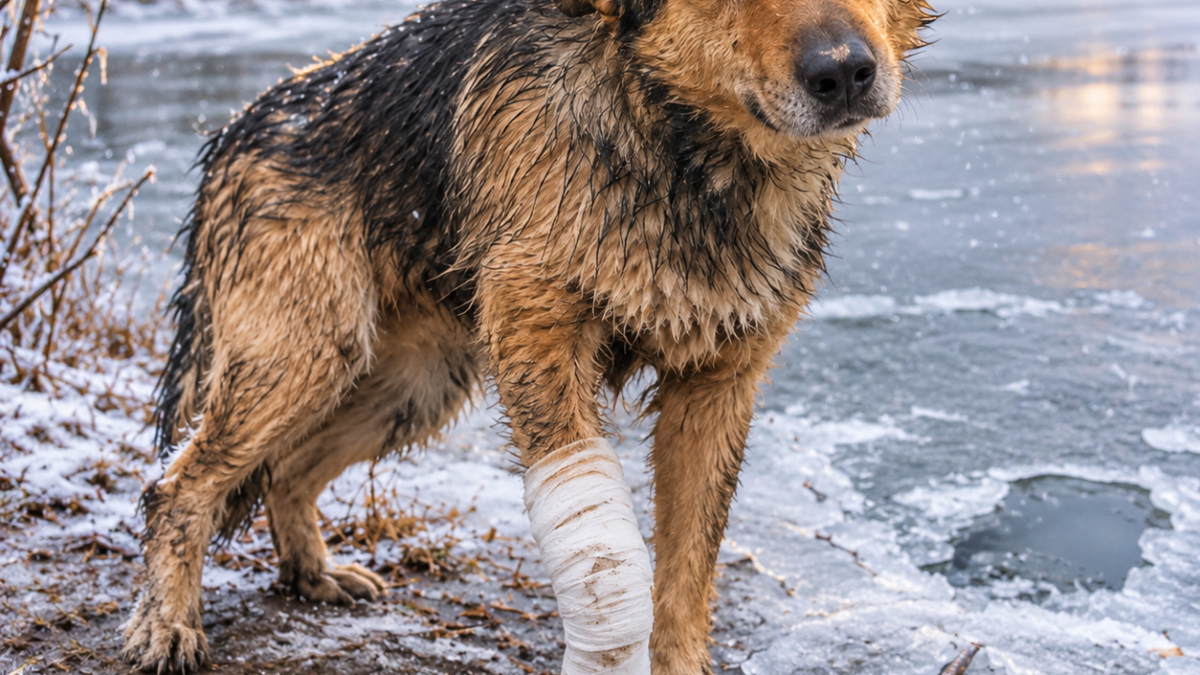
The dog’s front leg was clearly broken, but she kept dragging the freezing boy toward shore as if her own pain meant nothing.
Every time her injured paw collapsed beneath her, she got back up, locked her teeth around his jacket, and pulled again.
But when the boy’s mother finally saw that dog hours later, she whispered one name—and suddenly the rescue became part of a much darker story.
I will never forget that cold November afternoon.
The call came a little after three.
I was finishing paperwork at the small animal rescue where I volunteered when my phone began vibrating across the desk.
A woman on the other end was breathing so hard I could barely understand her.
“Please come quickly. A child fell through the ice at the old reservoir. There’s a dog with him. She’s hurt, but she won’t leave him.”
I was already reaching for my coat.
The reservoir was less than fifteen minutes away, but that drive felt endless.
The temperature had dropped sharply overnight, and a thin sheet of early-season ice had formed over parts of the water. Everyone in town knew it wasn’t safe.
By the time I reached the access road, several vehicles were already pulled onto the frozen grass.
People were running toward the shoreline.
Someone was shouting into a phone.
An older man lay flat on his stomach near the edge, trying to move toward the water without putting too much weight on the ice.
Then I saw her.
A large dark-coated dog stood on three legs near a jagged hole.
Her fur was soaked and pressed against her ribs.
Her left front leg hung at an angle that made my stomach tighten.
Broken.
There was no question.
But the dog didn’t seem to care.
Her teeth were clamped around the sleeve of a boy’s winter jacket.
The child was lying facedown near the hole.
His chest and arms were on the ice, but his legs and lower body were still submerged in black water.
His fingers scraped weakly against the frozen surface.
The dog pulled.
Her injured leg folded beneath her.
She slammed onto her shoulder.
A cry escaped her.
Then she pushed herself upright.
And pulled again.
“Oh my God,” a woman beside me whispered. “She’s hurt too.”
The dog lifted her head.
I had spent years around frightened animals, but I had never seen eyes like hers.
Fear.
Pain.
Desperation.
Not for herself.
For that child.
I moved closer.
“Easy, girl.”
Her ears twitched.
“We’re going to help him.”
Two rescuers arrived carrying ropes and a sled.
One crawled toward the boy while the other remained secured near shore.
The dog growled when the first rescuer approached.
Not aggressively.
Protectively.
“She thinks you’re going to hurt him,” I warned.
I lowered myself carefully.
“Sweetheart, look at me.”
For one second, she did.
“You’ve done enough. We’ve got him now.”
The rescuer reached the boy.
Only then did the dog release his jacket.
The child was pulled onto the sled and rushed toward an ambulance.
He looked about nine or ten.
His face was gray.
His lips were blue.
But he was alive.
As the stretcher disappeared toward the road, the dog tried to follow.
She managed one step.
Her broken leg gave out.
She collapsed in the mud.
This time, she didn’t get back up.
I ran to her.
“Hey. It’s okay. It’s okay.”
Her entire body trembled.
I wrapped my coat around her and carefully checked her neck.
That was when my fingers touched something beneath her wet fur.
An old leather collar.
Cracked.
Nearly torn through.
Attached to it was a scratched metal tag.
I wiped away the mud.
Most of the writing had faded.
But one word remained.
**JESSIE.**
We transported her to the veterinary clinic immediately.
X-rays confirmed a severe fracture in the front leg. She was also dangerously cold, underweight, covered in bruises, and marked by several older injuries.
Someone had hurt this dog long before the ice did.
Hours later, while Jessie slept under warm blankets with an IV in her leg, the clinic door opened.
A woman stepped inside.
Her eyes were swollen from crying.
“I’m the boy’s mother,” she said. “My son is stable. They told me the dog that saved him was brought here.”
I led her toward Jessie.
The moment she saw the dog, she stopped.
Her hand flew to her mouth.
Jessie slowly lifted her head.
The woman stared at her.
Then her knees nearly gave out.
“No…”
Jessie’s tail moved once against the blanket.
The woman started crying.
Not quietly.
Not politely.
The kind of crying that comes from somewhere deep inside you.
She pressed both hands against the kennel.
And whispered:
“Jessie?”
PART 2
Jessie tried to stand.
The movement was so sudden that the veterinarian stepped forward instinctively.
“No, sweetheart. Stay down.”
But Jessie wasn’t looking at him.
Her eyes were fixed on the woman.
Her tail began beating against the blanket.
Thump.
Thump.
Thump.
The woman sank to her knees.
“Jessie.”
The dog made a sound I had never heard from her before.
A soft, broken whine.
The woman pressed one hand between the kennel bars.
Jessie pushed her nose against her fingers.
The woman covered her mouth with her other hand and began sobbing.
I stayed quiet.
Something was happening between them that I didn’t understand.
Finally I asked, “You know her?”
The woman turned toward me.
“She was ours.”
I looked at Jessie.
“Was?”
“My name is Sarah. The boy she saved is my son, Noah.”
Sarah looked back at the dog.
“She disappeared almost a year ago.”
I glanced at the old collar.
“You thought she ran away?”
Sarah didn’t answer immediately.
Then she said, “That’s what my husband told me.”
“Your husband?”
“My ex-husband now.”
There was a weight in the way she said it.
“What happened?”
Sarah’s eyes stayed on Jessie.
“Eleven months ago, Jessie vanished from our backyard. Darren told me the gate had been left open.”
“Darren is your ex-husband?”
“Yes.”
She stroked Jessie through the bars.
“He said Jessie ran while he was taking out the trash.”
I looked at the dog’s ribs.
At the scars on her neck.
At the old wounds the veterinarian had already documented.
“And you never found her?”
“We looked everywhere.”
Sarah’s voice trembled.
“Noah made posters. We called shelters every day. We drove through neighborhoods until two in the morning.”
She swallowed.
“For weeks, he slept with Jessie’s blanket.”
Jessie rested her nose against Sarah’s wrist.
Sarah closed her eyes.
“Then Darren told us he found her.”
My chest tightened.
“Where?”
“He said she had been hit by a car.”
I stared at her.
Sarah nodded slowly.
“He said she was dead.”
For several seconds, no one spoke.
The clinic suddenly felt too quiet.
“He told Noah she died?”
“He told us he found her by the highway.”
Sarah’s mouth tightened.
“He said it was bad. That Noah shouldn’t see her. He said he buried her himself.”
My eyes moved back to Jessie.
Alive.
Broken.
Exhausted.
But alive.
“He lied,” I said.
Sarah looked at me.
“Yes.”
One word.
But it carried nearly a year of grief.
“He lied to my son.”
Jessie shifted.
Her tail tapped the blanket again.
Sarah leaned closer.
“Noah cried for months because of you.”
Jessie licked her fingers.
“And you were out there.”
Sarah’s voice broke.
“You were alive.”
The veterinarian cleared his throat gently.
“Sarah, there’s something you need to know.”
She stood.
He brought up Jessie’s X-rays.
“The broken front leg happened today. Probably when she went through the ice.”
Sarah nodded.
“But several other injuries are older.”
He pointed.
“This rib fracture healed months ago.”
Sarah stared at the image.
“And here.”
Another mark.
“And here.”
Her face changed.
“Someone hurt her?”
“We can’t say exactly how each injury happened.”
He paused.
“But these scars around her neck are consistent with prolonged restraint.”
Sarah’s eyes slowly moved toward the collar.
“A chain?”
“Possibly.”
Her hands started shaking.
I thought she might collapse.
Instead, she straightened.
“I want everything documented.”
The veterinarian nodded.
“We already are.”
“No. Everything.”
Her voice hardened.
“Photographs. Measurements. X-rays. Notes. Every scar.”
“We will.”
Sarah looked at Jessie.
“Because I’m going to find out what happened to her.”
That was when the story changed.
Until then, I thought I had witnessed a miracle on a frozen lake.
I had.
But I was also standing at the beginning of something uglier.
Something that had started long before Noah fell through the ice.
—
Noah remained in the hospital overnight.
His body temperature had fallen dangerously low, and doctors wanted to monitor his heart, breathing, and neurological function.
Sarah refused to leave him.
Just after midnight, my phone rang.
It was her.
“Is Jessie awake?”
I looked through the glass.
Jessie was lying under blankets.
Her eyes were open.
“Yes.”
“Can I ask you something?”
“Of course.”
There was silence.
Then I heard another voice in the background.
Small.
Weak.
“Can I talk to her?”
Noah.
I took the phone into the treatment area.
“Jessie?”
Her ears moved.
I put the call on speaker.
“Noah’s here.”
A moment passed.
Then the boy whispered:
“Jessie?”
Jessie’s reaction was immediate.
She tried to stand so fast that her IV line pulled tight.
“Whoa. Easy.”
She whimpered.
Then barked once.
On the phone, Noah began crying.
“It’s her.”
Sarah’s voice broke.
“Yes, baby.”
“You said she died.”
I closed my eyes.
“I know,” Sarah said.
“Dad said she died.”
“I know.”
Jessie pressed her face against the phone.
Noah sniffled.
“Good girl.”
Jessie whined again.
“You found me.”
I looked away.
Then Noah said something that changed the investigation before there even was one.
“Mom?”
“Yes?”
“I saw Jessie before I fell.”
Sarah went quiet.
“What do you mean?”
“She was near the lake.”
Noah’s voice was faint, but clear.
“I thought it looked like her.”
“Why did you go near the ice?”
“I called her name.”
I leaned closer.
“What happened?”
“She turned around.”
Noah paused.
“And then she ran toward me.”
Sarah inhaled sharply.
“I ran too.”
“Noah…”
“I’m sorry.”
His voice broke.
“I just wanted to know if it was really her.”
According to Noah, Jessie had stopped near the weak ice.
He had not.
The moment he stepped onto a thinner section, the surface cracked beneath him.
He dropped into the freezing water.
He screamed.
Jessie came after him.
At first she crawled on her belly.
Then the ice beneath one of her front legs gave way.
Her leg plunged through.
Noah heard her cry.
She pulled it free.
Something had clearly broken.
But she kept moving.
When Noah could no longer hold himself above the water, Jessie grabbed the hood of his jacket.
The hood tore.
She grabbed his sleeve.
Noah kicked.
Jessie pulled.
The ice cracked again.
She pulled harder.
Witnesses later estimated she fought for nearly ten minutes before anyone reached them.
Ten minutes with a fractured leg.
Ten minutes while half-frozen.
Ten minutes risking the same water that was killing Noah.
Sarah cried quietly on the phone.
“Noah, why didn’t you wait for an adult?”
“I thought she’d disappear again.”
That sentence destroyed every one of us.
“I thought if I waited, she would leave.”
Jessie rested her head beside the phone.
Noah whispered, “Don’t leave again, okay?”
Jessie closed her eyes.
—
The next morning Sarah called the police.
At first, the officer taking the report sounded uncertain.
A dog had disappeared almost a year ago.
An ex-husband allegedly said she was dead.
Now the dog had reappeared.
Suspicious?
Yes.
Provable?
Not yet.
But the veterinarian’s report changed the tone.
The scars.
The healed fractures.
The missing weight.
The restraint marks.
Then another discovery made everyone pay attention.
Jessie had been microchipped when she was a puppy.
Sarah had the registration paperwork.
We scanned Jessie.
Nothing.
We tried again.
Nothing.
The veterinarian frowned.
Microchips sometimes migrate.
He ordered an X-ray.
No chip.
Then he shaved a small area between Jessie’s shoulders.
There, beneath the dark fur, was a narrow scar.
The veterinarian stared at it.
“This was cut.”
Sarah’s face went white.
“What?”
“Someone opened the skin here.”
“To remove the chip?”
“I can’t prove that from the scar alone.”
He looked at the X-ray.
“But there is no chip in her body now.”
Sarah sat down.
Someone had taken an identifiable family dog.
Removed her permanent identification.
Then she vanished.
That was no longer an open gate and bad luck.
The police officer asked Sarah to come in for a formal statement.
I went with her because she was shaking so badly she didn’t want to drive alone.
At the station, she told the story from the beginning.
Jessie had been adopted three years before Darren moved in.
She belonged to Sarah and Noah.
Technically, the adoption contract was in Sarah’s name.
Noah had been four when they brought Jessie home.
From the beginning, the dog attached herself to him.
If Noah was sick, Jessie slept beside his bed.
If he cried, Jessie came running.
When the school bus arrived, she waited at the front window.
When Noah learned to ride a bicycle, Jessie ran beside him until she collapsed in the grass.
Sarah smiled while describing those memories.
Then the smile disappeared.
“Darren never liked how protective she was.”
The officer looked up.
“Protective how?”
“She would place herself between him and Noah when he yelled.”
“Did Darren yell often?”
Sarah hesitated.
“Yes.”
There are pauses that tell more than words.
The officer heard it too.
“Did he physically harm you?”
Sarah looked at her hands.
“Not at first.”
I stayed silent.
She continued.
“He punched walls. Broke dishes. Slammed doors. Then he started grabbing my wrists during arguments.”
The officer’s voice softened.
“And Noah?”
“He never hit Noah.”
Sarah paused.
“At least not in front of me.”
“But there was an incident with Jessie?”
Sarah nodded.
“A few weeks before she disappeared.”
Darren had come home angry.
Noah accidentally spilled juice on a new rug.
Darren grabbed him hard by the upper arm.
Jessie lunged between them.
She didn’t bite skin.
She caught Darren’s sleeve and pulled.
Darren fell backward.
“He said he was going to kill her.”
The officer stopped writing.
“Those exact words?”
“Yes.”
“What did you say?”
“I told him if he touched that dog, I’d leave.”
“And three weeks later?”
“Jessie disappeared.”
The officer leaned back.
“Why didn’t you suspect him?”
Sarah’s expression filled with something worse than sadness.
Shame.
“Because I was tired.”
Her voice went quiet.
“And because people like Darren don’t start by telling lies so big you immediately recognize them.”
She rubbed her wrist.
“They start with small things.”
He said she had misunderstood.
He said she remembered arguments incorrectly.
He said the hole in the wall happened because a shelf fell.
He said he grabbed her only because she was trying to walk away while he was talking.
He apologized.
Then blamed her.
Then apologized again.
By the time Jessie vanished, Sarah had spent years being taught to doubt her own instincts.
When Darren said the gate was open, she believed him.
When he said he found Jessie dead, she believed him again.
“I hate myself for that,” she whispered.
The officer looked at her.
“You were being manipulated.”
Sarah looked away.
“I should have known.”
I reached across the table.
“You know now.”
—
Jessie underwent surgery that afternoon.
Metal pins stabilized the broken leg.
The veterinarian expected her to recover, but warned us that the old injuries might leave permanent stiffness.
When Noah was discharged, Sarah brought him straight to the clinic.
The moment he entered the room, Jessie began crying.
There is no better word.
Her entire body trembled.
Noah fell to his knees.
“Jessie.”
She tried to run to him.
I grabbed her harness.
“Slowly.”
Noah crawled closer instead.
Jessie buried her face against his chest.
He wrapped both arms around her.
“I knew you didn’t leave me.”
Sarah turned away, crying.
“I knew it,” Noah repeated.
Jessie licked his cheek.
“You wouldn’t.”
Then he looked at his mother.
“Can she come home?”
Sarah laughed through her tears.
“Yes.”
“Forever?”
“Forever.”
That should have been the easy part.
It wasn’t.
Because the rescue had been caught on video.
Someone standing near the shore had recorded part of Jessie’s fight to pull Noah from the water.
By the next morning, the video was on local television.
By evening, it had spread online.
The headline called her:
**THE BROKEN-LEGGED HERO DOG WHO REFUSED TO LET A BOY DROWN.**
Sarah asked reporters not to identify Noah.
They respected that request.
But Darren didn’t need his name.
He recognized Jessie.
Three days after her surgery, I was at the clinic when the front door opened.
A man walked inside.
Tall.
Heavy shoulders.
Dark jacket.
His face was controlled, but his eyes weren’t.
“I’m here for my dog.”
The receptionist looked confused.
“Your dog?”
“Jessie.”
Every muscle in my body tightened.
“You’re Darren?”
His gaze shifted toward me.
“Who are you?”
“The person who brought Jessie here.”
He gave me a thin smile.
“Great. Thanks.”
Then he turned to the receptionist.
“Bring her out.”
“No.”
He looked back.
“I wasn’t talking to you.”
“I know.”
His smile vanished.
“She’s recovering from surgery.”
“I saw the news.”
He held up his phone.
A still image showed Jessie on the ice.
“That dog belongs to me.”
Property.
Not family.
Not Jessie.
Not the dog who saved his stepson.
Property.
“She’s registered to Sarah.”
“That can be fixed.”
“No.”
He leaned closer.
“I said bring me my dog.”
That was when Sarah walked through the clinic’s side entrance.
She stopped the moment she saw him.
Darren turned.
“Well.”
Sarah’s face hardened.
“Why are you here?”
“I came for Jessie.”
“You told us Jessie was dead.”
Darren shrugged.
“I made a mistake.”
“You described where you buried her.”
“People say things when they’re upset.”
“You told Noah her body was too damaged for him to see.”
“I thought she was dead.”
Sarah stepped toward him.
“How could you think she was dead if you never saw her?”
His eyes narrowed.
I saw it then.
Not panic.
Calculation.
He was trying to decide which version of the lie would work.
“She ran. I found a dog near the highway. I thought it was her.”
“You said you picked her up.”
“I was trying to give you closure.”
Sarah laughed once.
There was no humor in it.
“Closure?”
“You and Noah were obsessed.”
“She was his dog.”
“She was dangerous.”
The room changed.
Sarah stared at him.
“What did you do to her?”
“Nothing.”
“Why is her microchip gone?”
His face froze.
Only for half a second.
But I saw it.
“What?”
“The chip.”
Sarah stepped closer.
“Someone cut it out.”
Darren looked at me.
Then toward the hallway.
Then back at Sarah.
“You’re accusing me of surgery on a dog now?”
“I’m asking you a question.”
“I don’t know anything about a chip.”
“What about the scars around her neck?”
“She probably got tangled somewhere.”
“The healed ribs?”
“Cars. Animals. She was loose for a year.”
Sarah’s voice shook.
“You said she was dead.”
He smiled.
“I was wrong.”
“You lied.”
“Prove it.”
Those two words hung in the room.
Prove it.
Darren believed they protected him.
At that moment, maybe they did.
Then Sarah said, “Leave.”
“No.”
“You are not taking Jessie.”
“I paid for that dog.”
“You didn’t.”
“She lived in my house.”
“She lived in my house before you did.”
Darren stepped toward her.
“Don’t start acting brave because you have an audience.”
I moved between them.
He looked at me.
“You need to mind your own business.”
Sarah pulled out her phone.
“I already called the police.”
Darren laughed.
“For what?”
A uniformed officer entered less than a minute later.
Darren turned toward him.
“I’m trying to pick up my dog.”
The officer explained calmly that there was now an active investigation concerning Jessie’s disappearance and injuries.
Until ownership and circumstances were clarified, Darren would not be removing her.
Darren’s control finally cracked.
“This is ridiculous.”
“Sir—”
“My ex-wife is using a stupid dog to cause problems.”
Sarah flinched.
Darren saw it and smiled.
“You think you won something because the dog came back?”
Sarah said nothing.
He pointed toward the treatment area.
“I should’ve taken that animal farther away when I had the chance.”
Silence.
The officer’s face changed.
I felt cold.
Sarah stared at Darren.
He realized what he had said.
Too late.
“That’s not what I meant.”
The officer spoke quietly.
“What did you mean?”
“I meant when she ran. I should’ve searched farther away.”
“That isn’t what you said.”
“You twisting my words?”
The officer touched the camera mounted on his chest.
“No, sir.”
Darren looked at the camera.
For the first time, I saw real fear.
“I’m leaving.”
“That would be a good idea.”
He walked out.
But before the door closed, he looked directly at Sarah.
“This isn’t over.”
He was right.
Just not in the way he believed.
—
The police began digging into Jessie’s disappearance.
The problem was time.
Eleven months had passed.
Memories faded.
Security footage was erased.
Physical evidence disappeared.
But arrogant people have one weakness.
They believe the absence of immediate consequences means they are safe.
That makes them careless.
Two days after the confrontation, a man named Frank contacted the local television station.
He had seen the story about Jessie.
He recognized her.
Not from the rescue.
From months earlier.
Frank maintained county equipment near the reservoir.
Sarah and I went to meet him.
He lived behind a small repair shop about twenty miles outside town.
The moment Sarah showed him a photograph, he nodded.
“That’s her.”
Sarah grabbed the edge of the table.
“You’re sure?”
“I fed her most of the winter.”
“What?”
Frank looked confused.
“You didn’t know?”
Sarah’s face twisted.
“We thought she was dead.”
Frank sat back.
“Oh.”
He removed his cap.
“I’m sorry.”
“Please tell me everything.”
Frank had first seen Jessie in December, almost eleven months earlier.
She stayed near an abandoned pump house on the far side of the reservoir.
At first, she wouldn’t come close.
“She had rope around her neck.”
Sarah’s face went blank.
“Rope?”
“Thick yellow utility rope.”
Frank said the dog had chewed through part of it.
Several feet still trailed from her collar.
She was terrified of men.
Whenever Frank approached, she disappeared under the maintenance building.
So he began leaving food.
Within a few weeks, Jessie learned his truck meant dinner.
She still wouldn’t let him touch her.
“But she waited for me.”
Frank smiled sadly.
“Every evening around five.”
Sarah was crying.
“Why didn’t you call animal control?”
“I did.”
He looked ashamed.
“They came twice. Couldn’t catch her.”
“Why didn’t anyone tell me?”
“You lived where?”
“Thirty miles away.”
“The shelter posts strays online. Maybe she wasn’t identified because she had no chip.”
Sarah closed her eyes.
Of course.
The chip.
Someone had made sure Jessie couldn’t be identified.
Frank leaned forward.
“There’s something else.”
“What?”
“I saw the truck.”
Sarah opened her eyes.
“What truck?”
“The one that brought her.”
The room went silent.
Frank explained that on December 18 of the previous year, he had been repairing a backup generator near the reservoir.
Around 6:40 in the evening, a pickup drove down a restricted service road.
Nobody had a reason to be there.
Frank thought it might be thieves.
So he watched.
The truck stopped near the pump house.
A man got out.
Then he pulled a dog from the back seat.
“She didn’t want to get out.”
Sarah stopped breathing.
“He dragged her?”
“I couldn’t see everything from where I was.”
Frank swallowed.
“But yes.”
“What happened?”
“He tied her near the building.”
“And left?”
“Yes.”
“Did you see him?”
“Not well enough to identify his face.”
Sarah looked devastated.
Then Frank stood.
“But I got his plate.”
He went into another room and returned with an old notebook.
“I write plates down. We had copper theft problems.”
He flipped through pages.
December 18.
6:42 p.m.
Gray Ford pickup.
License plate.
Sarah stared at the numbers.
“That was Darren’s truck.”
“You’re sure?”
“He traded it after our divorce.”
Her voice was barely audible.
“I know that plate.”
Frank looked at me.
I looked at Sarah.
For nearly a year, she had imagined Jessie dying beside a highway.
Now she knew something far worse.
Darren had driven the dog somewhere remote.
Tied her up.
Left her.
Then returned home.
Sarah whispered, “He ate dinner with us that night.”
No one spoke.
“He sat at the table.”
Her eyes filled.
“Noah asked if anyone called about Jessie.”
She covered her mouth.
“And Darren said no.”
—
The police contacted county officials.
Frank remembered an old security camera near the maintenance road.
Most footage had been overwritten.
But because the area had suffered vandalism that winter, one storage drive had been preserved.
It was damaged.
A technician recovered parts of it.
Three days later, Sarah received a call.
She asked me to go with her to the station.
The detective dimmed the lights.
The video was grainy.
Black and white.
No sound.
At 6:42 p.m., Darren’s truck entered the service road.
Sarah gripped my hand.
At 6:51, a man walked into frame.
Darren.
Even from a distance, Sarah recognized his coat.
His walk.
His body.
Beside him was Jessie.
A rope was looped around her neck.
Jessie resisted.
Darren pulled.
At one point she dropped to the ground.
He yanked the rope again.
Sarah whispered, “Stop.”
The detective paused.
“You don’t have to watch.”
“I do.”
The video continued.
Darren disappeared beyond the pump house.
Six minutes later, he returned alone.
He got into the truck.
At 7:01, he drove away.
Jessie did not.
Sarah stood so suddenly her chair fell backward.
“I need air.”
Outside, she barely made it to the curb before vomiting.
I held her hair.
When she finally sat down, she stared at the pavement.
“He planned it.”
“Yes.”
“I threatened to leave him if he hurt her.”
I didn’t answer.
“So he waited.”
Her voice became hollow.
“He waited until Noah and I visited my mother.”
Sarah wiped her mouth.
“He took her.”
A car passed.
Neither of us looked up.
“He came home that night and asked how my mother was.”
Her face crumpled.
“Then he helped Noah make missing-dog posters.”
That detail was so cruel I didn’t know what to say.
“He helped him tape them to telephone poles.”
Sarah began shaking.
“All while knowing exactly where she was.”
—
Darren was questioned.
At first, he denied being at the reservoir.
When police showed him the vehicle record, he said someone else had borrowed his truck.
When asked who, he couldn’t remember.
Then they showed him the video.
His story changed.
He admitted taking Jessie.
But he said he intended to surrender her.
“To whom?”
“A man.”
“What man?”
“I don’t remember.”
“Name?”
“No.”
“Phone number?”
“No.”
“Why the reservoir?”
“The guy was supposed to meet me there.”
“Why tie the dog to a building?”
“I didn’t.”
“The video shows you walking toward the pump house with her and returning alone.”
“She slipped the rope.”
“So why didn’t you search for her?”
“I did.”
“How long?”
“I don’t remember.”
The detective let him talk.
The more Darren talked, the worse it became.
That’s the problem with lies.
One lie may be simple.
Ten lies need to remember each other.
Eventually they don’t.
Then police asked about the microchip.
Darren denied knowing Jessie had one.
Sarah produced vaccination records showing he had taken Jessie to the veterinarian twice.
The chip number was printed on both receipts.
Then investigators found something unexpected.
A purchase from a veterinary supply retailer.
Nine days before Jessie disappeared, Darren had ordered a handheld microchip scanner.
He claimed he bought it for a friend.
The friend denied asking for one.
Two days later, Darren had purchased disposable surgical tools.
He said they were for work.
He worked in construction.
The explanation made no sense.
Still, circumstantial evidence was not enough.
Then investigators obtained a warrant for data stored in an old cloud backup connected to Darren’s phone.
That changed everything.
There was a photograph.
Jessie.
Inside the garage.
A patch of fur between her shoulders had been shaved.
Beside her lay a bloody gauze pad.
The photograph was dated December 16.
Two days before Darren abandoned her.
Sarah saw it once.
Then pushed the phone away.
“He cut her.”
The detective didn’t answer.
“He did that himself.”
“We believe so.”
Sarah’s eyes filled with fury.
Not helpless grief anymore.
Fury.
“He removed her chip so nobody could bring her back.”
The detective nodded.
“That is what the evidence suggests.”
Another photograph was recovered.
The removed microchip.
Sitting on a paper towel.
Darren had photographed it.
Maybe as proof to himself.
Maybe because he was proud.
Whatever the reason, his own phone became the witness Jessie never had.
—
We slowly pieced together what her eleven lost months had looked like.
After Darren left her tied at the reservoir, Jessie chewed through the rope.
Marks on several teeth suggested she had bitten something hard repeatedly.
Frank found the broken rope the next morning.
Jessie remained in the area.
That puzzled Sarah.
“Why didn’t she try to go home?”
The veterinarian explained that she probably did.
Thirty miles was a long distance.
She had been transported by vehicle.
Dogs navigate by scent and landmarks, but when taken far away in darkness, returning can be nearly impossible.
Jessie may have believed staying near the place where Darren left her offered the best chance someone would return.
Maybe Noah.
Maybe Sarah.
Dogs don’t understand betrayal.
They understand waiting.
So Jessie waited.
Through December snow.
Through January nights when temperatures dropped below freezing.
Frank left food.
Sometimes it disappeared.
Sometimes raccoons got it first.
He built a crude shelter beneath the pump house.
Jessie eventually slept there.
In March, she disappeared for nearly two weeks.
When she returned, one side of her body was bruised.
Perhaps a vehicle struck her.
Perhaps another animal attacked her.
We would never know.
One rib fractured and healed badly.
In summer she became thinner.
Her coat matted.
Ticks covered her ears.
Still she avoided capture.
Then November arrived.
Noah happened to walk near the reservoir with a school friend.
Across the distance, he saw a dark dog.
He called one word.
“Jessie!”
After eleven months of waiting, she heard his voice.
She ran.
Noah ran too.
That was how they found each other.
And nearly lost each other again.
—
Once Jessie returned home, recovery began.
Not the clean, inspirational kind people imagine.
Real recovery is messy.
Jessie had nightmares.
She woke growling.
Truck engines terrified her.
The sound of a man shouting on television sent her under tables.
If someone touched the back of her neck unexpectedly, she flinched.
Noah had his own fear.
Water.
Baths.
Swimming pools.
Even photographs of frozen lakes.
At night he dreamed about the black water swallowing him.
Sometimes he woke screaming.
Jessie always reached him before Sarah did.
The first night she slept in his room again, Noah left one hand dangling from the bed.
Jessie lay beneath it.
Whenever Noah moved, his fingers touched her fur.
Sarah stood in the doorway crying.
Weeks passed.
Jessie’s leg slowly healed.
Noah returned to school.
Every afternoon at three fifteen, Jessie took her place at the front window.
Sarah noticed she arrived there twenty minutes before the bus.
Just like before.
The first time Noah stepped off the bus and saw her behind the glass, he started running.
Jessie limped toward the door.
They met on the porch.
Noah dropped his backpack.
Jessie nearly knocked him over.
One evening Sarah called me.
“You need to hear this.”
She held the phone near Noah’s bedroom.
Jessie was making a soft rhythmic sound.
Almost a hum.
Noah was asleep.
“He hasn’t slept through the night since the accident,” Sarah whispered.
“Until tonight?”
“Until tonight.”
Sometimes healing doesn’t look heroic.
Sometimes it looks like a boy sleeping because he can finally hear his dog breathing beside him.
—
Darren hated the attention Jessie received.
He hated the television stories.
He hated strangers calling her brave.
Most of all, I think he hated that an animal he had tried to erase was now impossible to ignore.
He began posting online.
Sarah was lying.
The police were harassing him.
The video was “taken out of context.”
Jessie had always been aggressive.
Then he made a spectacular mistake.
He filed a civil claim demanding ownership of Jessie.
His lawyer argued that Darren had paid certain household expenses while living with Sarah and therefore had financial interest in the dog.
It was ridiculous.
But it forced documents into court.
Documents were exactly what Darren should have avoided.
Sarah’s original adoption contract surfaced.
Her name.
Not his.
Microchip registration.
Sarah.
Veterinary records.
Sarah.
City dog license.
Sarah.
Photographs showed Jessie living with Sarah and Noah two years before Darren moved into the home.
The ownership claim began collapsing.
Then discovery uncovered Darren’s old messages.
One was sent to his brother on the night he abandoned Jessie.
**Problem solved. Dog won’t be back.**
His brother replied:
**What did you do?**
Darren responded:
**Nothing anyone can prove.**
I remember Sarah staring at that message in her attorney’s office.
She didn’t cry.
She laughed.
Quietly.
Her attorney looked at her.
“Are you okay?”
“For a year I thought I was stupid.”
She pointed at the screen.
“He was so sure.”
“Sure of what?”
“That he could do anything he wanted as long as nobody could prove it.”
She leaned back.
“And he kept receipts.”
—
Then came something none of us expected.
Another woman contacted Sarah.
Her name was Melissa.
She had dated Darren before Sarah met him.
At first, Sarah almost ignored the message.
Then Melissa wrote:
**I saw the story about the dog. There’s something you need to know.**
They met in a coffee shop.
I went because Sarah didn’t want to be alone.
Melissa looked nervous.
She kept glancing toward the windows.
“I should have said something years ago.”
Sarah’s jaw tightened.
“What?”
Melissa told us that Darren had owned a dog when they dated.
A mixed-breed named Rex.
One day, Rex disappeared.
Darren claimed the dog ran away.
Melissa believed him.
Months later during an argument, Darren said something strange.
“You remember that stupid dog? I took care of that problem too.”
Melissa never knew what he meant.
She had always wondered.
Now, after hearing Jessie’s story, she contacted police.
Investigators reopened records.
No body.
No proof.
But the pattern mattered.
Animals Darren considered inconvenient disappeared.
Then another former neighbor came forward.
He remembered Darren dragging Jessie into the garage one evening.
He heard the dog yelp.
When he asked if everything was okay, Darren said Jessie had cut herself on a fence.
The date?
December 16.
The day the photograph of the shaved microchip site was taken.
The case became stronger.
Darren became angrier.
He called Sarah repeatedly.
She blocked him.
He created new numbers.
She blocked those.
Then messages arrived through email.
**Drop this.**
**You’re destroying Noah’s life.**
**You think you’re protecting him, but you’re making everything worse.**
The last one read:
**Bad things happen when people don’t know when to stop.**
Sarah called the detective.
A protection order followed.
Darren violated it within forty-eight hours.
He drove past Sarah’s house twice.
A neighbor’s security camera recorded his truck.
The second time, Jessie was standing at the living-room window.
The moment she saw the vehicle, she began barking wildly.
Noah ran downstairs.
“What is it?”
Then he saw the truck.
His face went white.
Sarah called police.
Darren claimed he had taken a wrong turn.
He lived twenty-two miles away.
The judge didn’t believe him.
His bond conditions tightened.
That should have ended the intimidation.
It didn’t.
—
One night in February, I woke to my phone ringing.
Sarah.
Her voice was barely controlled.
“Someone opened my backyard gate.”
I sat up.
“What?”
“It was closed when I went to bed.”
“Where’s Jessie?”
“Inside.”
“Thank God.”
Noah had taken Jessie upstairs early.
At midnight, Sarah heard the metal latch move.
When she turned on the outside light, the gate was open.
Footprints crossed the snow.
Police arrived.
A security camera from the house across the street showed a hooded figure walking toward Sarah’s backyard.
The face wasn’t visible.
But the person moved with a slight limp.
Darren had injured his knee years earlier.
Not enough for identification.
Then officers found tire tracks.
Still not enough.
But a neighbor three houses down had better footage.
A truck drove past slowly.
Same make and model Darren currently owned.
The plate was obscured by snow.
Again, not enough.
Sarah became terrified.
Not for herself.
For Jessie.
“He tried to take her once.”
She stood in my kitchen the next morning.
“What if he tries again?”
“He knows the case is falling apart.”
“That’s why I’m scared.”
We installed better locks.
Cameras.
Motion lights.
Sarah changed her routine.
Noah stopped walking home alone.
The police increased patrols.
For weeks nothing happened.
Then Darren made his final mistake.
He contacted Frank.
The man who had identified his truck at the reservoir.
Darren apparently believed he could intimidate him.
Frank was seventy-two.
Retired military.
Six feet three.
Not easily intimidated.
Darren pulled into his repair yard one afternoon.
Frank was working outside.
“You Frank?”
“Who’s asking?”
“Darren.”
Frank immediately turned on the audio recorder on his phone.
“What do you want?”
“You’re confused about what you saw last year.”
“No, I’m not.”
“It was dark.”
“Still had your headlights.”
“You didn’t see me.”
“I saw your truck.”
“Lots of people own gray Fords.”
“Not lots with that plate.”
Darren stepped closer.
“My lawyer says witnesses change their minds all the time.”
Frank smiled.
“My mind’s fine.”
“You’re an old man.”
“That so?”
“Old men forget things.”
Frank’s smile disappeared.
“Are you threatening me?”
“I’m helping you.”
“With what?”
“Remembering.”
Frank looked straight at him.
“I remember you tying that dog near the pump house.”
Darren’s face changed.
“You didn’t see that.”
“I saw enough.”
“No.”
Darren leaned forward.
“You saw me leave her there for maybe ten minutes. You didn’t see what happened after.”
Frank said nothing.
Darren continued.
“For all you know, I came back.”
Frank’s recorder caught every word.
Police arrested Darren that evening for witness intimidation and violation of his release conditions.
For months, he had claimed he never abandoned Jessie.
Now he had effectively confirmed it himself.
—
The case never became a dramatic television trial.
Real justice rarely looks like movies.
There were hearings.
Motions.
Delays.
Paperwork.
Arguments between attorneys.
But piece by piece, Darren lost.
The video showed him bringing Jessie to the reservoir.
The photographs showed the removed chip.
The store records showed the scanner and surgical tools.
The veterinarian documented injuries.
Frank identified the truck.
Messages showed intent.
His own words at the clinic showed prior knowledge.
His attempt to intimidate Frank strengthened the case.
His threats toward Sarah destroyed his credibility.
Eventually prosecutors offered a plea agreement.
His attorney advised him to accept.
Darren resisted.
Then prosecutors made it clear they were prepared to take everything to trial.
He accepted.
The sentencing hearing took place in spring.
Sarah asked me to come.
Noah stayed with Sarah’s mother.
He didn’t need to see Darren.
He had already seen enough.
The courtroom was smaller than I expected.
Darren wore a dark suit.
For the first time since I met him, he looked uncertain.
The prosecutor described the timeline.
The conflict after Jessie protected Noah.
The microchip removal.
The trip to the reservoir.
The abandonment.
The false death story.
The intimidation.
Then the body-camera video from the clinic played.
Darren’s voice filled the courtroom.
**“I should’ve taken that dog farther away when I had the chance.”**
Darren stared at the table.
Then Frank’s recording played.
**“You saw me leave her there for maybe ten minutes.”**
The prosecutor paused.
“Those are the defendant’s own words.”
Sarah sat completely still beside me.
The judge addressed Darren directly.
“You did not simply abandon an animal.”
He looked down at the file.
“You deliberately removed identifying information, transported a family pet away from her home, restrained her in an isolated area, lied to a child about the animal’s death, and later attempted to interfere with witnesses.”
Darren’s lawyer asked for leniency.
Stress.
Divorce.
Financial pressure.
Poor judgment.
The judge listened.
Then he said something I remember clearly.
“Poor judgment is forgetting to close a gate. This required planning.”
Darren received jail time, followed by probation.
He was ordered to pay restitution for part of Jessie’s veterinary treatment.
He was prohibited from owning or possessing animals for years.
The protection order remained.
His civil claim for Jessie was dismissed.
His lies became part of the public record.
Sarah didn’t smile.
Neither did I.
Justice didn’t restore the eleven months Jessie lost.
It didn’t erase Noah’s nightmares.
It didn’t erase the nights Sarah had searched roads believing her dog was dead.
But truth mattered.
Consequences mattered.
For years Darren had convinced people that reality was whatever version he told loudest.
Not anymore.
—
Outside the courthouse, reporters waited.
Sarah had hoped to leave through another entrance, but Darren came out first.
Cameras turned toward him.
He ignored questions.
Then he looked across the street.
Sarah had arranged for her mother to bring Noah after the hearing.
Noah stood on the sidewalk.
Jessie sat beside him.
Her broken leg had healed, though she still carried a slight limp.
She wore a bright red harness.
No rope.
No cracked collar.
No fear.
Darren saw her.
Jessie saw him.
Her entire body stiffened.
For one second, I worried.
Then Noah placed his hand on her shoulder.
“It’s okay, girl.”
Jessie looked up at him.
Noah smiled.
She turned her back on Darren.
Just turned away.
The cameras caught it.
Darren stood surrounded by reporters.
Jessie walked toward Sarah with Noah.
He had spent nearly a year trying to erase that dog from their family.
In the end, he was the one standing alone while Jessie walked home.
I never believed revenge needed to look louder than that.
—
The town treated Jessie like a celebrity afterward.
Letters arrived from everywhere.
Children sent drawings.
One showed Jessie wearing a superhero cape.
Another showed her pulling Noah from a giant blue lake while a speech bubble said:
**I GOT YOU.**
Noah taped that drawing above his bed.
The fire department gave Jessie a special collar.
The police department presented her with a small medal.
A pet food company offered Sarah free food for a year.
Sarah accepted the food.
Turned down nearly everything else.
“She doesn’t need fame.”
She scratched Jessie behind the ears.
“She needs dinner.”
Jessie agreed.
Fame meant absolutely nothing to her.
Food mattered.
Warm blankets mattered.
Noah mattered most.
A year after the accident, the town organized a ceremony near the reservoir.
More than two hundred people came.
Firefighters.
Police.
Teachers.
Veterinary staff.
Neighbors.
Even some people who had only heard the story online.
Frank stood near the front.
When Jessie saw him, she stopped.
For nearly a year at the reservoir, she had never allowed Frank to touch her.
Now she pulled Noah toward him.
Frank crouched.
“Hey, old girl.”
Jessie walked directly into his arms.
The seventy-two-year-old man started crying.
“You finally let me pet you.”
Noah smiled.
“She knows you fed her.”
Frank shook his head.
“She remembers kindness.”
Jessie licked his chin.
Everyone laughed.
When they presented her medal, Jessie immediately tried to bite it.
That made everyone laugh harder.
She was a hero.
She didn’t know.
She didn’t care.
—
Noah’s recovery took longer.
He began therapy for his fear of water.
At first, he couldn’t even watch videos of lakes.
His counselor started small.
A glass of water.
Running sink.
Bathtub.
Swimming pool from a distance.
Months later, Sarah asked if I would go with them back to the reservoir.
The ice was gone.
Spring sunlight covered the water.
Jessie walked beside Noah.
Her old collar had been replaced.
But Noah carried the metal tag in his pocket.
We reached the spot where he had fallen through.
Noah stopped.
Jessie leaned against his leg.
“I remember it being darker.”
Sarah squeezed his hand.
“You were scared.”
“I thought I was going to die.”
No one knew what to say.
Then Noah looked at Jessie.
“She wouldn’t let me.”
He crouched.
Jessie licked his face.
Noah laughed.
It was the first time I had ever heard him laugh near that water.
He pulled the old tag from his pocket.
**JESSIE.**
The letters were still scratched.
Faded.
But visible.
“I’m keeping this forever.”
Sarah smiled.
“So you remember her?”
Noah shook his head.
“I don’t need something to remember her.”
“Then why?”
“So I remember she came back.”
Sarah looked away.
I understood.
For Noah, the tag wasn’t about Jessie.
It was proof that loss did not always get the final word.
—
Years passed.
Life became ordinary again.
That was the greatest gift.
No television cameras.
No courtroom.
No police reports.
Just school mornings.
Vet appointments.
Homework.
Grocery shopping.
Jessie stealing toast when nobody watched.
Noah complaining when she took up too much of the bed.
Sarah pretending not to notice that Jessie was technically not allowed on the couch.
Ordinary things.
Beautiful things.
Jessie’s muzzle slowly turned gray.
Her injured front leg became stiff when winter arrived.
Sometimes Sarah gave her anti-inflammatory medication.
Sometimes Noah warmed a towel and wrapped it around the joint.
“You saved me with this leg,” he would say.
Jessie usually tried to chew the towel.
The trauma never disappeared completely.
A truck engine could still make her nervous.
Certain deep male voices made her ears flatten.
If someone grabbed her collar from behind, she panicked.
But fear no longer controlled her.
Love did.
Every morning she waited outside Noah’s room.
Every afternoon she sat near the front window before his bus arrived.
Every night she walked slowly through the house, checking rooms.
Kitchen.
Hallway.
Sarah’s bedroom.
Then Noah.
Always Noah last.
Only after confirming he was there would Jessie settle down.
One evening, years after the rescue, I visited Sarah for dinner.
Noah was asleep on the couch.
He had grown taller.
His feet hung over the edge.
Jessie lay on the floor beneath him.
Her gray muzzle rested on his shoe.
Sunlight came through the window.
I stood in the doorway with Sarah.
For a while, neither of us spoke.
Then Sarah said quietly, “Sometimes I still think about what would’ve happened if she hadn’t survived that winter.”
I looked at Jessie.
“But she did.”
Sarah nodded.
“If Frank hadn’t fed her…”
“But he did.”
“If Noah hadn’t seen her…”
“But he did.”
“If she hadn’t gone onto the ice…”
I looked at Sarah.
“But she did.”
She smiled faintly.
“You always do that.”
“Do what?”
“Refuse to let me torture myself with all the versions where everything went wrong.”
“Because we’re standing inside the version where it didn’t.”
Sarah looked toward her son.
“Mostly.”
That was true.
Nothing had become perfect.
Jessie still had scars.
Noah still remembered the water.
Sarah still struggled with guilt over Darren.
Healing does not erase history.
It teaches you how to live without history controlling every day afterward.
—
One winter morning, nearly five years after the rescue, Sarah called me.
Her voice was calm.
Too calm.
“Jessie isn’t eating.”
My heart dropped.
“How long?”
“Since yesterday.”
“Take her in.”
“I already called the vet.”
Jessie was older now.
Not ancient.
But her difficult years had taken a toll.
The veterinarian ran tests.
Kidneys.
Liver.
Blood counts.
X-rays.
There was a mass near her spleen.
Sarah called me from the parking lot.
“No.”
One word.
I knew.
“No.”
I drove there.
Noah was sitting on the floor of the examination room with Jessie’s head in his lap.
He was fourteen now.
Almost as tall as me.
But in that moment he looked nine again.
“What are they saying?” I asked.
Sarah’s eyes were red.
“They need more tests.”
The tests confirmed cancer.
Aggressive.
Surgery might help.
Maybe.
Chemotherapy might buy time.
Maybe.
There were no guarantees.
Noah listened quietly.
Then asked the veterinarian, “Is she hurting?”
“A little.”
“Can you stop it?”
“We can manage the pain.”
“Will treatment make her sick?”
“Possibly.”
Noah looked at Jessie.
She licked his hand.
“What would you do if she was your dog?”
The veterinarian took a long breath.
“I would think about what Jessie wants her days to feel like.”
That was the right answer.
Sarah chose surgery.
Jessie came through it.
For eight months, she did surprisingly well.
She walked.
Ate.
Barked at delivery drivers.
Stole food.
Waited for Noah.
Then the cancer returned.
This time, there was nothing meaningful to do.
I wish every story could end without another loss.
It can’t.
But the kind of loss matters.
Jessie had once been abandoned beside a cold reservoir.
Her life would not end alone.
That much, we could control.
—
On Jessie’s final morning, snow fell lightly.
Noah carried her favorite blanket into the living room.
Sarah moved the couch so sunlight reached the floor.
I came over.
Frank came too.
He was older.
Slower.
Jessie lifted her head when she saw him.
Her tail moved.
Once.
Twice.
Frank sat beside her.
“You stubborn girl.”
Jessie licked his fingers.
He cried.
“So this time you’re going somewhere I can’t leave food for you, huh?”
Sarah covered her mouth.
Noah looked down.
Frank leaned close.
“You did good.”
Jessie closed her eyes.
The veterinarian arrived at the house.
Sarah had arranged it so Jessie would not spend her final moments in a clinic.
Noah lay beside her.
His arm rested around her neck.
Sarah sat on the other side.
I stayed near her feet.
The veterinarian explained every step.
Noah nodded.
Then he whispered:
“Wait.”
Everyone stopped.
He reached into his pocket.
The old metal tag.
The one from the reservoir.
He attached it gently to Jessie’s collar.
Sarah began crying.
“Noah…”
“She should have her name.”
Jessie looked at him.
“I know you know who you are.”
His voice broke.
“But I want you to have it.”
The tag rested against her fur.
**JESSIE.**
Noah pressed his forehead to hers.
“You found me.”
Jessie breathed slowly.
“You saved me.”
Another breath.
“You came home.”
His tears fell into her fur.
“So you don’t have to keep checking anymore.”
Sarah sobbed.
Noah continued.
“I’m here.”
Jessie’s tail moved once.
“I’m okay.”
The veterinarian gave the first medication.
Jessie relaxed.
Noah kept talking.
“You can sleep.”
Her breathing slowed.
“I promise I’m not going anywhere.”
The final injection was given.
Jessie took one soft breath.
Then another.
Then none.
Noah did not move.
None of us did.
Outside, snow continued falling.
But inside that room, Jessie was warm.
She was surrounded by the people who loved her.
No rope.
No frozen ground.
No waiting.
Home.
Exactly where she belonged.
—
A few months later, the town placed a small plaque near the reservoir.
Sarah initially resisted.
She didn’t want Jessie reduced to one dramatic rescue.
Then Noah helped write the inscription.
That changed her mind.
The plaque reads:
**JESSIE**
**She survived when someone tried to abandon her.
She waited when her family could not find her.
And when the boy she loved needed her most,
she chose him over her own pain.**
**LOYALTY ALWAYS FINDS ITS WAY HOME.**
Frank planted a small tree nearby.
Every spring, it grows a little taller.
Noah visits sometimes.
He doesn’t go because he is sad.
Not only because he is sad.
He goes because that reservoir holds two memories now.
The place he almost died.
And the place Jessie found him again.
For years, I told people the story as the day a dog with a broken leg saved a boy from an icy lake.
But eventually I realized that wasn’t the whole story.
Jessie had been saving Noah long before the lake.
She stood between him and anger when he was small.
She slept beside him when he was sick.
She waited for his bus.
She made him feel safe.
Then someone took her away.
Removed her identification.
Tied her somewhere remote.
Left her to disappear.
And still Jessie survived.
Winter.
Hunger.
Injuries.
Fear.
Eleven months without understanding why the people she loved had never come.
Then one afternoon she heard Noah’s voice.
Imagine that moment from her side.
For almost a year, every familiar sound had meant disappointment.
Every passing car might have been Sarah.
Every child’s voice might have been Noah.
Every evening ended without them.
Then suddenly—
“Noah.”
There he was.
The boy she had been waiting for.
Jessie ran.
Maybe she thought everything was finally okay.
Then the ice broke.
The universe had returned Noah to her and immediately tried to take him away.
Jessie refused.
Her leg broke.
She refused.
Her body froze.
She refused.
The ice cracked.
She refused.
Noah weakened.
She refused.
Again and again, that injured dog pulled.
Not because anyone had trained her.
Not because there was a reward.
Not because cameras were watching.
She did it because Noah was hers.
Family is not always blood.
Sometimes family is a frightened animal holding onto your jacket with her teeth while her own body is breaking.
—
People often ask what happened to Darren afterward.
He served his sentence.
When he was released, he left town.
I heard he moved several states away.
I never saw him again.
For a long time, part of me wanted some dramatic final punishment.
Something enormous.
Something equal to what he had done.
But years changed my understanding.
Darren lost something more permanent than a legal case.
He lost control of the story.
For years, he controlled truth by making Sarah doubt herself.
Jessie’s disappearance was whatever he said it was.
His anger was Sarah’s fault.
His threats were “misunderstandings.”
His cruelty was “discipline.”
His lies were “memory.”
Then Jessie survived.
A living animal came back carrying the truth in her body.
The scars.
The missing chip.
The fractured ribs.
The fear.
The collar.
The witnesses.
The video.
Darren had believed silence protected him.
But Jessie wasn’t silent.
Her survival spoke for her.
And once Sarah stopped doubting what she knew, Darren’s power collapsed.
That was the real revenge.
Not suffering.
Truth.
Not violence.
Freedom.
Sarah eventually sold the house where she had lived with Darren.
She moved into a smaller place with a large backyard.
Noah helped choose it.
One condition mattered more than anything else.
The fence had to be secure.
Years later, after Jessie died, Sarah adopted another dog.
Not immediately.
She wasn’t ready.
Neither was Noah.
Eventually they met a nervous shepherd mix at the rescue.
The dog had been returned twice because she hid from strangers.
Noah sat outside her kennel for nearly an hour.
He didn’t reach for her.
Didn’t call.
Didn’t force anything.
He simply sat.
Eventually the dog approached.
She sniffed his hand.
Noah smiled.
Sarah told me later that was the moment she knew.
They named her Hope.
Not as a replacement.
Nobody replaces Jessie.
Hope was a new story.
One built partly because Jessie had taught Noah what patience looked like.
—
Noah is older now.
Almost grown.
Sometimes I look at him and still see the small boy lying on ice.
He remembers pieces of the rescue.
The cold.
The dark water.
The feeling that his gloves were too heavy.
Jessie’s teeth gripping his sleeve.
The sound of her crying when her leg broke.
He remembers thinking she would stop.
Then realizing she wouldn’t.
Once, years later, I asked him what he thought about during those moments.
He was quiet for a long time.
Then said:
“I thought she was going to die because of me.”
I told him, “She made a choice.”
He nodded.
“I know.”
“Does that help?”
“No.”
Then he smiled faintly.
“But I understand it now.”
“What do you understand?”
He looked toward Hope, sleeping nearby.
“That when you really love someone, keeping score doesn’t matter.”
I never forgot that.
Jessie never counted what she had suffered.
She didn’t ask why Noah had failed to find her.
She didn’t know Darren had lied.
She didn’t blame Sarah.
She saw Noah.
That was enough.
—
Sometimes stories become famous because people want simple lessons.
Good dog.
Bad man.
Saved child.
Happy ending.
Real life is more complicated.
Jessie’s story had cruelty in it.
Fear.
Manipulation.
Trauma.
A child who nearly died.
A woman who had to rebuild her trust in her own judgment.
A dog who carried scars for the rest of her life.
But those scars were not the ending.
That matters.
Darren tried to make Jessie disappear.
He failed.
He tried to break Sarah’s confidence.
She rebuilt it.
He tried to convince Noah his dog was gone forever.
Jessie came running back.
He tried to hide what he had done.
His own words exposed him.
The revenge was not one dramatic act.
It was every morning Sarah woke without fearing him.
Every afternoon Noah came home to Jessie waiting.
Every night Jessie slept warm.
Every year Darren’s lies mattered less.
Every year the family he tried to control lived more freely without him.
That was the punishment he never expected.
They healed.
—
Years after Jessie’s death, I returned to the reservoir alone.
It was November again.
Cold.
Not frozen yet.
The tree beside her plaque had grown taller.
Leaves moved in the wind.
I stood there thinking about the first time I saw her.
Wet fur.
Broken leg.
Teeth clenched into a child’s jacket.
I remembered trying to tell her:
“We’ve got him now.”
At the time, I thought I was giving her permission to stop.
Now I understand something.
Jessie had probably spent eleven months hoping someone would tell her those words.
We’ve got him.
He’s safe.
You can rest.
You don’t have to do everything alone anymore.
Maybe that was why she finally released Noah’s jacket when rescuers took hold of him.
She had done her part.
She had found him.
She had kept him alive.
She had brought him close enough for someone else to help.
Then she collapsed.
Not because she was weak.
Because for the first time in a long time, she was allowed to be.
I touched the plaque.
The metal was cold.
Her name was warm in my memory.
Jessie.
A dog somebody once tried to turn into nothing.
A dog who became unforgettable.
—
There’s one detail I haven’t mentioned.
When Jessie died, Noah kept her old tag.
He removed it from her collar before she was cremated.
Years later, he had it placed inside a small glass frame.
Beneath it, he wrote a sentence.
I saw it hanging in his room.
**She never stopped looking for me.**
I stared at those words for a long time.
Then Noah corrected me.
“That’s not actually what I mean.”
“What do you mean?”
He pointed at the tag.
“Everybody says Jessie was lost.”
“She was.”
“No.”
I waited.
He said:
“We were.”
I didn’t understand.
“When she disappeared, Mom and I thought we lost her.”
He swallowed.
“But Jessie knew who she belonged to the whole time.”
I looked at him.
“She wasn’t the one who forgot.”
No.
She wasn’t.
Darren took Jessie away from home.
But he couldn’t take home away from Jessie.
She remembered.
Through hunger.
Through winter.
Through pain.
Through eleven months of waiting.
She remembered Noah.
And when she finally saw him again, there was no hesitation.
That is why I no longer tell people a stray dog saved a boy from a frozen lake.
Jessie was never a stray.
She was a lost dog.
There is a difference.
A stray may have nowhere waiting.
Jessie had a boy.
A bedroom.
A front window.
A place beside a bed.
A family searching for her.
A home she carried inside herself even when she couldn’t find the road back.
And on the coldest day of Noah’s life, she finally found that road.
It just happened to lead across breaking ice.
Her body was injured.
Her leg failed.
The water was freezing.
But love can be unbelievably stubborn.
So Jessie pulled.
Once.
Twice.
Again.
Again.
Until strangers arrived.
Until Noah was breathing.
Until someone finally told her:
“We’ve got him.”
Only then did she let go.
Years later, when Jessie took her final breath with Noah’s arms around her, I thought about that moment.
The lake.
The jacket.
The broken leg.
The refusal to release him.
And I realized their story had ended exactly the opposite way it began.
On the ice, Jessie refused to let go of Noah until she knew he was safe.
In the living room years later, Noah held Jessie until she knew the same thing.
He was safe.
He was home.
She had finished her job.
This time, Jessie could let go.
And she did.
Peacefully.
With her name around her neck.
With Noah beside her.
With no fear.
No rope.
No cold.
No one abandoning her.
Just home.
People remember Jessie because she saved a boy.
I remember her for something else.
She proved that cruelty can interrupt love.
It can delay it.
Confuse it.
Scar it.
Force it onto impossible roads.
But sometimes, despite everything, cruelty still loses.
Darren drove Jessie thirty miles away believing distance would erase her.
Eleven months later, she returned carrying the truth.
He removed her chip believing nobody would know who she belonged to.
Noah recognized her without one.
He tied her to a building believing she would disappear.
She survived long enough for the entire town to learn her name.
He told a child she was dead.
She came back and saved that child’s life.
He believed he had ended Jessie’s story.
All he really did was create the chapter everyone would remember.
And that is why, whenever someone asks me whether dogs truly understand love, I don’t give them a scientific answer.
I tell them about a freezing November afternoon.
About thin ice.
About a nine-year-old boy slipping into black water.
About a dark-coated dog who had already survived almost a year alone.
About the sound of her leg breaking.
About how she kept pulling anyway.
And about the moment, hours later, when a mother walked into a veterinary clinic, saw a dog she had mourned for nearly a year, and whispered one impossible word.
“Jessie?”
The dog lifted her head.
Her tail moved.
And in that single movement, an entire family came back to life.
Because sometimes the ones we think we have lost are still out there fighting their way home.
And sometimes…
they arrive just in time to save us.








