PART 2: The Dog Bared His Teeth Over an Unconscious Man—Then I Realized He Was Begging Me to Save Him
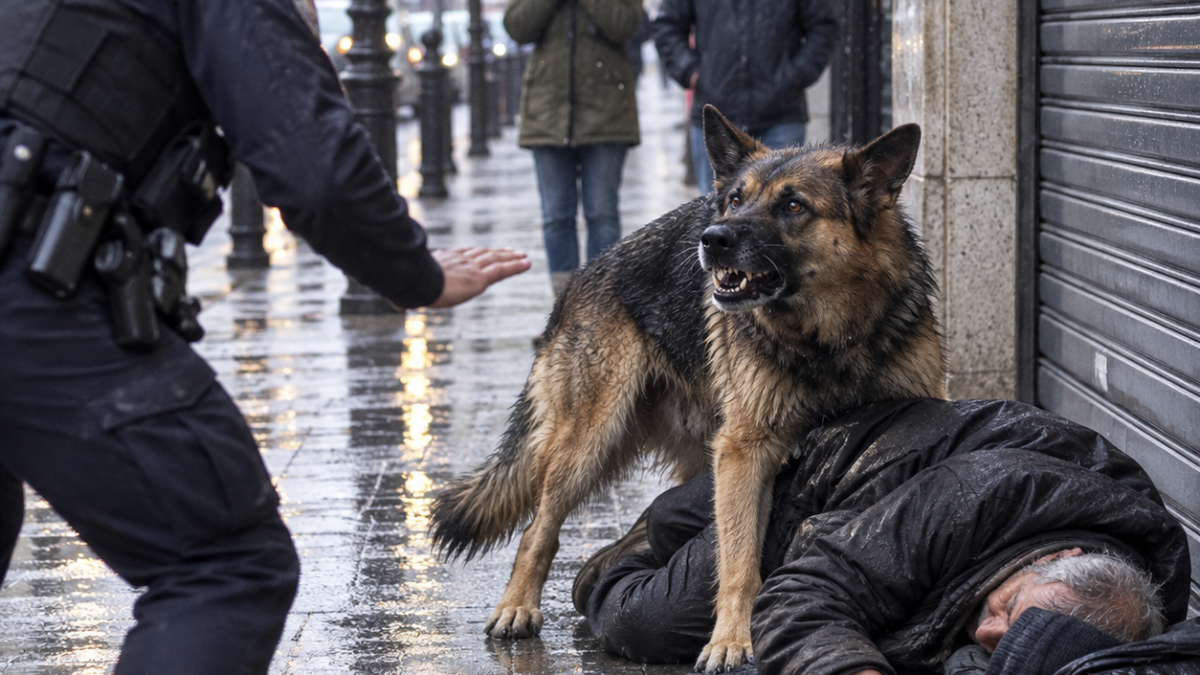
The dog was standing over an unconscious man with his teeth exposed, and everyone on that wet sidewalk was warning me not to take another step.
Everyone else saw an aggressive animal, but when I looked into his eyes, I saw terror—and a desperate plea that had nothing to do with protecting himself.
What happened after I trusted that look would force me to question every assumption I had made in twenty-seven years behind a badge.
My name is Julien Morel.
I was fifty-two years old that morning, with almost twenty-seven years of police work behind me.
I had dealt with family fights, wrecks, intoxicated people, psychiatric crises, frightened animals, and dogs that truly wanted to bite.
But something about the shepherd mix standing outside that closed café in Lyon felt different.
The man beneath him looked about sixty.
Gray beard.
Brown coat worn thin at the elbows.
Frayed gloves.
Shoes so old the sole of the left one had begun separating.
His shopping cart had tipped onto its side, spilling a blanket, clothing, and a few groceries across the rain-darkened sidewalk.
His right hand rested in a shallow puddle.
He wasn’t moving.
The dog stood above his chest.
Large.
Black and brown.
One ear upright, the other folding at the tip.
His coat was soaked, and his ribs showed faintly beneath wet fur.
His tail stayed low.
His lips were pulled back.
A delivery driver pointed at him.
“Officer, don’t get close. He won’t let anybody near that man.”
A woman under a red umbrella shook her head.
“Someone needs to catch that dog.”
Another man near the bus stop shrugged.
“His owner’s probably drunk.”
Probably.
That word bothered me.
Because nobody knew.
It is easy to invent someone’s story when you don’t want to look closely.
A dirty coat becomes alcoholism.
A shopping cart becomes failure.
A dog showing teeth becomes dangerous.
And sometimes those assumptions cost people minutes they don’t have.
I stepped forward.
The dog growled.
Low.
Deep.
But he didn’t charge.
He didn’t even move toward me.
He held his position above the man.
“Easy, boy.”
I raised both hands.
The dog stared at me.
Then suddenly lowered his head.
He pushed his nose against the man’s cheek.
Once.
Twice.
He sniffed around his mouth.
Then his neck.
Finally, he placed one paw carefully on the man’s chest.
And looked back at me.
That was when I noticed it.
He wasn’t watching us constantly.
Every few seconds, his attention returned to the man.
Checking.
Waiting.
Listening.
“You’re not protecting him from us,” I whispered.
The dog’s head tilted.
“You’re trying to tell us something’s wrong.”
I crouched.
My knees immediately reminded me I wasn’t twenty-five anymore.
“I’m not going to hurt him.”
The dog trembled.
That detail mattered.
An aggressive dog can be tense.
This animal was terrified.
Terrified of me.
Terrified of the people gathering nearby.
Terrified, I thought, of what was happening beneath him.
Then the man made a sound.
Barely anything.
A broken breath.
The dog spun around so quickly his paws slipped on the wet pavement.
He licked the man’s face.
Then barked once.
Not angrily.
Desperately.
He looked straight at me again.
I reached for my radio.
“Dispatch, I need medical response immediately. Male approximately sixty, unconscious, abnormal breathing.”
The dog growled when I shifted closer.
I stopped.
“All right. I know.”
I removed my glove.
Placed my bare hand flat on the sidewalk.
Then waited.
The dog stared at it.
“Let me help him.”
His chest rose and fell rapidly.
Behind me, somebody whispered that I was crazy.
Maybe.
But twenty-seven years had taught me that fear often looks like aggression when you don’t understand what you’re seeing.
I moved my hand one inch closer.
The dog looked down at the unconscious man.
Then back at me.
Finally, something changed.
His lips lowered over his teeth.
He took one step backward.
Only one.
But it was enough.
I moved toward the man.
The dog remained close enough that I could feel his breath on my wrist.
I touched two fingers to the man’s neck.
There was a pulse.
Weak.
Fast.
His skin felt cold.
Then I noticed a small medical pouch partly hidden beneath his coat.
I pulled it free.
Inside were insulin pens, glucose-testing supplies, and an emergency card.
The name read:
**GABRIEL FOURNIER.**
And beneath it:
**DIABETES — RISK OF SEVERE HYPOGLYCEMIA.**
My stomach dropped.
This man wasn’t sleeping.
He wasn’t drunk.
He was dying in front of people who had already decided they knew his story.
The ambulance siren sounded at the end of the street.
The dog pressed himself against Gabriel’s shoulder.
And as I looked at the medical card in my hand, one thought hit me harder than anything else.
How long had this dog been trying to tell everyone?
PART 2
The ambulance arrived less than four minutes later.
It felt like twenty.
Gabriel’s breathing had become more uneven, and every few seconds the dog pushed his nose beneath the man’s chin.
“Stay with me, Gabriel.”
I had no idea whether he could hear me.
The shepherd mix did.
His head snapped toward my voice each time I said the name.
Gabriel.
The dog knew it.
That gave me another piece of information.
This wasn’t a stray who had happened upon an unconscious man.
This was his dog.
One of the paramedics, a woman named Léa Martin, approached carrying a medical bag.
The dog immediately stood.
His lips lifted again.
Léa froze.
“Julien.”
“I know.”
“We need access.”
“I know.”
Her partner remained several feet behind her.
The small crowd had grown.
That was making everything worse.
Phones were coming out now.
People love witnessing emergencies once they believe somebody else is responsible for solving them.
I turned.
“Everybody back.”
Nobody moved.
“Now.”
My uniform finally became useful.
People retreated several meters.
The dog noticed.
His shoulders lowered slightly.
I looked at Léa.
“Give me thirty seconds.”
“You have maybe less.”
I understood.
Severe hypoglycemia could become fatal quickly.
Gabriel might also have hit his head.
Could be having a cardiac event.
Could be anything.
We needed the dog away from him.
But forcing that dog off Gabriel was exactly the wrong move.
I crouched again.
“All right, boy.”
His eyes stayed on mine.
I pointed toward Léa.
“She’s helping.”
Obviously, dogs do not understand sentences the way people do.
But they understand tone.
Movement.
Intent.
And this dog was studying every one of us.
Léa slowly placed her medical bag on the ground.
Then she sat down.
Right there on the wet sidewalk.
Her partner looked at her like she had lost her mind.
She ignored him.
“Hello, handsome,” she said softly.
The dog glanced at her.
“No one’s taking him away from you.”
His ears shifted.
Léa opened a side pocket and removed a small packet of glucose gel.
The dog smelled it immediately.
Not because he wanted it.
Because the scent was familiar.
He looked down at Gabriel.
Then back at the packet.
Something happened.
The dog whined.
That was the first time I heard him make anything other than a growl or bark.
A high, broken sound.
Léa looked at me.
“He knows.”
I nodded.
“Looks like it.”
She held the packet where he could smell it.
Then pointed toward Gabriel.
“We need to give him this.”
The dog paced once in a tight circle.
His body shook.
Then, incredibly, he stepped away.
Not far.
Maybe two feet.
But enough.
Léa moved.
Fast.
She checked Gabriel’s airway, pulse, pupils.
Her partner came in from the other side.
The dog growled.
I positioned myself between him and the second paramedic.
“Stay with me.”
His eyes locked on mine.
“Watch me.”
I held his gaze while they tested Gabriel’s blood sugar.
Léa looked at the meter.
“Twenty-eight.”
Her partner swore under his breath.
Even I knew that number was dangerously low.
They administered glucose.
The dog tried to move closer.
I blocked him gently with my forearm.
He didn’t bite.
Didn’t snap.
He pressed against me, trying to see.
“I know.”
His whole body trembled.
“I know.”
For several minutes, nothing changed.
Then Gabriel moved.
Barely.
His left hand twitched.
The dog saw it instantly.
He pushed past my arm.
“Wait—”
Too late.
He was beside Gabriel again.
But instead of becoming defensive, he lay down.
He put his head directly against Gabriel’s hand.
Léa looked at me.
“Let him.”
Nobody argued.
Gabriel’s fingers moved again.
They brushed the dog’s ear.
The dog closed his eyes.
Then Gabriel whispered something.
I leaned closer.
“Bruno.”
The dog’s tail struck the pavement once.
Bruno.
We had his name.
“Gabriel?”
His eyes did not open.
But he whispered it again.
“Bruno.”
The dog licked his fingers.
Léa smiled despite the tension.
“He knows you’re here, Bruno.”
The second glucose check improved.
Still bad.
But rising.
They needed Gabriel at the hospital.
That created our next problem.
Bruno was not going to calmly watch strangers place Gabriel on a stretcher and drive away.
I could see that before anyone touched him.
“We need animal services,” Léa said.
“No.”
She looked at me.
“No?”
“Not yet.”
“Julien, we can’t put him in the ambulance.”
“I know.”
“And we can’t wait.”
“I know.”
I took Gabriel’s medical card and checked the back.
There was an emergency contact.
A woman named Claire Fournier.
The number had been crossed out.
Underneath, in different handwriting, someone had written:
**DECEASED.**
No other contact.
I looked through the overturned cart.
Not to invade his life.
To save it.
Clothing.
Two cans of soup.
Bread.
A blanket.
Dog food in a plastic bag.
A stainless-steel bowl.
And beneath the blanket, a red leash.
I pulled it free.
Bruno saw it.
His tail moved.
Good.
Very good.
I held it out.
“Recognize this?”
Bruno came toward me.
Slowly.
I clipped it onto his collar.
No resistance.
Apparently, I had been promoted.
I wrapped the leash once around my hand.
“Léa, move him.”
They lifted Gabriel.
Bruno immediately pulled.
I moved with him.
“It’s okay.”
Gabriel’s arm fell slightly from the stretcher.
Bruno touched his hand with his nose.
The dog looked at me.
Then at the ambulance.
I made a decision that probably violated three procedural recommendations and at least one rule I would later pretend not to remember.
“I’m taking the dog.”
Léa blinked.
“Where?”
“Hospital.”
“You cannot bring him into emergency.”
“I’ll figure it out.”
My partner, Thierry, finally arrived.
He looked at Bruno.
Then at me.
Then at the ambulance.
“No.”
“What?”
“Whatever you’re thinking, no.”
“I didn’t say anything.”
“I’ve known you fourteen years. That face always costs me paperwork.”
I handed him the scene.
“Get witness names. Find out who saw Gabriel before he collapsed.”
“Julien.”
“Please.”
He sighed.
“Fine.”
I walked Bruno behind the ambulance.
Not inside.
Beside my patrol car.
The dog resisted when Gabriel disappeared into the vehicle.
He planted all four feet.
The ambulance doors closed.
Bruno barked.
Again.
Again.
His panic returned instantly.
I knelt.
“Listen to me.”
He strained against the leash.
“He’s not leaving you.”
The ambulance started moving.
Bruno lunged.
I held on.
“He’s not leaving you.”
That sentence came out stronger than I intended.
Bruno stopped.
Not because he understood the words.
Because something in my voice reached him.
I opened the rear door of my police car.
Bruno looked inside.
Then toward the disappearing ambulance.
“Come on.”
He jumped in.
I drove.
At the hospital, Gabriel went straight into emergency treatment.
Bruno was not allowed inside.
That was expected.
So I sat with him outside beneath the covered ambulance entrance.
Still raining.
Still cold.
Bruno paced.
Every time automatic doors opened, he stood.
Every person wearing medical scrubs got his attention.
At one point, an orderly brought us a bowl of water.
Bruno drank almost the entire thing.
Then returned to watching the door.
“You’re stubborn,” I told him.
He looked at me.
“So am I.”
I shared half my breakfast sandwich with him.
That violated another rule.
He ate the ham and ignored the bread.
“Ungrateful.”
His tail moved.
Progress.
Two hours later, Léa came outside.
“He’s conscious.”
I stood.
“Stable?”
“For now.”
“What happened?”
“Severe hypoglycemic episode, dehydration, exhaustion, probably worsened by not eating properly. Mild arrhythmia too. They’re keeping him.”
“Head injury?”
“No evidence.”
Bruno stood against my leg.
Léa crouched.
“He saved his life.”
I looked down.
“Maybe.”
“No maybe.”
She pointed toward the street.
“If Bruno hadn’t stayed over him, people might have walked past for another hour.”
I thought about the man at the bus stop.
His owner’s probably drunk.
An hour.
Maybe Gabriel would not have had one.
“Can Gabriel see him?”
Léa hesitated.
“Not inside.”
Bruno whined.
She sighed.
“I’ll ask.”
The answer was still no.
Hospital policy.
Infection control.
No registered service dog status.
I understood.
Bruno did not.
We waited another hour.
Then a nurse came outside with a wheelchair.
Gabriel sat in it.
Pale.
Wrapped in a hospital blanket.
The moment Bruno saw him, the leash ripped through my hand.
I almost lost it.
“Bruno!”
The dog ran the six meters between them.
Gabriel opened both arms.
Bruno hit him in the chest so hard the nurse grabbed the wheelchair.
Gabriel laughed.
It was weak.
Broken.
But it was laughter.
“You idiot,” he whispered.
Bruno climbed halfway into his lap.
Gabriel pressed his face into the wet fur.
“You stayed.”
I looked away.
Police officers become very skilled at pretending wind causes watering eyes.
Gabriel kept both arms around him.
Bruno made that same desperate little whine from the sidewalk.
Except now it sounded different.
Relief.
After a minute, Gabriel looked at me.
“You’re the officer?”
“Julien Morel.”
He held out his hand.
It shook.
I took it.
“Thank you.”
“Thank your dog.”
Gabriel looked down.
“I do. Every day.”
That was the beginning.
I thought the story would end there.
Man survives.
Dog proves loyal.
Officer goes home and tells his wife about the strangest call of the week.
But something about the scene stayed with me.
Especially that medical pouch.
Gabriel had insulin.
He had testing supplies.
He knew his condition.
So why had his blood sugar dropped so catastrophically?
And why, for a man carrying groceries, had there been almost no food in his cart?
I returned to the café the next morning.
It was open now.
Small place.
Green awning.
Eight tables.
The owner was wiping the counter when I entered.
Mid-forties.
Expensive sweater.
Perfectly trimmed beard.
His name, according to the license behind the register, was Marc Delon.
He recognized me.
“You were here yesterday.”
“Yes.”
“The homeless man.”
“Gabriel Fournier.”
Marc shrugged.
“Is he alive?”
“He is.”
“That’s good.”
His tone said something else.
I ordered coffee.
Then asked, “Did you know him?”
“He sleeps around here.”
“How long?”
“Months.”
“Any problems?”
Marc leaned closer.
“Officer, I run a business. Customers don’t want to step over homeless people.”
“That wasn’t my question.”
He stiffened.
“He creates problems.”
“What kind?”
“His cart. His dog. Smell. People complain.”
“Did Bruno ever bite anyone?”
“Bruno?”
“The dog.”
Marc gave a short laugh.
“I don’t know its name.”
“Did he bite anyone?”
“Not that I know.”
“Threaten anyone?”
“He growls.”
“Yesterday he growled at people approaching an unconscious man.”
Marc shrugged.
“Dangerous animal either way.”
That bothered me.
But not enough.
“Did you see Gabriel yesterday morning before he collapsed?”
“No.”
“Your café has cameras.”
Marc stopped wiping the counter.
“So?”
“So I’d like to review the exterior footage.”
“Do you have a warrant?”
Interesting question.
For a man who claimed to have seen nothing.
“Not yet.”
“Then no.”
I drank my coffee.
Paid.
Left.
The delivery driver from the previous morning was unloading bread across the street.
I recognized him.
He recognized me too.
“Officer.”
“Can I ask you something?”
“Sure.”
“What time did you arrive yesterday?”
“About six fifteen.”
“When did you first see Gabriel?”
“He was already there.”
“Conscious?”
The driver thought.
“Yes.”
That changed things.
“What was he doing?”
“Sitting against the wall.”
“Eating?”
“No.”
“Talking?”
The driver glanced toward Marc’s café.
Then back at me.
“He and Marc had an argument.”
I stayed quiet.
People often fill silence better than questions.
The driver continued.
“Marc came out before opening. Told him to move.”
“And?”
“Gabriel said he felt sick.”
“What happened?”
“Marc told him that wasn’t his problem.”
My jaw tightened.
“Then?”
“He grabbed some of Gabriel’s things.”
“What things?”
“A bag. Maybe food. I don’t know.”
“Where did he put it?”
The driver pointed toward the alley beside the café.
“Dumpster.”
I stared at him.
“Did Gabriel try to stop him?”
“Yes.”
“And Bruno?”
“Dog barked. Marc kicked the cart.”
“Did he kick the dog?”
“I didn’t see that.”
Good.
Facts.
Not anger.
“What happened next?”
“Marc went inside. Gabriel tried getting stuff out of the dumpster, but it’s tall. Then he sat down again.”
“How long before he collapsed?”
“Maybe twenty minutes.”
That was no longer a coincidence.
I called Thierry.
“I need you.”
“What did you do?”
“Why do you always assume I did something?”
“Experience.”
I explained.
His tone changed.
“Get the witness statement.”
“Already doing it.”
“We’ll request footage.”
“I know.”
“And Julien?”
“What?”
“Don’t go back inside that café angry.”
“I’m not angry.”
“You’re a terrible liar.”
The footage request became formal.
Marc resisted.
That made it worse for him.
By the afternoon, we had legal authorization to preserve and obtain the exterior security recording.
Marc’s attorney arrived before we finished copying it.
The video had no audio.
It did not need much.
At 5:58 a.m., Gabriel pushed his cart beneath the awning to escape the rain.
At 6:07, Marc came outside.
They spoke.
Gabriel pointed toward the street.
Then toward his own chest.
Marc gestured aggressively for him to leave.
Gabriel began gathering his things.
Slowly.
Too slowly for Marc.
At 6:09, Marc grabbed a blue insulated bag from the cart.
Gabriel reached for it.
Marc pulled it away.
Bruno barked.
Marc stepped back.
Then threw the bag into the commercial dumpster.
Gabriel stood there.
Staring.
Marc went inside.
At 6:13, Gabriel tried to climb against the dumpster.
He couldn’t.
He sat down.
At 6:18, Bruno began behaving strangely.
Pacing.
Nudging Gabriel.
Gabriel opened his coat.
Checked something.
Probably his glucose meter.
At 6:23, he stood.
Took three steps.
Collapsed against the wall.
Bruno immediately began licking his face.
Then barking toward the street.
The next twenty minutes were painful to watch.
People passed.
Some looked.
Some didn’t.
One person filmed.
Another tried to pull Bruno away.
Bruno showed his teeth.
They retreated.
The dog returned to Gabriel.
Over and over.
At 6:31, Bruno ran several meters toward pedestrians, barking.
Then back to Gabriel.
At 6:36, the woman with the red umbrella appeared.
At 6:38, somebody finally called police.
At 6:43, I arrived.
I paused the footage.
Thierry stood beside me.
Neither of us spoke.
Finally he said, “What was in the blue bag?”
We already knew what we needed to do.
The dumpster had been emptied that morning.
But Gabriel could answer.
I visited the hospital that afternoon.
Bruno was not with him.
A local outreach volunteer had agreed to keep the dog temporarily.
Gabriel looked anxious the moment I entered.
“Where’s Bruno?”
“Safe.”
“With who?”
“A woman named Sophie from Saint-Martin outreach. She says he ate two bowls of food and stole one sock.”
Gabriel relaxed slightly.
“He likes socks.”
“Apparently.”
I pulled up a chair.
“Gabriel, I need to ask you about yesterday morning.”
His face closed immediately.
That reaction was familiar.
People who live outside learn quickly that questions from officials often bring consequences.
“You’re not in trouble.”
“I know.”
“Do you?”
He looked at me.
“No.”
Fair.
“What was in the blue insulated bag Marc threw away?”
Gabriel stared toward the window.
“Food.”
“What else?”
Silence.
“Your medical supplies?”
“My insulin was in my coat.”
“What about emergency glucose?”
He swallowed.
“In the bag.”
“Anything else?”
“Crackers. Juice. Two sandwiches from the church.”
I felt my jaw tighten.
“When did you last eat before that?”
“The night before.”
“How much?”
“Soup.”
“Why didn’t you buy something?”
He laughed once.
Not because it was funny.
“With what?”
I looked at the small bedside table.
His wallet rested there.
Inside, later, I would learn, were four euros and eighty cents.
“Did Marc know you were diabetic?”
Gabriel didn’t answer.
“Gabriel.”
“Yes.”
“How?”
“He’d seen me inject insulin.”
“Had you told him?”
“Once.”
“When?”
“About a month ago.”
“Why?”
“He accused me of using drugs behind his café.”
I closed my eyes briefly.
Of course.
“He knew.”
Gabriel looked at me.
“Don’t make trouble.”
“He threw away food you needed during a medical crisis.”
“He didn’t know I would collapse.”
“That’s not the standard.”
Gabriel looked tired.
“Officer—”
“Julien.”
“What?”
“My name is Julien.”
He studied me.
“All right. Julien. Men like Marc always land standing up.”
“Maybe.”
“And men like me?”
I waited.
“We’re lucky if anyone notices we fell.”
I thought of Bruno standing over him.
“I noticed.”
Gabriel’s mouth tightened.
“That dog made you.”
“Yes.”
For the first time, he smiled.
“Then Bruno noticed.”
That was probably true.
The case expanded.
Not dramatically at first.
A statement.
Video.
Medical records showing severe hypoglycemia.
The contents of the bag, according to Gabriel.
Marc’s acknowledgment that he had handled Gabriel’s property.
His attorney argued that Marc had simply been clearing items blocking the entrance to his business.
The video made that difficult.
Especially because Gabriel was clearly gathering his belongings when Marc took the bag.
Then more people came forward.
Not because of publicity.
We hadn’t released anything.
Because Thierry did what good investigators do.
He asked around.
A woman who slept in a shelter two neighborhoods away said Marc had thrown her backpack into the street three months earlier.
An older man said Marc had sprayed water from a cleaning hose beneath the awning while he slept.
A neighborhood volunteer said Marc regularly called police claiming unhoused people were “threatening customers,” but often withdrew the complaint when officers arrived and found no actual threat.
None of that automatically made him criminally responsible for Gabriel’s collapse.
But it established behavior.
More importantly, Gabriel’s blue bag became physical evidence when waste workers found it at the transfer station.
That was luck bordering on miracle.
The contents were crushed.
Wet.
Ruined.
But still recognizable.
Two empty juice boxes.
Crackers.
Glucose tablets.
A spare testing kit.
And inside a side pocket, a folded piece of paper.
A letter.
Not evidence of the medical emergency.
Something personal.
I didn’t read it.
Not then.
I returned the bag to Gabriel after photographs and documentation were complete.
He opened the side pocket with shaking hands.
When he saw the letter, his face changed.
He pressed it to his chest.
“What is it?” I asked.
“My wife.”
Claire.
The deceased emergency contact.
“She wrote it before she died.”
I looked away.
“How long ago?”
“Four years.”
“You carry it everywhere?”
“Yes.”
He unfolded it carefully.
Water had blurred part of the ink.
Gabriel stared at the damage.
For the first time since I met him, I saw anger.
Not loud anger.
Something deeper.
“He threw this away too.”
I said nothing.
Gabriel traced the smeared handwriting.
“He can pay for food. He can pay for the medicine. I don’t care.”
His voice broke.
“But this…”
He closed his eyes.
“This was all I had left in her handwriting.”
That was when the case stopped being only about what Marc had thrown into a dumpster.
It became about the habit of deciding certain people’s belongings did not matter because their lives looked inconvenient.
I visited Bruno that evening.
Sophie Dubois, the outreach worker, had him in a small fenced courtyard behind Saint-Martin community center.
The moment Bruno saw me, he barked once.
Then came running.
“Traitor,” Sophie said.
“He likes authority.”
“He stole my sock.”
“Evidence?”
“He is literally carrying it.”
Bruno had a gray sock in his mouth.
I laughed.
It was the first time I had seen him look like an ordinary dog.
Not guardian.
Not emergency alarm.
Just ridiculous.
Gabriel remained hospitalized for five days.
Bruno stayed with Sophie.
Every day, I visited one or the other.
Thierry noticed.
“You adopting both of them?”
“No.”
“Your wife know that?”
“Élise knows everything.”
“That wasn’t my question.”
I ignored him.
On day six, Gabriel was discharged.
The hospital social worker had arranged temporary medical housing for two weeks.
One problem.
No dogs.
I watched Gabriel’s face when she told him.
“Then I’m not going.”
“Gabriel,” she said gently, “you need somewhere warm while your glucose stabilizes.”
“I’m not leaving Bruno.”
“We can place him temporarily.”
“No.”
“It’s only two weeks.”
“No.”
His voice hardened.
“You don’t understand.”
I did.
Bruno had been the one constant when everything else disappeared.
Claire.
Apartment.
Job.
Savings.
Health.
Bruno remained.
Asking Gabriel to sleep safely without him sounded reasonable to us.
To Gabriel, it sounded like losing the last piece of his life.
I called Sophie.
She called three people.
One called another.
By that evening, a church-run transitional residence had agreed to take Gabriel and Bruno together.
One small room.
Shared bathroom.
Thirty-day placement.
When I told Gabriel, he just stared at me.
“What?”
“You and Bruno. Together.”
“How?”
“People made calls.”
“Why?”
I almost laughed.
Because that question said everything.
“Because you needed a room.”
He looked at the floor.
“Nothing’s free.”
“No.”
“What do they want?”
“They want you to follow medical appointments, meet with a social worker, and stop letting your dog steal socks.”
Bruno wagged.
Gabriel’s eyes filled.
He turned away.
“I hate crying in front of cops.”
“I hate people crying in front of cops.”
“Good.”
“We agree.”
Bruno moved between us and leaned against Gabriel’s leg.
The transitional residence changed everything.
Not instantly.
Real life almost never changes instantly.
Gabriel’s health improved first.
Regular meals.
Insulin stored properly.
Blood sugar checked.
A bed.
A shower.
Bruno gained weight too.
His ribs disappeared beneath his coat.
His fur softened.
He stopped watching every doorway.
Then Sophie discovered something important about Gabriel.
He had worked for thirty-one years as an electrical maintenance technician.
Not casually.
Not occasionally.
He was certified.
Skilled.
Reliable.
He had lost his job after repeated absences during Claire’s cancer treatment.
After she died, depression swallowed the rest.
He missed rent.
Then another month.
Then another.
He sold his car.
Lost the apartment.
His diabetes became harder to manage.
By the time he asked for help, paperwork, shame, and exhaustion had turned every simple task into a wall.
People asked why he had not gone to a shelter.
He had.
Most did not accept Bruno.
The ones that did were full.
So he chose the dog.
Again and again.
I asked him once whether that decision made sense.
He looked at me.
“After Claire died, there were nights I didn’t care whether I woke up.”
Bruno lay at his feet.
Gabriel scratched behind his folded ear.
“He cared.”
I stopped asking.
The investigation into Marc continued.
His attorney tried to minimize everything.
Marc claimed Gabriel had been obstructing business.
Claimed the bag looked like trash.
Claimed he did not remember being told about the diabetes.
Then Thierry found something.
A prior police call.
Six weeks before the collapse.
Marc had reported “drug use” behind the café.
The responding officer had documented that Gabriel was not using illegal drugs.
He was injecting prescribed insulin.
The officer had explained this to Marc.
In writing.
Marc knew.
Not vaguely.
Not possibly.
He knew.
When confronted with that report, his attorney changed tactics.
Suddenly, Marc wanted to settle certain property claims privately.
Gabriel refused.
That surprised me.
“You could get compensation quickly,” I told him.
We were sitting outside Saint-Martin.
Bruno lay beneath the bench.
Gabriel shook his head.
“I don’t want his money if it buys silence.”
“It wouldn’t necessarily—”
“Yes, it would.”
He looked at me.
“You know what the worst part is?”
“What?”
“If Bruno had bitten him that morning, they would have taken Bruno away.”
I knew.
“And Marc would have become the victim.”
I said nothing.
“He throws away the food keeping me conscious. Bruno panics when I fall. Somebody tries to pull him off me. He bites.”
Gabriel looked down.
“And suddenly the only one who stayed beside me becomes the dangerous one.”
That possibility made me cold.
“But he didn’t bite.”
“No.”
Gabriel smiled faintly.
“He’s smarter than us.”
Bruno opened one eye.
Probably true.
The prosecutor eventually filed charges related to the destruction and unlawful disposal of Gabriel’s belongings, along with an endangerment theory tied to the known medical circumstances.
I will not pretend the case was simple.
It wasn’t.
Marc had not injected Gabriel with anything.
He had not caused diabetes.
Gabriel had not eaten enough.
Multiple factors contributed to the collapse.
The defense emphasized every one.
That is what defense attorneys are supposed to do.
But the video remained.
Marc taking the insulated bag.
Gabriel reaching for it.
Marc throwing it away.
And the earlier report confirming he knew Gabriel carried insulin and diabetic supplies.
Facts are stubborn things.
Then Marc made his biggest mistake.
He went after Bruno.
Three weeks before the hearing, animal control received a formal complaint alleging Bruno was a “known dangerous dog” that had repeatedly threatened café customers.
The complainant?
Marc Delon.
He requested restrictions that could have separated Bruno from Gabriel’s transitional housing.
When Sophie told me, I felt my blood pressure rise.
“Repeatedly?”
“That’s what he says.”
“Evidence?”
“Two written statements.”
“From who?”
“One café employee. One regular customer.”
I called Thierry.
He sighed the moment he heard my voice.
“What?”
“Marc filed a dangerous-dog complaint.”
Silence.
Then:
“That was stupid.”
“Very.”
“Don’t celebrate yet.”
“I’m not.”
“You sound happy.”
“I sound focused.”
“You sound like a man who found dessert.”
The hearing required documentation.
We had plenty.
Body camera footage from the morning Gabriel collapsed showed Bruno growling but retreating when given space.
No lunging.
No biting.
No uncontrolled attack.
The café’s own surveillance footage showed Bruno barking when Marc took the blue bag but never making contact.
Three months of records from Saint-Martin showed no aggression incidents.
Veterinary assessment described Bruno as fearful, bonded, protective under stress, but manageable.
Then we interviewed the two witnesses behind Marc’s complaint.
The café employee admitted Bruno had never bitten anyone.
The regular customer said the dog had “looked scary.”
That was it.
Looked scary.
At the dangerous-dog hearing, Marc sat with his attorney.
Gabriel sat beside Sophie.
Bruno was not in the room.
I testified.
So did Léa.
I described the morning exactly as it happened.
“Yes, he showed his teeth.”
Marc’s attorney leaned forward.
“So he was aggressive.”
“I didn’t say that.”
“Officer Morel, he growled at you.”
“Yes.”
“Bared his teeth?”
“Yes.”
“Prevented emergency responders from approaching?”
“For a short period.”
“That sounds aggressive.”
“It sounds protective and fearful.”
“Isn’t that interpretation subjective?”
“Behavior always requires context.”
The attorney smiled slightly.
“And your context is that you like this dog.”
“I do now.”
A few people smiled.
The attorney didn’t.
“What did you think then?”
“I thought he might bite me.”
“So you agree he was dangerous.”
“No.”
He paused.
“You thought he might bite.”
“Yes.”
“Yet not dangerous.”
“A frightened animal can bite without being an inherently dangerous animal, just as a frightened person can push someone without being a violent criminal.”
The hearing officer looked up.
The attorney changed direction.
Léa testified next.
She explained that Bruno had repeatedly directed attention toward Gabriel.
That when Gabriel’s condition worsened, the dog’s behavior intensified.
That once Bruno recognized the medical team was helping, he allowed access.
Then Marc’s own surveillance video played.
There was Bruno.
Barking when Marc took Gabriel’s bag.
Then retreating.
Later, standing over unconscious Gabriel.
Pacing.
Nudging.
Trying to attract attention.
The room became quiet.
When the footage ended, the hearing officer asked one question.
“Mr. Delon, where is the repeated unprovoked aggression described in your complaint?”
Marc said nothing.
His attorney spoke for him.
The complaint was dismissed.
Bruno was not designated dangerous.
Gabriel leaned forward and covered his face with both hands.
Sophie put an arm around him.
Outside, Bruno was waiting with a volunteer.
Gabriel walked through the doors.
Bruno ran to him.
Gabriel dropped to his knees.
“You’re staying.”
Bruno licked his face.
“You’re staying with me.”
I stood a few feet away.
That felt better than any punishment against Marc.
But Marc’s consequences were still coming.
His criminal case reached court several months later.
By then, Gabriel looked different.
Clean beard.
New jacket.
Better shoes.
Still thin, but healthy.
Bruno wore a red harness.
Gabriel had moved from transitional housing into a small subsidized studio that accepted dogs.
More importantly, he had started working again.
Only fifteen hours a week at first.
A nonprofit renovation program needed someone who understood old electrical systems.
Sophie introduced him to the supervisor.
Within a month, they increased him to twenty-five hours.
The day he got his first paycheck, Gabriel bought Bruno a ridiculous orthopedic dog bed.
Bruno slept beside it.
“I spent eighty euros,” Gabriel complained.
“Maybe he hates luxury.”
“He sleeps on the floor.”
“Principles.”
“Then at three in the morning he gets into my bed.”
“Flexible principles.”
The court hearing on Marc’s case attracted more attention than I expected.
The story had become known locally after public records from the dangerous-dog complaint were reported.
People were angry.
I disliked some of the commentary.
Online outrage simplifies everyone.
Marc became a monster.
Gabriel became a saint.
Bruno became a superhero.
Reality was more complicated.
Gabriel had made mistakes.
Marc had probably done kind things in his life.
Bruno was a dog.
What mattered was one morning and a series of choices.
Marc chose to throw away a sick man’s food and medical supplies.
He chose not to call for help when Gabriel said he felt ill.
Later, he chose to file a complaint against the dog whose behavior had helped save Gabriel.
Those were facts.
The court did not need a monster.
It needed evidence.
The prosecutor presented the video.
Medical testimony established that access to quick sugar could have significantly altered Gabriel’s hypoglycemic episode.
The prior police report established Marc’s knowledge of Gabriel’s diabetes.
The blue bag established what was discarded.
Then Gabriel testified.
I expected anger.
He surprised me.
The prosecutor asked, “What did you think when Mr. Delon threw your bag away?”
Gabriel considered his answer.
“I thought I didn’t matter.”
The courtroom became very still.
“Why?”
“Because that’s how people treat you after you’ve been outside long enough.”
He looked toward Marc.
“Not everyone. But enough.”
“What was in the bag?”
He listed it.
Then the letter.
The prosecutor asked, “Why was the letter important?”
Gabriel took a long breath.
“My wife wrote it the week before she died.”
“Did Mr. Delon know that?”
“No.”
“Then why is it relevant?”
Gabriel thought.
“Because when you decide someone’s property is worthless without asking, you don’t know what you’re destroying.”
Marc looked down.
The defense cross-examined carefully.
They emphasized that Marc could not have known Gabriel would collapse.
Gabriel agreed.
They pointed out that Gabriel was responsible for managing his own diabetes.
Gabriel agreed.
They suggested he could have gone elsewhere for food.
Gabriel looked at the attorney.
“With four euros?”
The attorney moved on.
The strongest moment came from the judge.
Not dramatic.
Not theatrical.
Just precise.
Before ruling, she said:
“This case is not about whether a business owner must tolerate every use of private commercial space. It is about whether frustration with another person’s presence permits the intentional disposal of property that the owner knows may contain medical necessities.”
She looked toward Marc.
“It does not.”
Marc was convicted on the principal property and endangerment-related counts the court found supported.
He received a suspended custodial sentence, probation, restitution, fines, and mandatory community-service obligations.
The court also ordered compensation for Gabriel’s ruined property and medical expenses not otherwise covered.
The café faced separate administrative penalties after inspectors found unrelated violations during the process.
Marc did not lose everything.
I was glad.
Revenge fantasies are easy when you do not have to live with their consequences.
I wanted accountability.
Not destruction.
But one particular condition of Marc’s community service felt almost poetic.
He was assigned part of his hours to a municipal food-distribution program.
The first time Gabriel heard that, he stared at me.
“You’re joking.”
“No.”
“He has to hand out food?”
“Yes.”
“To people who need it?”
“Yes.”
Gabriel leaned back.
Then he laughed.
Not cruelly.
Not triumphantly.
Just in disbelief.
Bruno lifted his head.
Gabriel scratched his ears.
“Well, boy.”
He smiled.
“Maybe the universe has a sense of humor.”
Months passed.
My involvement should have ended.
Technically, it did.
Personally, it didn’t.
Gabriel became my friend.
Not a project.
Not “the homeless man from the call.”
My friend.
There is a difference.
My wife, Élise, met him one Sunday when I invited him to lunch.
I had not fully warned her about Bruno.
I said “large dog.”
I did not say “large dog who believes personal space is a conspiracy.”
Bruno entered our apartment, inspected every room, then climbed halfway onto our sofa beside Élise.
She looked at me.
“This is the dangerous animal?”
“Apparently.”
Bruno put his head in her lap.
Élise scratched him.
“I’ve met worse policemen.”
“Name one.”
She looked at me.
I regretted asking.
Gabriel laughed so hard he nearly spilled his coffee.
That afternoon felt strange in the best possible way.
Six months earlier, Gabriel had been unconscious on a sidewalk.
Now he was complaining about football, arguing with Élise about coffee, and feeding tiny pieces of chicken to Bruno under the table while pretending not to.
Ordinary.
I began to understand that ordinary life is often the real miracle.
Not the ambulance.
Not the courtroom.
Not the dramatic rescue.
Rent paid.
Medication in the refrigerator.
Dog asleep under the table.
A friend expected for lunch.
Those things.
One year after the collapse, Gabriel returned to the café street.
He almost didn’t.
Marc still owned the business.
The awning was still green.
Same brick wall.
Same stretch of sidewalk.
“Why are we here?” I asked.
Gabriel held Bruno’s leash.
“I need to know.”
“Know what?”
“If I can walk past it.”
We stood at the corner.
Bruno recognized the place before Gabriel moved.
His ears changed.
His body stiffened.
Gabriel felt it through the leash.
“Easy.”
Bruno looked up.
“We’re not stopping.”
They walked.
Slowly.
I followed several steps behind.
Marc was inside.
I saw him through the window.
He saw Gabriel.
Their eyes met.
For one second, I thought Gabriel might stop.
Might go inside.
Might confront him.
Instead, he kept walking.
Bruno hesitated.
Gabriel touched his neck.
“Come on, boy.”
Bruno followed.
We passed the exact place where Gabriel had collapsed.
He did not look down.
At the next corner, he stopped.
Exhaled.
Then smiled.
“That’s it?”
“That’s what?”
“The revenge?”
Gabriel looked confused.
“I thought maybe you wanted him to see you.”
“He saw me.”
“Yes.”
“He saw I kept walking.”
I understood.
Marc had once controlled whether Gabriel could remain under an awning.
Now Gabriel had somewhere else to go.
That was enough.
The real change came the following winter.
The renovation nonprofit offered Gabriel full-time supervisory work.
He hesitated.
“Too much.”
“You did thirty-one years in maintenance,” I told him.
“That was before.”
“Before what?”
“Everything.”
I knew what he meant.
Before Claire.
Before grief.
Before the street.
Before becoming someone strangers stepped around.
“Skills don’t disappear because life knocks you down.”
He looked at me.
“That from a police manual?”
“No. Mine mostly tells us not to adopt dogs during active investigations.”
“You didn’t adopt Bruno.”
“I considered kidnapping him.”
Bruno wagged.
Traitor.
Gabriel accepted the job.
His first major project was rewiring an old building being converted into transitional housing.
The irony was not lost on him.
The day the building opened, Sophie invited me.
Twenty studio rooms.
Eight allowed pets.
A small courtyard.
Laundry.
A nurse three mornings a week.
Gabriel stood near the entrance in a clean work jacket.
Someone had put his name on a plaque with the other contractors.
He pretended not to care.
He cared.
I knew because he kept looking at it.
A young man arrived carrying two plastic bags and a small terrier.
He stopped at reception.
“Dog’s allowed?”
The staff member smiled.
“Yes.”
The young man looked down.
His shoulders dropped with relief.
Gabriel watched.
Then looked at me.
“That would’ve changed everything.”
“I know.”
He crouched and greeted the terrier.
Bruno, now grayer around the muzzle, watched from beside him.
Maybe that was where Gabriel’s story truly turned.
Not when the court ruled against Marc.
When somebody else did not have to choose between a bed and a dog.
Two years passed.
Then three.
I retired.
Twenty-nine years and seven months.
I had planned to stay thirty.
My knees voted otherwise.
At my retirement gathering, Thierry gave a speech containing at least six lies and three stories I had specifically forbidden him to tell.
Gabriel attended.
So did Bruno.
Bruno stole a sausage from the buffet.
A fitting tribute to my career.
By then, Bruno was old.
We never knew his exact age.
The veterinarian estimated eleven or twelve.
His black muzzle turned silver.
His hips stiffened.
The upright ear no longer stood quite as sharply.
But he remained Gabriel’s shadow.
Everywhere.
Worksite office.
Park.
Pharmacy.
Home.
When Gabriel’s blood sugar dropped, Bruno still noticed before most people.
He became restless.
Nudged Gabriel’s hand.
Sometimes barked once.
That same bark from the sidewalk.
Gabriel began carrying emergency glucose in three places.
Coat pocket.
Bag.
Bruno’s harness pouch.
“No one throws all three away,” he said.
He smiled when he said it.
But I heard the memory underneath.
One autumn morning, Gabriel called me.
“Can you come over?”
His voice told me something was wrong.
I drove immediately.
Bruno lay on the rug.
He tried to stand when I entered.
Couldn’t.
Gabriel sat beside him.
The veterinarian had already come.
Cancer.
Advanced.
We had weeks.
Maybe less.
I sat on the floor.
My knees hated me.
I didn’t care.
Bruno placed his head on my leg.
“Still causing trouble?”
His tail moved.
Gabriel looked toward the window.
“He saved me.”
“Yes.”
“What am I supposed to do without him?”
I had no good answer.
So I gave him the only honest one.
“I don’t know.”
Gabriel nodded.
“Thank you.”
“For what?”
“For not telling me it’ll be okay.”
Nothing about losing Bruno would be okay.
Some things are survivable without being okay.
We had nineteen days.
Gabriel made them count.
No dramatic bucket list.
Bruno did not want beaches or mountains.
He wanted Gabriel.
Food.
Warmth.
Slow walks.
Familiar smells.
So that was what he got.
Élise cooked chicken.
Thierry visited with sausage and claimed it was medically necessary.
Sophie brought a new blanket.
Léa came too.
Bruno remembered her.
I swear he did.
The woman who had sat on wet pavement with glucose gel in her hand.
He licked her wrist.
She cried.
“I knew you were smart,” she whispered.
On Bruno’s final morning, Gabriel called at 5:40.
I went.
The veterinarian arrived shortly after.
Bruno could barely lift his head.
Gabriel lay beside him on the floor.
I sat nearby.
No uniform now.
No radio.
No crowd.
No wet sidewalk.
Just friends.
Gabriel pressed his forehead against Bruno’s.
“You stayed.”
Bruno breathed slowly.
“When Claire died, you stayed.”
His voice broke.
“When we lost the apartment, you stayed.”
Bruno’s eyes remained on him.
“When I stopped wanting to wake up, you stayed.”
Gabriel swallowed.
“When I fell on that sidewalk, you stayed.”
I looked away.
Gabriel held Bruno’s face gently.
“So I’m staying now.”
The veterinarian gave the first injection.
Bruno relaxed.
Gabriel kept speaking.
“You don’t have to guard me anymore.”
One silver ear shifted.
“I’m okay.”
That was the lie we all permitted.
“I have a home.”
Bruno’s breathing slowed.
“I have work.”
Another breath.
“I have people.”
Gabriel looked at me.
I nodded.
“You can rest.”
Bruno exhaled.
And did.
Gabriel remained on the floor a long time.
His hand stayed on Bruno’s chest.
I did not touch him.
Did not tell him to stand.
Did not tell him Bruno had lived a good life.
There would be time for truths later.
Grief deserves silence before explanations.
Finally Gabriel whispered, “The first time you saw him, he showed you his teeth.”
“Yes.”
“You were scared?”
“Yes.”
Gabriel laughed through tears.
“Good.”
“Why?”
“He’d be offended if he knew he wasn’t intimidating.”
That made us both laugh.
And then cry harder.
Gabriel had Bruno cremated.
He kept the ashes beside Claire’s photograph.
For several months, he refused every suggestion of another dog.
Sophie never pushed.
Neither did I.
Then one afternoon the transitional housing program called Gabriel about an electrical problem.
He went to fix it.
A resident had recently died unexpectedly, leaving behind an elderly shepherd mix named Oscar.
No relatives would take him.
Shelters were full.
Oscar sat beneath a table in the community office.
Gray face.
One floppy ear.
Gabriel called me.
“I’m not adopting him.”
“Of course not.”
“He just needs somewhere tonight.”
“Obviously.”
“One night.”
“Absolutely.”
Oscar lived another four years with Gabriel.
Gabriel claimed this proved nothing.
I disagreed.
The most surprising chapter came long after Marc Delon’s court case had faded from public memory.
Seven years after the sidewalk collapse, Gabriel and I were walking past the municipal food-distribution center.
He stopped.
A man was carrying boxes from a truck.
Older now.
Thinner.
Gray in his beard.
Marc.
His court-ordered service had ended years earlier.
I knew that.
So why was he there?
We watched.
Marc carried another box inside.
Then another.
A volunteer greeted him by name.
Gabriel stared.
“Is he still working here?”
“I don’t know.”
The volunteer recognized me from some long-forgotten municipal event.
I asked.
“Oh, Marc? Every Thursday.”
“Volunteer requirement?”
She shook her head.
“No. He finished that years ago.”
Gabriel said nothing.
We walked away.
At the next block, he stopped.
“How do you feel?” I asked.
“I don’t know.”
“Disappointed?”
“Why would I be disappointed?”
“Some people prefer villains to stay villains.”
Gabriel thought.
“I wanted him punished.”
“He was.”
“I wanted him to understand.”
“Maybe he did.”
Gabriel looked back toward the center.
“Does that mean I have to forgive him?”
“No.”
“Good.”
We started walking again.
After a moment, he said, “But I’m glad he stayed.”
That word again.
Stayed.
Bruno had stayed.
Léa stayed long enough to earn his trust.
Sophie stayed through paperwork and housing meetings.
I stayed because a dog’s eyes told me not to walk away.
And maybe Marc, eventually, had learned something about staying too.
That did not erase what he did.
Nothing could.
Accountability and change are not enemies.
Sometimes one makes the other possible.
Years after Bruno’s death, Gabriel kept one photograph framed in his apartment.
Not the dramatic photograph someone took of Bruno standing over him.
He hated that one.
In the photograph he chose, Bruno was asleep.
That was all.
Curled on a blue blanket.
Gray muzzle tucked against his paws.
Sunlight across his back.
“You have hundreds,” I told him once. “Why that one?”
“Because he isn’t watching anything.”
I looked closer.
Gabriel was right.
Bruno’s eyes were closed.
His ears relaxed.
His body completely loose.
No guarding.
No checking Gabriel’s breathing.
No strangers.
No danger.
Just sleep.
“He spent years watching me,” Gabriel said.
“I like remembering that eventually he knew he didn’t have to.”
I think about that often.
People called Bruno brave because he showed his teeth.
That was not the bravest thing he did.
They called him heroic because he guarded Gabriel.
Maybe.
But Bruno’s greatest gift was simpler.
He refused to accept everybody else’s assumption.
People saw a dirty man on the sidewalk and thought they knew the story.
Bruno knew one fact.
His person was in trouble.
So he barked.
He blocked strangers until he understood their intentions.
He checked Gabriel’s breathing.
He stayed.
That was all.
And because he stayed, I stopped.
Because I stopped, I looked closer.
Because I looked closer, an ambulance came in time.
Everything afterward grew from that.
A hospital room.
A blue bag pulled from waste.
A court case.
A dismissed dangerous-dog complaint.
A room that accepted both man and dog.
A job.
A new apartment.
A building renovated for other people who needed somewhere safe.
A life rebuilt.
People often want justice to be loud.
They imagine humiliation.
Revenge.
Watching the person who hurt you lose everything.
But the older I get, the less interested I am in that kind of ending.
Marc threw away Gabriel’s bag because he had decided Gabriel did not matter.
Years later, Gabriel supervised electrical work on a building that gave twenty people a place to sleep.
Marc tried to have Bruno labeled dangerous.
Bruno died old, loved, and with Gabriel’s hands around his face.
Marc wanted Gabriel away from his doorway.
Gabriel ended up with a doorway of his own.
A key.
A bed.
A refrigerator filled with insulin and food.
A job badge hanging beside the door.
Photographs of Claire.
Bruno’s ashes.
Later, Oscar’s leash.
That was the revenge.
Not destroying Marc.
Proving him wrong.
Gabriel mattered.
Bruno mattered.
The belongings in that cart mattered.
The medical pouch mattered.
The letter mattered.
The dog’s fear mattered.
The extra thirty seconds I spent studying his eyes mattered.
I was twenty-seven years into police work that morning.
I thought experience meant recognizing danger quickly.
Bruno taught me that experience should also mean recognizing when your first interpretation might be wrong.
Bared teeth can mean aggression.
Sometimes.
A man on a sidewalk can be intoxicated.
Sometimes.
A shopping cart can belong to someone who has stopped trying.
Sometimes.
But “sometimes” is not evidence.
And “probably” is a dangerous word when somebody’s life depends on you looking closer.
I am retired now.
Gabriel and I still meet for coffee every Tuesday.
Not at Marc’s café.
Not because Gabriel avoids it anymore.
We simply found a better place.
Oscar is gone now too.
Gabriel swore afterward there would be no third dog.
Six months later, he adopted a twelve-year-old mutt named Marcel with cataracts and terrible breath.
I said nothing.
I didn’t need to.
Last winter, I asked Gabriel something I had never asked before.
“When Bruno looked at you after you collapsed, do you remember any of it?”
“No.”
“Nothing?”
Gabriel stirred his coffee.
“Almost nothing.”
Then he stopped.
“There is one thing.”
“What?”
“A sound.”
“What sound?”
“A bark.”
My skin prickled.
“One bark?”
“Yes.”
He looked embarrassed.
“I don’t know whether I actually heard it or invented the memory after you told me the story.”
“What do you remember?”
Gabriel stared into his cup.
“Feeling like I was very far away.”
He paused.
“Then hearing Bruno.”
Another pause.
“And thinking I should come back.”
Neither of us spoke for several seconds.
Maybe it was memory.
Maybe it was imagination.
I no longer cared.
Gabriel had come back.
Bruno had done his job.
The dog everyone feared had not been guarding an unconscious drunk from rescue.
He had been standing over the only family he had left, desperately trying to make one human being understand that something was wrong.
And on that cold morning in Lyon, for reasons I still cannot fully explain, I listened.
That was enough.
Sometimes saving a life does not begin with courage.
Sometimes it begins with doubt.
The willingness to question what everybody else already decided was true.
To move slower.
To look twice.
To notice fear behind teeth.
To notice a medical pouch beneath a dirty coat.
To notice that a dog is not watching you because he wants to attack.
He is watching because he needs you to understand.
I spent nearly three decades wearing a badge.
I arrested people.
Broke up fights.
Directed traffic around wrecks.
Knocked on doors with terrible news.
Helped lost children find parents.
Sat with old people whose spouses had died.
I remember hundreds of faces.
But when I think about the moment that changed how I saw my job, I see one pair of brown canine eyes.
Terrified.
Wet from rain.
Watching me above an unconscious man.
Everyone around me was saying the same thing.
Dangerous dog.
Drunk man.
Move the animal.
Clear the sidewalk.
But Bruno’s eyes told a different story.
So I stopped.
I listened.
And because I did, Gabriel lived long enough to build another life.
Bruno lived long enough to see him do it.
Marc lived long enough to face consequences and, maybe, become something better than the man he was that morning.
And I lived long enough to understand that sometimes the difference between tragedy and rescue is not strength.
Not authority.
Not experience.
It is the decision to look one more time before you judge what you think you see.
Bruno showed his teeth at me.
But his eyes were begging.
I am grateful every day that I finally understood the difference.
Years after Bruno was gone, I discovered that the lesson he had given me did not disappear with him.
It followed me into retirement.
It followed Gabriel into his rebuilt life.
And, in ways neither of us expected, it followed people who had never even met the dog.
Gabriel eventually stopped introducing himself as the man Bruno had saved.
That mattered.
For the first couple of years, whenever somebody recognized the story, they would point at him and say, “You’re that homeless man with the dog.”
Gabriel hated it.
Not because he was ashamed of having been homeless.
Because those words reduced years of his life to the worst chapter.
He had been a husband.
An electrician.
A caregiver.
A widower.
A diabetic.
A friend.
A man who knew how to repair an electrical panel from the 1970s without burning down the building.
And yes, for a while, he had also been homeless.
But eventually, people began knowing him for something else.
At the transitional housing project where he worked, young technicians started coming to him when they couldn’t solve a problem.
“Ask Gabriel.”
I heard it one afternoon while visiting.
A twenty-three-year-old apprentice stood beside a breaker panel with a confused expression.
Gabriel walked over.
He didn’t make the young man feel stupid.
He pointed to two wires.
“Don’t look at what someone labeled it. Look at what the circuit is actually doing.”
I stopped in the hallway.
That sentence hit me harder than Gabriel realized.
Don’t look at the label.
Look at what is actually happening.
Dangerous dog.
Drunk homeless man.
Aggressive animal.
Problem customer.
Labels.
That morning on the sidewalk, nearly everybody had used them.
Bruno hadn’t.
He had known only one thing.
Gabriel needed help.
After the apprentice walked away, I said, “That was annoyingly philosophical.”
Gabriel frowned.
“What?”
“What you just told him.”
“I was talking about electricity.”
“I know.”
He studied my face.
Then understood.
“Oh.”
We both looked toward Bruno’s old photograph on Gabriel’s desk.
“Maybe the dog was an electrician too,” Gabriel said.
“More qualified than Thierry.”
“That’s not difficult.”
We laughed.
Thierry complained about that joke for months after I told him.
By then, Gabriel had begun volunteering one evening a week at the same outreach center that had helped him.
He didn’t give speeches.
He hated speeches.
Instead, he repaired broken lamps, checked outlets, helped people fill out forms, and occasionally sat beside someone who did not want to talk.
“You know why I’m good at that?” he asked once.
“Why?”
“I remember how exhausting questions were.”
That made sense.
When you are surviving minute to minute, even a simple question can feel like an accusation.
Where do you live?
Why don’t you have identification?
Why didn’t you ask for help sooner?
Why are you sleeping outside?
Why do you still have a dog if you can’t afford housing?
Gabriel had heard all of them.
So when a man named Luc arrived at the center with two garbage bags containing everything he owned, Gabriel did not ask how he had ended up there.
He brought him coffee.
When Luc was ready, he talked.
That became Gabriel’s method.
Wait.
Listen.
Look again.
Bruno’s method.
One winter night, Luc collapsed in the center’s hallway.
The scene was frighteningly familiar.
People gathered.
Someone assumed drugs.
Someone else said alcohol.
Gabriel pushed through.
“Stop guessing.”
He checked Luc’s pockets for medical identification.
Nothing.
Then he noticed a bracelet beneath the sleeve.
Epilepsy.
The ambulance arrived within minutes.
Luc survived.
Gabriel called me afterward.
“You know what scared me?”
“What?”
“I almost believed the guy who said drugs.”
“But you didn’t.”
“I did for maybe two seconds.”
“That’s human.”
“No.”
His voice became quieter.
“That’s how it starts.”
I knew exactly what he meant.
Assumptions are efficient.
That is why we use them.
They help us move quickly through complicated situations.
But efficiency can become cruelty when we stop checking whether the assumption is true.
“You looked again,” I said.
Gabriel was silent.
“Because of Bruno.”
“Yes.”
“Then he saved another one.”
Neither of us spoke for a while after that.
Maybe it sounded sentimental.
I didn’t care.
Bruno had been dead almost five years.
Yet something he taught us had just changed what happened to another human being.
That was real.
Marc’s story changed too.
Slowly.
I never became his friend.
Gabriel never did either.
There are some endings where forgiveness is unnecessary.
But Marc continued volunteering at the food distribution center long after his sentence required it.
Eventually, he became responsible for coordinating deliveries twice a month.
The irony was almost too neat.
The man who once threw away another man’s food now spent Thursday mornings making sure boxes reached people who needed them.
One afternoon Gabriel saw him outside the center.
Marc noticed him.
They stood maybe twenty feet apart.
Neither moved.
Finally, Marc walked closer.
I wasn’t there.
Gabriel told me later.
“What did he say?” I asked.
“He apologized.”
“For everything?”
“He tried.”
“What did you say?”
Gabriel smiled faintly.
“I told him I believed he was sorry.”
“And?”
“And I told him that didn’t mean we needed to become friends.”
I laughed.
“Very diplomatic.”
“I learned from cops.”
“Then you learned from the wrong people.”
Gabriel became serious.
“He asked about Bruno.”
That surprised me.
“What did you tell him?”
“That Bruno died loved.”
Marc apparently looked down for several seconds.
Then said, “I’m glad.”
Gabriel walked away.
No handshake.
No dramatic forgiveness.
No hug.
Nothing that would make a good movie ending.
Just two men acknowledging something that could never be undone.
I respected that more.
Sometimes closure is not reconciliation.
Sometimes closure is simply discovering that the past no longer controls the next thing you do.
Gabriel proved that every Tuesday morning.
He still met me for coffee.
He still complained about the price.
He still carried emergency glucose.
He still kept Bruno’s old red harness in the bottom drawer of a cabinet.
And he still adopted dogs he swore he wasn’t going to adopt.
After Oscar came Marcel.
After Marcel came an ancient female spaniel named Louise.
Louise had one eye, arthritis, and a personality I can only describe as tyrannical.
“She hates me,” Gabriel told me.
“She sleeps in your bed.”
“She hates me comfortably.”
Louise lived sixteen months.
Gabriel cried when she died.
Then announced again:
“No more dogs.”
I didn’t respond.
“What?”
“Nothing.”
“You’re making that face.”
“What face?”
“The face that says you don’t believe me.”
“I would never.”
Three months later, he sent me a photograph of a thirteen-year-old terrier mix.
No message.
I replied with one word.
Temporary?
He called immediately.
“You’re insufferable.”
The terrier stayed.
There was something beautiful about it.
Bruno had once stayed because Gabriel needed him.
Years later, Gabriel kept choosing dogs who needed somebody to stay for them.
The circle had closed.
Not perfectly.
Nothing real closes perfectly.
But enough.
On the tenth anniversary of that rainy morning, Gabriel and I returned to the same street.
The café had changed ownership.
New name.
Different awning.
The brick wall remained.
We stood where I had first seen him unconscious.
Traffic moved around us.
A bus stopped.
People hurried past.
Nobody knew why two older men were staring at a wet section of sidewalk.
Gabriel pointed.
“Right there?”
“Right there.”
“And Bruno was standing over me?”
“Yes.”
“Showing you his teeth?”
“Quite enthusiastically.”
Gabriel smiled.
“He had good judgment.”
“I was armed.”
“He still thought he could take you.”
“Probably could have.”
We stood quietly.
Then Gabriel said, “I wish I remembered it.”
“You don’t need to.”
“Why?”
“Bruno remembered enough for both of you.”
Gabriel looked toward the street.
After a moment, he asked, “Do you know what I think now?”
“What?”
“I spent years thinking Bruno saved me because he refused to leave me.”
He paused.
“But maybe the part that saved me afterward was learning other people could stay too.”
Sophie.
The hospital staff.
The housing workers.
His employer.
Élise.
Me.
People.
That had been harder for Gabriel than trusting Bruno.
Dogs had never humiliated him.
Dogs had never walked past him.
Dogs had never decided his belongings were worthless.
Learning to trust people again took longer.
But he did.
So did I.
Bruno taught me something about police work I should have understood much earlier.
Authority gives you the ability to act quickly.
Experience gives you confidence.
Neither guarantees you are right.
Sometimes the most professional thing you can do is hesitate for five seconds.
Look at the eyes.
Look at the hands.
Look at what the dog is actually guarding.
Ask whether the story in your head matches the facts in front of you.
That morning, my radio was already in my hand.
I could have called animal control first.
Someone could have tried to restrain Bruno.
He might have bitten.
He might have been injured.
Gabriel might have lost the minutes he needed.
Instead, I stopped.
Not because I was brilliant.
Because a terrified dog looked at me in a way I could not ignore.
That tiny hesitation changed two lives.
Maybe more.
Now, when I think about Bruno, I don’t remember the teeth first.
I remember his eyes.
And I no longer remember Gabriel as the unconscious man beneath him.
I remember Gabriel laughing over coffee.
Teaching apprentices.
Holding old rescue dogs.
Standing beside a completed housing project with his name on the contractor plaque.
Living.
That is the final revenge against every person who once looked at him and decided he did not matter.
He mattered enough for a dog to stand guard.
He mattered enough for strangers to help.
He mattered enough to rebuild.
And Bruno mattered enough that, years after his last breath, the people who loved him still paused before judging what they thought they saw.
Sometimes a dog saves a man once.
Bruno kept saving us long after he was gone.
All he had asked that morning was simple.
Look closer.
Please.
Something is wrong.
I did.
And for the rest of my life, I was grateful I listened.








