PART 2: The 16-Year-Old Cat Faced the Shelter Wall and Stopped Eating—Then a Grieving Stranger Sat Beside Him
PART 2
I held my breath.
Walter didn’t seem to notice.
He kept staring at the wall.
“I know,” he whispered.
Peaches’ ear moved again.
That was all.
But after seven days of complete indifference, it felt enormous.
I crouched near the doorway.
“Walter.”
He looked at me.
“Keep talking.”
“About what?”
“Anything.”
He glanced at Peaches.
Then back at the wall.
“My wife’s name was Margaret.”
Peaches didn’t move.
“She hated my coffee.”
A faint smile touched Walter’s face.
“Forty-four years of marriage, and every morning she’d take one sip and tell me I’d somehow managed to burn water.”
I smiled despite myself.
Walter continued.
“She loved crossword puzzles. Hated television news. Collected ugly ceramic birds.”
Peaches’ ear remained turned toward him.
“I spent years pretending those birds were ridiculous.”
Walter swallowed.
“Now I can’t move a single one.”
Something shifted in Peaches’ shoulder.
Barely.
Walter saw it this time.
He stopped speaking.
“No,” I whispered. “Don’t stop.”
His voice broke slightly.
“I still leave her side of the bed untouched.”
Peaches lifted his head.
I pressed one hand over my mouth.
For the first time in a week, that old orange cat turned away from the wall.
Not completely.
Only enough to look at Walter from the corner of one amber eye.
Walter didn’t move.
Neither did I.
Nobody spoke for several seconds.
Then Walter whispered:
“Yeah.”
His eyes filled.
“I know.”
Peaches stared at him.
And something passed between those two old creatures that I will never be able to explain properly.
Recognition, maybe.
Not of faces.
Of pain.
Walter had come into our shelter looking for a dog.
He stayed on that floor for almost two hours.
Before leaving, he asked me:
“Can I come back tomorrow?”
“You don’t need permission.”
“I mean to see him.”
I looked at Peaches.
The cat had turned back toward the wall.
But his nose wasn’t touching it anymore.
“Yes.”
Walter returned the next morning.
And the morning after that.
He never forced Peaches to interact.
That mattered.
Visitors often made the same mistake with frightened animals.
They reached.
Called.
Clicked their tongues.
Offered treats.
Tried to make themselves important.
Walter did the opposite.
He came in.
Sat down.
And existed.
Some days he talked about Margaret.
Some days he said nothing.
On the fourth visit, he brought a book.
“What is it?” I asked.
“Something terrible.”
I looked at the cover.
It was a detective novel.
“You don’t like it?”
“Margaret did.”
He sat beside Peaches and began reading.
His voice was slow and rough.
Twenty minutes later, something extraordinary happened.
Peaches shifted.
Then he turned.
Not toward the wall.
Toward Walter.
Walter kept reading.
The cat took one step.
Stopped.
Another.
Then lowered himself three feet away from the man’s knee.
I was standing outside the glass with Alina.
She whispered:
“Don’t move.”
“I wasn’t planning to breathe.”
The following day, Peaches drank water on his own.
The day after that, he licked gravy from a plate.
It wasn’t much.
But it was life.
Walter began bringing his lunch to the shelter.
He ate a sandwich while Peaches sat nearby.
“Margaret would be horrified,” he told the cat one afternoon.
Peaches blinked.
“She didn’t allow animals near the dining table.”
I raised an eyebrow.
“You didn’t have pets?”
“We had one dog twenty years ago.”
“What happened?”
“Old age.”
Walter looked down.
“Margaret said she couldn’t do it again.”
“And now?”
“Now I’m apparently taking emotional advice from a cat who refuses chicken.”
That was the first time I heard Walter laugh.
A week later, Peaches ate from his hand.
Walter had a tiny piece of cooked chicken resting on his palm.
He held it near the floor without moving.
Peaches approached.
Sniffed.
Paused.
Then took it.
Walter’s eyes immediately filled with tears.
I pretended not to notice.
“Don’t make this embarrassing,” he muttered.
“I’m not doing anything.”
“You’re looking.”
“I’m allowed to look.”
He shook his head.
Peaches ate another piece.
That afternoon, Walter asked:
“What happens if nobody adopts him?”
I knew the question was coming.
“We keep caring for him.”
“For how long?”
“As long as we can.”
He looked directly at me.
“That’s not what I asked.”
I sat beside him.
“He’s sixteen, Walter.”
“I know.”
“He has arthritis.”
“I know.”
“His kidneys aren’t perfect.”
“I know.”
“He may require medication.”
“I know.”
“He could live three more years.”
Walter looked at Peaches.
“Good.”
“He could live three months.”
His answer came just as quickly.
“Then those three months count.”
I had to look away.
Walter continued.
“People keep telling me I should adopt something young.”
“They mean well.”
“They say I need something that’ll be around for years.”
Peaches slowly walked over and sat beside him.
Walter rested one hand on the floor.
The cat leaned against his fingers.
Walter whispered:
“Years aren’t guaranteed for any of us.”
That was the moment I knew.
“Do you want him?”
Walter laughed softly.
“I think he’s made that decision.”
The adoption wasn’t immediate.
Because of Peaches’ age and medical condition, we wanted to be certain Walter understood what he was taking on.
He did.
He came to every veterinary appointment.
Learned how to give medication.
Bought a heated cat bed.
Then returned it because Peaches refused to use anything expensive.
He bought three different foods.
Two water fountains.
A ramp for the sofa.
A low-sided litter box.
I finally told him:
“You’re preparing for a very small king.”
Walter looked offended.
“He has suffered enough.”
Three weeks after Walter first sat beside him, Peaches was cleared for adoption.
The morning Walter came to take him home, he wore a button-down shirt.
I stared.
“You dressed up.”
“No.”
“You absolutely dressed up.”
“This is just a shirt.”
“You normally wear flannel.”
Walter looked away.
Peaches sat in his carrier.
His eyes were bright.
His fur had been brushed.
He’d gained nearly a pound.
Before leaving, Walter bent down.
“All right, old man.”
Peaches blinked.
“Let’s go be miserable somewhere nicer.”
I laughed.
Walter smiled.
Then his expression softened.
“I’m kidding.”
He touched one finger to the carrier door.
“We’re going home.”
Peaches pressed his nose against the bars.
That should have been the end.
Two grieving souls found each other.
The old man took the old cat home.
Both healed.
Beautiful.
Simple.
But real life rarely knows when a story has reached its perfect ending.
Six days later, our shelter received a phone call.
A man asked for Peaches.
Linda, our director, transferred him to me because I had handled most of the case.
“This is Richard Cole,” he said.
“I understand you had my aunt’s orange cat.”
“Had?”
“Yes.”
“Are you related to Eleanor Cole?”
That was Peaches’ former owner’s name.
“She was my aunt.”
My stomach tightened.
“What can I help you with?”
“I want the cat returned.”
For several seconds, I thought I’d misunderstood him.
“Returned?”
“Yes.”
“To whom?”
“To the family.”
I almost laughed.
“You told the neighbors you didn’t want him.”
“I don’t know what you’ve been told.”
“The shelter paperwork says the family declined responsibility.”
“That was a misunderstanding.”
“No.”
My voice sharpened.
“It wasn’t.”
He became colder.
“I’m not discussing family business with a shelter employee.”
“Then why are you calling me?”
There was silence.
Finally he said:
“That animal belongs to the estate.”
My instincts started screaming.
“Why now?”
“What?”
“Your aunt died weeks ago. Peaches spent days alone. Then he spent weeks in this shelter. Why are you calling now?”
“I already told you.”
“No, you didn’t.”
He exhaled sharply.
“I want my aunt’s cat.”
“He has been legally adopted.”
Another silence.
Then:
“By whom?”
“I can’t give you that information.”
“You need to reverse it.”
“No.”
“You don’t understand.”
“Then explain it.”
He hung up.
I stood there holding the phone.
Linda appeared in the doorway.
“What?”
I told her.
She frowned.
“That’s strange.”
“Very.”
“Maybe guilt finally caught up with them.”
I shook my head.
“That wasn’t guilt.”
“How do you know?”
“Because he never asked if Peaches was alive.”
That stopped her.
He hadn’t asked if the cat recovered.
Hadn’t asked whether he was healthy.
Hadn’t asked whether he’d been adopted by a good person.
He only asked for him back.
The answer arrived two days later.
A woman named Miriam Hale came to the shelter.
She was an attorney representing Eleanor Cole’s estate.
“I believe you cared for Mrs. Cole’s cat.”
“Yes.”
“Is he still here?”
“No.”
Her expression changed.
“Where is he?”
I hesitated.
“Why?”
Miriam sat across from Linda and me.
“Because Mrs. Cole left instructions regarding Peaches.”
I felt a chill.
“What instructions?”
She opened a folder.
“Mrs. Cole knew her health was declining. About eighteen months ago, she revised several parts of her estate plan.”
“And?”
“She set aside money for Peaches’ lifetime care.”
Linda leaned forward.
“How much?”
“Twenty-five thousand dollars.”
I stared at her.
Suddenly Richard’s phone call made sense.
Miriam continued.
“The money was never intended as an inheritance for whichever relative possessed the cat. It was a restricted care fund.”
“But Richard thinks otherwise.”
Miriam gave me a knowing look.
“It appears Richard learned of the provision recently.”
“How?”
“He’s one of the beneficiaries of the remaining estate.”
I leaned back.
“And now he wants Peaches.”
“Yes.”
Anger rose slowly through me.
“Where was he when Peaches stopped eating?”
Miriam didn’t answer.
“Where was he when neighbors had to bring a sixteen-year-old cat here because the family didn’t want him?”
“I understand your frustration.”
“No.”
I shook my head.
“I’m not frustrated.”
I remembered Peaches facing that wall.
“I’m furious.”
Linda touched my arm.
Miriam remained calm.
“I may be able to help.”
She removed another document.
“This is a handwritten letter Eleanor asked me to retain.”
She unfolded it carefully.
“May I read part of it?”
We nodded.
Miriam read:
“If Peaches outlives me, I want him cared for by someone who treats him as family. The money is for his food, veterinary care, comfort, and whatever he needs in old age. It is not a reward for my relatives.”
I swallowed.
Miriam continued.
“If no member of my family truly wants him, I would rather he live with a kind stranger than feel unwanted in my home.”
Nobody spoke.
Miriam lowered the letter.
“Eleanor knew her family.”
“Apparently.”
“She was very specific.”
“What happens now?”
“That depends.”
“On what?”
“On whether Richard challenges the adoption.”
My heart dropped.
“Can he?”
“He can challenge anything.”
“Can he win?”
Miriam paused.
“That is a different question.”
I called Walter that afternoon.
I hated doing it.
Peaches had been in his home less than two weeks.
He was already sleeping at the foot of Walter’s bed.
Already waiting near the kitchen each morning while Walter made coffee.
Already following him into the living room.
When Walter answered, he sounded cheerful.
“You should see him.”
“See what?”
“He owns my chair.”
I smiled despite everything.
“Walter—”
Something in my voice changed him immediately.
“What happened?”
I told him.
He didn’t speak for a long time.
Finally:
“They want him back.”
“Richard does.”
“Why?”
“Money.”
Silence.
Then Walter said:
“No.”
“I know.”
“No, I mean he’s not getting him.”
“We’ll fight it.”
“Does Peaches have to come back to the shelter?”
“No.”
“Good.”
His voice hardened.
“He’s not going back into a cage.”
“He won’t.”
I wished I were as certain as I sounded.
Richard arrived at the shelter three days later.
He brought his wife, Denise.
They were both dressed like they were attending a business meeting.
Richard was in his late forties.
Expensive watch.
Perfect coat.
The kind of man who entered a room already irritated that anyone might question him.
He placed a folder on Linda’s desk.
“I’ve been advised the adoption occurred while ownership remained unresolved.”
Linda remained calm.
“The animal was surrendered by representatives of the deceased owner’s family.”
“We never surrendered him.”
“Your own statements to the neighbors were documented.”
Denise interrupted.
“This is ridiculous. Eleanor would have wanted Peaches with family.”
I couldn’t stay quiet.
“She did.”
Denise looked at me.
“Excuse me?”
“She wrote exactly what she wanted.”
Richard’s eyes narrowed.
“What letter?”
I realized Miriam hadn’t told him everything.
Good.
I leaned forward.
“She said she’d rather Peaches live with a kind stranger than with relatives who didn’t genuinely want him.”
Denise’s face changed.
Richard remained still.
“That doesn’t prove anything.”
“No.”
I looked at him.
“But twenty-five thousand dollars apparently proves a lot to you.”
Linda shot me a warning look.
Too late.
Richard’s face darkened.
“This is none of your business.”
“You made it my business when your aunt’s cat nearly starved himself to death in our quarantine room.”
“My aunt died.”
“I know.”
“He was traumatized.”
“Yes.”
“Then don’t blame us because an old animal was confused.”
I felt heat move through me.
“Confused?”
Richard shrugged.
“Cats adjust.”
I stood.
Linda said my name sharply.
But I couldn’t sit.
“He sat with his nose against a concrete wall for seven days.”
Richard looked away.
“He stopped eating.”
Nothing.
“We had to feed him because he had given up.”
Denise shifted uncomfortably.
Richard said:
“That’s unfortunate.”
Unfortunate.
The same way you might describe bad weather.
I stared at him.
“You didn’t come.”
“We had a funeral to arrange.”
“For three weeks?”
“We had an estate to handle.”
“And now there’s money attached to the cat.”
He slammed his palm against the desk.
“Enough.”
The room went quiet.
Linda stood.
“You need to lower your voice.”
Richard pointed toward me.
“She is accusing me of theft.”
“No.”
I replied.
“I’m accusing you of wanting an animal only after you learned he came with money.”
Denise whispered:
“Richard, let’s go.”
But he wasn’t finished.
“We are his family.”
I laughed once.
“Peaches doesn’t know that.”
Richard turned.
“What?”
“He knows who sat with him while he was dying.”
“You’re being dramatic.”
“He knows who fed him.”
“It’s a cat.”
“He knows who took him home.”
Richard scoffed.
“You think some lonely old man has more right to my aunt’s cat than her blood relatives?”
“Yes.”
The answer came from the doorway.
We all turned.
Miriam stood there.
Richard’s face went pale.
“You.”
She walked inside.
“Eleanor anticipated this exact problem.”
“What problem?”
“Someone confusing ownership with entitlement.”
Miriam placed a certified copy of Eleanor’s letter on the desk.
Richard didn’t touch it.
“She left Peaches to the person willing and able to care for him,” Miriam said.
“I am willing.”
“No.”
Her voice remained calm.
“You became willing after learning about the care fund.”
“You can’t prove that.”
“I don’t need to.”
She opened another file.
“The neighbors gave statements.”
Richard’s jaw tightened.
“One of them recorded a conversation because she was concerned about the animal.”
My heart jumped.
Miriam continued.
“In that recording, when asked whether you would take Peaches, you said, ‘No. He’s sixteen. He’s probably going to die soon anyway.’”
Denise stared at her husband.
Richard said nothing.
“And then,” Miriam continued, “when the neighbor asked whether any family member wanted him, you said, ‘Take him wherever people take unwanted cats.’”
The room became utterly still.
Richard finally whispered:
“That was taken out of context.”
“What context would improve it?”
He had no answer.
Miriam looked at Linda.
“The adoption will stand unless a court orders otherwise.”
Richard picked up his folder.
“This isn’t over.”
Miriam gave him a sad smile.
“No.”
She looked directly at him.
“It isn’t.”
He walked out.
Denise followed more slowly.
At the door, she turned toward me.
For the first time, she looked ashamed.
“Was he really that bad?”
“Who?”
“The cat.”
I understood what she meant.
“Peaches?”
She nodded.
“He almost died.”
Her face fell.
“Did he suffer?”
“Yes.”
Richard called from the hallway.
“Denise.”
She flinched.
Then left.
The legal dispute lasted almost two months.
Walter hated every day of it.
Not because he cared about the money.
Because he was afraid somebody might take Peaches.
He called me after every letter from an attorney.
“What if they win?”
“They haven’t.”
“What if they do?”
“We have evidence.”
“That’s not what I asked.”
I eventually drove to his house.
When he opened the door, Peaches was sitting beside his feet.
The difference was astonishing.
His coat had regained its shine.
He’d gained weight.
He still moved slowly because of arthritis, but his eyes were alive.
The house smelled like coffee and old books.
Photographs of Margaret covered the walls.
Ceramic birds filled shelves.
Walter noticed me looking.
“Ugly, aren’t they?”
“Extremely.”
He smiled.
Peaches walked into the living room.
Walter followed.
The cat jumped halfway onto a low stool, then used the ramp Walter had built to reach the couch.
“You made that?”
“Don’t insult it.”
“It appears structurally questionable.”
“It passed inspection.”
“By who?”
“Peaches.”
The cat settled into Margaret’s old chair.
I looked at Walter.
“Was that hers?”
He nodded.
“He started sleeping there on the third night.”
“How do you feel about that?”
Walter was quiet.
Then he smiled.
“At first, I hated it.”
I waited.
“That chair still smelled like her.”
His eyes softened.
“I hadn’t sat in it since she died.”
Peaches began washing one paw.
Walter continued.
“Then one night I came downstairs and found him curled up there.”
He looked toward the cat.
“And for the first time, the chair didn’t look empty.”
That sentence stayed with me.
Walter made coffee.
We sat at the kitchen table.
“I don’t want Eleanor’s money,” he said.
“I know.”
“I can pay for Peaches.”
“I know.”
“If taking the money makes them think I adopted him because of it, I don’t want a cent.”
“The money belongs to Peaches’ care.”
“I don’t care.”
I leaned forward.
“Walter.”
He looked at me.
“This isn’t about you proving you’re better than Richard.”
“It feels like it.”
“Don’t let him define what accepting help means.”
He looked away.
I continued.
“Eleanor set that money aside because she loved her cat.”
Walter’s jaw tightened.
“She would have wanted Peaches comfortable.”
He said nothing.
“If he needs kidney treatment next year?”
“I’ll pay.”
“What if it’s ten thousand dollars?”
“I’ll pay.”
“What if you need that money for yourself?”
“I’ll figure it out.”
I smiled slightly.
“You’re very stubborn.”
“So is he.”
Peaches meowed from the living room.
Walter pointed.
“See?”
I laughed.
Then his expression changed.
“I lost Margaret because there was nothing I could do.”
His hands tightened around the mug.
“Cancer doesn’t care how much you love someone.”
I stayed quiet.
“When Peaches came home with me, I thought maybe I could at least keep one thing from disappearing.”
He swallowed.
“And now these people…”
His voice failed.
I understood.
This wasn’t about ownership.
Walter had already survived one goodbye he couldn’t prevent.
The thought of another one being forced on him terrified him.
I reached across the table.
“No one is taking him tonight.”
He nodded.
“Tomorrow?”
“No one is taking him tomorrow either.”
A small sound came from the living room.
Peaches jumped down.
Slowly walked into the kitchen.
Then sat beside Walter’s chair.
Walter lifted him carefully.
Peaches rested his head against the man’s chest.
“You hear that?” Walter whispered.
“They’re trying to turn you into a lawsuit.”
Peaches closed his eyes.
“Very inconsiderate.”
The hearing occurred six weeks later.
Walter didn’t want to attend.
He said he would only get angry.
Miriam insisted.
“You’re Peaches’ adopter.”
“I’m his owner.”
“That’s exactly why you’re coming.”
The morning of the hearing, Walter wore the same button-down shirt he’d worn on adoption day.
I noticed.
He pretended not to.
Richard argued that Eleanor’s relatives had never formally relinquished ownership.
His attorney claimed the neighbors lacked authority to surrender Peaches.
But the shelter’s intake record told a different story.
The neighbors had contacted the family repeatedly.
The family had declined.
Richard’s own recorded statement confirmed it.
Then Miriam presented Eleanor’s written instructions.
Richard’s attorney argued that the care fund followed the cat and therefore the family had a financial interest in ensuring Peaches was properly cared for.
The judge asked:
“Was your client willing to care for the cat before learning of the fund?”
The attorney hesitated.
Richard whispered something.
The judge repeated the question.
Finally:
“Circumstances changed.”
The judge looked over her glasses.
“What circumstances?”
Nobody answered.
I almost smiled.
The judge then asked Walter to speak.
He stood slowly.
He looked uncomfortable.
“Mr. Hayes, why did you adopt Peaches?”
Walter cleared his throat.
“I didn’t mean to.”
The judge raised an eyebrow.
A few people laughed quietly.
Walter continued.
“I came to the shelter for a dog.”
“Why?”
“My wife died.”
The room became still.
“I thought a dog might force me to leave the house.”
He looked down.
“Then I saw Peaches facing a wall.”
His voice softened.
“I understood that.”
Richard shifted in his chair.
Walter continued.
“I’m not claiming I understand cats particularly well. I still don’t. He ignores the bed I bought him and sleeps on a newspaper if I leave one out.”
A few people smiled.
“He wakes me at four thirty for breakfast and then refuses half of what I give him.”
Another quiet laugh.
“But when I met him, he had lost the person he trusted.”
Walter paused.
“So had I.”
The judge listened carefully.
“I didn’t save him.”
Walter looked at me.
“He gave me somewhere to be every morning.”
His eyes reddened.
“He made me buy groceries because I had to buy his food. He made me open curtains because he likes the window. He made me sit in my wife’s chair again because he stole it.”
The room was silent.
“I don’t want twenty-five thousand dollars.”
Richard looked toward him.
Walter continued.
“If the court thinks accepting that money makes this look like I adopted him for financial gain, give the money to the shelter.”
Miriam whispered:
“Walter—”
He raised a hand.
“I want the cat.”
His voice broke.
“That’s all.”
The judge looked at Richard.
“Mr. Cole?”
Richard stood.
“My aunt intended that money for the cat.”
“Yes.”
“So someone must administer it.”
“That is not the same as owning the cat.”
“We are family.”
The judge’s expression remained neutral.
“Of whom?”
Richard frowned.
“Eleanor.”
“Not Peaches.”
The room went completely quiet.
The judge reviewed the documents again.
Then she made her decision.
The shelter had acted reasonably based on documented family refusal.
Walter’s adoption remained valid.
Richard had no claim to Peaches.
And because Eleanor’s instructions specifically stated that the care fund was for Peaches regardless of caretaker, the fund remained available for his legitimate veterinary and living expenses.
But there was one more condition.
Any money remaining after Peaches’ death would not revert to Eleanor’s relatives.
Miriam had found a later amendment.
It would go to animal welfare organizations supporting senior cats.
I saw Richard’s face.
That was the moment justice became almost poetic.
He had returned for the cat because he thought there was money attached.
By fighting for Peaches, he’d accomplished the opposite.
The money could never become his.
Not one dollar.
Even better, because of the legal challenge, the amendment had been formally reviewed and enforced.
The remaining fund would eventually help animals just like the one he’d discarded.
Old.
Unwanted.
Inconvenient.
I looked at Walter.
He didn’t smile.
He simply closed his eyes.
Relief.
Pure relief.
Outside the courthouse, Richard approached us.
Walter stepped between him and me.
Richard looked exhausted rather than angry.
“You got what you wanted.”
Walter frowned.
“I already had what I wanted.”
Richard laughed bitterly.
“You think you’re some hero?”
“No.”
“Then what?”
Walter looked at him for a long moment.
“I’m the man who showed up.”
Richard’s face changed.
Walter continued.
“That seems to be more than you did.”
Richard walked away.
That was Walter’s revenge.
No screaming.
No humiliation.
No threats.
Just the truth.
Richard had family status.
Walter had been present.
And in the end, presence mattered more.
When Walter returned home, Peaches was waiting by the door.
I had driven him back because Walter had been too nervous to leave Peaches alone all day, so a neighbor had checked on him twice.
The second Walter opened the door, Peaches appeared.
He meowed.
Walter dropped to one knee.
“Well?”
Peaches walked forward.
“You want to hear the verdict?”
He rubbed against Walter’s leg.
Walter picked him up.
“You’re stuck with me.”
Peaches purred.
It was the first time I had heard him purr loudly.
Walter’s face crumpled.
I looked away to give him privacy.
“Don’t you dare,” he said.
“What?”
“Pretend you’re not crying.”
“I’m not.”
“You are.”
“So are you.”
“Yes.”
He buried his face against Peaches’ fur.
“I’ve earned it.”
The months that followed were some of the happiest of Peaches’ life.
At least, that’s what I choose to believe.
Walter sent photographs constantly.
Peaches sleeping on Margaret’s chair.
Peaches stretched across the kitchen table despite apparently knowing he wasn’t allowed there.
Peaches sitting in a patch of sunlight.
Peaches stealing Walter’s pillow.
Peaches staring angrily at a new prescription diet.
One message read:
“He has rejected food costing four dollars a can and is currently trying to eat cardboard.”
Another:
“Your shelter knowingly gave me a criminal.”
Then:
“He knocked Margaret’s least favorite ceramic bird off the shelf. I may put him in the will.”
I started visiting twice a month.
Over time, something changed in Walter too.
When I’d first met him, his house had been preserved.
Not lived in.
Margaret’s shoes remained beside the door.
Her coat hung untouched.
Her crossword puzzle sat on the coffee table at the same unfinished clue.
Dust had settled over parts of the house because Walter couldn’t bear to disturb anything.
Peaches disturbed everything.
He slept on Margaret’s scarf.
Knocked a picture frame sideways.
Climbed into a box of her knitting.
One afternoon, I arrived to find Walter sorting clothes.
I stopped.
“You okay?”
He nodded.
“I think so.”
Peaches sat inside a cardboard box watching.
Walter held one of Margaret’s sweaters.
“For months, I thought putting things away meant I was putting her away.”
I sat beside him.
“And now?”
He looked at Peaches.
“Apparently grief and storage are different problems.”
I smiled.
He folded the sweater.
“I kept thinking if everything stayed exactly the same, then part of the day she died hadn’t finished.”
His voice became quiet.
“Peaches doesn’t let anything stay the same.”
As if summoned by his name, the cat climbed out of the box and lay on the folded sweaters.
Walter stared.
“Get off.”
Peaches closed his eyes.
“That’s cashmere.”
No response.
Walter looked at me.
“See what I live with?”
But he was smiling.
A year passed.
Peaches turned seventeen.
At least, we estimated he did.
Walter insisted on throwing him a birthday party.
“You don’t know his birthday,” I told him.
“I picked one.”
“You can’t do that.”
“Watch me.”
The guest list included me, Alina, two shelter volunteers, Walter’s neighbor, and three people from his grief support group.
Peaches wore a bow tie for approximately eleven seconds.
Then he bit it.
Walter bought him a small piece of salmon.
Peaches ate every bite.
Someone gave Walter a card.
It said:
“Congratulations on surviving one year under feline management.”
Walter framed it.
By then, he had begun volunteering at the shelter.
Every Thursday.
He said he didn’t want to work with kittens.
“Too energetic.”
He preferred seniors.
Old dogs.
Old cats.
Animals people walked past because they wanted something younger.
Walter would sit beside them.
Sometimes he’d talk.
Sometimes he wouldn’t.
One afternoon, I found him beside a twelve-year-old black cat named Martha.
She had been surrendered after her owner moved into assisted living.
Martha was hiding beneath a blanket.
Walter sat nearby reading the same terrible detective novel.
“You still haven’t finished that?”
“I restart it.”
“Why?”
“Margaret liked the first chapter.”
That was Walter.
Healing never meant erasing her.
It meant allowing new things to exist beside the old love.
Peaches understood that better than any of us.
At seventeen and a half, his kidneys worsened.
We had known it was coming.
Bloodwork showed progression.
Walter listened while Alina explained fluid therapy, diet, medication, monitoring.
“How long?”
He asked the question everyone eventually asks.
Alina shook her head.
“No one can tell you.”
“Months?”
“Maybe.”
“Years?”
“Possible, but less likely.”
Walter looked at Peaches on the examination table.
The cat was licking one paw as if nobody was discussing his mortality.
Walter smiled sadly.
“He’s rude.”
Alina laughed.
“He’s a cat.”
Walter used the care fund for the first time.
At first he resisted.
Then Miriam reminded him of Eleanor’s letter.
The money was there to make Peaches comfortable.
Walter finally agreed.
He kept every receipt in a folder labeled:
**THE KING’S EXPENSES**
The treatment helped.
Peaches rallied.
For another eight months, life remained good.
Slower.
More medication.
More vet appointments.
But good.
He still sat at the window.
Still stole Walter’s chair.
Still woke him early.
Then one winter morning, Walter called me.
I knew before he said anything.
His voice was different.
“Can you come?”
I drove immediately.
Peaches was lying in Margaret’s chair.
Walter sat beside him.
The cat looked very small.
Smaller than I’d ever seen him.
His orange fur had thinned.
His breathing was shallow.
He hadn’t eaten since the previous afternoon.
Alina came to the house.
She examined him gently.
Walter stood by the window.
“Is this it?”
Alina didn’t give him false hope.
“I think we’re close.”
Walter closed his eyes.
“How close?”
“Maybe hours. Maybe a day.”
He nodded.
Peaches lifted his head weakly.
Walter immediately returned to the chair.
“I’m here.”
The cat’s eyes closed again.
Walter looked at me.
“The first day I saw him, I thought he looked exactly how I felt.”
I sat beside him.
“And now?”
Walter stroked Peaches’ head.
“Now he looks tired.”
He swallowed.
“Just tired.”
That evening, we gave Peaches medication to keep him comfortable.
Alina offered to take him to the clinic.
Walter shook his head.
“No.”
He looked around the room.
“He spent enough time away from home.”
So we stayed.
Walter read aloud.
The detective novel.
Of course.
His voice shook.
Peaches lay against his leg.
Around midnight, I suggested Walter sleep.
“No.”
“You need rest.”
“I slept through Margaret’s last night.”
I froze.
“She was in the hospital,” he said.
“They gave her medication. The nurse told me to go home for a few hours.”
His eyes filled.
“She died before I got back.”
“Walter.”
“I know it wasn’t my fault.”
But the way he said it told me knowing and believing were different things.
He rested a hand on Peaches.
“I’m not leaving this time.”
I stayed too.
At 2:13 in the morning, Peaches stirred.
Walter stopped reading.
The cat lifted his head.
For a moment, his amber eyes became strangely clear.
He looked directly at Walter.
Then, with enormous effort, he moved closer.
Walter gathered him gently.
Peaches pressed his face against Walter’s chest.
His body relaxed.
Walter whispered:
“You can go.”
His voice broke.
“I’ll be okay.”
Peaches breathed.
Once.
Again.
Walter kissed his head.
“Tell Margaret I finally learned how to make coffee.”
I started crying.
“So she’ll know you’re lying.”
Walter laughed through tears.
Peaches took one final breath.
Then he was still.
Walter didn’t move.
For a long time, none of us did.
Finally, he whispered:
“He wasn’t facing the wall.”
I looked at him.
Walter held Peaches against his chest.
“When I met him, he thought there was nothing left worth looking at.”
His tears fell into the orange fur.
“He didn’t die that way.”
No.
He didn’t.
Peaches died looking at the person who came back every day.
There are endings that break you.
And endings that somehow hurt and heal at the same time.
Peaches’ death did both.
Walter buried him beneath a maple tree behind the house.
Near the garden Margaret had planted.
He placed a small stone there.
No dramatic inscription.
Just:
**PEACHES**
**HE STAYED**
I asked Walter why he chose those words.
He looked at the stone.
“Because that’s what we did for each other.”
After the final veterinary expenses were paid, almost eighteen thousand dollars remained in Eleanor’s care fund.
Under her amendment, it went to senior animal welfare.
Miriam arranged the transfer.
The shelter received part of it.
We used it to create a special program for elderly cats and dogs.
Medical care.
Foster support.
Adoption fees.
Comfort beds.
Medication assistance.
We called it the Peaches Project.
Walter hated the name initially.
“Sounds like a fruit stand.”
I ignored him.
The first animal supported by the program was a fourteen-year-old orange cat named Henry.
Walter met him on a Thursday.
Henry had diabetes.
No teeth.
And a habit of yelling at anyone who walked past without feeding him.
Walter stared through the kennel.
“No.”
I smiled.
“I didn’t say anything.”
“I know that expression.”
“What expression?”
“You’re trying to give me another cat.”
“I’m not.”
“Good.”
He sat outside Henry’s kennel.
Henry yelled.
Walter frowned.
“Very annoying.”
Henry yelled again.
Walter remained there for an hour.
Two weeks later, Henry was sleeping in Margaret’s chair.
When Walter sent me the photo, his message read:
“This is temporary.”
Six months later:
“Apparently temporary means permanent.”
Walter never replaced Peaches.
You can’t replace an animal.
You can’t replace a person either.
That isn’t how love works.
New love doesn’t occupy the same space.
It creates another one.
Richard never contacted us again.
I heard through Miriam that he was furious when he learned the remaining care money had gone to senior animals.
I won’t pretend I didn’t enjoy that.
He had dismissed Peaches because the cat was old.
He had said an elderly animal would probably die soon anyway.
In the end, the money he came back hoping to control helped dozens of animals exactly like Peaches.
Old cats with cloudy eyes.
Dogs with arthritis.
Animals requiring expensive medication.
Animals people overlooked.
That felt like justice.
Not because Richard suffered.
Because his cruelty failed.
He couldn’t turn Peaches into money.
He couldn’t undo Walter’s adoption.
He couldn’t erase Eleanor’s wishes.
He couldn’t stop Peaches from becoming the reason other unwanted animals were saved.
Sometimes revenge isn’t destroying the person who hurt you.
Sometimes it’s building something so good from the damage they caused that their cruelty becomes irrelevant.
Years have passed since then.
Walter still volunteers every Thursday.
He’s slower now.
So am I.
Henry died at nineteen.
Walter swore there would never be another cat.
There was.
Then another.
Always old.
Always difficult.
Always the kind nobody rushed to adopt.
One afternoon, I asked him:
“Why seniors?”
He looked at me like the answer was obvious.
“Because everybody deserves to be wanted at the end.”
I thought about the first day I met Peaches.
His nose against concrete.
His food untouched.
His eyes closed.
A sixteen-year-old cat whose person had disappeared from the world and whose remaining family had decided he wasn’t worth the inconvenience.
He had no idea that seven days later, a grieving man would walk into the building looking for a dog.
He had no idea that man would sit beside him.
No idea they would share a chair, a house, mornings, medication, terrible coffee, loneliness, healing.
No idea that his final years would be warm.
No idea that after he died, his name would help other old animals find homes.
Peaches thought his story had ended against that wall.
He was wrong.
Walter thought his life had ended in a hospital room when Margaret died.
He was wrong too.
That’s what I remember most.
Not the lawsuit.
Not Richard.
Not the money.
Not even the day Peaches died.
I remember one tiny movement.
An orange ear turning toward a stranger’s voice.
That was all it took.
One ear.
One sentence.
One human being willing to sit on a cold floor and say:
“I know what this feels like.”
We spend so much time believing rescue has to be dramatic.
Someone breaks down a door.
Pulls an animal from a fire.
Runs into traffic.
Sometimes rescue is much quieter.
Sometimes nobody carries anyone anywhere.
Sometimes two broken creatures simply sit beside each other long enough to decide they might stay.
Peaches didn’t need Walter to convince him that life was beautiful.
Walter couldn’t have done that.
Life wasn’t beautiful then.
They were both grieving.
Both lonely.
Both tired.
What Walter gave him was something smaller.
And maybe more important.
Company.
He didn’t say:
“Get over it.”
He didn’t say:
“Everything happens for a reason.”
He didn’t force Peaches to turn away from the wall.
He just sat beside him and stared at it too.
Eventually, Peaches turned on his own.
Years later, when we renovated the quarantine room, workers painted over that old concrete wall.
I stood there watching.
One of them asked:
“Is something wrong?”
“No.”
“You keep staring at this spot.”
I smiled.
“A cat used to sit here.”
The worker laughed.
“We’ve probably had hundreds of cats in this room.”
“Yes.”
But I remembered exactly where Peaches had been.
I could still see his orange back.
The torn ear.
The nose pressed against concrete.
I could still hear Walter’s voice.
I didn’t want to live after she died either.
The paint roller passed over the spot.
The old wall disappeared beneath fresh white paint.
And I realized I was okay with that.
Because Peaches’ story wasn’t in the wall anymore.
It was in Walter.
It was in me.
It was in the senior cats sleeping on heated beds paid for through the program carrying his name.
It was in every volunteer who learned that an animal who looks like it has given up may still be listening.
And sometimes, somewhere behind that silence, one ear is waiting to turn.
Toward a voice.
Toward a reason.
Toward one more chance.
Peaches was sixteen when his world ended.
Then someone sat down beside him.
And somehow, from that cold shelter floor, both of them found their way home.
The old orange cat pressed his nose against the shelter wall and stopped eating the same day we officially marked him as abandoned.
I had worked with frightened cats, aggressive cats, feral cats, animals so terrified they threw themselves against kennel doors until their paws bled. But I had never seen a cat simply turn away from the world.
And seven days later, when an elderly stranger sat down beside him and whispered a single sentence, I saw the first sign that maybe Peaches hadn’t given up completely.
His name was Peaches.
He was a large orange tabby, at least sixteen years old, with a body that still hinted at how magnificent he must once have been.
His coat was thick but badly tangled along his sides. His white chest had yellowed slightly with age. One ear carried an old tear near the tip, his once-bushy tail had thinned, and silver hairs had begun spreading around his amber eyes.
When our veterinarian, Alina, examined him, she ran her hands gently over his spine.
“He’s ancient,” she said softly.
“How ancient?”
“Sixteen. Maybe seventeen.”
For an animal entering a shelter, that age terrified me.
People came looking for kittens.
Young cats.
Playful cats.
Healthy cats.
They rarely walked through our doors hoping to take home a senior who might need medication, special food, and expensive veterinary care.
Peaches hadn’t come to us as a stray.
That somehow made his condition even harder to accept.
His owner, Eleanor Cole, had died three days before neighbors brought him in.
She had lived alone in a little house less than ten miles from the shelter.
According to the woman who carried Peaches through our doors, Eleanor had loved that cat obsessively.
“He slept in her bed,” the neighbor told me.
She stroked Peaches’ head through the carrier.
“She talked to him like a person.”
“What happened after Eleanor died?”
The woman’s mouth tightened.
“Her relatives came.”
“And Peaches?”
“They didn’t want him.”
I looked at the carrier.
Peaches was staring through the metal door.
“What did they say?”
She hesitated.
“One of the nephews said, ‘He’s old. We don’t need him.’”
I still remember the anger that moved through me.
Not because people are always able to keep an animal after a family member dies.
Sometimes they can’t.
Allergies.
Housing restrictions.
Other pets.
Financial problems.
Life can be complicated.
But there is a difference between saying, “I can’t care for him.”
And saying, “We don’t need him.”
As if Peaches had been another piece of furniture left behind in a dead woman’s house.
During his first few hours at the shelter, Peaches remained alert.
He watched the entrance.
Every time footsteps passed our quarantine room, his head lifted.
If he heard a woman’s voice, his ears turned.
Once, someone dropped a purse in the hallway.
A set of keys jingled against the floor.
Peaches stood up so quickly that I almost dropped the water dish in my hands.
He stared toward the door.
Waited.
Then, when nobody entered, he slowly sat down again.
I knew what he was doing.
He was listening for Eleanor.
Nobody had explained death to him.
Nobody could.
As far as Peaches understood, his person had simply disappeared.
Then the paperwork arrived.
The legal transfer was completed.
Under ownership status, someone typed:
“Relinquished. Animal considered abandoned.”
Peaches couldn’t read.
But that afternoon something changed.
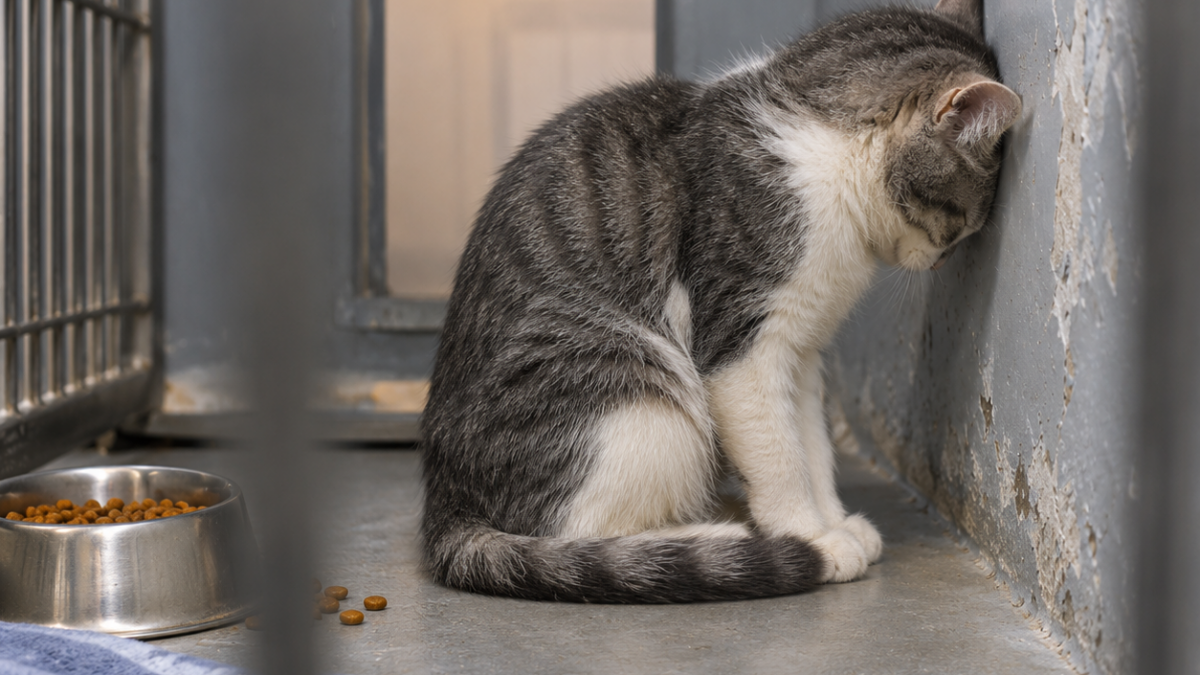
He walked to the far wall of his quarantine kennel.
Turned his back to the room.
Sat down.
Then lowered his face until his nose touched the concrete.
He stayed like that for hours.
That evening, he refused dinner.
The following morning, he refused breakfast.
Then lunch.
Then water.
At first we tried everything.
Warm chicken.
Tuna.
Salmon.
High-calorie paste.
Fresh wet food warmed just enough to increase the smell.
Peaches ignored it all.
“Come on,” I whispered one morning.
I slid the bowl closer.
“You used to eat this.”
No response.
I touched his shoulder gently.
He didn’t turn.
By the third day, Alina was worried.
“We can’t let this continue.”
“I know.”
“We’ll need supplemental feeding.”
Peaches didn’t fight the syringe.
That was the worst part.
A cat who fights still wants control.
Peaches simply accepted whatever we did.
No hiss.
No scratch.
No struggle.
He swallowed because his body still knew how.
But he gave us nothing else.
One afternoon, Alina crouched beside his kennel.
“He’s grieving.”
“Can grief really do this?”
“In people, yes.”
She looked at me.
“Why wouldn’t animals experience some version of it?”
I stared at Peaches.
“I feel like he’s choosing to die.”
Alina didn’t immediately disagree.
“Maybe he doesn’t understand what he’s choosing.”
“That doesn’t make it better.”
“No.”
“What do we do?”
“We keep him medically stable.”
“And after that?”
She sighed.
“We remind him the world still exists.”
So I tried.
Every evening, after the shelter quieted, I sat outside Peaches’ kennel.
Sometimes I read aloud.
Sometimes I just talked.
I told him about the dogs.
About the Chihuahua who stole a glove and hid it under three blankets.
About the kitten that climbed into a laundry basket and rode halfway across the building before anyone noticed.
About my terrible lunch.
About the rain.
Anything.
Peaches never turned around.
After a week, whispers began among the staff.
“He’s shutting down.”
“He’s too old.”
“Maybe he just wants to go.”
I hated hearing it.
But secretly, I was thinking the same thing.
Then Walter came in.
He was around seventy.
Tall.
Thin.
Gray hair.
A faded gray jacket with worn elbows.
He had recently lost his wife, Margaret, and wanted to adopt a calm adult dog.
“Not a puppy,” he told me.
“Definitely not a puppy.”
“Why?”
He looked offended.
“I’m seventy-one. I don’t need a creature that eats furniture and considers sleep optional.”
I laughed.
For the first time that week, I genuinely laughed.
We walked through the dog wing.
Walter liked several of them, especially an older spaniel mix named Ruby.
Then, while we were passing quarantine, he stopped.
He looked through the glass.
Peaches was facing the wall.
Walter didn’t move.
“What happened to that cat?”
I hesitated.
“He lost his owner.”
“How long ago?”
“A few weeks.”
Walter looked closer.
“What’s he doing?”
“Mostly that.”
“Does he eat?”
“Barely.”
Walter stayed silent.
Then he asked:
“Can I go in?”
“You came for a dog.”
“I know.”
I opened the door anyway.
Walter walked slowly into the room.
Peaches didn’t react.
Instead of reaching for him, Walter lowered himself onto the floor.
It took him several seconds because of his knees.
I almost offered a chair.
Something stopped me.
Walter sat facing the same wall as Peaches.
One minute passed.
Then five.
Then ten.
Nobody spoke.
Finally Walter said quietly:
“I didn’t want to live after she died either.”
I froze.
He wasn’t looking at me.
He was looking at the wall.
“Margaret,” he continued. “My wife.”
Peaches’ left ear twitched.
It was tiny.
Almost nothing.
But I saw it.
Walter didn’t.
“She died six months ago.”
His hands rested on his knees.
“Forty-four years married.”
Another ear movement.
Walter continued.
“For three weeks, I barely left the house.”
Peaches remained still.
“I stopped answering the phone. Stopped cooking.”
His voice became rough.
“I talked to photographs because hearing silence was worse.”
I pressed one hand against my mouth.
Walter swallowed.
“My neighbor started knocking every morning.”
For the first time, Peaches lifted his head slightly.
Walter saw it.
Neither of us moved.
“I hated him for it,” Walter whispered.
Peaches’ ear turned toward him.
“Every morning. Eight o’clock.”
Walter smiled faintly.
“Sometimes he’d bring coffee. Terrible coffee.”
Peaches shifted his weight.
“But he kept coming.”
Walter’s eyes filled.
“And one morning I opened the door before he knocked.”
That was when Peaches turned his head.
Just a few inches.
Enough to look at Walter from the corner of one amber eye.
I felt my chest tighten.
Walter whispered:
“Yeah.”
Peaches stared at him.
“I know.”
There was no miracle that afternoon.
Peaches didn’t leap into Walter’s arms.
He didn’t suddenly start eating.
He didn’t purr.
But when Walter stood to leave, Peaches was no longer touching the wall.
The next morning Walter returned.
“You changed your mind about the dog?”
“No.”
He held up a paperback.
“I brought reading material.”
“For Peaches?”
“Don’t make it weird.”
The book was a detective novel.
“Good?”
“Terrible.”
“Why bring it?”
“Margaret liked it.”
Walter sat beside Peaches again.
He began reading.
He didn’t use a childish voice.
Didn’t call Peaches “kitty.”
He simply read.
Twenty minutes later, Peaches turned fully around.
I watched through the glass.
Walter kept reading.
Peaches stood.
Took one slow step.
Then another.
He settled several feet away.
When Walter finished the chapter, he closed the book.
“That author has no respect for punctuation.”
Peaches blinked.
Walter nodded.
“Exactly.”
The next day, Peaches drank water on his own.
Two days later, he licked gravy from a plate.
Then he ate three small bites of chicken from Walter’s hand.
Walter looked at me immediately.
“Did you see that?”
“No.”
“You absolutely saw that.”
“I saw nothing.”
“Good.”
His eyes were wet.
Over the next two weeks, Peaches changed.
Slowly.
Painfully slowly.
But he changed.
He began grooming again.
He moved toward the front of his kennel when Walter arrived.
He started eating small meals.
One afternoon, Walter was sitting on the floor eating a sandwich when Peaches walked over and rested one paw against Walter’s shoe.
Walter stopped chewing.
“Marina.”
I was cleaning bowls.
“What?”
“Come here.”
“Why?”
“Quietly.”
I walked over.
Peaches’ paw remained on Walter’s shoe.
Walter stared at it like he’d been handed a priceless object.
“I think I’ve been selected.”
“You’ve been touched by a cat.”
“Same thing.”
A week later, Walter asked the question I knew was coming.
“What happens to him?”
“What do you mean?”
“If nobody takes him.”
“We care for him.”
“For how long?”
“As long as we can.”
He looked at me.
“That’s a shelter answer.”
I sighed.
“He’s sixteen.”
“I know.”
“He has arthritis.”
“I know.”
“Early kidney disease.”
“I know.”
“He may need expensive care.”
“I know.”
“He might have three years.”
“Good.”
“He might have three months.”
Walter looked down at Peaches.
“Then three months matters.”
That sentence hit me harder than I expected.
“Walter.”
“What?”
“You came here for a dog.”
“Apparently I was wrong.”
Peaches walked toward him.
Walter extended one hand.
Peaches rubbed his cheek against his fingers.
Walter looked at me.
“There.”
“There what?”
“He has made an administrative decision.”
I laughed.
“You want to adopt him.”
“I think he wants to adopt me.”
We began the process.
Walter attended every medical consultation.
He learned how to give fluids if Peaches ever needed them.
He bought a heated bed.
Peaches refused to sleep in it.
He bought another one.
Peaches refused that too.
Walter bought a third.
“Stop buying beds,” I told him.
“He needs options.”
“He sleeps on towels.”
“Because he has poor taste.”
Three weeks after they’d first met, Walter took Peaches home.
That morning he wore a clean button-down shirt.
“You dressed up.”
“No.”
“You did.”
“It’s laundry day.”
“You’re wearing polished shoes.”
Walter frowned.
“Mind your business.”
Peaches sat inside his carrier looking almost offended by everyone.
Walter crouched beside him.
“All right, old man.”
Peaches blinked.
“We’re going home.”
When Walter said the word home, his voice cracked.
I pretended not to notice.
Six days later, the shelter phone rang.
“This is Richard Cole.”
I recognized the last name.
Eleanor’s nephew.
“I understand you had my aunt’s cat.”
“Peaches?”
“Yes.”
“He has been adopted.”
Silence.
Then:
“I want him back.”
I thought I’d misheard.
“Excuse me?”
“The cat belongs to the family.”
“The family declined him.”
“That was a misunderstanding.”
“No.”
My voice became colder.
“It was documented.”
Richard exhaled sharply.
“I don’t need to explain family matters to you.”
“Then why are you calling?”
Another silence.
Finally:
“The cat is part of my aunt’s estate.”
I felt something shift inside me.
“Why do you want him now?”
“What kind of question is that?”
“A simple one.”
“He belonged to my aunt.”
“He belonged to your aunt when you said you didn’t need him.”
“That quote is being taken out of context.”
“Did you say it?”
He hung up.
Two days later, we learned why.
A woman named Miriam Hale arrived.
She was Eleanor’s attorney.
“There is a provision in Mrs. Cole’s estate regarding Peaches.”
Linda and I exchanged looks.
“What kind?”
“Twenty-five thousand dollars was set aside for his lifetime care.”
Suddenly everything made sense.
Miriam continued.
“The money is restricted. It pays for food, veterinary care, medication, comfort expenses.”
“And Richard thought it became his if he took the cat.”
Miriam’s expression told me yes.
She opened a folder.
“Eleanor anticipated this.”
She read from a handwritten letter.
“If Peaches outlives me, I want him with someone who treats him as family. The money is for him, not as a reward for whoever claims him. If my relatives do not truly want him, I would rather he live with a kind stranger.”
I sat back.
“She knew.”
“Yes.”
“Can Richard take Peaches?”
“He can challenge the adoption.”
My stomach dropped.
“Can he win?”
“He can make things unpleasant.”
I called Walter.
When I told him, he went completely silent.
Finally:
“No.”
“I know.”
“No, Marina. He’s not going back.”
“We’re going to fight this.”
“Does Peaches have to return to the shelter?”
“No.”
“Good.”
His voice changed.
“Because I’m not putting him back behind bars.”
Richard came in person three days later.
His wife, Denise, came with him.
He was neatly dressed, expensive watch, expensive coat, expression full of irritation.
“We want the cat returned.”
Linda remained calm.
“The cat was legally adopted after the family declined responsibility.”
Richard placed a folder on the desk.
“We never formally surrendered him.”
I couldn’t stay quiet.
“You told the neighbors to take him wherever unwanted cats go.”
His eyes snapped toward me.
“That wasn’t directed at you.”
“No. It was directed at a sixteen-year-old animal whose owner had just died.”
Denise looked uncomfortable.
Richard ignored her.
“This is about legal ownership.”
“No,” I said. “This is about twenty-five thousand dollars.”
His face changed.
Linda warned:
“Marina.”
But I continued.
“You didn’t ask whether Peaches survived.”
Richard said nothing.
“You didn’t ask whether he was sick.”
Silence.
“You didn’t ask whether he had a good home.”
His jaw tightened.
“You asked how to get him back.”
“That’s enough.”
“You left him.”
“We were arranging a funeral.”
“For weeks?”
“We had responsibilities.”
“So did Peaches.”
He laughed once.
“He’s a cat.”
Those three words changed something inside me.
“He stopped eating.”
Richard looked away.
“He sat with his nose against concrete.”
No response.
“We had to syringe-feed him because he had given up.”
“That’s unfortunate.”
Unfortunate.
I stared at him.
“He spent sixteen years with your aunt.”
Richard shrugged.
“Animals adjust.”
“Walter helped him adjust.”
“Walter?”
I regretted saying the name instantly.
Richard’s eyes narrowed.
“Who’s Walter?”
“His adopter.”
“A stranger.”
“A stranger who showed up.”
Richard stood.
“We are family.”
A voice came from behind him.
“Of Eleanor.”
We turned.
Miriam stood in the doorway.
She walked inside.
“Not of Peaches.”
Richard’s face hardened.
Miriam placed another document on the desk.
“The neighbors gave sworn statements.”
“So?”
“One recorded your conversation.”
Richard went still.
Miriam continued.
“When asked whether you wanted Peaches, you said, ‘He’s sixteen. He’ll probably die soon anyway.’”
Denise stared at him.
Miriam continued.
“When asked what should happen to the cat, you said, ‘Take him wherever people take unwanted cats.’”
Richard’s face had gone pale.
“That was emotional.”
“No,” Miriam said. “It was clear.”
He pointed at her.
“You work for the estate.”
“I worked for Eleanor.”
“And Eleanor wanted the cat cared for.”
“Yes.”
“I can care for him.”
“You became interested after learning about the fund.”
“You can’t prove that.”
Miriam’s voice remained quiet.
“We may not need to.”
The dispute lasted nearly two months.
Walter was terrified.
Every time a legal letter arrived, he called.
“What if they take him?”
“They haven’t.”
“That isn’t an answer.”
One afternoon I visited him.
The moment Walter opened the door, Peaches appeared beside his feet.
I barely recognized him.
His coat was cleaner.
His eyes brighter.
He had gained weight.
A small ramp led to the couch.
Photographs of Margaret covered the walls.
Ceramic birds sat everywhere.
Peaches walked slowly into the living room and climbed into an armchair.
“Was that Margaret’s?”
Walter nodded.
“He stole it.”
“How do you feel about that?”
“At first?”
He looked at Peaches.
“I hated it.”
I waited.
“That chair still smelled like her.”
He swallowed.
“I hadn’t sat in it since she died.”
Peaches curled into a ball.
“Then one night I found him sleeping there.”
Walter’s expression softened.
“And for the first time, the chair didn’t look empty.”
We sat in the kitchen.
Walter poured coffee.
It was terrible.
He wasn’t joking.
“I don’t want the money,” he said.
“I know.”
“I can pay for him.”
“I know.”
“If accepting the fund makes them think I wanted Peaches for money, give it away.”
“Walter.”
“What?”
“The money was Eleanor’s way of caring for him after she died.”
He looked away.
“Don’t let Richard turn her love into something shameful.”
That made him pause.
Peaches entered the kitchen and meowed.
Walter looked down.
“You’re expensive, apparently.”
Peaches meowed again.
“Rude too.”
The hearing finally came.
Walter wore the same shirt he’d worn when he adopted Peaches.
This time I didn’t tease him.
Richard’s attorney argued the family had never legally relinquished ownership.
Miriam presented the statements.
The recording.
Eleanor’s letter.
The shelter’s intake documents.
Then the judge asked Richard’s attorney:
“Was Mr. Cole willing to care for the cat before discovering the existence of the fund?”
The attorney hesitated.
“Circumstances changed.”
“What circumstances?”
Silence.
The judge turned to Walter.
“Why did you adopt Peaches?”
Walter stood.
His hands trembled slightly.
“I didn’t plan to.”
A few people smiled.
“I came for a dog.”
“Why?”
“My wife had died.”
The courtroom became quiet.
“I thought a dog would force me to go outside.”
He swallowed.
“Then I saw Peaches facing a wall.”
Walter paused.
“I knew what that looked like.”
His voice grew softer.
“I’d spent months doing the same thing, just in a bigger room.”
Even Richard looked at him then.
“I didn’t save Peaches.”
Walter shook his head.
“He gave me something to do in the morning.”
He smiled faintly.
“He made me buy groceries because his food was sold near the food I should have been buying for myself.”
A few people laughed.
“He made me open the curtains because he likes sunlight.”
Walter’s eyes filled.
“And he sleeps in my wife’s chair.”
He looked down.
“I thought that would hurt.”
His voice cracked.
“But instead, the chair stopped looking empty.”
The judge waited.
Walter continued.
“I don’t want twenty-five thousand dollars.”
Miriam looked toward him.
“If the money is a problem, give it to the shelter.”
He took a breath.
“I want the cat.”
That was all.
The judge reviewed the documents.
Then she ruled.
Walter’s adoption would stand.
Richard had no legal claim to Peaches.
The family had been given the opportunity to assume responsibility and had declined.
The care fund would remain available strictly for Peaches’ legitimate expenses.
Richard looked furious.
Then Miriam stood again.
“There is one additional amendment.”
Richard turned.
Miriam handed a document to the judge.
Any money remaining after Peaches’ death would go to senior animal welfare organizations.
Not to Eleanor’s heirs.
Not to Richard.
The judge reviewed it.
Then confirmed it.
I watched Richard’s face.
For the first time in the entire dispute, I almost smiled.
He had come back because he thought an old cat had become valuable.
Instead, his challenge guaranteed that the remaining money would eventually help animals exactly like Peaches.
Old.
Sick.
Overlooked.
Abandoned.
Outside the courthouse, Richard approached Walter.
“You got what you wanted.”
Walter looked genuinely confused.
“I already had what I wanted.”
Richard laughed bitterly.
“You think you’re some kind of hero?”
“No.”
“Then what are you?”
Walter looked at him for several seconds.
Then he said:
“I’m the man who showed up.”
Richard’s expression changed.
Walter added:
“That seems to be more than you did.”
He walked away.
That was all.
No shouting.
No threats.
No dramatic revenge.
Just a sentence Richard couldn’t argue with.
Walter had shown up.
Every day.
When Peaches was sick.
When he was frightened.
When he wouldn’t eat.
When he needed medication.
When he needed nothing except another living creature sitting beside him.
Months passed.
Peaches became the ruler of Walter’s house.
He slept in Margaret’s chair.
Stole Walter’s pillow.
Rejected expensive food.
Demanded breakfast before sunrise.
Walter complained constantly.
He was also happier than I’d ever seen him.
Then Peaches’ kidneys worsened.
We had known it would happen eventually.
Alina explained the treatment options.
Walter listened carefully.
“How much time?”
“No one can promise.”
“Months?”
“Maybe.”
“Years?”
“Possible, but unlikely.”
Walter looked at Peaches.
The cat was calmly licking one paw.
“He doesn’t seem concerned.”
“He’s a cat.”
Walter finally used Eleanor’s care fund.
He kept every receipt in a folder labeled:
THE KING’S EXPENSES.
Treatment gave Peaches more good months.
Nearly a year.
Then one winter morning, Walter called me.
“Can you come?”
I knew.
Peaches lay in Margaret’s chair.
He looked impossibly small.
Walter sat beside him.
Alina examined him at home.
“He’s tired,” she said gently.
Walter stared at her.
“Is he suffering?”
“Not badly right now.”
“Can we keep it that way?”
“Yes.”
Walter nodded.
“He stays here.”
Nobody argued.
That evening Walter began reading the old detective novel.
The same one he’d read in the shelter.
Peaches lay against his leg.
Around midnight, I told Walter to sleep.
He shook his head.
“I left Margaret’s hospital room one night.”
I stayed quiet.
“The nurse told me to go home.”
His eyes stayed on Peaches.
“She died before I got back.”
“Walter, you couldn’t have known.”
“I know.”
But his voice told me the wound was still there.
He rested his hand on Peaches.
“I’m staying this time.”
At a little after two in the morning, Peaches moved.
His eyes opened.
For a moment they looked clear again.
He lifted his head.
Walter leaned forward.
“I’m here.”
Peaches slowly shifted closer.
Walter gathered him against his chest.
“You can go.”
His voice broke.
“I’ll be okay.”
Peaches relaxed.
Walter kissed the top of his head.
“Tell Margaret I finally learned to make coffee.”
I laughed through my tears.
“So she’ll know you’re lying.”
Walter smiled.
Peaches took one breath.
Then another.
Then none.
Walter sat completely still.
For a long time, none of us spoke.
Finally he whispered:
“He wasn’t looking at the wall.”
I looked at him.
“When I met him, he thought there was nothing left worth looking at.”
Walter’s tears fell onto the orange fur.
“He didn’t leave that way.”
No.
He didn’t.
Peaches left while being held.
Warm.
Home.
Looking toward someone who had shown up.
Walter buried him beneath a maple tree behind the house near Margaret’s old garden.
The stone said only:
PEACHES
HE STAYED
I asked why.
Walter looked toward the house.
“Because that’s what we did for each other.”
After Peaches’ final expenses, nearly eighteen thousand dollars remained in Eleanor’s fund.
It went exactly where she had directed it.
Senior animal welfare.
Our shelter received part of the money.
We created a program for elderly cats and dogs who needed medical care or foster support.
We called it the Peaches Project.
Walter hated the name.
“Sounds like a fruit company.”
We kept it anyway.
The first cat supported through the program was fourteen years old.
Orange.
Diabetic.
Nearly toothless.
His name was Henry.
Walter stared through the kennel door.
“No.”
I said nothing.
“Don’t look at me like that.”
“Like what?”
“You know.”
Henry screamed for food.
Walter frowned.
“Obnoxious.”
Henry screamed again.
Walter sat down.
An hour later, he was still there.
Two weeks later, Henry was sleeping in Margaret’s chair.
Walter sent me a photograph.
His message read:
“This is temporary.”
Six months later, another message arrived.
“Apparently temporary means permanent.”
Walter never replaced Peaches.
That’s not how love works.
New love doesn’t erase old love.
It sits beside it.
Years later, I asked Walter why he kept adopting senior animals.
He looked at me as though the answer should have been obvious.
“Because everyone deserves to be wanted at the end.”
Whenever I walk past the quarantine room now, I still think about Peaches.
The wall has been repainted.
The old concrete is gone beneath fresh white paint.
But I can still see him.
A sixteen-year-old orange cat with his nose pressed against the wall because the one person he trusted had disappeared and everyone else had decided he was too old to matter.
He believed his story had ended there.
Walter believed his story had ended when Margaret died.
Both were wrong.
Peaches didn’t need someone to convince him that life was suddenly wonderful.
Walter couldn’t do that.
He didn’t force the cat to turn around.
Didn’t drag him away from the wall.
Didn’t demand that he eat.
He simply sat down beside him.
He looked in the same direction.
And he said:
“I know what this feels like.”
Sometimes rescue isn’t dramatic.
Sometimes nobody breaks down a door.
Nobody runs through fire.
Nobody pulls an animal from a river.
Sometimes rescue is one broken creature recognizing another.
Sometimes it is sitting on a cold floor.
Sometimes it is coming back the next morning.
And the morning after that.
Until one day, something almost invisible happens.
An ear turns.
A head lifts.
A body moves away from the wall.
And a heart that had decided there was nothing left worth seeing chooses to look at the world one more time.
Peaches was sixteen when he lost everything.
Walter was seventy-one when he thought the best part of his life was already behind him.
Neither one knew they were about to become exactly what the other needed.
And in the end, Richard didn’t get the money.
He didn’t get the cat.
He didn’t get to rewrite Eleanor’s wishes.
The old animal he had dismissed as useless became the reason dozens of senior pets received medical care and second chances.
That was the only revenge that mattered.
Cruelty didn’t win.
Indifference didn’t win.
And age didn’t make Peaches disposable.
He mattered when he was young.
He mattered when he was old.
He mattered when he was sick.
He mattered when he stopped eating.
He mattered when he had only months left.
Most of all, he mattered enough for somebody to show up.
And sometimes, that is the difference between dying with your face against a wall and leaving this world in someone’s arms.








