PART 2: Someone Thr3w a Cat From an Overpass Into Traffic—She Landed on My Semi and Held On for 60 Miles
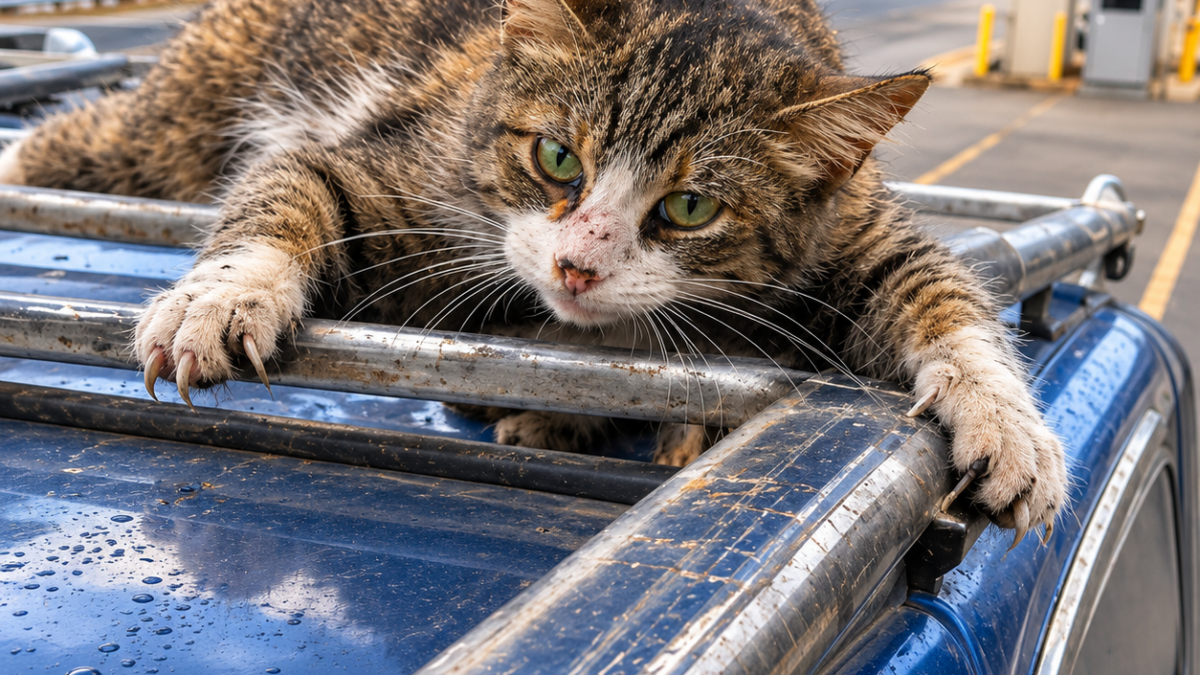
I had been driving my semi at nearly seventy miles an hour for close to sixty miles when a weigh-station attendant walked toward me, pointed above my head, and said there was a cat clinging to the roof of my cab.
When I climbed up far enough to see her, I found a tiny tabby flattened against the metal roof rack, her paws locked so tightly around it that several claws had split and left streaks of blood behind.
At that moment, I thought the impossible part was that she was still alive, but the security footage we watched less than an hour later showed me that surviving the ride was only half of what had happened to her.
My name is Daniel Mercer, and I’ve been a long-haul truck driver for more than seventeen years.
That Thursday started like hundreds of others.
I had picked up a refrigerated load outside Birmingham before sunrise and was heading north through central Alabama. Traffic was light, the sky was beginning to brighten, and I had settled into that familiar rhythm drivers know well—the engine humming underneath you, white lane markers sliding past, coffee cooling in the cup holder.
Nothing felt unusual.
I didn’t hear anything hit the truck.
No thump.
No scrape.
Nothing.
Around seven that morning, I pulled into a weigh station for a routine stop.
I parked, climbed down, stretched my back, and started walking around the trailer to inspect the tires.
That was when an attendant came outside.
He was maybe fifty, wearing a reflective vest and holding a clipboard.
He stared at my cab.
Then he stared at me.
“Sir?”
“Yeah?”
He pointed upward.
“You know you’ve got a cat up there?”
I actually laughed.
“A what?”
“A cat.”
I followed his finger.
From the ground, I couldn’t see anything.
“You messing with me?”
“I wish I was.”
Another attendant had already stepped outside.
She shaded her eyes and looked up.
“Oh, my God,” she said. “She’s moving.”
That erased my smile.
I grabbed the side rail and climbed onto the step beside the cab, pulling myself high enough to see over the roof.
For a second, my brain refused to understand what I was looking at.
A small brown-and-gray tabby was stretched almost completely flat against the roof.
Her belly pressed against the metal.
Her ears were pinned back.
Her eyes were huge.
All four paws were wrapped around the roof rack.
She didn’t meow.
She didn’t move.
She simply stared at me.
“Easy,” I whispered.
The moment I reached toward her, she tightened her grip.
I could see her claws.
Some were bent at ugly angles.
Two were bleeding.
There were deep scratches in the paint where she had apparently been sliding and pulling herself back.
“How long has she been up there?” the attendant called.
“I have no idea.”
“Where’d you last stop?”
I thought about it.
My stomach tightened.
“Almost sixty miles back.”
Nobody said anything for a moment.
The female attendant looked at the interstate beyond the station.
“You’ve been doing highway speed?”
“Most of the way.”
“Seventy?”
“About that.”
She stared at the cat.
“That’s impossible.”
I wanted to agree.
Instead, I climbed higher.
“Come on, sweetheart.”
I slipped on my work gloves.
The cat trembled when I touched her.
Not a small nervous shake.
Her entire body was vibrating.
I tried lifting her gently.
She would not release the rack.
“She’s stuck,” I said.
One attendant climbed onto the lower step to help.
“No,” I told him. “Let me do it. Too many hands might scare her.”
I started with her front left paw.
Her claws had hooked around the metal so tightly that I had to loosen them individually.
One.
Then another.
Then another.
She made a weak sound.
“Almost there.”
When I freed the second paw, she immediately tried grabbing the rack again.
That was when I realized she wasn’t holding on because she was trapped.
She was holding on because letting go terrified her.
By the time I freed all four paws, my gloves had tiny smears of blood on them.
I tucked her against my chest.
She went completely limp.
The attendant looked at her scraped paws.
“We need a vet.”
“I know.”
Then the woman from inside came hurrying toward us holding a tablet.
“Before you leave,” she said, “you need to see something.”
“What?”
“We checked the station camera, but it doesn’t show how she got there.”
I adjusted the trembling cat against my jacket.
“Then what am I looking at?”
“Your dashcam.”
My stomach tightened.
“You can access that?”
“If you let us pull the card.”
I looked down at the little tabby.
Then I handed over my keys.
Ten minutes later, the three of us stood around a computer.
The attendant rewound nearly an hour of highway footage.
Nothing.
Nothing.
Nothing.
Then my truck approached an overpass.
“Stop,” the woman said.
She moved backward frame by frame.
Empty roofline.
Concrete bridge.
A shadow above the windshield.
Then she froze the image.
Something was falling directly toward my truck.
PART 2
For several seconds, none of us spoke.
The image on the screen was grainy, but it was clear enough to make my stomach turn.
A dark shape was dropping from the overpass.
The woman moved forward one frame.
The shape got larger.
Another frame.
Then it disappeared above the dashcam’s field of view.
The next image looked completely normal.
Highway.
Morning sky.
Concrete disappearing behind me.
The attendant leaned closer.
“That’s the cat.”
I stared at him.
“You can’t know that.”
He looked at me.
“What else would it be?”
I wanted him to be wrong.
I wanted there to be some other explanation.
Maybe she had climbed onto the truck during my previous stop and hidden somewhere above the windshield.
Maybe the shadow was a bird.
Maybe the timing was a coincidence.
Anything was better than what the footage seemed to suggest.
The female attendant rewound again.
She slowed the footage until each second became a series of still photographs.
My truck approached the bridge.
There was nothing on the road.
No debris.
No animal.
Then, just as I passed underneath, the shadow dropped.
“Can you see the top of the bridge?” I asked.
“Not clearly.”
She enlarged the image.
Pixels blurred across the screen.
Near the railing, there appeared to be movement.
A person, maybe.
Or maybe just a shadow from a sign.
“You think somebody threw her?”
My voice sounded strange when I said it.
The attendant folded his arms.
“If she fell on her own, she would have had to be on that bridge railing at exactly the right second.”
The woman shook her head.
“And cats usually don’t jump from highway overpasses.”
I looked down.
The tabby was tucked inside my partially zipped jacket.
Her face was pressed against my chest.
One injured paw rested against the fabric.
She had stopped trembling quite as violently, but every time a truck passed outside and the building vibrated, her claws tightened.
I looked back at the screen.
Someone might have stood above that interstate holding this cat.
Someone might have looked down at traffic moving seventy miles an hour.
And then let go.
My hands curled into fists.
“Call the police.”
The attendant nodded.
“We already did.”
A state trooper arrived about fifteen minutes later.
By then, I had stopped thinking about my schedule.
Dispatch had called twice asking why I was still sitting at the weigh station.
I told them there was an emergency.
They assumed it involved the truck.
I didn’t correct them.
As far as I was concerned, it did.
The trooper introduced himself as Officer Randall.
He watched the dashcam footage several times.
He asked where I had started.
Where I had last stopped.
Whether anyone had access to my truck.
Whether I had seen anyone on the overpass.
“No.”
“Any vehicles parked on it?”
“Not that I remember.”
“Anything unusual?”
“I drive under a hundred things every week that I don’t remember.”
He nodded.
“That’s normal.”
He froze the footage again.
The image showed the shadow falling.
He exhaled slowly through his nose.
“It certainly looks intentional.”
I felt heat rise in my chest.
“So what happens?”
“We identify the overpass first. Then we check whether there are traffic cameras nearby. We’ll see if anybody called something in.”
“And if somebody threw her?”
His expression hardened.
“Then we treat it as animal cruelty.”
I looked at the cat.
“Good.”
He noticed the blood on my glove.
“She needs medical attention.”
“I’m taking her now.”
“I’ll need a copy of the dashcam file.”
“Take whatever you need.”
The weigh-station attendant transferred the footage.
I signed a statement.
Then I carried the cat back toward my semi.
The moment we stepped outside, she panicked.
Wind caught my jacket.
A tractor-trailer roared past on the interstate.
The cat twisted against me so violently I nearly lost my grip.
“No, no, no. I’ve got you.”
She dug one damaged paw into my shirt.
I didn’t care.
I turned my body to shield her from the highway.
The female attendant came running out with a cardboard pet carrier somebody had found in storage.
“Use this.”
We placed a towel inside.
The cat resisted for a moment, then crawled into the far corner and flattened herself against the cardboard.
I closed the top carefully.
“Do you know a veterinarian nearby?”
She wrote an address on the back of a weigh ticket.
“About twelve minutes from here.”
I thanked her.
Then I climbed into my truck.
For the first time in seventeen years of driving, I pulled away from a weigh station with a cat in a cardboard box strapped into the passenger seat.
Every few seconds, I glanced over.
“I know this probably isn’t helping,” I told her.
She stared at me through the ventilation holes.
“My truck is probably the last place on earth you want to be.”
Her eyes disappeared when she lowered her head.
“I don’t blame you.”
The veterinary clinic sat behind a grocery store in a small town I had passed dozens of times without noticing.
I parked the rig along the edge of the lot.
A receptionist opened the door when she saw me carrying the box.
“What happened?”
“Honestly, you’re going to think I’m lying.”
Ten minutes later, I was standing in an examination room with a veterinarian named Dr. Ellen Carver.
She opened the carrier slowly.
The cat stayed curled in the back.
Dr. Carver knelt.
“Hey, sweetheart.”
No response.
She reached in carefully and lifted her onto the table.
That was the first time I got a good look at her.
She was smaller than I had thought.
Maybe seven pounds.
Young adult.
Brown tabby stripes across her back and sides, white around her chin.
Her fur was dirty.
The edges of her ears were red.
Her nose looked raw.
But her paws were the worst.
Several pads were scraped almost smooth.
Three claws were cracked.
One had partially torn away.
There was dried blood between her toes.
Dr. Carver looked at me.
“You said she rode on top of your truck?”
“About sixty miles.”
The veterinarian stopped.
“Sixty?”
“Interstate speed.”
She stared at me.
“Seventy miles per hour?”
“Most of it.”
She looked back at the cat.
“That shouldn’t be possible.”
“I’ve heard that a few times today.”
Dr. Carver examined her ribs and abdomen.
The cat flinched when touched but never tried to bite.
Her heart was racing.
“She’s in shock.”
“Is she going to make it?”
“We need X-rays. Bloodwork. Fluids.”
“Do whatever you have to.”
The veterinarian glanced toward me.
“I need to discuss cost—”
“Do it.”
“Sir—”
“I’m paying.”
She paused.
“You understand this could be several hundred dollars, possibly more.”
I looked at the cat’s paws.
“She held onto my truck for sixty miles.”
Dr. Carver waited.
“The least I can do is cover the vet bill.”
That ended the discussion.
They took her into the treatment area.
I sat alone in the waiting room.
My dispatcher called again.
“Daniel, where are you?”
“Vet clinic.”
There was a pause.
“You hit an animal?”
“No.”
“Then why are you at a veterinarian?”
“A cat landed on my truck.”
Another pause.
“What?”
I rubbed my forehead.
“Somebody apparently threw a cat off an overpass. She landed on the roof.”
There was complete silence.
“Are you serious?”
“I wish I wasn’t.”
“What about the load?”
“I’m going to be late.”
“How late?”
“I don’t know.”
Normally, being late with a refrigerated load could become a serious problem.
Appointments mattered.
Fuel mattered.
Delivery windows mattered.
Every hour had consequences.
But sitting there with dried cat blood on my gloves, I discovered how quickly certain priorities can become meaningless.
“I’m not leaving until the vet tells me she’s stable.”
My dispatcher sighed.
Then his voice changed.
“Send me the clinic address.”
“Why?”
“I’ll deal with the customer.”
That surprised me.
“Thanks.”
“And Daniel?”
“Yeah?”
“Keep the receipts.”
I almost laughed.
“You reimbursing me?”
“No chance.”
Then he added, “But I want to see this cat.”
The veterinarian returned nearly an hour later.
I stood before she reached me.
“Well?”
“She’s lucky.”
“How lucky?”
“No broken bones. No evidence of internal bleeding.”
I stared at her.
“Nothing broken?”
“Nothing we can see.”
“What about her paws?”
“Painful, but treatable. Several claws are damaged. One may eventually fall off and regrow. Her paw pads are badly abraded.”
She sat across from me.
“She’s dehydrated. Her ears and nose have mild windburn. She’s exhausted, and physiologically she’s showing signs of extreme stress.”
“But she’ll live?”
Dr. Carver smiled slightly.
“Yes.”
My shoulders dropped.
I hadn’t realized how tense they were.
“How did she hold on?”
The veterinarian looked toward the treatment room.
“I honestly don’t know.”
“That seems to be everybody’s answer.”
“I can give you a theory.”
“I’ll take it.”
“Adrenaline. Survival response. Cats can extend and hook their claws very effectively. If she landed close enough to grab that rack immediately, she may have locked herself onto it almost reflexively.”
“For an hour?”
Dr. Carver shook her head slowly.
“That’s the part I can’t explain.”
She showed me photographs they had taken of the paws.
The claws were worn and cracked.
“She damaged herself holding on.”
“She knew what happened if she let go.”
“I suspect so.”
That sentence stayed with me.
She knew what happened if she let go.
I thought about the miles I had driven without knowing she was there.
Cars passing.
Bridges.
Wind.
Expansion joints.
Lane changes.
Every time I had hit a rough patch in the pavement, that little animal had probably been sliding across polished metal with nothing beneath her except traffic.
I suddenly felt sick.
“Can I see her?”
Dr. Carver led me into the back.
The cat was in a kennel with an IV line taped to one front leg.
A towel covered part of the door to give her privacy.
She looked exhausted.
I crouched.
“Hey.”
Her eyes opened.
For a second, she stared at me.
Then she lowered her head again.
“I’m sorry,” I said.
Dr. Carver stood beside me.
“For what?”
“I drove sixty miles with her up there.”
“You didn’t know.”
“I should’ve heard something.”
“At highway speed? Through a diesel cab?”
“I don’t know.”
“You didn’t put her there.”
I looked at the cat.
Somebody else had.
That thought brought the anger back.
Officer Randall called that afternoon.
They had located the overpass.
There were no cameras directly covering the walkway.
A gas station about a quarter mile away had exterior cameras, but whether they had captured anything useful was unknown.
“We’ve requested footage,” he said.
“Any witnesses?”
“Not yet.”
“So whoever did it might get away with it.”
“I didn’t say that.”
“You didn’t have to.”
He was quiet for a moment.
“We’ll follow the evidence.”
I stared through the clinic window at my truck.
“I want to know who did this.”
“I understand.”
“No. I mean I really want to know.”
His tone became firmer.
“Then let us do our job.”
I knew what he was telling me.
Don’t go looking yourself.
He was right.
I didn’t like it.
But he was right.
By late afternoon, the cat was stable enough to leave if someone could monitor her.
Dr. Carver asked the obvious question.
“Where is she going?”
I stared at her.
“What do you mean?”
“Do you know who owns her?”
“No.”
“Microchip came back negative.”
“So shelter?”
“Possibly.”
I looked through the kennel door.
The cat was awake now.
She watched me.
“What happens if the shelter takes her?”
“They’ll hold her while attempting to locate an owner.”
“And after that?”
“If no owner is found, she could become available for adoption.”
Something about that answer bothered me.
Maybe it was irrational.
She had been in my life for less than a day.
I hadn’t even touched her without gloves.
But the idea of carrying her out of that clinic and handing her to another unfamiliar person felt wrong.
Dr. Carver must have seen the hesitation.
“You could foster her temporarily.”
I looked at her.
“Me?”
“You brought her in.”
“I drive a truck.”
“So?”
“I live in the truck half the week.”
She smiled.
“Cats have lived in stranger places.”
I looked at the kennel again.
The tabby stood unsteadily.
She took two steps.
Then she sat.
Her bandaged front paws looked almost comically large.
“I’ve never owned a cat.”
“That’s fixable.”
“I barely keep plants alive.”
“Plants don’t remind you to feed them.”
“I’m serious.”
“So am I.”
I rubbed my jaw.
“What would I need?”
Twenty minutes later, I walked out of the clinic with medication, soft food, a litter box, litter, bowls, a small bed, and more instructions than I had received the first day I learned to drive a commercial truck.
The cat rode in the passenger seat.
Again.
But this time the carrier was secured properly, and the towel over the top blocked her view of the highway.
I had no plan beyond the next few hours.
My sleeper cab suddenly felt absurdly small.
There were boots beneath the bunk.
Paperwork stacked behind the passenger seat.
A duffel bag on the floor.
I spent half an hour reorganizing everything.
Then I opened the carrier.
The cat didn’t move.
“You can stay there.”
I filled a bowl with water.
Placed food nearby.
Set up the litter box.
Then I sat on the edge of the bunk.
For nearly ten minutes, nothing happened.
Finally, a striped face appeared.
She sniffed.
One bandaged paw emerged.
Then another.
She stepped into the cab.
She looked around.
Then something outside hissed.
Air brakes.
The cat exploded backward into the carrier.
“Okay.”
I lowered my voice.
“That one’s going to take some time.”
I called my dispatcher.
“You rolling?”
“In a minute.”
“How’s the cat?”
“Alive.”
“That wasn’t my question.”
I looked at the carrier.
“She’s coming with me.”
Silence.
Then laughter.
“You adopted the highway cat?”
“Temporary foster.”
“Sure.”
“It is.”
“Daniel, you once complained because I left a granola-bar wrapper in your cup holder.”
“That’s different.”
“You now have a litter box in your sleeper.”
“I’m aware.”
“You’re keeping the cat.”
“I’m not keeping the cat.”
A small head appeared from the carrier.
The tabby looked at me.
My dispatcher said, “What are you naming her?”
“I’m not naming her.”
“That’s not what I asked.”
I hung up.
Over the next three days, I discovered that traveling with an injured cat was more complicated than transporting twelve tons of refrigerated produce.
She hated sudden braking.
She hated rumble strips.
She hated air horns.
The first time another truck blew its horn beside us, she disappeared under the bunk and stayed there for forty minutes.
But she loved the dashboard.
I discovered that on the second afternoon.
I was parked at a truck stop, paperwork spread across the steering wheel.
She had been hiding behind the passenger seat.
Then I felt movement.
She climbed carefully onto the dashboard.
Her bandages made each step awkward.
She sat behind the windshield.
For several minutes, she stared outside.
Cars moved through the lot.
Trucks rumbled past.
People walked between fuel pumps.
Her ears twitched at every sound.
But she stayed.
I watched her from the driver’s seat.
“You’re either incredibly brave or incredibly confused.”
She looked at me.
“Probably both.”
That evening, she ate while I sat six feet away.
The following morning, she ate while I sat two feet away.
By Saturday night, she had started sleeping on the passenger seat.
Sunday morning, I woke with something pressing against my leg.
I opened my eyes.
The cat was curled at the foot of the bunk.
I didn’t move.
Neither did she.
For almost a minute, we stared at each other.
Then she closed her eyes again.
That was when temporary started becoming complicated.
Officer Randall called later that day.
They had obtained footage from the gas station near the bridge.
My stomach tightened.
“Did you get them?”
“Not exactly.”
“What does that mean?”
“There’s a vehicle.”
“What kind?”
“Dark SUV.”
“Plate?”
“Image isn’t clear enough.”
“Person?”
“We can see someone stop near the overpass access area.”
“With the cat?”
“Possibly.”
I gripped the phone.
“Possibly?”
“The angle is bad, Daniel.”
I hated the calmness in his voice.
I knew he wasn’t being dismissive.
He was being careful.
Police officers couldn’t build cases from what people wanted footage to show.
“Can you enhance it?”
“We’re working on it.”
“What about traffic cameras?”
“Nothing useful yet.”
I looked toward the dashboard.
The cat was sleeping in a patch of sunlight.
One paw twitched.
“How does somebody do something like that?”
Randall paused.
“I don’t know.”
That was the first time his voice sounded personal.
Then he said, “How’s she doing?”
“Better.”
“You still have her?”
“Yeah.”
“You keeping her?”
“Everybody keeps asking me that.”
“There might be a reason.”
I looked at the little tabby.
“She hasn’t exactly filled out an application.”
“Maybe she already did.”
I ended the call.
That afternoon, I bought her a proper carrier.
Then a scratching pad.
Then a toy mouse.
Then a small blanket.
At checkout, the cashier looked at the pile.
“New cat?”
“No.”
She looked at me.
I looked at the cat food.
“Maybe.”
By the following week, Dr. Carver removed most of the bandaging.
The paw pads were healing.
Two claws were still damaged.
The veterinarian examined her and smiled.
“She’s doing remarkably well.”
The cat was sitting on the examination table.
She was nervous but no longer shaking.
Dr. Carver touched her back.
The cat leaned slightly toward the pressure.
“Look at that.”
“What?”
“She trusts you.”
“She tolerates me.”
“That’s how cats start.”
I scratched behind one ear.
For the first time, I felt a vibration beneath my fingers.
I stopped.
“What’s that?”
Dr. Carver stared at me.
“Seriously?”
“What?”
“She’s purring.”
I had heard cats purr before.
Just never while touching one that had been thrown from a bridge onto my truck.
For some reason, that nearly broke me.
I looked away.
Dr. Carver pretended not to notice.
“She needs a name.”
“I know.”
“You still calling her ‘cat’?”
“Mostly.”
“That’s terrible.”
“I’ve been busy.”
She smiled.
“How far did she ride?”
“About sixty miles.”
She looked at me.
“There you go.”
I frowned.
“Sixty?”
The cat turned her head.
Dr. Carver laughed.
“She answered.”
“She moved.”
“She answered.”
I looked down.
“Sixty.”
The cat blinked.
I tried again.
“Sixty.”
One ear moved.
“That’s ridiculous.”
Dr. Carver crossed her arms.
“It’s perfect.”
The name stayed.
At first, I thought it represented the worst hour of her life.
Then I realized it represented something else.
Sixty miles was how long she refused to die.
Sixty miles was how long she held on.
So she became Sixty.
The investigation continued for several weeks.
Officer Randall called whenever there was something worth telling me.
The SUV footage improved slightly but never enough to identify a license plate confidently.
They interviewed people who lived near the bridge.
One person remembered seeing a dark vehicle.
Another remembered nothing.
A third thought there had been two people near the overpass.
Nothing was solid.
Then an anonymous tip came in.
A young man had allegedly bragged at a party about getting rid of a cat.
My anger came roaring back.
“Is that him?”
“We don’t know.”
“Talk to him.”
“We are.”
“What did he say?”
“I can’t discuss everything in an active investigation.”
That answer nearly drove me crazy.
For two days, I imagined confronting the person myself.
I imagined asking one question.
Why?
Then I imagined all the answers I might hear.
She scratched furniture.
She wasn’t wanted.
She belonged to somebody else.
It was a joke.
I was angry.
I didn’t think she’d survive.
None would have mattered.
No explanation could make standing on an overpass with a living animal in your hands acceptable.
But Officer Randall’s warning remained in my head.
Let us do our job.
So I did.
I drove.
Sixty rode with me.
And something strange happened.
The highway stopped frightening her.
Not immediately.
At first, she still crouched when trucks passed close.
She hated bridges.
I noticed that about three weeks after I found her.
Whenever we approached an overpass, she would leave the dashboard.
Every single time.
She would jump down.
Sometimes hide behind the passenger seat.
Sometimes crawl onto the bunk.
Once I began noticing, I couldn’t stop.
Bridge.
Down.
Bridge.
Down.
Bridge.
Down.
“Okay,” I whispered one afternoon. “I understand.”
After that, whenever I saw an overpass coming, I warned her.
“Bridge.”
Her ears would move.
“You’re inside this time.”
Eventually, she stopped hiding.
Then one afternoon in Tennessee, something happened that I’ll never forget.
Sixty was stretched across the dashboard.
A concrete overpass appeared ahead.
I glanced at her.
“Bridge.”
She lifted her head.
For a second, I expected her to jump down.
She didn’t.
The truck passed underneath.
Darkness swept across the windshield for half a second.
Then sunlight returned.
Sixty stayed exactly where she was.
I smiled so hard my face hurt.
“That’s right.”
She looked at me.
“It can’t touch you anymore.”
She settled her head back onto her paws.
That was the moment I stopped calling myself her foster owner.
She was mine.
Or maybe I was hers.
The paperwork became official shortly afterward.
No owner had come forward.
No microchip.
No missing-cat report matching her description.
No credible claim.
Dr. Carver helped connect me with the local shelter to handle everything properly.
When I signed the adoption form, the woman behind the desk asked, “Indoor cat?”
I laughed.
“Technically.”
She looked confused.
“She lives in a Freightliner.”
The woman stared at me.
“Seriously?”
“She has more states under her belt than most people I know.”
By then, Sixty had traveled through Alabama, Tennessee, Kentucky, Indiana, Ohio, Georgia, and Mississippi.
She had favorite truck stops.
Favorite sleeping positions.
A favorite corner of the dashboard.
She discovered windshield wipers.
The first time I turned them on during rain, she attacked the glass.
I laughed so hard I had to pull into a rest area.
She discovered that truck-stop employees sometimes carried treats.
She discovered that refrigerated trailers made interesting humming noises.
She discovered the sleeper curtain.
Unfortunately, she also discovered how to open it.
More than once, I woke to sunlight because Sixty had decided four-thirty in the morning was an appropriate time to start the day.
“You don’t even have a commercial license,” I told her.
She stepped on my chest.
“You’re not driving.”
She meowed.
“No.”
Another paw on my shoulder.
“Absolutely not.”
She became famous at my company terminal.
Drivers started asking about her.
“That the roof cat?”
“Yeah.”
“You got pictures?”
I had hundreds.
I pretended I didn’t.
Within two months, someone gave her a tiny reflective collar.
Someone else bought her a bed embroidered with SIXTY.
My dispatcher installed a photograph of her beside the scheduling board.
Underneath, he wrote:
EMPLOYEE OF THE MONTH — ZERO LATE DELIVERIES.
“She doesn’t work here,” I told him.
“She has better attendance than you.”
“She sleeps all day.”
“Management material.”
Even Officer Randall asked for updates.
Unfortunately, the investigation never gave me the ending I wanted.
The young man from the anonymous tip had owned cats, but investigators couldn’t establish that Sixty was one of them.
He denied throwing any animal.
The vehicle connected to him didn’t conclusively match the SUV on the gas-station footage.
No witness could identify the person on the bridge.
The dashcam showed enough to make what happened clear but not enough to show who had done it.
Months passed.
Eventually, Randall called.
His voice told me before his words did.
“You’re closing it.”
“We’re suspending active investigation unless new evidence comes in.”
I stared through the windshield.
Sixty was asleep on the dashboard.
“So they get away with it.”
“I know that’s how it feels.”
“That’s exactly what happened.”
“Maybe.”
“No. Not maybe.”
I heard my voice rising.
“Somebody threw an animal into seventy-mile-an-hour traffic.”
“I know.”
“And nothing happens?”
“I didn’t say nothing happened.”
“What happened to them?”
“We don’t know who they are.”
“That’s my point.”
Silence.
Then Randall said something I didn’t expect.
“Daniel, look at the cat.”
I frowned.
“What?”
“Look at her.”
I did.
Sixty’s front paws were stretched toward the windshield.
The damaged claws had grown back.
Her pads were healed.
She had gained almost two pounds.
Her fur looked clean and thick.
“She alive?”
“Yeah.”
“She safe?”
“Yes.”
“She got somebody?”
I swallowed.
“Yeah.”
“That isn’t justice.”
“No.”
“But it isn’t nothing.”
I didn’t answer.
He continued.
“Sometimes we catch the person. Sometimes we don’t. I wish I could give you something better than that.”
“So do I.”
“If evidence comes in, the case can reopen.”
“Okay.”
After we hung up, I stayed behind the wheel for a long time.
I had spent months imagining payback.
An arrest.
Handcuffs.
A courtroom.
A judge reading a sentence.
Someone being forced to look at photographs of Sixty’s bloody claws.
Someone finally understanding what they had done.
I still wanted that.
Part of me always will.
But Sixty woke while I sat there.
She stretched.
Walked across the dashboard.
Then climbed onto my chest.
Her head pressed beneath my chin.
I felt her purring.
And suddenly the person on that overpass seemed very far away.
They had tried to decide how Sixty’s story ended.
That was the ugliest part.
Somebody had looked at a living creature and decided she didn’t deserve another mile.
But they had been wrong.
She got sixty miles on the roof.
Then thousands inside the cab.
By the end of our first year together, Sixty had crossed more state lines than I could count.
She had seen mountains in Tennessee.
Snow in Ohio.
Thunderstorms in Georgia.
Sunrise over Arkansas.
She slept through most of them.
Drivers who met her expected a frightened animal.
Instead, she became confident.
Bossy, even.
At truck stops, she watched people through the windshield like she owned the parking lot.
At night, she slept beside my pillow.
When I stopped for breaks, she followed me around the cab.
If I stayed outside too long during inspections, she sat behind the windshield waiting.
She still disliked unfamiliar people reaching for her.
I never forced it.
People would say, “Can I pet her?”
“If she comes to you.”
That became the rule.
Sometimes she did.
Sometimes she didn’t.
She had already had enough choices taken away from her.
I wasn’t taking any more.
Dr. Carver saw her every six months.
At the one-year checkup, she examined Sixty’s paws.
“You’d never know.”
I looked at the claws.
They were smooth now.
Healthy.
“Any permanent damage?”
“Nothing significant.”
She rubbed Sixty’s shoulder.
Sixty purred.
“Still traveling?”
“Try stopping her.”
“You know most cats hate cars.”
“She hated the roof.”
Dr. Carver laughed.
“Fair distinction.”
Then her expression softened.
“You did good.”
I shook my head.
“She did the hard part.”
That was the truth.
People called me the man who saved the highway cat.
Local reporters eventually picked up the story after someone at the weigh station posted about it.
For a few weeks, strangers messaged my company.
Some offered money for Sixty’s care.
I didn’t need it.
I asked them to donate to shelters instead.
Others called me a hero.
That always made me uncomfortable.
I drove.
I stopped.
I paid a bill.
Sixty was the one who landed on moving metal and refused to release it.
If there was courage in the story, it belonged to seven pounds of fur and claws.
One reporter asked me during a phone interview, “What do you think she was thinking during those sixty miles?”
I hated the question.
Not because it was cruel.
Because I had asked myself the same thing too many times.
I imagined the first impact.
Metal slamming into her body.
Wind exploding around her.
Her claws finding the rack.
The road blurred beneath her.
No understanding.
No way to know whether the truck would ever stop.
Just hold.
So I answered with the only thing that felt true.
“I don’t think she was thinking about sixty miles.”
“What do you mean?”
“I think she was thinking about the next second.”
The reporter became quiet.
I continued.
“Then the second after that.”
That answer stayed with me too.
Maybe that is how survival works.
Not as one heroic decision.
Just refusing to let go for one more second.
And another.
And another.
Until eventually the truck stops.
Two years later, I drove through the same stretch of Alabama again.
I had passed it many times since the incident, but that morning the weather looked almost identical.
Early light.
Thin clouds.
Light traffic.
Sixty was on the dashboard.
I recognized the exit before the weigh station.
Then I saw the overpass.
My hands tightened on the steering wheel.
For an instant, I was back in that tiny office watching grainy footage.
Something falling.
A frozen frame.
A shadow.
I looked at Sixty.
She was watching birds from the windshield.
“Hey.”
Her ears moved.
“You know where we are?”
Nothing.
The overpass approached.
Years earlier, she would have jumped down.
This time she remained stretched across the dash.
We passed underneath.
She didn’t even lift her head.
A mile later, I turned into the weigh station.
The same male attendant was working.
Older.
More gray in his beard.
He walked toward my truck.
Then stopped when he saw Sixty through the windshield.
His mouth fell open.
“No way.”
I climbed down laughing.
“Remember her?”
He walked toward the passenger side.
“That’s the cat?”
“That’s her.”
Sixty stared at him through the glass.
He shook his head.
“I thought about that animal for months.”
“So did I.”
“You kept her.”
“Apparently.”
He laughed.
“I knew you would.”
“You knew before I did.”
The female attendant who had helped us that morning no longer worked there, but he called her.
Ten minutes later, I was standing beside the truck while he held his phone toward Sixty.
“You want to say hello?”
A woman’s voice came through the speaker.
“Is that really her?”
“That’s really her.”
“Oh, sweetheart.”
Sixty rubbed her cheek against the windshield.
The attendant became quiet.
Then he looked up at the roof.
I followed his eyes.
The scratches were still there.
I had never repaired them.
The truck had gained plenty of marks since then.
Stone chips.
Scrapes.
Weathering.
But four particular sets of scratches remained near the roof rack.
I had once planned to paint over them.
I never did.
The attendant pointed.
“Those from her?”
“Yeah.”
“You kept those too?”
“Yeah.”
“Why?”
I looked through the windshield at Sixty.
“Guess I wanted proof.”
“Of what?”
I thought for a moment.
Then I said, “That she was stronger than whoever put her there.”
He nodded.
Neither of us said anything after that.
There wasn’t much to add.
Before leaving, I climbed onto the side step.
I ran my fingers across the old scratches.
Some were deep enough to catch my fingernail.
That tiny animal had carved them into painted metal while traveling seventy miles an hour.
There were dozens.
Each one represented a moment when she could have slipped.
But she didn’t.
I climbed back down.
The attendant held out his hand.
“Safe travels.”
“You too.”
I started toward the cab.
Then he called after me.
“Daniel.”
I turned.
He smiled.
“Tell Sixty she doesn’t have to ride up top this time.”
I laughed.
“I think she figured that out.”
Back on the interstate, Sixty climbed from the dashboard onto the passenger seat.
Then onto the console.
Eventually she settled against my right arm.
I drove north.
The overpass disappeared behind us.
I didn’t look back.
Whoever stood on that bridge may never have faced the punishment I wanted.
I had to learn to live with that.
But they failed at the one thing they apparently intended to do.
They did not end Sixty’s life.
Instead, they accidentally dropped her onto the roof of the one truck whose driver would eventually stop, climb up, pry her bleeding claws from the metal, and refuse to leave her behind.
The person who threw her gave her terror.
They gave her pain.
They gave her scars nobody could see.
But they did not get the final word.
Sixty did.
She wrote it mile by mile.
She wrote it every time she climbed onto the dashboard without fear.
Every time she slept while eighteen wheels carried her down another interstate.
Every time we passed beneath a bridge and she stayed exactly where she was.
Every time she woke beside me instead of alone somewhere outside.
Years after that Thursday morning, I sometimes wake before sunrise at a truck stop and find Sixty sitting behind the windshield.
The parking lot is quiet.
Diesel engines idle in the darkness.
Truck lights glow in long rows.
And there she sits, watching everything.
The first time I saw her, she was gripping cold metal with bleeding claws because letting go meant death.
Now, when the engine starts and the highway begins moving beneath us, she stretches across the warm dashboard and falls asleep.
Her paws are loose.
Her claws are hidden.
She doesn’t have to hold on anymore.
I do that for her now.
[END OF STORY]








