PART 2: Someone Knew the Blind Mother Cat Was Out There—Then I Found the Sign Beside the Collapsed Shelter and Realized She Hadn’t Simply Been Lost
PART 2
For several seconds, Carla and I stood there without speaking, staring at that piece of cardboard as if another sentence might appear if we waited long enough.
The wind pushed through the trees and lifted one corner of the plastic covering the sign.
It made a faint tapping sound against the post.
Tap.
Tap.
Tap.
I remember that sound because everything else felt too quiet.
Carla crouched beside the shelter.
“Don’t touch anything yet.”
“I wasn’t going to.”
“You were absolutely going to.”
I looked at her.
“I deliver mail. I’m not a crime-scene investigator.”
“You’re currently standing inside a collapsed structure looking like you want to interrogate lumber.”
She was right.
I stepped back.
The old property consisted of a small weather-beaten house, the collapsed shed, and another metal outbuilding farther uphill.
No vehicle.
No people.
The windows of the house had been boarded.
Grass had grown waist-high near the porch.
But the food bowl bothered me.
The property looked abandoned.
That bowl did not.
Someone had been coming here recently enough to feed Grace.
At least occasionally.
I walked toward the sign without touching it.
The writing was faded but still legible.
Two different markers had been used.
The first line—**BLIND MOTHER CAT**—was older, the black ink turned almost gray.
The second sentence was darker.
Newer.
Carla noticed too.
“Two people?”
“Or the same person on different days.”
“Could be.”
I looked at the collapsed roof.
“What happened here?”
Carla examined the ground.
“Storm damage?”
There had been strong winds three nights before I found Grace.
Nothing unusual for March, but enough to knock down branches.
Still, the collapse looked strange.
One support beam had snapped cleanly.
Another had been pulled away from the wall.
The corrugated roof had fallen inward.
I thought about Grace.
Blind.
Nursing.
Four kittens.
If they had been under this structure when it came down, how had she gotten all four out?
Carla pointed.
“There.”
A narrow gap beneath the rear wall opened toward the woods.
Tiny paw prints remained in the dried mud.
Not clear enough for identification.
But small.
Many.
And one larger set.
I crouched.
Grace had gotten them out.
Maybe one at a time.
Maybe by sound.
Maybe by scent.
I imagined her beneath falling wood, unable to see what was collapsing above her, hearing her babies scream and moving toward them anyway.
My chest hurt.
Carla stood.
“We need animal control.”
“Why?”
“Because someone knew they were here.”
“So?”
“So if this property has an owner, we need to know whether they were abandoned deliberately.”
I looked again at the sign.
“No one else is feeding them.”
That sentence kept repeating in my head.
Not *please feed the cat.*
Not *stray cat.*
Someone knew there were babies.
Someone knew Grace was blind.
Someone believed she had been left without care.
We called the county animal-control office.
An officer named Marcus Reed met us forty minutes later.
Tall.
Late thirties.
Calm voice.
He photographed everything before touching anything.
The sign.
Bowl.
Shelter.
Blanket.
Paw prints.
He also found something Carla and I had missed.
A small blue plastic container beneath a section of roofing.
Cat food.
Dry.
Some of it damp and moldy.
The lid had cracked when the roof collapsed.
Marcus put on gloves.
“Someone had been feeding them.”
“Regularly?”
“Can’t tell yet.”
He turned toward the boarded house.
“Do you know who owns this property?”
“No.”
“I’ll check county records.”
I asked the question that had been bothering me.
“If someone knew Grace was blind and had kittens, were they legally responsible?”
“Depends.”
I hated that word immediately.
“Depends on what?”
“Whether they owned the cat, claimed the cat, were temporarily feeding a stray, were caring for her on behalf of someone else, whether this was an occupied property at the time, what notice they had.”
He saw my face.
“Denise, feeding an outdoor cat doesn’t automatically make someone criminally liable for everything that happens.”
“I understand.”
I didn’t.
Not emotionally.
Legally, maybe.
But that sign meant somebody had looked at Grace long enough to understand her life.
They had watched a blind cat become pregnant.
Watched her deliver babies.
Watched her try to survive.
Then what?
Walked away?
Marcus continued photographing.
“I’ll find the owner.”
“Call me.”
He looked at me.
“You’re a witness, not an investigator.”
“Call me anyway.”
Carla laughed under her breath.
Marcus smiled.
“I’ll call the rescue.”
“I work there now apparently.”
“You’ve been there twenty-four hours.”
“Promotion was fast.”
That afternoon I returned to Cedar Grove.
Grace was eating.
That alone felt miraculous.
Dr. Bennett had started her on small, frequent meals because her body was so depleted.
The kittens had been given supplemental formula.
All four had gained a little weight overnight.
The smallest—the gray kitten who rolled into the ditch—had become my favorite despite my attempts at neutrality.
Carla named him Pebble.
The others became Fern, June, and Cricket.
Grace remained Grace.
I had chosen the name before asking anyone.
The rescue volunteers accepted it.
“She’s graceful?” Carla asked.
“No.”
Grace walked directly into the side of her carrier.
Carla raised an eyebrow.
“She survived.”
I watched Grace locate her kittens by sound.
“That’s enough.”
When I sat beside the enclosure, Grace turned toward me.
Her ears shifted.
She recognized my voice.
“Hi, mama.”
She stood.
Walked slowly toward the sound.
Then pressed her forehead into the bars.
That was the first time she touched me voluntarily.
I put one finger through.
She rubbed against it.
I started crying again.
I had cried more over this cat in two days than I had during my divorce.
Carla passed behind me.
“You okay?”
“No.”
“Good.”
“What?”
“If you said yes, I’d worry about you.”
The first real break came that evening.
Marcus called.
“The property belongs to a man named Everett Pike.”
“Does he live there?”
“Not currently.”
“Where is he?”
“Charlotte.”
“What do you know?”
“Property belonged to his mother until she died last year. Everett inherited it.”
“Was Grace hers?”
“We don’t know.”
“Ask him.”
“We are.”
“What did he say?”
“Denise.”
“What?”
“You’re not an investigator.”
“And yet you called.”
He sighed.
“Pike says he hasn’t lived at the property in fifteen years.”
“Did he know about the cats?”
“He says no.”
“Then who wrote the sign?”
“We’re working on it.”
“Did he have anyone cleaning the property?”
Pause.
That pause was enough.
“Marcus?”
“He hired a contractor.”
My back straightened.
“To do what?”
“Clear debris and prepare the property for sale.”
“When?”
“Work began two weeks ago.”
I looked toward Grace’s enclosure.
“Two weeks.”
“Yes.”
“The shelter collapsed three days before I found her.”
“That appears likely.”
“Did the contractor collapse it?”
“We don’t know.”
“Who was the contractor?”
“Denise.”
“Marcus.”
He exhaled.
“Harlan Property Services.”
I wrote it down.
“Don’t contact them.”
“I didn’t say I would.”
“You were thinking loudly.”
Apparently everyone in my life had learned that phrase.
The next morning, Marcus had more.
The contractor was owned by a man named Wade Harlan.
He had sent a two-person cleanup crew to the Pike property.
They removed scrap metal, old furniture, and brush.
According to Harlan, the shed had already been unstable.
His workers were told to pull down anything considered unsafe.
I gripped my phone.
“Were they told cats were under it?”
“That is exactly what we’re trying to determine.”
“And Pike?”
“He says he knew nothing.”
I looked at the sign we had photographed.
“Somebody knew.”
“Yes.”
Then Marcus said:
“We found who wrote it.”
I stopped.
“Who?”
“Neighbor. Woman named Elaine Porter.”
“How close?”
“About half a mile down the road.”
“Can I talk to her?”
“She agreed to speak with the rescue.”
I drove to Elaine’s house with Carla that afternoon.
Elaine Porter was seventy-one and lived alone in a small brick ranch surrounded by bird feeders.
Before we even reached the porch, she opened the door.
“You found Grace?”
My heart stopped.
“You knew her name?”
Elaine began crying.
“Oh, thank God.”
Carla stepped forward.
“She’s alive.”
“The babies?”
“All four.”
Elaine put both hands over her mouth.
I had expected anger.
Maybe defensiveness.
Instead, she looked like someone had removed a weight from her chest.
We sat at her kitchen table.
She told us the history.
Grace had belonged to Everett Pike’s mother, Eleanor.
Eleanor found her as a young cat six years earlier.
Grace still had both eyes then.
An infection changed that.
“It started in one eye,” Elaine said. “Eleanor took her to the vet. Then the other eye became infected too. They tried treatments, but both eventually had to be removed.”
“Grace lived inside?”
“Mostly.”
“What happened after Eleanor died?”
Elaine looked down.
“That’s where everything went wrong.”
Eleanor had died suddenly the previous summer.
Everett came for the funeral.
Cleared valuables from the house.
Then left.
“What about Grace?”
“I asked him.”
Elaine’s mouth tightened.
“He said she was an outdoor cat.”
“Was she?”
“Not really.”
Elaine shook her head.
“She went outside sometimes, but Eleanor always brought her in.”
“Did Everett take her?”
“No.”
“Find her a home?”
“No.”
“Call a rescue?”
“I gave him three numbers.”
My anger sharpened.
“What did he say?”
“That he didn’t have time to deal with a cat.”
There it was.
The first betrayal.
Not Wade Harlan.
Everett Pike.
Elaine continued.
She started feeding Grace.
She tried taking her home.
Grace refused to leave the property.
“She knew that house.”
Elaine wiped her eyes.
“She kept waiting near Eleanor’s back door.”
That hurt in a way I had not expected.
Grace wasn’t born wild.
She had had a home.
Then one day her person disappeared, and the surviving family decided a blind cat could manage outside.
Elaine fed her daily at first.
Then every other day when winter weather worsened.
She built the little wooden shelter.
“You built that?”
“My grandson did.”
“What about the sign?”
“After Eleanor died, delivery people and workers kept moving the bowl. One man nearly took the shelter because he thought it was trash. So I put up the sign.”
“Blind mother cat?”
Elaine nodded.
Grace became pregnant in early winter.
Elaine had planned to trap her and have her spayed before that.
But Grace disappeared for nearly two weeks.
When she returned, she was pregnant.
“I called rescues.”
Carla asked, “Ours?”
Elaine nodded.
“We were full.”
Carla looked devastated.
That happens in rescue.
Capacity is not kindness.
It is mathematics.
Sometimes cruel mathematics.
Elaine planned to keep feeding Grace until the kittens were old enough to move.
Then Harlan’s crew arrived.
“I went over the first day.”
Her hands tightened around her coffee cup.
“I told them about Grace.”
My heartbeat changed.
“You told the workers?”
“Yes.”
“What exactly?”
“That she was blind. That she had kittens under the shed. That the shed could not be torn down until we moved them.”
Carla and I looked at each other.
“Did they understand?”
“They said yes.”
“Who?”
“One young man. And another man older than him.”
“Names?”
“I don’t know.”
“Did you tell Harlan?”
“I called the number on the truck.”
“And?”
“A man said they would make a note.”
I leaned forward.
“What happened next?”
Elaine’s eyes filled again.
“I had to leave town.”
Her sister had been hospitalized in Raleigh.
Elaine left for four days.
She filled two feeders before going.
“I thought they were safe.”
She began crying.
“When I came back, the shed was down.”
I reached across the table.
She gripped my hand.
“I searched everywhere.”
“For Grace?”
“For all of them.”
“Did you call anyone?”
“Animal control.”
Marcus had a record of the call.
She also called Harlan Property Services.
“What did they say?”
“That the crew had not seen any cats.”
“Did you tell them there had been kittens under the shed?”
“I screamed it.”
My jaw tightened.
“What did they say?”
“That the structure was condemned and could fall at any time.”
Elaine laughed bitterly.
“It did fall.”
Carla asked the question carefully.
“Do you think the workers deliberately brought it down?”
Elaine looked at us.
“I know they did.”
“How?”
She stood.
Walked to a drawer.
Pulled out her phone.
Then opened a photograph.
The shed.
Still standing.
A yellow machine beside it.
A compact track loader.
Next photograph.
A worker attaching a chain.
Third photograph.
The chain attached to the front support.
My hands went cold.
“When did you take these?”
“The morning I left.”
Carla whispered, “Oh my God.”
Elaine swiped again.
A picture of the sign.
Clearly visible.
**BLIND MOTHER CAT. PLEASE DON’T REMOVE THE BOWL—SHE HAS FOUR BABIES UNDER THE SHED AND NO ONE ELSE IS FEEDING THEM.**
Beside it stood a worker.
Looking directly at it.
The story changed instantly.
It was no longer speculation about whether someone knew.
We had a photograph.
A worker.
A machine.
The warning.
Elaine sent the photographs to Marcus.
The investigation moved fast after that.
Harlan Property Services had work logs.
The crew was identified.
Twenty-three-year-old Tyler Harlan—Wade’s nephew.
And forty-seven-year-old Leon Briggs.
Marcus interviewed both.
Leon told the truth first.
According to him, Elaine warned them.
He passed the information to Tyler.
Tyler called Wade.
Wade called Everett Pike.
Everett said:
“Clear everything.”
That phrase became central later.
Clear everything.
Leon said he argued that there were cats under the structure.
Tyler allegedly replied:
“They’ll move.”
Blind cat.
Five-week-old kittens.
They’ll move.
I heard that and wanted to break something.
Carla had to physically take a coffee mug out of my hand.
Leon claimed they made noise around the shed before pulling it down.
“Did they check under it?” I asked Marcus.
“No evidence they did.”
“Did they move the cat first?”
“No.”
“Did they call animal control?”
“No.”
“Rescue?”
“No.”
“Neighbor?”
“No.”
“So they pulled the shelter down.”
“Yes.”
“With Grace and four babies underneath.”
“We believe they were underneath or immediately adjacent before the collapse.”
“How did they survive?”
“Same question you’ve been asking.”
I knew the answer now.
Grace.
She heard the machinery.
Maybe felt the vibration.
Maybe sensed danger before the supports gave way.
Somehow she got her babies out.
The evidence in the wreckage suggested the nest had been beneath the rear section.
The only gap after collapse led into the woods.
Grace probably carried at least some of them.
One at a time.
Blind.
Through debris.
Then when the shelter was gone and the feeding bowls remained empty, she started moving.
She had no map.
No destination.
Only babies calling behind her.
Three miles.
Three miles through woods, drainage ditches, gravel shoulders, and finally highway grass.
The thought of it made me sick.
The story reached local media after the county confirmed an animal-neglect investigation.
I did not want Grace turned into entertainment.
But Elaine wanted the truth out.
So did Carla.
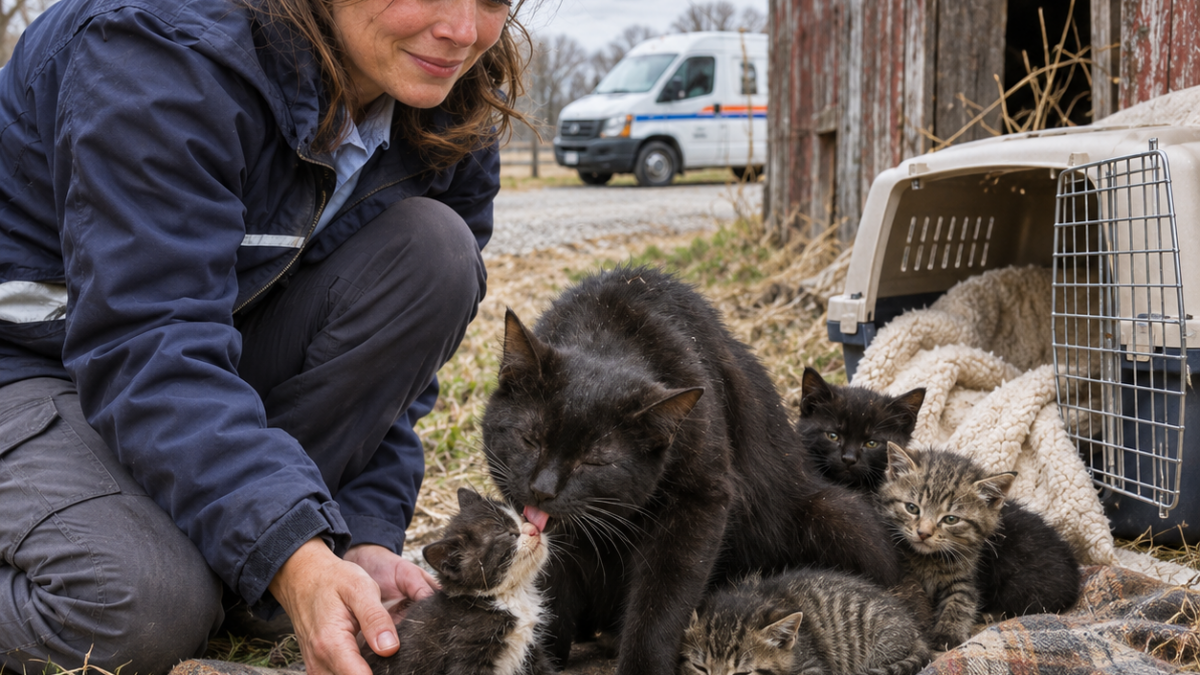
The rescue released one photograph.
Grace curled around all four kittens after their first stable week.
No road.
No dramatic injury close-up.
No exploitation.
Just a mother.
The caption:
**Grace is safe. Her kittens are safe. The circumstances that placed them in danger are under investigation.**
People reacted strongly.
Too strongly sometimes.
Threats appeared against Harlan Property Services.
We condemned them.
No one needed vigilantes.
Justice built on intimidation was not justice.
I wanted evidence.
Charges.
Consequences.
Not strangers screaming outside someone’s house.
Everett Pike hired an attorney.
His statement claimed he had no knowledge of any cats.
Then Marcus obtained text messages from Wade Harlan.
One message to Everett:
**Neighbor says blind cat + babies under shed. Wants delay.**
Everett replied:
**No delay. Property photographer comes Friday. Clear it all.**
Wade:
**Crew worried about liability if animals there.**
Everett:
**Then scare them out first. I’m not paying another week for cats.**
That was the moment everything became undeniable.
He knew.
Not vaguely.
Blind cat.
Babies.
Under shed.
No delay.
The text spread after it became part of public court filings.
People were furious.
I was too.
But I remember staring at the phrase *I’m not paying another week for cats.*
Grace had lived with Eleanor for years.
She had slept in that house.
Been taken to veterinary appointments.
Had both eyes surgically removed.
Been held.
Fed.
Known.
Then Eleanor died, and to her son, Grace became an expense.
Something left on property.
Something to clear.
I could not understand that.
Maybe I never will.
Criminal charges followed.
Not attempted murder of animals.
People online invented laws that did not exist.
Real cases are less dramatic in wording.
Animal cruelty and abandonment counts.
Neglect-related charges.
Potential civil violations connected to the cleanup.
The prosecutor had to prove knowledge and reckless disregard.
The texts helped.
Elaine’s photographs helped.
Leon’s statement helped.
Veterinary records helped.
Grace herself could not testify.
But her body told part of the story.
Severe malnutrition.
Dehydration.
Paw abrasions.
Milk production consistent with nursing four kittens under extreme caloric stress.
The kittens’ condition showed prolonged inadequate nutrition.
All five could have died.
Dr. Bennett testified later that another forty-eight to seventy-two hours without intervention might have killed the smallest kitten and potentially Grace.
That statement haunted me.
Two days.
I had almost taken a different route that morning.
Road work on County 118 had made me consider switching the delivery sequence.
If I had—
I stopped letting myself finish that thought.
Grace did not need my imaginary tragedies.
She had survived the real one.
Her recovery was slow.
She ate like a creature afraid food might disappear.
The first week, she would leave her bowl every few seconds to locate the kittens.
Touch one.
Listen.
Return.
Touch another.
She could not visually count them.
She counted with sound and smell.
Fern had a squeaky meow.
June chirped.
Cricket screamed as though every inconvenience were fatal.
Pebble, the smallest, made a low little grunt.
Grace knew each one.
If one was moved to another blanket, her ears immediately searched.
Dr. Bennett told me:
“She’s built a map of them.”
“What do you mean?”
“Sound. Smell. Position.”
I watched Grace find Pebble without hesitation.
“She doesn’t need eyes.”
Dr. Bennett looked at me.
“She needs a safe environment.”
That sentence mattered more.
People turned Grace into a superhero online.
I understood why.
Blind mother walks three miles with four kittens.
It sounded impossible.
But calling her heroic could hide the ugly truth.
Grace should never have needed heroism.
She should have had a warm room.
Food.
A clean nesting box.
A human checking on her.
Safety should not require extraordinary courage from the vulnerable.
I said that in the first interview I agreed to give.
A reporter asked:
“What makes Grace so inspiring?”
I looked through the rescue window at her.
“She survived.”
Then I added:
“But please don’t let her survival make what happened acceptable.”
The reporter paused.
“What do you mean?”
“She shouldn’t have had to be extraordinary just to stay alive.”
That line traveled farther than I expected.
Donations arrived.
Cedar Grove paid off several old veterinary balances.
The rescue created an emergency fund for special-needs animals.
Elaine visited Grace three days later.
I was there.
The moment Elaine spoke, Grace stood.
Her ears moved.
Then she ran.
Not fast.
Not straight.
But directly toward the voice.
Elaine dropped to her knees.
“Oh, baby.”
Grace pressed her entire face beneath Elaine’s chin.
Elaine sobbed.
“I’m sorry.”
Grace rubbed against her.
“I’m so sorry.”
I stepped outside.
Some reunions do not belong to witnesses.
Later, Elaine told me she wanted to adopt Grace.
That surprised me.
“You already have two cats.”
“I know.”
“Grace needs a predictable house.”
“I know.”
“The kittens?”
“I can’t take all five.”
I looked through the glass.
Grace was nursing.
Elaine cried again.
“I failed her.”
“No.”
“I left.”
“Your sister was sick.”
“I should have checked.”
“You fed her for months.”
“I should have protected her.”
I understood guilt.
I had been inventing reasons to blame myself for not finding Grace sooner.
Guilt loves impossible standards.
“You warned them.”
“They ignored me.”
“That belongs to them.”
Elaine looked at me.
“Then who takes Grace?”
I didn’t answer.
Because somewhere inside, I already knew.
I had started visiting twice a day.
I learned how Grace navigated.
She mapped rooms by whiskers and memory.
She hated furniture being moved.
She loved fleece blankets.
She chirped when I scratched the base of her tail.
She slept with one paw touching a kitten at all times.
When I spoke, she turned toward me instantly.
Carla noticed.
“You know this is happening, right?”
“What?”
“You’re adopting her.”
“No.”
“You bought a blind-cat fountain.”
“Research.”
“You rearranged your guest room.”
“Cleaning.”
“You put textured rugs at doorways so she can map rooms.”
“Accessibility.”
Carla stared.
“Denise.”
“I am not adopting five cats.”
“Nobody said five.”
I looked at the kittens.
“That’s worse.”
They were old enough soon to begin weaning.
Applications poured in.
Hundreds.
We screened heavily.
People wanted “the highway kittens.”
We rejected anyone who seemed more interested in the story than the animals.
Fern went to a veterinary technician and her wife.
June went to a retired couple with another young cat.
Cricket was adopted by a family whose twelve-year-old daughter had partial vision loss.
The girl met Cricket and said:
“My mom says animals don’t care what’s different about you.”
Cricket climbed her jeans.
Decision made.
Pebble was harder.
He had remained smaller.
Dr. Bennett found a mild congenital heart murmur.
Maybe harmless.
Maybe not.
Applications decreased after we disclosed it.
That made me angry.
Everyone wanted the miracle kitten until the miracle might cost money.
Then Elaine said:
“I’ll take him.”
I stared.
“You sure?”
“I’m not taking Grace.”
Her voice cracked.
“Let me take one of her babies.”
So Pebble went home with Elaine.
Grace’s last kitten left on a rainy Tuesday.
I expected her to panic.
We had transitioned gradually.
Short separations.
Longer ones.
Kittens sleeping in a nearby enclosure.
Grace handled it better than I did.
After Pebble left, she walked around the room.
Sniffed.
Called twice.
Then climbed into my lap.
That settled it.
I signed the adoption papers the next day.
**Grace Harper.**
Carla read the form.
“Last name?”
“She needs one.”
“Of course.”
Grace came home with me on April eighteenth.
I prepared everything.
Textured mats.
Low litter box.
Water fountain.
Furniture fixed in place.
No open stair access.
Bell on my ankle for the first week so she could hear where I was.
Carla laughed at that.
“You sound like livestock.”
“Leave.”
Grace adapted in three days.
I had spent hours creating routes.
She created her own.
Kitchen to living room.
Living room to bedroom.
Bedroom to sunroom.
She mapped corners with her whiskers.
Counted steps.
Learned surfaces.
At night, she slept beside my pillow.
The first time I woke and found her nose against my cheek, I cried.
Again.
I became a person who cried because a cat breathed near me.
The trial took nearly eight months.
Everett Pike fought the charges.
Wade Harlan accepted a plea earlier and agreed to cooperate.
Tyler Harlan’s case was handled separately because he had been on site.
Leon Briggs was not charged after investigators concluded he repeatedly raised concerns and followed his supervisor’s final direction, though public opinion still treated everyone equally for a while.
That bothered me.
Responsibility needs precision.
Not everyone involved carried the same moral weight.
Wade admitted he received Elaine’s warning.
Admitted he sent the text.
Admitted Everett refused delay.
Then came the question:
Why not call animal control anyway?
Wade stared at the prosecutor.
“I should have.”
“Why didn’t you?”
“I wanted to keep the client.”
Four words.
That was the whole system.
Keep the client.
Finish the job.
Take the photo.
Sell the property.
Cats in the way.
The prosecutor showed the photograph of the warning sign.
Then Elaine’s photograph of the machine beside the shed.
Then Everett’s text:
**No delay. Property photographer comes Friday. Clear it all.**
Everett’s attorney argued that “scare them out” showed concern for the animals.
The prosecutor asked:
“How does a blind cat with newborn kittens understand that instruction?”
Silence.
“Who was assigned to physically confirm the animals had exited?”
No one.
“Who checked the structure?”
No one.
“Who contacted the neighbor?”
No one.
“Who contacted animal services?”
No one.
“Who verified the kittens could walk?”
No one.
“Then what, exactly, did ‘scare them out’ mean?”
Everett’s attorney objected.
The judge allowed the question.
Everett finally answered:
“I assumed the workers would handle it.”
That sentence made something inside me go cold.
Assumed.
Grace survived inside the space between someone’s assumption and someone else’s responsibility.
The court heard from Dr. Bennett.
Elaine.
Marcus.
Wade.
Leon.
Me.
When I testified, Everett’s lawyer tried to establish that I had become emotionally involved and therefore exaggerated Grace’s condition.
“Ms. Harper, you adopted the cat, correct?”
“Yes.”
“You run a social media page about her?”
“The rescue posts updates. I occasionally contribute.”
“You have described her story publicly as abandonment.”
“Because she was abandoned.”
“Isn’t that a legal conclusion?”
“No.”
The attorney looked surprised.
I continued.
“Her owner died. The inheritor knew she remained on the property. He declined to arrange care. A neighbor fed her. Later, he was directly informed that she was blind and nursing four kittens beneath a structure. He ordered the structure cleared without delay.”
The attorney stood.
“Your Honor—”
The judge looked at me.
“Ms. Harper, answer only the question.”
“Yes, Your Honor.”
The attorney approached again.
“Do you hate my client?”
That surprised me.
The prosecutor objected.
The judge allowed limited questioning.
I thought carefully.
“No.”
The lawyer paused.
“You don’t?”
“No.”
“After everything you’ve said?”
“I don’t know him well enough to hate him.”
“Are you angry?”
“Yes.”
“Very?”
“Yes.”
“Would you like him punished?”
I looked at Everett.
He finally looked back.
“I want him held responsible.”
“That was not my question.”
“Then yes.”
The lawyer nodded as if he had won something.
Then I added:
“But punishment is not the part I care about most.”
He turned.
“What do you care about?”
I looked toward the photographs.
Grace.
Her kittens.
The collapsed shelter.
“I want the next person who sees a blind cat under a shed to understand that ‘not my problem’ is still a decision.”
The courtroom went quiet.
The lawyer moved on.
Everett was convicted on the primary animal-cruelty and abandonment counts that survived pretrial motions, along with civil penalties tied to the property cleanup. The exact sentence was less dramatic than people online wanted. There were fines, probation, restitution, restrictions involving animal ownership, and court-ordered community service through approved programs that did not place him in direct care of animals.
Some people were furious.
They wanted jail for years.
They wanted ruin.
I had imagined something harsher too.
Then I watched Everett leave the courthouse.
Reporters shouting.
Cameras.
He looked smaller than I expected.
Not innocent.
Not sympathetic.
Just human.
And I realized ruining him would not put food in Grace’s bowl.
It would not uncollapse the shelter.
It would not return those three miles to her body.
Justice had to become something more useful.
Restitution paid a portion of Grace and the kittens’ veterinary bills.
Civil settlement funds from the contractor helped Cedar Grove build a dedicated special-needs cat room.
Elaine helped design it.
Textured flooring.
Low platforms.
Sound-based enrichment.
Protected nesting areas.
No blind cat would be expected to navigate a standard shelter kennel if we could help it.
We called the room Grace’s Way.
I hated the name.
Carla loved it.
“It sounds like a church.”
“You deliver mail. You don’t get naming authority.”
“I named Grace.”
“Exactly. You used up your power.”
The opening ceremony was small.
No politicians.
No dramatic speeches.
Elaine brought Pebble.
He had grown.
Still small.
Still had the murmur.
Still alive.
Grace heard him before he entered.
Her entire body changed.
She stood.
Called.
Pebble answered.
I began crying before they even touched.
When we set him down, he ran toward her.
Grace sniffed his face.
Licked his head.
Pebble climbed over her as though five months had never passed.
Elaine covered her mouth.
“Does she remember him?”
Dr. Bennett stood beside us.
“Probably by scent.”
I looked at Grace.
“Definitely.”
Dr. Bennett smiled.
“Science says probably.”
“Science can leave.”
Pebble stayed two hours.
When he left, Grace did not panic.
She returned to my lap.
That was important.
Her babies were safe.
And somehow, she seemed to know she was safe too.
Grace’s story continued spreading.
I became uncomfortable with the phrase “miracle mom.”
Grace was not a miracle.
She was an animal.
A remarkable animal.
But turning her into a myth risked missing the point.
So whenever schools, rescues, or local groups asked me to speak, I told them the same thing:
“Grace survived because she was capable, determined, and lucky. But good systems should not require luck.”
We started a community program through Cedar Grove.
People could register outdoor community cats, especially disabled ones.
Neighbors shared feeding schedules.
Shelters kept emergency contact lists.
Property owners undergoing demolition or cleanup received reminders to check for nesting animals.
Contractors could call animal control for same-day guidance.
Wade Harlan donated equipment for building insulated shelters.
That surprised me.
At first, I refused the donation.
Carla challenged me.
“You want consequences or permanent enemies?”
“Both.”
“That’s not useful.”
“He helped bring down the shed.”
“He admitted it.”
“So?”
“So maybe spending money to build shelters is part of accountability.”
I stared at her.
“Why are you always reasonable when I want to be angry?”
“Years of rescue work.”
We accepted the materials.
Harlan Property Services later added an animal-check box to its pre-demolition checklist.
**Evidence of animals/nests? Yes/No.**
**Neighbor warning received? Yes/No.**
**Animal control contacted if needed? Yes/No.**
A box on a form sounds unimpressive.
Tell that to Grace.
A box might have saved her three miles.
A box might have prevented a roof from falling.
Sometimes systems change through paperwork.
I learned to respect boring solutions.
Everett Pike disappeared from public view.
For almost two years, I heard nothing.
Then one afternoon a letter arrived at Cedar Grove.
Not addressed to me.
To Elaine.
She called.
“Denise, you need to see this.”
We met at the rescue.
The letter was from Everett.
Handwritten.
Short.
He said his probation officer had encouraged him to write but had not required it.
He apologized to Elaine.
Not well.
Not beautifully.
But specifically.
**You warned us. I treated the cat as part of the property cleanup instead of as a living animal. I kept telling myself you would take care of her because you already had. That was cowardly and unfair.**
Elaine stopped reading.
Her eyes filled.
She continued.
**I also knew my mother cared for Grace. I did not want the responsibility after she died. I told myself that made Grace a stray. It didn’t. It made me someone who walked away from something my mother had trusted me not to ignore.**
I looked down.
That was the first time I understood there was grief on his side too.
Not justification.
Grief.
Maybe Everett had been unable to enter his mother’s house without confronting her absence.
Maybe Grace had become another obligation tied to a death he did not know how to handle.
Human pain explains cruelty sometimes.
It does not excuse it.
Elaine finished the letter.
Everett had begun donating monthly to a senior-cat rescue in his mother’s name.
Not Grace’s.
Eleanor’s.
Elaine looked at me.
“Do I answer?”
“That’s your decision.”
“What would you do?”
“I don’t know.”
“Liar.”
I smiled.
“I’d probably write one sentence.”
“What?”
“Do better.”
Elaine laughed.
Then she cried.
She eventually wrote back.
I never asked what she said.
Not everything needs to become part of a public story.
Grace turned two.
Then three.
She developed into the most confident blind cat I had ever known.
Not fearless.
Confident.
There is a difference.
She hated unfamiliar rooms.
She needed time to map them.
But once she did, she moved like she could see.
People visited and forgot she was blind.
Then someone moved a chair.
Grace walked into it.
I would yell:
“Don’t move furniture!”
The visitor would apologize.
Grace would sit there judging all of us.
She learned the sound of my mail truck.
On days off, if another carrier drove past my house in the same model, Grace ran to the window.
Not because she could see.
Because engines have voices too.
She slept in a heated bed every winter.
The first cold night each year, I thought about the collapsed shed.
I hated that memory.
Grace didn’t seem to.
That was another thing animals taught me.
We carry narratives around trauma.
They carry reactions.
Sometimes the reaction fades before our story does.
I was the one who kept returning to County Road 118 in my mind.
Grace was busy attacking a felt mouse.
Her kittens grew.
Fern became enormous.
June developed a habit of stealing kitchen sponges.
Cricket slept with the visually impaired girl who adopted her.
Pebble remained Elaine’s shadow.
Every year, we held a reunion.
Not because Grace needed it.
Because humans are sentimental.
The first year, all four adult kittens returned.
Grace sat in the middle of a room while four cats approached.
At first she seemed overwhelmed.
Then Fern chirped.
Grace turned immediately.
June made her strange trill.
Grace located her.
Cricket yelled.
Impossible to miss.
Pebble grunted.
Grace walked toward him.
I watched her touch noses with each one.
Carla whispered:
“She knows.”
I whispered back:
“Obviously.”
“You’re crying.”
“No.”
“Your face is wet.”
“Humidity.”
“Indoors?”
“Leave me alone.”
The photograph from that day became my favorite.
Grace in the center.
Her four grown babies around her.
No road.
No starvation.
No collapsed shelter.
No warning sign.
Just family.
That was the image I wanted people to remember.
Not suffering.
After the trial, reporters kept asking me about “revenge.”
One even used the phrase:
“Do you feel Grace got revenge on the people who left her?”
I hated the question.
Cats do not care about revenge.
Grace did not wake up hoping Everett suffered.
She wanted breakfast.
Warmth.
Predictability.
Touch.
Her babies safe.
So eventually I developed an answer.
“Grace’s revenge is that she lived long enough to become more than what happened to her.”
That was true.
Everett tried to reduce her to a problem on property.
Instead, her case changed local procedure.
The contractor changed policy.
The rescue expanded.
Disabled cats were adopted because people learned they could live full lives.
Elaine stopped blaming herself.
Four kittens grew up.
And I—someone who had always considered myself a dog person—became the human servant of a blind black cat who screamed at me if breakfast was thirty seconds late.
That seemed like sufficient revenge.
Then, four years after I found Grace, something happened that brought the story back to County Road 118.
A storm hit.
Stronger than the one that had preceded the shelter collapse.
Trees fell.
Power disappeared across half the county.
Creeks overflowed.
I was working a shortened mail route when Carla called.
“We have a problem.”
“What?”
“Elaine found kittens.”
My heart dropped.
“Where?”
“Pike property.”
I pulled over.
“What?”
“The land sold last year.”
“I know.”
“New owner is restoring the house.”
“Okay.”
“There’s a feral mom nesting near the old shed site.”
I closed my eyes.
History has a cruel sense of humor.
“How many?”
“Six.”
“Blind?”
“No.”
“Thank God.”
“What?”
“Nothing.”
The new owner had followed the county’s updated demolition checklist.
He noticed paw prints.
Called animal control.
Construction stopped.
A trap-neuter-return team came.
Mother and kittens were safely moved before workers continued.
Exactly what should have happened to Grace.
Elaine sent me a photograph.
Six kittens inside a warm crate.
Mother nearby.
Safe.
I sat in my mail truck staring at it.
Then I cried.
Not because it was sad.
Because nothing happened.
That was the point.
No collapse.
No desperate walk.
No highway.
No starving mother.
No dramatic rescue.
The system worked before tragedy.
Nobody wrote a viral article about those cats.
Good.
Some of the best rescue stories are the ones that never become rescue stories because someone acted early.
I brought Grace to Elaine’s house that evening.
We sat on the porch.
Rain on the roof.
Grace asleep in my lap.
Elaine showed me the photograph again.
“This is because of her.”
“Partly.”
“Because of what happened.”
“Yes.”
Elaine stroked Grace’s head.
“Do you ever wish none of it happened?”
“Every day.”
She looked at me.
“Even though all this came from it?”
“Especially then.”
I explained.
A good outcome does not make suffering necessary.
Grace did not need to be starved so our county could learn something.
We should have known before.
The lesson is not:
Bad things happen for a reason.
Sometimes bad things happen because people fail.
Then other people decide what to do with the aftermath.
Elaine nodded.
“I like that better.”
“So do I.”
Grace purred.
Years passed.
I retired from mail delivery after twenty-one years on County Road 118.
My coworkers gave me a cake decorated like a mailbox.
Carla brought Grace to the party even though Grace lived with me and had arrived in my car.
“Surprise.”
“She was literally beside me ten minutes ago.”
“Act surprised.”
Grace wore a tiny postal-worker bandana.
I objected.
Then took forty photographs.
Retirement changed our routine.
For the first month, Grace seemed confused that I was home in the mornings.
She would wait near the door around seven.
“Not going.”
Ears moved.
“I retired.”
She meowed.
“Yes, apparently we’re both disappointed.”
Eventually we created new routines.
Coffee for me.
Breakfast for Grace.
Garden time.
Cedar Grove twice a week.
I became a volunteer.
Of course.
Carla called it destiny.
I called it unpaid labor.
Grace became an ambassador for special-needs cats.
People meeting her would ask:
“How does she find things?”
“Nose. Ears. Whiskers. Memory.”
“Does she use a litter box?”
“Yes.”
“Can she climb?”
“Unfortunately.”
“Does she need another blind cat?”
“No.”
“Does she know she’s blind?”
That question always made me laugh.
“What would she compare herself to?”
Grace never sat around thinking:
I am missing something other cats have.
She simply lived using what she had.
That became useful when potential adopters worried about disabled animals.
Not every home is right.
Special needs are real.
Costs can be real.
Adjustments matter.
But disability is not the same as misery.
Grace proved that daily.
At nine years old, Grace developed kidney disease.
Early stage.
Manageable.
Prescription food.
More water.
Regular blood tests.
She hated veterinary visits.
Dr. Bennett remained her doctor.
“Remember when she weighed six pounds?”
“I remember when she tried to remove your finger.”
“She still does.”
Grace hissed.
“See?”
We managed the disease for years.
Elaine aged too.
Pebble died before Grace.
Heart failure.
He was eight.
Elaine called me at six in the morning.
“He’s gone.”
I drove over.
Pebble lay wrapped in the same kind of fleece blanket Cedar Grove used when he was a kitten.
Elaine sat beside him.
“I promised his mother I’d keep him safe.”
“You did.”
“Not long enough.”
“There is no long enough.”
She looked at me.
“I hate that.”
“So do I.”
We brought Grace later.
I did not know whether showing a dead adult offspring to a cat mattered.
Some experts recommend allowing animals to investigate familiar companions after death.
Grace sniffed Pebble.
Once.
Twice.
Then sat beside the blanket.
Five minutes.
No dramatic reaction.
Then she walked into Elaine’s lap.
Elaine sobbed.
Grace stayed.
Maybe she understood.
Maybe she only understood Elaine was hurting.
Either was enough.
Cricket died at eleven after cancer.
June lived to thirteen.
Fern outlived all of them.
Grace became an old mother whose children slowly disappeared before her.
I thought of Vera and Oliver sometimes—another story, another kind of bond—but Grace remained uniquely herself.
At thirteen, her kidney disease worsened.
Subcutaneous fluids.
Medication.
Appetite changes.
She hated needles.
She tolerated me.
Trust is a strange privilege.
The blind cat who once had to survive without human reliability eventually allowed me to hold her still while I placed a needle beneath her skin because she had learned my hands meant help.
That never stopped humbling me.
One morning, she refused breakfast.
Grace never refused breakfast.
I knew.
Dr. Bennett ran tests.
Kidneys failing more rapidly.
We adjusted treatment.
Grace rallied.
Two months.
Then three.
One evening, she became disoriented in the living room.
A room she had mapped for years.
She stopped.
Turned in circles.
Cried.
I sat on the floor.
“Grace.”
Her ears found me.
She walked toward my voice.
Pressed into my chest.
I cried into her fur.
“I’ve got you.”
Those were the words I wished someone had been there to say at the shed.
I could say them now.
That mattered.
Her final week arrived quietly.
Less food.
More sleep.
Longer recovery after walking.
Dr. Bennett came to the house.
Grace lay in her heated bed.
“How do I know?”
I asked.
“You already do.”
“I hate that answer.”
“I know.”
“Is she suffering?”
“Some.”
“Can we fix it?”
“Not enough.”
I looked at Grace.
Her empty eye sockets had never seemed sad to me after the beginning.
They were simply part of her face.
Beautiful.
Familiar.
“Tomorrow?”
Dr. Bennett nodded.
“If you’re ready.”
“No.”
She waited.
“But she is.”
That night, I did not sleep.
Grace rested against my stomach.
I thought about County Road 118.
The line of kittens.
The truck coming around the curve.
Pebble rolling into the ditch.
Grace searching blindly.
That little cry.
I had spent years imagining her journey.
Maybe too much.
I knew parts.
Not every step.
No one did.
But I knew where it ended.
Not at the highway.
Not at the rescue.
Not at the courthouse.
Here.
Warm bed.
Full stomach.
My hand on her back.
Safe.
I whispered:
“You were never helpless.”
Grace purred faintly.
“People called you helpless.”
I stroked her ears.
“You weren’t.”
Blind?
Yes.
Starving?
Yes.
Abandoned?
Yes.
Helpless?
No.
She had gotten four babies out.
Led them forward.
Listened for danger.
Called when one fell.
Kept moving.
She had done everything she could with the world she had been given.
Humans were the ones who failed.
Then humans helped.
Both truths mattered.
The next morning, Elaine came.
Carla came.
Dr. Bennett arrived at ten.
Grace lay in my lap.
Elaine touched her head.
“You remember me?”
Grace turned toward her voice.
Elaine broke.
“She does.”
“Of course.”
Carla sat beside us.
“This cat ruined my life.”
I laughed through tears.
“She made you famous.”
“I was already famous.”
“To six people.”
“Eight.”
Grace purred.
Dr. Bennett prepared the medication.
I held Grace close.
“You know something?”
Her ear moved.
“You never needed to see where you were going.”
My voice cracked.
“You just needed somebody to stop leaving you alone out there.”
I kissed her head.
“Not today.”
I wrapped both arms around her.
“You’re not alone today.”
The first medication relaxed her.
Her breathing softened.
For a moment, she kneaded my shirt.
The same motion kittens make against their mothers.
I thought of her babies.
Fern.
June.
Cricket.
Pebble.
All the lives behind her.
Then Dr. Bennett gave the final medication.
Grace exhaled.
And did not inhale again.
No highway.
No cold ditch.
No collapsed boards.
No hunger.
Just my arms.
When it was over, Elaine said:
“She found the right place.”
I shook my head.
“No.”
Elaine looked at me.
“I found her.”
That distinction mattered.
Grace had not been walking toward me.
She had not known salvation waited three miles away.
She was simply moving because staying had become more dangerous than leaving.
I happened to come along.
That is why I still think about all the animals nobody happens to come along for.
Grace’s story did not make me believe fate saves everyone.
It made me believe people have to pay attention.
We scattered part of Grace’s ashes beneath a tree behind Cedar Grove.
Another small portion went to Elaine.
The rest stayed with me.
Grace’s Way still operates.
Special-needs cats still sleep there.
The demolition checklist remains county guidance.
Harlan’s company still uses its animal-safety form.
The Pike property is now owned by a family who restored Eleanor’s house rather than demolishing it.
They keep a photograph of Grace in the mudroom.
I thought that was strange at first.
Then they explained:
“We want everyone who works here to remember what happens when people stop looking.”
Fair.
The old shelter site has a new structure now.
Not for Grace.
For community cats.
Insulated.
Raised.
Safe.
Elaine helped build it before arthritis made tools difficult.
On one side is a small metal plate.
No dramatic quote.
No accusation.
Just:
**CHECK BEFORE YOU CLEAR.**
I like that.
Simple.
Practical.
A command.
Because after everything, that is the lesson I trust most.
Check.
Before you remove the bowl.
Before you pull down the shed.
Before you call an animal a stray.
Before you assume somebody else is handling it.
Before you decide a disabled animal cannot survive.
Before you walk past.
Check.
Maybe there is a blind mother beneath the boards.
Maybe there are four babies behind her.
Maybe the difference between tragedy and rescue is one person taking five extra minutes to look.
People still ask me about the sign.
They always focus on the first line.
**BLIND MOTHER CAT.**
But the second line is the one that stayed with me.
**SHE HAS FOUR BABIES UNDER THE SHED AND NO ONE ELSE IS FEEDING THEM.**
That sentence contained the entire failure.
Someone knew.
Someone cared enough to write it.
Someone else knew too.
And still the protection failed.
Grace’s story was never about one monster.
That would have been easier.
It was about a chain of decisions.
Everett refusing responsibility.
A rescue being full.
Elaine doing more than one neighbor should have had to do alone.
A contractor prioritizing schedule.
Workers assuming animals would move.
No one stopping long enough to confirm safety.
Then one structure came down.
After that, Grace had to become extraordinary.
I wish she hadn’t.
I wish her most remarkable achievement had been sleeping twenty hours a day in Eleanor’s house.
I wish she had been spayed.
Fed.
Warm.
Boring.
I wish I had never met her because she had never needed me.
That is the strange truth rescue people understand.
We love the animals we save.
We also wish there had been nothing to save them from.
But once the damage existed, Grace did something with the life left afterward.
She raised four kittens.
Trusted again.
Learned my house.
Became an ambassador for blind cats.
Changed procedure.
Forced people to confront what negligence looks like when written in text messages and captured in photographs.
And lived long enough to become old.
That final part may be my favorite.
She became old.
The starving cat beside the highway got gray hairs.
Needed kidney medicine.
Became picky.
Yelled at me for breakfast.
Slept in sunlight.
Became ordinary.
There is enormous victory in ordinary life after catastrophe.
A young volunteer once asked me:
“What was Grace’s most amazing moment?”
She expected me to say the three-mile journey.
Or saving her kittens.
Or surviving the collapse.
I told her:
“Tuesday morning when she refused the expensive kidney food and demanded chicken.”
The volunteer laughed.
I did too.
But I meant it.
Because survival gets applause.
Living gets overlooked.
Grace did both.
Years after that March morning, I sometimes drive County Road 118 just because I can.
I pass the place where I found them.
The ditch looks smaller now.
The highway still curves the same way.
Cars move fast.
Grass grows.
Nothing marks the exact spot.
That seems right.
Grace did not belong to the roadside.
Then I continue three miles.
Past the old Pike property.
Past the rebuilt shelter.
Past the metal plate.
And sometimes I stop.
I stand beneath the trees.
Listen.
Wind.
Birds.
Traffic faint in the distance.
I think about a blind cat hearing machinery approach.
Feeling the ground shake.
Babies crying beneath broken wood.
I imagine her searching.
One kitten.
Then another.
Then another.
Then another.
Getting them out.
Moving into the woods.
No idea where safety was.
Only knowing where danger had been.
Maybe that is courage.
Not knowing where you are going.
Only knowing you cannot stay.
And continuing anyway.
Grace never saw the highway.
Never saw my mail truck.
Never saw my face.
She never saw Carla.
Dr. Bennett.
Elaine after their reunion.
Her kittens grown.
The courtroom.
Grace’s Way.
The new shelter built where the old one fell.
She never saw any of it.
She did not need to.
She knew the world through other evidence.
Voices that returned.
Hands that did not hurt.
Bowls that filled again.
Blankets that stayed warm.
Babies answering when she called.
A door opening.
My footsteps.
Home.
Maybe that is the ending I want people to remember.
Not the blind mother wandering beside the highway.
Not the collapsed shelter.
Not Everett Pike.
Not the trial.
Not even the viral photograph.
Remember Grace years later.
Old.
Fed.
Curled in a heated bed with her paws tucked beneath her chest.
Hearing me enter the kitchen.
Lifting her head.
Knowing exactly who I was.
No eyes required.
She had spent the worst days of her life moving forward without seeing where the road led.
And in the end, the world finally gave her something she should have had from the beginning.
A place where she no longer needed to escape.
A place where the food bowl never disappeared.
A place where no one pulled down the roof above her.
A place where every time she called—
someone answered.








