PART 2: Someone Covered Two Hairless Puppies in Motor Oil—Months Later, No One Recognized Them
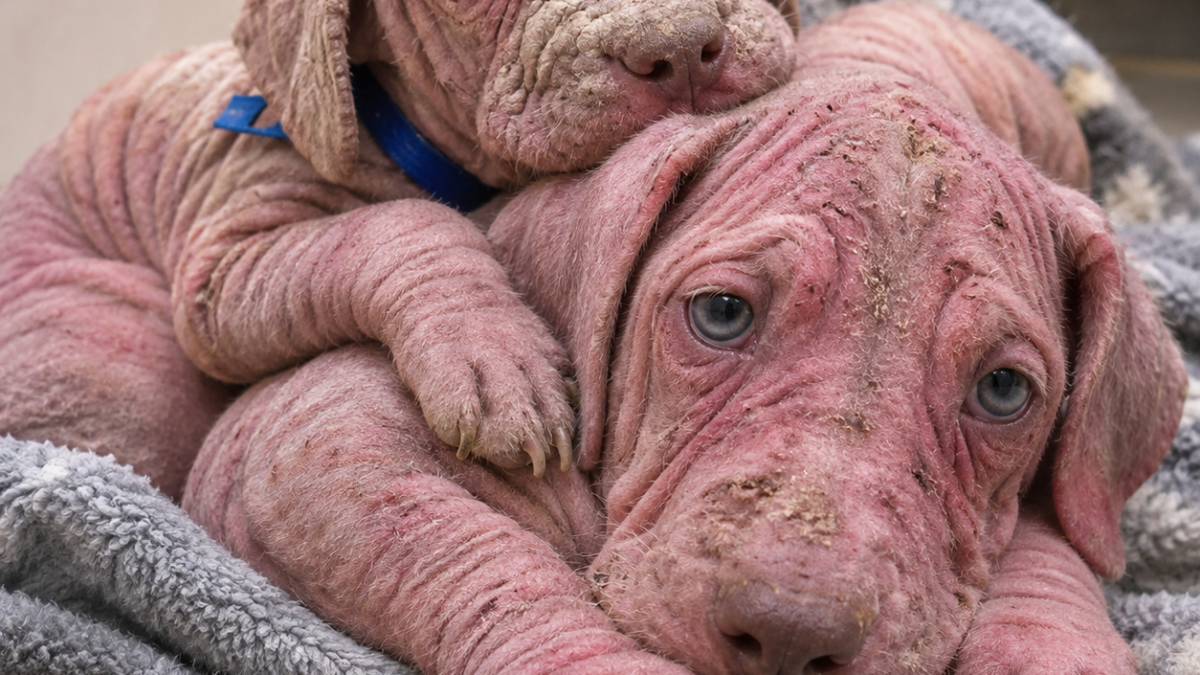
PART 2
The veterinary appointment was the next morning.
Getting Rhaegal into the carrier was easy.
I opened the door.
He tried to climb into my lap.
“You have known me for twelve hours.”
Tail wag.
“Zero survival instinct.”
Drogon made up for both of them.
The moment he saw the carrier, he flattened himself against the kennel wall.
“No one is chasing you.”
He didn’t believe me.
I placed food inside.
Nothing.
Rhaegal walked in, ate Drogon’s food, then looked at me as if he’d completed the assignment.
“Not helpful.”
We eventually used patience, blankets, and very slow movement.
Drogon went inside without being grabbed.
That mattered.
Every time we could avoid forcing him, we did.
At the clinic, Dr. Evans examined Rhaegal first.
She ran gloved fingers gently across his skin.
He leaned into her.
“This one likes people.”
“Too much.”
Rhaegal tried to lick the stethoscope.
Dr. Evans smiled.
“Definitely too much.”
Then she examined his legs.
Her expression became serious.
“How long has he been undernourished?”
“No idea.”
She palpated the joints.
Rhaegal didn’t complain.
“These bones are very weak.”
“Rickets?”
“Likely. We’ll confirm what we can with imaging and bloodwork.”
Drogon was more difficult.
Not aggressive.
He never tried to bite.
He simply shut down.
When Dr. Evans touched his shoulder, he froze.
When she moved toward his hind leg, he tried to crawl backward.
I sat near his head.
“You’re okay.”
His eyes locked on mine.
“Nobody’s hurting you.”
The words felt inadequate.
He had no reason to believe them.
The test results gave us what we expected and a little more than we wanted.
Both puppies had severe mange.
Their skin was inflamed and vulnerable to secondary infection.
Both were significantly underweight.
Their nutritional status was poor enough to have affected bone development.
The bowed legs and enlarged joints were consistent with rickets and prolonged deficiency.
Their bodies needed more than calories.
They needed the right nutrition, veterinary management, controlled exercise, parasite treatment, skin treatment, and time.
A lot of time.
Then Dr. Evans asked:
“Who put the oil on them?”
“We don’t know exactly.”
“Owner?”
“Possibly someone caring for them. We were told it was meant as a mange treatment.”
She sighed.
“This still happens.”
“Can it poison them?”
“It can irritate skin, be dangerous if swallowed or inhaled, and interfere with proper treatment. We need to remove the residue carefully.”
“So bath them?”
“Not aggressively. Their skin is already compromised.”
Everything would have to be gentle.
That became the rule of their recovery.
Gentle.
Not fast.
Not dramatic.
Not one miracle treatment.
Care layered on care.
The first medicated cleaning took nearly an hour.
We didn’t scrub.
There was no way I was dragging a rough cloth over skin that already looked painful.
Warm water.
Veterinary-approved cleansing products.
Soft towels.
Patience.
Rhaegal behaved like he’d been invited to a spa.
He leaned into the towel.
Licked my arm.
Tried to drink the bathwater.
“Dignity,” I told him.
He had none.
Drogon hated every second.
Not because the water hurt.
Because hands were everywhere.
He trembled.
I kept one palm near his chest.
Not restraining.
Just present.
“Almost done.”
His breathing came fast.
“Look at me.”
He did.
“Good.”
We finished.
Wrapped him in a towel.
And instead of immediately putting him down, I waited.
Drogon was stiff in my arms.
Then, after maybe thirty seconds, something changed.
His weight settled.
Not much.
A fraction.
But he stopped fighting the contact.
I carried him to the kennel.
The moment his paws touched the blanket, he moved away.
Still progress.
Their treatment schedule became the center of our days.
Medication.
Skin care.
Meals.
Supplements and nutritional support as directed by the veterinarian.
Short periods outside.
Rest.
More food.
More cleaning.
More medication.
I started taking photographs.
Not because I planned to show anyone.
I needed proof that things were changing.
When you’re looking at a sick animal every day, progress can become invisible.
Day three looked like day two.
Day five looked like day four.
Their skin was still bare.
Still dark.
Still irritated.
Their legs still bowed.
They still looked terribly thin.
But the scale changed.
A few ounces.
Then more.
The itching eased slightly.
They slept longer.
Rhaegal developed a habit of rolling onto his back whenever someone entered the kennel.
“You’re naked.”
Tail wag.
“You have no fur.”
More wagging.
“Stop showing everyone your stomach.”
Impossible.
Drogon stayed behind him.
If a volunteer entered, Rhaegal moved forward.
Drogon moved back.
Rhaegal became his shield.
That relationship fascinated me.
At night, Drogon slept with his nose against Rhaegal’s side.
If Rhaegal moved too far away, Drogon woke.
If Drogon became frightened by a sound, Rhaegal crawled back toward him.
They were brothers in every practical sense.
Not simply puppies from the same litter.
They had survived as a unit.
The first real scare came during the second week.
Rhaegal stopped eating breakfast.
For Rhaegal, that was catastrophic enough to terrify me.
This was a puppy who would have eaten the bowl if given enough time.
I placed chicken near him.
He turned away.
“Okay.”
My heart accelerated.
“That’s not funny.”
He was quieter.
Warm.
Too warm.
We went back to the clinic.
Secondary skin infection.
His damaged skin had given bacteria an opportunity.
Dr. Evans adjusted his treatment.
He needed closer monitoring.
Drogon was left at the rescue for only a few hours.
He hated it.
He paced the kennel looking for Rhaegal.
Not normally paced.
His weak legs couldn’t handle that.
He dragged himself from one side to the other, sniffing.
I sat inside.
“He’s coming back.”
Drogon ignored me.
“He is.”
Finally he stopped.
Looked at me.
I placed my hand on the blanket.
Not touching him.
Drogon hesitated.
Then lay down maybe eight inches away.
Closest he had voluntarily rested near me.
When Rhaegal returned that afternoon, Drogon practically climbed over him.
Rhaegal, who was supposed to be resting, immediately tried to wrestle.
“Absolutely not.”
They ignored me.
I separated them with a pillow.
Drogon slept against the pillow.
Rhaegal on the other side.
Brothers.
By the end of week two, Rhaegal’s infection was responding.
He started eating normally.
Then excessively.
Crisis over.
But the setback reminded us how vulnerable they still were.
People often think rescue transformations move in one direction.
Bad to good.
Thin to healthy.
Hairless to furry.
Reality is messier.
Progress.
Setback.
Progress.
Fear.
Hope.
Another problem.
Then a good day you didn’t expect.
Rhaegal and Drogon lived inside that rhythm.
At week three, I noticed something along Rhaegal’s shoulder.
I stared.
Tiny.
Soft.
Almost invisible.
I called another volunteer.
“Come here.”
She looked.
“What?”
“Right there.”
“I don’t see anything.”
“Use your eyes.”
She leaned closer.
Then gasped.
“Hair.”
I laughed.
Three tiny patches.
That was all.
Fuzz.
But after weeks of bare, inflamed skin, those few hairs looked magnificent.
We took a photograph.
Drogon’s first fur appeared several days later.
A dark patch along his neck.
I touched it.
Drogon immediately turned.
“Sorry.”
I pulled my hand back.
He sniffed my fingers.
Then, for the first time, he licked them.
One lick.
Retreat.
I sat completely still.
“Okay.”
My eyes filled.
“That’s bigger than the hair.”
Trust arrived in increments smaller than fur follicles.
Rhaegal’s trust was immediate.
Drogon’s had to be earned one touch at a time.
I began spending quiet time in the kennel without doing anything medical.
That was important.
If every human interaction brings medicine, baths, restraint, or examination, a frightened dog learns that people predict discomfort.
So sometimes I sat.
Read emails.
Drank coffee.
Talked nonsense.
No treatment.
No touching.
Rhaegal climbed into my lap.
Naturally.
Drogon watched.
First from four feet away.
Then three.
Then two.
One afternoon, he walked behind me and sniffed my back.
I pretended not to notice.
Another day, his nose touched my elbow.
Still nothing from me.
Then the day came when I sat down and Drogon approached from the front.
He stopped just outside arm’s reach.
I looked away.
He stepped closer.
His nose touched my knee.
Rhaegal immediately tried to wedge his entire body between us.
“Rhaegal.”
I moved him gently aside.
“This is not about you.”
Rhaegal disagreed.
Drogon retreated.
“Excellent work.”
Eventually Rhaegal fell asleep on my leg.
Drogon returned.
Sniffed.
Then lowered himself on the blanket beside my foot.
Not touching.
Close.
That night I wrote one sentence in their care notes:
**Drogon chose to stay near me.**
Nobody else would have understood why that sentence mattered so much.
A week later, he chose touch.
I was changing the bedding.
Drogon stood near the wall.
Rhaegal was outside with a volunteer.
I expected Drogon to be more nervous without him.
Instead, he watched.
I finished.
Sat down.
Drogon walked over.
His head lowered.
I offered my hand.
He sniffed.
Then pushed his forehead under my fingers.
My chest tightened.
I scratched gently between his ears.
Drogon closed his eyes.
Five seconds.
Then he stepped away.
That was all.
I cried anyway.
Rescue has a strange way of destroying your emotional standards.
One dog running across a field?
Normal.
One terrified puppy allowing five seconds of affection?
I’ll cry all afternoon.
Their bodies were changing faster now.
The skin infections resolved.
The inflammation calmed.
The constant scratching became occasional.
Their fur started returning in visible patches.
Rhaegal’s coat came in lighter than expected.
Warm tan and cream.
Drogon’s came in darker.
Rich brown-black along the back and face.
They no longer looked identical.
Their personalities didn’t either.
Rhaegal remained social.
Everyone was his friend.
Volunteer?
Friend.
Veterinarian?
Friend.
Delivery driver?
Potential friend.
Person cleaning drains?
Absolutely friend.
Drogon made people work for it.
He observed.
Assessed.
Decided.
If he liked you, eventually you’d know.
If he didn’t know you, you existed at a respectful distance.
Neither personality needed fixing.
That became one of the most important lessons of caring for them.
We weren’t trying to turn Drogon into Rhaegal.
We were helping Drogon become a safe version of Drogon.
Their rickets took longer.
Fur can create the illusion that an animal is healed before the deeper problems are gone.
Once their coats started returning, visitors would say:
“They look amazing!”
They did.
But their legs were still weak.
Bone recovery takes time.
Muscles needed rebuilding.
Nutrition had to remain carefully balanced.
They couldn’t simply be allowed to run wild because they felt better.
Try explaining restraint to two adolescent puppies who have just discovered energy.
Rhaegal was the first problem.
He realized he could run.
Not gracefully.
But fast enough to become dangerous to himself.
I opened the yard gate one morning.
Rhaegal saw a ball.
He exploded forward.
“Rhaegal!”
He ignored me.
Drogon followed because if Rhaegal was committing a crime, brotherhood apparently required participation.
Their bowed legs gave them an odd bouncing gait.
They reached the ball.
Rhaegal grabbed it.
Drogon grabbed Rhaegal.
Both fell over.
I covered my face.
“Absolutely brilliant.”
They got up.
Did it again.
Our rehabilitation specialist, Maya, watched a video later.
“You let them run like that?”
“It happened quickly.”
“You’re a terrible patient manager.”
“I know.”
“Short controlled exercise.”
“I know.”
“Not puppy Olympics.”
“I know.”
Rhaegal barked from across the room.
Maya pointed.
“He doesn’t know.”
No.
He did not.
Controlled walks.
Gentle strengthening.
Proper footing.
Rest.
Gradual increases.
Rhaegal found all of this insulting.
Drogon preferred structure.
Another difference.
On a leash, Drogon focused.
Rhaegal tried to greet leaves.
One day Rhaegal spent ten minutes attempting to befriend a garden hose.
Drogon looked at him with the exact expression I felt.
Despite the humor, there were difficult days.
Some mornings their legs ached.
Cold weather made them stiffer.
Drogon once slipped while turning and cried out.
I was beside him immediately.
Nothing broken.
But the sound took me back to the first day.
Bare skin.
Bowed limbs.
Oil.
Weakness.
The fear of losing progress never completely disappeared.
At the next veterinary checkup, Dr. Evans compared their new radiographs with the originals.
“Better.”
I leaned forward.
“How much?”
“Meaningful.”
“That is a veterinarian’s favorite vague word.”
She smiled.
“The bones are mineralizing better. Their overall condition is improving. The legs may never be perfectly straight.”
“I don’t care.”
“I know.”
“Will they have normal lives?”
She looked through the glass where Rhaegal was trying to steal a paper towel and Drogon was watching him commit the theft.
“They’re already working on that.”
By month three, the oil smell was only a memory.
I hadn’t realized how strongly it had affected me until one afternoon a mechanic visited the rescue to repair a gate.
The smell of engine oil came from his clothes.
My stomach tightened immediately.
Memory is physical.
Rhaegal ran toward him.
Of course.
The mechanic knelt.
Rhaegal licked his face.
Drogon stayed six feet away.
The man noticed their coats.
“These the puppies you told me about?”
“Yes.”
“The oil ones?”
I nodded.
He looked horrified.
“People still do that?”
“Unfortunately.”
“My grandfather used to say diesel cured everything.”
“It doesn’t.”
He scratched Rhaegal’s chest.
“Guess this guy learned the hard way.”
I looked at Rhaegal.
“No. Somebody else made the mistake. He paid for it.”
That’s the part that bothers me most about careless remedies.
The person experimenting isn’t usually the one who suffers.
The animal is.
But I also learned to be careful with anger.
We never had proof that whoever applied the oil wanted to hurt the puppies.
Everything we heard suggested the opposite.
Someone thought they were helping.
Wrongly.
Dangerously.
Ignorantly.
But probably helping.
That matters.
Because if you treat every ignorant person as a monster, they stop asking questions.
And if they stop asking questions, the next sick puppy may get another bottle of motor oil instead of a veterinarian.
So our rescue began using Rhaegal and Drogon’s story differently.
Not:
**Look what a terrible person did.**
Instead:
**This is why dangerous home remedies can make suffering worse. Please ask for help.**
That felt more useful.
Still, privately, I was angry.
Not necessarily at one person.
At the entire chain of failure.
At the idea that two puppies could reach this condition before proper help arrived.
Mange severe enough to strip every hair.
Bodies weak enough for rickets.
Ribs showing.
Skin burning.
Then oil.
How many days had they scratched?
How many nights had they slept on inflamed skin?
How many meals had they missed?
That anger needed somewhere to go.
So I put it into recovery.
Every pound gained became an answer.
Every patch of fur.
Every stronger step.
Every time Drogon voluntarily approached someone.
Every time Rhaegal behaved like an idiot because he had enough energy to be one.
That was our revenge.
Health.
By the fourth month, people who had seen the original photographs struggled to recognize them.
A rescue friend visited.
She stood outside the yard.
Two furry adolescent dogs ran toward the fence.
“Where are they?”
I pointed.
She laughed.
“No.”
“Yes.”
“Those are not the same dogs.”
“Rhaegal!”
The lighter dog turned.
Tail wagging.
“Drogon!”
The darker one lifted his head but stayed where he was.
My friend covered her mouth.
“Oh my God.”
She entered slowly.
Rhaegal threw himself at her.
Drogon watched.
She knelt.
“I can’t believe it.”
Rhaegal licked her chin.
She started crying.
“He was completely bald.”
“I know.”
“Both of them.”
“I know.”
She looked at Drogon.
“Will he come?”
“Don’t call him.”
She understood.
Sat down.
Talked to me instead.
After several minutes, Drogon approached.
Sniffed her shoulder.
Then her hand.
She didn’t move.
Drogon touched his nose to her fingers.
My friend cried harder.
“He’s so beautiful.”
That word.
Beautiful.
Months earlier, people would have looked at the boys and seen disease first.
Now you had to know the history to find the scars beneath the fur.
Rhaegal’s coat became thick and golden-tan, with lighter areas across his chest.
Drogon grew a darker, richer coat that made his eyes look brighter.
Their bodies filled out.
Their shoulders widened.
Their ribs disappeared beneath muscle.
Their legs remained slightly imperfect.
But stable.
Strong.
Functional.
Dr. Evans eventually said the sentence I had been waiting for:
“They’re ready to live like dogs.”
“Normal activity?”
“Gradually. Yes.”
I stared.
“You’re sure?”
She laughed.
“You asked me for this for four months.”
“I know. Now I’m afraid.”
“That’s rescue.”
The first unrestricted play session nearly gave me a heart attack.
We released them into a larger fenced field.
Rhaegal ran.
Full speed.
No hesitation.
Drogon followed.
They circled.
Changed direction.
Rhaegal crashed into Drogon.
Drogon chased him.
For five minutes, I couldn’t stop smiling.
Bare skin had become fur moving in the wind.
Weak bowed legs had become bodies strong enough to run.
Then Rhaegal discovered mud.
He rolled.
I screamed.
“NO.”
Too late.
Four months of skin care.
Supplements.
Baths.
Medication.
Nutrition.
And he coated half his beautiful new coat in mud.
Maya laughed until she couldn’t breathe.
“This is what you wanted.”
“I wanted health.”
“You got dog.”
Fair.
The harder part came next.
Adoption.
From the beginning, we had known the brothers would eventually need homes.
That is what rescue does.
Take in.
Heal.
Let go.
But healing an animal for months creates a dangerous intimacy.
You know how they eat.
Sleep.
React to thunder.
Which side they prefer to lie on.
What frightens them.
Which medication trick works.
Which toy matters.
You start thinking no adopter will notice enough.
That’s usually fear pretending to be standards.
Rhaegal received applications first.
No surprise.
He loved everyone.
Photographs loved him too.
Big smile.
Golden coat.
Tail always blurred.
Several families looked wonderful.
We screened carefully.
History.
Veterinary references.
Home environment.
Understanding of his previous nutritional and orthopedic issues.
Willingness to continue monitoring.
One family stood out.
Quiet home.
A fenced yard.
Experience with rescue dogs.
An older gentle dog.
They came to meet him.
Rhaegal decided within forty seconds.
He climbed into the woman’s lap.
Her husband laughed.
“I think that’s it.”
I wanted to object.
Rhaegal had betrayed me with shocking efficiency.
Their older dog met him.
Rhaegal immediately tried to lick her face.
She corrected him.
He respected it.
Five seconds later, he tried again.
“He’s persistent,” the man said.
“That’s one word.”
The family understood his medical history.
Asked good questions.
Not:
“Will his legs ever look normal?”
Instead:
“What signs of pain should we watch for as he ages?”
That question mattered.
Not appearance.
Comfort.
I approved the adoption.
Then went home and cried.
Ridiculous.
Happy.
Sad.
Proud.
Terrified.
The day Rhaegal left, Drogon knew something was wrong.
The carrier came out.
Rhaegal was excited.
Car ride.
People.
Adventure.
Drogon followed.
I kept him behind the gate.
Rhaegal’s new family arrived.
He greeted them like old friends.
Of course.
I went through medication history.
Diet.
Joint monitoring.
Skin sensitivity.
Everything.
The woman listened.
Then asked:
“Is there anything not on the paperwork?”
I looked at Rhaegal.
“Yes.”
She waited.
“He likes to sleep touching someone.”
She smiled.
“We can handle that.”
“He steals socks.”
Her husband nodded.
“Less ideal.”
“He gets upset if another dog is sick.”
They looked at each other.
“And he thinks every person wants to meet him.”
The woman scratched his head.
“They should.”
I hugged Rhaegal.
He licked my face.
“You are leaving me.”
Tail wag.
“No remorse.”
Nothing.
They loaded him into the car.
I stood outside.
The car left.
Then I heard a sound behind me.
Drogon.
Whining.
I turned.
He stood at the gate.
Looking toward the road.
My heart broke.
I sat with him for a long time.
“He’s okay.”
Drogon searched the yard that evening.
Kennel.
Door.
Blanket.
He slept badly.
So did I.
The next morning, a photograph arrived.
Rhaegal on a couch.
On his back.
Legs in the air.
His new canine sister asleep beside him.
Caption:
**He stole my husband’s pillow.**
I showed Drogon.
“He is clearly devastated.”
Drogon sniffed the phone.
Walked away.
The brothers had survived together.
Separating them felt cruel emotionally.
But they had always been different dogs.
Rhaegal flourished anywhere.
Drogon needed a home designed around his temperament.
Keeping them together simply because of our feelings could have limited both.
Still, Drogon grieved.
For about two weeks, he became quieter.
Then something interesting happened.
Without Rhaegal acting as his social shield, Drogon began making more decisions himself.
A volunteer entered.
Normally he would follow Rhaegal.
Now he watched.
Then approached.
A visitor sat outside.
Drogon chose whether to engage.
His confidence started becoming his own.
Rhaegal had helped him survive.
Now Drogon had to discover who he was without hiding behind his brother.
His adoption took longer.
Applications came.
Many weren’t right.
Some wanted him because his transformation photos were dramatic.
That irritated me.
A dog isn’t a before-and-after decoration.
One family asked:
“Will he eventually be as friendly as Rhaegal?”
I answered honestly.
“Maybe not.”
They looked disappointed.
“He’s shy?”
“He’s cautious.”
“Can training fix that?”
“No.”
That ended the conversation.
Good.
Drogon did not need someone who considered his personality defective.
Then a woman named Sarah applied.
She lived alone in a quiet house with a fenced garden.
No children.
No other pets.
Worked partly from home.
She had previously adopted a fearful dog who had died at fifteen.
During the meet-and-greet, she did everything right.
She entered.
Sat sideways.
Didn’t stare.
Didn’t reach.
Didn’t call Drogon repeatedly.
Nothing.
For ten minutes, Drogon ignored her.
Sarah ignored him back.
I liked her immediately.
Rhaegal would have considered this terrible hospitality.
Drogon appreciated it.
Fifteen minutes.
He approached.
Sniffed her shoe.
Sarah kept talking to me.
Twenty minutes.
Drogon sniffed her hand.
No movement.
Thirty.
He sat three feet away.
Sarah finally looked at him.
Softly.
No reaching.
“Hi.”
Drogon’s ears relaxed.
When she left, she said:
“I don’t need him to love me quickly.”
That was the sentence.
I knew.
“He may hide the first few days.”
“That’s fine.”
“Maybe weeks.”
“That’s fine.”
“He might never greet strangers enthusiastically.”
“Neither do I.”
I laughed.
“Good answer.”
She came back twice before adoption.
Each time Drogon approached sooner.
The third time, he leaned against her leg.
Sarah didn’t cry.
I did.
“You’re supposed to be the emotional one.”
She smiled.
“I’m waiting until I reach my car.”
Fair.
Drogon left two weeks later.
His departure was completely different from Rhaegal’s.
Rhaegal jumped into the car.
Drogon stopped at the open door.
Looked at me.
Looked at Sarah.
Back at me.
My throat tightened.
I crouched.
“You don’t have to be brave.”
Sarah waited.
No pulling.
No pressure.
Drogon sniffed the seat.
Then climbed in himself.
Choice.
Always choice.
I touched his head once.
“Good boy.”
He looked at me.
Then moved toward Sarah.
That was enough.
The rescue felt empty after both brothers left.
Their kennel was cleaned.
Blankets washed.
Bowls removed.
I stood there longer than necessary.
Months earlier, two hairless puppies had been curled in that exact space.
Rhaegal pressing into every hand.
Drogon hiding behind him.
Now both had homes.
Mission accomplished.
Still hurt.
That night Rhaegal’s family sent a video.
He was running through their yard with the older dog.
Full coat.
Strong body.
No hesitation.
Drogon’s update came later.
Just a photograph.
He was under Sarah’s kitchen table.
Watching her.
Caption:
**He ate dinner. Then slept two feet from me. I think we’re negotiating.**
I laughed.
Perfect.
Day three:
**He followed me to the kitchen.**
Day five:
**He took chicken from my hand.**
Day eight:
A photograph of Drogon asleep on the couch.
Not touching Sarah.
But beside her.
Day twelve:
His head on her leg.
No caption.
None needed.
One month:
Drogon standing in the yard, tail up.
Two months:
Drogon greeting Sarah at the front door.
Three months:
A video.
Sarah came home.
Drogon ran toward her.
Not Rhaegal’s explosive greeting.
Drogon’s version.
Fast steps.
Soft body.
Tail wagging.
Straight to the person he’d chosen.
I watched that video more times than I’ll admit.
Rhaegal’s transformation was visible in his fur and body.
Drogon’s deepest transformation was invisible unless you knew where to look.
He expected someone to come home.
That is trust.
The brothers saw each other again six months after adoption.
We arranged it carefully.
Neutral fenced yard.
Both families came.
I worried they might not care.
Dogs don’t experience sibling relationships exactly the way humans romanticize them.
Maybe they’d sniff and move on.
Rhaegal arrived first.
Of course.
He ran toward me.
Nearly knocked me down.
“You still have no manners.”
Tail wag.
His coat was glorious.
Thick.
Healthy.
His legs looked strong.
Then Sarah’s car arrived.
Drogon stepped out.
He saw Rhaegal.
Stopped.
Rhaegal saw him.
Also stopped.
For maybe half a second.
Then chaos.
They ran.
Straight at each other.
Rhaegal dropped into a play bow.
Drogon tackled him.
Both rolled.
Their families laughed.
I cried.
Again.
Apparently this story was going to keep doing that to me.
For an hour, they played.
Not as fragile puppies.
As dogs.
Fur flying.
Bodies strong.
Mouths open.
Happy.
At one point, they stopped beneath a tree.
Rhaegal lay down.
Drogon collapsed beside him.
Their bodies touched.
Exactly like the first night.
Except now there was grass beneath them instead of padded medical blankets.
No oil.
No inflamed skin.
No constant scratching.
No trembling from weakness.
Just two brothers resting after running too hard.
Sarah looked at me.
“Hard to believe.”
I nodded.
“I have the pictures.”
“Don’t show me.”
She had seen them before.
“I hate them.”
“Me too.”
Rhaegal’s adopter walked over.
“But we need them.”
“Why?”
“Because otherwise you forget how impossible this looked.”
She was right.
Transformation photos have value when used carefully.
Not because suffering is entertainment.
Because they document distance.
They prove a body can change.
Circumstances can change.
The future can become unrecognizable.
We eventually used Rhaegal and Drogon’s case in community education.
The title of the presentation was simple:
**Mange Needs Treatment, Not Motor Oil.**
No humiliation.
No blame.
Just facts.
We explained that severe mange requires veterinary diagnosis and proper parasite management.
That motor oil and other harsh substances can irritate already damaged skin and create new risks.
That malnutrition and rickets need professional assessment and appropriate nutrition.
That waiting makes everything harder.
People asked questions.
Good ones.
One older man raised his hand.
“My father used motor oil on dogs.”
I nodded.
“Lots of people were taught that.”
“He said it worked.”
“Sometimes an animal improves despite a treatment, not because of it.”
The man thought.
“So people think the remedy did it.”
“Exactly.”
He looked at the photographs of Rhaegal and Drogon.
“I’ve done it before.”
The room went quiet.
He looked embarrassed.
I could have shamed him.
Instead I said:
“Then now you know what to do differently.”
He nodded.
That felt more valuable than punishment.
Later he became one of the people who called us when he found animals with skin disease instead of trying home remedies.
Change.
That was the point.
The boys’ story spread through rescue circles.
Not because we wanted sympathy.
Because their recovery was visually extraordinary.
People struggled to believe the before and after were the same dogs.
Hairless.
Frail.
Oily skin.
Then—
Rhaegal with his golden coat.
Drogon dark and glossy.
Healthy weight.
Bright eyes.
Running.
People said:
“How did you do it?”
The answer was boring.
Veterinary care.
Proper medication.
Nutrition.
Skin management.
Time.
Clean bedding.
Physical strengthening.
Routine.
Patience.
No miracle.
That’s usually the truth.
Healing looks dramatic in retrospect because photographs skip the thousands of ordinary acts between them.
Wash bowl.
Measure food.
Give medicine.
Clean kennel.
Wash blanket.
Check skin.
Repeat.
Repeat.
Repeat.
Love is repetitive.
Rhaegal’s family kept sending updates.
At one year after adoption, he had developed a deep friendship with their older dog.
He slept against her.
Stole her toys.
Followed her outside.
When she underwent dental surgery, Rhaegal waited beside the door until she returned.
“Still worried when somebody’s sick,” I said.
His adopter nodded.
“He cried when we brought her home.”
Maybe those early months had stayed somewhere inside him.
Or maybe he was simply sensitive.
Either way, his family understood.
Drogon’s life became quieter.
Perfectly.
Sarah discovered he loved routine.
Breakfast at the same time.
Morning garden.
Sleep near desk.
Afternoon walk.
Dinner.
Couch.
If the schedule changed dramatically, Drogon became nervous.
So Sarah gave him predictability.
Not rigidly.
Kindly.
She never demanded more sociability than he offered.
The result?
He became affectionate.
Very.
With her.
When I visited after a year, Drogon barked at me from the hallway.
I laughed.
“Excuse me?”
Sarah smiled.
“Home security.”
Drogon recognized me after a minute.
His posture softened.
He approached.
I crouched.
“Do you remember me?”
He sniffed.
Then leaned his shoulder into my knee.
There.
Same dog.
I scratched his neck.
His fur was so thick I could barely feel the skin underneath.
I remembered touching those first tiny hairs.
Three little patches.
Now my fingers disappeared into coat.
Sarah brought out a photograph she’d framed.
Drogon on his first day home.
Thin fur still growing.
Next to it:
Drogon now.
Full coat.
Confident eyes.
“You kept the first one?”
“I need to remember.”
“Why?”
She looked at him.
“Because some days he still gets scared. I don’t want to mistake fear for ingratitude.”
That sentence stayed with me.
Rescue animals don’t owe us perfect recovery.
They don’t owe us constant affection because we helped.
Trauma isn’t a debt that love automatically cancels.
Drogon could be safe and still cautious.
Loved and still frightened sometimes.
Recovered and still shaped by his past.
Both truths could exist.
Rhaegal taught something different.
He seemed to forgive the whole world before the world apologized.
That wasn’t morally superior.
It was simply who he was.
His resilience looked like openness.
Drogon’s looked like careful trust.
Same survival.
Different language.
Several years passed.
The boys matured.
Their legs remained slightly bowed, a physical reminder of early rickets.
Nothing dramatic.
Most people barely noticed.
Regular veterinary monitoring helped manage their joints.
Rhaegal developed mild stiffness earlier than a dog his age normally might.
His family adjusted.
Weight management.
Appropriate exercise.
Supplements and care as directed by their veterinarian.
Drogon had similar issues later.
Sarah added rugs to slippery floors.
A small step near the couch.
No complaint.
Just adaptation.
One day she sent me a photograph of Drogon using the step.
Caption:
**He refused this for two months. Today he decided he invented it.**
I laughed.
Exactly.
Rhaegal continued making friends everywhere.
At the veterinarian, he once climbed into the lap of a man waiting with a nervous Chihuahua.
His adopter apologized.
The man said:
“No, it’s okay.”
Rhaegal stayed.
The Chihuahua eventually relaxed enough to sniff him.
The man’s eyes filled.
“He’s never liked big dogs.”
Rhaegal had once needed strangers to help him.
Now his mere presence helped another frightened animal calm down.
That was another kind of revenge.
A body once associated only with disease becoming safety for somebody else.
Drogon did not become a public ambassador.
He didn’t need to.
His victory was private.
A warm home.
A person.
A routine.
The right to be selective.
The freedom not to perform recovery for anyone.
That mattered just as much.
On the fifth anniversary of their rescue, we held another reunion.
The brothers were older.
Still recognized each other.
Still played.
Slower.
Rhaegal started the chase.
Naturally.
Drogon finished it.
They rested together afterward.
I sat between the two families looking through photographs.
The original images came up.
Silence.
Even after five years, they shocked us.
Rhaegal’s adopter said:
“That’s him?”
She knew.
Of course she knew.
Still, the image felt impossible.
Bare skin.
Huge eyes.
Thin limbs.
Drogon’s adopter stared.
“He looks terrified.”
“He was.”
She rubbed his chest.
Drogon was asleep at her feet.
“I wish I could tell him.”
“What?”
“That I’m coming.”
My throat tightened.
The rescue friend who had first brought them to me was there too.
She looked at the two adult dogs.
“I remember calling you.”
“You said I should see pictures.”
“You refused.”
“Probably smart.”
“You sounded annoyed.”
“I was cleaning kennels.”
“You said ‘bring them’ before I finished.”
I laughed.
“Also probably stupid.”
“No.”
She looked at the boys.
“No.”
Later that night, after everyone went home, I thought about revenge again.
The user-friendly version of rescue stories often asks for a villain.
Someone to hate.
Someone to punish.
A clean target.
Rhaegal and Drogon’s story never gave me that.
We didn’t know exactly who poured the motor oil.
We didn’t know whether it was one person or several.
Everything suggested it had been an attempt to treat them.
A dangerous one.
But probably not an act of deliberate torture.
There was no courtroom.
No arrest.
No dramatic confrontation.
And I came to believe that was important.
Not every satisfying ending requires another person to suffer.
Sometimes ignorance is the enemy.
Then knowledge is revenge.
Disease is the enemy.
Then health is revenge.
Neglect is the enemy.
Then a full food bowl is revenge.
Fear is the enemy.
Then Drogon sleeping deeply beside Sarah is revenge.
Pain is the enemy.
Then Rhaegal sprinting through a yard is revenge.
The most powerful transformation doesn’t always destroy someone.
Sometimes it destroys the prediction.
They looked hopeless.
They weren’t.
They looked permanently broken.
They weren’t.
They looked like the kind of puppies people would avert their eyes from.
Years later, strangers stopped to ask what breeds those beautiful dogs were.
That’s revenge enough.
One winter, Rhaegal’s older canine sister died.
His family called me.
He had stopped sleeping in his normal place.
He wandered the house.
Checked her bed.
Waited near the door.
I visited.
Rhaegal was older now.
Gray beginning around his muzzle.
Still handsome.
He leaned into me.
“Where is she?” his adopter whispered.
I had no answer for him.
We can’t explain death to dogs in words.
We can only stay.
Rhaegal’s family did.
After several weeks, he adapted.
Eventually they adopted another rescue dog.
Not as a replacement.
Never.
A young female with anxiety.
Rhaegal became patient with her.
He walked slowly around her.
Didn’t force play.
Slept near but not touching.
I laughed when I heard.
“The maniac matured.”
His adopter replied:
“Mostly.”
Then sent a photograph of Rhaegal stealing the new dog’s bed.
Fair.
Drogon’s life changed too.
Sarah married.
I worried.
Not because marriage is tragic.
Because Drogon had designed his world around one person.
How would he handle someone moving in?
Slowly.
Exactly how everything happened with Drogon.
Her partner visited often first.
No forced affection.
Treats without approaching.
Walks together.
Eventually Drogon accepted him.
Then liked him.
Then one evening Sarah sent me a picture.
Drogon asleep with his head on the man’s foot.
Caption:
**Approved. Took 14 months.**
I replied:
**Fast for Drogon.**
She sent a laughing emoji.
The fearful puppy in the back of a kennel had built a family.
On his terms.
That made me happier than any dramatic transformation photograph.
At eight years old, both brothers developed more noticeable joint stiffness.
Their early rickets had consequences.
No rescue story erases biology.
We managed what could be managed.
Their families never complained.
Rhaegal got an orthopedic bed.
Ignored it.
Slept on the couch.
Drogon got an orthopedic bed.
Used it immediately.
Again, personalities.
Rhaegal needed shorter walks.
He responded by trying to run at the beginning of every walk.
Drogon preferred slow sniffing anyway.
Age suited him better.
At ten, the brothers reunited again.
They didn’t wrestle the way they once did.
They sniffed.
Tail wagging.
Walked together.
Then lay in the sun.
I sat nearby.
Their coats were still beautiful.
Different shades now mixed with gray.
I looked at the old photograph on my phone.
Hairless babies.
Then at the dogs in front of me.
How do you measure a rescue?
Years?
Meals?
Weight gained?
Hair follicles?
Steps?
Vet appointments?
Adoptions?
Maybe you measure it in ordinary things that once seemed impossible.
Rhaegal snoring.
Drogon letting a stranger photograph him without hiding.
Two elderly dogs lying in sunlight.
Nothing happening.
That’s success.
Nothing hurts.
Nothing is urgent.
Nobody is fighting to stay alive.
Ordinary peace.
Rhaegal’s health declined first.
He was eleven.
Cancer.
The diagnosis came after his family noticed weight loss.
The irony was cruel.
We had spent his puppyhood celebrating every ounce gained.
Now the scale moved backward.
Treatment options existed.
His family pursued what offered good quality time.
For several months, Rhaegal remained himself.
Food obsessed.
Social.
Stubborn.
Then the good days became fewer.
His adopter called me one evening.
“I think it’s time.”
I drove over.
Rhaegal was on the couch.
Of course.
He looked old.
Not the hairless puppy.
Not the young golden dog.
Old.
Loved.
His family sat around him.
The newer rescue dog lay nearby.
Rhaegal saw me.
His tail moved.
Still.
After eleven years.
“Hey, trouble.”
Another wag.
I sat.
His adopter cried.
“Do you remember the day he left with us?”
“Yes.”
“He climbed into my lap.”
“He climbed into everyone’s lap.”
She laughed through tears.
“I thought I was special.”
“You were.”
I touched Rhaegal’s head.
His coat had gone soft with age.
I could still see, in my mind, the bare skin underneath.
The old scars.
The tiny first patch of fur.
“I need you to know something,” I told him.
His eyes half closed.
“You made this look easy.”
His family looked at me.
“It wasn’t.”
I rubbed his ear.
“You were just good at joy.”
The veterinarian came to the house.
No sterile clinic.
No fear.
Rhaegal ate pieces of chicken.
Naturally.
Almost to the end.
His final minutes were quiet.
His adopter held his face.
Her husband stroked his back.
I sat beside them.
The sedative relaxed him.
Rhaegal sighed.
That familiar body leaned completely into the people around him.
Trust to the last moment.
When his breathing stopped, the room felt impossibly still.
His adopter whispered:
“He never stopped loving people.”
No.
He hadn’t.
That was his victory.
I called Sarah later.
Drogon was still alive.
Older.
Sleeping more.
I told her.
She cried.
Then sat beside Drogon.
She sent me a photograph.
Drogon’s head lifted, looking toward the phone.
I couldn’t help thinking of the two puppies asleep against each other in that first kennel.
One gone.
One still here.
Drogon lived almost another year.
His final months were slower.
Arthritis.
Age.
Kidney changes.
Sarah built his world smaller and softer.
Rugs.
Beds.
Short garden walks.
Food warmed.
Medication hidden in things he loved.
Drogon had once been difficult to medicate because he feared hands.
As an old dog, he allowed Sarah to do almost anything.
Not because he’d become submissive.
Because he trusted her.
There is a difference.
One evening, Sarah called.
“He doesn’t want dinner.”
My chest tightened.
“Nothing?”
“Chicken either.”
For Drogon, like most dogs who survived starvation, refusing food meant something significant.
The vet came.
There wasn’t one dramatic diagnosis.
Age.
Organ decline.
Pain increasing.
A body finishing.
Sarah asked:
“How do I know?”
I knew exactly what she meant.
“When the things he loves stop being enough.”
Silence.
“Is that now?”
“You know him better than anyone.”
She cried.
“I don’t want to know him that well.”
No one does at the end.
I visited the next morning.
Drogon was in his bed.
The cautious puppy had become a gray-faced old dog.
He lifted his head when I entered.
For a second, I wondered whether he’d recognize me.
Then his tail moved.
Once.
My chest broke.
“You remember.”
Sarah smiled through tears.
“He remembers everybody he decided mattered.”
Small list.
Exclusive.
I was honored.
I sat near him.
Didn’t immediately touch.
Old habits.
Drogon looked at me.
Then shifted closer.
His head came to rest against my hand.
Exactly the contact he’d needed months to choose as a puppy.
I stroked him.
“Good boy.”
Sarah sat on the other side.
“I used to think Rhaegal was the brave one.”
I looked at her.
“Why?”
“He walked toward everybody.”
“And now?”
She rubbed Drogon’s chest.
“This one was scared and kept trying anyway.”
That was the right definition.
Rhaegal’s courage looked fearless.
Drogon’s courage included fear.
Neither was greater.
Just different.
The veterinarian arrived.
Drogon didn’t panic.
No trembling.
No backing into a wall.
He remained beside Sarah.
When the first medication made him sleepy, he put his head completely in her lap.
She cried into his fur.
“I waited for you.”
Drogon’s eyes closed.
“I would have waited forever.”
His breathing slowed.
I placed my hand against his shoulder.
There was thick fur beneath my fingers.
So much fur.
I thought about the first time I touched his bare, inflamed skin.
How he flinched.
How he watched every movement.
Now he slept under our hands.
No fear.
The final medication went in.
Drogon exhaled.
Then was still.
Sarah didn’t move.
Neither did I.
Eventually she whispered:
“He’s with Rhaegal.”
I don’t pretend to know what happens after death.
But I understood what she meant.
The brothers’ story felt complete.
Two puppies arrived together.
Two completely different lives grew from the same beginning.
Both ended in homes.
Not shelters.
Not streets.
Not on painful bare skin.
Homes.
Years later, people still shared their transformation pictures.
Sometimes the captions were wrong.
People exaggerated.
Said someone intentionally tortured them with oil.
Claimed they were moments from death.
Added details nobody knew.
That bothered me.
Their real story was enough.
Two puppies had severe mange.
They were malnourished.
They had rickets.
Someone used motor oil as a misguided treatment.
A rescue took them.
They received proper veterinary care.
They healed.
One trusted quickly.
One needed time.
Their fur grew back.
Their bodies strengthened.
Each found a family.
They lived long lives.
You don’t need to invent cruelty to make that powerful.
The truth already contains everything.
Ignorance.
Pain.
Patience.
Trust.
Transformation.
Love.
And the quiet revenge of becoming almost impossible to recognize.
The rescue still uses their photographs in education.
First image:
Rhaegal and Drogon hairless.
Thin.
Oil residue visible.
Second:
Months later.
Two beautiful young dogs.
Full coats.
Standing side by side.
People always stare.
“Same dogs?”
Same dogs.
That’s why we keep the photographs.
Not to freeze them in suffering.
To prove suffering wasn’t permanent.
Under the photographs, we eventually added one sentence:
**The best answer to a bad beginning is a life that grows far beyond it.**
That was Rhaegal and Drogon.
Someone thought motor oil would cure their mange.
It didn’t.
Medicine did.
Nutrition did.
Patience did.
Clean bedding did.
Consistent care did.
Time did.
And love gave all those things somewhere to work.
Rhaegal taught me that pain doesn’t always destroy openness.
Drogon taught me that fear doesn’t mean a heart is closed.
Sometimes it simply means trust deserves to be earned.
One brother ran toward everyone.
One watched from a distance.
Both were good dogs.
Both deserved exactly the kind of home that understood who they were.
If I could return to their first night, I’d find myself sitting outside the kennel.
Rhaegal asleep.
Drogon watching me.
I’d tell that exhausted version of myself:
The fur comes back.
All of it.
Those bowed little legs get stronger.
Rhaegal will run so fast you’ll yell at him to slow down.
Drogon will eventually walk across a room just because his person came home.
Rhaegal will steal socks from a family who adores him.
Drogon will sleep with his head on the leg of a woman patient enough to wait months for his trust.
They will grow old.
That’s the part you can’t imagine yet.
Old.
Gray faces.
Arthritis.
Warm beds.
People crying because they had too many years together for goodbye to feel possible.
Not because their lives were short.
Because they were full.
You are looking at two hairless puppies tonight and wondering whether they will survive.
One day, somebody will look at their healthy photographs and refuse to believe they’re the same dogs.
They are.
And that’s the revenge.
Not against one person.
Against every terrible prediction made by their condition.
Against the mange that stole their fur.
Against the malnutrition that weakened their bodies.
Against rickets that bent their growing legs.
Against the fear that told Drogon every hand might hurt.
Against the ignorance that covered sick skin in motor oil instead of proper treatment.
They answered all of it by living.
Rhaegal answered with a wagging tail.
Drogon answered by learning to trust.
And both brothers answered by becoming beautiful dogs who were cherished until the very end.
The first time I saw them, they were lying together on sore, naked skin.
The last way I choose to remember them is different.
Rhaegal running through a yard, golden fur moving in the wind.
Drogon standing at the door of his home, tail wagging because the person he loved had returned.
Two brothers.
Two families.
Two lives that grew much larger than the suffering that introduced us.
And nobody who saw those beautiful dogs in the end would ever have guessed that once, they had arrived in my care without a single healthy patch of fur between them.








