PART 2: She Was Too Weak to Run—When We Found Lolo With a Rope Around Her Neck, We Thought We Were Already Too Late
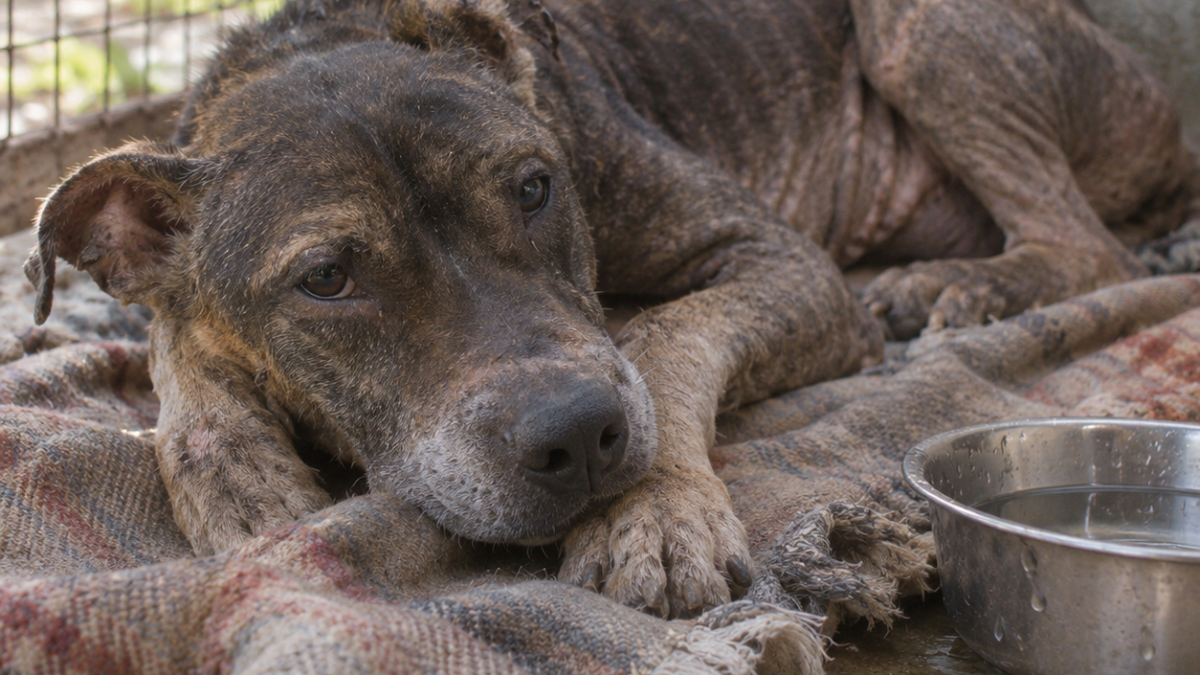
She didn’t run when I walked toward her, because by then Lolo barely had enough strength to lift her head.
A dirty rope still hung from her neck, every rib pressed against her skin, and when I placed food in front of her, her eyes wanted it long before her body could move.
I thought the most frightening question was whether she would survive the next few hours, but before this was over, I would learn that surviving was only the first battle.
My name is Emma, and I had been volunteering with a small rescue group for almost seven years when the call about Lolo came in.
It was just after six in the morning.
A sanitation worker had spotted a dog lying beside a drainage ditch behind an old commercial lot. At first, he thought she was dead. Then he saw one ear move.
By the time my partner, Daniel, and I arrived, the morning was already hot.
Lolo was lying beneath a concrete barrier where a narrow strip of shade crossed the dirt.
She didn’t bark.
She didn’t growl.
She didn’t try to hide.
That scared me immediately.
Even injured dogs usually react when strangers approach. Fear gives them energy. Adrenaline gives them one last reason to move.
Lolo simply watched me.
Or tried to.
Her eyes were sunken. Her muzzle looked dry. Her gums were pale.
A length of frayed rope hung from her neck and dragged across the dirt beside her.
“Hey, sweetheart.”
One ear moved.
I crouched several feet away.
Daniel whispered, “Look at her legs.”
I did.
A deep wound ran along the inside of her left hind leg. The surrounding skin was swollen and dark with infection. Flies circled constantly.
Her hip bones jutted upward.
Every rib showed.
I had seen underweight dogs before.
Lolo was beyond thin.
Her body had begun consuming itself.
I opened a can of soft food.
The smell reached her immediately.
Her nose moved.
Then her eyes fixed on the bowl.
For the first time, something like urgency appeared in her face.
I placed one spoonful on a small plate and slid it toward her.
Lolo tried to rise.
Her front legs trembled.
She lifted her chest maybe two inches.
Then collapsed.
Daniel swore under his breath.
I moved closer.
“It’s okay. Don’t get up.”
I pushed the food within reach.
Lolo stretched her neck.
Even that seemed exhausting.
Her tongue touched the food.
One lick.
Then another.
She swallowed.
Her whole body shuddered.
I wanted to give her everything in the can.
I wanted to watch her eat until the hunger disappeared.
But years in rescue had taught me something cruel.
When starvation becomes severe enough, feeding too much too fast can become dangerous.
So I gave her one small spoonful.
Then stopped.
Lolo looked at me.
That look nearly broke me.
She didn’t understand why food had appeared and then disappeared again.
“I know.”
Her eyes stayed on the can.
“I know, baby.”
Daniel checked her water response.
She tried to drink too quickly.
We slowed that too.
Everything had to be measured.
Everything careful.
Even kindness.
I examined the rope without pulling it.
There were old abrasions beneath it and a raw patch along one side of her neck.
“Was she tied somewhere?”
Daniel asked.
“Probably.”
“And chewed free?”
“Maybe.”
The end of the rope was frayed, but not cleanly.
Someone might have cut it.
Or it might have snapped.
We didn’t know.
At that moment, I didn’t care.
Finding whoever had abandoned her could come later.
If there was a later.
I slipped a blanket beneath her.
Lolo flinched so hard that her body curled inward.
“Easy.”
She looked toward my hands.
Not angry.
Terrified.
That told me more than the rope did.
Someone had taught her that hands could hurt.
Daniel and I lifted her together.
She weighed almost nothing.
As I carried her toward the van, Lolo’s head rested against my arm.
For one second, her eyes closed.
Then they opened again.
As if she was afraid that if she stopped watching, we might disappear.
I whispered the first promise I made to her.
“You don’t have to chase anybody anymore.”
Her paw moved weakly against the blanket.
“We’ve got you.”
I wanted to believe it.
But when we reached the veterinary hospital and Dr. Maya Chen took one look at Lolo, her expression told me everything I had been trying not to think.
Help had arrived.
The question was whether it had arrived in time.
PART 2
Two technicians rolled a stretcher toward us.
Dr. Maya Chen followed.
She had treated dozens of our rescue animals over the years, and I had learned to read her face.
Concern was normal.
Urgency was normal.
Silence was not.
When she saw Lolo, she stopped talking.
“Oh, sweetheart.”
That was all.
We placed Lolo on the stretcher.
She didn’t resist.
One technician reached for the rope.
Maya stopped her.
“Photograph it first.”
The technician nodded.
Maya looked at me.
“Any history?”
“None.”
“Owner?”
“Unknown.”
“Age?”
“Maybe four? Five? Hard to tell.”
“Has she eaten?”
“One spoonful.”
“Water?”
“A little.”
“Good. Nothing else yet.”
I already knew why.
Refeeding.
When a body has been starved severely enough, giving large amounts of food can cause dangerous shifts in electrolytes and metabolism.
The cruelest part of saving a starving animal is that you cannot simply let them eat.
You have to teach the body how to receive food again.
The Examination
Lolo’s weight was nineteen pounds.
Maya estimated she should have been closer to thirty-five.
Her body temperature was low despite the warm morning.
She was severely dehydrated.
Blood pressure weak.
Gums pale.
The wound on her hind leg had become infected and contained dead tissue.
Her neck showed signs of prolonged tethering.
The rope had rubbed deep enough in one area to create an ulcerated wound.
There were older scars underneath.
More than one.
“What does that mean?”
I asked.
Maya didn’t answer immediately.
“It could mean she’s been tethered before.”
“For how long?”
“I can’t tell.”
“Days?”
“Longer.”
“How much longer?”
“Emma.”
I knew that tone.
Stop asking questions medicine cannot answer.
Maya continued the exam.
Lolo’s nails were worn unevenly, as if she had spent long periods pacing over hard ground.
There were calluses at her elbows.
Her paw pads were cracked.
Several teeth were chipped.
Then Maya reached the infected leg.
Lolo screamed.
The sound shocked everyone.
Until then, she had barely made a noise.
Her entire body tried to twist away, but she didn’t have the strength.
Maya immediately stopped.
“Pain medication first.”
Lolo panted.
I put my hand near her face but didn’t touch.
“Sorry.”
Her eyes found mine.
That was the first time I understood how much pain she had been hiding.
The Bloodwork
The laboratory results were worse than we hoped.
Lolo was anemic.
Her protein levels were dangerously low.
Electrolytes were abnormal.
Markers suggested significant infection.
Her kidneys showed stress from dehydration.
“Is she septic?”
I asked.
“Possibly early sepsis.”
“Can you treat it?”
“We already are.”
“Can she survive?”
Maya removed her glasses.
Whenever she did that, I knew the answer would hurt.
“She is very fragile.”
“That isn’t what I asked.”
“I know.”
“Maya.”
She looked at me.
“If we had found her tomorrow, I would be more pessimistic.”
Tomorrow.
One more night.
Maybe that was all.
I thought about Lolo beneath the concrete barrier.
The sanitation worker almost driving past.
One ear moving.
A difference of seconds.
A difference of someone looking twice.
Food
At noon, Lolo received her second tiny meal.
A carefully formulated recovery diet.
One spoonful.
Then another after a measured interval.
She ate without chewing.
Maya slowed her.
“Easy.”
Lolo tried to follow the spoon.
Her eyes widened every time it moved away.
When the bowl was removed, she whimpered.
I had heard dogs cry from pain.
This was different.
It was panic.
“What if it doesn’t come back?”
That was what the sound seemed to say.
I sat beside her kennel.
“It comes back.”
She watched me.
“Food comes back now.”
She had no reason to believe me.
So we showed her.
Two hours later, another small meal.
Then another.
Then another.
Each time, the same panic.
Each time, the bowl returned.
Her First Night
Lolo’s fever climbed after sunset.
Her leg wound had to be flushed.
Maya removed dead tissue carefully.
The infection went deeper than expected.
There was concern that it might involve the underlying muscle.
Surgery would probably be necessary.
But not yet.
Lolo was too unstable.
We needed fluids.
Antibiotics.
Nutrition.
Time.
Time.
The one thing her body had almost run out of.
At eleven thirty, I left the clinic.
I made it to the parking lot.
Then went back inside.
Daniel was sitting in the waiting room with coffee.
“You went home?”
“No.”
“Me neither.”
We sat in silence.
At 1:17 a.m., Maya came out.
“She vomited.”
My stomach tightened.
“Why?”
“Could be gastrointestinal stress. Could be infection. Could be the refeeding process.”
“Is that bad?”
“Yes.”
I hated honest doctors.
“What now?”
“We slow feeding further. Repeat bloodwork.”
Lolo slept beneath warming blankets.
Her breathing looked shallow.
I sat outside the kennel.
At three in the morning, she opened her eyes.
I whispered:
“You’re still here.”
Her tail did not move.
Nothing dramatic happened.
But she stayed alive until sunrise.
That was enough.
Day Two
The second day was worse emotionally because we had started believing she might live.
Hope makes fear sharper.
Lolo stood once.
Not fully.
She pushed herself onto her front legs.
Her rear legs trembled.
Then she fell.
A technician caught her.
“That counts,” I said.
Maya looked at me.
“As what?”
“Standing.”
“She was upright for half a second.”
“Still counts.”
Maya almost smiled.
Later, Lolo ate four small meals without vomiting.
Bloodwork stabilized slightly.
Her kidney values improved.
Protein remained critically low.
The infection remained dangerous.
But she was moving in the right direction.
One inch.
One blood result.
One spoonful.
That was how we measured victory.
The Rope
Animal control collected the rope.
At first, I thought it wouldn’t matter.
A piece of filthy nylon rope.
Brown with dirt.
Frayed.
Ordinary.
Then an officer named Kevin called.
“Emma, do you remember exactly where you found her?”
I gave him the location.
“Why?”
“We found a knot at the end.”
“Okay.”
“It wasn’t chewed through.”
I sat straighter.
“What?”
“The rope was cut.”
“With what?”
“Blade or scissors, probably.”
My stomach tightened.
“So someone cut her loose?”
“Or cut her off something before abandoning her.”
That was worse.
If the rope had snapped, maybe Lolo had escaped.
If someone had cut it, then someone had handled that rope.
Someone had seen her body.
Seen her ribs.
Seen the infected wound.
And still left her.
The Lot
Kevin returned to the commercial lot.
There were several businesses nearby.
A plumbing supply warehouse.
A tire shop.
An abandoned furniture store.
A storage facility.
Most had cameras.
The sanitation worker had found Lolo behind the abandoned furniture store.
The nearest active camera belonged to the storage facility.
The manager agreed to review footage.
For three nights, nothing.
Then:
A white pickup.
2:14 a.m.
The truck entered the service alley.
Stopped.
Stayed nine minutes.
Then left.
The camera angle did not show what happened behind the barrier.
But another camera farther down the alley caught something.
At 2:26 a.m., after the truck was gone, a small dog emerged.
She walked three steps.
Collapsed.
Stood again.
Rope trailing behind her.
Lolo.
My hands went cold when Kevin showed me.
“Can you read the plate?”
“Partial.”
“How partial?”
“Enough to work with.”
The Truck
There were more white pickups in the county than anyone wanted to count.
But a partial plate plus make and model narrowed it.
Then came a break.
The sanitation worker had seen the truck before.
It belonged to a man who occasionally dumped construction debris behind the old furniture store.
His name was Gary Nolan.
He ran a small handyman business.
Animal control located his address.
He owned a white pickup.
Same model.
Similar plate.
The last two visible numbers matched.
Kevin called me.
“We’re going to talk to him.”
“Can I come?”
“No.”
“Why?”
“Because you’re angry.”
“I’m calm.”
“You called him a monster three minutes ago.”
“I said if he dumped Lolo, he was a monster.”
“Exactly.”
I hated when Kevin was reasonable.
Gary Nolan
Gary denied knowing Lolo.
He said he had been at the commercial lot that night because he was dropping scrap lumber in a dumpster.
At 2:14 in the morning.
He could not explain why.
He denied having a dog.
Then officers noticed a metal stake in his backyard.
A length of rope was tied to it.
Same color.
Same thickness.
That was not proof.
Rope is rope.
But then a neighbor came outside.
“Are you here about the brown dog?”
Kevin turned.
“What brown dog?”
The neighbor pointed at Gary’s yard.
“The skinny one. She used to stay back there.”
Gary’s face changed.
Her Name
The neighbor knew her as Lolo.
That was how we finally learned it.
“She was always friendly,” the neighbor said.
“How long did she live there?”
“Maybe three years.”
“Outside?”
“Mostly.”
“Did she get fed?”
“I guess.”
“You guess?”
The neighbor looked uncomfortable.
“I didn’t watch.”
“When did you last see her?”
“Week or two ago.”
“Condition?”
“Thin.”
“How thin?”
The neighbor stopped.
“You should’ve called.”
It wasn’t a question.
He looked away.
That became a recurring theme in Lolo’s case.
People had seen pieces.
No one had seen enough.
Or maybe no one wanted to.
Gary’s Story Changes
First, Gary had never seen Lolo.
Then she was “a stray that hung around.”
Then he admitted feeding her sometimes.
Then investigators found old veterinary paperwork in a trash bin behind his shed.
LOLO NOLAN.
Two years earlier.
Vaccination record.
Gary’s name.
Now she had been his dog.
His next story:
Lolo ran away.
When?
“About a month ago.”
The security footage showed his truck at the dumping location ten days earlier.
Story changed again.
He had found her “already injured” and drove her to the lot because he thought a rescue organization checked that area.
No rescue organization did.
“Why didn’t you call one?”
He said he had no phone.
Kevin looked at the smartphone in his pocket.
Gary stopped talking.
Lolo’s Third Day
While Gary lied, Lolo fought.
The third morning, she ate from a bowl for the first time instead of a spoon.
Still small portions.
Still monitored.
But a bowl.
She stared at it suspiciously.
Then ate.
When she finished, she licked the metal for almost a minute.
I hated that.
There was nothing left.
But she kept checking.
“More later.”
She looked at me.
“Promise.”
I started using that word carefully.
Animals do not understand promises.
But I did.
So I needed to keep them.
The Leg
Maya believed the leg wound required surgery.
There was dead tissue that antibiotics alone could not fix.
The infection had carved a cavity beneath the skin.
The good news:
No bone involvement.
The bad news:
Lolo still might not tolerate a long procedure.
“We keep it short,” Maya said.
“How short?”
“As short as medicine allows.”
“She survives?”
“That is the plan.”
I glared at her.
“I hate that sentence.”
“I know.”
Surgery
They took Lolo back at 10:03.
The operation lasted ninety-seven minutes.
Dead tissue removed.
Wound flushed.
Drain placed.
Maya managed to preserve the leg.
When she came out, she said:
“She did well.”
I did not trust myself to speak.
“Emma?”
“Yeah.”
“She did well.”
I hugged her.
She sighed.
“You all need boundaries.”
“No.”
The First Tail Wag
It happened that evening.
Daniel entered carrying chicken.
Not for Lolo.
For himself.
Lolo smelled it.
Her head lifted.
Daniel walked closer.
Her tail moved.
One tap.
He froze.
“Did you see that?”
“Do it again.”
“I didn’t do anything.”
“Walk out.”
“What?”
“Walk out and come back.”
“This is ridiculous.”
“Daniel.”
He left.
Came back.
Chicken in hand.
Tail.
Two taps.
I laughed.
Daniel looked offended.
“She likes the chicken.”
“She likes you.”
“Chicken.”
We never settled the argument.
The Evidence
Investigators obtained additional footage from a gas station near Gary’s house.
At 1:47 a.m. on the night Lolo was dumped, Gary’s truck stopped for fuel.
Camera angle:
Clear plate.
Driver:
Gary.
Something was visible in the truck bed.
A dog.
Lying down.
Rope attached.
The video was not graphic.
It did not need to be.
Gary had put a starving, injured dog in the back of his pickup.
Driven across town.
Then left her behind a commercial lot.
When confronted, he said:
“I thought somebody would find her.”
That sentence made me angrier than denial.
“You thought somebody would find her.”
As if abandonment became compassion because he picked a place where people might pass.
The Veterinary Records
The old paperwork led investigators to Gary’s former veterinary clinic.
They had not seen Lolo in two years.
The last appointment:
Routine vaccines.
Weight: thirty-four pounds.
Healthy body condition.
Photo attached.
A completely different dog.
Brown coat.
Bright eyes.
Full face.
Standing.
I stared at the image.
“That’s her?”
Kevin nodded.
I put the photograph beside the one from rescue.
Two years.
That was all.
Two years between healthy and almost dead.
Why
Gary’s ex-wife eventually provided context.
She had left the marriage eighteen months earlier.
She said Lolo had originally belonged to both of them.
“She slept inside.”
I stared.
“Inside?”
“Yes.”
“What changed?”
“Gary didn’t want the mess.”
“After you left?”
She nodded.
“Lolo started staying outside.”
“Did you know how bad she got?”
“No.”
“Why didn’t you take her?”
Gary had kept the house.
There had been an ugly separation.
She had moved to another state.
She said Gary told her Lolo had been rehomed.
She believed him.
When she saw the rescue photograph, she cried.
“I thought she was safe.”
That sentence broke something in me.
Rehomed
It is an easy word.
So clean.
So responsible.
Rehomed.
People use it when they mean:
I gave the animal to someone else.
Sometimes true.
Sometimes a lie that ends questions.
Gary had told his ex-wife Lolo was rehomed.
Then kept her outside.
Thin.
Tethered.
Injured.
And finally dumped.
Week One
One week after rescue, Lolo walked six steps.
I counted.
One.
Two.
Three.
Pause.
Four.
Five.
Six.
Then she sat down hard.
Her legs trembled.
I dropped to my knees.
“You did it.”
Maya stood nearby.
“Six steps is medically unimpressive.”
“You are medically unimpressive.”
Daniel laughed.
Lolo looked between us.
Tail tap.
Maya lost the argument.
The Rope Scar
Once the dirt was washed away and the swelling decreased, we could see old scars beneath Lolo’s neck.
Several lines.
Not all from the rope she was found with.
Repeated tethering.
Maybe years.
Gary claimed she preferred being tied outside because she “destroyed fences.”
No evidence supported that.
The neighbor said the rope was often short.
Sometimes Lolo could reach shade.
Sometimes not.
The Heat
Weather records showed temperatures above ninety degrees during several days before she was dumped.
No permanent shade structure in Gary’s yard.
No insulated shelter.
A plastic bowl.
A metal stake.
That was her world.
The prosecutor later used photographs.
I wish she hadn’t had to.
But she did.
Lolo Learns the Bowl Returns
The panic around food lasted weeks.
She guarded empty bowls.
Licked floors.
Tried to steal wrappers.
Once she swallowed part of a paper towel before we could stop her.
So we created a schedule.
Same times.
Same room.
Same bowl.
Small portions increasing gradually as her body stabilized.
Breakfast.
Snack.
Lunch.
Snack.
Dinner.
Each meal ended with the same phrase.
“All done. More later.”
At first, words meant nothing.
Then repetition gave them meaning.
One afternoon, Lolo finished eating.
She licked the bowl twice.
Then walked away.
I stared.
Daniel said:
“What?”
“She left.”
“So?”
“She left the bowl.”
He understood.
“Oh.”
Lolo climbed onto her bed.
She believed more food would come.
That was trust.
Her Bed
Lolo did not understand beds either.
The first orthopedic bed frightened her.
She circled it.
Sniffed.
Then slept beside it on the floor.
We put an old blanket on top.
She moved the blanket to the floor.
Fine.
We put the bed under the blanket.
She slept on the corner.
Progress.
Three days later, I came in and found her completely stretched across it.
Belly down.
Head hanging off one side.
One hind leg sticking out.
I took a photograph.
Daniel said:
“That is the least flattering photo ever.”
“It’s perfect.”
It was.
The Court Order
Animal control obtained temporary custody authorization.
Gary challenged it.
Of course he did.
Not because he wanted Lolo back, according to his attorney.
Because he claimed the seizure was “excessive.”
I sat in the hearing.
Gary’s lawyer said:
“Mr. Nolan did not intend harm.”
The prosecutor replied:
“Intent does not reverse starvation.”
The judge reviewed the photographs.
The medical report.
The video.
Temporary custody remained with the rescue.
Gary looked angry.
Not heartbroken.
Angry.
As if Lolo’s suffering had become an inconvenience to him.
The Threat
Two nights later, someone left a note on the rescue van.
DROP THE CASE.
No signature.
No proof.
We reported it.
Then Daniel noticed one of the tires had been cut.
Not punctured accidentally.
Cut.
The police took it seriously.
I did too.
Elena installed cameras.
We changed parking procedures.
I was furious.
“Is he trying to scare us?”
Kevin said:
“We don’t know who did it.”
“You think it’s random?”
“I think assumptions make bad evidence.”
Again with reason.
I hated reason.
Lolo Doesn’t Know About Revenge
That was the strange thing.
While humans argued about legal consequences, Lolo cared about simpler things.
Food.
Pain.
Sunlight.
Whether Daniel had chicken.
Whether her bed was warm.
Whether I returned when I left the room.
She did not know Gary might face charges.
She did not know people were angry for her.
She did not care.
Her world was becoming smaller in a good way.
Predictable.
Safe.
The First Bath
We waited until the wounds could tolerate it.
Warm water.
Gentle medicated shampoo.
No pressure near the neck.
Lolo hated the tub.
She tried to climb out.
Not much strength, but determination.
Daniel held a towel.
“Almost done.”
She gave him a look that could have killed.
I laughed.
“That’s personality.”
Afterward, we wrapped her in towels.
Her coat, once cleaned, was a rich reddish brown.
I had barely realized.
She looked at us from inside the towels.
Daniel said:
“She looks like an angry burrito.”
Lolo growled.
We laughed harder.
That growl was beautiful.
The Second Note
Another note arrived.
This time at Elena’s house.
She lived miles from the rescue.
YOU ARE RUINING A MAN’S LIFE OVER A DOG.
That changed everything.
The police examined nearby cameras.
One showed a dark SUV.
Another captured part of the plate.
Not Gary’s vehicle.
His brother’s.
The brother admitted delivering the note.
He claimed Gary asked him to “tell the rescue to back off.”
No admission about the slashed tire.
But the intimidation charge became part of the investigation.
Gary’s situation worsened because he could not stop making it worse.
The Plea Offer
Prosecutors offered Gary a deal.
Animal cruelty by neglect.
Abandonment.
Restitution.
Probation.
Animal ownership ban.
Some jail time.
He refused.
His reason?
He did not want the animal ownership ban.
I laughed when Kevin told me.
“He doesn’t even want Lolo.”
“Doesn’t matter.”
“What does he want?”
“To not be told he can’t.”
Control.
That was the word.
Foster Search
After six weeks, Lolo was medically stable enough to leave the clinic.
Not adoptable yet.
Too much rehabilitation.
We needed a foster.
Many people offered.
Not all were appropriate.
Some wanted the “famous rescue dog.”
No.
Some had energetic dogs.
No.
One family had toddlers.
Not yet.
Then came Sarah.
Forty-six.
Worked from home.
No pets.
Fenced yard.
Experience with fearful dogs.
She did not ask for photos.
She asked:
“What scares her?”
That was the right question.
Sarah Meets Lolo
Sarah sat on the floor.
No eye contact.
No reaching.
Lolo stayed near me.
Five minutes.
Ten.
Sarah talked to me about ordinary things.
Work.
Weather.
Her terrible attempt at gardening.
Lolo sniffed the air.
Fifteen minutes.
She took one step.
Sarah ignored her.
Twenty.
Another step.
Lolo sniffed Sarah’s shoe.
Sarah continued talking.
Perfect.
At thirty minutes, Lolo sat beside her.
Not touching.
But beside.
I looked at Daniel.
He nodded.
The Car Ride
Lolo trembled inside Sarah’s car.
She associated vehicles with something bad.
Maybe being dumped.
Maybe earlier experiences.
We didn’t know.
Sarah waited.
“Take your time.”
Lolo looked back at me.
That look hurt.
“You’re okay.”
I touched the car door.
“I’m coming to visit.”
Her eyes stayed on mine.
The car drove away.
I stood there far longer than necessary.
Daniel said:
“Come on.”
“I’m fine.”
“You’re crying.”
“I have dust in my eye.”
“We’re indoors.”
“Indoor dust.”
The First Night
Sarah sent updates.
7:10 p.m.
She ate half her dinner.
8:03.
She discovered the couch.
8:44.
She got off the couch when I moved.
9:12.
She keeps staring at the front door.
10:01.
She is asleep.
Photo.
Lolo curled on a blanket beside the couch.
Not on it.
Beside.
At 2:37 a.m.:
She came into my bedroom, checked I was here, and left.
I stared at that message.
Checked I was here.
Lolo had been abandoned once.
Maybe more than once.
Now she checked.
People still there?
Yes.
Go back to sleep.
The Yard
Sarah’s backyard became the hardest part.
The first time she opened the door, Lolo froze.
Rope.
Stake.
Outside.
Maybe those memories existed in her body even if we could never prove them.
Sarah did not pull.
She left the door open.
Sat on the step.
Lolo stayed inside.
Day two:
One paw outside.
Day three:
Two.
Day four:
All four.
Then back inside.
Day seven:
Lolo walked onto the grass.
Looked around.
Then immediately returned.
Sarah laughed.
“I’m still here.”
The next time, she stayed longer.
The First Zoom
Three months after rescue, Lolo ran.
It happened accidentally.
Sarah dropped a dish towel.
The towel blew across the yard.
Lolo chased it.
Ten feet.
Twenty.
Then she grabbed it.
Sarah screamed.
Lolo jumped.
Sarah apologized while laughing.
The video arrived in our group chat.
Daniel replied:
SHE STOLE THE TOWEL.
I replied:
SHE RAN.
Maya replied:
Please stop treating basic canine locomotion as a religious event.
I responded:
No.
Trial
Gary chose trial.
He should not have.
The evidence was stronger than his pride allowed him to understand.
Security footage.
Gas station video.
Veterinary records.
Neighbor statements.
His ex-wife.
The rope.
His changing stories.
The threat message delivered by his brother.
And Lolo’s medical condition.
I testified.
I described the morning we found her.
The food.
Her inability to lift her head.
The infected leg.
The rope.
The prosecutor asked:
“What did she do when you approached?”
“Nothing.”
“What do you mean?”
“She didn’t run.”
“Why not?”
I looked at Gary.
Then at the jury.
“Because she didn’t have enough strength left.”
Maya’s Testimony
Maya was devastating.
Calm.
Precise.
No emotion needed.
She explained severe malnutrition.
Dehydration.
Infection.
Refeeding risk.
The surgery.
“How long would it take a dog to reach this condition?”
The prosecutor asked.
“There is no single timeline.”
“Could this happen overnight?”
“No.”
“In a few days?”
“No.”
“Would a reasonable owner notice?”
“Yes.”
“Why?”
Maya looked toward the jury.
“Because you do not need veterinary training to notice that every rib is visible and your dog cannot stand.”
Gary’s attorney objected.
The judge overruled.
The Truck Video
They played the gas station footage.
Gary at the pump.
Truck bed.
Lolo lying there.
Rope visible.
Then the storage camera.
Truck entering the alley.
Truck leaving.
Lolo emerging later.
The courtroom was silent.
The prosecutor froze the frame.
Lolo collapsed behind the truck’s path.
Then she asked Gary:
“You thought somebody would find her?”
“Yes.”
“Why didn’t you bring her to a shelter?”
“I didn’t know where one was.”
“Did you have a smartphone?”
“Yes.”
“Did you search?”
“No.”
“Did you call animal control?”
“No.”
“Police?”
“No.”
“A veterinarian?”
“No.”
“Any rescue?”
“No.”
“What did you do?”
Gary stared at the table.
The prosecutor answered for him.
“You left.”
Verdict
Guilty.
Neglect.
Abandonment.
Failure to provide necessary care.
Additional charges connected to intimidation were handled separately.
The sentencing hearing came weeks later.
The judge referenced Lolo’s condition.
The conscious decision to transport her rather than seek care.
The false stories.
The attempt to interfere with the investigation.
Then came consequences.
Jail.
Probation.
Restitution.
Community service.
And a lengthy ban on owning or possessing animals.
Gary’s face changed at that part.
Exactly as Kevin predicted.
Control.
Gone.
The Restitution Number
The veterinary bill was enormous.
Thousands.
Hospitalization.
Surgery.
Medication.
Bloodwork.
Wound care.
Nutrition management.
Physical therapy.
The court ordered Gary to pay a substantial portion over time.
Daniel looked at the order.
“He wouldn’t pay for her food.”
“No.”
“Now he pays for the surgery.”
“Yep.”
He smiled.
I did too.
Not because money balanced suffering.
It never could.
But consequences mattered.
Lolo’s Revenge
People online called it revenge.
Gary dumped her.
Lolo survived.
His lies collapsed.
His truck became evidence.
His rope became evidence.
His own decisions became evidence.
There was satisfaction in that.
But Lolo did not know.
Her revenge was quieter.
She learned to sleep on Sarah’s couch.
She learned the refrigerator meant food.
She learned hands could touch her leg without causing pain.
She learned the backyard had an open door.
She learned a bowl could be empty without the world ending.
The Adoption Question
At seven months, Lolo was officially cleared for adoption.
I called Sarah.
“We need to talk.”
“No.”
I smiled.
“I haven’t said anything.”
“I know where this is going.”
“She’s ready.”
“No.”
“She’s medically stable.”
“No.”
“Sarah.”
“No.”
I waited.
She sighed.
“Do you already have applicants?”
“Two strong ones.”
Silence.
“That’s good.”
“Very.”
Longer silence.
“Would they keep her routine?”
“Yes.”
“Same food?”
“Yes.”
“No neck collar?”
“Yes.”
“Quiet home?”
“Yes.”
Sarah started crying.
I didn’t say anything.
Finally:
“Send me the adoption paperwork.”
I smiled.
“You want to apply?”
“I hate you.”
“Understood.”
Lolo Becomes Sarah’s
The adoption was almost insultingly simple after everything else.
Signatures.
Microchip update.
Fee waived because Sarah had already spent months buying half the rescue supply aisle.
Sarah signed.
Lolo sat under the desk.
I stamped the paperwork.
“That’s it.”
Sarah stared.
“That’s it?”
“That’s it.”
“I expected something dramatic.”
I looked down at Lolo.
“You’ve had enough drama.”
Sarah knelt.
“Come on, baby.”
Lolo stood.
Walked toward her.
Then stopped.
Came back to me.
Pressed her head against my knee.
I froze.
Sarah smiled through tears.
“She’s saying goodbye.”
“No, she isn’t.”
Lolo stayed for several seconds.
Then turned.
Went to Sarah.
I cried all the way home.
First Anniversary
One year after the rescue, Sarah brought Lolo back to visit.
I knew she was coming.
Still, when she walked through the door, I stopped breathing.
She had gained fourteen pounds.
Healthy weight.
Muscle.
Shiny coat.
The leg scar remained.
The neck scar remained.
But her eyes were bright.
Her tail moved constantly.
“Lolo?”
She recognized my voice.
Then ran.
Actually ran.
Straight into me.
I fell backward.
Daniel shouted:
“Watch the leg!”
Too late.
Lolo climbed onto my chest and licked my face.
I laughed.
“You remember me.”
Sarah said:
“She remembers everything food-related. You were the first meal.”
“That is insulting.”
“Accurate.”
Her First Beach
Sarah took Lolo to the coast the following summer.
Quiet beach.
Early morning.
Long training line attached to a harness.
No collar.
Lolo saw the ocean.
Stopped.
Wave came in.
She backed away.
Another wave.
She barked.
Sarah laughed.
Then Lolo chased the water.
For fifteen minutes, she ran along the edge.
The video made me cry.
Of course.
The dog who couldn’t lift her head to eat now racing the ocean.
Gary Writes
Two years after sentencing, a letter arrived at the rescue.
Gary.
He said he was sorry.
Sort of.
He wrote:
I never meant for her to get that bad.
I stared at the sentence.
Elena asked:
“Want to respond?”
“No.”
Then I changed my mind.
I wrote one line.
Intent did not feed her.
I did not send it.
It was for me.
We did not respond at all.
Lolo’s life no longer belonged inside his apology.
Sarah’s Neighbor
A new neighbor moved next door.
He had a large dog.
The dog barked through the fence.
Lolo panicked.
Old fear.
Sarah brought her inside.
Next day, she worked farther from the fence.
Treats.
Distance.
Choice.
Weeks passed.
Eventually, Lolo could be outside while the neighboring dog barked.
Not relaxed.
But functional.
Healing is not becoming fearless.
Sometimes it is learning fear does not make every decision.
The Rope Problem
Lolo never tolerated ropes.
Not leashes.
Actual rope.
One day, Sarah bought a rope toy without thinking.
She placed it on the floor.
Lolo froze.
Tail tucked.
Sarah immediately removed it.
She called me.
“I feel horrible.”
“Don’t.”
“I should’ve known.”
“You know now.”
We never tested her again.
There was nothing to prove.
Lolo did not need to conquer rope.
She needed a life without it.
Daniel Admits He Cried
Three years after rescue, we attended a fundraising dinner.
A photograph of Lolo appeared in a slideshow.
Before.
Then after.
Daniel looked away.
I whispered:
“You’re crying.”
“No.”
“You are.”
“Lighting.”
“In a dark room?”
“Bad lighting.”
Later, after two glasses of wine, he admitted:
“Fine. I cried that first day.”
“I knew.”
“She looked dead.”
“I know.”
“And then the chicken tail wag…”
“I know.”
He pointed at me.
“Never tell anyone.”
Naturally, I told everyone.
Lolo Gets Gray
Time passed.
The best kind.
Boring time.
Lolo’s muzzle grayed.
Her runs became shorter.
She became obsessed with blankets.
She hated rain.
Loved roasted chicken.
Refused carrots.
Stole bread once from a counter and hid the bag under Sarah’s bed.
A dog who had nearly starved became a food thief.
I considered that progress.
Her Leg
The old infected leg developed arthritis earlier than the others.
Maya expected it.
Medication helped.
Physical therapy helped.
Swimming helped.
Lolo hated swimming.
“She looks betrayed,” I said.
Sarah held her in the therapy pool.
“She is betrayed.”
Lolo glared.
Afterward, she walked better.
Worth it.
Maybe.
Lolo disagreed.
The Old Lot
Five years after her rescue, the abandoned furniture store was demolished.
The commercial lot changed ownership.
New buildings went up.
Sarah asked if I wanted to take Lolo there.
I hesitated.
“Why?”
“I don’t know.”
We decided not to.
Lolo did not need to revisit the place where she was left.
Humans like symbolic closure.
Dogs often prefer chicken.
We chose chicken.
Gary’s Release
Gary completed the jail portion of his sentence.
Probation continued.
The ownership ban remained.
Someone sent me a news clipping about his release.
I deleted it.
That surprised me.
Years earlier, I would have read every word.
Now?
Lolo had a vet appointment.
A joint supplement.
A birthday.
Gary had become irrelevant.
That was better than revenge.
Lolo’s Eighth Birthday With Sarah
Her true birthday was unknown.
So Sarah used rescue day.
Every year:
Chicken.
New blanket.
No party hats.
Lolo hated hats.
At eight years after rescue, she was probably twelve or thirteen.
She walked slowly.
Still demanded breakfast at 6:30.
Still inspected every grocery bag.
Still checked the front door when Sarah left.
But no longer panicked.
Sarah always came back.
When Sarah Was Late
One winter evening, Sarah’s car broke down.
She was three hours late.
A neighbor fed Lolo.
Lolo paced.
Then lay at the door.
Sarah arrived near midnight.
The neighbor opened the door.
Lolo ran.
Not young-dog fast.
Old-dog desperate.
She pressed against Sarah’s legs.
Sarah sat on the floor.
“I’m sorry.”
Lolo licked her face.
“I came back.”
That phrase had become their promise.
I came back.
The Diagnosis
At approximately fourteen, Lolo’s bloodwork changed.
Kidney disease.
Early.
Manageable.
Diet.
Medication.
Monitoring.
Sarah called me from the clinic.
“I’m scared.”
“I know.”
“She already lost so much time.”
“She gained a lot too.”
“It isn’t enough.”
“No amount is.”
Silence.
Then:
“I want more.”
“So do I.”
More
We got more.
Eighteen months.
Good months.
Slow walks.
Blankets.
Chicken.
Sunlight.
A ridiculous stroller Sarah bought when Lolo could no longer walk long distances.
I laughed.
“You bought a stroller.”
“She likes the park.”
“You said people who put dogs in strollers were ridiculous.”
“I was young and ignorant.”
Lolo sat inside like royalty.
One Last Rescue Event
Lolo attended our annual event in her stroller.
People recognized her photograph.
A little girl asked:
“Is that the dog who was starving?”
Sarah crouched.
“She used to be.”
The girl looked at Lolo.
“She looks fat.”
Sarah laughed.
“Healthy.”
The girl offered a treat.
Lolo took it gently.
The girl smiled.
“She’s not sad.”
That sentence stayed with me.
She’s not sad.
We spend so much time defining rescued animals by what happened to them.
Lolo had become something else.
Old.
Spoiled.
Loved.
Hungry for treats instead of survival.
The Last Winter
The kidney disease worsened.
So did arthritis.
Then Lolo stopped eating breakfast.
That frightened us more than any lab number.
Lolo never skipped breakfast.
Sarah called Maya.
Fluids.
Medication adjustment.
She improved for a week.
Then stopped again.
Maya examined her.
The conversation was quiet.
I had heard versions of it many times.
Quality of life.
Pain.
Nausea.
Good days.
Bad days.
Sarah cried.
“I promised she would never be hungry again.”
Maya held her hand.
“You kept that promise.”
“What if she wants food and can’t eat?”
“She doesn’t.”
That was the difference.
Once, Lolo desperately wanted food but lacked strength.
Now her body was simply tired.
One More Chicken Dinner
On her last good evening, Sarah cooked chicken.
No bland prescription food.
No measuring.
No worrying about perfect kidney diet.
Just chicken.
Lolo smelled it.
Raised her head.
Sarah smiled.
“You want some?”
Lolo ate three small pieces.
Slowly.
Then stopped.
Sarah offered another.
Lolo turned away.
For years, we had dreamed of the day she could choose when she had enough.
Now Sarah honored it.
“Okay.”
No forcing.
No panic.
Enough.
The Call
Sarah called me the next morning.
“Today.”
One word.
I understood.
Daniel came.
Maya came to the house.
Elena came.
No crowd.
Lolo lay on her favorite blanket near the back door.
Open.
Sunlight coming in.
Her harness removed.
Nothing around her neck.
That mattered.
The Rope
Sarah still had the first harness Lolo ever wore.
Blue.
She placed it beside the blanket.
No collar.
Never a collar.
I looked at the faint scar around Lolo’s neck.
Hair had grown over much of it.
But I could still see the line.
I touched beside it.
Not directly.
“Remember when we found you?”
Lolo opened her eyes.
Tail moved once.
Daniel said:
“She remembers the chicken.”
“Probably.”
What Sarah Said
Sarah lay on the floor.
Face near Lolo’s.
“You were never hard to love.”
Her voice broke.
“You know that?”
Lolo breathed slowly.
“You were never too much.”
Another breath.
“You were never a burden.”
Sarah cried into the blanket.
“And you never deserved what they did.”
I looked away.
Then Sarah whispered the most important sentence.
“You never have to be hungry again.”
Goodbye
Maya gave the first medication.
Lolo relaxed.
Her head settled against Sarah’s arm.
I placed one hand on her back.
Daniel touched her paw.
No one spoke for a while.
Then I whispered:
“You stood again.”
Her breathing slowed.
“You ran.”
Another breath.
“You stole bread.”
Sarah laughed through tears.
“You got fat enough for someone to call you fat.”
Daniel laughed.
Maya cried.
Lolo’s last breath came quietly.
No rope.
No concrete.
No drainage ditch.
No empty stomach.
Home.
After Lolo
Sarah kept the blanket.
I kept the first rescue photograph.
Not because I liked it.
Because sometimes I needed to remember the distance between almost dead and deeply loved.
Daniel kept nothing.
Then I discovered he had saved the tail-wag video.
Liar.
Gary
Gary eventually completed probation.
The animal ownership ban expired years later.
I do not know whether he ever got another dog.
I hope not.
But Lolo’s story stopped being about him long before that.
That is important.
Abusers should not remain the center of the lives they harmed.
The ending belonged to Lolo.
The Real Revenge
People still call what happened revenge.
Gary abandoned her to die.
Then cameras exposed him.
Neighbors testified.
His own truck placed him at the scene.
His lies contradicted each other.
The court convicted him.
He paid.
He lost the right to own animals for years.
Yes.
That was justice.
But Lolo’s real revenge was far more complete.
She lived.
Not for a week.
Not for a month.
For years.
Long enough to become old.
Long enough to develop gray fur.
Long enough to need arthritis medicine.
Long enough to hate swimming.
Long enough to ride in a ridiculous stroller.
Long enough to learn that an empty bowl did not mean starvation.
Long enough to leave food uneaten.
Long enough to be late for breakfast because she was sleeping comfortably.
Long enough to become ordinary.
That was victory.
The Fund
After Lolo died, Sarah donated money to create a small emergency fund for starvation cases.
She named it:
LOLO’S SECOND BOWL.
The idea came from something she once said.
“The first bowl saves the body. The second bowl teaches them there will be another.”
I loved that.
The fund pays for emergency nutritional support, bloodwork, hospitalization, and treatment for severely neglected animals.
The first dog it helped was a shepherd mix named Cooper.
He survived.
Then a hound.
Then a senior pit bull.
Then three puppies.
Lolo never met them.
Still, they ate because she had once been hungry.
The Photograph
The rescue uses one photograph of Lolo for the fund.
Not the terrible before picture.
Not ribs.
Not wounds.
Not rope.
Lolo is sitting in Sarah’s backyard.
Healthy.
A little gray.
Mouth open.
Sunlight on her coat.
There is a bowl beside her.
Food still inside.
That matters.
The Bowl
Whenever I tell new volunteers Lolo’s story, I focus on the bowl.
They expect the dramatic parts.
The abandonment.
The rope.
The surgery.
The trial.
I tell them those too.
But then I explain the real milestone.
The day Lolo walked away from unfinished food.
Because starvation is not only physical.
It changes the way an animal thinks.
Food becomes emergency.
Every crumb now.
Nothing can be trusted later.
The first time Lolo left food, she was saying something with her body:
I believe there will be more.
That was the day safety became real.
A Young Volunteer Asked Me
“Did she forgive him?”
Gary.
I stared at the volunteer.
“Dogs don’t think about forgiveness the way we do.”
“Did she remember?”
“Probably some things.”
“Was she scared forever?”
“No.”
“Then what happened to the fear?”
I thought about it.
“It got crowded out.”
“By what?”
“Other experiences.”
Breakfast.
Sarah coming home.
Chicken.
Beds.
Walks.
Open doors.
Years.
Fear was no longer the only thing Lolo knew.
The Place We Found Her
I returned once.
Years later.
The concrete barrier was gone.
The drainage ditch had been repaired.
The old furniture store was a warehouse for home appliances.
I stood near the place where Lolo had been lying.
Nothing marked it.
No plaque.
No sign.
Cars passed.
Workers carried boxes.
Life moved.
For a moment, I felt angry.
How could a place where something so terrible happened look ordinary?
Then I realized:
Good.
Lolo was not there anymore.
That place did not deserve a monument.
Her backyard with Sarah did.
Sarah Plants a Tree
Sarah planted a dogwood where Lolo liked to lie.
Under it, a small stone.
LOLO
SHE GOT UP.
I stared at the inscription.
“Of all the things you could write…”
Sarah smiled.
“That was the question, remember?”
“What?”
“Would she ever stand again?”
I remembered.
That first week.
Would Lolo stand?
Would help be enough?
Would she survive?
She stood.
Then walked.
Then ran.
Then grew old.
The inscription was perfect.
The First Step
Sometimes memory edits pain.
Makes it cleaner.
Simpler.
But I still remember Lolo’s first real walk at the clinic.
Nine steps that day.
Not six.
Nine.
She moved from the treatment room to the hallway.
I walked backward with chicken.
“Come on.”
One paw.
Then another.
Her leg bandaged.
Neck scar fresh.
Ribs still visible.
She stopped after four.
I crouched.
“No pressure.”
Lolo stared at the chicken.
Five.
Six.
Seven.
Then she looked at me.
Eight.
Nine.
Sat down.
Everyone cheered.
Lolo looked confused.
She only wanted chicken.
Maybe that is the secret of survival.
You do not have to understand the whole future.
Just want something one step away.
What We Couldn’t Give Back
We could not give Lolo the time she lost.
Could not undo hunger.
Could not erase fear.
Could not make Gary choose differently.
Could not remove every scar.
Rescue does not restore the past.
It creates a different future.
That is enough.
It has to be.
Years Later
I still work with the rescue.
Not as much field work.
My knees have opinions now.
Daniel runs transport coordination.
Maya pretends she will retire and never does.
Sarah volunteers twice a month.
Usually with senior dogs.
She says puppies are exhausting.
The Second Bowl fund continues.
Every time it pays for another starving dog’s care, I think of Lolo staring at that first spoonful.
Wanting it.
Unable to lift her head.
The New Dog
Last spring, we received a call about a dog found tied near a park.
Young.
Thin.
Not as bad as Lolo.
Someone had noticed quickly.
That matters.
The dog ate under veterinary supervision.
Recovered.
No surgery.
No trial.
No viral story.
Just a dog helped early.
That is the outcome I prefer.
Rescue stories should not have to become tragedies before people care.
What I Tell People Now
If you see something wrong, you do not need to solve it yourself.
Call.
Document.
Ask for help.
Do not wait for ribs to show.
Do not wait for infection.
Do not wait for collapse.
Do not wait until a dog is too weak to run.
Lolo’s story had a beautiful ending.
It should never have needed one.
Epilogue
The last time I visited Sarah’s house, the dogwood tree was flowering.
We sat beneath it.
No dog beside us.
That still felt strange.
Sarah brought coffee.
I looked at the stone.
SHE GOT UP.
“You ever think about the first day?”
“All the time,” she said.
“You weren’t there.”
“I’ve heard you tell it enough.”
I smiled.
She looked toward the house.
“I think about her first night here.”
“What happened?”
“Nothing.”
“That’s your memory?”
“Yes.”
She smiled.
“She ate. She walked around. She checked the front door about fifteen times. Then she slept.”
“Sounds exciting.”
“It was.”
I understood.
Ordinary can be sacred after suffering.
Sarah continued.
“I woke at three in the morning. She was standing beside the bed.”
“Scared?”
“Maybe.”
“What did you do?”
“I touched the mattress.”
“And?”
“She put her head there.”
Sarah looked down.
“She didn’t climb up. She just rested her head against the bed and fell asleep standing.”
My chest tightened.
“I didn’t know that.”
“I never told you.”
“Why?”
She shrugged.
“It felt like ours.”
We sat quietly.
Then she said:
“The next night, she climbed onto the bed.”
Of course she did.
The Ending I Choose
If I had to choose one image to end Lolo’s story, it would not be the day we found her.
Not the rope.
Not the ribs.
Not the infected wound.
Not Gary in court.
Not the verdict.
Not even her final day.
I would choose a morning several years after rescue.
Sarah sent me the photograph at 7:04.
Lolo was asleep on the couch.
Upside down.
Belly exposed.
One paw hanging over the edge.
A half-finished bowl of food sat nearby.
Sunlight crossed the floor.
Nothing else.
A dog asleep.
Safe enough to expose her stomach.
Full enough to leave breakfast.
Certain enough that when she opened her eyes, Sarah would still be there.
That photograph told me everything.
When we first found Lolo, I kept asking whether help had come too late.
I know the answer now.
It came far later than it should have.
But not too late.
Not too late for nine steps down a clinic hallway.
Not too late for grass beneath her paws.
Not too late for a couch.
Not too late for chicken.
Not too late for a beach.
Not too late for gray fur.
Not too late for an old dog’s slow walk in the sun.
Not too late for a woman named Sarah to become home.
Not too late for breakfast to stop being an emergency.
Not too late for Lolo to learn the most important lesson starvation had stolen from her:
There would be another meal.
There would be another morning.
Someone would come back.
She had been abandoned with a rope hanging from her neck, too weak to run and almost too weak to eat.
Years later, she left this world with no rope, no empty stomach, and no doubt about where she belonged.
Gary had left her beside a ditch because he thought her life was no longer worth the trouble.
He was wrong.
The court told him that.
The rescue told him that.
Sarah told him that without ever speaking to him.
But Lolo proved it best.
She got up.
She ate.
She healed.
She ran.
She grew old.
And she became so loved that when she finally stopped standing, there were people beside her wishing they could give her just one more day.
That is the ending I choose.
Not the day someone abandoned Lolo.
The day she finally understood no one was going to abandon her again.








