PART 2: She Was Too Hungry to Lift Her Head—Then I Learned Why She’d Been Locked in That Cage
PART 2
“I’m taking her home.”
The words came out before I had completely worked out how I was going to make them happen.
The veterinary technician standing across the room looked at me.
“Taking her home for the night?”
I shook my head.
“No.”
Chelsea was still sitting in my lap, one front paw resting against my wrist.
“I mean home.”
The technician stared at me for about two seconds before a smile spread across her face.
“You’re adopting her?”
“I think I already did.”
I looked down at Chelsea.
She sneezed.
Then she grabbed the sleeve of my sweatshirt with her tiny teeth and started tugging.
The technician laughed.
“Apparently she agrees.”
I laughed too, but I could feel tears coming.
I turned my face away.
I had promised myself years earlier that I would never make emotional decisions in rescue.
That sounds cold until you understand why.
You cannot take every animal home.
If you try, eventually you stop being able to help any of them.
You learn to build boundaries.
You learn to love an animal while accepting that another family will become their family.
You learn how to say goodbye.
Chelsea had somehow slipped through every boundary I had built.
Maybe because she never asked for anything.
She had not cried for attention.
She had not thrown herself against her enclosure.
She had not tried to make us love her.
She had simply stepped out of a miserable little cage and behaved as if the world might still contain something good.
That broke me.
There were practical things to handle before I could take her.
Paperwork.
Vaccinations.
Medication.
Feeding instructions.
A follow-up veterinary appointment.
The veterinarian, Dr. Mercer, sat with me that afternoon and explained everything carefully.
“She’s improving,” she said. “But don’t let the energy fool you. She’s still significantly underweight.”
“How long before she’s normal?”
Dr. Mercer leaned back in her chair.
“That depends on what you mean by normal.”
I looked at her.
She continued.
“Physically? We may see dramatic improvement over the next few months. Emotionally? She might surprise you. Dogs are resilient. But food insecurity can leave behaviors behind. Confinement can too.”
“What should I watch for?”
“Guarding food. Panic when left alone. Fear of cages. Fear of certain objects or sounds. She may regress for reasons you don’t understand.”
I nodded.
“And if she does?”
“You don’t punish fear.”
Her answer came immediately.
“You show her that whatever she thinks is about to happen isn’t going to happen anymore.”
I wrote that sentence down.
At the time, I thought it was veterinary advice.
Later, I understood it was the entire job.
The day I brought Chelsea home, I put a clean blanket on the passenger seat.
I had a crate in the back because that was technically the safest way to transport her, but after what she had survived, I couldn’t bring myself to shut her behind another door that first day.
So I secured her safely beside me with a harness system and drove slowly.
For the first ten minutes, she stood stiffly.
Every passing truck made her duck.
Every sharp sound made her ears move.
Then something changed.
She lifted her nose.
The window was open just enough to let fresh air into the car.
Chelsea smelled it.
Really smelled it.
Her nose began twitching.
She looked toward the glass.
Trees moved past us.
Sunlight flickered across her face.
She had probably seen roads before.
She had probably been in vehicles.
But watching her that afternoon felt like watching someone discover movement itself.
I reached over and touched her gently.
“You’re going home, little girl.”
She looked at me.
I know dogs don’t understand sentences the way we do.
But I swear something in her expression softened.
When we reached my house, I did not bring my other dogs outside immediately.
I wanted introductions to happen calmly.
Chelsea had already experienced enough chaos.
My oldest dog, Murphy, was eleven.
He was a large, patient mixed breed who had reached the stage of life where almost nothing impressed him.
My second dog, Rosie, was six and believed every visitor existed exclusively to entertain her.
I introduced them one at a time.
Murphy approached first.
Chelsea froze.
Murphy sniffed her.
Chelsea sniffed him.
Then Murphy turned away, walked to the porch, and lay down.
That was his entire evaluation.
“You passed,” I told Chelsea.
Rosie was different.
Rosie came around the corner like a hurricane.
I caught her harness.
“Easy.”
Her tail slammed against my leg.
Chelsea backed up.
Rosie lowered herself into a play bow.
For three seconds, neither dog moved.
Then Chelsea made the smallest bounce forward.
Rosie bounced backward.
Chelsea did it again.
Five minutes later, they were running in crooked circles around the yard.
Chelsea did not have much endurance.
After only a few laps, she stopped and stood panting.
Rosie stopped too.
She walked back and touched her nose to Chelsea’s cheek.
I felt my throat tighten.
That first evening, Chelsea explored every room.
She inspected the couch.
She inspected the kitchen.
She inspected the hallway.
She stood in front of a mirror and barked at herself.
Then she discovered the dog beds.
There were three of them.
She walked to the smallest one.
Stepped inside.
Turned around twice.
Then froze.
She looked at me.
I had seen that expression before.
It was the same expression she had given me beside the food bowl.
Suspicion.
Could this really be hers?
“It’s okay,” I said.
She lowered herself slowly.
For the first few minutes, her head remained upright.
Then her chin touched the blanket.
Her eyes closed.
I sat across the room watching her sleep.
I should have felt happy.
Instead, I felt furious.
Because safety looked so ordinary.
A blanket.
A bowl of water.
A quiet room.
A person nearby.
Things that cost almost nothing.
Things that required no special knowledge.
And somebody had denied her even that.
The anger surprised me.
Rescue work teaches you to focus on what is in front of you.
The animal needs treatment.
The animal needs food.
The animal needs housing.
You cannot repair yesterday.
But looking at Chelsea asleep that night, I wanted someone to answer for yesterday.
I wanted to know who had put her in that cage.
I wanted to know how long she had been there.
Most of all, I wanted to know whether there were other animals.
The next morning, I called the officer who had assisted with the rescue.
His name was Daniel Ruiz.
“Any update on the property?” I asked.
There was a pause.
“We’re working on it.”
“That means something happened.”
Another pause.
“Where’s Chelsea?”
“At my house.”
“You adopted her?”
“Yes.”
For the first time in the conversation, he sounded amused.
“I figured you would.”
“Daniel.”
“I know.”
His tone changed.
“We went back.”
I stood up from my kitchen table.
“And?”
“The property owner wasn’t there. We made contact later.”
“Were there other dogs?”
“One.”
My stomach dropped.
“What condition?”
“Better than Chelsea. Still not acceptable.”
“Where is it?”
“Safe.”
I closed my eyes.
“Thank God.”
Daniel continued.
“We’re documenting everything.”
“Is somebody being charged?”
“I can’t tell you what will happen yet.”
“You know what happened to her.”
“I know what we found.”
“That dog was starving.”
“I know.”
I realized I was gripping the phone so tightly that my hand hurt.
From the living room, I could hear Chelsea and Rosie moving around.
“Please don’t let this disappear,” I said.
Daniel’s voice became quieter.
“It won’t.”
For the next several weeks, Chelsea’s world became bigger.
At first, our walks were only to the end of the driveway.
She would move confidently until something frightened her.
A trash can lid slamming.
A motorcycle.
A man carrying a rake.
Then she would flatten herself against the ground.
The first time it happened, I reached down automatically.
She flinched away.
That movement stopped me.
I remembered Dr. Mercer’s words.
You don’t punish fear.
You show her that whatever she thinks is about to happen isn’t going to happen anymore.
So I sat down on the curb.
Chelsea stared at me.
I didn’t pull her leash.
I didn’t coax her.
I just waited.
Eventually, her body loosened.
She came closer.
We walked home.
The next day we went five feet farther.
Then ten.
Then half a block.
Progress with Chelsea did not happen in dramatic transformations.
It happened in inches.
She stopped checking over her shoulder while eating.
She learned that water bowls remained full.
She began sleeping on her side instead of curled tightly into herself.
She learned that hands could reach toward her without hurting.
And slowly, her body changed.
Her ribs became less visible.
Her coat began growing back.
The irritated skin healed.
Her eyes brightened.
She gained enough strength to chase Rosie around the yard without stopping after two minutes.
She also developed opinions.
Strong opinions.
Chelsea hated rain.
She loved chicken.
She believed socks were communal property.
She became personally offended when Murphy occupied the sunny spot near the back door.
And she discovered my bed.
I had planned to establish rules.
Chelsea had other plans.
The first night she jumped onto my mattress, I pointed toward the floor.
“No.”
Chelsea stared at me.
“Dog bed.”
She continued staring.
I pointed again.
She sat down.
“That’s not what I meant.”
Chelsea slowly lowered herself onto my pillow.
I lost the argument.
By the end of the month, I was waking up every morning with approximately six inches of mattress while a twelve-pound dog slept diagonally across the rest.
I did not care.
Then one afternoon, Daniel called.
“We filed charges.”
I stopped walking.
I was outside the grocery store.
“What charges?”
“Animal cruelty and neglect.”
“Against the owner?”
“Yes.”
“What about the second dog?”
“Already placed with rescue.”
I leaned against my car.
“What happens now?”
“There will be a hearing.”
“Can I come?”
“You can.”
“I’m coming.”
There was silence.
Then Daniel said, “I thought you might.”
The court date was several weeks away.
During that time, we learned more.
Some details came through official channels.
Others came from neighbors who finally started talking once they realized authorities were involved.
Chelsea had apparently belonged to a woman named Patricia Harlan.
Patricia lived on a small property outside town.
According to neighbors, she had once owned several dogs.
At different times, people had heard barking from sheds behind the house.
One neighbor said he had complained months earlier about animals being left outside.
Another said he had seen cages but assumed the dogs were being temporarily contained.
Nobody had understood the full situation.
That sentence bothered me.
Nobody had understood.
It is one of those phrases that can mean almost anything.
Sometimes it means people truly did not know.
Sometimes it means people saw pieces and never put them together.
And sometimes it means everyone waited for somebody else to act.
I was not interested in blaming neighbors.
The responsibility belonged to the person who owned those animals.
Still, I kept thinking about how suffering can exist in plain sight when everyone sees only one fragment.
A bark.
A cage.
A thin dog glimpsed through a fence.
Chelsea could not call anyone.
She could not explain what was happening.
Her entire life depended on a human being noticing enough to ask another question.
The week before the hearing, Chelsea had another veterinary examination.
Dr. Mercer weighed her.
“Fourteen pounds.”
I smiled.
She had gained almost four.
“Is that good?”
“That’s very good.”
Chelsea was standing on the examination table, attempting to steal a tongue depressor.
Dr. Mercer took it away.
“She’s certainly feeling better.”
“She acts like she owns my house.”
“Technically, she probably does.”
I laughed.
Then Dr. Mercer became serious.
“I prepared the medical report for the case.”
My smile faded.
“How bad was she?”
“You saw her.”
“I know what I saw.”
I hesitated.
“I’m asking what you think would have happened if she had stayed there.”
Dr. Mercer did not answer immediately.
That was enough.
“Tell me.”
“She could have died.”
The room seemed suddenly too quiet.
“From starvation?”
“Malnutrition, dehydration, infection, complications from untreated conditions. There wasn’t one single risk.”
I looked at Chelsea.
She had stopped trying to steal instruments and was sniffing my sleeve.
“How close?”
“I can’t give you a precise timeline.”
“Days?”
“I don’t know.”
“Weeks?”
“I don’t know.”
Dr. Mercer touched my arm.
“What matters is that she didn’t.”
I nodded.
But on the drive home, I cried.
Not loudly.
Not dramatically.
Tears simply ran down my face while Chelsea slept in the passenger seat.
At a red light, I looked at her.
She was wearing a little blue harness.
Her coat had begun growing back soft and clean.
Her stomach was full.
She had spent that morning stealing Murphy’s toy.
She had no idea how narrowly her story might have ended somewhere else.
That night, I sat on the kitchen floor and let her climb into my lap.
“You almost didn’t get this,” I whispered.
Chelsea licked my chin.
“You almost didn’t get any of this.”
She licked me again.
I held her tighter.
The hearing took place on a gray Tuesday morning.
I left Chelsea at home.
Part of me wanted to bring her.
I wanted Patricia Harlan to see what she had done.
I wanted her to see Chelsea healthy.
I wanted her to understand that the miserable dog she had left behind was not disposable.
But court was not a place for Chelsea.
Chelsea had already given enough to the case.
Her body had been evidence.
She did not need to be evidence anymore.
The courtroom was smaller than I expected.
Daniel was there.
Dr. Mercer was there.
An animal control supervisor sat near the prosecutor.
Patricia entered with an attorney.
I had never seen her before.
She looked ordinary.
That unsettled me.
I think people expect cruelty to announce itself.
We imagine monsters should look like monsters.
They rarely do.
Patricia looked like someone you might stand behind at a pharmacy.
Someone you might pass in the produce aisle.
Someone who could ask you what time the store closed.
I watched her sit down.
For a moment, anger rose through me so quickly that I had to look away.
Daniel noticed.
“You okay?”
“Yes.”
“Remember why we’re here.”
I nodded.
The prosecutor presented photographs.
I had seen most of them.
The cage.
The dirty water container.
The matted fur.
Chelsea’s body the day she was removed.
Then Dr. Mercer testified.
She spoke calmly.
Clinically.
That made it harder.
She described Chelsea’s weight.
Her skin.
Her coat.
Her nutritional condition.
Her medical needs.
The defense attorney asked whether some small dogs were naturally thin.
Dr. Mercer answered without hesitation.
“Thin is not the word I would use to describe Chelsea’s condition.”
The attorney tried again.
“Is it possible she had recently refused food?”
“Her behavior around food and her physical examination were not consistent with a brief reduction in appetite.”
“What were they consistent with?”
“Prolonged inadequate care.”
Patricia looked down.
I watched her hands.
She was twisting a ring around her finger.
Then photographs of the property were shown.
The prosecutor asked Daniel about the conditions.
He described the cage.
The smell.
The lack of clean bedding.
The second animal.
Then came the part I had not known about.
Records.
Food purchases.
Veterinary histories.
Messages recovered from Patricia’s phone after investigators obtained the appropriate legal authority.
The prosecutor read one exchange aloud.
A relative had apparently asked Patricia months earlier what she planned to do about the dogs.
Patricia had responded that she was “tired of dealing with them.”
Another message said she was trying to give them away.
The defense argued that Patricia had been overwhelmed.
That she had experienced financial hardship.
That she had intended to find homes for the animals.
I listened.
I tried to be fair.
Hardship is real.
People lose jobs.
People get sick.
People become overwhelmed.
I know that.
But there were organizations she could have called.
Shelters.
Rescues.
Animal control.
Neighbors.
Friends.
Anyone.
You can be broke and still open a cage door.
You can be overwhelmed and still ask for help.
Chelsea had not been neglected because nobody in the world would have helped her.
She had been neglected because help was never requested until somebody else stepped in.
When Patricia eventually spoke, her voice shook.
“I never wanted the dog to suffer.”
The prosecutor asked, “When did you last take Chelsea to a veterinarian?”
Patricia could not remember.
“When did you notice she was losing weight?”
“I knew she was small.”
“That wasn’t my question.”
Her attorney objected.
The judge ruled.
The prosecutor rephrased.
Patricia said she had been “having a difficult year.”
Then the prosecutor showed one final photograph.
Chelsea standing beside the cage the day she was rescued.
Even from where I sat, I could see every rib.
“Did you believe this dog was healthy?”
Patricia began crying.
I expected satisfaction.
I expected some sense of revenge.
Instead, I felt tired.
Deeply tired.
Because there was no answer she could give that would return those lost months to Chelsea.
No courtroom could erase hunger.
No fine could remove fear from her memory.
No sentence could make the first part of Chelsea’s life fair.
Justice, I realized, was not going to feel like victory.
It was simply going to establish that what happened mattered.
The judge found Patricia responsible on the cruelty and neglect counts presented in the case.
She was prohibited from owning animals for a period established by the court, ordered to pay fines and costs, and required to comply with additional conditions.
I will not pretend I remember every legal phrase.
I remember one sentence.
The judge looked directly at Patricia and said, “Animals are completely dependent on the people who choose to keep them.”
That sentence stayed with me.
Outside the courthouse, Daniel caught up with me.
“You got what you wanted.”
I looked at him.
“Did I?”
He seemed surprised.
“I thought I’d feel different.”
“How?”
“I don’t know. Satisfied.”
Daniel nodded toward the parking lot.
“You know what I’ve learned doing this job?”
“What?”
“The court can punish what happened.”
He paused.
“It can’t create what should have happened instead.”
I knew exactly what he meant.
Chelsea should never have needed rescuing.
She should have spent those months sleeping on blankets.
Running through grass.
Eating until she was full.
Being annoyed when somebody stopped petting her.
Those things were gone.
But there was something the court could do.
It could reduce the chance that another dog would be placed in Patricia’s care and suffer the same way.
Maybe that was enough.
Not emotionally.
But practically.
Sometimes justice is not the feeling you imagine.
Sometimes justice is simply closing one door so another animal cannot be locked behind it.
I drove home.
The moment I opened the front door, Chelsea came flying toward me.
She had perfected the art of running with absolutely no concern for furniture.
She skidded around the corner, collided with Rosie, recovered, and launched herself at my legs.
I dropped my bag.
“Hi.”
Chelsea jumped.
“Hi, crazy girl.”
She jumped again.
Murphy approached at a dignified pace.
I knelt and wrapped my arms around all three of them.
Chelsea squirmed until she could reach my face.
Then she licked my nose.
I started laughing.
That was when I understood something.
Patricia’s punishment was not the part that healed me.
This was.
Chelsea alive.
Chelsea healthy.
Chelsea behaving like a ridiculous little dog who believed I had been gone for six years instead of six hours.
Her recovery was the only revenge that actually mattered.
The following months were not perfect.
Healing rarely is.
One evening, I dropped a metal baking sheet in the kitchen.
It hit the floor with a violent crash.
Chelsea disappeared.
I found her behind the couch trembling so hard that her tags were shaking.
I sat on the floor several feet away.
“It’s okay.”
She would not come.
I waited.
Twenty minutes passed.
Then thirty.
Rosie eventually wandered in, looked at me, looked behind the couch, and lay down nearby.
Murphy joined us.
Nobody forced Chelsea out.
After almost forty-five minutes, her nose appeared.
Then her eyes.
Finally, she crawled toward Rosie.
Rosie licked her ear.
Chelsea stayed pressed against her for another ten minutes.
That night, she slept under my chin.
There were food issues too.
At first, Chelsea became frantic if I approached her bowl while she was eating.
She never bit.
But her body stiffened.
Her head lowered.
Her eating accelerated.
So we worked on it slowly.
I would walk past and drop something better into the bowl.
A piece of chicken.
A tiny bit of cheese.
Then I would walk away.
Eventually, my approach stopped meaning that food might disappear.
It started meaning more food might arrive.
One afternoon, I accidentally brushed her bowl with my foot.
Chelsea stepped back.
She looked at me.
Then she wagged her tail.
I nearly cried over a dog moving away from a bowl.
That is what recovery does to you.
It makes ordinary behavior feel miraculous.
Her first trip to a park was another milestone.
I chose a quiet weekday morning.
No crowds.
No barking dogs racing everywhere.
Just a wide field bordered by trees.
Chelsea stepped out of the car and froze.
Wind moved through the grass.
Birds were calling somewhere overhead.
She looked at me.
“Go ahead.”
I attached a long training line.
Rosie trotted forward.
Chelsea followed.
Then Rosie ran.
Chelsea watched.
Something changed in her face.
She ran too.
Not the weak, short bursts I had seen during her first week.
She stretched into it.
Full speed.
Her ears flew backward.
Her legs reached farther with every stride.
She chased Rosie across the grass, turned, and raced back toward me.
I started laughing before she even reached me.
Chelsea flew past.
Turned.
Came back.
Then ran again.
I stood in the middle of that field crying like an idiot.
A woman walking on the trail slowed down.
“Are you okay?”
I wiped my face.
“Yeah.”
Chelsea tore past us.
“I’m very okay.”
That evening, she slept for nearly five hours without moving.
I took a picture.
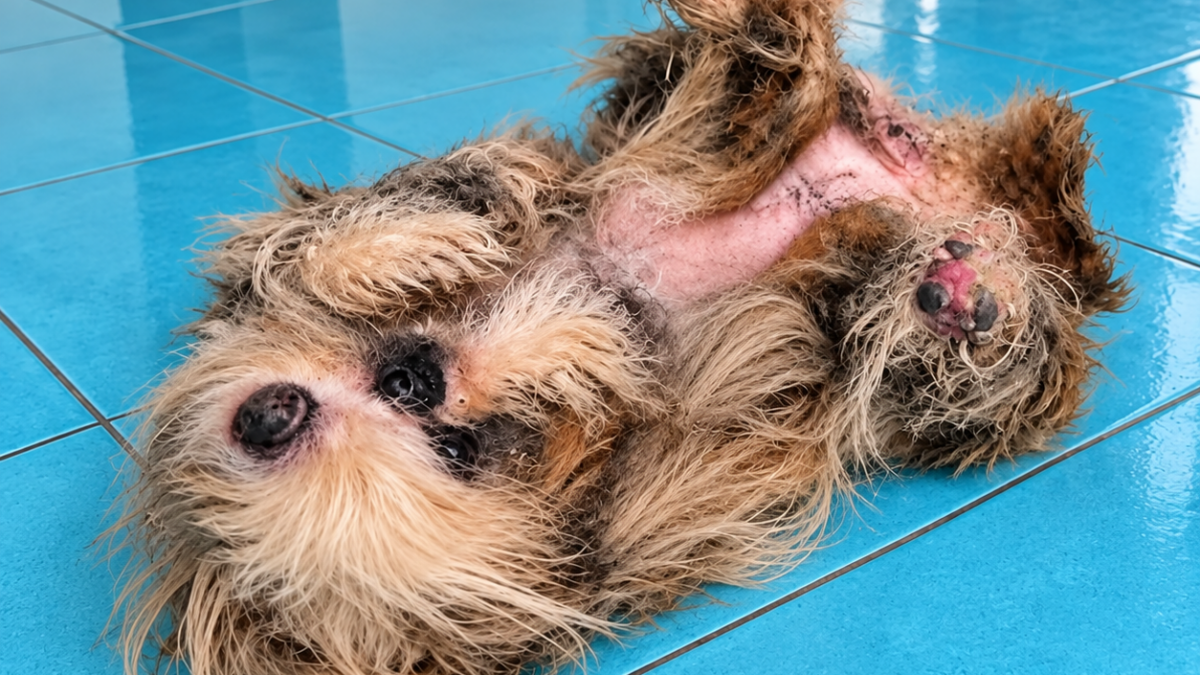
In the photograph, she was upside down on the couch with all four feet in the air.
Her belly was round.
Her coat was coming back.
There was no tension in her body.
I saved that picture beside one from the day she was rescued.
I looked at them together only once.
I did not need to keep comparing her to what she had been.
Chelsea was becoming herself.
That distinction mattered.
People often said things like, “You saved her.”
I understood what they meant.
But it never felt accurate.
We got Chelsea out of a cage.
Veterinarians treated her.
Authorities intervened.
I adopted her.
Those were things we did.
But Chelsea did the hardest part.
She chose to participate in life again.
She chose to trust when fear would have made perfect sense.
She chose to play.
She chose to approach people.
She chose to sleep deeply enough to dream.
Nobody can force an animal to do those things.
You can only give them enough safety that they become possible.
Six months after I adopted her, we returned to Dr. Mercer for another checkup.
Chelsea walked into the clinic like she owned that too.
A technician who had been there during her rescue saw us.
She stopped in the hallway.
“No way.”
Chelsea immediately ran toward her.
The technician crouched.
“Oh my God.”
Chelsea climbed into her lap.
The woman looked up at me.
“She’s fluffy.”
“She has fur now.”
“She looks like a completely different dog.”
I smiled.
“She acts like one too.”
Dr. Mercer examined her from nose to tail.
Weight healthy.
Skin healthy.
Coat healthy.
Bloodwork normal.
Then she listened to Chelsea’s heart.
“All good.”
I released a breath I had not realized I was holding.
“Completely?”
“As completely as I can promise with any living creature.”
Chelsea tried to climb across the examination table toward me.
Dr. Mercer smiled.
“I think she’s officially graduated from rescue case to spoiled pet.”
“Can you write that in her chart?”
“I probably should.”
As we were leaving, Dr. Mercer stopped me.
“Do you remember what you asked me when she first came in?”
I thought.
“I asked if she would be normal.”
“Yes.”
I looked at Chelsea, who was attempting to steal a tissue from the trash.
“I think normal was overrated.”
Dr. Mercer laughed.
“So do I.”
Life settled.
That is another part of rescue stories people do not always talk about.
The dramatic moments fade.
There are fewer emergencies.
The medication ends.
The appointments become annual instead of weekly.
And the animal becomes part of the background rhythm of your home.
That is the goal.
Chelsea stopped being “the starving dog from the cage.”
She became Chelsea.
The dog who barked at delivery boxes.
The dog who slept with her head hanging off the couch.
The dog who tried to carry three tennis balls despite having a mouth designed for approximately half of one.
The dog who followed me into the bathroom because privacy was clearly dangerous.
The dog who waited beside the refrigerator whenever I opened it.
She also became Murphy’s shadow.
That relationship surprised me.
At first, Murphy had seemed almost indifferent to her.
But as months passed, Chelsea began sleeping beside him.
If Murphy moved rooms, Chelsea followed.
If he lay in the sun, she squeezed herself against his side.
He tolerated everything.
Rosie was her playmate.
Murphy became something closer to family.
One winter morning, I found Chelsea curled against his chest.
Murphy was asleep.
Chelsea’s face was buried in his fur.
I stood in the doorway for a long time.
A year earlier, Chelsea had slept alone in a cage.
Now she could choose from four dog beds, two couches, my bed, and apparently Murphy.
She chose Murphy.
I took a picture.
Then I left them alone.
About fourteen months after Chelsea came home, Daniel called again.
I had not spoken to him in several months.
“How’s your criminal mastermind?” he asked.
“Currently stealing laundry.”
“So rehabilitated.”
“Completely.”
He laughed.
Then his voice became more serious.
“I thought you might want to know something.”
My stomach tightened automatically.
“What?”
“We had a follow-up compliance issue with Patricia.”
“What kind of issue?”
“She was found caring for an animal despite the court restriction.”
I stood up.
“What animal?”
“A dog.”
“Condition?”
“Okay.”
I exhaled.
“Thank God.”
“We removed it while the issue was addressed.”
“Did she own it?”
“She said she was keeping it temporarily for someone.”
“Was that allowed?”
“No.”
Anger returned immediately.
“So what happens?”
“That’s being handled.”
“Daniel.”
“It is.”
I paced across the kitchen.
Chelsea watched me from the couch.
“I don’t understand.”
“I know.”
“She stood in that courtroom.”
“I know.”
“She saw those photographs.”
“I know.”
“She heard the veterinarian say Chelsea could have died.”
“I know.”
“And she still—”
“I know.”
Daniel let the silence sit between us.
Finally, he said, “This is why restrictions have enforcement.”
That second incident changed something in me.
Until then, I had tried to place Patricia in the past.
A closed chapter.
A person who had been punished and hopefully understood.
Now I realized understanding was not guaranteed.
Consequences did not automatically create empathy.
The court responded to the violation.
The dog involved was safe.
Additional restrictions and penalties followed.
I attended nothing this time.
I did not need to see Patricia.
I did not need another courtroom.
The system was doing what it was supposed to do.
My responsibility was Chelsea.
Still, the situation pushed me toward something I had been considering for months.
Education.
Not the dramatic kind.
I did not want to stand somewhere giving speeches about evil people.
Most neglect cases are complicated.
Poverty exists.
Mental illness exists.
Age and disability exist.
People become overwhelmed.
But none of those realities change an animal’s physical needs.
So I started volunteering with a local outreach program that helped struggling pet owners before situations became emergencies.
Pet food.
Low-cost veterinary referrals.
Temporary foster care.
Transportation.
Spay and neuter assistance.
Sometimes the difference between a safe animal and a neglected animal was not punishment.
Sometimes it was a fifty-pound bag of dog food and somebody willing to drive.
The work gave me a place to put my anger.
One Saturday, I delivered food to an older man named Earl who had called because his Social Security check would not arrive for another week.
He had two dogs.
Both healthy.
Both clean.
Both obviously loved.
When I carried the food into his kitchen, Earl looked embarrassed.
“I’ve never had to ask before.”
“You asked before they went hungry.”
He looked at me.
“That matters.”
He nodded.
His eyes filled.
I thought about Patricia.
Then I stopped myself.
This was not about her.
People who ask for help should not be treated as if asking itself is failure.
Asking is often the thing that prevents failure.
Chelsea began accompanying me occasionally when it was appropriate.
She was surprisingly good with people.
Especially older people.
She would approach slowly, sit near their feet, and wait.
One afternoon, a woman named Denise who had recently lost her husband sat on her porch stroking Chelsea’s head.
“She was neglected?” Denise asked.
“Very badly.”
“You’d never know.”
I smiled.
“Sometimes I still know.”
Denise looked at me.
“What does that mean?”
“She remembers certain things.”
“Like what?”
“Food disappearing. Loud noises. Being confined.”
Denise continued petting her.
“Funny how a body remembers even when life gets better.”
I looked at her.
She was no longer talking only about Chelsea.
“No,” I said. “It doesn’t forget everything.”
Denise scratched behind Chelsea’s ears.
“But she’s still happy.”
“Very.”
“That gives me hope.”
Chelsea rolled onto her back.
Denise laughed.
“So much for dignity.”
“She has none.”
There were many moments like that.
Small moments.
Chelsea had survived something terrible, but I refused to make suffering her entire identity.
Her joy deserved equal attention.
Maybe more.
Two years after I adopted her, Murphy died.
He had been slowing down for months.
We knew it was coming.
Knowing did not help.
On his final morning, I sat on the floor beside him.
Rosie lay near his feet.
Chelsea pressed herself against his side.
Murphy could barely lift his head.
I touched his face.
“You were a good boy.”
His tail moved once.
At the veterinary clinic, I stayed with him until the end.
When I returned home alone, Chelsea ran to the door.
She looked behind me.
Then beside me.
She walked outside.
She checked the driveway.
She came back in.
For the next three days, she searched for him.
She went to his bed.
She sniffed his blanket.
She stood at the back door whenever a car passed.
On the fourth night, she carried one of Murphy’s old toys into my bedroom and placed it beside my pillow.
Then she curled against me.
We grieved together.
That loss taught me something else about Chelsea.
She had not simply received love.
She had learned to give it.
There is a difference.
Survival had not made her empty.
It had not made her permanently suspicious.
It had not destroyed her ability to attach.
Chelsea had built relationships.
She had a family.
And now she could lose someone because she had been fortunate enough to love someone.
Painful as it was, even grief felt like proof of how far she had come.
A few months later, I found myself thinking about the cage again.
Not because Chelsea had regressed.
Because I realized I no longer remembered every detail clearly.
For a moment, that bothered me.
Then I understood.
I did not need to preserve the cage perfectly in my mind.
Chelsea’s life was no longer defined by my ability to remember the worst day.
The best days had become more numerous.
That was the victory.
Her third birthday with me was celebrated with a ridiculous dog-safe cake.
Rosie ate her portion in seven seconds.
Chelsea ate half of hers and then attempted to steal Rosie’s empty plate.
I took photographs.
In one, Chelsea was standing with frosting on her nose.
In another, she was looking upward with both ears raised because someone had said the word “chicken.”
I printed one photograph and placed it in a frame.
Beside it, I kept a much smaller photograph from the rescue.
Not because I wanted visitors to be shocked.
Because I wanted to remember the distance between those two images.
Sometimes people asked what had happened to the woman responsible for Chelsea.
I answered factually.
She had faced legal consequences.
She had been restricted from possessing animals.
Authorities had enforced that restriction when necessary.
Then I changed the subject.
Because eventually, Patricia became the least interesting part of Chelsea’s story.
That surprised me.
For a long time, I thought justice required keeping the person who caused the suffering at the center.
It did not.
Accountability mattered.
Enforcement mattered.
But after accountability came something better.
Irrelevance.
The person who had neglected Chelsea no longer decided what Chelsea’s life looked like.
She did not decide where Chelsea slept.
She did not decide when Chelsea ate.
She did not decide whether Chelsea received medical care.
She did not decide whether Chelsea could run.
She did not decide whether Chelsea was loved.
That power was gone.
And maybe that was the most complete kind of justice available.
Years passed.
Chelsea’s coat grew thick and soft.
People meeting her for the first time could not imagine the condition she had once been in.
Sometimes they thought I was exaggerating until they saw the photograph.
“That’s her?”
“That’s her.”
“No.”
“Yep.”
They would look down.
Chelsea would usually be doing something undignified, like rolling on her back or trying to investigate a purse.
It became almost impossible to connect the lively dog in front of them to the starving animal in the image.
I loved that.
I wanted the past to become unbelievable.
One autumn afternoon, I took Chelsea back to the park where she had first run freely.
Rosie was older now and could not sprint the way she once had.
So we walked.
Leaves covered the ground.
Chelsea pushed her nose through them.
Every few feet, she discovered something apparently worthy of extensive investigation.
I found a bench.
Rosie lay beside my feet.
Chelsea wandered to the end of her long leash.
Then she stopped.
She looked across the field.
I remembered that first day.
The skinny little body.
The uncertain steps.
The sudden explosion into a run.
I unclipped the long line inside the fenced exercise area.
“Go.”
Chelsea stood still.
“Go on.”
She ran.
Not as fast as she once had.
She was older too.
But she ran with the same enthusiasm.
Across the field.
Around a tree.
Back toward me.
Then away again.
I laughed.
When she finally returned, she was panting.
She sat between my feet.
I scratched her chest.
“You know something?”
Chelsea looked up.
“You won.”
Her tail moved.
I thought about everything people call revenge.
Punishment.
Humiliation.
Making someone suffer because they caused suffering.
I had wanted some of that once.
The morning of Patricia’s hearing, I had wanted her to feel a fraction of what Chelsea had felt.
Hunger.
Fear.
Helplessness.
But standing in that park years later, I understood revenge differently.
Chelsea had been treated as though her life had little value.
So we built a life that proved otherwise every single day.
She had been left hungry.
Now she never wondered whether dinner was coming.
She had been confined.
Now she ran until she was tired.
She had been ignored.
Now three veterinarians, two groomers, half my neighborhood and every person in my family knew her name.
She had once slept in filth.
Now she complained if a blanket was not arranged correctly.
She had once been afraid of hands.
Now she shoved her head underneath them when she wanted petting.
Someone had reduced her world to a cage.
Chelsea answered by building a world so large that the cage became only one old photograph.
That was enough revenge for me.
More than enough.
As Chelsea grew older, I became more protective of time.
I stopped assuming there would always be another summer.
Another Christmas.
Another walk.
Another morning when I woke up with her feet pressed into my back.
Her muzzle eventually began turning gray.
At first, it was just a few hairs around her mouth.
Then more.
Her running slowed.
She still loved walks, but we shortened them.
She still chased Rosie occasionally, though the chase sometimes ended after fifteen feet when both dogs apparently reconsidered the value of unnecessary exercise.
Our house became quieter.
Not sad.
Just slower.
Chelsea spent more time lying beside me while I worked.
She still stole socks.
Age had not improved her ethics.
One morning, I woke up and found her sitting beside the bed staring at me.
“What?”
She stared.
“Breakfast?”
Tail wag.
I got up.
She trotted toward the kitchen.
I followed.
Halfway down the hallway, she turned around to make sure I was coming.
That tiny gesture hit me unexpectedly.
There had been a time when Chelsea watched me walk away because she feared I might not return.
Now she simply assumed I would follow.
Trust had become ordinary.
I think that may have been her greatest recovery.
Not eating.
Not gaining weight.
Not growing fur.
Expectation.
Chelsea expected good things.
She expected breakfast.
She expected walks.
She expected warmth.
She expected me to come home.
She expected kindness.
Trauma had taught her one version of the world.
Years of love had taught her another.
Eventually, Rosie passed too.
Chelsea became my only dog for the first time since I had adopted her.
I worried she would struggle.
For a while, she did.
The house felt different.
She followed me constantly.
So I adjusted.
We took more walks.
I brought her along when I visited friends.
She became the unofficial greeter at our outreach program’s monthly supply events.
People loved her.
Most had no idea why she mattered so much to me.
One Saturday, a young woman arrived asking for dog food.
She looked embarrassed.
Her name was Kayla.
She had recently left an unsafe relationship and was living temporarily with her sister.
Her dog, Bear, was staying with her.
“I can feed myself cheaply,” she said. “I just don’t want him missing meals.”
I helped her load food into her car.
Chelsea stood nearby.
Kayla knelt.
“She’s cute.”
“Thank you.”
“How old?”
“Older than she admits.”
Kayla smiled and stroked Chelsea’s back.
“She’s really friendly.”
“She wasn’t always this confident.”
I gave her the short version of Chelsea’s story.
Kayla looked down at her.
“So somebody rescued her.”
“Yes.”
Chelsea leaned against Kayla’s knee.
Kayla’s eyes filled.
“I almost gave Bear up.”
“Because of money?”
She nodded.
“I thought maybe I was being selfish keeping him.”
“You asked for help.”
“I hate asking.”
“I know.”
She looked at me.
“How?”
I glanced at Chelsea.
“Because sometimes needing help and refusing help look very different from an animal’s side.”
Kayla was quiet.
I continued.
“If you can care for him safely with some temporary support, asking is exactly what you should do.”
She wiped her eyes.
Chelsea licked her hand.
Kayla laughed.
“Does she do therapy too?”
“Only when snacks are involved.”
Months later, Kayla returned as a volunteer.
Bear looked healthy.
That made me think about the chain of events that started with Chelsea.
A starving dog had entered my life.
Because of her, I had become involved in outreach.
Because of outreach, Kayla had received help before Bear went hungry.
One rescued animal had indirectly protected another.
There was no courtroom dramatic enough to compete with that.
When Chelsea was around eleven, Dr. Mercer found a heart murmur.
It was mild.
Then it became less mild.
Medication helped.
We adjusted her activities.
I learned the names of drugs I had never wanted to know.
I learned how to count resting breaths.
I learned to recognize the difference between normal tiredness and something worth calling the clinic about.
Dr. Mercer had more gray hair now.
So did I.
One afternoon, she listened to Chelsea’s chest for a long time.
I watched her face.
“Don’t do that.”
She removed the stethoscope.
“Do what?”
“That veterinarian face.”
“What face?”
“The face where you’re deciding how to explain something without terrifying me.”
She smiled slightly.
“You’ve known me too long.”
“Exactly.”
She explained that Chelsea’s heart disease had progressed.
Not catastrophically.
Not immediately.
But enough that we needed another medication.
“How much time?”
“You know I can’t answer that.”
“Try.”
Dr. Mercer looked at Chelsea.
“With good response? We could still have meaningful time.”
Meaningful time.
I hated the phrase.
Then I came to love it.
Because that became the goal.
Not maximum time.
Meaningful time.
Chelsea did not understand prognosis.
She understood breakfast.
She understood sunshine.
She understood car rides.
She understood that the blanket on the left side of my couch was hers.
So we kept living.
On good days, we walked slowly through the park.
On warm evenings, she slept on the porch while I read.
I started taking more photographs.
Then I stopped.
I realized sometimes I was watching life through my phone because I was afraid of losing evidence that it had happened.
So I put the phone away.
I memorized instead.
The white around her muzzle.
The way one ear folded when she slept.
The sound of her nails crossing the kitchen.
The tiny snore she made when she was completely relaxed.
One night, a thunderstorm rolled through.
Chelsea had never liked storms.
She climbed into bed beside me.
I pulled the blanket over her.
“You’re okay.”
Thunder shook the windows.
Chelsea moved closer.
I placed my hand against her side.
Her heart beat beneath my palm.
Slower than I remembered from when she was young.
But steady.
I thought about the cage.
I thought about the first food bowl.
I thought about every meal after it.
Thousands of meals.
That mattered.
One terrible chapter had been followed by thousands of ordinary good days.
Nobody tells you that healing is often repetitive.
Feed.
Walk.
Treat.
Comfort.
Sleep.
Repeat.
Love is not always a grand rescue.
Most of the time, love is maintenance.
It is showing up again tomorrow.
Chelsea taught me that.
Two years after her heart diagnosis, I woke one morning and knew something was wrong.
Chelsea did not come for breakfast.
That had never happened.
I found her in her bed.
She was awake.
Her tail moved when she saw me.
But she did not stand.
I knelt.
“Hey.”
Her breathing was different.
Not dramatic.
Just harder.
I called Dr. Mercer.
She told me to come immediately.
The drive felt horribly familiar.
Years earlier, I had driven Chelsea home for the first time, telling her she was safe.
Now I drove with one hand on her blanket.
“You’re okay.”
I knew I was saying it partly for myself.
At the clinic, they took her for imaging.
I sat alone in the examination room.
I looked at the floor.
The same kind of floor she had once played on after stepping out of that cage.
I remembered that tiny bounce.
That impossible joy.
Dr. Mercer came in.
She sat beside me instead of across from me.
I knew.
“What happened?”
“Her heart is failing.”
I looked toward the door.
“Can you fix it?”
“We can try to stabilize her.”
“Will it work?”
“I don’t know.”
I hated those words.
“How scared is she?”
“She’s comfortable right now.”
“I want to see her.”
They brought Chelsea back.
She looked tired.
But when she saw me, her tail moved.
I sat on the floor.
She rested her head in my lap.
Dr. Mercer explained options.
Hospitalization.
Oxygen.
Medication.
A chance she might improve enough to go home.
But also the possibility that we were reaching the end.
I listened.
Then I asked the only question that mattered.
“If she were your dog?”
Dr. Mercer looked at me.
“She has been treated like one of mine for a long time.”
“That’s not an answer.”
She swallowed.
“I would give her a short chance to respond because she is still alert and engaged. But I would not let her struggle for my sake.”
I nodded.
Chelsea stayed overnight.
It was the longest night I had spent away from her since adopting her.
At 2:13 a.m., I woke up and reached toward the empty space beside me.
At 5:40, the phone rang.
My heart stopped.
It was Dr. Mercer.
“She responded.”
I sat upright.
“What?”
“She’s breathing more comfortably.”
“Can I get her?”
“Later today if she remains stable.”
I started crying.
Chelsea came home that afternoon.
We got four more months.
Four meaningful months.
I knew what they were.
A gift.
We did not travel anywhere extraordinary.
Chelsea did not need a bucket list.
We went to the park.
We ate chicken.
We sat in the sun.
I let her have far too many treats.
I carried her when she became tired.
She slept against my side.
One morning, I took her to that same field again.
She could not run anymore.
So we sat.
Wind moved through the grass.
Chelsea raised her nose.
She smelled the world.
Exactly as she had through the car window on the day I brought her home.
I put my hand on her back.
“You got a lot of life, didn’t you?”
Her tail tapped the ground.
The final morning came quietly.
She refused breakfast.
Then she refused chicken.
That frightened me more than anything.
Chelsea had never refused chicken.
She walked outside and stood in the yard.
Sunlight touched her face.
Then she lay down.
I sat beside her.
Her breathing was difficult again.
I called Dr. Mercer.
This time, neither of us needed many words.
At the clinic, I carried Chelsea inside wrapped in her favorite blanket.
The staff knew.
Several came to say goodbye.
The technician who had first watched Chelsea climb into my lap years earlier was still there.
She knelt beside us.
“I remember when she came in.”
“So do I.”
“She was such a mess.”
I laughed through tears.
“She remained a mess. Just a healthier one.”
The technician cried.
Then she kissed Chelsea’s head and left.
Dr. Mercer gave us time.
I sat on the floor with Chelsea.
Her head rested against my chest.
“I need you to know something,” I whispered.
Her ear moved.
“You never have to be hungry again.”
I could barely speak.
“You never have to be scared in a cage again.”
I pressed my face against her head.
“You never have to wonder if somebody is coming back.”
Chelsea breathed slowly.
“I came back.”
Tears fell onto her fur.
“Every time I could, I came back.”
Her tail moved once against the blanket.
That destroyed me.
I laughed and sobbed at the same time.
“Yeah. I know.”
Dr. Mercer came in.
I nodded.
Chelsea died with my hand over her heart.
She was warm.
She was not afraid.
The last thing she heard was my voice telling her she was loved.
For several days afterward, my house felt wrong.
No nails on the floor.
No small body blocking the hallway.
No face appearing whenever the refrigerator opened.
I still looked toward her bed.
I still woke expecting her beside me.
Grief made ordinary objects dangerous.
A leash.
A food bowl.
A half-used bag of treats.
One sock she had carried into the living room and abandoned.
I could not move it for a week.
Eventually, I placed Chelsea’s collar beside the framed photograph of her with frosting on her nose.
Not beside the rescue picture.
That was intentional.
Her life deserved to be remembered by joy.
A month after she died, Daniel sent me a message.
I had not spoken to him in years.
He had heard through someone at the clinic.
I’m sorry about Chelsea.
I stared at the screen.
Then another message arrived.
She got lucky when she found you.
I typed a reply.
Then deleted it.
Typed another.
Deleted that too.
Finally, I wrote:
We got lucky when we found each other.
That felt right.
Chelsea had changed my life in ways I did not understand when I lifted her from that cage.
Because of her, I adopted differently.
Volunteered differently.
Judged people more carefully.
Responded to suffering faster.
Understood accountability more clearly.
Understood forgiveness differently too.
I never forgave the neglect.
I did stop carrying the person responsible around in my head.
There is freedom in that.
Not forgetting.
Not excusing.
Simply refusing to give someone who caused harm permanent ownership of the story.
Chelsea’s story belonged to Chelsea.
And Chelsea’s story was not ultimately about starvation.
It was about appetite.
Her appetite for food, certainly.
But also for play.
For friendship.
For sunlight.
For walks.
For warm blankets.
For stolen socks.
For ridiculous amounts of chicken.
For life.
The first time I saw her, Chelsea ate as though every bite might be her last.
Years later, on one of our final good evenings, I gave her a small piece of chicken.
She took it gently.
Chewed.
Then sat beside me without asking for another.
There was more food in the kitchen.
She knew that.
There would be breakfast tomorrow.
She believed that too.
She was not desperate.
She was secure.
That tiny moment meant more to me than any courtroom ruling ever could.
A dog who once could not lift her head from a food bowl had learned that she did not need to hurry.
There would be enough.
There would always be enough.
Enough food.
Enough warmth.
Enough space.
Enough safety.
Enough love.
People sometimes ask whether rescuing an abused animal is heartbreaking.
Yes.
Absolutely.
But heartbreak is only the beginning if you are lucky.
After heartbreak comes work.
After work comes trust.
After trust comes routine.
And one day, without noticing exactly when it happened, the animal you once described as “rescued” simply becomes family.
Chelsea did that.
She stopped being the dog from the cage.
She became the dog in my bed.
The dog at my feet.
The dog in every family photograph.
The dog who helped another frightened dog trust.
The dog who comforted strangers.
The dog who accidentally led me toward helping people before their animals reached crisis.
The dog who showed me that punishment and justice are not always the same thing.
The people responsible for what happened to Chelsea faced consequences.
That mattered.
But their consequences were never the happiest ending.
Chelsea was.
Every meal she finished without fear was an ending.
Every night she slept with her belly exposed was an ending.
Every time she ran across that field was an ending.
Every time she leaned into a human hand instead of shrinking away was an ending.
Every birthday she was never supposed to reach was an ending.
Every ordinary morning was an ending rewritten.
Sometimes I still look at the first photograph.
The tiny body.
The terrible coat.
The ribs.
The uncertain eyes.
Then I look at the last photograph I took of her.
Chelsea is lying in the grass.
Her muzzle is white.
Her eyes are half closed in the sunlight.
She looks old.
Peaceful.
Safe.
There is nothing dramatic in the image.
That is why I love it.
For most of her life with me, nothing dramatic was happening.
Nobody was saving her.
Nobody was rushing her into a clinic.
Nobody was gathering evidence.
Nobody was standing in court.
She was simply living.
And after the way her story began, simply living became the greatest victory I could have given her.
Chelsea came into my life starving so badly that she could not lift her face from a bowl.
She left it many years later knowing exactly where her next meal would come from, exactly where she would sleep, and exactly whose arms would hold her when she was tired.
Someone once treated her as though she could be forgotten behind a cage door.
They were wrong.
Chelsea was loved.
Chelsea was protected.
Chelsea mattered.
And long after that cage disappeared from her life, she became the kind of dog nobody who met her could ever forget.








