PART 2: She Was Tied Inside an Old Sack and Left to Die—But She Kept Her Puppies Alive Until Someone Heard Her Cry
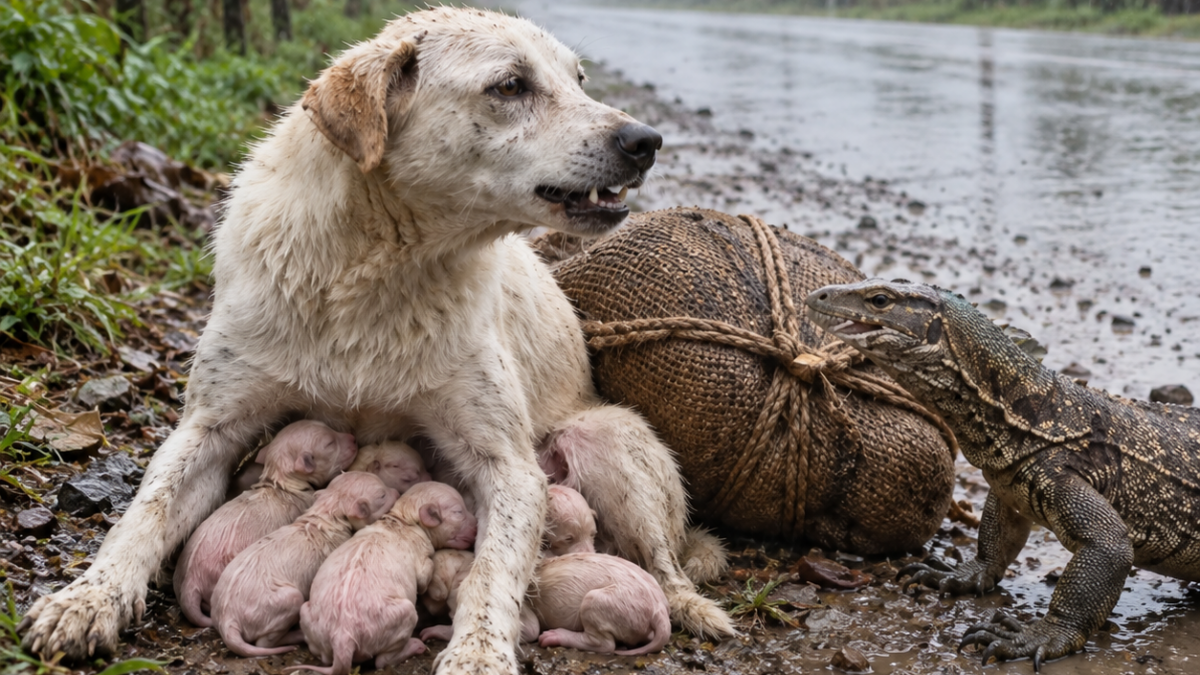
The sack was moving when I first saw it, but only because one exhausted paw kept pushing weakly against the muddy fabric from the inside.
Then I heard a mother dog cry out, followed by several tiny sounds beneath her, and I realized she had been fighting for more than her own life.
What I found when I cut that old sack open would lead me far beyond that empty field—and straight to the person who had expected none of them to survive.
My name is Mason Carter, and that morning I wasn’t looking for a dog.
I was checking storm damage along the back edge of my uncle’s property after two nights of hard rain had washed debris down from the hills.
The place was quiet.
Too quiet.
A dirt path ran between an abandoned feed shed and a line of cottonwood trees, then disappeared toward an old drainage ditch no one used anymore.
I had walked that path hundreds of times.
That was why the sound stopped me.
A cry.
Thin.
Hoarse.
Almost swallowed by the wind.
I stood still.
Nothing.
Then it came again.
Not a bark.
Not a growl.
A desperate, broken sound from somewhere beyond the weeds.
“Hello?”
I felt stupid the second I said it.
Then something scratched against fabric.
I pushed through the grass.
That was when I saw the sack.
It was an old brown feed bag, soaked dark from rain and mud, lying beside a rusted section of fencing.
The top had been twisted and tied with blue nylon cord.
The whole thing barely moved.
Then a muddy paw pushed through a torn seam.
Once.
Twice.
Then stopped.
“Oh, God.”
I dropped to my knees.
The smell hit me first.
Wet fur.
Mud.
Blood.
Fear.
I touched the sack.
Something inside immediately shifted.
A dog cried out.
“Easy. Easy. I’m getting you out.”
I pulled my pocketknife free and started cutting the cord.
The instant the opening loosened, a brindle-colored muzzle appeared.
She gasped for air.
Her face was thin.
Her eyes were sunken from exhaustion.
One ear was folded beneath the fabric, and scratches covered the bridge of her nose where she had apparently tried to tear her way out.
But she wasn’t trying to escape anymore.
She was pressing her body backward.
Protecting something.
I opened the sack farther.
That was when I heard them.
Tiny squeaks.
I froze.
“No…”
There were puppies beneath her.
Five that I could see.
Maybe only days old.
Their eyes were still closed.
They were wet, cold, and packed against their mother’s belly while she curled herself around them as tightly as the sack allowed.
She had almost no room to move.
Yet somehow, she had managed to keep her body between them and the opening.
I reached toward one puppy.
The mother lifted her head.
A growl came from somewhere deep inside her.
Weak.
But serious.
I pulled my hand back immediately.
“All right.”
Her eyes never left mine.
“You don’t know me.”
She was terrified.
Starving.
Trapped.
And still willing to use whatever strength she had left to defend those puppies.
Then I noticed something else.
There were tears in the sack near her back.
Not knife cuts.
Bite marks.
Something had tried to get inside during the night.
The mother’s muzzle had fresh blood on it.
Whatever came near those puppies had met her teeth first.
I looked around.
Paw prints covered the mud.
Several sets.
Coyotes, maybe.
The bag had been dragged nearly three feet from where the ground was first disturbed.
She had spent the night trapped in fabric, unable to run, while predators circled her babies.
And she had fought them from inside a sack.
My hands started shaking.
“Who did this to you?”
Her eyes softened for half a second.
Then her head dropped.
“No. Stay with me.”
I pulled out my phone.
No signal.
Of course.
The nearest house was almost half a mile away.
My truck was farther in the opposite direction.
I looked at the mother.
Then at the puppies.
One wasn’t moving.
I reached carefully toward it.
This time she didn’t growl.
She simply watched me.
Almost as though she finally understood I was the only thing standing between her family and another night out there.
I slid my fingers beneath the tiny body.
Cold.
Far too cold.
Behind me, the weeds suddenly rustled.
The mother forced herself upright.
Her lips pulled back.
Another sound came from the brush.
Closer.
I grabbed a broken fence post and stood over the open sack.
“Whatever you are,” I whispered, “you picked the wrong morning.”
Then the brush moved again.
PART 2
I raised the fence post with both hands.
For one second, all I could hear was my own breathing.
The mother dog remained half inside the torn sack.
She should have been too weak to stand.
Somehow, she was standing anyway.
Her legs trembled beneath her.
Her shoulders were narrow.
Her ribs showed even through the mud.
Yet the second the weeds moved again, she shifted her body in front of the puppies.
That told me everything I needed to know about her.
Whatever was coming through those weeds would have to go through her first.
Then a rabbit exploded from the grass.
I nearly swung the post at it.
It shot across the trail and disappeared under the fence.
I stood there feeling both relieved and ridiculous.
“Great,” I muttered. “Nearly got killed by breakfast.”
The mother’s legs folded.
She dropped beside her puppies.
That snapped me back into focus.
The cold puppy was still in my left hand.
I rubbed it with the bottom of my shirt.
No response.
I had grown up around farm animals, but newborn puppies were different territory.
I knew enough to know that warmth mattered.
I tucked the tiny body against my chest inside my jacket.
Then I looked at the mother.
“I need to move you.”
Her eyes followed me.
“You’re not going to like it.”
I removed my jacket carefully, leaving the puppy wrapped inside.
Then I used my knife to cut the entire sack open from top to bottom.
The mother flinched each time the fabric shifted.
“Easy.”
When the bag finally fell away, I could see the full extent of what had happened to her.
A length of yellow plastic rope was tied around one hind leg.
Not tightly enough to cut circulation, but tight enough that she had probably been tethered inside the sack before it was closed.
Her neck carried an old leather collar.
No tag.
Her belly was enlarged from nursing.
The skin around several nipples was irritated.
She had bite wounds along one shoulder.
Small punctures.
Fresh.
The coyotes—or dogs, or whatever had approached during the night—had managed to reach her through the torn fabric.
She had not been imagining a threat.
She had been fighting one.
I counted the puppies.
Six.
Not five.
The sixth had been hidden beneath her front leg.
Three were dark brindle like their mother.
Two were tan.
One was almost black except for a white patch under its chin.
All were tiny.
All had closed eyes.
Five were moving.
One—the little tan puppy inside my jacket—was still frighteningly still.
I had to get them out.
But the mother could barely walk.
The puppies couldn’t survive a half-mile trip in the cold air without protection.
I needed something larger than my arms.
I looked toward the abandoned feed shed.
There might be an old crate inside.
“Stay.”
I almost laughed.
As though she had any intention of leaving.
I ran.
The shed was fifty yards away.
Its door hung crooked on one hinge.
Inside were broken buckets, old fencing wire, empty mineral tubs, and a stack of cracked plastic produce crates.
I grabbed the strongest one.
Then I found an old horse blanket folded beneath a shelf.
It smelled like dust and mice.
I didn’t care.
I shook it out.
A cloud of dirt filled the shed.
I carried both back.
The dog hadn’t moved.
I spread the blanket inside the crate.
Then I transferred the puppies one by one.
The mother watched every movement.
The first time I picked up a puppy, she tried to stand.
“It’s okay.”
Her head followed my hands until I placed the baby inside the crate.
The puppy squeaked.
The mother relaxed slightly.
I moved another.
And another.
When I reached inside my jacket, I felt something.
A twitch.
I froze.
The cold puppy moved its front leg.
“Come on.”
I rubbed harder.
A tiny mouth opened.
No sound.
Then a faint squeak.
I don’t know why that sound hit me so hard.
Maybe because I had already decided the puppy was gone.
Maybe because hope sounds different when you have almost given up on it.
“There you are.”
I placed the puppy beside its siblings.
The mother immediately crawled toward the crate.
She sniffed all six.
Then tried to climb in.
Her hind legs failed.
I caught her before she hit the ground.
She turned toward me sharply.
For one second I thought she might bite.
Instead, she looked directly into my face.
Close enough that I could see the mud dried in the fine hairs around her eyes.
“I’m going to pick you up.”
She had no reason to trust me.
I knew that.
The last human hands she remembered might have been the hands that tied the sack.
I slid one arm under her chest and one under her hips.
She stiffened.
“Easy.”
Then I lifted.
She weighed almost nothing.
That frightened me more than the wounds.
A dog her size should have had substance.
Muscle.
Weight.
She felt hollow.
I placed her inside the crate beside her puppies.
The moment she settled, all six began searching for her.
Even the tiny tan one.
They crawled toward her belly.
She curled around them.
Then she closed her eyes.
For the first time since I had opened the sack, she stopped fighting.
Not because she had given up.
Because someone else was finally carrying the weight.
I lifted the crate.
It was heavier now.
Awkward.
The plastic handles cut into my fingers.
The trail to my truck was uphill.
Halfway there I had to stop.
The mother opened her eyes immediately.
“I’m not leaving you.”
I adjusted my grip.
“I’m old enough to regret skipping the gym, that’s all.”
I was forty-three.
Not exactly ancient.
But carrying a dog and six puppies in a broken produce crate over wet ground can age a man quickly.
When I reached my truck, I placed the crate on the passenger-side floor and wedged towels around it to keep it stable.
Then I checked my phone.
One bar.
I called the nearest veterinary clinic.
A receptionist answered.
“Pine Ridge Animal Hospital.”
“I found a dog and six newborn puppies dumped in a sack.”
There was a pause.
“Did you say dumped in a sack?”
“Yes.”
“Is the mother conscious?”
“Barely.”
“Any active bleeding?”
“Some bite wounds. She’s extremely thin.”
“Puppies?”
“Alive. One was cold and not moving at first, but it is now.”
“Bring them immediately.”
“I’m twenty-five minutes away.”
“I’ll tell the doctor.”
I started the truck.
The mother lifted her head as the engine turned over.
“That’s okay.”
She stared at the windshield.
Maybe she had been in a vehicle before being dumped.
Maybe engines meant danger.
I drove slower than I had ever driven that road.
Every pothole felt personal.
At the first paved intersection, I pulled over long enough to look inside the crate.
The six puppies were pressed against their mother.
The tan puppy was moving.
Not much.
But moving.
The mother had her nose resting over it.
“You knew that one was in trouble, didn’t you?”
Her eyes opened.
I don’t know whether she understood anything I said.
I kept talking anyway.
“You did your part.”
I touched the edge of the crate.
“Now let somebody do ours.”
Dr. Rachel Nguyen met me in the clinic parking lot with two technicians.
They had a cart waiting.
“What happened?”
“I found them near the old Carter property.”
One technician lifted the crate.
The mother immediately raised her head.
“It’s okay,” I said.
Dr. Nguyen looked at me.
“She responds to you.”
“She doesn’t know me.”
“She knows your voice.”
They rushed the family inside.
I followed until a technician stopped me at the treatment-room door.
“We need space.”
“I understand.”
I did not understand.
I wanted to follow.
Instead, I sat in a plastic chair under a faded poster about heartworm prevention.
My hands were covered in mud and dried blood.
Not mine.
I kept looking at them.
Twenty minutes passed.
Then forty.
At fifty-two minutes, Dr. Nguyen came out.
Her expression was serious but not hopeless.
“How are they?”
“The mother is severely dehydrated and significantly underweight. She has several puncture wounds, probably from a canine predator or loose dogs. No major internal injury that we can detect so far.”
“And the puppies?”
“Five are reasonably stable given the circumstances.”
My stomach tightened.
“The sixth?”
“The tan male?”
“Yes.”
“Very low body temperature. Low blood glucose. He’s responding to warming and glucose.”
“Is he going to make it?”
“I can’t promise that.”
I hated those words.
Doctors and veterinarians never promised when you most wanted them to.
“What about the mother?”
“She has a fever.”
“From the bites?”
“Possibly. Could also be uterine infection, mastitis, or simply severe stress combined with exposure. We’re running bloodwork.”
She paused.
“Do you know who she belongs to?”
“No.”
“Microchip?”
“We haven’t found one.”
“Do you know how long she was there?”
“No.”
Dr. Nguyen looked through the treatment-room window.
“I don’t think she had those puppies in the sack.”
“Why?”
“The puppies are approximately four to six days old. Their umbilical areas are healing. She was likely moved after giving birth.”
My stomach turned.
“So someone waited until she had puppies, put all seven of them into a feed sack, tied it shut and dumped them.”
“We don’t know that for certain.”
I looked at her.
“Rachel.”
She knew me.
Small towns do that.
We had gone to the same high school, though she was two years behind me.
She exhaled.
“The sack was tied.”
“Yes.”
“There was rope around her leg.”
“Yes.”
“Then yes. Someone placed them there.”
I stood.
“I’m going back.”
“To the field?”
“Yes.”
“Why?”
“To see if they left anything.”
“Mason.”
“What?”
“If this is intentional abandonment, call animal control before disturbing the area.”
That was smarter than what I had planned.
My plan involved anger and a truck.
“I’ll call.”
“You should.”
I looked through the glass.
The mother was lying beneath warm blankets with an IV line in one front leg.
A technician had placed the puppies beside her in a heated enclosure.
The mother was awake.
Watching the door.
Watching me.
“I need to name her.”
Dr. Nguyen raised an eyebrow.
“For the medical record?”
“No. Because I can’t keep calling her ‘the mother.’”
“You know temporary names become permanent very quickly.”
“Fine.”
I watched the dog.
She had fought through a sack.
Predators.
Cold.
Hunger.
She had protected six puppies while trapped.
“June.”
“Why June?”
“My mother was born in June.”
Rachel smiled.
“June it is.”
The tan puppy needed a name too.
I wasn’t going to name all six yet.
That felt dangerous.
As if names made loss more possible.
But the little tan male had come back from almost nothing.
“Chance,” I said.
Dr. Nguyen wrote it down.
“That one may be too obvious.”
“I don’t care.”
I called county animal control from the parking lot.
Officer Lena Ortiz answered.
Within an hour, she met me at the field.
We walked the trail together.
The weather had begun clearing.
Sunlight made the wet grass shine.
From a distance, the torn sack looked harmless.
That angered me.
Objects don’t look guilty.
People do things.
Then objects sit there quietly afterward.
Lena photographed everything before touching it.
The blue nylon cord.
The yellow rope.
The bite marks.
The blood.
The drag marks.
The paw prints.
She examined the feed sack.
“Turner Premium Sow Feed.”
“Pig feed.”
“Looks like it.”
There was a printed batch code.
And something else.
A paper label had stuck to the damp fabric near the bottom seam.
Most of it was unreadable.
But three letters and part of a number remained.
Lena photographed it.
“Could be a store inventory tag.”
“You can trace it?”
“Maybe.”
She looked at the ground.
A vehicle had driven down the access path despite the mud.
Tire tracks remained.
One rear tire had an unusual wear pattern.
A missing section of tread on one side.
“Photograph that.”
“I am.”
We followed the tracks to the county road.
They disappeared on pavement.
Then Lena noticed something near the ditch.
A red plastic reflector lens.
Broken.
“Could be unrelated.”
“Could be from the vehicle.”
She bagged it.
I pointed toward the cottonwoods.
“What attacked June?”
Lena crouched beside the prints.
“Likely coyotes.”
“She fought them from inside that bag.”
“Looks that way.”
I pictured her again.
No room to run.
Six newborns beneath her.
Teeth pushing through torn fabric.
“Whoever did this should have to see what she looked like.”
Lena stood.
“They may.”
“That doesn’t sound promising.”
“It sounds like an investigation.”
I crossed my arms.
“You’ve done these?”
“Too many.”
“Do you catch them?”
“Sometimes.”
“And when you don’t?”
She looked at me directly.
“Then I still document everything like we will.”
That answer calmed me more than reassurance would have.
We spent another hour searching.
Near the place where the bag had first landed, we found an empty bottle of cheap sports drink.
A cigarette butt.
A length of black electrical tape.
Nothing else obvious.
Lena collected what might matter.
Before leaving, she looked at me.
“Don’t post the evidence.”
“I wasn’t planning to.”
“Don’t confront anyone you suspect.”
“I don’t suspect anyone yet.”
“Good. Keep it that way.”
I drove back to the clinic.
Chance was alive.
That was the first thing Rachel told me.
“Still critical,” she added.
“But alive.”
“Yes.”
“And June?”
“Bloodwork confirms anemia, dehydration, infection, and severe nutritional deficiency. But her kidneys and liver values are better than I expected.”
“She’ll live?”
Rachel leaned against the counter.
“I think she has a good chance.”
I felt my knees weaken.
I sat.
“Can I see her?”
“Five minutes.”
She led me into the treatment room.
June raised her head.
Her eyes looked clearer than before.
“Hey.”
Her tail moved.
A small tap against the blanket.
That was all.
It nearly undid me.
“You’re making me look emotional in front of professionals.”
Rachel snorted behind me.
June lowered her head.
Chance was in a separate warming box beside the family.
I could see his tiny chest moving.
“Can she see him?”
“Yes.”
“Does she know?”
“She knows one puppy is missing.”
“How?”
“Because mothers count differently than we do.”
I didn’t ask what that meant.
I believed her.
That afternoon, the other five puppies began nursing.
Rachel supplemented them because June’s milk supply was poor.
The clinic staff named them temporarily for recordkeeping.
Scout.
Bean.
Rosie.
Otis.
Willow.
Chance.
I told myself those names were not necessarily permanent.
I was already lying to myself.
June stayed hospitalized for five days.
I visited every morning before work and every evening after.
I ran a small fencing and equipment repair business, which meant technically I worked for myself.
In reality, my customers, invoices, and broken machinery worked me harder than any boss ever had.
For those five days, everything revolved around the clinic.
On day two, June ate from my hand.
On day three, she stood without assistance.
On day four, Chance returned to her.
That reunion is still one of the strongest things I have ever seen.
Rachel carried the puppy in a towel.
June had been sleeping.
The instant Chance squeaked, her head snapped up.
She stood too quickly.
Her IV line pulled.
A technician steadied her.
Rachel placed Chance beside her.
June sniffed him from nose to tail.
Then she licked his head over and over until he protested.
The other puppies climbed across one another trying to reach her.
June lay down around all six.
Her eyes closed.
Chance found a place against her belly.
“He’s nursing,” I said.
Rachel nodded.
“That’s what we wanted.”
I stood there grinning like an idiot.
Then Rachel said, “Don’t get too comfortable.”
My smile disappeared.
“What?”
“June’s milk production isn’t enough for six. We’re supplementing every two to three hours.”
“So?”
“So when she leaves the hospital, whoever fosters this family is going to have a full-time job.”
I knew exactly where she was going.
“No.”
She raised an eyebrow.
“I didn’t ask.”
“You were about to.”
“The rescue network is overwhelmed after kitten season. Foster homes are full.”
“I have a business.”
“You own the business.”
“I sleep.”
“Not much, from what I remember.”
“I’ve never raised newborn puppies.”
“You’ve raised calves.”
“Calves stand up.”
“So do puppies eventually.”
“Rachel.”
She smiled.
“You’re already visiting twice a day.”
“That is different.”
“How?”
“It just is.”
June opened her eyes and looked at me.
Rachel followed her gaze.
“Oh, that’s unfair,” I said.
“I didn’t do anything.”
“You trained her.”
“In four days?”
“You’re a veterinarian. You people have methods.”
June’s tail thumped.
Rachel folded her arms.
“You have a heated workshop office.”
“I repair welders in there.”
“You have a spare room at home.”
“How do you know?”
“Your sister told me.”
“My sister is dead to me.”
“I’m seeing her tonight. I’ll let her know.”
That evening my sister Claire called.
Not the same Claire from the earlier story of another dog. My Claire was forty-six, a school counselor, and had spent our entire lives volunteering me for things.
“You’re fostering them.”
“No.”
“You are.”
“Rachel called you?”
“I called Rachel.”
“Why?”
“Because you sent me seventeen photographs of June.”
“That proves nothing.”
“One was at 4:12 in the morning.”
“I couldn’t sleep.”
“You drove to the clinic because you couldn’t sleep?”
“Chance was critical.”
There was silence.
Then she said, “Mason.”
“What?”
“You’re fostering them.”
Three days later, June and six puppies were in my spare bedroom.
I had purchased a large washable whelping pen.
Heating pads designed for animals.
Puppy formula.
Bottles.
Digital scale.
Twenty-two towels.
Three packs of absorbent pads.
And one expensive orthopedic dog bed June refused to use.
She preferred an old quilt on the floor.
The first night was chaos.
Chance wouldn’t latch.
Bean crawled under June’s back leg and screamed as if murdered.
Otis somehow escaped the pen despite lacking functional eyesight.
I found him six feet away moving toward nothing in particular with enormous confidence.
June followed me with her eyes every time I touched one.
At 1:40 a.m., I sat on the floor feeding Chance with a bottle.
June rested her head on my thigh.
“You owe me.”
She sighed.
“You hear me?”
Nothing.
“Big time.”
Her tail moved once.
By the fourth night, we had a routine.
Feed.
Weigh.
Clean.
Sleep for forty minutes.
Repeat.
I developed respect for every mother who has ever cared for newborn anything.
June slowly gained weight.
The puppies gained faster.
Chance remained the smallest.
But he was stubborn.
If another puppy pushed him away from a nipple, he climbed over them.
If he fell onto his back, he kicked until he rolled.
“That’s your boy,” I told June.
She licked his face.
Animal control continued investigating.
The feed sack’s inventory label came from one of three farm-supply stores in the county.
Lena checked each.
Only one used the exact style of adhesive tag.
Henderson Farm & Feed.
The batch had been delivered three weeks earlier.
Eighty-six sacks sold.
That sounded hopeless.
Then the store owner said something useful.
Turner Premium Sow Feed wasn’t popular locally.
Only nine customers had purchased it from that shipment.
Seven were commercial hog operations.
One was a school agricultural program.
The ninth was a man named Curtis Vale.
That name meant nothing to me.
At first.
Lena called me.
“Do you know him?”
“No.”
“Any reason he would dump a dog on your uncle’s property?”
“No.”
“Do you mind if I ask around before you search his name?”
“Why?”
“Because I know you.”
“You barely know me.”
“I know your type.”
“What type?”
“Man who thinks the internet is an investigative warrant.”
“I was just going to look.”
“Mason.”
“Fine.”
I waited almost eleven minutes.
Then I searched.
Curtis Vale operated something called Vale Family Puppies from a property seventeen miles away.
The website showed clean fencing.
Green grass.
Healthy-looking dogs.
Golden retrievers.
Australian shepherds.
Mixed breeds marketed as “designer companions.”
Then I found an older cached social media post.
A brindle female dog stood behind a wire fence.
White chest.
Thin scar across muzzle.
June.
Except she wasn’t called June.
Her caption said:
**Brindle Mama “Daisy” expecting another beautiful litter soon.**
My hands went cold.
Another litter.
I kept scrolling.
Photographs went back nearly three years.
June—Daisy—appeared in multiple posts.
Different litters.
Different puppies.
At least three.
Maybe four.
In some images she looked healthy.
In later ones she looked thinner.
The newest public picture was from two months earlier.
Her ribs were faintly visible even then.
I called Lena.
“You told me not to search.”
“I know.”
“I searched.”
“I assumed you would.”
“Curtis Vale had June.”
“That’s one possibility.”
“Her picture is on his business page.”
“I know.”
“You already knew?”
“I said I’m investigating.”
“Why didn’t you tell me?”
“Because you are fostering evidence with six tiny legs times six and a temper.”
“June is not evidence.”
“She is both a living animal and relevant to the investigation.”
I hated that sentence.
“Is Vale the person who dumped her?”
“I don’t know yet.”
“He bought the feed.”
“So did eight others.”
“He bred her.”
“That is significant.”
“Then go arrest him.”
“That is not how this works.”
“Lena—”
“Do you want a case that feels good for twelve hours or one that holds up later?”
I shut up.
She continued.
“I visited Vale’s property this morning.”
My heart started beating faster.
“And?”
“He claims Daisy escaped five days before you found her.”
“With six newborn puppies?”
“He claims she had not yet given birth when she disappeared.”
“That’s impossible.”
“Dr. Nguyen estimates the puppies were already several days old when found.”
“Exactly.”
“He says the estimate is wrong.”
“Of course he does.”
“He also says he searched.”
“Did he report her missing?”
“No.”
“Post online?”
“No.”
“Call shelters?”
“Not that we’ve found.”
“Then he’s lying.”
“Likely is not the same as provable.”
I stared at June across the room.
She was asleep while six puppies formed a pile beside her.
“Does he know she’s alive?”
“Yes.”
June opened her eyes.
“Does he want her back?”
There was a pause.
That told me the answer before Lena did.
“He says she is his property.”
“No.”
“Mason.”
“No.”
“He has claimed ownership.”
“He put her in a sack.”
“We haven’t proved that.”
“He starved her.”
“We have medical documentation showing prolonged poor condition. Attribution is the next step.”
“He bred her until she was skin and bones.”
“We are documenting her breeding history.”
“Six puppies almost died.”
“I know.”
“If you tell me I have to hand her over—”
“I’m not telling you that.”
“Good.”
“The county issued a temporary protective hold.”
I breathed again.
“For how long?”
“Until the initial custody determination.”
“And after?”
“Depends on evidence.”
I looked at June.
“Then find it.”
The next piece of evidence came from someone I never expected.
A seventeen-year-old named Tyler Marsh.
Tyler worked weekends for Vale.
He called animal control after seeing a local Facebook post about June.
He had been afraid to speak at first.
His mother convinced him.
Lena interviewed him with a parent present.
Later, after prosecutors allowed certain details to become public, I learned what he said.
June had given birth at Vale’s property.
Six puppies.
Tyler had seen them.
Vale had been angry because the litter included several puppies whose coloring did not match what he expected to advertise.
More importantly, June became sick after delivery.
She stopped eating.
She developed diarrhea.
She needed veterinary treatment.
Tyler told Vale.
Vale allegedly replied that he wasn’t spending hundreds of dollars on “a worn-out female.”
Two days later, Tyler came to work.
June and the puppies were gone.
Vale said someone had purchased the entire litter.
Tyler thought that was strange because the puppies were less than a week old.
He asked again.
Vale told him to mind his job.
That alone was damaging.
But Tyler had something else.
Photographs.
Teenagers photograph everything.
Three days before I found June, Tyler had taken a picture of a broken kennel latch to show Vale.
In the background, June was visible with the puppies.
Timestamp.
Location metadata.
Alive.
At Vale’s property.
Already nursing six newborns.
That destroyed his story that she escaped before giving birth.
Still, it did not prove he placed her in the sack.
Then Lena obtained camera footage from a gas station.
Vale owned an older silver Ford pickup.
The right rear taillight had a cracked red lens.
Remember the broken reflector found near my uncle’s road?
Same color.
Same general type.
But again, not enough by itself.
The gas station camera showed Vale’s truck at 11:18 p.m. the night before I found June.
In the bed was a large brown feed sack.
No one could see what was inside.
The truck traveled south.
Toward our road.
A county highway camera captured the same truck twenty minutes later.
Still heading south.
At 12:06 a.m., another camera recorded it traveling north.
The bed appeared empty.
I sat in Lena’s office when she showed me the still frames.
My hands gripped the chair.
“That’s him.”
“Likely.”
“You can see the sack.”
“We can see a sack.”
“Same truck.”
“Yes.”
“Same time.”
“Yes.”
“His dog.”
“Yes.”
“His puppies.”
“Yes.”
“His feed bag.”
“Potentially.”
“What else do you need?”
“Physical corroboration.”
I wanted to scream.
Instead, I looked at her.
“What does that mean?”
“Search warrant.”
That afternoon, officers searched Vale’s property.
They found a roll of blue nylon cord in his workshop.
Common material.
They found Turner Premium Sow Feed.
Expected.
They found more plastic feed sacks.
Expected.
They found yellow utility rope consistent with the rope on June’s leg.
Again, common.
Then investigators examined Vale’s truck.
The right rear lens had been recently replaced.
The trash barrel in his workshop contained the old broken housing.
A missing fragment aligned with the red piece recovered near the dumping site.
That mattered.
Then came the thing he apparently had never considered.
Mud.
The tires on his truck still carried dried soil compacted deep inside the wheel wells.
Samples were compared with the unusual pale clay from the Carter access road.
Not proof by itself.
But consistent.
The rear tire pattern matched the unusual worn section photographed in the field.
By then, even Lena sounded different when she called.
“It’s getting stronger.”
“Getting?”
“Yes.”
“What would make it strong enough?”
“He talks.”
“He won’t.”
“People often do.”
“Why?”
“Because they think they are smarter than evidence.”
She was right.
Vale did talk.
Not a confession.
Something almost better.
During an interview, investigators asked why his truck had traveled toward my property that night.
He said he had gone to check on a hog farmer named Benson.
Benson lived in the opposite direction.
When told that, Vale changed his story.
He said he was delivering feed to another customer.
Asked for the customer’s name, he couldn’t remember.
Then he claimed Tyler had used the truck.
Tyler was at home with his parents that night and his phone location records supported it.
Every explanation opened another hole.
Finally, Vale made the mistake of referring to the sack being “near the ditch.”
Lena had never told him where June was found.
Public posts only said “rural property outside town.”
No ditch.
No feed shed.
No description of the exact site.
Investigators stopped him.
“How do you know there was a ditch?”
Vale tried to recover.
He said he assumed.
Maybe he had seen a picture.
There had been no public picture showing the ditch.
That detail went into the report.
When Lena told me, I sat quietly for a long time.
“You got him.”
“We have substantial evidence.”
“That’s your version of yes?”
“It’s my version of ‘the prosecutor decides charges.’”
I smiled for the first time during one of our investigation calls.
“I’ll take it.”
June didn’t care about any of it.
Her world had become remarkably simple.
Food.
Puppies.
Sleep.
Me.
She followed me from room to room whenever I let her out of the whelping area.
The first time she entered my kitchen, she froze when I dropped a metal bowl.
It clattered on the floor.
June flattened herself instantly.
Her tail tucked.
Her eyes widened.
I stopped.
“Hey.”
She backed into the wall.
“June.”
I didn’t move toward her.
I sat on the floor instead.
For nearly five minutes she remained against the wall.
Then she came forward.
One step.
Another.
She sniffed my hand.
I let her.
Finally she pressed her head against my shoulder.
I closed my eyes.
Whatever her life with Vale had been, some sounds had taught her fear.
I couldn’t erase that.
But I could teach her new endings.
So I picked up the bowl.
Placed it gently on the floor.
Put chicken in it.
June stared.
Then ate.
After that, whenever I accidentally made a loud noise, I followed it with something calm.
A treat.
A soft voice.
An open hand.
Weeks passed.
The puppies opened their eyes.
That transformed the house.
Blind potatoes became criminals overnight.
Scout escaped constantly.
Rosie discovered shoe laces.
Bean learned that human toes were chew toys.
Otis barked at his own reflection in the oven door.
Willow was quiet until she wanted something, at which point she could produce a scream that sounded medically urgent.
Chance remained smaller.
But he became fearless.
He was the first to climb out of the puppy pen without assistance.
I found him standing in the hallway at 2 a.m., looking pleased with himself.
“How?”
He wagged his entire body.
“No.”
He barked.
“Absolutely not.”
June appeared behind me.
She looked from Chance to me.
“This is your fault.”
She wagged.
“You’re both impossible.”
Claire visited almost every day.
She fell in love with Willow.
“I am not adopting a puppy,” she announced while holding Willow like a baby.
“You’ve said that eleven times.”
“I work all day.”
“You have a fenced yard.”
“I have responsibilities.”
“You already bought a leash.”
“It was on sale.”
“Blue?”
“It was the only color.”
“Willow is wearing it.”
Claire looked down.
“That proves nothing.”
I smiled.
Family habits repeat.
The temporary custody hearing came when the puppies were six weeks old.
Vale wanted June and the litter returned.
His attorney argued that no criminal conviction had occurred.
That Vale was the lawful owner.
That my continued possession amounted to interference with property rights.
Property.
Again.
I hated that word when it came to June.
Yes, legally animals occupy property categories in many contexts.
But listening to a man who had allegedly tied a mother and newborns inside a feed sack insist on his ownership made something hot rise in my chest.
Lena warned me before court.
“Do not react.”
“I don’t react.”
She stared at me.
“Fine. I react internally.”
“Keep it internal.”
Vale sat ten feet away.
He wore a navy suit.
His hair was combed.
He looked cleaner than I did.
That annoyed me for reasons I can’t explain.
He glanced at me once.
Then at June’s photograph in the evidence packet.
No emotion.
None I could read.
Dr. Nguyen testified first.
She described June’s condition.
Severe underweight status.
Dehydration.
Anemia.
Infection.
Puncture wounds.
Old pressure marks around the neck consistent with repeated collar or tether wear.
The puppies’ age.
Chance’s hypothermia.
The risk all six faced.
Vale’s lawyer asked, “Doctor, can you determine exactly when the mother became underweight?”
“No.”
“Can you prove my client caused that?”
“My role is to document medical condition.”
“So no.”
“I can tell you the condition developed over a period longer than the time between the alleged disappearance and rescue.”
The attorney paused.
“How can you know?”
“Severe loss of muscle mass does not occur overnight.”
He changed direction.
“Could lactation contribute?”
“Yes.”
“Could pregnancy contribute?”
“Yes.”
“So it is possible she became thin because she was nursing six puppies?”
Rachel’s expression remained calm.
“A healthy lactating dog may lose some body condition. This dog was clinically malnourished.”
Vale looked down.
Then Tyler’s photograph was introduced.
June nursing the six puppies at Vale’s property three days before I found her.
Timestamp intact.
Vale’s prior claim—that she disappeared before giving birth—collapsed visibly.
His attorney argued Vale had simply been confused about dates.
Then came the gas station footage.
The truck.
The sack.
The route.
The repaired taillight.
The matching fragment.
The tire impression.
The blue cord.
The yellow rope.
The feed bag.
The ditch statement.
No single thing told the entire story.
Together, they did.
The judge ordered June and the puppies to remain in protective custody pending the criminal proceedings.
Vale would not get them back.
Claire gripped my hand.
I hadn’t even realized she was holding it.
Outside the courthouse, I breathed differently.
For weeks I had lived with the possibility that some technical gap might send June back.
Now she remained safe.
Temporary, yes.
But safe.
Vale exited behind us.
His attorney walked ahead.
For a moment Vale and I were nearly alone near the steps.
He looked at me.
“You enjoying this?”
I remembered Lena.
Keep it internal.
“No.”
“You’re making money from my dogs?”
I almost laughed.
“I have spent more money on puppy formula than I spent on my first truck.”
“They’re mine.”
I looked at him.
“Then why didn’t you search?”
His expression hardened.
“I did.”
“Where?”
“Everywhere.”
“Shelters?”
No answer.
“Veterinary clinics?”
No answer.
“Missing animal reports?”
His jaw moved.
“You don’t know anything.”
“I know Tyler photographed her at your kennel with six puppies.”
Vale stepped closer.
“You think that kid knows how a business works?”
There it was.
Not how animals live.
How a business works.
“You think a sick female that can’t produce is worth thousands in vet bills?”
I stared at him.
He realized too late what he had said.
Not a confession to dumping her.
But a window.
A clear one.
I kept my voice quiet.
“She was worth saving.”
He scoffed.
“To you.”
“Yes.”
I stepped back.
“To me.”
Then I walked away.
I told Lena exactly what he said.
She documented it.
Because that’s what she did.
Document.
Every careless sentence.
Every contradiction.
Every fact.
The criminal charges came two weeks later.
Animal abandonment.
Animal cruelty and neglect counts under applicable state law.
Additional business and licensing violations discovered during the broader inspection.
Because when investigators examined Vale Family Puppies, June was not the only concern.
Three dogs on the property were underweight.
One had untreated ear infections.
Another had severe dental disease.
Kennels did not meet required sanitation standards.
Records were incomplete.
Medication had been administered without proper documentation.
A freezer in an outbuilding contained expired veterinary products.
The place from the website photographs had been carefully framed.
Green lawn in front.
Problems behind.
Authorities removed several animals under separate protective orders.
Vale blamed me.
At least publicly.
He wrote online that an “obsessed stranger” had caused authorities to destroy a family business.
I never responded.
The evidence did.
Former buyers began speaking.
A family named the Parkers had purchased a puppy from Vale the year before.
The puppy arrived with parasites and pneumonia.
They had spent thousands on treatment.
A woman named Renee had returned a sick puppy after three days because Vale promised veterinary care.
He later told her the puppy had recovered and been rehomed.
Investigators could find no record of veterinary treatment or rehoming.
Other former workers came forward.
Not everyone accused Vale of deliberate cruelty.
Some described him as cheap.
Impatient.
Focused on litter numbers.
That was enough to build a pattern.
Animals became expenses and inventory.
June had become both.
A mother who needed care but had already produced another litter.
I thought often about that sack.
How long did he expect it to take?
Did he imagine the bag sinking into the mud?
Did he assume coyotes would solve the evidence?
Did he think nobody walked that path anymore?
Maybe all three.
I stopped trying to understand his mind.
It was not useful.
Understanding June mattered more.
At eight weeks, the puppies began leaving.
That broke me more than expected.
The rescue group screened every adopter.
Home visits.
Veterinary references.
Landlord confirmation when necessary.
No impulse choices.
Scout went to a firefighter and his wife.
Bean went to a retired couple with an older beagle.
Otis joined a family with two boys who spent the entire meet-and-greet lying on the floor while he climbed over them.
Rosie went to a veterinary technician from Rachel’s clinic.
That left Willow and Chance.
Claire lasted exactly eight minutes into Willow’s adoption appointment before admitting she had already filled out the paperwork.
“You lied to me.”
“I changed my mind.”
“You bought that leash three weeks ago.”
“Coincidence.”
Willow licked her face.
“Traitor,” I told the puppy.
Claire took Willow home.
Then there was Chance.
His approved adopter was a quiet man named Samuel Reed.
Fifty-eight.
Widower.
Retired postal worker.
He had lost his old Labrador seven months earlier.
During the home visit, he had shown the rescue volunteer a fenced half-acre yard, a dog bed still sitting near the fireplace, and three tennis balls he had not been able to throw away.
When Samuel met Chance, he sat on the clinic floor.
Chance walked directly into his lap.
Not climbed.
Walked.
Turned three circles.
Lay down.
Samuel looked at me.
“I think I’ve been assigned.”
I swallowed.
“Looks like it.”
Chance had been the puppy I had carried inside my jacket believing he might already be gone.
Now he was fat.
Healthy.
Annoying.
Perfect.
I knelt before Samuel left.
Chance attacked my chin with his tongue.
“You nearly died on me.”
He bit my jacket zipper.
“Very respectful.”
Samuel smiled.
“You can visit.”
“That may be a mistake.”
“I mean it.”
I looked at him.
“I know.”
Chance left.
The house became quiet.
Too quiet.
For the first time in weeks, June was alone.
I worried she would search for them.
She did.
For one night.
She walked through the spare room.
Sniffed the empty pen.
Checked behind the chair.
Then came to my bedroom.
She stood in the doorway.
I patted the floor beside the bed.
“You can sleep here.”
She hesitated.
Then lay down.
At 3 a.m., I woke because something heavy was pressing against my leg.
June had climbed onto the bed.
I had never invited her.
Technically.
I stared at her.
She was asleep.
Her head on my blanket.
One paw across my ankle.
“Well.”
Her ear twitched.
“You’ve made a decision.”
She stayed.
The next morning I called the rescue.
“I want to adopt June.”
The coordinator laughed.
“What?”
“I haven’t even finished the sentence.”
“We started your paperwork two weeks ago.”
“Who told you?”
“Everyone.”
“I hate this town.”
June became mine officially a month later.
Or I became hers.
The paperwork could be interpreted either way.
She gained fourteen pounds in the first three months.
Her coat became glossy.
Muscle returned to her legs.
She learned stairs.
She hated the vacuum cleaner.
Loved scrambled eggs.
Feared plastic trash bags.
That one made sense.
The first time I shook open a large black garbage bag, June bolted.
She ran into the bathroom and pressed herself behind the toilet.
I found her shaking.
I felt sick.
I sat on the tile floor.
“I’m sorry.”
It took twenty minutes for her to come out.
After that, no trash bag opened near her.
Eventually Rachel suggested desensitization.
Very slow.
Bag across the room.
Treat.
No movement.
Treat.
Touch bag.
Treat.
Small sound.
Treat.
Weeks.
Months.
By the end of the year, June could watch me replace a kitchen trash bag from ten feet away.
She still disliked it.
But she didn’t flee.
Progress doesn’t always look impressive.
Sometimes progress is a dog remaining in the room.
The trial came almost ten months after the rescue.
By then the puppies were nearly grown.
The prosecutor had offered Vale a plea agreement.
He refused initially.
He insisted the case was circumstantial.
Then pretrial rulings allowed most of the physical and digital evidence to come in.
Tyler was prepared to testify.
Gas station footage remained.
The taillight fragment remained.
Tire evidence remained.
The feed sack remained.
The contradictory statements remained.
The location detail remained.
Former employees remained.
Veterinary evidence remained.
Vale changed his position.
He accepted a negotiated resolution involving guilty pleas to multiple animal-related offenses and associated violations.
I was in court.
I had imagined that moment for months.
I expected triumph.
I expected some internal switch to flip.
Nothing did.
Vale stood before the judge.
He acknowledged abandoning June and the puppies.
Not with emotion.
Not with the words I wanted.
The legal language was clinical.
He admitted enough for the plea.
The court imposed penalties that included fines, probationary requirements, restitution related to veterinary and shelter costs, and restrictions on breeding and animal ownership consistent with the court’s authority.
His breeding operation closed.
The remaining dogs seized during the case were placed through rescue organizations after their legal status was resolved.
Vale Family Puppies disappeared.
The website went offline.
The sign came down.
People called that revenge.
It wasn’t.
Not to me.
Revenge would have been June understanding what had happened and enjoying his punishment.
She didn’t know.
She was home sleeping on my couch.
She didn’t know there had been a judge.
She didn’t know the county had seized records.
She didn’t know strangers had argued online.
She didn’t know Vale’s business was finished.
She knew I kept chicken in the refrigerator.
She knew the sound of Claire’s car.
She knew Willow visited on Sundays.
She knew my work boots meant I was leaving.
She knew the old green blanket near the fireplace belonged to her.
That was her world.
And her world had become safe.
After court, Lena found me outside.
“You look disappointed.”
“I’m not.”
“You expected to feel something bigger.”
I laughed.
“Is it that obvious?”
“Yes.”
I looked toward the parking lot.
“What am I supposed to feel?”
“Whatever you feel.”
“I thought hearing him admit it would make me less angry.”
“Did it?”
“No.”
She nodded.
“That happens.”
“What does make it go away?”
“I don’t know that it goes away.”
I thought about June.
“Then what changes?”
“What you spend time looking at.”
I didn’t understand immediately.
Later, I did.
If I looked backward, I saw the sack.
The rope.
The bite marks.
Vale.
The courtroom.
If I looked forward, I saw June running beside Willow in Claire’s yard.
Choice.
That became my revenge.
Not his suffering.
Her freedom.
Six months after the case ended, Samuel invited me to Chance’s first birthday.
All six littermates came.
Scout.
Bean.
Rosie.
Otis.
Willow.
Chance.
June came too.
We met at Samuel’s property.
The dogs were almost full grown.
Chance was no longer the smallest.
He had become lean and fast.
The second June entered the yard, six young dogs rushed her.
I braced for chaos.
June stood still.
They sniffed her.
Circled her.
Chance shoved his head beneath her chin.
Willow bounced against her side.
Rosie licked her muzzle.
Did they remember?
People like simple answers.
I don’t have one.
Maybe scent brought something back.
Maybe dogs simply recognized something familiar.
What I know is June’s tail began wagging.
Then she ran.
All six followed.
Seven dogs sprinted across the yard.
I watched June stretch into a full stride.
Her legs powerful.
Her mouth open.
Her ears flying backward.
She had been trapped inside a sack when I first saw her.
Now nothing touched her.
No rope.
No fabric.
No walls.
Just grass.
Samuel stood beside me.
“That’s the mother?”
“Yeah.”
“She doesn’t look like the pictures.”
“No.”
“Good.”
That word again.
Good.
Chance raced toward us.
He slammed into my knees.
I nearly fell.
“You’re still trouble.”
He wagged.
Samuel laughed.
“He has your personality.”
“That’s slander.”
At lunch, Samuel showed me a framed photograph.
Chance asleep in front of the fireplace.
One tennis ball under his paw.
“You kept the old balls.”
“Of course.”
“Doesn’t that hurt?”
Samuel looked toward Chance.
“Different kind of hurt now.”
I understood.
Later Claire showed me that Willow had learned to open cabinet doors.
Scout’s family said he slept beside their toddler every night.
Bean became obsessed with swimming.
Rosie accompanied her veterinary-technician owner to work.
Otis had grown huge and still believed he was a lap dog.
Six lives.
Ordinary.
Beautifully ordinary.
June spent most of the afternoon beneath a shade tree.
Whenever one of her offspring passed, she sniffed them.
Sometimes they stopped.
Sometimes not.
No one needed anything from her.
That mattered.
She had spent years being valuable because she could produce puppies.
Now her puppies were grown.
Her body belonged only to her.
When we got home that evening, June jumped onto the couch.
I sat beside her.
“You know what today was?”
She closed her eyes.
“Birthday.”
Nothing.
“All your kids.”
She sighed.
“Fine.”
I turned on the television.
June put her head on my leg.
Maybe normal life was the point.
Two years passed.
Then three.
The scar from the sack never disappeared entirely from me.
June’s physical scars healed better.
The rope abrasion around her leg faded.
The puncture wounds vanished beneath fur.
Her ribs disappeared.
Her muzzle scratches healed.
What remained were behaviors.
Fear of enclosed fabric.
Sensitivity to sudden grabbing.
An instinct to place herself between unfamiliar dogs and smaller animals.
That last one showed up unexpectedly.
I had agreed—against my better judgment—to foster an orphaned kitten for one night.
One night.
Rachel claimed the kitten only needed a place until transport the next morning.
The kitten weighed less than two pounds.
June stared at it.
I supervised every interaction.
The kitten hissed.
June backed away.
Then the kitten wandered under the kitchen chair.
June followed.
Not touching.
Watching.
That night I placed the kitten inside a secure crate in the spare room.
At 2 a.m., I woke.
June wasn’t beside the bed.
I found her lying outside the kitten’s crate.
Guarding it.
“Seriously?”
She looked at me.
“You have a problem.”
Tail thump.
“You cannot adopt everything smaller than you.”
The next morning Rachel arrived.
June stood between her and the crate.
Rachel laughed.
“Oh, June.”
“This is your fault.”
“Mine?”
“You brought the kitten.”
Rachel crouched.
June allowed her to approach.
The kitten went to a foster family.
June watched the carrier leave.
Then looked at me accusingly.
“No.”
She sighed.
“I have limits.”
She walked toward the couch.
“Stop judging me.”
Claire later said June had become exactly what she had always been.
A protector.
The sack did not create that.
Vale did not create it.
It belonged to her.
He only exploited it.
I liked that thought.
Years later, Tyler visited.
He was twenty-one by then.
Studying veterinary technology.
He called first.
Asked if he could see June.
I said yes.
When he arrived, he stood at my gate for a long time.
June walked toward him.
Her pace slowed.
She sniffed the air.
Tyler crouched.
“Hey, Daisy.”
June stopped.
The old name.
I watched her body.
No fear.
No obvious recognition.
Then Tyler started crying.
“I’m sorry.”
June tilted her head.
He looked at me.
“I should’ve reported him earlier.”
I didn’t immediately comfort him.
That wasn’t my job.
He continued.
“I saw things.”
“What things?”
“Not like the sack. I never thought he’d do that.”
“But?”
“Dogs too thin. Females bred again too fast. Sick puppies. I told myself it wasn’t my business.”
“You were a kid.”
“I was old enough to know.”
Both could be true.
He had been a teenager.
He had also seen things.
“I’m glad you spoke when you did.”
“It wasn’t soon enough.”
“No.”
He nodded.
I respected that.
June approached him.
Tyler held out his hand.
She sniffed.
Then walked past him toward the porch.
He laughed through tears.
“She never liked me much.”
“Maybe she has standards.”
He smiled.
Before leaving, he told me he wanted to work in animal welfare.
“Because of her?”
“Partly.”
I looked at June.
Another consequence.
Not all endings were about punishment.
Some were about people changing direction.
On the fifth anniversary of the rescue, Lena texted me a photograph.
The old access path had been cleaned.
The county had installed a camera near the dumping area after several illegal dumping complaints.
A sign now read that animal abandonment was monitored and prosecutable.
Under it, somebody had left a small painted stone.
A paw print.
No words.
I drove out there with June.
I hadn’t returned in years.
The feed shed had collapsed.
The cottonwoods were taller.
Grass covered most of the place where the sack had been.
I parked near the gate.
June jumped down.
She sniffed the air.
Did she know?
I couldn’t tell.
We walked the path.
When we reached the approximate place, she stopped.
Not dramatically.
Just stopped.
She sniffed the ground.
Then looked at me.
My chest tightened.
“We can go.”
She walked forward.
Past the spot.
Toward the ditch.
Then she found something fascinating in the grass and began digging.
I laughed.
Of course.
No cinematic recognition.
No grand moment.
A smell.
A hole.
A dog being a dog.
Maybe that was better.
I sat on a fallen log.
June eventually came over.
She leaned against my knee.
I remembered the first sound I heard that morning.
That desperate cry.
Then the paw through the seam.
The bag moving.
The tiny squeaks.
The blood on her muzzle.
I had thought I was walking into a rescue.
I hadn’t understood that June had already been rescuing six lives for hours before I arrived.
She couldn’t escape.
She couldn’t run.
She couldn’t carry them away.
So she did the only thing left.
She stayed between them and danger.
Coyotes tore at the sack.
She fought.
Cold settled into the ground.
She kept them beneath her body.
Chance stopped moving.
She still kept him close.
Her own body was weak.
She still defended them.
Then she heard footsteps.
Mine.
I wonder what that sounded like to her.
Another threat?
Another person coming to hurt her?
Maybe.
She growled when I reached toward the puppies.
I don’t blame her.
Trust wasn’t her first response.
Protection was.
She trusted later.
Slowly.
That distinction matters.
People sometimes tell rescue stories as if kindness erases fear the instant it arrives.
It doesn’t.
I cut the sack.
That did not cut away June’s memory.
I carried her.
That did not make her understand every human was safe.
I fed her.
That did not stop her from flinching at metal bowls.
I gave her a home.
That did not make trash bags harmless overnight.
Healing was thousands of small moments after the dramatic one.
Meals arriving on time.
Doors opening again.
Hands stopping when she became afraid.
No one forcing her to breed.
No one tying her.
No one calculating whether her veterinary care cost more than she was worth.
That was the real rescue.
The rest of her life.
June grew older.
Her face turned gray first.
Then her legs slowed.
At ten—or whatever age Rachel estimated she had reached—she developed arthritis.
I put ramps beside the porch steps.
Claire laughed.
“You built a better ramp for that dog than you built for Mom’s shed.”
“Mom complained.”
“June can’t.”
“Exactly.”
Willow still visited.
She had gray around her muzzle too.
Chance came twice a year with Samuel.
The other families sent photographs.
Scout with a birthday hat.
Bean at a lake.
Rosie sleeping under a veterinary desk.
Otis occupying an entire couch.
Six puppies became six adult dogs.
No one could look at them and see what they had once been.
Tiny bodies trapped in darkness.
That pleased me.
One winter evening, June struggled to stand.
I helped her.
She looked annoyed.
“I know.”
Her dignity had always been formidable.
We walked slowly outside.
Snow covered the yard.
June loved snow.
The first winter after rescue, she had buried her entire face in it and sneezed for five minutes.
Now she stood quietly.
Flakes landed on her gray muzzle.
I put my hands in my pockets.
“Not bad.”
She looked at me.
Then walked toward the fence.
Slow.
Steady.
Free.
That word still mattered most.
Free.
The legal case had punished Vale.
The investigation had shut down the business.
The other animals had been removed.
The court had imposed consequences.
But the thing that satisfied me years later was not remembering him standing before a judge.
It was watching June choose where to walk.
Choose where to sleep.
Choose when to come inside.
Choose whether to greet a stranger.
Choose whether a hand touched her.
Small choices.
Ordinary choices.
The exact things an animal kept for breeding and later tied inside a sack had been denied.
People asked if I hated Vale.
For a while, yes.
Later, I became tired of carrying him.
June wasn’t carrying him.
Why should I?
She was busy.
Busy stealing my pillow.
Busy waiting for Claire.
Busy inspecting grocery bags for chicken.
Busy barking at the mail carrier and then wagging when he brought biscuits.
Busy living.
So I followed her example.
I stopped making him the center of the story.
He was the reason the sack existed.
He was not the reason June’s life mattered.
That difference freed me too.
On the seventh anniversary, all six offspring were still alive.
Samuel organized another reunion.
This time June couldn’t run with them.
She lay beneath a tree.
One by one, the grown dogs approached.
Chance lay beside her.
Willow rested near her front paws.
Otis stood over both.
Bean brought a tennis ball and dropped it beside June.
She ignored it.
Scout sniffed her ears.
Rosie curled against her back.
For ten minutes, all seven dogs were still.
Samuel whispered, “Look at that.”
I couldn’t speak.
I remembered them packed inside the feed sack.
Six blind puppies beneath a starving mother’s body.
Now they were big.
Healthy.
Loved.
Surrounding her.
The direction had reversed.
She had once protected them.
Now, at least in my imagination, they surrounded her.
Not because she needed saving.
Because families circle back.
Chance lifted his head and looked at me.
His muzzle was turning white.
I thought of the tiny cold body inside my jacket.
“You still owe me,” I told him quietly.
His tail moved.
Samuel laughed.
“He doesn’t.”
“No. Probably not.”
When June was finally ready to leave the reunion, she stood slowly.
All six dogs stood with her.
For a few seconds, they moved together.
Then they scattered toward their families.
Separate homes.
Separate lives.
One beginning.
That night June slept deeply.
I sat beside her.
My hand rested against her shoulder.
Her breathing was slow.
I thought about time.
How rescue stories usually end too early.
Animal saved.
Veterinarian smiles.
Adoption photograph.
Done.
But the best part happens afterward.
Years.
Ordinary years.
June gave me those.
She lived long enough to become boring.
That is one of the greatest things I can say.
There were mornings when nothing happened.
She ate breakfast.
Walked around the yard.
Slept.
There were afternoons when she lay in sunlight for three hours.
There were evenings when she snored through television shows.
No danger.
No heroics.
No survival.
Just life.
The sack was one day.
She deserved thousands after it.
And she got them.
When strangers hear June’s story, they often focus on the moment I cut the cord.
They call me a hero.
I don’t like it.
I walked toward a sound.
I used a knife.
I made a phone call.
June was the one who did something extraordinary.
She was the one trapped in darkness.
She was the one who could barely breathe.
She was the one who heard predators outside.
She was the one whose body was starving.
She was the one who put herself between teeth and six newborns.
She was the one who kept fighting after there was no obvious reason to believe help was coming.
I just happened to become the footsteps.
That’s all.
The footsteps she heard after a night of threats.
The footsteps that stopped.
The footsteps that came closer.
The footsteps that, for once, did not mean pain.
Years later, that thought still changes the way I move through the world.
When I hear something unusual, I check.
When I see an animal beside a road, I slow down.
When someone tells me a situation is probably “nothing,” I remember a muddy paw pushing through a sack.
Sometimes nothing is six lives and a mother waiting for one person to notice.
Sometimes hope doesn’t arrive with sirens.
Sometimes it sounds like boots in wet grass.
June is old now.
As I write this, she is sleeping beside the fireplace.
Her hearing isn’t what it used to be.
Her eyes are cloudy.
Her joints hurt when the weather changes.
But she still knows the refrigerator door.
She still knows Claire’s car.
She still knows Willow.
And somehow, even from deep sleep, she still knows when I leave the room.
Her head rises.
She checks.
I come back.
Every time.
Maybe that matters more to her than I realize.
Once, someone carried her away from everything familiar.
Once, someone put her and her babies into darkness.
Once, footsteps may have meant danger.
Now footsteps mean I’m coming home.
A few nights ago, rain began.
Hard rain.
The kind that used to make her restless.
June lifted her head.
Listened.
Then lowered it again.
No fear.
I sat beside her.
“You’re okay.”
Her tail tapped once.
I smiled.
The same small movement I had seen so many years earlier after the clinic.
A tiny answer.
Enough.
I sometimes think about the person I was before that morning.
Busy.
Impatient.
Always measuring days by jobs finished.
Fence repaired.
Invoice paid.
Equipment delivered.
Then an old feed sack moved beside a ditch.
My schedule disappeared.
Everything important rearranged itself.
Because a weak mother kept calling.
Because six puppies kept making tiny sounds.
Because one paw kept moving.
There is justice in what happened afterward.
Vale lost the operation he treated like a production line.
He lost the right, under the court’s restrictions, to continue doing what he had done.
The evidence he assumed would disappear in a muddy field followed him into court.
The truck.
The broken light.
The tire tracks.
The feed sack.
The boy he underestimated.
The veterinarian he never expected to testify.
The puppy he expected never to survive.
All of it came back.
But the most satisfying justice did not happen inside the courtroom.
It happened in six homes.
Scout asleep beside a firefighter’s family.
Bean jumping into a lake.
Rosie walking into a veterinary clinic where everyone knew her name.
Otis occupying a child’s bed.
Willow waiting by Claire’s front window.
Chance sleeping beside Samuel’s fireplace.
And June?
June sleeps wherever she wants.
Sometimes couch.
Sometimes bed.
Sometimes directly in the middle of the hallway where I nearly trip over her.
The dog who once could not move inside a sack now chooses where her body rests.
The mother who had to defend her babies alone eventually watched every one of them leave with someone who promised to protect them.
The animal someone considered disposable became the most carefully loved creature in my house.
That is enough revenge for me.
More than enough.
I once asked Lena what she remembered most about the case.
I expected her to say the taillight evidence.
Or the interview.
Or the plea.
She surprised me.
“The sack.”
“Because it was evidence?”
“No.”
“Then why?”
She thought for a moment.
“Because when we photographed it, there were claw marks inside.”
I had forgotten.
Or maybe I had tried to.
Claw marks.
June had tried to dig through the fabric.
Again.
Again.
Again.
Until she was exhausted.
But she never stopped entirely.
One paw was still moving when I arrived.
Lena said, “That’s what I remember.”
I looked at June asleep nearby.
“So do I.”
The world often celebrates dramatic strength.
Running.
Fighting.
Winning.
But June taught me another kind.
Strength can be weak.
Strength can be exhausted.
Strength can tremble.
Strength can cry for help.
Strength can be trapped.
And still move one paw.
Still cover six small bodies.
Still bare teeth when danger comes close.
Still stay alive until footsteps arrive.
That morning, I thought hope entered the field when I did.
I was wrong.
Hope was already inside the sack.
It was starving.
Covered in mud.
Bleeding.
Almost gone.
But still protecting six little lives.
I simply opened the bag.
Everything after that was June finally getting the chance to become what she had been fighting to remain.
Alive.
A mother.
A dog.
Loved.
And free.
My name is Mason Carter.
I followed a cry into the weeds and found an old feed sack tied shut beside a rusted fence.
A muddy paw pushed through a torn seam.
Inside was a mother dog whose body had almost nothing left.
Beneath her were six puppies.
She had spent the night trapped, cold, hungry, and surrounded by predators.
She could not run.
So she fought.
She could not carry her babies away.
So she covered them.
She could not know anyone was coming.
So she kept calling anyway.
And then she heard footsteps.
Mine.
I still think about what happened in the seconds before I reached her.
Maybe she thought I was another threat.
Maybe she gathered whatever strength remained to defend those puppies one more time.
Maybe she believed the next thing to touch that sack would hurt her.
Instead, a knife cut the cord.
Light came in.
Air came in.
And for the first time in a very long time, human hands lifted her without asking her for anything in return.
That was the beginning.
Not the end.
The end came years later.
A warm house.
Six grown puppies safe in six homes.
An old dog asleep beside my fire.
Rain against the windows.
No sack.
No rope.
No predators.
No fear.
Just June breathing slowly while I sit beside her.
And every so often, when I say her name, one tired tail still taps the floor.
Once.
Twice.
As if to remind me that the paw in that sack never truly stopped fighting.
It was only waiting for someone to hear it.








