PART 2: She Was Suffocating in a Glass Jar—But After We Freed Her, She Refused Rescue and Led Us Deeper Into the Forest
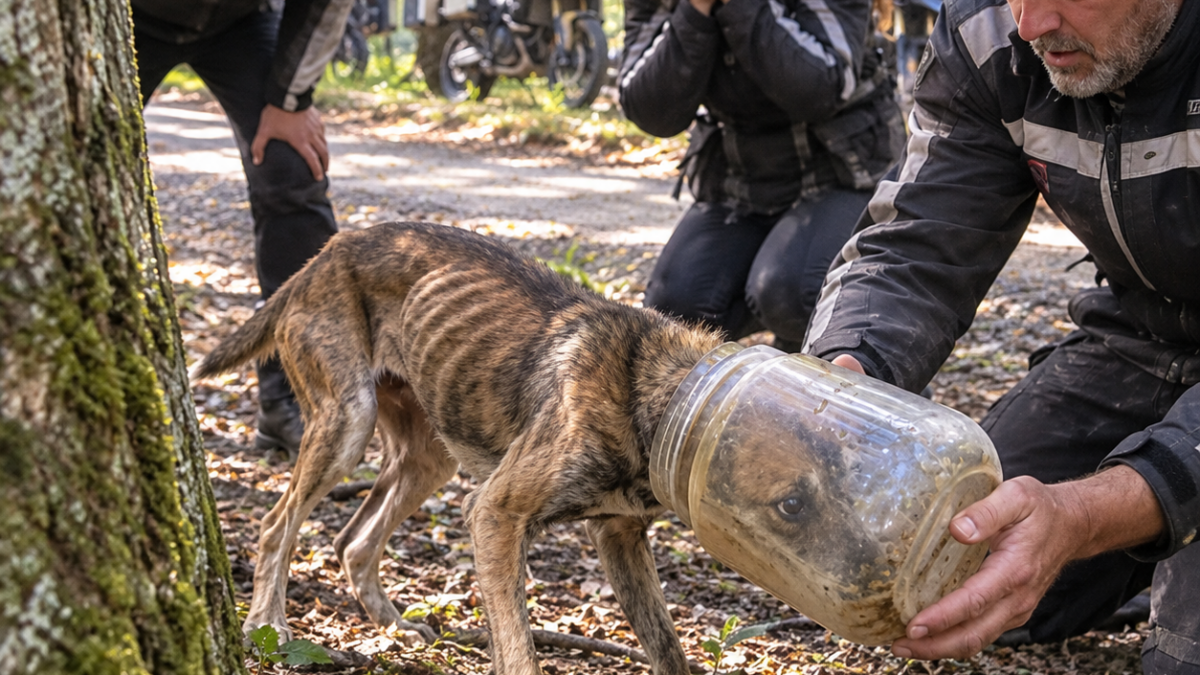
The dog was suffocating in a glass jar when we found her, but the strangest thing happened only after we finally gave her air. She was starving, staggering, and barely conscious, yet the moment she could stand, she fought every attempt to take her toward safety. And when I realized what she was trying to do, the six of us stopped thinking about a rescue and started wondering what was waiting deeper in the forest.
The sound had followed us for almost a kilometer.
Knock.
Silence.
Knock.
At 12:39 that July afternoon, our six motorcycles were moving along a narrow road through the Morvan forest in central France. Heat shimmered above the asphalt, and cicadas nearly swallowed the low growl of our engines.
But that sound was wrong.
I raised my fist.
The five riders behind me slowed immediately.
When we killed the engines, the forest seemed to inhale around us. No traffic. No voices. Just leaves moving high overhead.
Then it came again.
Knock.
Élodie pulled off her helmet.
“That isn’t a bird.”
At forty-three, she was the smallest in our group and somehow always the first to notice when something felt off.
We left the bikes on the shoulder and followed the sound through waist-high ferns.
I expected a hiker who had fallen, maybe a piece of trash swinging against a tree.
Instead, a brindled dog stumbled out from behind a fir.
For a second, none of us moved.
Her entire head was trapped inside a large glass jar.
She walked like she was drunk, shoulder striking one trunk, hip striking another. The jar hung heavily from her neck and dragged her muzzle toward the ground.
The glass was cloudy with dirt and condensation.
The fog from her breath was the only proof she was still alive.
Then she heard us.
She panicked.
The dog tried to run, slammed the jar against a tree, and crashed onto her side.
Her legs clawed at the pine needles.
Somehow, she got back up.
But she didn’t run toward the road.
She kept turning in the same direction.
Northwest.
“Don’t chase her,” Marc said. “We close in slowly.”
Marc had worked for years as a first responder. He used the same calm voice with frightened animals that he used with injured people.
We spread out so she couldn’t tumble down a rocky embankment.
She made it another twenty feet.
Then her legs folded.
She collapsed beside the exposed roots of an old oak.
I had approached terrified dogs before. Some growled. Some snapped.
This one did neither.
Even lying on her side, she kept trying to crawl.
Not far.
Just northwest.
I caught the jar before it struck another root.
Behind the filthy glass, her eyes were almost shut. Her tongue lay dark and swollen against the bottom.
Marc pressed two fingers against her chest.
“Her heart is racing.”
“Can we pull it off?”
He studied the rim wedged tightly behind her ears.
“Not without hurting her badly.”
Élodie ran back for the first-aid kit we kept in a saddlebag.
We wrapped the jar in a thick emergency blanket, lubricated the rim, and tried to ease it over the swelling around her neck.
Nothing moved.
She must have pushed her head inside before the tissue behind her ears became inflamed. Hours of struggling had turned the jar into a vise.
Then, for one terrifying second, her chest stopped moving.
Marc looked at me.
“We break it.”
Nobody argued.
We covered her eyes, wrapped the glass again, and used the smallest emergency hammer we had.
One controlled tap.
A crack spread across the jar.
Another.
The glass split.
We peeled the broken pieces away beneath the blanket, one section at a time.
The dog sucked in a breath so deep that all six of us froze.
Then she coughed.
Once.
Twice.
Air finally reached her.
Élodie started crying without making a sound.
I thought the worst was over.
I was wrong.
We offered water a little at a time. She drank desperately, then tried to rise.
“Easy,” I whispered. “We’ve got you.”
I reached beneath her chest to carry her toward the road.
The dog twisted away.
She staggered three steps northwest and collapsed.
I tried again.
Again she resisted.
Not violently.
Desperately.
Marc stared at her, then at the trees.
“She’s not trying to escape us.”
The dog forced herself upright.
Her ribs showed beneath her coat.
She looked back at us once.
Then she limped deeper into the forest.
That was when we heard something else.
PART 2
At first I thought the sound was another animal moving through the brush.
Then it came again.
High.
Weak.
Almost too faint to hear.
A whimper.
Élodie’s face changed immediately.
“Did you hear that?”
Marc nodded.
The brindled dog did too.
Her ears lifted.
For the first time since we had removed the jar, something stronger than exhaustion moved through her body.
She tried to run.
She managed three awkward steps before nearly falling.
I caught her under the chest.
This time she didn’t twist away from me.
She only stared northwest.
Then she whined.
It was the first sound we had heard her make.
Marc looked at the sagging skin beneath her belly.
Then at me.
“Oh, no.”
I knew what he had seen.
Her nipples were enlarged.
Some were crusted with dried milk.
“She’s nursing.”
Élodie whispered the words.
Nobody spoke for a second.
The dog had almost suffocated inside a jar because she had been searching for food.
And somewhere in that forest, something was waiting for her to come back.
We moved.
Marc took the dog’s front weight with one arm beneath her chest while I supported her hips. We weren’t carrying her toward the road anymore.
We were carrying her where she wanted to go.
Every few yards, we lowered her enough for her paws to touch the ground.
She would pull northwest.
Then we would lift her again.
The forest became thicker as we left the old footpath.
Fern fronds slapped against our jeans.
Bramble vines caught our sleeves.
The ground dropped into a shallow ravine where an old forestry track had almost disappeared beneath moss and weeds.
The whimper came again.
Closer now.
The dog began struggling in our arms.
“Okay,” I told her. “Show us.”
We put her down.
She limped toward a stand of hazel bushes.
There was nothing there at first.
Then Élodie pushed aside a branch.
Behind it stood the remains of a tiny stone storage hut.
Half the roof had collapsed.
A sheet of green plastic had been pulled across the opening and weighted with rocks.
The dog scratched at it.
Marc crouched and lifted one corner.
The smell hit us first.
Urine.
Feces.
Wet earth.
And something sour from spoiled food.
Inside the darkness was a plastic transport crate.
A large one.
The door had been tied shut with electrical wire.
Something moved behind it.
Élodie covered her mouth.
“Oh, God.”
Four puppies were pressed together inside.
They were so small that for a moment I couldn’t understand how they were still alive.
One lifted its head.
Another crawled over its sibling and gave a dry little squeak.
A third barely moved at all.
The fourth was wedged against the back wall, its muzzle resting in an empty metal bowl.
The mother dog pushed past Marc.
She reached the crate and began licking through the metal door.
Every puppy that still had strength came alive.
They made sounds I will never forget.
Not barking.
Not normal puppy cries.
Tiny broken noises.
Relief.
Recognition.
Hunger.
Their mother had come back.
Élodie dropped to her knees.
“Who does this?”
Marc pulled a multitool from his pocket and cut the wire.
When the crate door opened, the brindled dog crawled halfway inside.
The puppies buried themselves against her.
She lay down immediately.
Her entire body shook.
One puppy found milk.
Then another.
The weakest didn’t move.
Marc reached in.
He was a tiny male with a dark muzzle and white toes.
When Marc lifted him, his head fell backward.
“Still breathing,” he said.
Barely.
We had water, clean cloths, glucose gel and basic emergency equipment for roadside accidents.
Nothing designed for newborn animals.
But Marc had spent years making do until professional help arrived.
He rubbed a tiny amount of glucose against the puppy’s gums.
Élodie called the nearest veterinary clinic.
I called emergency services and explained where we were.
Then I heard Marc count.
“One, two, three, four.”
He looked into the crate again.
His eyes moved to the mother.
Her body told the story before any of us said it.
Five active mammary glands were swollen.
Possibly six.
Marc looked around the hut.
“There may be another puppy.”
We searched everywhere.
Behind the crate.
Beneath the tarp.
Under a broken wooden pallet.
Nothing.
The mother suddenly stood.
She left the four puppies.
Then she walked back outside.
I followed.
She crossed the ravine and stopped beside a drainage pipe partly buried beneath leaves.
She lowered her head toward it.
Whined.
Something answered.
A tiny squeal came from underground.
Élodie was beside me instantly.
The pipe was narrow, no more than ten inches across, and disappeared beneath the remains of the forestry track.
I shone my phone light inside.
Two little eyes reflected back.
“There.”
The puppy was perhaps six feet in.
Alive.
But too deep for an arm.
And the pipe narrowed where roots had crushed one side.
“He must’ve crawled in,” Marc said.
“Or rolled down here.”
The mother began digging.
Her paws tore frantically at the wet soil around the pipe.
I put my hand over her shoulders.
“We know. We know he’s there.”
She didn’t know that.
She only knew one of her babies was trapped.
The puppy squealed again.
The mother went wild.
She tried to shove her head inside the pipe.
After what had just happened with the jar, the sight made my stomach turn.
Marc caught her.
“No. Not again.”
We needed another way in.
The pipe ran beneath perhaps ten feet of dirt before emerging on the opposite side of the old track.
Jean and Luc circled around.
A minute later Jean shouted.
“Here!”
The far opening was almost completely buried beneath mud.
We started digging.
No shovels.
Just our hands, boots, a tire iron and the folding tools from our motorcycles.
Dirt packed beneath my fingernails.
Stones tore the skin across Luc’s knuckles.
Nobody cared.
Every thirty seconds, one of us called into the pipe to make sure the puppy was still responding.
At first he squealed.
Then he stopped.
“Marc.”
“I know.”
We dug faster.
Finally Jean pulled away a clump of roots.
Cold air moved through the pipe.
Luc reached inside from his side.
“Can’t get him.”
I lay flat at the opposite opening.
The light showed the puppy curled in the middle.
He wasn’t crawling anymore.
Marc handed me a length of clean cloth.
“Can we slide him?”
We fed the cloth beneath him using a flexible branch.
Millimeter by millimeter, we created a sling.
Jean pulled from one side while I guided from the other.
The puppy moved.
Three inches.
Six.
A foot.
Then Jean reached in.
“I have him.”
He backed away from the pipe holding a mud-covered brindled puppy in both hands.
The mother nearly knocked him over.
She licked the puppy’s entire face.
He coughed.
One tiny paw moved.
Élodie burst into tears.
I think all of us came close.
We had found five puppies.
All alive.
But the situation around us was beginning to feel less like an accident.
The transport crate bothered me.
So did the wire.
So did the tarp.
A mother dog might choose an abandoned hut to hide her litter.
She would not wire herself and five puppies inside a transport crate.
Someone had put them there.
And someone had left them without enough food or water.
I began looking around more carefully.
Near the wall was an empty dog-food sack.
Beside it sat two glass jars.
Both were wide-mouthed.
One had dried meat residue inside.
The same kind of jar that had nearly killed the mother.
My stomach tightened.
Maybe she had pushed her head into one while searching for food.
Maybe the jar had been left carelessly.
But the more we looked, the worse it became.
A torn blanket lay beneath the crate.
There were tire tracks outside the hut.
Fresh ones.
The ground had been dry for several days, but a shaded patch of mud near the ravine had held the tread perfectly.
Élodie was photographing everything.
“Don’t move that sack,” she said.
I looked at her.
“Why?”
She pointed.
There was a shipping label still attached to it.
Most of the paper had been torn away.
But part of a name remained.
P. Vaut—
And underneath it, a postal code.
Marc saw it too.
“Photograph it.”
She already had.
A distant siren finally reached us.
Help was coming.
The mother dog was lying with her puppies again.
Her eyes kept closing.
Every time one puppy squeaked, they opened.
I crouched beside her.
“You did it,” I whispered.
She looked at me.
No tail wag.
No dramatic reaction.
Just exhaustion.
But she no longer tried to crawl away.
She had brought us where she needed us.
That was enough.
The first person to reach us was a volunteer firefighter from a nearby village.
Then two gendarmes arrived with an officer from the local animal protection organization.
The veterinarian we had called couldn’t reach the hut by car, so she parked near our motorcycles and came down the track carrying a medical bag.
Dr. Camille Renaud was younger than I expected.
She stepped beneath the tarp, looked at the mother and puppies, and her expression hardened.
“How long have they been here?”
“We don’t know.”
She touched the mother’s gums.
Checked her eyes.
Listened to her heart.
Then she examined the puppies.
“We move all of them now.”
“Can she walk?”
“No.”
That answer ended the discussion.
The firefighters brought a rescue stretcher.
We placed blankets around the mother and arranged all five puppies against her body.
She allowed it.
The dog who had panicked when six strangers approached her now let us lift her without resistance.
The smallest puppy—the one Marc had treated with glucose—was placed against her chest.
As we carried them back through the trees, her head remained raised.
She counted them.
I’m convinced of that.
Her eyes moved from one puppy to the next until she had seen all five.
Only then did she lower her head.
At the road, the veterinary clinic had sent a van.
Before we loaded her inside, one of the gendarmes approached me.
“Who found the food sack?”
“Élodie.”
“Did anyone touch it?”
“Not after we noticed the label.”
He nodded.
“There are fresh vehicle tracks too.”
“We saw them.”
The officer looked toward the forest.
“This area isn’t a normal dumping site.”
The way he said it made me ask the obvious question.
“Have you seen something like this before?”
He hesitated.
“Not exactly.”
That wasn’t an answer.
But he didn’t say more.
We followed the veterinary van into town.
Our motorcycles must have looked absurd rolling behind it like an escort.
At the clinic, the mother was immediately placed on fluids.
The puppies were weighed.
The weakest was just over a kilogram.
Dr. Renaud ran blood work and checked each animal for parasites, dehydration and infection.
The mother had cuts behind both ears where the jar had rubbed her skin raw.
Her paws were damaged.
She was dangerously thin.
Her body had been producing milk while she herself had almost nothing to eat.
There was something else.
Old scars.
One ran across her flank.
Another circled part of her neck.
And her teeth showed wear inconsistent with her estimated age.
Dr. Renaud ran the microchip scanner along her shoulders.
It beeped.
We all looked up.
“She’s chipped.”
That should have been good news.
Instead, the veterinarian frowned at the computer.
“What?”
She didn’t answer immediately.
She checked the number twice.
Then she picked up the phone.
The mother dog’s name was Maya.
She was five years old.
Her registered owner lived less than twenty kilometers from the forest.
A man named Pascal Vautrin.
And three months earlier, according to the database, Pascal had reported Maya missing.
Élodie crossed her arms.
“Missing?”
“That’s what it says.”
I thought about the puppies.
They were roughly four weeks old.
Maybe five.
Dr. Renaud’s expression told me she was doing the same calculation.
A dog’s pregnancy lasts a little over two months.
If Maya had truly disappeared three months earlier, it was possible she had become pregnant while wandering.
Possible.
But something didn’t fit.
I remembered the food sack.
P. Vaut—
I called the gendarme.
He answered on the second ring.
I told him the name attached to Maya’s chip.
There was a pause.
Then he said, “Do not contact the owner.”
That sentence changed the room.
“Why?”
“We’ll handle it.”
He hung up.
Élodie stared at me.
“That sack.”
“Yeah.”
“P. Vaut…”
“Yeah.”
Marc sat beside Maya’s kennel.
She was asleep now, the five puppies tucked against her.
He didn’t turn around when he spoke.
“If it’s him, I don’t want him near her.”
None of us did.
Around six that evening, two gendarmes arrived at the clinic.
One was the officer from the forest.
His name was Lieutenant Morel.
He asked us to describe everything from the beginning.
The knocking sound.
The jar.
Maya’s direction of travel.
The hut.
The wired crate.
The puppies.
The fifth puppy in the drainage pipe.
The sack.
The tracks.
Then he asked Dr. Renaud to document every injury.
Photographs.
Weights.
Body condition.
Blood results.
Everything.
When he finished, I asked the question we were all thinking.
“Is Vautrin coming here?”
“No.”
“Does he know she’s been found?”
“Not from us yet.”
“What’s going on?”
Morel studied us for a moment.
Then he chose his words carefully.
“Mr. Vautrin has previously sold dogs.”
“Breeder?”
“Officially, not anymore.”
That word—officially—landed hard.
Morel continued.
“There have been complaints over the years. Noise. Dogs escaping. Questions about sales. Nothing that established what we would need for a serious case.”
“And now?”
“Now we have a dog registered to him found severely neglected with a litter in a wired crate. We have material at the site that may connect to an address. We have tire impressions. We will investigate before making conclusions.”
Marc turned from the kennel.
“He reported her missing.”
“Yes.”
“Do you believe him?”
Morel’s face didn’t change.
“My job is to prove what happened, not believe what I want to be true.”
I respected him for that.
It was exactly what we needed.
Anger is easy.
Evidence is harder.
And if somebody had done this deliberately, I didn’t want rage.
I wanted proof strong enough that no one could talk their way out of it.
The next morning, Maya was still alive.
That sounds like a small sentence.
It didn’t feel small.
Her temperature had stabilized.
She had eaten several spoonfuls of a high-calorie veterinary diet.
Four puppies were nursing normally.
The smallest male was being supplemented.
Élodie named him P’tit Marc as a joke because Marc had been the first to treat him.
Marc pretended to hate it.
The name stuck for three days.
Then Dr. Renaud told us the shelter would eventually choose proper names.
Maya, however, already knew hers.
When the veterinarian said it, Maya’s head lifted.
“Maya.”
Her ears moved.
Dr. Renaud said it again.
Maya looked at her.
That confirmed the chip record in a way technology never could.
This dog had belonged to somebody.
She had heard that name before.
At 10:15, Lieutenant Morel called.
“Can you return to the forest?”
We did.
The old hut had been taped off.
A forestry officer stood beside the road.
Morel was waiting near a small wooden post I hadn’t noticed the day before.
Mounted ten feet up was a wildlife camera.
Élodie saw it and immediately understood.
“No way.”
Morel almost smiled.
“It belongs to the forestry service.”
The camera had been installed because illegal dumping had become a problem along several remote tracks.
It did not point directly at the hut.
But it covered the entrance to the forestry road.
Morel held a tablet.
“Two days before you found the dogs, a vehicle entered at 5:21 in the morning.”
He showed us a still image.
A white panel van.
At 5:33, it left.
Twelve minutes.
The rear license plate was visible.
Not perfectly.
But enough.
Morel swiped to another image.
A clearer angle.
Élodie inhaled sharply.
“Whose?”
Morel looked at us.
“The vehicle is registered to Pascal Vautrin.”
Nobody celebrated.
I had imagined that proof would feel satisfying.
It didn’t.
I looked toward the trees and pictured Maya in the crate.
Five puppies.
No real supply of water.
No food except whatever scraps had been abandoned with them.
At some point, Maya had gotten out.
Maybe the crate door had not been fully secured.
Maybe she had bent something loose.
She had gone searching.
She had found a jar with food residue.
Pushed her head inside.
Then couldn’t get it back out.
And even while suffocating, she had tried to return to her puppies.
Morel wasn’t finished.
“There’s more.”
He held up another still.
The driver had stepped briefly from the van near the camera.
The side of his face was visible.
So were his clothes.
A heavyset man.
Gray hair.
Dark work pants.
Green shirt.
The same man was listed on the vehicle registration.
Pascal Vautrin.
Élodie’s voice shook.
“He dumped them.”
Morel remained careful.
“The images place his vehicle here. We are continuing.”
“But you know.”
“I know what the evidence currently shows.”
“What happens now?”
His answer was simple.
“We go see Mr. Vautrin.”
We weren’t allowed to come.
That was probably wise.
Instead, we went back to the clinic.
Maya was standing.
Barely.
But standing.
When Élodie entered the kennel area, Maya’s tail moved once.
One tiny sweep against the blanket.
Élodie froze.
“Did you see that?”
Marc smiled.
“I saw it.”
She crouched.
Maya took two steps toward her.
Then stopped and looked back at the puppies.
Élodie sat on the floor.
“You don’t have to choose,” she whispered. “They’re coming too.”
Three hours later, Lieutenant Morel called again.
His voice was different.
Tighter.
“Do you remember seeing any other dogs at the hut?”
“No.”
“Any collars? Chains?”
“There was old junk, but nothing I noticed.”
“Okay.”
“What happened?”
A pause.
Then:
“We found dogs at Vautrin’s property.”
“How many?”
He didn’t answer directly.
“Enough that an animal welfare team is responding.”
My hand tightened around the phone.
“Are they alive?”
“Yes.”
That mattered most.
Later we learned there were eleven.
Eleven dogs.
Some in outdoor runs behind an old agricultural building.
Others inside crude kennels.
Several were underweight.
Two had untreated skin infections.
One elderly female had a mammary mass that should have been examined long before.
Three young dogs had no current identification paperwork.
There were transport crates stacked against a wall.
The same brand and model as the crate in the forest.
There were green feed sacks.
Same manufacturer.
And in a storage area, investigators found a box containing the same type of large glass jars.
Pascal Vautrin had an explanation for everything.
The van?
He used the forest road regularly.
The feed sack?
Thousands were sold.
The crate?
Common model.
Maya?
She had escaped months earlier.
The puppies?
Not his.
The fact that his van appeared on the forestry camera forty-eight hours before Maya and her puppies were found?
Coincidence.
According to Morel, Pascal claimed he had gone into the forest to collect firewood.
At 5:21 in the morning.
For twelve minutes.
Without any firewood visible in the van when he left.
It was a bad story.
But bad stories aren’t the same as convictions.
Pascal knew that.
For the first week, he denied everything.
Then something happened that he apparently hadn’t expected.
People began talking.
Not because we launched some internet crusade.
We didn’t.
The animal rescue organization made a brief public announcement after authorities approved it.
Five puppies and an adult female had been recovered from severe neglect in the Morvan.
That was all.
No suspect named.
No address.
No accusations.
But in small communities, stories move.
A woman named Sophie called the gendarmerie.
She had bought a puppy from Pascal Vautrin two years earlier.
Cash.
No proper sales agreement.
The puppy had become dangerously ill within forty-eight hours.
Another family came forward.
Then another.
A former neighbor reported hearing litters behind Vautrin’s building at times when he claimed to own only two dogs.
A delivery driver remembered frequent shipments of dog food.
None of those things alone proved Maya had been abandoned.
Together, they gave investigators somewhere to look.
The most important call came nine days after the rescue.
A young man named Adrien asked to speak with Lieutenant Morel.
Adrien had worked occasionally for Pascal.
Cleaning kennels.
Repairing fences.
Delivering feed.
At first he claimed he knew nothing about Maya.
Then Morel showed him a photograph.
Not the forest.
Maya.
Adrien went silent.
He knew her.
Everyone there had known her.
She had produced multiple litters.
The last pregnancy had been accidental, according to Pascal.
Or inconvenient.
The puppies were mixed breed.
They weren’t worth what his usual dogs could bring.
And Maya had become thin after giving birth.
Adrien said Pascal complained she “looked terrible” and would attract attention if customers saw her.
Then Adrien said something that turned the investigation.
Three days before we found Maya, Pascal had told him to load a transport crate into the white van.
The crate contained puppies.
Maya was placed in the van separately.
Adrien asked where they were going.
Pascal said:
“Somewhere they won’t come back from.”
Adrien didn’t go with him.
He didn’t stop him either.
When he learned the animals had been found alive, guilt finally did what fear had prevented.
He talked.
That statement led investigators back through Pascal’s property records and phone.
The phone had connected to a cellular tower covering the forest during the exact period recorded by the wildlife camera.
His fuel receipt placed him on the road shortly beforehand.
More importantly, investigators recovered messages.
One was sent to a friend the evening before.
It said:
“Getting rid of the brindle one and the useless litter tomorrow.”
There are moments when anger becomes so clean it feels cold.
When Morel eventually told us about that message, I stopped speaking.
Élodie walked outside.
Marc stared through the clinic window.
Maya was lying in the sun.
She had gained almost three kilograms.
Her wounds were healing.
Her puppies were rounder now.
They climbed over her legs and bit each other’s ears.
She had survived.
That mattered.
But she had survived something that had been planned.
The jar had been an accident.
Being in that forest was not.
Pascal had left her there.
He had left the puppies.
And Maya, starving, had done what mothers do.
She searched for food.
That was how her head ended up trapped.
The strangest part was that Pascal still tried to get her back.
His lawyer sent a letter claiming Maya remained his legal property and demanding that the clinic prevent her “unauthorized transfer.”
When Dr. Renaud read it, she actually laughed once.
Not because it was funny.
Because sometimes something is so outrageous that your body chooses laughter instead of shouting.
“He wants her back?”
Élodie said.
Dr. Renaud placed the letter on the counter.
“He wants control.”
Maya was technically registered to him.
That complicated things.
But the authorities had already placed her under protective seizure pending the investigation.
Pascal could demand whatever he wanted.
He wasn’t getting through the clinic door.
A week later he tried anyway.
I happened to be there.
So was Marc.
We had stopped by after work with new washable blankets.
A white van pulled into the parking area.
I recognized it immediately.
Pascal stepped out.
The first thing I noticed was his green work shirt.
Not the same shirt from the camera necessarily.
But close enough that my stomach turned.
He walked toward the entrance.
Dr. Renaud saw him through the glass.
She locked the door.
He knocked.
Hard.
She didn’t open it.
He knocked again.
“I’m here for my dog.”
Dr. Renaud spoke through the closed door.
“You need to leave.”
“That dog belongs to me.”
“She is under official protective seizure. You know that.”
“My name is on the chip.”
“So is the seizure order.”
He looked past her and saw me.
Recognition flickered.
Maybe he had seen us in one of the photographs authorities took for statements.
Maybe someone had told him about the bikers.
He pointed.
“You’re the one who stole her.”
I almost moved toward the door.
Marc put a hand against my chest.
“No.”
Pascal shouted again.
“You had no right to take my property.”
Then Maya heard his voice.
She was in a recovery room behind the reception area.
We couldn’t see her.
But we heard something fall.
A metal bowl hit the floor.
Dr. Renaud turned.
Then came the sound.
Maya barking.
Not the normal bark we had finally begun hearing when the puppies played.
This was different.
Sharp.
Panicked.
She slammed against the kennel door.
Élodie, who had been in the back room, appeared.
“She’s shaking.”
That was all I needed to hear.
Marc had to say my name twice before I realized my hands were clenched.
Pascal heard the barking too.
His expression changed.
Not guilt.
Annoyance.
“See? She knows me.”
Dr. Renaud’s face went completely still.
“Yes,” she said. “I believe she does.”
Then she called the gendarmerie.
Pascal left before they arrived.
But the clinic’s cameras recorded the entire thing.
Including his demand for Maya.
Including his admission that she was his dog.
That became important later because his lawyer had begun floating another possibility—that the microchip registration was outdated and Maya might have changed hands.
Pascal’s own words destroyed that argument.
For once, his arrogance helped us.
Maya’s recovery took nearly two months.
The puppies recovered faster.
They became the kind of healthy chaos that makes a veterinary clinic reconsider every object placed below knee level.
They stole towels.
Chewed the corner of a cardboard box.
Knocked over a mop bucket.
One of them developed a fascination with Marc’s boots.
The smallest puppy—the one we had pulled from the pipe—became the boldest of all.
The rescue named him Milo.
P’tit Marc was retired.
Marc objected for approximately ten seconds.
Then he secretly called him P’tit Marc whenever nobody from the shelter was listening.
Maya changed more slowly.
She gained weight.
Her coat began to shine.
The wounds behind her ears closed.
But emotional injuries don’t appear on blood tests.
For weeks, she hated enclosed spaces.
If a glass bowl was placed near her food, she backed away.
The clinic switched to metal dishes.
If someone carried a large jar through the treatment room, Maya froze.
And whenever a white van entered the parking lot, her entire body became rigid.
Élodie noticed first.
She began visiting at the same time every afternoon.
No pressure.
No grabbing.
No forcing affection.
She sat on the floor and read books.
Sometimes Maya stayed across the room.
Sometimes she moved closer.
One afternoon, Maya rested her head on Élodie’s boot.
Élodie didn’t move for twenty minutes.
Her leg went numb.
She didn’t care.
I watched from the doorway.
“You know what’s happening here, right?”
She looked at me.
“Don’t say it.”
“You’re adopting her.”
“I said don’t say it.”
Maya sighed and pressed her head harder against Élodie.
I smiled.
“Maya seems to have voted.”
Élodie wiped her eyes.
“We don’t even know if I’ll be allowed.”
“We will.”
“How do you know?”
I didn’t.
But after everything Maya had fought through, I couldn’t imagine the story ending any other way.
Pascal delayed that ending as long as he could.
His lawyer challenged the seizure.
He claimed the animals on his property were adequately cared for.
He claimed Adrien was a disgruntled worker.
He claimed the forest camera did not prove what was inside his van.
He claimed the text message about “getting rid” of Maya meant he intended to rehome her.
He claimed abandonment was an interpretation.
Then investigators found the photograph.
It was on Pascal’s phone.
Taken at 5:27 the morning he entered the forest.
Maya was visible beside the ruined hut.
So was the transport crate.
Pascal apparently took the picture to send to someone.
Maybe as proof the job was done.
He never sent it.
But he never deleted it properly either.
Digital investigators recovered it.
In the photograph, Maya was standing beside the crate.
Her ribs were visible.
The five puppies were inside.
There was no water.
And beside the crate were the same glass jars we had found.
The timestamp matched the wildlife camera.
The phone location matched.
The van matched.
The dog matched.
The crate matched.
The forest matched.
There was no story left to tell.
Only what he had done.
The investigation expanded.
Several of the dogs seized from Pascal’s property had veterinary problems consistent with long-term neglect.
Records showed repeated litters.
Advertisements had been posted under multiple names and phone numbers.
Cash payments were common.
Documentation was inconsistent.
None of that was as dramatic as the photograph.
But cases aren’t won by drama.
They’re built piece by piece until denial has nowhere left to stand.
Months passed.
Autumn arrived.
The Morvan turned gold, then brown.
Our riding group returned to the forest once before winter.
Not to the hut.
Authorities had removed the crate and debris.
The site was being cleaned.
We stopped at the roadside where we had first heard the knocking.
For a while nobody spoke.
Jean finally said, “We almost kept riding.”
He was right.
The sound had been faint.
We were moving.
Helmets on.
Engines running.
Another curve in the road and maybe we wouldn’t have heard it again.
I hated thinking about that.
Marc understood what I was doing.
“Don’t.”
“Don’t what?”
“Build a version where we weren’t there.”
I looked at him.
He shrugged.
“We were.”
Simple.
True.
Sometimes that has to be enough.
The court hearing took place the following spring.
By then all five puppies had been placed with approved families.
Milo went to a retired couple with a fenced garden and a granddaughter who sent the shelter photographs every week.
Another puppy, Luna, went to a veterinary technician.
The largest male went to a family with two older dogs.
All five were sterilized at the appropriate age.
All five were healthy.
Maya remained in foster care with Élodie while ownership was legally resolved.
She slept beside Élodie’s bed.
Not on it.
Maya preferred the floor where she could see the door.
She had discovered couches but treated them with suspicion.
She loved chicken.
She hated jars.
And the first time Élodie started her motorcycle near the house, Maya ran to the window and barked until Élodie came back inside.
“She thinks motorcycles bring rescuers,” Élodie told us.
Maybe.
Or maybe she simply recognized the sound of the people who had followed her when she refused to give up.
On the morning of the hearing, the six of us arrived separately.
No leather-clad intimidation.
No spectacle.
We weren’t there to perform.
We were witnesses.
Pascal entered with his attorney.
He looked smaller than I remembered.
Not physically.
Some people seem powerful only while everyone around them is afraid to challenge their version of events.
Put evidence on a table and that kind of power shrinks quickly.
Adrien testified.
His voice shook.
He admitted he had suspected what Pascal intended.
He admitted he should have called someone earlier.
He didn’t ask to be seen as a hero.
That made me believe him more.
Dr. Renaud testified about Maya’s condition.
Severe dehydration.
Malnutrition.
Soft-tissue damage around the neck and ears.
Exhaustion.
Risk of suffocation.
Lactation while underweight.
The puppies’ dehydration and poor condition.
The prosecutor asked a simple question.
“In your professional opinion, could Maya and her puppies have survived indefinitely under the conditions in which they were found?”
“No.”
“How much longer?”
Dr. Renaud paused.
“The puppies might have lasted longer than their mother because she was sacrificing her own reserves to feed them. Maya was already near collapse. With the jar obstructing her breathing, I would not confidently give her even another hour.”
An hour.
I stared at the table.
We had first heard that knock at 12:39.
Maybe by 1:39 she would have been gone.
Then the puppies would have waited.
And waited.
The wildlife-camera images were shown.
5:21.
White van entering.
5:33.
White van leaving.
Then the recovered photograph.
Maya beside the hut.
The crate.
The puppies.
The jars.
Pascal didn’t look at the screen.
The prosecutor read the recovered message.
“Getting rid of the brindle one and the useless litter tomorrow.”
Useless litter.
Five living animals reduced to two words.
Élodie was sitting behind me.
I heard her inhale.
Then came the clinic footage.
Pascal at the door.
“I’m here for my dog.”
“That dog belongs to me.”
“My name is on the chip.”
His own voice filled the courtroom.
His lawyer had spent months trying to create uncertainty around ownership.
Pascal had erased it himself in twenty seconds.
The defense argued that Pascal had intended someone to find the dogs.
There was no evidence he had tied the crate shut, they said.
No evidence he had placed the jar over Maya’s head.
That part was true.
Nobody claimed he had.
Maya probably trapped herself in the jar while searching for food.
But the prosecutor answered with a sentence I remember almost word for word.
“The jar was not the act of cruelty. The hunger that forced her to search inside it was part of the cruelty. The isolated forest was the cruelty. The wired crate was the cruelty. Driving away was the cruelty.”
The courtroom went completely quiet.
Pascal was convicted.
The penalties could never recreate what Maya had endured, and no courtroom result can make suffering disappear.
But it mattered.
He received a substantial sentence that included a custodial component largely suspended under strict conditions, financial penalties, and restitution for veterinary and rescue expenses.
More importantly to us, the court prohibited him from owning, breeding, selling or keeping animals for years.
The remaining dogs seized from his property were permanently removed.
His breeding activity was finished.
His equipment was confiscated where permitted.
His operation disappeared.
And Maya?
The court terminated his claim to her.
When the decision was read, Élodie gripped my forearm so hard her nails hurt.
She whispered, “She’s free.”
That evening we drove directly to the rescue.
Maya was in the fenced garden.
She saw Élodie first.
Her tail started.
Not one cautious movement.
A full wag.
Then her whole body joined it.
Élodie knelt.
Maya ran.
I had never seen that dog run without fear before.
She crossed the grass and hit Élodie hard enough to knock her backward.
Élodie laughed from the ground while Maya climbed across her chest and licked her face.
Marc turned away pretending to inspect the fence.
Jean suddenly became very interested in his boots.
I didn’t bother pretending.
I cried.
Dr. Renaud came outside carrying a folder.
Inside was the final transfer paperwork.
Maya officially belonged to Élodie.
Élodie signed.
Then she looked at Maya.
“You know what this means?”
Maya stared at her.
“You never have to go back.”
Maya sneezed.
We all laughed.
A year passed.
Then another.
Maya became almost unrecognizable.
Her ribs disappeared beneath healthy muscle.
Her coat turned deep brown and black, glossy in sunlight.
The scars behind her ears remained.
Small pale lines.
Élodie never tried to hide them.
“They’re part of her,” she said.
Maya learned that not every enclosed space was a trap.
She learned to sleep with her back exposed.
She learned white vans could deliver packages without taking anyone away.
She even learned to eat from a ceramic bowl.
Glass was never reintroduced.
Nobody saw the point.
But one fear stayed.
The forest.
For months, Maya refused to walk beneath dense trees.
She would stop at the edge and plant all four paws.
Élodie never forced her.
They walked fields instead.
Village roads.
Lake paths.
Open trails.
Then one autumn morning, almost two years after we found her, Élodie called me.
“Are you busy?”
“What happened?”
“Nothing.”
That usually means something.
“Maya walked into the woods today.”
I sat up.
“By herself?”
“With me. But she chose it.”
“How far?”
“Maybe fifty yards.”
“That’s huge.”
“I know.”
She paused.
“There’s something else.”
“What?”
“She kept pulling northwest.”
I knew immediately what she meant.
“No.”
“Yes.”
“You’re not taking her back there.”
“I didn’t say I was.”
But three weeks later, after talking with Dr. Renaud and a canine behavior specialist, we decided to try something carefully.
Not the hut.
Not immediately.
Just the road.
All six of us met there.
Same motorcycles.
Same group.
Different season.
Maya rode with Élodie in a secured vehicle, not on the bike.
When she stepped out, she sniffed the air.
Her body stiffened.
We waited.
Nobody pulled the leash.
Nobody coaxed.
Maya took one step.
Then another.
She reached the place where we had first found her.
She smelled the ground.
Of course there was nothing left after two years.
No glass.
No tracks.
No scent we could recognize.
Maybe she recognized nothing either.
Then she looked toward the trees.
Northwest.
Élodie glanced at me.
“What do we do?”
“The same thing we did last time.”
“What’s that?”
“Follow her.”
Maya walked.
Slowly.
She stopped often.
But she kept going.
The path to the old hut had changed.
Vegetation had grown back.
The forestry service had removed the dangerous debris and partially dismantled the unstable structure.
The drainage pipe had been replaced.
Sunlight reached places that had once been dark.
Maya entered the clearing.
Then stopped.
Every muscle in her body tightened.
Élodie crouched a few feet away.
“Maya.”
The dog didn’t look at her.
She stared at the space where the crate had been.
One minute passed.
Maybe two.
Nobody moved.
Then Maya walked forward.
She sniffed the ground.
Circled once.
And sat down.
That was all.
No collapse.
No panic.
No attempt to escape.
She simply sat.
Élodie went to her.
Maya leaned against her leg.
Marc quietly said, “I think she’s done.”
I knew what he meant.
Not forgotten.
You don’t need to forget a place to stop belonging to it.
We stayed for a few minutes.
Then Maya stood.
She turned away from the clearing.
And for the first time, she led us southeast.
Back toward the road.
Back toward home.
Halfway there, we heard a sharp sound.
Toc.
Every one of us froze.
Then it happened again.
Toc.
Maya lifted her head.
My heart jumped before my brain caught up.
Jean laughed.
A woodpecker was hammering at a dead tree.
Toc.
Toc.
Élodie started laughing too.
Soon all six of us were.
Maya looked from one person to another as if we had lost our minds.
Then her tail began wagging.
There was something perfect about it.
Two years earlier, a knocking sound in that forest had led us to a dying dog.
This time it was only a bird.
Nothing needed rescuing.
Nothing was trapped.
Nobody was waiting in the darkness.
We walked back to the road.
Maya climbed into Élodie’s car, turned twice on her blanket and lay down.
Before the door closed, I touched the pale scar behind her ear.
I thought about the first moment I had seen her through dirty glass.
Her eyes almost shut.
Her tongue dark.
Her body collapsing.
I thought about how every instinct in us had said the same thing once the jar came off.
Take her away.
Get her to safety.
Save her.
But Maya had understood something we didn’t.
Her own rescue wasn’t finished.
Five tiny lives were still behind her.
She had been starving.
She had been suffocating.
Her legs were failing.
And somehow, after we gave her the first clean breath she had taken in hours, she used it to lead us back to her babies.
People later told us we saved Maya.
That was never the whole story.
We broke the glass.
We carried her when she couldn’t walk.
We followed her through the forest.
But Maya was the one who refused to leave.
Maya was the one who remembered where her puppies were.
Maya was the one who kept moving northwest when her body had almost nothing left.
And because she refused to save only herself, five puppies grew up in safe homes.
Eleven other dogs were removed from a place where they had been treated like inventory.
A man who believed unwanted animals could simply disappear into the forest lost the right to control another one.
And a brindled dog who had once fought for every breath eventually learned what it felt like to sleep in a house where nobody would ever abandon her again.
A few months after that final walk, I visited Élodie on a cold Sunday morning.
Maya was asleep near the fireplace.
She was on the couch.
That surprised me.
“I thought she didn’t trust couches.”
Élodie smiled.
“She changed her mind.”
Maya opened one eye when she heard us.
Then closed it again.
On the shelf above her were framed photographs.
The five puppies.
Milo with the retired couple.
Luna beside her veterinary-tech owner.
The others with their families.
In the center was one photograph from Maya’s first healthy summer.
She was standing in a field.
No leash visible.
No cage.
No jar.
No forest pressing around her.
Just Maya in tall green grass, looking directly at the camera.
Élodie handed me coffee.
“She still wakes me up sometimes.”
“Nightmares?”
“Maybe.”
“What do you do?”
“Nothing complicated.”
She looked at Maya.
“I turn on the light so she can see where she is.”
Maya stretched.
Her paws extended toward the warmth.
Then she sighed and fell back asleep.
I watched her for a long time.
Sometimes justice is loud.
A courtroom.
A verdict.
A kennel door opening while seized dogs are carried into waiting vans.
Sometimes it is quieter.
Five puppies growing old in homes where they are wanted.
A rescue bill finally paid by the person responsible.
A white van disappearing from a property forever.
A woman signing her name on an adoption document.
And sometimes justice is simply a once-starving dog sleeping so deeply beside a fire that she no longer needs to keep one eye on the door.
That was the ending I wanted for Maya.
Not revenge measured in pain.
Something better.
The man who abandoned her expected the forest to erase what he had done.
Instead, Maya survived long enough to expose it.
He wanted her and her puppies to disappear.
Instead, every one of them lived.
He tried to reduce them to a “useless litter.”
Instead, they became the evidence that ended his operation.
And Maya—the dog he discarded because she had become inconvenient—was ultimately the reason eleven more dogs got their own chance to leave.
People sometimes ask which moment from that day I remember most clearly.
You might expect me to say the jar breaking.
Or the first enormous breath Maya took.
Or the puppies crying when their mother reached the crate.
I remember all of those.
But the image that stays with me is smaller.
After the glass came off, Maya was lying beneath that uprooted oak.
Her body was finished.
We were strangers.
The road was behind us.
Safety was behind us.
Everything easy was behind us.
I reached down to carry her away.
And Maya resisted.
Then she stood on shaking legs.
She took three steps northwest.
She fell.
She stood again.
At the time, I thought she didn’t understand that we were trying to save her.
Now I know I was the one who didn’t understand.
Maya knew exactly what rescue meant.
She just refused to let it end with her.
The judge did not read the decision quickly.
Maybe that was why every sentence felt heavier.
Pascal Vautrin sat at the defense table with his hands folded in front of him, staring at a spot somewhere below the judge’s bench.
For months, he had denied.
Explained.
Minimized.
Blamed.
He had called Maya an escaped dog.
The puppies an accidental litter.
The forest trip a coincidence.
The wire on the crate something he knew nothing about.
The message saying he was “getting rid of the brindle one and the useless litter” had supposedly meant he planned to find them another home.
Every explanation had required us to ignore one more piece of evidence.
The wildlife camera.
The van.
The time stamp.
Adrien’s testimony.
The phone location.
The photograph recovered from Pascal’s device.
The condition of the animals.
His visit to the veterinary clinic demanding Maya back.
And finally, Maya herself.
A dog could not testify.
But her body already had.
The scars behind her ears.
The raw paws.
The ribs visible beneath her brindled coat.
The milk she had kept producing while her own body starved.
The panic when Pascal’s voice reached her through the clinic door.
The judge spoke about responsibility.
Then neglect.
Then abandonment.
Then the repeated violations uncovered on Pascal’s property.
I barely heard the legal language.
I was watching Élodie.
She sat beside me with both hands clenched in her lap.
When the judge confirmed that Pascal’s claim of ownership over Maya was permanently terminated, Élodie stopped breathing for a second.
I felt her fingers close around my arm.
Then came the words we had been waiting nearly a year to hear.
Pascal would be prohibited from breeding, selling, keeping, or acquiring dogs for the period ordered by the court.
The seized animals would not be returned.
Financial penalties were imposed.
He was ordered to reimburse substantial veterinary and rescue costs.
The breeding operation that had existed in the gray area between neglect and profit was over.
No more litters behind that building.
No more cash sales.
No more dogs disappearing when they stopped being useful.
Pascal looked up only once.
Not at us.
Not at Adrien.
Not at the veterinarian.
He looked at the screen where, minutes earlier, the photograph of Maya and the puppies in the forest had been displayed.
Then he lowered his eyes again.
I had imagined I would feel triumphant.
I didn’t.
Justice didn’t feel like winning.
It felt like finally putting down something we had carried for too long.
Outside the courthouse, nobody cheered.
Marc lit a cigarette, took one drag, then crushed it beneath his boot.
“I quit six months ago,” he said.
Jean looked at him.
“Then why did you light it?”
Marc stared at the courthouse doors.
“I needed to do something with my hands.”
Élodie laughed through her tears.
It broke the tension.
Then Lieutenant Morel walked out carrying a folder.
He stopped in front of us.
“That’s it.”
“For him?” I asked.
“For this case.”
Then he looked at Élodie.
“And for Maya.”
Élodie’s face changed.
She understood before he said anything else.
“The shelter can finalize the transfer today.”
She covered her mouth.
After everything that had happened, that simple sentence defeated her.
We had watched Maya nearly suffocate.
We had crawled through mud for her puppy.
We had seen photographs of the place she had been discarded.
We had listened to lawyers debate whether the person who abandoned her still had legal rights over her.
Now a folder and one signature were going to do what no rescue tool could.
Make her safe permanently.
We drove straight to the shelter.
Maya was in the outdoor enclosure with Dr. Renaud.
By then, she was almost unrecognizable from the dog we had found in the forest.
Her ribs no longer showed.
The dull brindle coat had become glossy.
Her neck was stronger.
Her legs no longer trembled when she stood.
But the scars behind her ears remained.
They always would.
Maya saw Élodie through the fence.
Her entire body changed.
Her ears rose.
Her mouth opened.
Then her tail began moving.
Not the cautious little sweep we had celebrated months earlier.
A full wag.
Then another.
Then her hips joined in.
Élodie opened the gate.
“Maya.”
The dog ran.
Actually ran.
The first time I had seen Maya try to run, a glass jar had struck a tree and knocked her to the ground.
This time nothing stopped her.
She crossed the enclosure and slammed into Élodie hard enough to knock her backward onto the grass.
Élodie laughed and cried at the same time.
Maya climbed halfway over her and licked her chin.
“You’re free,” Élodie kept saying.
“You’re free.”
Dr. Renaud stood beside me.
“I think she already knew where home was.”
She handed Élodie the papers.
One final signature.
That was it.
Maya Vautrin ceased to exist on paper.
From that afternoon forward, she was simply Maya.
No connection to the man who had abandoned her was required.
No permission from him.
No claim.
Nothing.
That evening, the six of us went to Élodie’s house.
We ordered too much food.
Jean brought wine.
Marc brought an absurdly expensive dog bed.
Maya ignored it and slept beneath the kitchen table.
Every twenty minutes, Élodie looked down just to make sure she was still there.
Later that night, as we were leaving, I noticed five photographs stuck to Élodie’s refrigerator.
One for each puppy.
Milo was stretched across the lap of the retired man who had adopted him.
Luna was asleep beside another dog twice her size.
The third puppy was standing in snow for the first time.
The fourth had stolen a child’s stuffed rabbit.
The fifth was lying on a porch in the sunlight.
Five puppies Pascal had called useless.
Five animals he had driven into the forest expecting never to see again.
Every one of them had a family.
That was the revenge none of us could have planned.
They lived.
Time did what time does.
The story stopped appearing in local newspapers.
People moved on.
Another case replaced it.
Another scandal.
Another headline.
But Maya’s recovery continued quietly.
At first she slept with her body pressed against the bedroom door.
Any sound outside woke her instantly.
A car door.
A delivery truck.
Wind rattling the gate.
She would stand before Élodie even opened her eyes.
It took months before Maya slept deeply enough to dream.
The first time it happened, Élodie called me the next morning.
“She was running in her sleep.”
“Bad dream?”
“I don’t know.”
“What did you do?”
“Put my hand beside her. She woke up, saw me, and went back to sleep.”
That became their routine.
No drama.
No forcing her past fear.
Just proof, night after night, that when Maya opened her eyes, the same person was still there.
She learned the house slowly.
The kitchen first.
Then the living room.
For weeks she refused to step onto the couch.
Élodie bought ramps, blankets, treats.
Nothing worked.
Then one rainy Sunday, she walked into the room and found Maya asleep across the entire sofa as if she had owned it for years.
The expensive dog bed remained untouched.
Maya also developed opinions.
Strong ones.
Chicken was good.
Carrots were unacceptable.
Thunder was tolerated.
Vacuum cleaners were enemies.
Men wearing green work shirts were watched carefully.
Glass food containers were forbidden.
Élodie never tried to change that last one.
Some fears don’t need to be conquered to prove recovery.
Sometimes healing is simply having the freedom to avoid what hurt you.
Almost two years passed before Maya chose the forest again.
Élodie called me early one autumn morning.
Her voice was trembling.
“Maya walked under the trees today.”
I sat up in bed.
“How far?”
“Maybe fifty yards.”
“Did you lead her?”
“No.”
That mattered.
Élodie had spent two years refusing to pull Maya toward any wooded trail.
If Maya stopped, they turned around.
If she planted her paws, the walk ended.
This time, Maya had stood at the tree line for nearly a minute.
Then she stepped forward.
Fifty yards became a hundred the following week.
Then half a kilometer.
And eventually Élodie asked the question I had hoped she never would.
“Do you think we should take her back?”
I knew exactly where she meant.
“The forest?”
“The place.”
I wanted to say no.
There was no reason.
The hut was gone.
The investigation was finished.
Pascal was out of Maya’s life.
Why reopen it?
But Élodie had already spoken with Dr. Renaud and a canine behavior specialist.
Nobody suggested forcing Maya.
The idea was simple.
Drive to the road.
Open the door.
Let Maya decide everything else.
So on a cold October morning, the six of us returned to the Morvan.
The motorcycles came too.
It seemed right.
We parked almost where we had parked on the day we found her.
Élodie arrived last with Maya secured in the back of her car.
When the hatch opened, Maya didn’t jump down immediately.
She stood inside.
Nose raised.
Testing the air.
Her tail stopped moving.
The forest was almost silent.
No July heat now.
No cicadas.
Only leaves shifting under a pale sky.
Élodie clipped on the long leash but left it loose.
“You choose.”
Maya stepped down.
She smelled the roadside.
Walked a few yards.
Stopped.
Then turned toward the trees.
Northwest.
Nobody said anything.
Maya entered the forest.
We followed.
The path looked smaller than I remembered.
Maybe because that first day everything had felt enormous.
The fear.
The urgency.
The sound of Maya’s breathing inside glass.
Now there was only the soft crack of leaves beneath our boots.
Maya paused several times.
At the uprooted oak where she had collapsed, she stood for almost a minute.
Then she continued.
When we reached the clearing where the ruined hut had been, she stopped.
The structure was gone.
Forestry crews had dismantled what remained.
The old transport crate was evidence somewhere or already destroyed.
The jars were gone.
The drainage pipe had been replaced.
Sunlight reached the ground.
Nothing about the place looked dangerous anymore.
Maya didn’t know that.
Her body lowered.
Her ears went back.
Élodie crouched several feet away.
She didn’t call her.
Didn’t touch her.
Didn’t say, “It’s okay.”
Because people say that when they want an animal to believe something before the animal is ready.
Maya stared toward the spot where the crate had been.
I suddenly saw the scene again.
Five puppies pressed together.
Their mother pushing through us.
The smallest barely breathing.
Maya had once crossed this clearing starving and suffocating because she could not leave them.
Now there were no puppies here.
They were adults.
Safe.
Loved.
Alive.
Maya walked forward.
One step.
Then another.
She sniffed the earth.
Circled slowly.
Then sat down.
Nothing happened.
That was the miracle.
Nothing happened.
No panic.
No collapse.
No glass around her head.
No van returning.
No person coming to take her away.
Just Maya sitting in the middle of a place that had once contained the worst day of her life.
Élodie approached.
Maya leaned against her leg.
Marc whispered beside me.
“She beat it.”
I shook my head.
“No.”
He looked at me.
“She doesn’t have to beat it.”
I watched Maya.
“She just doesn’t belong to it anymore.”
After several minutes, Maya stood.
She looked toward the northwest once more.
Then turned.
Southeast.
Toward the road.
Toward the car.
Toward home.
She began walking.
We followed.
Halfway back, a sharp sound cracked through the trees.
Toc.
Every one of us stopped.
Another.
Toc.
My stomach tightened automatically.
Then Jean pointed upward.
A woodpecker clung to a dead tree.
Toc.
Toc.
For one second nobody reacted.
Then Élodie laughed.
Marc joined her.
Then Jean.
Soon all six of us were standing in the forest laughing at a bird.
Maya looked up at us as if we were ridiculous.
Then her tail started wagging.
The first knocking sound had led us to a dying dog.
This one meant nothing was wrong.
Nothing needed rescuing.
Nobody was trapped.
Nobody was waiting.
When we reached the road, Maya climbed into the car by herself.
She turned twice on her blanket.
Lay down.
And closed her eyes before Élodie had even started the engine.
Months later, I visited them one winter evening.
A fire was burning in the living room.
Maya was stretched across the couch.
All four paws in the air.
Completely exposed.
Completely asleep.
I stood in the doorway longer than I needed to.
Élodie noticed.
“What?”
“I was remembering how she used to sleep.”
“Facing the door?”
“Yeah.”
Élodie sat beside Maya.
On the wall above the couch were photographs of all five puppies.
Older now.
Healthy.
Milo had gray beginning around his muzzle.
Luna wore a ridiculous red raincoat.
Another was lying beside a toddler.
Every photograph was ordinary.
That was what made them beautiful.
No rescue scene.
No courtroom.
No suffering.
Just dogs living the lives they should have had from the beginning.
Maya stirred.
Her eyes opened.
She looked at me.
Then at Élodie.
Then she put her head back down.
No need to check the door.
No need to count puppies.
No need to run.
Élodie scratched behind one ear, careful around the old scar.
“She still wakes me sometimes,” she said.
“Nightmares?”
“Maybe.”
“What do you do?”
“The same thing every time.”
“What?”
“I turn on the light.”
I looked at her.
“So she can see where she is?”
Élodie nodded.
“So she can see where she is.”
That stayed with me.
Because maybe that was what the whole story had become.
Not forgetting what happened.
Not pretending the forest never existed.
Not erasing the scars.
Just waking up and realizing you are somewhere else now.
Pascal once believed he could drive Maya into an isolated forest and make his problem disappear.
Instead, Maya came back carrying evidence in every scar.
He tried to discard five puppies because they had no value to him.
They survived and became beloved members of five families.
He tried to keep control through paperwork and ownership.
A court took that control away.
He expected silence.
Instead, a frightened former worker testified.
Families spoke.
Veterinarians documented.
Investigators followed the trail.
And the dog he considered disposable became the reason eleven other dogs were taken out of his hands.
People sometimes call that revenge.
Maybe it was.
But not the kind where someone suffers because you hurt them back.
It was better.
Pascal lost the thing he had used animals for—control.
Maya gained everything he had denied her.
Food.
Safety.
Choice.
A home.
And rest.
Most of all, she gained the right to decide where she went next.
I still think about that first afternoon.
12:39.
The heat.
The motorcycles.
The strange knocking sound.
Maya beneath the oak.
Her head finally free of the jar.
Her lungs filling with air.
I had reached for her because every part of me believed rescue meant carrying her toward the road.
She fought me.
Three steps northwest.
Collapse.
Stand.
Three more steps.
At the time I thought she was confused.
She wasn’t.
She knew exactly where she needed to go.
Five puppies were waiting.
Her rescue could wait.
Theirs could not.
Years later, when Maya walked into that same forest again, there was one difference that mattered more than all the others.
The first time, she went northwest because someone she loved was trapped there.
The last time, she turned southeast because nobody was.
And this time, when Maya walked out of the forest, she wasn’t running from anything.
She was simply going home.








