PART 2: She Was Starving on a Heavy Chain—But Every Time We Reached for Her 5 Puppies, She Forced Herself to Stand
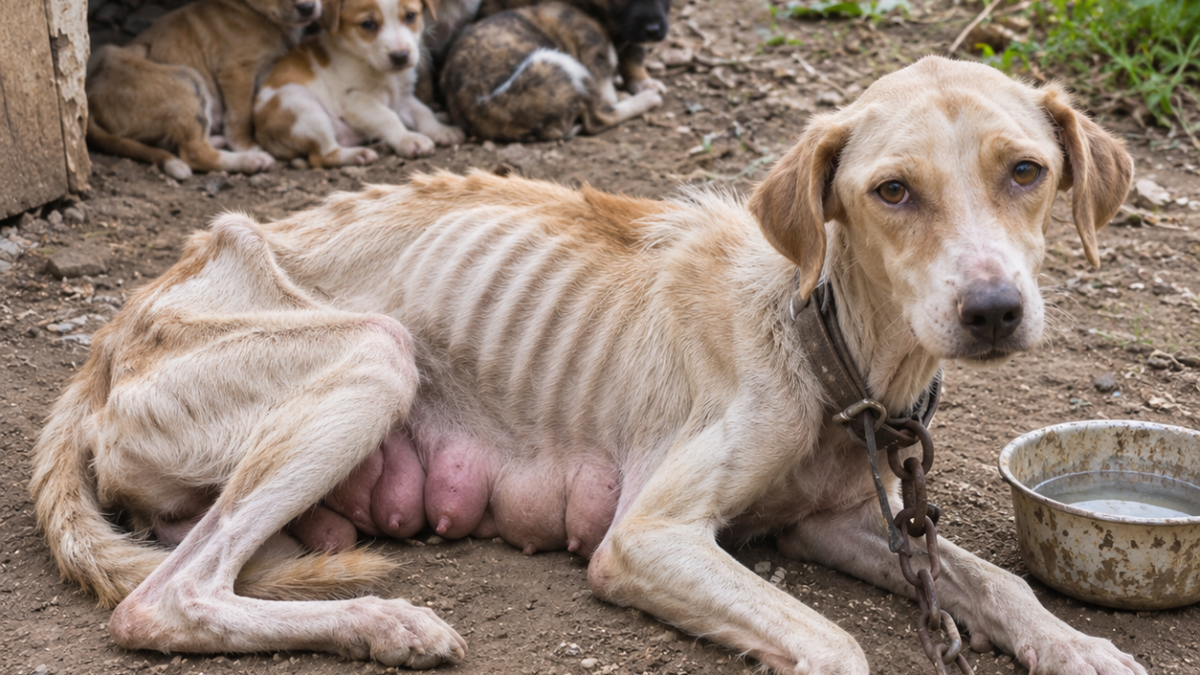
PART 2
I didn’t reach for the collar immediately.
That would have been the fastest way to destroy the small amount of trust she’d given me.
Instead, I sat down in the gravel.
The mother watched me.
Her puppies were inside the carrier only a few feet away. Daniel kept the door open so she could see and smell them.
The smallest puppy remained wrapped in the towel against his chest.
“She’s cold,” he whispered.
“I know.”
“We need to go.”
“I know.”
But rushing the mother could turn a rescue into panic.
I put my hands on my knees where she could see them.
“Listen, mama.”
Her ears moved.
“We’re taking all of you.”
She couldn’t understand the words.
Tone mattered anyway.
“You’re not staying here.”
I looked at the thick metal links running from her collar to the post.
“And that thing isn’t coming with you.”
Daniel crouched near the puppies.
The mother turned toward him immediately.
He stopped.
“She really doesn’t like me near them.”
“She doesn’t know you.”
“She doesn’t know you either.”
“No. But I’ve been bribing her.”
I pushed another small piece of food toward her.
She sniffed.
Ate it.
Then returned her attention to the carrier.
I slowly moved my hand toward the collar.
The mother became rigid.
I stopped.
“Okay.”
I waited another thirty seconds.
Tried again.
This time my fingertips touched the fur on her neck.
Her entire body trembled.
But she didn’t move away.
I gently scratched beneath the collar.
The skin underneath was raw.
Not bleeding heavily, but irritated from constant pressure and friction.
“How long has she been on this?” Daniel whispered.
“I don’t know.”
The buckle was stiff with dirt.
I tried once.
Nothing.
Again.
The mother shifted toward the puppies.
I stopped.
“Bolt cutters?” Daniel asked.
“Too close to her neck.”
“I’ve got small cutters.”
“Let me try the buckle first.”
I worked slowly.
The leather had almost hardened around the metal pin.
Finally it moved.
One notch.
Then another.
The collar loosened.
I slipped it over her head.
The chain hit the gravel with a heavy metallic crash.
The mother jumped.
Then froze.
For a second, she stared at the chain.
So did I.
She had probably heard that sound every time she tried to move.
Every time she stood.
Every time she reached her babies.
Every time she crawled toward an empty bowl.
Now the chain was lying on the ground.
Not attached to her.
I expected her to run.
She didn’t.
She walked directly to the carrier.
Slowly.
Painfully.
Then touched her nose to the smallest puppy’s towel.
Daniel looked at me.
“Well.”
“Yeah.”
“She could leave.”
“She doesn’t want to.”
The mother sniffed every puppy.
One.
Two.
Three.
Four.
Five.
Only when she had checked all of them did she lie down.
Beside the carrier.
I reached toward her.
She flinched slightly.
Then allowed my hand to rest between her ears.
“You did your job.”
Her eyes closed for half a second.
“Now let us do ours.”
—
We named her Hope before we even reached the clinic.
It happened accidentally.
Daniel was driving.
I sat in the back with the carrier and Hope.
She refused to be separated from the puppies, so we’d put her on a blanket beside them.
The smallest puppy was in my lap, wrapped in two towels with a warm water bottle beneath one layer.
I kept checking her gums.
Too pale.
Her breathing was shallow.
“Come on,” I whispered.
Hope lifted her head.
“I wasn’t talking to you.”
She stared at me anyway.
Daniel glanced through the mirror.
“How’s the little one?”
“Still breathing.”
“Mom?”
“Watching me like I’m personally responsible for everything.”
“Good.”
I touched the puppy’s chest with two fingers.
A heartbeat.
Fast but weak.
Daniel said, “Hope she makes it.”
Hope raised her ears.
I looked at the mother.
“Hope.”
Daniel understood immediately.
“That’s not bad.”
I said it again.
“Hope.”
The mother’s eyes moved toward me.
“Looks like you’ve got a name.”
The puppy didn’t have one yet.
That would come later.
First, she had to survive.
—
Dr. Rachel Kim met us at the clinic door.
The moment she saw Hope, her face changed.
“How long has she been like this?”
“Unknown.”
“History?”
“Abandoned property. Chained outside. Five nursing puppies. No reliable food or water.”
Rachel touched Hope’s gums.
“She’s anemic.”
“How bad?”
“We’ll know after bloodwork.”
She looked at the puppies.
“Bring all of them.”
The smallest went first.
Rachel placed her on the scale.
Then frowned.
“She’s significantly behind the others.”
“Cold too.”
“Very.”
A veterinary technician brought a warming box.
Hope immediately stood.
Her legs shook.
She tried to follow.
“Wait,” I said.
She ignored me.
The moment the puppy disappeared through the treatment-room door, Hope began pacing.
Three steps.
Turn.
Three steps.
Turn.
Her eyes stayed fixed on the door.
I crouched beside her.
“They’re helping her.”
Hope continued pacing.
I rested a hand lightly against her shoulder.
She stopped.
Not because she relaxed.
Because she didn’t have enough strength to continue.
Her legs folded.
I caught her before she hit the floor.
“Easy.”
Rachel returned.
“She needs treatment too.”
Hope tried to get up again.
“She won’t leave them,” I said.
“Then we’ll work around her.”
That was exactly what they did.
They moved Hope into a larger treatment area and brought the puppies beside her one by one after each examination.
Every time a puppy returned, Hope sniffed the entire body.
Face.
Belly.
Paws.
Only then would she settle.
The bloodwork came back.
Hope was severely malnourished.
Dehydrated.
Anemic.
She had intestinal parasites.
There was inflammation around her neck.
Several pressure sores.
And her milk production was far lower than five growing puppies needed.
“Can she recover?” I asked.
Rachel nodded carefully.
“I think she has a good chance.”
I looked toward the warming box.
“And the little one?”
Rachel became quiet.
“She worries me.”
That was the puppy who eventually became Lily.
At that moment, she was simply Puppy Five.
The smallest.
The coldest.
The quietest.
“We’re giving warmed fluids, glucose support, and supplemental feeding.”
“Will she make it?”
“I can’t promise that.”
I hated those words even when they were honest.
Hope seemed to sense something.
She lifted her head.
I sat beside her.
“Your baby has people fighting for her now.”
Hope stared at me.
“You can rest.”
She didn’t.
Not yet.
—
The first feeding almost went wrong.
Hope had been starved so long that her instincts told her to eat everything immediately.
Her body couldn’t safely handle that.
Rachel gave us a careful feeding plan.
Small amounts.
Multiple times.
High-quality recovery food.
Slow introduction.
Hope disagreed.
Strongly.
When I placed the first small bowl down, she devoured it in seconds.
Then stared at me.
“That’s all for now.”
She licked the bowl.
“Hope.”
Another lick.
“You’ll get more.”
She looked offended.
Daniel laughed from across the room.
“She’s going to hate you.”
“She can hate me alive.”
Hope put one paw into the bowl as though checking whether food was hidden beneath it.
Despite everything, I smiled.
That was the first glimpse of the dog underneath the starvation.
Not only mother.
Not only survivor.
A hungry dog with opinions.
—
The five puppies had very different personalities from the beginning.
The largest male was black with a small brown patch above each eye.
We called him Bruno.
Bruno considered every human finger edible.
The second was a light brown female who cried louder than puppies twice her size.
Maya.
The third, a dark brown male with one white paw, became Finn.
The fourth was a tan female with a black muzzle.
Rosie.
And the tiny brown-and-white puppy in the warming box became Lily.
Lily stayed fragile.
For the first two days, she couldn’t nurse properly.
We supplemented every few hours.
Hope watched every feeding.
At first, she became anxious whenever I picked Lily up.
She would lift her head.
Whine.
Try to stand.
So I began sitting directly beside her.
I held Lily where Hope could see.
“Look.”
Hope sniffed the bottle.
Then Lily.
I let her lick the puppy’s head between feedings.
After several sessions, Hope stopped trying to get up.
She stayed lying down.
Watching.
That was progress.
Not because she cared less.
Because she was beginning to believe I might return her baby.
—
The first night at the clinic, I went home at midnight.
I made it halfway to my house before turning around.
Daniel called.
“Where are you?”
“Driving.”
“You’re supposed to be sleeping.”
“I know.”
“Going home?”
Silence.
He sighed.
“You turned around.”
“Yes.”
“You can’t stay at the clinic forever.”
“I’ll leave in an hour.”
“You said that three hours ago.”
“Hope doesn’t know anyone there.”
“She knows Rachel.”
“Not like she knows me.”
“She has known you for twelve hours.”
“Exactly.”
Daniel laughed.
“You’re impossible.”
I hung up.
When I returned, Hope was awake.
The puppies slept around her.
Four against her belly.
Lily in a small warmed bed beside them.
Hope saw me.
Her tail moved once.
The same movement she’d made in the abandoned yard.
I sat on the floor.
“There it is.”
She put her head down.
For the first time since I’d found her, she closed her eyes while another person was in the room.
Not half closed.
Not watching.
Actually closed.
She slept.
I stayed until morning.
—
Three days later, Lily finally gained weight.
Fourteen grams.
It wasn’t much.
To us it felt enormous.
Rachel came into the room holding the chart.
“She gained.”
I stood.
“How much?”
“Fourteen grams.”
“That’s good?”
“It’s better than losing.”
I looked at Lily.
She was sleeping beneath Hope’s chin.
“Did you hear that?”
Hope opened one eye.
“Your tiny daughter finally did something useful.”
Rachel laughed.
“She survives three days and you’re already criticizing her productivity.”
“I have high standards.”
The next day Lily gained twenty-one grams.
Then eighteen.
Her suckling improved.
Her body temperature stabilized.
She began pushing against her siblings instead of getting buried beneath them.
One morning Bruno crawled over her.
Lily squeaked and shoved him with both front paws.
I nearly celebrated.
“Fight back.”
Hope looked at me.
“Sorry.”
But I wasn’t.
A puppy complaining is a beautiful sound when you’ve spent days afraid she might never be strong enough to do it.
—
Hope’s recovery was slower.
The puppies were taking what little energy her body had.
Rachel recommended partial separation during some feedings so Hope could rebuild strength.
Hope hated it.
The first time we closed a low barrier between her and the puppies for thirty minutes, she stood at the gate.
Whining.
“Hope, you need to eat.”
She ignored the bowl.
“Your puppies are literally six feet away.”
Whine.
“They’re fine.”
Whine.
I sat beside her.
“You can’t raise them if you collapse.”
Hope looked toward the puppies.
“They need you alive.”
Then I pushed the bowl closer.
She finally ate.
Slowly.
Every few bites, she checked the puppies.
Eventually she finished the entire meal.
That became our routine.
Motherhood had nearly consumed her body.
We had to teach her something she had probably never been allowed to learn.
Taking care of herself was also taking care of them.
—
One week after the rescue, Hope stood without trembling for almost a full minute.
I noticed while changing the blanket.
She got up.
Walked toward the water.
Drank.
Turned.
And remained standing.
I froze.
Daniel noticed.
“Don’t stare.”
“I’m not.”
“You’re absolutely staring.”
Hope looked at us.
“She’s not shaking.”
“Don’t jinx it.”
Hope took three steps.
Then five.
Her legs were still thin.
Her spine still visible.
But she moved without dragging the chain.
There was no metallic scraping behind her.
I think I noticed the silence before anything else.
For the first time, every step she took belonged only to her.
I followed her into the small clinic yard.
Sunlight hit her fur.
She stopped.
Looked around.
No chain.
No post.
No wooden shelter.
She sniffed the grass.
Then, cautiously, stepped onto it.
I will never forget that.
Hope had been lying on gravel and broken stone so long that grass seemed unfamiliar.
She lifted one paw.
Set it down.
Then another.
Finally she lowered her nose and smelled the ground for nearly a minute.
Daniel stood beside me.
“She likes it.”
“Maybe.”
Hope suddenly dropped onto her side.
I panicked.
Then realized she wasn’t collapsing.
She was rolling.
Once.
Twice.
Her back rubbed against the grass.
Her legs kicked weakly.
Daniel laughed.
Hope stopped.
Looked at us.
Then did it again.
That was the first time I saw her behave like a dog instead of a prisoner.
—
The investigation began almost by accident.
I hadn’t gone to that yard looking for a criminal case.
I went because someone reported an abandoned dog.
But the chain bothered me.
The empty bowl bothered me.
The puppies bothered me.
Most of all, the property bothered me.
Someone had put Hope there.
She hadn’t chained herself.
Animal control officer Marcus Reed met me at the property two days after the rescue.
He photographed everything.
The chain.
The post.
The shelter.
The bowls.
The trash.
The old shed.
“Do we know who owns the place?” I asked.
“Property records say a man named Harold Vance.”
“Lives here?”
“Not anymore.”
“Then who chained her?”
“That’s what we’re figuring out.”
I looked at the wooden shelter.
There were scratches around the entrance from tiny paws.
“How long do you think she’s been here?”
Marcus crouched near the post.
“Chain wear suggests a while.”
“That isn’t an answer.”
“You know better than to ask me for guesses.”
“I know.”
He stood.
“There are neighbors.”
“What did they say?”
“One woman remembers seeing the dog months ago.”
“Months?”
“Yes.”
“With the chain?”
“Yes.”
My stomach tightened.
“And no one called?”
“Apparently they thought someone was feeding her.”
I looked at the dust-filled bowl.
“Someone wasn’t.”
Marcus didn’t answer.
—
The nearest neighbor was an elderly man named Mr. Shaw.
He lived across a narrow field.
He remembered Hope.
“Brown dog?”
“Yes.”
“Had pups?”
“We found five.”
He shook his head.
“Poor thing.”
“Who put her there?”
He hesitated.
“Harold’s son came around sometimes.”
“Name?”
“Evan.”
“How often?”
“Not often enough.”
“When did you last see him?”
“Maybe three weeks ago.”
Three weeks.
Hope had not become severely starved in three days.
“Did you ever see him feed her?”
“A couple times.”
“Water?”
“Can’t say.”
“What was she doing on the property?”
“Guarding it, I suppose.”
“An abandoned yard needed a starving nursing dog to guard it?”
Mr. Shaw looked ashamed.
“When you say it like that…”
“There isn’t another way to say it.”
I regretted the sharpness immediately.
He wasn’t the person who chained her.
But I was angry.
Anger searches for somewhere to land.
Mr. Shaw rubbed his hands together.
“I should’ve called sooner.”
“Yes.”
He looked at me.
I softened.
“But you can help now.”
He did.
He gave Marcus a statement.
So did two other neighbors.
One had photographs from months earlier because Hope sometimes barked at night.
In the background of one image, Evan Vance’s pickup was visible.
In another, Hope was chained to the same post.
No puppies yet.
Her body looked healthier.
That meant something.
She had been there before pregnancy became obvious.
Before starvation.
Before five little bodies depended on her.
—
Marcus found Evan three days later.
The first story was predictable.
The dog wasn’t his.
Then:
It technically belonged to a friend.
Then:
He was only keeping it temporarily.
Then:
He’d asked someone else to feed it.
Then:
He didn’t know she had puppies.
Every version moved responsibility farther away from himself.
Marcus told me none of that surprised him.
“People remember ownership very clearly until an animal is found neglected.”
“Will he be charged?”
“We’re building the case.”
“That means maybe.”
“That means evidence.”
I hated waiting.
But I’d learned something from rescue.
Waiting wasn’t the same as doing nothing.
Sometimes you waited while evidence accumulated.
Sometimes you waited while a puppy gained fourteen grams.
Sometimes you waited for a mother dog to understand that hands could remove chains instead of attaching them.
Progress doesn’t always make noise.
—
Two weeks after the rescue, Hope came to a foster home with me.
I hadn’t planned to foster her.
I was going to take the puppies.
That was the original idea.
Hope changed it.
When we tried to move the puppies into my car while another foster prepared to take Hope separately, she panicked.
Not mild anxiety.
Panic.
She pulled toward the puppies so hard that the temporary leash tightened.
I immediately stopped.
“No.”
The foster looked at me.
“No what?”
“We’re not separating them today.”
“You’re taking six dogs?”
“Apparently.”
“You don’t have space.”
“I’ll make space.”
Daniel laughed when I called him.
“You’ve lost your mind.”
“Probably.”
“You’ve got Hope and five puppies?”
“Yes.”
“Your living room?”
“Gone.”
“Kitchen?”
“Partially gone.”
“Sleep?”
“Never heard of it.”
He laughed.
“You sound happy.”
I looked at Hope.
She was lying inside a large pen.
All five puppies were asleep around her.
Her ribs still showed.
But less.
She looked at me.
Tail wag.
Twice now.
“I am.”
—
My house became chaos.
Beautiful chaos.
Bruno escaped the puppy pen first.
No one knew how.
I found him under the kitchen table chewing a shoe.
“You’re four weeks old.”
Bruno continued.
“How did you get out?”
No answer.
Hope appeared in the doorway.
She looked at Bruno.
Then at me.
“Your son.”
Hope walked away.
“Excellent parenting.”
Maya discovered her voice.
Finn discovered that water bowls could be stood in.
Rosie discovered my pant legs.
Lily discovered food.
That one mattered most.
The puppy who had barely moved beneath the broken board became obsessed with eating.
She shoved between siblings.
Climbed into bowls.
Once fell asleep with her front paws in wet food.
I took a photograph.
Rachel called it “clinically excellent greed.”
Hope ate too.
Four meals a day.
Then three larger meals.
Her weight climbed slowly.
Her coat began changing.
The dull brown became warm chestnut.
The wounds under her collar healed.
The hair started growing back.
The strangest change was her face.
Starvation had made her eyes look enormous.
As she gained weight, her features softened.
She looked younger.
Health was returning years that suffering had added.
—
Trust was more complicated.
Hope loved me.
Or at least trusted me deeply.
She remained afraid of some strangers, especially men.
Daniel had to earn every inch.
The first time he entered my house after Hope arrived, she positioned herself between him and the puppies.
Not growling.
Just watching.
Daniel stopped.
“Back to zero?”
“Not zero.”
“Feels like zero.”
“Sit.”
“Where?”
“Floor.”
“My knees aren’t twenty anymore.”
“Neither are mine.”
He sat.
Hope watched.
Daniel ignored her.
Five minutes.
Ten.
Then Lily escaped the pen and toddled toward him.
Hope stood.
Daniel froze.
Lily crawled directly onto his shoe.
“Help.”
“Don’t move.”
“This is a very small hostage situation.”
Hope approached.
Sniffed Lily.
Then Daniel.
Daniel stared straight ahead.
Hope sniffed his hand.
Then stepped away.
He exhaled.
“Did I pass?”
“For today.”
The next visit, Hope accepted food from him.
Then a touch beneath the chin.
Eventually, she greeted him at the door.
Trust wasn’t one decision.
It was a collection of small experiences that did not end badly.
—
The puppies began weaning.
Hope seemed confused by the change.
For weeks, her entire existence had revolved around keeping them alive.
Now they wanted to run away from her.
Bruno climbed over the barrier.
Maya followed.
Finn attacked Hope’s tail.
Rosie stole toys.
Lily—the fragile one—bit Hope’s ear.
Hope looked at me with the exhausted expression of every mother in history.
“You wanted them safe.”
She sighed.
“They’re safe.”
Lily attacked her other ear.
Hope stood and moved to the couch.
The puppies tried to follow.
She looked at me.
“No.”
I lifted them back into the pen.
Hope rested her head on the couch cushion.
“You’ve earned ten minutes.”
She closed her eyes.
—
At six weeks post-rescue, Rachel examined Hope again.
The scale number made her smile.
“She’s gained almost twelve pounds.”
I stared.
“Twelve?”
“You’ve been feeding her.”
“Constantly.”
“Bloodwork is dramatically better.”
“Anemia?”
“Almost resolved.”
“Parasites?”
“Cleared.”
“Neck?”
“Healing beautifully.”
I put my hand on Hope’s back.
“What about long-term damage?”
Rachel considered.
“She’s fortunate. Severe malnutrition can cause lasting problems, but so far her organs look surprisingly good.”
Hope sniffed Rachel’s pocket.
“You hear that?”
Rachel gave her a treat.
Hope swallowed it instantly.
“She’s learned veterinary medicine produces snacks.”
“Very evidence-based.”
Then Rachel examined Lily.
The scale beeped.
I held my breath.
Rachel smiled.
“She’s caught up significantly.”
“Still smallest?”
“Yes.”
“Problem?”
“Not if she keeps following her curve.”
Lily bit the stethoscope.
Rachel pulled it away.
“Behavioral prognosis is excellent.”
I laughed.
—
Then the case against Evan Vance became stronger.
Marcus called me one evening.
“We found messages.”
“What messages?”
“Between Evan and his father.”
I sat down.
Hope was sleeping beside the couch.
“What do they say?”
“One from about two months before the rescue. His father asks whether he’s still keeping the dog at the property.”
“And?”
“Evan says yes.”
“So he admitted ownership.”
“Control, at least.”
“Anything else?”
Marcus hesitated.
“Another message mentions puppies.”
My jaw tightened.
“He knew.”
“Looks that way.”
“How long?”
“At least three weeks before the rescue.”
I looked at Hope.
Three weeks.
She had been trying to feed five puppies while barely feeding herself.
“What did he say?”
Marcus read the paraphrased exchange.
His father had asked what Evan planned to do with the puppies.
Evan replied that he would “deal with them when they were old enough.”
“What does that mean?”
“We asked him.”
“And?”
“He says he planned to give them away.”
“While their mother starved?”
“He says someone was supposed to be feeding her.”
“Who?”
“He hasn’t identified them.”
“Convenient.”
“Yes.”
“Marcus.”
“I know.”
“No, you don’t.”
My voice rose.
Hope woke.
Her body stiffened.
I stopped immediately.
Marcus heard the silence.
“You okay?”
“Yeah.”
I lowered my voice.
“Sorry.”
Hope watched me.
I reached down.
“Not you.”
Her tail moved once.
I realized then how easily anger could enter a room where fear was still healing.
I wasn’t going to bring Evan into Hope’s home.
Not even through my voice.
—
The puppies received vaccinations.
Then microchips.
Then individual adoption profiles.
That was harder than expected.
Not the paperwork.
The idea of them leaving.
I’d known from the beginning.
Five puppies.
Five homes.
That was the goal.
Still, when the applications arrived, I became unbearable.
“Apartment.”
Daniel looked at me.
“So?”
“Bruno needs room.”
“He weighs nine pounds.”
“He’ll grow.”
“Okay.”
Next application.
“They work full-time.”
“So do most people.”
“Too long alone.”
“They have another dog.”
“Maybe that dog doesn’t like puppies.”
Daniel stared.
“You don’t want any of them adopted.”
“That’s ridiculous.”
“You just rejected a veterinarian.”
“She has three cats.”
“And?”
“Bruno might chase them.”
“Bruno walked into a wall yesterday.”
“He’s developing.”
Daniel took the applications away from me.
“You need supervision.”
“I rescued them.”
“You are now emotionally compromised.”
He was right.
I hated him.
—
The first approved family came to meet Rosie.
A couple named Elena and Marcus—unrelated to Officer Reed—with a twelve-year-old daughter named Sofia.
Sofia sat on the floor.
She didn’t grab.
Didn’t squeal.
Didn’t chase.
Rosie approached her.
Sniffed.
Then climbed into her lap.
Hope watched from across the room.
I watched Hope.
That mattered more.
She didn’t panic.
She didn’t stand between them.
She observed.
When Sofia gently scratched Rosie’s chest, Hope lay down.
I nearly cried.
Daniel saw.
“Don’t.”
“I have something in my eye.”
“Sure.”
When the family left, Rosie remained with us for another week while paperwork finalized.
Hope sniffed her carefully when she returned to the pen.
Then licked her face.
I wondered whether she knew.
Probably not.
But sometimes human hearts assign meaning because we need to.
—
Finn went next.
A retired couple with a fenced yard and an older dog adopted him.
Then Maya went to a young nurse who had grown up with rescue dogs.
Bruno received twenty-nine applications because he had ridiculous eyebrows.
Daniel found this offensive.
“Lily survived death and Bruno gets famous because of eyebrows.”
“Life isn’t fair.”
Bruno eventually went to a family with two teenagers and a huge yard.
That left Lily.
And Hope.
I had told everyone from the beginning that Lily could be adopted when ready.
Then I stopped saying it.
Daniel noticed.
“What about Lily?”
“What about her?”
“Applications?”
“She needs more time.”
“Rachel cleared her.”
“She was fragile.”
“Was.”
“She could have hidden issues.”
“All puppies could.”
I looked at him.
He smiled.
“You’re keeping her.”
“No.”
“You’re keeping her.”
“I already have two dogs.”
“And?”
“And three is irresponsible.”
Daniel looked toward the couch.
My two dogs were sleeping.
Hope was on the rug.
Lily was asleep on Hope’s back.
“Right.”
I sighed.
“Shut up.”
—
Then something happened that changed Hope’s adoption plan too.
A woman named Teresa came to meet her.
Teresa had experience with shy adult dogs.
Quiet home.
Fenced yard.
No children.
Everything sounded perfect.
Hope greeted her cautiously.
Accepted treats.
Allowed one gentle touch.
I thought:
This could work.
Then Teresa asked:
“Does she have to stay with the puppy?”
I looked at Lily.
“No.”
Hope looked too.
“They can be separated.”
“Good. I really only want one dog.”
Reasonable.
Completely reasonable.
Yet the moment Teresa put a leash on Hope and walked toward the door as part of the meet-and-greet, Hope stopped.
She looked behind her.
Lily was inside the pen.
Hope wouldn’t move.
Teresa waited.
I encouraged gently.
“Come on.”
Hope took one step.
Then turned back.
Lily began whining.
Hope returned to the pen.
Pressed her nose through the bars.
I felt my chest tighten.
Teresa understood before I said anything.
“She isn’t ready.”
“Maybe with time.”
Teresa looked at me.
“No.”
I expected disappointment.
Instead she smiled.
“I mean don’t make her ready for me.”
I stared.
“She spent too long having no choices.”
Teresa crouched a few feet from Hope.
“If her choice is staying with that puppy right now, let her.”
I liked Teresa immediately.
She eventually adopted another adult dog from the rescue.
And Hope stayed.
—
The court hearing took place three months after the rescue.
I wasn’t required to attend.
I went anyway.
Hope stayed home with Lily.
Daniel came with me.
Evan Vance looked younger than I’d imagined.
Early thirties.
Clean shirt.
Hair neatly cut.
Ordinary.
That always unsettles people.
We expect cruelty to announce itself.
Usually it doesn’t.
His attorney argued that Hope had not been intentionally starved.
That Evan had arranged for someone to feed her.
That the property wasn’t abandoned in the legal sense because family members still visited.
That the puppies had shelter.
Shelter.
I remembered the broken boards.
The cold dirt.
Lily barely moving behind them.
The prosecutor presented photographs.
Hope’s ribs.
The empty bowl.
The chain.
The raw skin beneath the collar.
Then veterinary records.
Severe malnutrition.
Dehydration.
Anemia.
Parasites.
Five dependent puppies.
Then the messages proving Evan knew the puppies existed.
His attorney kept repeating a phrase:
“Poor judgment.”
I hated that phrase.
Poor judgment is taking the wrong exit.
Forgetting an umbrella.
Buying bad shoes.
Leaving a nursing mother chained without reliable food or water for weeks is a pattern of choices.
When the judge asked whether I wanted to provide a statement, I stood.
My hands were colder than I expected.
I looked at the page I’d written.
Then folded it.
I didn’t use it.
“I was the person who removed Hope’s chain.”
Evan looked at me.
I continued.
“The first thing she did after the chain came off wasn’t run.”
The room stayed quiet.
“She went to her puppies.”
I described how she’d eaten.
How she stopped after a few bites to check them.
How she drank and looked back.
How she stood on shaking legs whenever we approached the shelter.
“She was starving,” I said. “But she still thought her body had one job left—stand between us and her babies.”
I looked toward the judge.
“The defense keeps saying someone was supposed to feed her.”
I paused.
“I don’t know who was supposed to.”
Then I looked directly at Evan.
“I know who didn’t.”
His attorney shifted.
I continued.
“Hope couldn’t call anyone. She couldn’t unlock the chain. She couldn’t drive to a clinic. She couldn’t buy food.”
My voice tightened.
“She depended entirely on the person who put her there.”
I thought of Lily.
“The smallest puppy nearly died.”
Then Hope sleeping on clean blankets.
“Every one of those animals survived because somebody eventually noticed what the responsible person failed to do.”
I lowered my hands.
“I don’t want revenge.”
At the time, that wasn’t completely true.
Part of me did.
“But I do want the court to make sure no animal depends on him like that again.”
I sat down.
Daniel squeezed my shoulder.
“Good.”
I stared forward.
My heart was pounding.
—
The final outcome wasn’t dramatic enough for social media fantasies.
No one dragged Evan away for decades.
Real life rarely gives you that.
He pleaded guilty to animal neglect-related charges under the applicable local statutes.
He received probation.
Fines.
Restitution toward veterinary expenses.
Mandatory community service.
And restrictions on owning or keeping animals for a court-defined period.
The court also ordered regular compliance checks during probation.
Most importantly, he surrendered any claim to Hope and the puppies.
Completely.
Legally.
Permanently.
When the judge said those words, my shoulders dropped.
Daniel leaned toward me.
“That’s the part.”
I nodded.
Yes.
That was the part.
Evan had once controlled the length of Hope’s chain.
Now he had no legal control over where she slept.
What she ate.
Who touched her.
Where she walked.
Whether she had puppies beside her.
Nothing.
She belonged to herself as much as any domesticated animal can.
And to the people who would care for her.
That felt better than any imagined punishment.
—
When I returned home, Hope met me at the door.
Lily came behind her.
Hope had gained enough weight that her ribs were only faintly visible now.
Her tail wagged.
Not once.
Back and forth.
I dropped to my knees.
“Hey.”
Hope pressed her head against my chest.
I buried my face in her neck.
Where the collar had once rubbed the skin raw, new fur was growing.
“You’re free.”
She licked my chin.
“You were already free here.”
Lily jumped onto my leg.
I laughed.
“Yes, you too.”
I looked at them both.
The plan had been to foster.
That plan was clearly dead.
—
Lily stayed.
There was never really another outcome.
I signed her adoption papers first.
Then Hope’s.
The rescue coordinator smiled.
“Mother and daughter?”
“Apparently.”
“You sure?”
I looked at Hope.
She was sleeping beside Lily.
Their bodies touched from shoulder to hip.
“Yes.”
“What about your other dogs?”
“They’ve accepted that democracy has failed.”
She laughed.
I signed.
Hope’s legal name became Hope Carter.
Lily Carter.
Ridiculous.
Perfect.
—
Months passed.
Hope discovered sofas.
This became a problem.
I had spent weeks buying expensive orthopedic beds.
Hope used them occasionally.
Then one night I came into the living room and found her stretched across the couch.
All four legs extended.
Head on a pillow.
Lily asleep on top of her.
I stared.
“No dogs on the couch.”
Hope opened one eye.
“That’s been the rule for years.”
Nothing.
“My other dogs follow it.”
One of my other dogs was also on the couch.
I pointed.
“You’re not helping.”
Nobody moved.
I gave up.
Some battles are not worth fighting.
—
Food remained complicated.
Hope no longer starved.
But her body remembered.
If a bowl was empty, she sometimes checked it repeatedly.
If another dog moved near her food, she ate too fast.
At first, we fed her separately.
Quiet room.
Door open but protected.
No competition.
One evening, she finished her meal.
Then walked away while food still remained in the bowl.
I noticed immediately.
Daniel was visiting.
“Look.”
“What?”
“She left food.”
He stared.
“That’s good?”
“That’s huge.”
Hope drank water.
Then returned later and ate the rest.
She had finally begun learning a bowl could stay full.
Food would still exist in ten minutes.
No one was taking it.
No one was forgetting her.
Safety can look like leaving three bites for later.
—
Lily grew.
And grew.
And grew.
The tiny puppy who fit inside a towel became a long-legged brown-and-white teenager who seemed unaware that furniture was solid.
She ran into chairs.
Fell off the couch.
Stole socks.
Once dragged an entire roll of paper towels through the house.
Hope watched her with visible exhaustion.
“You created that.”
Hope looked at me.
“Technically, I suppose someone else helped.”
Lily ran through the room carrying a slipper.
Hope sighed and rested her chin on her paws.
I laughed.
“You survived starvation for this.”
Hope closed her eyes.
Motherhood is cruel.
—
We organized a reunion when all five puppies were about eight months old.
At a fenced park.
I worried Hope might become overwhelmed.
She didn’t.
Bruno arrived first.
Huge.
Those eyebrows had become even more ridiculous.
Hope sniffed him.
Bruno immediately rolled onto his back.
“You remember who’s boss.”
Then Rosie.
Finn.
Maya.
Finally Lily, who lived with Hope and therefore believed she owned the entire park.
For several minutes, chaos.
Running.
Sniffing.
Barking.
Wrestling.
Hope stood in the middle.
Watching.
Then something extraordinary happened.
She started running.
Not because she was scared.
Not because someone approached her puppies.
She ran with them.
Across the grass.
Her body was strong now.
Muscle had replaced the hollow spaces along her hips.
Her coat shone in the sun.
She chased Bruno.
Bruno chased Maya.
Lily collided with everyone.
I stood by the fence.
Daniel beside me.
Neither of us spoke for a while.
Finally he said:
“Remember when she couldn’t stand?”
I swallowed.
“Yes.”
Hope ran past us.
Tail high.
Mouth open.
Alive.
Daniel smiled.
“That’s your revenge.”
I looked at him.
“What?”
“Whoever thought leaving her chained like that was okay.”
Hope turned and ran again.
Daniel nodded toward her.
“That.”
I understood.
—
The chain was still in evidence storage for months.
Eventually, after the case closed, Marcus asked whether I wanted it returned because the rescue had requested certain recovered property.
“No.”
Then I changed my mind.
“Yes.”
Daniel looked horrified.
“Why would you want that thing?”
“I don’t know.”
“You’re going to keep a giant chain in your house?”
“No.”
“What then?”
I found a local metalworker.
I asked him to cut one link.
Just one.
Clean it.
Seal it.
Then mount it inside a small wooden frame.
Below it, I put a photograph.
Hope running with her five grown puppies.
The plaque underneath said:
THIS USED TO DECIDE HOW FAR SHE COULD GO.
NOT ANYMORE.
The rest of the chain went to scrap.
I hung the frame at the rescue center.
Not at home.
Hope didn’t need that object in her house.
People did need the reminder.
—
A year after the rescue, we returned to the original property.
Not because Hope needed to.
Because animal control had finally confirmed the yard was being cleared and the post removed.
I debated bringing her.
Rachel said:
“Don’t turn it into something symbolic if it stresses her.”
Good advice.
I drove there alone first.
The shelter was gone.
The bowls gone.
Most of the trash cleared.
The post remained.
No chain.
I stood where Hope had been lying.
The ground looked smaller than I remembered.
Suffering often makes places enormous in memory.
Marcus arrived.
“They’re pulling the post today.”
“Good.”
“You want it?”
“Absolutely not.”
He laughed.
A worker attached a cable.
The machine pulled.
Metal groaned.
The post came out of the ground.
A hole remained.
Then dirt filled it.
That was all.
No ceremony.
No applause.
A post left the ground.
Still, I felt something.
Not revenge.
Closure is an overused word.
Maybe removal.
One less thing in the world capable of holding Hope there.
—
I took Hope back several weeks later.
Only because the property had become part of a new community garden project and the area was safe.
I kept her on a long leash.
Lily came too.
Hope got out of the car.
Sniffed.
Stopped.
Her body became slightly tense.
I watched carefully.
“Want to leave?”
She looked at me.
Then smelled the ground again.
Lily had no emotional awareness whatsoever.
She immediately attempted to chase a butterfly.
Hope watched her.
The tension eased.
We walked toward the place where the wooden shelter had stood.
Nothing remained.
Just new soil.
Hope sniffed.
Then Lily pulled her toward a patch of grass.
Hope followed.
That was it.
No dramatic recognition.
No collapse.
No revenge scene.
She walked away from the place where she’d once been chained.
Because there was something more interesting ahead.
That felt exactly right.
—
Hope became unusually gentle with frightened foster puppies.
We noticed by accident.
A tiny dog named Benny arrived after being found beneath an abandoned porch.
He was terrified.
Wouldn’t eat if anyone watched.
Wouldn’t leave his crate.
I placed the crate in a quiet foster room.
Hope walked past.
Stopped.
Looked inside.
Benny growled.
Hope backed away.
Then lay down six feet from the crate.
She did nothing.
An hour later, she was still there.
Benny came out.
One paw.
Then another.
Hope didn’t move.
He sniffed her.
She turned her head away politely.
By evening, Benny was sleeping against her side.
I sat on the floor staring.
Hope looked at me.
“You remember, don’t you?”
Maybe she did.
Maybe she simply had a patient temperament.
I didn’t need a scientific answer.
From then on, Hope became my unofficial foster aunt.
No certification.
No training.
Just presence.
She taught puppies things humans couldn’t.
The house is safe.
Food returns.
Sleep is allowed.
People can walk past without hurting you.
Sometimes healing becomes something you pass forward without realizing it.
—
Lily became the opposite.
Lily taught foster puppies crime.
She showed them where shoes lived.
How to open one low cabinet.
Which sofa cushion contained the most interesting stuffing.
Hope provided emotional stability.
Lily provided delinquency.
Balance.
—
Two years after the rescue, I received a letter from Evan.
That surprised me.
It came through the rescue, not directly.
I almost didn’t read it.
Daniel said:
“You don’t owe him anything.”
“I know.”
“You definitely don’t owe him forgiveness.”
“I know.”
I opened it.
The letter was short.
He didn’t make excuses.
That surprised me more.
He said community service had placed him with a municipal cleanup program, not animals.
He said the case had cost him money, work opportunities, and relationships.
I felt nothing about that.
Then one sentence:
I kept telling myself somebody else was feeding her because believing that was easier than driving over and checking.
I read it again.
That was probably the most honest thing he’d ever said about the case.
Not that he didn’t know.
That he chose not to know.
He continued:
I saw one of the photos of her now. I don’t expect you to answer. I’m sorry.
I folded the letter.
Daniel watched me.
“Well?”
“I believe he’s sorry.”
“Do you forgive him?”
I looked at Hope sleeping in the yard.
“That’s not mine to give.”
Daniel nodded.
“What are you going to do with the letter?”
I put it in a drawer.
Nothing.
Consequences had happened.
Hope was safe.
I didn’t need to build a relationship with the person who failed her.
Remorse was his work.
Healing was ours.
—
Hope aged beautifully.
Not quickly.
The first gray hairs appeared around her muzzle a few years later.
I noticed one morning.
“No.”
She looked at me.
“You’re not allowed.”
Lily was beside her, fully grown now.
Hope’s gray muzzle made her look dignified.
Lily still looked like someone had interrupted her during a crime.
Hope had long since stopped worrying about empty bowls.
She slept deeply.
That mattered.
Deep sleep is trust.
The first week I knew her, every small noise lifted her head.
Years later, thunderstorms could rumble and she would remain curled on her bed.
Sometimes Lily would panic at loud sounds.
Hope would lift her head.
Then go back to sleep.
Lily would look at her.
Decide apparently the world wasn’t ending.
Settle too.
Motherhood continued.
Just differently.
—
Each puppy’s family kept in touch.
Bruno became enormous and convinced he was a lap dog.
Maya worked with her owner as a certified therapy dog after proper training.
Finn spent his life chasing tennis balls.
Rosie became Sofia’s constant companion through middle school, high school, and eventually college applications.
Lily remained with us.
Every birthday, we tried to get a photograph of all five together.
This was impossible.
Year one: Bruno looking left, Maya jumping, Finn licking the camera, Rosie sitting perfectly, Lily upside down.
Year two: worse.
Year three: Hope walked out of the picture.
Eventually we accepted chaos.
The photographs were better that way.
Five dogs alive enough to refuse cooperation.
Perfect.
—
People continued asking me about Hope’s “transformation.”
They wanted the dramatic parts.
Before photo.
After photo.
Starving.
Healthy.
Chained.
Running.
I understood why.
Those contrasts are powerful.
But they aren’t the parts I remember most.
I remember the first time she left food in a bowl.
The first time she slept through someone entering the room.
The first time I touched her collar area and she didn’t flinch.
The first time she walked away from her puppies because she trusted another person to watch them.
The first time she played with a toy.
The first time she chose a bed in another room instead of sleeping beside Lily.
Freedom often arrives quietly.
You notice it only because fear stops making a decision it used to make.
—
There was one moment years later that brought everything back.
A rescue call.
Another chained dog.
Different property.
Different circumstances.
Male.
No puppies.
But the sound of the chain scraping over gravel hit me in the stomach.
Hope was at home.
I approached the dog slowly.
He growled.
Different from Hope.
More defensive.
I sat.
Waited.
The volunteer beside me asked:
“What are we doing?”
“Giving him time.”
“We could probably catch-pole him.”
“If necessary.”
“He’s growling.”
“He’s scared.”
The chain scraped again.
I thought of Hope forcing herself upright.
Then turning toward the wooden shelter.
The male eventually took food.
Then water.
Then allowed us close enough to secure him safely.
When we removed the chain, it fell with that same metallic crash.
I flinched.
He did too.
Later, I returned home.
Hope met me at the door.
I sat on the floor.
She sniffed my clothes.
Then my hands.
She smelled the other dog.
Hope leaned against me.
I put both arms around her.
“You started something.”
She had no idea.
That was fine.
—
The rescue created a small emergency fund in Hope’s name.
Not because I wanted another sentimental plaque.
Because chained nursing dogs often arrived with enormous medical costs.
The Hope Family Fund covered emergency care for mothers and litters.
Food.
Vaccines.
Foster supplies.
Treatment.
Transport.
The first family it helped was a black dog with four puppies found beneath a bridge.
Then a beagle with seven.
Then a pregnant shepherd whose owner had died.
Every time the fund paid another bill, I thought about Evan’s dusty empty bowl.
One person had failed Hope.
Dozens of strangers eventually helped dogs they’d never meet because of her.
That’s a kind of justice courts can’t order.
—
Years after Hope’s rescue, Marcus retired.
At his small retirement gathering, he brought up her case.
“Do you know what I remember?” he asked.
“The chain?”
“No.”
“The puppies?”
“No.”
“What?”
“You yelling at Mr. Shaw.”
I groaned.
“I apologized.”
“You were furious.”
“I was.”
Marcus smiled.
“What I remember is you learned to aim it.”
That stayed with me.
Anger had helped.
It made me document.
Report.
Return calls.
Attend court.
Push for evidence.
But if I’d only stayed angry, Hope would have spent her recovery living beside my rage.
She deserved better.
Anger should build a bridge.
Then you cross it and leave it behind.
—
Hope’s final years were peaceful.
That sentence means more to me than any dramatic rescue.
Peaceful.
She ate breakfast.
Walked around the yard.
Slept in sunlight.
Raised foster puppies who weren’t hers.
Shared couches.
Stole bread once when she was eight and acted completely innocent.
She visited the veterinarian without panic.
She allowed Daniel to trim her nails.
Mostly.
She became the dog new volunteers met when they were learning how much neglected animals could change.
But I always corrected one phrase.
“Look how grateful she is.”
No.
I hated that.
Hope didn’t owe us gratitude.
We hadn’t done her a favor in exchange for devotion.
We had corrected something humans should never have allowed to happen.
Her love was hers to give.
She gave plenty.
But she didn’t owe it.
—
When Hope was around eleven, her hips began slowing.
Arthritis.
Nothing dramatic.
Medication helped.
Lily adjusted her speed on walks.
That surprised me.
Lily had never adjusted anything for anyone.
But with Hope, she did.
If Hope stopped, Lily stopped.
If Hope lay down, Lily waited.
One afternoon, I watched them in the yard.
Lily was still energetic.
Hope rested beneath a tree.
Lily chased a ball twice.
Then carried it over and dropped it beside Hope.
Hope put one paw over it.
Lily lay down.
My throat tightened.
The smallest puppy had spent her first days pressed against Hope’s front leg.
Years later, she was the one staying close when her mother needed rest.
Life had turned the picture around.
—
Hope’s appetite remained excellent almost to the end.
That made the first refused meal frightening.
I put breakfast down.
She smelled it.
Walked away.
My stomach dropped.
Lily ate hers.
Then looked at Hope’s bowl.
“Don’t.”
Lily actually listened.
That worried me even more.
At the clinic, Rachel—older now, but still our vet—examined Hope.
Bloodwork.
Ultrasound.
More tests.
Cancer.
The word arrived quietly.
There are no good ways to hear it.
The tumor was advanced.
Treatment options existed, but Hope’s age and condition made aggressive therapy unlikely to give her much quality time.
Rachel laid out everything.
I listened.
Then asked:
“Pain?”
“Manageable right now.”
“Time?”
“Hard to know.”
Weeks.
Maybe months.
I looked at Hope.
She was lying beside Lily.
Calm.
I had once fought desperately for every day.
Now loving her meant not turning days into another chain.
That lesson hurt.
—
We managed symptoms.
Good food.
Medication.
Short walks.
Sun.
Visitors she loved.
Daniel came almost every day.
The puppies’ families arranged one final reunion.
I wasn’t sure it was a good idea.
Hope surprised us.
The moment Bruno arrived, her tail wagged.
Then Maya.
Finn.
Rosie.
Lily already there.
Five grown dogs around their mother.
No longer puppies.
Hope sniffed each one.
Bruno lowered his body.
Maya licked her face.
Rosie rested beside her.
Finn brought a tennis ball.
Of course.
Hope looked tired.
But peaceful.
We didn’t force them together for a photograph.
Someone took pictures from a distance.
In my favorite, Hope is lying in the grass.
Her five children scattered around her.
No one looking at the camera.
Just existing.
That was enough.
—
That evening, after everyone left, Hope and Lily slept together.
I sat beside them.
My hand rested where the old collar scar had once been.
The fur there was thick now.
You could barely find the spot unless you knew.
I remembered touching that neck in the abandoned yard.
Feeling the rough collar.
Hearing the chain.
Hope trembling.
I whispered:
“You know what the best part was?”
Her eyes opened.
“You never ran away when I took it off.”
She blinked.
“You could have.”
My voice tightened.
“But you went to them.”
Lily lifted her head.
I scratched her ear.
“Always them.”
Hope closed her eyes.
—
Two weeks later, Hope stopped wanting to walk.
She still drank.
Ate a little.
But getting up became difficult.
Rachel came to the house.
I didn’t want Hope’s last day to be inside a clinic if we could avoid it.
We spread a blanket beneath the tree in the yard.
The same tree where she had learned to nap without watching every sound.
Lily lay beside her.
My other dogs stayed nearby.
Daniel sat several feet away.
No one talked much.
Hope lifted her nose.
Wind.
Grass.
Home.
No gravel.
No broken stones.
No empty bowl.
No chain.
Rachel asked quietly:
“Ready?”
“No.”
She nodded.
I looked at Hope.
Her breathing was slow.
Tired.
I thought about the first day.
She had been starving and still forced herself to stand.
Not for herself.
For her babies.
She had spent so much of her life refusing rest because she believed something depended on her.
Now nothing did.
Her puppies were safe.
Grown.
Loved.
Lily was beside her.
I put my forehead against Hope’s.
“You can rest.”
Her eyes met mine.
“You don’t have to stand up anymore.”
That was the last thing I wanted her to know.
No one needed her to guard anything.
No one needed her to endure.
No one needed her to prove how strong she was.
We were watching now.
She could sleep.
Hope died with Lily’s nose pressed against her front leg.
Almost exactly where Lily had curled on that first clean blanket years earlier.
I cried until my chest hurt.
Daniel did too.
No one pretended otherwise.
—
Lily searched for her for several days.
That was the hardest part after.
She checked Hope’s bed.
The yard.
The hallway.
At night, she slept in the place Hope had used.
I sat with her.
There was nothing to fix.
Grief does not always need a solution.
Sometimes it needs company.
Eventually, Lily began playing again.
Slowly.
Then loudly.
Of course.
She returned to stealing socks.
One morning, I found her asleep beside Hope’s old bed.
Not inside.
Beside.
I left it there for months.
—
We scattered part of Hope’s ashes beneath the tree.
The rest stayed in a wooden box at home.
At the rescue, we placed a photograph beside the framed chain link.
Not the starvation photograph.
I refused.
Hope was more than what had been done to her.
We chose the reunion picture.
Hope in the grass.
Five grown puppies around her.
Below it, another small plaque:
SHE STOOD WHEN SHE HAD ALMOST NOTHING LEFT.
THEN SHE LIVED LONG ENOUGH TO LEARN SHE DIDN’T ALWAYS HAVE TO.
That was her story.
Not the chain.
Not Evan.
Not starvation.
Those were chapters.
Her story was what came after.
—
People sometimes ask whether Evan deserved a harsher punishment.
Maybe.
I can’t measure punishment cleanly.
I know what he did.
I know Hope suffered.
I know Lily almost died.
I know five puppies depended on a mother whose body had been consumed by hunger.
I know he had choices Hope didn’t.
The court gave consequences.
He lost the right to control animals for years.
He paid restitution.
He lived with a public record of what happened.
But no sentence could give Hope back the weeks she spent hungry.
That’s why revenge eventually stopped interesting me.
What interested me was restoration.
What could we return to her?
Food.
Safety.
Choice.
Grass.
Sleep.
Trust.
Years.
A home.
Her puppy.
Those were things I could help give.
And every one of them mattered more than imagining someone else suffering.
—
The most satisfying part came long after the court hearing.
I was at the rescue when a new volunteer stood in front of the framed chain link.
She read the plaque.
Then looked at Hope’s photograph.
“Is that really the same dog?”
“Yes.”
“She looks completely different.”
“She felt different.”
The volunteer studied the chain.
“How long was she attached to it?”
“We don’t know exactly.”
She pointed to the photograph.
“And she got all five puppies raised?”
“Yes.”
“All survived?”
“Yes.”
I smiled.
“All five.”
She stared at the picture again.
Then asked:
“What happened to the person who did it?”
I told her briefly.
Charges.
Court.
Restrictions.
The volunteer nodded.
Then looked back at Hope.
“Good.”
I waited.
She added:
“But this is better.”
“What?”
She pointed to the photograph of Hope surrounded by her grown puppies.
“This.”
I smiled.
Exactly.
—
Bruno lived twelve years.
Maya thirteen.
Finn eleven.
Rosie fourteen.
Lily became the last of the five.
She grew gray in the same places Hope had.
Around the muzzle.
Above the eyes.
For years, Lily helped me foster other dogs.
Not as patiently as her mother.
Definitely not.
But she had moments.
One frightened puppy once crawled beneath her bed.
Lily looked underneath.
Then lay down nearby.
For twenty minutes.
I smiled.
“Your mother would know what you’re doing.”
Lily sighed.
The puppy eventually came out.
—
On Lily’s twelfth birthday, all the families sent photographs of the siblings.
Some were gone by then.
Others old.
We made an album.
The first page was the rescue photograph.
Hope on the blanket.
Five tiny puppies.
Lily wrapped separately.
The second page was Hope running with them in the park.
The last page was the reunion before Hope died.
Three moments.
Beginning.
Freedom.
Family.
I kept the album near the framed photograph at home.
Not the chain.
The chain stayed at the rescue.
The house belonged to better memories.
—
Years after Hope died, the abandoned yard was completely unrecognizable.
The community garden had expanded.
Families grew vegetables there.
Children played nearby.
A wooden bench stood almost exactly where the metal post had once been.
The first time I noticed, I sat down.
No plaque.
No memorial.
Nobody there knew.
That was okay.
A little girl ran past carrying a watering can.
Her mother called after her.
Somewhere a dog barked.
Normal sounds.
I looked at the ground.
Once, Hope had been unable to move farther than the chain allowed.
Now there wasn’t even evidence the post had existed.
I liked that.
Not every painful place needs a monument.
Sometimes removing the thing that caused pain is enough.
—
I still remember the exact sound of that chain hitting the gravel.
Heavy.
Metallic.
Final.
For years, whenever I told Hope’s story, people focused on the moment she stood between me and the puppies.
I understand why.
It was powerful.
A starving mother using the last of her strength to protect five babies.
But the moment that stayed with me came later.
After the collar opened.
After the chain fell.
Hope could have run.
She didn’t.
She walked to the carrier.
Checked every puppy.
Then lay down.
She had been responsible for them alone for so long that freedom meant nothing until she knew they were safe.
That was who she was.
But I’m glad her story didn’t end there.
Because eventually she learned something else.
Love didn’t always mean standing guard.
Sometimes love meant sleeping while someone else watched.
Sometimes it meant eating your own meal.
Sometimes it meant letting your puppies leave with good families.
Sometimes it meant allowing another person to hold the smallest one.
Sometimes it meant running across grass simply because your body finally could.
Sometimes it meant lying beneath a tree and doing absolutely nothing.
Hope had spent the beginning of her life proving how much she could endure.
The rest of her life taught her she didn’t have to.
—
And if there was revenge in her story, this was it.
Someone chained her to a rusted post.
She eventually ran through open fields.
Someone left her bowl empty.
She learned food would always come back.
Someone treated her puppies like a problem to be dealt with.
Every one of them grew up in a home where they had names, beds, veterinary care, toys, and people waiting for them.
Someone allowed Hope to become so thin she could barely stand.
Years later, she stood in the middle of five healthy adult dogs who existed because she refused to give up.
Someone made her afraid that strangers near her babies meant danger.
She eventually became the dog frightened foster puppies slept beside.
Someone controlled how far she could move with a chain.
Her daughter spent twelve years following her through rooms, parks, yards, and ordinary life.
The person who failed her became a court file.
Hope became a family.
That is a difference no punishment could improve.
—
I think about Lily most when I remember the first day.
That tiny brown-and-white puppy behind the broken board.
Cold.
Silent.
So small I wasn’t sure she would survive the drive.
Hope stretching her nose toward the towel.
Then that one movement of her tail.
It was barely anything.
But now I think I understand it.
For the first time, Hope saw someone else holding one of her babies carefully.
Maybe she didn’t trust me.
Not completely.
But something inside her recognized that I wasn’t taking Lily away to hurt her.
I was trying to keep her warm.
That one tail movement was the beginning.
A question.
Maybe even permission.
Years later, when Lily lay beside Hope on her final day, I thought about that towel again.
The smallest puppy had once needed her mother’s body to survive.
At the end, the mother had her daughter beside her.
A full circle sounds too neat.
Real life wasn’t neat.
There were infections.
Court hearings.
Fear.
Vet bills.
Sleepless nights.
Adoptions that hurt.
Losses.
Grief.
But yes.
There was also a circle.
—
Hope entered my life attached to something.
A chain.
She left it attached to something too.
Family.
But the second attachment was different.
She could walk away from us whenever she wanted.
She just didn’t want to.
That’s the difference between captivity and belonging.
One is forced.
The other is chosen.
I think Hope eventually knew the difference better than anyone.
—
If I could go back to that abandoned yard for one minute, I wouldn’t tell her everything that was coming.
She wouldn’t understand.
I wouldn’t tell her about court.
Or adoption papers.
Or the reunion.
Or the fund named after her.
I’d only kneel beside her the way I did then.
I’d put down the bowl of water.
I’d wait until she looked at me.
And I’d tell her:
“You don’t know me yet.
That’s okay.
You don’t have to.
You don’t have to stop being afraid.
You don’t have to give me your puppies.
You don’t have to prove anything.
Just let me take one piece of that weight.
Then another.
Then another.
Until there’s nothing left around your neck.”
Because that’s how rescue actually happened.
Not all at once.
Water.
Food.
One puppy.
Another puppy.
A collar loosened.
A chain dropped.
A ride to the clinic.
A warm blanket.
One safe night.
One pound gained.
One wound healed.
One trusting glance.
One peaceful nap.
One adoption.
One entire life.
Small things kept becoming bigger things.
Until the starving mother chained to broken ground became almost impossible to recognize in the dog sleeping on my couch.
Almost.
I always recognized her eyes.
The same eyes that watched every movement toward the shelter.
Only later, they stopped asking:
Are my babies safe?
They started saying something quieter.
I know they are.
And that was the moment I knew we’d finally kept our promise.
Hope had watched over those puppies when no one else did.
In the end, she lived long enough to discover what it felt like when the whole world no longer rested on her shoulders.
Someone else was watching too.
And finally, she could rest.








