PART 2: SHE WAS LYING BESIDE A FENCE WAITING TO DI3—THEN I FOUND THE RED CORD BURIED UNDER HER FUR
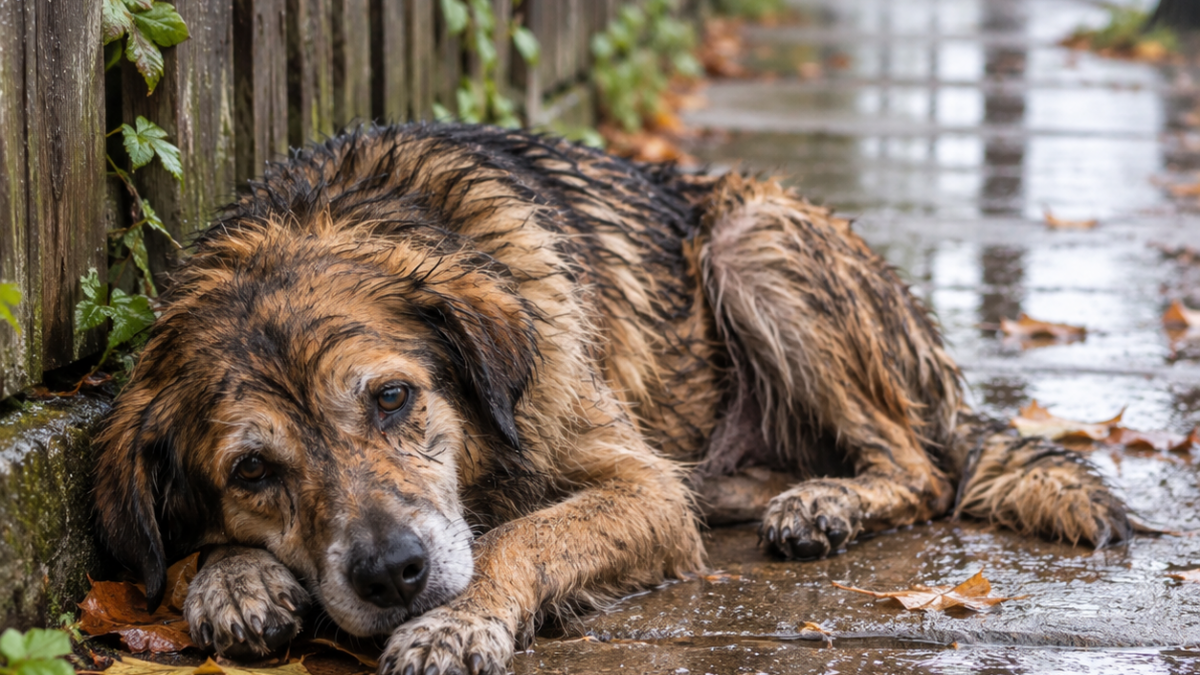
The dog lying beside that broken fence was so weak that people had already begun walking past her as if someone else had decided how her story would end.
When I sat down on the cold concrete and whispered, “Hey, girl. I see you,” she opened her eyes just enough to prove that somewhere inside that ruined body, something was still fighting to stay.
Then I moved the filthy fur along her ribs and found a strip of red buried underneath—and suddenly I knew this wasn’t simply a sick stray who had collapsed in the wrong place.
My name is Megan Foster.
I wasn’t working in rescue that morning.
I wasn’t even supposed to be on that street.
Road construction had backed traffic up for almost a mile, so I took a side road through an older industrial neighborhood on the east side of town.
That tiny decision is the reason I saw her.
At first, I thought the shape beside the chain-link fence was a pile of wet clothes.
It had rained most of the night. The sidewalk was dark, weeds leaned heavily against the rusted fence, and everything smelled like wet concrete and old metal.
Then the pile breathed.
I stopped my car.
Three people were standing across the street.
An older man.
A teenage boy.
A woman holding a grocery bag.
All three were looking toward the same spot.
The teenager said quietly, “I think she’s dying.”
I crossed the street.
The dog was a medium-sized shepherd mix, maybe forty-five pounds when healthy.
She couldn’t have weighed thirty.
Her brown-and-black coat was pasted against her body with rain and dirt. Every rib showed. One front paw had dried blood around the toes, and her head rested directly on the concrete.
“Has anybody called someone?”
The older man shrugged.
“Animal control. Got voicemail.”
“How long has she been here?”
“Since before six.”
I looked at my phone.
8:54 a.m.
Almost three hours.
I crouched several feet away.
“Hey, girl.”
Nothing.
I moved closer.
“It’s okay.”
One eye opened.
Then the other.
She saw me.
That was all.
No growl.
No attempt to crawl away.
No warning.
That frightened me more than aggression would have.
Scared dogs usually tell you they’re scared.
They stiffen.
Show teeth.
Pin their ears.
Try to escape.
This dog simply closed her eyes again, as though she had already learned that whatever a human decided to do next was not something she had any power to change.
I sat down on the concrete.
Not touching her.
Just staying.
“I’m not going to hurt you.”
A few minutes passed.
The people behind me began leaving.
Someone said, “Probably abandoned.”
Another person answered, “If she’s been there this long, she’s probably really sick.”
Maybe.
But I wasn’t leaving.
I took off my jacket and slowly draped it over her back.
She flinched.
Then froze.
“Easy.”
I found an old plastic bowl in my trunk and filled it with bottled water.
She couldn’t lift her head.
So I held the bowl against the pavement near her muzzle.
Her tongue touched the surface once.
Then again.
The third swallow was stronger.
“There you go.”
Her eyes opened.
For the first time, she looked directly at me.
“I’ve got you.”
I called the nearest veterinary hospital.
They told me to bring her immediately.
While I waited for my friend Jason to arrive with his SUV, I noticed something red beneath the wet fur along her left side.
At first, I thought it was blood.
My stomach dropped.
I carefully separated the hair.
It wasn’t blood.
It was nylon.
A bright red braided cord disappeared beneath swollen skin near her chest and emerged again farther down her ribs.
I barely touched it.
The dog jerked.
A tiny cry escaped her.
I froze.
“Oh, sweetheart.”
The cord was tight.
Far too tight.
Part of it had become hidden beneath matted fur and damaged skin.
Someone had tied something around this dog.
And she’d been wearing it long enough for her body to begin growing around it.
Then I saw something else.
A small metal tag still attached to the red cord.
Dirty.
Scratched.
Almost hidden.
But there were letters stamped into it.
BMR-17.
I stared at the tag, then at the dog.
I had arrived believing I had found an exhausted stray.
Now I was sitting beside evidence.
And somewhere out there, somebody knew exactly what those letters meant.
PART 2
I didn’t touch the red cord again.
Every instinct I had told me to cut it off immediately.
But the section disappearing beneath the swollen skin terrified me.
I didn’t know how deeply it had cut.
I didn’t know whether removing it could open a wound that had already started sealing around it.
And the dog was too weak for guessing.
So I stayed beside her.
“Almost there,” I whispered.
She couldn’t understand the words.
But I kept saying them anyway.
Sometimes words aren’t about information.
Sometimes they are just proof that someone has chosen not to leave.
Jason arrived eleven minutes later.
He parked partly on the curb, jumped out, and came toward us carrying two blankets.
Then he saw her.
His steps slowed.
“Megan…”
“I know.”
“What happened?”
“I don’t know.”
I showed him the red cord without touching it.
His face hardened immediately.
“Someone put that on her?”
“Looks like it.”
“Can we cut it?”
“Not here.”
He looked at the bloody paw.
“We need to move.”
Together, we slid one blanket underneath her as carefully as we could.
Even that was difficult.
Her body had become so thin that every rib felt sharp beneath the fabric.
When we lifted her, she made one low sound.
Not a yelp.
More like a breath that hurt.
“Sorry,” I whispered. “I’m sorry.”
Jason opened the rear hatch.
We laid her across both blankets.
I climbed into the back beside her.
“You drive.”
He didn’t argue.
The veterinary hospital was twelve minutes away.
It felt like an hour.
Halfway there, we stopped at a red light.
The dog went completely still.
Too still.
I leaned forward.
“Hey.”
Nothing.
My chest tightened.
I put two fingers near her nose.
Warm air touched them.
Still breathing.
“Come on, girl.”
Her eyelid lifted.
“Don’t quit now.”
Jason glanced at me in the mirror.
“She okay?”
“Drive.”
When we reached the clinic, two technicians were already waiting with a rolling stretcher.
Dr. Aaron Klein met us inside.
I had taken injured animals to Aaron before through volunteer work.
He was calm almost to the point of irritation, which was exactly what you wanted when panic was useless.
He listened to the dog’s heart.
Checked her gums.
Took her temperature.
Examined the bloody paw.
Then he moved toward the cord.
His expression changed.
“How long could this have been there?” I asked.
“A while.”
“Days?”
“Probably longer.”
“Weeks?”
“Maybe.”
My stomach turned.
Aaron looked at one of the technicians.
“Fluids. Bloodwork. Pain control. Let’s get radiographs and ultrasound before we remove anything.”
“Why imaging?”
“I want to know what’s happening beneath the cord and whether she has other injuries.”
“Can you sedate her?”
“If her bloodwork supports it.”
“Is she going to live?”
Aaron stopped.
That was when I knew the answer wasn’t easy.
“I don’t know yet.”
“She drank water.”
“Good.”
“She looked at me.”
“Also good.”
“So she’s fighting.”
“Yes.”
“Then—”
“Megan.”
I stopped.
“She is severely dehydrated. Severely underweight. Her paw is infected. The cord caused significant tissue damage. Her body has been compensating for a long time.”
“How long?”
“I can’t tell you yet.”
I looked through the treatment-room door.
A technician had placed a warming blanket over her.
“What do I do?”
“Give us time.”
I sat in the waiting room.
Jason stayed for the first hour.
He bought me coffee from the machine.
I held it until it went cold.
At 11:42, Aaron came out.
“She is stable enough for us to remove the cord.”
I stood.
“Stable means?”
“It means I’m more optimistic than I was an hour ago.”
I exhaled.
“Kidneys?”
“Stressed, but functioning.”
“Liver?”
“Elevated values. Could be dehydration, infection, starvation.”
“Anything broken?”
“No fractures.”
That felt like winning something.
Then I remembered the metal tag.
“There was a tag attached.”
Aaron nodded.
“One of the technicians removed it before cleaning.”
He handed me a clear plastic specimen bag.
Inside was the scratched aluminum tag.
BMR-17.
Nothing else.
“What do you think that means?”
“No idea.”
“Microchip?”
“We scanned twice. Nothing.”
“So this is all we’ve got?”
“For identity, yes.”
I looked toward the treatment room.
“No name.”
“Not one we know.”
The dog went into the procedure room shortly after noon.
The surgery wasn’t dramatic in the way people imagine surgery.
There was no giant incision.
No broken bone to repair.
But removing the embedded cord required sedation, cleaning dead tissue, flushing the wounds, trimming damaged skin, and assessing infection.
Sections of the cord had cut so deeply around her chest that her skin had begun forming around it.
Aaron later told me it was similar to what happened with collars left on growing animals.
Except this wasn’t a normal collar.
It was a crude homemade harness made from braided tie-out rope.
At 2:26, Aaron returned.
“She’s awake.”
“Can I see her?”
“For a minute.”
I followed him.
The cord was gone.
A wide section of fur had been shaved away.
Bandages wrapped her chest and front leg.
Without the dirty coat disguising her frame, she looked impossibly thin.
“Hey.”
Her eyes moved toward me.
I crouched outside the kennel.
“Remember me?”
One ear shifted.
I smiled.
“Good enough.”
Aaron stood behind me.
“She’ll need several days here.”
“Whatever she needs.”
“We’ll report the injuries to animal welfare.”
“I already called.”
“Of course you did.”
He paused.
“You know she may belong to somebody.”
I looked at him.
“If she does, somebody has explaining to do.”
County Animal Welfare Investigator Dana Ruiz arrived that afternoon.
Dana was in her early forties, with dark hair pulled back tightly and a notebook that looked like it had survived a decade of rain, coffee, and angry people.
She photographed everything.
The cord.
The tag.
The wounds.
The bloody paw.
She asked me to explain exactly how I found the dog.
I started at the detour.
Told her about the neighbors.
The water.
The jacket.
The red nylon.
The tag.
When I finished, she studied BMR-17.
“You recognize it?” I asked.
“Maybe.”
My pulse changed.
“What?”
“There are businesses around here that mark property with initials.”
“Property?”
“Tools. Equipment. Containers.”
I looked toward the treatment room.
“You think someone tagged a dog like equipment?”
“I didn’t say that.”
“But you’re thinking it.”
Dana looked at me.
“You always this helpful?”
“Usually worse.”
She slipped the tag into an evidence envelope.
“Where exactly did you find her?”
I gave her the location.
“Industrial area?”
“Yes.”
“Nearby businesses?”
“Old tire place. Storage yard. Machine shop.”
“What about salvage?”
I thought.
“There is a scrap yard farther east.”
Dana wrote something down.
“Anyone see a vehicle?”
“I didn’t ask.”
“I will.”
When she left, I went back to the kennel.
The hospital chart called the dog Patient 422.
I hated it immediately.
“She needs a name,” I told Aaron.
“She may already have one.”
“Not one anybody bothered to put on her.”
“What do you want to call her?”
I thought about the metal tag.
About the red rope.
About the fact that finding those things had changed everything.
Then I remembered the first sentence I had said while sitting on the concrete.
I see you.
“Vera.”
Aaron raised an eyebrow.
“Why Vera?”
“Truth.”
“That’s your whole explanation?”
“Yes.”
He smiled.
“Vera it is.”
That night, Vera barely slept.
Every time someone entered the room, her body stiffened.
If a technician touched the kennel latch, she lowered her head.
She never growled.
Never snapped.
Never tried to escape.
Aaron told me that frightened him more than aggression.
“Why?”
“Because aggression means she still believes she can control the outcome.”
I looked at Vera.
“And this?”
“This is learned helplessness.”
The phrase stayed with me.
Learned helplessness.
Not calm.
Not obedience.
Not trust.
Giving up.
The next morning, Vera ate four spoonfuls of recovery food.
Then stopped.
I sat outside her kennel.
“You’ll get more later.”
She watched me.
I moved my hand slowly toward the bars.
She didn’t retreat.
Didn’t approach.
I waited.
After several minutes, she moved forward an inch.
Then another.
Her nose touched my knuckles.
I didn’t move.
After one second, she retreated.
“That counts,” I whispered.
Dana called that afternoon.
“BMR stands for Brammer Metal Recovery.”
I stood so fast I knocked my chair against the wall.
“The salvage yard?”
“Six miles from where you found Vera.”
“What does seventeen mean?”
“Don’t know yet.”
“Does the owner have dogs?”
“He says three.”
I went still.
“What kind?”
“Two shepherd mixes and a Rottweiler-type dog.”
“Vera?”
“He says he’s never seen her.”
“He’s lying.”
“Megan.”
“What?”
“We have a tag.”
“A tag with his company initials.”
“Likely.”
“On a dog wearing the same kind of rope used at his property?”
There was a pause.
“You went there?”
“I did.”
“What did you see?”
“Red braided tie-out line attached to one kennel.”
My grip tightened on the phone.
“Same as Vera’s?”
“Similar.”
“So take it.”
“I didn’t have a warrant.”
“Get one.”
“We need probable cause beyond your emotional confidence.”
I paced across my kitchen.
“Dana, a dog with BMR stamped on a tag is found six miles away wearing industrial tie-out rope buried in her chest.”
“I know.”
“The owner says he doesn’t know her.”
“I know.”
“You believe him?”
“I believe evidence.”
I hated that answer.
Later, I understood why it mattered.
Then Dana said:
“One employee recognized the photo.”
I stopped.
“What?”
“A yard worker named Luis Bennett.”
“And?”
“He wouldn’t say anything with the owner standing there.”
My stomach tightened.
“Why?”
“Could be fear. Could be caution.”
“What happens now?”
“We contact him away from work.”
Before hanging up, Dana said:
“Do not go to the salvage yard.”
“I wasn’t planning to.”
“You absolutely were.”
Maybe.
Vera’s condition improved in tiny increments.
A little more food.
A lower temperature.
Cleaner bloodwork.
Her paw infection began responding to antibiotics.
But emotionally, she was still somewhere else.
On the third day, a male maintenance worker rolled a metal cart past her room.
The wheels rattled.
Vera flattened herself against the back wall.
Her body shook.
She urinated beneath herself.
Aaron called me.
I arrived twenty minutes later.
She was curled as tightly as she could get.
I sat on the floor outside the kennel.
No touching.
No baby talk.
No forcing eye contact.
Just presence.
Ten minutes.
Fifteen.
Then I whispered:
“I’m here.”
One ear moved.
“You don’t have to come over.”
Twenty minutes later, Vera shifted forward.
Only a few inches.
Enough.
I stayed until the clinic closed.
The next morning, Dana called at 6:40.
“Luis talked.”
I sat up in bed.
“What did he say?”
“Vera lived at Brammer.”
For several seconds, I couldn’t answer.
“Her name?”
“They called her Seven.”
I closed my eyes.
Seven.
Not Vera.
Not a name.
A number.
“BMR-17?”
“Luis says the company tagged dogs the same way they tagged some equipment. The seventeen corresponded to their security-dog inventory record.”
Security-dog inventory.
I felt sick.
“How long?”
“About four years.”
“What was her job?”
“Overnight yard security. Tethered in different sections after closing.”
“With red rope?”
“Yes.”
I got out of bed.
I couldn’t stay still.
“Did they feed her?”
“Inconsistently.”
“What does that mean?”
“Luis says workers were expected to handle the dogs at closing. Sometimes one assumed another person did it.”
“And if no one did?”
Dana didn’t answer.
She didn’t need to.
“What about the cord?”
“Luis says Vera once had a commercial harness. It broke. Somebody improvised one from tie-out material.”
“How long ago?”
“More than a year.”
“Was it adjusted?”
“Apparently not.”
My hand tightened around the phone.
“She was wearing the same rope for more than a year?”
“Likely.”
“As she changed weight?”
“Yes.”
“Did anyone tell the owner?”
“Luis says he did.”
“What was the answer?”
Dana paused.
“Megan…”
“Say it.”
“He remembers Curtis Brammer saying, ‘She’s a yard dog, not a house pet.’”
I sat down.
The cruelty of the sentence wasn’t dramatic.
That was why it hurt.
Not a threat.
Not rage.
Indifference.
A yard dog.
As if the category removed her right to pain.
“What happened before she disappeared?”
“She hurt her paw.”
“How?”
“Possibly scrap metal.”
“And they didn’t treat it.”
“Luis says somebody poured antiseptic on it.”
“That isn’t veterinary care.”
“No.”
“Then what?”
“She stopped getting up when delivery trucks arrived.”
The answer was obvious.
A security dog who no longer guarded.
A tool that stopped working.
“What did Curtis do?”
“Luis came to work Monday morning. Vera was gone.”
“What did Curtis say?”
“She’d been handled.”
Handled.
Another word that meant nothing and everything.
“Did Luis ask where?”
“Yes.”
“And?”
“He was told it wasn’t his business.”
Vera had been found Thursday morning.
Three days later.
“Can Luis prove she left in one of their vehicles?”
“He saw Leon Brammer load her into a company pickup Tuesday night.”
“Curtis’s brother?”
“Yes.”
“Alive?”
“Yes.”
“Walking?”
“Barely.”
My eyes burned.
“Where did he take her?”
“Luis doesn’t know.”
I thought about the cold concrete.
The rain.
People walking away.
“They dumped her.”
“We’re working on proving that.”
“Dana.”
For once, she didn’t correct me.
“I know.”
The warrant came two days later.
Investigators searched Brammer Metal Recovery.
Dana didn’t call until officers were already inside.
She knew me too well.
By then, Vera was stable enough to sit for several minutes at a time.
She still wouldn’t stand on the injured paw.
I was beside her kennel when my phone rang.
Dana.
“We’re in.”
“And?”
Her silence was enough.
“Dana?”
“It’s worse.”
Two words.
My stomach dropped.
“What did you find?”
“Three visible kennels were cleaned recently.”
“Recently?”
“Fresh straw. New water bowls. Newly opened food bags.”
“They knew you were coming.”
“Possibly.”
“But?”
“Behind the main sorting building, there’s an older kennel row.”
“How many?”
“Six.”
“Dogs?”
“Empty.”
“Conditions?”
“Bad.”
I waited.
“Rust. Broken bowls. Old chains. Red braided cords.”
I looked at Vera.
“What else?”
“Locked storage room. Expired veterinary medication. No current prescriptions. No complete medical records.”
“Anything linking Vera?”
“Yes.”
My chest tightened.
“What?”
“Photographs.”
The company had kept security records.
Every dog photographed and numbered.
BMR-11.
BMR-12.
BMR-14.
BMR-17.
Vera.
Dana showed me the photographs later.
The earliest version barely looked like the dog I knew.
Healthy.
Strong.
Alert.
Thick coat.
Head high.
No wounds.
A dog prepared to work.
Then the sequence changed.
Thinner.
Fur worn along her chest.
Red cord visible.
One photo taken six months before I found her showed the cord already pressing deeply into her coat.
Another showed a raw patch.
Another, nine days before she disappeared, showed Vera holding up the injured front paw.
Timestamped.
Documented.
Visible.
Curtis Brammer would later claim he had never noticed anything wrong.
The photographs disagreed.
There was more.
A warehouse camera across the industrial road showed a Brammer company pickup leaving the salvage yard at 10:48 Tuesday night.
At 11:07, a traffic camera captured the same truck near the neighborhood where I found Vera.
At 11:16, it traveled back toward the salvage yard.
Nineteen minutes.
Then investigators located a residential security camera.
Dark footage.
Bad angle.
But enough.
A pickup stopped near the vacant lot.
A man stepped out.
Walked to the back.
Dragged a low shape from the truck bed.
A dog.
He pulled the animal toward the fence.
Then returned to the truck.
Headlights disappeared.
No one came back.
I watched the footage once.
That was enough.
“Who is it?”
Dana stood beside me.
“Can’t identify the person from video alone.”
“Leon?”
“Likely.”
“Where was Curtis?”
“We’re establishing that.”
The answer came from text messages recovered from their phones.
Tuesday, 8:14 p.m.
LEON: 17 BAD AGAIN. WON’T GET UP.
CURTIS: THEN GET RID OF HER.
I stared at the screen.
Another message.
LEON: WHERE?
CURTIS: NOT MY PROBLEM. I NEED THE PEN.
The pen.
Her kennel.
Her home, if you could call it that.
He needed the space.
Then:
LEON: SHE CAN BARELY WALK.
CURTIS: THEN SHE WON’T COME BACK.
I read that line four times.
“Then she won’t come back.”
The point wasn’t to place her somewhere she might be found.
The point was that she couldn’t return.
I went outside the investigator’s office and threw up beside my car.
That was the first time Dana touched my shoulder.
“You okay?”
“No.”
“Good.”
I looked at her.
“What?”
“You shouldn’t be okay with that.”
I wiped my mouth.
“But you still don’t contact them. You still don’t post threats. You still let us build it.”
I nodded.
For once, there was nothing to argue about.
The remaining three dogs were removed temporarily during the investigation.
Their conditions weren’t as severe as Vera’s, but none were as healthy as Curtis claimed.
Two had untreated dental disease.
One had a chronic ear infection.
All three had pressure sores or coat damage consistent with long-term outdoor tethering.
None were microchipped.
All wore numbered company tags.
Not names.
Numbers.
That broke something in me.
I began visiting them too.
BMR-21 became Hank.
BMR-23 became Rosie.
BMR-24 became Mack.
They responded to their new names slowly.
Vera responded to hers faster.
Maybe because she had never had much attachment to Seven.
When I said “Vera,” she began looking toward me within a week.
The clinic discharged her after eleven days.
She wasn’t ready for adoption.
Not even close.
She needed wound care, antibiotics, weight gain, physical therapy, and a home quiet enough for a terrified dog to learn what life indoors meant.
Carol Hayes offered to foster her.
Carol was sixty-one.
Retired respiratory therapist.
Two fenced acres outside town.
One elderly Labrador named Gus.
No children.
No chaotic household.
No need for a security dog.
The first afternoon I drove Vera there, she refused to leave the vehicle.
I opened the door.
She remained curled against the back seat.
Carol stood twenty feet away.
“Don’t force her.”
“I wasn’t going to.”
We waited.
Five minutes.
Ten.
Fifteen.
Gus appeared on the porch.
He was a yellow Lab with white around his muzzle and the slow expression of a dog who had survived fourteen years by refusing unnecessary effort.
He looked at Vera.
Vera looked at him.
Gus yawned.
Turned around.
Went back inside.
Carol laughed.
“That’s his entire temperament assessment.”
Vera eventually lowered one paw to the ground.
Then another.
Her injured paw barely touched.
She stepped down.
She smelled grass.
Real grass.
Not oily dirt.
Not concrete.
Not rust.
She stood completely still.
Then she took three cautious steps.
Stopped.
Looked back at me.
I crouched.
“You’re okay.”
She didn’t believe me.
But maybe one day she would.
The first week at Carol’s house was difficult.
Vera slept beside the back door.
Not in the orthopedic bed Carol bought.
Not on the blanket.
The floor.
She refused to walk through the kitchen if Carol held anything red.
Leashes caused full panic.
Even a soft harness made her flatten herself.
So Carol didn’t force one.
The yard was fenced.
For the first month, that fence gave Vera freedom without requiring equipment around her body.
Her food behavior was heartbreaking.
She ate too fast.
Then searched.
Under the bowl.
Behind furniture.
Near the trash.
Carol started feeding four small meals a day.
Vera gained two pounds.
Then three.
Then four.
Her chest wounds healed slowly.
The infected paw improved.
But emotionally, she still looked like a dog expecting everything good to disappear.
One evening, Carol called me.
“She did something.”
My stomach tightened.
“What happened?”
“She barked.”
I paused.
“That’s it?”
“She has never barked here.”
“What caused it?”
“A squirrel.”
I started laughing.
“One bark.”
“And?”
“Then she scared herself.”
“That is wonderful.”
Carol was silent.
“How is barking wonderful?”
“Because barking means she believes making noise might change something.”
That was the first time we celebrated Vera having an opinion.
A week later, she barked twice when a delivery truck entered the driveway.
A month later, she stole Gus’s bed.
Gus stood beside it staring at Carol.
Carol stared at Vera.
Vera stayed exactly where she was.
“Are you going to make her move?” Carol asked me later.
“Absolutely not.”
“Poor Gus.”
“He has another bed.”
“That’s not the point.”
“Vera has discovered property crime. This is progress.”
Carol laughed.
The changes came in pieces.
Vera learned the refrigerator made food.
She learned rain could be watched through a window instead of endured.
She learned blankets were soft.
She learned a television wasn’t a threat even though voices came from it.
She learned Carol’s vacuum cleaner was evil.
Some beliefs were reasonable.
The first time Vera slept on her side with her legs stretched out, Carol texted me a photograph.
I stared for a long time.
Dogs don’t sleep deeply when they believe danger is close.
Vera was beginning to sleep.
That mattered more than any courtroom update.
The legal case moved slowly.
Curtis denied neglect.
He said the dogs were working animals.
He said they weren’t pets.
He claimed different welfare standards should apply because the dogs lived outdoors for security.
His attorney argued that employees were responsible for daily care.
Curtis claimed he didn’t know Vera’s rope had become embedded.
He claimed he didn’t know her paw was infected.
He claimed when he told Leon to “get rid of her,” he meant surrender her.
Dana listened.
Documented.
Asked questions.
Then let the evidence answer.
If Curtis intended surrender, why no shelter had a call from him?
Why no animal control report?
Why was Vera left after 11 p.m. beside a vacant property?
Why was she still wearing an embedded restraint?
Why did the text say she wouldn’t come back?
Why did the truck leave the yard and return nineteen minutes later?
Why did Leon initially lie?
Every answer created another contradiction.
Leon broke first.
Facing charges himself, he admitted the truth.
Curtis had told him Vera was no longer useful.
Leon loaded her into the truck.
She couldn’t jump.
He had to lift her.
She whimpered when his arm pressed against the embedded rope.
He knew she was injured.
He drove toward the east side.
He chose the vacant lot because he had seen stray dogs there before.
He dragged Vera out.
She tried to stand.
Couldn’t.
He left.
The prosecutor later asked:
“Did you believe she might die?”
Leon looked at the floor.
“Yes.”
“Why didn’t you take her to a clinic?”
“I was doing what Curtis told me.”
“Did Curtis threaten you?”
“No.”
“Did he force you physically?”
“No.”
“So why did you do it?”
Leon stayed silent for several seconds.
Then said:
“Because it was easier than arguing.”
That answer stayed with me almost as much as Curtis’s messages.
Cruelty is not always passionate.
Sometimes it is convenience.
Sometimes someone suffers because another person decides doing the right thing is inconvenient.
Leon eventually cooperated.
That didn’t erase what he did.
But it changed what happened next.
He gave investigators access to old records.
He identified other former employees.
He admitted Vera had been underfed for months.
He confirmed Curtis refused veterinary treatment unless an animal was considered financially useful.
Then another employee came forward.
Maria Santos had worked in the office two years earlier.
She remembered Vera.
“She used to wait by the gate when people left,” Maria told Dana.
“What was she like?”
“Sweet.”
“Did she ever bite?”
“No.”
“Growl?”
“Only once when somebody tried to pull something from her mouth.”
“Was she considered aggressive?”
“Never.”
“Why was she selected as a security dog?”
Maria almost laughed.
“She barked at trucks.”
That was it.
Vera wasn’t trained protection.
Wasn’t an attack dog.
She was a dog who barked when vehicles came in.
Curtis chained her outside because her barking was useful.
Then he stopped caring whether the body producing that sound was healthy.
The criminal hearing happened six months after I found Vera.
By then, she weighed forty-one pounds.
Eleven more than the morning beside the fence.
Her coat had grown back over most of the chest scar.
The injured paw still stiffened in cold weather, but she used it.
She could run across Carol’s yard.
Not far.
Not fast.
But run.
I attended court.
Carol stayed home with Vera.
“I don’t need to see him,” she said.
Fair.
I did.
Maybe I wanted to know whether Curtis looked like a monster.
He didn’t.
That almost bothered me.
Fifty-two.
Clean haircut.
Pressed shirt.
Glasses.
Ordinary.
Cruelty rarely helps us by looking obvious.
The prosecutor displayed Vera’s earliest company photograph.
Healthy.
Then photographs across the years.
The red cord became visible.
Tighter.
Then tighter.
Weight loss.
The injured paw.
Finally, my intake photograph.
Vera beside the fence.
Curled.
Wet.
Almost dead.
The courtroom was completely quiet.
Aaron testified.
He described the embedded cord.
The infection.
Starvation.
Dehydration.
“Could these conditions have developed overnight?” the prosecutor asked.
“No.”
“Could a reasonable caretaker have noticed?”
“Yes.”
“Could the embedded restraint have been hidden entirely from someone regularly handling the dog?”
“Not for the duration indicated by the tissue damage.”
Curtis’s attorney asked:
“Doctor, working dogs often sustain minor injuries, correct?”
Aaron remained calm.
“Dogs can sustain injuries.”
“Outdoor dogs may have coat wear?”
“Yes.”
“Weight fluctuations?”
“Yes.”
“So none of these individually proves intentional cruelty.”
Aaron looked at him.
“An embedded restraint, untreated infected paw, severe underweight condition, dehydration, and abandonment while unable to walk are not minor fluctuations.”
The attorney stopped.
Then came the text messages.
LEON: 17 BAD AGAIN. WON’T GET UP.
CURTIS: THEN GET RID OF HER.
The prosecutor waited before showing the next one.
LEON: SHE CAN BARELY WALK.
CURTIS: THEN SHE WON’T COME BACK.
I watched Curtis.
He stared at the table.
No one shouted.
No one needed to.
The words were enough.
Luis testified next.
He admitted he had known Vera’s rope was too tight.
“Did you tell Mr. Brammer?”
“Yes.”
“What did he say?”
Luis swallowed.
“She was a yard dog, not a house pet.”
“Did that stop you from removing the rope?”
“I was afraid I’d be fired.”
“Were you fired for reporting it?”
“No. I didn’t report it.”
Luis looked down.
“I should have.”
Curtis’s attorney tried to blame him.
“So you personally saw the injury and did nothing.”
“Yes.”
“You fed the animals sometimes.”
“Yes.”
“You were assigned care responsibilities.”
“Sometimes.”
“So any neglect could have been your fault.”
Luis looked toward Curtis.
Then back at the attorney.
“I failed her.”
The room became quiet.
“But when I told him she needed help, he was the owner. He made the decisions.”
The distinction mattered.
Luis had failed.
He admitted it.
Curtis had failed and tried to turn everyone else into the explanation.
The remaining evidence was straightforward.
Truck footage.
Neighborhood camera.
Veterinary records—or lack of them.
Company photographs.
Animal-welfare inspection.
Leon’s cooperation.
Curtis eventually accepted a plea rather than continue toward full trial.
He received the harsher penalties.
Probation.
Jail time.
Fines.
Restitution for veterinary and boarding care.
Long-term restrictions on owning, possessing, or using animals for security under the court order.
Leon received a lesser sentence due to cooperation, though the abandonment remained part of his record.
Brammer Metal Recovery was also facing separate safety investigations.
The animal search had exposed unsecured scrap piles, improperly stored chemicals, damaged fencing, and incomplete workplace inspection records.
Then commercial partners began leaving.
One city contractor suspended its agreement.
A recycling partner ended deliveries.
Insurance costs rose.
Customers stopped coming.
Within a year, Brammer Metal Recovery closed.
The sign came down.
People congratulated me.
They said:
“You got revenge.”
I didn’t feel like I had.
Vera didn’t care whether Brammer had contracts.
She cared whether breakfast came.
Whether anyone touched the scar.
Whether a red object meant pain.
Whether Carol returned after taking out the trash.
That was where the real work remained.
The red-color fear became one of our biggest challenges.
At first, Vera would leave a room if Carol wore anything bright red.
A towel.
A bag.
A sweater.
Even a red dog toy.
We never forced exposure.
Carol worked with a behavior specialist.
A red washcloth started forty feet away in the yard.
Vera saw it.
Stayed.
Food arrived.
Next day, thirty-five feet.
Then thirty.
Nothing wrapped around her.
Nothing chased her.
Nothing hurt.
Weeks later, the washcloth sat on a chair inside the kitchen.
Vera entered.
Saw it.
Paused.
Then walked around it.
We celebrated.
Months later, Carol forgot everything we were working on and came downstairs wearing a red sweatshirt.
Vera stood beside her bowl.
She looked up.
Carol froze.
“Oh.”
Vera stared.
Red.
Human.
Breakfast.
She looked at Carol.
Then lowered her head and continued eating.
Carol called me crying.
“She didn’t leave.”
I cried too.
From the outside, it was ridiculous.
A dog ate breakfast next to a red sweatshirt.
But to us, it meant the past had lost some authority.
Red was becoming a color again.
Not rope.
Not pain.
Not helplessness.
Eleven months after Vera entered Carol’s home, Carol adopted her officially.
She pretended it had been a difficult decision.
I pretended to believe her.
“You sure?” I asked.
Carol stared at me.
“She has been here eleven months.”
“Fostering can be lengthy.”
“She has an orthopedic bed.”
“Rescue equipment.”
“She has a stocking with her name on it.”
“Seasonal enrichment.”
“She has a veterinarian listed under my address.”
“Administrative detail.”
“She sleeps in my room.”
“Poor boundaries.”
Carol pointed to Vera.
Vera was asleep on the couch.
“Look at her.”
I did.
“Temporary.”
Carol threw a dish towel at me.
The paperwork said:
VERA HAYES.
Not Seven.
Not BMR-17.
No inventory number.
A family name.
I didn’t expect that to affect me as much as it did.
But when Carol signed, I had to turn away.
Vera had once worn a metal tag identifying the company that owned her.
Now her identification tag read:
VERA HAYES.
IF LOST, PLEASE CALL CAROL.
HOME.
A phone number.
A way back.
No one would ever be able to say:
Then she won’t come back.
We would make sure she did.
Gus died two years later.
Fourteen years old.
Peaceful.
Vera searched for him.
Bedroom.
Porch.
Yard.
His bed.
For three days, she ate less.
Carol sat beside her.
“I’m sorry.”
Vera eventually began sleeping in Gus’s bed.
Months later, Carol offered to foster another dog.
A ten-pound black terrier named Eddie.
I thought she had lost her mind.
Eddie had one goal in life.
Be near Vera.
Vera disagreed.
If Vera moved three feet, Eddie moved four.
If Vera lay down, Eddie curled beside her.
If Vera sighed, Eddie considered it encouragement.
For two weeks, Vera tolerated him only because apparently murder was too much effort.
Then Carol sent a photograph.
Vera asleep.
Eddie curled against her back.
I replied:
Traitor.
Carol wrote:
She denies everything.
Vera had a family.
That fact still amazes me.
Not because rescue dogs can’t.
Because the animal I found on wet concrete didn’t even believe touching a human could change anything.
Now she got irritated when Eddie invaded her bed.
You need to believe something belongs to you before you can be annoyed when someone steals it.
That was progress too.
Years passed.
Vera’s muzzle turned gray.
The old paw injury developed arthritis.
Carol covered the hardwood with rugs.
Then built a ramp to the porch.
Medication came every morning.
Vera learned pills arrived inside cheese.
She became suspicious of cheese.
Carol upgraded to chicken.
Vera approved.
At twelve, a heart murmur.
Manageable.
At thirteen, early kidney changes.
Manageable.
At fourteen, she became picky about food.
That might have been my favorite stage of her life.
The dog who once went hungry now rejected breakfast.
Carol would call me.
“Chicken is unacceptable.”
“Try turkey.”
“Turkey was unacceptable yesterday.”
“Beef?”
“She ate beef Tuesday.”
“And?”
“Apparently Tuesday beef and Thursday beef are different foods.”
“Obviously.”
“I hate both of you.”
Vera sat in the background waiting for better service.
It was glorious.
Useless.
Spoiled.
Ordinary.
The exact opposite of her old life.
One winter morning, I brought her a soft red collar.
Carol looked at me.
“Are you sure?”
“No.”
We placed it on the floor.
Vera sniffed.
Walked away.
We left it.
Later, she returned.
Sniffed again.
No panic.
After three days, Carol picked it up while Vera watched.
No reaction.
Eventually, we touched it to her shoulder.
Then removed it.
Weeks passed.
Finally, Vera allowed Carol to fasten it loosely around her neck.
She stood.
Waited.
Then shook herself.
Walked to the kitchen.
That was it.
No fear.
No collapse.
A red collar.
Years earlier, red had meant restraint.
Now it carried a tag with her name and home address.
The symbol had changed because her life had changed.
Carol kept that collar until Vera died.
The final decline came slowly.
She was almost fifteen by our estimate.
One spring morning, Carol called me.
“Megan.”
I knew from her voice.
“She couldn’t get up.”
I drove over.
Vera lay on the porch.
Sunlight touched her paws.
Eddie was pressed against her side.
Carol sat beside them.
I lowered myself to the floor.
“Hey, girl.”
Vera opened her eyes.
Cloudy.
Tired.
Still her.
Her tail moved once.
I put my hand on the boards between us.
Not on her.
Even after all those years, I remembered the first rule.
Let Vera decide.
She moved her head.
Slowly.
Her nose reached my fingers.
Contact.
I smiled through tears.
“You remember me?”
Her eyes stayed on mine.
“I remember you.”
The fence.
The cold sidewalk.
The wet fur.
The third swallow of water.
The red cord.
I had once promised:
I’ve got you.
At the time, I meant:
For the next hour.
Maybe the next day.
I didn’t know promises could grow.
The veterinarian came to Carol’s home that afternoon.
No clinic.
No car ride.
No restraint.
Vera stayed on the porch because that was where she wanted to be.
Carol stroked her shoulder.
I touched the scar hidden beneath her fur.
Almost impossible to find now.
That mattered.
For years, the cord had been one of the first things people noticed about Vera’s history.
Now I had to search for evidence it had ever existed.
Carol leaned close.
“You never have to guard anything again.”
Vera breathed.
“You never have to sleep outside.”
Another breath.
“You never have to earn your dinner.”
My throat closed.
I whispered:
“You never have to be useful.”
Her eye moved toward me.
“You already did enough.”
The veterinarian gave the first medication.
Vera relaxed.
Her muscles softened.
No freezing.
No silent waiting for pain.
She knew these hands.
She knew this porch.
She knew Carol.
She knew me.
She knew Eddie.
She knew home.
Carol pressed her forehead gently against Vera’s.
“You can go.”
Vera exhaled.
Then she was gone.
For a long time, no one moved.
Eddie remained beside her.
I thought I would remember that afternoon as sad.
I don’t.
I remember warmth.
Sunlight.
Birds somewhere in the trees.
Carol’s hand resting against Vera’s fur.
A dog who had once been dumped beside a fence because somebody decided she had stopped being useful, dying years later surrounded by people who had rearranged their entire lives because she mattered.
That was the ending.
Not Curtis losing his company.
Not Leon’s conviction.
Not the court.
Not the fines.
Not the closure of the salvage yard.
Those things mattered.
Accountability matters.
But Vera’s greatest revenge happened somewhere else.
Every time she slept without a chain.
Every time she walked away from food because she knew more would come.
Every time she barked and expected someone to listen.
Every time she moved away from a hand and nobody chased her.
Every time she took Gus’s bed.
Every time she tolerated Eddie beside her.
Every time she wore that red collar.
Every morning she woke old.
Old.
That word still gets me.
Because the dog beside the fence did not look like she had another hour.
She got years.
Enough years to become gray.
Enough years to become stubborn.
Enough years to become picky.
Enough years for the worst thing that happened to her to stop being the most important thing about her.
After Vera died, Carol hung the red collar beside the front door.
Under it she placed a small photograph.
Vera asleep beside Gus.
No salvage yard.
No wound.
No chain-link fence.
No red rope.
Just sleep.
“Why that picture?” I asked.
Carol looked surprised.
“Because that’s who she was.”
Exactly.
That is the problem with rescue stories.
We often freeze animals at the worst moment of their lives.
The starving dog.
The abused dog.
The abandoned dog.
But Vera wasn’t the dog beside the fence forever.
She was that dog for one terrible chapter.
Then she kept living.
The rest of her story was grass.
Beds.
Medication hidden in chicken.
Gus.
Eddie.
Carol.
Sunlight.
Red collars.
Breakfast negotiations.
Barking at squirrels.
Ordinary life.
Maybe that’s the part we should remember most.
Not the injury.
The afterward.
The first time she slept deeply.
The first stolen bed.
The first bark.
The first red sweatshirt she ignored.
The first meal she rejected because she had become confident enough to believe another option existed.
Those were the real victories.
Months after Vera died, Dana called me.
She had retired from county animal welfare.
We met for coffee.
She asked:
“What part of that case do you remember most?”
I thought she expected the messages.
The truck footage.
The courtroom.
I shook my head.
“The water.”
“What about it?”
“The third swallow.”
Dana frowned.
I explained.
When I first found Vera, the first touch of water on her tongue barely counted.
The second was slightly stronger.
Then came the third.
Deliberate.
A body everyone thought was finished had chosen another swallow.
Maybe that was the beginning.
Or maybe there was no beginning.
Maybe Vera had been fighting the whole time.
Even when she lay still.
Even when people thought she had given up.
There had been something inside her no rope completely erased.
No hunger erased.
No chain erased.
No number erased.
BMR-17.
Curtis thought that tag described her.
Then Seven.
Another label.
Another way to reduce a life to function.
But Vera’s value had never been what she guarded.
Never how loudly she barked at trucks.
Never whether she could stand in the cold.
Never whether she could patrol a fence with an infected foot.
Her value did not begin when I found her.
It had always been there.
We were simply the first people in a long time to behave as if it mattered.
Carol scattered Vera’s ashes beneath the maple tree near the porch.
Not all of them.
She kept a small urn inside.
Eddie watched from the doorway.
We planted nothing elaborate.
No giant memorial.
Just a simple stone.
VERA.
BELOVED.
No dates.
Carol said dates felt too much like inventory.
I understood.
The following spring, wild clover grew around the stone.
Eddie slept beside it sometimes.
When Carol sent me the first picture, I cried.
Not because I was sad.
Because there was something complete about it.
Vera had spent years tethered to industrial ground.
Now the place holding her name was grass.
No rope.
No kennel.
No job.
Just earth and sunlight.
Years later, I still take that detour sometimes.
The old fence where I found Vera has been replaced.
The vacant lot is now part of a small warehouse expansion.
The concrete is gone.
Traffic moves normally.
Nobody driving through would know a dying dog once lay there.
At first, that bothered me.
Then it didn’t.
Places don’t have to remember everything.
People can.
I do.
Sometimes I stop at the corner and look toward where she had been.
I see the older man shrugging.
The teenager saying she was dying.
The grocery bag.
The rain.
My jacket over her body.
I hear myself saying:
“Hey, girl. I see you.”
At the time, I thought I was reassuring Vera.
Now I think the sentence was a promise.
Seeing something means responsibility.
Once you truly see suffering, it becomes harder to pretend you didn’t.
That morning, most people saw a sick dog.
I almost did too.
Then I sat down.
That’s the only part of the story I ever allow myself credit for.
I stopped.
Not because I was heroic.
Because I had time.
Because she was there.
Because leaving felt wrong.
Sometimes the line between a life continuing and a life ending is not some extraordinary person.
Sometimes it’s an ordinary person who is willing to be late.
People have asked me:
“What if you’d taken the normal road?”
I don’t know.
I don’t like that question.
It creates a version of Vera’s story that has no Carol.
No Gus.
No Eddie.
No red collar.
No gray muzzle.
No picky breakfasts.
So I don’t stay there long.
The version we got is enough.
Vera lived.
Curtis and Leon were held accountable.
The other yard dogs got homes.
Luis changed too.
He carried guilt for years.
But unlike Curtis, he did something with it.
He began volunteering at the county shelter.
At first, he cleaned kennels.
Then walked dogs.
Eventually, he became especially good with frightened animals.
One afternoon, I saw him sitting outside a kennel with a terrified shepherd mix.
Not touching.
Not calling.
Just sitting.
I stood behind him.
“You’ve been there long?”
“Forty minutes.”
“Dog come closer?”
“Two inches.”
I smiled.
“That counts.”
He looked at me.
“I learned that from you.”
“No.”
I looked at the dog.
“You learned it from Vera.”
Luis nodded.
For a long time, neither of us spoke.
Then he said:
“I still think about the rope.”
“Good.”
He looked surprised.
I continued.
“Don’t let guilt disappear if disappearing means you forget what it taught you.”
“How long do I carry it?”
“As long as it makes you kinder.”
He looked back at the dog.
“Fair.”
That may have been the last gift Vera gave somebody who had failed her.
A reason not to fail the next one.
I don’t believe suffering happens for a reason.
I hate when people say that.
Vera did not need to be abused so we could learn compassion.
She deserved compassion before the first wound.
But once suffering happened, we were allowed to decide what followed.
What followed was evidence.
Accountability.
Rescue.
Change.
Three other dogs removed.
One employee speaking up.
Another learning to stop looking away.
Carol opening her home.
Gus sharing it.
Eddie inheriting it.
A red collar replacing red rope.
That was what we could control.
The afterward.
And if I had to tell Vera’s entire life in one image, I wouldn’t choose the fence.
I wouldn’t choose the courtroom.
I wouldn’t choose her scar.
I would choose a photograph Carol sent me three years after the rescue.
Vera was lying on her back in the middle of the living room.
All four paws bent loosely.
Belly exposed.
Mouth slightly open.
Gus asleep three feet away.
A red blanket on the couch behind her.
No tension.
No vigilance.
No job.
Nothing required.
Just a dog sleeping so deeply she trusted the world to continue without her monitoring it.
That photograph is still on my desk.
Visitors sometimes ask:
“Is that the dog you rescued?”
I always answer:
“Yes.”
But privately, I know the sentence is incomplete.
I helped rescue Vera from the fence.
Aaron rescued her from infection.
Dana rescued the truth from lies.
Luis helped rescue the other dogs by finally speaking.
Carol rescued Vera from the belief that every human relationship was transactional.
Gus taught her how to waste entire afternoons doing nothing.
Eddie taught her that she could be needed without being used.
And Vera rescued something in all of us too.
Not because animals are magical saints.
She wasn’t.
She stole beds.
Rejected food.
Barked at delivery drivers.
Once ate half a loaf of bread from Carol’s counter.
She was a dog.
That was the point.
She didn’t need to be extraordinary to deserve protection.
She didn’t need to save a child.
Detect cancer.
Guard property.
Perform tricks.
Offer endless gratitude.
She simply needed to be alive.
That should have been enough from the beginning.
Curtis Brammer didn’t understand that.
He saw function.
When function ended, value ended.
Then she won’t come back.
Those words had once sounded like the final line of Vera’s story.
They weren’t.
She came back in every way that mattered.
Back to health.
Back to curiosity.
Back to barking.
Back to trust.
Back to sleep.
Back to choice.
She never went back to Brammer Metal Recovery.
She never needed to.
She came back to herself.
And that was better.
Sometimes, when I look at her photograph, I remember the first time she touched my fingers through the hospital bars.
One second.
Maybe less.
A nose against skin.
Then retreat.
I thought it was a tiny moment.
Now I think that may have been the bravest thing she ever did.
Because the last humans she trusted had tied her to a yard, ignored her pain, loaded her into a truck, and left her on concrete.
Then another human put a hand near her.
She still chose to move closer.
Not much.
But enough.
That is how trust returned to Vera.
Not in one dramatic leap.
An inch.
Then another.
A meal.
A nap.
A bark.
A stolen bed.
A red sweatshirt.
A collar.
A family.
A lifetime.
One small decision at a time.
And if I could go back to that rainy morning and say one thing to the dog lying beside the fence, I wouldn’t tell her what would happen to Curtis.
I wouldn’t tell her about court.
Or investigators.
Or the salvage yard closing.
She wouldn’t care.
I’d tell her about the things that mattered.
I’d say:
There is a woman named Carol you haven’t met yet.
She is going to buy you an expensive bed you will ignore.
There is an old Lab named Gus who is going to let you steal his spot.
There is a ridiculous little terrier named Eddie who will follow you everywhere.
You’re going to become picky about breakfast.
You’re going to bark at squirrels.
You’re going to wear red again.
You’re going to sleep so deeply that people will have to step around you.
Your muzzle is going to turn gray.
You’re going to become old.
And one day, when your body finally stops, it won’t happen in rain beside a fence.
It will happen in sunlight.
At home.
With people touching you only because you chose to let them.
I think that is the ending Vera deserved.
Not revenge.
Not tragedy.
A life.
A long, stubborn, wonderfully ordinary life.
And every time I remember the red cord buried under her fur, I remind myself of the red collar that replaced it.
One meant:
You belong to us because you’re useful.
The other meant:
You belong here because you’re loved.
That difference was the rest of Vera’s life.
And in the end, it was everything.
[END OF FULL STORY]








