PART 2: She Was Chained to Die With Her 3 Newborn Puppies—But Two Dogs Refused to Leave Her Side
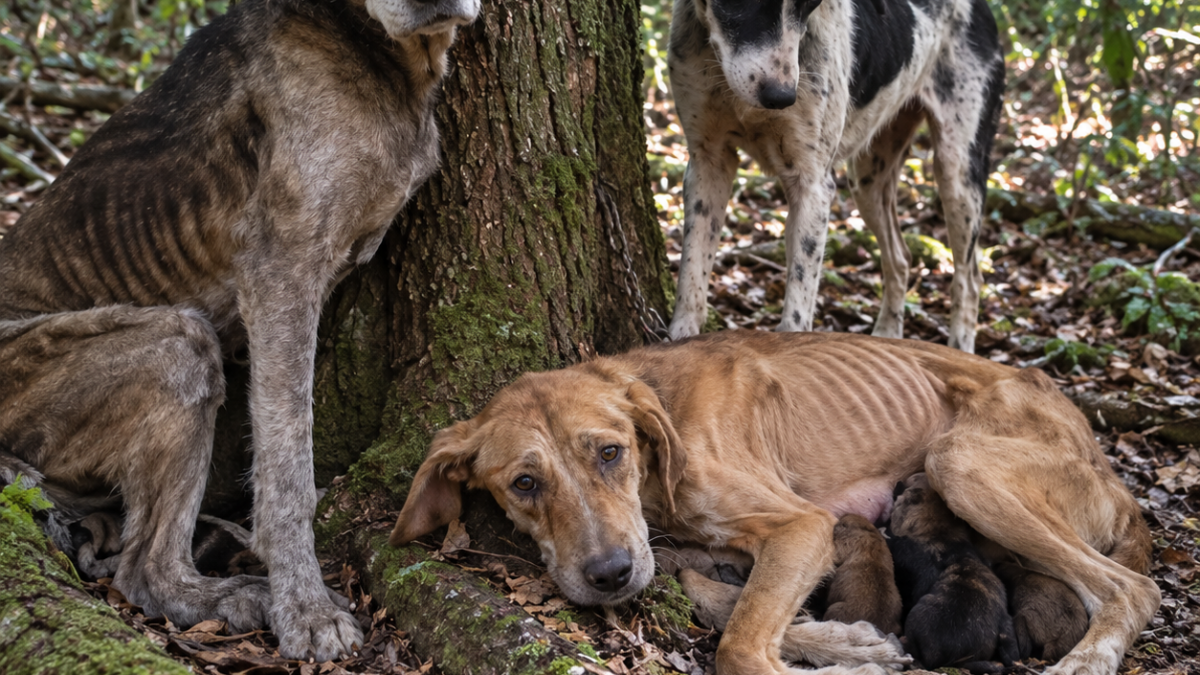
I went into the woods to inspect an abandoned trail and found a mother dog chained to an oak with three newborn puppies pressed beneath her ribs.
Before I could touch the chain, two starving dogs came out of the brush and placed themselves between us like guards who had been waiting weeks for someone to come.
What I discovered about why they had stayed—and who had left her there—changed the way I understood loyalty, cruelty, and justice forever.
I had been a forest ranger for thirty-eight years, long enough to know that silence has different meanings.
A forest can be quiet because rain is coming. It can go still because a predator is near. Sometimes the woods settle into a soft, harmless hush just before sunset.
That morning, the silence felt wrong.
I was checking an old service trail in the northern section of the district. The route had been closed for years, but during the previous two weeks I had found fresh tire marks near the locked access gate and footprints beyond a washout where no one was supposed to be driving.
Moss covered the old stumps. Ferns crowded the trail. Sunlight came through the canopy in narrow strips.
Then I heard one bark.
Low. Careful. Domestic.
I stopped so quickly that the radio on my belt knocked against my hip.
There are coyotes, foxes, and the occasional black bear in those woods, but after nearly four decades outside, I knew the sound of a dog.
I moved toward it slowly.
About fifty yards off the trail, the trees opened into a small clearing. An old oak stood near the center, its roots lifting through the dirt like knuckles.
A gray female dog sat against the trunk.
For one second, I thought she was loose.
Then I saw the chain.
It was rusty, looped around the oak and clipped to a worn collar around her neck. She was painfully thin. Her ribs showed through her coat, and her belly sagged with the unmistakable strain of nursing.
Beneath her were three newborn puppies.
Their eyes were still closed.
One pushed weakly against her front leg. Another made a tiny squeaking sound and buried its face into her fur.
I crouched ten feet away.
“Easy, girl,” I whispered. “I’m not going to hurt you.”
She watched me without blinking.
Her fear was obvious, but so was something else. She did not try to run. She could not have anyway. Instead, she shifted her body so the puppies were farther behind her chest.
I took out my canteen and set it on the ground.
Then I extended one hand.
The instant I moved closer, she cried out—not a bark, but a sharp, frightened sound that made me stop.
“All right,” I said. “I hear you.”
Leaves snapped behind me.
Two dogs burst from the brush.
The first was a large brown dog with a gray muzzle and a frame as lean as a fence rail. The second was smaller, black and white, with mud dried to his legs.
They came between us immediately.
Both barked.
The larger dog showed his teeth.
I eased backward and lowered myself onto the ground.
For a few seconds, I thought I had made a serious mistake.
Then I noticed where they were standing.
Not in front of me.
In front of her.
The larger dog kept his shoulder against the mother’s chain. The smaller one glanced back at the puppies every few seconds.
Their paws were raw. Their coats were dirty. Their bodies were thin enough that I could count ribs.
And scattered near the oak were things I had not noticed before: part of a hamburger bun, a torn food wrapper, the wing of a bird, and the crushed bottom of a plastic cup holding a little rainwater.
I could not prove who had brought those things.
But I knew what I was looking at.
They had not wandered past that morning.
They had been staying.
I put both hands flat on my knees.
“I’m here to help,” I said.
The big dog stared at me.
The black-and-white dog stopped barking.
And for the first time, the mother lowered her head instead of shielding her puppies.
That was when I saw the metal tag beneath her collar—and the name stamped into it.
PART 2
JUNE.
That was the name stamped across the front of the tag.
I waited another few seconds before leaning enough to see the back.
Most of the lettering had been scratched nearly smooth, but I could still make out three words.
HARLAN RIDGE KENNELS.
My stomach tightened.
I knew the name.
Almost everybody in our county did.
Harlan Ridge sat about eighteen miles south of the forest, beyond an old quarry and a stretch of dairy farms. They bred hunting dogs—mostly pointers, hounds, and retriever mixes—and every fall I saw their advertisements taped to gas station bulletin boards.
“Champion bloodlines.”
“Family raised.”
“Healthy, socialized puppies.”
There was even a photograph in one of the advertisements of Wade Harlan, the owner, kneeling in clean grass while half a dozen glossy dogs crowded around him.
I had driven past the property dozens of times.
I had never stopped.
Looking at June, I wished I had.
I reached slowly for my radio.
The large brown dog stiffened the instant the speaker crackled.
I froze again.
“Easy,” I said.
His lips lowered over his teeth, but his eyes never left me.
I turned the radio volume down.
“Dispatch, this is Carter.”
“Go ahead, Ben.”
“I need county animal control and a veterinarian if they can send one into the north district. Old service road fourteen. About three-quarters of a mile past the washout.”
There was a pause.
“What have you got?”
I looked at June.
“Three adult dogs. One restrained. Three neonatal puppies. All severely underweight.”
Another pause.
Then the dispatcher’s voice changed.
“Copy. Are the adults aggressive?”
“No.”
The big dog watched me.
“Protective.”
“Understood.”
I gave her my coordinates.
Then I waited.
Thirty-eight years as a ranger had taught me that sometimes the hardest part of helping an animal was resisting the urge to hurry.
June needed water.
She needed food.
She needed that chain off her neck.
But if I frightened her protectors into attacking, everything would become harder.
So I stayed on the ground.
I unscrewed the lid from my canteen and poured a little water into it.
The black-and-white dog stared.
I pushed the lid three feet toward him.
He stepped forward.
The large dog bumped his shoulder as if warning him.
The smaller one stopped.
I pushed the lid another foot and pulled my hand back.
For almost a minute nobody moved.
Then the smaller dog approached.
He stretched his neck first, sniffed the water, and lapped twice.
The large dog watched.
The little dog drank again.
Then something happened that I still remember more clearly than almost anything from that morning.
Instead of finishing the water, he turned around, walked back to June, and stood beside the lid looking at her.
June tried to rise.
Her front legs shook.
She got halfway up and collapsed again.
The big dog immediately moved beside her.
June leaned against his shoulder.
I had spent most of my career telling people not to assign human motives to wild animals. Animals are animals. Their behavior deserves to be understood for what it is, not turned into whatever story makes us feel better.
But these were domestic dogs.
And whatever word you chose for what I was watching—bonding, instinct, attachment, cooperation—it was real.
The big dog stood there while June used his body to steady herself.
She reached the water.
She drank.
Not wildly.
Not greedily.
Three small laps.
Then she turned back toward her puppies.
I poured more.
“Good girl,” I whispered.
The black-and-white dog sat down.
That was the first break in the wall between us.
Twenty-eight minutes later I heard an engine near the washout.
The big dog heard it first.
He jumped up.
June pulled the puppies closer.
“Easy,” I said.
A woman’s voice called from the trail.
“Ben?”
“Come slow.”
Maya Ellis appeared through the ferns carrying a medical pack and two slip leads.
Behind her was Dr. Lena Ortiz, one of the county’s large-animal veterinarians, carrying a folded blanket and a hard plastic case.
Maya had worked animal control for eleven years. I had seen her catch terrified dogs under abandoned houses, coax an injured shepherd out of a drainage culvert, and climb waist-deep into January water after a Labrador that had fallen through pond ice.
She took one look at the clearing and stopped.
“Oh, God.”
“Three puppies,” I said quietly.
Lena crouched beside me.
“How old?”
“You tell me.”
She studied them from a distance.
“A few days. Maybe less.”
June watched every movement.
Maya whispered, “What about the two loose ones?”
“Been guarding her.”
“For how long?”
“I don’t know.”
Lena saw the scraps near the tree.
Her expression changed.
“You think they’ve been feeding her?”
“I think somebody has.”
She looked around the empty forest.
There was no house within miles.
No campsite.
No road open to the public.
Maya slowly opened a pouch and took out pieces of chicken.
The smell changed everything.
The black-and-white dog stood immediately.
The large brown dog did not.
He stayed in front of June.
Maya tossed one piece halfway between us.
The smaller dog grabbed it.
She tossed another.
He ate that too.
The third piece landed closer to Maya.
He hesitated.
Then hunger won.
He crept forward and swallowed it.
Maya did not reach for him.
She simply kept feeding.
Within five minutes he was standing six feet from her.
The large dog still had not moved.
“He’s the one we need permission from,” Maya whispered.
She meant it as a joke.
It did not feel like one.
Lena examined June from where she sat.
“Her gums are probably pale. Her breathing is fast. I don’t like the way she’s holding her abdomen.”
“Can we move her?”
“We have to.”
“What about the puppies?”
“Keep them warm and with her if possible. But we need to get all of them into the clinic.”
I looked at the chain.
A heavy padlock joined two links behind the tree.
Whoever had put June there had not improvised.
They had brought a chain.
They had wrapped it around the oak.
They had locked it.
Then they had walked away.
I felt anger rise in me.
After thirty-eight years, I knew anger could make a person careless.
So I swallowed it.
“Bolt cutters are in my truck,” I said.
“I brought some,” Maya replied.
She set them on the ground where June could see them.
The steel handles made a faint clink.
June flinched.
The big dog growled.
Maya backed away immediately.
For the next fifteen minutes we did almost nothing.
We fed them.
We spoke softly.
We let them study us.
The black-and-white dog eventually took chicken from Maya’s fingers.
The brown dog finally ate one piece that I tossed near his front feet.
Then another.
Then another.
I moved the food a few inches closer to myself each time.
He knew exactly what I was doing.
So did I.
On the eighth piece, he walked forward and took it from the ground two feet from my boot.
His eyes met mine.
“You’re exhausted, aren’t you?” I whispered.
His ears shifted.
I reached toward him.
He stepped back.
I stopped.
Ten minutes later, he approached me on his own.
He sniffed my knee.
Then my hand.
His nose was dry and rough.
I did not move.
Finally, he touched my palm with the side of his muzzle.
That was all the permission I needed.
I scratched him once beneath the chin.
His eyes closed.
Only for a second.
But they closed.
Behind him, June watched.
I stood slowly.
The dog followed me.
I walked toward the tree.
He walked with me.
When we reached June, I knelt beside her.
This time she did not cry out.
I touched the top of her head.
Her coat felt coarse beneath my fingers.
“All right, June,” I said. “We’re getting you out.”
Lena slid a towel beneath the puppies.
Maya kept feeding the two males.
I positioned the bolt cutters around the chain.
The steel was thick.
I squeezed.
Nothing.
I shifted my grip.
June trembled.
The large dog pressed against her shoulder.
“Stay with me,” I whispered.
I squeezed again.
The link snapped.
The sound cracked through the clearing like a gunshot.
All three dogs jumped.
June tried to lunge away.
For the first time in who knew how many days, there was nothing holding her to the tree.
She made it two steps.
Then her legs folded.
The large dog was beside her before I was.
He stood across her chest as though he could hold her together with his body.
Lena rushed forward.
“She’s crashing.”
We moved quickly then.
Fear no longer mattered as much as time.
Maya wrapped the puppies in the blanket.
Lena and I lifted June onto a canvas stretcher.
The large dog barked at us once.
“Come,” I told him.
He followed.
The black-and-white dog followed him.
We carried June down the abandoned trail.
Every few yards I looked back.
Both dogs were still there.
At the washout, Maya opened the rear compartment of the animal-control truck.
We placed June inside with the puppies.
The brown dog put his front paws on the bumper.
He hesitated.
Then he climbed in.
The black-and-white dog jumped in after him.
Maya stared at me.
“Well,” she said.
“Guess we’re taking everybody.”
She shut the door.
The big dog immediately lay beside June.
The smaller one curled against the crate wall.
For the first time that morning, neither of them was watching the forest.
They were watching us.
As if their shift had finally ended.
The veterinary clinic was twenty-two miles away.
I drove behind Maya’s truck and ignored the speed limit more than I should have.
At the clinic, Lena’s staff had already cleared a treatment room.
June’s temperature was low.
She was dehydrated, anemic, infected, and dangerously underweight.
The puppies were dehydrated too.
The smallest one, a little gray male with a white chin, barely weighed nine ounces.
Lena held him in one hand.
“I don’t know if this one makes it.”
June lifted her head from the table.
The puppy squeaked.
She tried to stand.
“Keep him near her,” I said.
“We will.”
The two males refused to leave the doorway.
Maya tried guiding them toward a separate kennel.
The big one planted all four feet.
The smaller one slipped around her and ran back to June.
Lena looked at them.
“Fine. Put beds in here.”
Hospital rules became flexible that afternoon.
By five o’clock, June was receiving fluids.
The puppies were in a warmed box within three feet of her.
The two males were asleep on blankets beside the treatment table.
I should have gone home.
Instead, I sat in a plastic chair with a paper cup of coffee cooling between my hands.
Maya came in carrying a scanner.
“Ready for some names?”
She ran it over June first.
A beep.
Microchip.
Registered owner: Harlan Ridge Kennels.
Wade Harlan.
My jaw tightened.
The large brown dog had a chip too.
His registered name was Boone.
Owner: Harlan Ridge Kennels.
The black-and-white dog had no chip.
But when Maya cleaned the mud from his faded collar, a handwritten word appeared beneath the buckle.
PATCH.
June.
Boone.
Patch.
Three dogs in a clearing eighteen miles from the business connected to two of them.
One dog chained.
Two loose.
Three newborn puppies.
Maya looked at me.
“You think Harlan dumped them?”
“I think we need evidence before we think anything out loud.”
“That sounded like ranger talk.”
“It is.”
She looked toward June.
“Then go find evidence.”
So I did.
I returned to the forest before sunset.
The clearing looked different without the dogs.
Empty.
Wrong.
The chain still lay where I had cut it, so I photographed everything before touching anything.
The padlock.
The links.
The disturbed soil.
The food wrappers.
The plastic cup.
The tree.
The place where June’s body had flattened the leaves.
A shallow depression beneath one root held dark stains where rainwater had collected and dried.
I found tracks around the clearing.
Some belonged to dogs.
Some belonged to me, Maya, and Lena.
But one set was older.
Men’s boots.
Large.
Deep heel.
Distinctive triangular tread.
They led from the clearing toward an old spur road.
I followed.
Two hundred yards later, I found tire impressions in a patch of mud that stayed damp beneath the hemlocks.
Wide truck tires.
The right rear had a missing block in the tread.
That was useful.
But the thing that mattered most was farther up the trail.
One of our wildlife cameras.
I had forgotten about it.
Three months earlier, we had mounted cameras throughout the northern district after someone started dumping deer carcasses near closed roads.
Camera seven faced the service route about half a mile from the clearing.
I removed the memory card and carried it back to my truck.
I did not wait until I reached the office.
I opened the files on my field laptop.
Deer.
Raccoons.
A fox.
Nothing.
Then I found a night image from nineteen days earlier.
2:14 a.m.
A white pickup truck was entering the closed road.
The license plate was blurred by mud.
But the driver’s side door carried dark lettering.
I enlarged the image.
Most of it became pixels.
But I could read the bottom word.
KENNELS.
My pulse quickened.
I moved to the next photograph.
The truck was closer.
Three dogs were visible in the bed.
A gray female.
A large brown dog.
A smaller black-and-white dog.
June.
Boone.
Patch.
I stared at the screen.
The next image was forty-six minutes later.
Same truck.
Leaving.
The bed was empty.
I sat alone in my vehicle as darkness settled over the forest.
I had seen many ugly things in thirty-eight years.
Poached deer left to rot.
Owls shot for no reason.
Bears poisoned because someone disliked them getting into garbage.
Dogs abandoned at trailheads.
Cats dumped in cardboard boxes.
But there was something different about seeing those three dogs standing together in the back of that truck.
They had trusted the person driving.
Nineteen days later, one of them had been chained to a tree.
The other two had been free to leave.
And they had not.
I called Deputy Frank Keller with the county sheriff’s office.
“Frank, I need you to meet me tomorrow morning.”
“About the dogs?”
“Who told you?”
“Small county.”
“I have photographs.”
He paused.
“What kind?”
“The kind Wade Harlan is not going to like.”
The next morning, we went to Harlan Ridge Kennels.
Wade Harlan was fifty-three, broad shouldered, clean shaven, with expensive boots and the easy confidence of a man used to being liked.
His property looked exactly the way an animal-breeding business wanted customers to see it.
White fencing.
Fresh gravel.
A red barn.
A wooden sign burned with the words HARLAN RIDGE KENNELS.
Four dogs ran behind a fenced exercise yard, healthy-looking and clean.
Wade walked out before we reached the office.
“Morning, Ben.”
He knew me.
That did not surprise me.
“You’re a long way from your trees.”
Frank showed his badge.
“We’re asking about three dogs.”
Wade’s smile disappeared.
“What dogs?”
“A female named June. Male named Boone. Black-and-white male called Patch.”
For half a second, his face changed.
Then it came back under control.
“June’s missing.”
“How long?”
“Couple weeks.”
“Boone?”
“Missing too.”
“And Patch?”
“Never heard of him.”
Frank said, “Did you report June or Boone missing?”
“No.”
“Why not?”
Wade crossed his arms.
“Dogs get out.”
I looked at the six-foot kennel fencing.
“Two of them?”
“Gate got left open.”
“Same night?”
He looked at me.
“Probably.”
I took out a printed photograph from the wildlife camera.
I did not show him the one with the dogs.
Not yet.
I showed him the white truck.
“Is this yours?”
Wade studied it.
“Looks like a hundred trucks in this county.”
The faint smile at the corner of his mouth told me more than his answer.
Frank said, “Does your truck have Harlan Ridge Kennels printed on the door?”
“Yeah.”
“What tires do you run?”
Wade’s eyes moved toward a white pickup parked beside the barn.
So did mine.
The right rear tire was muddy.
One tread block was missing.
Frank followed my gaze.
Wade noticed.
His jaw tightened.
“That prove something?”
“No,” I said. “But this might.”
I showed him the photograph of the truck entering the closed service road.
Three dogs stood in the bed.
Wade stopped smiling.
For several seconds nobody spoke.
Then he laughed.
Not because anything was funny.
It was the kind of laugh people use when the truth has arrived and they need a few extra seconds before deciding which lie to tell next.
“All right,” he said. “I drove up there.”
“With the dogs?”
“Yes.”
“Why?”
“To exercise them.”
“At two fourteen in the morning?”
“I hunt early.”
“Hunting season wasn’t open.”
“I scout.”
“That road is closed to motor vehicles.”
“So write me a ticket.”
Frank stepped slightly closer.
“Where are the dogs now, Wade?”
“I told you. They got loose.”
“You drove in with them and drove out without them.”
“They jumped out.”
“All three?”
He shrugged.
“Dogs chase deer.”
I took another photograph from my folder.
The padlock around the oak.
The chain.
June’s collar.
“Did June lock herself to the tree?”
Something hardened in his face.
“I don’t know anything about that.”
“That tag around her neck has your kennel name on it.”
“Anybody can have one of my dogs.”
“She is microchipped to your business.”
“She was stolen.”
“You just told us she got loose.”
His eyes narrowed.
There it was.
The first crack.
Frank asked him to come to the sheriff’s office and make a formal statement.
Wade declined.
He had that right.
Then he told us to leave his property.
He had that right too.
We left.
But before I got into Frank’s cruiser, I looked back at the kennels.
A dog stood alone behind one of the rear fences.
Thin.
Brown.
Watching us through the wire.
Frank noticed me looking.
“Not enough for a warrant yet.”
“I know.”
“You thinking there are more?”
“I’m thinking I want to know.”
Back at the veterinary clinic, June was still alive.
So were all three puppies.
The smallest one was barely hanging on.
Lena had placed him on supplemental heat and was feeding him tiny amounts every two hours.
When I entered, Boone raised his head.
Patch wagged his tail once.
June looked at me.
That tiny movement from Patch nearly broke something in me.
Yesterday he had been prepared to bite me.
Today I was somebody who came back.
I sat on the floor.
Boone came over and leaned his entire body against my shoulder.
He was heavier than he looked.
“Careful, old man.”
Lena stood in the doorway.
“He’s probably eight or nine.”
“Old enough.”
She handed me June’s lab sheet.
“How bad?”
“She was close.”
“To dying?”
“Yes.”
I looked at her.
“And the puppies?”
“Two are improving. The small male is the concern.”
June lifted her head when he squeaked.
Lena smiled sadly.
“She has almost nothing left, and she’s still trying to give it to them.”
I rubbed Boone’s chest.
“What about these two?”
“Dehydrated. Parasites. Weight loss. Torn pads. Boone has arthritis. Patch has a healing cut under his front leg. Nothing we can’t treat.”
“How long would they have survived out there?”
“Depends on weather, food, luck.”
“And June?”
Lena looked through the glass toward her.
“Another day or two, maybe.”
That stayed with me.
Another day or two.
If I had postponed the trail inspection until Monday, June might have died beneath that oak.
The puppies would have followed.
And Boone and Patch?
I knew what they would have done.
They would have stayed.
That evening, I visited the district office and pulled every wildlife-camera file from the previous three weeks.
It took hours.
At 9:40 p.m., I found something.
Camera nine sat near a creek crossing three hundred yards south of the clearing.
The first photograph showed Boone.
Night.
Eleven days before I found them.
He was carrying something.
I zoomed in.
A paper bag.
The next night, Patch appeared.
Something pale was in his mouth.
Bread, maybe.
Two days later Boone crossed again carrying what looked like part of a rabbit.
Then Patch with a discarded fast-food container.
Then Boone.
Then Patch.
Always traveling north.
Always toward June.
I leaned back from the screen.
They had been leaving the clearing.
They could have kept going.
There was a campground six miles south.
Farms beyond that.
Roads.
People.
Food.
Instead they had gone out and come back.
Again.
And again.
And again.
I called Maya even though it was nearly ten.
“You awake?”
“I work animal control. I’m always awake.”
“I found more camera footage.”
“What?”
“Boone and Patch.”
“Doing what?”
“Bringing things toward the clearing.”
Silence.
Then Maya said quietly, “Food?”
“Looks like it.”
Another silence.
“How many times?”
“At least six.”
She inhaled sharply.
“Ben.”
“I know.”
“You need to save copies.”
“Already did.”
The next morning, there was one more surprise.
Someone had entered the forest during the night.
I knew because the padlock on the service gate had been cut.
I called Frank before driving in.
We went together.
The clearing had been disturbed.
The pieces of food wrapper I had left beneath evidence flags were gone.
So was the plastic cup.
Someone had kicked leaves across the area where the chain had been.
They had even scraped bark from the side of the oak where the chain had rubbed against it.
“They’re cleaning,” Frank said.
“Trying to.”
“You take everything important?”
“Chain, lock, photographs, samples.”
He nodded.
“Good.”
Then I looked up.
Our replacement camera was gone.
The steel security box remained attached to another tree, but the camera had been ripped out.
Frank swore under his breath.
I smiled.
“What?”
“New model.”
“So?”
“Uploads images automatically.”
I took out my phone.
The camera had transmitted six photographs before being destroyed.
The first three showed a flashlight.
The fourth showed a man approaching.
The fifth showed his face.
Wade Harlan.
The sixth showed his hand reaching toward the lens.
Frank looked at the photograph.
“Well,” he said.
“That help with your warrant?”
“It doesn’t hurt.”
By noon, Wade Harlan had an attorney.
By three, the sheriff’s office and county animal-welfare investigators were preparing a search-warrant affidavit.
At four fifteen, Harlan Ridge Kennels posted a message online claiming that two valuable hunting dogs had been stolen and that “government officials” were attempting to destroy a respected local business.
Maya showed me the post.
“Want to read the comments?”
“No.”
“Smart.”
“Anything useful?”
“One thing.”
She turned the phone toward me.
An account belonging to a man named Noah Price had written only six words.
Ask him what happened to June.
The comment disappeared twelve minutes later.
But Maya had taken a screenshot.
Frank found Noah that evening.
He was twenty-four and had worked at Harlan Ridge for nearly two years before quitting the previous month.
He agreed to speak to us at a diner outside town.
The moment I mentioned June, he looked down at his coffee.
“I knew this was coming.”
“What was coming?” Frank asked.
Noah rubbed both hands across his face.
“Something bad.”
“Tell us.”
He stared through the window for a while.
Then he started talking.
June had belonged to Harlan Ridge for six years.
She had produced four litters.
After the fourth, Wade had told Noah she was finished breeding.
But several months later June became pregnant again.
Wade was furious.
“He said he wasn’t paying vet bills for another litter,” Noah told us.
“Was she sick?” I asked.
“She was losing weight. Wouldn’t eat right. I told him she needed a vet.”
“What did he say?”
Noah looked at me.
“He said dogs had been having puppies without veterinarians for ten thousand years.”
Frank wrote that down.
“What about Boone?”
“Boone was one of his first stud dogs. Too old now. Bad hips.”
“Patch?”
“A stray that showed up last winter. Wade used him to train younger dogs.”
“Train them how?”
Noah hesitated.
“Just around livestock and gunfire. Stuff like that.”
“Why didn’t Patch have a chip?”
“He wasn’t worth anything.”
The words made me grip my coffee cup harder.
Noah noticed.
“I’m telling you what Wade said. Not me.”
“What happened the night the dogs disappeared?”
Noah looked back toward the window.
“I wasn’t there.”
“Then what do you know?”
“Wade called me the next morning asking if I’d left the back kennel unlocked. I said no. He said June, Boone and Patch were gone.”
“You believed him?”
“No.”
“Why?”
“Because he had told me two days earlier that he needed to ‘clear out dead weight.’”
Frank stopped writing.
“Exact words?”
“As close as I remember.”
“Did he say what he meant?”
“No.”
“Anything else?”
Noah swallowed.
“I saw a chain in his truck.”
“When?”
“That afternoon.”
My pulse changed.
“What kind?”
“Heavy galvanized chain. Maybe fifteen feet. There was a new padlock still in the package.”
“Could you identify it?”
“Maybe.”
Frank and I looked at each other.
Noah continued.
“I should’ve said something.”
“You didn’t know what he planned,” I said.
“I knew enough to ask.”
“That’s different.”
He shook his head.
“No. Sometimes you know a man is cruel before you know exactly what he’s going to do.”
Nobody had an answer to that.
The warrant was signed the following morning.
I did not participate in the search.
That belonged to the sheriff’s office and animal-welfare investigators.
But Frank called me before sunset.
“You were right.”
“How many?”
“Eleven dogs on the property.”
I closed my eyes.
“Condition?”
“Seven okay. Four we’re removing.”
“Why?”
“Underweight. One with untreated injury. One pregnant female with no water in the kennel.”
I leaned against my truck.
“Wade?”
“Not here when we arrived.”
“Where is he?”
“His lawyer says he’s out of town.”
“Convenient.”
“Very.”
They found veterinary records.
Breeding records.
Purchase receipts.
Photographs.
And, in a locked cabinet inside the kennel office, documents listing June as “retired—dispose.”
That word would later matter in court.
Dispose.
As if she were a broken tool.
As if Boone’s arthritic hips erased nine years of life.
As if Patch’s lack of pedigree made him invisible.
But Wade Harlan still had not been arrested.
His attorney argued there was no direct evidence showing Wade himself had chained June to the tree.
The camera proved his truck entered the forest.
The camera showed three dogs inside.
The camera showed the truck leaving empty.
The camera showed Wade returning nineteen days later and destroying evidence.
It was strong.
But Frank wanted stronger.
Then the smallest puppy stopped breathing.
It happened at 2:18 the next morning.
Lena called me.
I was asleep.
My phone rang twice before I understood what I was hearing.
“Ben, it’s Lena.”
I sat up.
“What happened?”
“The little male crashed.”
I was already getting dressed.
“Is he alive?”
“For now.”
The clinic was dark except for the treatment wing.
When I arrived, Lena was bent over the tiny puppy.
A technician squeezed a small ventilation bag.
June lay three feet away, whining.
Boone stood pressed against the kennel gate.
Patch paced in tight circles.
I stayed against the wall because there was nothing useful I could do.
For twenty-three minutes I watched people fight for nine ounces of life.
At one point, Lena stopped.
The room went quiet.
June whined again.
Then the puppy moved.
Barely.
His tiny mouth opened.
The technician whispered, “Come on.”
Another breath.
Then another.
Lena looked at me.
“He’s back.”
I realized I had been holding my breath.
June tried to stand.
I opened her kennel after Lena nodded.
June walked unsteadily to the warmed box.
Lena placed the puppy near her nose.
June licked his head once.
Then again.
Boone lay down outside the box.
Patch finally stopped pacing.
I sat on the floor.
Nobody said anything for a while.
Around four in the morning, Lena handed me a fresh coffee.
“You know you don’t work here.”
“I’m starting to suspect that.”
“You could go home.”
“I have a house. That’s different.”
She looked at me.
I regretted the sentence the moment I said it.
Lena knew my wife, Ellen, had died four years earlier.
Most people in town knew.
Ellen had been the person who filled our house.
Music while cooking.
Shoes by the door.
Books stacked on the stairs.
Arguments with the television.
She had died after eleven months of cancer treatments, and when people asked how I was afterward, I usually told them I was doing fine.
“Fine” is useful because nobody knows what it means.
The truth was simpler.
I had become very good at living quietly.
Lena sat beside me.
“That’s why you’re here every night?”
“No.”
She waited.
I looked at Boone.
“Maybe.”
She did not press.
At six, the little puppy was still breathing.
Lena began calling him Pip because “the smallest patient in the room deserves at least one syllable.”
The name stayed.
His sisters became Fern and Daisy.
For the next three days, my life divided itself between the forest, the sheriff’s office, and the veterinary clinic.
June improved slowly.
She started eating.
The first day she finished an entire bowl, Maya took a photograph and sent it to me with three exclamation points.
Boone gained two pounds.
Patch gained three.
Pip survived.
And Wade Harlan disappeared.
His attorney insisted he was visiting family.
Frank did not believe it.
Neither did I.
On Friday evening, I left the clinic shortly after nine.
As I walked toward my truck, Boone began barking inside.
Not his usual alert bark.
Harder.
Faster.
I turned.
A vehicle sat across the road with its lights off.
White pickup.
My heart kicked once.
I walked back inside.
“Call Frank.”
Maya looked through the lobby window.
“Is that him?”
“I don’t know.”
The truck started.
Its headlights came on.
It pulled away.
Not fast.
Slowly.
Deliberately.
The following morning, we found a note beneath the windshield wiper of my ranger truck.
STOP BEFORE YOU LOSE MORE THAN A DOG.
Frank read it twice.
“You touch this?”
“Only the edge.”
He bagged it.
“Could be anybody.”
“I know.”
“Doesn’t mean we ignore it.”
“I know.”
He looked at me.
“Ben, this isn’t a movie. Don’t go looking for him alone.”
“I’m sixty-three years old, Frank.”
“That supposed to reassure me?”
“I haven’t gone looking for a fight since 1987.”
“What happened in 1987?”
“Lost.”
He almost smiled.
Then his face became serious again.
“Keep your doors locked.”
That afternoon, Wade Harlan walked into the sheriff’s office with his attorney.
He claimed he had heard officers were looking for him.
He denied leaving the note.
He denied chaining June.
He denied destroying evidence despite the camera image showing his face.
His explanation was that he had returned to the forest searching for his “stolen property” and removed the camera because he thought it belonged to whoever had stolen his dogs.
Frank asked why he had scraped the tree.
Wade denied doing it.
He was arrested on several charges pending further investigation.
He posted bond before dinner.
The next morning, he came to the veterinary clinic.
I was there.
So was Maya.
Wade entered with his attorney and two sheets of paper.
The receptionist stood immediately.
“You need to leave.”
“I’m here for my dogs.”
Maya moved between him and the treatment wing.
“They’re under protective custody.”
“They’re my property.”
“No longer your decision.”
Wade looked past her and saw me.
His expression changed.
“You.”
I stood.
His attorney touched his arm.
“Wade.”
But Wade stepped closer.
“You’ve turned half the county against me.”
“I haven’t spoken publicly about you once.”
“You showed police those pictures.”
“That’s my job.”
“You think you know something because you found three dogs in the woods?”
“Six.”
His brow tightened.
“Three adults. Three puppies.”
He stared at me.
Then he laughed.
“Those pups won’t be worth anything.”
The room became absolutely silent.
His attorney said, “Wade, stop talking.”
But it was too late.
Maya’s eyes shifted toward mine.
I said, “How did you know about the puppies?”
He realized it too.
Nobody outside the investigation and clinic staff had publicly released that June had given birth.
The photographs online showed only June, Boone, and Patch being treated.
No puppies.
No ages.
No litter.
Wade’s face drained.
His attorney grabbed his elbow.
“We’re leaving.”
Wade pulled away.
“I heard it somewhere.”
“Where?” Maya asked.
“People talk.”
“Who?”
He did not answer.
From behind the treatment-room door came one sharp bark.
Boone.
Wade turned toward the sound.
Boone barked again.
Then Patch joined him.
June began barking too.
Three dogs.
Not panicked.
Not frightened.
Furious.
Wade took a step backward.
I had never seen animals identify a person in a courtroom-style lineup, and I am not going to pretend those barks were legal proof of anything.
But I saw Wade’s face.
He knew those voices.
And they knew him.
He left.
Maya waited until the door closed.
Then she whispered, “Well.”
I looked at her.
“That wasn’t nothing.”
“No,” she said. “It wasn’t.”
Two days later, the case broke open.
Noah Price called Frank.
He had remembered something.
The kennel had exterior security cameras.
Wade had told investigators the system had stopped recording months earlier.
Noah knew that was false.
The camera feeds were backed up automatically to an online account because Noah had helped install them.
He still had an old email containing the setup information.
A warrant went out to the storage provider.
The recordings were recovered.
The footage from the night June disappeared showed Wade Harlan walking from the kennel barn at 1:26 a.m.
June was on a leash.
Boone followed.
Patch followed behind Boone.
Wade loaded all three into his white pickup.
Before closing the tailgate, he put a coil of chain into the truck bed.
Then he drove away.
Forty-eight minutes later, our forest camera photographed him entering the restricted road.
At 3:01 a.m., it photographed him leaving without the dogs.
That alone changed the case.
But one more piece arrived.
Wade’s phone location records.
A warrant placed his phone in the northern district for fifty-two minutes that night.
He could still claim the dogs escaped.
He could still claim somebody else chained June after he lost them.
But the jury would eventually hear one fact that made that explanation difficult.
The chain recovered from the oak matched a fifty-foot chain Wade had purchased from a farm-supply store two days earlier.
The store’s receipt recorded twenty-one feet being cut from the original length at the time of purchase.
Investigators found the remaining twenty-nine feet inside his barn.
The cut ends matched in diameter, manufacturer markings, and finish.
When Frank told me, I stared at him.
“That enough?”
He nodded.
“Now it’s enough.”
Wade Harlan was arrested again.
This time the charges were more serious.
His kennel operation was suspended pending the case.
The four additional dogs removed during the search stayed in protective custody.
Local customers began coming forward.
Some were angry at law enforcement.
Some defended Wade.
Some said he had always treated their dogs well.
Others told different stories.
A family reported that they had returned a sick puppy years earlier after Wade promised to place it with a veterinarian.
They never learned what happened to it.
A former employee described dogs being left without treatment when they were no longer considered profitable.
None of those allegations automatically became facts simply because people made them.
Frank reminded everyone of that.
So did the prosecutor.
The case centered on what could be proved.
June.
Boone.
Patch.
The chain.
The truck.
The cameras.
The phone.
The records.
And one man’s decision to leave three domestic animals in an isolated forest.
The first time I took June outside after she was strong enough to walk, she stopped beneath a maple tree.
Her body went rigid.
The leash tightened in my hand.
I thought she had smelled an animal.
Then I saw what she was staring at.
A chain around the trunk.
Nothing cruel.
The clinic used it to secure a metal trash container.
But June did not know that.
She sank toward the ground.
“June.”
Her ears flattened.
Boone came beside her.
He pressed his shoulder against hers exactly as he had beneath the oak.
Patch walked around both of them and stood between June and the tree.
I crouched.
“It’s all right.”
June looked at me.
I unclipped the leash.
Maya inhaled behind me.
“Ben.”
“I know.”
June was not fenced.
The parking area was open.
The road was sixty yards away.
For nineteen days she had been attached to a tree.
Now nothing held her.
She stood.
Boone stepped forward.
Patch trotted toward the grass.
June followed them.
Not toward the road.
Not away from us.
She walked in a slow circle around the maple.
Then she came back and placed her nose against my hand.
I had to look away.
Maya pretended not to notice.
“You realize,” she said, “you’re in trouble.”
“What kind?”
“The expensive kind involving dog food.”
“I’m not adopting six dogs.”
“I didn’t say six.”
“I’m not adopting three dogs.”
“I didn’t say three.”
“You’re a terrible liar.”
“So are you.”
I told myself she was wrong.
For the next six weeks, June and her puppies remained under veterinary care and then moved into foster placement.
Boone and Patch refused to leave June voluntarily.
Every attempt to kennel them separately resulted in one or both pacing, barking, or refusing food.
Eventually the rescue stopped trying.
They called them the Forest Three.
I hated the name.
It sounded like a television show.
But everyone else loved it.
Photographs spread through town.
Not graphic photographs.
Maya refused to publish those.
Instead people saw June lying on a clean bed with her puppies.
Boone resting beside her.
Patch sitting with his front paws crossed, looking deeply offended by the camera.
Donations arrived.
So did adoption applications.
Hundreds.
Some people wanted the puppies because they were cute.
Some wanted June because they felt sorry for her.
Dozens wanted Boone after hearing how he had guarded the clearing.
But Maya made one rule.
The three adults would not be separated unless their behavior eventually showed they were comfortable apart.
That did not happen.
If June walked into another room, Boone checked on her.
If Boone went outside, Patch waited by the door.
If Patch disappeared behind a shed, June stood until he returned.
They were not simply three dogs who happened to share a foster home.
They were a unit.
Their bond had been formed somewhere before the forest, but what happened beneath that oak had hardened it.
They had survived because they did not abandon one another.
I understood that more than I wanted to.
One evening, I brought them to my house.
Only temporarily.
Their foster family had a wedding out of state.
Maya called me.
“You have a fenced yard.”
“I also have furniture.”
“They’re house-trained.”
“Patch looks like a criminal.”
“He has no convictions.”
“I’m a government employee. I can’t associate with that type.”
“I’ll bring them at six.”
She hung up.
At six fifteen, three dogs stood in my kitchen.
June sniffed every cabinet.
Boone found the rug beside the fireplace and lay down as if he had lived there for years.
Patch stole one of my socks.
I caught him halfway down the hallway.
“Give me that.”
He wagged his tail.
“Patch.”
He ran.
I chased him around the dining table twice before realizing I was laughing.
The sound startled me.
Not Patch.
Me.
I had not heard myself laugh like that in a long time.
June stood near the kitchen doorway watching.
When I stopped, she came over.
I knelt.
She rested her forehead against my chest.
That first night, I arranged three dog beds in the living room.
At 10:30, Boone was asleep.
Patch was upside down with all four legs pointed toward the ceiling.
June lay nearest the front door.
I turned off the lights and went upstairs.
At 11:07, I heard nails on wood.
I came down.
All three dogs were standing at the bottom of the stairs.
“What?”
Patch wagged.
I went back up.
They followed.
“No.”
They kept coming.
“My bedroom is not a kennel.”
Boone walked past me.
“Boone.”
He entered my room.
Patch followed.
June waited in the hallway.
I sighed.
“Fine.”
Boone lay beside the dresser.
Patch curled near the foot of the bed.
June walked to Ellen’s side.
She sniffed the floor.
Then she settled beside the empty half of the bed.
I stood in the dark looking at her.
Four years earlier, after Ellen died, I had stopped sleeping on that side.
I had never moved her nightstand.
Her last paperback was still in the drawer.
There are losses you heal from.
And there are losses you simply learn to build your life around.
June lowered her head onto her paws.
I sat on the edge of the mattress.
“Don’t make too much of this,” I told her.
Her tail struck the floor once.
She stayed there all night.
The next morning, I called Maya.
“The wedding is how long?”
“Three days.”
“Fine.”
On day four, she arrived to collect them.
Patch hid behind my truck.
Boone walked onto the porch and lay down.
June sat beside me.
Maya looked at the three dogs.
Then at me.
“You packed their things?”
“No.”
“Why?”
“I forgot.”
“All of them?”
“Yes.”
“Their food too?”
“I bought more.”
“I see.”
She smiled.
I hated that smile.
“You’re enjoying this.”
“Immensely.”
“I haven’t decided anything.”
“Of course not.”
She left without the dogs.
I called her ten minutes later.
“You did that on purpose.”
“Yes.”
I hung up.
The court case took seven months.
That is something stories often skip.
Justice is rarely quick.
It is paperwork.
Continuances.
Motions.
Phone calls.
Expert reports.
Arguments over evidence.
Days when nothing seems to happen.
Wade Harlan remained free on bond while his attorney challenged the search warrant and tried to exclude the camera footage.
The motions failed.
The defense argued that Wade had abandoned the dogs but had not intended for them to suffer.
The prosecutor asked a simple question.
Why chain June?
If the intention had merely been to surrender or release the dogs, why bring a lock?
Why take a pregnant animal to an isolated restricted forest in the middle of the night?
Why restrain her to a tree where she could not reach a stream fifty yards away?
Why leave two others loose?
The prosecution’s theory was brutal in its simplicity.
Wade believed Boone and Patch would leave.
He believed June could not.
What he had not anticipated was that the two dogs would stay.
The trial began on a cold Monday morning in February.
I was the first witness.
The courtroom was smaller than people imagine.
No dramatic marble columns.
No television cameras.
Wood benches.
Fluorescent lights.
A clock that ticked too loudly.
Wade sat at the defense table wearing a dark suit.
He looked thinner.
His kennel had closed permanently four months earlier after his business license was revoked over unrelated regulatory violations discovered during the investigation.
I took the oath.
The prosecutor asked me to describe why I had been on the abandoned trail.
I explained the tire tracks.
The barking.
The clearing.
June.
The puppies.
Boone and Patch.
She showed the jury photographs.
I did not look at Wade.
Then she played the wildlife-camera footage.
The white truck entering.
Three dogs visible in the bed.
The truck leaving empty.
Next came the photographs of Boone and Patch crossing the creek trail during the following days.
Boone with the paper bag.
Patch with food.
Again.
Again.
Again.
The prosecutor paused on one image of Boone traveling north in heavy rain.
“Ranger Carter, where did this trail lead?”
“Toward the clearing.”
“Where June was chained?”
“Yes.”
“Could Boone have traveled south instead?”
“Yes.”
“What was south?”
“Roads. Farms. A campground.”
“Places where a loose dog might find people?”
“Yes.”
“Did he go south?”
“Not in any image I reviewed.”
“What did he do?”
I looked at Boone’s photograph.
“He kept going back.”
Wade’s attorney objected.
“Speculation regarding the animal’s intent.”
The judge nodded.
“Sustained. Jury will disregard any inference concerning the dog’s intention.”
The prosecutor adjusted.
“Ranger Carter, what did the photographs factually show?”
“Boone repeatedly traveled north toward the clearing after obtaining food or carrying objects that appeared to be food.”
“And Patch?”
“Same pattern.”
No speculation.
Just evidence.
That was enough.
The defense attorney stood for cross-examination.
He was good.
Calm.
Professional.
He asked whether I personally saw Wade chain June.
“No.”
“Did you see Mr. Harlan unload the dogs?”
“No.”
“Did the wildlife camera show the clearing itself?”
“No.”
“So you cannot testify that my client placed the chain around June’s tree.”
“Not from personal observation.”
He walked toward the jury.
“And you cannot tell this jury whether another person encountered June after she escaped my client’s vehicle.”
“That is correct.”
“Thank you.”
He turned away.
Then I said, “But June didn’t escape.”
He stopped.
The prosecutor rose.
“Your Honor—”
The judge looked at me.
“Ranger, answer only the questions asked.”
“Yes, Your Honor.”
The defense attorney returned.
“What do you mean by that?”
Now he had asked.
I looked at him.
“The photographs show June arriving in the bed of the truck. The chain recovered from the tree was purchased by Mr. Harlan two days earlier. Twenty-one feet were cut from that chain. The remaining twenty-nine feet were recovered from his property. His phone was located near the clearing during the same time period. So while I did not personally watch him attach that chain, I found no evidence that June ever escaped anything.”
The courtroom stayed quiet.
The defense attorney stared at me for a moment.
Then he said, “No further questions.”
Lena testified next.
She described June’s condition.
The dehydration.
The anemia.
The infection.
The puppies.
She explained that without treatment, June likely would have died.
“How soon?” the prosecutor asked.
“There is no way to know exactly.”
“Days?”
“Possibly.”
“Weeks?”
Lena shook her head.
“I would not expect weeks.”
Then came Noah Price.
He looked terrified.
His hands shook when he took the oath.
Wade stared directly at him.
Noah almost lost his nerve.
I could see it.
The prosecutor asked about his employment.
The dogs.
June’s pregnancy.
Boone’s age.
The chain in Wade’s truck.
Then she asked, “Did Mr. Harlan ever discuss what he planned to do with June?”
Noah swallowed.
“He said she wasn’t worth spending money on.”
“Anything else?”
“He said he needed to clear out dead weight.”
Wade shook his head.
Noah saw him.
The prosecutor said, “Mr. Price, look at me.”
Noah did.
“Did anyone promise you anything in exchange for your testimony?”
“No.”
“Are you receiving money?”
“No.”
“Are you charged with a crime?”
“No.”
“Then why are you here?”
Noah’s eyes filled.
“Because I should’ve stopped it.”
The prosecutor waited.
Noah continued.
“I knew how he talked about dogs when they stopped making money. I knew June was sick. I knew Boone was old. I saw the chain. I told myself it wasn’t my business.”
He looked toward the jury.
“Then I saw that picture of June from the clinic.”
His voice cracked.
“I should have done something.”
For the first time, Wade looked away.
The kennel security footage came next.
Wade loading June.
Boone.
Patch.
The chain.
Driving away.
The defense offered an alternative explanation.
Wade had intended to take the dogs for exercise.
They escaped in the forest.
He had carried the chain because he often used it around the kennel.
The prosecution responded with the receipt.
Then the remaining twenty-nine feet.
Then the matching manufacturer markings.
Then the image of Wade returning to the clearing and reaching for the wildlife camera.
Then his statement claiming the camera belonged to the imaginary thief who had supposedly stolen his dogs.
Then one more recording.
The veterinary clinic’s lobby security video.
Wade saying:
“Those pups won’t be worth anything.”
The jury heard my question.
“How did you know about the puppies?”
They watched his face.
The defense argued he had heard rumors.
Maybe he had.
That one sentence alone proved nothing.
But combined with everything else, it became another stone added to a wall already too high to climb.
The jury deliberated for five hours.
I spent most of them outside.
I had never liked courtrooms.
They made me restless.
Maya sat beside me on a bench.
“You nervous?”
“It’s not my verdict.”
“That wasn’t my question.”
“Yes.”
She handed me coffee.
I stared at the courthouse lawn.
“What if they acquit him?”
“Then we take the dogs home.”
“And that’s it?”
“No. We take the dogs home.”
I looked at her.
She shrugged.
“You can’t control everything, Ben.”
“I know.”
“You’ve spent thirty-eight years trying.”
“That obvious?”
“Painfully.”
At 4:37, Frank came through the courthouse doors.
“Verdict.”
We went back inside.
Wade stood.
The clerk read the first count.
Guilty.
The second.
Guilty.
The third.
Guilty.
Animal cruelty.
Abandonment.
Evidence tampering.
Illegal entry into the restricted forest was almost an afterthought.
Wade stared straight ahead.
I felt no triumph.
That surprised me.
For months I had imagined the verdict would feel like revenge.
It didn’t.
Nothing a judge could say would erase those nineteen days beneath the oak.
Nothing could give June back the weight she lost.
Nothing could explain to Boone that he should never have needed to search garbage for food.
Nothing could make Patch’s loyalty less costly.
Justice did not undo suffering.
It simply drew a line and said:
This mattered.
What happened to them mattered.
At sentencing six weeks later, the judge prohibited Wade Harlan from owning, breeding, selling, or caring for animals during his probation period and imposed incarceration, fines, restitution for veterinary expenses, and additional penalties related to evidence tampering and the kennel violations.
The kennel property was sold later that year.
I drove past once.
The wooden HARLAN RIDGE sign was gone.
I never drove past again.
Noah Price eventually began volunteering at the county shelter.
The first time I saw him there, he was cleaning kennels.
He looked embarrassed when I recognized him.
“I’m not trying to make myself look good,” he said.
“I didn’t say you were.”
“I just thought maybe I could help.”
I handed him another mop.
“Then help.”
He did.
Pip grew.
That was its own small miracle.
By ten weeks, he was still the smallest puppy, but he was also the loudest.
Fern became fearless.
Daisy discovered that every human lap belonged to her.
All three were adopted after careful screening.
Pip went home with a retired elementary school teacher and her husband.
Fern went to a young couple with a fenced yard and an older Labrador.
Daisy went to a veterinary technician who had helped feed her during the first week.
The day the last puppy left, June walked through the house searching room by room.
That hurt more than I expected.
She sniffed their empty pen.
She checked the laundry room.
Then the porch.
Boone followed her.
Patch carried one of the puppies’ old rope toys.
June finally lay beside the fireplace.
Boone settled against her back.
Patch dropped the toy in front of her.
She put one paw over it.
I sat beside them.
“They’re okay,” I said.
June looked at me.
“I promise.”
That night, she slept beside my bed.
By then, the adoption paperwork for June, Boone, and Patch had already been sitting unsigned on my kitchen table for nine days.
Maya had delivered it herself.
Every morning, I moved the papers aside to eat breakfast.
Every evening, I moved them again to make room for dinner.
On the tenth day, Patch stole the top page.
He ran through the kitchen with it hanging from his mouth.
“Patch!”
He went into the yard.
I chased him.
June followed.
Boone followed more slowly.
Patch made one lap around the shed before dropping the paper in the grass.
I picked it up.
One corner was wet with saliva.
My signature line remained intact.
Maya arrived twenty minutes later because I called her.
She stood on the porch holding a pen.
“You own pens.”
“Not good ones.”
She handed it to me.
I signed.
June Carter.
Boone Carter.
Patch Carter.
Maya looked at the names.
“You gave them your last name?”
“Apparently.”
“You’re becoming sentimental.”
“Leave my property.”
She laughed.
I retired from the forest service eight months later.
People assumed the dogs had something to do with it.
They did.
But not in the way most thought.
I had already planned to retire.
Thirty-eight years is a long time to wear the same badge.
The difference was that before June, Boone, and Patch entered my life, retirement felt like something I was approaching with dread.
Work had given my days structure.
The forest needed checking.
Trails needed clearing.
Reports needed filing.
Lost hikers needed finding.
Trees came down in storms.
Fires started.
People did foolish things.
There was always a reason to get up.
At home, there had been silence.
After the dogs came, silence disappeared.
Patch barked at delivery trucks.
Boone snored louder than any animal his size had a right to.
June followed me from room to room.
Every morning at 6:10, Boone stood beside my bed and breathed directly into my face until I got up.
Retirement stopped looking like emptiness.
It started looking like time.
On my final day, I drove to the northern district.
Not in uniform.
Not officially.
Just me.
And the dogs.
The old service road remained closed.
We parked at the gate and walked.
Boone was slower now.
Medication helped his hips, but steep ground tired him.
Patch ran ahead and returned every thirty seconds to make sure we were coming.
June stayed beside me.
As we approached the abandoned trail, I felt her change.
Her ears moved back.
Her pace slowed.
I almost turned around.
Then she kept going.
We reached the clearing.
The oak was still there.
Of course it was.
Trees do not care about human stories.
The marks from the chain had begun disappearing beneath new bark.
Ferns grew where the puppies had lain.
Boone walked directly to the tree.
He sniffed it.
Patch circled once.
June stopped twenty feet away.
I crouched beside her.
“We can leave.”
She looked at the oak.
Then at Boone.
Then at Patch.
Boone moved away from the tree and came toward her.
Patch joined him.
June stepped forward.
Five feet.
Ten.
She reached the place where the chain had been.
There was nothing there now.
No metal.
No lock.
No rope.
I had removed every piece.
June sniffed the ground.
Then she walked past the tree.
That was all.
No dramatic bark.
No magical understanding.
She simply walked beyond the distance the chain had once allowed her to reach.
Boone followed.
Patch ran ahead.
I stood behind them with my hands in my jacket pockets.
June reached the edge of the clearing.
She turned.
For nineteen days, that tree had defined the size of her world.
Now the forest stretched in every direction.
She looked back at me.
I said, “Go ahead.”
June ran.
Not far.
Maybe forty yards.
But she ran.
Patch chased her.
Boone tried and immediately decided dignity was more important.
I laughed.
June looped around the clearing and came back toward us.
Her ears were up.
Her mouth open.
Her body strong.
She passed the oak without even looking at it.
Then she stopped in front of me.
I knelt.
She pushed her head beneath my hand.
“You win,” I whispered.
I don’t know why I said it.
Maybe because for months people had talked about winners and losers.
The state won the case.
Wade lost his kennel.
The rescue won donations.
The dogs survived.
But none of those words ever felt right.
June had not defeated anybody.
Boone had not stayed in that forest because he wanted to become a hero.
Patch had not carried food through the woods because he knew a camera might record him.
They had simply done what the person responsible for them had refused to do.
They stayed.
That was the part I could never forget.
When June could not leave, Boone and Patch could have saved themselves.
They could have followed the road.
They could have found farms.
They could have wandered toward town.
Instead they slept near her.
They searched for food.
They came back.
They guarded three puppies who were not capable of giving them anything.
There was no reward waiting beneath that oak.
No warm bed.
No full bowl.
No person telling them they were good dogs.
There was only another night.
Then another.
Then another.
And still they stayed.
People asked me afterward which of the three had changed my life.
They expected me to say June.
Sometimes Boone.
Usually Patch, because everybody loved Patch.
But the truth was that I could never separate them in my mind.
June taught me that surviving does not always look heroic.
Sometimes it looks like lying beneath a tree because you have no strength left and still moving your body between danger and your babies.
Boone taught me that loyalty is not proven when staying is easy.
It is proven when leaving would save you.
Patch taught me something I should have learned years earlier.
Hope can be ridiculously stubborn.
It can be hungry, muddy, exhausted, and carrying half a hamburger bun through three miles of forest.
But it still comes back.
We stayed in that clearing for almost an hour.
Then the sky darkened.
A light rain began.
I called the dogs.
“Home.”
Patch came immediately.
Boone turned toward the trail.
June stayed near the oak for another few seconds.
I waited.
Eventually she walked toward me.
I did not leash her.
I did not need to.
She passed beside my leg and continued down the trail.
Halfway back to the truck, Boone became tired.
I stopped.
He looked at me with the long-suffering expression of an old dog who considered human concern insulting.
“Need a break?”
He sat down.
Patch returned and sat beside him.
June did the same.
So I lowered myself onto an old log.
The forest went quiet.
Years earlier, that kind of silence had seemed empty to me.
After Ellen died, I sometimes sat alone on my porch and thought quiet was simply what remained when everything important was gone.
I know better now.
Silence can mean many things.
Sometimes it means danger.
Sometimes grief.
Sometimes a forest holding its breath.
And sometimes it means an old man sitting on a fallen log while three dogs rest around his boots, with nowhere else any of them need to be.
Boone rested his head on my knee.
Patch leaned against my left leg.
June settled on my right.
Rain tapped softly against the leaves.
I looked at the three of them and thought about the morning I first walked into that clearing.
I had believed I was going there to investigate tire tracks.
Then I believed I was rescuing six dogs.
For months afterward, that was how I told the story.
I found them.
I cut the chain.
I called for help.
I gathered evidence.
We saved them.
It took me a long time to understand that this was only half the truth.
Because when I found June beneath that oak, I was sixty-three years old and had spent four years convincing myself that being alone and being at peace were the same thing.
I had a house.
Food.
Health.
A pension coming.
Friends I rarely called.
A daughter who worried about me from three states away.
I was free to go anywhere I wanted.
Yet some invisible part of me had been tied to the same place since Ellen died.
I had simply learned not to pull against the chain.
June did not know any of that.
Boone didn’t either.
Patch certainly didn’t.
They only knew that I fed them, opened doors, drove them places, complained when they stole socks, and made room for three dog beds that eventually became useless because all three slept wherever they pleased.
But every morning, they gave me a reason to move.
Every evening, they gave me something waiting at the door.
They did not replace what I had lost.
Nothing could.
That was not their job.
They simply reminded me there was still life after loss.
Still noise after silence.
Still loyalty after betrayal.
Still home after abandonment.
We eventually reached the truck.
Patch jumped into the back seat.
June climbed after him.
Boone put his front paws on the floorboard and hesitated.
“Need help, old man?”
He looked offended.
I lifted him anyway.
He grumbled but allowed it.
Before closing the door, I looked at all three.
June had already curled up.
Patch had stolen my glove.
Boone was sitting beside them like a tired guard whose shift would apparently never end.
“Ready?”
Three sets of eyes looked back.
I closed the door.
We drove home.
Years have passed since that morning.
The puppies grew into healthy dogs.
Pip still visits sometimes.
His owners send me photographs on his birthday.
Fern became almost twice June’s size.
Daisy still believes laps are public property.
Noah works full-time with an animal-rescue organization now.
Maya continues to remind everyone that she was responsible for my accidental acquisition of three dogs.
Lena denies that she ever encouraged it, which is a lie.
As for June, Boone, and Patch, their lives became wonderfully ordinary.
That may be my favorite part of the entire story.
June discovered blankets.
Boone discovered heated orthopedic beds.
Patch discovered unattended sandwiches.
They learned the sound of my truck.
They learned where sunlight crossed the kitchen floor in winter.
They learned that bowls were refilled.
Doors opened again.
People came back.
No chain appeared around June’s neck.
No one left Boone behind because his hips hurt.
No one decided Patch was worthless because he lacked papers.
They became dogs who worried about ordinary things.
Thunder.
Vacuum cleaners.
Squirrels.
Whether I was late with dinner.
For animals who had once spent nineteen days fighting just to survive, ordinary life was the greatest ending I could have given them.
Boone was the first to leave us.
He was older than we originally thought.
One spring morning, several years after the rescue, he could no longer stand without pain.
Lena came to the house.
Boone lay on his favorite blanket beneath the porch window.
June pressed against one side of him.
Patch lay on the other.
I sat behind him with my hand against his chest.
His breathing slowed.
I told him everything people tell good dogs when there is nothing else left to give them.
That he had done enough.
That June was safe.
That Patch was safe.
That the puppies were grown.
That nobody needed him to keep watch anymore.
His eyes were cloudy, but he looked toward me when I said that.
“You can stop guarding us now,” I whispered.
Boone exhaled.
June licked his ear.
Patch placed his chin across Boone’s front paw.
Lena gave the final medication.
Boone died between the two dogs he had refused to abandon.
Afterward, I buried him on the edge of my property beneath a maple tree.
Not tied to it.
Not trapped beneath it.
Just beneath the shade.
June sat beside the grave for a long time.
Patch stayed with her.
Of course he did.
I stood a few yards away and watched them.
Some things never changed.
Later, I placed a small stone above Boone.
There is no long inscription.
No explanation of the forest.
No account of the trial.
Just his name.
BOONE.
And beneath it:
HE STAYED.
That was enough.
June grew old after him.
Patch’s black markings turned gray.
I grew older too.
But every autumn, as long as June could manage the walk, I took her back to the northern trail.
We never stayed long.
She would sniff the clearing.
Walk past the oak.
Then turn toward home.
The last time she visited, she was moving slowly.
Patch walked beside her.
I carried water.
When we reached the clearing, June did something she had never done before.
She lay down.
Not beside the oak.
Beyond it.
In a patch of sunlight near the far edge.
Patch lay beside her.
I sat in the grass.
For twenty minutes we watched leaves move above us.
Then June stood on her own.
She looked toward the trail.
And we left.
I never returned after that.
I did not need to.
When I think of June now, I do not picture the chain.
I don’t picture her ribs.
I don’t picture the fear in her eyes the morning we met.
I picture her running past that oak the first time I brought her back.
I picture Boone trying to follow.
I picture Patch racing ahead.
Three dogs moving through open woods with nothing around their necks but collars carrying my phone number and the address of a home where somebody was waiting for them.
For thirty-eight years, I believed my work as a ranger was mostly about protecting a forest.
I protected boundaries.
Wildlife.
Trails.
Water.
People who became lost.
Then, near the end of my career, three dogs taught me something I had somehow missed.
Sometimes the most important thing you can do for a living creature is not rescue it once.
It is to become the person who does not leave afterward.
The chain took me less than a minute to cut.
Keeping the promise that came after took the rest of their lives.
I would choose that promise again.
Every single time.








