PART 2: She Was Abandoned Before Her Eyes Even Opened—But the 100-Gram Kitten Refused to Let the Cold Yard Be Her Last Home
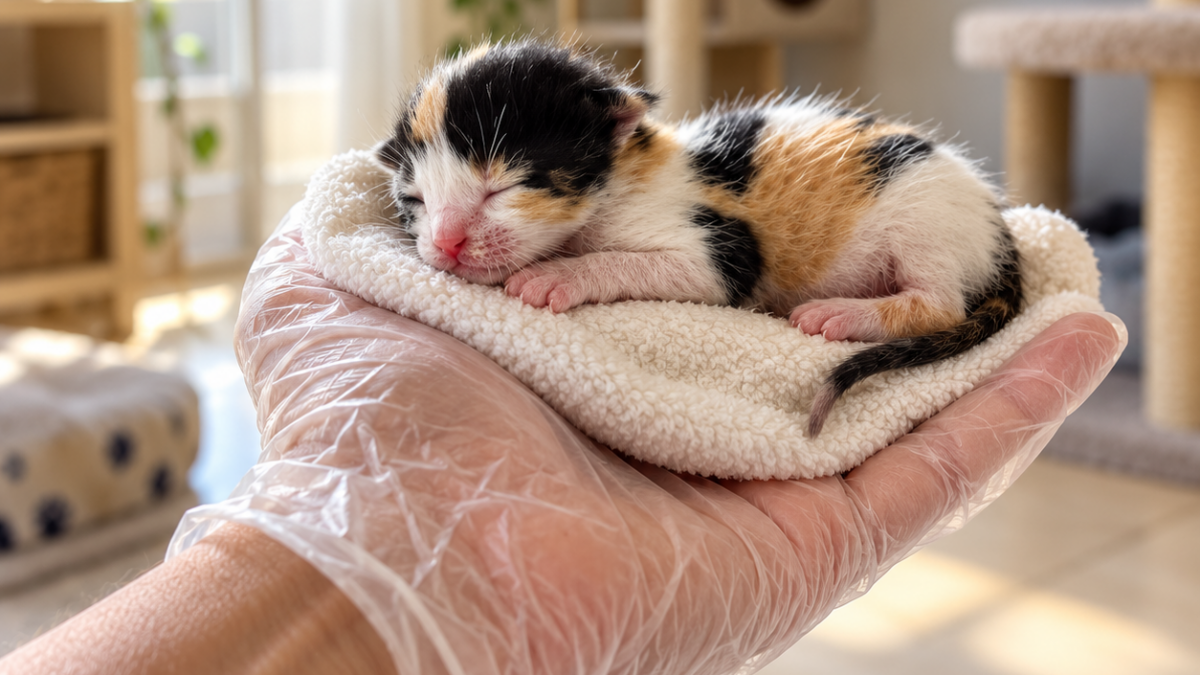
PART 2
She wrapped her paw around my finger.
Not tightly.
She was too weak for that.
Her toes simply curled.
One tiny paw.
One finger.
That was all.
But after hours of wondering whether the next breath might be her last, it felt like an answer.
I stayed completely still.
“Okay,” I whispered. “I’m here.”
Her paw remained there for several seconds.
Then relaxed.
She fell asleep.
I did not.
I sat beside the little box watching her chest move.
Up.
Down.
Pause.
Up again.
At that age, everything frightened me.
A long pause in breathing.
A feeding that took too long.
A feeding that ended too quickly.
A cry that sounded weaker.
A body that felt slightly cooler.
People sometimes talk about newborn rescue as though it is mostly feeding bottles and adorable blankets.
It is not.
It is clocks.
It is measurements.
It is fear.
It is waking every few hours because a life the size of your palm cannot wait until morning.
We weighed her before the next feeding.
The number on the scale barely changed.
I felt disappointed.
The veterinarian saw my face.
“You are going to have to learn something.”
“What?”
“With a kitten this small, tiny progress is progress.”
“I know.”
“No, you understand the sentence. You don’t believe it yet.”
I looked toward the box.
He continued.
“You’re going to stare at grams. Don’t let one number decide your whole day.”
Easy advice.
Almost impossible to follow.
The kitten’s weight became the center of my universe.
One gram gained.
Relief.
One gram lost.
Panic.
Same weight.
Confusion.
I recorded everything.
Time of feeding.
Amount.
Temperature.
Elimination.
Behavior.
Weight.
Sleep.
I wrote so much that our notes on a one-hundred-gram kitten looked like a medical chart for a human patient.
I did not care.
If something changed, I wanted to notice.
We also had another problem.
She did not have a name.
At first, that seemed unimportant.
Survival came first.
But by the second day, I was tired of calling her “baby,” “little one,” and “the kitten.”
A volunteer suggested names.
Hope.
Tiny.
Minnie.
Bean.
I rejected all of them.
“Why?”
“I don’t know.”
“You’re impossible.”
“I want something that fits.”
The kitten cried from the box.
The volunteer smiled.
“She has opinions.”
“She weighs one hundred grams.”
“She has one hundred grams of opinions.”
I laughed.
That sound surprised me.
It had been two days since I had laughed about anything.
We still did not name her.
Not yet.
Part of me was afraid.
That is difficult to admit.
People who rescue fragile animals sometimes hesitate to name them because a name feels like permission to imagine a future.
I was already attached.
A name would make it real.
If she died, I would not be losing “the kitten.”
I would be losing someone.
So I delayed.
Cowardly, maybe.
Human, definitely.
The second night was harder than the first.
She refused part of a feeding.
I tried again after a short rest.
Nothing.
Her mouth remained closed.
Her body felt tired.
I called the veterinarian.
“She ate the earlier meal?”
“Yes.”
“Temperature?”
I gave the number.
“Warm her slightly and try again. Do not force it.”
I hated the words do not force it.
Every instinct screamed feed her.
But forcing formula into a newborn incorrectly can cause aspiration.
Trying harder can become dangerous.
So I warmed her.
Held her.
Waited.
She cried once.
Then again.
I touched a tiny amount of formula to her lips.
Her mouth opened.
She swallowed.
I exhaled.
“Good girl.”
One drop.
Another.
The feeding took nearly forty minutes.
When it ended, I felt as tired as if I had run miles.
I placed her back in the warm box.
She slept.
I watched.
Again.
By the third day, the fleas were gone.
That alone changed how she looked.
Without tiny dark bodies crawling across her fur, she seemed less like an abandoned thing and more like what she had always been.
A baby.
A very small baby.
Her skin looked cleaner.
Her belly slightly rounder after feeding.
Her cries grew stronger.
Not strong.
Stronger.
That distinction mattered.
At the clinic, a technician heard her from the next room.
“Was that her?”
“Yes.”
“She’s louder.”
I smiled.
“She’s complaining.”
“Good.”
Normally nobody celebrates a screaming infant.
We did.
Noise meant energy.
Energy meant possibility.
That afternoon, we weighed her again.
The scale settled.
Three grams up.
I stared.
The technician looked at me.
“Do not cry over three grams.”
“I’m not.”
“You are absolutely crying over three grams.”
“She gained.”
“I know.”
“Three.”
“I can read.”
I laughed through tears.
“Three whole grams.”
We wrote it down.
There is something humbling about realizing your happiness can fit inside three grams.
The fourth day brought the first moment of real fear after the initial rescue.
She became quieter.
Too quiet.
The morning feeding went slowly.
Her body temperature dropped slightly.
The veterinarian checked her.
No obvious infection.
No major respiratory issue.
But newborns have very little reserve.
A small problem can become large quickly.
We increased monitoring.
Adjusted the warmth.
Changed the feeding schedule slightly.
I sat beside her.
“What are you doing?”
No response.
“Yesterday you were yelling at everybody.”
Her nose twitched.
“I liked that version better.”
I touched the blanket near her.
“Come back.”
That phrase slipped out.
Come back.
She had not gone anywhere yet.
But fear made it feel like she was drifting toward somewhere I could not follow.
Hours passed.
She ate small amounts.
Then slept.
By evening, her temperature improved.
At the final feeding before midnight, she drank with more determination.
Her front paws pushed against the towel.
I almost laughed.
“There you are.”
She drank again.
That night I slept for ninety minutes at a time.
Luxury.
By day five, she had gained more weight.
Still not enough for me to relax.
But enough to make the veterinarian nod approvingly.
“She’s doing what she should.”
“Which is?”
“Growing.”
The word landed strangely.
Growing.
For the first several days, I had thought only about surviving.
Growing implied future.
Tomorrow.
Next week.
Eyes opening.
Walking.
Playing.
Becoming a cat.
I let myself imagine it for maybe five seconds.
Then fear shut the image down.
Not yet.
One feeding at a time.
That became my discipline.
Not next month.
Not adoption.
Not adulthood.
The next bottle.
The next gram.
The next warm night.
On day six, something changed in the way she responded to my voice.
I entered the room and spoke before opening the box.
“Hey, baby.”
Her head moved.
Tiny.
Uncoordinated.
But toward the sound.
I stopped.
“Did you hear me?”
Her head shifted again.
Of course she could not understand words.
But newborn kittens begin recognizing patterns quickly.
Smell.
Touch.
Voice.
Warmth.
Feeding.
I had become part of the pattern.
That realization felt enormous.
The first experience she had with a human may have been abandonment.
Now another human voice meant milk.
Warmth.
Hands that returned.
I wanted that second association to win.
So I kept talking.
During feedings.
During cleaning.
During weigh-ins.
Nonsense mostly.
“You are very expensive for something so small.”
Tiny swallow.
“You realize nobody here is sleeping.”
Another swallow.
“Your customer-service reviews are going to be terrible.”
Her paw pushed my thumb.
“Rude.”
A volunteer walked in.
“Are you arguing with a newborn kitten?”
“She started it.”
The kitten cried.
“See?”
We laughed.
By day seven, she had earned a name.
Not because she reached some medical threshold.
Because one morning, sunlight came through the clinic window and touched the edge of her blanket.
The kitten shifted toward the warmth.
I thought about how she had been found.
Cold yard.
Concrete.
No mother.
Then now.
A small body always searching for warmth.
“Sunny,” I said.
The volunteer beside me looked over.
“What?”
“Sunny.”
She smiled.
“That’s her?”
I looked at the kitten.
“Maybe.”
The kitten meowed.
The volunteer laughed.
“She approves.”
So Sunny she became.
It was almost painfully hopeful.
A kitten abandoned in cold darkness named for sunlight.
But maybe that was why it fit.
Sunny.
I wrote the name at the top of the feeding chart.
The moment ink touched paper, she became even more real.
SUNNY.
One hundred and something grams.
Female.
Newborn.
Umbilical cord now drying naturally.
Eyes closed.
Flea infestation resolved.
Under intensive neonatal care.
Very loud opinions.
I added that last part privately.
At the end of the first week, Sunny’s weight gain became steadier.
Not dramatic.
A few grams.
Then several.
The scale no longer felt like an executioner every morning.
I still held my breath.
But sometimes the number made me smile instead of fear.
Her body began rounding.
Her head looked slightly less oversized compared with the rest of her.
Her belly filled after feeding.
The little legs pushed more strongly.
And she became demanding.
This was glorious.
At two in the morning, Sunny cried before the alarm.
I stumbled toward her.
“You are early.”
Meow.
“Your appointment is in twelve minutes.”
Meow.
“You have no concept of time.”
Louder meow.
I prepared the formula.
She moved toward the smell.
The kitten who once had to be convinced to swallow now searched for the syringe.
“Greedy.”
Her paws kneaded the towel.
“That’s good. Keep being greedy.”
Hunger had changed meaning.
At first, hunger was a threat.
Now hunger was evidence that her body expected food.
Sunny began telling us when she wanted it.
That was power.
Tiny power.
But hers.
A few days later, the dried umbilical cord detached.
I found it in the bedding.
I stared at the tiny piece.
Such an ordinary developmental moment.
Yet it struck me emotionally.
When we found Sunny, that cord had been visual proof of how impossibly young she was.
A newborn separated from her mother before she was ready.
Now one sign of that earliest vulnerability was gone.
She was moving forward.
The next milestone terrified me for a different reason.
Her eyes began to open.
At first, a narrow slit.
One eye before the other.
I noticed during a morning feeding.
“Wait.”
I leaned closer.
Sunny’s eyelid had separated slightly.
A dark blue-gray glimpse underneath.
I called the technician.
“Come here.”
“What?”
“Her eye.”
The technician looked.
“Oh.”
“That’s opening, right?”
“Yes.”
I smiled so hard my face hurt.
Sunny looked ridiculous.
One eye partly open.
One completely closed.
The technician laughed.
“She looks suspicious.”
“She is suspicious.”
Over the next several days, both eyes opened gradually.
No sudden cinematic reveal.
A little more each day.
The world entered slowly.
Light.
Shapes.
Movement.
Me.
I remember the first time Sunny seemed to look directly at my face.
Her vision was still developing.
Maybe she saw only blur.
Still, she stared.
I whispered, “Hi.”
She meowed.
There was something deeply moving about being among the first things she ever saw after human abandonment had nearly been the last thing she experienced.
I wanted the world she opened her eyes into to be different.
Warm.
Predictable.
Kind.
It was an impossible promise to make about the entire world.
So I made it about the part I could control.
Her room.
Her meals.
My hands.
The people we allowed near her.
That was enough.
By the second week, Sunny no longer fit quite so invisibly inside my palm.
She was still tiny.
But heavier.
I noticed when I lifted her.
“That’s new.”
A volunteer asked, “What?”
“She feels like something.”
“That is an alarming sentence.”
“You know what I mean.”
At first, Sunny had felt almost weightless.
Now there was substance.
A little body.
Muscle beginning.
Warmth that lasted better.
Life accumulating.
We weighed her.
The number confirmed it.
More grams.
I had stopped celebrating every single one aloud.
Mostly.
The volunteer raised an eyebrow.
“You’re smiling at the scale.”
“I am being professionally pleased.”
“You cried over three grams last week.”
“That was different.”
“Sure.”
The third week brought mobility.
Sunny started trying to stand.
At first, her legs went in four different directions.
I called it starfish mode.
She pushed.
Front legs straightened.
Back legs slid outward.
Down.
Again.
“Take your time.”
Sunny did not believe in taking her time.
She tried repeatedly.
One morning, she got all four paws under herself.
Her body shook.
One second.
Two.
Then she toppled sideways.
I laughed.
“Excellent.”
Sunny looked offended.
She tried again.
By afternoon, she could stand for several seconds.
By the next day, she took a step.
Then another.
The walk looked less like walking and more like controlled falling.
Still.
Movement.
That was the morning mentioned in the original rescue notes.
The one when everyone stopped.
The little kitten who had once barely lifted her head sat upright by herself.
She was shaky.
Clumsy.
Her head seemed too heavy.
But she sat.
I took a photograph.
Not for social media.
For me.
I wanted proof.
Because fragile neonatal rescue distorts memory.
The sleepless nights blur together.
You forget exactly when change happened.
I wanted to remember.
Sunny sitting.
Eyes open.
Tiny ears now upright.
A body that had survived long enough to begin learning balance.
That evening, I printed the photo.
Placed it beside the intake image.
The contrast hurt.
Cold concrete.
Then blanket.
Dirt and fleas.
Then clean fur.
Eyes sealed.
Then open.
Both versions were Sunny.
But only one showed where her life was going.
The revenge, if anyone insists on using that word, began there.
Not against some identified person.
We never learned with certainty who left Sunny in that yard.
There was no dramatic confrontation.
No confession.
No courtroom.
I will not invent one to make the story cleaner.
The world does not always give us a villain we can punish.
Sometimes someone does something cruel and disappears.
That frustrated me.
I wanted an answer.
Who?
Why?
Was Sunny unwanted?
Was her mother nearby and unable to reach her?
Was she deliberately taken from a litter?
Was someone careless?
Was someone cruel?
We searched for information.
Asked neighbors.
Checked whether anyone knew of a mother cat with newborn kittens.
Nothing certain.
There were rumors.
No evidence.
I had to accept something I did not like.
We might never know.
So if there was going to be justice for Sunny, it would have to look different.
She would live.
That would be enough.
The person who left her had reduced her chances to almost nothing.
Every gram she gained contradicted that act.
Every feeding.
Every step.
Every purr still to come.
Sunny would answer abandonment by becoming impossible to abandon.
That became the only revenge I wanted.
Week three also brought personality.
A dangerous development.
Sunny discovered that my fingers moved.
Therefore, they were prey.
At first, she patted them.
Soft little paw.
Then she attempted to bite.
Her teeth were barely beginning.
I gasped theatrically.
“Violence.”
Sunny attacked again.
A volunteer laughed.
“Terrifying.”
“She’s dangerous.”
Sunny wrestled my thumb.
This was another normal milestone that felt extraordinary.
Play requires energy beyond basic survival.
A body close to death does not waste calories attacking fingers.
Sunny had enough life now to be silly.
We introduced appropriate kitten toys.
Small soft objects.
Lightweight balls.
Nothing dangerous.
At first, she watched them.
A fuzzy ball rolled past.
Sunny turned her head.
Another roll.
She raised a paw.
Missed.
Third roll.
Paw contact.
The ball moved.
Sunny froze.
I could almost see the surprise.
I did that.
She hit it again.
The ball rolled farther.
Sunny chased.
Three clumsy steps.
Fall.
Get up.
Hit.
Fall.
I laughed until my stomach hurt.
This was what she should have been doing with littermates.
Learning movement.
Cause and effect.
Predatory play.
Instead, humans became her temporary family.
We did our best.
But bottle babies present special behavioral challenges.
Without a mother and siblings, kittens can miss important social lessons.
Bite inhibition.
Boundaries.
Cat communication.
As Sunny grew stronger, we began thinking about how to give her appropriate feline socialization.
A foster caregiver had a calm nursing mother cat whose litter was slightly older.
Introducing a strange kitten had to be done carefully.
Not every mother accepts one.
We discussed risks.
Disease screening.
Age differences.
Behavior.
Eventually, under supervision, we tried a gradual introduction.
The mother cat’s name was Luna.
A gentle tabby.
The first time Luna smelled Sunny through a barrier, she became alert.
Sunny heard kittens.
Her entire body changed.
She moved toward the sound.
That hurt.
She had never had siblings after we found her.
Maybe she remembered nothing of her mother.
Probably not.
Still, some instinct recognized cats.
Luna sniffed again.
No aggression.
Good.
Later, we allowed controlled contact.
Sunny approached.
Luna smelled her head.
Then her body.
Sunny froze.
Everyone froze.
Luna licked Sunny’s forehead.
I covered my mouth.
“Oh.”
Sunny leaned into it.
Another lick.
Then another.
The foster caregiver started crying.
“I think she accepts her.”
We remained cautious.
But Luna did.
Not instantly as a magical replacement mother.
Real animal behavior is more nuanced.
Yet she tolerated Sunny.
Groomed her.
Allowed her to sleep near the litter under supervision.
Sunny suddenly had cats.
The first time I saw her curled among the other kittens, I stood in the doorway and cried.
She disappeared into the pile.
That was the beautiful part.
For weeks, Sunny had been unique because she was fragile.
The smallest.
The abandoned newborn.
The emergency.
Now, in a pile of warm kittens, she looked ordinary.
I loved ordinary.
A tiny back.
A tiny tail.
No special tragedy visible.
Luna’s kittens helped teach Sunny things humans could not.
When she bit too hard, another kitten protested.
When she pounced awkwardly, they responded.
When play became too rough, Luna intervened.
Sunny developed faster socially.
She also became obsessed with climbing.
This was less charming at three in the morning.
The first object she conquered was a folded towel.
Then the edge of a low bed.
Then my pant leg.
I looked down and found a kitten halfway to my knee.
“Absolutely not.”
Sunny kept climbing.
“You weigh more now, but not enough for this behavior.”
She reached my lap.
Victory.
Curled up.
I sighed.
“Manipulative.”
She purred.
The first purr stopped me.
I had felt vibrations before during feeding, uncertain whether they were tiny purrs or just movement.
This one was unmistakable.
Sunny lay on my lap.
Eyes partly closed.
Tiny paws kneading.
A steady vibration.
Purr.
I put one hand lightly against her side.
The sound grew.
I cried.
Again.
At this point, crying had become part of the care plan.
A volunteer entered.
“What happened?”
“She’s purring.”
The volunteer listened.
“Oh.”
Then she cried too.
Two adults crying because a kitten purred.
It makes sense only if you heard the first cries in that yard.
Weak.
Thin.
Nearly whispers.
The purr was the opposite sound.
Not a call for help.
A sound of comfort.
Sunny no longer needed the world to hear her because she was alone.
She was making noise because she felt safe.
That difference stayed with me.
By the end of the first month, Sunny looked like a kitten rather than a newborn.
That sounds simple.
It was not.
Her face developed.
Ears grew.
Eyes brightened.
Legs lengthened.
She cleaned herself clumsily.
She played.
She slept in absurd positions.
She demanded food.
We transitioned gradually according to veterinary guidance.
Bottle feedings remained important until she was developmentally ready for more.
Then came the messy introduction to soft food.
Sunny stepped directly into it.
Of course.
I placed a shallow dish down.
She sniffed.
Licked.
Then one paw entered.
Another.
Seconds later, half her body was in the plate.
“Sunny.”
She continued eating.
A volunteer laughed.
“She’s committed.”
“She’s wearing dinner.”
Sunny lifted one paw.
Food everywhere.
We cleaned her.
She protested.
The next meal went slightly better.
The one after that, better again.
Soon Sunny understood bowls.
Mostly.
Bottle dependence decreased.
I expected to feel relief.
Instead, I felt strange sadness.
The bottle had been our first lifeline.
Every few hours.
Day and night.
Now she needed me less.
That was the goal.
Still hurt.
Rescue is full of successful heartbreaks.
The better they get, the less central you become.
That is how it should be.
One evening, Sunny finished her meal.
Then climbed into my lap.
This time without clawing her way up my clothes.
She turned once.
Twice.
Curled.
Her body fit against my stomach.
She sighed.
Then slept.
Completely.
No twitching vigilance.
No crying.
No searching.
Sleep.
I looked down for a long time.
This was the scene people later loved most.
Not the rescue.
Not the first standing.
This.
A kitten abandoned before her eyes opened now closing them voluntarily in a human lap.
Trust is not abstract.
Sometimes it looks like sleep.
She trusted that nothing bad would happen while she was unconscious.
That my body would remain beneath her.
That warmth would not disappear.
That was enormous.
At six weeks, Sunny ran.
Properly.
Not wobbling.
Not controlled falling.
Running.
She chased another kitten across the room.
Turned badly.
Slid into a blanket.
Popped up.
Continued.
I laughed.
“You have brakes.”
She ignored me.
The kitten ran again.
I remembered the concrete.
A body barely moving.
The comparison no longer felt like sadness.
It felt like defiance.
Abandonment had expected stillness.
Sunny answered with motion.
Cold had nearly stopped her heart.
Sunny became a creature who could not stop moving.
That was revenge.
Her toys multiplied.
Someone donated a small tunnel.
Sunny entered.
Disappeared.
For one second, panic hit me irrationally.
Then her head popped out the other side.
She attacked another kitten.
Normal.
A scratching post arrived.
Sunny tried climbing the outside.
A small cat tree followed when she was big enough.
She conquered the first level.
Then the second.
Then sat at the top as though she had personally built the structure.
I took a photo.
Caption for myself:
FROM CONCRETE TO QUEEN OF THE TOWER.
No one saw it except our team.
We loved it.
The medical concerns gradually shrank.
Weight healthy for age.
Body temperature normal.
No fleas.
No infection.
Umbilical area healed.
Eyes clear.
Development appropriate.
The veterinarian eventually stopped sounding cautious every time he spoke.
One afternoon, he finished an examination.
“She’s doing great.”
I waited.
“But?”
“No but.”
I stared.
He laughed.
“There is no but.”
“Nothing?”
“Nothing unusual.”
“You’re sure?”
“She is a healthy kitten.”
Healthy kitten.
I almost did not know what to do with the phrase.
For weeks, Sunny had been a fragile neonatal rescue.
A high-risk bottle baby.
A one-hundred-gram abandoned newborn.
Now?
Healthy kitten.
I crouched beside her carrier.
“You’ve been downgraded.”
Sunny meowed.
“Very serious medical title gone.”
She stuck one paw through the carrier opening.
“Now you’re just trouble.”
That was when adoption became real.
I hated it immediately.
A foster volunteer looked at me.
“You knew this was coming.”
“No.”
“Yes.”
“I intellectually understood it.”
“That’s knowing.”
“No. Very different.”
Sunny was not yet ready that exact day, but soon.
Vaccinations needed to continue.
Development.
Spay planning at the appropriate age.
Final checks.
Still, the applications could begin.
I wanted the perfect home.
This is impossible.
There is no perfect home.
There are good homes.
Prepared homes.
Safe homes.
Compatible homes.
Trying to find perfection is often another way of avoiding goodbye.
I knew that.
Ignored it.
Sunny’s story had reached people locally.
Applications came quickly.
Some people wanted her because she was tiny and cute.
Those made me cautious.
Kittens grow.
Cute is not a care plan.
Some applicants had very young children without prior cat experience.
Not impossible, but we considered handling carefully.
One person wanted to surprise a partner.
No.
Animals should not be surprise commitments.
Another said she wanted Sunny specifically because “she needs me more than other kittens.”
That worried me.
Sunny did not need to remain fragile to deserve love.
I wanted a home that would love the adult cat she would become.
Not only the rescued baby she had been.
Then came an application from a woman named Emily.
She lived with her husband, Mark.
No children.
One adult cat named Oliver.
Excellent veterinary references.
Indoor-only home.
Secure windows.
Experience introducing cats gradually.
They had recently lost an elderly cat after seventeen years.
They were not looking specifically for a “special needs rescue.”
They were looking for a kitten.
That mattered.
Emily wrote:
We read her history and are prepared for any follow-up she may need, but we are applying because she sounds curious, social, and fearless. We think Oliver would appreciate a younger companion once properly introduced.
Curious.
Social.
Fearless.
Not abandoned.
Not helpless.
Not miracle kitten.
They described who Sunny was now.
I read the application twice.
Then a third time.
A volunteer smiled.
“You like them.”
“I am evaluating.”
“You like them.”
“They have stairs.”
“She is a cat.”
“Fair.”
“They have plants.”
“Cat-safe plants. It says so.”
I kept reading.
“They work during the day.”
“Alternating schedules.”
“They—”
“Stop.”
I looked up.
The volunteer laughed.
“You cannot fail people for existing.”
“I’m checking.”
“You’re stalling.”
Yes.
We scheduled the meeting.
Emily and Mark arrived quietly.
No dramatic reactions.
No reaching immediately.
Sunny was in the playroom with two other kittens.
Emily sat on the floor.
Mark sat nearby.
Sunny noticed them.
Kept playing.
Good.
After several minutes, she approached.
Sniffed Emily.
Climbed onto her leg.
Of course.
I felt betrayed.
Emily laughed softly.
“Hi.”
Sunny investigated her sleeve.
Mark held out one finger.
Sunny attacked it.
He smiled.
“I’ve been chosen for violence.”
I liked him.
Annoying.
We talked.
They asked about bottle feeding history.
Current food.
Vaccination schedule.
Behavior with other cats.
Any lingering medical issues.
Sleep habits.
Scratching.
Whether she tolerated nail trims.
Normal cat questions.
Then Emily asked, “Does she still seek laps when she’s tired?”
“Yes.”
“I like that.”
“She may stop as she grows.”
“That’s okay.”
Another point.
No demand that Sunny remain a baby forever.
Oliver’s introduction would be gradual.
Separate room.
Scent swapping.
Barrier meetings.
Supervised contact.
They understood.
The home check was excellent.
Again, annoyingly.
Cat trees.
Window perches.
Secure screens.
A quiet spare room for transition.
Oliver appeared healthy, calm, and mildly offended by our presence.
Perfect adult-cat energy.
I returned to Sunny that evening.
“You have applicants.”
She bit my shoelace.
“They’re good.”
Attack.
“You could at least pretend this is emotional.”
Sunny rolled onto her back.
I rubbed her belly.
She grabbed my hand.
“Fine.”
The adoption coordinator approved the match.
Still, Sunny needed a little more time before leaving.
Those final weeks felt different.
Every milestone carried an ending inside it.
Sunny climbed higher.
Soon someone else would see it.
Sunny learned to chase a wand toy.
Soon someone else would hold the wand.
Sunny slept on my lap.
Soon another lap.
I caught myself becoming possessive.
Then reminded myself of the yard.
Sunny’s life had nearly ended because someone treated her as disposable.
I could not turn around and treat her future as something I owned.
Love was not keeping her.
Love was choosing where she could keep growing.
The day before adoption, I looked through the photographs.
First image.
Concrete.
Tiny dirty body.
Cord attached.
Eyes closed.
Second.
Wrapped in towel.
Third.
Feeding syringe.
Fourth.
One eye cracking open.
Fifth.
Sitting.
Sixth.
Playing.
Seventh.
Sleeping in my lap.
Eighth.
Running.
It looked like a time-lapse of life arriving.
I printed two photographs for Emily and Mark.
Not the worst one.
I debated.
They knew the history.
They did not need Sunny’s home decorated with suffering.
I chose the lap photo.
And one of her sitting upright for the first time.
On the back, I wrote dates.
Nothing dramatic.
Just history.
Adoption morning arrived.
Sunny did not care.
I cared enough for both of us.
She ate breakfast.
Attacked another kitten.
Used the litter box.
Climbed.
Normal.
I packed her things.
Food.
Medical records.
A blanket that smelled familiar.
Small toys.
One towel from her neonatal box.
I almost did not include it.
Then did.
Emily and Mark arrived.
Sunny recognized them from previous visits.
She approached.
No fear.
Good.
Oliver remained at home, waiting for the slow introduction.
We reviewed everything.
Again.
Food.
Again.
Vet appointment.
Again.
No outdoor access.
Again.
Microchip information.
Again.
Emily smiled patiently.
“We’ve got it.”
“I know.”
“You can say it again.”
I laughed.
“Thank you.”
Finally, there was nothing left except the carrier.
Sunny walked inside to investigate a toy.
Of course.
No dramatic resistance.
I closed the door.
My chest hurt.
I lifted the carrier.
Sunny meowed.
“I know.”
She meowed again.
“You are not being abandoned.”
The sentence broke me.
Emily’s eyes filled.
I crouched so Sunny could see me through the opening.
“This is the opposite.”
She reached one paw toward the bars.
I touched it.
Her paw curled around my finger.
Exactly like the first night.
Not exactly.
Now the paw was larger.
Strong.
Claws capable of damage.
But the gesture brought everything back.
Cold concrete.
One hundred grams.
A whisper of a cry.
One tiny paw.
I started crying.
Mark looked away politely.
Emily cried openly.
“You promised not to make this emotional,” she said to Sunny.
Sunny bit my finger.
I laughed.
“Apparently she didn’t.”
I stood.
“Go home.”
Emily took the carrier.
Sunny watched me.
I wanted her to cry for me.
That is another ugly truth.
Some selfish little part of me wanted proof she would miss me.
Instead, she became interested in the movement outside the window.
Good.
That was healthier.
Her future mattered more than my importance in it.
They left.
I stood at the door.
The carrier disappeared into the car.
Then the car left.
The room felt huge.
The little box from her newborn days was long gone.
Still, I could almost hear the two-a.m. cries.
A volunteer came beside me.
“You okay?”
“No.”
“She got a great home.”
“I know.”
“That’s the job.”
“I know.”
“Doesn’t help?”
“No.”
She nodded.
“Fair.”
That evening, at 7:14, Emily sent the first photo.
Sunny inside the transition room.
Sitting on the bed.
Tail around her paws.
Her message:
ATE DINNER. USED THE LITTER BOX. INSPECTED EVERYTHING. NOW YELLING BECAUSE SHE CAN HEAR OLIVER OUTSIDE THE DOOR.
I laughed.
I replied:
THAT SOUNDS LIKE HER.
Next morning:
SUNNY SLEPT IN MY LAP.
A photo.
Same curl.
Different lap.
Pain and happiness hit together.
The promise continued.
I did not have to be the warm place forever.
I only had to help her reach the next one.
Oliver’s introduction took time.
Exactly as it should.
Sunny wanted immediate friendship.
Oliver wanted bureaucracy.
First scent swapping.
Sunny smelled his blanket.
Rolled on it.
Oliver smelled Sunny’s.
Walked away.
Day two, barrier.
Sunny approached.
Oliver stared.
Sunny reached a paw.
Oliver hissed.
Sunny retreated.
No crisis.
Cats communicate.
Emily updated me.
I reminded her not to rush.
“I know.”
“I’m saying it for myself.”
She laughed.
Over several days, Oliver’s posture relaxed.
Hissing decreased.
Then one afternoon, he sat beside the barrier while Sunny played.
Progress.
Eventually, supervised face-to-face contact.
Sunny bounced toward him.
Oliver lifted one paw.
Not a strike.
A warning.
Sunny stopped.
For approximately three seconds.
Then bounced again.
Oliver walked away.
I watched the video.
“Poor Oliver.”
Emily replied:
HE HAS REALIZED RETIREMENT IS OVER.
Two weeks later, she sent a photograph.
Sunny asleep beside Oliver.
Not touching.
Six inches apart.
Three days later, another.
Closer.
A week later, Sunny’s head rested against Oliver’s side.
Friendship established.
The abandoned newborn had family.
Human and feline.
Her life became normal quickly.
That was the best part.
Updates became ridiculous.
Sunny stole a bread tie and was immediately deprived of it.
Sunny climbed a curtain.
Sunny discovered faucets.
Sunny knocked a pen off the table while maintaining eye contact.
Sunny slept in the bathroom sink.
Sunny attacked Mark’s feet beneath the blanket.
Sunny learned the refrigerator sound.
Sunny sat on Emily’s keyboard.
I saved too many photos.
At three months old, she returned for a scheduled veterinary visit.
I was there.
Of course.
Sunny entered in a carrier.
I spoke.
“Hey.”
Her head snapped toward me.
She meowed.
The carrier opened.
Sunny stepped out.
Sniffed my hand.
Then climbed onto my lap.
I cried immediately.
The veterinarian laughed.
“You people are predictable.”
“She remembers.”
“Probably.”
“Definitely.”
Sunny attacked my zipper.
“Yes. Definitely.”
She had grown enormously.
Still small compared with an adult cat.
But nothing like the one-hundred-gram newborn.
I lifted her.
Real weight.
Warmth.
Muscle.
Her eyes bright.
Coat clean and soft.
The veterinarian examined her.
“Healthy.”
That word still affected me.
“Everything normal?”
“Yes.”
“Development?”
“Excellent.”
“Any concerns?”
“Only your inability to relax.”
I ignored that.
Emily laughed.
Sunny climbed onto the exam table.
Started investigating instruments.
The veterinarian moved them away.
“Curious.”
“Very.”
“You picked the right family.”
Emily smiled.
“I think she picked us.”
Maybe.
I do not romanticize adoption selection too much.
But Sunny did seem very comfortable.
After the appointment, we let her spend a little time in the familiar room.
She sniffed.
Then went straight to the corner where the neonatal box once sat.
The box was gone.
Sunny sniffed the floor.
I wondered whether smell memory remained.
Probably faintly, if at all.
She turned.
Chased a toy.
That felt appropriate.
The past held no attraction.
Months passed.
Sunny grew into an adolescent cat.
Long legs.
Huge ears she had not yet grown into.
Endless energy.
She became a jumper.
Counter.
Shelf.
Refrigerator.
Once, top of a door.
Emily sent a photo.
HOW?
I replied:
REVENGE ON GRAVITY.
Sunny eventually discovered outdoor birds from the safety of a window.
She chattered.
Tail twitching.
Oliver sat beside her, more dignified.
The kitten who once lay outdoors vulnerable to weather now watched the outside from a warm home behind secure glass.
She could enjoy the world without being exposed to it.
That contrast comforted me.
Her first birthday became emotional.
Emily invited us.
I almost laughed.
“A birthday party for a cat?”
“You cried over three grams.”
“Fair.”
We went.
No huge decorations.
No costume Sunny would hate.
Just a few people who knew her story.
Oliver.
Toys.
A cat-safe treat.
Sunny ignored the ceremonial aspects and climbed into a cardboard box.
Of course.
Emily handed me a framed photo.
Sunny as an adult.
Standing in sunlight near the window.
“Why are you giving me this?”
“Because you gave us her first year.”
“No.”
I shook my head.
“You gave her most of it.”
Emily smiled.
“You know what I mean.”
I looked at the photo.
Sunny looked confident.
One paw raised.
Eyes fixed on something outside the frame.
There was no visual trace of the concrete.
None.
“Do you ever think about who left her?” Emily asked.
“Yes.”
“Still angry?”
I considered.
“Yes.”
That surprised her.
“But not in the same way.”
“What way now?”
“At first, I wanted an answer.”
“And now?”
I watched Sunny disappear inside the box.
“Now I think whoever did it lost.”
Emily looked at me.
I continued.
“They left her as if her life had no value. Look at her.”
Sunny launched from the box and attacked a toy.
Everyone laughed.
“That’s the answer.”
No court.
No confession.
No confrontation.
Life itself had contradicted the abandonment.
That was enough.
Still, I remained bothered by one question.
Was Sunny’s mother somewhere?
Newborn kittens are rarely alone without a story behind it.
Maybe the mother had been injured.
Maybe moved.
Maybe the kitten was taken.
We had searched early but found nothing.
A year later, a woman from the neighborhood contacted us after seeing an old photo.
She remembered a stray female cat that had given birth around that time.
Could it have been Sunny’s mother?
Possibly.
No proof.
The mother had disappeared from the area months later.
I asked whether she remembered the litter.
“Three or four kittens.”
“Did one go missing?”
“I don’t know.”
That was all.
Not enough to rewrite the story.
Not enough for certainty.
We left it there.
Sometimes rescue demands tolerance for unanswered questions.
Sunny did not need us to solve her origin to validate her life.
She had a present.
That mattered more.
Year two.
Sunny matured.
The giant ears now fit.
Her coat became sleek.
She remained lap-oriented.
Emily said every evening at approximately nine, Sunny climbed into her lap.
Turned twice.
Curled.
Same ritual.
“That’s from you,” Emily said.
“No.”
“Yes.”
“Cats choose comfort.”
“She learned the lap thing with you.”
Maybe.
I liked thinking that.
One of the things abandoned animals teach us is that attachment can begin again.
Early loss matters.
Development matters.
But one bad beginning does not make connection impossible.
Sunny learned human warmth before her eyes fully opened.
Not from whoever abandoned her.
From the people who stayed.
That pattern became part of her.
She trusted.
Not blindly.
As a normal cat.
She disliked the vacuum.
Avoided strangers for the first few minutes.
Hated the carrier.
Loved certain people.
Ignored others.
Healthy boundaries.
One afternoon, Emily called laughing.
“Sunny caught a mouse.”
“What?”
“Toy mouse.”
“Okay.”
“I threw it. She brought it back.”
I paused.
“You have a fetching cat?”
“Apparently.”
She sent a video.
Sunny chased the soft mouse.
Picked it up.
Returned.
Dropped it near Emily.
Again.
I laughed.
“She’s defective.”
“Oliver agrees.”
Sunny became obsessed.
Fetch every evening.
She would bring the mouse.
Drop.
Wait.
If ignored, meow.
If still ignored, place mouse on lap.
If still ignored, paw the human.
The newborn who once cried because she had no one now demanded entertainment as a constitutional right.
This pleased me deeply.
At three years, Sunny helped another animal without knowing it.
Emily and Mark found a young stray kitten near their home.
Not newborn.
Old enough to eat.
Thin.
They called us.
We arranged medical care.
During temporary isolation, Sunny sat outside the door.
Meowed.
The rescued kitten answered.
Emily laughed.
“She’s obsessed.”
After clearance, gradual introduction happened.
Sunny became surprisingly gentle.
Oliver, now older, wanted no part of mentoring.
Sunny handled it.
She played.
Corrected.
Slept nearby.
The kitten eventually went to another home.
But something about watching Sunny interact with him moved me.
She had once entered the world without her mother.
Now she knew how to be an older cat beside a vulnerable kitten.
Not a mother.
Not some sentimental destiny.
Just a social adult cat providing normal companionship.
That was enough.
Emily later began fostering occasionally.
Only one kitten at a time.
Sunny became part of the routine.
Some fosters she liked.
Others she ignored.
One she actively disliked.
Fair.
She was not a saint.
She was a cat.
I loved that too.
Rescue stories sometimes flatten animals into symbols.
Brave.
Grateful.
Pure.
But animals are personalities.
Sunny could be selfish.
Jealous.
Demanding.
Affectionate.
Funny.
Stubborn.
Her value did not depend on becoming a perfect inspirational creature.
She deserved life simply because she was alive.
That lesson mattered to me.
At four years, Sunny developed a minor medical problem unrelated to her newborn abandonment.
Nothing serious.
Still, Emily panicked.
She called.
“She isn’t eating breakfast.”
“When did it start?”
“This morning.”
“Any vomiting?”
“No.”
“Lethargy?”
“A little.”
“Vet.”
“Already scheduled.”
I smiled.
That was the difference.
The first time Sunny was helpless, no one came until strangers found her.
Now missing one breakfast triggered a veterinary appointment.
Was that overcautious?
Maybe.
Did I love it?
Absolutely.
The issue resolved quickly.
Sunny returned home.
Demanded dinner.
Life continued.
Every ordinary act of care rewrote the beginning.
Not erased.
Rewrote the meaning.
Abandonment said nobody was responsible.
Her family answered: we are.
Cold concrete said warmth was uncertain.
Their home answered: here is your bed.
Hunger said food might not come.
Their routine answered: breakfast is at seven.
Silence said no one hears you.
Emily answered every ridiculous nighttime meow.
This was the revenge.
Consistency.
Year after year.
One rainy afternoon, I visited.
Sunny sat by the window.
Rain covered the glass.
She watched.
I thought about the cold yard.
I said, “You know you were once outside in weather like this?”
Emily looked at me.
“She has no idea.”
“I know.”
Sunny groomed one paw.
“That’s good.”
Maybe the best healing is when the survivor no longer knows they are supposed to be tragic.
Sunny did not live as an abandoned kitten.
She lived as Sunny.
That distinction felt like victory.
Around age five, Oliver died.
He had been older when Sunny arrived.
Kidney disease.
Gradual decline.
Emily and Mark were devastated.
Sunny changed too.
She searched rooms.
Sat near his favorite window spot.
Slept more.
Animals experience absence.
We should be careful about projecting human narratives onto them, but behavior clearly shifted.
Emily asked, “Should we get another cat?”
“Not for Sunny.”
“What do you mean?”
“If you want another cat eventually, fine. But don’t treat a new cat like medicine for grief.”
She nodded.
Sunny adjusted.
Weeks.
Months.
She returned to routines.
Still sometimes slept in Oliver’s old spot.
Maybe because it was comfortable.
Maybe because his scent lingered.
We cannot know.
A year later, Emily and Mark adopted another adult cat named Jasper.
Not a kitten.
Three years old.
Calm.
Sunny hated him for five days.
Then tolerated.
Then friendship.
Good.
No cinematic instant bond.
Real life.
Sunny became older.
The kitten face disappeared into a mature cat’s expression.
The energy remained but changed.
Fewer curtain attacks.
More strategic mischief.
She learned cabinets.
This was worse.
Emily called.
“She opened the treat cabinet.”
“How?”
“I don’t know.”
“Secure it.”
“I did.”
Next day:
SHE OPENED IT AGAIN.
We laughed.
Sunny had gone from needing formula delivered drop by drop to committing organized food theft.
Another victory.
At seven, she remained healthy.
At eight, still active.
At nine, a little slower.
I kept forgetting years were passing.
In my mind, Sunny remained the kitten fitting inside my hand.
Then photos showed otherwise.
Full-grown.
Then mature.
Later, a little gray around the face.
Cats age subtly.
Until they do not.
At ten, Emily sent a picture of Sunny sleeping in the same lap position she had used as a baby.
I stared.
Her body now filled Emily’s lap.
No tiny ball.
A substantial cat.
Same curl.
Same trust.
Caption:
SOME THINGS NEVER CHANGE.
I replied:
THANK GOD.
That evening, I found the old photograph.
Baby Sunny in my lap.
Turn twice.
Curl.
Sleep.
I placed the photos side by side.
The distance between them was a life.
This is what rescue ultimately gives.
Not transformation photos.
Time.
Years between images.
Enough years for a one-hundred-gram newborn to become an older cat with habits nobody remembers beginning.
At eleven, Sunny developed early kidney changes.
Manageable.
Diet.
Monitoring.
More water stations.
Emily called me.
“I hate this.”
“I know.”
“She was supposed to stay young.”
“No one gets that deal.”
“I know.”
Sunny adjusted to the diet reluctantly.
She preferred the old food.
Of course.
We found veterinary-approved options she would eat.
The numbers stabilized.
More time.
At twelve, arthritis began.
Very mild.
She hesitated before high jumps.
Mark installed steps to the bed.
Sunny ignored them.
Jumped anyway.
Later, she used them only when nobody watched.
Pride.
Emily laughed.
“She is ancient and stubborn.”
“Correct.”
At thirteen, Sunny still fetched occasionally.
Not every night.
Maybe twice a week.
She would bring the old-style soft mouse.
Drop it.
Emily would throw.
Sunny walked after it now more than ran.
Still brought it back.
The ritual survived.
At fourteen, her hearing weakened.
At fifteen, sleep increased.
I had trouble emotionally connecting this elderly cat with the cold-yard newborn.
Yet it was the same life.
That was the miracle.
She had gotten enough time to become unrecognizable.
One winter morning, Emily called.
“Can you come?”
My stomach tightened.
“What happened?”
“She’s okay right now.”
Right now.
Those words told me enough.
Sunny’s kidneys had worsened.
Treatment still offered options.
Fluids.
Medication.
Diet.
Monitoring.
We used them.
I was not her owner.
Emily and Mark made decisions with the veterinarian.
I supported.
Sunny improved.
For several months.
Spring arrived.
She sat in sunlight near the window.
Still purred.
Still sought laps.
Still interested in food.
Good life.
Then summer.
More decline.
Age is not defeat.
I reminded myself.
We are trained by rescue to think survival is always the goal.
But survival forever is impossible.
A good ending is not a life without death.
It is a life with enough love before death that the beginning no longer gets the last word.
Sunny had that.
By her final year, she needed help with grooming.
Emily brushed gently.
Cleaned areas Sunny no longer reached easily.
Steps everywhere.
Low-sided litter box.
Warm bedding.
More veterinary checks.
No one complained.
No one called her inconvenient.
Old age became a reason for more care, not less.
That mattered deeply to me.
Because animals are easy to love when they are young, cute, and entertaining.
Commitment is revealed when care becomes work.
Sunny’s family passed that test.
Again.
And again.
And again.
One evening, Emily sent me a photo.
Sunny asleep beneath a heated blanket.
Only her head visible.
Message:
THE QUEEN DEMANDS TEMPERATURE CONTROL.
I smiled.
Cold had nearly killed her once.
Now at fifteen, she had personalized heating.
If revenge exists, perhaps sometimes it looks like thermostats.
That made me laugh.
The final decline came gradually.
Less appetite.
More sleeping.
Weight loss.
The scale returned.
I hated the scale.
After all those years.
Numbers again.
But this time the meaning was different.
At the beginning, every gram gained moved Sunny toward life.
At the end, every gram lost reminded us time was shortening.
Same scale.
Opposite direction.
Emily cried during one appointment.
“I remember you telling me she was only about a hundred grams.”
“Yes.”
“She’s still heavier than that.”
I laughed through tears.
“Significantly.”
The veterinarian discussed quality of life.
Pain.
Nausea.
Hydration.
Interest.
Mobility.
Connection.
Sunny still had good days.
We took them.
There is no shame in taking good days when comfort remains.
One afternoon, I visited.
Sunny was on Emily’s lap.
Old.
Thin.
Eyes still recognizable.
I sat beside them.
“Hey, baby.”
Her ears moved.
She opened her eyes.
Then did something that destroyed me.
She reached one paw toward my hand.
I offered my finger.
Her paw rested on it.
Not curled the way it had on the first night.
Too weak now.
Still.
Contact.
I cried.
Emily knew immediately.
“What?”
“The first night.”
She looked at our hands.
“Oh.”
“I thought she was dying.”
Emily stroked Sunny’s head.
“You saved her.”
I shook my head.
“No.”
“You did.”
“People helped her survive the beginning.”
I looked at Emily.
“You gave her the middle.”
The middle.
That is where life is.
We obsess over beginnings and endings because they are dramatic.
But the middle is the gift.
Breakfasts.
Windows.
Oliver.
Jasper.
Fetch.
Laps.
Vet visits.
Cabinets.
Rain.
Naps.
Fifteen years of middle.
Sunny got them.
A few weeks later, she stopped eating enough to enjoy life.
Medication helped less.
Emily called the veterinarian for an in-home evaluation.
I came too.
Not because Sunny needed me specifically.
Because Emily asked.
The room was warm.
Of course.
Sunny lay inside a soft bed near the window.
Sunlight crossed half the blanket.
I almost laughed at the symbolism.
Sunny.
Sun.
After all those years.
Mark sat on the floor.
Emily held her.
Jasper remained nearby.
The veterinarian examined gently.
The conversation was quiet.
Options existed.
Aggressive hospitalization might buy a little time.
Maybe.
At cost of stress.
Sunny hated clinics now.
She was old.
Tired.
The veterinarian said, “You don’t have to decide based on whether we can do more. You can decide based on whether more is kind.”
That sentence stayed.
More is not always kinder.
Emily cried.
“I don’t want her last days to be needles and fear.”
Mark nodded.
Neither did I.
Sunny had once needed aggressive effort because she had an entire possible life ahead.
Now she had lived it.
Letting go would not betray the rescue.
It would complete the care.
We chose comfort.
The final day came at home.
Sunny ate a little favorite food.
Not much.
She sat in sunlight.
Mark opened the secure window slightly so fresh air could come through the screen.
Sunny lifted her nose.
Smelled outside.
I wondered if the air carried anything like that first yard.
If it did, the context was completely different.
Then: cold, alone, helpless.
Now: warm, held, home.
Emily placed Sunny on her lap.
The familiar position.
Sunny turned once.
Slowly.
Could not manage twice.
Settled.
I laughed and cried.
“Still doing that.”
Emily nodded.
“She always does.”
The veterinarian arrived later.
We gave Sunny time.
No rush.
She purred faintly when Emily scratched beneath her chin.
That purr.
I remembered the first clear one.
Tiny body.
My lap.
Everyone crying.
Now another.
Quieter.
But still comfort.
The veterinarian gave the sedative.
Sunny relaxed.
Her paws softened.
Emily whispered, “You never have to be cold again.”
That line shattered me.
Mark looked away.
I touched Sunny’s paw.
“You were heard.”
I do not know why that was the sentence I chose.
Maybe because her story began with crying into an empty yard.
Hoping somebody heard.
We did.
Years earlier.
And we were still there.
Emily kissed her head.
“You were loved every day.”
The final medication was given.
Sunny’s breathing slowed.
No struggle.
No fear.
She died asleep in the same kind of place where she had learned trust.
A warm lap.
Not cold concrete.
That was the ending.
Painful.
Complete.
Right.
Afterward, Emily held her for a long time.
Jasper approached.
Sniffed.
Stayed nearby.
Mark cried quietly.
I looked at Sunny’s body.
Still small compared with some cats.
But enormous in my memory.
One hundred grams had become fifteen years.
That is how I remember it.
Not weight.
Years.
We buried none of the truth.
Sunny had been abandoned.
That mattered.
It was wrong.
Whoever did it may never have faced consequences.
That remained unsatisfying.
But they did not control the outcome.
Their act lasted a moment.
Sunny’s life lasted years.
Cruelty got one cold yard.
Love got thousands of warm nights.
Cruelty got a hundred-gram body.
Love got a grown cat sprawled across furniture.
Cruelty got weak cries.
Love got purrs, demands, and angry meows at closed doors.
Cruelty got closed eyes.
Love got the first opening.
Then a lifetime of things worth seeing.
If that is not revenge, I do not know what is.
Not violence.
Not punishment.
A life becoming bigger than what tried to end it.
After Sunny died, Emily gave me a small box.
Inside was the original towel from her neonatal days.
I stared.
“You kept this?”
“Of course.”
It was washed.
Folded.
Tiny.
I remembered wrapping Sunny inside it.
Cold body pressing toward warmth.
Emily said, “I thought you should have it.”
“No.”
“Why?”
“It belongs with her family.”
She smiled.
“You are her family too.”
That broke me again.
We compromised.
She kept the towel.
I took a copy of the lap photograph.
Baby Sunny asleep.
Years later, Emily sent me another image from the final months.
Old Sunny asleep on her lap.
I framed them together.
First safe sleep.
One of the last.
Between those photographs was everything.
When new volunteers joined, they sometimes saw the frame.
“Same cat?”
“Yes.”
“How old?”
“In the second? Fifteen.”
They stared.
Then looked at the first.
“How young?”
“Newborn.”
“Was she really that small?”
“About one hundred grams.”
Nobody quite understood until I showed them with my hand.
Smaller than this.
Eyes closed.
Cord attached.
Then they understood.
One volunteer asked, “What made her survive?”
I wanted a simple answer.
There was none.
Warmth.
Feeding.
Medical care.
Luck.
Timing.
Her own physiology.
People waking up every few hours.
A nursing cat later.
A good home.
No single thing.
So I said, “A lot of small things done on time.”
That is usually the truth.
Rescue mythology loves heroes.
Real rescue is systems.
Someone notices.
Someone drives.
Someone warms.
Someone feeds.
Someone sets an alarm.
Someone cleans.
Someone weighs.
Someone fosters.
Someone adopts.
Then repeats tomorrow.
Sunny lived because many ordinary acts lined up before her body ran out of chances.
That is what makes abandonment so cruel.
A newborn needs an entire chain of care.
Leaving one alone removes the chain.
Sunny got lucky enough for another chain to form.
Years after her death, Emily began fostering neonatal kittens.
I did not expect that.
She called.
“I blame you.”
“For what?”
“I have three bottle babies.”
I laughed.
“Why?”
“A litter came in. Rescue needed overnight help.”
“Do you know what you’re doing?”
“I have training.”
“Good.”
She paused.
“I keep thinking about Sunny.”
Of course.
Her first night with the kittens, Emily texted at 2:11 a.m.
HOW DID YOU DO THIS?
I replied:
BADLY AND TIRED.
At 4:48:
ONE GAINED TWO GRAMS.
I smiled.
Then replied:
TWO WHOLE GRAMS.
She answered:
I UNDERSTAND NOW.
That made me cry.
The three kittens survived.
All adopted.
Sunny’s life had now indirectly helped others live.
Not destiny.
Not magic.
Influence.
A rescued animal changes people.
People change future outcomes.
That is legacy.
One summer, Emily showed me a photograph.
One of those former bottle babies, grown.
Sitting in a window.
“I still think Sunny taught me.”
“She did.”
“Not how to feed.”
“No.”
“How to wait.”
I understood.
Newborn rescue requires patience.
You cannot force a body to mature overnight.
You cannot make eyes open because you are anxious.
Cannot make weight jump because you love harder.
You provide conditions.
Then wait.
Sunny taught all of us that.
She also taught me not to underestimate beginnings.
When I first saw her, every fact looked terrible.
Cold.
Alone.
Fleas.
No mother.
One hundred grams.
Eyes closed.
Yet none of those facts described her entire future.
They described one morning.
That distinction became one of the most important lessons of my work.
A terrible moment is not automatically a terrible life.
A helpless body is not a hopeless future.
An animal can be at the edge of death and still contain fifteen years you cannot see.
We rarely know what is hidden inside the next hour.
That is why we try.
Not because survival is guaranteed.
Because the future might be enormous.
Sunny’s was.
Sometimes I think about the person who left her.
Not with the same anger.
More with confusion.
Did they ever wonder?
Did they assume she died?
Did they forget immediately?
Did they see a photo years later and recognize anything?
Probably impossible.
Sunny changed too much.
I hope, if they ever learned, they understood what they almost erased.
Not an abstract kitten.
A specific life.
Sunny.
A cat who fetched mice.
Bullied Oliver.
Slept on Emily.
Opened cabinets.
Hated carriers.
Loved warm windows.
Accepted foster kittens selectively.
Aging into gray.
A whole personality.
Abandonment always destroys more than a body if it succeeds.
It destroys every future relationship that body would have had.
Sunny survived long enough to reveal what those futures were.
That is why her story still affects me.
She was not valuable because she became beautiful.
She was valuable on the concrete too.
Before the purring.
Before the photographs.
Before anyone knew her personality.
At one hundred grams.
Eyes closed.
Dirty.
Flea-covered.
She mattered already.
Everything later proved only what had always been true.
She was worth the effort.
That is the part I wish the world understood.
We should not need transformation photos to decide something helpless deserves care.
We should not need a happy ending to justify trying.
Sunny deserved warmth even if she had lived one hour.
She deserved not to be left.
The long life was a gift.
The value existed before we knew the outcome.
That belief changes rescue.
It stops us from asking whether an animal is worth saving based on how inspiring the result might be.
You act because suffering is present.
Because the creature cannot fix it alone.
Because you can do something.
Sunny’s cries were almost silent.
But silence is not absence.
Someone still has to listen closely enough.
I sometimes visit the neighborhood where we found her.
The yard looks different now.
New fence.
Fresh paint.
Concrete still there.
Ordinary.
No sign of what happened.
The first time I returned years later, I expected some emotional reaction.
Instead, I mostly noticed how small the corner was.
Sunny’s whole universe had once been that patch of concrete.
Cold wall.
Ground.
Sky she could not see because her eyes were closed.
Then the universe expanded.
Towel.
Box.
Clinic.
Lap.
Room.
Other kittens.
Home.
Window.
Years.
That is rescue in spatial terms.
Making the world bigger.
The abandoned animal thinks the bad place is all there is because that is all they know.
Then a hand arrives.
Not always literally.
But something opens.
Another place.
Another possibility.
Sunny’s world kept opening until the original yard became almost irrelevant.
That is what healing should do.
Not erase memory.
Reduce its proportion.
The cold yard became one dot in a fifteen-year map.
Warm homes occupied the rest.
If someone asks me now what the most dramatic moment was, they usually expect the rescue.
Finding her.
Lifting her.
First feeding.
Maybe the morning she sat up.
Those were dramatic.
But my favorite memory came years later.
Sunny was maybe eight.
I visited Emily.
We were drinking coffee.
Sunny entered the room.
Jumped onto the sofa.
Walked across Emily without permission.
Stepped onto me.
Turned twice.
Curled.
Went to sleep.
Nobody gasped.
Nobody took a photo.
Nobody celebrated.
We kept talking.
That is my favorite memory because Sunny had become ordinary enough not to interrupt the room.
Once, every breath mattered.
Years later, she could sleep on me and nobody needed to count anything.
No grams.
No milliliters.
No temperatures.
No hours.
She existed without emergency.
That is success.
Not being inspirational forever.
Being safe enough to become background.
Family.
Expected.
At some point, the rescued animal stops being “the rescue.”
They are just the cat.
The dog.
The one who steals food.
The one who sleeps in the sink.
The one who hates storms.
The one who needs medication.
The one who belongs.
Sunny got there.
And because she did, her abandonment eventually became less important than her preference for laps.
That may be the most complete revenge possible.
The person who left her tried, intentionally or through terrible irresponsibility, to reduce Sunny’s entire future to a cold yard.
They failed.
Completely.
Sunny got warm towels.
Formula.
Luna.
Other kittens.
Emily.
Mark.
Oliver.
Jasper.
Fifteen birthdays.
Thousands of meals.
Thousands of naps.
Thousands of moments when someone opened a door and expected her to be there.
The yard was a beginning.
Not the definition.
Her final night was the opposite image.
No cold.
No empty space.
No unanswered cries.
Warm room.
Sun fading outside.
Hands touching her gently.
A human lap.
People who had organized their lives around her care for fifteen years.
Sunny’s eyes closed again at the end.
This time because she was safe enough to rest.
I think about that symmetry often.
Eyes closed on concrete because she was too young to open them.
Eyes closed in a lap because she had lived long enough to become old.
Between those two moments, she saw everything she was almost denied.
Sunlight.
Toys.
Cats.
People.
Windows.
Rooms.
Years.
That is the story.
Not simply that a newborn kitten survived.
That she got to see the world.
The world was not always kind.
It had proved that immediately.
But enough people were kind afterward.
Sometimes that is what saves us.
Not a perfect world.
Enough kindness arriving before the cold wins.
Sunny’s first cries were barely louder than whispers.
Someone heard them.
And because someone heard them, fifteen years later there were people crying over an old cat whose life had become too full to summarize.
That is why I still tell her story.
Not to make people angry.
Though abandonment should anger us.
Not to make anyone cry.
Though I still do.
I tell it because somewhere right now there may be another sound so faint that someone is tempted to ignore it.
A kitten.
A puppy.
An animal behind a fence.
A small movement at the edge of a road.
Something easy to classify as not my problem.
Sunny had no way to make herself anyone’s problem.
She could only cry.
Quietly.
We did the rest.
And if I could return to that first morning knowing everything I know now, I would kneel beside the cold concrete again.
I would lift her.
Wrap her.
Feel how frighteningly little she weighed.
Hear that whisper of a cry.
But this time, I would know.
I would know the eyes would open.
I would know the tiny legs would run.
I would know she would climb curtains.
I would know another cat would become her friend.
I would know a woman named Emily would spend fifteen years making sure she was never cold again.
I would know the weak little paw in my hand would someday become an elderly paw resting there one last time.
I would know the cold yard did not win.
And maybe I would whisper something different into the towel.
Not “Please survive.”
Something more certain.
“You have no idea how much life is waiting for you.”
Because she didn’t.
Neither did I.
That was the miracle.
The future was already there.
Hidden inside one hundred grams.
All we had to do was keep her warm long enough to reach it.








